U.S. retail sales fell unexpectedly by 0.6% month over month in July 2026, coming in well below the forecast of a 0.1% increase. The data, released this morning, points to a significant slowdown in American consumer spending and a reversal of the momentum seen in previous months.
Key Figures From the July Report
Headline retail sales: Down 0.6%, following a revised 0.2% increase in June.
Excluding autos: Down 0.3%, versus expectations for a 0.2% increase.
Excluding autos and gasoline: Down 0.2%, compared with an expected 0.3% increase.
Control group sales: Down 0.4%, missing the projected 0.3% gain.
Bad News for the Economy
The broad-based weakness suggests that American consumers are becoming increasingly constrained by high prices, elevated living costs, and strained household budgets. Discretionary spending appears to be particularly vulnerable as consumers cut back in response to declining purchasing power.
The slowdown is also affecting financial-market expectations, potentially strengthening the case for a more accommodative Federal Reserve monetary policy in the months ahead.
But there is another way to look at these numbers.
Demand Destruction
This may be another indication of demand destruction—a sustained reduction in consumption caused by rising prices, declining purchasing power, supply constraints, or the availability of alternatives.
Climate change can contribute to this process in several ways. Extreme heat, drought, flooding, wildfires, and other climate-related disruptions can damage agricultural production and supply chains, increasing the cost of food and other necessities. Rising insurance, energy, transportation, and infrastructure costs can further squeeze household budgets.
Food prices are particularly important. Climate-driven disruptions to agriculture can contribute to food inflation, creating one of the most direct ways climate change reaches the household budget. When essential goods become more expensive, consumers have less money available for discretionary purchases.
That creates an uncomfortable paradox.
Bad News for Consumers. Good News for the Climate?
For lower-income households, this is unquestionably bad news. Families already living close to the edge have far less ability to absorb higher food, housing, energy, transportation, and insurance costs. For them, demand destruction isn’t a lifestyle choice. It can mean doing without necessities or postponing purchases they would otherwise make.
But from an environmental perspective, declining consumption can have an unexpected benefit.
Our economy is built around a powerful cycle: produce more → sell more → consume more → produce even more. Economic growth has traditionally depended heavily on increasing consumption of energy, materials, goods, and services.
If rising costs begin breaking that cycle, the result could be a gradual decline in resource consumption.
That is the paradox of demand destruction:
What is bad news for the economy can sometimes be good news for the environment.
A reduction in fossil-fuel consumption, material throughput, unnecessary production, and resource-intensive consumption can reduce environmental pressures. In that sense, demand destruction could unintentionally contribute to the transition away from an economic model based on ever-increasing consumption.
The problem is that we should not confuse economic hardship with a successful environmental transition.
There is a profound difference between people consuming less because they have chosen more efficient, sustainable alternatives and people consuming less because they can no longer afford what they need.
The first represents managed transition.
The second represents contraction.
The challenge is to find a way to reduce humanity’s environmental footprint without forcing the people least able to absorb the costs to bear the greatest burden.
That may ultimately be one of the defining economic challenges of climate change: how do we move beyond consumerism without making poverty the mechanism that gets us there?
The climate costs of fossil-fuel dependence are increasingly outweighing its benefits—not in some distant future, but here and now. We are moving beyond arguments about what climate change might cost decades from today. Across the Western world, climate impacts are already imposing costs of hundreds of billions of dollars in real time.
Insurance is only one part of the story.
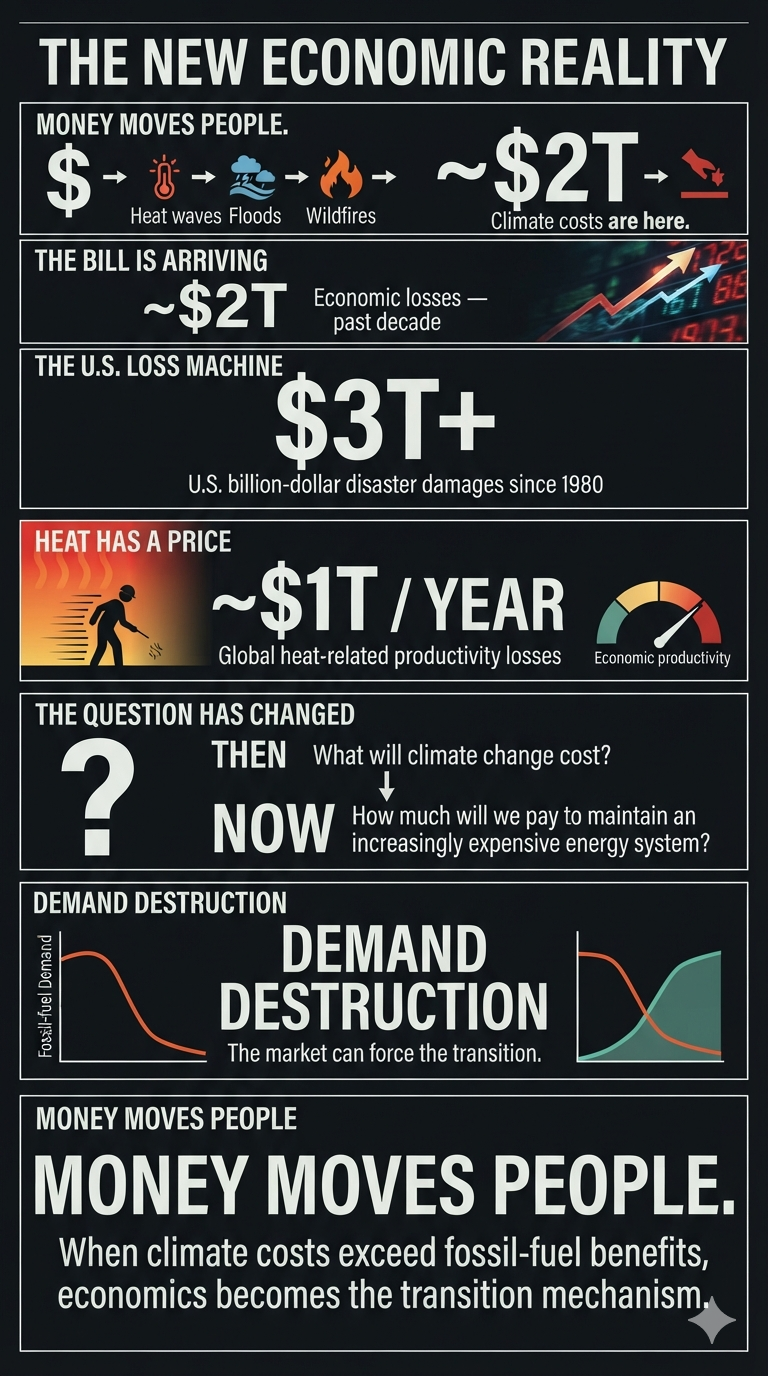
Infrastructure, agriculture, transportation, labor productivity, public health, energy systems, and financial markets are all beginning to absorb the cost of a destabilizing climate. The economic question is therefore changing. It is no longer simply:
“What will climate change cost us?”
It is increasingly:
“How much are we willing to pay to preserve an energy system that is becoming progressively more expensive to maintain?”
Climate Stress Is Becoming an Economic Stress Test
The physical infrastructure of the global economy is already being affected.
Maersk CEO Vincent Clerc has warned that climate change is putting increasing pressure on European waterways and that substantial infrastructure investment will be needed to keep the Rhine operating as a critical transportation artery.
But the economic importance of waterways extends far beyond shipping.
Rivers, lakes, and reservoirs are also critical components of the energy, industrial, agricultural, municipal, and ecological systems that support modern economies.
When water levels fall or water temperatures rise, power plants can be affected directly. Thermoelectric and nuclear power plants rely heavily on water for cooling. If river flows become too low, or water temperatures become too high, operators may be forced to reduce generation or temporarily shut down units because sufficient cooling capacity is no longer available or because thermal discharge limits are exceeded.
That creates an economic chain reaction:
Lower river flows or higher water temperatures ↓ Reduced cooling capacity ↓ Reduced power generation ↓ Tighter electricity supplies ↓ Higher electricity prices and grid stress ↓ Higher operating costs for industry and consumers
The same waterways that transport fuel, raw materials, agricultural products, chemicals, and manufactured goods can therefore also be essential to producing the electricity needed to move and manufacture those goods.
Water is simultaneously a transportation system, cooling system, industrial input, agricultural resource, and ecological asset.
When that system becomes unstable, multiple economic sectors can be affected at the same time.
Low water levels can also restrict the movement of coal, oil, natural gas, grain, chemicals, construction materials, and other bulk commodities. Barges may have to reduce their loads or make more trips to transport the same volume of goods. In some cases, alternative transportation by rail or truck becomes necessary, increasing fuel consumption, congestion, labor costs, and emissions.
Flooding creates the opposite problem.
Excess water can damage ports, locks, bridges, rail connections, roads, warehouses, industrial facilities, and electrical infrastructure. A waterway can therefore become economically disruptive at both extremes—too little water and too much water.
Agriculture is similarly exposed. Rivers and reservoirs provide irrigation, livestock water, and municipal supplies. Persistent drought can reduce agricultural output while increasing competition among farmers, cities, industry, ecosystems, and energy producers for increasingly scarce water.
There is also a less visible economic cost: water temperature itself is becoming an economic variable.
Warmer rivers can reduce their ability to absorb additional heat from industrial processes and power-plant cooling systems. At the same time, warmer water can stress aquatic ecosystems, fisheries, and drinking-water systems, creating additional regulatory, treatment, and ecological costs.
This produces a broader economic concept that is often missed in conventional disaster accounting:
Waterway disruption is not a single-sector problem. It is a systems problem.
The Rhine and Danube are not simply waterways. They are components of Europe’s economic infrastructure. They connect ports, factories, power plants, farms, cities, mines, warehouses, rail networks, and consumers. When climate conditions interfere with their operation, the economic consequences propagate through the system. A river does not have to disappear to create an economic crisis. It only has to become less reliable. And reliability is one of the most valuable—and often least visible—assets in a modern economy.
The Economic Toll of Extreme Weather
Global extreme weather and natural disasters are generating enormous economic losses. Recent estimates from the International Chamber of Commerce, insurers including Swiss Re, and disaster-loss tracking organizations show that severe convective storms, wildfires, floods, and other extreme events are producing annual losses measured in the hundreds of billions of dollars.
The first half of 2026 alone has already produced approximately $100 billion in global economic losses, while the cumulative economic toll over the past decade has reached roughly $2 trillion, according to recent assessments.
And the year is not over.
The second half of the year normally includes the peak of the North Atlantic hurricane season, creating the potential for another substantial wave of losses.
The Major Economic Drivers
Escalating annual losses. Global disaster losses continue to accumulate at extraordinary levels. The combined economic losses from 2022 and 2023 alone have been estimated at roughly $451 billion.
The concentration of U.S. losses. The United States remains a major source of global insured catastrophe losses. By June 2026, the country had already experienced 12 billion-dollar weather and climate disasters, with estimated losses totaling approximately $31.9 billion.
Severe convective storms. Hail, tornadoes, straight-line winds, and other severe thunderstorms have become an increasingly persistent source of financial losses. The United States recorded a record 21 billion-dollar severe-convective-storm events in 2025.
Extreme heat and productivity. The economic damage from climate change is not limited to destroyed buildings and infrastructure. Heat reduces worker productivity, particularly in construction, agriculture, manufacturing, and outdoor occupations. Global heat-related productivity losses have been estimated at roughly 1% of world GDP annually—around $1 trillion.
The long-term U.S. bill. U.S. billion-dollar weather and climate disasters have generated cumulative damages exceeding $3 trillion since systematic tracking began in 1980.
The Trajectory Is the Story
Recent U.S. disaster statistics illustrate the increasing economic burden:
Year
Billion-Dollar Events
Estimated Damage
Major Loss Drivers
2025
23
~$115 billion
Severe storms, wildfires
2024
27
~$182.7 billion
Severe storms, tropical cyclones, extreme heat
2023
28
$145+ billion
Severe storms and other extreme events
The important point is not that every individual disaster can be attributed exclusively to climate change.
The economic signal emerges from the frequency, intensity, persistence, and cumulative cost of extreme conditions.
Climate change does not need to create every storm, flood, drought, or wildfire to transform the economics of risk. It only needs to increase the probability, severity, or duration of damaging events enough to alter the cost structure of society.
That is already happening.
“Demand Destruction” Is Our Friend
This brings us to one of the most powerful—and least appreciated—economic mechanisms in the energy transition:
Demand destruction.
The International Energy Agency has projected that global oil demand will decline more sharply than previously expected in 2026, forecasting a reduction of approximately 1.6 million barrels per day.
The significance extends beyond the number itself.
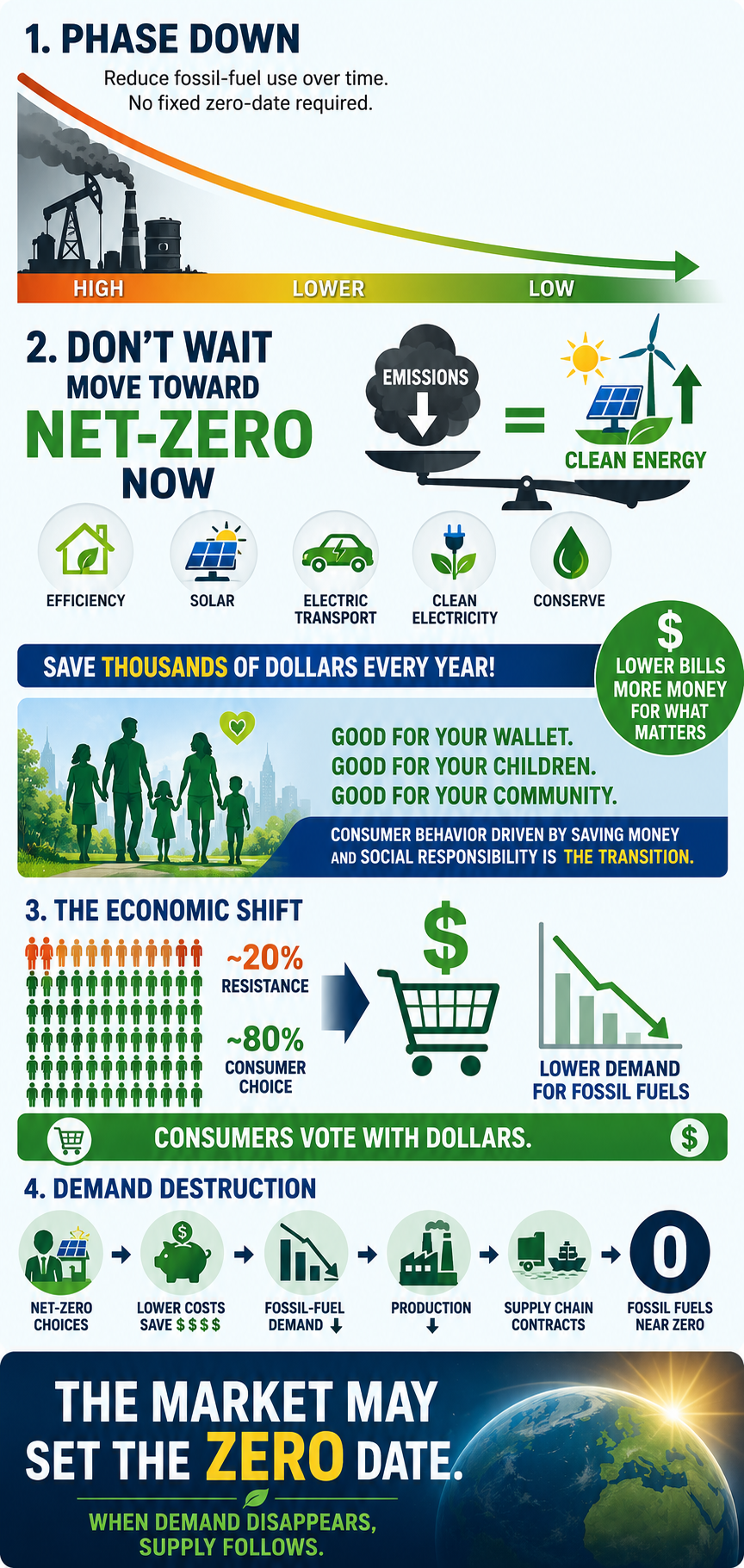
As an economist, I am less concerned with establishing a specific date by which the world must eliminate fossil fuels than I am with changing the economic forces that sustain fossil-fuel demand.
That distinction matters.
People do not necessarily change because someone wins an argument about climate science. They change because incentives change. Prices change. Risk changes. Availability changes. And eventually, behavior changes.
Money Moves People
I am unlikely to change the minds of the roughly 20% of Americans who are ideologically committed to policies that accelerate fossil-fuel dependence.
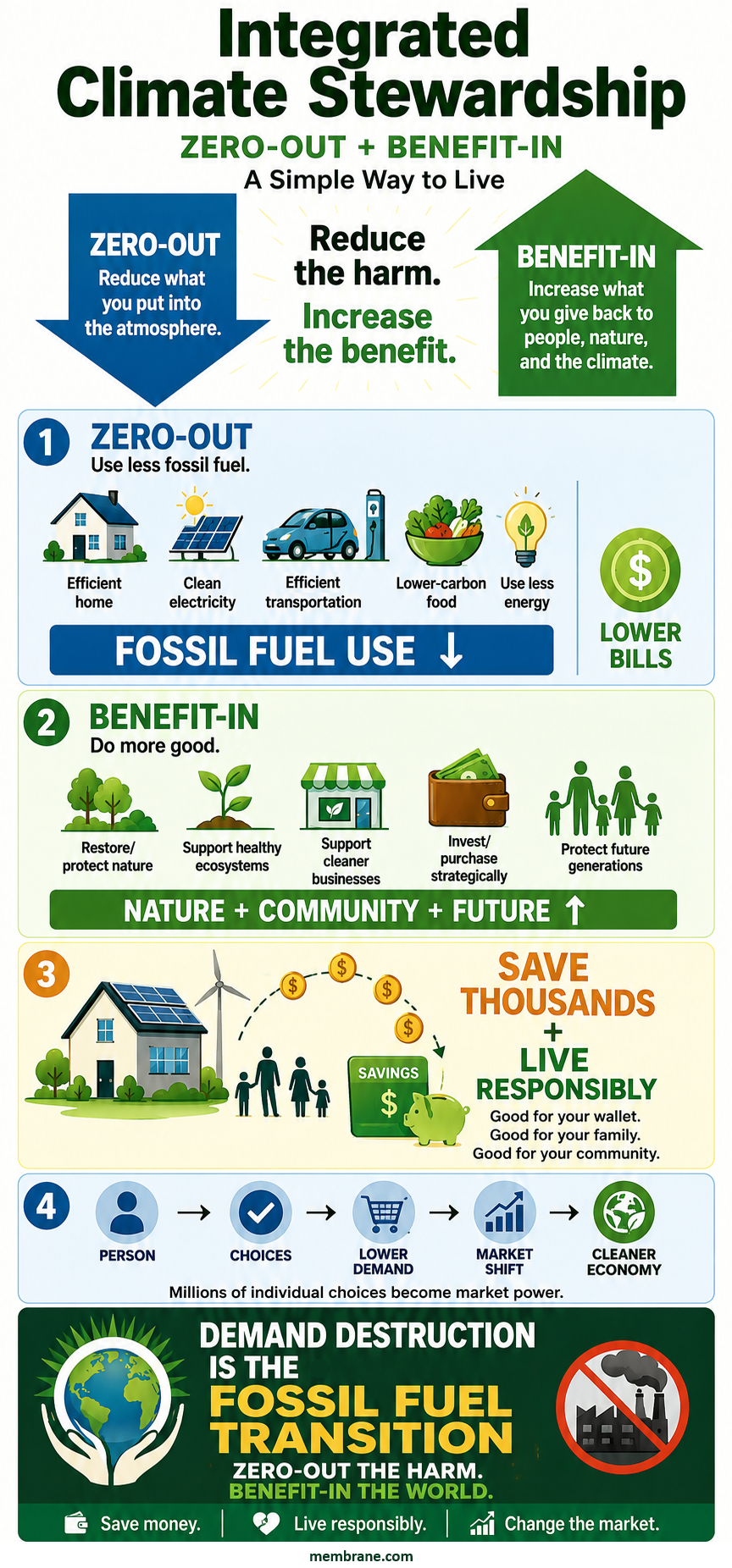
But that leaves the vast majority of the population. And economics can do much of the work. Integrated Climate Stewardship begins with reducing unnecessary consumption.
Consumerism drives energy demand, resource extraction, pollution, waste, and habitat destruction. Every unnecessary unit of consumption represents another demand for energy and materials somewhere in the global economy.
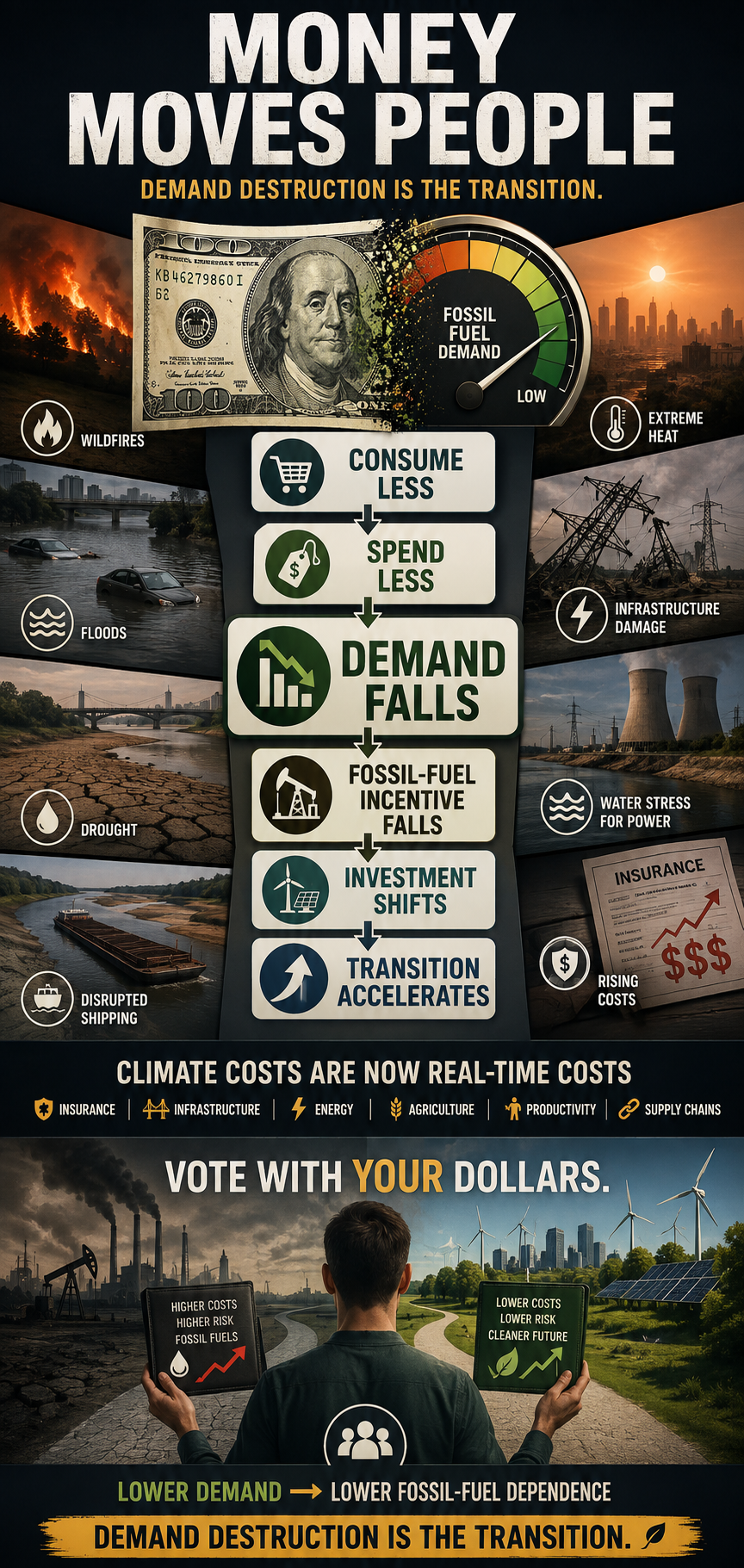
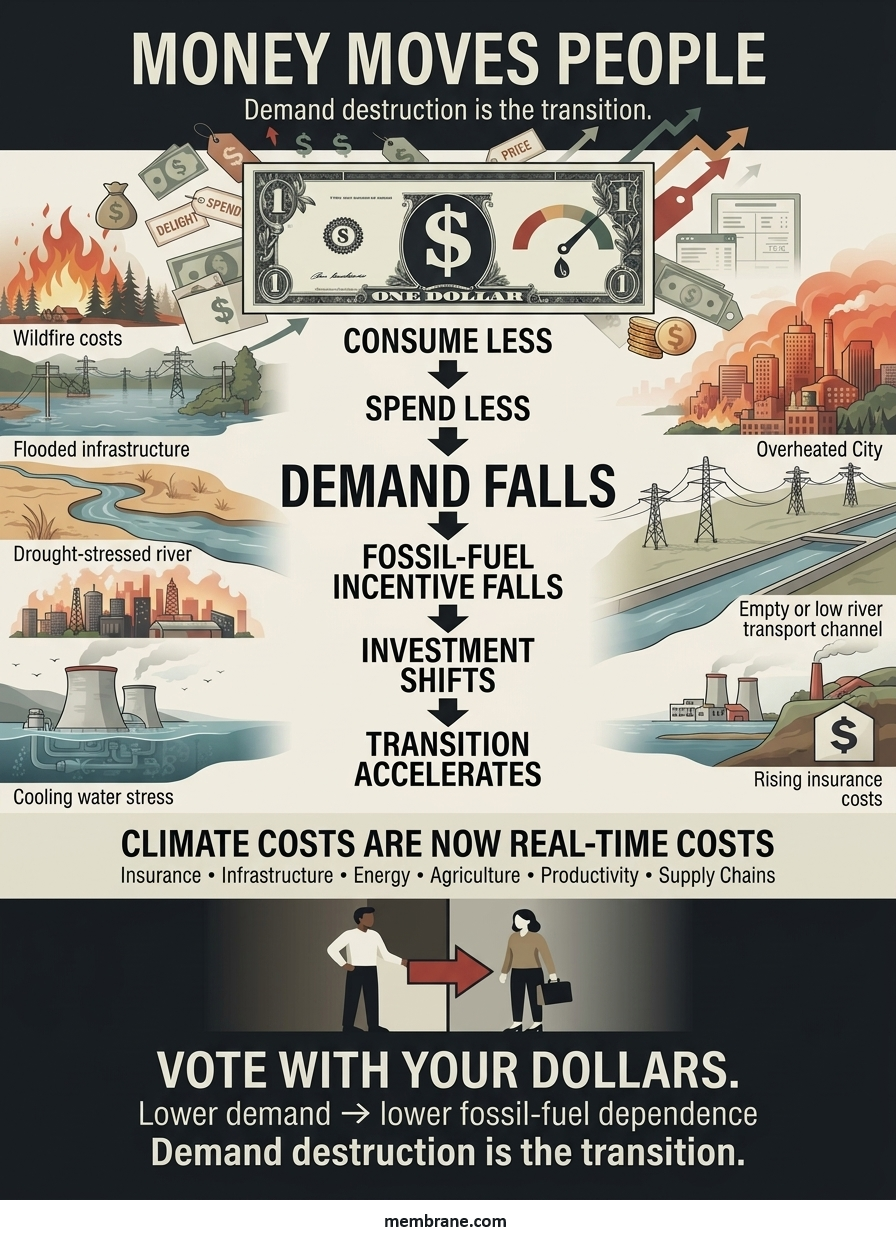
Consume less, and demand falls.
Demand falls, and the economic incentive to produce falls.
That is the mechanism.
The Economics of Personal Climate Stewardship
Today, only a small fraction of Americans appear to be pursuing a deliberately structured net-zero lifestyle through continuous behavioral reductions, efficiency improvements, and intentional balancing. But this does not mean the model cannot scale. The critical question is how climate stewardship is presented.
If reducing climate impact is framed exclusively as sacrifice, people resist. If it is framed as economic self-interest, the equation changes.
What happens when people discover that reducing unnecessary consumption can save them thousands of dollars a year?
What happens when energy efficiency lowers household expenses?
When smaller vehicles reduce fuel, maintenance, and insurance costs?
When reducing waste means buying fewer things that do not provide meaningful value?
When local production and durable goods become economically attractive?
When conservation becomes synonymous with financial resilience?
The behavior does not have to begin with ideology.
It can begin with a household budget.
Vote With Your Dollars
This is where the remaining majority of the population becomes economically important.
When millions of people begin making purchasing decisions based on cost, durability, efficiency, resilience, and environmental impact, they collectively alter demand.
When demand changes, markets respond. When fossil-fuel demand declines, the economic incentive to extract, refine, transport, and sell fossil fuels declines with it. This is fundamentally different from waiting for governments to impose every change from the top down. It is a bottom-up economic transition.
People do not have to agree about everything.
They do not have to become climate activists.
They do not even have to agree about climate policy.
They simply have to discover that some forms of consumption are no longer worth what they cost.
The Feedback Loop
The process can become self-reinforcing:
Lower unnecessary consumption ↓ Lower household costs ↓ Lower energy and resource demand ↓ Reduced fossil-fuel demand ↓ Lower economic incentive for fossil-fuel expansion ↓ Greater investment in alternatives and efficiency ↓ Further reductions in fossil-fuel demand
This is an economic feedback loop.
And unlike many climate-policy debates, it does not require everyone to agree on the destination before beginning the journey.
Demand Destruction Is the Transition
The transition away from fossil fuels is often described as a supply problem:
How quickly can we replace coal, oil, and natural gas?
But there is another side of the equation.
How quickly can we reduce the demand that makes fossil-fuel extraction profitable?
That may ultimately be the more powerful question.
We do not need to convince every person to become an environmentalist.
We need to make lower-carbon choices increasingly rational economic choices.
The climate crisis is already generating enormous costs. Insurance premiums are rising. Infrastructure is being stressed. Agricultural productivity is being disrupted. Heat is reducing labor capacity. Extreme weather is destroying capital. Supply chains are becoming more vulnerable.
These costs are not theoretical.
They are appearing on balance sheets, household budgets, insurance statements, government budgets, and corporate earnings reports.
The economic system is beginning to receive the bill.
And money moves people.
Demand destruction is not the enemy of the energy transition.
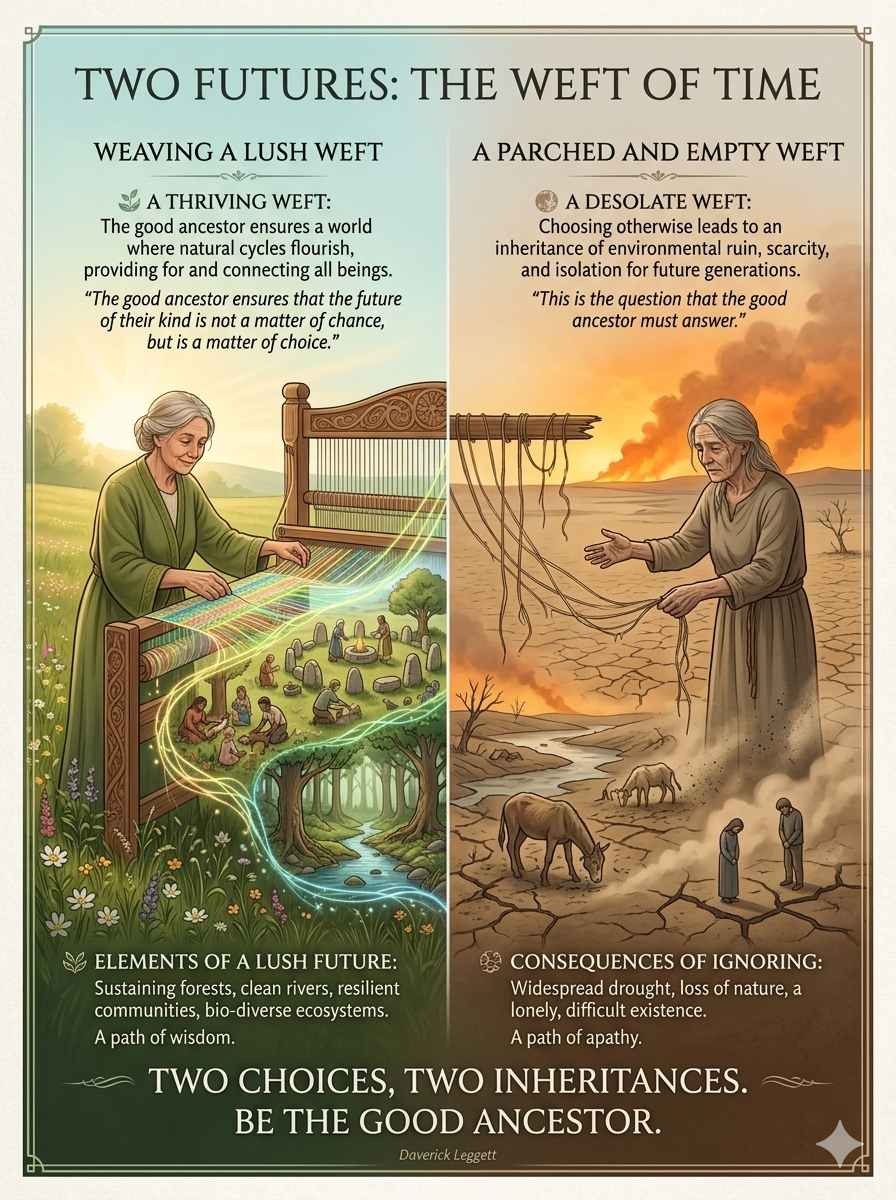
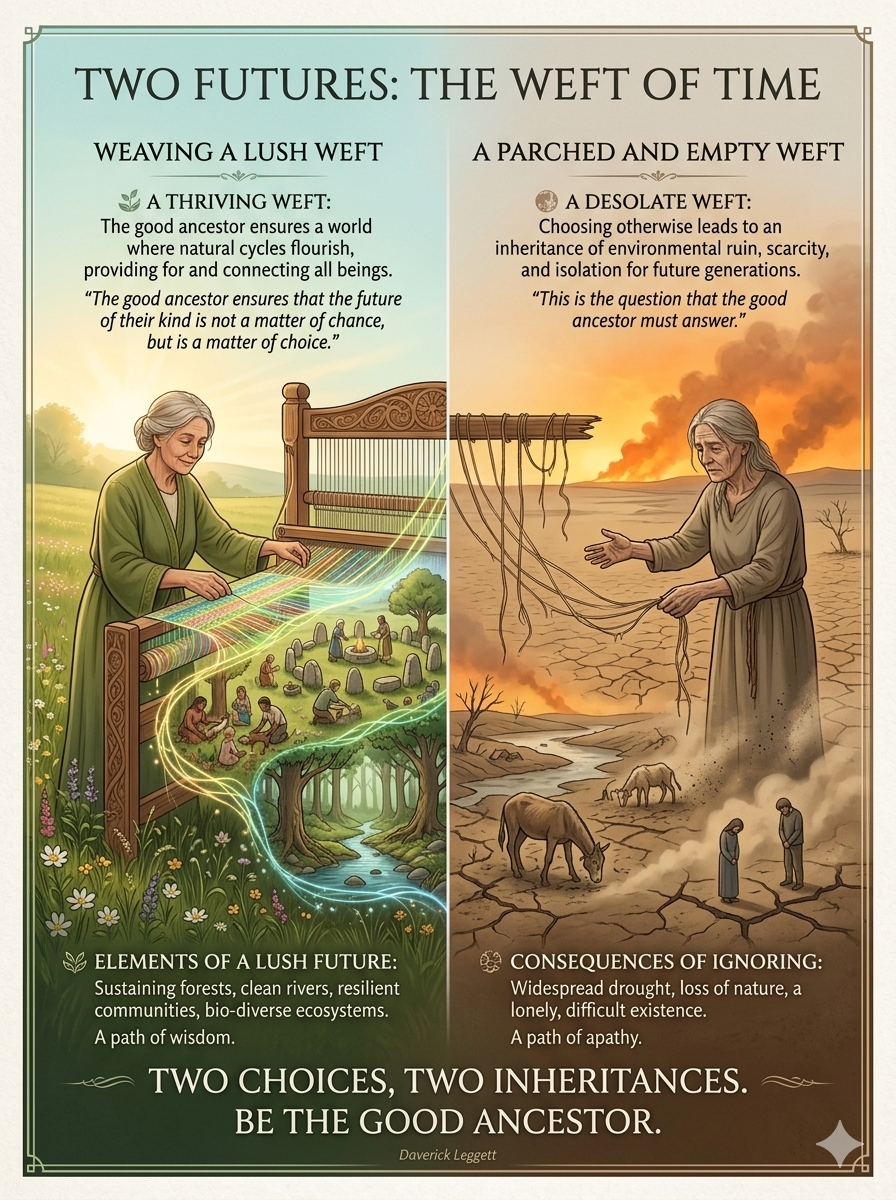
Every day I walk a hundred years to the hill where my great, great granddaughter sits. I carry words of blessing and reach to touch her back.
But feeling me near she turns, sad-eyed and heavy with grief.
“What was it like?” she asks, “when the great whales swam, when the birds sang you awake, when the rains came soft, and the soil smelled sweet underfoot?”
And the blessings catch in my throat.
On darker days she turns, her famished face charred, and eyes sunk in their bony orbits, burn with curses.
And the blessings froth at my mouth with the poisonous spume of betrayal.
On the darkest of all days I walk the hundred years and find no one there.
Let today be the bright day. Let today be the bright day I lay my hand upon her back.
And, feeling me near, she turns and blesses me, saying,
“Your love was fierce enough, sweet ancestor, your love was fierce enough.”
Roman Krznaric’s The Good Ancestor: How to Think Long Term in a Short-Term World begins with a deceptively simple question: How can we become good ancestors? His argument is fundamentally about time. Modern societies have become increasingly organized around immediate rewards, quarterly results, election cycles, daily news, and rapidly changing information. The climate system operates on radically different temporal scales. Carbon dioxide released today can influence atmospheric and oceanic processes for decades to centuries, while ice sheets, ocean circulation, ecosystems, and human infrastructure respond through interacting processes that unfold across multiple time horizons.
This temporal mismatch is one of the central problems in understanding climate change.
The climate problem is therefore not merely a problem of atmospheric physics. It is also a problem of human time perception. We make decisions within political, economic, and personal time horizons while the Earth system accumulates energy, reorganizes circulation, alters hydrological patterns, loses ice, and modifies ecological and social conditions over much longer periods.
Krznaric identifies six approaches to long-term thinking: deep-time humility, legacy mindset, intergenerational justice, cathedral thinking, holistic forecasting, and transcendent goal.
Applied to climate science, these six principles provide more than an ethical framework. They provide a conceptual architecture for understanding why conventional climate decision-making repeatedly underestimates systemic risk.
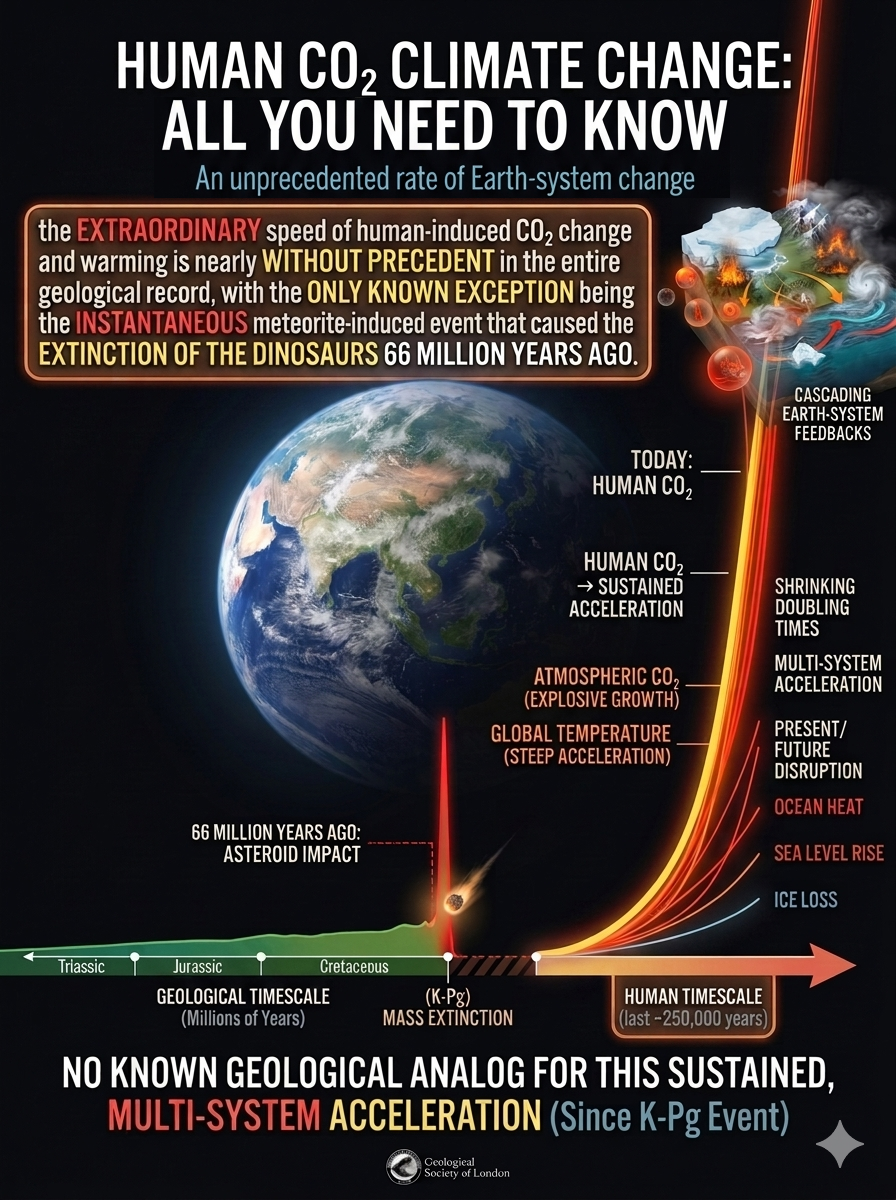
My climate work has focused on a related problem: climate change is not adequately described as a linear increase in average temperature followed by proportionally increasing impacts. The climate system is a coupled, nonlinear system in which accumulated energy can alter the conditions governing subsequent change. Ocean heat, atmospheric moisture, sea-level rise, ice loss, circulation changes, extreme heat, ecological degradation, and socioeconomic disruption interact across different timescales.
The result is a fundamental challenge to short-term thinking.
We are attempting to manage a long-duration, nonlinear Earth-system transition with institutions designed to optimize the present.
Krznaric’s Good Ancestor framework provides a powerful way to confront that contradiction.
1. Deep-Time Humility: Recognizing the Scale of the System
Krznaric’s first principle is deep-time humility: understanding humanity’s extraordinarily small position within the history of Earth and the cosmos. His argument is that recognizing our temporal insignificance can expand rather than diminish our sense of responsibility.
Climate science makes this principle especially important.
Human political systems commonly operate within horizons of months, years, or decades. Climate processes operate simultaneously across days, years, decades, centuries, and longer. An extreme heat event can develop within hours. Ocean heat accumulation occurs over years and decades. Ice-sheet responses can extend over centuries. Carbon-cycle consequences can persist much longer.
These are not competing descriptions of the same phenomenon. They are different temporal layers of one coupled system.
That distinction matters because a climate system can appear relatively stable when observed over one interval while undergoing substantial structural change over another.
A single year’s temperature anomaly tells us something important about the state of the system. But it does not necessarily reveal the direction of the system’s underlying dynamics.
This is why rates of change and changes in rates of change matter.
A climate variable that is increasing linearly presents one kind of risk. A variable whose rate of increase is itself changing presents another. If the acceleration persists, projections based solely on historical averages can systematically underestimate the future trajectory.
The same principle applies to sea-level rise, ocean heat, extreme heat, ice loss, and other indicators. The important question is not simply:
How much has the climate changed?
It is also:
How rapidly is the rate of change itself changing?
This perspective is consistent with the central premise of a nonlinear climate framework: the Earth system must be evaluated not merely by its current state, but by its trajectory, acceleration, feedback structure, and proximity to thresholds.
Deep-time humility therefore changes the unit of analysis.
We stop asking only what climate conditions will look like at the end of the next political cycle and begin asking what trajectory we are establishing for people living decades, centuries, and generations from now.
2. Legacy Mindset: The Climate We Leave Behind
Krznaric’s second principle is the legacy mindset: asking how future generations will remember what we did with the conditions inherited by our generation.
This is particularly powerful when applied to climate change because humanity is not merely experiencing a changing climate.
We are actively determining the initial conditions inherited by future generations.
Every generation receives an Earth system shaped by previous generations and then modifies it before passing it forward.
The critical question becomes:
What climate system are we leaving behind?
That question is larger than carbon emissions alone.
We are leaving future generations altered coastlines, changed hydrological regimes, warmer oceans, different ecosystems, stressed agricultural systems, modified atmospheric circulation, altered wildfire regimes, infrastructure designed for historical climate conditions, and potentially reduced resilience to compound extremes.
The legacy is therefore a system state, not simply an emissions total.
This distinction is important to a nonlinear framework. The consequences of present decisions are not necessarily proportional to the decisions themselves. A system approaching a threshold can respond very differently from one far from a threshold.
The legacy mindset consequently requires us to evaluate not merely the emissions we produce but the conditions under which future generations will have to operate.
That changes the moral question from:
How much climate damage can we tolerate?
to:
What state of the Earth system are we willing to hand to people who had no role in creating it?
That is a substantially different standard.
3. Intergenerational Justice: Future People Are Stakeholders
The third principle, intergenerational justice, asks us to recognize obligations to people who do not yet exist. Krznaric explicitly connects this concept to thinking about the seventh generation and the rights and interests of future people.
Climate change exposes a fundamental weakness in conventional economic and political accounting: the people who receive many of the costs may not be the people making the decisions that generate them.
A decision made today can produce benefits immediately while distributing costs across decades.
That creates a profound temporal asymmetry.
The beneficiaries are present.
The consequences may be inherited.
This becomes even more consequential when nonlinear processes are involved. A generation may consume the benefits of an activity while transferring to future generations a climate system with fewer degrees of freedom and less resilience.
This is the point at which climate science and climate ethics converge.
If the system is approaching thresholds, then delaying action does not simply preserve the same problem for later. It can change the problem itself.
The future may inherit not merely more warming, but a different set of system dynamics.
That distinction is central.
A linear interpretation imagines:
more emissions → proportionally more warming → proportionally more impacts.
A nonlinear systems interpretation recognizes the possibility of:
The precise behavior of each component must be established scientifically; not every proposed feedback or tipping interaction is equally certain. But the broader systems principle is robust: interacting components can produce outcomes that are not adequately represented by treating each component independently.
Intergenerational justice therefore demands more than reducing today’s visible damage.
It requires maintaining future adaptive capacity.
4. Cathedral Thinking: Building What We Will Never See Completed
Krznaric’s fourth principle is cathedral thinking: beginning projects whose completion or full benefits extend beyond an individual lifetime. He uses the cathedral as a metaphor for undertaking work whose builders understand that they may never see the finished structure.
This concept fits climate science almost perfectly.
Climate stabilization, ecosystem restoration, adaptation of infrastructure, long-term water management, coastal planning, soil restoration, forest management, energy transformation, and preservation of scientific observations all require decisions whose full consequences extend beyond ordinary political cycles.
But cathedral thinking must go beyond simply building large projects.
It requires building institutional continuity.
A climate strategy designed for four years is not a long-term climate strategy. Neither is one designed around a single election, market cycle, administration, or corporate planning horizon.
The climate system does not reset when political leadership changes.
A genuine cathedral approach would therefore establish institutions capable of maintaining long-term climate observation, infrastructure adaptation, ecosystem protection, scientific research, and risk management regardless of short-term political fluctuations.
This also changes the purpose of climate modeling.
A model should not merely tell us what conditions are likely at a particular future date. It should help identify path dependencies—decisions made today that constrain what future generations can realistically do.
That is especially important when dealing with tipping elements.
If Greenland ice loss, West Antarctic ice instability, permafrost degradation, Amazon ecosystem stress, ocean circulation changes, or other components approach thresholds, the relevant question is not simply whether a particular threshold will be crossed at a particular date.
The more important question is:
Are we constructing conditions that make future reversibility increasingly difficult?
Cathedral thinking therefore demands that we evaluate irreversibility and option value.
A decision that preserves future options has value even if its immediate economic return is difficult to quantify.
5. Holistic Forecasting: From Isolated Variables to a Coupled System
The fifth principle, holistic forecasting, may be the most directly compatible with a nonlinear climate framework.
Krznaric argues that long-term forecasting must consider multiple pathways for civilization rather than rely upon narrow forecasts of a single future.
Climate science requires precisely this kind of thinking.
The Earth system is not a collection of independent variables.
Atmospheric warming influences atmospheric moisture. Increased moisture changes latent heat transport and precipitation dynamics. Ocean warming alters marine heatwaves, circulation, and sea-level contributions. Ice loss modifies albedo and freshwater fluxes. Atmospheric and oceanic circulation redistribute energy. Ecosystem degradation changes carbon storage and surface energy exchange. Extreme events impose stress on infrastructure, agriculture, insurance systems, financial markets, and public health.
These processes can interact.
A useful conceptual chain is therefore not:
CO₂ → temperature → damage.
It is closer to:
forcing → energy accumulation → physical response → feedback → circulation and ecological response → extreme events → infrastructure and economic stress → societal response → additional environmental feedbacks.
This is where the concept of nonlinear acceleration becomes important.
The climate system may exhibit changes in the rate of change because feedbacks alter the system’s effective response over time.
A useful research framework therefore needs to monitor at least four dimensions:
State — where the system is.
Velocity — how rapidly it is changing.
Acceleration — whether that rate is changing.
Coupling — whether independent indicators are becoming dynamically connected.
The fourth dimension is particularly important.
A collection of extreme indicators becomes much more consequential when they cease behaving as isolated anomalies and begin interacting as components of a broader system transition.
This is why the emphasis on persistent nighttime heat, ocean heat accumulation, sea-level acceleration, hydrological disruption, and tipping-system interactions is important.
The question is no longer simply whether one record has been broken.
It is:
Are multiple components of the climate system changing simultaneously in ways that reinforce one another?
That is a holistic forecasting question.
6. Transcendent Goal: From Climate Management to System Preservation
Krznaric’s sixth principle is the transcendent goal—a purpose larger than short-term institutional interests. His formulation points toward the goal of creating conditions in which humanity and the living world can thrive over the long term.
Climate policy frequently becomes trapped in narrower objectives:
reducing emissions by a certain percentage;
achieving a particular temperature target;
meeting a regulatory deadline;
protecting a particular industry;
minimizing near-term costs.
These objectives are useful, but they can become inadequate when treated as the ultimate goal.
The deeper objective should be preserving a functioning Earth system capable of supporting human civilization and ecological complexity across generations.
That means climate policy should ultimately be judged by resilience rather than by any single metric.
The goal is not merely to minimize today’s inconvenience.
It is to preserve the capacity of future generations to choose their own future.
That is a transcendent objective because it places human civilization within the larger Earth system rather than treating the environment as an externality.
The Six Principles as a Climate Research Architecture
Krznaric’s six principles can therefore be transformed from philosophical concepts into an analytical framework for climate research:
Krznaric principle
Climate application
Deep-Time Humility
Analyze climate trajectories across decades, centuries, and longer system timescales
Legacy Mindset
Measure the Earth-system conditions inherited by future generations
Intergenerational Justice
Treat future adaptive capacity as an ethical and analytical constraint
Cathedral Thinking
Design climate institutions, infrastructure, and restoration projects beyond political cycles
Holistic Forecasting
Model coupled physical, ecological, economic, and social pathways rather than isolated variables
Transcendent Goal
Preserve a resilient Earth system and the long-term capacity of civilization to thrive
Together, these principles produce something more powerful than a philosophical appeal to “think long term.”
They provide a temporal systems framework.
From Climate Change to Climate Regime Change
This framework also helps explain why the distinction between climate change and climate regime change matters.
Climate change can be understood as a shift in the statistical characteristics of the climate system.
Climate regime change goes further.
It asks whether the underlying relationships among components of the system are themselves changing.
A regime transition could manifest as persistent changes in extreme heat, nighttime temperatures, precipitation behavior, ocean heat, sea-level rise, circulation patterns, ecological responses, or the frequency and persistence of compound extremes.
The importance of persistent nighttime heat illustrates this distinction.
A daytime temperature record is an extreme event.
Persistent elevation of nighttime temperatures is different because the nighttime period normally provides an opportunity for ecosystems, infrastructure, agriculture, and human bodies to dissipate accumulated heat.
When nighttime cooling is progressively compressed, heat accumulates across successive days.
The system is no longer simply producing isolated extremes.
The baseline itself is moving.
This is precisely where the Good Ancestor framework becomes useful.
A short-term observer asks:
Was today unusually hot?
A long-term systems observer asks:
Has the system entered a state in which unusually hot conditions are becoming persistent, self-reinforcing, and structurally normal?
Those are fundamentally different questions.
The Climate Problem as a Failure of Temporal Governance
Krznaric describes modern society as being dominated by what he calls the “tyranny of the now”: the tendency to privilege immediate concerns over long-term consequences.
Climate change exposes this problem with unusual clarity.
Political systems are optimized around elections.
Businesses are often optimized around quarterly or annual performance.
Financial systems discount future returns.
News systems reward immediacy.
Social media rewards attention measured in seconds.
The climate system does not operate according to any of these clocks.
This produces a structural mismatch:
Human institutions optimize for the present while the Earth system integrates the past and determines the future.
That mismatch is one reason climate risks can repeatedly be underestimated.
A society may respond to an extreme event after it occurs while failing to recognize that the event is part of a changing distribution.
It may repair infrastructure to the historical climate standard even while the climate distribution is shifting.
It may calculate the immediate cost of mitigation while ignoring the potentially much larger cost of reduced future resilience.
And it may treat each extreme as an independent disaster rather than examining whether multiple extremes are manifestations of a common systemic transition.
Good Ancestor thinking challenges this institutional short-termism directly.
Toward a Good Ancestor Climate Index
The philosophical framework suggests a possible extension of climate-risk measurement.
Instead of evaluating climate policy solely through emissions, temperature, or economic cost, a Good Ancestor Climate framework could ask whether present decisions increase or decrease the resilience inherited by future generations.
Such an assessment could consider:
Physical trajectory: Are major climate indicators accelerating, stabilizing, or decelerating?
Feedback exposure: Are positive feedbacks becoming stronger or more interconnected?
Threshold proximity: Are critical Earth-system components moving toward states where reversibility becomes increasingly difficult?
Persistence: Are extreme conditions becoming more persistent rather than merely more intense?
System coupling: Are climate, ecological, infrastructure, economic, and social stresses becoming increasingly interconnected?
Adaptive capacity: Are we expanding or consuming the ability of future generations to respond?
Intergenerational burden: Are present benefits being purchased by transferring disproportionate costs into the future?
This would shift climate assessment from a narrow accounting of emissions toward a broader accounting of system inheritance.
The central metric becomes:
What are we leaving behind?
The Good Ancestor Test
Krznaric’s philosophy ultimately suggests a remarkably simple test for climate decisions.
Before making a decision, ask:
Would the people living with its consequences a century from now regard us as responsible ancestors?
That question can be applied to virtually every major climate decision.
Would future generations regard us as good ancestors if we knew that climate indicators were accelerating and chose to treat them as static?
Would they regard us as good ancestors if we knew that physical systems were becoming increasingly coupled but continued to govern them separately?
Would they regard us as good ancestors if we optimized infrastructure for a climate that no longer exists?
Would they regard us as good ancestors if we transferred enormous adaptation costs to people who had no voice in the decisions that created them?
And perhaps most importantly:
Would they regard us as good ancestors if we possessed evidence of an approaching systemic transition but refused to think beyond the next election, fiscal year, or news cycle?
These questions transform climate change from an abstract environmental problem into a question of historical responsibility.
Conclusion
Roman Krznaric’s The Good Ancestor provides an ethical and philosophical framework for confronting one of the greatest weaknesses in modern climate governance: our inability to think on the same temporal scale as the system we are changing.
His six principles—deep-time humility, legacy mindset, intergenerational justice, cathedral thinking, holistic forecasting, and transcendent goal—can be mapped directly onto the requirements of nonlinear climate analysis.
Deep-time humility expands the temporal horizon.
Legacy mindset forces us to consider the Earth system we leave behind.
Intergenerational justice recognizes future people as legitimate stakeholders.
Cathedral thinking requires projects and institutions that outlast their creators.
Holistic forecasting demands that climate risks be evaluated as coupled systems rather than isolated variables.
And the transcendent goal establishes a purpose larger than immediate economic or political interests: maintaining a resilient Earth system capable of sustaining future generations.
This perspective reinforces a central proposition of nonlinear climate research:
The most important climate signal may not be the magnitude of change at a particular moment, but the changing dynamics of the system itself.
If rates of change increase, if feedbacks strengthen, if extremes become persistent, if previously separate components become coupled, and if thresholds become increasingly consequential, then the climate problem is no longer adequately described as a gradual environmental trend.
It becomes a system transition.
And once the problem is understood as a system transition, the moral question becomes unavoidable.
We are not merely deciding what kind of climate we will experience.
We are deciding what kind of Earth system we will hand to those who come after us.
That is the essence of the Good Ancestor principle.
The test of our generation will not ultimately be whether we correctly predicted every detail of the future.
It will be whether, having recognized the direction and dynamics of the system, we acted as though future generations mattered.
In that sense, becoming a good ancestor is not an exercise in nostalgia or moral sentiment.
It is a demand for better temporal mathematics, better systems thinking, better governance, and better stewardship.
The future is not simply something that happens to us.
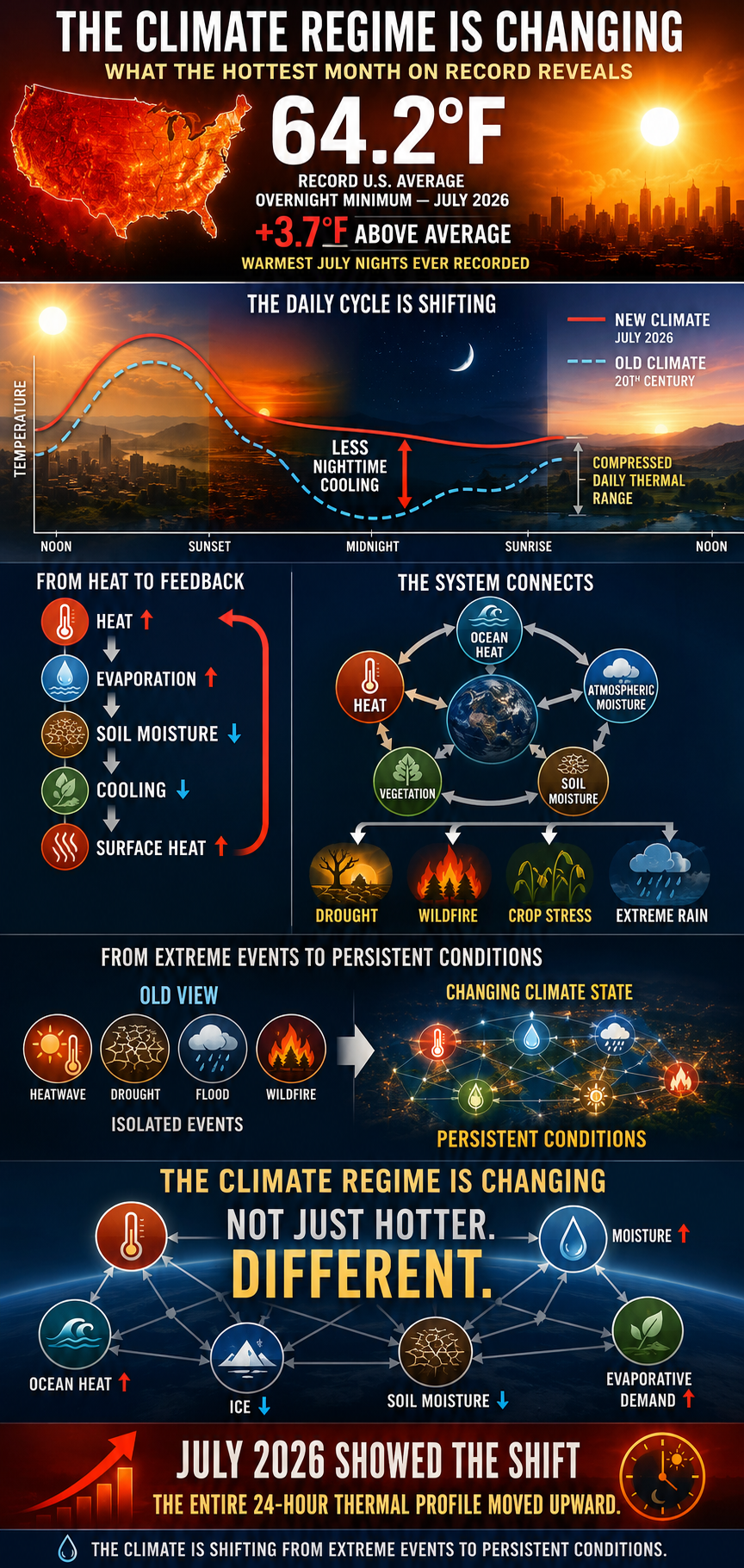
July 2026 was the hottest month ever recorded for the contiguous United States—but the most revealing record wasn’t the daytime heat.
It was the heat that didn’t go away at night.
The average overnight minimum reached 64.2°F—3.7°F above average, setting a new U.S. record for the warmest average July minimum temperature.
That matters because nighttime cooling is part of the climate system’s ability to shed accumulated heat.
When nights stay warmer:
🌡️ The daily temperature range compresses. 💧 Evaporative demand increases. 🌱 Soil moisture declines faster. 🔥 Surface heating intensifies. 🌾 Vegetation and crops face greater stress. 🌧️ Atmospheric moisture interacts with a warmer atmosphere to alter precipitation extremes.
These aren’t isolated changes. They interact.
Heat + drought + soil moisture loss + wildfire + extreme precipitation are components of the same changing climate system.
July 2026 provides a striking example: the entire 24-hour temperature profile shifted upward.
The Climate Regime Is Changing: July 2026 and the Transformation of the 24-Hour Earth System
July 2026 was the hottest month ever recorded for the contiguous United States since national records began in 1895. The daytime heat was extraordinary, but the defining feature of the record was the heat that remained after sunset. The average overnight minimum temperature reached 64.2°F—3.7°F above average. That established the warmest average minimum temperature ever recorded for the contiguous United States, surpassing the previous record, set in July 2022, by 0.7°F.
This is more than another temperature record. It is a measurable change in how the climate system operates. A record daytime temperature shows that the surface became exceptionally hot. A record nighttime temperature demonstrates that the system retained an exceptional amount of that heat through the entire overnight period. The distinction is fundamental. Climate change is not simply producing more extreme temperatures within an otherwise familiar climate. It is changing the background conditions that govern the atmosphere, oceans, land surface, hydrological cycle, ecosystems, agriculture, infrastructure, and human health.
July 2026 therefore provides direct observational evidence of a changing thermal regime. The important signal is not simply how high temperatures reached during the afternoon. It is how little the system cooled before the next day began.
Nighttime temperatures reveal accumulated heat
Nighttime minimum temperatures provide a direct window into the thermal behavior of the surface-atmosphere system. After sunset, the land surface normally loses energy through infrared radiation, and the air near the surface cools. This daily cycle of heating and cooling is fundamental to Earth’s climate and to the biological and physical systems operating within it.
Daytime temperatures respond strongly to solar radiation, wind, soil moisture, cloud cover, and atmospheric circulation. Nighttime temperatures respond to these factors as well, but they also reveal how effectively the surface-atmosphere system releases accumulated heat. Greenhouse gases and water vapor absorb and re-emit infrared radiation, reducing the efficiency of radiative cooling. Atmospheric moisture, clouds, wind, soil conditions, and circulation further influence the amount of heat that remains near the surface overnight.
July 2026 demonstrates this change clearly. The United States did not simply experience exceptionally hot afternoons. It experienced exceptionally warm mornings. The average minimum temperature was 3.7°F above normal, producing a larger anomaly than the daytime temperature anomaly and establishing a national record.
The most important number in understanding the character of this event is therefore 64.2°F, not simply the daytime maximum.
That minimum temperature records the condition of the system after an entire day of heating and an entire night of attempted cooling. The system remained unusually warm at the point when it historically would have reached its daily minimum. That is a direct indication that the thermal baseline has shifted.
The daily thermal cycle is being compressed
Rising nighttime temperatures are changing the daily temperature cycle itself. A hot afternoon historically transitioned into a cooler night, allowing people, plants, animals, soils, buildings, and infrastructure to release accumulated heat. As nighttime temperatures rise, that recovery period becomes shorter and less effective.
The system increasingly moves from daytime heating into incomplete nighttime cooling and then immediately into another daytime heating cycle. The following morning begins with more residual heat. The next afternoon adds additional energy. The following night begins from an even warmer condition.
This creates persistence.
Weather variability can interrupt this process through clouds, precipitation, wind, or the arrival of cooler air. But a warmer climate baseline increases the probability of warm nights and reduces the frequency and duration of substantial overnight cooling.
The result is a compression of the daily thermal range. The upper temperature limit rises, but the lower temperature limit rises as well. The entire temperature distribution shifts upward.
Climate change therefore does not simply increase the height of the temperature peaks.
It raises the floor beneath them.
The climate system stores and transfers energy
The Earth system has enormous thermal memory. The atmosphere, oceans, land, soils, vegetation, ice, and built environment absorb, store, transport, and release energy continuously. The oceans dominate this energy storage because their heat capacity allows them to absorb and redistribute enormous quantities of energy.
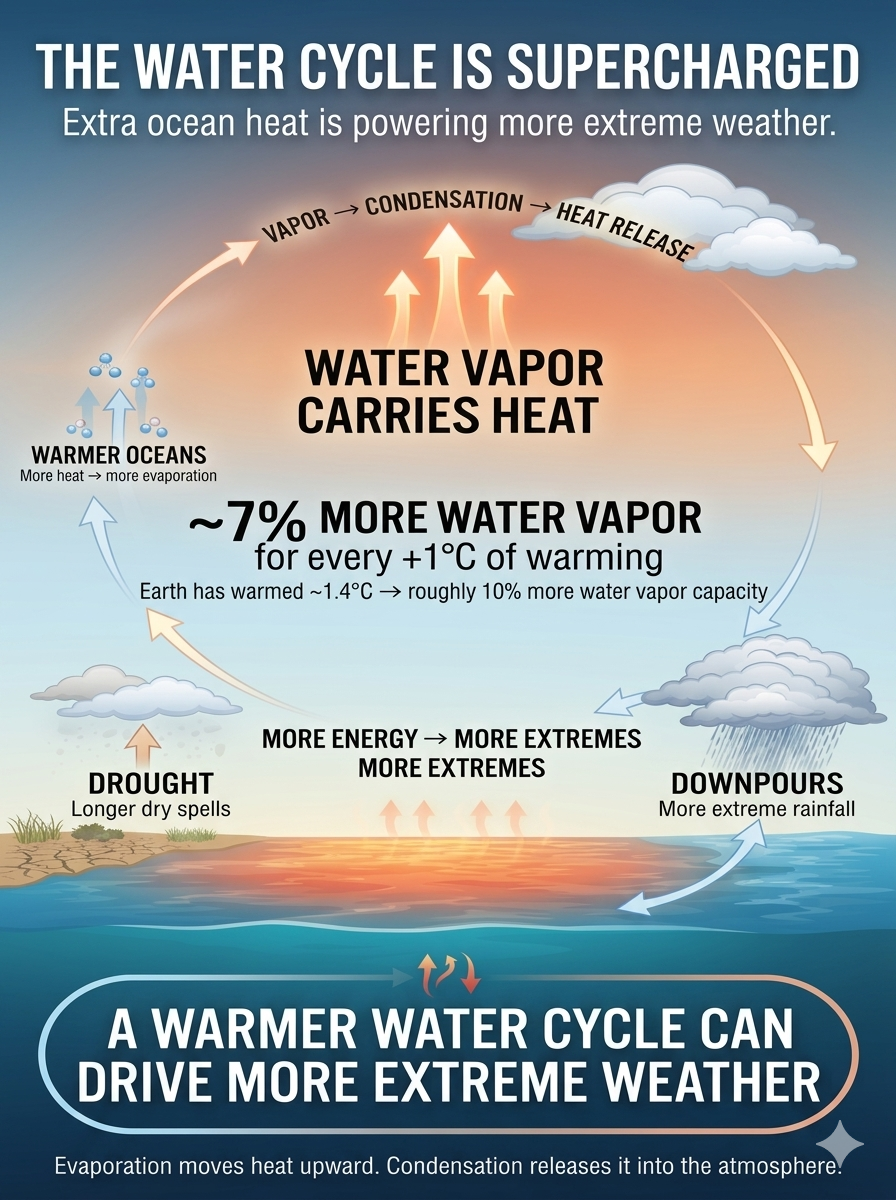
The atmosphere is changing at the same time. A warmer atmosphere can contain more water vapor, and water vapor is a greenhouse gas that absorbs and re-emits infrared radiation. Increased atmospheric moisture also changes cloud formation, precipitation, atmospheric instability, and the movement of latent heat.
The land surface stores heat as well. Urban areas, pavement, buildings, and other infrastructure remain warm after sunset. Soil moisture determines how much incoming energy is converted into evaporation versus sensible heat. When soils dry, evaporative cooling declines and a larger share of available energy remains as heat near the surface.
Temperature therefore reflects more than the conditions at a single moment. It reflects the accumulated state of a system that is continually absorbing, transporting, storing, and releasing energy.
Rising nighttime temperatures demonstrate that more of that energy remains within the coupled surface-atmosphere system through the overnight period.
The system begins the next day carrying more heat.
A warmer baseline changes the meaning of extreme
Climate extremes are defined relative to a baseline. When the baseline moves, the statistical meaning of an extreme changes with it.
A temperature that once occurred only during an exceptional event becomes more common when the entire distribution shifts upward. A nighttime temperature that once provided relief can become a source of physiological stress. A daytime temperature that once represented a rare heatwave can become increasingly probable.
This changes the character of heat itself.
A hot day followed by a cool night is fundamentally different from a hot day followed by another hot night. In the first case, the system experiences heating followed by recovery. In the second, heating is followed by incomplete recovery.
The difference accumulates over time.
For humans, elevated nighttime temperatures interfere with physiological recovery and sleep. For agriculture, warm nights increase plant respiration and reduce recovery from daytime heat. For buildings and infrastructure, warm nights reduce the opportunity to dissipate stored heat. For electrical systems, elevated nighttime temperatures prolong air-conditioning demand.
The impact of heat therefore depends not only on the maximum temperature reached but also on the amount of time the system remains thermally stressed.
The hydrological cycle is part of the transformation
Temperature is inseparable from the movement of water through the climate system. Warmer air can hold more water vapor. Increased atmospheric moisture changes evaporation, cloud formation, precipitation, and the transfer of latent heat.
Evaporation moves energy from the surface into the atmosphere. Condensation releases that energy back into the atmosphere. This continuous transfer of energy connects surface temperature with atmospheric moisture and precipitation.
Changes in soil moisture add another layer. When soils contain water, evaporation provides cooling. When soils dry, evaporative cooling declines. More incoming solar energy then remains available to heat the surface.
The resulting heat can intensify drought, increase wildfire conditions, stress crops, reduce ecosystem resilience, and increase water demand.
The nighttime temperature record is therefore not an isolated atmospheric statistic. It is one visible component of a larger reorganization of energy and water within the Earth system.
Heat and soil moisture create interacting feedbacks
The relationship between heat and soil moisture demonstrates why climate change cannot be evaluated through individual variables in isolation.
A warm atmosphere increases the demand for water from soils and vegetation. Persistent heat accelerates evaporation and plant water use. As available moisture declines, evaporative cooling weakens. Surface temperatures then rise more efficiently.
The consequences propagate through the system.
Agriculture experiences increased water stress. Vegetation becomes more vulnerable to heat and drought. Dry landscapes become more susceptible to wildfire. Reduced vegetation and soil moisture alter the surface energy balance. Water supplies face greater demand at the same time that replenishment becomes less reliable in some regions.
These interactions create conditions in which the effects of warming reinforce one another.
The temperature record is therefore not the entire story. It is a measurement of one component within a network of coupled physical processes.
The transformation extends into infrastructure
The same thermal changes affect the built environment.
Buildings, roads, pavement, bridges, electrical equipment, and other infrastructure absorb heat during the day and normally release some of that energy overnight. When nighttime temperatures remain elevated, the cooling period becomes less effective.
Buildings begin the next day warmer. Air-conditioning systems operate longer. Electricity demand remains elevated for more hours. Equipment experiences prolonged thermal loading. Infrastructure designed around historical temperature ranges increasingly encounters conditions outside those assumptions.
The energy system is particularly sensitive to this change. A conventional heat event produces high afternoon demand followed by overnight relief. Persistent nighttime heat converts that pattern into sustained demand.
The difference is important because infrastructure responds not only to peak intensity but also to duration.
A system can withstand a short peak that becomes difficult to manage when the same stress persists for days.
From extreme events to persistent conditions
This is the central distinction between a changing climate and a collection of isolated weather records.
A heatwave occurs within a climate state. A drought occurs within a climate state. A flood occurs within a climate state. A wildfire occurs within a climate state.
When the climate state changes, the conditions surrounding every one of those events change.
Heat occurs over warmer oceans and a warmer atmosphere. Drought occurs under greater evaporative demand. Heavy precipitation occurs in an atmosphere capable of carrying more moisture. Wildfire occurs on landscapes increasingly exposed to heat and dryness. Extreme heat increasingly follows nights that provide less cooling.
The background condition becomes part of the event.
This transforms the risk profile.
A heatwave is no longer simply a period of unusually high daytime temperatures. It becomes a period of sustained thermal loading involving daytime heat, nighttime heat, humidity, soil moisture, water availability, electricity demand, human physiology, and ecological stress.
The system becomes more interconnected because the stresses occur simultaneously.
This is a change in climate regime
The term “climate regime” describes the statistical and physical conditions in which weather occurs. A regime changes when the underlying distribution and relationships among climate variables change sufficiently to alter system behavior.
That process is occurring now.
The baseline temperature is rising. Atmospheric moisture is increasing. Ocean heat is increasing. Ice is declining. Soil moisture is changing. Evaporative demand is increasing. Extreme precipitation is intensifying in many regions. Heat extremes are becoming more frequent and persistent.
These changes interact.
The result is not simply a warmer version of the old climate.
It is a climate system operating under different boundary conditions.
July 2026 provides a clear example because the change appears simultaneously at the top and bottom of the daily temperature cycle. The United States experienced record daytime heat and record nighttime warmth. The entire 24-hour thermal profile shifted upward.
That is the signature of a changing regime.
The rate of change is historically significant
Human civilization developed within a comparatively stable climate. Agriculture, cities, infrastructure, water systems, economies, and food networks evolved around climatic conditions that remained within relatively narrow ranges over the period in which civilization expanded.
Human activities are now changing the atmospheric composition and energy balance of the planet on a timescale measured in decades and centuries. Multiple Earth-system components are responding simultaneously.
The result is a rapid departure from the climatic conditions within which modern civilization developed.
The danger comes not only from the absolute temperature reached but from the rate at which the baseline is moving and the speed with which interconnected systems must adapt.
The climate is shifting from events to conditions
The most important conceptual change is the transition from thinking about climate change as a series of extreme events to understanding it as a transformation of persistent background conditions.
A heatwave does not occur independently of ocean temperature, atmospheric moisture, soil moisture, vegetation, and nighttime cooling. A drought does not occur independently of temperature and evaporative demand. A wildfire does not occur independently of heat, dryness, vegetation stress, and wind. A flood does not occur independently of atmospheric moisture and precipitation intensity.
The climate system connects them.
As the baseline changes, the relationships among these variables change as well.
This produces compound risks in which several stressors occur simultaneously. High temperatures combine with warm nights. Heat combines with drought. Drought combines with wildfire. Atmospheric moisture combines with extreme precipitation. Ocean heat combines with atmospheric instability.
The risk emerges from the interaction.
July 2026 demonstrates the transformation
July 2026 should therefore not be remembered simply as the month when the United States broke another temperature record.
It should be remembered as a month that demonstrated a change in the structure of the climate system itself.
The record was present in the daytime heat, but it was equally present in the nighttime minimum. The system heated more intensely and cooled less effectively. The thermal range compressed. The next day began from a warmer baseline.
That change affects everything connected to the temperature cycle: human health, sleep, agriculture, ecosystems, soil moisture, wildfire conditions, water demand, buildings, infrastructure, and electricity consumption.
The significance extends beyond July.
A climate system that retains more heat overnight operates differently from one that releases that heat efficiently. A climate system with warmer oceans, more atmospheric moisture, altered soil moisture, declining ice, and elevated temperatures operates differently from the system that existed when modern civilization developed.
The evidence is accumulating across multiple variables and multiple physical systems.
The fundamental change is therefore not simply that temperature records are being broken.
The baseline itself is moving.
The climate is becoming warmer throughout the 24-hour cycle. The atmosphere is carrying more energy and moisture. The land is experiencing changing water availability and evaporative demand. The oceans are storing more heat. Ecosystems and human systems are operating under increasingly different thermal conditions.
July 2026 makes that transformation visible in one of the simplest measurements possible: the temperature before sunrise. The record minimum temperature demonstrates that the climate system no longer resets to the same thermal state each night.
The heat carries forward. That is the deeper significance of the July 2026 record. We are not simply experiencing more extreme weather within the old climate regime.
We are changing the regime itself.
And the most important evidence of that transformation is not only found in how high the temperature rises.
July 2026 was officially the hottest month ever recorded for the contiguous United States since national records began in 1895. According to the National Oceanic and Atmospheric Administration (NOAA), the average temperature across the Lower 48 reached 76.9°F—about 3.3°F above the 20th-century average and roughly 0.1–0.2°F warmer than the previous July records set during the Dust Bowl era in 1936 and the exceptional heat of 2012.
But the most important part of this record may not have been the daytime heat.
It was the heat that refused to leave at night.
The nighttime record is the real warning signal
July’s average daytime maximum temperature was 89.5°F, which was 2.9°F above average and ranked as the sixth-warmest month on record for average high temperatures.
The average overnight minimum temperature, however, reached 64.2°F—an extraordinary 3.7°F above average. That was the warmest average minimum temperature ever recorded for the contiguous United States, surpassing the previous record, set in July 2022, by 0.7°F.
That distinction matters.
A hot afternoon is dangerous, but a hot afternoon followed by a substantial nighttime cooldown gives the human body, vegetation, soils, buildings, infrastructure, and electrical systems an opportunity to recover.
When nighttime temperatures remain elevated, that recovery period disappears.
July 2026 therefore represents more than another record for daytime heat. It demonstrates an increasingly important characteristic of a warming climate: the thermal baseline is rising around the clock.
Why nighttime temperatures matter so much
Nighttime cooling is a fundamental part of Earth’s daily heat cycle.
After sunset, the land surface normally loses energy through infrared radiation. As the surface cools, the air near the ground cools as well. This produces the familiar drop from afternoon highs to early-morning lows.
Greenhouse-gas-driven warming interferes with that process. A warmer atmosphere contains more heat and can emit more infrared radiation back toward the surface. Increased atmospheric moisture can further enhance this effect because water vapor is itself a powerful greenhouse gas.
Cloud cover, humidity, soil moisture, wind, urbanization, and atmospheric circulation also influence how much the temperature falls overnight.
The result is not simply that afternoons become hotter. The floor beneath the temperature curve rises. That is critically important because the minimum temperature determines how much accumulated heat is actually released before the next day begins. If an afternoon reaches 100°F but the temperature falls to 65°F overnight, the body and environment experience a meaningful period of relief. If that same afternoon is followed by an 82°F night, the next day begins with the system already carrying a substantial heat load.
This is why nighttime warming can transform an episodic heatwave into a cumulative heat event.
The human body needs nighttime recovery
The human body is particularly vulnerable to persistent nighttime heat because sleep is one of the primary periods available for physiological recovery.
During sleep, the body normally reduces its core temperature. A hot bedroom makes that process more difficult. Higher nighttime temperatures can increase sweating, heart rate, dehydration, and thermal stress while disrupting normal sleep.
Research examining hundreds of thousands of U.S. respondents found that increases in nighttime temperatures were associated with more reports of insufficient sleep, with particularly strong effects during summer.
The consequences extend beyond simply feeling tired the next morning.
Repeated nights of inadequate sleep can impair cognitive performance, mood, immune function, metabolic regulation, and the ability to cope with additional heat stress.
Nighttime heat therefore creates a potentially dangerous cycle:
Hot day → inadequate nighttime cooling → poor sleep and incomplete recovery → greater vulnerability the next day → another hot day.
Research specifically examining nighttime warming has also found significant associations between hot nights and mortality. One modeling study concluded that nighttime warming could become an increasingly important component of future heat-related mortality, with the mortality risk on hot nights substantially higher than on days without hot nighttime conditions.
More recent multicountry research likewise finds that hot nights themselves contribute independently to heat-related mortality risk.
In other words, nighttime heat is not merely an inconvenience between two hot days. It is itself a health hazard.
The agricultural implications are equally important
Plants do not stop metabolizing when the sun goes down.
At night, plants continue to respire. They consume stored energy and undergo physiological processes that are essential for growth, reproduction, and recovery from daytime stress. When nighttime temperatures remain unusually high, respiration increases and plants can consume more of the carbohydrates they produced during the day.
Research involving wheat has demonstrated this effect experimentally. A field study found that artificially increasing nighttime temperatures by 2°C reduced grain yield, with yield declining by approximately 1.9% for every 1°C increase in nighttime temperature in the experiment.This is especially significant because nighttime warming can affect crops even when daytime temperatures do not become dramatically more extreme.
A crop can therefore experience a double burden:
More daytime heat stress + less nighttime physiological recovery.
Higher nighttime temperatures can also increase water loss and alter plant stomatal behavior, while warmer soils can accelerate moisture loss and biological activity. For agriculture, the problem is not simply the temperature at noon. It is the accumulated thermal stress across the entire 24-hour cycle.
Nighttime heat also keeps the landscape from resetting
The same principle applies beyond human beings and crops.
Soils need to cool.
Water bodies need to release heat.
Buildings need to dissipate stored heat.
Urban infrastructure needs to shed the energy accumulated during the day.
Even ecosystems depend upon daily temperature cycles.
When nights remain warm, all of these systems begin the following day from a higher thermal starting point.
This can become particularly important during prolonged heatwaves. Consider two hypothetical heatwaves with identical daytime highs:
Heatwave A: 100°F day → 65°F night → 100°F day → 65°F night
Heatwave B: 100°F day → 82°F night → 100°F day → 82°F night
The daytime maximum is identical.
But Heatwave B is vastly more difficult for people, plants, buildings, soils, and ecosystems because the system never receives the same opportunity to cool.
That is the hidden dimension of persistent heat.
Nighttime warming can amplify the consequences of daytime warming
It is important to be precise here: rising nighttime temperatures should not be described as a standalone climate “feedback” in the strict physical sense. Rather, nighttime warming is both a consequence of increased heat retention in the climate system and an amplifier of the impacts produced by daytime warming.
The distinction matters.
The physical climate system contains genuine feedbacks—such as increased atmospheric water vapor, declining snow and ice, and changes in soil moisture—that can amplify warming.
Nighttime warming is an important expression of those processes at the surface.
And once it occurs, it can amplify consequences across other systems.
For example:
Higher greenhouse-gas concentrations → greater atmospheric heat retention → warmer nights → less nighttime recovery → greater human heat stress → greater vulnerability to the next day’s heat.
A parallel agricultural pathway is:
Warmer nights → increased plant respiration and physiological stress → reduced recovery → lower productivity → greater vulnerability to subsequent heat and drought.
This is why minimum temperatures deserve far more attention than they traditionally receive.
The energy system feels it too
There is another important consequence: electricity demand.
Hot afternoons increase air-conditioning demand. But when temperatures remain high overnight, air conditioners continue operating long after sunset.
That extends the period of peak or elevated electricity demand and reduces the opportunity for buildings to naturally cool.
Instead of a system experiencing:
high demand → nighttime relief → recovery
the grid can experience:
high demand → continued overnight demand → high demand again.
This becomes especially problematic when multiple consecutive days and nights are exceptionally warm.
The result is a compound infrastructure stress rather than a single afternoon peak.
Nighttime temperatures reveal accumulated heat
There is also a deeper climate signal embedded in minimum temperatures.
Daytime temperatures can be strongly influenced by short-term weather conditions, including sunshine, wind, soil moisture, and atmospheric circulation. Minimum temperatures are also affected by these factors, but persistently elevated nighttime temperatures can reveal something particularly important: the atmosphere and surface are retaining more heat between sunset and sunrise.
That makes nighttime minimums an important indicator of how the climate system is changing.
July 2026 provides an extraordinary example.
The United States did not merely experience exceptionally hot afternoons.
It experienced exceptionally warm mornings.
The average minimum temperature was 3.7°F above normal—an even larger anomaly than the daytime maximum—and established a national record by a substantial margin.
That is why the July 2026 record deserves to be examined differently from a conventional heat record.
The most important number may be 64.2°F, not 89.5°F.
A warmer baseline changes what “extreme” means
There is another consequence that is easy to overlook.
As nighttime temperatures rise, the definition of a dangerous heat event changes.
Historically, a very hot day followed by a relatively cool night allowed the human body and natural systems to partially recover. But as the nighttime baseline rises, temperatures that once represented nighttime relief can themselves become hazardous.
The result is a compression of the daily thermal cycle.
The difference between daytime and nighttime temperatures becomes smaller, while the entire 24-hour temperature profile shifts upward. This means climate change is not simply producing more extreme peaks. It is elevating the entire thermal floor.
And once that floor rises sufficiently, heat becomes persistent rather than episodic.
July 2026 fits into a larger global pattern
The U.S. record occurred within an exceptionally warm global month. According to the Copernicus Climate Change Service, July 2026 was the joint-second-warmest July globally, tied with July 2024. Global ocean surface temperatures outside the polar regions were the highest recorded for any July, with developing El Niño conditions contributing to the unusually warm ocean state.
NOAA also reports that El Niño is continuing to strengthen and is expected to persist into early 2027, adding another natural source of variability to an already substantially warmer climate background.
El Niño can help explain why a particular period becomes exceptionally warm, but it does not explain away the long-term warming trend. Natural variability operates on top of a climate system whose baseline has been shifted upward by human-caused greenhouse-gas emissions.
That distinction is essential.
The warning hidden in the overnight record
July 2026 should therefore not be remembered simply as the month when the United States broke another temperature record. It should be remembered as a month when the nighttime thermal floor rose dramatically. The record daytime heat was dangerous. The record nighttime heat made it harder to recover from that danger.
For people, that means poorer sleep and greater cumulative heat stress. For agriculture, it means less nighttime recovery and additional physiological stress. For buildings and power systems, it means less overnight cooling and prolonged energy demand. For soils and ecosystems, it means less opportunity to shed accumulated heat.
And for the climate system itself, it is another indication that the traditional rhythm of hot day → cool night → recovery is being disrupted.
That is the significance of rising nighttime temperatures.
A hotter afternoon creates heat stress. A hotter night prevents the system from recovering from it.
When both happen repeatedly, heat stops behaving like a series of isolated events and begins behaving like a persistent environmental load.
That may ultimately be one of the most consequential—and least appreciated—features of a warming climate.
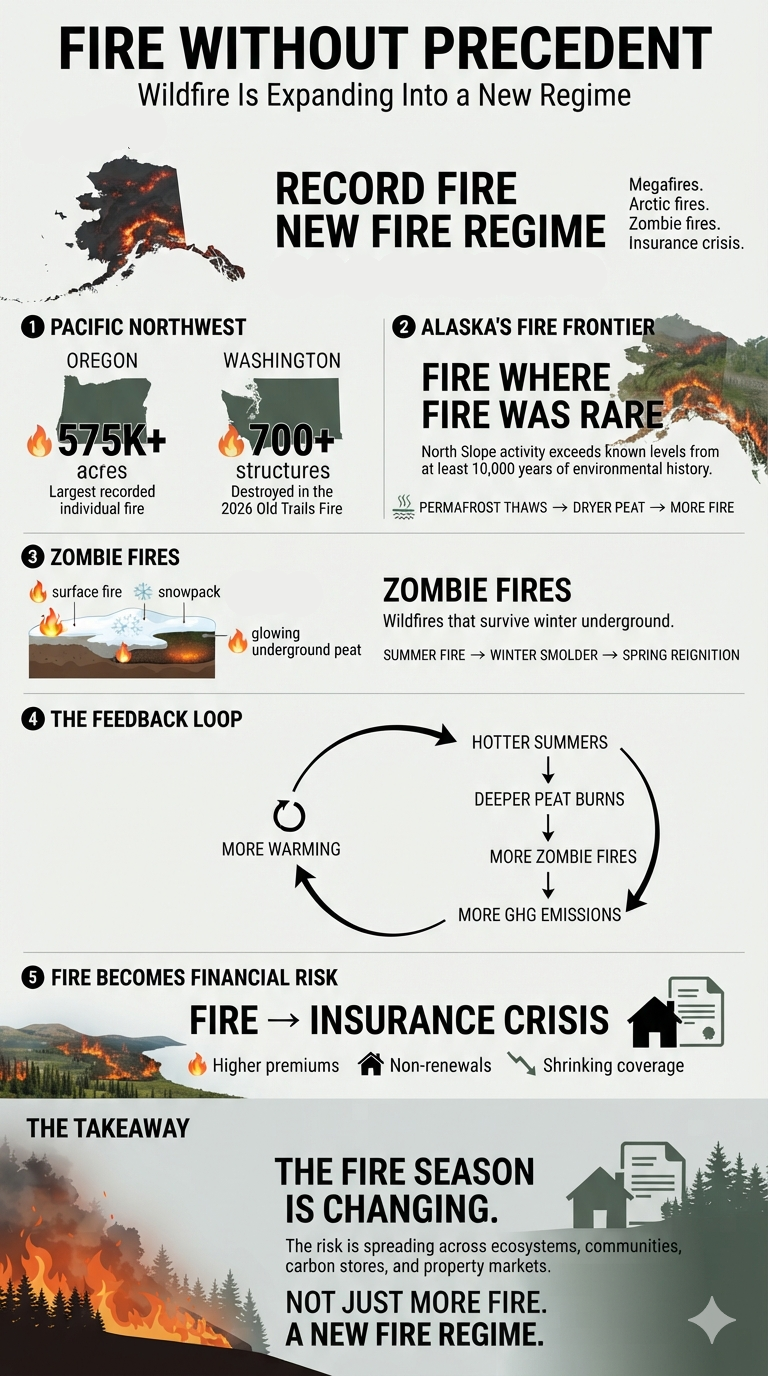
The 2026 wildfire season is rewriting the history of wildfire in Oregon, Washington, and Alaska. Record-setting megafires, increasingly unusual Arctic fires, overwintering “zombie fires,” and growing insurance losses reveal a wildfire regime that is expanding in both intensity and geographic reach.
From Oregon’s record-breaking Big Grass Fire to destructive fires around Spokane and unprecedented burning across Alaska’s tundra and boreal forests, the scale of change is becoming increasingly difficult to dismiss as simply another bad fire season.
Oregon’s Worst Wildfires
Oregon’s wildfire history is being rewritten by back-to-back extreme fire years, particularly in 2024 and 2026.
The Big Grass Fire (2026)
Burning 575,341 acres, the active Big Grass Fire has become the largest individual wildfire in recorded Oregon history by acreage.
The Long Draw Fire (2012)
The Long Draw Fire consumed 557,028 acres of rangeland in southeastern Oregon and previously held the modern state record.
The Biscuit Fire (2002)
The Biscuit Fire burned approximately 500,000 acres through southwestern Oregon’s Siskiyou National Forest, requiring a massive national firefighting response.
The Rowe Creek and Coleman Creek Fires (2026)
These two major fire complexes have burned approximately 372,971 and 308,721 acres, respectively, adding to an extraordinary season of large-scale burning.
The Labor Day Fires (2020)
Although not the largest Oregon fires by individual acreage, the 2020 Labor Day fires demonstrated how rapidly extreme weather can transform multiple fires into a statewide disaster. Severe winds drove simultaneous fires—including the Santiam and Almeda fires—that collectively burned more than 1 million acres, destroyed thousands of homes, and caused multiple fatalities.
Washington’s Worst Wildfires
Washington’s most intense historical fires have generally occurred in the state’s drier eastern regions. More recently, however, extreme fires have increasingly demonstrated their destructive potential at the wildland-urban interface.
The Okanogan Complex (2015)
The Okanogan Complex burned more than 304,000 acres, making it the largest wildfire complex in modern Washington history. Three wildland firefighters lost their lives.
The Carlton Complex (2014)
The Carlton Complex burned approximately 256,000 acres in the Methow Valley and destroyed about 300 homes, making it the state’s most destructive fire in terms of property loss at that time.
The Old Trails Fire (2026)
The catastrophic, human-caused Old Trails Fire near Spokane has consumed more than 700 structures, contributing to what is being described as Washington’s most destructive wildfire season on record.
The Sinlahekin Fire (2026)
This ongoing megafire has scorched more than 115,514 acres in Okanogan County.
The Gray and Oregon Fires (2023)
These two fast-moving fires in Spokane County destroyed a combined 710 structures, including 366 homes, and caused two deaths.
Cross-Border Blazes
Wildfires do not recognize state boundaries. The shared Columbia River border between Oregon and Washington can allow fire impacts to cross from one state to the other.
In 2017, the human-caused Eagle Creek Fire ignited in Oregon’s Columbia River Gorge, burned approximately 50,000 acres, and sent airborne embers across the river, igniting secondary fires in Washington.
Alaska’s New Wildfire Frontier
Alaska is experiencing another dimension of the wildfire transformation: fire is expanding into landscapes where large, persistent wildfires were historically exceptionally rare.
The North Slope tundra and portions of southwestern Alaska are experiencing wildfire activity that paleofire research suggests has no close parallel in the region’s known environmental history.
The North Slope Tundra
Historically, the Arctic tundra north of the Brooks Range was too cold, wet, and sparsely vegetated to sustain frequent large fires. Recent research indicates that North Slope wildfire activity during the past century has risen beyond anything observed in at least 3,000 years.
The drivers: Thawing permafrost is lowering local water tables and drying ancient peat layers that once acted as natural fire barriers. At the same time, warmer conditions are allowing woody shrubs to expand, creating additional fuel across the tundra.
The precedent: Modern megafires in this region—including the historic Anaktuvuk River Fire, which burned more than 400 square miles of tundra—represent a fundamentally different fire regime from what prevailed during much of the previous several millennia.
Southwestern Alaska: Yukon-Kuskokwim Delta and Bristol Bay
Southwestern Alaska has also historically experienced very little wildfire because of maritime moisture and tundra conditions.
That pattern is changing.
Millions of acres have burned across the region during recent consecutive fire seasons, including major events such as the Lime Complex and East Fork Fire.
Fires are now occurring as early as April and can burn deeply into organic-rich soils that have stored carbon for thousands of years.
The Yukon Flats
Farther south, in Alaska’s Interior boreal forest, the Yukon Flats ecoregion has experienced a dramatic increase in fire frequency and severity. Research indicates that recent fire activity has reached levels exceeding those seen at any point in approximately 10,000 years.
The ecological consequences extend beyond individual fires. Repeated severe burning can help convert ancient conifer-dominated spruce forests into more fire-adapted deciduous woodlands, potentially altering the region’s ecosystem for generations.
Zombie Fires: Wildfires That Survive the Winter
One of the most unusual consequences of Arctic and sub-Arctic warming is the rise of “zombie fires,” scientifically known as overwintering or holdover fires.
These fires can continue burning underground through the freezing winter and then reemerge at the surface the following spring. Instead of being extinguished by rain and heavy snow, they remain hidden beneath the surface until conditions become favorable for renewed combustion.
How a Fire Survives Under Ice and Snow
Zombie fires depend heavily on the unique composition of Arctic and sub-Arctic soils.
The fuel layer: Boreal and tundra ecosystems contain thick layers of peat and decomposing organic material. Peat is highly compacted, carbon-rich, and capable of sustaining slow, persistent combustion.
Low-oxygen smoldering: When a summer wildfire penetrates deeply into peat, it can transition from an open flame to underground smoldering. The winter snowpack restricts oxygen availability without necessarily extinguishing the fire, allowing it to move slowly through roots and organic matter even while surface temperatures plunge far below freezing.
Spontaneous combustion: Research has also identified another potential mechanism. Rapid spring warming can accelerate microbial decomposition within peat, producing heat that may contribute to spontaneous ignition under certain conditions.
Why Zombie Fires Challenge Fire Management
Fire managers once viewed overwintering fires as rare anomalies. Increasing observations suggest they may be becoming a more important source of new wildfire ignitions across Alaska, northern Canada, and Siberia.
An early start to fire season: Zombie fires can reemerge in April or May, weeks before the traditional summer lightning season. This can place additional demands on firefighting resources before seasonal crews are fully deployed.
An invisible threat: While buried, these fires can produce little visible flame and relatively little surface heat, making detection difficult. Firefighters may not discover them until they emerge along the edges of previous burn scars.
Booby-trapped landscapes: As underground fires consume roots and peat, they can hollow out sections of the ground. The resulting landscape can contain extensive areas of fallen trees and unstable soil, creating dangerous conditions for helicopters and ground crews.
The Climate Feedback Loop
The most consequential concern may be what these fires release into the atmosphere.
Peatlands store enormous quantities of carbon. When zombie fires smolder through peat for months, they can release carbon dioxide (CO₂), carbon monoxide (CO), and potentially methane (CH₄), adding greenhouse gases to the atmosphere.
That creates the potential for a reinforcing feedback loop:
The concern is not simply that the Arctic is burning more. It is that warming can alter the underlying conditions that determine where, when, and how fire can persist.
Wildfire Is Becoming an Insurance Crisis
The intensifying wildfire seasons across the Western United States are also triggering a severe property-insurance crisis, characterized by soaring premiums, policy non-renewals, and increasingly stringent requirements for homes in fire-prone areas.
Major nationwide insurers, including State Farm and Allstate, have been pulling back from or reducing exposure to some high-risk Western markets as they attempt to limit catastrophic wildfire losses.
The effects differ considerably among Oregon, Washington, and Alaska because of differences in fire activity, population exposure, and state regulation.
Oregon: Pushed Toward the Brink
Oregon’s insurance market is under increasing pressure following consecutive years of severe wildfire activity.
Premium surges: Homeowners in Central Oregon, along the Oregon Coast, and on rural acreage properties are facing renewal increases ranging from 50% to more than 100%.
Statewide non-renewals: Some carriers are dropping entire ZIP codes, leaving rural homeowners increasingly dependent on high-cost, bare-bones “last-resort” insurance pools.
Regulatory intervention: Under S.B. 82, insurers must provide clear and detailed notices explaining the wildfire risk factors contributing to a cancellation or premium increase.
During the active 2026 fire season, the Oregon Division of Financial Regulation issued an emergency order pausing home-insurance cancellations and non-renewals through August 2026 in affected areas.
Local governments are also responding. Deschutes County, for example, has adopted the R327 building code, which requires newly constructed or remodeled homes to incorporate features such as ember-resistant vents and Class A roofing to improve wildfire resilience and eligibility for specialty insurance markets.
Washington: Post-Spokane Instability
Before August 2026, Washington’s property-insurance market had been showing signs of stabilization. The devastating Old Trails Fire near Spokane, however, has injected new volatility into the market.
The Spokane drop-off: Data indicate that after severe fire seasons, Washington insurers have dropped or canceled policies on more than a third of fire-impacted properties, while Spokane County has experienced a 65% increase in non-renewals.
Risk-score friction: Insurers increasingly use wildfire-risk scores to price policies. A 2026 legislative effort backed by the Washington Office of the Insurance Commissioner sought greater transparency and an appeals process for consumers. The bill passed the Senate 48–1 but ultimately stalled in the House.
Mandated baseline coverage: Washington law requires standard homeowners policies to cover basic fire, smoke, and soot damage under terms that meet or exceed the state’s official model policy. Yet obtaining new coverage in a high-risk area has become increasingly difficult.
Alaska: The Emerging Insurance Frontier
Alaska has not yet experienced the widespread homeowner-insurance collapse seen in some other high-risk Western markets. But the underlying risk profile is changing.
Lagging actuarial models: Many legacy underwriting maps continue to assess Alaska through a historical lens—one that assumes an Arctic environment with relatively low structural wildfire risk.
The tundra shift: Much of Alaska’s recent extreme fire activity has occurred in remote wilderness rather than heavily populated residential areas. As a result, structural losses remain comparatively limited.
Future vulnerability: The situation could change as tundra and Interior fires move closer to isolated communities and population centers such as Fairbanks. Insurance brokers anticipate that carriers could respond with tighter underwriting standards and higher deductibles for smoke and fire damage in vulnerable wildland-urban interface areas.
From Wildfire Season to a New Fire Regime
The story unfolding across Oregon, Washington, and Alaska is larger than a collection of record-breaking fires.
It is a shift in the conditions under which fire operates.
Oregon is experiencing record-scale megafires. Washington is confronting increasing destruction at the wildland-urban interface. Alaska is seeing fire penetrate ecosystems where large fires were historically rare. And beneath the surface, overwintering fires are extending the wildfire season beyond the traditional summer window.
The consequences do not stop when the flames disappear. They reach into forests, soils, carbon stores, communities, property markets, and the insurance system itself.
The question is no longer simply how bad the next wildfire season will be.
It is whether the wildfire regime itself is changing faster than our ecosystems, infrastructure, insurers, and communities can adapt.
I use phasing out in a way that means completely ending the use and production of fossil fuels down to zero. Phasing down means a gradual reduction or scaling back in FF use over time without specifying a complete stop. Would add or alter that in any way?
How would you define differntiate ‘transition away’?
Reply:
I would slightly modify your definition of “phasing down” to: “a gradual reduction or scaling back in fossil-fuel use over time without specifying a date for complete cessation.”
There are really two separate issues for me:
1. For this generation, I prefer net-zero carbon emissions as the immediate goal. If someone isn’t already moving toward net-zero, I think they should start now. We don’t need to wait for a theoretical future phase-out date to begin reducing emissions.
2. As both a climatologist and an economist, I’m not convinced that setting a specific date for the complete elimination of fossil fuels is ultimately what matters. In the U.S., roughly 20% of the population appears ideologically committed to policies that would accelerate climate change. Nothing I say or do is likely to change that.
But that still leaves roughly 80% of the population—and I think economics is going to do much of the work.
Right now, perhaps only ~0.5% of Americans are seriously attempting a structured net-zero lifestyle through continuous behavioral reductions and intentional balancing. As more people discover that net-zero can actually save them thousands of dollars a year while also leaving a better environment for their children and grandchildren, I expect consumer behavior to change.
When the remaining ~79.5% begin voting with their dollars, fossil-fuel demand will fall. That creates demand destruction, which ultimately means suppliers will have less and less reason to produce fossil fuels.
So, ironically, I don’t think we necessarily need to establish the exact date when fossil fuels reach zero. The market may establish that date for us. The “complete stop” happens when there is no longer sufficient demand to sustain the fossil-fuel supply chain.
Question:
When you use the term net zero is it with the understanding that the “net” component allows continuous greenhouse gas emissions under the assumption that unproven removal technologies or flawed offsets will balance them out later, delaying necessary fossil fuel phaseouts?
Net zero is a contentious term within my community and I want to be clear that I understand how you see and apply it.
Reply:
That’s an important distinction. When I use the term net-zero, I’m talking about it at the personal/lifestyle level, and I am not using “net” to justify continuing to emit greenhouse gases while assuming that unproven technologies or questionable offsets will clean up the problem later.
What I mean is closer to “Holistic Net-Zero Living” or “Integrated Climate Stewardship”: reducing and, wherever realistically possible, zeroing out the emissions associated with my own lifestyle first, while also taking responsibility for the impacts I can’t immediately eliminate.
For me, that means a 360-degree carbon strategy:
ZEROING OUT / STRUCTURAL DECARBONIZATION
Electrifying transportation and home energy
Increasing energy efficiency
Using clean electricity
Reducing fossil-fuel consumption as close to zero as practical
Reducing high-carbon consumption, including dietary choices
BEYOND MY DIRECT FOOTPRINT
Supporting ecosystem restoration and conservation
Protecting forests and biodiversity
Supporting businesses and technologies that accelerate decarbonization
Using my purchasing and investment decisions to create economic demand for cleaner alternatives
So I’m not saying, “Keep emitting and someone will remove it later.” Quite the opposite. The first priority is eliminating the emissions themselves.
I think of the “net” component as recognizing that an individual cannot instantly eliminate every indirect emission associated with modern life. Rather than pretending those emissions don’t exist, I try to compensate through additional positive actions while continuously working to reduce the underlying footprint.
Ultimately, my goal isn’t simply to achieve a favorable carbon-accounting number. It’s to change the way I live so that my actual fossil-fuel demand approaches zero—and to use my economic choices to help make that transition happen systemically.
That’s why I sometimes think “holistic net-zero living” or “integrated climate stewardship” communicates what I mean better than simply saying “net-zero.”
Question:
Why continue using the language of ‘net zero’? What economic model do you see best aligns w/ what you have outlined?
Reply:
Haaha… good questions.
A: I’m actually in the process of writing the paper that officially changes my language from “net-zero” to “Integrated Climate Stewardship.” So thank you for pushing me on that. I think the new terminology better captures what I’ve been trying to describe.
B: I’m also working on the economic model, and that one is considerably trickier—not because of the terminology, but because AI is changing the underlying economics so rapidly.
I see AI as a double-edged sword. On one edge, as AI replaces more human labor and productivity, the human contribution to economic production could eventually become a much smaller share of GDP. AI may also be capable of producing enormous amounts of economic value with far less energy per unit of output than traditional human labor and many existing production systems.
But the other edge of that sword is wealth distribution.
If the ownership of AI, capital, and productive capacity becomes increasingly concentrated, we could see extraordinary productivity growth occurring alongside increasingly unjust wealth inequality. We could potentially solve one problem—resource and energy efficiency—while creating another: who actually owns and benefits from the productivity?
That’s the economic model I’m wrestling with now: how do we build an economy where AI-driven productivity, decarbonization, consumer savings, and environmental stewardship reinforce each other while the resulting wealth is broadly distributed?
That may ultimately be a much bigger economic question than the climate transition itself.
Question:
Have you been sitting with the economic of degrowth in all of this then? Sounds like there is that tension in what is being considered.
Reply:
Yes. I’ve been sitting with the economics of degrowth quite a bit. And I think there’s an interesting tension here.
Traditional capitalism is fundamentally tied to population growth, human labor, productivity, and consumption. But AI potentially breaks that relationship. If technology increasingly replaces human labor, then economic growth can continue—even accelerate—while the economic value of human labor declines, perhaps dramatically.
So I’m not sure the future necessarily looks like “degrowth.” It may be something stranger: exponential technological growth occurring alongside declining human labor demand, an aging population in the developed regions of the world, and potentially declining population worldwide.
That raises a much bigger question: if human labor is no longer the primary engine of economic value, what exactly are we trying to maximize—and how should the economy distribute the benefits of that productivity?
That’s the economic model I’m wrestling with right now.
Question:
What about lands and waters in these considerations?
Can we agree that what we need must be either mined or grown?
Raw materials come from somewhere with significant externalities — often left out of economic theory.
My other issue is the assumptive ghost of interest-bearing-debt as a driver of unnecessary growth.
Reply:
Yes—and I think land, water, and raw materials have to be part of the model. My initial modeling, however, is pointing toward a very different problem than the one we traditionally assume.
If AI continues improving itself, productivity could eventually become extraordinarily resource-efficient. Very little additional human labor—and potentially much less land, water, or energy per unit of economic output—may be required for productivity and growth. At the same time, consumers could be forced to consume much less because their income from labor is declining. And as solar and other clean-energy technologies continue becoming cheaper, the pressure for some forms of mining and extraction could decline as well.
That brings me back to your point about interest-bearing debt. I think sovereign debt may become the critical part of the equation.
Productivity gains and abundant cheap clean energy are profoundly deflationary. Deflation sounds wonderful for consumers in theory—but not if it is accompanied by collapsing labor income. You could have falling costs and prices while households simultaneously lose the purchasing power needed to buy anything.
Now add governments facing enormous debt obligations while their traditional tax base is shrinking because human labor is becoming less economically valuable. Governments could increasingly rely on interest-bearing debt to finance poverty reduction, redistribution, and some form of basic income.
And that creates a potentially nasty feedback loop: AI-driven productivity → declining labor income → shrinking tax base → rising sovereign debt → greater reliance on monetary expansion → inflationary pressure.
Historically, severe sovereign debt problems have sometimes been resolved through substantial currency devaluation and inflation. I’m not saying hyperinflation is inevitable—but it is one of the risks I’m now modeling.
The really strange possibility is that we could simultaneously have exponential productivity, increasingly abundant cheap energy, falling costs of production—and increasing economic hardship for ordinary people.
In other words, the problem may not ultimately be whether the planet can produce enough. It may be whether humans can maintain enough income, purchasing power, and economic agency to participate in the abundance that AI creates.
That, to me, is where the economic model gets really interesting.
One way into discussing climate change as a whole is to refer to the water cycle, because most people learned about it at school.
The water cycle is now supercharged by extra heat in the oceans.
Warmer seas produce more evaporation – and that extra water vapour* carries the extra heat high into the air. The water vapour then releases the extra heat into high-altitude air as it condenses to make clouds. So weather systems are becoming more energetic, more chaotic. Like other aspects of the climate systems, the water cycle seems to be creating more extremes – prolonged droughts, and also sudden huge rainfall events.
*7% more water vapour for each extra 1 C degree of average global temperature, so we’ve added about 10% at this point. Changes of state (such as evaporation and condensation) involve lots of heat – in physics this is called latent heat.
Our system gives no value to global commons such as the atmosphere or the oceans, because they are not seen as “scarce commodities”. One oak tree does not matter, because there are vast numbers of oak trees.
Pumping sewage into the sea doesn’t matter, because the sea is too big for it to matter.
Pumping CO2 into the air doesn’t matter, because the air is limitless.*
This is a mythological view of the world, and generally people prefer myths to facts, because facts don’t obey wishes.
*In fact if there was a lift that could travel vertically at the speed of a fast car, within minutes you’d need breathing equipment.
— Rocky Rex
Human CO2 Climate Change: All You Need to Know An unprecedented rate of Earth-system change.
The Geological Society of London (the UK’s expert association of professional geologists since 1807) says:
” ….the current speed of human-induced CO2 change and warming is nearly without precedent in the entire geological record, with the only known exception being the instantaneous, meteorite-induced event that caused the extinction of non-bird-like dinosaurs 66 million years ago” (H/T Rocky Rex)
We’ve arrived at a very similar observation in our own work, but I don’t think I’ve seen it stated this clearly—or published elsewhere. Thanks, Rocky, for helping to illuminate it.
Juxtapose the two and let me know whether the comparison can be communicated more effectively.
Multiple climate indicators now point to rates of warming-related disruption far beyond those observed during the modern instrumental era.
There is no well-established geological analog for a sustained, multi-variable, decade-scale pattern of accelerating change across the full Earth system at the resolution available in contemporary observations. If sustained, this may represent one of the most abrupt large-scale climate transitions in Earth’s geological history.
Rocky replied:
I’ve been citing that for a long time, and I’m always impressed by how many people can totally ignore it. It’s very much the scientific version of “The Good Ancestor” poem, it should hit people between the eyes and wake them up. All the signs are that we are entering an abrupt climate change process. Have I told you this true story before?
In the mid 1950s, Russell Coope was looking for a PhD project after graduating as a geologist. He noticed beetle remains in ice age deposits in a gravel pit in the UK Midlands. His supervisor, Prof Fred Shotton, said something like: “I expect they are just modern beetles that have got stuck to the surface.” Fred was wrong – a rare event.
Coope decided to base his PhD on recording what kinds of beetles there were in different ice age deposits, to see where it led. He discovered that the mix of beetles was linked to the temperatures at that time.
He did this by comparing his layer-by-layer collections with collections of beetles from different places in the modern world – beetles happen to evolve very slowly, so the actual variety of beetles hasn’t changed much over the last million years or so.
As his research proceeded, Coope was shocked to find that the beetles showed that at times, during the ice ages, temperatures had changed significantly in just a few decades – his beetles showed that the Earth’s climate is not fundamentally stable.
He had discovered abrupt climate change events, a previously unknown phenomenon. Geologists had always assumed that most processes were slow.
I had the good fortune to be a student in Coope’s palaeontology lectures long ago…. and also in Fred’s physical geology lectures. (In 1943, Fred Shotton was involved in a secret project that produced geological maps of certain beaches in northern France…… that’s a movie that should be made by someone)
“We are messing with the trigger that causes climate change….the outcome is likely to be ferocious.”
The climate system is not simply warming—it is changing how it responds to that warming. Coupled climate feedbacks are becoming one of the most consequential dimensions of climate risk in the 21st century because they amplify changes and connect individual tipping-point pathways into larger cascading effects.
The longer warming persists, the more climate feedbacks become active. As these feedbacks interact, we are already observing nonlinear responses, amplification, and cascading impacts across the climate system. Hundreds of feedback mechanisms have been identified, and many can couple and reinforce one another, contributing to the accelerating pace and increasing magnitude of climate change—The Domino Effect.
by Daniel Brouse, Sidd Mukherjee, and Rocky Rex
Can Anthropogenic Global Warming Be Proven?
Yes.
The isotopic signature of atmospheric carbon dioxide provides direct evidence.
Fossil carbon is depleted in 13C and contains essentially no measurable 14C (radiocarbon), because 14C decays over thousands of years.
Observed atmospheric trends show:
A measurable decline in the 13C/12C ratio
A measurable decline in atmospheric 14C concentration
A measurable decline in atmospheric O2 concentration
These shifts form a remarkably consistent fingerprint.
The carbon isotopes tell us where the additional carbon is coming from. Fossil fuels were formed from ancient biological material and therefore have a characteristic isotopic signature: relatively little 13C and virtually no 14C. As fossil carbon is added to the atmosphere, the atmospheric CO2 isotope ratios shift in precisely the direction expected from fossil-fuel combustion.
The decline in atmospheric oxygen provides an independent piece of evidence.
When fossil fuels are burned, carbon combines with atmospheric oxygen:
C + O2 → CO2
The process consumes O2 and produces CO2. Because the additional atmospheric CO2 is accompanied by a measurable decline in atmospheric O2, the observations are consistent with large-scale combustion of carbon rather than simply a redistribution of carbon through the natural carbon cycle.
This is especially important because the ocean, vegetation, and atmosphere continuously exchange carbon and oxygen. Natural processes can move carbon between reservoirs, but they do not explain the simultaneous long-term pattern of rising CO2, falling O2, declining 13C/12C, and declining radiocarbon.
Together, these measurements provide a chemical and isotopic fingerprint of fossil-carbon combustion.
Volcanoes do not produce the observed isotopic pattern, and the natural carbon cycle cannot account for the simultaneous changes in the required direction and magnitude.
The molecules carry their own fingerprint—and the atmosphere is preserving the evidence in both carbon and oxygen.
It has no business blocking roads, or sweeping away bridges.
What if an ambulance was stuck on the wrong side of the river?
Give the clouds a suspended sentence.
They are trying to remind us that a warmer world has wetter air. They should go and tell China, not us.
Arrest the rain.
How dare it remind us that the climate is changing?
Let’s pretend it always rained like this.
Sentence the melting ice to 10 years in the cooler.
Why does it matter if the sea floods Bangladesh?
And Miami can be the New Atlantis.
The Earth is protesting?
We are not interested – just lock it up.”
The Good Ancestor
A poem by Daverick Leggett
Every day I walk a hundred years to the hill where my great, great granddaughter sits. I carry words of blessing and reach to touch her back.
But feeling me near she turns, sad-eyed and heavy with grief.
“What was it like?” she asks, “when the great whales swam, when the birds sang you awake, when the rains came soft, and the soil smelled sweet underfoot?”
And the blessings catch in my throat.
On darker days she turns, her famished face charred, and eyes sunk in their bony orbits, burn with curses.
And the blessings froth at my mouth with the poisonous spume of betrayal.
On the darkest of all days I walk the hundred years and find no one there.
Let today be the bright day. Let today be the bright day I lay my hand upon her back.
And, feeling me near, she turns and blesses me, saying,
“Your love was fierce enough, sweet ancestor, your love was fierce enough.”
About Rocky Rex
I was a science teacher for a long time – and I taught geology when I could. Rocky Rex began as a poster on my lab wall….I was given a T Rex poster, and as soon as I pinned it up I knew he was called Rocky Rex. The name just came to me, out of nowhere.
He gave a focus for information added to his notice board. He ended up making money for school funds by appearing on T-shirts, pens, key-rings etc.
It wasn’t long before some of the other staff started calling me Rocky. This was all long before the internet existed, but when social media appeared it just seemed obvious that my avatar would be Rocky Rex. I like keeping my online stuff slightly disconnected from my offline life. [I actually did a physics degree, but we had to take an “additional science” course in the first year, so I chose geology. It was the same geology course taken by those doing a joint degree in geology and archaeology. ]
Some of the most fascinating—and concerning—climate feedback loops are ones that were barely considered in climate models a decade ago. They illustrate how a relatively small change can trigger a cascade of nonlinear responses, making them particularly relevant from a chaos theory perspective.
Chaos Theory and the Acceleration of Climate Change
Climate change isn’t just one feedback causing another.
It’s becoming a network of interacting feedbacks where seemingly unrelated processes reinforce each other in ways that traditional linear thinking struggles to capture.
Our newest infographic explores some of the Earth’s most unusual and recently recognized climate feedbacks, including:
This is nonlinear amplification: modest initial changes propagating through interconnected systems to produce responses far larger than the original disturbance.
As these hidden connections strengthen, predicting climate behavior becomes increasingly difficult using simple cause-and-effect models.
Understanding the network is becoming just as important as understanding the individual feedbacks.
🌍 Every new connection matters.
1. Zombie Fires (Overwintering Peat Fires)
Feedback loop:
Higher temperatures → more drought.
Peat ignites during summer fires.
Fire smolders underground all winter.
Fire re-emerges the following spring.
Vegetation and insulating peat disappear.
Permafrost thaws.
Ancient carbon and methane are released.
More warming → more fires.
These fires can survive beneath snow because peat acts like charcoal, insulating the combustion. They’re becoming increasingly common across Canada and Siberia as warmer, drier conditions expand.
2. Greenland Ice Algae
Perhaps one of the strangest biological feedbacks.
Feedback loop:
Warmer summers melt snow.
Microscopic algae bloom on exposed ice.
Dark pigments reduce ice reflectivity (albedo).
More sunlight is absorbed.
Ice melts faster.
More liquid water supports additional algae.
Researchers call this biological darkening. In parts of Greenland’s “Dark Zone,” algae have become a measurable contributor to increased melt.
3. Thermokarst Lakes
One of the least intuitive feedbacks.
Feedback loop:
Permafrost begins thawing.
Ground collapses into depressions.
Lakes form.
Water conducts heat much better than frozen soil.
Deeper permafrost melts.
Ancient organic carbon decomposes.
Methane bubbles escape.
Methane accelerates warming.
Small lakes become “hot spots” that can emit disproportionately large amounts of methane.
4. Beaver Expansion in the Arctic
As northern regions warm:
beavers move farther north,
they build dams,
ponds trap warm water,
warm water melts surrounding permafrost,
wetlands expand,
methane emissions increase.
An animal once considered ecologically beneficial in temperate regions becomes an unexpected amplifier of Arctic warming.
5. Boreal Forest Beetles
Cold winters historically killed bark beetles.
Now:
milder winters
more beetles survive
forests die
dead forests burn more easily
fires release carbon
soot darkens snow and ice
additional warming allows beetles to expand farther north.
6. Wildfire Smoke Darkening Snow
Smoke doesn’t just affect air quality.
Wildfire ash and black carbon settle on:
glaciers
Arctic sea ice
mountain snowpack
This lowers albedo, causing earlier melt, which exposes darker land and ocean surfaces that absorb even more solar energy.
7. Arctic Shrubification
As tundra warms:
shrubs invade formerly snow-covered areas,
shrubs absorb more sunlight than snow,
shrubs trap drifting snow,
deeper snow insulates the soil,
winter soil temperatures rise,
permafrost thaws faster.
A simple change in vegetation alters the thermal properties of the landscape.
8. Rain-on-Snow Events
Increasing winter rain instead of snow causes:
ice crust formation,
vegetation damage,
reduced insulation,
altered hydrology,
increased runoff,
greater summer drying,
increased wildfire risk.
This feedback connects winter weather directly to summer fire seasons.
9. Kelp Forest Collapse
Marine heat waves can eliminate kelp forests.
Loss of kelp means:
less carbon uptake,
reduced coastal cooling,
altered nutrient cycling,
warmer coastal waters,
additional kelp mortality.
10. Ocean Stratification
Warmer surface oceans become lighter.
This reduces vertical mixing.
Consequences include:
less oxygen reaching deep water,
reduced nutrient upwelling,
warmer surface layers,
marine heat waves become more persistent,
coral bleaching,
weaker biological carbon pump.
11. Wetland Methane Pulse
Heavy rainfall creates:
saturated soils,
oxygen-poor conditions,
methanogenic microbes,
increased methane emissions,
additional warming.
Ironically, wetter conditions can increase greenhouse-gas emissions from wetlands.
12. Glacier Elevation Feedback
As glaciers melt:
their surfaces sink,
lower elevations are warmer,
melting accelerates,
glaciers descend farther into warmer air,
retreat speeds up.
Greenland exhibits this effect over large areas.
13. AMOC Freshwater Feedback
Greenland meltwater freshens the North Atlantic.
Fresh water is less dense, reducing deep-water formation.
This can alter ocean circulation, redistribute heat, and change regional weather patterns. Some studies suggest this may also increase subsurface warming near marine-terminating glaciers, enhancing ice-sheet melt.
14. Lightning Feedback
Warmer air produces:
more atmospheric moisture,
greater instability,
more lightning,
more wildfire ignitions,
greater carbon emissions,
additional warming.
Recent studies indicate lightning activity is increasing in parts of the Arctic, where lightning was historically uncommon.
These gases further warm the atmosphere, increasing microbial activity even more.
Why these are important for chaos theory
What’s striking is that these feedbacks don’t operate independently. They form an interconnected network in which one process often triggers several others. For example:
Warming → zombie fires
Zombie fires → soot deposition
Soot → darker snow and ice
Darker ice → faster melting
Faster melting → thermokarst lakes
Thermokarst lakes → methane release
Methane → additional warming
Likewise:
Warming → Greenland algae
Algae → lower albedo
Lower albedo → more meltwater
Meltwater → larger algal blooms
These interactions exemplify nonlinear amplification: a modest initial perturbation can propagate through multiple coupled systems, producing a response much larger than the original forcing (The Butterfly Effect). That networked behavior is one reason Earth-system responses can become increasingly difficult to predict with linear cause-and-effect thinking.