bookmark_borderFinancial Ethics and Legal Controversies: Trump, Musk, and Conflicts of Interest

Financial Disclosure and Conflict of Interest Regulations for U.S. Presidents and Officials

When a U.S. president takes office, they—as well as their cabinet members, high-ranking officials, and anyone with substantial influence in the administration—are generally required to disclose all financial activities. This process is designed to ensure transparency, prevent conflicts of interest, and uphold ethical standards in governance.

Typically, this includes the public release of their tax returns, which provides insight into their financial history, sources of income, and potential conflicts of interest. Additionally, officials are expected to divest from any assets or positions that could create conflicts, either by selling them outright or placing them into a blind trust managed independently to prevent undue influence over policy decisions.

A broad set of federal laws and regulations, including the Ethics in Government Act and various conflict-of-interest statutes, exist to prevent public officials from using their positions for personal financial gain. These laws prohibit actions such as insider trading, self-dealing, and preferential treatment in policymaking or government contracts. Violations can lead to legal consequences, loss of office, or significant reputational damage.

While past presidents have largely adhered to these ethical norms, there have been exceptions and controversies, highlighting the ongoing debate about the adequacy of existing laws and enforcement mechanisms.

Donald Trump’s Lack of Transparency and Authenticity

President Donald Trump’s adherence to financial disclosure and conflict of interest regulations has been a subject of extensive scrutiny and debate.​

Financial Disclosures:

As a candidate and officeholder, President Trump was required to submit financial disclosure reports detailing his assets, income sources, and business interests. While he did file these disclosures, organizations like Citizens for Responsibility and Ethics in Washington (CREW) have raised concerns about the completeness and transparency of these reports. For instance, CREW obtained and analyzed Trump’s 2023 financial disclosures, highlighting potential gaps and ambiguities.

Conflicts of Interest:

Unlike his predecessors, President Trump chose not to divest from his extensive business holdings upon assuming office. This decision led to numerous allegations of conflicts of interest. CREW documented over 3,400 instances where the line between the Trump Organization and the Trump administration appeared blurred, raising questions about whether policy decisions were influenced by personal financial interests.

Specific concerns include the promotion of personal business ventures and the intertwining of official duties with private interests. For example, events and initiatives that involved both governmental roles and private business promotions have been criticized as potential violations of ethical standards. ​

Legal and Ethical Considerations:

It’s important to note that the President is exempt from certain federal conflict of interest laws that apply to other executive branch employees. However, ethical norms and the Constitution’s Emoluments Clauses are intended to prevent undue influence and ensure that presidential decisions are made in the public interest, free from personal financial considerations. Critics argue that President Trump’s actions challenged these principles, leading to legal challenges and calls for greater accountability.

Concerns have been raised regarding potential conflicts of interest and ethical standards involving President Donald Trump, his family, and Elon Musk. Key issues include:​

Tesla Event on the White House Lawn

On April 1, 2025, Elon Musk hosted an event on the White House lawn alongside President Trump to promote Tesla vehicles. This event drew criticism for potentially using public office for private gain, as it appeared to leverage the presidential platform to benefit Musk’s private enterprise. The event also sparked global protests, with demonstrators targeting Tesla showrooms to express opposition to Musk’s partnership with President Trump. ​

Trump Organization’s Ventures in Vietnam

The Trump Organization announced plans for multi-billion-dollar investments in Vietnam, including golf courses, hotels, and real estate projects. The first project, valued at $1.5 billion near Hanoi, is set to break ground in May 2025. These developments proceed amid potential U.S. tariffs on Vietnam due to trade imbalances. Critics argue that such foreign ventures by a sitting president’s business could lead to conflicts of interest, especially when intertwined with international trade policies. ​

Starlink Contracts and Tariff Relief

Elon Musk’s Starlink secured contracts to provide satellite internet services in Vietnam, coinciding with Vietnam’s efforts to mitigate U.S. tariffs by increasing imports from the U.S. This arrangement has raised questions about potential quid pro quo dealings and the ethical implications of a government official’s private company benefiting from international agreements influenced by U.S. trade policies. ​

Elon Musk’s Role in Government and Business Interests

Elon Musk’s appointment as co-lead of the Department of Government Efficiency (DOGE) under President Trump has been scrutinized due to potential conflicts of interest. As a “special government employee,” Musk is subject to less stringent conflict-of-interest rules, allowing him to maintain leadership roles in his private companies while influencing government operations. This dual role has prompted calls for investigations into whether Musk has used his government position to benefit his businesses, particularly concerning the cancellation of a $2.4 billion FAA contract with Verizon in favor of Starlink.

Legal Actions and Investigations

In March 2025, a U.S. judge ruled that Elon Musk must face a fraud lawsuit alleging he delayed disclosing his significant stake in Twitter (now X), potentially misleading investors and violating securities laws. Additionally, leading Democrats have called for investigations into Musk’s activities, focusing on his influence over federal agencies and the financial benefits his companies have received from government contracts. ​

These instances highlight ongoing concerns about the intersection of public duties and private interests among high-ranking officials and their associates, emphasizing the need for stringent ethical standards and transparency in government operations.

Senators Launch Investigation into Trump’s Crypto Corporation, Urge SEC to Preserve Documents

​Senator Elizabeth Warren, along with Representative Maxine Waters, has requested that the Securities and Exchange Commission (SEC) preserve records related to President Donald Trump’s cryptocurrency venture, World Liberty Financial. They are investigating potential conflicts of interest stemming from the Trump family’s financial ties to this crypto business. ​

In a separate initiative, Senator Warren, joined by four other Democratic senators, expressed concerns about conflicts of interest regarding World Liberty Financial’s plans to issue a stablecoin named USD1. They sent a letter to U.S. financial regulators seeking clarification on how they intend to oversee this venture.

Additionally, Senator Warren has called on David Sacks, President Trump’s Special Advisor for AI and Crypto, to publicly disclose his financial records. She aims to address potential conflicts of interest related to the administration’s cryptocurrency policies.

These actions reflect ongoing concerns among Democratic lawmakers about the intersection of President Trump’s official duties and his family’s business interests in the cryptocurrency sector.

TRUMP’S HISTORY OF CRIMINALITY AND UNETHICAL BEHAVIOR

President Donald Trump and his associated entities have been involved in numerous legal proceedings, encompassing civil and criminal cases, impeachments, bankruptcies, defamation suits, sexual assault allegations, and controversies surrounding both non-profit and for-profit ventures. Below is an overview:

Criminal Indictments and Convictions:

  • 2023-2024 Criminal Cases: Between 2023 and 2024, Trump faced four criminal indictments on charges including fraud, election subversion, and obstruction. These marked the first instances of a former U.S. president facing criminal charges.
  • 2025 Conviction: In early 2025, Trump was convicted on 34 felony counts related to concealing a “hush money” transaction intended to hide a sex scandal from voters. Despite the conviction, he was sentenced to no penalty, making him the first individual convicted of a felony to assume the office of president.

Civil Lawsuits and Investigations:

  • New York Civil Fraud Lawsuit: In September 2022, New York Attorney General Letitia James filed a civil lawsuit against Trump, his three eldest children, and the Trump Organization, alleging over 200 instances of fraud and misrepresentation. The suit sought $250 million in penalties and aimed to restrict future business activities in New York. In February 2024, a judge ordered Trump to pay a penalty exceeding $450 million and barred him from leading any New York company for three years.

Defamation and Sexual Assault Cases:

  • E. Jean Carroll Case: In 2019, writer E. Jean Carroll accused Trump of raping her in a department store dressing room in the 1990s. Trump denied the allegation, leading Carroll to file a defamation lawsuit against him. In May 2023, a jury found Trump liable for sexual abuse and defamation, awarding Carroll $5 million in damages. Subsequent appeals by Trump were rejected, and in a later ruling, he was ordered to pay an additional $83.3 million in damages.
  • Other Allegations: Multiple women have accused Trump of sexual misconduct over the years. While he has denied these allegations, they have led to various legal challenges and public scrutiny.

Impeachments:

  • First Impeachment (2019): The House of Representatives impeached Trump on charges of abuse of power and obstruction of Congress related to his dealings with Ukraine. The Senate acquitted him in early 2020.
  • Second Impeachment (2021): Following the January 6 Capitol riot, Trump was impeached again, this time for incitement of insurrection. The Senate acquitted him in February 2021.

Bankruptcies:

While Donald Trump has never filed for personal bankruptcy, several of his business ventures have — repeatedly. The exact number of corporate bankruptcies tied to Trump is difficult to pin down, largely because of how they are counted. For example, Trump’s casino empire — operating under Donald J. Trump (DJT) Hotels & Casinos — filed for bankruptcy four separate times, though some analysts group those together as a single event.

Most sources agree that Trump-related companies have filed for bankruptcy at least six times. However, when counting repeat filings by the same entities, some estimates place the total closer to 12 to 14.

In every case, a familiar pattern emerges: Trump personally profited while shareholders, lenders, and employees absorbed the losses. His playbook centers on aggressive debt, questionable financial management, and systematically transferring risk away from himself and onto investors and creditors.

Now, he’s applying the same strategy on a global scale.

Legal Issues Involving Non-Profit and For-Profit Entities:

  • Trump University: Established in 2005, Trump University offered real estate training programs. It faced multiple lawsuits alleging fraudulent practices, including a significant case in which plaintiffs accused the institution of misleading students about the quality of education provided. In 2018, a federal judge finalized a $25 million settlement to resolve these lawsuits, allowing former students to receive compensation for their financial losses.
  • Donald J. Trump Foundation: Founded in 1988, the Trump Foundation came under scrutiny for alleged misuse of funds, including accusations of self-dealing and advancing Trump’s political interests. In 2019, the New York Supreme Court ordered Trump to pay $2 million in damages for improperly using charitable assets to intervene in the 2016 presidential primaries and further his own political interests.

​Jail

Both Allen Weisselberg, the former Chief Financial Officer (CFO) of the Trump Organization, and Michael Cohen, President Donald Trump’s former personal attorney and “fixer,” were convicted and served prison sentences due to their involvement in financial crimes related to their roles within the Trump Organization.​

Allen Weisselberg:

Weisselberg was implicated in a tax fraud scheme involving the Trump Organization. He pleaded guilty to 15 felony charges, including grand larceny, criminal tax fraud, and falsifying business records. These charges stemmed from his failure to pay taxes on $1.7 million in indirect compensation, which included benefits such as a rent-free luxury apartment, private school tuition for his grandchildren, and leased Mercedes-Benz vehicles. In January 2023, Weisselberg was sentenced to five months in jail and began serving his sentence at Rikers Island.

Michael Cohen:

Cohen pleaded guilty to multiple charges, including tax evasion, bank fraud, and campaign finance violations. The campaign finance violations were particularly notable, as they involved orchestrating hush money payments to women alleging affairs with Donald Trump during the 2016 presidential campaign. These payments were intended to influence the election by suppressing potentially damaging information. In December 2018, Cohen was sentenced to three years in federal prison.

Profit Over Patriotism: How Trump’s Second Term Blurred the Line Between Presidency and Personal Gain
Donald Trump’s second term in office marked a sharp escalation in the merger of political power and personal profit. From crypto schemes and cell service ventures to corporate-sponsored parades and questionable foreign deals, Trump turned the presidency into a revenue-generating enterprise, prioritizing his brand and wallet over democratic norms and military integrity.

Trump’s Crimes, Illegal Activities, and Immorality: A Record of Corruption

Trumpenomics: The Decline of the US

bookmark_borderThe Impending Economic Impact of April 2 Tariff Announcement: A Global Crisis in the Making

by Daniel Brouse
April 1, 2025

The Washington Post has reported that sources indicate the April 2 tariff announcement is set to impose an across-the-board 20% tariff on a broad range of imports. Such a drastic move would have far-reaching implications for the global economy, potentially triggering the most significant worldwide economic downturn since the Great Depression.

Understanding the Scope of the 20% Tariff

Tariffs are taxes on imported goods, usually levied by governments to protect domestic industries or to encourage certain economic behaviors. A 20% across-the-board tariff means that the cost of many goods entering the U.S. from other countries will increase by 20%. This would apply to various sectors, from electronics and consumer goods to industrial materials and food products. As a result, the prices of everyday items could surge, straining consumers and businesses alike.

The immediate impact of such a policy would be felt in the U.S., as companies pass on the added costs to consumers. But the ramifications would not stop at U.S. borders. Trade is a two-way street, and countries affected by these tariffs are likely to retaliate. This could lead to a global trade war, where countries impose tariffs on each other’s exports, resulting in widespread disruptions to the global supply chain.

Potential Global Economic Consequences

  1. Rising Prices and Inflation
    A 20% tariff would lead to higher prices on a wide array of goods. Manufacturers and retailers would face increased costs for materials and products, which would, in turn, be passed on to consumers in the form of higher prices. For everyday consumers, this would result in reduced purchasing power, further exacerbating inflationary pressures already present in many economies. The cost of living would rise, leading to decreased consumer spending and potentially slowing down economic growth.

  2. Global Trade Disruption
    Global trade relies on the free flow of goods between nations. A sudden imposition of tariffs of this magnitude would disrupt supply chains, as businesses would need to find new suppliers or production methods to avoid the increased costs. Countries that rely heavily on exports to the U.S. could face severe economic hardships, while other nations may retaliate with tariffs of their own, creating a cycle of protectionist measures that harms all parties involved.

  3. Risk of Recession
    The last time the global economy faced a crisis of this magnitude was during the Great Depression. The widespread implementation of tariffs back in the 1930s triggered a global trade collapse, leading to massive economic contractions, rising unemployment, and a dramatic decrease in global output. Similarly, a modern-day trade war could push the world economy into recession, as countries become more isolated and less able to collaborate on international economic growth.

  4. Impact on Developing Economies
    Developing economies, which often rely on exports to wealthier nations, would be especially vulnerable to the effects of a 20% tariff. Countries like China, Mexico, and those in Southeast Asia could see their exports significantly reduced, hurting their GDP growth. This could lead to a rise in poverty and unemployment in these nations, which may also result in political instability and unrest.

  5. Financial Market Volatility
    The announcement of such a significant tariff could lead to considerable volatility in global financial markets. Investors would likely respond with caution, retreating from stocks and other risky assets in favor of safer investments like government bonds or gold. This could cause major declines in stock market indices worldwide and exacerbate economic instability. The uncertainty around trade relations could also harm long-term business planning and investment decisions.

Historical Precedents and the Global Economic Landscape

The Great Depression remains the most well-known example of how tariffs can spiral into a global economic collapse. The Smoot-Hawley Tariff Act of 1930, which raised U.S. tariffs on over 20,000 imported goods, is often cited as a contributing factor to the global depression. The resulting trade barriers reduced global trade by more than 60% and deepened the economic crisis. History has shown that protectionist policies, while sometimes aimed at shielding domestic industries, can often backfire, leading to a reduction in global trade, lower economic growth, and widespread hardship.

The global economy today is more interconnected than ever, with supply chains that stretch across borders and trade that plays a central role in most nations’ economic health. A tariff policy that disrupts this interconnectedness would likely have a ripple effect, leading to job losses, lower productivity, and declining standards of living for people around the world.

Conclusion

The April 2 tariff announcement, with its proposed 20% across-the-board levy, carries immense risks for the U.S. and the world. While the goal of such tariffs is often to protect domestic industries, the broader economic consequences could be catastrophic. With the potential to trigger a global trade war, increase inflation, and push the world into recession, the decision to impose such tariffs could very well be seen as a turning point in the global economic landscape. As businesses and consumers brace for these impacts, the world faces a future that is increasingly uncertain, with the specter of the Great Depression looming once more.

Trumpenomics: The Decline of the US

bookmark_borderTrump Economic Facts

Amazingly, some still suffer from Trump Delusionment Syndrome, defending his economic policies while claiming Biden ‘destroyed the economy’ or insisting that Trump needs to ‘break some eggs’ to bake a cake—meaning we need to endure pain. No, we don’t need pain. The economy performed the best in history during Biden’s term, in sharp contrast to both Trump 1.0 and the early signs of Trump 2.0.

Let’s look at the numbers: During Trump’s first term (2017–2021), the national debt increased by about $7.8 trillion, mainly due to tax cuts that didn’t pay for themselves and pandemic-related spending. Under Biden (2021–2025), the debt rose by about $6.3 trillion—but a significant portion of that came from legislation and tax policies enacted under Trump.

Now, three months into Trump’s second term (2025–2029), debt projections are looking even worse. Estimates suggest Trump 2.0 will add an additional $10 trillion, driven by an extension of his tax cuts and increasing deficits. By the end of Trump 2.0, Trump will have added more to the national debt than all Democratic presidents combined.

So if debt is your concern, you might want to rethink which administration is actually running up the tab. On the other hand, if you’re talking about GDP, we are currently experiencing the sharpest decline since Trump’s last term—when he oversaw the fastest economic contraction in U.S. history.

Protectionism is one of the worst economic policies. Tariffs are regressive taxes that disproportionately harm marginalized communities while failing to boost the economy or reduce the deficit. The last time a president imposed broad tariffs, it contributed to the Great Depression—a global economic catastrophe that took decades to recover from and provided no lasting benefits to society.

Trumpenomics: The Decline of the US

bookmark_borderTrump’s Sector-Specific Tariffs

March 27, 2025

Since January 2025, the United States has implemented several sector-specific tariffs in an effort to protect domestic industries. These tariffs are in addition to any existing country-specific tariffs and represent a continuation of protectionist trade policies. However, historical data suggests that such high sector-specific tariffs often fail to achieve their intended goals. Instead of revitalizing domestic production, they tend to result in a net job loss across affected industries due to increased input costs, supply chain disruptions, and retaliatory measures from trade partners. In many cases, the cost to consumers and businesses far outweighs any economic benefits, with each job “saved” coming at an exorbitant price to taxpayers and the broader economy.

  • Steel and Aluminum: Effective March 12, 2025, a 25% tariff was imposed on all steel and aluminum imports, eliminating previous country exemptions. ​

  • Automobiles and Auto Parts: Announced on March 26, 2025, a 25% tariff on all imported cars and car parts will take effect on April 2, 2025. This measure aims to bolster domestic manufacturing but raises concerns about increased consumer prices and potential disruptions in global supply chains. ​

Additionally, the administration has proposed tariffs on other sectors:​

  • Pharmaceuticals: Plans to impose a 25% tariff on imported pharmaceuticals have been signaled, though specific details and implementation dates are yet to be announced. ​

  • Lumber: A Section 232 investigation into timber and lumber imports has been initiated, potentially leading to future tariffs. ​

  • Copper: The administration has threatened to impose a tariff of up to 25% on all copper imports, aiming to increase U.S. production.

These measures reflect the administration’s strategy to protect domestic industries, though they have sparked concerns about escalating trade tensions and potential retaliatory actions from trading partners.

Trumpenomics: The Decline of the US

bookmark_borderWhy Are People Boycotting Tesla?

Elon Musk’s extreme hypocrisy has led to widespread boycotts and protests against Tesla. It’s the only company in U.S. history to achieve profitability primarily through carbon credits and remains one of the largest recipients of government subsidies, including tax credits. Yet Musk publicly opposes these very policies, making his contradictions even more damaging—not just to his brand but also to his employees.

My biggest concern is the economic hypocrisy and Tesla’s role in slowing the transition to sustainable energy. While Tesla benefits from more government subsidies than any other company in the world, the U.S. has imposed a 120% tariff on higher-quality, more affordable EVs like those from BYD. This has left the U.S. with an uncompetitive, inefficient EV industry, while China has become the global leader in EV manufacturing.

This isn’t just about Tesla—it’s about fairness and the fastest path to sustainability. The U.S. is blocking competition by slapping massive tariffs on superior, lower-cost EVs while funneling billions in subsidies to Tesla, despite its questionable labor practices and supply chains. If the goal is to fight climate change, we should prioritize the best EVs at the best prices, regardless of where they’re made, rather than propping up a single company with government handouts.

Finally, Trump remains the only president to openly violate ethics rules, conflict-of-interest laws, and bans on endorsing private products—most notably by purchasing a Tesla on the White House lawn. The Secretary of Commerce further compounded these violations by publicly promoting Tesla stock.

In summary, Elon Musk leveraged taxpayer money to amass his fortune, then hypocritically denounced such practices—even accusing others of fraud for doing the same. Additionally, he acted without congressional authority, making his actions unconstitutional and unlawful. As a government employee, he violated ethics rules, conflict-of-interest laws, and bans on endorsing private products. He should have divested his assets before entering government service and stepped down as CEO of Tesla.

Trumpenomics: The Decline of the US

bookmark_borderGOP Socializes Egg Prices

Ironically, President Trump has taken a far-left liberal approach by socializing the egg industry. Unable to keep his campaign promise to lower egg prices, the U.S. government has subsidized the industry to the tune of billions of dollars.

​U.S. Agriculture Secretary Brooke Rollins announced that the United States is importing hundreds of millions of eggs from South Korea and Turkey. ​

The U.S. government is actively addressing soaring egg prices through a comprehensive strategy that includes both financial support for domestic producers and increased imports. In February 2025, the USDA unveiled a $1 billion plan to combat avian influenza and stabilize egg prices. This plan allocates $400 million in financial relief for affected farmers, effectively subsidizing domestic egg production to mitigate the impact of the outbreak. Additionally, to quickly augment the egg supply and alleviate price pressures, the U.S. is importing hundreds of millions of eggs from countries like South Korea and Turkey. During his campaign this is what Trump referred to as radical liberals.

Trumpenomics: The Decline of the US

bookmark_borderTrump’s Sweeping Tariff Plan Threatens to Reverse Decades of Trade Progress

by Daniel Brouse
March 20, 2025

Trump aides are preparing to implement a sweeping new set of tariffs on imports valued in the trillions of dollars, aligning with the administration’s push for a more protectionist trade policy. This plan, part of Trump’s so-called “reciprocal” trade agenda, is expected to significantly alter U.S. trade relations by targeting countries that impose tariffs or non-tariff barriers on American goods.

According to Edward Gresser, a trade policy expert, Trump’s proposed tariff plan could push the average U.S. tariff rate to levels not seen since the early 1930s—approximately 20 percent. Such a shift would mark a dramatic departure from decades of trade liberalization, reversing much of the progress made in reducing global trade barriers since World War II.

This is the first indication of the scope and magnitude of the April 2nd tariffs.

Economic and Historical Concerns

Critics warn that imposing tariffs at such high levels could trigger retaliatory measures from trading partners, leading to increased costs for American consumers and businesses. Economists and industry leaders have expressed concerns that a tariff regime reminiscent of the 1930s could result in supply chain disruptions, inflationary pressures, and reduced global economic growth. Historically, these types of tariffs were a significant factor in exacerbating the Great Depression.

There is no evidence that tariffs protect American industries or bring manufacturing back to the U.S. During Trump’s first term, the administration imposed 25% tariffs on steel and 10% on aluminum under the justification of protecting American jobs and reducing reliance on foreign imports. However, studies, including one from the Peterson Institute for International Economics, found that these policies were a net negative for the economy.

The Economic Damage of Trump’s First Tariffs

  • Net Loss of 75,000 U.S. Manufacturing Jobs – While a handful of domestic steel jobs were temporarily created, the broader manufacturing sector suffered significantly. Industries reliant on steel and aluminum, such as automotive production, construction, and appliance manufacturing, faced higher input costs, leading to layoffs and production cuts.
  • Each Job Saved Cost Taxpayers $900,000 – The few jobs protected by tariffs came at an extraordinarily high cost, making it one of the least efficient job protection policies in U.S. history.
  • Higher Prices for American Businesses and Consumers – U.S. companies paid 15-20% more for steel and aluminum compared to international competitors, leading to price increases for consumer goods, vehicles, and infrastructure projects.
  • Decline in U.S. Exports Due to Retaliatory Tariffs – In response to Trump’s tariffs, major trading partners—including Canada, China, and the European Union—imposed retaliatory tariffs on U.S. goods. This particularly hurt the agriculture sector, leading to billions in lost revenue for American farmers.
  • Stock Market and Business Uncertainty – The tariffs increased economic volatility, with markets reacting negatively to heightened trade tensions and uncertainty in key manufacturing industries.

As Trump pushes forward with his sweeping tariff agenda, the potential consequences for the U.S. economy, global trade relations, and domestic industries remain a significant concern.

Trumpenomics: The Decline of the US

bookmark_borderGlobal Economic Outlook Dims Amid Rising Trade Barriers and Geopolitical Tensions

by Daniel Brouse
March 17, 2025

On March 17, 2025, the Organization for Economic Co-operation and Development (OECD) released its latest Interim Economic Outlook, revising downward its global economic growth forecasts. This worldwide slowdown is attributed to higher trade barriers in several G20 economies, which are expected to dampen global growth and contribute to inflationary pressures, elevated geopolitical tensions and policy uncertainties. For the United States, the OECD has notably reduced its GDP growth forecasts, anticipating a multiyear decline with a meager 1.6% growth rate in 2026.

Atlanta Fed's GDP Tracker
Atlanta Fed’s GDP Tracker

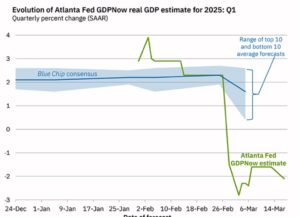
Additionally, the Atlanta Fed’s GDP tracker for real GDP growth also was revised downward today to -2.1% for the first quarter of 2025 indicating a possible recession in the first half of this year.

These forecasts highlight both the immediate and long term decline in global economies, as well as the severe impacts to the US economy due to Trump’s economic policies.

Ironically, a sharp decline in the U.S. economy could help counteract the ‘drill, baby, drill’ policy and slow fossil fuel consumption, which would be beneficial for the environment. An economic slowdown typically leads to reduced demand for oil and fossil fuels, resulting in lower emissions. This decreased demand often causes oil prices to fall. When the price of a barrel of oil drops below certain thresholds, drilling new wells can become unprofitable. For instance, in 2022, the average breakeven price to profitably drill a new well in the United States was approximately $56 per barrel, with regional variations ranging from $48 to $69 per barrel.  Therefore, sustained oil prices below these breakeven points can discourage new drilling activities.

Explanation of the ‘Drill, Baby, Drill’ Policy:
The phrase “drill, baby, drill” emerged as a political slogan advocating for increased domestic oil and gas production in the United States. It gained prominence during the 2008 Republican National Convention and has been associated with policies aiming to boost fossil fuel extraction to achieve energy independence and economic growth. In recent years, this slogan has been revitalized to support expansive fossil fuel production initiatives. Proponents argue that such measures can lead to lower energy prices and reduced reliance on foreign oil. However, critics express concerns that this approach undermines efforts to combat climate change by perpetuating dependence on carbon-intensive energy sources.

President Donald Trump’s stance on climate change has been characterized by skepticism and policy actions that deprioritize environmental concerns in favor of economic and energy interests.

Public Statements:

  • Historically, Trump has referred to climate change as a “hoax.”
  • More recently, he has dismissed concerns about rising sea levels, stating, “That is not our problem,” and has emphasized “nuclear warming” as a more pressing threat.
  • Trump has repeatedly referred to the climate crisis as the Green New Scam.

Policy Actions:

  • Upon his inauguration in January 2025, President Trump withdrew the United States from the Paris Agreement and pledged to roll back executive orders and policies from the previous administration aimed at addressing climate change.

  • He issued an executive order titled “Promoting Energy Independence and Economic Growth,” aiming to dismantle many federal actions addressing climate change.

  • The administration has proposed cuts to agencies like FEMA, which could significantly impact disaster response capabilities in states vulnerable to climate-related events, such as California.

Impact on Environmental Policies:

  • The administration’s stance has led to reduced funding for clean energy projects and transportation initiatives. Major financial institutions have withdrawn from net-zero alliances, and the Securities and Exchange Commission (SEC) has implemented rules making it more challenging for investors to address environmental, social, and governance (ESG) issues within companies.

Trumpenomics: The Decline of the US

The Human Induced Climate Change Experiment

bookmark_borderTrumpenomics: How Tariffs, Policy Cuts, and Labor Shortages Are Devastating American Farmers

by Daniel Brouse
March 13, 2025

Recent policies enacted by the President have had significant financial repercussions on American farmers, leading to substantial economic losses.​

1. Impact of Tariffs and Retaliatory Measures

The Trump 2.0 administration’s imposition of tariffs, particularly on steel and aluminum, has triggered retaliatory tariffs from major trading partners such as China, Canada, and the European Union. These countermeasures have significantly reduced demand for U.S. agricultural exports, exacerbating existing challenges like droughts, supply chain disruptions, and low commodity prices. Texas farmers, many of whom have historically supported the President, are now voicing concerns over the mounting economic pressures caused by these policies.

The precedent for these economic consequences was set during Trump’s first administration. The 1.0 tariffs, particularly those targeting steel and aluminum, prompted severe retaliatory measures, notably from China. The impact on U.S. agriculture was devastating:

  • Soybean Exports: In 2018, U.S. soybean exports to China plummeted by $9.4 billion. While some alternative markets were found, they only recovered $4.7 billion in lost revenue, leaving a net loss of $4.7 billion for American soybean farmers.
  • Regional Losses: Major agricultural states like Iowa, Illinois, and Kansas saw significant financial hits. Iowa farmers alone lost $1.46 billion, Illinois suffered $1.41 billion in losses, and Kansas endured a $955 million decline in revenue.
  • Federal Bailouts: In an attempt to compensate for the damages, the U.S. Department of Agriculture (USDA) issued $23 billion in direct payments to farmers between 2018 and 2020. However, these subsidies often fell short, leaving many farmers struggling with long-term economic setbacks.

The Trump 2.0 tariffs are broader in scope, applying to more countries at higher rates, making the expected economic fallout far more devastating than before. With supply chain disruptions, climate-related hardships, and rising input costs already squeezing farmers, these new tariffs threaten to push many agricultural operations to the brink of collapse.

So far in 2025, several countries and trading blocs imposed retaliatory tariffs on U.S. agricultural imports in response to the current administration’s tariffs on steel, aluminum, and other goods. The European Union (EU) announced €26 billion in countermeasures against U.S. products, including agricultural goods. The first phase, effective April 1, targets €4.5 billion worth of U.S. consumer goods such as bourbon whiskey, jeans, and Harley-Davidson motorcycles. The second phase, set for mid-April, will impose tariffs on €18 billion worth of U.S. steel and agricultural products. Canada followed suit, imposing 25% tariffs on $21 billion worth of U.S. imports, including steel, aluminum, and various other goods. This action builds on earlier tariffs of $30 billion enacted on March 4. Meanwhile, China announced 10-15% tariffs on U.S. meat and agricultural products, suspended imports of U.S. lumber, and revoked soybean import licenses for three major U.S. firms.

Important to note, the bulk of the Trump tariffs have not yet been announced and are expected to be implemented on April 2, 2025. The President has stated that these tariffs will be applied to all countries and may be as high as 250%.

2. Cancellation of USAID’s Programs

The recent termination of local food programs, including USAID’s “Food for Peace,” has further strained farmers:

  • Loss of Funding: Since 2021, local school lunch programs have provided over $2 billion to various states, supporting local food purchases for schools and food banks. Their cancellation removes a critical revenue stream for farmers, exacerbating financial challenges.

  • Food for Peace: The USAID “Food for Peace” program, which operated with an annual budget of approximately $1.7 billion, has been terminated as part of the broader dismantling of USAID. This program purchased U.S.-grown commodities, such as rice, wheat, lentils, and peas, for distribution to populations facing food insecurity worldwide. Its cancellation not only impacts global hunger relief efforts but also removes a significant market for American farmers.

These program cancellations have disrupted supply chains, leading to financial instability for farmers who previously relied on these initiatives. The sudden loss of funding has left many agricultural producers without alternative markets, intensifying the economic challenges within the farming community.

3. Labor Shortages Due to Immigration Policies

Stricter immigration policies have led to a shortage of immigrant workers, who are essential to the agricultural workforce. This scarcity has resulted in increased labor costs and challenges in harvesting crops, thereby reducing overall productivity and profitability for farmers.​

4. Economic Uncertainty and Market Instability

The combination of trade tensions, program cancellations, and labor shortages has created an environment of economic uncertainty. Farmers are facing volatile market conditions, making it difficult to plan for the future and invest in their operations. This instability threatens the sustainability of the agricultural sector and the rural communities that depend on it.​

In summary, the current administration’s policies have introduced significant challenges for American farmers, affecting export markets, domestic program support, labor availability, and overall economic stability.

ALSO SEE:

Trumpenomics: The Decline of the US

bookmark_borderA Storm Brewing in Global Trade

by Daniel Brouse
March 12, 2025

Daily Market Update: A Storm Brewing in Global Trade

While domestic markets remained relatively calm, international markets reacted with volatility to the latest round of tariffs, escalating trade tensions worldwide.

In Trump 1.0, steel and aluminum tariffs were introduced at 25% on steel and 10% on aluminum, selectively targeting a handful of nations. Today, those tariffs have returned—but this time, they are 25% across the board, applying to all steel and aluminum imports, regardless of their origin. This marks a significant escalation in protectionist policies, with the potential to destabilize supply chains and increase costs for U.S. manufacturers and consumers alike.

The global response has been swift. Retaliatory tariffs are already being discussed, with several key trading partners preparing countermeasures. Even Australia, a long-standing U.S. ally that was previously exempt, is now expressing frustration, with one prominent economist summing up the sentiment as: “What the fuck?”

The Impact: Higher Costs, Fewer Jobs, and Economic Instability

Historically, tariffs of this nature have had disastrous economic consequences. The last round of steel and aluminum tariffs under Trump led to a net loss of 75,000 U.S. manufacturing jobs, and each job “saved” cost taxpayers nearly $900,000. Prices on everything from automobiles to canned goods surged, making life more expensive for American families.

This time, the impact is likely to be even worse. A broad, across-the-board tariff will strain international relations, drive inflation, and trigger widespread retaliation. U.S. companies reliant on imported metals will face higher costs, leading to job cuts, reduced investment, and lower economic growth.

The Markets React: Uncertainty Takes Hold

While the full effects will take time to unfold, the immediate market reaction has been one of caution and concern. The tariffs add another layer of economic uncertainty at a time when global markets are already grappling with inflation, geopolitical instability, and rising interest rates. Investors are wary, and market volatility is expected to increase in the coming weeks.

Final Thoughts: Repeating History’s Mistakes

Despite clear evidence from his first term that tariffs did more harm than good, Trump is doubling down on failed economic policies that increase costs, eliminate jobs, and weaken the U.S. economy. The previous steel and aluminum tariffs were an economic disaster, and this round—hitting more industries, more countries, and more supply chains—will only accelerate the damage.

As trade partners prepare their countermeasures, the question is no longer if the U.S. economy will suffer, but how badly.

… and oh, yeah… these aren’t the real tariffs, yet. They come April 2.