by Daniel Brouse
Some of the most fascinating—and concerning—climate feedback loops are ones that were barely considered in climate models a decade ago. They illustrate how a relatively small change can trigger a cascade of nonlinear responses, making them particularly relevant from a chaos theory perspective.
Chaos Theory and the Acceleration of Climate Change
Climate change isn’t just one feedback causing another.
It’s becoming a network of interacting feedbacks where seemingly unrelated processes reinforce each other in ways that traditional linear thinking struggles to capture.
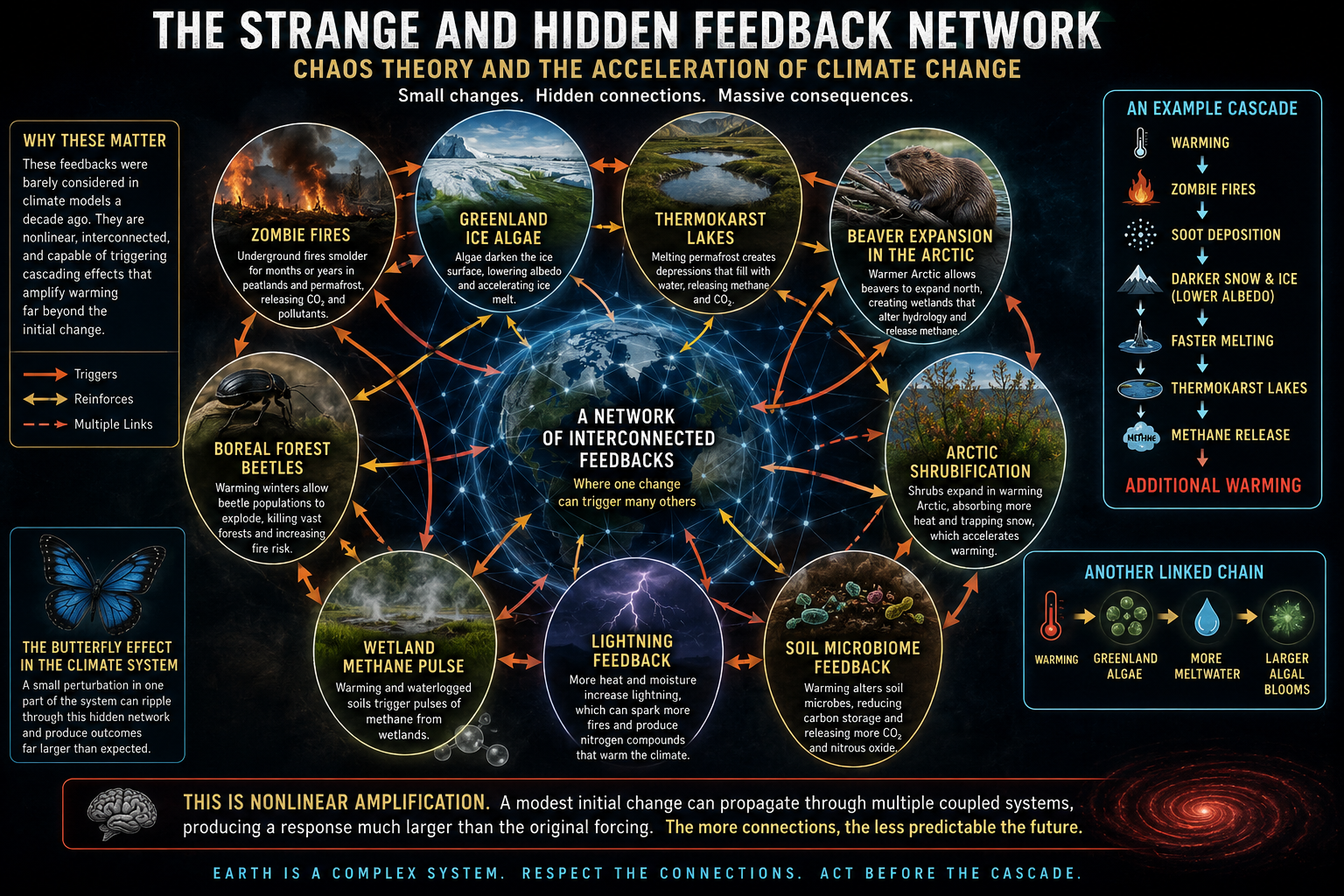
Our newest infographic explores some of the Earth’s most unusual and recently recognized climate feedbacks, including:
🔥 Zombie Fires
🟢 Greenland Ice Algae
🏞️ Thermokarst Lakes
🦫 Arctic Beaver Expansion
🪲 Boreal Forest Beetles
🌿 Arctic Shrubification
💨 Wetland Methane Pulses
⚡ Lightning Feedback
🦠 Soil Microbiome Feedback
These systems don’t operate independently.
A small change can trigger multiple connected responses that amplify one another—a climate-scale example of the Butterfly Effect.
For example:
Warming → Zombie Fires → Soot on Ice → Lower Albedo → Faster Melting → Thermokarst Lakes → Methane Release → More Warming
This is nonlinear amplification: modest initial changes propagating through interconnected systems to produce responses far larger than the original disturbance.
As these hidden connections strengthen, predicting climate behavior becomes increasingly difficult using simple cause-and-effect models.
Understanding the network is becoming just as important as understanding the individual feedbacks.
🌍 Every new connection matters.
1. Zombie Fires (Overwintering Peat Fires)
Feedback loop:
- Higher temperatures → more drought.
- Peat ignites during summer fires.
- Fire smolders underground all winter.
- Fire re-emerges the following spring.
- Vegetation and insulating peat disappear.
- Permafrost thaws.
- Ancient carbon and methane are released.
- More warming → more fires.
These fires can survive beneath snow because peat acts like charcoal, insulating the combustion. They’re becoming increasingly common across Canada and Siberia as warmer, drier conditions expand.
2. Greenland Ice Algae
Perhaps one of the strangest biological feedbacks.
Feedback loop:
- Warmer summers melt snow.
- Microscopic algae bloom on exposed ice.
- Dark pigments reduce ice reflectivity (albedo).
- More sunlight is absorbed.
- Ice melts faster.
- More liquid water supports additional algae.
Researchers call this biological darkening. In parts of Greenland’s “Dark Zone,” algae have become a measurable contributor to increased melt.
3. Thermokarst Lakes
One of the least intuitive feedbacks.
Feedback loop:
- Permafrost begins thawing.
- Ground collapses into depressions.
- Lakes form.
- Water conducts heat much better than frozen soil.
- Deeper permafrost melts.
- Ancient organic carbon decomposes.
- Methane bubbles escape.
- Methane accelerates warming.
Small lakes become “hot spots” that can emit disproportionately large amounts of methane.
4. Beaver Expansion in the Arctic
As northern regions warm:
- beavers move farther north,
- they build dams,
- ponds trap warm water,
- warm water melts surrounding permafrost,
- wetlands expand,
- methane emissions increase.
An animal once considered ecologically beneficial in temperate regions becomes an unexpected amplifier of Arctic warming.
5. Boreal Forest Beetles
Cold winters historically killed bark beetles.
Now:
- milder winters
- more beetles survive
- forests die
- dead forests burn more easily
- fires release carbon
- soot darkens snow and ice
- additional warming allows beetles to expand farther north.
6. Wildfire Smoke Darkening Snow
Smoke doesn’t just affect air quality.
Wildfire ash and black carbon settle on:
- glaciers
- Arctic sea ice
- mountain snowpack
This lowers albedo, causing earlier melt, which exposes darker land and ocean surfaces that absorb even more solar energy.
7. Arctic Shrubification
As tundra warms:
- shrubs invade formerly snow-covered areas,
- shrubs absorb more sunlight than snow,
- shrubs trap drifting snow,
- deeper snow insulates the soil,
- winter soil temperatures rise,
- permafrost thaws faster.
A simple change in vegetation alters the thermal properties of the landscape.
8. Rain-on-Snow Events
Increasing winter rain instead of snow causes:
- ice crust formation,
- vegetation damage,
- reduced insulation,
- altered hydrology,
- increased runoff,
- greater summer drying,
- increased wildfire risk.
This feedback connects winter weather directly to summer fire seasons.
9. Kelp Forest Collapse
Marine heat waves can eliminate kelp forests.
Loss of kelp means:
- less carbon uptake,
- reduced coastal cooling,
- altered nutrient cycling,
- warmer coastal waters,
- additional kelp mortality.
10. Ocean Stratification
Warmer surface oceans become lighter.
This reduces vertical mixing.
Consequences include:
- less oxygen reaching deep water,
- reduced nutrient upwelling,
- warmer surface layers,
- marine heat waves become more persistent,
- coral bleaching,
- weaker biological carbon pump.
11. Wetland Methane Pulse
Heavy rainfall creates:
- saturated soils,
- oxygen-poor conditions,
- methanogenic microbes,
- increased methane emissions,
- additional warming.
Ironically, wetter conditions can increase greenhouse-gas emissions from wetlands.
12. Glacier Elevation Feedback
As glaciers melt:
- their surfaces sink,
- lower elevations are warmer,
- melting accelerates,
- glaciers descend farther into warmer air,
- retreat speeds up.
Greenland exhibits this effect over large areas.
13. AMOC Freshwater Feedback
Greenland meltwater freshens the North Atlantic.
Fresh water is less dense, reducing deep-water formation.
This can alter ocean circulation, redistribute heat, and change regional weather patterns. Some studies suggest this may also increase subsurface warming near marine-terminating glaciers, enhancing ice-sheet melt.
14. Lightning Feedback
Warmer air produces:
- more atmospheric moisture,
- greater instability,
- more lightning,
- more wildfire ignitions,
- greater carbon emissions,
- additional warming.
Recent studies indicate lightning activity is increasing in parts of the Arctic, where lightning was historically uncommon.
15. Soil Microbiome Feedback
Warmer soils stimulate microbial activity.
Microbes decompose organic matter faster, releasing:
- CO₂
- methane
- nitrous oxide
These gases further warm the atmosphere, increasing microbial activity even more.
Why these are important for chaos theory
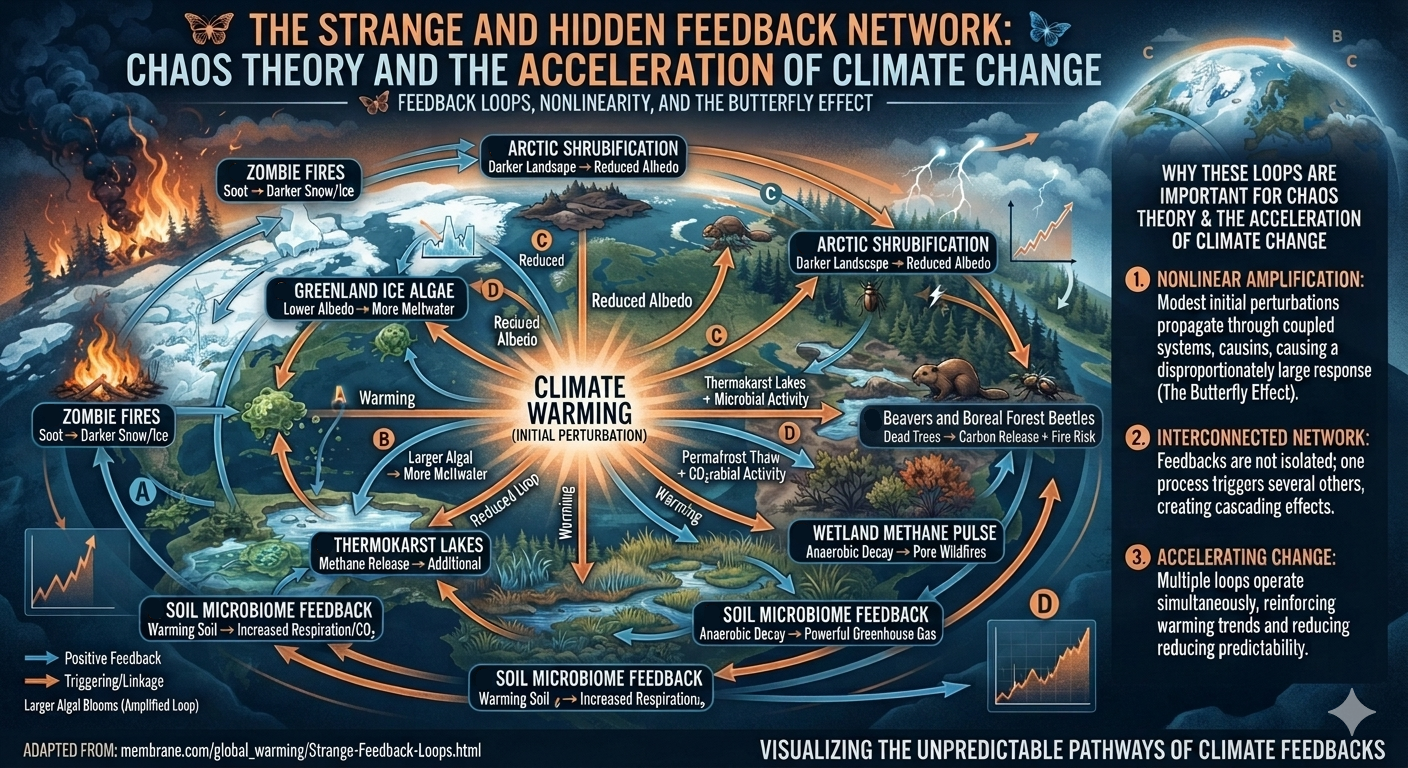
What’s striking is that these feedbacks don’t operate independently. They form an interconnected network in which one process often triggers several others. For example:
- Warming → zombie fires
- Zombie fires → soot deposition
- Soot → darker snow and ice
- Darker ice → faster melting
- Faster melting → thermokarst lakes
- Thermokarst lakes → methane release
- Methane → additional warming
Likewise:
- Warming → Greenland algae
- Algae → lower albedo
- Lower albedo → more meltwater
- Meltwater → larger algal blooms
These interactions exemplify nonlinear amplification: a modest initial perturbation can propagate through multiple coupled systems, producing a response much larger than the original forcing (The Butterfly Effect). That networked behavior is one reason Earth-system responses can become increasingly difficult to predict with linear cause-and-effect thinking.