bookmark_borderWhere Will Be Safe? The Future of Human Habitation on a Rapidly Collapsing Earth

by Daniel Brouse and Sidd Mukherjee
July 15, 2025


Q: Where will be safe to live in the coming years as climate change accelerates?

Great question.

The simple answer is: “Underground.”

The habitability of Earth’s surface will become increasingly complicated as tipping points and cascading system failures accelerate. For the next 30 years, it will likely still be possible to live above ground if you remain nomadic with enough money and power—but keep in mind, the value of money will rapidly erode, and what counts as “wealth” will change, becoming increasingly difficult to protect and secure.

In this part of the world, the Appalachian Trail will likely become a primary trade and migration route, but it will be extremely dangerous due to raping, pillaging, and collapse of social structures. If cannibalism becomes widespread, you will need to ensure you do not become livestock.

Sea Level “Surges” Will Accelerate Collapse

We are going to start seeing “surges” in sea level rise where, instead of millimeters of rise per year, some years will suddenly see feet of rise in a single year, likely 2–3 feet per year for several consecutive years. When this happens, places like Philadelphia and Camden will become uninhabitable overnight. Infrastructure, sewer systems, water treatment, and energy grids will fail in these low-lying regions, forcing mass migration and amplifying societal collapse.

These surges will not only drown infrastructure but will contaminate freshwater systems, disable transport routes, and spread disease. Expect these rapid shifts to happen episodically and without much warning, making it impossible for most people to adapt in place.

Underground: The Last Option

Within 30 years, much of Earth’s surface will likely become uninhabitable due to deadly wet-bulb heat, violent storms, flooding, and societal collapse. At that point, finding a secure underground living space will become the objective.

However, underground living brings its own challenges:

  • Food production without sunlight.

  • Water access and purification.

  • Sanitation: The hardest part will be sewage removal and flood control.

  • Flash floods will increase, contaminating underground spaces with sewage and disease.

  • Underground dwellings will be at risk of collapse or drowning during extreme weather.

  • People living in below-grade housing already have the highest mortality during flash floods, a risk that will only increase.

The Short Window of Nomadism

In the coming decades, if you have the means, nomadic relocation may temporarily work as you chase the last habitable microclimates. However, this window is closing quickly as tipping points and system failures compound.

Local community resilience, underground flood-resistant infrastructure, and developing off-grid water and food systems will matter far more than money in the world we are heading toward.

Conclusion

Where will it be safe? Nowhere for long. The collapse will come in waves:

  • Economic collapse,

  • Infrastructure collapse,

  • Social collapse,

  • Environmental collapse.

The final wave will be surface uninhabitability, forcing humanity underground if it wishes to survive. This will be a harsh, disease-ridden, and resource-constrained existence requiring preparation far beyond bug-out bags and solar panels.

If you want to survive, think beyond climate denial and political distraction. Think engineering, hydrology, sanitation, and nutrition, not just “location.” The sooner we face this reality, the better we can prepare.

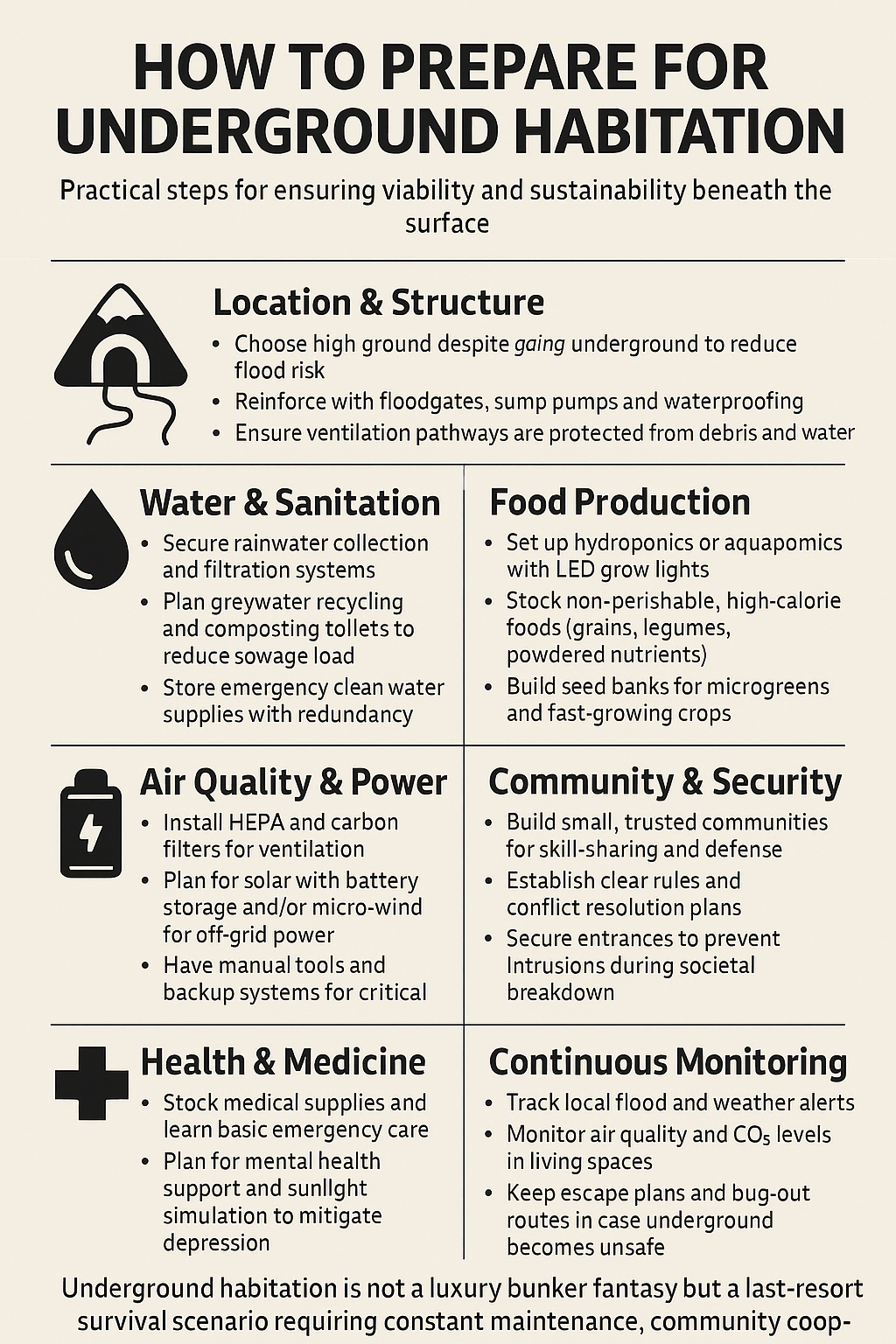
How to Prepare for Underground Habitation

 Location & Structure

  • Choose high ground despite going underground to reduce flood risk.

  • Reinforce with floodgates, sump pumps, and waterproofing.

  • Ensure ventilation pathways are protected from debris and water.

Water & Sanitation

  • Secure rainwater collection and filtration systems.

  • Plan greywater recycling and composting toilets to reduce sewage load.

  • Store emergency clean water supplies with redundancy.

Food Production

  • Set up hydroponics or aquaponics with LED grow lights.

  • Stock non-perishable, high-calorie foods (grains, legumes, powdered nutrients).

  • Build seed banks for microgreens and fast-growing crops.

Air Quality & Power

  • Install HEPA and carbon filters for ventilation.

  • Plan for solar with battery storage and/or micro-wind for off-grid power.

  • Have manual tools and backup systems for critical needs.

 Community & Security

  • Build small, trusted communities for skill-sharing and defense.

  • Establish clear rules and conflict resolution plans.

  • Secure entrances to prevent intrusions during societal breakdown.

Health & Medicine

  • Stock medical supplies and learn basic emergency care.

  • Plan for mental health support and sunlight simulation to mitigate depression.

  • Maintain physical fitness to handle manual labor and emergencies.

Continuous Monitoring

  • Track local flood and weather alerts.

  • Monitor air quality and CO2 levels in living spaces.

  • Keep escape plans and bug-out routes in case underground becomes unsafe.

Remember:
Underground habitation is not a luxury bunker fantasy; it is a last-resort survival scenario requiring constant maintenance, community cooperation, and adaptability in a rapidly collapsing climate system.


Underground Living Guide
Underground Living Guide

The Human Induced Climate Change Experiment

bookmark_borderNine Tipping Points Crossed: The Domino Collapse of Earth’s Climate Systems

by Daniel Brouse and Sidd Mukherjee
July 13, 2025

Human-induced climate change has now crossed at least nine critical tipping points, each triggering irreversible shifts in the Earth’s climate system. These tipping points are not isolated; they are interconnected, and their cascading effects amplify each other in a self-reinforcing feedback loop that accelerates global climate disruption.

The nine tipping points include:

  1. Greenland Ice Sheet Collapse

  2. West Antarctic Ice Sheet Collapse

  3. Labrador-Irminger Seas / SPG Convection Collapse

  4. East Antarctic Subglacial Basins Collapse

  5. Arctic Winter Sea Ice Collapse

  6. East Antarctic Ice Sheet Collapse

  7. Amazon Rainforest Dieback

  8. Boreal Permafrost Collapse

  9. Atlantic Meridional Overturning Circulation (AMOC) Collapse

These are not in strict chronological order, as the tipping points are dynamically interconnected, but the sequence of total collapse impacts the severity and global reach of the consequences.

As my colleague Sidd noted, “Number 7 might be first.”

The Amazon Rainforest Dieback

For decades, Sidd and I have researched the ozone feedback loop, an often-overlooked but critical piece of the climate crisis puzzle. Ozone, a byproduct of carbon combustion, does not act as a greenhouse gas itself but severely disrupts the Earth’s ability to manage greenhouse gases indirectly.

Tropospheric ozone pollution damages the stomata of plant leaves, which are microscopic openings essential for absorbing CO₂ during photosynthesis. This impairment drastically reduces plant productivity, health, and growth, weakening one of the planet’s most vital carbon sinks. Recent studies indicate that ozone poisoning has already reduced the productivity of plant CO₂ absorption by approximately 30%, undermining the natural carbon removal capacity of the Amazon and other forests.

As the Amazon’s ability to sequester carbon weakens, it becomes increasingly vulnerable to higher temperatures and intensified droughts, which are themselves driven by regional deforestation and climate change. Ozone-induced reductions in CO₂ uptake further weaken tree health, making the forest more susceptible to wildfires, pest outbreaks, and large-scale mortality.

Once the Amazon crosses its tipping threshold, large-scale dieback becomes irreversible, releasing immense quantities of stored carbon from vegetation and soils into the atmosphere. This shifts the Amazon from being a powerful carbon sink to a significant carbon source, accelerating global warming and reinforcing a destructive feedback loop that drives further regional drying and forest decline.

The Amazon also plays a critical role in recycling water across South America. As forest cover declines, this water recycling function weakens, reducing rainfall locally and regionally, amplifying drought, and hastening the ecosystem’s collapse. If current trends continue, the Amazon is poised to transform from the world’s largest carbon sink into a catastrophic carbon emitter, with devastating consequences for global climate stability and biodiversity.

Why This Matters Now

These tipping points are no longer theoretical warnings—they are unfolding in real time, compounding their effects and accelerating systemic collapse. Each tipping point increases the likelihood of crossing additional tipping points, fueling the domino effect of climate destabilization.

From the loss of polar ice sheets raising sea levels, to the collapse of ocean circulation patterns disrupting weather and food systems, to the dieback of the Amazon intensifying warming and reducing rainfall, these interlinked crises are now reshaping our world at a pace faster than traditional models predicted.

We are witnessing the transition from linear climate change to non-linear, system-wide collapse. It is critical for policymakers, scientists, and the public to recognize that mitigation and adaptation strategies must account for these cascading tipping points to avoid deeper, irreversible damage to the Earth’s systems and human civilization.

The Human Induced Climate Change Experiment

bookmark_borderTipping Cascades: The Nonlinear Dominoes of Climate Collapse

by Daniel Brouse
July 14, 2025

My latest deep reflection has centered on how tipping points have triggered self-sustaining feedback loops in the climate system. We knew this was coming—and it is now here. Luckily, I was prepared for that part.

What I could not fully envision in my mind’s eye was how the interplay of different tipping points would ignite a domino effect so rapidly—so, so fast.

Now, I can see it clearly: the nonlinear, dynamic dance of economic, physical, and ecological unordered systems in real time. This is pure math and science, visibly unfolding for all to see, transforming abstract models into undeniable, measurable reality.

To understand unordered systems, you must “zoom out.” Imagine standing in the eye of a hurricane, unable to grasp its structure from within, then pulling back to see the swirling system from a satellite view. Only then can you perceive its shape, patterns, and momentum. Climate science and economics share this paradox: from within, the chaos feels incomprehensible, but from a higher vantage, the pattern is clear.

I offer this perspective to help you grasp the critical reality of where we stand today:

We are witnessing at least nine major tipping points that are already in play, with dominoes falling and each accelerating the collapse of the next. Crossing these tipping points represents a threshold beyond which impacts on global ecosystems and human societies become irreversible within human timescales.

The Nine Tipping Points in Motion:

1. Greenland Ice Sheet Collapse
Accelerated melting is injecting vast freshwater into the ocean, disrupting marine ecosystems, weakening the AMOC, and raising sea levels.

2. West Antarctic Ice Sheet Collapse
Rapid destabilization threatens to raise sea levels by meters, displacing populations and eroding infrastructure globally.

3. Labrador-Irminger Seas / Subpolar Gyre Convection Collapse
Collapse of this convection disrupts the AMOC, a critical regulator of global heat distribution, weather stability, and ocean health.

4. East Antarctic Subglacial Basins Collapse
Grounded below sea level, these basins are vulnerable to rapid ice loss, accelerating sea level rise and destabilizing coastal regions.

5. Arctic Winter Sea Ice Collapse
Shrinking winter ice amplifies Arctic warming, disrupting jet streams, altering ocean currents, and triggering further heat absorption.

6. East Antarctic Ice Sheet Collapse
Long considered stable, sections of the East Antarctic are showing vulnerability to collapse, with the potential to significantly raise sea levels.

7. Amazon Rainforest Dieback
Deforestation and warming threaten the Amazon’s water recycling and carbon storage roles, turning it from a carbon sink to a carbon source.

8. Boreal Permafrost Collapse
Thawing permafrost is releasing methane and CO₂ in massive quantities, creating a powerful feedback loop of accelerated warming.

9. Atlantic Meridional Overturning Circulation (AMOC) Collapse
Potential collapse of the AMOC could lead to abrupt weather pattern shifts, including intensified droughts, storms, and regional cooling in some areas, while exacerbating global climate instability.


Tipping Cascades and The Domino Effect

These tipping points do not act in isolation. Each collapse amplifies stress on others, triggering tipping cascades:

  • Melting Greenland ice weakens the AMOC, which alters weather patterns, drying the Amazon, triggering dieback that releases CO₂, further warming the Arctic, collapsing permafrost, and amplifying ocean heating.

  • Changes in Arctic sea ice affect jet stream patterns, causing persistent heat domes, droughts, and flooding cycles, which destabilize ecosystems and food systems.

  • The weakening of the AMOC is linked to increased East Coast flooding, European storm intensification, and droughts in the Sahel, while simultaneously accelerating Antarctic ice melt.

We are seeing chaotic systems align into self-perpetuating loops, moving climate change from linear, human-driven emissions to nonlinear, nature-driven escalation.


Why This Matters Now

It is now clear: climate change has entered a phase where natural systems themselves are the drivers. Even if humans ceased all emissions today, these processes will continue for centuries or millennia, while continuing emissions add fuel to the fire.

Understanding and communicating the urgency of these tipping cascades is essential not only for scientists but for policymakers, businesses, and every individual. We must accelerate adaptation strategies while urgently reducing emissions to slow additional triggers.

The sooner we act, the more we can reduce the damage of the tipping cascades that are now unstoppable but can still be limited in scope and speed.

The Human Induced Climate Change Experiment

bookmark_borderThe Coming Treasury Flood: Why Rates May Stay High for Years

by Daniel Brouse
July 14, 2025

More than $1 trillion in U.S. short-term Treasury bills are expected to flood the market over the next 18 months following the latest debt ceiling increase, as the Treasury moves to replenish its depleted cash balance while continuing to fund the country’s massive fiscal deficit.

This is exactly the kind of risk I have been warning about. The massive increase in Treasury issuance will collide with a shifting demand landscape that could keep interest rates elevated for years. In a median scenario, rates could return to levels last seen in the 1980s within just a few years.

Here’s why:

  • Fiscal Policy Headwinds: Current fiscal policies, including massive deficit spending and protectionist tariffs, are reducing foreign demand for U.S. securities. Key buyers like China and Japan are already reducing their holdings, and confidence in U.S. debt stability is eroding.

  • Economic Slowdown: At the same time, a slowing economy, likely heading into a prolonged recession, will further complicate demand for Treasuries and weaken domestic consumption and investment.

  • Fed Quagmire: This creates a quagmire for the Federal Reserve. While the Fed might want to lower short-term rates to stimulate the economy, the market’s need to absorb huge Treasury supply will keep long-term rates elevated, limiting the effectiveness of monetary easing.

  • Real Estate Risks: These dynamics also point to the recent all-time highs in the real estate market as potentially marking a long-term peak. Structural issues—including a lack of immigration, an aging population, and the accelerating impacts of climate change—are likely to lead to declining home values within the decade. The collapse of the insurance industry in climate-vulnerable regions further compounds this risk, as uninsurable homes will lose liquidity and market value, accelerating the decline.

In short, we are entering a period of compounding systemic risks, driven by runaway fiscal policy, demographic challenges, and climate realities that threaten the sustainability of U.S. growth and the stability of key asset markets.

If you are an investor or policymaker, ignoring these converging trends is not an option. Now is the time to plan for a high-rate, low-growth environment and to reassess real estate and fixed-income strategies before the market fully prices in this new reality.

The Human Induced Climate Change Experiment

Trumpenomics: The Decline of the US

bookmark_borderWhen “Privatization” Means Control: The Pentagon’s Quiet Takeover of MP Materials

by Daniel Brouse
July 10, 2025

The U.S. Department of Defense has begun taking over a private company, MP Materials, in a move that raises red flags for anyone concerned about the creeping merger of state and corporate power. While the government claims to champion “free markets” and “privatization,” it is now directly intervening to pick stocks, winners, and losers—contradicting its own stated economic values.

The Pentagon is partnering with MP Materials to secure the domestic supply of rare earth magnets, essential for advanced weapons, electric vehicles, and clean energy technologies. On the surface, this may appear to be a national security measure to counter China’s near-monopoly on rare earths. However, it also signals a significant shift: the U.S. government is now moving to control key industries under the guise of “partnership.” Shares of the stock skyrocketed 50% on the news.

Environmental Impact: A Hidden Cost of “Security”

One of the gravest concerns is the environmental devastation caused by rare earth mining and processing. The reason there is so little rare earth mining in the U.S. today is precisely because it is extremely toxic and deadly, leaving behind giant hazardous waste zones and radioactive tailings that poison water, soil, and air. The processing pools used to extract rare earth elements generate massive amounts of waste, including radioactive elements and heavy metals, creating long-term contamination risks for surrounding communities and ecosystems. By ramping up domestic rare earth production under the banner of “national security,” the U.S. risks creating sacrifice zones on its own soil, prioritizing military and economic aims over public health and environmental safety.

Why This Matters:

State Control Disguised as National Security:
While ensuring supply chains for critical materials is important, the mechanism here is effectively a nationalization of production without calling it that. This blurs the line between private enterprise and state control.

Distortion of Free Markets:
By injecting government capital, guarantees, and direction into specific companies, the Pentagon is picking winners and losers, undermining competition, and creating an uneven playing field.

Contradictions in U.S. Economic Policy:
The same government that lectures other nations about privatization and free-market reforms is now orchestrating the domestic economy to suit geopolitical goals. This hypocrisy undermines trust in U.S. policy abroad and at home.

Militarization of the Economy:
Securing rare earths for weapons and defense applications further expands the military-industrial complex, channeling public resources into war readiness rather than prioritizing civilian infrastructure, climate adaptation, or social needs.

Environmental Impact:

An example of the devastating consequences of rare earth mining can be witnessed in China, which currently dominates global rare earth mining and processing. Entire villages have become uninhabitable due to toxic waste, radioactive runoff, and air and water contamination caused by processing operations. Black sludge-filled lakes, poisoned farmland, and cancer clusters have become common in these regions, demonstrating the catastrophic cost of rare earth extraction when environmental protections are weak or ignored. If the U.S. pushes forward with domestic rare earth production without strict environmental safeguards, it risks replicating these sacrifice zones within its own borders, harming communities and ecosystems in the name of “security” and economic competition.

A Question for Policymakers:

If “privatization” only applies when it benefits corporate profits, but “nationalization” becomes acceptable when it serves military interests, what kind of economy are we really building?

Trumpenomics: The Decline of the US

bookmark_borderHuman-Caused Global Warming Tripled Heat Deaths During European Heatwave

by Daniel Brouse
July 9, 2025

A rapid attribution study led by Imperial College London found that human-caused global warming increased peak temperatures during Europe’s early summer heatwave by up to 7°F, tripling heat-related deaths across 12 major cities, including Paris, London, and Madrid. Of 2,300 estimated heat deaths between June 23 and July 2, 2025, 1,500 (65%) were directly attributable to anthropogenic climate change, disproportionately affecting the elderly and medically vulnerable (88% of deaths were aged 65+).

Key findings:

  • The heatwave was 2–7°F hotter than it would have been without human-caused warming.

  • Europe has warmed twice as fast as the global average since the 1980s.

  • Climate models project heatwave days could double or triple by 2100 without drastic emissions cuts.

  • Human-induced warming is causing more “stuck” planetary wave patterns, leading to persistent heat domes and floods, which climate models often underestimate.

  • Media and political response remain inadequate, often downplaying heat danger as “fun in the sun.”

Analysis: Climate Acceleration and the Shrinking Doubling Period

The findings strongly align with our climate acceleration and shrinking doubling period analysis:

Non-linear acceleration confirmed:

  • The 2–7°F increase directly translates to exponentially greater health impacts, evident in tripled heat deaths, demonstrating the amplified sensitivity of human and natural systems to seemingly small increases in mean temperatures.

Shrinking Doubling Period (from 100 years → 10 → 2 years):

  • Heatwaves and extreme events now intensify at rates consistent with this shrinkage, as damage today is double what it was 2 years ago, with the potential for 4x in 2 years, 8x in 4 years, 64x in 10 years if emissions continue.

  • The surge in persistent heat domes and resonance patterns confirms that climate system thresholds are being crossed faster than models predict.

Feedback loops in action:

  • Increased atmospheric moisture (7% more per 1°C warming) intensifies storms and heatwave humidity, compounding mortality risk.

  • Warming oceans and disrupted jet streams lock in planetary wave patterns, amplifying the persistence of heat domes.

The cost of inaction:

  • As we noted in our prior writings, the physics of flow dynamics applies to heat: small increases in temperature can disproportionately escalate mortality and infrastructure failures, with the non-linear scaling of impacts now observable in real time.

  • Insurance and healthcare systems are unprepared for this acceleration, and the economic system will fail to handle compounding climate impacts if unaddressed.

Takeaways for your climate files:

* This event is a live demonstration of climate change’s non-linear acceleration and the shrinking doubling period, consistent with your lab’s findings.
* The climate system is behaving as predicted by tipping point and feedback loop frameworks, confirming this is not theoretical but measurable and lethal now.
* Messaging should emphasize that a few degrees of warming are not small: they translate into tripling of death rates, extreme economic losses, and systemic risks within a decade.

*Our climate model integrates geophysical systems alongside social, political, and economic feedback loops within a dynamic, nonlinear framework. The findings are sobering: we now project a potential 9°C rise in global temperatures within this century—a trajectory that would render large regions of the planet uninhabitable, drive mass human migration, and trigger systemic failures across food, water, and economic systems.

Hydroclimate Whiplash: America’s Flood Disaster Signals Accelerating Climate Chaos Brouse (2025)

1,000-Year Flood Hits Chapel Hill: Another Warning Sign of a Warming World Brouse (2025)

Florida’s Real Estate Collapse: Climate Physics, Soaring Costs, and the End of Coastal Wealth Brouse (2025)

Texas Flood Disaster: 500-Year Floods Become Regular Events Brouse (2025)

The Converging Collapse: AMOC, Jet Streams, and Deadly Wet-Bulb Temperatures Brouse (2025)

Polar Vortex Disruptions, Rossby Waves, and a New Threats to the Stratosphere: Why Our Jet Streams Are Becoming Unrecognizable Brouse (2025)

Weakened Atlantic Meridional Overturning Circulation causes the historical North Atlantic Warming Hole Kai-Yuan Li & Wei Liu (2025)

Burning to Stay Cool: How Our Fight Against Heat Is Fueling Climate Collapse Brouse (2025)

Crossing the Heat Threshold: Wet-Bulb Temperatures Signal a Climate Tipping Point Brouse (2025)

Broken: Deviation, Cracked Fractals, Climate, and Economics Brouse (2025)

The Decline of Economic Power and the Ascent of Environmental Reality Brouse (2025)

The Human Induced Climate Change Experiment

bookmark_borderHydroclimate Whiplash: America’s Flood Disaster Signals Accelerating Climate Chaos

by Daniel Brouse
July 9, 2025

Hydroclimate whiplash describes the extreme swings between severe droughts and catastrophic floods, a phenomenon intensified by climate change. Another term, Drought-Flood Abrupt Alternation (DFAA), highlights how these sudden shifts compound the vulnerability of communities already stretched thin by recurring climate disasters.

In the past week alone, the United States has experienced a cascade of what were once considered “100- to 1,000-year floods,” devastating communities in Texas, New Mexico, North Carolina, New Jersey, Pennsylvania, and Illinois.

In Chapel Hill, North Carolina, the remnants of Tropical Storm Chantal dumped 8–12 inches of rain in just a few hours, producing what is being described as a “1,000-year flood event.” Streets turned into rivers, homes and businesses were inundated, and emergency crews scrambled to conduct water rescues as flash floods swept through the area.

In Texas, over 100 people died during a catastrophic flooding event classified as a “500-year flood.” Entire neighborhoods were swallowed by rapidly rising waters, and the damage to infrastructure, homes, and livelihoods will be felt for years to come.

Events like these, once deemed exceedingly rare, are now disturbingly common in our rapidly warming world. In the 1990s, we first hypothesized the non-linear acceleration of climate change. By the early 2000s, this hypothesis evolved into an established climate theory, now widely recognized in scientific circles. My lab partner, a Doctor of Physics from Ohio State, and I provided key evidence underpinning this theory, documenting the dramatic reduction in the doubling time of climate impacts—the rate at which these effects intensify. Initially, the doubling time was around 100 years; it has since shrunk to 10 years, and more recently to as little as 2 years.

This means that the climate-driven damage we see today is double what it was just two years ago, and if trends continue, it will be four times worse in another two years, eight times worse in four years, and potentially 64 times worse within a decade. These are conservative estimates, assuming the doubling period does not shrink further. If the trajectory holds, the consequences will be far more catastrophic than previously anticipated.

The physics of a warming planet explains why this is happening. For every 1°C (1.8°F) increase in global temperatures, the atmosphere can hold about 7% more water vapor, fueling heavier rainfall and violent downpours. What was once a “1,000-year flood” is now a 10-year event in many regions, as we witnessed this week.

Violent rain, however, is just one aspect of the escalating climate crisis. Warming oceans, disrupted jet streams, and intensified atmospheric rivers are sharply increasing the frequency and severity of extreme weather globally. Communities across Texas, North Carolina, and beyond are already living with the reality of these mounting human and economic costs as the climate crisis transforms once-rare “freak events” into the new normal.

It is no longer a question of if these impacts will worsen, but how fast. The window to prepare and adapt is rapidly closing, while the storms—and their consequences—are arriving faster than our systems can handle.

We face an accelerating climate emergency that threatens to overwhelm not just our economy, but the physical conditions required for human survival. Our  climate model —  incorporating complex social-ecological feedback loops within a dynamic, nonlinear system–projects that global temperatures could rise by up to 9°C (16.2°F) within this century. This far exceeds earlier projections, which estimated a 4°C rise over the next thousand years, and signals a dramatic acceleration of planetary warming.

At this level of heating, vast regions of the Earth will become uninhabitable due to a combination of extreme temperatures, sea level rise, agricultural collapse, and mass migration. Crucially, parts of the United States are already experiencing wet-bulb temperatures approaching or exceeding 31°C (87.8°F)–a physiological threshold beyond which the human body can no longer regulate internal temperature, even in the shade with unlimited access to water. This makes extended outdoor exposure potentially fatal.

This is no longer a distant or theoretical threat. The climate system is now entering a phase of compound risk and cascading collapse, where disruptions in one area–such as crop failure–can trigger a domino effect across health systems, infrastructure, food security, and civil stability. We are already witnessing the early stages of this unraveling.

Immediate, radical action is now essential–not only to mitigate future emissions but also to adapt our societies, preserve habitable zones, safeguard food systems, and protect public health. The longer we delay, the higher the cost–economically, socially, and in terms of human life.

The Reign of Violent Rain Brouse and Mukherjee (2023-2024)

Florida’s Real Estate Collapse: Climate Physics, Soaring Costs, and the End of Coastal Wealth Brouse (2025)

Texas Flood Disaster: 500-Year Floods Become Regular Events Brouse (2025)

The Converging Collapse: AMOC, Jet Streams, and Deadly Wet-Bulb Temperatures Brouse (2025)

Polar Vortex Disruptions, Rossby Waves, and a New Threats to the Stratosphere: Why Our Jet Streams Are Becoming Unrecognizable Brouse (2025)

The Philadelphia Experiment: a Study on the Reign of Violent Rain Brouse (2024)


bookmark_border“1,000-Year Flood” Hits Chapel Hill: Another Warning Sign of a Warming World

by Daniel Brouse
July 7, 2025

Yesterday, Chapel Hill, North Carolina, experienced what is being described as a “1,000-year flood event” as the remnants of Tropical Storm Chantal unleashed between 8–12 inches of rain in just a few hours. Streets turned into rivers, homes and businesses were inundated, and emergency crews conducted multiple water rescues as flash floods swept through the region.

Events like these, once considered rare, are becoming disturbingly common in our rapidly warming world. A “1,000-year flood” does not mean such a flood happens only once every thousand years; it means there is a 0.1% chance of it occurring in any given year under past climate conditions. But with warming oceans, a destabilized jet stream, and an atmosphere that holds more moisture, the probability of these extreme rain events is increasing sharply.

As climate change accelerates, what was once a 1,000-year flood can become a 100-year, or even a 10-year event. Chapel Hill’s devastating flood is not just a local disaster; it is a warning signal of a global system under increasing stress, where violent rain, flash flooding, and catastrophic water events are rewriting what we once thought of as “normal.”

URGENT CLIMATE WARNING
Our most recent climate model — now incorporating economic and social feedback loops — projects up to 9°C global warming by 2100. This far exceeds prior estimates and indicates we are entering a phase of compound, cascading collapse.

At this level of heating, many regions will become uninhabitable due to heat stress, sea-level rise, food system failure, and forced migration. Wet-bulb temperatures in the U.S. are already nearing 31°C (87.8°F) — a physiological limit beyond which human life cannot be sustained outdoors for long, even with water and shade.

This is not hypothetical. The climate system is tipping now.

Immediate mitigation and adaptation are essential to preserve habitable zones and public health—and to avoid collapse on both ecological and economic fronts.

Florida’s Real Estate Collapse: Climate Physics, Soaring Costs, and the End of Coastal Wealth Brouse (2025)

Texas Flood Disaster: 500-Year Floods Become Regular Events Brouse (2025)

Tipping points and feedback loops drive the acceleration of climate change. When one tipping point is breached and triggers others, the cascading collapse is known as the Domino Effect.

The Climate Crisis: Violent Rain | Deadly Humid Heat | Extreme Weather Events | Insurance | Trees Deforestation | Air Pollution | Rising Sea Level | Food and Water | Updates

The Human Induced Climate Change Experiment

bookmark_borderHow to Protect Your Kids from Hidden Chemical Exposures

by Daniel Brouse
July 7, 2025

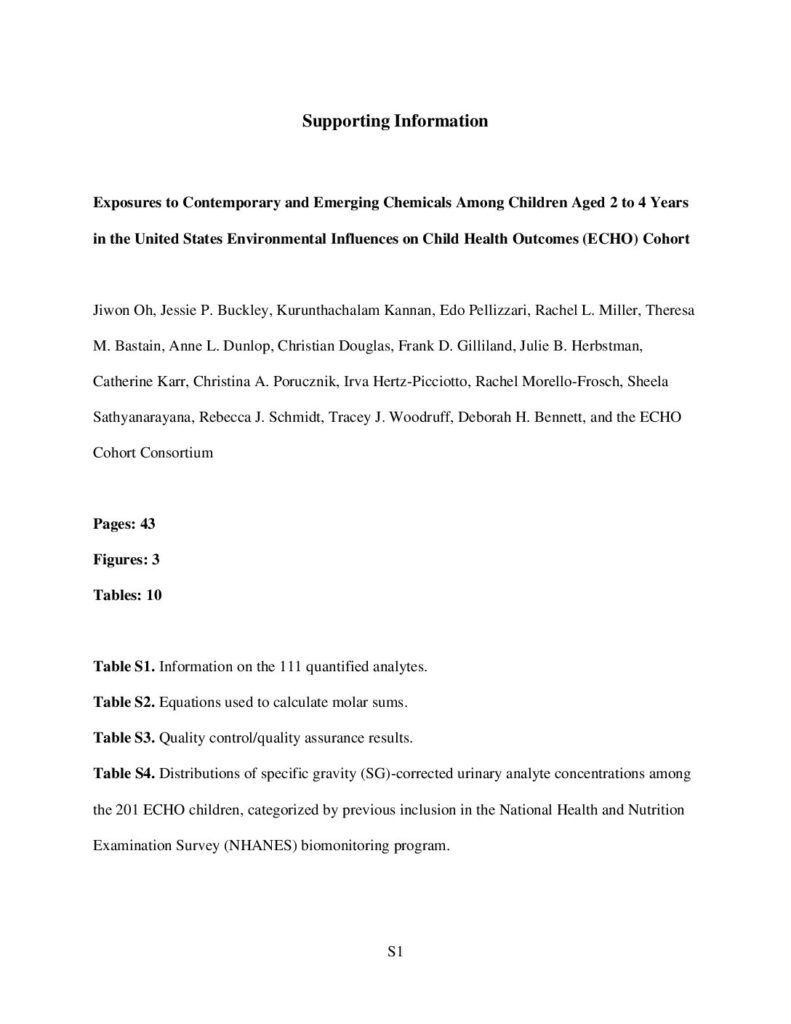
The study, “Exposures to Contemporary and Emerging Chemicals among Children Aged 2 to 4 Years in the United States Environmental Influences on Child Health Outcome (ECHO) Cohort,” reveals that U.S. preschoolers are routinely exposed to dangerous levels of toxic chemicals. This landmark research shows that children are absorbing a complex mix of both legacy and emerging chemicals—many of which are not currently tracked in national surveys. Exposure levels are especially high among more vulnerable subgroups, with substitutes like DINCH and newer pesticides increasingly found in children’s bodies. The findings underscore the urgent need for expanded monitoring and stronger environmental protections focused on children’s health.

Air fresheners and scented candles may seem harmless, but they can release a range of harmful chemicals into your home’s air, including phthalates, volatile organic compounds (VOCs), and formaldehyde. These chemicals can irritate the eyes, nose, and throat, trigger asthma attacks, and may interfere with hormone function, especially in young children whose bodies are still developing. Some scented products also release ultrafine particles that can penetrate deep into the lungs, increasing the risk of respiratory problems over time. Choosing fragrance-free cleaning products and using fresh air ventilation or natural options like baking soda for odor control can help reduce your family’s exposure to these hidden dangers while keeping your home safer and healthier.

Practical Takeaways for Parents:

  • Choose products labeled “phthalate-free,” “paraben-free,” and “fragrance-free.”

  • Avoid plastics with recycling codes #3, #6, and #7.

  • Maintain hygiene through frequent handwashing, good ventilation, and regular dust cleaning.

  • Reduce pesticide exposure by washing produce thoroughly or choosing organic when possible.

Exposures to Contemporary and Emerging Chemicals Among Children Aged 2 to 4 Years in the United States Environmental Influences on Child Health Outcomes (ECHO) Cohort

bookmark_borderWatching Genocide in Real Time

Ahmed said:
Indeed, I am speaking to you, my friend, from the ground, and through eyewitnesses who went to receive aid from the Gaza Humanitarian Foundation. People’s testimonies are full of oppression. They humiliate people, push them to push, and shoot at them whenever they approach the aid sites. They starve us and prevent us from approaching. They treat us like slaves. We must all be held accountable. This foundation must close its doors.And that all those who created and contributed to it be held accountable. And that it be replaced and distributed through UNRWA and the World Food Organization.

Genocide in Real Time

by Daniel Brouse
July 6, 2025

It is profoundly disturbing to witness the systematic genocide of a people in real time. Schools and hospitals have been bombed into rubble. Farmland has been contaminated with chemical weapons, ensuring long-term food insecurity and poisoning the soil for generations. The infrastructure—roads, electricity, water treatment plants—has been deliberately destroyed, leaving sewer water running through streets while disease spreads among the displaced.

Tens of thousands of children have been killed by these bombings, with countless others left as amputees, forced to undergo surgery without anesthesia or pain medication due to the total collapse of medical supply chains. Entire families are starving under siege, cut off from food, water, and basic medical care as fuel blockades prevent bakeries from operating and hospitals from functioning.

Now, these children and families are being driven into so-called “humanitarian zones,” which the UN itself has labeled “death traps.” People are herded under the promise of safety only to be bombed again, creating a cycle of forced displacement, starvation, and mass death—all documented, all visible to the world.

A few arrest warrants for war crimes have already been issued, but many more are needed, including for leaders in the United States who enable, arm, and defend these atrocities. It is a grim reflection on our own nation’s moral collapse that we continue to fund, support, and justify these actions while calling ourselves a beacon of democracy and human rights.

In a bitter twist of irony, it may be Donald Trump’s own reckless fiscal policies that finally dethrone the United States from its position of global leadership. Stripped of its exceptionalism and credibility, the U.S. may eventually face the same legal accountability it has helped to avoid for itself and its allies for decades. Perhaps then, at last, the world will be able to hold war criminals to account—no matter how powerful they are or where they hide.

Evangelical Christianity and Israel
If you’re curious about the driving force behind US support for Israel, it’s ironically rooted in Evangelical Christianity. Many Evangelical Christians believe they can hasten the “second coming of Christ” by bringing about the apocalypse. According to their interpretation of the Bible, this involves Israel reclaiming Jerusalem, Jesus returning, and ultimately eliminating all Jews. For numerous “Christian Zionists,” especially influential evangelists aligned with the Republican Party, support for Israel is less about political strategy and more about its supposed role in biblical prophecy. In this worldview, war is not something to be avoided but embraced as a divine necessity—an inevitable and even celebratory step toward Jesus’ rule from the Temple Mount in Jerusalem. The fate of Jews and Palestinians is, to put it mildly, seen as collateral damage.

Trumpenomics: The Decline of the US