bookmark_borderBlack Zombie Fires and the Rise of Green Unicorn Algae

Daniel Brouse and Sidd Mukherjee
February 5, 2026

Introduction

For decades, Sidd and I have studied applied systems analysis in nonlinear dynamic climate systems. We have co-authored papers on carbon cycles, jet stream dynamics, albedo shifts, brown carbon, AMOC instability, permafrost thaw, Amazon rainforest dieback, sea-level rise pulses, hydroclimate whiplash, Arctic sea ice loss, and interacting tipping points — using a probabilistic, ensemble-based model integrating socio-economic and ecological feedbacks within a dynamic nonlinear framework.

For many years, much of it remained theoretical.

By the early 2000s, we had gathered sufficient evidence to articulate what we called The Nonlinear Acceleration Hypothesis:

Climate feedback loops do not act independently.
They interact synergistically in what we termed the Domino Effect — a cascade of tipped tipping points in which each destabilized system accelerates the next.

Since then, what was once hypothesis has steadily moved toward mainstream climate science. By 2024, the acceleration was observable to the layperson. As Sidd would say: “Just look out your window.”

The real issue is not any single dramatic event. It is the cumulative interaction of multiple reinforcing feedback loops that amplify warming and destabilization.

For example, a recent study identified a previously underappreciated Ice–Albedo feedback: mineral dust deposited on the Greenland ice sheet promotes algal growth, darkening the ice and accelerating melt. This raises deeper questions:

How many such feedback mechanisms exist?
How do they interact?
And how do they collectively influence the pace and severity of climate change?

Fully cataloguing every feedback may be impossible. A practical heuristic may therefore be more useful. Our research suggests that many observable climate impacts are doubling in intensity or frequency on timescales of roughly 2 to 10 years. At current emission levels — with multiple feedbacks already activated — large regions of Earth risk becoming increasingly uninhabitable within this century.

A Deep Dive Into Unimaginable Feedbacks

The apparent acceleration has shifted from century-scale doubling to multi-year doubling within just three decades — not three millennia.

In 2023, Sidd remarked:

“Do you remember in the early 2000s when we thought we wouldn’t live to see the extreme changes from global warming?”

I replied:

“2023 may be the most significant year yet. We saw confirmation of tipping dynamics involving mountain glaciers, Greenland mass loss, Antarctic destabilization, and potentially AMOC weakening.”

Sidd responded:

“We suspected those. What stunned me was Canada burning. I never thought I’d see that.”

I asked:

“Will permafrost peatlands produce sustained zombie fires and trigger large-scale thaw feedback?”

Sidd answered:

“They already are. Siberia showed us.”

By 2025, I reflected:

We anticipated tipping points would eventually activate self-reinforcing loops. I was prepared for that in theory.

What I did not fully envision was the speed of interaction — the rapid coupling of physical, ecological, and economic systems into cascading acceleration.

Abstract models were becoming measurable reality.

Black Zombie Fires and Green Unicorn Algae

In the 1990s, neither of us fully accounted for the scale of human delay. We assumed mitigation would begin in earnest. It did not.

By 2026, feedback loops that once seemed remote were unfolding in real time.

Permafrost: From Slow Thaw to Persistent Fire

Old assumption:
Permafrost would thaw gradually over centuries to millennia, steadily releasing CO₂ and CH₄.

Observed reality:
Large regions are no longer reliably frozen. Peatlands and thawed soils are igniting — sometimes overwintering as “zombie fires” beneath snowpack — releasing greenhouse gases on compressed timescales.

This introduces significant uncertainties:

  • Combustion accelerates CO₂ release.
  • Methane may combust in situ, converting to CO₂ (less potent but still warming).
  • A substantial fraction likely escapes unburned.
  • The net balance between flaring and direct methane release remains poorly constrained.

What is clear: release rates are faster than many early models anticipated. These feedbacks are no longer theoretical.

Linear Ice Loss Meets Nonlinear Surface Processes

Separately, we had been discussing Greenland’s near-linear cumulative ice mass loss over the past 25 years — surprising in a system governed by nonlinear physics.

Then came an additional layer.

A 2026 University of Waterloo study found that windblown mineral dust from proglacial regions supplies phosphorus to surface algae on the Greenland ice sheet. The algae darken the ice, reduce albedo, and accelerate melt — a self-reinforcing loop.

Sidd added:

“And smoke and dust from Canadian wildfires — not to mention Russian ones.”

That connection reframed the system.

Glacial retreat exposes sediment.
Sediment and wildfire aerosols are transported by intensifying wind patterns.
Nutrients land on ice.
Algae bloom.
Albedo drops.
Melt accelerates.

Regional feedbacks intertwine across continents.

I found myself thinking:

Glacial retreat alters weather patterns — rain, wind, atmospheric circulation —
transporting sediments and aerosols onto remaining ice sheets.
Surface darkening becomes biological terraforming.
Algae plumes and blooms spread.
Feedbacks cascade.

Not abstractly —
but visibly.
Now.

Canada and Russia’s wildfire carbon fallout adds an unmistakably international dimension.

Such strange interacting loops:

Black zombie fires.
Green unicorn algae.

The poetic framing reflects something real: systems interacting in ways that once seemed implausible but are now measurable.

A Final Question

If permafrost combustion and biologically enhanced albedo reduction are active, what other feedbacks are emerging?

  • Boreal forest transition from carbon sink to source
  • Ocean stratification weakening biological carbon pumps
  • Soil microbial regime shifts under heat stress
  • Aerosol–cloud interactions altering regional precipitation
  • Jet stream persistence amplifying drought-flood oscillations

The central challenge is not identifying one catastrophic event.
It is understanding the network.

The nonlinear acceleration of interacting systems may be the defining feature of this century.

The question is no longer whether feedbacks exist.

It is how many are already active — and how tightly coupled they have become.

Easy to Read Resources

Climate Change Made Simple: Understanding Feedback Loops and Acceleration

The Nonlinear Acceleration Hypothesis: Easy-Read Format
Chaos Theory Basics (quick refresher)

Statistical Mechanics and Chaos Theory in Climate Science

bookmark_borderAccelerating Climate Collapse: Understanding Feedback Networks and Their Impact

by Daniel Brouse and Sidd Mukehrjee

Climate doesn’t respond instantly — it has inertia. The oceans absorb enormous amounts of heat, so even after greenhouse gases are emitted, warming continues for years and decades. That’s why the hottest days of summer come weeks after the longest day of the year — the system takes time to heat up.

Permafrost is already thawing and releasing carbon, adding more greenhouse gases to the atmosphere and reinforcing warming. But it’s only one piece of a larger pattern of interacting feedbacks:

Ice–Albedo Feedback — As reflective ice disappears, darker land and ocean surfaces absorb more heat, locking in additional warming.

Permafrost Thaw & Boreal Fires — Thawing soils and intensifying wildfires release vast quantities of CO₂ and methane.

Amazon & Rainforest Dieback — Critical carbon sinks are shifting from absorbing carbon to emitting it.

Ocean Circulation Disruption — Weakening currents are destabilizing weather patterns, affecting jet streams, monsoons, and global food systems.

Marine Ecosystem Stress — Coral bleaching and plankton decline threaten fisheries and ocean-based food security.

Soil Degradation & Crop Failure — Intensifying drought and heat stress are reducing yields, increasing famine risk and forced migration.

Individually, each of these feedbacks is serious. Together, they form an interconnected network of reinforcing processes that amplify overall climate instability. As these feedbacks compound, the energy in the system increases — helping explain why extreme weather events are becoming more frequent, more intense, and more disruptive.

The real issue isn’t just one dramatic event — it’s the stacking and interaction of multiple feedbacks that accelerate climate change. For example, a January study revealed a new feedback mechanism tied to the Ice–Albedo Feedback: mineral dust promotes algae growth, which speeds up the melting of the Greenland ice sheet. But how many feedback mechanisms exist, and how do they interact?

To better understand the pace of this acceleration, more research on all feedback mechanisms is needed. Since this may be an impossible task, adopting a practical rule of thumb is helpful. Our research suggests that climate change impacts are doubling every 2 to 10 years for most climate-related events, underscoring the rapid rate of acceleration. At current emission levels and with multiple feedback loops already activated, much of the Earth is likely to become uninhabitable within this century.

The Human Induced Climate Change Experiment

Additional Resource:

Large-scale melting of the Greenland Ice Sheet is irreversible and happening at a rapid rate, and now a new international study is the first to understand why. A University of Waterloo scientist and a team of international collaborators found that airborne mineral dust and other aerosols are directly connected to how much algae grows on the ice. The algae interfere with albedo, or the reflection of the sun’s rays, exacerbating melting. The work is published in the journal Environmental Science & Technology.

bookmark_borderEconomic Collapse and the Trump Card: When Leverage, Confidence, and Credibility Fail

by Daniel Brouse
February 4, 2026

Past Performance Does Not Necessarily Predict Future Performance

Every prospectus carries the familiar warning: “Past performance does not guarantee future results.” It is a mandatory SEC disclosure reminding investors that historical returns — whether strong or weak — do not reliably predict what comes next.

That disclaimer guards against naïve extrapolation. It does not require us to ignore patterns of behavior, capital structure, or governance. In periods of financial stress, history often serves less as prophecy and more as a diagnostic tool — a way to identify recurring risk dynamics before they become systemic failures.

A Case Study in Leverage: The Original DJT

The original stock trading under the ticker symbol DJT belonged to Trump Hotels & Casino Resorts (THCR), founded in the 1990s. The company operated high-profile properties including Trump Plaza, Trump Taj Mahal, and Trump Marina in Atlantic City. When it went public in 1995, the primary objective was not organic growth, but debt refinancing and balance sheet expansion.

From the beginning, the business model depended heavily on leverage. Junk bond financing and high interest obligations left the company acutely vulnerable to downturns in revenue and shifts in demand.

Financial distress predated the IPO. In 1991, the Trump Taj Mahal filed for Chapter 11 bankruptcy after failing to service more than $1 billion in debt. Trump surrendered roughly half of his ownership stake but retained operational control.

In 2004, Trump Hotels & Casino Resorts — by then publicly traded under DJT — entered bankruptcy again. Creditors took greater control, though Trump remained chairman. In 2009, after rebranding as Trump Entertainment Resorts, the company filed for Chapter 11 a third time. Trump resigned as chairman and exited the board, retaining only a minority stake.

The final collapse came in 2014. The company entered bankruptcy for the fourth time, shuttering Trump Plaza and Trump Taj Mahal. DJT equity was wiped out. Assets were sold. Shareholders absorbed the losses.

Across Trump’s broader business portfolio, bankruptcy counts vary depending on methodology. Most mainstream sources cite at least six corporate bankruptcies, with broader accounting placing the total higher. What remains consistent is the pattern: aggressive leverage, restructuring through bankruptcy, and the transfer of financial losses to creditors, investors, and employees.

This history is not a moral judgment. It is a structural one.

Highly leveraged systems perform well during expansion and fail rapidly during contraction. When debt exceeds sustainable cash flow, restructuring becomes inevitable. When confidence erodes, capital exits.

The disclaimer is technically correct. But capital structures, incentives, and decision-making patterns tend to rhyme.

The Anatomy of Economic Collapse

Economic collapse rarely arrives without warning. It follows a recognizable sequence:

  1. Excessive leverage

  2. Rising borrowing costs

  3. Policy distortion

  4. Erosion of institutional credibility

  5. Loss of confidence

  6. Liquidity failure

Systems built on debt can appear stable — even prosperous — for extended periods. But when revenue growth fails to keep pace with obligations, fragility becomes exposed. Collapse is rarely caused by a single shock. It is the cumulative result of unsustainable fiscal practices, mispriced risk, delayed correction, and declining trust.

When confidence breaks, capital moves quickly. Liquidity evaporates. Asset values reset. What once appeared resilient reveals itself as structurally overextended.

History does not predict timing. It reveals mechanics. And those mechanics are always governed by math — debt arithmetic, cash flow constraints, and the psychology of confidence.

Trumpenomics: Private-Sector Logic Applied to a Nation-State

Trump’s approach to national economic policy mirrors his private-sector playbook: maximize leverage, defer reckoning, and rely on confidence and branding to sustain financing.

His policies are actively reshaping — and in key respects destabilizing — the post–World War II economic order. As of January 2026, central bank gold holdings by market value have surpassed official U.S. Treasury holdings as the world’s largest reserve asset class for the first time since the mid-1990s, exceeding $4 trillion. That shift reflects accelerating reserve diversification and growing concern over U.S. fiscal sustainability and geopolitical reliability.

Repeated disruptions of trade agreements and alliance structures have weakened international trust in U.S. policy continuity. Confidence is the foundation of any reserve system. When credibility erodes, diversification accelerates.

At the same time, sustained political pressure on the Federal Reserve risks undermining perceptions of central bank independence — another core pillar supporting global confidence in U.S. financial leadership.

The central question is no longer whether structural imbalances exist, but whether policy actions can delay their visible consequences.

Delay Mechanisms and Their Limits

Several mechanisms may temporarily cushion stress:

  • Political pressure on the Fed to absorb blame

  • Regulatory adjustments that artificially increase Treasury demand

  • Promotion of stablecoins backed by U.S. government debt

  • Public encouragement of domestic bond purchases

Each may buy time. None alters the underlying arithmetic.

There is also evidence that the Fed itself is attempting to pre-empt growing strain. Cutting short-term rates — despite political pressure for more aggressive easing — has not relieved market stress. Long-term Treasury yields have risen since rate cuts began, signaling that markets are pricing fiscal risk and inflation expectations independently of policy rates.

More important than interest rates is the balance sheet. The Fed has resumed purchasing billions of dollars in Treasuries each month and is adjusting its holdings of mortgage-backed securities. These are liquidity management operations — stabilizing funding markets beneath the surface.

Simultaneously, the administration is moving to reorganize Fannie Mae (FNMA) and Freddie Mac (FMAC), which underpin most U.S. mortgages. Here, systemic risk deepens. Public denial of climate risk does not remove it. Climate change is already one of the largest long-term threats to mortgage markets — from coastal flooding and wildfire exposure to extreme heat and insurance withdrawal. If underwriting, insurance markets, and federal backstops remain misaligned with physical reality, mortgage risk can reprice abruptly.

Monetary policy can manage liquidity. It cannot erase structural exposure — fiscal, environmental, or credibility-based.

Warning Signals in Plain Sight

Recent data provide concrete examples of stress masking:

  • Employment reporting: While the Bureau of Labor Statistics maintains core methodology, unusually large revisions and methodological shifts are revealing that hundreds of thousands of jobs previously reported no longer exist.

  • Agriculture: The chair of the U.S. Senate Agriculture Committee has warned of heavy losses across farming sectors. More than two dozen former industry leaders have cautioned of a potential “widespread collapse of American agriculture,” prompting a $12 billion emergency bailout amid falling commodity prices, rising input costs, trade disruptions, and tightening credit.

These interventions do not change rollover risk, deficit arithmetic, or rising interest expense. Financial history is clear: interventions may delay reckoning, but they rarely eliminate it.

The Trump Card

The defining risk is not messaging or political theater. It is whether fiscal sustainability and institutional credibility can be restored before confidence thresholds are crossed.

Trump’s private-sector history demonstrates a strategy of postponing collapse through leverage, restructuring, and narrative control. Applied at the scale of a nation-state, that strategy becomes exponentially more dangerous.

Past performance does not guarantee future results.

But when leverage, confidence, and credibility all deteriorate at once, the math becomes unforgiving.

Trumpenomics

bookmark_borderStorm Warnings Over America’s Heartland: Senate Leaders and Industry Veterans Warn of Agricultural Crisis

The chair of the U.S. Senate Agriculture Committee issued a stark warning Tuesday: American farmers are absorbing heavy losses across multiple sectors, and the financial strain is intensifying. At the same time, more than two dozen former agricultural industry leaders released a joint statement cautioning that the nation faces the risk of a “widespread collapse of American agriculture” if structural pressures are not addressed.

Their concerns come as a $12 billion federal bailout package is expected to reach growers this month — an emergency measure intended to stabilize farm incomes amid falling commodity prices, rising input costs, trade disruptions, and tightening credit conditions.

Mounting Financial Strain

Farmers are confronting a convergence of pressures:

  • High input costs for fuel, fertilizer, equipment, and labor
  • Volatile commodity prices and shrinking margins
  • Trade instability limiting export markets
  • Rising interest rates increasing the cost of operating loans and land financing
  • Extreme weather events damaging crops and livestock

Many producers operate on thin margins even in strong years. When multiple stressors hit simultaneously, liquidity evaporates quickly. Debt servicing becomes harder, refinancing options narrow, and generational farms become vulnerable to consolidation or foreclosure.

Bailout or Bandage?

The $12 billion aid package may provide short-term relief, but critics argue it functions more as a stopgap than a solution. Emergency payments can stabilize cash flow temporarily, yet they do not resolve structural issues such as:

  • Long-term trade realignment
  • Climate-related crop volatility
  • Market concentration among processors and distributors
  • Escalating insurance and reinsurance costs

Former industry leaders warning of collapse argue that without systemic reform — including trade clarity, supply chain resilience, and climate adaptation strategies — federal assistance will become recurring rather than exceptional.

The Broader Economic Risk

Agriculture is not an isolated sector. It underpins rural economies, food security, export revenues, transportation networks, and credit markets. A sustained contraction would ripple outward:

  • Rural banks exposed to farm loans could face elevated default risk.
  • Equipment manufacturers and input suppliers would see demand decline.
  • Food prices could become more volatile.
  • Land values — often used as collateral — could weaken.

In short, stress in agriculture can migrate into the broader financial system.

A Structural Crossroads

The warning from lawmakers and former industry leaders signals more than a bad season. It reflects a deeper reckoning over how American agriculture adapts to:

  • Changing global trade dynamics
  • Climate variability and extreme weather
  • Technological transition and consolidation
  • Rising financial leverage

Whether the current bailout acts as a stabilizer or merely delays a larger adjustment remains uncertain. What is clear is that confidence — in trade policy, credit markets, and long-term sustainability — is becoming as critical to farmers as rainfall and soil quality.

The heartland is sending a signal. Policymakers now face the question: will they treat it as a temporary setback, or as an early warning of structural transformation?

Trumpenomics

bookmark_borderYouth Mental Health in the Era of Accelerating Climate Extremes: Psychological Trauma, Agency, and the Emerging Molecular Health Crisis

Daniel Brouse
February 2, 2026

Abstract

Recent peer-reviewed research published in Nature (2026), PNAS, and a January 2026 analysis in Taylor & Francis Online converges on a stark conclusion: climate change now constitutes a measurable and escalating threat to youth mental health. Extreme weather exposure, chronic climate disruption, and perceived governmental inaction are driving significant increases in post-traumatic stress disorder (PTSD), depression, anxiety, and climate-related distress among children and adolescents worldwide.

Approximately half of reported psychological burden appears directly linked to lived exposure to climate disasters; the remaining burden reflects a crisis of agency — young people’s recognition of existential threat coupled with limited power to alter outcomes. Simultaneously, escalating heat exposure and pollution are exerting measurable biological stress at the cellular and epigenetic level. Together, these findings suggest that climate change is not only an environmental and economic emergency but a multi-generational public health crisis spanning mental and physical domains.

1. Introduction

The climate system’s accelerating instability is increasingly mirrored in the psychological health of younger generations. Unlike abstract environmental concerns of prior decades, today’s youth are growing up amid direct, recurrent, and intensifying exposure to floods, hurricanes, tornadoes, extreme rainfall, landslides, drought, extreme heat, bomb cyclones, wind shear events, hailstorms, wildfires, and zoonotic disease outbreaks.

The cumulative effect is no longer speculative. It is clinically observable.

Research in Nature (2026) and related analyses demonstrate that climate change is contributing to measurable increases in PTSD, depression, anxiety disorders, and chronic distress among children and adolescents. Many young people report feelings of betrayal and abandonment, citing perceived governmental inaction in the face of escalating evidence.

2. Widespread Distress and Solastalgia

A defining feature of this crisis is the phenomenon of solastalgia — often described as “homesickness while still at home.”

Unlike eco-anxiety, which is anticipatory fear about future environmental collapse, solastalgia arises when one’s immediate home environment is visibly degraded. It is the distress of watching familiar landscapes burn, flood, dry, or decay.

Key findings indicate:

  • Increasing climate-related disasters and heat exposure are directly associated with higher rates of anxiety, depression, and PTSD in children.
  • Communities repeatedly exposed to extreme events exhibit compounding psychological harm.
  • Emotional distress often intensifies when environmental change alters identity, place attachment, and cultural continuity.

The PTSD reported by youth is frequently rooted in direct lived experience — evacuations, home loss, displacement, community destruction, and prolonged instability.

3. Direct Exposure and the Paradox of Agency

A study published in PNAS finds that direct experience with climate-related disasters correlates strongly with increased eco-anxiety and functional impairment. However, the same exposure can also catalyze adaptation behaviors and activism.

This introduces a paradox.

Approximately 50% of mental health burden appears to stem from direct trauma exposure. The remaining burden relates to agency — or lack thereof.

Children and adolescents possess the cognitive capacity to understand the existential dimensions of climate destabilization. Their distress is amplified not by ignorance, but by insight. What compounds the trauma is the recognition that decision-making power rests largely with adults whose responses are often perceived as insufficient, dismissive, or delayed.

The psychological strain thus reflects both trauma and moral injury.

4. Climate Change as a Dual Health Crisis

The emerging data suggest that climate change must be understood as both a mental and physical health emergency.

4.1 Heat Mortality and Rising Exposure

  • Global heat-related deaths now approximate one fatality per minute during peak periods.
  • Over the past four years, the average person has endured approximately 19 days annually of life-threatening heat exposure, largely attributable to anthropogenic warming.
  • Extreme heat contributes to heatstroke, dehydration, acute kidney injury, cardiovascular stress, and respiratory complications.
  • Heat exposure worsens pre-existing heart and lung diseases and increases hospitalization rates.

Heat stress also directly exacerbates depression, anxiety, aggression, and suicide risk.

5. Climate Extremes and Cellular Breakdown

Prolonged exposure to extreme heat accelerates biological aging. Research indicates:

  • Tissue damage linked to chronic heat stress.
  • Telomere shortening, a marker of accelerated cellular aging.
  • Increased risk of chronic diseases including cancer, dementia, and diabetes.

These risks are compounded by pollution exposure and infectious disease burden. Climate-related stressors do not act in isolation; they interact and amplify vulnerability across organ systems.

6. Epigenetic Changes: The Molecular Convergence of Climate Stressors

A critical and emerging dimension of this crisis involves epigenetic modification — chemical changes that regulate gene expression without altering the underlying DNA sequence.

Epigenetic mechanisms function as molecular switches, activating or silencing genes in response to environmental stimuli.

Extreme heat, tropospheric ozone exposure, and COVID-19 infection have all been associated with epigenetic alterations linked to:

  • Cardiovascular disease
  • Diabetes
  • Cancer susceptibility
  • Neurodegenerative disorders
  • Immune dysregulation

When multiple stressors occur simultaneously — heat, pollution, infection, psychological trauma — their effects compound rather than merely accumulate. These converging stressors may increase lifetime disease risk and potentially influence transgenerational health outcomes.

This represents a shared biological pathway through which climate destabilization translates into long-term systemic illness.

7. Intergenerational Implications

The possibility that stress-induced epigenetic modifications may influence subsequent generations raises profound ethical and policy implications. Climate-driven biological stress today may shape disease risk tomorrow.

Thus, the youth mental health crisis is not an isolated psychological phenomenon. It is embedded within broader ecological, physiological, and social systems undergoing rapid destabilization.

8. Conclusion

The emerging research makes clear that climate change is a cascading public health emergency affecting both mind and body.

Youth mental distress reflects:

  • Direct trauma from climate disasters,
  • Chronic environmental degradation (solastalgia),
  • Existential awareness without adequate agency.

Simultaneously, climate stressors are accelerating cellular aging, increasing chronic disease risk, and potentially altering gene expression across generations.

Addressing climate anxiety cannot be separated from addressing climate change itself. Tangible mitigation, adaptation, and accountability are not only environmental imperatives — they are mental health interventions.

Recognizing adult responsibility in driving this crisis may be uncomfortable. Yet acknowledging that responsibility may be the first step toward restoring both ecological stability and psychological resilience.

The climate crisis is no longer abstract. It is lived, felt, and embodied — particularly by those who will inherit its consequences.

The Human Induced Climate Change Experiment

bookmark_borderCracked Fractals: Climate Thermodynamics, Insurance Instability, and Sovereign Debt Transmission in Late-Stage Capitalism

by Daniel Brouse (February 2, 2026 update to an ongoing study)

Abstract

The relationships between climate physics and modern financial structure are complex, dynamic, and fundamentally non-linear. This paper examines the transmission mechanisms linking climate destabilization to structural fragility within advanced capitalist economies. Drawing on thermodynamics, actuarial science, and sovereign debt dynamics, it argues that the insurance sector functions as the primary systemic tripwire between physical climate risk and financial abstraction. Evidence from Florida and California demonstrates how accelerating climate losses are already migrating from private balance sheets to public backstops. As these liabilities propagate through municipal bonds, mortgage-backed securities, and ultimately federal debt, the system exhibits the instability patterns of complex systems approaching critical thresholds—what I describe as “cracked fractals.” The convergence of climate acceleration and fiscal overextension suggests not isolated sectoral stress, but the emergence of systemic collapse dynamics.

1. Introduction: Nonlinear Coupling of Climate and Capital

Climate systems and financial systems share defining characteristics: feedback loops, lag structures, threshold behavior, and sensitivity to compounding shocks. Both are governed by non-linear dynamics. Small perturbations can produce outsized consequences when systems are near critical states.

In previous work, I have described the interaction between climate destabilization and financial fragility through a “Domino Effect” framework. The metaphor applies equally to ice sheets and balance sheets. When one structural support fails, stress redistributes across the network. In tightly coupled systems, redistribution accelerates failure elsewhere.

The central analytical question is not whether climate change affects the economy—it demonstrably does—but how physical climate risk transmits into financial architecture, and where the first irreversible fractures appear.

2. Insurance as Systemic Tripwire

The insurance sector occupies the interface between physical risk and financial abstraction. It translates meteorological volatility into actuarial pricing and reserve allocation. When tail risks accelerate beyond historical probability distributions, actuarial tables lose predictive reliability. At that point, the system’s shock absorbers begin to fail.

This failure mode is already visible in:

  • Property insurance withdrawals from high-risk geographies
  • Rapid repricing of premiums
  • Reinsurance market tightening
  • Escalating deductibles and coverage exclusions

Insurance does not create climate risk; it prices it. When pricing becomes impossible, risk migrates.

3. Florida and California: Real-Time Case Studies

Florida and California provide contemporary illustrations of this transmission dynamic.

Florida:
Repeated hurricane losses have driven private insurers into insolvency or retreat. Citizens Property Insurance Corporation—the state-backed insurer of last resort—has become the largest property insurer in the state. Citizens is ultimately backed by policyholder surcharges and post-event assessments that function as a quasi-tax. Climate risk has therefore migrated from private capital to public balance sheets. This model is politically expedient but structurally fragile: if losses outpace premium growth and reserve accumulation, the public backstop itself becomes a destabilizing liability.

California:
Escalating wildfire losses have led major carriers to pause or withdraw new policies. Exposure has shifted toward the California FAIR Plan, increasing the state’s implicit fiscal exposure. As in Florida, the public sector has become the de facto reinsurer of last resort.

In both cases, actuarial strain precedes broader financial contagion. Insurance is the first derivative that breaks.

4. Contagion Pathways

Once insurance destabilizes, transmission channels are straightforward:

  1. Municipal Infrastructure Bonds
    Communities facing repeated disasters encounter rising borrowing costs and impaired credit ratings.
  2. Mortgage-Backed Securities (MBS)
    Real estate values depend on insurability. If coverage becomes unaffordable or unavailable, collateral assumptions underlying MBS structures erode.
  3. Federal Backstops and U.S. Treasuries
    Disaster recovery increasingly migrates to federal balance sheets. As sovereign exposure rises, climate risk becomes embedded in national debt markets.

Bond markets rarely collapse in isolation. They absorb and socialize losses until confidence fractures. Insurance is simply the earliest visible fracture plane.

5. Cracked Fractals and Statistical Deviation

The U.S. economy and climate system increasingly resemble complex systems approaching critical thresholds—what I term “cracked fractals.” These fragile branching patterns represent fragmented stability and inflection points beyond which recovery becomes progressively constrained.

Key indicators—including federal deficits, disaster recovery expenditures, housing unaffordability, and insurance exposure—are now running 2 to 3 standard deviations above historical norms. When multiple independent systems deviate simultaneously at that magnitude, the signal is structural, not cyclical.

Through the lens of chaos theory and nonlinear dynamics, such clustering of extreme deviations indicates tightening feedback loops. Climate volatility increases fiscal strain; fiscal strain reduces adaptive capacity; diminished adaptation increases climate damages. The system begins to fracture along its weakest seams.

6. Integrating Thermodynamics, Actuarial Science, and Sovereign Debt

Climate acceleration is thermodynamically grounded. Greenhouse gas accumulation increases radiative forcing, intensifies energy imbalances, and drives nonlinear physical responses. These physical processes do not negotiate with financial models.

Simultaneously, sovereign debt expansion in advanced economies has accelerated. Aging populations and slowing labor-force growth undermine the growth assumptions that traditionally support debt sustainability. In several Western nations, restrictive immigration policies further weaken demographic resilience, while rapid advances in automation and AI introduce structural labor displacement that complicates income growth, tax base stability, and long-term fiscal balance.

Overlaying these trends are trillions of dollars in climate-related healthcare expenditures, infrastructure repair, disaster recovery, and supply chain disruption. As these costs compound, fiscal space narrows. When exponential climate acceleration meets expanding sovereign liabilities, the result is a coupled instability—what can be described as a domino effect across thermodynamic and financial domains.

Both systems—climate and sovereign debt—exhibit trajectories that are unsustainable under current structural assumptions.

7. Conclusion

The destabilization of insurance markets in high-risk states is not a regional anomaly; it is an early-stage manifestation of a broader structural convergence. Climate thermodynamics and financial architecture are not separate systems—they are dynamically coupled.

Insurance represents the first systemic derivative to fail because it directly translates physical volatility into financial liability. As that failure propagates through municipal finance, mortgage markets, and sovereign debt, the risk becomes nationalized and eventually globalized.

The emerging pattern is not cyclical stress but nonlinear convergence toward structural thresholds. Recognizing insurance instability as the primary transmission mechanism clarifies both the scale of the risk and the urgency of structural reform.


References and Related Work

Brouse, D. (2025). Deviation, Cracked Fractals, Climate, and Economics.
http://membrane.com/global_warming/Cracked-Fractals-Deviations.html

Brouse, D. et al. Insurance Collapse – Introduction.
http://membrane.com/global_warming/Insurance-Collapse-intro.html

Brouse, D. Systemic Collapse.
http://membrane.com/global_warming/Systemic-Collapse.html

Brouse, D. Social-Ecological Feedbacks.
http://membrane.com/global_warming/Social-Ecological-Feedbacks.html

Brouse, D. Dollars and Demise.
http://membrane.com/global_warming/Dollars-Demise.html

Additional materials available at:
http://membrane.com/global_warming/

bookmark_borderCyclogenesis

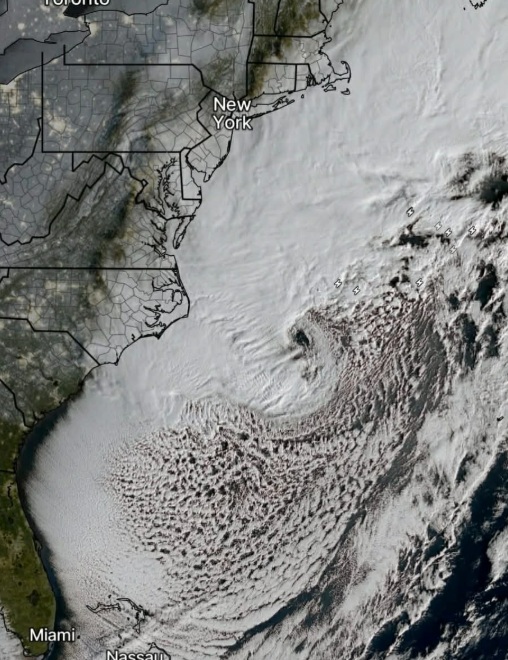
Bomb cyclones (rapidly intensifying mid-latitude extratropical cyclones) are fundamentally driven by baroclinic instability — the conversion of temperature gradients into kinetic energy. Polar amplification is altering those gradients and the background circulation in ways that can favor more extreme storm behavior.

Bomb Cyclone of the East Coast 2026
Bomb Cyclone striking the U.S. East Coast, 2026 — a rapidly intensifying winter storm fueled by sharp temperature contrasts and anomalously warm Atlantic waters.

Here’s how the mechanism works.
1. The Energy Source: Temperature Gradients
Mid-latitude cyclones intensify when:
Cold, dense Arctic air collides with
Warm, moist subtropical air

The stronger the horizontal temperature contrast, the greater the available potential energy for storm development.

Polar amplification complicates this picture.

While the average equator-to-pole temperature gradient is weakening, the structure of that gradient is becoming more uneven and episodic. Instead of a smooth gradient, we now see:

Extreme Arctic warming
Increased sea surface temperatures in the western Atlantic
Larger, sharper localized contrasts during cold-air outbreaks

When Arctic air spills southward over abnormally warm ocean waters, explosive cyclogenesis becomes more likely.

The ocean heat is the fuel.

2. Warmer Oceans = More Latent Heat Release
Bomb cyclones intensify when surface pressure drops ≥ 24 mb in 24 hours.

One of the key accelerants is latent heat release from condensing water vapor.

Because:
Warmer air holds ~7% more moisture per °C (Clausius–Clapeyron relation)

Western Atlantic SSTs are significantly warmer than late 20th-century averages

Arctic amplification contributes to open-water heat release in fall and early winter

Storms now tap into greater moisture and ocean heat reservoirs.

This increases:
Pressure falls
Wind speeds
Precipitation intensity
Storm surge potential
The thermodynamic ceiling is higher.

3. Jet Stream Destabilization
Polar amplification reduces the equator-to-pole temperature gradient on average, which weakens and slows the jet stream.

A slower jet stream tends to:
Meander more (amplified Rossby waves)
Stall weather systems
Create deeper troughs and ridges

These amplified waves can:
Pull Arctic air farther south
Inject subtropical moisture farther north
Enhance upper-level divergence (critical for surface pressure drops)
That combination supports explosive cyclogenesis.

So even if the mean gradient weakens, the waviness and variability of the jet can enhance storm intensification events.

4. Arctic Sea Ice Loss
Reduced sea ice contributes in two ways:
Heat Flux into the Atmosphere
Open water releases stored summer heat in autumn and winter, increasing lower-atmosphere instability.

Enhanced Moisture Supply
More evaporation from ice-free Arctic waters adds atmospheric moisture that can feed developing systems.

This modifies the polar air mass characteristics feeding mid-latitude storms.

5. Intensity
Observed trends suggest:
Greater precipitation rates
Higher wind extremes in some basins
Increased rapid deepening events in the North Atlantic

More extreme compound events (cold + heavy snow + coastal flooding)

Frequency trends are more regionally variable, but the tail risk distribution is thickening — meaning the most extreme storms are becoming more extreme.

6. Nonlinear Feedback Context
In our broader framework of nonlinear climate acceleration:

Bomb cyclones represent:
A dynamical response to polar amplification
A thermodynamic response to warmer oceans
A circulation response to jet destabilization

They are not isolated phenomena. They are manifestations of interacting feedback loops:
Ice-albedo feedback
Ocean heat uptake
Jet stream destabilization
Moisture amplification
The system is not simply warming — it is reorganizing energetically.

Bottom Line

Polar amplification does not just warm the Arctic. It alters:
Temperature gradients
Jet stream behavior
Ocean heat distribution
Moisture availability

Those changes create conditions that favor:
More intense rapid cyclogenesis events
Greater precipitation extremes
Larger pressure drops
Stronger winds and storm surge

Bomb cyclones are one visible symptom of a climate system shifting toward higher-energy variability rather than smooth linear warming.

They are dynamical expressions of amplification.

The Human Induced Climate Change Experiment

bookmark_border2026: Confirmation of Nonlinear Climate Acceleration in the Arctic–North Atlantic System

Daniel Brouse and Sidd Mukherjee
Ongoing Study

Abstract

Recent observational evidence from the Arctic–North Atlantic system indicates that climate change is not proceeding linearly but is accelerating through interacting feedback mechanisms. Arctic amplification has intensified beyond earlier projections, coinciding with destabilization of large-scale atmospheric circulation patterns, increased Greenland Ice Sheet mass loss, nonlinear cryospheric events, and measurable geophysical responses such as rapid isostatic rebound. This paper synthesizes multi-decadal satellite, atmospheric, oceanographic, and cryospheric observations through early 2026, arguing that the collapse of doubling times across key indicators—Arctic temperature anomalies, sea-ice loss, ice mass balance, and circulation variability—confirms a regime shift toward accelerated climate disruption.

1. Introduction

Three decades ago, we proposed that anthropogenic climate forcing would manifest through nonlinear acceleration rather than gradual linear warming. Increasing greenhouse gas concentrations alter Earth’s radiative balance, while feedback loops—albedo loss, water vapor amplification, permafrost carbon release, ocean circulation shifts—compress the “doubling time” of key climate indicators.

As of early 2026, the Arctic provides the clearest confirmation of this hypothesis. Observations demonstrate extreme amplification, destabilized jet stream dynamics, Greenland hydrological disruption, and geophysical rebound occurring at rates inconsistent with linear change.

2. Arctic Amplification and Circulation Destabilization

2.1 Arctic Warming Rates

Arctic amplification has long been observed at approximately three to four times the global mean warming rate (Serreze & Barry, 2011; IPCC AR6, 2021). Since 2006, some Arctic regions have exhibited warming exceeding double the global rate, with episodic winter anomalies reaching 10–20× the hemispheric average during extreme events.

This amplification accelerates:

  • Sea-ice loss, reducing albedo and enhancing ocean heat absorption.
  • Permafrost thaw, increasing methane and CO₂ release.
  • Ocean–atmosphere heat exchange, destabilizing circulation patterns.

The Arctic is transitioning toward a warmer, seasonally ice-diminished state (Overland et al., 2019).

2.2 Jet Stream, Rossby Waves, and SSW Events

As the equator-to-pole temperature gradient weakens, the polar jet stream slows and becomes more meridional (Francis & Vavrus, 2012; Mann et al., 2017). Amplified Rossby waves lead to “stuck” weather regimes—persistent droughts, floods, and cold-air outbreaks.

Sudden Stratospheric Warming (SSW) events—rapid stratospheric temperature increases of up to 50°C within days—disrupt the polar vortex (Baldwin et al., 2021). When displaced, Arctic air masses surge southward while anomalous warmth intrudes northward.

In early 2026, Utqiaġvik (Barrow), Alaska—within the polar night—recorded January temperatures above 40°F, exceeding the previous 36°F January record set in 2017. Concurrently, mid-latitude regions such as the northeastern United States experienced record cold outbreaks. These extremes exemplify circulation destabilization rather than contradiction of warming.

3. Greenland Ice Sheet: Nonlinear Dynamics

3.1 Mass Loss and Sea-Level Contribution

Greenland has lost approximately 169 ± 12 gigatons of ice per year since 2002 (IMBIE Team, 2020), contributing ~14 mm to global mean sea-level rise (SLR). Roughly half of this loss arises from surface melt and runoff, which are projected to intensify under continued Arctic warming.

Recent satellite data show global SLR rates accelerating from ~1.5 mm/yr (1990s) to over 5 mm/yr in 2024–2025 (NASA, 2025), consistent with collapsing doubling times in cryospheric contribution.

3.2 Subglacial Outburst Flood (2025)

The 2025 study Outburst of a Subglacial Flood from the Surface of the Greenland Ice Sheet documented a ~90 million m³ upward-draining flood through ice previously assumed frozen to bedrock. The event fractured the ice sheet and altered downstream glacier flow, demonstrating two-way coupling between basal hydrology and surface melt processes—dynamics not fully represented in current models.

Such nonlinear hydrological feedbacks accelerate ice-sheet instability.

3.3 Dickson Fjord Mega-Tsunami (2023)

In September 2023, a glacier-destabilized landslide in Greenland’s Dickson Fjord triggered a 200-meter mega-tsunami. The resulting seiche generated a global seismic signal lasting nine days, initially classified as an unidentified seismic object (Svennevig et al., 2023; Global Seismology Network data).

The landslide was attributed to glacier retreat destabilizing mountain slopes—an example of cryosphere–lithosphere coupling under warming conditions.

4. Isostatic Rebound and Regional Sea-Level Effects

Greenland’s ice sheet depresses the lithosphere. As ice mass decreases, elastic and viscoelastic rebound occurs. GPS measurements indicate uplift rates exceeding 8 mm/yr in southeastern Greenland (Khan et al., 2016).

Key implications:

  • Local relative sea level may fall, despite global SLR.
  • Crustal stress redistribution may influence seismicity.
  • Peripheral glacier melt contributes up to ~30% of elastic rebound in some regions.

While rebound offsets local sea level temporarily, global redistribution of meltwater increases coastal risk worldwide.

5. Feedback Loop Convergence

The Arctic–Greenland system now exhibits interacting feedback loops:

  • Ice-albedo feedback
  • Ocean stratification and AMOC weakening (Caesar et al., 2021)
  • Permafrost carbon release
  • Jet stream destabilization
  • Subglacial hydrological acceleration

These processes reduce doubling times of climate indicators. Nonlinear acceleration is evident not only in temperature trends but in circulation extremes, cryospheric fracture events, and geophysical responses.

6. Conclusion

The evidence through early 2026 supports the conclusion that climate change is accelerating via interconnected feedback loops rather than progressing linearly. Arctic amplification, destabilized atmospheric circulation, nonlinear Greenland hydrology, accelerating sea-level rise, and rapid isostatic rebound collectively indicate regime-level transition.

The compression of doubling times across these indicators confirms a shift toward exponential intensification. Future projections must incorporate coupled nonlinear dynamics and tipping elements to avoid systematic underestimation of risk.


References

Greenland Slip Sliding Away Mukherjee (2001)
SLR Exponential Fit Mukherjee (2004)
Greenland If the Ice Were Gone Mukherjee (2013)
Sea-Level Rise: Greenland and the Collapse of the East Antarctic Ice Sheet Brouse and Mukherjee (2022)
Baldwin, M. P., et al. (2021). Sudden stratospheric warmings. Reviews of Geophysics.
Caesar, L., et al. (2021). Current Atlantic Meridional Overturning Circulation weakest in a millennium. Nature Geoscience.
Francis, J. A., & Vavrus, S. J. (2012). Evidence linking Arctic amplification to extreme weather. Geophysical Research Letters.
IMBIE Team (2020). Mass balance of the Greenland Ice Sheet from 1992–2018. Nature.
IPCC (2021). AR6 Working Group I Report.
Khan, S. A., et al. (2016). Greenland ice mass loss and crustal uplift. Science Advances.
Mann, M. E., et al. (2017). Influence of anthropogenic warming on planetary waves. Scientific Reports.
NASA (2025). Global Mean Sea Level from Satellite Altimetry.
Overland, J. E., et al. (2019). The urgency of Arctic change. Nature Climate Change.
Serreze, M. C., & Barry, R. G. (2011). Processes and impacts of Arctic amplification. Global and Planetary Change.
Svennevig, K., et al. (2023). Seismic signature of Greenland fjord landslide and seiche event. Geophysical Research Letters.

The Human Induced Climate Change Experiment

bookmark_borderAI, Immigration, and Productivity

by Daniel Brouse
January 29, 2026

Protectionist, nationalist, and anti-immigration economic policies are interacting with — and in some cases accelerating — the rapid deployment of artificial intelligence and automation technologies. Trillions of dollars in public and private capital are now being directed toward AI infrastructure, robotics, machine learning systems, and computational hardware. These investments are fundamentally reshaping labor markets.

Since 2025, both the supply of and the demand for human labor have undergone systemic structural change. On the supply side, immigration restrictions, demographic aging, and declining labor force participation in some sectors have constrained available workers. On the demand side, firms are increasingly substituting capital for labor, deploying AI systems capable of performing cognitive, analytical, logistical, and even creative tasks once thought uniquely human.

Paradoxically, aggregate productivity has continued to rise. Automation has reduced marginal labor costs, accelerated production cycles, optimized logistics, and expanded scalable digital services. In macroeconomic terms, output per worker has increased even as the total demand for certain categories of labor has stagnated or declined. Economic expansion, therefore, is increasingly decoupled from broad-based employment growth.

This structural shift raises critical distributional questions. When capital deepening replaces labor, the gains from productivity growth tend to accrue disproportionately to asset owners, technology firms, and high-skill workers, while mid- and low-skill labor markets face displacement pressures. Anti-immigration policies may temporarily tighten certain labor markets, but in combination with automation incentives, they also encourage firms to accelerate capital substitution strategies.

The result is not the literal “elimination” of humans, but the progressive redefinition of human economic value within production systems. Entire sectors — transportation, customer service, finance, logistics, manufacturing, and portions of professional services — are undergoing rapid task automation. The long-term trajectory suggests a restructuring of work itself, with fewer routine roles and a growing premium on adaptability, creativity, and system-level oversight.

The central economic question is no longer whether productivity will increase — it already has — but whether policy frameworks will adapt to manage labor displacement, income concentration, and social stability in an era where technological capital scales faster than human employment.

Artificial intelligence adds another layer of complexity to the climate system—not physically, but socio-economically. AI development is energy-intensive, requiring vast data centers powered by electricity that, in many regions, is still generated from fossil fuels. Training large-scale models can consume significant amounts of electricity and water for cooling, contributing to emissions and local resource strain. At the same time, AI can accelerate climate solutions by optimizing grid management, improving energy efficiency, enhancing climate modeling, and supporting precision agriculture. The net impact depends on governance, energy sourcing, hardware efficiency, and deployment priorities. In other words, AI is neither inherently climate-positive nor climate-negative; it is a force multiplier whose trajectory will amplify either decarbonization efforts or fossil-fuel dependence, depending on how intelligently—and ethically—it is integrated into the global energy system.

From “Solutions to the Fossil Fuel Economy and the Myths Accelerating Climate and Economic Collapse“

Tipping Points and Feedback Loops drive the Acceleration of Climate Change.

The Human Induced Climate Change Experiment

bookmark_borderSolutions to the Fossil Fuel Economy and the Myths Accelerating Climate and Economic Collapse

Summary: Solutions to the Fossil Fuel Economy and the Myths Accelerating Climate and Economic Collapse

http://membrane.com/global_warming/Basic-Economics.html

In this paper, Daniel Brouse argues that climate change and misguided economic policies are converging to create systemic risks that threaten both global capitalism and human habitability. He frames climate change as a nonlinear system driven by tipping points and feedback loops; once breached, these triggers can cascade into a “Domino Effect” of economic and ecological collapse.

The paper criticizes dominant political trends—high taxes on productivity, protectionism, nationalism, populism, and anti-immigration sentiment—arguing that they undermine long-term economic growth. Income taxes, in particular, are described as suppressing productivity and capital formation. In contrast, Brouse advocates shifting taxation away from labor and toward resource consumption—especially fossil fuels. He proposes steep direct taxes on coal, oil, and natural gas to accelerate decarbonization and send clear market signals.

Climate change is presented not only as an environmental issue but as a systemic financial threat. Rising climate-related disasters are straining insurers and could destabilize the broader financial system. Pollution and warming are also driving public health crises that threaten to overwhelm healthcare systems and government entitlement programs.

The paper strongly defends immigration as essential to economic sustainability. With aging populations and declining birth rates, Brouse argues that large-scale immigration is necessary to sustain GDP growth and maintain Social Security and Medicare. Without it, fiscal imbalance becomes mathematically unavoidable.

Looking forward, he outlines two paths:

  1. Preserve the current economic structure by embracing large-scale immigration.
  2. Undertake systemic reform by replacing income taxes with consumption and pollution taxes while aggressively phasing out fossil fuels and investing in clean energy.

The paper concludes with a stark climate warning. Updated modeling that incorporates social-ecological feedback loops projects potential warming of up to 9°C—far beyond earlier estimates. At such levels, large regions could become uninhabitable due to extreme heat, sea-level rise, food system collapse, and mass migration. The climate system, he argues, is entering a phase of compound risk and cascading breakdown.

The central message: economic myths and political short-termism are accelerating both climate and financial instability. Immediate structural reform—economically and energetically—is essential to prevent cascading collapse.