bookmark_borderThe Race Against Time: Climate Crisis vs. the United States

by Daniel Brouse
April 12, 2025

Abstract
Humanity stands at a historic crossroads where the accelerating pace of climate change threatens to overtake both our capacity for response and the viability of the global economic system itself. Recent models indicate that without immediate intervention, climate change could cause the collapse of capitalism as we know it—potentially as soon as 2050. At the same time, U.S. political developments—particularly Trump-era trade, fiscal, and environmental policies—may unintentionally hasten this collapse. The central question becomes: Will the U.S. economic system implode before climate change forces its hand, or has irreversible damage already been done?

I. Climate Change: From Hypothesis to Imminent Catastrophe

In the 1990s, we proposed a hypothesis: that climate change would not follow a linear trajectory but would instead accelerate non-linearly—driven by feedback loops such as polar ice melt, permafrost thaw, ocean acidification, and carbon release from soil and forests. Over the following decades, this hypothesis evolved into an established scientific theory, now widely accepted by the international scientific community.

Through collaboration with a physicist from Ohio State University, we observed a startling trend in the “doubling time” of climate impacts. Originally pegged at around 100 years, this timeframe has since shrunk to 10 years, and now—alarmingly—approaches just 2. That means climate-related damages could be 64 times worse a decade from now than they are today. These aren’t worst-case scenarios; they are conservative models assuming no further acceleration.

Our latest models integrate not only geophysical systems but also social, political, and economic feedback loops. The results are grim: we now forecast a potential 9°C rise in global temperatures within this century—a rate that would make much of the planet uninhabitable and render large-scale human migration and system failure unavoidable.

II. A New Threat Emerges: Trumpenomics and the War on Global Stability

Ironically, the Trump administration—through its aggressive trade, credit, and isolationist policies—has accelerated the very breakdown of capitalism that climate change is expected to cause.

The imposition of widespread tariffs, especially those based on falsified “reciprocal” trade deficits, has triggered not just a trade war, but a credit war. This combination has never before been tested in modern economic history. During Trump’s first term, the stage was set. Now, in his second term, the global economy is being subjected to a real-time, uncontrolled experiment.

The administration’s “drill, baby, drill” energy policy, paired with unprecedented regulatory rollbacks, has only deepened the climate crisis. Yet, from an economic systems perspective, it is the trade and credit dislocations that may deliver the first major blow.

III. Global Trade, Capital Flows, and the Liquidity Death Spiral

Most people think of tariffs as mere taxes on goods. But in today’s complex financial system, their impact extends far beyond the shipping yard.

When the U.S. imports less, foreign exporters earn fewer dollars. This reduces their ability to invest in U.S. Treasuries—the bedrock of the global financial system. As demand for Treasuries falls, yields rise, borrowing costs spike, and credit conditions tighten. This sets off a self-reinforcing liquidity crisis, undermining everything from consumer lending to corporate investment.

The risk is real and growing: a scenario where the U.S. dollar loses its global reserve status is no longer the stuff of academic theory. Should this occur, the fallout would include:

  • Exploding U.S. borrowing costs

  • A collapse in consumer purchasing power

  • Capital flight from U.S. markets

  • Severe contraction in both trade and credit

  • Domestic political and social unrest on a scale not seen in modern history

IV. The Tipping Point: Will Climate Collapse or Economic Collapse Win the Race?

The economic trajectory of the U.S. under Trump’s policies suggests that a post-capitalist transition may be triggered by domestic fiscal instability rather than climate catastrophe alone. In other words, the United States may be the first nation to economically implode under the dual weight of environmental and self-inflicted economic collapse.

Complicating matters, the U.S. is simultaneously dealing with aging infrastructure, mounting national debt, deteriorating public health, climate-related disasters, and rising political extremism—all of which erode resilience and reduce the chances of a coordinated national response.

This raises a chilling question: Will the collapse of the U.S. economy accelerate faster than climate change itself—or are we already too late to avoid either fate?

The U.S. dollar’s decline from global dominance — driven by unprecedented political dysfunction and fiscal recklessness — is unraveling the myth of American exceptionalism. Once the cornerstone of international finance, the United States now risks becoming a net liability to the world economy. Paradoxically, this economic unraveling may carry a sliver of hope. If Trump’s economic collapse marks the end of mass consumption, over-leveraged capitalism, and fossil fuel dependency, it could trigger a sharp drop in global emissions and slow the pace of climate change. Such a forced degrowth scenario–where contraction curbs carbon output–might buy humanity precious time to adapt, innovate, and survive. But this path would come at a steep cost: to livelihoods, political stability, and America’s standing in the world.

Conclusion: What Comes After?

Regardless of which crisis arrives first, one outcome is increasingly likely: the U.S. standard of living will fall sharply, and life expectancy may follow. Whether that post-collapse society can still be sustainable—or even enjoyable—will depend on the decisions we make in the next few years.

Our only hope is to treat this as a true “race against time” and respond with urgency, humility, and collective will. The future depends not just on science and economics, but on whether we can choose survival over ideology, cooperation over conflict, and truth over convenience.

The Human Induced Climate Change Experiment

bookmark_borderWhen Hypothesis Becomes Theory: Trump’s Trade War Has Triggered a Global Credit War

by Daniel Brouse
April 11, 2025

For decades, economists have quietly asked a disturbing hypothetical: What happens if the U.S. launches a trade war and a credit war at the same time? It was an academic curiosity — a thought experiment for textbooks, not real life. Until now.

Donald Trump has turned that hypothesis into reality.

During Trump’s first term (Trump 1.0), he laid the groundwork — tearing up trade agreements, undermining global institutions, and threatening America’s economic alliances. But now, in Trump 2.0, he’s gone from testing the waters to executing a full-scale economic experiment on a global stage.

What was once theory is now practice. And the world is starting to buckle under the strain.

Trade War Meets Credit War: A Dangerous Combination

Most people think of tariffs as isolated tools — a tax on imported goods here, a protectionist policy there. But in a global economy powered by complex capital flows, the consequences are far more sweeping. Tariffs don’t just hit goods — they hit trust, stability, and most importantly: liquidity.

By weaponizing trade, Trump has triggered a second, even more dangerous war: a global credit war.

Here’s why that matters.

The U.S. dollar has long been the world’s reserve currency because global trade flows through it. Countries that export goods to the U.S. accumulate dollars — and those dollars flow right back into U.S. assets like Treasury bonds. That system keeps interest rates low, funds U.S. debt, and stabilizes the global economy.

But what happens when that trade flow is deliberately choked off?

The Early Signs of System Failure

If foreign countries export less to the U.S., they earn fewer dollars. If they have fewer dollars, they buy fewer U.S. Treasuries. And if they buy fewer Treasuries, U.S. borrowing costs go up — triggering higher interest rates, tighter credit, and financial instability.

This is not just a theoretical concern anymore. We are seeing early evidence that this credit war is underway:

  • Bond market liquidity is evaporating.

  • Foreign demand for U.S. Treasuries is declining.

  • Global central banks are diversifying away from the dollar.

  • Gold, commodities, and non-dollar assets are surging.

  • Interest rates are rising — not because of growth, but because of risk.

Chaos Theory in Action

This is a classic example of a complex, non-linear dynamic system at work — the domain of chaos theory. The parts are all connected, but not in simple, linear ways. A shock in one area — tariffs — is now producing unpredictable disruptions in areas that may seem unrelated but are fundamentally tied together.

The variables in this system include:

  • The value of the U.S. dollar

  • U.S. debt and Treasury markets

  • Interest rates (both domestic and global)

  • Inflation and deflation pressures

  • Recession — or worse, depression

  • Foreign cash flows and investment patterns

  • Trade wars and their escalation

  • Climate disasters exacerbating supply shocks

  • Immigration pressures triggered by economic collapse

The Big Question: What If the Dollar Loses Its Reserve Status?

Ultimately, the darkest scenario is no longer unthinkable: What happens if the U.S. dollar loses its status as the world’s reserve currency?

This would unleash a profound economic reset, marked by:

  • Exploding U.S. borrowing costs

  • A collapse in consumer purchasing power

  • Global capital flight from U.S. assets

  • Severe contraction in both trade and credit

  • Domestic political and economic instability unlike anything in modern history

Conclusion: We Are In the Experiment Now

This is no longer just economic theory.

This is real.

Trump’s trade war has metastasized into a global credit war. The feedback loops are forming. The shocks are compounding. And the system is starting to behave exactly as economists long feared: chaotically, violently, and unpredictably.

Welcome to the experiment. We’re all in it now. The only question left is whether the damage is reversible — or if we’ve already crossed the tipping point.

Capital Preservation During Trumpenomics

The Inevitable Collapse: How Trump’s Policies and Climate Neglect Will Reshape the Economy

Trumpenomics: The Decline of the US

bookmark_borderClimate Collapse Will Break Capitalism

by Daniel Brouse
April 11, 2025

As extreme weather accelerates, the world is nearing a tipping point where insurance — and capitalism itself — can no longer function.

The climate crisis is on track to destabilize and ultimately destroy global capitalism, according to a stark warning from one of the world’s largest insurers. Allianz SE board member Günther Thallinger has sounded the alarm: the growing cost of climate-driven disasters threatens to break the financial sector’s ability to operate — starting with insurance.

Speaking as both a top executive of Allianz and chair of its investment board, Thallinger said the world is fast approaching temperature thresholds beyond which many climate risks will simply become uninsurable. And without insurance, critical sectors of modern finance — from mortgages and real estate to infrastructure and industry — will cease to function.

“Heat and water destroy capital,” Thallinger wrote in a widely discussed LinkedIn post. “Flooded homes lose value. Overheated cities become uninhabitable. Entire asset classes are degrading in real time.”

A Financial System on the Brink

Current government policies still allow global carbon emissions to rise, putting the world on track for a temperature increase between 2.2°C and 3.4°C above pre-industrial levels. The damage expected at 3°C is so severe, Thallinger warned, that it will overwhelm governments’ ability to provide financial relief or adaptation measures.

Already, the scale of climate-related damage is staggering. Insurance company Aviva estimated that extreme weather caused $2 trillion in damages globally between 2013 and 2023. In 2024 alone, GallagherRE reported climate losses of $400 billion. Insurers like Zurich have declared it “essential” to reach net-zero emissions by 2050 to avoid systemic collapse.

But Thallinger warns that time is running out — and that the breakdown is already underway. In parts of California, for example, insurers have stopped covering homes due to escalating wildfire risks. Entire regions, he said, are becoming “uninsurable.”

The Math No Longer Works

“As temperatures rise to 1.5°C, 2°C, 3°C, insurers will no longer be able to offer coverage for many of these risks,” Thallinger said. “The math breaks down: the premiums required exceed what people or companies can pay. This is already happening.”

Our updated climate model, now integrating complex social-ecological factors as part of a dynamic and non-linear system, shows that global temperatures could rise by up to 9°C within this century—far beyond previous predictions of a 4°C rise over the next thousand years. This level of warming will render much of the world uninhabitable within this century.

Without insurance, the ripple effects spread rapidly through the financial system. Mortgages, infrastructure investment, agriculture, and transportation all rely on insurance to manage risk. Remove that foundation, and the global credit system starts to seize up — a “climate-induced credit crunch.”

“This is a systemic risk threatening the very foundation of the financial sector,” Thallinger warned.

Nick Robins, chair of the Just Transition Finance Lab at the London School of Economics, called the analysis “devastating,” adding that it highlights not only a financial crisis but a civilizational one.

The End of Adaptation Myths

Thallinger also pushed back on the comforting narrative that humanity can simply adapt its way through climate breakdown.

“There is no way to ‘adapt’ to temperatures beyond human tolerance,” he wrote. “Whole cities built on flood plains cannot simply pick up and move uphill.”

Australia’s disaster recovery spending has already increased sevenfold between 2017 and 2023. No government, Thallinger argued, will be able to cover the cost when multiple extreme events strike in rapid succession — something climate models increasingly predict.

At 3°C, Capitalism Fails

At 3°C of warming, the damage becomes uninsurable, governments become financially crippled, and adaptation becomes largely impossible.

“That means no more mortgages, no new real estate development, no long-term investment, no financial stability,” Thallinger concluded. “The financial sector as we know it ceases to function. And with it, capitalism as we know it ceases to be viable.”

The Solution? Urgent, Global Decarbonization

The only solution, Thallinger said, is to end fossil fuel burning at unprecedented speed and scale. Everything else — delay, half-measures, false comforts — will only hasten systemic collapse.

“The good news is we already have the technologies to switch from fossil combustion to zero-emission energy,” he said. “The only thing missing is speed and scale. This is about saving the conditions under which markets, finance, and civilization itself can continue to operate.”

Or, as Janos Pasztor, former UN assistant secretary-general for climate change, put it: “The insurance sector is a canary in the coal mine when it comes to climate impacts.”

This canary is no longer just singing — it’s screaming.

The Human Induced Climate Change Experiment

bookmark_borderThe Destructive Legacy of Trump’s Climate and Economic Policies: A Call for Urgent Action

by Daniel Brouse
April 9, 2025

Donald Trump’s dismissal of climate science and his aggressive promotion of fossil fuel extraction have resulted in a harmful and increasingly unsustainable energy policy. By labeling climate change as a “hoax” and referring to policies designed to combat it as “The Green New Scam,” Trump has ignored the overwhelming scientific consensus that climate change is real and accelerating. His catchphrase, “Drill, Baby, Drill,” is emblematic of an energy policy that favors short-term profits from fossil fuel extraction over the long-term health of the planet. This approach has not only worsened the climate crisis but has also contributed to growing economic instability. If left unchecked, the policies enacted during Trump’s administration will likely render the planet uninhabitable for future generations, causing irreversible damage to both the environment and the economy.

Trump’s Climate-Defying Actions: A Clear Threat to the U.S.

One of the most glaring examples of Trump’s failure to address climate change is his active support for policies that encourage fossil fuel extraction, even in the face of overwhelming evidence of its destructive impacts. While news broke about a major leak in the Keystone pipeline, causing widespread environmental damage, Trump was busy pandering to coal executives at a Republican fundraiser, celebrating the reopening of coal mining on public lands. At the same time, his Energy Secretary went on financial news outlets and falsely claimed that coal-fired power plants emit nothing but water vapor. This blatant ignorance and the spread of misinformation not only mislead the public but also accelerate the environmental degradation that is already threatening our future.

“Drill, Baby, Drill”: The Policy That Puts Us All at Risk

Perhaps no phrase better encapsulates Trump’s approach to energy policy than “Drill, Baby, Drill.” This mantra, which prioritizes fossil fuel extraction, is a cornerstone of an energy strategy that ignores the overwhelming evidence of climate change and its economic consequences. The immediate result of this policy is an increase in carbon emissions, which exacerbates the very climate crisis that threatens to destabilize both our environment and economy.

Climate change, driven by such policies, presents the most severe threat to not only our ecosystems but also to the global economy. The fallout from unchecked environmental destruction will have far-reaching effects, from agricultural disruptions to significant increases in healthcare costs and the destruction of vital infrastructure.

The Economic Consequences of Climate Change: A Perfect Storm of Inflation and Instability

Trump’s climate-denying energy policies are not just harmful to the planet—they have also created a volatile economic environment. The first inflationary shock tied to climate change occurred in 2019, when a devastating drought in Taiwan crippled the semiconductor industry. Taiwan, a global leader in microchip production, saw critical manufacturing facilities forced to shut down due to water shortages. This disruption, which impacted the global supply chain, marked the beginning of a series of economic challenges tied to climate-induced disasters.

In the years since, climate-related disasters have continued to escalate. From severe hurricanes and wildfires to prolonged droughts, each event has intensified the economic instability caused by climate change. These disasters have driven up insurance premiums, adding to the financial burden on homeowners and businesses alike. President Trump’s “Drill, Baby, Drill” approach has only fueled this instability by perpetuating fossil fuel dependency, accelerating climate change, and deepening the economic crisis.

The Price of Inaction: U.S. Faces Trillions in Economic Losses

In 2023, the United States experienced a record-breaking number of climate-related events, each causing damage exceeding one billion dollars. The cumulative impact of these events is staggering, with some individual disasters costing hundreds of billions of dollars. The frequency and severity of these events highlight the accelerating pace of climate change and the urgent need for intervention.

Projections suggest that the long-term economic costs of climate change could reach trillions of dollars for the U.S. alone. These costs stem from a range of factors, including the destruction of infrastructure, increased healthcare expenditures due to climate-related illnesses, and disruptions to agriculture and the food supply chain. Perhaps most concerning of all is the projected rise in homeowners’ insurance premiums, driven by the growing frequency of climate disasters. Short sellers predict that, within the next decade, up to 25% of U.S. properties could become uninsurable. Without significant policy changes, these costs will continue to rise, exacerbating the inflationary pressures already plaguing the U.S. economy.

A Future at Risk: The Need for Urgent Action

The economic effects of climate change go beyond financial losses—they have the potential to undermine future growth, reduce productivity, and deepen social inequalities. Proactive investments in renewable energy, climate resilience, and sustainable practices are not just necessary to protect the environment—they are also critical to safeguarding economic stability and future prosperity. Without a dramatic shift in policy direction, the U.S. risks a future where economic growth is stunted, natural disasters become the new normal, and entire communities are left to cope with the aftermath.

As a climate scientist with decades of experience developing climate models, I have seen firsthand the alarming projections of global warming. Our updated climate model, now integrating complex social-ecological factors as part of a dynamic and non-linear system, suggests that global temperatures could rise by as much as 9°C within this century. This is far beyond previous estimates of a 4°C increase over the next thousand years, and such an extreme rise in temperature would render much of the world uninhabitable within our lifetimes.

Without urgent intervention, the accelerating pace of climate change will surpass our ability to adapt, leading to widespread ecological collapse, economic destabilization, and loss of human life on a scale never before seen. The time to act is now. Climate change is not a distant threat—it is happening right now, and the choices we make today will determine whether or not future generations will inherit a livable planet.

Conclusion: A Call for Immediate Change

Donald Trump’s policies, which have ignored the science of climate change and prioritized fossil fuel extraction, have exacerbated the environmental and economic challenges facing the world. These policies, driven by ignorance and short-term profit motives, have intensified the climate crisis and undermined global efforts to transition to a more sustainable future. It is critical that we shift away from such destructive policies and invest in solutions that will not only protect our environment but also safeguard the future of the global economy. The window for action is closing, and the time for change is now.

The Persistence of Climate Change Denial: Impact and Consequences
Politicians Hinder Fight Against Climate Change
Insurance Cost and Availability

The Human Induced Climate Change Experiment

Trumpenomics: The Decline of the US

bookmark_borderEU’s Trade Counterattack: Tariffs Designed to Target U.S. Red States

by Daniel Brouse
April 9, 2025

In response to the U.S. administration’s recent implementation of reciprocal tariffs affecting numerous trading partners, the European Union (EU) has enacted counter-tariffs targeting a broad range of American goods. These measures aim to pressure the U.S. by focusing on exports from states that traditionally support the Republican Party, often referred to as “red states.”​

Scope and Implementation of EU Tariffs:

  • Targeted Products: The EU’s tariffs encompass a variety of U.S. exports, including motorcycles, bourbon, peanut butter, and jeans. Additionally, agricultural commodities such as soybeans, beef, and poultry, as well as industrial goods like tobacco, iron, steel, and aluminum, are affected. Notably, Louisiana’s soybean exports, Kansas’s beef, and Southern states’ poultry are among the products targeted.

  • Economic Impact: These countermeasures impact U.S. exports valued at approximately €26 billion ($28 billion), aligning with the economic scale of the U.S. tariffs. The EU’s strategy appears to be a calculated effort to influence U.S. trade policy by affecting regions that are politically significant to the current administration. ​

  • Implementation Timeline: The EU’s tariffs are being rolled out in phases, with the initial measures starting in mid-April 2025. This staggered approach allows for potential negotiations between the EU and the U.S. to resolve trade disputes before further escalation occurs.

By strategically targeting exports from Republican-leaning states, the EU seeks to apply economic pressure on the U.S. administration, potentially influencing future trade negotiations and policies. Additionally, EU citizens are increasingly boycotting U.S. products and travel as part of their response to the ongoing trade tensions.

Trumpenomics: The Decline of the US

bookmark_borderIntegrating Chaos: New Climate Models Project Up to 9°C Warming This Century

by Daniel Brouse
April 6, 2025

How can the climate breakdown and collapse of the climate system be explained through chaos theory?

Great question — this is one of those rare cases where chaos theory isn’t just useful — it’s necessary to understand what’s happening with the climate system.

In a nutshell:

The climate system is a non-linear, complex, feedback-driven system — exactly the kind of system chaos theory was developed to describe.

Chaos Theory Basics (quick refresher)

Chaos theory studies how small changes in initial conditions can lead to wildly different outcomes in complex systems. This is often called sensitive dependence on initial conditions — or famously, the butterfly effect.

In chaotic systems:

  • Behavior looks random, but is deterministic underneath.

  • Predictability breaks down over time.

  • Feedback loops accelerate instability.

  • Thresholds or tipping points matter more than averages.

The Climate System is a Classic Chaotic System

Climate Feature Chaos Theory Concept Example in Climate Breakdown
Feedback Loops Positive/Negative Feedback Melting ice reduces reflectivity → warms faster. Dying forests release CO₂ → warms faster.
Sensitive Dependence Butterfly Effect Tiny changes in Arctic ice cover alter the jet stream → extreme weather thousands of miles away.
Non-linearity Disproportionate Outcomes +1°C doesn’t mean “a little worse” → it can mean entirely new weather patterns, droughts, floods, collapse.
Tipping Points Critical Thresholds Collapse of Greenland Ice Sheet or Amazon rainforest sets off irreversible global changes.
Attractors Shifting Stability Zones The climate might “prefer” certain stable states (ice age vs warm period) — human forcing could push us into a new, hostile attractor.

Chaos Theory Explains Why Climate Collapse Feels Sudden

  1.  Long period of relative stability (homeostasis in chaos theory terms).

  2.  Hidden stresses build slowly (greenhouse gases, deforestation, pollution).

  3.  System nears a critical threshold (edge of chaos).

  4.  Seemingly small trigger (like a bad El Niño year) causes cascading failures:

    • ocean currents stall

    • food systems fail

    • regional collapses emerge

    • global feedbacks accelerate

The Frightening Part (but also the scientific truth)

Climate breakdown isn’t a slow, smooth, linear decline.
It’s a chaotic, non-linear system heading for phase shifts, tipping points, and potential collapse.

That’s why decades of “x degrees = y impacts” models are failing.
Real-world climate disruption is jumping ahead faster than expected — because the system is moving into a chaotic regime.

A Final Visual Metaphor (from chaos theory)

Imagine Earth’s climate as a ball rolling in a valley:

  • Stable = ball stays in the valley bottom.

  • We’ve pushed the ball up the slope (burning fossil fuels).

  • The higher it goes, the more unstable.

  • At some point the ball tips over into another valley — a new stable state (but maybe hostile to life as we know it).

 This is what collapse looks like in chaos theory.

Bottom Line

Climate change isn’t just “getting hotter.”
It’s a chaotic transition, where:

  • Local events become global.

  • Predictability evaporates.

  • System stability breaks.

  • Collapse happens not slowly — but in lurches, jumps, and phase changes.

Our updated climate model, which integrates complex social-ecological dynamics with the non-linear, feedback-driven behavior of physical systems, indicates global temperatures could rise by as much as 9°C this century.

bookmark_borderTrump, Debt, and the Art of Losing Other People’s Money

Company Profile

Donald J. Trump (DJT) Hotels & Casinos was an entertainment company that owned and operated the Trump Plaza Hotel and Casino, Trump Taj Mahal Casino Resort, Trump’s Castle Casino Resort and Trump Indiana.

Besides revenues from gambling, the properties offered other forms of entertainment. The Taj Mahal was an experience unto itself. Just the entrance had $1 million in 24-karat gold leaf… and, millions of dollars worth of German crystal chandeliers sparkled over the lobby’s Carrera marble-floor.

I’m an economist. In the 1990s, I conducted a moral and ethics experiment involving the stock DJT for a widows and orphans fund, during which Trump misappropriated the funds. A business bankruptcy impacts more people than a personal bankruptcy and is seen as a more significant violation of business ethics and morals.

The original stock with the ticker symbol DJT belonged to Trump Hotels & Casino Resorts (THCR), a company founded by Donald Trump in the 1990s. It operated various casinos and resorts, including Trump Plaza, Trump Taj Mahal, and Trump Marina in Atlantic City. THCR faced ongoing financial difficulties, which eventually led to four major bankruptcies. In 1995, the company went public under the ticker DJT, aiming to raise funds to refinance debts and expand its casino ventures. However, the company quickly became over-leveraged with high-interest debt, which plagued its operations.

The first bankruptcy in the timeline occurred in 1991, before DJT went public, when Trump’s Taj Mahal casino filed for Chapter 11 bankruptcy after failing to generate enough revenue to service its over $1 billion debt from junk bonds. Trump had to give up half of his ownership in the Taj Mahal but retained control of the casino. In 2004, Trump Hotels & Casino Resorts (by then public under DJT) filed for bankruptcy a second time due to its massive debt load and struggling casino operations. During this bankruptcy, Trump gave up more control of the company to creditors, though he stayed on as chairman.

In 2009, the company, rebranded as Trump Entertainment Resorts, filed for Chapter 11 again, marking the third bankruptcy. Trump resigned as chairman and left the board of directors, maintaining only a small ownership stake. Despite these efforts, the financial situation worsened, and in 2014, the company filed for bankruptcy a fourth time, leading to the closure of the Trump Plaza and Trump Taj Mahal casinos. This final bankruptcy signaled the end of Trump’s casino ventures, though his name remained on some properties through branding agreements.

The successive bankruptcies decimated the value of DJT stock, and Trump’s stake in the company dwindled over time. By the time of the 2014 bankruptcy, Trump had little control over the company. Eventually, DJT stock ceased to exist as the company’s assets were sold off. The bankruptcies are often cited as part of Trump’s controversial financial history, where he used bankruptcy laws to restructure debts, often at the cost of shareholders and creditors.

Conclusion

It’s difficult to determine the exact number of corporate bankruptcies associated with Donald Trump’s business ventures, in part because of how some analysts count them. In this particular case, there were four separate bankruptcy filings, though many analysts count them collectively as a single event. Broadly, most sources agree that Trump’s companies have filed for bankruptcy at least six times, with some estimates — depending on how repeat filings by the same entity are treated — placing the total closer to 12 to 14.

In each instance, critics have argued that Trump personally profited despite the financial losses borne by shareholders, lenders, and employees. These allegations typically focus on patterns of aggressive debt use, questionable fiscal management, and the transfer of risk from Trump to investors and creditors.

Now, he is doing it worldwide.

As one economist put it:

“Trump didn’t just pick a trade war — he picked one with the entire planet.”

A Crisis of This Magnitude Has Not Been Seen in Nearly 100 Years

While past recessions were driven by financial collapses (such as 2008’s mortgage crisis or the dot-com bubble in 2000), this economic crisis is entirely policy-driven. The sheer scale of the tariffs, combined with global retaliation and the isolation of the U.S., has created a trade collapse not seen since the 1930s. If history is any guide, the consequences could be severe, with prolonged economic hardship, market instability, and lasting damage to U.S. credibility in global trade.

Capital Preservation During Trumpenomics

Trumpenomics: The Decline of the US

bookmark_borderEconomic Survival 101: Liquidity & Long-Term Strategy

by Daniel Brouse

Capital Preservation is Survival Rule #1

Capital preservation has always been important — but in today’s economic environment, it has become absolutely critical. The phrase dominating Wall Street has been “The Wealth Effect.” Normally, the stock market and the real economy are loosely connected — the ups and downs of stock prices don’t immediately ripple through everyday life. But these aren’t normal times.

The sharp contraction in wealth is not just a stock market story anymore — it’s spreading. It’s affecting real people, real spending, and real businesses.

This is The Wealth Effect in action.

Why It Matters

When people feel poorer, they spend less — not just on luxuries, but on everything. Airline stocks, hotel chains, cruise lines, car companies, and even high-end retailers are feeling the squeeze. Discretionary spending is collapsing.

Remember: the stock market is often called a “leading indicator” — it signals where the economy is heading, not where it’s been. But right now, it’s more like a real-time broadcast of wealth destruction.

Preserving capital was the first step.

Now comes step two:

Liquidity Testing: What Good Are Assets If You Can’t Use Them?

Liquidity is a word investors throw around, but in times of crisis, liquidity becomes survival.

Liquidity simply means: How fast — and with how little friction — can you turn something into usable cash?

But here’s the catch: liquidity isn’t just theoretical. You need to test it.

Practical Liquidity Drills

  1. Bank Accounts:
    Can you access your money digitally (debit card, online transfer)?
    Can you physically withdraw it (ATMs, branch visits)?

  2. Brokerage Accounts:
    Sell a single share of stock.
    Move that money to your checking account.
    Then, physically withdraw it.

See how long that takes. Time every step. Note every fee. Every delay. Every “unexpected problem.” This is your liquidity test.

  1. Retirement Accounts:
    Try withdrawing $1. Even if there’s a penalty, learn the process now — not when you’re desperate.

  2. Alternative Assets:
    Gold: Can you sell an ounce and get cash today? Where? How?
    Bitcoin or Crypto: Can you convert $1 worth to local currency — and then get that in your hand?

  3. Physical Cash:
    Do you have enough for at least 2-4 weeks of emergency needs — but not so much that it creates storage and theft risk?

This is not paranoia. This is rehearsal. When you’re hungry, the person with practice will eat first.

Long-Term Economic Survival Planning

Liquidity is for short-term survival. But what about the long-term?

There’s an uncomfortable possibility investors need to consider: If current economic policies — particularly those championed by Trump and his allies — stay in place, we could be heading toward intentional dollar devaluation.

Trump has openly said he favors a weaker dollar to juice exports and reduce debt burdens. That sounds fine on cable news. But in the real world, a falling dollar means your savings buy less and less — possibly very quickly.

What Happens If The Dollar Weakens Dramatically?

In that environment, capital preservation shifts from holding dollars to holding value — and that’s a very different skillset.

But each alternative comes with its own risks:

Asset Challenge
Gold Heavy, hard to store, risk of theft
Bitcoin Not physical, depends on electricity/internet, no intrinsic value
Real Estate Illiquid, maintenance costs, tax exposure
Commodities (Food/Fuel) Perishable, storage issues, not scalable
Foreign Currencies Complex, geopolitical risks
Precious Metals (Silver, Platinum) Similar to gold, but less portable

Bottom Line: Adapt or Lose

→ First, protect your assets. Preserve what you have.
→ Second, test your liquidity. Don’t assume. Verify.
→ Third, begin developing an exit strategy from the dollar — not out of fear, but out of discipline.

This is Economic Survival 101.

The people who survive economic storms are not always the richest. They’re the most prepared, the most adaptable, and the most liquid.

Are you?

RESOURCES:

Capital Preservation

Trumpenomics: The Decline of the US

bookmark_borderLiberation (From Your Money) Day: Largest Tax Increase in History

April 2, 2025

On April 2, 2025, President Donald Trump announced a series of new tariffs under the “Liberation Day” initiative, targeting multiple countries and sectors. The key measures include:​

  • Universal Tariff: A minimum 10% tariff on all U.S. imports. ​

  • Country-Specific Tariff Examples:

    • China: 34% tariff on imports. Although challenging to calculate precisely, this appears to bring the total tax on imports from China to 165% (updated). It also remains unclear whether the tax on EVs will now rise to 265%.

    • Taiwan: 32% tariff on imports. Taiwan’s semiconductors are currently exempt; however, the U.S. administration is still evaluating the possibility of imposing tariffs of up to 100% on Taiwanese chips and related electronic devices.
    • European Union: 20% tariff on imports.

    • Japan: 24% tariff on imports. ​

    • Vietnam: 46% tariff on imports. ​

    • United Kingdom: 10% tariff on all goods. ​

    • Canada: 25% tariff on goods, with a 10% tariff specifically on energy products. ​

    • Mexico: 25% tariff on all products. ​

    • Australia: Tariffs imposed on beef exports to the U.S., citing Australia’s ban on American beef due to mad cow disease concerns.

There are at least 180 country-specific tariffs, in addition to sector-specific tariffs on industries such as automobiles, steel, and aluminum. Calculating the total sales tax impact requires complex assessments, factoring in tariffs on individual components, the country of origin for each part, and any additional sector-based levies. This layered tariff structure makes it difficult for businesses to accurately predict final costs and pricing for imported goods, especially since most products contain some imported materials. For example, 55% of fresh fruits and 32% of fresh vegetables consumed in the U.S. are imported, meaning the price of a salad could rise by 45%. In Pennsylvania, where there is a 6% sales tax, the new tariffs on a purchase from China could result in a total sales tax of 172%, including the state’s 6%. If it’s an electric vehicle (EV), the tax could reach 272%. Another estimate suggests that the cost of lumber for new construction could rise by $25,000. Most drywall comes from Mexico or China, so this would add a substantial tax burden. Metals, such as aluminum, steel, and copper, are also being taxed on a sector basis, adding to the overall cost. All of these factors are likely to double the cost of building a home.

Tariff Theater: Trump’s Economic War on the World — Including Penguins

Tariff Theater: Trump’s Economic War on the World — Including Penguins

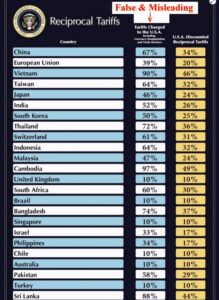
The tariffs announced on what Trump dubbed “Liberation Day” featured a chart titled Tariffs Charged to the U.S.A., purporting to show the crushing rates foreign countries supposedly impose on American goods. But these numbers were completely fabricated — not grounded in trade data or economic principles. Instead, Trump’s team appears to have confused tariffs with trade deficits, using the size of the U.S. trade deficit with each country to create a fictional “tariff rate.”

This fundamental misunderstanding is emblematic of much of Trump’s economic worldview — one that runs counter to decades of established economic theory.

In reality, U.S. trade deficits have long benefited American consumers by allowing access to cheaper foreign goods, while the strength of the dollar fuels domestic spending. The U.S. essentially trades inexpensive paper money for real goods — raw materials, finished products, and even luxury items — while foreign countries often recycle those dollars back into U.S. Treasuries, helping finance America’s debt.

Yet Trump continues to argue that trade deficits equal theft.

Trump’s Trade Narrative: Economic Victimhood

In speeches and social media posts in April 2025, Trump has claimed:

“For too long, corrupt foreign leaders — even from the poorest countries — have slapped massive tariffs on American products while flooding our markets with their goods, often duty-free. It’s been a one-sided scam — they’ve taken our jobs, stolen our industries, and destroyed entire American communities.”

Trump alleges that:

  • Foreign tariffs make U.S. farmers and manufacturers uncompetitive.

  • The U.S. has been the “piggy bank” of the world.

  • New tariffs will “level the playing field” and force “fair deals.”

Supporters call this economic justice. Critics call it economic vandalism.

Lesotho: Targeting One of the World’s Poorest Nations

Among the most striking examples of Trump’s tariff policy is Lesotho — a tiny, landlocked kingdom in southern Africa and one of the poorest nations in the world. The U.S. has imposed a staggering 50% tariff on its exports — the highest tariff applied to any sovereign country.

Lesotho’s economy depends heavily on textiles exported under the African Growth and Opportunity Act (AGOA), and diamond exports to the U.S. are another vital revenue source. In 2024, Lesotho exported about $237 million in goods to the U.S.

The 50% tariff threatens to devastate Lesotho’s fragile economy, potentially wiping out thousands of jobs in a country where nearly half the population already lives below the poverty line.

Tariffs on Penguins: Heard and McDonald Islands

In perhaps the most surreal example of Trump’s trade war, a 10% tariff was imposed on the Heard and McDonald Islands — an uninhabited Australian territory in the sub-Antarctic populated only by penguins and seals.

With no human population and no meaningful exports, the islands became a global punchline. Memes exploded online mocking Trump’s “penguin tariff” as the ultimate symbol of policy absurdity.

Economic Isolation — and Global Backlash

Trump’s tariff strategy has triggered a wave of retaliatory measures, trade disruptions, and diplomatic backlash. Analysts warn that the U.S. is rapidly isolating itself from global supply chains, allies, and markets.

The economic damage has been swift and severe — not just abroad but at home, as higher consumer prices, supply shortages, and market instability ripple through the U.S. economy.

As one critic put it:

“Trump didn’t just pick a trade war — he picked one with the entire planet.”

Full List of Countries Hit With Reciprocal Tariffs

Country Tariffs Charged to the U.S.A. (%) U.S.A. Discounted Reciprocal Tariffs (%)
China 67 34
European Union 39 20
Vietnam 90 46
Taiwan 64 32
Japan 46 24
India 52 26
South Korea 50 25
Thailand 72 36
Switzerland 61 31
Indonesia 64 32
Malaysia 47 24
Cambodia 97 49
United Kingdom 10 10
South Africa 60 30
Brazil 10 10
Bangladesh 74 37
Singapore 10 10
Israel 33 17
Philippines 34 17
Chile 10 10
Australia 10 10
Pakistan 58 29
Turkey 10 10
Sri Lanka 88 44
Colombia 10 10
Peru 10 10
Nicaragua 36 18
Norway 30 15
Costa Rica 17 10
Jordan 40 20
Dominican Republic 10 10
United Arab Emirates 10 10
New Zealand 20 10
Argentina 10 10
Ecuador 12 10
Guatemala 10 10
Honduras 10 10
Madagascar 93 47
Myanmar (Burma) 88 44
Tunisia 55 28
Kazakhstan 54 27
Serbia 74 37
Egypt 10 10
Saudi Arabia 10 10
El Salvador 10 10
Côte d’Ivoire 41 21
Laos 95 48
Botswana 74 37
Trinidad and Tobago 12 10
Morocco 10 10
Papua New Guinea 15 10
Malawi 34 17
Liberia 10 10
British Virgin Islands 10 10
Afghanistan 49 10
Zimbabwe 35 18
Benin 10 10
Barbados 10 10
Monaco 10 10
Syria 81 41
Uzbekistan 10 10
Republic of the Congo 10 10
Djibouti 10 10
French Polynesia 10 10
Cayman Islands 10 10
Kosovo 10 10
Curaçao 10 10
Vanuatu 44 22
Rwanda 10 10
Sierra Leone 10 10
Mongolia 10 10
San Marino 10 10
Antigua and Barbuda 10 10
Bermuda 10 10
Eswatini 10 10
Marshall Islands 10 10
Saint Pierre and Miquelon 99 50
Saint Kitts and Nevis 10 10
Turkmenistan 10 10
Grenada 10 10
Sudan 10 10
Turks and Caicos Islands 10 10
Aruba 10 10
Montenegro 10 10
Saint Helena 15 10
Kyrgyzstan 10 10
Yemen 10 10
Saint Vincent and the Grenadines 10 10
Niger 10 10
Saint Lucia 10 10
Nauru 59 30
Equatorial Guinea 25 13
Iran 10 10
Libya 61 31
Samoa 10 10
Guinea 10 10
Timor-Leste 10 10
Montserrat 10 10
Chad 26 13
Mali 10 10
Algeria 59 30
Oman 10 10
Uruguay 10 10
Bahamas 10 10
Lesotho 99 50
Ukraine 10 10
Bahrain 10 10
Qatar 10 10
Mauritius 80 40
Fiji 63 32
Iceland 10 10
Kenya 10 10
Liechtenstein 73 37
Guyana 76 38
Haiti 10 10
Bosnia and Herzegovina 70 35
Nigeria 27 14
Namibia 42 21
Brunei 47 24
Bolivia 20 10
Panama 10 10
Venezuela 29 15
North Macedonia 65 33
Ethiopia 10 10
Ghana 17 10
Moldova 61 31
Angola 63 32
Democratic Republic of the Congo 22 11
Jamaica 10 10
Mozambique 31 16
Paraguay 10 10
Zambia 33 17
Lebanon 10 10
Tanzania 10 10
Iraq 78 39
Georgia 10 10
Senegal 10 10
Azerbaijan 10 10
Cameroon 22 11
Uganda 20 10
Albania 10 10
Armenia 10 10
Nepal 10 10
Sint Maarten 10 10
Falkland Islands 82 41
Gabon 10 10
Kuwait 10 10
Togo 10 10
Suriname 10 10
Belize 10 10
Maldives 10 10
Tajikistan 10 10
Cabo Verde 10 10
Burundi 10 10
Guadeloupe 10 10
Bhutan 10 10
Martinique 10 10
Tonga 10 10
Mauritania 10 10
Dominica 10 10
Micronesia 10 10
Gambia 10 10
French Guiana 10 10
Christmas Island 10 10
Andorra 10 10
Central African Republic 10 10
Solomon Islands 10 10
Mayotte 10 10
Anguilla 10 10
Cocos (Keeling) Islands 10 10
Eritrea 10 10
Cook Islands 10 10
South Sudan 10 10
Comoros 10 10
Kiribati 10 10
Sao Tome and Principe 10 10
Norfolk Island 58 29
Gibraltar 10 10
Tuvalu 10 10
British Indian Ocean Territory 10 10
Tokelau 10 10
Guinea-Bissau 10 10
Svalbard and Jan Mayen 10 10
Heard and McDonald Islands 10 10
Reunion 73 37

Dumbfoundingly Dumb Tariffs

China Hits Back: 84% Tariff Targets U.S. Farmers First

EU’s Trade Counterattack: Tariffs Designed to Target U.S. Red States


On April 2, President Trump unilaterally declared a trade war against the rest of the world, imposing protectionist tariffs on 180 countries — calling it “Liberation Day.” This action was taken without congressional approval and in direct violation of the Constitution.

Trump’s Sector-Specific Tariffs

Trumpenomics: The Decline of the US

bookmark_borderTrump’s Record Breaking Tax Increase

by Daniel Brouse
April 1, 2025

Republicans and Libertarians Implement the Largest Tax Increase in U.S. History

Despite historically opposing taxation in all forms—often citing the Boston Tea Party as a foundational principle—Republicans and Libertarians are now enacting what amounts to the largest tax increase in U.S. history. Their longstanding stance that taxation justifies revolution contrasts sharply with their current policies, which impose an unprecedented financial burden on American households.

Historic Impact: Tariffs as the Largest Regressive Tax Increase

According to Treasury Secretary Peter Navarro, the newly announced tariffs will constitute the largest tax increase since 1951. As a percentage of GDP, they could rank as the most significant tax hike in U.S. history. However, what sets these tariffs apart is their extreme regressivity—placing a disproportionate burden on lower-income households.

Unlike progressive tax policies that scale with income, tariffs function as a hidden tax embedded in the cost of goods. Lower- and middle-income Americans, who spend a larger share of their earnings on essential goods, will bear the brunt of these price increases. As a result, this policy will exacerbate economic inequality while contradicting the long-standing anti-tax rhetoric of its proponents.

This shift represents not only a fundamental contradiction in ideology but also a high-stakes economic gamble that could fuel inflation, reduce consumer spending, and destabilize the economy. The only historical parallel to such a sweeping and regressive tax increase is the economic collapse that followed the protectionist policies of the Great Depression.


Trump’s Sector-Specific Tariffs

Trumpenomics: The Decline of the US