bookmark_borderThe Climate Has Entered a Runaway Phase: Why “1.5°C” No Longer Describes Our Reality

By Daniel Brouse and Sidd Mukherjee
November 17, 2025

Q: What is happening with climate change?
A: It is accelerating at an exponential rate — far faster than the public narrative or old models suggest.

For years, the world was taught to focus on “holding global warming to 1.5°C.” But that number has quietly become meaningless. Not only have we likely crossed it already, the real danger is not the temperature itself — it is the tipping points that crossing that threshold has set in motion. These tipping points have triggered cascading, self-reinforcing feedback loops that are now reshaping Earth’s systems with unprecedented speed.

We are not approaching a climate crisis.
We are living inside its accelerating phase.

Why the “Global Average Temperature” Is a Misleading Metric

A global average masks extremes — the very extremes that dictate human survival.

A 3°C rise in the global mean may sound manageable, but that average blends together oceans, land, and atmosphere. Because oceans absorb ~90% of excess heat and warm far more slowly, they artificially depress the global mean. Meanwhile, the land and atmosphere — the parts humans inhabit — are warming far faster.

And nowhere is this clearer than at the poles.

The Arctic: 20× Faster Warming and Localized Surges Above 22°C

The Arctic is not warming at “four times” the global rate — it is already warming at more than 20 times the global rate in certain intervals, with localized anomalies exceeding 22°C above historical norms.

This is the engine room of planetary destabilization.

Why does this matter?

1. The moisture multiplier

For every 1°C increase, the atmosphere can hold 7% more moisture.
At +22°C anomalies, Arctic air can now hold:

22 × 7% = 154% more moisture

This surplus water vapor fuels:

  • dramatically faster sea level rise

  • explosive increases in extreme rainfall

  • larger, faster, more destructive raindrops

  • intensifying storms, hurricanes, and atmospheric rivers

Momentum of falling rain scales with mass × velocity; velocity and wind damage scale with the square of flow speed; water is 800× denser than air. The result is a nonlinear explosion in destructive power.

2. Accelerated feedback loops

An Arctic 20× hotter than average accelerates:

  • loss of sea ice

  • albedo collapse

  • permafrost thaw

  • methane release

  • stratospheric moisture injections

  • atmospheric and oceanic circulation disruption

These amplify global warming on a time-compressed schedule: not centuries, but years to decades

Oceans: Silent Heat Storage With Catastrophic Potential

A deep-ocean analysis revealed that even the abyss is warming.
A mere 0.1°C increase in deep-ocean temperature represents a staggering accumulation of heat. If redistributed to land, that heat would equate to ~35°C of warming — incompatible with human life.

In 2025, the entire Pacific is 1.6°C above average, a six-sigma anomaly — virtually impossible under natural variability. This is a planetary red alert.

Two Critical Thresholds

1.5°C – Tipping point activation

≈9°C – Human survivability limit for land and air temperatures

Both are being breached rapidly in localized regions.

Cascading Feedbacks: A System Moving Toward Runaway Behavior

In just ten days of July 2025, the U.S. saw:

  • hundreds of flash floods

  • multiple “1-in-1,000-year” rainfall events

  • widespread infrastructure failures across multiple states

This isn’t “bad weather.”
This is an unstable climate system undergoing phase transition.

Permafrost: From Slow Thaw to Permanent Fire

Old models assumed gradual thaw over millennia.

Reality:

  • formerly frozen landscapes now burn year-round

  • methane and CO₂ release is orders of magnitude faster

  • vast carbon stores are now entering the atmosphere on human timescales

  • fires may partially “flare” methane into CO₂ — but the overall emissions surge is catastrophic

The real uncertainty isn’t if this feedback accelerates warming; it’s how fast and how far it will go.

Ozone: The Overlooked Feedback Harming Ecosystems and Humans

Combustion doesn’t only emit CO₂ — it forms tropospheric ozone, a potent plant toxin.

Ozone exposure:

  • reduces plant growth 10–40%

  • kills sensitive species

  • weakens forests and crops

  • makes ecosystems more vulnerable to drought, heat, pests, and fire

Global forests — the planet’s lungs — have already shifted from carbon sinks to carbon sources.

In our Pennsylvania field site, old-growth trees have lost:

  • ~40% of foliage since 2003

  • ~33% of canopy height

This mirrors global patterns of vegetation decline and reduced carbon uptake.

And ozone harms humans directly:

  • triggers asthma

  • increases cardiovascular stress

  • causes premature death

  • disproportionately affects children and the elderly

The ozone-wildfire-warming feedback loop is now one of the strongest multipliers of climate instability.

A Planet in Nonlinear Transition

These are not distant projections.
These are real-time runaway feedbacks already visible across ecosystems, oceans, and the atmosphere.

The climate system is now governed by compound nonlinear interactions:

  • Arctic amplification

  • ocean heat accumulation

  • ozone stress

  • runaway wildfires

  • permafrost collapse

  • accelerating hydrological extremes

Each amplifies the others in ways models struggle to capture.

The central scientific question is no longer:

“Will feedback loops accelerate warming?”

It is now:

“How much time is left before cascading feedbacks overwhelm natural and human systems?”

Our research is focused on precisely this:
mapping the speed, scale, and irreversibility of climate feedbacks — and determining how close Earth is to thresholds that will define the trajectory of human civilization.
 

bookmark_borderEarth at the Threshold: CO₂ Acceleration, Systemic Feedback Loops, and the Coming Era of Rapid Sea-Level Rise

by Daniel Brouse and Sidd Mukherjee
November 17, 2025

CO₂ is only one component in a vast, interconnected climate system — but it remains the most significant driver of human-caused warming. While water vapor, clouds, aerosols, and ocean circulation all play essential roles, CO₂ is the primary forcing mechanism we directly control. And today, it is rising at a speed unprecedented in Earth’s recent geological history.

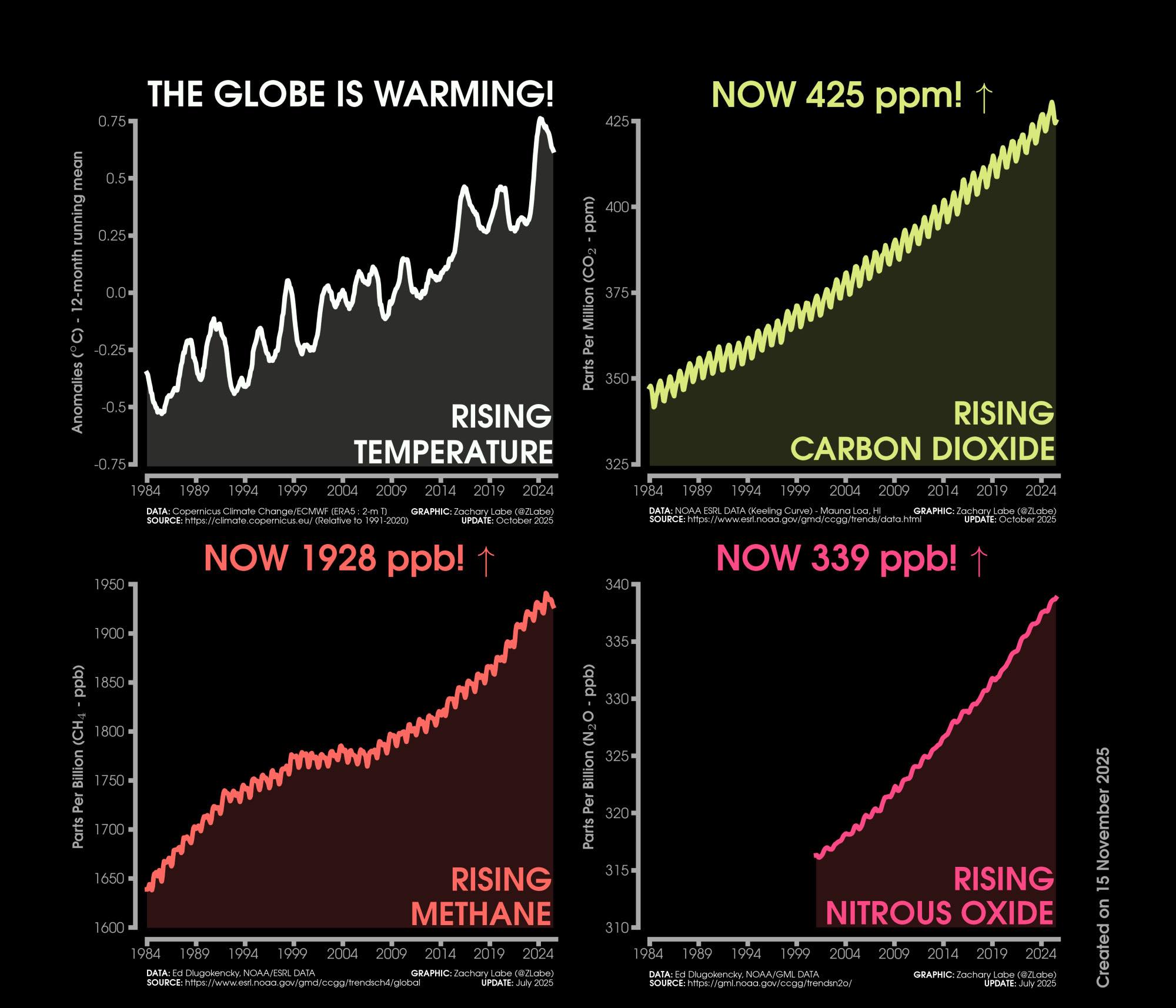
According to the World Meteorological Organization (2025) and the Global Carbon Project (2025), the year 2024 marked the most extreme convergence of climate records ever observed. Atmospheric CO₂ levels reached 422.7 ppm, the highest in three million years, with a record annual increase of 3.75 ppm. Monthly readings peaked at 426.91 ppm in June 2024 — a value that would have been unimaginable even a generation ago.

Accelerating Emissions and the Collapse of “Natural Buffers”

Global fossil fuel and cement emissions rose to 37.4 gigatons of CO₂ in 2024, a 0.8% increase from 2023. The growth was driven by:

  • Coal expansion across Asia

  • Post-pandemic industrial rebound

  • Sharp increases in liquefied natural gas (LNG) production, particularly in the United States

While often marketed as a “bridge fuel,” methane leakage from LNG infrastructure — over 80 times more potent than CO₂ over 20 years — has erased its supposed climate advantage. These cumulative emissions are now overwhelming the buffering capacity of the oceans, cryosphere, and biosphere.

This record convergence signals a fundamental phase transition in the Earth system. Regions that once absorbed carbon, stabilized temperature, and moderated climate extremes are now flipping into self-reinforcing feedback loops. What was once a slow climb in global heat content is now taking on the characteristics of nonlinear acceleration.

Glaciers, Cryosphere Collapse, and the Finality of “Point of No Return”

The WMO issued one of its starkest warnings in 2023:

“The world’s glaciers melted at dramatic speed last year and saving them is effectively a lost cause…
Antarctic sea ice fell to its lowest extent on record.
Some European glaciers are literally off the charts.”

WMO Secretary-General Petteri Taalas summarized the situation bluntly:

“We have already lost the melting-of-the-glaciers game.
The CO₂ concentration is now simply too high.”

In the Swiss Alps alone, 6.2% of total glacier mass vanished in a single summer, the greatest loss in the entire observational record.

Taalas further warned that disappearing glaciers will:

  • Reduce global freshwater supply

  • Impair agriculture

  • Destabilize river transport and hydrology

  • Accelerate sea-level rise far beyond prior projections

For decades, sea-level rise was expected to unfold over millennia. But with runaway CO₂ growth and feedback amplification, that timeline is rapidly collapsing into decades.

How Fast Could Sea Levels Rise? A Scientific Exchange

A natural question follows:
Could this trigger the fastest sea-level rise in Earth’s history?

Physicist Sidd Mukherjee offered the following expert assessment:

“It depends on what you mean by ‘ever.’
In terms of human civilization: yes, likely.”

He notes:

  • The total global ice inventory can produce ~200 feet of sea-level rise.

  • Greenland and West Antarctica may already be committed to collapse.

Breakdown of likely contributions:

  • Greenland: ~20 feet over 100–300 years

  • West Antarctica: ~10 feet, potentially in decades to a century

Average over a century:

  • ~20 feet → 2 inches per year (50 mm/year), 10x the current rate

But the average masks the danger. Sea-level rise will likely arrive in pulses, not a smooth curve:

“We could dawdle along at half an inch per year, then suddenly experience a couple of years with a foot of rise annually.”

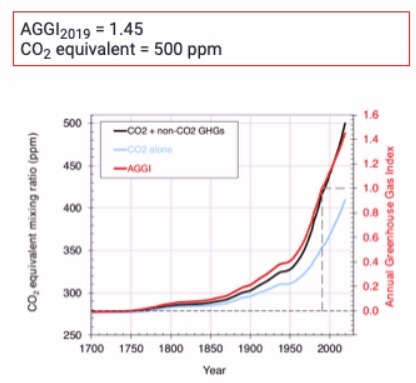
If CO₂-equivalent concentrations can be stabilized near 500 ppm, there may still be a chance to preserve East Antarctica, the largest remaining ice sheet. But if it destabilizes:

“Expect another couple hundred feet of sea-level rise.”

A Civilization-Level Threshold

We are now witnessing the early stages of a global system crossing into a new and dangerous mode of operation — one defined by:

  • Rapid CO₂ accumulation

  • Collapsing carbon sinks

  • Accelerating ocean heat storage

  • Cryosphere destabilization

  • Intensified extreme weather

The question is no longer whether these changes are occurring, but how quickly, and how prepared we are for the consequences.

Humanity is approaching — and in some cases passing — thresholds that earlier generations believed were centuries away. The decisions made in the next decade will determine whether sea-level rise is measured in inches, feet, or tens of feet within a single human lifetime.

WARNING

* Our probabilistic, ensemble-based climate model — which incorporates complex socio-economic and ecological feedback loops within a dynamic, nonlinear system — projects that global temperatures are becoming unsustainable this century. This far exceeds earlier estimates of a 4°C rise over the next thousand years, highlighting a dramatic acceleration in global warming. We are now entering a phase of compound, cascading collapse, where climate, ecological, and societal systems destabilize through interlinked, self-reinforcing feedback loops.

What Can I Do?
The single most important action you can take to help address the climate crisis is simple: stop burning fossil fuels. There are numerous actions you can take to contribute to saving the planet. Each person bears the responsibility to minimize pollution, discontinue the use of fossil fuels, reduce consumption, and foster a culture of love and care. The Butterfly Effect illustrates that a small change in one area can lead to significant alterations in conditions anywhere on the globe. Hence, the frequently heard statement that a fluttering butterfly in China can cause a hurricane in the Atlantic. Be a butterfly and affect the world.

Tipping points and feedback loops drive the acceleration of climate change. When one tipping point is toppled and triggers others, the cascading collapse is known as the Domino Effect.

The Climate Crisis: Violent Rain | Deadly Humid Heat | Health Collapse | Extreme Weather Events | Insurance | Trees and Deforestation | Soil | Rising Sea Level | Food and Water | Updates

The Human Induced Climate Change Experiment

bookmark_borderPennsylvania’s Budget: A Step Forward in Education, a Step Backward on Climate

Governor Josh Shapiro signed Pennsylvania’s long-delayed $50 billion state budget into law Wednesday, ending a four-month stalemate in Harrisburg. The spending plan, which increases expenditures by $2.27 billion over last year, was shaped through difficult negotiations in a politically divided legislature.

While the budget delivers much-needed funding for public education and workforce development, it simultaneously enacts one of the most environmentally regressive decisions in the state’s modern history: Pennsylvania’s formal withdrawal from the Regional Greenhouse Gas Initiative (RGGI).

RGGI Withdrawal: An Expensive Mistake for Pennsylvania’s Future

Exiting the RGGI is more than a political statement — it’s a financial and public health miscalculation. The multi-state carbon trading program, launched in 2009, was designed to reduce greenhouse gas emissions from power plants through a market-based mechanism that generates revenue for participating states. Those funds have been used to lower energy bills, create jobs, and invest in renewable infrastructure.

By walking away, Pennsylvania has effectively abandoned hundreds of millions in potential revenue and forfeited leadership in clean energy innovation. Worse still, the state’s withdrawal signals to polluters that short-term profit outweighs long-term sustainability — a dangerous precedent in a state still burdened by coal, methane leaks, and fossil fuel dependence.

Hidden Costs: Insurance, Infrastructure, and Health

The decision carries steep economic and social costs that go far beyond lost carbon credits.

  • Insurance premiums across the state — already climbing due to intensified storms and floods — will continue to rise as climate-related risks escalate.

  • Infrastructure spending will balloon, as aging roads, bridges, and stormwater systems face more frequent and severe weather damage.

  • Public health impacts will worsen as air pollution increases, leading to higher rates of asthma, heart disease, and heat-related illness — costs that ultimately fall on taxpayers.

In essence, Pennsylvania residents are being handed the bill for political negligence. By rejecting RGGI, the state isn’t saving money; it’s socializing the cost of pollution while privatizing the profits.

A Tale of Two Priorities

Governor Shapiro’s commitment to public education and fiscal stability deserves credit, but his climate policy marks a troubling contradiction. Investments in schools and communities will mean little if those same communities face increasing floods, crop losses, and pollution-related illness.

Pennsylvania, the birthplace of American coal, had an opportunity to redefine itself as a leader in clean energy transition. Instead, the state’s exit from RGGI moves it backward — environmentally, economically, and morally.

The Bigger Picture

At a time when climate change is accelerating faster than predicted, this decision isolates Pennsylvania from its regional allies and undermines national efforts to decarbonize the power sector. The costs will not be measured in partisan victories but in lives, livelihoods, and lost opportunities.

History will not look kindly on this moment.
By withdrawing from RGGI, Pennsylvania’s leaders have chosen to side with polluters rather than the people they serve — and the consequences will unfold across generations.

* Our probabilistic, ensemble-based climate model — which incorporates complex socio-economic and ecological feedback loops within a dynamic, nonlinear system — projects that global temperatures are becoming unsustainable this century. This far exceeds earlier estimates of a 4°C rise over the next thousand years, highlighting a dramatic acceleration in global warming. We are now entering a phase of compound, cascading collapse, where climate, ecological, and societal systems destabilize through interlinked, self-reinforcing feedback loops.

What Can I Do?
The single most important action you can take to help address the climate crisis is simple: stop burning fossil fuels. There are numerous actions you can take to contribute to saving the planet. Each person bears the responsibility to minimize pollution, discontinue the use of fossil fuels, reduce consumption, and foster a culture of love and care. The Butterfly Effect illustrates that a small change in one area can lead to significant alterations in conditions anywhere on the globe. Hence, the frequently heard statement that a fluttering butterfly in China can cause a hurricane in the Atlantic. Be a butterfly and affect the world.

→ “Solutions to the Fossil Fuel Economy and the Myths Accelerating Climate and Economic Collapse.“

Tipping points and feedback loops drive the acceleration of climate change. When one tipping point is toppled and triggers others, the cascading collapse is known as the Domino Effect.

The Human Induced Climate Change Experiment

bookmark_border2025’s Catastrophic Triple‐Threat: EF-5 Tornado, Category 5 Hurricane & G5 Geomagnetic Storm

By Daniel Brouse
November 13, 2025

If confirmed, 2025 would be the first year in recorded history to experience an EF-5 tornado, a Category 5 hurricane, and a G5 geomagnetic storm all within the same calendar year — a convergence of atmospheric and space-weather extremes unlike anything previously documented.

Earth’s Systems in Overdrive

While each of these events operates in distinct domains — atmospheric, oceanic, and heliophysical — their occurrence within a single year underscores the accelerating volatility of Earth’s interconnected systems.

  • EF-5 tornadoes represent the most violent wind events on the planet, with speeds exceeding 200 mph and capable of leveling entire communities.
  • Category 5 hurricanes are the apex of tropical cyclone intensity, driven by ocean surface temperatures that have now repeatedly shattered records due to climate-induced warming.
  • G5 geomagnetic storms arise from the Sun’s eruptions — particularly coronal mass ejections (CMEs) — which slam into Earth’s magnetosphere, generating auroras visible across continents and posing risks to satellites, power grids, and communications systems.

Solar Storm Update: The First Potential G5 of 2025

If confirmed, this event would be the first recorded G5 geomagnetic storm of 2025. Currently, forecasts indicate the storm could reach G5 levels, though as of now it remains at G4 (severe) intensity pending final assessment by NOAA’s Space Weather Prediction Center (SWPC).

This storm has already produced multiple X-class solar flares and “cannibal CMEs” — instances where fast eruptions overtake slower ones, merging into powerful shock waves. If the storm is officially upgraded, it will join the small handful of G5-class events observed since measurements began in the 20th century, including the May 2024 event that caused widespread auroras and satellite disruptions.

A Year of Extreme Energy

2025 has already shattered climate and space-weather norms.

  • Global sea surface temperatures have remained at all-time highs for over a year, fueling record-strength hurricanes and flash droughts.
  • Atmospheric CO₂ concentrations are now above 427 ppm, continuing the steep rise that drives planetary energy imbalance.
  • Tornado and flood activity in the U.S. have been intensified by shifting jet streams and atmospheric instability tied to warming patterns.
  • In parallel, the Sun is nearing its Solar Maximum, with heightened solar activity expected through 2026.

A Warning from Nature and Physics

These converging extremes — in the atmosphere, oceans, and magnetosphere — demonstrate how Earth’s energy systems are now operating closer to physical and thermodynamic limits.
The EF-5, Category 5, and potential G5 are not random coincidences; they’re manifestations of a planet under compound stress, where terrestrial and solar dynamics can amplify one another through complex feedbacks.

If confirmed, 2025 will stand as a pivotal year — one that highlights both the escalating instability of Earth’s climate system and the profound vulnerability of our technological civilization to forces far beyond our control.

The Human Induced Climate Change Experiment

bookmark_borderThe Silent Surge: Climate Change and the Acceleration of Food Price Inflation

Recent data indicates a clear acceleration in food price inflation — a trend now supported by both formal statistics and everyday observation. What once appeared to be temporary pandemic-era disruptions have evolved into structural pressures driven by deeper forces — among them, climate change, trade policy distortions, and systemic supply vulnerabilities.

From the perspective of both macroeconomic and climate systems analysis, the current surge in food prices is not an isolated event. Instead, it reflects the convergence of multiple feedback loops: extreme weather events, global trade realignments, and shifting ecological baselines that are altering both supply and cost structures.

Anecdotal data aligns with the statistics. Consumers are not only facing rising sticker prices but also a noticeable reduction in sales, promotions, and price competition. Items subject to international tariffs — such as bananas, coffee, and other imported produce — have seen disproportionately higher increases, suggesting that trade policy continues to amplify global cost pass-throughs.

Meanwhile, protein prices — particularly beef and poultry — have climbed at an accelerated rate, and the underlying cause is more complex than supply chain inefficiency. Climate change–driven droughts have reduced feed and water availability; fires have disrupted grazing and farmland; and floods have destroyed crop cycles critical for livestock production. Additionally, zoonotic diseases — emerging and reemerging due to warming temperatures and habitat shifts — are further reducing herd sizes and increasing production costs.

This compounding effect — where climate disruption intensifies agricultural volatility, which in turn feeds back into global markets — represents a new phase in food inflation dynamics. It suggests that food inflation is becoming not only more persistent but also more climate-sensitive, resistant to traditional monetary and fiscal interventions.

Unless aggressive adaptation and mitigation strategies are implemented — from resilient agriculture and decarbonized logistics to equitable trade frameworks — food inflation will remain one of the clearest and most immediate economic manifestations of the global climate crisis.

bookmark_borderDon the Con: How Trump Cemented His Legacy as the Dumbest World Leader in History

Trump said it best, “Smart people don’t like me.”

Trump is going down in history as the dumbest president in American history; however, that title may not be “biggly” enough for him. He is now being recognized globally as the dumbest world leader in history — a man who has willfully ignored, denied, and lied about established science, accelerating a planetary crisis that has already cost millions of lives. Trump’s science denial directly resulted in millions of preventable COVID deaths in his first term. Now, he is endangering the entire population of the world.

Trump has repeatedly dismissed climate science as a “hoax,” “bullshit,” and “the green scam.” At the United Nations, he called climate change a “con” — an irony lost on no one, coming from “Don the Con” himself, a man whose business empire was built on deceit, bankruptcies, and fraud. His record now includes criminal convictions, civil judgments, and an unparalleled legacy of scientific ignorance.

This year, Trump refused to cooperate with the COP30 global climate summit in Brazil, further cementing America’s retreat from global climate leadership. With global emissions nearly doubling in the last 33 years, few would argue that progress has met expectations. Worse, the post-COVID global consensus on tackling climate change is fracturing — led by Trump’s renewed campaign of climate disinformation and economic coercion. His administration’s new trade tariffs pressure allies such as Japan, the EU, and South Korea to buy more U.S. fossil fuels, directly undermining global decarbonization efforts.

Trump’s absence from COP30 drew sharp rebukes from world leaders. “For small island states, the climate crisis is not past tense or future tense. It is our reality. We have no way to run, no way to hide,” said Antigua and Barbuda’s Prime Minister Gaston Browne. Chilean President Gabriel Boric accused Trump of spreading “lies” about the climate crisis, while Colombian President Gustavo Petro declared, “Mr. Trump is against humankind.”

As Trump abandons both people and planet, others are stepping into the leadership void. California Governor Gavin Newsom announced he will attend COP30 in Brazil, representing the world’s fourth-largest economy. Newsom aims to strengthen climate partnerships, promote clean-energy investments, and showcase California’s model for creating jobs while cutting toxic pollution.

“As the President of the United States turns his back on people and the planet, California is inking global partnerships focused on creating jobs and cutting toxic pollution,” Newsom said. “The economic winners of the 21st century are those who build the clean-energy future. We’re doing that right now — and showing the world that climate action means jobs, clean air, and lower costs.”

While Trump clings to fossil-fueled fantasies and falsehoods, California and the world are moving forward without him. History will remember Trump not as a leader, but as a warning — a living example of how ignorance, arrogance, and greed can conspire to imperil the planet itself.

The Great Race Against Time: Trump vs. Mother Nature

Donald Trump has consistently dismissed the science of climate change, calling it a hoax and dismissing policies aimed at addressing it as “The Green New Scam.” His repeated use of the phrase “Drill, Baby, Drill” symbolizes an energy policy that prioritizes fossil fuel extraction over sustainable alternatives. These policies have only intensified the climate crisis, posing severe risks not only to the environment but to the global economy as well. If left unchecked, Donald Trump’s economic and environmental policies will render the planet uninhabitable for future generations.

The evidence is irrefutable: climate change is accelerating at an alarming pace, and the associated costs—both economic and human—are rising exponentially. Immediate, decisive action is essential to reduce greenhouse gas emissions and prevent further environmental collapse. Our updated climate model, now grounded in chaos theory and incorporating complex social-ecological factors within a dynamic, non-linear framework, predicts that global temperatures could increase by up to 9°C this century—far surpassing the previous estimate of a 4°C rise over the next thousand years. Such extreme warming will render large portions of the planet uninhabitable within this century, threatening the stability of ecosystems and human societies alike.


* Our probabilistic, ensemble-based climate model — which incorporates complex socio-economic and ecological feedback loops within a dynamic, nonlinear system — projects that global temperatures are becoming unsustainable this century. This far exceeds earlier estimates of a 4°C rise over the next thousand years, highlighting a dramatic acceleration in global warming. We are now entering a phase of compound, cascading collapse, where climate, ecological, and societal systems destabilize through interlinked, self-reinforcing feedback loops.

What Can I Do?
The single most important action you can take to help address the climate crisis is simple: stop burning fossil fuels. There are numerous actions you can take to contribute to saving the planet. Each person bears the responsibility to minimize pollution, discontinue the use of fossil fuels, reduce consumption, and foster a culture of love and care. The Butterfly Effect illustrates that a small change in one area can lead to significant alterations in conditions anywhere on the globe. Hence, the frequently heard statement that a fluttering butterfly in China can cause a hurricane in the Atlantic. Be a butterfly and affect the world.

→ “Solutions to the Fossil Fuel Economy and the Myths Accelerating Climate and Economic Collapse.“

The Human Induced Climate Change Experiment

bookmark_borderTrumpenomics: A Manufactured Meltdown

Trumpenomics is crashing the economy at a record pace. The torrent of bad news is so rapid it’s becoming difficult to track in real time.

1. Imports Collapse: The Statistical Mirage Vanishes

U.S. imports just fell nearly 44% — the largest drop ever recorded. This was no surprise. It’s exactly what serious economists expected following the artificial spikes in growth earlier this year.

The first quarter GDP was negative, followed by two quarters of modestly positive growth — both of which were statistical illusions, not signs of recovery. Those gains were largely the result of how imported inventories are counted in national accounts. Once those temporary boosts washed out, the underlying weakness became undeniable.

Now, we are likely entering a sharp economic contraction, perhaps already crossing into recession territory. Consumption is slowing. Business investment is falling. Real wages are stagnant amid persistent inflationary pressure. The illusion of growth has given way to the reality of systemic decline.

2. The Human Factor: Immigration and Innovation Under Attack

Compounding the downturn is the economic fallout of white nationalism and xenophobic policy. Over the past five years, immigrants have driven nearly 80% of U.S. GDP growth — fueling productivity, entrepreneurship, and labor force expansion. Restricting immigration at this scale is more than socially regressive; it’s economically suicidal.

The loss of immigrant labor is already reducing output, raising prices, and crippling industries from agriculture to healthcare. America’s innovation pipeline — once the envy of the world — is drying up as skilled immigrants look elsewhere. When policy turns away the very people who build the future, decline is inevitable.

3. Credibility Collapse: America as an Unreliable Partner

Equally alarming is the erosion of U.S. credibility abroad. The administration’s disregard for truth, consistency, and the rule of law has shredded confidence among global partners. America — once the cornerstone of international stability — is increasingly seen as erratic, insular, and untrustworthy.

As a result, alliances and supply chains are being restructured. Nations are pivoting toward more predictable trading partners, leaving the U.S. isolated just as global cooperation is most needed to manage economic, environmental, and geopolitical risks.

4. The Fed Cut That Raised Rates

One of the clearest signs of dysfunction is the recent disconnect between Federal Reserve policy and market reaction. In early November 2025, the Fed cut its benchmark lending rate by 25 basis points — yet mortgage rates rose by 20 basis points almost immediately.

This seemingly paradoxical outcome exposes how little Trump understands about economics. The federal funds rate affects only short-term loans between banks, not long-term borrowing like mortgages. Those longer-term rates are governed by the bond market — where investors demand yields that compensate for inflation and risk.

When the Fed cuts rates under political pressure, investors interpret it as a sign that inflation risk is increasing. To protect themselves, they demand higher yields. In other words, Trump’s push for lower rates caused higher rates, because the market sees through the manipulation.

The result? A credibility crisis at the very heart of U.S. monetary policy. Markets no longer trust that the Fed is acting independently, and once that trust erodes, confidence — and stability — quickly follow.

5. Job Cuts Surge: The Human Toll of Economic Chaos

The human impact is already visible. In October 2025, U.S. employers announced 153,074 layoffs — the highest October total in more than 20 years, according to Challenger, Gray & Christmas.

Much of this is driven by cost-cutting and the rapid adoption of artificial intelligence in sectors like technology, logistics, and finance. For the year, total job cuts have surpassed 1 million, the highest since the pandemic in 2020. Yet, instead of cushioning the transition or investing in retraining, the administration continues to destabilize institutions and stoke division — widening the gap between workers and wealth.

6. The Inevitable Reckoning

The recipe for disaster is already baked in:

  • Weakening growth and collapsing imports.

  • Stagnant wages and soaring inflation.

  • Political interference in the Fed.

  • Attacks on the judiciary and rule of law.

  • Isolation from allies and markets.

What we are witnessing is not a natural business cycle — it is a politically induced economic crisis, one made worse by denial, ideology, and short-term thinking.

Trumpenomics isn’t just failing — it’s accelerating America’s decline. And unless the U.S. restores institutional integrity, global credibility, and a rational approach to policy, this contraction may become the defining economic collapse of our generation.

Trumpenomics

bookmark_borderTrump’s Tariff Lies: The Supreme Court Case That Could Expose the Biggest Tax Hike in U.S. History

President Trump has made several posts on Truth Social regarding today’s Supreme Court hearing on the legality of his tariffs, held Wednesday, November 5, 2025. He called the case one of immense national importance, writing, “This case is, literally, LIFE OR DEATH for our Country.” He went on to argue that presidential authority to impose tariffs is essential for national security, saying, “If a President was not able to quickly and nimbly use the power of Tariffs, we would be defenseless, leading perhaps even to the ruination of our Nation.”

This is an outright lie — one of many he’s repeated to disguise what his tariffs really are: the largest tax increase in U.S. history. Worse, they are among the most regressive taxes ever imposed, disproportionately harming low- and middle-income Americans while providing little measurable benefit to U.S. industries or workers.

Trump’s tariffs were declared under fabricated “national emergencies,” allowing him to bypass Congress — a direct violation of constitutional checks and balances. The case now before the Supreme Court stems from a class action lawsuit filed by thousands of small businesses that have been crushed under the weight of these taxes. Many of these businesses, already struggling with inflation and supply chain disruptions, have been forced to close their doors or lay off workers because of steep import costs.

In reality, tariffs are taxes — taxes paid by American consumers, not foreign countries. Every economist outside Trump’s echo chamber agrees that the tariffs have raised prices across nearly every sector, from food and automobiles to construction materials and electronics. The idea that tariffs make the U.S. “stronger” is pure fiction. They weaken purchasing power, fuel inflation, and undermine the very small businesses that form the backbone of the American economy.

Trump’s framing of this Supreme Court case as a matter of “life or death” is pure political theater — designed to rally his base and distract from the economic damage his policies have inflicted. The real stakes are indeed high, but not for the reasons he claims. What’s at risk is the rule of law, the integrity of the Constitution, and the economic wellbeing of millions of American families and businesses already paying the price for his reckless trade war.

Trumpenomics

bookmark_borderA Sad Milestone: America Leads the World in Pollution, Not Progress

By Daniel Brouse
November 3, 2025

The High Cost of “Energy Dominance”

It’s a sad day in America.

According to preliminary data from LSEG, the United States has become the first country in history to export 10 million metric tonnes (mmt) of liquefied natural gas (LNG) in a single month. This record, rather than a triumph, marks another grim milestone in the accelerating climate crisis.

Supporters are celebrating this as proof of “energy dominance.” In truth, it’s a national failure — an indictment of U.S. energy policy and its deepening dependence on fossil fuels. The short-term economic gain comes at a catastrophic long-term cost.

The United States is now both the largest producer and exporter of fossil fuels and the largest polluter on Earth — not just in total volume but per capita. Every LNG tanker leaving U.S. ports represents more methane leaks, more carbon emissions, and more climate destabilization — all while locking poorer nations into decades of fossil fuel dependence.

Natural gas is often sold as a “bridge fuel,” but science has made it clear: it’s a bridge to nowhere. Methane, the primary component of natural gas, traps 86 times more heat than CO₂ over a 20-year period. From extraction to transport to combustion, each stage of LNG production emits significant greenhouse gases, making it one of the fastest-growing contributors to global warming.

Even worse, the infrastructure required to sustain these exports — pipelines, terminals, and drilling fields — will lock the world into fossil fuel use for the next half century. Once built, these systems are costly and politically difficult to dismantle. Every new LNG terminal is a 50-year promise of continued emissions and escalating climate damage.

Meanwhile, Americans are already paying the price of this so-called “energy success.” Rising healthcare costs, polluted air and water, infrastructure collapse, and deadly weather extremes are now the hidden surcharges of fossil fuel expansion. Globally, the poorest and most vulnerable communities suffer the most, as floods, droughts, and heat waves intensify.

The true cost of this policy path is far greater than any economic balance sheet can capture — and in many ways, it’s incalculable. Consider the price of epigenetic damage — the molecular scars passed down to future generations. How do we quantify the suffering of children yet to be born, whose health, development, and lifespan are already being compromised by our pollution and heat-driven environment?


Climate Extremes & Cellular Breakdown

Prolonged exposure to extreme heat accelerates biological aging, damaging tissues and shortening telomeres at the cellular level. These changes increase the risk of chronic diseases such as cancer, dementia, and diabetes — all of which are made worse by pollution and infection.

Heat stress also undermines mental health, driving higher rates of depression, anxiety, and suicide. These aren’t distant hypotheticals — they are measurable biological responses to the climate stress we have already unleashed.


Epigenetic Changes: The Molecular Convergence of Climate Stressors

A critical link between these health effects lies in epigenetic modifications — chemical changes that alter how genes are expressed without changing the DNA itself. Think of it as the dimmer switch of the genome, turning genetic pathways up or down in response to environmental stress.

Extreme heat, ozone exposure, and even COVID-19 infection are all known to trigger these molecular modifications.

These shifts can activate high-risk genes tied to cancer, cardiovascular disease, diabetes, and neurological disorders. When multiple stressors converge, the effects don’t simply add up — they amplify, creating a compounding vulnerability across organ systems.

This molecular-level disruption forms a shared mechanism underlying many climate-related health threats, accelerating the feedback loops that push individuals — and entire populations — toward chronic illness and premature death.

Even more alarming is the transgenerational impact: stress-induced epigenetic changes in one generation may permanently alter gene expression in the next. In other words, the damage we allow today will be biologically written into the lives of our descendants.

The Climate Crisis: Deadly Humid Heat | Health Collapse

Trump’s Climate Vs. Economic Collapse

The Human Induced Climate Change Experiment


bookmark_borderTrump’s Illegal War on Venezuela: Civilian Deaths, Extrajudicial Murders, and a Nation in Decline

Trump’s latest foreign policy adventure — an undeclared and unauthorized war on Venezuela — is spiraling into yet another humanitarian and fiscal catastrophe. Despite lacking congressional authorization or international legal standing, U.S. forces under Trump’s directive have launched a series of extrajudicial attacks resulting in civilian deaths, international condemnation, and growing outrage among global observers.

According to multiple reports, at least 14 non-combative civilian boats have been blown out of the water by U.S. strikes in the Caribbean. The victims were fishermen, transport workers, and families fleeing violence — not armed combatants. These are not “collateral damage” incidents; they are illegal killings under international law and constitute potential war crimes.

Extrajudicial Murders Disguised as Policy

The international community has been swift to condemn what many describe as state-sanctioned murder. The deliberate targeting of civilian vessels without a declaration of war or credible intelligence linking them to hostile activity violates both the U.N. Charter and the Geneva Conventions.

The Trump administration, however, has framed these operations as part of a so-called “war on narco-terrorism” — a familiar euphemism used to justify lethal force without transparency, oversight, or legal accountability. In reality, this is a war of optics, designed to project strength and distract from deepening domestic political and economic failures.

A Catastrophic Drain on U.S. Resources

The financial burden of this illegal campaign is staggering. Each Hellfire missile costs roughly $150,000, while the aircraft carrier strike group deployed to the region operates at an estimated $8 million per day — even before accounting for fuel, maintenance, and logistics. Every fighter jet sortie adds another layer of expense, with operational costs averaging $30,000 per flight hour. Collectively, these figures represent an immense and ongoing drain on public funds. A substantial portion of the U.S. Navy’s active assets is now tied up in the Caribbean, diverting manpower, funding, and strategic focus from legitimate global defense priorities and humanitarian responsibilities.

Adding to the escalation, 10,000 U.S. troops have been deployed to a reopened military base in Puerto Rico, reviving Cold War-era operations at enormous expense. Meanwhile, American citizens — including many on the island itself — continue to face food insecurity, failing infrastructure, and limited access to healthcare.

Trump’s illegal use of taxpayer dollars for unauthorized military operations comes at a time when the U.S. government itself has been deliberately shut down by his own directive. In this manufactured crisis, millions of Americans are paying the price for his political brinkmanship. Essential services have been halted, federal workers furloughed, and countless families left without paychecks or access to critical programs.

Under Trump’s orders, vital food assistance, healthcare, and social support systems are being suspended — not out of fiscal necessity, but as a weapon of political coercion. Federal nutrition programs are running out of funds, hospitals reliant on federal reimbursements are struggling, and patients dependent on life-saving treatments are being forced to wait.

The contrast is staggering: while billions of taxpayer dollars are being funneled into an illegal foreign war, the U.S. government is actively denying its own citizens the basic necessities of life. Trump’s actions expose an administration that prioritizes militarism and self-interest over human welfare, turning both foreign and domestic policy into instruments of control and cruelty.

The True Cost of Trump’s War

Given public cost data and reasonable operational assumptions, a conservative estimate for the campaign in the Caribbean — including a carrier strike group, large troop deployments, and precision munitions — runs between $10 and $20 million per day, or $3.5 to $7.3 billion per year. When factoring in one-time and long-term costs — including replacement munitions, rebuilding, nuclear expansion, legal liabilities, and humanitarian fallout — the price tag could climb into the tens or even hundreds of billions over the next decade.

Humanitarian Neglect at Home and Abroad

The hypocrisy could not be clearer. The same administration that claims to defend “freedom and democracy” abroad is withholding food and medical aid from civilians both in Venezuela and within U.S. territories. Billions are being burned on unauthorized warfare while essential domestic programs — from education to disaster relief — remain underfunded or deliberately dismantled.

This is not national defense. It is a moral and fiscal betrayal. Every missile launched and every gallon of jet fuel burned represents money that could have saved lives, rebuilt communities, or strengthened the nation’s resilience.

The Cost of Hubris

Trump’s unilateral aggression against Venezuela reveals a dangerous convergence of political theater, militarism, and corruption. It serves neither American interests nor international stability. Instead, it deepens global mistrust, destabilizes Latin America, and reinforces the growing perception that the United States has abandoned the rule of law for the rule of force.

If left unchecked, these operations will not only continue to kill innocent people — they will also erode what remains of America’s moral authority, economic stability, and global credibility.

The United States cannot bomb its way to legitimacy. It can only lead through justice, restraint, and the rule of law — all of which this administration has willfully abandoned.

Trumpenomics: The Fall of the USA