bookmark_borderPowell’s QE Pivot: The Fed’s Dangerous Return to Easy Money

by Daniel Brouse
October 14, 2025

On October 14, 2025, in a speech delivered in Philadelphia, Federal Reserve Chair Jerome Powell hinted at a significant policy shift — one that could reshape the financial landscape for years to come. Powell indicated that the Fed may soon end its balance sheet reduction program, effectively pausing Quantitative Tightening (QT) and signaling the potential return of Quantitative Easing (QE).

The motivation, he said, lies in growing concern over labor market weakness and the need to provide “stability” amid economic uncertainty. Powell described the move as “QE-like” and acknowledged the risks of persistent inflation, while emphasizing the importance of tracking a broad set of data — particularly state-level employment figures — in the absence of timely federal economic reports.

In practical terms, Powell also suggested that the Fed would begin buying U.S. Treasuries again. For investors, businesses, and consumers, this represents a major turning point — and a deeply troubling one.

What Is Quantitative Easing (QE)?
In simple terms, QE is money creation. The Federal Reserve purchases financial assets — usually Treasury bonds or mortgage-backed securities — to inject liquidity into the banking system and push long-term interest rates lower. While this can provide short-term relief to credit markets, it almost always comes with serious long-term consequences: asset bubbles, wealth inequality, and inflationary pressure.

Fiscally conservative economists, including many Republicans, have traditionally opposed QE for precisely this reason — it’s artificial stimulus that distorts markets and devalues currency. Ironically, the largest expansions of QE have occurred under Republican administrations, particularly under Presidents Bush and Trump.

At its core, QE works like this:
* The U.S. Treasury issues debt in the form of bonds.
* The Federal Reserve buys those bonds using newly created money.

The result is a loop of monetized debt, where the government effectively funds itself by printing dollars through the Fed’s balance sheet. When considering the full fiscal picture, the real U.S. debt burden should include both the national debt and the Federal Reserve’s assets — a combined total of roughly $44.5 trillion:

$37,887,475,445,601 (national debt)
+ $6,608,000,000,000 (Federal Reserve assets)
= $44.495 trillion owed by U.S. taxpayers

That’s the true figure Americans are on the hook for. And the question remains: how will it ever be repaid?

The History of QE
The Federal Reserve first launched Quantitative Easing in November 2008, during the Great Recession, under President George W. Bush. Known as QE1, the program focused on purchasing mortgage-backed securities and agency debt to stabilize collapsing credit markets when interest rates were already near zero.

This initial cycle expanded the Fed’s balance sheet to approximately $4.5 trillion. By late 2019, the Fed began to unwind those holdings — allowing assets to “roll off” as they matured — marking the start of Quantitative Tightening (QT). However, the onset of the COVID-19 pandemic in 2020, under President Trump, triggered an unprecedented new wave of Quantitative Easing (QE), which rapidly expanded the balance sheet to nearly $9 trillion, the highest level in U.S. history. Many economists attribute a significant portion of the 2021–2022 inflation surge to this Trump-era QE, which flooded the financial system with liquidity and fueled speculative bubbles across housing, equities, and commodities.

In 2022, under President Biden, the Fed began a gradual process of balance sheet reduction, marking the start of Quantitative Tightening (QT) reducing the Fed’s assets to $6.6 trillion.

Now, just a few years later, Powell’s comments suggest a reversal of that policy — a return to money printing at a time when inflation remains above target and fiscal deficits are exploding.

QE Today: The Warning Signs
Powell’s latest remarks should set off alarm bells across the financial community. Reintroducing QE in the current environment — with massive fiscal deficits, high consumer debt, and lingering inflation — is not a stabilizing policy. It’s a recipe for economic disaster.

By artificially lowering rates and inflating asset prices, the Fed risks fueling another speculative bubble — one that could end in catastrophic wealth destruction, job loss, and financial contagion. Meanwhile, the federal government’s relentless spending ensures that each round of QE only digs the hole deeper.

This is not monetary stability. It’s the illusion of prosperity — a temporary sugar high before a historic crash.

If the Fed follows through with this plan, the outcome is predictable: rising inequality, eroding purchasing power, and ultimately what could become the Greatest Depression in U.S. history.
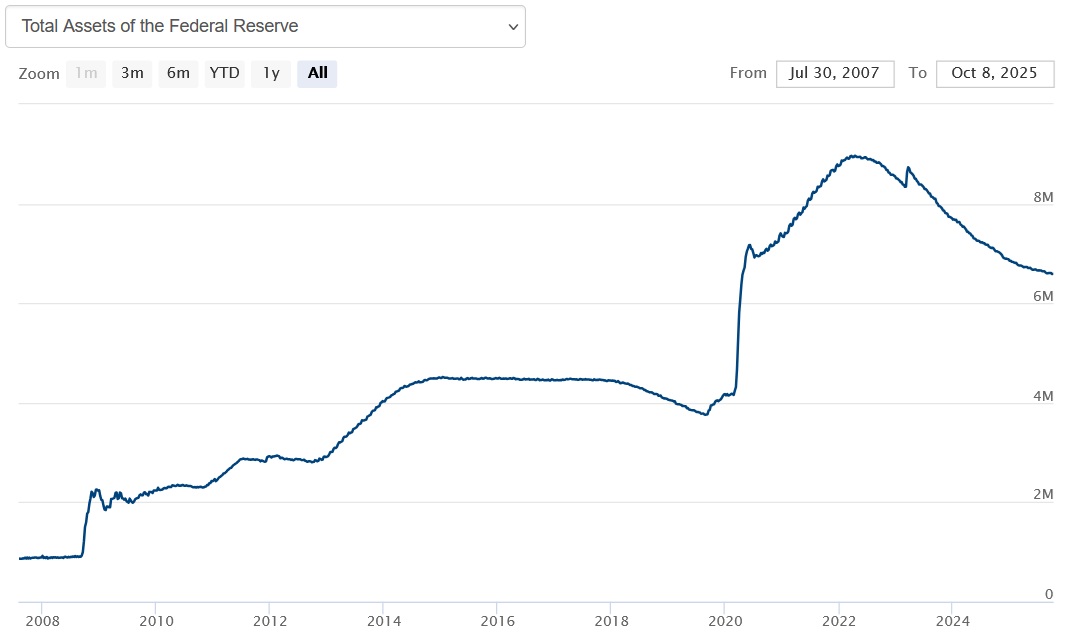
Fed Assets: The History of Quantitative aEsing (QE)

Creative Destruction in the Age of AI: How Endogenous Growth Theory Explains AI Stock Market Bubble

Déjà Vu Economics: How Trump’s Deregulation and Tariff Policies Mirror the Road to the Great Depression

Trumpenomics: The Fall of the USA

bookmark_borderTariff Truths: How Trump’s Trade War Is Taxing American Families and Businesses

Despite repeated claims from Donald Trump and his advisors that foreign countries are “paying the tariffs,” new data clearly shows the opposite. U.S. consumers and domestic companies are bearing nearly all of the costs — a hidden tax that is worsening inflation, eroding profits, and undermining economic growth.

According to an October 2025 analysis by Goldman Sachs, American consumers are now shouldering 55% of the total cost of Trump’s new import tariffs, while U.S. companies pay another 22%. In other words, more than three-quarters of the tariff burden is being paid by Americans — not by foreign exporters. Only a small portion is absorbed by overseas producers, debunking the administration’s long-standing assertion that tariffs are “paid for by China” or “funded by foreign governments.”

The economic mechanics behind this are straightforward but devastating. When tariffs are imposed, U.S. importers pay the added tax on goods entering the country. Those higher costs are then passed through the supply chain, eventually reaching consumers in the form of higher prices on everyday essentials — including food, automobiles, electronics, and household goods. The result is a direct contribution to inflation, disproportionately affecting low- and middle-income households.

Meanwhile, U.S. corporations are absorbing part of the impact to remain competitive, sacrificing profit margins and cutting back on investment, hiring, and wage growth. For small and mid-sized businesses dependent on imported components, these tariffs have become crippling — pushing many to the brink of insolvency in an already fragile economy.

Example of Corporate Failure
A recent casualty of these policies is First Brands Group, one of the largest aftermarket auto parts manufacturers in the world, which filed for Chapter 11 bankruptcy in September 2025. The collapse has caused billions in financial losses and raised alarm bells about the stability of the private credit market, already strained by manufacturing-sector exposure.

While the company faced several economic headwinds — including rising interest rates, supply chain disruptions, and slowing demand — tariffs played a decisive role. The Trump administration’s escalating import taxes on metals, components, and finished goods dramatically increased input costs across its supply chain. For a multinational firm operating on five continents and employing 26,000 people, the financial pressure became untenable.

Before filing, First Brands managed a well-known portfolio — Fram, Trico, and Raybestos among them — and generated approximately $5 billion in 2024 revenue. Yet as tariffs inflated raw material costs and credit tightened, the company could not sustain liquidity or refinance its mounting debt. Its bankruptcy represents not just a loss for the auto parts industry, but a warning sign of structural weakness spreading through U.S. manufacturing — the very sectors these tariffs were supposed to protect.

A Double Blow to the U.S. Economy
The outcome is a double blow to the American economy: consumers face rising prices while businesses struggle with shrinking margins. What was billed as a measure to “protect American industry” has instead functioned as an across-the-board tax hike on Americans.

Historically, tariffs are among the most regressive forms of taxation, hitting lower- and middle-income families hardest. As Trump’s trade wars expand, economists warn that the renewed wave of tariffs could reignite inflation, undermining recent progress in stabilizing prices.

Once again, protectionism is being sold as patriotism — and once again, it is American families and workers who are paying the price.

Trumpenomics: The Fall of the USA

bookmark_borderCreative Destruction in the Age of Artificial Intelligence: How Endogenous Growth Theory Explains Today’s AI Stock Market Bubble

by Daniel Brouse
October 13, 2025

The Theory: Innovation, Growth, and Creative Destruction

Joel Mokyr, Philippe Aghion, and Peter Howitt Nobel Prize winning work advanced what’s known as endogenous growth theory, which emphasizes that technological progress is not something that just happens outside the economy (“exogenously”) but rather emerges from within it — from incentives, competition, and human ingenuity.

1. Aghion & Howitt – The Schumpeterian Model of Creative Destruction

Their core idea builds on Joseph Schumpeter’s notion of creative destruction:

  • Economic growth results from new innovations that make old technologies obsolete.

  • Entrepreneurs and firms invest in research and development (R&D) to gain temporary monopoly profits.

  • But those profits are eroded as new innovations arise, replacing the old technologies in a perpetual cycle.

This process is inherently disruptive — some firms and workers lose out while the economy as a whole advances.  Aghion and Howitt’s mathematical framework formalized this dynamic, showing how policies that encourage innovation — such as intellectual property rights, education, and competition — can accelerate long-run growth.

2. Joel Mokyr – Technological Revolutions and the “Culture of Growth”

Mokyr provided the historical and cultural context. He argued that the Industrial Revolution wasn’t a random event, but the result of a cultural shift toward experimentation, curiosity, and tolerance for failure.
In other words, progress comes not only from inventions themselves, but from societies that reward innovation and permit “creative destruction” to play out.


Connection to Today’s AI Stock Market Bubble

Now let’s apply this to today’s markets, especially the so-called “AI boom” or “AI bubble” of the 2020s.

1. Innovation-Driven Expectations

AI represents the next major general-purpose technology, much like the steam engine, electricity, or the internet. According to the Aghion–Howitt model, such technologies can trigger long periods of high growth by spawning new industries, raising productivity, and replacing outdated methods.

However — as with every technological revolution — the market tends to overprice the early promise. Investors project rapid and universal adoption long before the productivity gains materialize.
This is classic in early phases of creative destruction: massive capital pours into the “new thing,” often faster than the real economy can absorb it.

2. Creative Destruction in Real Time

AI is already destroying and creating value:

  • Winners: chip manufacturers (NVIDIA, AMD), cloud providers, and leading AI platforms.

  • Losers: traditional software firms, smaller labor-intensive industries, and certain white-collar sectors vulnerable to automation.

This mirrors the mechanism Aghion and Howitt described — innovation shifts profits and productivity across the economy, while creative destruction eliminates older structures.

3. The Bubble Mechanism

The AI stock bubble arises when:

  • Investors focus on potential future monopoly rents of innovation leaders (e.g., OpenAI, Microsoft, NVIDIA).

  • They overestimate the speed and scale of productivity spillovers.

  • The expectation of continuous innovation feeds speculative growth loops — firms are valued not on present earnings but on anticipated technological dominance.

This speculative behavior has historical precedent:

  • Railroad boom (1840s)

  • Electricity and radio bubbles (1920s)

  • Dot-com bubble (1990s–2000s)

Each reflected a genuine technological breakthrough, but financial markets priced in decades of progress almost overnight.

4. Mokyr’s Cultural Insight

Mokyr’s emphasis on cultural attitudes toward innovation helps explain why the bubble exists at all.
Modern tech culture — particularly in Silicon Valley — celebrates disruption and treats exponential growth as inevitable. The “AI hype” is as much cultural and psychological as it is economic:

  • The belief that “if we don’t invest now, we’ll miss the revolution” drives valuations higher.

  • Social narratives around AI (from AGI dreams to existential risk) amplify both fear and greed, core emotional drivers in financial bubbles.

5. The Long-Term Payoff

Despite the bubble, endogenous growth theory predicts that the underlying innovation cycle will eventually justify much of the investment — just not as fast or evenly as markets expect.
After each crash, the surviving technologies and firms lay the foundation for the next era of sustained productivity growth.


Thus, while the AI stock market bubble may burst, the AI technological revolution will likely continue reshaping the economy — improving productivity, transforming industries, and generating new waves of creative destruction.

It would not be unreasonable to suggest that as much as 90% of today’s companies could face creative destruction within the next decade, including members of the so-called “Magnificent Seven” tech giants. History shows that no company—no matter how dominant—remains immune to technological upheaval.

Artificial intelligence represents a general-purpose technology capable of reshaping nearly every industry, from manufacturing and finance to entertainment and healthcare. As automation, machine learning, and generative AI continue to advance, they are likely to collapse traditional cost structures, eliminate redundant business models, and redistribute profits toward entirely new players.

The “Mag 7” firms—Apple, Microsoft, Alphabet, Amazon, Meta, NVIDIA, and Tesla—currently appear invincible, much like IBM in the 1980s or Yahoo in the early 2000s. Yet their dominance depends on maintaining proprietary advantages in algorithms, data, and computing infrastructure. As AI becomes more open-source, decentralized, and commoditized, those moats could shrink quickly. A new generation of innovators may rise on more efficient models, more agile platforms, or disruptive uses of AI that make even the current leaders look obsolete.

In short, creative destruction doesn’t spare its own champions. The same technological forces that built the modern tech giants could dismantle them—proving once again that in an age of accelerating innovation, staying dominant is harder than becoming dominant.


In Summary

Concept Economic Theory Relation to AI Bubble
Endogenous growth Innovation arises from within the economy Firms are racing to internalize and monetize AI capabilities
Creative destruction New technologies displace old ones AI is already rendering older business models obsolete
Temporary monopoly profits Innovators earn short-term gains Market leaders (NVIDIA, Microsoft, OpenAI) enjoy outsized valuations
Speculative overshoot Early overvaluation of innovation potential AI stocks trade on promise, not earnings
Cultural driver (Mokyr) Societies that glorify progress fuel innovation Tech optimism and “AI evangelism” inflate the bubble

bookmark_borderDéjà Vu Economics: How Trump’s Deregulation and Tariff Policies Mirror the Road to the Great Depression

by Daniel Brouse
October 13, 2025

In 1919, General Motors transformed the American economy by founding the General Motors Acceptance Corporation (GMAC), a revolutionary move that allowed customers to buy cars on credit. This innovation made cars accessible to the masses through installment plans and helped ignite the era of consumer financing. What began as a tool to boost car sales quickly evolved into a model for broader consumer credit across multiple sectors.

By the late 1920s, Wall Street adopted a similar approach. Brokerages began allowing retail investors to purchase stocks on margin — putting as little as ten percent down and borrowing the rest. This was marketed as “democratizing access” to the markets, a patriotic slogan that masked the systemic risks of unchecked speculation. With little to no regulation, the market ballooned into a fragile bubble built on debt and delusion.

Then came the inevitable. In October 1929, the stock market crashed, wiping out fortunes overnight and triggering the Great Depression. In response, sweeping regulations were enacted to protect small investors and stabilize the financial system — including the Securities Act of 1933, the Glass-Steagall Act, and the creation of the SEC. These guardrails safeguarded the economy for decades.

Fast forward nearly a century, and history is repeating itself. Since Donald Trump’s second term began, many of those same regulatory protections have been rolled back or weakened. Under the guise of “free markets” and “democratizing access,” Trump’s administration has pushed to open high-risk assets — such as cryptocurrencies and private equity — to small investors. Once again, speculative leverage is being glorified as empowerment, while systemic risk quietly grows beneath the surface.

Today, brokerages like Robinhood enable investors to buy stocks using borrowed money — eerily similar to the margin practices of the 1920s. Market leverage has reached its highest levels since 1929. Meanwhile, Trump’s protectionist trade agenda, marked by sweeping tariffs and economic isolationism, echoes another disastrous historical precedent: the Smoot-Hawley Tariff Act of 1930. That policy, intended to protect American jobs, instead provoked global retaliation and deepened the Great Depression by collapsing international trade.

The parallels are alarming. Over-leveraged markets. Deregulated speculation. Protectionist trade wars. Rising inequality. All signs point to a familiar outcome.

The question is no longer if the market will crash — it’s when. And this time, with far greater global interconnection and systemic debt, the fallout could make 1929 look like a dress rehearsal.

Trumpenomics: The Decline of the USA

bookmark_borderAmerica’s Bankruptcy Wave: How Trump’s Fiscal Policies and Economic Mismanagement Are Accelerating Business Collapses

by Daniel Brouse
October 7, 2025

For 2025, U.S. bankruptcy filings have surged, marking one of the steepest upward trends in more than a decade. The spike reflects the combined weight of rising interest rates, historic consumer debt levels, and mounting economic uncertainty. Both consumer and corporate bankruptcies are climbing sharply compared to previous years, signaling deep structural stress within the economy.

Local Fallout: Iron Hill Brewery Collapses

A telling example is Iron Hill Brewery, a well-known restaurant chain once boasting 16 locations across the Mid-Atlantic and South. In late September 2025, the company filed for bankruptcy after shuttering all operations abruptly. Initially, Iron Hill had announced the closure of only a few underperforming locations. However, just weeks later, it closed all remaining sites without warning.

Court filings revealed a stark financial picture: only $125,000 in liquid assets against more than $20 million in delinquent debt. The company filed for Chapter 7 bankruptcy, which calls for liquidation rather than reorganization. In contrast, Chapter 11 bankruptcy allows companies to restructure operations and debt, typically reserved for businesses that can still be salvaged. Iron Hill’s Chapter 7 filing underscores the severity of its financial collapse—and highlights the widening gap between temporary distress and total insolvency in today’s economy.

National Trend: Rite Aid’s Final Fall

On a national scale, Rite Aid provides another sobering case study. Once one of the country’s leading pharmacy chains, the company has been trapped in a cycle of financial collapse. After emerging from Chapter 11 bankruptcy in September 2024, Rite Aid filed again just eight months later, in May 2025—this time with no path to survival.

At its height, Rite Aid operated more than 1,200 stores across 15 states, from California to Vermont. Founded in 1962 as Thrift D Discount Center in Scranton, Pennsylvania, it became the nation’s third-largest standalone pharmacy chain. But by mid-2025, the company’s mounting debt, declining sales, and loss of investor confidence forced it to shutter all remaining locations. The closures not only marked the end of an American retail mainstay but also disrupted prescription access for millions of customers nationwide.

The Bigger Picture: Fiscal Policy and the Trump Effect

Economists warn that this wave of bankruptcies is not a coincidence but rather a predictable consequence of Trump’s fiscal and monetary interference. His administration’s uncoordinated tax policies, protectionist tariffs, and attacks on Federal Reserve independence have undermined both investor confidence and credit stability. By destabilizing long-term interest rate expectations and driving inflationary volatility, Trump’s policies have made borrowing more expensive for both consumers and corporations—while failing to stimulate sustainable growth.

The result is a toxic feedback loop:

  • Higher interest rates increase default risks.

  • Rising defaults weaken credit markets.

  • Weak credit markets lead to higher borrowing costs, further strangling small and mid-sized businesses.

Under these conditions, liquidation bankruptcies (Chapter 7) are becoming more common than reorganizations (Chapter 11). This shift indicates not just economic weakness but systemic erosion in the nation’s capacity to recover from financial distress.

Interest Rate Trends

Trends indicate that interest rates for borrowers with B (Fair) and C (Poor) credit are
at historically high levels, driven up by overall economic conditions and an increased risk premium charged by lenders. While the Federal Reserve has recently lowered its benchmark rate, interest rates for consumers with lower credit scores are expected to remain elevated.

  • Fair credit (630–689): For personal loans, the estimated average APR was around 17.93% in 2024, but some lenders charge much more.
  • Poor credit (300–629): For personal loans, borrowers received an average rate of 21.65% in 2024, with some online lenders charging rates that can be much higher, sometimes up to 36% or more.

Looking Ahead

If current trends persist, analysts project a 25–35% increase in total business bankruptcies by mid-2026, with liquidation filings growing at twice that rate. The combination of tariff-induced inflation, trade isolation, and fiscal mismanagement is eroding business confidence and pushing fragile sectors—like retail, hospitality, and manufacturing—toward collapse.  The United States now faces a stark warning: Trump’s version of economic nationalism has mutated into economic self-destruction. What began as rhetoric about “protecting American jobs” is instead destroying the financial foundation of American enterprise.

The question is, how do we get our corporate leaders to realize this and stop backing Trump and his Neo fascist lackeys?

Unfortunately, there’s very little that corporate leaders can do under the current circumstances. Trump has demonstrated a blatant disregard for constitutional law, market independence, and the rule of economics. Rather than engaging in dialogue or respecting private enterprise, he has repeatedly attacked and threatened corporations that publicly challenge his administration. In several cases, he has even asserted ownership or control over companies through coercive tactics, regulatory retaliation, and preferential contracting—behaviors fundamentally at odds with free-market capitalism.

Behind the scenes, however, many corporations are taking defensive measures—just not the kind that benefit the U.S. economy. Instead of “re-shoring” manufacturing or expanding domestic investment as Trump claims, the opposite is happening. Companies are quietly diversifying supply chains abroad, moving production to more stable markets to avoid tariff volatility and political risk. This exodus is accelerating the decline of U.S. exports and weakening long-term economic competitiveness.

The damage extends far beyond manufacturing. Major U.S. trading partners have lost confidence in America’s reliability, and as a result, global markets are shifting away from the dollar. Multinationals now view the U.S. as a politically unstable environment, where economic decisions are driven by vengeance rather than sound policy.

The irony is inescapable: while Trump rails against “socialism,” his administration continues to hand out taxpayer-funded bailouts to cover the fallout from his own trade wars. In fact, today he is expected to announce a multi-billion dollar bailout for farmers devastated by his tariff policies—a desperate attempt to mask the consequences of his economic incompetence.

In short, business leaders understand the danger, but their ability to act is constrained by retaliatory governance, protectionist policies, and fear of political retribution. The result is a climate of uncertainty that discourages innovation, investment, and trust—the very pillars of capitalism that Trump claims to defend.

Trumpenomics: The Decline of the US

bookmark_borderNeptune Flood IPO: Riding the Rising Tide of Climate Risk

by Daniel Brouse
October 1, 2025

Neptune Flood, the largest private flood insurance company in the U.S., went public today, October 1, 2025, with its initial public offering (IPO) on the New York Stock Exchange under the ticker symbol “NP.” The St. Petersburg, Florida-based company raised $368 million by selling over 18 million shares at $20 per share, pricing at the top of its marketed range.

The IPO underscores the growing intersection between climate change, financial markets, and technological disruption. For decades, the flood insurance sector in the United States has been dominated by the National Flood Insurance Program (NFIP), a government-run system long criticized for outdated risk maps, cross-subsidized premiums, and mounting losses as extreme weather intensifies.

Neptune Flood is positioning itself as a market-based alternative. By leveraging artificial intelligence, machine learning, and big data, the company provides instant, risk-adjusted quotes—a major departure from the slow, bureaucratic processes of traditional insurance systems. Its model appeals to homeowners and businesses seeking coverage in areas where climate-driven flooding has rendered NFIP or private insurers either too slow, too expensive, or unwilling to underwrite risk.

But the company’s growth also highlights a troubling trend: vast regions of the U.S. are becoming increasingly uninsurable due to climate change. Rising sea levels, heavier rainfall, and stronger hurricanes are driving up both the frequency and severity of flood events. Where government-backed programs once absorbed much of the cost, private insurers like Neptune are stepping in with higher-cost policies tailored to high-risk consumers willing to pay for coverage.

While investors are attracted to Neptune’s profitability and data-driven underwriting, critics argue that its model may accelerate inequality in climate resilience. Wealthier homeowners and businesses may be able to afford Neptune’s “climate risk premium,” while middle- and lower-income households are left exposed or priced out of protection entirely. This could widen the gap between those who can adapt financially to climate change and those who cannot.
As Neptune Flood begins its life as a publicly traded company, its trajectory will serve as a bellwether for how private capital navigates the growing risks of climate change. Whether it represents a genuine solution or simply a profitable adaptation to a failing system remains to be seen—but one thing is clear: the tide of climate risk is rising, and financial markets are now deeply invested in who sinks and who swims.

Is this a good stock to short?

Actually, it’s not that simple. Neptune’s AI model incorporates climate risk directly into its premium setting, which gives it a built-in hedge—if people are willing (or forced) to pay the extraordinary premiums, Neptune stays profitable. As FEMA gradually steps back from subsidized coverage and shifts toward managed retreat, the private flood insurance market is only going to grow.

That said, there’s a real wild card here: states like Florida are already socializing homeowners’ insurance with taxpayer money. That creates a distorted market where Neptune may find itself competing not just with other insurers, but with its own state government’s artificially underpriced coverage.

So, shorting them might not be as obvious as it looks. This is one of those stocks where climate, policy, and economics will collide in unpredictable ways. Definitely worth watching.

* Our climate model employs chaos theory to comprehensively consider human impacts and projects a potential global average temperature increase of 9℃ above pre-industrial levels.

Tipping points and feedback loops drive the acceleration of climate change. When one tipping point is breached and triggers others, the cascading collapse is known as the Domino Effect.

The Human Induced Climate Change Experiment

bookmark_borderTrump’s Bailouts: Socialism for Farmers, Handouts Abroad, and a Wrecking Ball for U.S. Taxpayers

Donald Trump has once again taken to social media to tout a taxpayer-funded “solution” to problems of his own making. After launching destructive tariff wars and pushing through regressive tax policies, he is now bailing out U.S. soy farmers left devastated by his economic blunders. The irony is glaring: a president who endlessly denounces “socialism” has engineered one of the largest socialized farm bailout schemes in modern U.S. history.

But Trump didn’t stop there. In a stunning twist, he also pledged a $20 billion bailout to Argentina—an economy already shattered by its own radical president, Javier Milei, whose wrecking-ball style of governance mirrors Trump’s. The justification? None offered, beyond Trump’s apparent admiration for Milei’s theatrics. The irony deepens as China, once the biggest buyer of U.S. soybeans, now sources much of its supply from Argentina. In essence, Trump is bailing out a competitor that has directly benefited from his failed trade war.

What emerges is a system of economic feedback loops where taxpayer money props up failed policies but provides no lasting benefits. Soy farmers are trapped in a cycle of dependency created by tariffs that cut them off from global markets. Meanwhile, billions flow overseas to countries like Argentina, whose gain comes at America’s loss. These are not investments in growth or competitiveness; they are subsidies for failure.

The larger picture is clear: Trump has redefined “America First” into “America Pays.” Trade wars have gutted U.S. exports, protectionism has isolated American industries, and fiscal recklessness has ballooned deficits. Instead of fostering resilience, his policies have created dependency at home and strategic giveaways abroad.

In the end, Trump’s bailouts are not acts of strength but confessions of failure—an admission that his economic vision is collapsing under its own weight, leaving taxpayers to foot the bill while competitors reap the rewards.

Trumpenomics: The Decline of the US

bookmark_borderTrump Faces Over 300 Lawsuits for Executive Overreach and Harm to U.S. Citizens

Donald Trump is now facing more than 300 lawsuits challenging his executive overreach, authoritarian policies, and actions that have caused widespread harm to American citizens. The sheer volume of litigation is unprecedented in modern U.S. history and reflects the growing backlash against his administration’s unchecked power and disregard for constitutional limits.

A large portion of these lawsuits stem from Trump’s implementation of the largest regressive tax policies in U.S. history, which disproportionately burden working families, individuals, and small businesses while offering sweeping benefits to billionaires and multinational corporations. Small businesses across the country argue that Trump’s tax structure and tariffs have left them at a competitive disadvantage, forcing layoffs, closures, and in some cases, permanent shutdowns.

The tariff wars have also crushed American farmers, driving up input costs, cutting off access to foreign markets, and leaving crops unsold. Instead of addressing the damage caused by his own policies, Trump has announced that he will use billions in taxpayer money for bailouts—a form of economic intervention he derides as “socialism” when practiced by other countries. Critics point out that this hypocrisy not only undercuts U.S. credibility on trade policy but also exposes farmers to greater long-term instability as markets realign away from American agriculture.

Other lawsuits target Trump’s executive actions undermining democratic norms, including restrictions on immigration, the use of federal agents without identification in domestic operations, and policies that have weaponized federal agencies for political gain. Civil rights groups, state attorneys general, and advocacy organizations have joined the litigation, arguing that these actions not only violate the Constitution but also set dangerous precedents that erode the rule of law.

Additionally, several cases allege that Trump’s decisions have resulted in direct violations of individual rights—including denial of due process, infringement on free speech and assembly, and discriminatory practices rooted in racism and bigotry. Plaintiffs point to travel bans, detention practices, and the rollback of environmental and labor protections as examples of executive overreach that harm both people and the planet.

Legal experts note that while many of these cases will take years to wind through the courts, the sheer number and diversity of lawsuits illustrate a nation in deep conflict with its own leadership. If successful, these challenges could redefine limits on executive authority and reshape the balance of power between the presidency, the judiciary, and the people.

Trumpenomics: The Decline of the USA

bookmark_borderTrump’s Crimes, Illegal Activities, and Immorality: A Record of Corruption

Donald Trump’s public record is one of corruption, cruelty, and contempt for truth, law, and democracy. His actions—documented in court rulings, congressional reports, and his own words—paint a picture of a man unfit for power.

Trump’s Record:

  1. Been implicated in pedophilia and sexual misconduct allegations. The Epstein files are being withheld by Donald Trump—that’s not an accusation, it’s a fact. Trump himself admitted that Epstein “stole” his underaged massage girl from Mar-a-Lago, and his relationship with Epstein is well documented.
  2. Repeatedly denied science—on climate change, on public health, and on issues with life-or-death consequences.
  3. Lied pathologically about everything from crowd sizes to election results.
  4. Promoted white supremacy and emboldened racially charged violence.
  5. Been found liable for sexual assault in civil court.
  6. Stoked division through bigotry, bullying, and fear-based politics.
  7. Stood by as the U.S. Capitol was attacked, later praising or pardoning those responsible.
  8. Attempted to overturn a lawful election, undermining democracy itself.
  9. Engaged in financial fraud, including a judgment for falsifying business records.
  10. Misused charity funds, leading to a lifetime ban from operating a charitable foundation in New York.
  11. Implemented family separation policies at the border, losing track of children in the process.
  12. Attacked the independence of the Federal Reserve, destabilizing global markets.
  13. Attacked the First Amendment going so far as to threaten any television network critical of him.
  14. Exploded the national debt by trillions while handing tax cuts to billionaires, worsening inequality.
  15. Tried to weaponize the Justice Department as his personal shield and sword.
  16. Floated the idea of “suspending” the Constitution to stay in power.
  17. Been convicted of falsifying business records to hide damaging information from voters before an election.
  18. The real question is: who, knowing all of this, still chooses to support or defend such behavior?

The Bottom Line

Trump’s record is not a string of mistakes or misjudgments—it is a sustained pattern of lies, lawbreaking, and immorality. The real question is not whether Trump is guilty of corruption. The evidence is overwhelming. The real question is: who, knowing all of this, still chooses to support or defend such behavior—and why?

Trumpenomics: The Decline of America

bookmark_border100% TACO: Trump’s Reckless Tariff on Life-Saving Medicines

Protectionism, White Nationalism, and the Collapse of U.S. Economic Credibility

Donald Trump has just announced one of the most dangerous and reckless policies of his presidency: a 100% tariff on all branded or patented pharmaceutical products, unless the manufacturer is currently building a plant in the United States.

“Starting October 1st, 2025, we will be imposing a 100% Tariff on any branded or patented Pharmaceutical Product, unless a Company IS BUILDING their Pharmaceutical Manufacturing Plant in America,” Trump declared on Truth Social. The tariff exemption would only apply if a company had already broken ground on U.S. facilities.

While generic drugs—representing the majority of U.S. imports—are excluded, the real impact falls on life-saving branded medicines, including cancer treatments, biologics, vaccines, and advanced therapies. Nathalie Moll, director-general of the European pharma lobby EFPIA, warned bluntly: “Tariffs on medicines, however excessive, will create the worst of all worlds. Patients will be denied access to life-saving treatments.”

The pharmaceutical industry had previously been spared from Trump’s earlier “reciprocal tariff” packages, but this announcement breaks with prior commitments made to the EU and other trading partners. The EU’s 15% tariff ceiling deal, which included a “no stacking” clause, now appears to be in jeopardy. Switzerland, despite agreeing to steep tariffs in August, had exempted pharmaceuticals—until now. The UK, lacking any pharma-specific trade agreement, is scrambling for clarity.

In an attempt to appease Washington, drugmakers like AstraZeneca, GSK, Novartis, and Roche have already announced new U.S. investments, though many projects remain in the planning stage. Analysts caution that even these companies could face tariffs until actual construction is underway, leaving them vulnerable to immediate disruption.

Financial markets reflected the uncertainty: AstraZeneca and Roche shares initially fell before recovering. Still, the longer-term threat is not to investors but to patients, who may face higher drug costs, restricted supply, and delayed access to new treatments.

This tariff bombshell highlights the hypocrisy of Trump’s economic nationalism. For years, Trump has attacked foreign countries for subsidizing industries like farming or steel while quietly supporting similar “Trump-socialist” policies at home, including stakes in U.S. Steel, Intel, and other politically favored corporations. His latest tariffs expand this protectionist playbook to essential medicines—a sector where the costs of political gamesmanship are measured not in dollars but in human lives.

The announcement came alongside new tariffs of 25% on imported heavy-duty trucks and 50% on kitchen and bathroom cabinets—further evidence of Trump’s broader war against free trade. Rather than strengthening America’s position, these moves isolate the U.S., alienate allies, undermine credibility, and expose consumers to higher costs across essential goods.

This is not an “America First” policy. It is protectionism and white nationalism masquerading as economic strategy. If enacted, it could mark not only the collapse of Trump’s economic credibility but also the decline of U.S. global leadership. By weaponizing access to life-saving medicine, Trump has crossed a line that could cost lives, destabilize markets, and fracture alliances.

The question now is simple: Will Trump TACO out before America does?

Trumpenomics: The Decline of the USA