bookmark_borderUnderestimation of Climate Sensitivity and Feedback Processes

by Daniel Brouse
April 2, 2025

In the 1990s, we first hypothesized the non-linear acceleration of climate change. By the early 2000s, this hypothesis had evolved into established climate theory, now widely recognized as scientific fact. My lab partner, a Doctor of Physics from Ohio State, and I collaborated to provide key evidence supporting this theory. Over the years, we have observed a dramatic reduction in the doubling time of climate change impacts — the rate at which these effects intensify. Initially, the doubling time was approximately 100 years, but it has since decreased to 10 years and, more recently, to just 2 years. This trend implies that the damage caused by climate change today is double what it was two years ago. In two years, it could be four times worse; in four years, eight times worse; and within a decade, potentially 64 times worse. These projections are conservative, assuming the doubling period does not continue to shrink further. Alarmingly, this rapid acceleration does not appear to be an anomaly. If this trajectory persists, the consequences will likely be far more catastrophic than previously anticipated.

Dr. James E. Hansen’s paper Global Warming Acceleration: Impact on Sea Ice confirms our theory with an analysis of the acceleration of global warming and its impact on sea ice, ice sheets, and ocean circulation, with a particular focus on the Atlantic Meridional Overturning Circulation (AMOC). Climate sensitivity is higher than previously estimated (ECS = 4.5 ± 0.5°C for doubled CO₂), which fundamentally alters expectations for future climate change. IPCC models fail to account for freshwater effects on sea ice cover, leading to an underestimation of climate sensitivity and feedback processes.

AMOC Shutdown Risk: Hanson emphasizes that accelerated warming increases the likelihood of AMOC shutdown by reducing surface water density in deepwater formation regions. A shutdown would trigger severe long-term consequences, including rapid sea level rise.

An AMOC shutdown would have severe and far-reaching impacts worldwide. For instance, on the U.S. East Coast it would lead to rapid sea level rise, stronger storms, and extreme weather shifts. As the AMOC slows or stops, warm water would no longer be transported northward, causing ocean water to pile up along the East Coast, which could raise sea levels by 1-3 feet (30-90 cm) almost immediately, on top of global sea level rise. This would have particularly devastating effects on the Northeast U.S. (New York, Boston, DC, Miami), where flooding would be most severe.

The weakening or shutdown of the AMOC would also impact hurricane formation. With warmer waters off the East Coast, hurricanes would become more intense and slower-moving, leading to longer-lasting and more destructive storms, like Hurricane Sandy. As the Gulf Stream weakens, hurricanes could linger longer over coastal cities, causing catastrophic flooding. Additionally, the disruption of weather patterns would lead to a stark contrast: the Northeast and Europe could experience much colder winters while the Southeast U.S. (Florida, Georgia, Carolinas) would face more extreme heat and droughts.

Increased rainfall and flooding would also become more common. With the Gulf Stream weakened, storms could stall over cities, dumping massive amounts of rainfall, similar to what occurred during Hurricane Harvey in Texas but along the East Coast. Nor’easters and stronger winter storms would become more frequent, particularly in New England. The disruption of the AMOC would also have catastrophic consequences for marine ecosystems. The circulation helps distribute nutrients in the ocean, and its shutdown could disrupt fish migration patterns and collapse major fisheries, especially in the Northeast U.S., where industries like cod fishing and lobster harvesting would be devastated.

In a Climate Crisis

Since the Earth’s equilibrium climate sensitivity (ECS) is 4.5 ± 0.5°C for a doubling of CO₂, the likely temperature rise this century under current emission levels will be significantly higher than IPCC estimates. Here’s a breakdown of how that translates into global warming:

1. CO₂ Projections & Radiative Forcing

  • Pre-industrial CO₂ (~280 ppm) to Present (~420 ppm): We’ve already experienced a ~1.2°C rise in global temperature.

  • Business-as-Usual Scenario (High Emissions, ~800-1000 ppm CO₂ by 2100): If emissions continue at current levels, CO₂ could more than double from pre-industrial levels, reaching or exceeding 560 ppm (the doubling threshold for ECS calculations).

  • Additional non-CO₂ greenhouse gases (methane, nitrous oxide, etc.) also contribute to warming.

2. Temperature Increase by 2100

Using ECS = 4.5 ± 0.5°C, and considering:

  • Climate sensitivity refers to long-term equilibrium response (centuries), but transient warming occurs within this century.

  • The Transient Climate Response (TCR), which is lower than ECS, typically ranges ~60-70% of ECS, meaning near-term warming may be slightly less than equilibrium projections.

Projected Warming by 2100 Based on ECS = 4.5°C

  1. Lower-End Case (~550-600 ppm CO₂, with significant mitigation efforts)

    • Optimistic warming: ~3.5–4.5°C

    • Comparable to IPCC’s worst-case scenarios (RCP 6.0–7.0 range)

  2. High-Emissions Case (~800-1000 ppm CO₂, with some mitigation)

    • Potential warming: ~5–7°C

    • This is significantly worse than IPCC’s RCP 8.5 projection, which assumes ECS = 3°C.

  3. Business as Usual Case (Feedbacks Accelerate Warming: AMOC Shutdown, Ice-Albedo, Methane Releases, etc.)

    • Expected warming: 7-9°C or more

    • This would resemble past hyperthermal events like the Paleocene-Eocene Thermal Maximum (PETM).

3. Policy & Adaptation Implications

  • If ECS is higher than IPCC estimates, it means current climate policies are underestimating risk.

  • The IPCC’s mid-range scenarios (projecting ~3°C by 2100) may be too optimistic if ECS is truly ~4.5°C.

  • Higher ECS implies faster and more extreme tipping points, including AMOC collapse, rapid sea level rise, and uninhabitable regions.

4. Urgency for Rapid Emission Cuts

  • Even immediate aggressive action (net-zero by mid-century) would still result in ~2.5-3°C warming due to existing CO₂ levels and slow response time.

  • Avoiding catastrophic warming (>4°C) requires drastic reductions in fossil fuel use this decade.

Bottom Line: At Current Emissions, Warming by 2100 is Likely 6°C or Higher

This level of warming would lead to massive global disruptions, including widespread droughts, stronger hurricanes, agricultural collapse, and displacement of hundreds of millions due to rising sea levels. If ECS is truly 4.5°C, the window to prevent catastrophic warming is far smaller than most policymakers assume.

* Our climate model employs chaos theory to comprehensively consider human impacts and projects a potential global average temperature increase of 9℃ above pre-industrial levels.

bookmark_borderTrump Economics: Immediate Economic Deterioration

by Daniel Brouse
April 1, 2025

The Atlanta Fed’s GDPNow model estimate for real GDP growth (seasonally adjusted annual rate) in the first quarter of 2025 has been revised downward to -3.7% as of April 1, a significant drop from the previous estimate of -2.8% on March 28. This sharp decline reflects increasing signs of economic weakness, with downward adjustments driven by recent economic data releases.

The latest revision follows the release of the U.S. Census Bureau’s construction spending report and updated March data, which have been incorporated into the models’ dynamic factor model. This includes key economic indicators such as manufacturing data from the Institute for Supply Management (ISM) and consumer sentiment measures from two major surveys. As a result, projections for real final sales to private domestic purchasers—a measure that excludes inventory changes and trade to focus on underlying domestic demand—have also been downgraded significantly, from an already modest 1.5% growth to just 0.4%.

This decline in final sales growth suggests weakening consumer and business demand, a concerning sign for the broader economy. The steep drop in the GDPNow estimate highlights mounting economic headwinds, including potential slowdowns in construction activity, weaker manufacturing output, and dampened consumer confidence. The rapid downward adjustments underscore the fragile nature of the economy and raise the likelihood of a deeper economic contraction in the first quarter of 2025.

The Atlanta Fed’s GDPNow tracker is unique among economic forecasting models because it relies entirely on real-time economic data rather than subjective adjustments, expert judgments, or historical trend corrections. This distinguishes it from models used by institutions like Goldman Sachs, the Congressional Budget Office (CBO), or the Federal Reserve Board, which incorporate analyst assumptions and long-term economic trends into their projections.

Key Features of GDPNow’s Real-Time Approach

  1. Data-Driven, No Human Adjustments

    • GDPNow updates its estimates immediately as new economic reports are released.

    • Unlike other forecasts, it does not incorporate expert opinions, policy expectations, or qualitative analysis.

  2. Incorporation of Official Economic Indicators

    • The model dynamically integrates data from government reports and key economic surveys, such as:

      • Retail Sales & Personal Consumption (from Census Bureau & BEA)

      • Industrial Production & Manufacturing Data (from the Federal Reserve & ISM)

      • Housing Market & Construction Spending (from the Census Bureau)

      • Trade Balance & Net Exports (from the Bureau of Economic Analysis)

    • As soon as this data is released, GDPNow automatically recalculates GDP growth rather than relying on outdated estimates.

  3. No Lag in Economic Signal Processing

    • Traditional economic models smooth out extreme movements by adjusting for historical trends or potential policy impacts.

    • GDPNow, however, reflects economic conditions as they happen, allowing for a faster reaction to economic shocks (e.g., sudden supply chain disruptions, inflation surges, or unexpected recessions).

  4. Comparisons to Traditional Forecasts

    • Goldman Sachs, Morgan Stanley, and Federal Reserve models include human judgment, adjustments for policy changes, and expectations about long-term economic behavior.

    • These models might underestimate sudden downturns because they assume mean reversion (the idea that GDP will return to its trend level).

    • GDPNow has historically provided more accurate short-term predictions during periods of economic volatility.

Why This Matters

Because GDPNow operates solely on real-time data, it is often the first indicator of economic slowdowns or recessions before other forecasters adjust their outlooks. The recent sharp drop in the Q1 2025 estimate to -3.7% (as of April 1) highlights its ability to reflect immediate economic deterioration rather than lagging behind consensus forecasts.

Immediate Economic Deterioration -3.7% GDP

Trumpenomics: The Decline of the US

Trumpenomics: The Decline of the US

bookmark_borderFinancial Ethics and Legal Controversies: Trump, Musk, and Conflicts of Interest

Financial Disclosure and Conflict of Interest Regulations for U.S. Presidents and Officials

When a U.S. president takes office, they—as well as their cabinet members, high-ranking officials, and anyone with substantial influence in the administration—are generally required to disclose all financial activities. This process is designed to ensure transparency, prevent conflicts of interest, and uphold ethical standards in governance.

Typically, this includes the public release of their tax returns, which provides insight into their financial history, sources of income, and potential conflicts of interest. Additionally, officials are expected to divest from any assets or positions that could create conflicts, either by selling them outright or placing them into a blind trust managed independently to prevent undue influence over policy decisions.

A broad set of federal laws and regulations, including the Ethics in Government Act and various conflict-of-interest statutes, exist to prevent public officials from using their positions for personal financial gain. These laws prohibit actions such as insider trading, self-dealing, and preferential treatment in policymaking or government contracts. Violations can lead to legal consequences, loss of office, or significant reputational damage.

While past presidents have largely adhered to these ethical norms, there have been exceptions and controversies, highlighting the ongoing debate about the adequacy of existing laws and enforcement mechanisms.

Donald Trump’s Lack of Transparency and Authenticity

President Donald Trump’s adherence to financial disclosure and conflict of interest regulations has been a subject of extensive scrutiny and debate.​

Financial Disclosures:

As a candidate and officeholder, President Trump was required to submit financial disclosure reports detailing his assets, income sources, and business interests. While he did file these disclosures, organizations like Citizens for Responsibility and Ethics in Washington (CREW) have raised concerns about the completeness and transparency of these reports. For instance, CREW obtained and analyzed Trump’s 2023 financial disclosures, highlighting potential gaps and ambiguities.

Conflicts of Interest:

Unlike his predecessors, President Trump chose not to divest from his extensive business holdings upon assuming office. This decision led to numerous allegations of conflicts of interest. CREW documented over 3,400 instances where the line between the Trump Organization and the Trump administration appeared blurred, raising questions about whether policy decisions were influenced by personal financial interests.

Specific concerns include the promotion of personal business ventures and the intertwining of official duties with private interests. For example, events and initiatives that involved both governmental roles and private business promotions have been criticized as potential violations of ethical standards. ​

Legal and Ethical Considerations:

It’s important to note that the President is exempt from certain federal conflict of interest laws that apply to other executive branch employees. However, ethical norms and the Constitution’s Emoluments Clauses are intended to prevent undue influence and ensure that presidential decisions are made in the public interest, free from personal financial considerations. Critics argue that President Trump’s actions challenged these principles, leading to legal challenges and calls for greater accountability.

Concerns have been raised regarding potential conflicts of interest and ethical standards involving President Donald Trump, his family, and Elon Musk. Key issues include:​

Tesla Event on the White House Lawn

On April 1, 2025, Elon Musk hosted an event on the White House lawn alongside President Trump to promote Tesla vehicles. This event drew criticism for potentially using public office for private gain, as it appeared to leverage the presidential platform to benefit Musk’s private enterprise. The event also sparked global protests, with demonstrators targeting Tesla showrooms to express opposition to Musk’s partnership with President Trump. ​

Trump Organization’s Ventures in Vietnam

The Trump Organization announced plans for multi-billion-dollar investments in Vietnam, including golf courses, hotels, and real estate projects. The first project, valued at $1.5 billion near Hanoi, is set to break ground in May 2025. These developments proceed amid potential U.S. tariffs on Vietnam due to trade imbalances. Critics argue that such foreign ventures by a sitting president’s business could lead to conflicts of interest, especially when intertwined with international trade policies. ​

Starlink Contracts and Tariff Relief

Elon Musk’s Starlink secured contracts to provide satellite internet services in Vietnam, coinciding with Vietnam’s efforts to mitigate U.S. tariffs by increasing imports from the U.S. This arrangement has raised questions about potential quid pro quo dealings and the ethical implications of a government official’s private company benefiting from international agreements influenced by U.S. trade policies. ​

Elon Musk’s Role in Government and Business Interests

Elon Musk’s appointment as co-lead of the Department of Government Efficiency (DOGE) under President Trump has been scrutinized due to potential conflicts of interest. As a “special government employee,” Musk is subject to less stringent conflict-of-interest rules, allowing him to maintain leadership roles in his private companies while influencing government operations. This dual role has prompted calls for investigations into whether Musk has used his government position to benefit his businesses, particularly concerning the cancellation of a $2.4 billion FAA contract with Verizon in favor of Starlink.

Legal Actions and Investigations

In March 2025, a U.S. judge ruled that Elon Musk must face a fraud lawsuit alleging he delayed disclosing his significant stake in Twitter (now X), potentially misleading investors and violating securities laws. Additionally, leading Democrats have called for investigations into Musk’s activities, focusing on his influence over federal agencies and the financial benefits his companies have received from government contracts. ​

These instances highlight ongoing concerns about the intersection of public duties and private interests among high-ranking officials and their associates, emphasizing the need for stringent ethical standards and transparency in government operations.

Senators Launch Investigation into Trump’s Crypto Corporation, Urge SEC to Preserve Documents

​Senator Elizabeth Warren, along with Representative Maxine Waters, has requested that the Securities and Exchange Commission (SEC) preserve records related to President Donald Trump’s cryptocurrency venture, World Liberty Financial. They are investigating potential conflicts of interest stemming from the Trump family’s financial ties to this crypto business. ​

In a separate initiative, Senator Warren, joined by four other Democratic senators, expressed concerns about conflicts of interest regarding World Liberty Financial’s plans to issue a stablecoin named USD1. They sent a letter to U.S. financial regulators seeking clarification on how they intend to oversee this venture.

Additionally, Senator Warren has called on David Sacks, President Trump’s Special Advisor for AI and Crypto, to publicly disclose his financial records. She aims to address potential conflicts of interest related to the administration’s cryptocurrency policies.

These actions reflect ongoing concerns among Democratic lawmakers about the intersection of President Trump’s official duties and his family’s business interests in the cryptocurrency sector.

TRUMP’S HISTORY OF CRIMINALITY AND UNETHICAL BEHAVIOR

President Donald Trump and his associated entities have been involved in numerous legal proceedings, encompassing civil and criminal cases, impeachments, bankruptcies, defamation suits, sexual assault allegations, and controversies surrounding both non-profit and for-profit ventures. Below is an overview:

Criminal Indictments and Convictions:

  • 2023-2024 Criminal Cases: Between 2023 and 2024, Trump faced four criminal indictments on charges including fraud, election subversion, and obstruction. These marked the first instances of a former U.S. president facing criminal charges.
  • 2025 Conviction: In early 2025, Trump was convicted on 34 felony counts related to concealing a “hush money” transaction intended to hide a sex scandal from voters. Despite the conviction, he was sentenced to no penalty, making him the first individual convicted of a felony to assume the office of president.

Civil Lawsuits and Investigations:

  • New York Civil Fraud Lawsuit: In September 2022, New York Attorney General Letitia James filed a civil lawsuit against Trump, his three eldest children, and the Trump Organization, alleging over 200 instances of fraud and misrepresentation. The suit sought $250 million in penalties and aimed to restrict future business activities in New York. In February 2024, a judge ordered Trump to pay a penalty exceeding $450 million and barred him from leading any New York company for three years.

Defamation and Sexual Assault Cases:

  • E. Jean Carroll Case: In 2019, writer E. Jean Carroll accused Trump of raping her in a department store dressing room in the 1990s. Trump denied the allegation, leading Carroll to file a defamation lawsuit against him. In May 2023, a jury found Trump liable for sexual abuse and defamation, awarding Carroll $5 million in damages. Subsequent appeals by Trump were rejected, and in a later ruling, he was ordered to pay an additional $83.3 million in damages.
  • Other Allegations: Multiple women have accused Trump of sexual misconduct over the years. While he has denied these allegations, they have led to various legal challenges and public scrutiny.

Impeachments:

  • First Impeachment (2019): The House of Representatives impeached Trump on charges of abuse of power and obstruction of Congress related to his dealings with Ukraine. The Senate acquitted him in early 2020.
  • Second Impeachment (2021): Following the January 6 Capitol riot, Trump was impeached again, this time for incitement of insurrection. The Senate acquitted him in February 2021.

Bankruptcies:

While Donald Trump has never filed for personal bankruptcy, several of his business ventures have — repeatedly. The exact number of corporate bankruptcies tied to Trump is difficult to pin down, largely because of how they are counted. For example, Trump’s casino empire — operating under Donald J. Trump (DJT) Hotels & Casinos — filed for bankruptcy four separate times, though some analysts group those together as a single event.

Most sources agree that Trump-related companies have filed for bankruptcy at least six times. However, when counting repeat filings by the same entities, some estimates place the total closer to 12 to 14.

In every case, a familiar pattern emerges: Trump personally profited while shareholders, lenders, and employees absorbed the losses. His playbook centers on aggressive debt, questionable financial management, and systematically transferring risk away from himself and onto investors and creditors.

Now, he’s applying the same strategy on a global scale.

Legal Issues Involving Non-Profit and For-Profit Entities:

  • Trump University: Established in 2005, Trump University offered real estate training programs. It faced multiple lawsuits alleging fraudulent practices, including a significant case in which plaintiffs accused the institution of misleading students about the quality of education provided. In 2018, a federal judge finalized a $25 million settlement to resolve these lawsuits, allowing former students to receive compensation for their financial losses.
  • Donald J. Trump Foundation: Founded in 1988, the Trump Foundation came under scrutiny for alleged misuse of funds, including accusations of self-dealing and advancing Trump’s political interests. In 2019, the New York Supreme Court ordered Trump to pay $2 million in damages for improperly using charitable assets to intervene in the 2016 presidential primaries and further his own political interests.

​Jail

Both Allen Weisselberg, the former Chief Financial Officer (CFO) of the Trump Organization, and Michael Cohen, President Donald Trump’s former personal attorney and “fixer,” were convicted and served prison sentences due to their involvement in financial crimes related to their roles within the Trump Organization.​

Allen Weisselberg:

Weisselberg was implicated in a tax fraud scheme involving the Trump Organization. He pleaded guilty to 15 felony charges, including grand larceny, criminal tax fraud, and falsifying business records. These charges stemmed from his failure to pay taxes on $1.7 million in indirect compensation, which included benefits such as a rent-free luxury apartment, private school tuition for his grandchildren, and leased Mercedes-Benz vehicles. In January 2023, Weisselberg was sentenced to five months in jail and began serving his sentence at Rikers Island.

Michael Cohen:

Cohen pleaded guilty to multiple charges, including tax evasion, bank fraud, and campaign finance violations. The campaign finance violations were particularly notable, as they involved orchestrating hush money payments to women alleging affairs with Donald Trump during the 2016 presidential campaign. These payments were intended to influence the election by suppressing potentially damaging information. In December 2018, Cohen was sentenced to three years in federal prison.

Profit Over Patriotism: How Trump’s Second Term Blurred the Line Between Presidency and Personal Gain
Donald Trump’s second term in office marked a sharp escalation in the merger of political power and personal profit. From crypto schemes and cell service ventures to corporate-sponsored parades and questionable foreign deals, Trump turned the presidency into a revenue-generating enterprise, prioritizing his brand and wallet over democratic norms and military integrity.

Trump’s Crimes, Illegal Activities, and Immorality: A Record of Corruption

Trumpenomics: The Decline of the US

bookmark_borderThe Impending Economic Impact of April 2 Tariff Announcement: A Global Crisis in the Making

by Daniel Brouse
April 1, 2025

The Washington Post has reported that sources indicate the April 2 tariff announcement is set to impose an across-the-board 20% tariff on a broad range of imports. Such a drastic move would have far-reaching implications for the global economy, potentially triggering the most significant worldwide economic downturn since the Great Depression.

Understanding the Scope of the 20% Tariff

Tariffs are taxes on imported goods, usually levied by governments to protect domestic industries or to encourage certain economic behaviors. A 20% across-the-board tariff means that the cost of many goods entering the U.S. from other countries will increase by 20%. This would apply to various sectors, from electronics and consumer goods to industrial materials and food products. As a result, the prices of everyday items could surge, straining consumers and businesses alike.

The immediate impact of such a policy would be felt in the U.S., as companies pass on the added costs to consumers. But the ramifications would not stop at U.S. borders. Trade is a two-way street, and countries affected by these tariffs are likely to retaliate. This could lead to a global trade war, where countries impose tariffs on each other’s exports, resulting in widespread disruptions to the global supply chain.

Potential Global Economic Consequences

  1. Rising Prices and Inflation
    A 20% tariff would lead to higher prices on a wide array of goods. Manufacturers and retailers would face increased costs for materials and products, which would, in turn, be passed on to consumers in the form of higher prices. For everyday consumers, this would result in reduced purchasing power, further exacerbating inflationary pressures already present in many economies. The cost of living would rise, leading to decreased consumer spending and potentially slowing down economic growth.

  2. Global Trade Disruption
    Global trade relies on the free flow of goods between nations. A sudden imposition of tariffs of this magnitude would disrupt supply chains, as businesses would need to find new suppliers or production methods to avoid the increased costs. Countries that rely heavily on exports to the U.S. could face severe economic hardships, while other nations may retaliate with tariffs of their own, creating a cycle of protectionist measures that harms all parties involved.

  3. Risk of Recession
    The last time the global economy faced a crisis of this magnitude was during the Great Depression. The widespread implementation of tariffs back in the 1930s triggered a global trade collapse, leading to massive economic contractions, rising unemployment, and a dramatic decrease in global output. Similarly, a modern-day trade war could push the world economy into recession, as countries become more isolated and less able to collaborate on international economic growth.

  4. Impact on Developing Economies
    Developing economies, which often rely on exports to wealthier nations, would be especially vulnerable to the effects of a 20% tariff. Countries like China, Mexico, and those in Southeast Asia could see their exports significantly reduced, hurting their GDP growth. This could lead to a rise in poverty and unemployment in these nations, which may also result in political instability and unrest.

  5. Financial Market Volatility
    The announcement of such a significant tariff could lead to considerable volatility in global financial markets. Investors would likely respond with caution, retreating from stocks and other risky assets in favor of safer investments like government bonds or gold. This could cause major declines in stock market indices worldwide and exacerbate economic instability. The uncertainty around trade relations could also harm long-term business planning and investment decisions.

Historical Precedents and the Global Economic Landscape

The Great Depression remains the most well-known example of how tariffs can spiral into a global economic collapse. The Smoot-Hawley Tariff Act of 1930, which raised U.S. tariffs on over 20,000 imported goods, is often cited as a contributing factor to the global depression. The resulting trade barriers reduced global trade by more than 60% and deepened the economic crisis. History has shown that protectionist policies, while sometimes aimed at shielding domestic industries, can often backfire, leading to a reduction in global trade, lower economic growth, and widespread hardship.

The global economy today is more interconnected than ever, with supply chains that stretch across borders and trade that plays a central role in most nations’ economic health. A tariff policy that disrupts this interconnectedness would likely have a ripple effect, leading to job losses, lower productivity, and declining standards of living for people around the world.

Conclusion

The April 2 tariff announcement, with its proposed 20% across-the-board levy, carries immense risks for the U.S. and the world. While the goal of such tariffs is often to protect domestic industries, the broader economic consequences could be catastrophic. With the potential to trigger a global trade war, increase inflation, and push the world into recession, the decision to impose such tariffs could very well be seen as a turning point in the global economic landscape. As businesses and consumers brace for these impacts, the world faces a future that is increasingly uncertain, with the specter of the Great Depression looming once more.

Trumpenomics: The Decline of the US

bookmark_borderThe Importance of CFOs and Their Pessimistic Outlook on the U.S. Economy

by Daniel Brouse
April 1, 2025

The Role of CFOs in Business and the Economy

Chief Financial Officers (CFOs) play a crucial role in guiding businesses through financial strategy, risk management, and economic uncertainty. They are responsible for overseeing a company’s financial planning, ensuring liquidity, optimizing capital allocation, and mitigating financial risks. Because CFOs are deeply involved in forecasting and resource management, their perspectives offer valuable insights into broader economic trends.

Their importance extends beyond individual companies, as CFO sentiment often serves as a leading indicator of economic health. Their concerns and expectations influence corporate investment decisions, hiring trends, capital expenditures, and market stability. When CFOs express caution, businesses may delay expansion plans, cut costs, or limit hiring, which in turn can have ripple effects throughout the economy.

CFOs’ Pessimistic Outlook in Q1 2025

According to the CNBC CFO Council quarterly survey for Q1 2025, CFOs are generally “pessimistic” about the overall state of the U.S. economy and uncertain about the stock market. This outlook reflects growing concerns over several key economic factors:

  1. Inflation and Interest Rates – Persistent inflation, coupled with high interest rates set by the Federal Reserve to curb rising prices, continues to strain corporate budgets and consumer spending. Many CFOs anticipate higher costs of capital, which could limit investment and expansion efforts.

  2. Rising National Debt and Fiscal Policy Uncertainty – The U.S. national debt has reached historic levels, and concerns over government spending and potential tax policy changes contribute to market uncertainty. CFOs may fear tighter fiscal conditions leading to slower economic growth.

  3. Stock Market Volatility – Uncertainty in the stock market stems from fluctuating corporate earnings, geopolitical tensions, and potential shifts in Federal Reserve policy. CFOs, as key financial decision-makers, must navigate these market dynamics to protect their companies’ financial health.

  4. Trade Wars and Global Instability – With ongoing trade disputes, particularly with China, companies face supply chain disruptions and higher costs. Many CFOs worry that an ill-conceived trade war could further slow economic growth and increase financial instability.

  5. Labor Market Challenges – While the labor market remains relatively strong, businesses are struggling with higher wages, a skills gap, and labor shortages in key industries. CFOs must balance cost-cutting measures with maintaining a competitive workforce.

Implications of CFO Pessimism

When CFOs express widespread pessimism, it can have significant economic implications:

  • Reduced Business Investment – Companies may hold off on capital expenditures, delaying projects that could contribute to economic growth.

  • Slower Hiring or Layoffs – Businesses may become more conservative in workforce expansion, potentially leading to higher unemployment.

  • Stock Market Reactions – Investors take CFO sentiment seriously, and negative outlooks from financial leaders can contribute to market fluctuations.

  • Shift Toward Financial Conservatism – Many companies may prioritize cost-cutting, debt reduction, and liquidity preservation instead of expansion.

As the economy moves through 2025, CFO sentiment will remain a key indicator of corporate confidence and economic momentum. If pessimism persists, it could signal broader economic challenges ahead, reinforcing the need for policymakers to address inflation, trade policies, and fiscal stability to restore business confidence.

Trumpenomics: The Decline of the US

bookmark_borderClimate Change Fuels Devastating Floods in Australia: Record Rainfall and Economic Fallout

by Daniel Brouse
April 1, 2025

The devastating floods occurring in Australia today have been significantly influenced by climate change. As global temperatures rise, the atmosphere can hold more moisture, leading to more intense and prolonged rainfall events. This increase in heavy precipitation elevates the risk of severe flooding. ​

In Queensland, for instance, the recent deluge has resulted in unprecedented rainfall, with Townsville nearing its annual rainfall record within just three months. This excessive rainfall has caused rivers to overflow, inundating vast areas and leading to the loss of over 100,000 livestock.

Climate change not only intensifies rainfall but also contributes to more extreme weather patterns, including prolonged droughts followed by sudden, heavy downpours. This variability exacerbates the severity of flooding, as parched soils are less able to absorb water, increasing runoff into rivers and floodplains. ​

The economic and social impacts of these climate-induced floods are profound. Beyond the immediate damage to property and infrastructure, the agricultural sector faces significant losses, with livestock casualties and crop destruction leading to increased food prices and economic hardship for communities. ​

Addressing the root causes of climate change by reducing greenhouse gas emissions is crucial to mitigate the frequency and severity of such extreme weather events in the future.

The Human Induced Climate Change Experiment

bookmark_borderLow-Level Ozone the Hidden Climate Threat

by Daniel Brouse
March 30, 2025

The Hidden Climate Threat: How Low-Level Ozone Weakens Vegetation and Accelerates Global Warming

Recent studies have shown that low-level ozone (O₃)—a major air pollutant formed by the reaction of sunlight with vehicle and industrial emissions—negatively affects vegetation in several ways, leading to a climate feedback loop that worsens global warming.

1. Reduced CO₂ Intake by Vegetation

Plants and trees absorb carbon dioxide (CO₂) from the atmosphere through photosynthesis. However, exposure to tropospheric ozone damages leaf tissues, reducing their ability to take in CO₂. This occurs in several ways:

  • Stomatal damage: Ozone causes stomata (tiny pores on leaves) to malfunction, reducing gas exchange.

  • Reduced photosynthetic efficiency: Ozone exposure disrupts chloroplast function, lowering the rate of photosynthesis.

  • Premature leaf senescence: Ozone accelerates leaf aging, shortening the period during which plants can absorb CO₂.

As a result, vegetation becomes a less effective carbon sink, leading to higher atmospheric CO₂ concentrations.

2. Early Tree Mortality

Chronic ozone exposure weakens trees by:

  • Reducing their ability to produce and store energy.

  • Making them more susceptible to pests, disease, and drought.

  • Increasing rates of dieback and premature death.

Studies have shown that trees in areas with high ozone pollution experience reduced growth rates and shorter lifespans. The death of trees reduces biomass available for CO₂ absorption, further contributing to higher atmospheric carbon levels.

3. Climate Feedback Loop

This process creates a self-reinforcing cycle:

  • Higher CO₂ levels lead to more warming.

  • Higher temperatures can increase ozone formation.

  • More ozone damages vegetation, reducing CO₂ absorption.

  • Less CO₂ absorption means even higher atmospheric CO₂.

  • Increased tree mortality leads to the release of stored carbon, further accelerating climate change.

Conclusion

Low-level ozone is not just a pollutant but a direct climate amplifier—weakening Earth’s natural ability to regulate CO₂ levels. Addressing ozone pollution through stricter air quality regulations could help slow this damaging feedback loop and support climate mitigation efforts.

Death By Ozone | The Ozone Know Zone

The Human Induced Climate Change Experiment

bookmark_borderTrump Economic Facts

Amazingly, some still suffer from Trump Delusionment Syndrome, defending his economic policies while claiming Biden ‘destroyed the economy’ or insisting that Trump needs to ‘break some eggs’ to bake a cake—meaning we need to endure pain. No, we don’t need pain. The economy performed the best in history during Biden’s term, in sharp contrast to both Trump 1.0 and the early signs of Trump 2.0.

Let’s look at the numbers: During Trump’s first term (2017–2021), the national debt increased by about $7.8 trillion, mainly due to tax cuts that didn’t pay for themselves and pandemic-related spending. Under Biden (2021–2025), the debt rose by about $6.3 trillion—but a significant portion of that came from legislation and tax policies enacted under Trump.

Now, three months into Trump’s second term (2025–2029), debt projections are looking even worse. Estimates suggest Trump 2.0 will add an additional $10 trillion, driven by an extension of his tax cuts and increasing deficits. By the end of Trump 2.0, Trump will have added more to the national debt than all Democratic presidents combined.

So if debt is your concern, you might want to rethink which administration is actually running up the tab. On the other hand, if you’re talking about GDP, we are currently experiencing the sharpest decline since Trump’s last term—when he oversaw the fastest economic contraction in U.S. history.

Protectionism is one of the worst economic policies. Tariffs are regressive taxes that disproportionately harm marginalized communities while failing to boost the economy or reduce the deficit. The last time a president imposed broad tariffs, it contributed to the Great Depression—a global economic catastrophe that took decades to recover from and provided no lasting benefits to society.

Trumpenomics: The Decline of the US

bookmark_borderGold: A Growing Influence in Today’s Market

by Daniel Brouse
March 28, 2025

Gold: A Growing Influence in Today’s Market

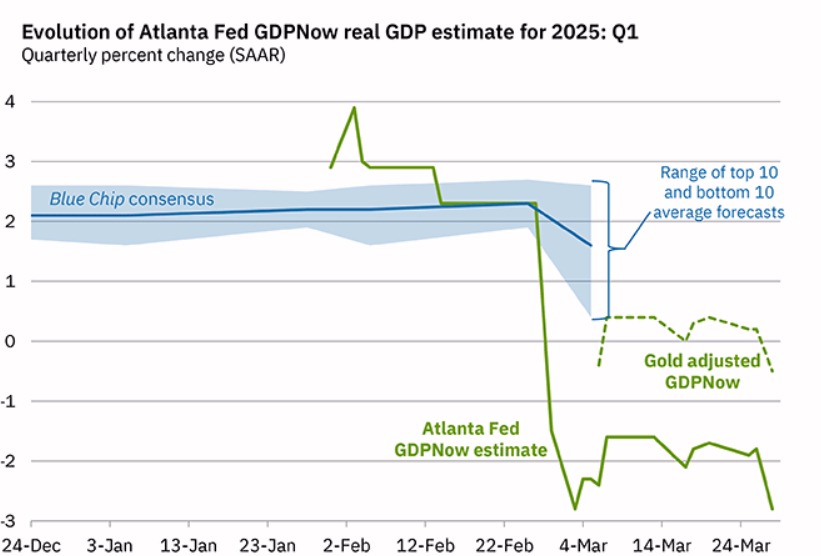
Gold has always been a significant asset in the global financial landscape, but recently, its influence has grown in ways not seen for quite some time. One key reason for this increased attention is its impact on the Atlanta Federal Reserve’s GDPNow tracker. In fact, the Fed had to add a special line in its graph to account for the significant influence of net gold imports on U.S. GDP. This is not a typical occurrence and signals that gold is playing a more prominent role in the economy than it has in recent decades.

Why is Gold Significant?

Gold is generally considered in two primary ways: as a store of wealth and as a commodity used in products such as jewelry and electronics. Traditionally, gold flows have been relatively stable. That means the Fed typically does not focus much on gold as it doesn’t typically cause significant economic disruption or fluctuation. However, recent trends have shown an increase in gold imports that is disproportionate to other sectors of the economy. This surge has been so large that it has skewed GDP calculations, prompting the Fed to specifically acknowledge it.

The challenge with accurately tracking gold’s economic impact stems from how it is measured and classified. Imports and exports of gold can be difficult to track, especially considering the different forms in which gold is used. It is not always clear whether gold is entering the country for industrial use or simply as a hedge against economic uncertainty, making it harder for analysts to determine its full economic impact.

The Fed’s Usual Disregard for Gold

So why doesn’t the Federal Reserve usually pay more attention to gold? In past decades, gold flows were relatively predictable and static. It was a safe asset that largely served as a store of value, with only small fluctuations in demand. Therefore, gold didn’t play a significant role in influencing broader economic data like GDP growth. This predictability, combined with the move away from the gold standard, meant that gold was seen as less relevant in day-to-day monetary policy decisions.

However, recent patterns have changed. A combination of global economic uncertainties, inflation fears, and geopolitical tensions has led to a surge in demand for gold as a safe haven asset. As a result, huge gold imports have recently overshadowed other aspects of the GDP, pushing the Federal Reserve to reconsider its influence.

What Does This Mean for You?

For the average investor, the growing prominence of gold has several potential implications. The most significant impact could be felt if you have a 401(k), invest in mutual funds, or hold ETFs. Many of these investment vehicles, particularly index funds and mutual funds, are required to stay fully invested in the market. This can leave investors vulnerable during periods of market volatility or when certain asset classes, like stocks, are underperforming.

In these times, it might be wise to consider reducing risk, or “beta,” in your portfolio. This means adjusting your investment strategy to become more defensive, moving away from riskier equities, and diversifying into other assets—such as gold. By reallocating a portion of your investments into gold, you can help hedge against volatility, preserve wealth, and potentially capitalize on gold’s rising demand. This is especially pertinent when traditional markets experience instability, and gold continues to serve as a long-standing safeguard against inflation and market turmoil.

The Bottom Line

The growing significance of gold in today’s economic environment is not a passing trend. As illustrated by the Fed’s GDPNow tracker, the surge in gold imports is not merely a statistical anomaly but a clear indication of broader economic shifts. Such movements in asset flows are valuable signals for individual investors, offering insight into changing market dynamics. Other key indicators to watch include currency and credit flows, which also provide clues about the direction of the economy. However, for small investors, participating directly in many of these trades can be challenging—especially with issues like storing gold, soy, or pork bellies.

In times like these, your best investment strategy is likely to focus on tangible assets. Housing should remain your largest asset, offering long-term stability and growth potential. For additional savings and retirement funds, consider allocating 90% to short-term treasuries, 5% to Treasury I Bonds, and 5% to gold and other real assets. This diversified approach can help protect your wealth and provide a hedge against economic uncertainty.


GDPnow 3-28-2025
GDPnow 3-28-2025

Capital Preservation During Trumpenomics

Trumpenomics: The Decline of the US

bookmark_borderCOVID UPDATE: Trump the Destroyer

by Daniel Brouse
March 28, 2025

Trump the Destroyer

During his first term, Trump oversaw the rise and spread of COVID-19, which resulted in millions of deaths. He downplayed the virus, even calling it a hoax. He suggested ingesting disinfectants and exposing the internal organs to UV light as remedies, despite widespread medical warnings against such dangerous misinformation.  Now, he has cut all funding for critical programs aimed at preventing future pandemics, leaving the nation vulnerable to future outbreaks of even more deadly viruses.

The Trump administration, in coordination with the Department of Government Efficiency (DOGE), has implemented sweeping cuts to COVID-19 research funding, including the critical AVIDD (Antiviral Drug Discovery and Development) and ASAP (Accelerating COVID-19 Therapeutic Interventions and Vaccines) programs. These cuts threaten the progress made in understanding and combating zoonotic diseases, which are responsible for the emergence of deadly viruses such as COVID-19.

Scientific experts have warned that reducing funding for these antiviral programs will leave the U.S. and the world more vulnerable to future pandemics. AVIDD and ASAP were instrumental in the rapid development of treatments and vaccines during the COVID-19 crisis. Without sustained investment in these areas, research into potential emerging pathogens will be significantly hindered, delaying response times and increasing the likelihood of widespread outbreaks.

The administration’s decision to cut funding is part of a broader rollback of public health initiatives. The NIH, which oversees AVIDD and ASAP, is facing an overall budget reduction, including a proposed 20% funding cut that would impact infectious disease research, vaccine development, and pandemic preparedness. Scientists and health officials have raised alarms that these cuts could set back medical advancements by decades, making it harder to develop treatments for existing and future health threats.

Public health organizations and advocacy groups are mounting opposition to these policy decisions, emphasizing that weakening pandemic defenses in a world still recovering from COVID-19 is reckless and dangerous. The cuts not only threaten scientific progress but also put millions of lives at risk by reducing the nation’s ability to respond swiftly to new viral threats.

As researchers scramble to find alternative funding sources, the long-term consequences of these cuts remain uncertain. However, history has shown that underfunding infectious disease research can lead to devastating consequences. The world witnessed this with COVID-19, and without continued support for programs like AVIDD and ASAP, the risks of another pandemic grow exponentially.

The question remains: Will the U.S. learn from past mistakes, or will short-sighted policy decisions undermine the progress made in pandemic preparedness?

COVID-19