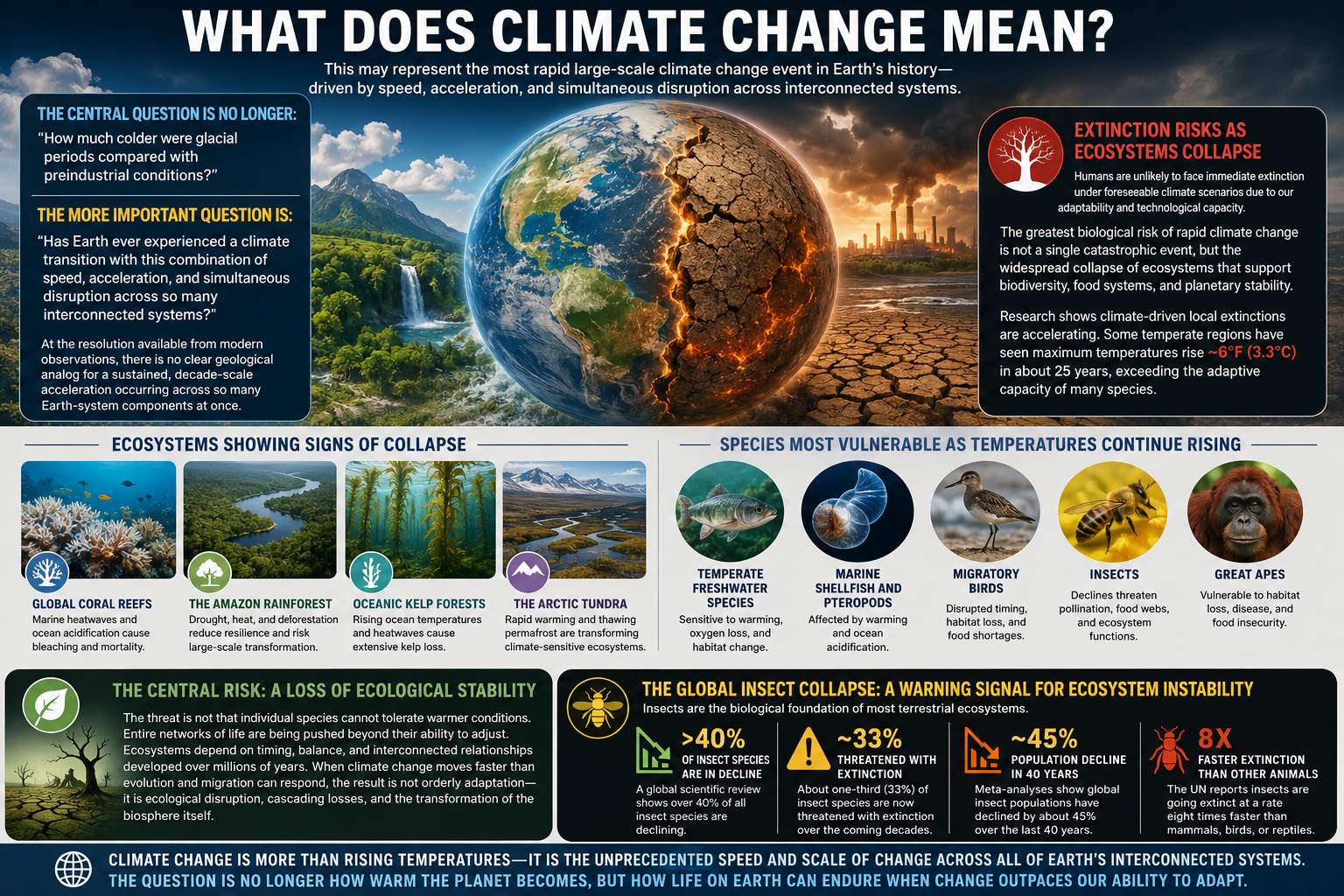
Introduction: Climate Change as an Economic and Human Security Crisis
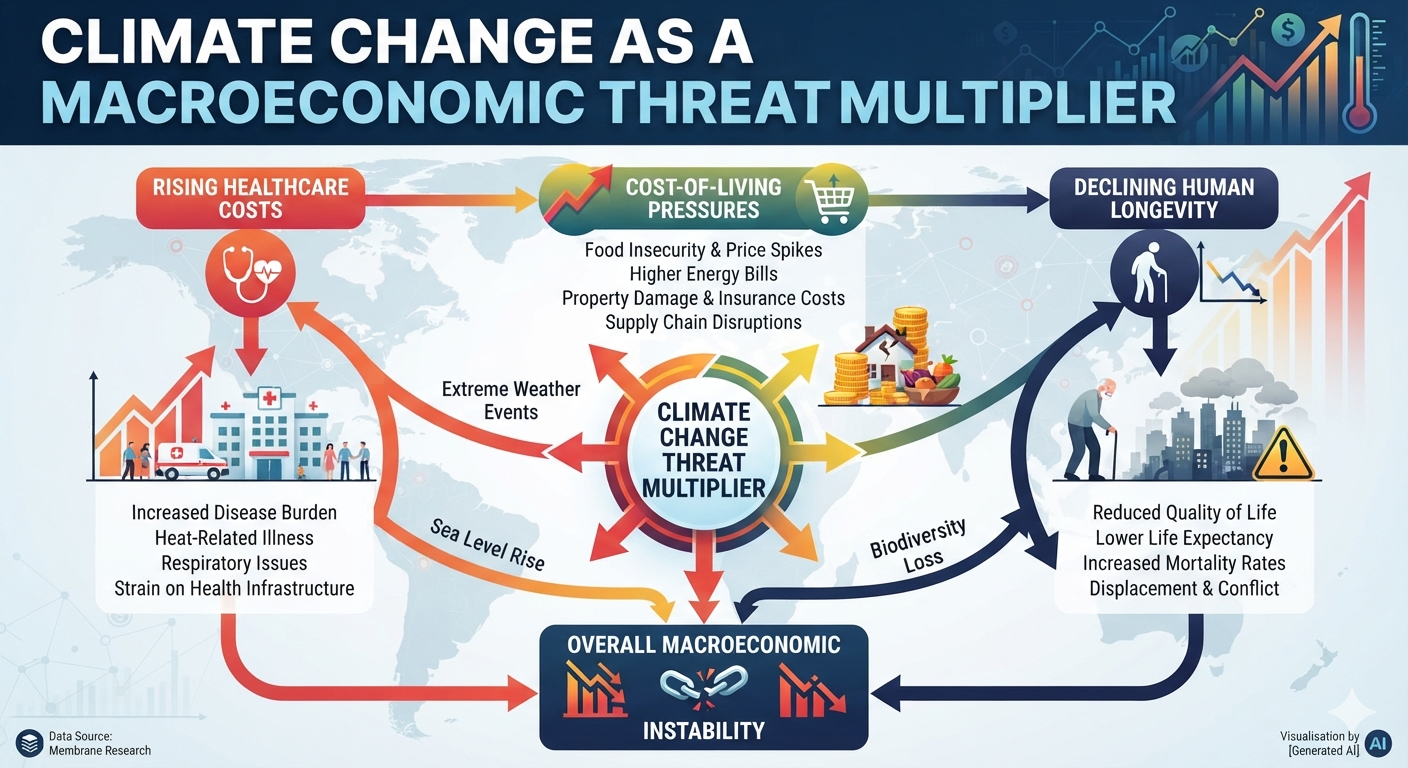
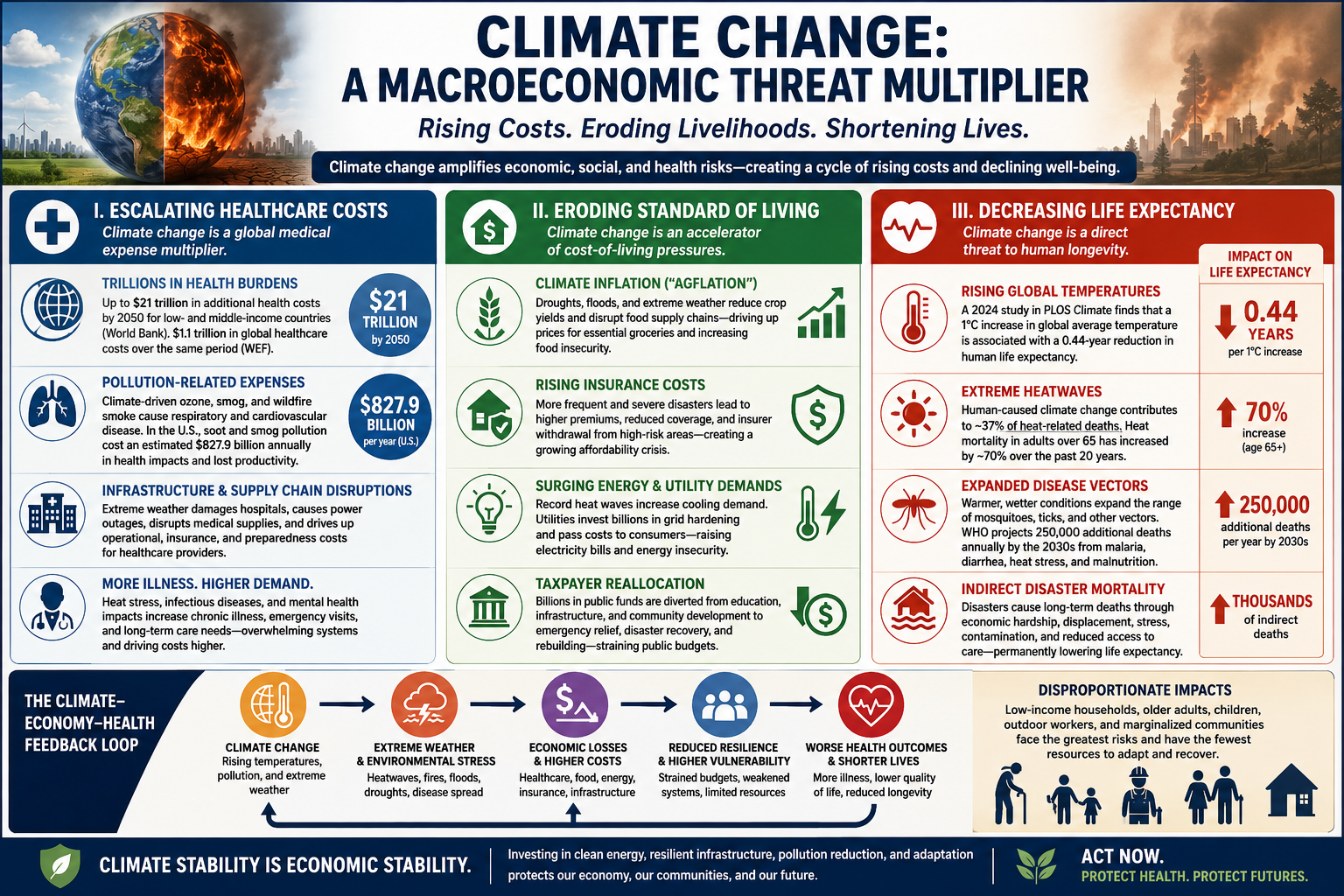
Climate change is no longer only an environmental challenge; it has become a powerful macroeconomic threat multiplier that amplifies existing social, economic, and public health vulnerabilities. Rising temperatures, increasingly extreme weather events, deteriorating air quality, and destabilized ecosystems are creating cascading financial pressures that extend from governments and businesses to individual households.
The economic consequences of climate change are increasingly visible through three interconnected pathways:
Escalating healthcare costs caused by heat exposure, air pollution, infectious diseases, and climate-related disasters.
Erosion of living standards through inflationary pressures on food, energy, insurance, housing, and public infrastructure.
Declining human longevity as environmental stressors undermine physical health, increase mortality, and reverse decades of progress in life expectancy.
These impacts are not distributed equally. Low-income households, elderly populations, outdoor workers, and marginalized communities often face the greatest exposure while having the fewest resources to adapt. Climate change therefore transforms environmental instability into a localized economic and human health crisis.
I. Escalating Healthcare Costs: Climate Change as a Global Medical Expense Multiplier
Climate change is placing unprecedented strain on healthcare systems by increasing both the frequency and severity of climate-related illnesses while simultaneously disrupting healthcare infrastructure.
1. Trillions of Dollars in Climate-Driven Health Burdens
The financial consequences of climate-related health impacts are expected to reach historic levels.
The World Bank estimates that climate-related health crises could impose approximately $21 trillion in additional costs by 2050 across low- and middle-income countries, reflecting increased disease burdens, reduced productivity, and expanding healthcare needs.
The World Economic Forum estimates that climate change could create approximately $1.1 trillion in additional global healthcare costs over the same period.
These costs represent more than direct medical expenses. They include lost productivity, reduced workforce participation, premature mortality, emergency response requirements, and infrastructure adaptation.
2. Pollution-Related Healthcare Expenses
Climate change and fossil fuel combustion are closely linked. Rising temperatures accelerate atmospheric chemical reactions that increase ground-level ozone formation, intensifying smog episodes and worsening respiratory and cardiovascular disease.
Fine particulate matter (PM2.5), ozone, wildfire smoke, and other pollutants contribute to:
Asthma and chronic respiratory illness
Heart attacks and strokes
Lung disease
Premature deaths
Increased emergency room visits
In the United States alone, soot and smog pollution are estimated to generate hundreds of billions of dollars annually in health-related costs, including medical expenses and lost economic productivity.
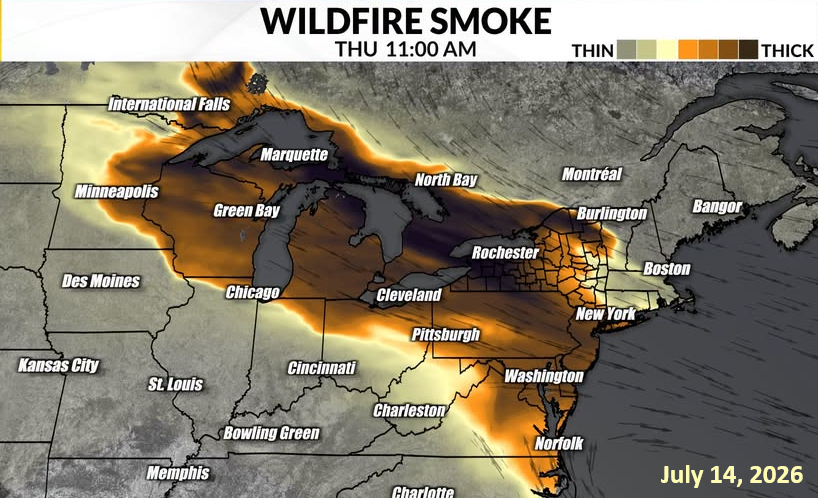
The growing frequency of wildfire smoke events demonstrates how climate impacts can transform regional air pollution into a national health emergency. Smoke from distant wildfires can travel thousands of miles, exposing millions of people far from the original source.
3. Healthcare Infrastructure and Supply Chain Disruptions
Extreme weather events increasingly threaten the operational stability of healthcare systems.
Climate-related disruptions include:
Hospitals losing electrical power during heat waves, hurricanes, and wildfires
Flooding damaging medical facilities
Disruptions in pharmaceutical and medical equipment supply chains
Increased emergency response costs
Higher insurance and operational expenses for healthcare providers
Hospitals are being forced to spend billions on climate resilience measures, including backup power systems, flood protection, cooling infrastructure, and emergency preparedness.
II. Eroding Standard of Living: Climate Change as a Cost-of-Living Accelerator
Climate change is increasingly becoming an economic reality experienced directly through household budgets. The same forces increasing healthcare costs are also driving inflationary pressures throughout the economy.
1. Climate Inflation and Agricultural Instability (“Agflation”)
Food systems are among the most climate-sensitive sectors of the global economy.
Rising temperatures, droughts, flooding, changing precipitation patterns, and extreme storms reduce agricultural productivity by damaging:
Crop yields
Livestock health
Fisheries
Agricultural infrastructure
Transportation networks
These disruptions create supply-side inflation, increasing prices for essential goods including:
Grains
Fruits and vegetables
Meat and dairy products
Transportation-dependent food products
Climate-driven food inflation disproportionately harms lower-income households because food represents a larger percentage of their monthly expenses.
2. Rising Insurance Costs and the Retreat From High-Risk Regions
The insurance industry has become one of the clearest economic indicators of accelerating climate risk.
As hurricanes, wildfires, floods, and severe storms become more frequent and destructive:
Insurance premiums increase dramatically.
Coverage becomes more restricted.
Insurers withdraw from vulnerable markets.
Property values decline in high-risk regions.
Homeowners increasingly face a difficult choice: pay rapidly increasing premiums or assume greater financial risk without adequate coverage.
This creates a growing climate affordability crisis, particularly for homeowners living in areas exposed to wildfire, coastal flooding, extreme storms, and severe weather.
3. Rising Energy Demand and Utility Costs
Climate change increases energy demand while simultaneously placing stress on energy infrastructure.
During extreme heat events:
Electricity consumption rises sharply due to increased air conditioning demand.
Utilities must invest billions in grid upgrades.
Transmission systems require additional protection against storms and wildfires.
Energy insecurity becomes a growing concern as vulnerable households struggle to afford cooling during dangerous heat events.
4. Taxpayer Costs and Public Financial Burdens
Climate disasters increasingly redirect public resources away from long-term investments toward emergency response and recovery.
Government spending is increasingly allocated toward:
Disaster relief
Infrastructure repairs
Emergency housing assistance
Flood recovery
Wildfire response
Agricultural assistance
These expenditures compete directly with funding for:
Education
Transportation improvements
Community development
Public health programs
Climate change therefore functions as a long-term fiscal drain, increasing government expenditures while reducing resources available for economic development.
III. Declining Human Longevity: Climate Change as a Biological Stressor
Beyond economic impacts, climate change increasingly affects the fundamental measure of human well-being: life expectancy.
The cumulative effects of extreme heat, pollution exposure, disease expansion, food insecurity, and climate disasters are slowing—and in some regions reversing—historical gains in longevity.
Climate Driver
Impact on Human Health and Longevity
Rising Global Temperatures
A 2024 study published in PLOS Climate found that a 1°C increase in global average temperature is associated with approximately a 0.44-year reduction in life expectancy.
Extreme Heatwaves
Human-caused climate change is estimated to contribute to approximately 37% of heat-related deaths. Heat-related mortality among adults over age 65 has increased substantially over recent decades.
Expanded Disease Vector Ranges
Warmer and wetter conditions allow mosquitoes, ticks, and other disease vectors to expand into new regions, increasing risks from malaria, dengue fever, Lyme disease, and other infections.
Food and Water Stress
Climate disruption increases risks of malnutrition, dehydration, agricultural failure, and water insecurity, particularly in vulnerable populations.
Indirect Disaster Mortality
Floods, hurricanes, wildfires, and other disasters create long-term health impacts through displacement, economic hardship, psychological stress, and environmental contamination.
This feedback loop means climate impacts are not isolated events. A wildfire, flood, or heat wave can simultaneously damage infrastructure, increase healthcare expenses, reduce productivity, raise insurance costs, and shorten human lives.
The poorest communities often experience the strongest effects because they have fewer resources to prepare, recover, and relocate.
Conclusion: Climate Stability Is Economic Stability
Climate change represents one of the largest economic and public health challenges of the modern era. Its consequences extend far beyond environmental degradation, affecting national budgets, household finances, healthcare systems, and human survival.
Addressing climate change is therefore not simply an environmental investment—it is an economic resilience strategy and a public health imperative. Investments in clean energy, resilient infrastructure, pollution reduction, efficient buildings, and climate adaptation can reduce future costs while protecting both human health and economic stability.
The cost of inaction is no longer measured only in degrees of warming. It is measured in rising medical bills, shrinking household budgets, damaged communities, and lost years of human life.
One of the most common misconceptions about climate change is that a warmer planet should produce less ice. In reality, the opposite is increasingly true for severe thunderstorms. While winters are warming and snow cover is declining in many regions, the atmosphere is becoming more energetic, more moisture-laden, and more capable of producing exceptionally large hail.
Hailstorms illustrate one of the central themes found throughout modern climate science: global warming is not simply making the planet warmer—it is making the atmosphere more unstable. The climate system is undergoing a nonlinear increase in available energy, atmospheric moisture, and circulation instability. The result is not gradual change, but an acceleration toward more powerful and destructive weather extremes.
Hail is one manifestation of this broader transition.
Severe Convective Energy Events
Hailstorms are among the most energetic convective weather systems on Earth. They develop inside powerful thunderstorms where intense upward air currents repeatedly lift developing ice particles through layers of supercooled water.
Each trip through the storm adds another layer of ice.
If the updraft remains strong enough, hailstones continue growing until gravity finally overcomes the upward force.
The stronger the storm, the larger the hail.
Large hail has become one of the fastest-growing sources of weather-related insurance losses worldwide, producing billions of dollars in damage each year to:
Homes
Roofs
Windows
Solar panels
Vehicles
Crops
Electrical infrastructure
Aircraft
Unlike heavy rainfall, which loses much of its kinetic energy through atmospheric friction, hailstones maintain tremendous momentum. Baseball-sized hail can strike the ground at speeds exceeding 100 mph (160 km/h), while the largest hailstones exceed 150 mph.
At those velocities, hail becomes a dangerous projectile capable of causing severe injuries and fatalities.
A Warmer Atmosphere Produces Bigger Hail
The same physical processes described in previous papers—especially the increasing atmospheric water vapor driven by the Clausius-Clapeyron relationship—also fuel hail growth.
Every degree Celsius of warming allows the atmosphere to hold approximately 7% more water vapor.
That additional moisture provides thunderstorms with more latent heat energy.
When this latent heat is released during condensation, it strengthens thunderstorm updrafts dramatically.
The result is a positive feedback:
More warming
More atmospheric moisture
More latent heat release
Stronger thunderstorms
Stronger updrafts
Larger hail
This is another example of Earth’s climate system amplifying itself through reinforcing feedback loops rather than responding linearly.
Updrafts: Nature’s Giant Ice Factory
Imagine a lava lamp operating at maximum power.
Instead of blobs of wax rising through liquid, enormous columns of warm, moisture-rich air accelerate upward through the atmosphere.
Inside these towers:
Water droplets freeze.
Ice particles are lifted thousands of feet upward.
Supercooled water freezes onto existing hailstones.
The growing hailstone falls.
The updraft catches it again.
Another layer forms.
This process repeats many times.
The stronger the updraft, the longer the hailstone remains suspended.
Eventually the hailstone becomes too heavy.
Then gravity wins.
The result is giant hail capable of catastrophic destruction.
As climate warming strengthens convective energy, these powerful updrafts are becoming increasingly common.
Why Small Hail Is Declining
Climate change does not necessarily increase every type of hail.
In fact, many regions may experience fewer small hail events.
This occurs because freezing levels are rising.
As temperatures increase:
Snow melts sooner.
Ice melts higher in the atmosphere.
Small hailstones completely melt before reaching the ground.
Large hailstones survive.
The result is a dramatic shift in hail size distribution.
Instead of numerous harmless pea-sized hailstones, storms increasingly produce fewer—but much larger and more destructive—hailstones.
Current projections suggest that by the end of this century:
Large hail events may increase by 38–47%
Small hail events may decrease by 4–8%
This represents another example of the climate system shifting toward extremes rather than averages.
Geography Is Changing
Historically, the world’s most active hail regions included:
The U.S. Great Plains
Argentina
South Africa
Northern India
Central Europe
Today, climate models suggest these regions are changing.
Increasing hail environments are projected across:
The U.S. Midwest
Ohio Valley
Northeast
Southeastern United States
Canada
Northern Europe
New Zealand’s South Island
The traditional “Hail Alley” of the Great Plains is expected to expand eastward while favorable atmospheric conditions migrate poleward as global temperatures rise.
These geographic shifts mirror changes already observed in atmospheric rivers, jet stream behavior, and storm tracks.
Changing Seasons
The timing of severe hailstorms is also evolving.
Rather than occurring primarily during midsummer, favorable conditions are increasingly appearing during:
Early spring
Late fall
Even portions of winter
Warmer winters allow severe thunderstorms to develop during months that historically experienced relatively stable atmospheric conditions.
This creates new risks for agriculture.
Winter wheat and other cool-season crops become increasingly vulnerable to destructive hail during critical stages of development.
Climate Change Is Increasing Financial Losses
Few weather hazards have produced such rapidly escalating insured losses.
Since 2008:
U.S. hail-related insurance claims have increased approximately fivefold.
Annual insured losses now regularly exceed tens of billions of dollars.
Vehicle damage has become one of the largest components of weather-related insurance costs.
One of the most striking recent examples occurred in northern Italy during 2023.
A series of severe thunderstorms produced approximately $8.6 billion in damages while dropping a European-record hailstone measuring nearly 19 centimeters (7.5 inches) in diameter.
Across North America, giant hail is increasingly damaging:
Solar farms
Wind facilities
Data centers
Warehouses
Airports
Distribution centers
As urban development expands into storm-prone regions, exposure continues to rise even as the storms themselves become more intense.
The result is a compounding economic feedback between climate risk and infrastructure vulnerability.
Human Safety
Although hail is often viewed as primarily a property hazard, it is increasingly becoming a public health concern.
Large hail can:
Cause traumatic brain injuries
Fracture bones
Damage eyesight
Kill livestock
Trigger multi-vehicle accidents
Force aircraft into emergency landings
As giant hail events become more common, so do reports of injuries and fatalities.
The danger is amplified because hail often accompanies tornadoes, destructive straight-line winds, flash flooding, and frequent lightning, creating multiple simultaneous hazards.
A Symptom of a More Energetic Climate
Large hail is not an isolated phenomenon.
It is part of the same global pattern documented throughout this body of work.
The accelerating increase in atmospheric water vapor, ocean heat content, jet stream instability, atmospheric rivers, bomb cyclones, extreme rainfall, wildfire behavior, and severe convective storms all point to the same underlying driver:
An atmosphere containing more energy.
As Arctic amplification weakens the temperature gradient between the poles and the tropics, atmospheric circulation becomes increasingly distorted. Rossby waves become more amplified, blocking patterns persist longer, and weather systems slow or stall. At the same time, warmer oceans and land surfaces inject additional heat and moisture into the atmosphere, providing more fuel for explosive thunderstorms.
When these large-scale circulation changes coincide with abundant moisture and intense surface heating, the result is an environment capable of generating stronger updrafts, larger hail, heavier rainfall, more damaging winds, and more frequent tornado outbreaks. Hail therefore should not be viewed as an isolated weather event, but as one expression of a broader shift toward higher-energy atmospheric dynamics.
The Shift to Extremes
One consistent pattern emerges:
Climate Change → Energy Imbalance → More Atmospheric Moisture + Greater Instability → Stronger Storm Dynamics → More Frequent & More Severe Weather Extremes → Hotter Heat Waves → Wetter Atmospheric Rivers → Larger Wildfires → More Intense Flash Floods → Stronger Hurricanes → Giant Hailstorms
This is the hallmark of nonlinear climate change: a progressive shift from moderate conditions toward increasingly severe outcomes as Earth’s energy imbalance grows. Hail is another visible indicator that the climate system is moving beyond historical norms, where extremes become more common and their impacts more costly.
Understanding hail in this broader context helps connect individual weather disasters to the larger transformation underway in the Earth’s climate system. Rather than isolated anomalies, these events are increasingly linked by the same physical processes: rising atmospheric moisture, greater available energy, and amplifying feedbacks that are reshaping weather across the globe.
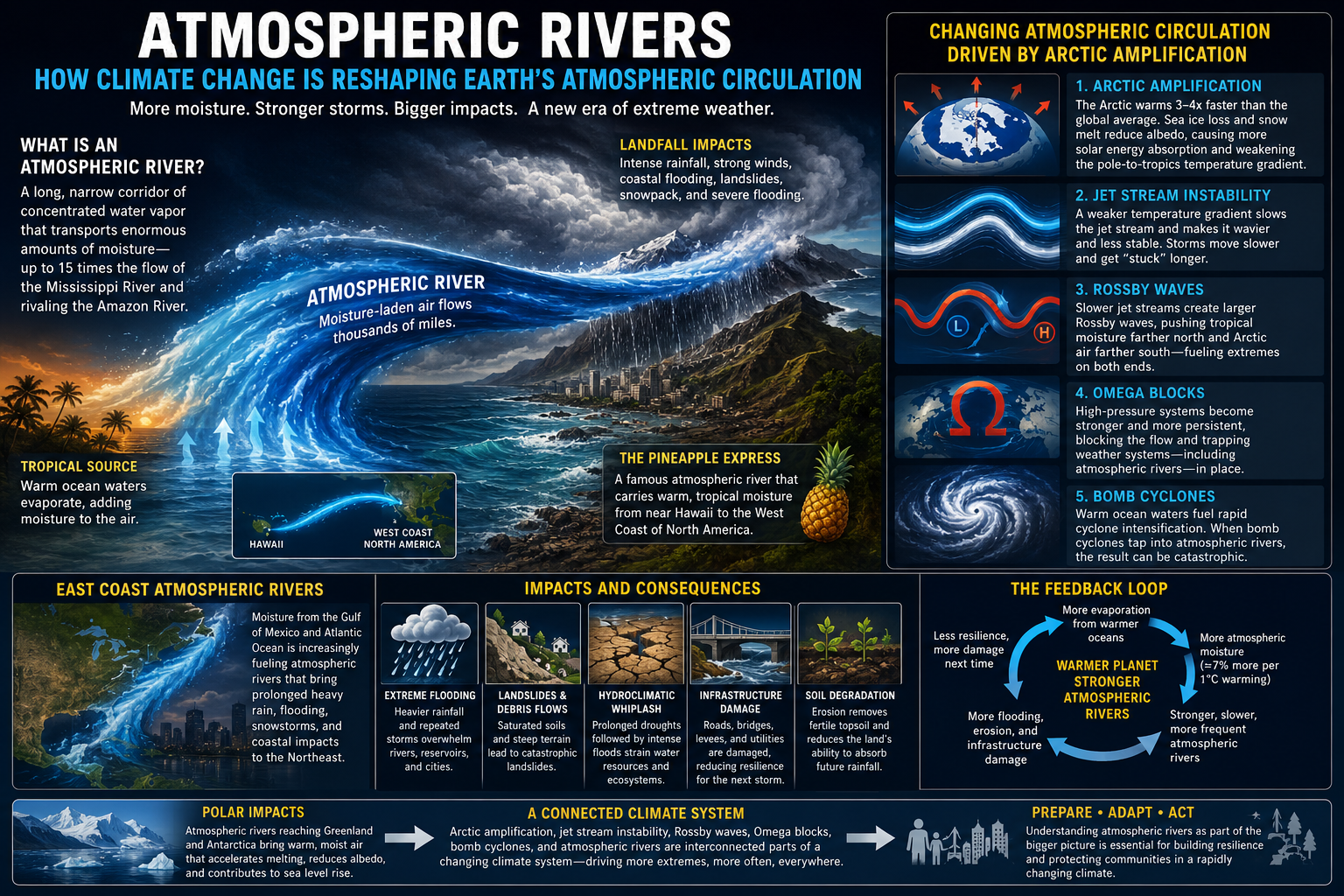
Atmospheric rivers are among the most powerful weather systems on Earth. These long, narrow corridors of concentrated water vapor transport immense quantities of moisture through the atmosphere, acting as airborne rivers that connect the tropics with higher latitudes.
At their peak, atmospheric rivers can carry as much water through the sky as the Amazon River carries on land. When they make landfall, they release torrential rainfall, hurricane-force winds, mountain snowfall, flooding, and landslides.
Historically, atmospheric rivers have been an essential part of Earth’s hydrologic cycle, replenishing reservoirs and snowpacks. Today, however, human-induced climate change is fundamentally changing their behavior. A warmer atmosphere, warmer oceans, and rapidly changing atmospheric circulation patterns are producing stronger, wetter, slower-moving, and increasingly destructive atmospheric rivers.
Rather than isolated weather events, atmospheric rivers are becoming part of a larger transformation of Earth’s climate system.
What Are Atmospheric Rivers?
Atmospheric rivers (ARs) are narrow bands of exceptionally moist air that transport water vapor thousands of miles through the atmosphere. Although they occupy only a small fraction of the atmosphere, they account for nearly 90% of the poleward transport of water vapor outside the tropics.
When these moisture streams encounter mountains or colder air masses, the water vapor condenses into intense rain or snow.
The strongest atmospheric rivers can transport more than fifteen times the average flow of the Mississippi River and rival the discharge of the Amazon River.
The Pineapple Express
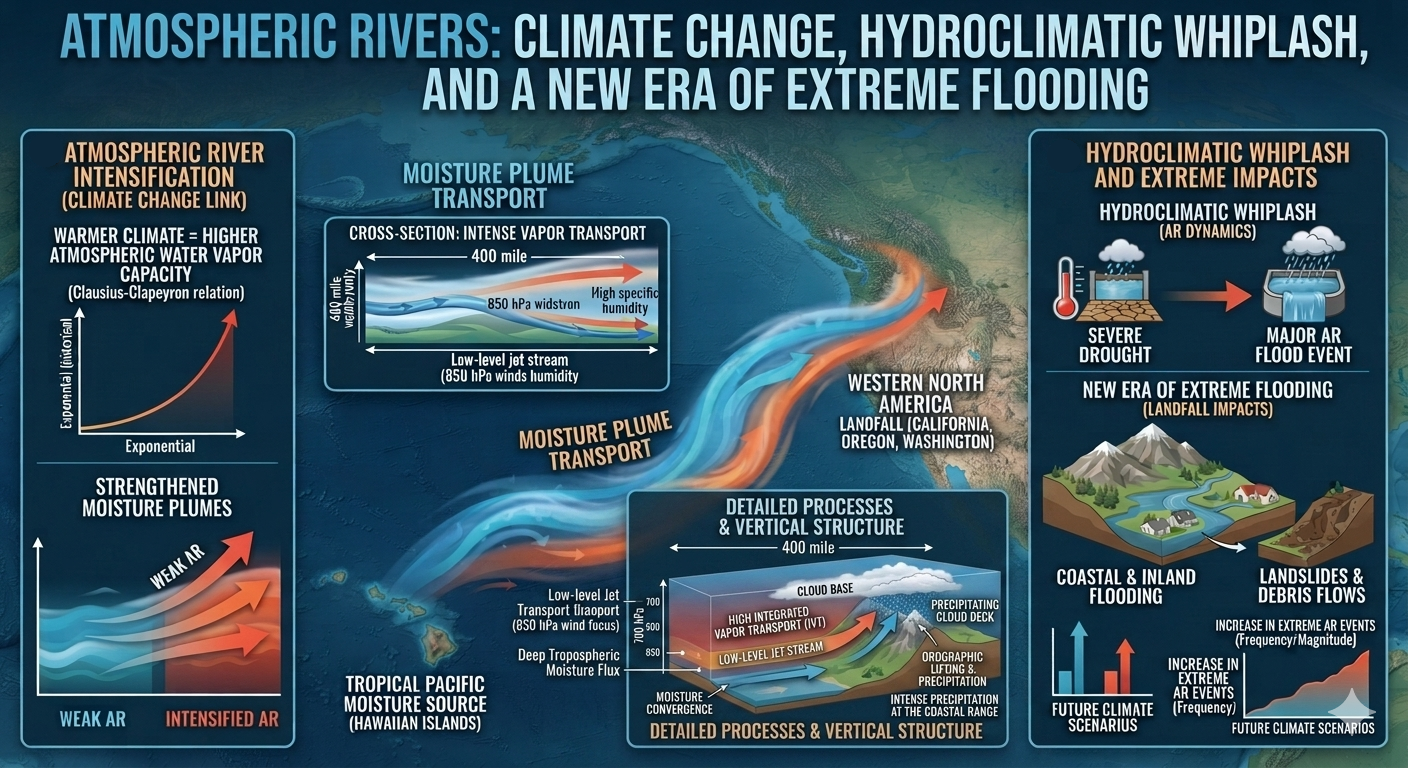
The best-known atmospheric river is the Pineapple Express, which transports warm tropical moisture from near Hawaii to western North America.
These storms have always occurred, but today they are producing more extreme flooding because:
Ocean temperatures are higher.
Evaporation is increasing.
The atmosphere contains more water vapor.
Storms often move more slowly than they once did.
California’s recent years of devastating floods illustrate this transition toward more powerful atmospheric rivers.
Why Climate Change Is Intensifying Atmospheric Rivers
According to the Clausius-Clapeyron relationship, every 1°C of warming allows the atmosphere to hold approximately 7% more water vapor.
This additional moisture increases:
rainfall rates
storm duration
flood severity
snowfall at higher elevations
moisture transport over thousands of miles
Meanwhile, record ocean heat dramatically increases evaporation, providing an ever-growing supply of atmospheric moisture.
The result is an atmosphere capable of producing unprecedented precipitation events.
Arctic Amplification: Changing the Planet’s Atmospheric Engine
Atmospheric rivers do not occur independently.
They are guided by Earth’s large-scale atmospheric circulation.
One of the most profound consequences of climate change is Arctic amplification—the Arctic warming roughly three to four times faster than the global average.
As sea ice disappears and snow cover declines, Earth’s reflective surface shrinks. Dark ocean water absorbs more solar energy, accelerating warming and reducing the temperature difference between the Arctic and the tropics.
This weakened temperature gradient fundamentally changes atmospheric circulation.
Jet Stream Instability
The polar jet stream is powered largely by the temperature contrast between cold Arctic air and warmer subtropical air.
As Arctic amplification weakens this contrast, the jet stream slows and becomes increasingly unstable.
Instead of flowing in relatively smooth west-to-east patterns, the jet stream develops larger north-south waves that linger over regions for extended periods.
A slower jet stream allows weather systems to stall, dramatically increasing the duration of extreme weather.
Atmospheric rivers that once passed in a day may now persist for several days, greatly increasing rainfall totals.
Rossby Waves
The large undulations in the jet stream are known as Rossby waves.
As the jet stream slows, Rossby waves become larger and more amplified.
These amplified waves transport tropical heat and moisture farther poleward while allowing Arctic air to plunge farther south.
The result is greater weather extremes:
prolonged heat waves
persistent drought
repeated atmospheric rivers
severe flooding
extreme winter outbreaks
Because atmospheric rivers often travel along these Rossby wave patterns, changes in wave behavior directly influence where flooding occurs and how long storms remain over one location.
Omega Blocks
Sometimes Rossby waves become so amplified that they form nearly stationary high-pressure systems resembling the Greek letter Ω (Omega).
These Omega blocks can persist for days or even weeks.
An Omega block effectively traps weather systems on either side.
For atmospheric rivers, this can be disastrous.
Instead of moving inland and weakening, repeated moisture streams may be directed into the same region, producing multiple rounds of flooding over already saturated ground.
Many of the catastrophic flood events observed during the past decade have involved stalled atmospheric rivers interacting with blocking patterns.
Bomb Cyclones
Atmospheric rivers frequently interact with rapidly strengthening low-pressure systems known as bomb cyclones.
A bomb cyclone develops when atmospheric pressure falls at least 24 millibars within 24 hours.
Warm ocean waters provide enormous amounts of latent heat that fuel explosive cyclone development.
When bomb cyclones intercept atmospheric rivers, the result can include:
hurricane-force winds
torrential rainfall
coastal flooding
storm surge
mountain blizzards
widespread infrastructure damage
These compound events represent one of the most destructive combinations in modern weather.
East Coast Atmospheric Rivers
Atmospheric rivers were once viewed primarily as a West Coast phenomenon.
Recent research, however, has documented increasingly frequent atmospheric rivers affecting the eastern United States.
Moisture drawn northward from the Gulf of Mexico and the Atlantic Ocean now fuels atmospheric rivers that move along the East Coast.
These systems often produce:
multi-day flooding
inland flash flooding
severe river flooding
heavy snowfall in winter
coastal erosion
compound flooding when combined with storm surge and high tides
The Northeast has experienced a noticeable increase in prolonged heavy-rain events consistent with stronger atmospheric rivers.
Greenland and Antarctica
One of the most alarming developments is the increasing frequency of atmospheric rivers reaching Greenland and Antarctica.
These storms transport unusually warm, moisture-rich air into polar regions.
Their impacts include:
rainfall replacing snowfall
accelerated surface melting
reduced nighttime cooling from cloud cover
darker snow surfaces
increased meltwater production
The resulting loss of reflectivity (albedo) accelerates melting even further.
This creates a powerful positive climate feedback that contributes directly to accelerating sea-level rise.
Atmospheric Rivers and Hydroclimatic Whiplash
Atmospheric rivers are becoming central drivers of hydroclimatic whiplash—rapid swings between prolonged drought and extreme flooding.
During drought:
soils harden
vegetation dies
infiltration decreases
When an atmospheric river arrives, rainfall can no longer soak into the ground efficiently.
Instead, water rapidly becomes runoff, producing flash floods, landslides, debris flows, and catastrophic erosion.
Climate change is increasing both extremes simultaneously.
Infrastructure Feedbacks and Soil Degradation
Repeated atmospheric river events are creating an emerging infrastructure feedback.
Floodwaters damage:
roads
bridges
levees
railroads
dams
drainage systems
water treatment facilities
electrical infrastructure
As infrastructure weakens, future storms cause even greater damage.
Healthy soils normally absorb rainfall like a sponge.
Degraded soils cannot.
This increases runoff, erosion, and future flooding, creating another reinforcing climate feedback.
Atmospheric Rivers Within Earth’s Nonlinear Climate System
Atmospheric rivers illustrate that climate change is not simply making storms stronger.
It is reorganizing Earth’s atmospheric circulation.
Arctic amplification slows the jet stream.
A slower jet stream produces larger Rossby waves.
Rossby waves encourage Omega blocks.
Blocking patterns stall atmospheric rivers.
Warmer oceans feed both atmospheric rivers and bomb cyclones.
The atmosphere carries more moisture.
Floods become larger.
Soils degrade.
Infrastructure weakens.
Ice melts faster.
Sea level rises.
Each component reinforces the others.
Rather than isolated weather events, atmospheric rivers are becoming one element of an interconnected system of nonlinear climate feedbacks.
Conclusion
Atmospheric rivers have always been an essential part of Earth’s climate system, but they are entering a new era. Human-induced warming is fundamentally altering the atmosphere’s ability to transport moisture while simultaneously reshaping the large-scale circulation patterns that govern where storms form, how long they persist, and how much destruction they produce.
Arctic amplification, jet stream instability, Rossby wave amplification, Omega blocking patterns, bomb cyclones, and expanding East Coast atmospheric rivers are not isolated phenomena. They are interconnected expressions of a climate system being pushed beyond its historical equilibrium.
As global temperatures continue to rise and the oceans accumulate additional heat, atmospheric rivers are expected to become more frequent, more intense, and more geographically widespread. Their growing role in hydroclimatic whiplash, polar ice-sheet melting, infrastructure failure, and cascading climate feedbacks makes them one of the defining hazards of the twenty-first century.
Understanding atmospheric rivers as part of this larger network of interacting climate processes is essential for improving forecasts, strengthening infrastructure, and preparing societies for a future in which extreme precipitation events become increasingly common.
Climate Control Feedback Loops: When Cooling Becomes Part of the Climate System
How the growing need for air conditioning is creating new reinforcing climate feedbacks
Introduction
For most of the twentieth century, air conditioning was considered a luxury in many parts of the world. Today, in an increasing number of regions, it is becoming essential for human health and survival. As climate change drives longer, hotter, and more humid heat waves, indoor climate control is rapidly shifting from a convenience to a critical component of public safety.
This transition carries an important consequence that is often overlooked: climate control itself is becoming part of the climate system. Cooling technologies are increasingly intertwined with energy production, infrastructure resilience, water availability, urban design, and greenhouse gas emissions. As societies become more dependent on mechanical cooling, air conditioning becomes linked to a growing number of reinforcing climate feedback loops.
Many of these feedbacks are indirect, but together they form an interconnected system capable of amplifying both climate risks and societal vulnerability. Understanding these emerging “climate control feedback loops” is becoming increasingly important as the world enters an era of persistent extreme heat.
Heat Is Becoming a Public Health Emergency
Heat waves are starting earlier, becoming more intense, and lasting longer as climate change reshapes weather patterns around the world. In the United States, extreme heat events have become dramatically more likely because of human-caused global warming. Similar trends are occurring across Europe, the United Kingdom, Asia, Australia, and many developing nations where populations and infrastructure were never designed for prolonged extreme heat.
Extreme heat is far more than an inconvenience—it is a major public health hazard.
High temperatures place increasing stress on the cardiovascular system, kidneys, lungs, and immune system while reducing the body’s ability to regulate its core temperature. Heat exhaustion, heat stroke, dehydration, and cardiovascular failure become more common during prolonged heat events. Emerging research also suggests that some heat-related cellular and metabolic impacts may occur at lower temperatures than previously believed, particularly when high humidity limits the body’s ability to cool itself through perspiration.
As these conditions become more common, reliable indoor cooling increasingly becomes a life-saving necessity rather than simply a comfort.
Climate Control Is Becoming Critical Infrastructure
Modern societies are becoming increasingly dependent upon:
air conditioning
electrical grids
water infrastructure
cooling centers
healthcare systems
refrigeration
telecommunications
indoor climate stabilization technologies
Each of these systems depends upon the others.
Hospitals require electricity to operate cooling systems.
Power plants often require large amounts of water for cooling.
Water systems require electricity to pump and distribute water.
Telecommunications rely upon climate-controlled data centers.
The result is an increasingly interconnected infrastructure network that becomes progressively more vulnerable during extreme heat.
The Primary Climate Control Feedback Loop
As temperatures rise, cooling demand rises simultaneously.
Unfortunately, the same heat that increases cooling demand also reduces the efficiency of many parts of the energy system.
Extreme heat can:
reduce electrical transmission efficiency
lower transformer performance
decrease power plant efficiency
reduce solar panel output during peak afternoon heat
increase wildfire risks near transmission lines
increase drought stress on hydroelectric generation
reduce available cooling water for thermal power plants
At precisely the moment society needs more electricity, the energy system often becomes less capable of supplying it.
The reinforcing cycle becomes:
More Heat → Higher Cooling Demand → Greater Electricity Use → More Greenhouse Gas Emissions (where electricity is fossil-fuel powered) → More Global Warming → More Heat
Although renewable energy can weaken this loop, much of the world’s electricity still relies upon fossil fuels, making this one of the most important emerging climate feedbacks.
Additional Climate Control Feedback Loops
Urban Heat Island Feedback
Cities absorb enormous amounts of solar energy through asphalt, concrete, brick, and roofing materials.
Air conditioners remove heat from inside buildings but release that heat outdoors through their condensers.
As more buildings use air conditioning:
Indoor Heat → Outdoor Heat Release → Higher Urban Temperatures → Greater Air Conditioning Demand → More Waste Heat
Large cities can become several degrees warmer simply from accumulated waste heat released by millions of cooling systems operating simultaneously.
Electrical Grid Feedback
As cooling demand grows:
Heat Wave → Air Conditioning Demand Surges → Grid Stress → Brownouts or Blackouts → Loss of Cooling → Higher Heat Illness and Mortality
During major heat waves, the electrical grid itself becomes one of the most vulnerable components of society.
Power failures during extreme heat can quickly become humanitarian disasters.
Water Infrastructure Feedback
Many cooling systems depend upon water.
Meanwhile, hotter temperatures increase evaporation while drought reduces water supplies.
Climate Warming → Drought → Reduced Water Supply → Less Cooling Capacity → Greater Heat Stress → Increased Cooling Demand
Thermoelectric power plants, cooling towers, and some industrial cooling systems all become less reliable during water shortages.
Refrigerant Feedback
Although newer refrigerants are improving, many cooling systems still contain gases with very high global warming potential.
More Cooling Equipment → More Refrigerant Leakage → Increased Greenhouse Warming → More Heat → More Cooling Equipment
Even relatively small refrigerant leaks can have significant climate impacts if high-global-warming-potential gases are involved.
Healthcare Feedback
Extreme heat increases hospital admissions.
Hospitals require continuous climate control.
More Heat → More Heat Illness → Greater Hospital Demand → Higher Energy Consumption → Additional Emissions → More Heat
Healthcare systems become both victims of climate change and contributors to increased energy demand.
Economic Productivity Feedback
Extreme heat lowers worker productivity.
Businesses compensate by increasing indoor cooling.
Higher Temperatures → Lower Worker Productivity → Increased Air Conditioning Use → Greater Energy Demand → Additional Warming
This loop becomes especially important in manufacturing, warehouses, offices, and logistics.
Housing Inequality Feedback
Not everyone can afford adequate cooling.
Communities with limited access to air conditioning experience greater illness, higher mortality, and reduced economic resilience.
Lower Income → Less Cooling → Greater Heat Exposure → Reduced Economic Opportunity → Continued Inability to Invest in Cooling
How Wildfire Smoke Increases Air Conditioning Demand
Wildfire smoke illustrates how climate feedbacks can extend well beyond temperature alone.
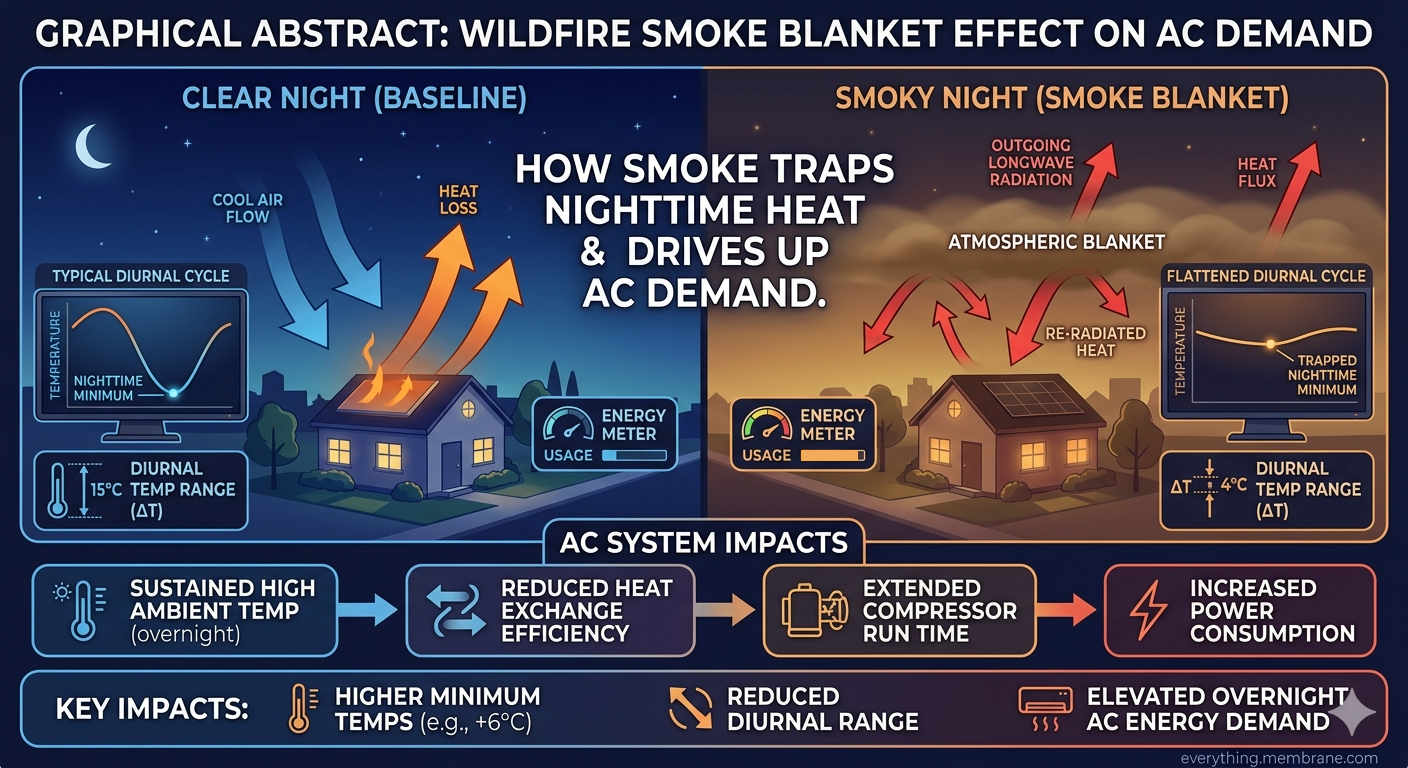
Smoke contains aerosols, soot, and black carbon that alter the atmosphere in multiple ways. During the day, dense smoke may partially block incoming sunlight in some locations. At night, however, smoke acts like an insulating blanket by absorbing and re-radiating longwave infrared radiation emitted from Earth’s surface. Instead of allowing accumulated daytime heat to escape efficiently into space, smoke traps a portion of that heat near the ground.
Buildings normally cool overnight by releasing stored heat through roofs, walls, windows, and ventilation. When smoke reduces nighttime cooling:
buildings retain more heat overnight
indoor temperatures begin each morning at a higher level
air conditioners start earlier
cooling systems operate longer
afternoon peak electricity demand increases
electrical grids experience additional stress
Where electricity generation still depends on fossil fuels, increased cooling demand can produce additional greenhouse gas emissions.
Wildfire smoke also deposits black carbon onto snow and ice. Darkened snow absorbs more solar radiation, reducing surface reflectivity (albedo) and accelerating melting. Faster snow and ice loss exposes darker land and ocean surfaces, which absorb even more solar energy and further amplify regional warming.
This creates multiple reinforcing feedbacks operating simultaneously.
Climate Change → More Frequent and Intense Wildfires → More Smoke, Black Carbon, and Aerosols → Nighttime Heat Trapping + Black Carbon Deposition on Snow and Ice → Warmer Nights + Reduced Surface Albedo → Accelerated Regional Warming → Higher Air Conditioning Demand + Faster Arctic Ice Melt → Greater Greenhouse Gas Emissions (where grids remain fossil-fuel powered) + Increased Solar Heat Absorption → Additional Global Warming → More Frequent and Intense Wildfires
Rather than a single feedback loop, wildfire smoke demonstrates how one climate impact can trigger several interconnected reinforcing loops that amplify one another.
Building Resilience
Preparing for extreme heat does not always require expensive renovations. Many low-cost measures can significantly improve resilience while reducing energy demand.
Examples include:
improving attic insulation
installing reflective roofing materials
adding exterior shading
planting shade trees
improving ventilation
using ceiling fans
sealing air leaks
installing high-efficiency heat pumps
increasing battery backup capability
incorporating passive cooling design
expanding urban tree canopies
Each improvement reduces dependence upon mechanical cooling while lowering stress on electrical infrastructure.
Conclusion
Climate control is rapidly becoming one of the defining infrastructure challenges of the twenty-first century. As temperatures continue to rise, air conditioning is evolving from a consumer appliance into a critical component of public health, economic stability, and societal resilience.
Yet the expansion of climate control also creates new reinforcing feedback loops involving energy systems, cities, water resources, healthcare, digital infrastructure, refrigerants, and wildfire dynamics. These feedbacks demonstrate that climate change is no longer simply an environmental issue—it is an interconnected systems problem in which human responses can either amplify or reduce future warming.
Breaking these feedback loops will require more than expanding air conditioning. It will depend upon cleaner electricity, higher-efficiency cooling technologies, passive building design, urban greening, resilient electrical grids, improved water management, and thoughtful climate adaptation. Every improvement that reduces the energy required to keep people safe weakens these reinforcing cycles.
The future of climate resilience will not be determined solely by how much we cool our buildings, but by how intelligently we redesign the systems that make cooling possible.
Wildfire smoke does more than reduce air quality—it can fundamentally alter local temperature patterns by changing how solar radiation and thermal energy interact with the atmosphere. Dense smoke layers can create a counterintuitive effect: cooler daytime temperatures but warmer nighttime conditions.
This disruption of the normal day–night temperature cycle can significantly increase air conditioning demand, strain electrical grids, and reduce HVAC efficiency.
Why Wildfire Smoke Lowers Daytime Temperatures
During the day, wildfire smoke acts as an atmospheric shield that reduces the amount of sunlight reaching Earth’s surface.
Blocks Incoming Solar Radiation
Thick smoke plumes contain millions of tiny aerosol particles that scatter and reflect incoming shortwave solar radiation back into space. This reduces the amount of direct sunlight reaching the ground.
Reduces Surface Heating
With less solar energy absorbed by land surfaces, buildings, roads, and vegetation receive less daytime heating. As a result:
Maximum daytime temperatures may be lower than forecast.
Surface heating is reduced.
The normal buildup of daytime thermal energy is weakened.
However, this cooling effect does not mean the overall energy balance has improved. Instead, the smoke changes when and where heat is stored and released.
The absorbed energy is re-emitted in all directions.
Some of that thermal energy is radiated back toward the surface.
The result is a warmer nighttime environment with reduced radiational cooling.
The “Atmospheric Blanket” Effect
This process is similar to the greenhouse effect:
Less heat escapes to space.
More heat remains trapped near the surface.
Overnight temperatures stay elevated.
Instead of providing the normal nighttime recovery period, wildfire smoke can flatten the daily temperature cycle by lowering daytime peaks while preventing nighttime cooling.
How Wildfire Smoke Thermal Trapping Increases Air Conditioning Demand
The nighttime warming effect from wildfire smoke can significantly increase local cooling requirements by eliminating the period when buildings and HVAC systems normally recover.
1. Eliminates Nighttime “Compressor Rest”
Under normal conditions, outdoor temperatures drop after sunset, allowing air conditioners to cycle less frequently or shut off for extended periods.
With smoke-enhanced nighttime heat:
Continuous Operation
Outdoor temperatures remain elevated.
Indoor heat removal continues throughout the night.
Compressors operate longer and more frequently.
Instead of recovering overnight, HVAC systems may begin the next day already under stress.
Increased Mechanical Wear
Extended compressor operation can accelerate:
Electrical component fatigue.
Capacitor failures.
Motor overheating.
Refrigerant system stress.
A hot afternoon followed by a smoke-trapped warm night creates a longer continuous period of thermal stress.
2. Flattens and Extends Electricity Demand Peaks
Power grids depend on nighttime cooling periods to recover after daytime heat waves.
Wildfire smoke can disrupt this pattern.
No Overnight Demand Drop
When thousands or millions of homes continue running air conditioning overnight:
Utility demand remains elevated.
Transformers and transmission equipment receive less recovery time.
Grid operators lose the normal nighttime reduction in load.
Increased Infrastructure Stress
The combination of:
Extreme daytime temperatures,
Reduced nighttime cooling,
Persistent HVAC operation,
creates a sustained demand pattern that pushes electrical systems closer to their limits.
3. Reduces HVAC Efficiency
Air conditioners remove heat by transferring indoor thermal energy to the outdoor environment through condenser coils.
When outdoor conditions remain hot, this process becomes less efficient.
Poorer Heat Exchange
Higher outdoor temperatures mean:
The condenser must work harder.
More electricity is required to move the same amount of heat.
Cooling capacity decreases during peak demand periods.
Wildfire smoke can worsen this problem by extending the number of hours when outdoor temperatures remain unfavorable.
4. Smoke Particulates Increase Filter and Airflow Problems
Wildfire smoke introduces large amounts of fine particulate matter (PM2.5) into the air.
Many homeowners respond by running HVAC systems continuously to improve indoor air quality.
However, this creates additional challenges.
Filter Loading
Smoke particles accumulate rapidly on filters, causing:
Reduced airflow.
Increased blower motor workload.
Higher electricity consumption.
Reduced cooling performance.
A severely clogged filter can force HVAC equipment to work significantly harder while moving less air.
Balancing Cooling and Filtration
During wildfire smoke events:
Use high-quality filters rated for fine particles when compatible with the HVAC system.
Replace filters more frequently.
Avoid unnecessarily restricting airflow with filters beyond the system’s design capability.
Use portable HEPA air cleaners when possible to reduce the burden on central HVAC systems.
The Bigger Climate Connection
Wildfire smoke demonstrates that climate impacts are not limited to simple temperature increases. Climate change is altering the physical processes that regulate Earth’s energy balance.
A warmer atmosphere, longer fire seasons, and more intense wildfire events create cascading effects:
Smoke changes radiation patterns.
Radiation changes temperature patterns.
Temperature changes energy demand.
Energy demand increases stress on infrastructure.
The result is a feedback loop where extreme climate events amplify economic and technological pressures.
Understanding these interactions is increasingly important as communities adapt to a changing climate where heat, smoke, energy demand, and infrastructure resilience are becoming interconnected challenges.
Straight-line winds are among the most destructive weather hazards on Earth, yet they often receive far less public attention than tornadoes and hurricanes. These powerful, non-rotational winds can flatten forests, rip roofs from buildings, topple power lines, and cause widespread infrastructure failures. In many cases, the damage resembles the aftermath of a tornado or even a hurricane.
Unlike tornadoes, which concentrate damage within a rotating vortex, straight-line winds can devastate broad regions simultaneously. Wind speeds frequently exceed 70–100 mph and, in extreme cases, may surpass 140 mph. Because they can strike with little warning and affect large geographic areas, straight-line wind events represent a growing hazard to communities, transportation systems, utilities, and the insurance industry.
Emerging research indicates that climate change is altering the atmospheric ingredients that produce severe convective storms. As the atmosphere warms and stores more energy, straight-line wind events are becoming more frequent, more destructive, and increasingly widespread. These changes are transforming severe convective storms into one of the fastest-growing sources of weather-related economic losses in the United States.
What Are Straight-Line Winds?
Straight-line winds are powerful horizontal winds that move outward from their source without rotating. They are most commonly produced by the downward plunge and subsequent outward surge of rain-cooled air from severe thunderstorms.
Unlike tornadoes, which draw air inward and rotate violently around a central vortex, straight-line winds push air exclusively outward along the ground. Despite this difference, their destructive potential can rival or even exceed that of weak-to-moderate tornadoes.
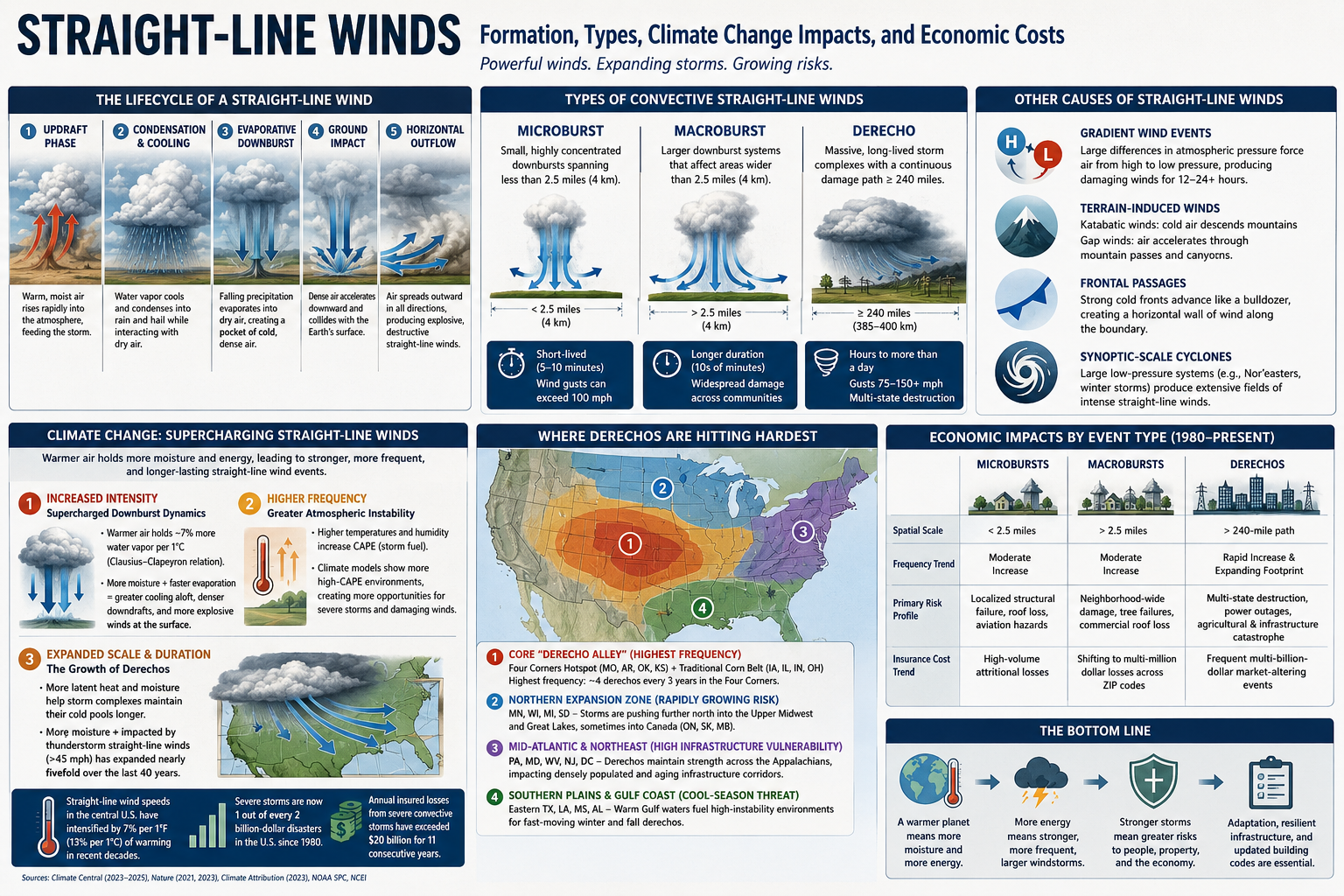
The Lifecycle of a Straight-Line Wind Event
1. Updraft Phase
Warm, moist air rises rapidly into the atmosphere, feeding the development of a growing thunderstorm.
2. Condensation and Cooling
As water vapor ascends, it cools and condenses into rain and hail while interacting with surrounding layers of drier air.
3. Evaporative Downburst Formation
Falling precipitation evaporates into dry air aloft. Because evaporation absorbs heat, it creates a large pocket of extremely cold, dense air.
4. Ground Impact
This dense air mass accelerates downward as a powerful downdraft and collides with Earth’s surface.
5. Horizontal Outflow
Upon impact, the descending air can no longer move downward. Instead, it compresses and surges outward in all directions, producing an explosive burst of destructive straight-line winds.
Classification of Convective Straight-Line Wind Events
Meteorologists classify thunderstorm-generated straight-line winds according to their size and duration.
Microbursts
Microbursts are highly concentrated downbursts spanning less than 2.5 miles (4 km). Although typically lasting only five to ten minutes, they can produce sudden wind gusts exceeding 100 mph and are particularly dangerous because of their intensity and lack of warning.
Macrobursts
Macrobursts are larger downburst systems that spread destruction across areas wider than 2.5 miles (4 km) and often persist significantly longer than microbursts.
Derechos
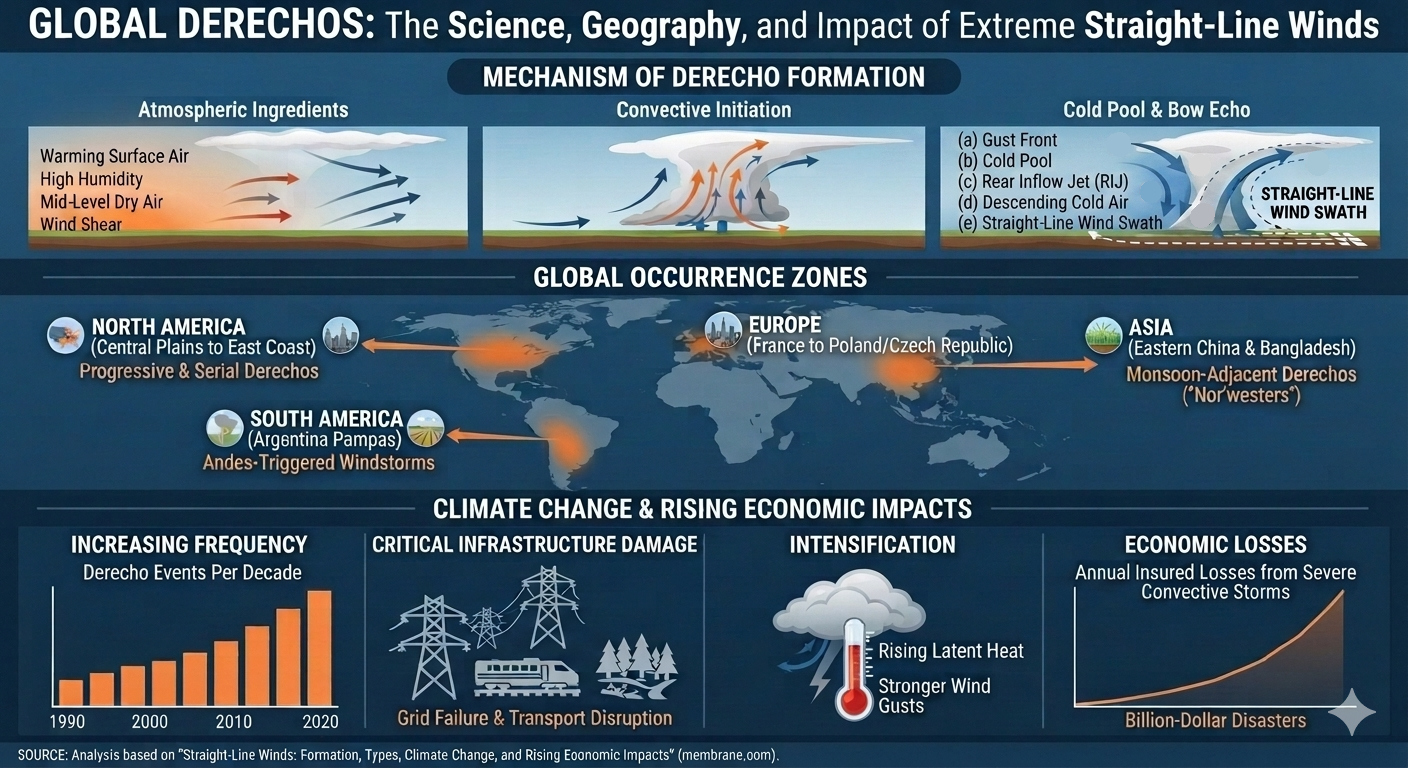
Derechos are massive, long-lived convective storm systems that produce continuous swaths of wind damage extending at least 240–250 miles (385–400 km). By definition, derechos generate sustained winds of at least 58 mph, with gusts commonly ranging between 75 and 150 mph.
Other Causes of Straight-Line Winds
Although convective downbursts are the most common source of straight-line winds, meteorologists classify any non-rotational horizontal wind as a straight-line wind, regardless of its origin.
Gradient Wind Events
These winds arise from large differences in atmospheric pressure. Air naturally flows from areas of high pressure toward low pressure. When powerful pressure systems are positioned close together, the resulting pressure gradient can accelerate air to damaging speeds. Unlike thunderstorm downbursts that last only minutes, gradient wind events can persist for 12 to 24 hours or longer.
Terrain-Induced Winds
Mountain landscapes frequently create severe straight-line winds.
Katabatic Winds: Cold, dense air descends from elevated plateaus or ice sheets under the influence of gravity, accelerating dramatically before spreading across valleys below.
Examples include:
Santa Ana winds in California
Bora winds in southeastern Europe
Gap Winds: Air masses forced through narrow mountain passes and canyons become compressed and accelerated, producing intense horizontal wind speeds.
Frontal Passages
The leading edge of a strong cold front can generate destructive straight-line winds. As dense cold air advances, it acts like an atmospheric bulldozer, forcing warmer air upward and creating a powerful wall of horizontal wind along the frontal boundary.
Synoptic-Scale Extratropical Cyclones
Large non-tropical low-pressure systems, such as Nor’easters and major winter storms, produce extensive fields of intense straight-line winds through tightly packed pressure gradients extending across hundreds of miles.
Climate Change and the Intensification of Straight-Line Winds
Climate change directly influences the atmospheric variables that fuel severe convective storms, causing thunderstorm-generated straight-line winds to become more frequent, intensely destructive, and geographically expanded.
Research synthesized by Climate Central and peer-reviewed studies published in Nature indicates that straight-line wind speeds across portions of the central United States have already intensified by approximately 7% per 1°F (13% per 1°C) of atmospheric warming during recent decades.
Several physical mechanisms are driving these changes.
The fundamental engine behind a straight-line wind event is the evaporative downburst. Climate change amplifies this process in multiple ways.
Higher Atmospheric Moisture Capacity
According to the Clausius-Clapeyron relationship, a warmer atmosphere can hold approximately 7% more water vapor for every 1°C increase in temperature. This additional moisture allows thunderstorms to contain substantially greater amounts of precipitation.
Enhanced Evaporative Cooling
When this larger volume of precipitation falls through relatively dry layers of air, evaporation occurs more rapidly. The evaporation dramatically cools the descending air, making it denser and heavier than its surroundings.
The greater the temperature contrast between the chilled downdraft and the surrounding environment, the faster the air accelerates downward. The result is a more violent impact at the surface and stronger, more destructive straight-line wind speeds.
Severe convective storms require highly unstable atmospheric conditions.
Elevated Convective Available Potential Energy (CAPE)
Warmer temperatures and increased humidity elevate Convective Available Potential Energy (CAPE), a measure of the energy available for thunderstorm development.
More Severe Storm Environments
Advanced climate models consistently project increases in high-CAPE environments under continued greenhouse gas forcing. These environments provide more opportunities for ordinary thunderstorms to intensify into severe systems capable of producing damaging straight-line winds.
3. Expanded Scale and Duration: The Growth of Derechos
Climate change also appears to be altering the longevity and geographic footprint of large convective systems.
Longer-Lived Storm Complexes
A warmer atmosphere contains greater amounts of latent heat and moisture, enabling storm systems to maintain their rain-cooled cold pools for longer periods. Because these cold pools drive storm propagation, straight-line wind events can persist over hundreds of miles.
Fivefold Geographic Expansion
Research summarized by Climate Attribution indicates that the total area affected by thunderstorm-generated straight-line winds exceeding 45 mph has expanded nearly fivefold during the past forty years. Regions farther north and east that historically experienced fewer severe wind events are increasingly experiencing high-intensity derecho systems.
The Severe Convective Storm Crisis
The financial consequences of straight-line winds have fundamentally changed since 1980. Driven by climate change, expanding development patterns, and inflation, severe convective storms have become the most frequent billion-dollar disaster category in the United States.
According to Climate Central, severe storms now account for approximately one out of every two billion-dollar weather disasters recorded since 1980. Annual insured losses from severe convective storms that generally remained below $5 billion during the 1980s have evolved into an eleven-year streak of annual losses exceeding $20 billion.
Comparing Straight-Line Wind Types and Their Economic Impacts
Neighborhood-wide damage and extensive tree failures
Multi-state infrastructure destruction and widespread power outages
Insurance Cost Trend
High-volume attritional losses
Increasing multi-million-dollar localized losses
Frequent multi-billion-dollar catastrophe events
Economic Impacts by Event Type
Microbursts and Macrobursts: The Aggregate Loss Problem
Microbursts and macrobursts generally function as localized “attritional losses” for the insurance industry. Individually, most events do not exceed catastrophe thresholds. However, their increasing frequency means they collectively generate billions of dollars in annual claims.
As residential development has expanded into previously rural areas, localized downbursts increasingly strike populated communities. The financial impact often manifests through:
Roof replacements
Siding damage
Broken windows
Vehicle losses
Fallen tree claims
Localized business interruptions
Although these events rarely dominate national headlines, their cumulative economic impact has become enormous.
Derechos: The Multi-Billion-Dollar Market Shifters
Derechos represent the fastest-growing financial threat among straight-line wind events.
Geographic Expansion
Greater atmospheric moisture allows derecho complexes to maintain their structure over much longer distances. Storms increasingly extend into regions where infrastructure and housing stock were not designed to withstand sustained horizontal winds of 80–110 mph.
Hurricane-Scale Damage
Events such as the 2020 Midwest Derecho, which caused more than $11 billion in damages, demonstrated that a single modern derecho can inflict destruction comparable to that of a major landfalling hurricane.
Consequences frequently include:
Regional power grid failures
Agricultural devastation
Widespread commercial losses
Transportation disruptions
Long-duration business interruptions
Extensive residential destruction
Geographic Shifts in Derecho Risk: Expanding Beyond Traditional Boundaries
The United States Midwest and the Corn Belt are experiencing the most severe impacts and greatest geographic expansion associated with intensifying derechos. Although a climatological “hot zone” for these storms has long existed in the central United States, climate change appears to be altering the environmental conditions that govern their formation and propagation.
Warmer atmospheric temperatures, increased moisture availability, and persistent summer heat domes are creating environments capable of sustaining larger and longer-lived convective systems. As a result, regions that historically experienced relatively infrequent derecho activity are increasingly facing severe straight-line wind events with multi-billion-dollar consequences.
1. The Core “Derecho Alley”: Highest Frequency and Agricultural Exposure
Similar to the nation’s Tornado Alley, a region often referred to as Derecho Alley experiences the highest baseline concentration of derechos in North America, averaging approximately one major event each year.
The Four Corners Hotspot
The area encompassing:
Southwest Missouri
Northwest Arkansas
Northeast Oklahoma
Southeast Kansas
records the highest historical frequency of derechos, averaging roughly four major events every three years.
The Traditional Corn Belt
Immediately east lies the traditional Corn Belt, including:
Iowa
Illinois
Indiana
Ohio
These states possess extensive flat terrain and some of the world’s most productive agricultural land. The lack of significant topographic barriers allows derecho complexes to accelerate and maintain their structure over hundreds of miles with minimal disruption.
The consequences can be enormous. A single derecho may flatten millions of acres of corn and soybeans within hours, producing severe agricultural losses, disrupting supply chains, damaging grain storage and transportation infrastructure, and generating billions of dollars in economic damages.
2. The Northern Expansion Zone: A Rapidly Growing Risk
As atmospheric warming and persistent summer heat increasingly extend farther north, states that once viewed derechos as rare anomalies are experiencing a growing number of severe events.
Impacted States
Minnesota
Wisconsin
Michigan
South Dakota
Emerging Trends
Strengthening high-pressure systems and expanding zones of atmospheric instability are supporting derecho development farther into the Upper Midwest and Great Lakes regions. Some events are now maintaining sufficient intensity to continue into Canada, affecting:
Ontario
Saskatchewan
Manitoba
This northward expansion represents one of the clearest examples of shifting severe weather boundaries in a warming climate.
3. The Mid-Atlantic and Northeast: High Infrastructure Vulnerability
Although derechos occur less frequently in the eastern United States than in the Plains and Midwest, their societal and economic impacts are often disproportionately large.
Impacted States
Pennsylvania
Maryland
West Virginia
New Jersey
Washington, D.C.
Emerging Trends
Historically, the Appalachian Mountains often weakened convective systems moving eastward. However, recent events suggest that increasingly energetic storm complexes are better able to maintain their structural integrity while crossing the mountains.
As a result, damaging straight-line winds are increasingly reaching densely populated metropolitan corridors of the Mid-Atlantic and Northeast.
The consequences include:
Large-scale electrical grid failures
Widespread tree damage
Transportation disruptions
Telecommunications outages
Extensive residential and commercial property losses
Because much of the region’s electrical and transportation infrastructure is decades old and designed for historical wind conditions, vulnerability to major derecho events remains exceptionally high.
4. The Southern Plains and Gulf Coast: The Cool-Season Threat
Approximately 70 percent of all derechos occur during the warm season between May and August. However, a secondary corridor remains active during autumn and winter.
Impacted States
Eastern Texas
Louisiana
Mississippi
Alabama
Emerging Trends
The Gulf of Mexico is supplying increasingly warm and moisture-rich air masses later into the year. These conditions can create highly unstable environments even during winter months, supporting the development of fast-moving cool-season derechos.
Because communities generally associate severe convective storms with spring and summer, winter derechos often arrive with lower public awareness and preparedness, increasing the potential for widespread impacts.
A Global Phenomenon
Although North America experiences some of the world’s most powerful and well-documented derechos, these storms are not unique to the United States. Derecho-like convective systems occur on nearly every continent and are increasingly being recognized in:
Central Europe
Eastern Asia
The subtropical plains of South America
As the global atmosphere continues to warm and store more moisture and energy, researchers are increasingly investigating whether the environmental conditions that support long-lived convective windstorms are becoming more common in regions that historically experienced them only rarely.
The expanding geographic footprint of derechos underscores a central lesson of climate science: severe weather hazards are not remaining stationary. As atmospheric energy increases, the boundaries of extreme events are shifting, exposing new populations, infrastructure, and economic systems to risks that were once considered geographically improbable.
Insurance Industry Responses
Global insured losses from severe convective storms are increasing at an estimated average annual rate of approximately 9%, substantially exceeding the growth rate of losses from other natural catastrophes.
In response, insurers are rapidly restructuring coverage across many regions of the United States.
Traditional policies that once contained flat-dollar wind deductibles are increasingly being replaced by percentage-based wind and hail deductibles ranging from 1% to 5% of a home’s insured value. These changes shift thousands of dollars of immediate disaster costs directly onto homeowners and businesses.
The insurance industry increasingly recognizes straight-line wind events not as isolated weather anomalies but as an emerging systemic risk requiring substantial adjustments in underwriting practices, pricing models, and catastrophe exposure management.
Conclusion: More Energy in the Atmosphere Means More Extreme Winds
Straight-line winds demonstrate a fundamental principle of climate physics: a warmer world is a more energetic world.
As greenhouse gases trap additional heat, the atmosphere stores more moisture and potential energy, creating increasingly favorable conditions for severe convective storms. The result is an environment capable of producing stronger downbursts, more frequent severe thunderstorms, and larger, longer-lived derecho systems.
Climate change does not cause any individual straight-line wind event in isolation. However, it is increasingly altering the environmental ingredients that govern these storms by increasing atmospheric moisture, elevating instability, and supporting more persistent convective systems.
The consequences extend well beyond meteorology. Straight-line winds are becoming a growing challenge for public safety, infrastructure resilience, electrical grid reliability, insurance markets, and building design standards. As the climate system continues to warm, understanding and preparing for these increasingly energetic wind events will become essential for protecting communities and reducing future economic losses.
What are the climate risks where you live?
Many people are surprised to learn that their greatest weather-related risk is often wind damage. Wind and hail damage are among the most common homeowners insurance claims in the United States, accounting for roughly 40% of all property damage claims.
Standard homeowners policies from major insurers generally cover wind damage under dwelling and personal property coverage. These claims can include repairs for roof and shingle damage, siding damage, structural failures, and damage caused by wind-driven debris such as fallen trees.
However, homeowners in high-risk areas—such as coastal regions and “Tornado Alley”—may face separate windstorm deductibles. Unlike a standard fixed deductible (for example, $1,000), these deductibles are often calculated as a percentage of the home’s insured value, typically ranging from 1% to 5%.
“Climate change is increasing the amount of energy violent rain events contain, amplifying how much damage they can inflict.”
The physics of wind and rain are important to understand: their destructive force increases nonlinearly with velocity and is further amplified by density and mass. Even relatively small increases in wind speed or rainfall intensity can produce disproportionately larger impacts and damage.
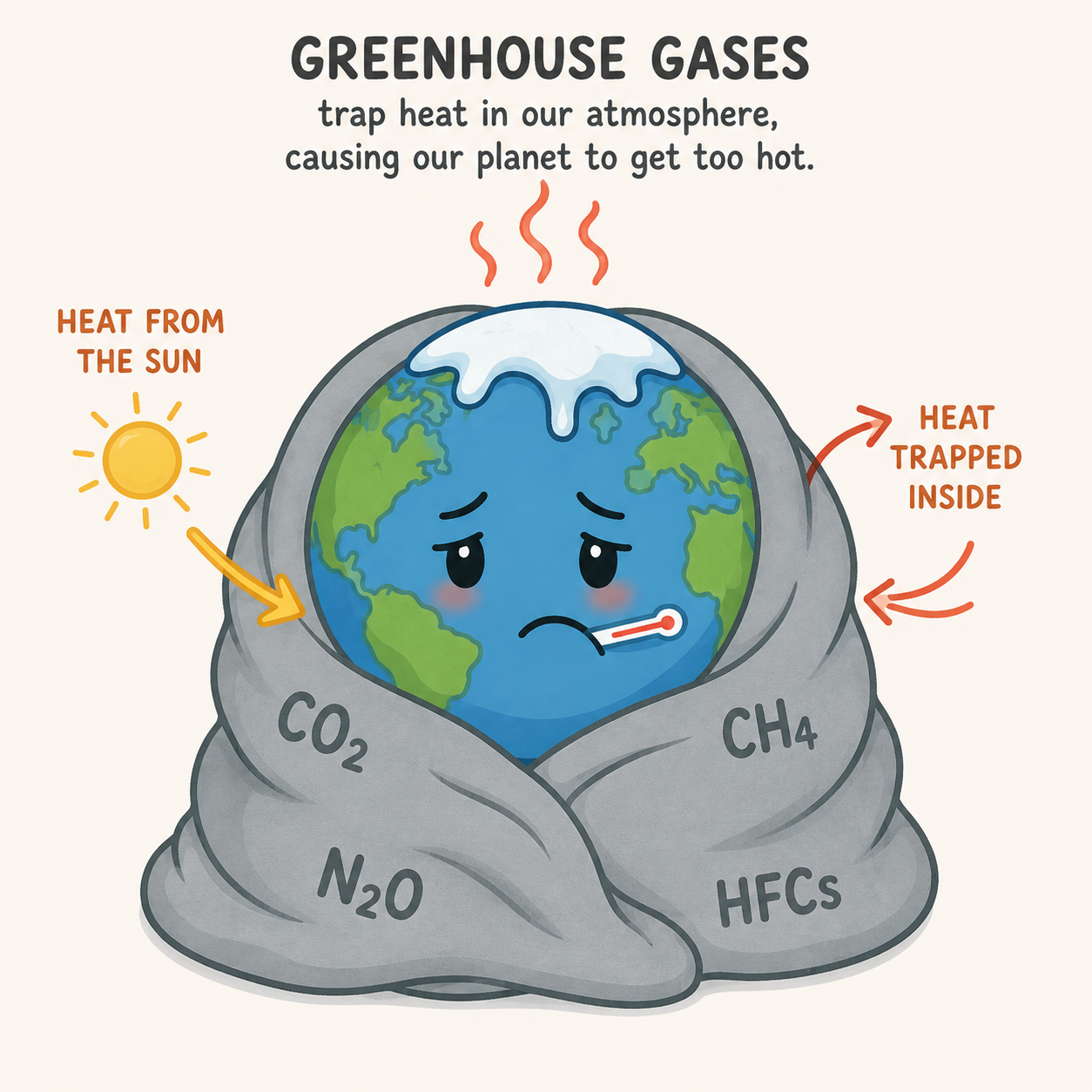
This principle applies to all extreme energy events. At its core, climate change is an energy imbalance. As excess heat accumulates within the Earth system, more energy becomes available to drive storms, floods, droughts, heatwaves, and wildfires. As the energy intensifies, so do its manifestations.
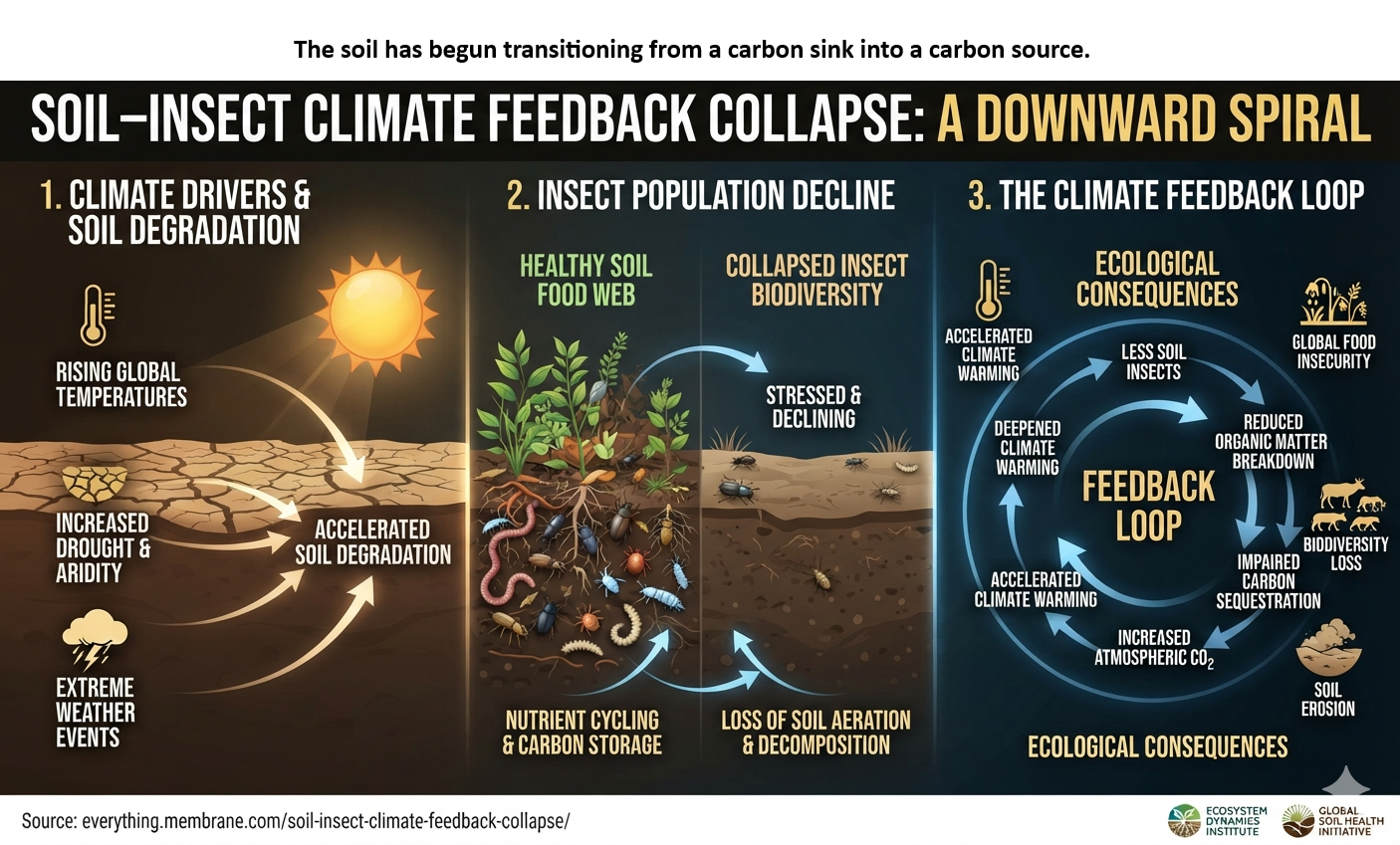
The soil has begun transitioning from a carbon sink into a carbon source.
by Daniel Brouse
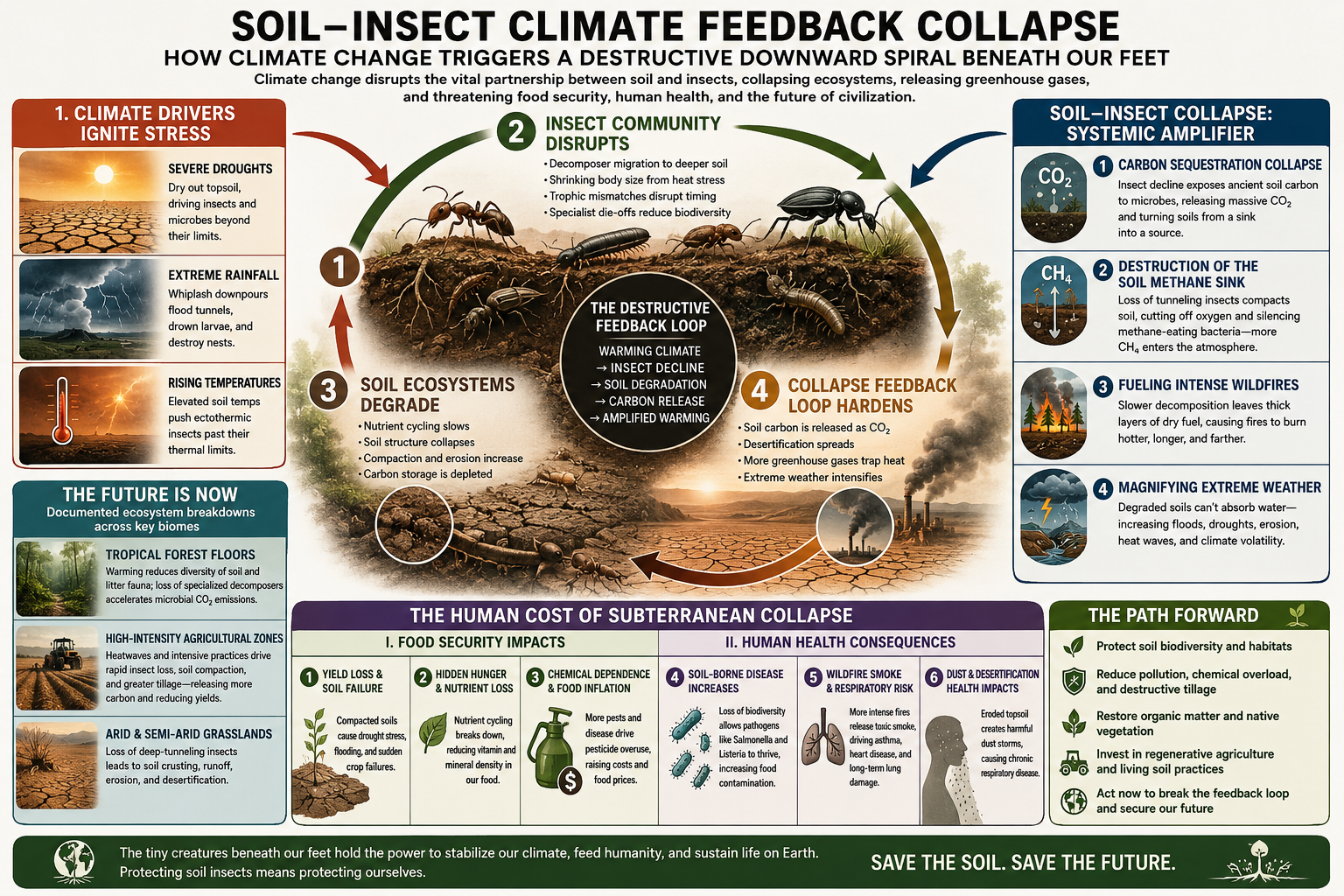
Soil–Insect Climate Feedback Collapse: How Climate Change Is Triggering a Downward Spiral in Earth’s Hidden Ecosystems
Introduction: The Collapse Beneath Our Feet
Climate change is not only transforming the atmosphere, oceans, and visible landscapes of Earth; it is also disrupting one of the planet’s most important hidden systems—the living soil ecosystem beneath our feet. Soil and insects exist in a highly interconnected relationship where insects regulate decomposition, nutrient cycling, carbon storage, water movement, and the physical structure of the ground itself.
As global temperatures rise and extreme weather becomes more intense, this relationship is being pushed beyond its natural limits. Soil insects, particularly ectothermic organisms whose body temperatures are controlled by their environment, are highly vulnerable to rising temperatures, drought, flooding, and ecological instability. At the same time, soil itself becomes increasingly degraded as biological processes that maintain its structure and fertility begin to fail.
The collapse of soil-insect systems represents more than a biodiversity crisis. It is a systemic disruption of one of Earth’s largest carbon reservoirs and one of humanity’s most important life-support systems. As subterranean ecosystems deteriorate, the consequences extend upward into agriculture, wildfire behavior, atmospheric processes, food security, and human health.
1. Climate Drivers Ignite Soil-Insect Stress
Climate change acts as the primary trigger for the collapse of the soil-insect system. Rising temperatures, changing precipitation patterns, drought, and extreme rainfall events place intense pressure on organisms that have evolved within relatively stable environmental conditions.
Severe Drought and Soil Drying
Increasing drought conditions dry out the upper layers of soil, eliminating critical habitat for many soil organisms. Moisture-dependent insects and other decomposers experience increased mortality as soils become too dry to support biological activity.
Dry soils also:
Reduce microbial activity.
Increase compaction.
Limit decomposition.
Reduce nutrient availability.
As moisture disappears, many soil insects are forced deeper underground to escape unfavorable surface conditions, leaving the upper soil layers biologically depleted.
Extreme Rainfall and Flooding
Climate change is also increasing the frequency of intense rainfall events. These sudden floods disrupt underground ecosystems by:
Flooding insect tunnels.
Destroying underground nesting structures.
Drowning eggs and larvae.
Removing surface organic material.
The increasing combination of drought and extreme rainfall creates a climate “whiplash” effect, forcing soil organisms to survive rapidly shifting and increasingly hostile environments.
Rising Soil Temperatures
Elevated soil temperatures place ectothermic organisms under direct physiological stress. Because insects rely on environmental temperatures to regulate metabolism, warming can push them beyond their thermal limits.
The consequences include:
Reduced survival.
Disrupted reproduction.
Altered development cycles.
Increased ecological instability.
The result is a progressive breakdown of the underground biological network that supports healthy soils.
2. The Soil Insect Community Disrupts
As climate pressures intensify, soil insect communities begin experiencing widespread ecological disruption. The impacts are not limited to population decline but include changes in behavior, body size, timing, and species composition.
Decomposer Migration
Macrofauna such as ants, beetles, termites, and other large decomposers are essential for processing organic matter and maintaining soil structure.
Under increasing heat and drought stress:
These organisms migrate deeper into the soil.
Surface decomposition declines.
Organic matter remains exposed rather than being incorporated into deeper layers.
The loss of surface-level decomposer activity weakens the entire soil food web.
Shrinking Body Size
Rising temperatures accelerate insect development rates. However, faster growth often results in smaller adult insects.
This reduction in body size decreases:
Physical efficiency.
Reproductive capacity.
Ecosystem function.
Smaller insects are less capable of performing critical roles such as decomposition, soil mixing, and nutrient movement.
Trophic Mismatches
Climate disruption alters the timing relationships between organisms.
Examples include:
Insect emergence occurring before food resources become available.
Reduced synchronization between decomposers and plant litter cycles.
Disruption of predator-prey relationships.
These mismatches weaken ecosystem stability and reduce the ability of soil communities to adapt.
Specialist Die-Offs
Specialized soil insects are among the most vulnerable organisms during rapid environmental change.
Localized extinctions of sensitive species result in:
Reduced biodiversity.
Loss of ecological functions.
Increased dominance of heat-tolerant generalist species.
As biodiversity declines, the soil ecosystem becomes less resilient and more vulnerable to additional climate stress.
3. Soil Ecosystems Degrade
The decline of soil insect communities causes cascading failures throughout the underground ecosystem. Without healthy insect populations, soils lose many of the biological processes required to maintain fertility, structure, and climate regulation.
Halted Nutrient Cycling
Soil insects are fundamental to the breakdown of organic material.
Without macrofauna:
Plant litter decomposition slows.
Nutrients remain trapped in undecomposed material.
Soil fertility declines.
The biological recycling system that sustains terrestrial ecosystems begins to fail.
Structural Collapse
Burrowing insects act as ecosystem engineers by creating tunnels and channels throughout the soil.
These structures provide:
Soil aeration.
Water infiltration pathways.
Root access.
Microbial habitat.
As tunneling organisms disappear:
Soil becomes compacted.
Water absorption decreases.
Surface erosion increases.
The soil loses its ability to function as a living, dynamic system.
Carbon Depletion
Healthy soils represent one of Earth’s largest carbon reservoirs. Soil insects help protect carbon by shredding organic matter and mixing it into deeper layers where it can become stabilized.
When insect communities collapse:
Organic carbon becomes exposed.
Microbial decomposition accelerates.
Carbon storage capacity declines.
The soil has begun transitioning from a carbon sink into a carbon source.
4. The Collapse Feedback Loop Hardens
Once soil degradation begins, the damage feeds back into the climate system, accelerating the original disruption. The loss of soil insects transforms a biological decline into a broader Earth-system feedback mechanism.
Greenhouse Gas Release
As soil structures fail and organic matter becomes exposed, large quantities of stored soil carbon are released into the atmosphere.
Healthy soils function as long-term carbon storage systems by protecting organic matter within complex soil structures. When insect activity declines:
Soil aggregates break down.
Previously protected carbon becomes accessible to microbes.
Decomposition accelerates.
Carbon dioxide emissions increase.
As more carbon enters the atmosphere, additional warming occurs, intensifying the environmental pressures already affecting soil organisms.
Desertification
The combined loss of soil biodiversity and soil structure can transform productive ecosystems into degraded landscapes.
Without healthy insect communities:
Soil loses its ability to retain moisture.
Vegetation declines.
Organic matter inputs decrease.
Erosion accelerates.
The landscape gradually loses its capacity to support biological productivity, creating conditions favorable for permanent desertification.
Amplified Warming
The release of additional greenhouse gases creates a reinforcing climate feedback.
The original disturbance is therefore amplified through the collapse of a critical biological system.
The Future Is Now: Evidence of Active Soil-Insect Collapse
This destructive feedback loop is no longer only a theoretical projection. It is actively documented across multiple ecosystems worldwide. Field experiments, long-term ecological monitoring, and regional surveys reveal visible breakdowns where insect declines directly affect soil stability, carbon cycling, and ecosystem function.
1. Tropical Forest Floors
Tropical ecosystems contain some of the most biologically diverse soil communities on Earth. However, tropical insects often live close to their maximum thermal tolerance, making them particularly vulnerable to even modest increases in temperature.
The Evidence
Controlled whole-profile soil warming experiments in tropical forests have demonstrated:
Significant reductions in soil and leaf-litter fauna diversity.
Declines in soil organism richness.
Greater vulnerability during dry-season warming.
The Feedback
As specialized macro-decomposers such as larger beetles and millipedes decline:
They are replaced by fewer heat-tolerant and aggressive microarthropod species.
Soil food-web complexity decreases.
Microbial activity becomes less regulated.
Without a diverse insect community controlling microbial processes, microbes can accelerate the breakdown of organic matter, increasing carbon dioxide emissions from tropical soils.
2. High-Intensity Agricultural Zones
Agricultural ecosystems are experiencing a compounding crisis as climate stress combines with intensive land management practices.
Major pressures include:
Synthetic chemical use.
Heavy tillage.
Monoculture farming.
Increasing heat extremes.
The Evidence
Long-term ecological monitoring indicates that heavily managed agricultural regions experience accelerating declines in insect abundance and species richness as climate pressures increase.
The Feedback
When croplands experience extreme heat:
Native soil insects decline.
Natural soil aeration decreases.
Soil compaction increases.
Water retention capacity declines.
As biological soil engineers disappear, farmers increasingly rely on mechanical intervention to break apart hardened soils.
However, increased tillage:
Destroys remaining underground habitats.
Accelerates organic carbon exposure.
Increases agricultural greenhouse gas emissions.
This creates a reinforcing cycle:
Climate stress → soil insect loss → soil degradation → increased tillage → further soil ecosystem destruction
3. Arid and Semi-Arid Grasslands
Dryland ecosystems depend heavily on ecosystem-engineering insects such as ants and termites. These organisms regulate water movement, nutrient distribution, and soil structure in some of the planet’s most water-limited environments.
The Evidence
Increasing temperatures and prolonged drought have altered grassland soil communities, causing significant declines in moisture-sensitive soil organisms.
Deep-dwelling insects are increasingly affected as underground moisture disappears.
The Feedback
Without deep-tunneling insects:
Soil loses internal pathways for water movement.
Surface crusts form.
Rainfall infiltration declines.
Vegetation recovery becomes more difficult.
When intense rainfall events occur, degraded soils cannot absorb water effectively.
Instead:
Water runs across the surface.
Severe erosion occurs.
Topsoil is removed.
Plant communities collapse.
The loss of vegetation further reduces organic matter inputs, reinforcing the decline of soil insects and accelerating desertification.
Soil-Insect Collapse as a Systemic Climate Amplifier
The soil-insect collapse feedback does not occur independently. It connects directly with major Earth-system processes involving carbon storage, methane regulation, wildfire intensity, and extreme weather.
The destruction of subterranean biodiversity transforms a microscopic ecological disruption into a planetary-scale climate amplifier.
1. Collapse of Carbon Sequestration
Soils contain roughly three times more carbon than terrestrial vegetation. Soil insects function as biological gatekeepers that determine how carbon is processed and stored.
Disruption
Healthy soils depend on insects to:
Break down organic material.
Mix plant debris into deeper layers.
Create conditions where carbon binds with minerals.
Build stable soil aggregates.
Global environmental changes reduce the feeding and burrowing activity of soil detritivores, weakening this carbon protection system.
The Feedback
Without insects physically incorporating and protecting carbon:
Organic matter becomes exposed.
Oxygen reaches stored carbon.
Microbial decomposition accelerates.
Long-term warming experiments show that stressed soils can begin consuming persistent, centuries-old organic matter, releasing additional carbon dioxide into the atmosphere.
This converts soils from climate stabilizers into climate amplifiers.
2. Destruction of the Soil Methane Sink
Upland soils represent a major global methane sink because they contain methane-consuming microorganisms called methanotrophs.
Disruption
Methanotroph activity depends on proper soil gas exchange.
This balance is maintained by:
Soil structure.
Oxygen movement.
Insect-created tunnels and macropores.
When heat and drought drive tunneling insects away:
Soil compacts.
Underground airflow decreases.
Methane-consuming microbial communities become impaired.
The Feedback
As the methane sink weakens:
Less methane is removed from the atmosphere.
More CH₄ accumulates.
Atmospheric warming increases.
The soil shifts from actively filtering methane toward becoming a weaker climate-regulating system.
3. Fueling More Intense Wildfires
The collapse of soil decomposer communities fundamentally changes the physical characteristics of forests, grasslands, and other terrestrial ecosystems. When insects responsible for breaking down organic material decline, landscapes accumulate larger quantities of dry, undecomposed biomass.
Disruption
Healthy populations of millipedes, woodlice, beetles, and other macro-insects rapidly process fallen leaves, dead plant material, and organic debris.
When these decomposers decline:
Leaf litter decomposition slows.
Dead vegetation accumulates on the surface.
Organic material remains exposed to drying conditions.
Forest floors and grasslands become increasingly fuel-loaded.
The result is the transformation of biologically active landscapes into increasingly combustible environments.
The Feedback
When climate-driven wildfires ignite these ecosystems:
Fires spread more rapidly.
Burning temperatures increase.
Larger areas are consumed.
More carbon is released into the atmosphere.
Intense fires also damage the remaining plant-soil-microbe relationships that allow ecosystems to recover.
Healthy soils and their insect communities function as a natural climate buffer. Soil organisms help regulate water movement, maintain moisture storage, and reduce the severity of environmental extremes.
When this biological infrastructure collapses, landscapes lose their ability to absorb climate shocks.
Disruption
Without insect-driven bioturbation—the natural mixing and restructuring of soil—the upper layers of soil become increasingly compacted and degraded.
The consequences include:
Reduced soil porosity.
Lower water infiltration.
Increased surface crust formation.
Reduced moisture retention.
The soil becomes hardened and less capable of functioning as a living water-management system.
The Feedback
When extreme rainfall events occur:
Water cannot penetrate degraded soils.
Surface runoff increases.
Flash flooding intensifies.
Mudslides and erosion become more severe.
Topsoil is lost.
The landscape loses its ability to store water, increasing drought stress after storms and creating conditions that intensify future heat waves.
The cycle becomes:
Soil degradation → reduced water storage → stronger drought impacts → greater heat stress → further ecosystem decline
The Human Cost of Subterranean Collapse
The effects of soil-insect collapse extend directly into human systems. Because human civilization depends on productive soils for agriculture, the degradation of underground ecosystems represents a direct threat to food security, economic stability, and public health.
Humans depend on healthy soils for approximately 95% of the food consumed globally. As soil biological systems decline, the consequences move from ecological disruption into human survival systems.
I. Food Security Impacts
1. Declining Crop Yields and Structural Soil Failure
As temperatures rise and insect communities decline, agricultural soils lose critical biological functions.
The Mechanism
When fields lose tunneling macrofauna:
Soil becomes compacted.
Water infiltration decreases.
Plant-accessible water storage declines.
During drought:
Crops experience water stress more rapidly.
Roots cannot access deeper moisture reserves.
During extreme rainfall:
Hardened soils prevent water absorption.
Fields experience increased flooding.
Crops become vulnerable to sudden failure.
The same degraded soil becomes vulnerable to both drought and flooding, creating increasingly unstable agricultural conditions.
2. Hidden Hunger and Nutrient Decline
Food production depends not only on crop quantity but also on nutritional quality.
The relationship between insects, microbes, and plants maintains the movement of essential nutrients through ecosystems.
The Mechanism
Soil insects:
Break down organic material.
Create smaller biological fragments.
Support microbial conversion of nutrients into plant-available forms.
These processes influence the availability of minerals such as:
Crops grown in degraded soils may experience reduced nutrient density, increasing the risk of “hidden hunger”—micronutrient deficiencies that impair human development and immune function.
3. Increasing Chemical Dependence and Food Inflation
As native insect diversity collapses, agricultural ecosystems become increasingly vulnerable to pests and disease.
The Mechanism
The loss of beneficial insects removes important ecological controls over:
Crop pests.
Soil pathogens.
Root-damaging organisms.
To maintain production:
Farmers increase pesticide use.
Synthetic inputs become more necessary.
Production costs rise.
The Impact
Greater chemical dependence contributes to:
Higher agricultural expenses.
Increased food prices.
Greater chemical runoff into freshwater systems.
Additional stress on vulnerable communities.
The agricultural system becomes trapped in a cycle of ecological decline and increasing dependence on external inputs.
II. Human Health Consequences
4. Increased Soil-Borne Disease and Opportunistic Pathogens
A diverse soil ecosystem acts as a biological defense system by limiting the expansion of opportunistic pathogens.
The Mechanism
High biodiversity helps suppress harmful organisms, including pathogens such as:
Salmonella enterica
Listeria monocytogenes
When soil biodiversity declines:
Ecological competition decreases.
Opportunistic organisms gain advantages.
Agricultural contamination risks increase.
The Impact
As soil ecosystems become increasingly disrupted:
Food safety risks rise.
Fresh produce contamination becomes more difficult to control.
Human exposure to soil-associated pathogens may increase.
5. Respiratory Disease and Toxic Wildfire Smoke
The soil-insect feedback loop connects directly to human respiratory health through increased wildfire intensity.
The Mechanism
When insect decomposers decline:
Dead vegetation accumulates.
Forest and grassland surfaces become fuel-loaded.
Fires burn with greater intensity.
These severe fires release:
Fine particulate matter (PM2.5).
Carbon compounds.
Volatile organic compounds.
The Impact
Smoke exposure can contribute to:
Increased asthma attacks.
Cardiovascular stress.
Respiratory illness.
Long-term health consequences.
As wildfire seasons intensify, the loss of soil biodiversity becomes connected to increasingly widespread air-quality threats.
6. Chronic Dust Exposure and Desertification Health Impacts
The final stage of soil collapse occurs when degraded landscapes lose their ability to maintain stable vegetation and soil structure.
The Mechanism
When insect populations decline:
Soil loses biological cohesion.
Root systems weaken.
Topsoil becomes vulnerable to erosion.
Wind can then transport large quantities of fine soil particles across broad regions.
The Impact
Chronic exposure to dust can increase risks of:
Respiratory irritation.
Chronic lung disease.
Silica-related health problems.
Reduced air quality across downwind communities.
The degradation of soil ecosystems therefore creates direct human health consequences far beyond the original affected landscape.
End Synthesis: The Soil-Insect Connection as a Climate Feedback System
The soil-insect relationship represents one of Earth’s most important biological feedback systems. Although insects are small organisms, their collective influence extends across planetary-scale processes involving carbon storage, water regulation, atmospheric chemistry, agriculture, and human health.
Climate change destabilizes this relationship by pushing soil organisms beyond their ecological limits. As insect communities decline, soils lose their ability to function as living ecosystems. Nutrient cycling slows, carbon storage weakens, water regulation declines, and landscapes become increasingly vulnerable to drought, flooding, wildfire, and erosion.
The resulting feedback loop transforms a biological disruption into a climate amplifier:
A warming climate damages insects. Declining insects damage soils. Damaged soils release carbon and lose resilience. Carbon release and ecosystem degradation accelerate climate instability.
The collapse occurring beneath the surface is therefore not separate from global climate change—it is part of the same interconnected Earth-system response.
Protecting soil biodiversity is not only an effort to preserve insects. It is an essential component of protecting carbon storage, food production, ecosystem stability, and human civilization itself.
The future of climate stability depends not only on what happens in the atmosphere above us, but also on whether the living world beneath our feet continues to function.
Q:“Has Earth ever experienced a climate change with this combination of speed, acceleration, and simultaneous disruption across Earth?”
There is no comparison in the geological record. The present is revealing a system changing at a rate that may be outside the range experienced throughout human civilization and perhaps for millions of years.
Q: “What Are the Immediate Impacts?
A: More extreme weather.
Severe weather is becoming more frequent, more intense, and more persistent, with extreme events lasting longer and affecting larger areas.
Bottom line: We cannot control the laws of physics, but we can control the amount of heat-trapping gases we add to the atmosphere. The most effective action is to phase out fossil fuel combustion as quickly as possible.
Q: What Causes Climate Change?
A: Human activities.
The primary driver of modern global warming is the increase in greenhouse gases released through human activities, especially the burning of fossil fuels. Carbon dioxide (CO2) and other greenhouse gases act like an insulating layer in the atmosphere, absorbing and re-emitting infrared radiation. This slows the loss of heat from Earth to space, creating an energy imbalance that causes the planet to warm.
Q: What Is Climate Change?
A: Climate change is energy transfer.
The phrase “global warming” is often misunderstood. While it correctly describes rising average temperatures, it does not tell the whole story. The real issue is the rapid buildup and movement of extra heat energy throughout Earth’s climate system.
Global warming is the beginning of climate change—not the end of it.
When greenhouse gases trap additional heat, that energy does not simply make the air warmer. It is continually transformed into other forms of energy, including:
Kinetic energy: Stronger winds and more powerful storms.
Gravitational potential energy: Greater vertical motion in the atmosphere and heavier rainfall.
Latent heat: More energy available to fuel hurricanes and atmospheric rivers.
Radiant energy: Increased trapping of infrared heat that amplifies warming.
Chemical energy: Wildfires and other processes that release additional greenhouse gases.
Electrical energy: More lightning in highly energetic thunderstorms.
More than 90% of this excess heat is absorbed by the oceans, not the atmosphere. The oceans act like a giant heat reservoir, storing energy and releasing it slowly over time. Because of this thermal inertia, the climate can continue changing even if emissions begin to decline.
By 2025, global temperatures had exceeded the long-recognized 1.5°C (2.7°F) warming threshold. To many people, an increase of 1.5°C may sound small. In Earth’s climate system, it is not.
Small increases in average temperature can produce much larger changes in temperature differences, air pressure, and atmospheric moisture. These changes alter weather patterns, intensify storms, increase heavy rainfall, and make many extreme events more severe.
What we are witnessing are not simply isolated weather events. They are increasingly extreme energy events occurring within an interconnected Earth system.
To understand climate change, it helps to think not only in terms of degrees of warming, but also in terms of joules of energy and how that energy moves through the atmosphere, oceans, ice, and living ecosystems.
Q: How Fast Is the Climate Changing?
A: The climate appears to be changing at an exceptionally rapid pace—faster than at any time in human history and possibly faster than at any time in the past several million years.
Many past climate transitions unfolded over centuries, thousands of years, or longer. The modern climate system is experiencing simultaneous changes across the atmosphere, oceans, cryosphere, and biosphere over time scales measured in decades.
Climate change is often measured in degrees, but degrees alone cannot describe the full magnitude of the transformation now underway. The defining feature of the modern climate system is not simply that Earth is warmer than it was in the past, but that multiple components of the Earth system are changing simultaneously at rates that challenge the ability of natural systems, ecosystems, and human societies to adapt.
Historical climate records remain essential for understanding how the planet responds to changes in energy balance. However, the current climate trajectory represents a fundamentally different challenge: a rapidly accelerating transition occurring across the atmosphere, oceans, cryosphere, and biosphere within decades rather than centuries or millennia. The question is no longer only how much the climate has changed, but how quickly the rate of change itself is increasing and how those changes interact through a highly connected planetary system.
The past reveals what climate systems can do.
The present is revealing a system changing at a rate that may be outside the range experienced throughout human civilization and perhaps for millions of years.
Beyond Temperature: What Climate Change Really Means
Climate change is often framed around a simple comparison:
How much colder were ice ages than the climate before the Industrial Revolution?
While historical temperature comparisons remain scientifically important, they no longer capture the most significant feature of modern climate change.
The more important question today is:
Has Earth ever experienced a climate transition with this combination of speed, acceleration, and simultaneous disruption across so many interconnected systems?
Based on modern observations, there is no clear geological example of a sustained, decade-scale acceleration occurring simultaneously across numerous components of the Earth system. Rising temperatures are occurring alongside accelerating changes in oceans, ice sheets, ecosystems, atmospheric moisture, and extreme weather patterns. It is this convergence of rapid changes—not temperature alone—that defines the modern climate era. This may represent the most rapid large-scale climate change event in Earth’s history, based on the rate and simultaneous disruption now being observed across multiple interconnected Earth systems.
The Growing Risk of Ecosystem Collapse
Humans are unlikely to face immediate extinction under foreseeable climate scenarios. Our species possesses technological capabilities, global communication networks, and a remarkable ability to adapt to changing conditions.
Many other species, however, do not have those advantages.
The greatest biological danger posed by rapid climate change is not a single catastrophic event. It is the gradual breakdown of ecosystems that support biodiversity, food production, and the stability of the biosphere itself.
Research increasingly shows that climate-driven local extinctions are accelerating. Some temperate regions have experienced unexpectedly high biodiversity losses associated with rapidly increasing temperature extremes. In certain areas, maximum temperatures have risen by approximately 6°F (3.3°C) in only about 25 years, creating environmental conditions that exceed the ability of many species to adapt or migrate.
Ecosystems Already Showing Signs of Stress
Several major ecosystems are exhibiting characteristics consistent with ecological disruption and increasing instability:
Global Coral Reefs: Marine heatwaves and ocean acidification are causing repeated mass bleaching events and widespread mortality.
The Amazon Rainforest: Increasing drought, heat, and deforestation are reducing resilience and raising concerns about large-scale ecosystem transformation.
Oceanic Kelp Forests: Rising ocean temperatures and marine heatwaves are causing extensive losses of kelp ecosystems that support diverse marine life.
The Arctic Tundra: Rapid warming, thawing permafrost, and shifting vegetation are fundamentally altering one of Earth’s most climate-sensitive regions.
Species Most Vulnerable to Continued Warming
Some groups of organisms appear particularly vulnerable because they occupy narrow ecological niches or depend on highly synchronized environmental conditions.
Among the most at-risk are:
Temperate freshwater species
Marine shellfish and pteropods
Migratory birds
Insects
Great apes
The loss of these organisms can have consequences far beyond individual extinctions because each species is connected to larger ecological networks.
The Real Threat: Losing Ecological Stability
The defining danger of rapid climate change is not simply that individual species cannot survive warmer temperatures.
The larger threat is that entire networks of life are being pushed beyond their capacity to adjust.
Ecosystems depend on timing, balance, and intricate relationships that evolved over millions of years. Plants flower at specific times to coincide with pollinators. Predators and prey maintain dynamic balances. Migratory species depend on seasonal cues that have remained relatively stable throughout human history.
When climate change occurs faster than evolution, migration, and adaptation can respond, ecosystems do not smoothly transition to new conditions. Instead, they experience disruption, cascading losses, and fundamental reorganization.
The result is not merely a warmer planet. It is the transformation of the biosphere itself.
The Global Insect Collapse: An Early Warning Signal
One of the clearest indicators of accelerating ecological disruption is the worldwide decline of insect populations.
Insects form the biological foundation of most terrestrial ecosystems. They pollinate crops and wild plants, decompose organic material, recycle nutrients, and provide food for countless birds, fish, amphibians, reptiles, and mammals.
Scientific studies paint a concerning picture:
More than 40% of known insect species are experiencing population declines.
Approximately one-third of insect species are considered threatened with extinction over the coming decades.
Long-term analyses suggest that global insect abundance has fallen by roughly 45% over the past 40 years.
The United Nations has reported that insects are disappearing at rates estimated to be eight times faster than mammals, birds, or reptiles.
Because insects support so many ecological processes, their decline serves as an early warning signal of broader ecosystem instability. Reduced pollination, disrupted food webs, and diminished nutrient cycling can trigger cascading effects that extend throughout the biosphere.
Climate Change Is About More Than Degrees
Climate change is often discussed in terms of global average temperature—1°C, 2°C, or 3°C of warming. But the defining characteristic of the modern climate system is not simply how warm the planet becomes.
It is the unprecedented pace of change and the simultaneous disruption occurring across interconnected physical and biological systems.
The central question of climate change is therefore no longer:
“How different is today’s temperature from the past?”
The more consequential question is:
“How do ecosystems and societies respond when multiple Earth systems begin changing faster than they can adapt?”
The answer to that question may determine not only the future of individual species, but the stability of the biosphere upon which human civilization ultimately depends.
Conclusion
The question is no longer how warm the planet becomes, but how life on Earth can endure when change outpaces our ability to adapt.
Bottom line: We cannot control the laws of physics, but we can control the amount of heat-trapping gases we add to the atmosphere. The most effective action is to phase out fossil fuel combustion as quickly as possible.
Feedback Loops → Tipping Points → Acceleration → Domino Effect Feedback loops amplify climate change and can push interconnected Earth systems past critical tipping points. As tipping points are crossed, they can trigger additional feedback loops and destabilize other climate systems. This cascading “Domino Effect” compresses timescales, accelerates change, and increases the risk of rapid, nonlinear climate transformations.
Climate change is often framed around a simple comparison:
How much colder were ice ages than the climate before the Industrial Revolution?
While historical temperature comparisons remain scientifically important, they no longer capture the most significant feature of modern climate change.
The more important question today is:
Has Earth ever experienced a climate transition with this combination of speed, acceleration, and simultaneous disruption across so many interconnected systems?
Based on modern observations, there is no clear geological example of a sustained, decade-scale acceleration occurring simultaneously across numerous components of the Earth system. Rising temperatures are occurring alongside accelerating changes in oceans, ice sheets, ecosystems, atmospheric moisture, and extreme weather patterns. It is this convergence of rapid changes—not temperature alone—that defines the modern climate era. This may represent the most rapid large-scale climate change event in Earth’s history, based on the rate and simultaneous disruption now being observed across multiple interconnected Earth systems.
The Growing Risk of Ecosystem Collapse
Humans are unlikely to face immediate extinction under foreseeable climate scenarios. Our species possesses technological capabilities, global communication networks, and a remarkable ability to adapt to changing conditions.
Many other species, however, do not have those advantages.
The greatest biological danger posed by rapid climate change is not a single catastrophic event. It is the gradual breakdown of ecosystems that support biodiversity, food production, and the stability of the biosphere itself.
Research increasingly shows that climate-driven local extinctions are accelerating. Some temperate regions have experienced unexpectedly high biodiversity losses associated with rapidly increasing temperature extremes. In certain areas, maximum temperatures have risen by approximately 6°F (3.3°C) in only about 25 years, creating environmental conditions that exceed the ability of many species to adapt or migrate.
Ecosystems Already Showing Signs of Stress
Several major ecosystems are exhibiting characteristics consistent with ecological disruption and increasing instability:
Global Coral Reefs: Marine heatwaves and ocean acidification are causing repeated mass bleaching events and widespread mortality.
The Amazon Rainforest: Increasing drought, heat, and deforestation are reducing resilience and raising concerns about large-scale ecosystem transformation.
Oceanic Kelp Forests: Rising ocean temperatures and marine heatwaves are causing extensive losses of kelp ecosystems that support diverse marine life.
The Arctic Tundra: Rapid warming, thawing permafrost, and shifting vegetation are fundamentally altering one of Earth’s most climate-sensitive regions.
Species Most Vulnerable to Continued Warming
Some groups of organisms appear particularly vulnerable because they occupy narrow ecological niches or depend on highly synchronized environmental conditions.
Among the most at-risk are:
Temperate freshwater species
Marine shellfish and pteropods
Migratory birds
Insects
Great apes
The loss of these organisms can have consequences far beyond individual extinctions because each species is connected to larger ecological networks.
The Real Threat: Losing Ecological Stability
The defining danger of rapid climate change is not simply that individual species cannot survive warmer temperatures.
The larger threat is that entire networks of life are being pushed beyond their capacity to adjust.
Ecosystems depend on timing, balance, and intricate relationships that evolved over millions of years. Plants flower at specific times to coincide with pollinators. Predators and prey maintain dynamic balances. Migratory species depend on seasonal cues that have remained relatively stable throughout human history.
When climate change occurs faster than evolution, migration, and adaptation can respond, ecosystems do not smoothly transition to new conditions. Instead, they experience disruption, cascading losses, and fundamental reorganization.
The result is not merely a warmer planet. It is the transformation of the biosphere itself.
The Global Insect Collapse: An Early Warning Signal
One of the clearest indicators of accelerating ecological disruption is the worldwide decline of insect populations.
Insects form the biological foundation of most terrestrial ecosystems. They pollinate crops and wild plants, decompose organic material, recycle nutrients, and provide food for countless birds, fish, amphibians, reptiles, and mammals.
Scientific studies paint a concerning picture:
More than 40% of known insect species are experiencing population declines.
Approximately one-third of insect species are considered threatened with extinction over the coming decades.
Long-term analyses suggest that global insect abundance has fallen by roughly 45% over the past 40 years.
The United Nations has reported that insects are disappearing at rates estimated to be eight times faster than mammals, birds, or reptiles.
Because insects support so many ecological processes, their decline serves as an early warning signal of broader ecosystem instability. Reduced pollination, disrupted food webs, and diminished nutrient cycling can trigger cascading effects that extend throughout the biosphere.
Climate Change Is About More Than Degrees
Climate change is often discussed in terms of global average temperature—1°C, 2°C, or 3°C of warming. But the defining characteristic of the modern climate system is not simply how warm the planet becomes.
It is the unprecedented pace of change and the simultaneous disruption occurring across interconnected physical and biological systems.
The central question of climate change is therefore no longer:
“How different is today’s temperature from the past?”
The more consequential question is:
“How do ecosystems and societies respond when multiple Earth systems begin changing faster than they can adapt?”
The answer to that question may determine not only the future of individual species, but the stability of the biosphere upon which human civilization ultimately depends.
Conclusion
The question is no longer how warm the planet becomes, but how life on Earth can endure when change outpaces our ability to adapt.
Bottom line: We cannot control the laws of physics, but we can control the amount of heat-trapping gases we add to the atmosphere. The most effective action is to phase out fossil fuel combustion as quickly as possible.