bookmark_borderClimate Denial, Drought, and the Death of Capitalism: How Trump’s Anti-Science Policies Are Driving Economic Collapse

President Trump recently claimed that his administration is working to reduce record-high beef prices — a crisis he attributed to drought impacting U.S. cattle ranchers. Yet what he failed to acknowledge is that the drought itself is a direct consequence of the very climate crisis his administration continues to deny. The irony is stark: the same policies that prop up fossil fuel production and reject climate science are now dismantling the foundations of American capitalism.

The Western U.S. — once a global breadbasket and livestock powerhouse — is facing a multi-decade megadrought, worsened by rising temperatures, declining snowpack, and shifting precipitation patterns. Extreme heat accelerates evaporation, depleting both soil moisture and surface water. Pastures have withered, feed costs have soared, and cattle herds have been culled to historic lows. This has driven beef prices to record highs, threatening not just ranchers but the entire food supply chain — from processing plants to grocery shelves.

Under normal circumstances, capitalism adjusts through innovation and efficiency. But when leadership denies the root cause — in this case, anthropogenic climate change — markets cannot adapt. Trump’s policies of fossil fuel expansion, regulatory rollbacks, and environmental deregulation amount to state-sponsored self-sabotage. His administration’s energy and agricultural agendas reward short-term extraction while destroying the long-term natural capital — clean water, arable soil, and stable climate — that all economic systems depend on.

Trump’s climate denial isn’t just anti-scientific; it’s anti-capitalist in the truest sense. A functioning market requires stable conditions and predictable risk. Climate chaos destroys both. Droughts, floods, and fires are driving up insurance costs, collapsing crop yields, and creating food insecurity. Supply shocks ripple through every industry — from beef to banking — as climate volatility erodes investor confidence and undermines global trade.

By rejecting climate science, Trump’s administration is ensuring that capitalism itself becomes unsustainable. The free market cannot function on a dying planet. The laws of physics do not yield to political ideology or corporate lobbying. As the drought deepens and prices rise, the invisible hand of the market is being scorched by the very flames of denial it helped ignite.

If America wants capitalism to survive, it must end the illusion that economic growth and climate denial can coexist. The longer Trump and his allies cling to fossil-fueled delusion, the faster both our environment — and our economy — will collapse.

Trumpenomics

Climate Science

bookmark_borderPowell’s QE Pivot: The Fed’s Dangerous Return to Easy Money

by Daniel Brouse
October 14, 2025

On October 14, 2025, in a speech delivered in Philadelphia, Federal Reserve Chair Jerome Powell hinted at a significant policy shift — one that could reshape the financial landscape for years to come. Powell indicated that the Fed may soon end its balance sheet reduction program, effectively pausing Quantitative Tightening (QT) and signaling the potential return of Quantitative Easing (QE).

The motivation, he said, lies in growing concern over labor market weakness and the need to provide “stability” amid economic uncertainty. Powell described the move as “QE-like” and acknowledged the risks of persistent inflation, while emphasizing the importance of tracking a broad set of data — particularly state-level employment figures — in the absence of timely federal economic reports.

In practical terms, Powell also suggested that the Fed would begin buying U.S. Treasuries again. For investors, businesses, and consumers, this represents a major turning point — and a deeply troubling one.

What Is Quantitative Easing (QE)?
In simple terms, QE is money creation. The Federal Reserve purchases financial assets — usually Treasury bonds or mortgage-backed securities — to inject liquidity into the banking system and push long-term interest rates lower. While this can provide short-term relief to credit markets, it almost always comes with serious long-term consequences: asset bubbles, wealth inequality, and inflationary pressure.

Fiscally conservative economists, including many Republicans, have traditionally opposed QE for precisely this reason — it’s artificial stimulus that distorts markets and devalues currency. Ironically, the largest expansions of QE have occurred under Republican administrations, particularly under Presidents Bush and Trump.

At its core, QE works like this:
* The U.S. Treasury issues debt in the form of bonds.
* The Federal Reserve buys those bonds using newly created money.

The result is a loop of monetized debt, where the government effectively funds itself by printing dollars through the Fed’s balance sheet. When considering the full fiscal picture, the real U.S. debt burden should include both the national debt and the Federal Reserve’s assets — a combined total of roughly $44.5 trillion:

$37,887,475,445,601 (national debt)
+ $6,608,000,000,000 (Federal Reserve assets)
= $44.495 trillion owed by U.S. taxpayers

That’s the true figure Americans are on the hook for. And the question remains: how will it ever be repaid?

The History of QE
The Federal Reserve first launched Quantitative Easing in November 2008, during the Great Recession, under President George W. Bush. Known as QE1, the program focused on purchasing mortgage-backed securities and agency debt to stabilize collapsing credit markets when interest rates were already near zero.

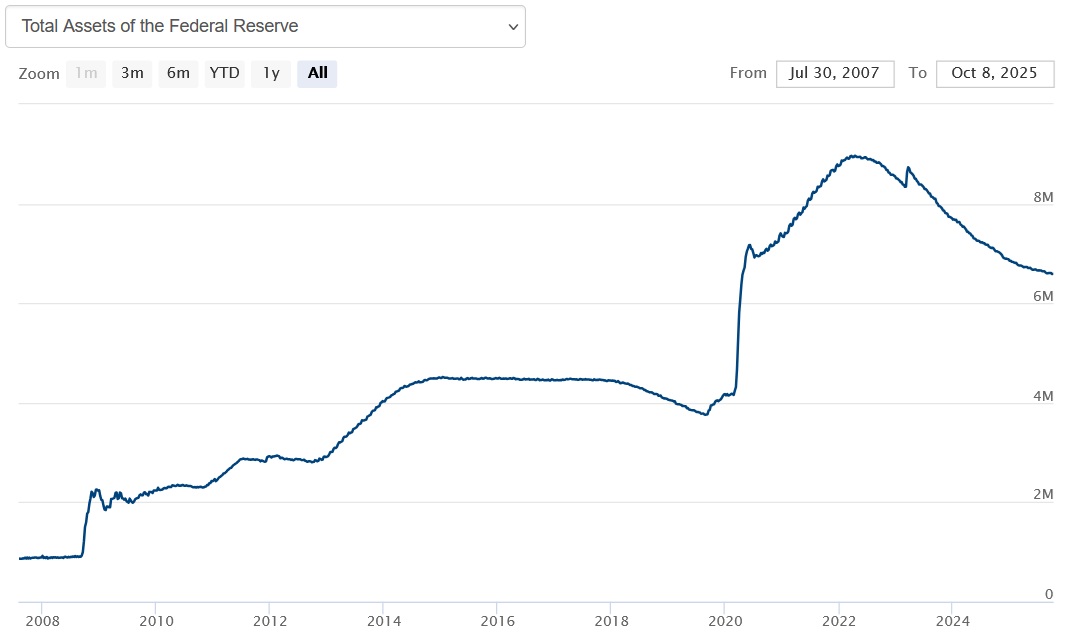
This initial cycle expanded the Fed’s balance sheet to approximately $4.5 trillion. By late 2019, the Fed began to unwind those holdings — allowing assets to “roll off” as they matured — marking the start of Quantitative Tightening (QT). However, the onset of the COVID-19 pandemic in 2020, under President Trump, triggered an unprecedented new wave of Quantitative Easing (QE), which rapidly expanded the balance sheet to nearly $9 trillion, the highest level in U.S. history. Many economists attribute a significant portion of the 2021–2022 inflation surge to this Trump-era QE, which flooded the financial system with liquidity and fueled speculative bubbles across housing, equities, and commodities.

In 2022, under President Biden, the Fed began a gradual process of balance sheet reduction, marking the start of Quantitative Tightening (QT) reducing the Fed’s assets to $6.6 trillion.

Now, just a few years later, Powell’s comments suggest a reversal of that policy — a return to money printing at a time when inflation remains above target and fiscal deficits are exploding.

QE Today: The Warning Signs
Powell’s latest remarks should set off alarm bells across the financial community. Reintroducing QE in the current environment — with massive fiscal deficits, high consumer debt, and lingering inflation — is not a stabilizing policy. It’s a recipe for economic disaster.

By artificially lowering rates and inflating asset prices, the Fed risks fueling another speculative bubble — one that could end in catastrophic wealth destruction, job loss, and financial contagion. Meanwhile, the federal government’s relentless spending ensures that each round of QE only digs the hole deeper.

This is not monetary stability. It’s the illusion of prosperity — a temporary sugar high before a historic crash.

If the Fed follows through with this plan, the outcome is predictable: rising inequality, eroding purchasing power, and ultimately what could become the Greatest Depression in U.S. history.

Fed Assets: The History of Quantitative aEsing (QE)

Creative Destruction in the Age of AI: How Endogenous Growth Theory Explains AI Stock Market Bubble

Déjà Vu Economics: How Trump’s Deregulation and Tariff Policies Mirror the Road to the Great Depression

Trumpenomics: The Fall of the USA

bookmark_borderTariff Truths: How Trump’s Trade War Is Taxing American Families and Businesses

Despite repeated claims from Donald Trump and his advisors that foreign countries are “paying the tariffs,” new data clearly shows the opposite. U.S. consumers and domestic companies are bearing nearly all of the costs — a hidden tax that is worsening inflation, eroding profits, and undermining economic growth.

According to an October 2025 analysis by Goldman Sachs, American consumers are now shouldering 55% of the total cost of Trump’s new import tariffs, while U.S. companies pay another 22%. In other words, more than three-quarters of the tariff burden is being paid by Americans — not by foreign exporters. Only a small portion is absorbed by overseas producers, debunking the administration’s long-standing assertion that tariffs are “paid for by China” or “funded by foreign governments.”

The economic mechanics behind this are straightforward but devastating. When tariffs are imposed, U.S. importers pay the added tax on goods entering the country. Those higher costs are then passed through the supply chain, eventually reaching consumers in the form of higher prices on everyday essentials — including food, automobiles, electronics, and household goods. The result is a direct contribution to inflation, disproportionately affecting low- and middle-income households.

Meanwhile, U.S. corporations are absorbing part of the impact to remain competitive, sacrificing profit margins and cutting back on investment, hiring, and wage growth. For small and mid-sized businesses dependent on imported components, these tariffs have become crippling — pushing many to the brink of insolvency in an already fragile economy.

Example of Corporate Failure
A recent casualty of these policies is First Brands Group, one of the largest aftermarket auto parts manufacturers in the world, which filed for Chapter 11 bankruptcy in September 2025. The collapse has caused billions in financial losses and raised alarm bells about the stability of the private credit market, already strained by manufacturing-sector exposure.

While the company faced several economic headwinds — including rising interest rates, supply chain disruptions, and slowing demand — tariffs played a decisive role. The Trump administration’s escalating import taxes on metals, components, and finished goods dramatically increased input costs across its supply chain. For a multinational firm operating on five continents and employing 26,000 people, the financial pressure became untenable.

Before filing, First Brands managed a well-known portfolio — Fram, Trico, and Raybestos among them — and generated approximately $5 billion in 2024 revenue. Yet as tariffs inflated raw material costs and credit tightened, the company could not sustain liquidity or refinance its mounting debt. Its bankruptcy represents not just a loss for the auto parts industry, but a warning sign of structural weakness spreading through U.S. manufacturing — the very sectors these tariffs were supposed to protect.

A Double Blow to the U.S. Economy
The outcome is a double blow to the American economy: consumers face rising prices while businesses struggle with shrinking margins. What was billed as a measure to “protect American industry” has instead functioned as an across-the-board tax hike on Americans.

Historically, tariffs are among the most regressive forms of taxation, hitting lower- and middle-income families hardest. As Trump’s trade wars expand, economists warn that the renewed wave of tariffs could reignite inflation, undermining recent progress in stabilizing prices.

Once again, protectionism is being sold as patriotism — and once again, it is American families and workers who are paying the price.

Trumpenomics: The Fall of the USA

bookmark_borderDéjà Vu Economics: How Trump’s Deregulation and Tariff Policies Mirror the Road to the Great Depression

by Daniel Brouse
October 13, 2025

In 1919, General Motors transformed the American economy by founding the General Motors Acceptance Corporation (GMAC), a revolutionary move that allowed customers to buy cars on credit. This innovation made cars accessible to the masses through installment plans and helped ignite the era of consumer financing. What began as a tool to boost car sales quickly evolved into a model for broader consumer credit across multiple sectors.

By the late 1920s, Wall Street adopted a similar approach. Brokerages began allowing retail investors to purchase stocks on margin — putting as little as ten percent down and borrowing the rest. This was marketed as “democratizing access” to the markets, a patriotic slogan that masked the systemic risks of unchecked speculation. With little to no regulation, the market ballooned into a fragile bubble built on debt and delusion.

Then came the inevitable. In October 1929, the stock market crashed, wiping out fortunes overnight and triggering the Great Depression. In response, sweeping regulations were enacted to protect small investors and stabilize the financial system — including the Securities Act of 1933, the Glass-Steagall Act, and the creation of the SEC. These guardrails safeguarded the economy for decades.

Fast forward nearly a century, and history is repeating itself. Since Donald Trump’s second term began, many of those same regulatory protections have been rolled back or weakened. Under the guise of “free markets” and “democratizing access,” Trump’s administration has pushed to open high-risk assets — such as cryptocurrencies and private equity — to small investors. Once again, speculative leverage is being glorified as empowerment, while systemic risk quietly grows beneath the surface.

Today, brokerages like Robinhood enable investors to buy stocks using borrowed money — eerily similar to the margin practices of the 1920s. Market leverage has reached its highest levels since 1929. Meanwhile, Trump’s protectionist trade agenda, marked by sweeping tariffs and economic isolationism, echoes another disastrous historical precedent: the Smoot-Hawley Tariff Act of 1930. That policy, intended to protect American jobs, instead provoked global retaliation and deepened the Great Depression by collapsing international trade.

The parallels are alarming. Over-leveraged markets. Deregulated speculation. Protectionist trade wars. Rising inequality. All signs point to a familiar outcome.

The question is no longer if the market will crash — it’s when. And this time, with far greater global interconnection and systemic debt, the fallout could make 1929 look like a dress rehearsal.

Trumpenomics: The Decline of the USA

bookmark_borderGlobal Energy Shift and the Climate Crisis: The U.S. Falling Behind

by Daniel Brouse
October 7, 2025

Over the past year, solar and wind energy worldwide generated more electricity than coal, marking a historic milestone in global renewable energy deployment. China alone added more solar and wind capacity than the rest of the world combined, highlighting how rapidly the United States is losing both economic and energy security to China. Meanwhile, U.S. policy and trade decisions have undermined domestic gains in electric vehicle (EV) and battery technology, stifling innovation, increasing costs, and allowing China to dominate critical supply chains.

On the domestic front, fossil fuel dependence has increased. False claims and deliberate misinformation promoted by the Trump administration have destroyed public confidence in climate science while exacerbating the environmental and economic costs of energy mismanagement.

The climate itself continues to accelerate beyond what many policymakers and the public grasp. The year 2024 was confirmed as the hottest year on record, with global average temperatures approximately 1.55°C above the pre-industrial 1850–1900 baseline. This new record surpassed the previous high in 2023, meaning that all ten of the hottest years on record have occurred in the last decade. Organizations including NASA, NOAA, the World Meteorological Organization (WMO), and the EU’s Copernicus Climate Change Service all confirm these findings, marking the first calendar year to exceed the 1.5°C warming threshold.

Relying on global averages can be dangerously misleading. A 3°C rise in global mean temperature may sound modest, but it masks severe regional extremes. The Arctic, for example, is warming at more than four times the global rate, with localized increases exceeding 10°C. Human habitability depends on these regional extremes and wet-bulb thresholds—the combined heat and humidity levels that overwhelm the body’s ability to cool itself.

Oceans, which absorb over 90% of excess heat trapped by greenhouse gases, are hiding the true extent of warming. Deep-ocean studies reveal rapid warming even in the lowest layers. Though a fraction of a degree increase may seem small, it represents an enormous accumulation of thermal energy—enough, if transferred to land, to theoretically raise surface temperatures by as much as 35°C. This thermal storage masks immediate warming while destabilizing ocean circulation, driving stratification, ecosystem collapse, and extreme weather events. In 2025, the entire Pacific Ocean is running approximately 1.6°C above its long-term average—roughly six standard deviations above the mean—a level far outside historical variability.

Two critical thresholds demand immediate attention: roughly 1.5°C of global average warming, signaling major climate tipping points, and approximately 9°C of warming over land and air, representing the upper limit of human survivability. These thresholds are not distant projections; they are being approached rapidly, with feedback loops accelerating the pace of change.

Meanwhile, U.S. trade policies have undermined domestic EV and battery production. Tariffs, restrictive import rules, and inconsistent incentives have driven up costs for American manufacturers, slowing adoption and innovation. While other nations, particularly China, scale up production and refine next-generation battery technology, the U.S. risks losing its competitive edge in a sector critical to both energy security and climate mitigation.

In short, the world is transitioning to renewables at an unprecedented pace. Solar and wind are surpassing coal globally, but the U.S. is falling behind due to poor policy, mismanagement, and trade decisions. Meanwhile, the climate crisis is intensifying faster than anticipated, threatening regional stability, human survival, and economic security. The need for immediate, informed action—both in energy policy and climate mitigation—has never been more urgent.

* Our probabilistic, ensemble-based climate model — which incorporates complex socio-economic and ecological feedback loops within a dynamic, nonlinear system — projects that global temperatures are becoming unsustainable this century. This far exceeds earlier estimates of a 4°C rise over the next thousand years, highlighting a dramatic acceleration in global warming. We are now entering a phase of compound, cascading collapse, where climate, ecological, and societal systems destabilize through interlinked, self-reinforcing feedback loops.

We examine how human activities — such as deforestation, fossil fuel combustion, mass consumption, industrial agriculture, and land development — interact with ecological processes like thermal energy redistribution, carbon cycling, hydrological flow, biodiversity loss, and the spread of disease vectors. These interactions do not follow linear cause-and-effect patterns. Instead, they form complex, self-reinforcing feedback loops that can trigger rapid, system-wide transformations — often abruptly and without warning. Grasping these dynamics is crucial for accurately assessing global risks and developing effective strategies for long-term survival.

What Can I Do? → “Solutions to the Fossil Fuel Economy and the Myths Accelerating Climate and Economic Collapse.“
There are numerous actions you can take to contribute to saving the planet. Each person bears the responsibility to minimize pollution, discontinue the use of fossil fuels, reduce consumption, and foster a culture of love and care. The Butterfly Effect illustrates that a small change in one area can lead to significant alterations in conditions anywhere on the globe. Hence, the frequently heard statement that a fluttering butterfly in China can cause a hurricane in the Atlantic. Be a butterfly and affect the world.

What you can do today. How to save the planet.

Tipping points and feedback loops drive the acceleration of climate change. When one tipping point is toppled and triggers others, the cascading collapse is known as the Domino Effect.

The Human Induced Climate Change Experiment

bookmark_borderAmerica’s Bankruptcy Wave: How Trump’s Fiscal Policies and Economic Mismanagement Are Accelerating Business Collapses

by Daniel Brouse
October 7, 2025

For 2025, U.S. bankruptcy filings have surged, marking one of the steepest upward trends in more than a decade. The spike reflects the combined weight of rising interest rates, historic consumer debt levels, and mounting economic uncertainty. Both consumer and corporate bankruptcies are climbing sharply compared to previous years, signaling deep structural stress within the economy.

Local Fallout: Iron Hill Brewery Collapses

A telling example is Iron Hill Brewery, a well-known restaurant chain once boasting 16 locations across the Mid-Atlantic and South. In late September 2025, the company filed for bankruptcy after shuttering all operations abruptly. Initially, Iron Hill had announced the closure of only a few underperforming locations. However, just weeks later, it closed all remaining sites without warning.

Court filings revealed a stark financial picture: only $125,000 in liquid assets against more than $20 million in delinquent debt. The company filed for Chapter 7 bankruptcy, which calls for liquidation rather than reorganization. In contrast, Chapter 11 bankruptcy allows companies to restructure operations and debt, typically reserved for businesses that can still be salvaged. Iron Hill’s Chapter 7 filing underscores the severity of its financial collapse—and highlights the widening gap between temporary distress and total insolvency in today’s economy.

National Trend: Rite Aid’s Final Fall

On a national scale, Rite Aid provides another sobering case study. Once one of the country’s leading pharmacy chains, the company has been trapped in a cycle of financial collapse. After emerging from Chapter 11 bankruptcy in September 2024, Rite Aid filed again just eight months later, in May 2025—this time with no path to survival.

At its height, Rite Aid operated more than 1,200 stores across 15 states, from California to Vermont. Founded in 1962 as Thrift D Discount Center in Scranton, Pennsylvania, it became the nation’s third-largest standalone pharmacy chain. But by mid-2025, the company’s mounting debt, declining sales, and loss of investor confidence forced it to shutter all remaining locations. The closures not only marked the end of an American retail mainstay but also disrupted prescription access for millions of customers nationwide.

The Bigger Picture: Fiscal Policy and the Trump Effect

Economists warn that this wave of bankruptcies is not a coincidence but rather a predictable consequence of Trump’s fiscal and monetary interference. His administration’s uncoordinated tax policies, protectionist tariffs, and attacks on Federal Reserve independence have undermined both investor confidence and credit stability. By destabilizing long-term interest rate expectations and driving inflationary volatility, Trump’s policies have made borrowing more expensive for both consumers and corporations—while failing to stimulate sustainable growth.

The result is a toxic feedback loop:

  • Higher interest rates increase default risks.

  • Rising defaults weaken credit markets.

  • Weak credit markets lead to higher borrowing costs, further strangling small and mid-sized businesses.

Under these conditions, liquidation bankruptcies (Chapter 7) are becoming more common than reorganizations (Chapter 11). This shift indicates not just economic weakness but systemic erosion in the nation’s capacity to recover from financial distress.

Interest Rate Trends

Trends indicate that interest rates for borrowers with B (Fair) and C (Poor) credit are
at historically high levels, driven up by overall economic conditions and an increased risk premium charged by lenders. While the Federal Reserve has recently lowered its benchmark rate, interest rates for consumers with lower credit scores are expected to remain elevated.

  • Fair credit (630–689): For personal loans, the estimated average APR was around 17.93% in 2024, but some lenders charge much more.
  • Poor credit (300–629): For personal loans, borrowers received an average rate of 21.65% in 2024, with some online lenders charging rates that can be much higher, sometimes up to 36% or more.

Looking Ahead

If current trends persist, analysts project a 25–35% increase in total business bankruptcies by mid-2026, with liquidation filings growing at twice that rate. The combination of tariff-induced inflation, trade isolation, and fiscal mismanagement is eroding business confidence and pushing fragile sectors—like retail, hospitality, and manufacturing—toward collapse.  The United States now faces a stark warning: Trump’s version of economic nationalism has mutated into economic self-destruction. What began as rhetoric about “protecting American jobs” is instead destroying the financial foundation of American enterprise.

The question is, how do we get our corporate leaders to realize this and stop backing Trump and his Neo fascist lackeys?

Unfortunately, there’s very little that corporate leaders can do under the current circumstances. Trump has demonstrated a blatant disregard for constitutional law, market independence, and the rule of economics. Rather than engaging in dialogue or respecting private enterprise, he has repeatedly attacked and threatened corporations that publicly challenge his administration. In several cases, he has even asserted ownership or control over companies through coercive tactics, regulatory retaliation, and preferential contracting—behaviors fundamentally at odds with free-market capitalism.

Behind the scenes, however, many corporations are taking defensive measures—just not the kind that benefit the U.S. economy. Instead of “re-shoring” manufacturing or expanding domestic investment as Trump claims, the opposite is happening. Companies are quietly diversifying supply chains abroad, moving production to more stable markets to avoid tariff volatility and political risk. This exodus is accelerating the decline of U.S. exports and weakening long-term economic competitiveness.

The damage extends far beyond manufacturing. Major U.S. trading partners have lost confidence in America’s reliability, and as a result, global markets are shifting away from the dollar. Multinationals now view the U.S. as a politically unstable environment, where economic decisions are driven by vengeance rather than sound policy.

The irony is inescapable: while Trump rails against “socialism,” his administration continues to hand out taxpayer-funded bailouts to cover the fallout from his own trade wars. In fact, today he is expected to announce a multi-billion dollar bailout for farmers devastated by his tariff policies—a desperate attempt to mask the consequences of his economic incompetence.

In short, business leaders understand the danger, but their ability to act is constrained by retaliatory governance, protectionist policies, and fear of political retribution. The result is a climate of uncertainty that discourages innovation, investment, and trust—the very pillars of capitalism that Trump claims to defend.

Trumpenomics: The Decline of the US
bookmark_borderConstitutional Challenges to Trump Administration Actions

Timeline

Jan 2025 — Federal judge blocks broad Trump spending freeze (funding impoundment)

  • What happened: A federal judge temporarily blocked the administration’s wide freeze on dozens of federal grants, loans, and assistance programs set to take effect. Courts found the action likely exceeded executive authority under appropriations law and the Impoundment Control Act.
  • Constitutional/statutory issues: Congressional “power of the purse” / separation of powers / Impoundment Control Act.
  • Source: Government Executive reporting on the injunction. Government Executive

Jan 27, 2025 — Executive Order (EO 14183) banning transgender military service (EO signed)

  • What happened: President Trump signed EO 14183, directing policy changes to exclude people who identify as transgender from military service. Multiple lawsuits were filed immediately.
  • Constitutional issues: Equal protection (5th/14th Amendment), due process, and statutory claims regarding military policy.
  • Source / background on the order and litigation: EO summary and tracker. Wikipedia+1

March 2025 — District courts issue nationwide preliminary injunctions blocking Trump’s transgender military ban

  • What happened: Federal judges in multiple districts issued preliminary injunctions stopping enforcement of the EO removing transgender service members, finding plaintiffs were likely to succeed on constitutional due process/equal protection claims. The Ninth Circuit declined to stay one injunction; litigation moved through the courts.
  • Constitutional issues: Equal protection, due process.
  • Source / litigation tracker: Lambda Legal / LGBTQ Bar tracker & reporting. The National LGBTQ+ Bar Association

Jan–Mar 2025 (ongoing) — Multiple lawsuits challenging administration orders targeting law firms (Perkins Coie, WilmerHale, Jenner & Block, etc.)

  • What happened: The administration issued or threatened punitive measures (suspending security clearances, denying federal contracts, barring building access) aimed at several law firms the administration said had “conflicts” or “political” practices. Those firms sued. Judges found the orders targeted constitutionally protected speech and legal advocacy and enjoined enforcement.
  • Constitutional issues: First Amendment (free speech/retaliation), Fifth Amendment (due process), separation-of-powers concerns.
  • Key rulings: U.S. District Judge Richard Leon blocked the order as unconstitutional in the WilmerHale case (May 2025); earlier judges similarly enjoined actions against Perkins Coie and others. Reuters+2Courthouse News+2

May 27, 2025 — Judge Richard Leon blocks Trump order targeting WilmerHale (detailed opinion)

  • What happened: Judge Leon held that the order unlawfully punished the firm for engaging in constitutionally protected speech/legal representation and violated due process and separation-of-powers principles.
  • Constitutional issues: First and Fifth Amendments; executive overreach.
  • Source / court opinion and reporting: Reuters coverage; court opinion PDF. Reuters+1

June 27, 2025 — Supreme Court document / action (Trump v. CASA and related birthright citizenship litigation)

  • What happened: The Supreme Court docket and filings reflect challenges to the administration’s January executive order seeking to curtail birthright citizenship. Multiple district courts had issued universal injunctions; the matter reached the Supreme Court in various procedural postures. (See the Court PDF for case background.)
  • Constitutional issues: 14th Amendment Citizenship Clause; separation of powers.
  • Source / Supreme Court filing / docket: Supreme Court filing (case PDF). Supreme Court

July–October 2025 — Federal appeals courts reject Trump’s attempt to curtail birthright citizenship (multiple circuits)

  • What happened: Appeals courts (including the 1st Circuit and 9th Circuit in related rulings) upheld injunctions blocking the administration’s birthright-citizenship executive order, finding it likely unconstitutional under the 14th Amendment. The administration sought Supreme Court review.
  • Constitutional issues: 14th Amendment Citizenship Clause.
  • Sources: AP, Reuters reporting on appeals court decisions. AP News+1

Jan–Sep 2025 — Litigation over broad freezes/withholding of funds (foreign aid and other appropriations)

  • What happened: Multiple courts weighed whether the administration lawfully withheld funds appropriated by Congress (including foreign aid). Lower courts ordered funds to be spent; the Supreme Court at times allowed or limited holds pending appeals. Judges found likely violations of appropriations law and separation-of-powers constraints in several rulings.
  • Constitutional issues: Congressional appropriations authority; separation of powers.
  • Sources: SCOTUSblog and related coverage of funding cases. SCOTUSblog

Ongoing / broad litigation — Dozens to hundreds of cases tracked by litigation projects

  • What’s happening: Independent trackers (Lawfare, Just Security, and others) document scores of active suits challenging executive orders, regulatory rollbacks, spending freezes, immigration policies, and other actions. Many of these cases raise constitutional claims (due process, equal protection, take care clause, limits on executive authority). These trackers provide continuously updated case lists and outcomes.
  • Sources / trackers: Lawfare’s Trump Administration Litigation Tracker; Just Security litigation tracker. Default+1

How to read this timeline — caveats & context

  • Not everything here is “final.” Many entries are preliminary injunctions or appeals. Some cases may ultimately be resolved differently by higher courts (including the Supreme Court). I cited the most authoritative, contemporary reporting and court filings available.
  • Volume is large. Independent trackers show over three hundred active cases (dozens with constitutional claims). The items above are the highest-impact, precedent-setting litigation where courts have already issued decisions or clear injunctions. For a full, day-by-day legal chronology I can compile a downloadable timeline (PDF or spreadsheet) with direct links to opinions and filings for every case listed in trackers like Lawfare and Just Security.
  • Why these matter: The recurring themes in these challenges are (1) claims of executive overreach (exceeding statutory authority or violating separation of powers), (2) equal protection/due process violations (particularly in orders affecting transgender people, immigrants, or targeted entities), and (3) violations of Congress’s appropriations power.

Sources & further reading

  • Lawfare — Trump Administration Litigation Tracker. Default
  • Just Security — Legal Challenges to Trump Administration Actions (litigation tracker). Just Security
  • Reuters — “Judge bars Trump order against law firm tied to Robert Mueller” (May 27, 2025). Reuters
  • Court opinion (WilmerHale) PDF and reporting. Courthouse News
  • Government Executive — “Court temporarily blocks Trump’s spending freeze” (Jan 28, 2025). Government Executive
  • LGBTQ Bar / litigation trackers — challenges to EO banning transgender military service. The National LGBTQ+ Bar Association
  • AP / Reuters coverage — Appeals court rulings on birthright citizenship challenges (Oct 2025). AP News+1
  • Supreme Court filing (Trump v. CASA, Jun 27, 2025 docket). Supreme Court

Trumpenomics: The Decline of the US

bookmark_borderTrump Faces Over 300 Lawsuits for Executive Overreach and Harm to U.S. Citizens

Donald Trump is now facing more than 300 lawsuits challenging his executive overreach, authoritarian policies, and actions that have caused widespread harm to American citizens. The sheer volume of litigation is unprecedented in modern U.S. history and reflects the growing backlash against his administration’s unchecked power and disregard for constitutional limits.

A large portion of these lawsuits stem from Trump’s implementation of the largest regressive tax policies in U.S. history, which disproportionately burden working families, individuals, and small businesses while offering sweeping benefits to billionaires and multinational corporations. Small businesses across the country argue that Trump’s tax structure and tariffs have left them at a competitive disadvantage, forcing layoffs, closures, and in some cases, permanent shutdowns.

The tariff wars have also crushed American farmers, driving up input costs, cutting off access to foreign markets, and leaving crops unsold. Instead of addressing the damage caused by his own policies, Trump has announced that he will use billions in taxpayer money for bailouts—a form of economic intervention he derides as “socialism” when practiced by other countries. Critics point out that this hypocrisy not only undercuts U.S. credibility on trade policy but also exposes farmers to greater long-term instability as markets realign away from American agriculture.

Other lawsuits target Trump’s executive actions undermining democratic norms, including restrictions on immigration, the use of federal agents without identification in domestic operations, and policies that have weaponized federal agencies for political gain. Civil rights groups, state attorneys general, and advocacy organizations have joined the litigation, arguing that these actions not only violate the Constitution but also set dangerous precedents that erode the rule of law.

Additionally, several cases allege that Trump’s decisions have resulted in direct violations of individual rights—including denial of due process, infringement on free speech and assembly, and discriminatory practices rooted in racism and bigotry. Plaintiffs point to travel bans, detention practices, and the rollback of environmental and labor protections as examples of executive overreach that harm both people and the planet.

Legal experts note that while many of these cases will take years to wind through the courts, the sheer number and diversity of lawsuits illustrate a nation in deep conflict with its own leadership. If successful, these challenges could redefine limits on executive authority and reshape the balance of power between the presidency, the judiciary, and the people.

Trumpenomics: The Decline of the USA

bookmark_borderTrump’s Crimes, Illegal Activities, and Immorality: A Record of Corruption

Donald Trump’s public record is one of corruption, cruelty, and contempt for truth, law, and democracy. His actions—documented in court rulings, congressional reports, and his own words—paint a picture of a man unfit for power.

Trump’s Record:

  1. Been implicated in pedophilia and sexual misconduct allegations. The Epstein files are being withheld by Donald Trump—that’s not an accusation, it’s a fact. Trump himself admitted that Epstein “stole” his underaged massage girl from Mar-a-Lago, and his relationship with Epstein is well documented.
  2. Repeatedly denied science—on climate change, on public health, and on issues with life-or-death consequences.
  3. Lied pathologically about everything from crowd sizes to election results.
  4. Promoted white supremacy and emboldened racially charged violence.
  5. Been found liable for sexual assault in civil court.
  6. Stoked division through bigotry, bullying, and fear-based politics.
  7. Stood by as the U.S. Capitol was attacked, later praising or pardoning those responsible.
  8. Attempted to overturn a lawful election, undermining democracy itself.
  9. Engaged in financial fraud, including a judgment for falsifying business records.
  10. Misused charity funds, leading to a lifetime ban from operating a charitable foundation in New York.
  11. Implemented family separation policies at the border, losing track of children in the process.
  12. Attacked the independence of the Federal Reserve, destabilizing global markets.
  13. Attacked the First Amendment going so far as to threaten any television network critical of him.
  14. Exploded the national debt by trillions while handing tax cuts to billionaires, worsening inequality.
  15. Tried to weaponize the Justice Department as his personal shield and sword.
  16. Floated the idea of “suspending” the Constitution to stay in power.
  17. Been convicted of falsifying business records to hide damaging information from voters before an election.
  18. The real question is: who, knowing all of this, still chooses to support or defend such behavior?

The Bottom Line

Trump’s record is not a string of mistakes or misjudgments—it is a sustained pattern of lies, lawbreaking, and immorality. The real question is not whether Trump is guilty of corruption. The evidence is overwhelming. The real question is: who, knowing all of this, still chooses to support or defend such behavior—and why?

Trumpenomics: The Decline of America

bookmark_border100% TACO: Trump’s Reckless Tariff on Life-Saving Medicines

Protectionism, White Nationalism, and the Collapse of U.S. Economic Credibility

Donald Trump has just announced one of the most dangerous and reckless policies of his presidency: a 100% tariff on all branded or patented pharmaceutical products, unless the manufacturer is currently building a plant in the United States.

“Starting October 1st, 2025, we will be imposing a 100% Tariff on any branded or patented Pharmaceutical Product, unless a Company IS BUILDING their Pharmaceutical Manufacturing Plant in America,” Trump declared on Truth Social. The tariff exemption would only apply if a company had already broken ground on U.S. facilities.

While generic drugs—representing the majority of U.S. imports—are excluded, the real impact falls on life-saving branded medicines, including cancer treatments, biologics, vaccines, and advanced therapies. Nathalie Moll, director-general of the European pharma lobby EFPIA, warned bluntly: “Tariffs on medicines, however excessive, will create the worst of all worlds. Patients will be denied access to life-saving treatments.”

The pharmaceutical industry had previously been spared from Trump’s earlier “reciprocal tariff” packages, but this announcement breaks with prior commitments made to the EU and other trading partners. The EU’s 15% tariff ceiling deal, which included a “no stacking” clause, now appears to be in jeopardy. Switzerland, despite agreeing to steep tariffs in August, had exempted pharmaceuticals—until now. The UK, lacking any pharma-specific trade agreement, is scrambling for clarity.

In an attempt to appease Washington, drugmakers like AstraZeneca, GSK, Novartis, and Roche have already announced new U.S. investments, though many projects remain in the planning stage. Analysts caution that even these companies could face tariffs until actual construction is underway, leaving them vulnerable to immediate disruption.

Financial markets reflected the uncertainty: AstraZeneca and Roche shares initially fell before recovering. Still, the longer-term threat is not to investors but to patients, who may face higher drug costs, restricted supply, and delayed access to new treatments.

This tariff bombshell highlights the hypocrisy of Trump’s economic nationalism. For years, Trump has attacked foreign countries for subsidizing industries like farming or steel while quietly supporting similar “Trump-socialist” policies at home, including stakes in U.S. Steel, Intel, and other politically favored corporations. His latest tariffs expand this protectionist playbook to essential medicines—a sector where the costs of political gamesmanship are measured not in dollars but in human lives.

The announcement came alongside new tariffs of 25% on imported heavy-duty trucks and 50% on kitchen and bathroom cabinets—further evidence of Trump’s broader war against free trade. Rather than strengthening America’s position, these moves isolate the U.S., alienate allies, undermine credibility, and expose consumers to higher costs across essential goods.

This is not an “America First” policy. It is protectionism and white nationalism masquerading as economic strategy. If enacted, it could mark not only the collapse of Trump’s economic credibility but also the decline of U.S. global leadership. By weaponizing access to life-saving medicine, Trump has crossed a line that could cost lives, destabilize markets, and fracture alliances.

The question now is simple: Will Trump TACO out before America does?

Trumpenomics: The Decline of the USA