bookmark_borderThe Dollar in Decline: Capital Flight, Reserve Status, and America’s Economic Reckoning

by Daniel Brouse
April 19, 2025

The recent flight from the U.S. dollar reflects a growing movement by investors and central banks to reduce their holdings of dollar-denominated assets—like U.S. Treasury bonds—in favor of alternative currencies, commodities such as gold, or more stable markets offering higher returns. This trend is accelerating due to a combination of fiscal instability, political dysfunction, and waning global confidence in American leadership.

Why Is Capital Fleeing the Dollar?

1. Unsustainable Debt and Deficits

The U.S. national debt now exceeds $36 trillion, with interest payments consuming a growing share of the federal budget. Investors fear that without serious structural reforms, the U.S. may resort to currency debasement or endure persistent inflation to manage its obligations.

Donald Trump significantly expanded the national debt during both his first and second terms through sweeping tax cuts, increased federal spending, and economic disruption stemming from trade policies. Between 2017 and 2021, the national debt ballooned by approximately $7.8 trillion—rising from $19.9 trillion to $27.7 trillion. The 2017 Tax Cuts and Jobs Act (TCJA), which slashed the corporate tax rate from 35% to 21% and lowered individual income taxes, failed to spur enough economic growth to offset lost revenues. The Congressional Budget Office estimated the TCJA would add nearly $1.9 trillion to the deficit over ten years.

Trump also ramped up military and discretionary spending through bipartisan deals, while the COVID-19 pandemic triggered an additional $3–4 trillion in emergency stimulus—further straining the federal balance sheet.

In his second term, which began in 2025, debt growth has again accelerated. Trump’s renewed protectionist agenda—including sweeping tariffs—has hurt economic output and reduced global appetite for dollar-based assets. Slower GDP growth and lower tax revenues have compounded fiscal pressures, while proposed extensions of the 2017 tax cuts and further corporate tax relief have deepened structural deficits. Simultaneously, higher interest rates—driven in part by diminishing global trust in U.S. fiscal management—have made it more expensive for the U.S. to service its debt.

Altogether, these trends push the U.S. toward a dangerous fiscal cliff, with debt-to-GDP ratios approaching record highs and investor confidence in the dollar as a reserve currency eroding.

2. Weaponization of the Dollar

The use of the U.S. dollar as a geopolitical tool—such as freezing Russian central bank reserves after the Ukraine invasion—has alarmed other nations. These moves demonstrate the dollar’s vulnerability to U.S. political decisions, prompting countries to seek alternatives. Trump’s polarizing foreign policy has only reinforced this trend, encouraging nations to diversify away from dollar-based assets.

3. Geopolitical Realignment

Nations like China, Russia, Brazil, and the Gulf states are accelerating efforts to reduce dependence on the dollar. Initiatives such as BRICS+ and bilateral trade agreements in yuan, euros, or local currencies are forming an emerging multi-currency world. Ironically, Trump’s isolationist and protectionist stances have only hastened this realignment by undermining global trust in U.S. engagement.

4. Loss of Confidence in U.S. Governance

Political dysfunction—manifested in repeated debt ceiling crises, erratic economic policies, and the erosion of democratic norms—has severely damaged global confidence in U.S. institutions. Trump’s populist leadership style, his open disregard for the rule of law, and his rejection of basic economic principles have deepened international distrust. Federal Reserve Chair Jerome Powell remarked, “We’ve had a big shock. These tariffs are larger than anybody expected. There’s a new global trade order potentially emerging here, and markets are doing what markets do, which is reprice.” Trump’s direct interference in monetary policy—including public attacks on the Fed and calls to remove Powell—has only amplified global concerns, further destabilizing trust in U.S. financial markets. As a result, some world leaders increasingly view China as a more stable and reliable economic partner.

5. Tariffs and Protectionism

Trump’s continued use of tariffs and other protectionist tools has disrupted global trade and damaged America’s reputation as a reliable economic partner. These policies create volatility in supply chains and discourage international businesses from conducting trade in dollars. As countries turn to more stable alternatives to hedge against future trade shocks, fewer surplus dollars return to U.S. markets—reducing demand for Treasuries and weakening the dollar’s foundation. Over time, this trend threatens the liquidity and attractiveness of U.S. financial markets and accelerates the erosion of the dollar’s global status.

What Happens If the U.S. Loses Reserve Currency Status?

1. A Weaker Dollar

  • Falling demand for the dollar would cause depreciation.

  • Imports—especially energy and consumer goods—would become significantly more expensive.

  • Inflation could spike, reducing household purchasing power.

2. Higher Interest Rates

  • Foreign investors would be less willing to finance U.S. debt.

  • To attract buyers, the U.S. would have to offer higher yields, driving up interest rates.

  • Higher borrowing costs would crowd out private investment and slow economic growth.

3. Diminished Economic Power

  • Without the ability to print the global reserve currency, the U.S. would lose its “exorbitant privilege.”

  • Trade deficits would become increasingly unsustainable.

4. Global Financial Instability

  • Many central banks hold U.S. debt as reserves. A collapse in dollar value could reverberate across global markets.

  • Investors may turn to gold, the euro, or emerging digital currencies as alternative safe havens.

Long-Term Outlook

If current trends continue:

  • The U.S. may experience a long-term economic decline, echoing Britain’s loss of pound sterling dominance after World War II.

  • Radical reforms in fiscal and monetary policy will become necessary to stabilize the economy.

  • A multi-polar global financial system—with no single dominant currency—could emerge, increasing transaction costs and global market volatility.

The decline of the dollar is no longer a distant hypothetical—it is an unfolding reality. And unless the U.S. addresses the root causes—ballooning debt, poor governance, and global disengagement—it risks permanently ceding its economic leadership in the 21st century.
Trumpenomics: The Decline of the US

The Human Induced Climate Change Experiment

bookmark_borderIt’s the Service, Stupid: Understanding the Real U.S. Economy

By Daniel Brouse
April 17, 2025

One of the most fundamental misconceptions of Trumpenomics is the belief that the United States is—or should be—a manufacturing-first economy. In reality, the U.S. has evolved into a service-based powerhouse and is now the world’s largest exporter of services, including finance, healthcare, education, software, intellectual property, and other knowledge-driven industries.

This misunderstanding leads to flawed policies, especially regarding trade and tariffs. By focusing solely on manufacturing, Donald Trump’s economic rhetoric and calculations ignore the true engine of American growth: its service sector. Consequently, trade deficits and labor dynamics are misrepresented, giving the public a distorted view of global economic relationships.

Moreover, the claim that American jobs have been “shipped overseas” doesn’t stand up to scrutiny. The vast majority of high-paying jobs in the U.S.—from tech and logistics to finance and retail—were never exported. Companies like Microsoft, Meta, Amazon, Apple, Nvidia, Tesla, and Walmart generate millions of high-wage, service-based and technology-driven jobs that never originated as U.S. manufacturing positions in the first place. These firms pay some of the highest wages in the country, often without union representation, and their core operations remain solidly domestic.

Many of these companies outsource some manufacturing to countries with a comparative advantage—not to “steal” American jobs, but because the U.S. never had a competitive edge in those areas to begin with. Attempting to resurrect those jobs now through protectionist measures only undermines U.S. competitiveness and innovation.

Labor policy should be forward-facing. The labor movement must pivot from defending obsolete jobs to championing education, reskilling, and innovation. As with the buggy whip—once essential, now archaic—progress depends on adaptation, not nostalgia.

The truth is clear: America’s economic future lies not in reindustrialization, but in continuing to lead the global service economy. Failing to recognize this does more than hurt economic efficiency—it risks steering the nation backward just when it needs to charge forward. By eroding global confidence in the U.S. as a reliable trading partner, Trump risks permanently weakening the dollar and undermining America’s ability to finance its debt at sustainable levels.

Trumpenomics: The Decline of the US

bookmark_borderCracked Safe Haven: Historic Deviations in U.S. Treasury Bonds

By Daniel Brouse
April 16, 2025

Exceeding a standard deviation means that a data point is significantly different from the average — a statistical red flag.

In finance or economics:

  • A move of 1 standard deviation is unusual but not rare.

  • 2 or more indicates extreme behavior — often signaling stress, instability, or systemic change.

When U.S. Treasury bonds — historically the world’s most stable asset — move multiple standard deviations, it’s not just noise. It suggests deep structural shifts in fiscal policy, market confidence, or macroeconomic expectations.

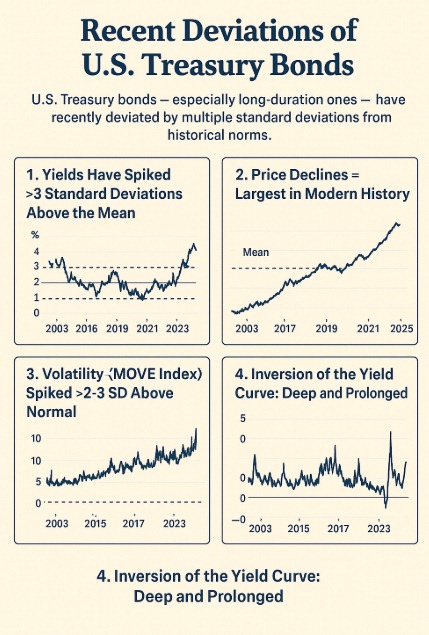
U.S. Treasury bonds — especially long-duration ones like the 10-year and 30-year Treasuries — have recently deviated by multiple standard deviations from historical norms in several key dimensions:

Historic Deviations in U.S. Treasury Bonds

1. Yields Have Spiked >3 Standard Deviations Above the Mean

  • As of late 2023 and early 2024, 10-year Treasury yields rose to around 4.5%–5%, levels 3+ standard deviations above the post-2008 average (~2%).

  • 30-year yields followed a similar pattern.

  • This is a massive deviation in historical bond market terms, which are usually stable and mean-reverting.

 This is a “once-in-a-generation” spike — the bond market equivalent of a hundred-year flood.

2. Price Declines = Largest in Modern History

  • Bond prices move inversely to yields.

  • The Bloomberg U.S. Treasury Index logged a historic drawdown (over –15%) in 2022–2023 — the worst since the 1780s in real terms.

  • That decline represents a >4 standard deviation move in price terms — practically unheard of in government bond history.

3. Volatility (MOVE Index) Spiked >2–3 SD Above Normal

  • The MOVE Index (bond market’s version of the VIX) soared past 160 in 2023.

  • Its long-term average is around 80–100.

  • A reading above 150 is a 3-sigma event — indicating extreme stress and uncertainty.

4. Inversion of the Yield Curve: Deep and Prolonged

  • The 2-year vs. 10-year yield inversion (short-term yields higher than long-term) has persisted at extreme levels — >1 standard deviation deeper and longer than historical precedent.

  • This inversion is a classic recession signal, but now it’s part of a structurally altered interest rate environment.

Summary: What’s Askew in U.S. Treasury Bonds


Metric Deviation from Norm Std. Dev. Estimate
10-yr Yield Sharp rise +3 to +4 SD
Treasury Price Index Historic loss –4+ SD
MOVE Volatility Index Sustained high volatility +2 to +3 SD
Yield Curve Inversion Depth Longest & deepest in decades >1 SD

Why It Matters

  • Bonds are usually the “safe haven” — but now they’re chaotic, cracked, and misaligned.

  • This upends traditional risk models used by banks, pensions, and governments.

  • It’s also a signal of fiscal fragility — markets demanding higher compensation for lending to the U.S.

The Big Question: What If the Dollar Loses Its Reserve Status?

Ultimately, the darkest scenario is no longer unthinkable: What happens if the U.S. dollar loses its status as the world’s reserve currency?

This would unleash a profound economic reset, marked by:

  • Exploding U.S. borrowing costs

  • A collapse in consumer purchasing power

  • Global capital flight from U.S. assets

  • Severe contraction in both trade and credit

  • Domestic political and economic instability unlike anything in modern history

Conclusion: We Are In the Experiment Now

Capital Preservation During Trumpenomics

The Inevitable Collapse: How Trump’s Policies and Climate Neglect Will Reshape the Economy

Trumpenomics: The Decline of the US

bookmark_borderDeviation, Cracked Fractals, Climate, and Economics

by Daniel Brouse
April 14, 2025

Cracked Fractals & U.S. Climate/Fiscal Policy

The U.S. economy and climate systems are exhibiting the erratic behavior of complex systems approaching critical thresholds — resembling “cracked fractals,” those chaotic, fragile patterns that form when dynamic systems near collapse. These structures are not just visual metaphors; they represent branching futures, fragmented stability, and points beyond which recovery may no longer be possible.

At the same time, key economic and climate indicators — including the federal deficit, disaster recovery costs, housing unaffordability, and insurance risk exposure — are now 2 to 3 standard deviations above historical norms. In statistical terms, this suggests we are far outside the “normal range” of fluctuation — a danger signal flashing red across multiple sectors.

These deviations, when interpreted through the lens of chaos theory and nonlinear dynamics, signal profound instability in both natural and economic systems.

What Are Cracked Fractals?

A “cracked fractal” describes a breakdown in the typical structure of a complex system. Unlike traditional fractals that are self-similar and stable within bounds, cracked fractals emerge when stress fractures the system’s underlying attractor — the set of conditions it returns to over time.

This breakdown often occurs when:

  • The system is pushed past a critical threshold (bifurcation point),

  • Feedback loops amplify instability,

  • The original symmetry or balance can no longer be maintained.

In climate science, this might manifest as rapid shifts in ocean currents or runaway feedbacks in polar ice melt. In economics, it could be a sovereign debt spiral, liquidity collapse, or the disintegration of monetary confidence.

Standard Deviations: Statistical Red Flags

A standard deviation is a statistical tool used to measure the dispersion of data from its average. When indicators deviate by 2 or more standard deviations from the mean, they are considered extreme outliers — rare events with serious implications.

In a normal distribution:

  • 68% of values lie within 1 standard deviation,

  • 95% within 2,

  • 99.7% within 3.

So when key indicators consistently exceed these bounds, it’s not a fluke — it’s a structural failure in progress.

Real-World Examples of Outlier Behavior (2024–2025)

1. Inflation Volatility

Core inflation has fluctuated wildly since 2021 — sometimes 2–3 standard deviations above long-term norms. These shifts have been driven by:

  • Pandemic-induced supply chain shocks,

  • Energy market instability from geopolitical conflict,

  • Erratic or delayed monetary responses.

2. Federal Deficit (as % of GDP)

The U.S. deficit has ballooned to nearly 7% of GDP in fiscal year 2024 — a figure more than two standard deviations above historical peacetime averages. This debt is increasingly difficult to finance amid rising interest rates.

3. Housing Unaffordability

Home price-to-income ratios have exploded. In cities like San Francisco and Austin, the median home now costs more than 10x median income — well beyond the historical norm of 3–4x and more than 2 standard deviations above long-term affordability trends.

4. Stock Market Overvaluation

The S&P 500’s Shiller CAPE ratio is hovering near levels seen only before the Great Depression and the Dot-Com crash. Valuations are now 2–3 standard deviations above the 150-year average.

5. Corporate Debt Overhang

Non-financial corporate debt as a percent of GDP is near all-time highs. Many firms are increasingly reliant on rolling over existing debt at higher rates — a fragile position vulnerable to shocks.

6. Climate-Driven Insurance Losses

U.S. insured losses from climate disasters — wildfires, floods, hurricanes — are now regularly exceeding $100 billion per year. These losses are now normalized, rather than considered “black swan” events. In actuarial terms, that’s multiple standard deviations away from historical climate stability.

Fractals, Chaos Theory, and Tipping Points

Chaos theory deals with systems that are deterministic but highly sensitive to initial conditions — where tiny changes can lead to vastly different outcomes. This “butterfly effect” describes how once-stable systems can become chaotic.

Cracked Fractal
Cracked Fractal

Cracked fractals emerge near bifurcation points — thresholds beyond which the system evolves in an entirely new direction, often unpredictably. In climate systems, these bifurcations could be:

  • The sudden collapse of the Atlantic Meridional Overturning Circulation (AMOC),

  • Massive methane release from permafrost,

  • Shifts in the jet stream or monsoon patterns.

In the economy, these might manifest as:

  • Sudden dollar devaluation,

  • Foreign dumping of U.S. Treasury debt,

  • Collapse of consumer demand due to runaway inflation or debt.

Chaos Meets Climate: A Dual Collapse?

The real danger is that these systems — climate and economy — are not isolated. They are interacting.

  • Climate disasters strain public budgets and private insurance systems.

  • Economic fragility reduces the capacity to respond to climate emergencies.

  • Environmental destruction undermines long-term productivity and food security.

This mutual reinforcement may lead to a compound crisis, accelerating both fiscal and ecological collapse. Each system may be a cracked fractal — but together, they risk triggering a global phase shift into uncharted territory.

Conclusion: A Fractured Future

Humanity is now at a critical junction — a bifurcation point — where the complex systems governing life, economy, and climate are diverging into new, unstable paths.

Unless structural reforms are made — including coordinated climate action, debt restructuring, and transition away from carbon-heavy growth models — we may be entering a prolonged period of instability marked by:

  • Market dislocations,

  • Sovereign debt crises,

  • Mass migration and food insecurity,

  • Potential breakdowns in democratic governance.

If left unaddressed, the question is no longer if these systems will fracture, but how violently and how soon.

The cracked fractal is not just a metaphor — it’s a warning.

URGENT CLIMATE WARNING
Our latest climate model — now incorporating complex social-ecological feedback loops within a dynamic, non-linear system — projects that global temperatures could rise by up to 9°C (16.2°F) within this century. This far exceeds earlier estimates, which predicted a 4°C rise over the next thousand years, and signals a dramatic acceleration of warming.

At this level of heating, large regions of the planet will become uninhabitable due to extreme heat, sea level rise, agricultural collapse, and mass migration. Critically, parts of the U.S. are already experiencing wet-bulb temperatures approaching or exceeding 31°C (87.8°F) — a physiological limit beyond which the human body can no longer regulate its internal temperature, even in the shade with ample water.

This is no longer a distant threat. The climate system is entering a phase of compound risk and cascading collapse — and we are already seeing the early signs.

Immediate, radical mitigation and adaptation efforts are now essential to preserve habitable zones, food systems, and public health.

WET-BULB TEMPERATURES

Wet-bulb temperatures above 31°C (87.8°F) are extremely dangerous — at these levels, the human body cannot cool itself through sweating, even in the shade, leading to potentially fatal heat stress within hours. While these thresholds have historically been rare outside the tropics, parts of the U.S. are now beginning to approach or breach this limit during extreme heat events — something that used to be considered virtually impossible in the U.S. climate.

Here are the U.S. regions most at risk and already showing wet-bulb temperatures exceeding 31°C or very close — often 2–3 standard deviations above historical norms:

 1. South Texas & Gulf Coast (Brownsville, Corpus Christi, Houston)

  • Already observed wet-bulb temperatures > 31°C, especially during heatwaves with high humidity and stagnant air.

  • This region is closest in climate to subtropical zones, with high Gulf moisture and intense solar heating.

  • Notable Event: July 2023 saw Brownsville record a wet-bulb of 31.2°C, nearing human survivability thresholds.

2. Louisiana, Mississippi & Coastal Alabama

  • High humidity from the Gulf + high temps create perfect storm conditions for wet-bulb extremes.

  • New Orleans and Baton Rouge have clocked wet-bulb temps around 30.5°C to 31.0°C in recent summers.

  • Trend: Average summer humidity and nighttime minimum temps have increased significantly since the 1980s.

3. Florida (Miami, Tampa, Fort Myers, and inland Everglades)

  • Very high baseline humidity and increasing urban heat island effects are pushing wet-bulb temps near critical thresholds.

  • Miami-Dade’s urban core can hit 30.5°C wet-bulb, with some inland areas (Everglades edge) hitting 31°C under stagnant conditions.

4. Mississippi River Valley & Midwest (in isolated events)

  • While not traditionally at risk, heat dome events have caused spikes in wet-bulb readings in Illinois, Missouri, and Iowa.

  • Wet-bulbs of 29.5°C–30.5°C were observed during July 2023 under extreme dew points (~80°F) and triple-digit heat.

5. Southwest Deserts (Phoenix, Las Vegas, Death Valley) — Dry Heat, but Changing

  • Typically hot but dry, these regions have avoided extreme wet-bulb temps historically.

  • However, monsoonal moisture and climate shifts are making 30°C+ wet-bulb temps more common — especially during nighttime heatwaves when humidity is trapped.

Climate Collapse Will Break Capitalism

The Decline of Economic Power and the Ascent of Environmental Reality

The Destructive Legacy of Trump’s Climate and Economic Policies

Trumpenomics: The Decline of the US

State of the Climate Crisis 2025

Updates

The Human Induced Climate Change Experiment

bookmark_borderThe Demise of the Dollar and U.S. Exceptionalism

by Daniel Brouse
April 13, 2025

Economic Collapse Ends the Era of Mass Consumption, Capitalism, and Fossil Fuel Dependence

In 2017 and 2018, many economists warned of rising inflation and interest rates due to Donald Trump’s economic, environmental, and social policies — warnings that were largely dismissed at the time. Few believed the U.S. dollar, the linchpin of global finance, could lose its status as the world’s reserve currency. That confidence, once deeply rooted in the strength of U.S. institutions and global leadership, is now unraveling.

Trump’s Debt-Driven Economics: A Personal Philosophy Gone National

In office, Donald Trump mirrored his personal business model on a national scale: borrow excessively and sidestep repayment. Having declared bankruptcy over six times, Trump’s track record raised serious concerns about his approach to fiscal responsibility. That approach translated into:

  • Massive tax cuts without corresponding spending reductions.

  • Explosive deficit growth, pushing the national debt beyond the size of the U.S. economy.

  • Crowding out private investment as government borrowing soared, pushing up interest rates.

The result was an era of artificially inflated growth fueled by unsustainable debt and reckless financial policies.

Weakening the Dollar: Trade Wars and Protectionist Failures

Trump’s “Make America Great Again” agenda, anchored in economic nationalism, inflicted direct damage on the U.S. dollar’s global standing. His administration’s use of tariffs, trade barriers, and unilateral withdrawal from international agreements led to:

  • Erosion of trust in the U.S. as a stable trading partner.

  • Increased costs for imported goods, contributing to persistent inflation.

  • Undermining the predictability and liquidity of global trade, which the U.S. dollar heavily relies upon.

A reserve currency depends not only on economic strength but on political stability, institutional reliability, and global trust. Trump’s policies weakened all three pillars.

When Trade War Meets Credit War

What was once a hypothetical scenario — simultaneous trade and credit wars — has become reality in Trump’s second term.

In Trump 1.0, the groundwork was laid: shredding trade agreements, attacking global institutions, and retreating from multilateral leadership. In Trump 2.0, that playbook has scaled up into a full-blown economic experiment.

This time, the effects are no longer speculative. They are materializing in real time.

Tariffs are not just taxes on goods. They are also blows to global liquidity and trust. Countries that earn fewer dollars from exports to the U.S. have fewer dollars to invest back into U.S. Treasuries and assets. That’s how a trade war becomes a credit war.

Early Warning Signs of Systemic Breakdown

The early tremors of this dual war are already visible:

  • Bond market liquidity is vanishing as fewer international buyers participate.

  • Foreign demand for U.S. Treasuries is declining, despite rising yields.

  • Global central banks are diversifying reserves away from the dollar.

  • Gold, commodities, and non-dollar assets are surging as safe havens.

  • Interest rates are climbing, not because of growth, but because of risk.

This creates a dangerous feedback loop: less trade, fewer dollars abroad, reduced Treasury demand, higher U.S. borrowing costs, and ultimately tighter credit across the economy.

Collateral Damage: The U.S. Housing Market and Mortgage-Backed Securities

Trump’s policies are also destabilizing a once-resilient cornerstone of the U.S. financial system: the mortgage-backed securities (MBS) market.

As foreign central banks accumulate fewer dollars, their purchases of U.S. MBS and Treasuries decline. This reduces liquidity and drives up borrowing costs for American households.

Simultaneously, domestic strain is rising. FHA mortgage delinquencies have reached 11%, and investors in the secondary mortgage market are offloading debt at 5–10% discounts to raise cash—signaling a broader crisis of confidence.

The Unsustainable Status Quo: Debt, Decline, and Desperation

The U.S. government’s rising debt, coupled with shrinking foreign capital inflows, will make refinancing more difficult. As a result, the U.S. may be forced to do something it hasn’t done in nearly a century: balance its budget.

That prospect threatens to upend decades of U.S. economic expansion. It could lead to:

  • A collapse in the standard of living.

  • Reduced life expectancy as healthcare, infrastructure, and social services are gutted.

  • Exploding property taxes and insurance costs, with annual increases potentially exceeding 100% in a high-inflation environment.

With few tools left, the U.S. could resort to the nuclear option: hyperinflation. Turning trillions of dollars in debt into billions via inflation would devastate consumers, retirees, and anyone on a fixed income. It would also destroy the credibility of the dollar.

A Pyrrhic Victory? The Painful Path to Environmental Sustainability

Ironically, there may be a sliver of hope in this economic unraveling. If Trump’s economic collapse ends the era of mass consumption, over-leveraged capitalism, and fossil fuel dependence, it could reduce global emissions and slow the pace of climate change.

A forced degrowth scenario—where economic contraction leads to lower carbon output—might offer the time humanity needs to adapt, innovate, and survive. But it would come at enormous cost: to livelihoods, stability, and America’s global role.

Conclusion: Exceptionalism Undone

The U.S. dollar’s fall from dominance, combined with unprecedented political and fiscal recklessness, is dismantling the illusion of American exceptionalism. Once the anchor of global finance, the U.S. is now showing signs of becoming a net liability to the world economy.

The question is no longer whether the dollar can fall—but whether it can be saved. And if it cannot, what comes next for a nation built on the myth of infinite credit, endless growth, and unquestioned supremacy?

* WARNING * — Our updated climate model, now integrating complex social-ecological factors as part of a dynamic and non-linear system, shows that global temperatures could rise by up to 9°C within this century — far beyond previous predictions of a 4°C rise over the next thousand years. This level of warming will render much of the world uninhabitable within this century.

Climate Collapse Will Break Capitalism

The Destructive Legacy of Trump’s Climate and Economic Policies

Trumpenomics: The Decline of the US

State of the Climate Crisis 2025


bookmark_borderDollar Outflows, Fed Policy, and Foreign Mortgage Holdings Amid Economic Strain

by Daniel Brouse
April 13, 2025

Over the past three months, global capital flows, Federal Reserve policy, and the health of U.S. mortgage-backed securities have each come under renewed pressure as economic uncertainty deepens. The confluence of a weakening dollar, rising international disinvestment, and domestic credit strains is redefining the outlook for U.S. financial stability. This article examines three interrelated developments shaping the current landscape: the movement of cash out of dollar-denominated assets, the Federal Reserve’s role in currency and credit stabilization, and the evolving status of U.S. mortgage debt in foreign portfolios.

I. Capital Flight from the Dollar: A Three-Month Trend

In recent months, capital has been steadily flowing out of U.S. dollar-denominated assets into foreign currencies and non-dollar investment vehicles. This shift has accelerated due to waning investor confidence in U.S. fiscal discipline and monetary policy, compounded by a volatile geopolitical environment.

As of early April 2025:

  • The U.S. Dollar Index dropped below 100 for the first time since July 2023, down 2.7% in just one week and 7.6% year-to-date.

  • In January 2025, net capital outflows from the U.S. reached $48.8 billion, reversing inflows seen in late 2024.

  • The euro and Canadian dollar gained notable strength, with repatriation flows and currency hedging strategies pushing the loonie to a four-month high.

Simultaneously, central banks have continued diversifying their reserves:

  • The U.S. dollar’s share of global foreign exchange reserves has fallen to 57.4%, its lowest level since 1994, with increased holdings in euros, yuan, and gold.

These movements reflect broader skepticism toward U.S. fiscal direction and a growing appetite for global alternatives that offer more stable returns or diversified geopolitical exposure.

II. The Federal Reserve’s Response: Balance Sheet Maneuvers and Liquidity Safeguards

In an effort to manage the dollar’s decline and stabilize financial conditions, the Federal Reserve has taken several notable steps. Although it has not directly intervened in foreign exchange markets, its recent balance sheet and interest rate decisions indicate a shift toward cautious support for dollar stability.

In March 2025, the Fed announced it would:

  • Reduce the pace of its balance sheet runoff, decreasing the monthly cap on Treasury redemptions from $25 billion to just $5 billion starting in April.

  • Maintain the cap on agency debt and mortgage-backed securities at $35 billion, with excess payments being reinvested in Treasurys.

  • Hold interest rates steady at 4.25% to 4.5%, while continuing to offer overnight repurchase operations to preserve liquidity with a $500 billion ceiling.

These measures aim to preserve Treasury market liquidity while ensuring the financial system remains well-functioning amid deteriorating external confidence. However, the Fed’s efforts are complicated by inflationary pressures tied to trade policies and ongoing credit tightening.

III. Foreign Holdings of U.S. Mortgage Debt and the Strain on the Secondary Market

Another fault line is emerging in the mortgage finance sector, where both international and domestic stressors are reshaping the market.

As of mid-2024:

  • Foreign investors held roughly $1.635 trillion in U.S. asset-backed securities (ABS), including mortgage-backed securities (MBS).

  • This represents 12.6% of the $12.982 trillion in long-term U.S. debt securities held abroad.

  • Major foreign holders of U.S. MBS include Japan ($253 billion), Canada ($190 billion), and the Cayman Islands ($107 billion).

Recent months have seen rising unease in the secondary mortgage market. The credit tightening cycle, paired with new tariffs and trade-related uncertainty, has made private credit assets—including MBS—less liquid and more volatile:

  • Investors are increasingly selling private credit and MBS in the secondary market at 5–10% discounts below par to raise cash.

  • Mortgage delinquencies among FHA borrowers have surged to 11%, underscoring the financial vulnerability of lower-income households.

These developments suggest that foreign investors are not only rebalancing away from U.S. government debt but also reassessing their exposure to U.S. housing-linked assets, which are increasingly seen as high-risk due to domestic economic fragility and policy unpredictability.

Conclusion: A System Under Strain

Taken together, the weakening of the dollar, strategic shifts in Federal Reserve policy, and erosion of investor confidence in U.S. mortgage debt paint a picture of an economic system under significant strain. As trade and credit tensions continue to weigh on global sentiment, the U.S. financial system faces growing pressure from both external capital flight and internal market stress. In this environment, maintaining liquidity, credibility, and policy coherence will be essential for preventing further destabilization of core financial markets.

Capital Preservation During Trumpenomics

The Inevitable Collapse: How Trump’s Policies and Climate Neglect Will Reshape the Economy

Trumpenomics: The Decline of the US

bookmark_borderThe Race Against Time: Climate Crisis vs. the United States

by Daniel Brouse
April 12, 2025

Abstract
Humanity stands at a historic crossroads where the accelerating pace of climate change threatens to overtake both our capacity for response and the viability of the global economic system itself. Recent models indicate that without immediate intervention, climate change could cause the collapse of capitalism as we know it—potentially as soon as 2050. At the same time, U.S. political developments—particularly Trump-era trade, fiscal, and environmental policies—may unintentionally hasten this collapse. The central question becomes: Will the U.S. economic system implode before climate change forces its hand, or has irreversible damage already been done?

I. Climate Change: From Hypothesis to Imminent Catastrophe

In the 1990s, we proposed a hypothesis: that climate change would not follow a linear trajectory but would instead accelerate non-linearly—driven by feedback loops such as polar ice melt, permafrost thaw, ocean acidification, and carbon release from soil and forests. Over the following decades, this hypothesis evolved into an established scientific theory, now widely accepted by the international scientific community.

Through collaboration with a physicist from Ohio State University, we observed a startling trend in the “doubling time” of climate impacts. Originally pegged at around 100 years, this timeframe has since shrunk to 10 years, and now—alarmingly—approaches just 2. That means climate-related damages could be 64 times worse a decade from now than they are today. These aren’t worst-case scenarios; they are conservative models assuming no further acceleration.

Our latest models integrate not only geophysical systems but also social, political, and economic feedback loops. The results are grim: we now forecast a potential 9°C rise in global temperatures within this century—a rate that would make much of the planet uninhabitable and render large-scale human migration and system failure unavoidable.

II. A New Threat Emerges: Trumpenomics and the War on Global Stability

Ironically, the Trump administration—through its aggressive trade, credit, and isolationist policies—has accelerated the very breakdown of capitalism that climate change is expected to cause.

The imposition of widespread tariffs, especially those based on falsified “reciprocal” trade deficits, has triggered not just a trade war, but a credit war. This combination has never before been tested in modern economic history. During Trump’s first term, the stage was set. Now, in his second term, the global economy is being subjected to a real-time, uncontrolled experiment.

The administration’s “drill, baby, drill” energy policy, paired with unprecedented regulatory rollbacks, has only deepened the climate crisis. Yet, from an economic systems perspective, it is the trade and credit dislocations that may deliver the first major blow.

III. Global Trade, Capital Flows, and the Liquidity Death Spiral

Most people think of tariffs as mere taxes on goods. But in today’s complex financial system, their impact extends far beyond the shipping yard.

When the U.S. imports less, foreign exporters earn fewer dollars. This reduces their ability to invest in U.S. Treasuries—the bedrock of the global financial system. As demand for Treasuries falls, yields rise, borrowing costs spike, and credit conditions tighten. This sets off a self-reinforcing liquidity crisis, undermining everything from consumer lending to corporate investment.

The risk is real and growing: a scenario where the U.S. dollar loses its global reserve status is no longer the stuff of academic theory. Should this occur, the fallout would include:

  • Exploding U.S. borrowing costs

  • A collapse in consumer purchasing power

  • Capital flight from U.S. markets

  • Severe contraction in both trade and credit

  • Domestic political and social unrest on a scale not seen in modern history

IV. The Tipping Point: Will Climate Collapse or Economic Collapse Win the Race?

The economic trajectory of the U.S. under Trump’s policies suggests that a post-capitalist transition may be triggered by domestic fiscal instability rather than climate catastrophe alone. In other words, the United States may be the first nation to economically implode under the dual weight of environmental and self-inflicted economic collapse.

Complicating matters, the U.S. is simultaneously dealing with aging infrastructure, mounting national debt, deteriorating public health, climate-related disasters, and rising political extremism—all of which erode resilience and reduce the chances of a coordinated national response.

This raises a chilling question: Will the collapse of the U.S. economy accelerate faster than climate change itself—or are we already too late to avoid either fate?

The U.S. dollar’s decline from global dominance — driven by unprecedented political dysfunction and fiscal recklessness — is unraveling the myth of American exceptionalism. Once the cornerstone of international finance, the United States now risks becoming a net liability to the world economy. Paradoxically, this economic unraveling may carry a sliver of hope. If Trump’s economic collapse marks the end of mass consumption, over-leveraged capitalism, and fossil fuel dependency, it could trigger a sharp drop in global emissions and slow the pace of climate change. Such a forced degrowth scenario–where contraction curbs carbon output–might buy humanity precious time to adapt, innovate, and survive. But this path would come at a steep cost: to livelihoods, political stability, and America’s standing in the world.

Conclusion: What Comes After?

Regardless of which crisis arrives first, one outcome is increasingly likely: the U.S. standard of living will fall sharply, and life expectancy may follow. Whether that post-collapse society can still be sustainable—or even enjoyable—will depend on the decisions we make in the next few years.

Our only hope is to treat this as a true “race against time” and respond with urgency, humility, and collective will. The future depends not just on science and economics, but on whether we can choose survival over ideology, cooperation over conflict, and truth over convenience.

The Human Induced Climate Change Experiment

bookmark_borderWhen Hypothesis Becomes Theory: Trump’s Trade War Has Triggered a Global Credit War

by Daniel Brouse
April 11, 2025

For decades, economists have quietly asked a disturbing hypothetical: What happens if the U.S. launches a trade war and a credit war at the same time? It was an academic curiosity — a thought experiment for textbooks, not real life. Until now.

Donald Trump has turned that hypothesis into reality.

During Trump’s first term (Trump 1.0), he laid the groundwork — tearing up trade agreements, undermining global institutions, and threatening America’s economic alliances. But now, in Trump 2.0, he’s gone from testing the waters to executing a full-scale economic experiment on a global stage.

What was once theory is now practice. And the world is starting to buckle under the strain.

Trade War Meets Credit War: A Dangerous Combination

Most people think of tariffs as isolated tools — a tax on imported goods here, a protectionist policy there. But in a global economy powered by complex capital flows, the consequences are far more sweeping. Tariffs don’t just hit goods — they hit trust, stability, and most importantly: liquidity.

By weaponizing trade, Trump has triggered a second, even more dangerous war: a global credit war.

Here’s why that matters.

The U.S. dollar has long been the world’s reserve currency because global trade flows through it. Countries that export goods to the U.S. accumulate dollars — and those dollars flow right back into U.S. assets like Treasury bonds. That system keeps interest rates low, funds U.S. debt, and stabilizes the global economy.

But what happens when that trade flow is deliberately choked off?

The Early Signs of System Failure

If foreign countries export less to the U.S., they earn fewer dollars. If they have fewer dollars, they buy fewer U.S. Treasuries. And if they buy fewer Treasuries, U.S. borrowing costs go up — triggering higher interest rates, tighter credit, and financial instability.

This is not just a theoretical concern anymore. We are seeing early evidence that this credit war is underway:

  • Bond market liquidity is evaporating.

  • Foreign demand for U.S. Treasuries is declining.

  • Global central banks are diversifying away from the dollar.

  • Gold, commodities, and non-dollar assets are surging.

  • Interest rates are rising — not because of growth, but because of risk.

Chaos Theory in Action

This is a classic example of a complex, non-linear dynamic system at work — the domain of chaos theory. The parts are all connected, but not in simple, linear ways. A shock in one area — tariffs — is now producing unpredictable disruptions in areas that may seem unrelated but are fundamentally tied together.

The variables in this system include:

  • The value of the U.S. dollar

  • U.S. debt and Treasury markets

  • Interest rates (both domestic and global)

  • Inflation and deflation pressures

  • Recession — or worse, depression

  • Foreign cash flows and investment patterns

  • Trade wars and their escalation

  • Climate disasters exacerbating supply shocks

  • Immigration pressures triggered by economic collapse

The Big Question: What If the Dollar Loses Its Reserve Status?

Ultimately, the darkest scenario is no longer unthinkable: What happens if the U.S. dollar loses its status as the world’s reserve currency?

This would unleash a profound economic reset, marked by:

  • Exploding U.S. borrowing costs

  • A collapse in consumer purchasing power

  • Global capital flight from U.S. assets

  • Severe contraction in both trade and credit

  • Domestic political and economic instability unlike anything in modern history

Conclusion: We Are In the Experiment Now

This is no longer just economic theory.

This is real.

Trump’s trade war has metastasized into a global credit war. The feedback loops are forming. The shocks are compounding. And the system is starting to behave exactly as economists long feared: chaotically, violently, and unpredictably.

Welcome to the experiment. We’re all in it now. The only question left is whether the damage is reversible — or if we’ve already crossed the tipping point.

Capital Preservation During Trumpenomics

The Inevitable Collapse: How Trump’s Policies and Climate Neglect Will Reshape the Economy

Trumpenomics: The Decline of the US

bookmark_borderThe Economic Reality Behind the Tariff ‘Pause’: A 35% Tariff Rate

by Daniel Brouse
April 10, 2025

On April 9, economists were left scratching their heads, wondering why anyone believed that the announcement of a “PAUSE” on tariffs would have any meaningful impact on the economy. It was a classic case of wishful thinking, with little grounding in the hard numbers that define economic reality. By April 10, as the smoke cleared, it became increasingly clear that the “pause” was more of a symbolic gesture than a substantive shift in trade policy.

A closer look at the numbers reveals the magnitude of the tariff situation. When we break it down, the initial tariff rate on imports stood at around 3%. However, the story changes dramatically on what is known as “Liberation Day,” when the effective tariff rate spiked to a staggering 40%. This isn’t a typo — it was a significant jump, and it marked a crucial point in the broader context of global trade.

On April 9, the effective tariff rate without factoring in China, the United States’ largest trading partner, shifted to 18%. This rate was still the highest we’ve seen since the 1940s. While this sounds like a notable shift, it doesn’t fully capture the broader impact. When we include China in the equation, the story takes an even more dramatic turn. The total effective tariff rate, including both the general tariffs and consumption taxes on Chinese imports, skyrocketed to a range of 30-35%. This figure is nothing short of unprecedented, making it the highest effective tariff rate in U.S. history.

The implications of these numbers are far-reaching. For one, a tariff rate that high can have serious consequences for both consumers and businesses, leading to higher costs for imported goods and potentially stifling economic growth. A “pause” on tariffs might sound like a step toward easing trade tensions, but in reality, it does little to reverse the long-term economic pressures already set in motion.

So, while the announcement of a tariff “pause” may have been met with some optimism, the underlying reality is that U.S. tariffs are at historically high levels, and the true impact of these policies is just beginning to unfold. For economists and policymakers alike, it’s crucial to move beyond superficial gestures and focus on the hard economic data that tells the real story of America’s trade situation.

Trumpenomics: The Decline of the US

bookmark_borderWall Street: When First is Last

by Daniel Brouse
April 10, 2025

How Some of the Biggest Market Gains Are Actually Signs of the Worst Losses

Those who appeared to be first, ended up last. Those who appeared to be last, ended up first.

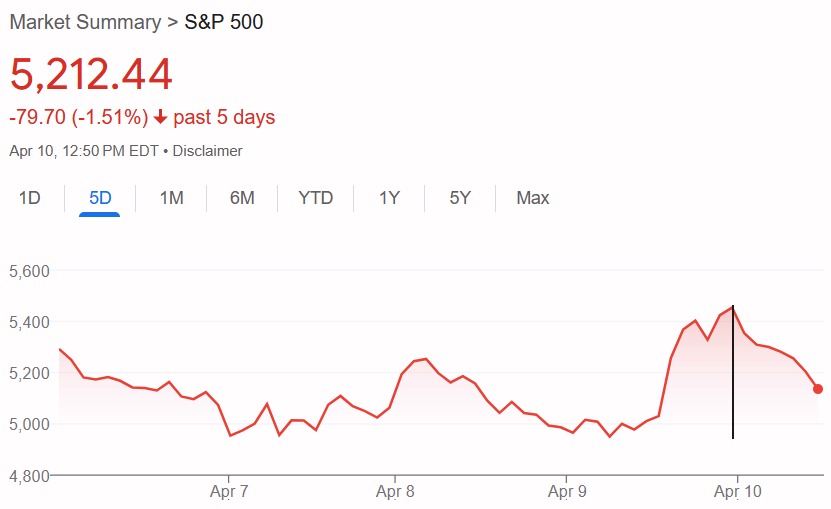
April 9 wasn’t just another volatile day on Wall Street — it was a near-perfect example of how markets behave during a crash, and why some of the biggest one-day rallies in history often happen inside brutal bear markets.

It’s one of the great paradoxes of investing:

The biggest up-days don’t mean recovery — they often signal panic, forced liquidation, and deeper instability ahead.

What Actually Happened?

In essence, the trillions of dollars that appeared to be gains in the market were really losses for short sellers. That’s the hidden truth of sharp rallies during a crash — the money didn’t come from real investment demand; it came from forced buying.

The key difference is this: when markets rise under normal conditions, long-term investors have unrealized gains — profits on paper, but not yet cashed out. But in a short squeeze, those unrealized gains for stockholders are directly matched by realized losses for short sellers who are forced to buy at any price to cover their positions.

It’s not wealth creation — it’s wealth transfer under pressure. In the chaos of a market crash, those who looked like winners became losers — and those who looked like losers became winners.

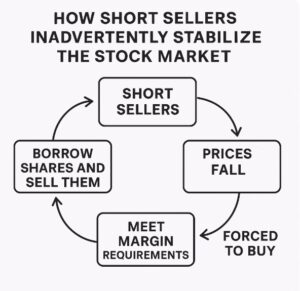
Short Sellers Help Stabilize the Stock Market

The Mechanics

Markets spiked sharply after a sudden and dramatic policy reversal was announced — a move investors hoped might slow down the economic freefall.

But here’s the key:
This initial surge wasn’t organic buying. It was mechanical.

→ Short sellers — traders betting against the market — suddenly got squeezed.
→ When prices jump too fast, short sellers face margin calls — demands from brokers to put up more money or buy back the stock they bet against.
→ Since short-selling carries unlimited loss potential, these traders are forced to buy shares no matter the price to avoid catastrophic losses.

That panic buying drives prices even higher, triggering more margin calls in a dangerous feedback loop.

Why Does This Matter?

Because once those short positions are closed (covered), the artificial buying pressure evaporates.

And here’s the brutal part:
→ Many of those same shares bought in a panic are quickly sold again by longer-term bearish investors or funds desperate to raise cash.

That’s what you saw today — the so-called “pullback” was not just natural volatility; it was the aftershock of forced buying unwinding itself.

Markets gave back much of yesterday’s gains. And worse, they are now at risk of retesting — or breaking — the recent lows.

The Illusion of Safety

In chaotic markets like this, price action becomes non-linear and unpredictable.

Massive rallies during a downturn are not necessarily signs of strength — they are often signs of extreme stress within the system.

This is why some of the biggest single-day gains in market history occurred during the Great Depression, the 2008 Financial Crisis, and the early phases of COVID’s market panic.

It’s not recovery.
It’s chaos.

Why Crashes Look Like This: Forced Buyers Meet Forced Sellers

Several key forces converge during these phases:

  • Short-sellers covering in panic.

  • Margin calls across hedge funds and leveraged traders.

  • Index funds and mutual funds, required to stay fully invested, reluctantly buying dips.

  • Passive investing structures amplifying volatility both directions.

  • Algorithmic trading chasing momentum.

These dynamics create a dangerous loop:
→ Sharp rallies from forced buying.
→ Followed by brutal reversals from forced selling.

The result?
A jagged, chaotic pattern — not a smooth decline.

And the Most Important Lesson:

In a true crash, there is no guaranteed floor.

Support levels only exist until panic overwhelms them. Fundamentals don’t matter when liquidity disappears.

Markets become driven by positioning, margin calls, and liquidity — not valuation.

This is why the old phrase still applies:
“Bear market rallies are designed to fool the maximum number of people in the minimum amount of time.”

Closing Thought:

The real danger today isn’t just volatility — it’s the fact that this is largely self-inflicted economic destruction.

Policy mistakes — from trade wars to immigration freezes to climate inaction to protectionist tariffs — have combined into a global slowdown unlike anything since the Great Depression.

And unlike past crashes, there is a real risk this time that the damage is structural — not cyclical.

Recovery is not guaranteed.

One-Week Chart Highlighting Record One-Day Spike

Trumpenomics: The Decline of the US