bookmark_borderThe Silencing of Science: How the Trump Administration Dismantled NOAA’s Billion-Dollar Disaster Tracking — and Ignored the Accelerating Costs of Climate Collapse

By Daniel Brouse / October 24, 2025

n a quiet yet devastating policy move, the Trump administration shut down a NOAA program that tracked U.S. weather disasters causing over $1 billion in damages. The program—critical for assessing economic losses from hurricanes, floods, wildfires, and droughts—provided indispensable data for policymakers, insurers, and researchers. Its termination not only blinded the public to the scale of destruction but also concealed the rapidly accelerating costs of climate change.

This was not an isolated act. It was part of a systematic dismantling of scientific infrastructure across federal agencies—one that silenced climate data, censored reports, and obstructed communication between scientists and the public. By halting NOAA’s billion-dollar disaster tracking, the administration effectively turned off one of the most important warning systems humanity had against environmental and economic collapse.


The Rising Cost of Climate Disasters

The cost of climate disasters is rising exponentially. In the 1990s, we first hypothesized the non-linear acceleration of climate change. My lab partner—a Doctor of Physics from Ohio State—and I collaborated to provide the key evidence that helped establish this theory. By the early 2000s, our work had evolved into a foundational climate model supported by experimental and observational data. Over the next two decades, independent validation by researchers worldwide cemented this as scientific consensus.

What we found—and what subsequent studies confirmed—is that the doubling time of climate impacts has been collapsing. Initially, global damages doubled roughly every 100 years. By the 2010s, that interval shrank to a decade. Today, evidence suggests that the doubling time is now just two years.

This means that the damage caused by climate change today is double what it was two years ago. In two more years, it could be four times worse. In four years, eight times worse. Within a decade, potentially 64 times worse—and that projection is conservative.

This rapid escalation isn’t an anomaly—it’s a signature of a destabilizing nonlinear system. Climate feedback loops, such as melting permafrost releasing methane or diminishing ice reducing planetary reflectivity, are compounding one another. Our probabilistic, ensemble-based climate model—which integrates socio-economic and ecological feedback loops within a dynamic nonlinear framework—projects that global temperatures are becoming unsustainable within this century.

This exceeds even the direst early projections of a 4°C rise over a millennium. Instead, we are entering an era of compound, cascading collapse, where climate, ecological, and societal systems destabilize together through self-reinforcing feedbacks.


Some Costs of Carbon Combustion

Below are ten categories of economic and societal costs directly linked to climate change, backed by peer-reviewed research and government data. They illustrate that the cost of inaction now dwarfs the cost of mitigation.


1. Lost Productivity Due to Extreme Heat — $100+ Billion Annually (U.S.)
Sources: Lancet, NOAA, GAO
Outdoor labor sectors—construction, agriculture, logistics—are losing billions due to heat-induced work stoppages, fatigue, and health risks. In 2023 alone, extreme heat cost the U.S. economy over $100 billion in lost productivity and medical impacts.


2. Flash Floods and Infrastructure Damage
Sources: FEMA, CBO
Flash floods have become national catastrophes. In just the first half of 2024, they caused over $50 billion in damage. By July 2025, hundreds of flash floods had devastated communities from coast to coast, including multiple “1-in-1,000-year” storms—once statistically impossible events that now occur several times a year.


3. Wildfires — Direct and Indirect Costs
Sources: National Interagency Fire Center, Climate Central
Beyond destruction and death, wildfires create hidden costs—smoke-related health crises, lost tourism, carbon loss, and power grid instability. By July 2025, wildfire-related damages reached $93 billion, with total economic costs exceeding $250 billion.


4. Air Conditioning Feedback Loops
Sources: IEA, IPCC
As heat intensifies, global cooling demand could triple by 2050—fueling more emissions and grid stress, creating a vicious self-reinforcing cycle.


5. Supply Chain Disruptions
Sources: World Bank, McKinsey, IMF
Floods, droughts, and hurricanes are crippling supply routes. Droughts in the Panama Canal and Mississippi River alone disrupted hundreds of billions in trade, while storms halted semiconductor and medical supply production worldwide.


6. Housing Market Instability and Insurance Collapse
Sources: Moody’s, Insurance Information Institute
As insurers flee high-risk zones—Florida, California, and Gulf states—millions of Americans are left uninsured. Property values are collapsing in regions now deemed “uninsurable.”


7. Public Health and Disease Expansion
Sources: CDC, WHO
Vector-borne diseases like dengue and West Nile are spreading northward. Heat-related ER visits are soaring. Climate-driven illness is projected to cost the U.S. $100–200 billion annually by the 2030s.


8. Agricultural Disruption and Food Inflation
Sources: USDA, FAO, IPCC
Floods, droughts, and shifting seasons are destabilizing food supply chains. Between 2022 and 2024, climate-related crop failures drove global food inflation above 10%, fueling hunger and unrest.


9. Intensifying Storms and Hurricane Damages
Sources: NOAA, Munich Re
Hurricanes are now slower, wetter, and vastly more destructive. U.S. hurricane damage averages $54 billion per year, with some storms topping $100 billion.


10. Climate-Driven Migration and Social Disruption
Sources: UNHCR, Brookings
More than 20 million people per year are already displaced by climate impacts—a number expected to multiply as coastlines vanish, droughts intensify, and agriculture collapses.


The Economic Case for Climate Action

The data are irrefutable: the cost of inaction now far exceeds the cost of action. Transitioning to renewables, electrifying transportation, and investing in resilient infrastructure are not acts of charity—they are acts of survival and sound economics.

By defunding NOAA’s billion-dollar disaster program and suppressing scientific evidence, the Trump administration delayed this reckoning. But the truth cannot be buried. Every hurricane, fire, and flood now exposes the cost of ignoring climate science—and every delay doubles the price humanity must pay.
Trumpenomics

The Human Induced Climate Change Experiment

bookmark_borderScientific Research: Tipped Tipping Points, the Accelerating Climate Collapse, and the Domino Effect

Daniel Brouse¹ and Sidd Mukherjee²

¹Independent Climate Researcher, Economist, Membrane Institute, USA
²Independent Physicist, Membrane Institute, USA


Abstract

Earth’s climate is a nonlinear, chaotic system composed of interdependent subsystems—atmosphere, hydrosphere, lithosphere, and biosphere. Drawing from chaos theory and nonlinear thermodynamics, this paper examines how feedback loops and tipping points interact to accelerate global warming. Building on prior work establishing the non-linear acceleration hypothesis, we present evidence that the doubling time of climate change impacts has decreased from approximately 100 years to less than 2 years. Data from 2024–2025 confirm record atmospheric CO₂ concentrations, fossil fuel emissions, and temperatures, signifying a transition to a phase of self-reinforcing instability. We synthesize recent research showing that cascading climate feedbacks are now driving a compound collapse of planetary systems — from carbon sinks turning into carbon sources to economic, health, and ecological destabilization. These interlinked “tipped tipping points” constitute what we term the Domino Effect — a systemic cascade that threatens global habitability within the century.

1. Introduction

The Earth functions as a dynamic climate system, governed by the flow and redistribution of thermal energy among its interlinked subsystems: the atmosphere, oceans, and land surface. Global warming arises from the accumulation of thermal energy within this system. The complexity and nonlinearity of these interactions have long been the domain of chaos theory, which illustrates how small perturbations can yield large, unpredictable consequences — an effect popularly described as the “Butterfly Effect”¹.

In climate science, General Circulation Models (GCMs) represent these interconnections, incorporating feedback loops between temperature, pressure, humidity, and energy flow. Because these systems are nonlinear and teleconnected, small local perturbations can propagate into large-scale global shifts². Despite inherent unpredictability, model-based projections have successfully anticipated long-term trends in global temperature and carbon flux — though with recognized uncertainty in rate and magnitude.

2. The Nonlinear Acceleration Hypothesis

In the early 1990s, we proposed the nonlinear acceleration hypothesis — the idea that climate change impacts do not increase linearly, but exponentially, through self-reinforcing feedback loops³. By the early 2000s, multiple independent studies had validated this framework, establishing it as part of the broader consensus in climate dynamics⁴,⁵.

Our analysis shows that the doubling time of observable impacts — heat extremes, wildfire frequency, and ice loss — has fallen from approximately 100 years (pre-industrial) to ~10 years by 2000 and to <2 years by 2024. If this exponential trend continues, the cumulative impact could increase sixty-fourfold within a decade, even assuming constant emissions. This acceleration signals a system entering chaotic instability.

3. Record-Breaking 2024: Earth Breaches the 1.5°C Threshold

According to the World Meteorological Organization (2025) and Global Carbon Project (2025), the year 2024 marked an unprecedented convergence of climate records⁶,⁷. Atmospheric CO₂ concentrations reached 422.7 ppm, the highest in 3 million years, with a record annual increase of 3.75 ppm. Monthly values peaked at 426.91 ppm in June 2024.

Simultaneously, global fossil fuel and cement emissions rose to 37.4 gigatons of CO₂, a 0.8% increase from 2023. The rise was driven primarily by coal use in Asia, post-pandemic industrial expansion, and increased liquefied natural gas (LNG) production — particularly from the United States⁸. Methane leakage from LNG infrastructure, over 80 times more potent than CO₂ over 20 years⁹, has sharply reduced the supposed climate benefit of natural gas.

This record convergence signals a phase transition in the Earth system: as warming accelerates, natural feedbacks that once stabilized climate are now amplifying it.

4. Collapse of Carbon Sinks

For millennia, forests, soils, and oceans absorbed roughly half of anthropogenic CO₂ emissions¹⁰. By 2024, multiple datasets confirmed that major carbon sinks — notably the Amazon Basin, boreal forests, and Arctic permafrost — have shifted from net absorbers to net emitters¹¹–¹³.

Ozone pollution, drought, and pests weaken trees’ photosynthetic capacity; wildfires, intensified by heat and aridity, release billions of tons of CO₂ annually¹⁴. In the Arctic, thawing permafrost releases methane and CO₂, sometimes reigniting “zombie fires” through winter¹⁵. In the oceans, coral die-offs and reduced vertical mixing from a slowing Atlantic Meridional Overturning Circulation (AMOC) limit carbon sequestration and nutrient flow¹⁶.

This collective degradation represents a systemic feedback reversal — the transformation of natural carbon sinks into carbon sources — driving an escalating and largely self-sustaining cycle of warming.

5. Cascading Feedbacks: The Domino Effect

Climate feedback loops do not act independently; rather, they interact synergistically in what we term the Domino Effect — a cascade of tipped tipping points where each system failure accelerates the next¹⁷.

For example, rising heat intensifies wildfires and particulate pollution, which alters atmospheric chemistry and reduces photosynthesis; decreased plant uptake increases CO₂ concentrations, driving further heat. Similarly, sea level rise and loss of glacial mass amplify coastal erosion, migration, and economic instability — reinforcing social and political feedbacks that delay mitigation.

This emergent behavior exemplifies a complex adaptive system entering runaway disequilibrium — one that can only be described probabilistically.

6. Human and Economic Implications

The social and economic consequences of accelerating warming are becoming immediate and measurable.

A Scientific Reports study (January 2025) found that in half of 38 global cities, annual heat-related deaths will exceed COVID-19 mortality rates within a decade if warming reaches 3°C¹⁸. A Nature Reviews Earth & Environment paper (February 2025) projected that at 2°C, global land area where human thermoregulation becomes impossible will triple¹⁹.

Economic analyses by the First Street Foundation (2025) estimate $1.47 trillion in U.S. property devaluation by 2055 due to flooding and extreme weather²⁰. Boston Consulting Group (2025) calculates that failing to limit warming from 3°C to 2°C would cost the world 11–27% of total GDP²¹.

Beyond these, secondary and indirect feedbacks are emerging: cooling of the upper atmosphere extends orbital debris lifetime²²; sleep disorders linked to rising temperatures may triple²³; and wildfire-driven PM₂.₅ exposure could cause 98,000 annual excess deaths in the U.S. by 2050²⁴.

Even cultural systems are at risk: by 2050, 14 of 16 FIFA World Cup stadiums will face “unsafe” extreme heat, with two-thirds of grassroots football fields already crossing climate risk thresholds²⁵.

7. Toward a Unified Framework

Our ensemble-based probabilistic climate model integrates socio-economic, ecological, and biogeophysical feedbacks within a nonlinear dynamical system. The results indicate that global temperatures are on course to become unsustainable within this century, far surpassing earlier projections of a 4°C rise over a millennium²⁶.

The transition from a stable Holocene equilibrium to a runaway Anthropocene trajectory is characterized by compounding, interdependent feedbacks across multiple systems — thermal, hydrological, biological, and societal.

8. Conclusion: A Closing Window

The events of 2024–2025 reveal the limits of incremental mitigation. Stabilizing Earth’s climate now demands more than emission reductions — it requires active carbon removal, ecosystem restoration, and an immediate global phase-out of fossil fuels.

As the planet’s natural stabilizers fail, humanity faces a critical juncture: continue deferring action or act decisively to preserve habitability. The evidence is unequivocal — the feedback loops have tipped, the tipping points have cascaded, and the window for prevention is rapidly closing.


References

  1. Lorenz, E. N. (1963). Deterministic Nonperiodic Flow. Journal of the Atmospheric Sciences, 20(2), 130–141.
  2. IPCC. (2023). AR6 Climate Change 2023: The Physical Science Basis.
  3. Brouse, D., & Mukherjee, S. (1999). Nonlinear Acceleration of Climate Change. Membrane Institute Working Paper Series.
  4. Lenton, T. M. et al. (2008). Tipping elements in the Earth’s climate system. PNAS, 105(6), 1786–1793.
  5. Steffen, W. et al. (2018). Trajectories of the Earth System in the Anthropocene. PNAS, 115(33), 8252–8259.
  6. WMO. (2025). State of the Global Climate 2024.
  7. Friedlingstein, P. et al. (2025). Global Carbon Budget 2025. Earth System Science Data.
  8. IEA. (2025). Global Energy Review 2025.
  9. IPCC. (2022). Climate Change 2022: Mitigation of Climate Change.
  10. Friedlingstein, P. et al. (2020). Global carbon budget 2020. Earth System Science Data, 12, 3269–3340.
  11. Gatti, L. V. et al. (2021). Amazonia as a carbon source linked to deforestation and climate change. Nature, 595, 388–393.
  12. McGuire, A. D. et al. (2023). Permafrost carbon feedbacks. Nature Climate Change, 13, 456–465.
  13. Buitenhuis, E. et al. (2024). Oceanic carbon sink slowdown. Nature Communications, 15(6), 4441.
  14. Bowman, D. M. J. S. et al. (2023). Wildfire trends under climate change. Science, 379(6629), 44–50.
  15. Natali, S. et al. (2023). Arctic carbon emissions from permafrost thaw. Nature Geoscience, 16, 255–262.
  16. Caesar, L. et al. (2021). Weakening AMOC in recent decades. Nature Climate Change, 11, 680–686.
  17. Mukherjee, S., & Brouse, D. (2025). Tipped Tipping Points, Feedback Loops, and the Domino Effect. Membrane Institute Press.
  18. Mora, C. et al. (2025). Heat-related mortality projections. Scientific Reports, 15, 101–112.
  19. Sherwood, S. C. et al. (2025). Limits of human heat tolerance. Nature Reviews Earth & Environment, 6, 88–96.
  20. First Street Foundation. (2025). Climate Risk and U.S. Property Devaluation.
  21. Boston Consulting Group. (2025). Economic Consequences of Climate Inaction.
  22. Meech, K. et al. (2025). Orbital debris lifetimes in a warming atmosphere. Nature Sustainability, 8(3), 221–230.
  23. Gao, Y. et al. (2025). Rising global temperature and sleep apnea prevalence. Nature Communications, 16, 5543.
  24. Burke, M. et al. (2025). Wildfire PM₂.₅ and excess mortality in the United States. Nature, 625, 34–41.
  25. Common Goal & Football for Future. (2024). Heat Risk and Football Infrastructure Report.
  26. Brouse, D., & Mukherjee, S. (2025). Ensemble modeling of compound climate collapse. Membrane Institute Climate Series, 3(2), 14–27.

The Human Induced Climate Change Experiment

bookmark_borderThe Domino Effect: Tipped Tipping Points and the Accelerating Collapse of Earth’s Climate System

By Daniel Brouse and Sidd Mukherjee

The Climate as a Chaotic System

The Earth is a climate system — a vast network of interconnected subsystems including the atmosphere, oceans, and land. Global warming is driven by an increase in thermal energy within this system. Chaos theory reveals the inherent complexity and nonlinearity of such dynamic systems, particularly in the intricate interactions between soil, air, and sea.

Atmospheric and oceanic circulation redistribute thermal energy around the globe. These flows are governed by nonlinear dynamics, meaning small perturbations can cause disproportionate effects — a concept captured by the “Butterfly Effect,” in which the flap of a butterfly’s wings in one region can influence a hurricane in another.

General Circulation Models (GCMs), which simulate the Earth’s climate, are highly teleconnected and nonlinear. A minor change in temperature, pressure, or humidity in one small area can trigger large changes anywhere on the planet. Climate science must wrestle with these complex models, extracting insight despite inherent chaos — with both remarkable successes and sobering failures. Yet, we must proceed.


The Acceleration Hypothesis

In the 1990s, we first hypothesized the nonlinear acceleration of climate change. My lab partner, a Doctor of Physics from Ohio State, and I collaborated to provide the foundational evidence for this theory. By the early 2000s, our work had evolved into an established framework, validated repeatedly by independent studies and now accepted as scientific consensus.

Over the decades, the doubling time of climate impacts — the rate at which effects intensify — has shortened dramatically. Initially around 100 years, it fell to 10 years, and more recently to just 2. This means climate damage today is double what it was two years ago, potentially quadrupling within two more, and growing sixty-fourfold within a decade if trends continue. These are conservative estimates that assume the doubling time does not shrink further.

This is not an anomaly — it is a trajectory. Without immediate global intervention, the results will be far more catastrophic than previously projected.


2024: The Year of Records — and Warnings

Research released in 2025 confirmed that 2024 was the year the planet shattered multiple climate records — none of them good. Atmospheric carbon dioxide (CO₂) concentrations, fossil fuel emissions, and global average temperatures all reached unprecedented highs, officially breaching the 1.5°C warming threshold of the Paris Agreement.

This convergence signals a dangerous new phase: self-reinforcing climate instability, where runaway feedback loops — from melting ice and collapsing ecosystems to oceanic and atmospheric disruptions — are beginning to overpower human mitigation efforts.


Record CO₂ Concentrations and Emissions

The global average concentration of CO₂ reached 422.7 ppm in 2024 — the highest in at least three million years — with a record annual increase of 3.75 ppm, the steepest since modern measurements began in 1959. Monthly concentrations peaked in June 2024 at 426.91 ppm.

Record heat across air and oceans amplified carbon releases from soils, forests, and seas. Wildfires, droughts, and ecosystem die-offs weakened natural absorptive capacity, forming a dangerous feedback: as the planet warms, its ability to regulate CO₂ declines — further accelerating warming.

Meanwhile, fossil fuel and cement emissions reached 37.4 gigatons in 2024, a 0.8% rise over 2023. Much of this growth stemmed from coal use in Asia and oil-driven transport demand. The U.S. contributed heavily through record fossil fuel consumption and liquefied natural gas (LNG) exports. Methane leakage from this “bridge fuel” — over 80 times more potent than CO₂ over 20 years — erased any claimed climate advantage, compounding global warming.

This paradox persists: while renewable capacity expands, fossil fuel use rises nearly as fast. The carbon gap — between emissions and absorption — widens, while natural sinks falter under stress.


The Collapse of Carbon Sinks

Forests, soils, and oceans have long absorbed about half of human-generated CO₂. But that balance is unraveling. In 2024, mounting evidence suggested key ecosystems had crossed tipping points, shifting from net absorbers to net emitters of greenhouse gases.

Ozone pollution now impairs photosynthesis; drought, heat, and pests accelerate tree death; and megafires release billions of tons of carbon each year. The Amazon — once a crucial carbon sink — now emits more carbon than it stores.

In the Arctic, thawing permafrost releases methane and CO₂ while fueling “zombie fires.” Oceans, destabilized by coral die-offs and a slowing Atlantic Meridional Overturning Circulation (AMOC), absorb less CO₂ and support fewer marine organisms. Each failure amplifies the next, reinforcing the global feedback cycle.


Cascading Feedbacks and the Domino Effect

These are not isolated failures but interconnected system breakdowns. As forests burn, permafrost thaws, reefs die, and currents weaken, each feedback loop amplifies others. The transformation of carbon sinks into carbon sources marks one of Earth’s most profound shifts — ensuring that even if emissions plateau, atmospheric CO₂ may continue to rise for centuries.

We are witnessing the onset of the Domino Effect — a cascade of tipped tipping points pushing the planet toward a less stable, hotter equilibrium.


The Human and Economic Toll

The year 2025 has clarified that these changes are no longer theoretical. Peer-reviewed research reveals accelerating, compounding crises that threaten human health, economies, and planetary stability.

  • Health: A Scientific Reports study found that in half of 38 major cities, annual heat deaths will surpass COVID-19 mortality rates within a decade under 3°C warming. A Nature Reviews paper warns that at 2°C, vast regions will become uninhabitable without artificial cooling.
  • Economy: The First Street Foundation projects $1.47 trillion in U.S. property devaluation by 2055. Boston Consulting Group estimates a global GDP loss of up to 27% if warming exceeds 3°C.
  • Planetary Systems: The World Meteorological Organization reports a 70% chance that global warming will exceed 1.5°C between 2025–2029. Glacial studies predict massive ice loss and irreversible sea level rise even if warming halted today.
  • Ecological Collapse: Coral reefs, forests, and permafrost systems are crossing thresholds beyond recovery.
  • Social Systems: Even cultural events are affected; by 2050, 11 of 16 FIFA World Cup stadiums are projected to be “unplayable” due to extreme heat.

Integrating the Evidence: A System in Cascade

Our 2025 framework, “Tipped Tipping Points, Feedback Loops, and the Domino Effect,” describes this accelerating collapse. Rising heat amplifies wildfire smoke and PM2.5 deaths, which alter atmospheric chemistry and weaken photosynthesis. Forests become carbon and methane sources. Sea level rise and coastal loss fuel economic instability and migration.

Each “tipped” system stresses the next — compounding risk in an exponential cascade.

Our ensemble-based probabilistic climate model — integrating socio-economic and ecological feedbacks — projects that global temperatures will become unsustainable within this century, far exceeding earlier estimates of 4°C over a millennium. Humanity is entering a phase of compound, cascading collapse — where climate, ecological, and societal systems destabilize through self-reinforcing feedback loops.


Conclusion: A Closing Window

The year 2024 will be remembered not just for record-breaking heat, but for revealing the limits of incrementalism. Stabilizing the climate now demands more than emission cuts — it requires active carbon removal, ecosystem restoration, and the immediate global phase-out of fossil fuels.

As natural systems that once protected us begin to fail, humanity faces an existential choice: continue rationalizing short-term convenience or act decisively to preserve a habitable planet.

The evidence is overwhelming. The feedback loops are accelerating. The window for prevention is closing.

* Our probabilistic, ensemble-based climate model — which incorporates complex socio-economic and ecological feedback loops within a dynamic, nonlinear system — projects that global temperatures are becoming unsustainable this century. This far exceeds earlier estimates of a 4°C rise over the next thousand years, highlighting a dramatic acceleration in global warming. We are now entering a phase of compound, cascading collapse, where climate, ecological, and societal systems destabilize through interlinked, self-reinforcing feedback loops.

We examine how human activities — such as deforestation, fossil fuel combustion, mass consumption, industrial agriculture, and land development — interact with ecological processes like thermal energy redistribution, carbon cycling, hydrological flow, biodiversity loss, and the spread of disease vectors. These interactions do not follow linear cause-and-effect patterns. Instead, they form complex, self-reinforcing feedback loops that can trigger rapid, system-wide transformations — often abruptly and without warning. Grasping these dynamics is crucial for accurately assessing global risks and developing effective strategies for long-term survival.

Tipping points and feedback loops drive the acceleration of climate change. When one tipping point is toppled and triggers others, the cascading collapse is known as the Domino Effect.

bookmark_borderThe Future of Climate Change: The Science, the Economics, and the Tipping Edge of Human Survival

by Daniel Brouse
October 22, 2025

The year 2025 has been a watershed moment in understanding the near-term trajectory of climate change. A growing body of peer-reviewed research underscores that the impacts of anthropogenic warming are no longer distant projections—they are rapidly materializing in compounding, interconnected crises that threaten human health, the global economy, and planetary stability itself.

Human Health and Heat Mortality

A study published in Scientific Reports (January 6) compared projected heat-related deaths from climate change with COVID-19 mortality rates across 38 global cities. In half of these cities, annual heat-related deaths are expected to exceed COVID-19 death rates within just ten years if global temperatures rise by 3°C above pre-industrial levels. The sharpest increases are anticipated in Mediterranean and Central European cities. Similarly, research in Nature Reviews Earth & Environment (February 4) warns that 2°C of warming will triple the global land area where human core temperature becomes uncontrollable—rendering large parts of the planet effectively uninhabitable for outdoor labor or survival without artificial cooling.

Economic Fallout and Property Value Collapse

Financial modeling by the First Street Foundation (February 3) projects that by 2055, climate-driven property devaluation in the U.S. could exceed $1.47 trillion, with 84% of neighborhoods suffering losses. The Boston Consulting Group (March 12) estimates that the cost of failing to limit warming from 3°C to 2°C would equate to 11–27% of cumulative global economic output—an existential hit to the world economy.

Planetary System Instability

The World Meteorological Organization (May 28) reports a 70% likelihood that average global warming will exceed 1.5°C between 2025 and 2029—an alarming acceleration from earlier projections. This projection reflects a decadal average, yet 2024 has already been confirmed at 1.55°C above pre-industrial levels, indicating that the threshold has effectively been reached on an annual basis.

Glacier studies published in Science (May 29) predict that without further warming, glaciers will lose 39% of their 2020 mass—raising sea levels by 113 mm—but current policies (leading to ~2.7°C) would double that loss. Even if current temperatures were frozen in place, the Nature Communications study (May 20) warns, the legacy of past emissions already locks in several meters of sea level rise over coming centuries, guaranteeing “extensive loss and damage to coastal populations.”

Expanding and Emerging Threats

Less-discussed but equally critical are indirect effects of global warming:

  • Space debris: A Nature Sustainability study (March 10) shows that cooling of the upper atmosphere due to climate change will reduce drag on orbital debris, extending its lifetime and reducing satellite capacity by up to two-thirds.

  • Health impacts: A Nature Communications paper (June 16) links warming to a potential threefold increase in obstructive sleep apnea by 2100, while another Nature study (September 18) projects up to 98,000 annual excess U.S. deaths from wildfire-related PM2.5 exposure by 2050.

  • Ecological collapse: Nature (September 17) predicts that if warming exceeds 2°C, 99% of western Atlantic coral reefs will be eroding by 2100.

  • Water crises: The Nature Communications study (September 23) finds that many regions will enter cycles of “Day Zero Drought” events—periods when water supply systems completely fail—by the 2020s and 2030s.

Sports and Social Systems Under Threat

Even cultural institutions are not immune. A report by Common Goal and Football for Future (September 10) projects that by 2050, 14 of 16 FIFA World Cup stadiums will face “unsafe” extreme heat conditions, with 11 deemed completely “unplayable.” Two-thirds of grassroots fields are already breaching multiple climate risk thresholds. In fact, many matches held in the U.S. in preparation for the 2026 World Cup have already been **postponed or canceled due to extreme weather—heat, flooding, and high winds—**offering a preview of the challenges to come.

Integrating the Evidence: Tipped Tipping Points and Cascading Feedbacks

Taken together, these findings confirm a grim reality long anticipated in “Tipped Tipping Points, Feedback Loops, and the Domino Effect” (Mukherjee & Brouse, 2025). The accelerating crises are not isolated data points; they are interlinked feedbacks in a nonlinear system that has already surpassed several critical thresholds.

Rising heat and ocean temperatures amplify wildfire smoke and PM2.5 deaths, which in turn alter atmospheric chemistry and reduce plant productivity. Forests, once carbon sinks, are becoming carbon and methane sources. Sea level rise intensifies coastal erosion and migration, compounding social and economic instability. Each “tipped” system increases stress on the next—amplifying global risk in a self-reinforcing cascade.

As our framework argues, humanity is no longer confronting a single tipping point but a network of cascading failures that are accelerating exponentially. The latest scientific record of 2025 confirms that the feedback loops once described as theoretical are now visibly—and measurably—underway. The future of climate change, therefore, is not merely one of incremental warming but one of accelerating disruption, where adaptation and mitigation must now race against compounding planetary feedbacks.

* Our probabilistic, ensemble-based climate model — which incorporates complex socio-economic and ecological feedback loops within a dynamic, nonlinear system — projects that global temperatures are becoming unsustainable this century. This far exceeds earlier estimates of a 4°C rise over the next thousand years, highlighting a dramatic acceleration in global warming. We are now entering a phase of compound, cascading collapse, where climate, ecological, and societal systems destabilize through interlinked, self-reinforcing feedback loops.

We examine how human activities — such as deforestation, fossil fuel combustion, mass consumption, industrial agriculture, and land development — interact with ecological processes like thermal energy redistribution, carbon cycling, hydrological flow, biodiversity loss, and the spread of disease vectors. These interactions do not follow linear cause-and-effect patterns. Instead, they form complex, self-reinforcing feedback loops that can trigger rapid, system-wide transformations — often abruptly and without warning. Grasping these dynamics is crucial for accurately assessing global risks and developing effective strategies for long-term survival.

The Human Induced Climate Change Experiment


bookmark_borderTrump’s Undeclared War: Covert Strikes, Civilian Deaths, and the Erosion of U.S. Law

Did anybody else hear Trump drop the F-Bomb live? The news stations did not know what to do… censor his free speech or blow it all to hell?

During a White House meeting with Ukrainian President Volodymyr Zelenskyy on October 17, 2025, Donald Trump used an expletive when warning Venezuelan leader Nicolás Maduro against a conflict with the U.S.

When asked by a reporter about Maduro and reports of a rejected peace plan, Trump stated, “He’s offered everything,” and then added, “Because he doesn’t want to f— around with the United States”

Yesterday, Trump declared that he’s “authorized the CIA to carry out covert lethal action” in Venezuela.

Wait—how exactly do you announce a covert operation? And if it’s made public, can it still be considered “covert”?

Beyond the absurdity of the statement itself, there are serious legal and constitutional questions here. Who approved it? Was Congress notified, as required by law? The whole thing raises far more troubling questions than answers.

This comes on top of other crimes against humanity committed under Trump’s leadership. Recently, he openly boasted about ordering the destruction of a submarine, claiming it was a “show of force.” According to emerging reports, two survivors were recovered and are now being held aboard a U.S. Navy vessel—despite the fact that the strike itself was unauthorized under international law and there is no evidence that the submarine or its crew had violated any U.S. or international statutes.

Even more disturbing are at least six previous U.S. military strikes on civilian boats in the Caribbean over the past several months. Eyewitnesses and family members describe these incidents as summary executions carried out under the pretext of “maritime security operations.” In one particularly heartbreaking account, a grieving mother broke down during an interview, saying her son—a local fisherman—was “executed by the U.S. Navy for doing his job.”

Taken together, these actions point to a pattern of reckless military aggression and disregard for human life, echoing broader concerns about executive overreach, lack of accountability, and the erosion of international law under Trump’s renewed presidency.

Conclusion: A War Without Declaration

The United States is not at war with Venezuela, nor has Congress authorized any military action against it. Yet Trump’s words and deeds increasingly resemble those of a president waging an undeclared and unconstitutional war. The supposed “covert” operations he brags about publicly, the destruction of foreign vessels without due process, and the mounting civilian casualties all point to an alarming pattern: the casual erosion of both domestic and international law under the guise of strength.

No evidence has been presented—none whatsoever—that Venezuela or its citizens pose any imminent threat to U.S. national security. These actions, therefore, cannot be justified under the Constitution, the War Powers Resolution, or the U.N. Charter. Instead, they reflect a dangerous concentration of power in one man’s hands, unchecked by oversight and unmoored from reason.

If America truly stands for freedom, justice, and the rule of law, then it must hold its leaders accountable to those same principles. Declaring war by executive impulse is not strength—it is tyranny in motion.

Trumpenomics: The Fall of the USA

bookmark_borderCracks in the Foundation: Rising Bankruptcies and Regional Bank Weakness Rattle Wall Street

The recent turbulence on Wall Street marked a notable shift in market sentiment. The spike in volatility wasn’t triggered by the usual suspects — not tariffs, not interest rate speculation, nor even the economic damage of the government shutdown. Instead, investors were shaken by a growing wave of bankruptcies and increasing fragility within the nation’s regional banks.

For months, markets have largely shrugged off the unpredictable behavior coming from the White House. Trump’s impulsive economic outbursts — often dubbed “TACO tantrums” (Tariffs, Attacks, Chaos, and Outrage) — have become so routine that traders now view them as background noise. But bank instability is another matter entirely. Unlike political rhetoric, a weakening financial system has tangible, measurable consequences that can ripple through the economy with devastating speed.

Recent corporate bankruptcies, particularly in manufacturing and retail, have underscored a troubling trend: the combination of high interest rates, tariff-driven supply chain pressures, and tightening credit conditions is pushing an increasing number of firms into insolvency. The most alarming development, however, is the strain showing up in regional and mid-sized banks — the same sector that fueled the March 2023 banking crisis.

As these institutions face mounting loan defaults and declining asset values, confidence is eroding. Investors are beginning to question whether the financial safeguards put in place after the 2008 crisis are enough to withstand the compounding pressures of protectionist trade policies, inflationary fiscal spending, and tightening liquidity.

Markets can tolerate uncertainty in leadership; they can even price in volatility. But what they cannot endure is the growing certainty of systemic risk. The cracks in America’s financial foundation are widening — and if policymakers continue to prioritize political theater over economic stability, Wall Street’s volatility today may soon look mild compared to what’s coming.

Trumpenomics: The Fall of the US Economy

bookmark_borderClimate Denial, Drought, and the Death of Capitalism: How Trump’s Anti-Science Policies Are Driving Economic Collapse

President Trump recently claimed that his administration is working to reduce record-high beef prices — a crisis he attributed to drought impacting U.S. cattle ranchers. Yet what he failed to acknowledge is that the drought itself is a direct consequence of the very climate crisis his administration continues to deny. The irony is stark: the same policies that prop up fossil fuel production and reject climate science are now dismantling the foundations of American capitalism.

The Western U.S. — once a global breadbasket and livestock powerhouse — is facing a multi-decade megadrought, worsened by rising temperatures, declining snowpack, and shifting precipitation patterns. Extreme heat accelerates evaporation, depleting both soil moisture and surface water. Pastures have withered, feed costs have soared, and cattle herds have been culled to historic lows. This has driven beef prices to record highs, threatening not just ranchers but the entire food supply chain — from processing plants to grocery shelves.

Under normal circumstances, capitalism adjusts through innovation and efficiency. But when leadership denies the root cause — in this case, anthropogenic climate change — markets cannot adapt. Trump’s policies of fossil fuel expansion, regulatory rollbacks, and environmental deregulation amount to state-sponsored self-sabotage. His administration’s energy and agricultural agendas reward short-term extraction while destroying the long-term natural capital — clean water, arable soil, and stable climate — that all economic systems depend on.

Trump’s climate denial isn’t just anti-scientific; it’s anti-capitalist in the truest sense. A functioning market requires stable conditions and predictable risk. Climate chaos destroys both. Droughts, floods, and fires are driving up insurance costs, collapsing crop yields, and creating food insecurity. Supply shocks ripple through every industry — from beef to banking — as climate volatility erodes investor confidence and undermines global trade.

By rejecting climate science, Trump’s administration is ensuring that capitalism itself becomes unsustainable. The free market cannot function on a dying planet. The laws of physics do not yield to political ideology or corporate lobbying. As the drought deepens and prices rise, the invisible hand of the market is being scorched by the very flames of denial it helped ignite.

If America wants capitalism to survive, it must end the illusion that economic growth and climate denial can coexist. The longer Trump and his allies cling to fossil-fueled delusion, the faster both our environment — and our economy — will collapse.

Trumpenomics

Climate Science

bookmark_borderPowell’s QE Pivot: The Fed’s Dangerous Return to Easy Money

by Daniel Brouse
October 14, 2025

On October 14, 2025, in a speech delivered in Philadelphia, Federal Reserve Chair Jerome Powell hinted at a significant policy shift — one that could reshape the financial landscape for years to come. Powell indicated that the Fed may soon end its balance sheet reduction program, effectively pausing Quantitative Tightening (QT) and signaling the potential return of Quantitative Easing (QE).

The motivation, he said, lies in growing concern over labor market weakness and the need to provide “stability” amid economic uncertainty. Powell described the move as “QE-like” and acknowledged the risks of persistent inflation, while emphasizing the importance of tracking a broad set of data — particularly state-level employment figures — in the absence of timely federal economic reports.

In practical terms, Powell also suggested that the Fed would begin buying U.S. Treasuries again. For investors, businesses, and consumers, this represents a major turning point — and a deeply troubling one.

What Is Quantitative Easing (QE)?
In simple terms, QE is money creation. The Federal Reserve purchases financial assets — usually Treasury bonds or mortgage-backed securities — to inject liquidity into the banking system and push long-term interest rates lower. While this can provide short-term relief to credit markets, it almost always comes with serious long-term consequences: asset bubbles, wealth inequality, and inflationary pressure.

Fiscally conservative economists, including many Republicans, have traditionally opposed QE for precisely this reason — it’s artificial stimulus that distorts markets and devalues currency. Ironically, the largest expansions of QE have occurred under Republican administrations, particularly under Presidents Bush and Trump.

At its core, QE works like this:
* The U.S. Treasury issues debt in the form of bonds.
* The Federal Reserve buys those bonds using newly created money.

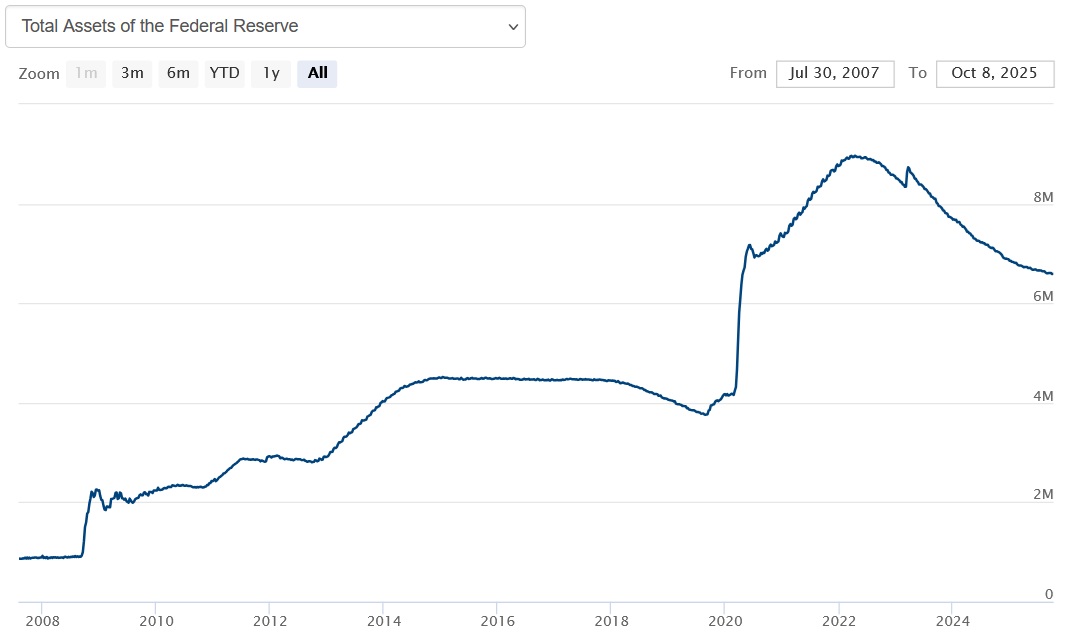
The result is a loop of monetized debt, where the government effectively funds itself by printing dollars through the Fed’s balance sheet. When considering the full fiscal picture, the real U.S. debt burden should include both the national debt and the Federal Reserve’s assets — a combined total of roughly $44.5 trillion:

$37,887,475,445,601 (national debt)
+ $6,608,000,000,000 (Federal Reserve assets)
= $44.495 trillion owed by U.S. taxpayers

That’s the true figure Americans are on the hook for. And the question remains: how will it ever be repaid?

The History of QE
The Federal Reserve first launched Quantitative Easing in November 2008, during the Great Recession, under President George W. Bush. Known as QE1, the program focused on purchasing mortgage-backed securities and agency debt to stabilize collapsing credit markets when interest rates were already near zero.

This initial cycle expanded the Fed’s balance sheet to approximately $4.5 trillion. By late 2019, the Fed began to unwind those holdings — allowing assets to “roll off” as they matured — marking the start of Quantitative Tightening (QT). However, the onset of the COVID-19 pandemic in 2020, under President Trump, triggered an unprecedented new wave of Quantitative Easing (QE), which rapidly expanded the balance sheet to nearly $9 trillion, the highest level in U.S. history. Many economists attribute a significant portion of the 2021–2022 inflation surge to this Trump-era QE, which flooded the financial system with liquidity and fueled speculative bubbles across housing, equities, and commodities.

In 2022, under President Biden, the Fed began a gradual process of balance sheet reduction, marking the start of Quantitative Tightening (QT) reducing the Fed’s assets to $6.6 trillion.

Now, just a few years later, Powell’s comments suggest a reversal of that policy — a return to money printing at a time when inflation remains above target and fiscal deficits are exploding.

QE Today: The Warning Signs
Powell’s latest remarks should set off alarm bells across the financial community. Reintroducing QE in the current environment — with massive fiscal deficits, high consumer debt, and lingering inflation — is not a stabilizing policy. It’s a recipe for economic disaster.

By artificially lowering rates and inflating asset prices, the Fed risks fueling another speculative bubble — one that could end in catastrophic wealth destruction, job loss, and financial contagion. Meanwhile, the federal government’s relentless spending ensures that each round of QE only digs the hole deeper.

This is not monetary stability. It’s the illusion of prosperity — a temporary sugar high before a historic crash.

If the Fed follows through with this plan, the outcome is predictable: rising inequality, eroding purchasing power, and ultimately what could become the Greatest Depression in U.S. history.

Fed Assets: The History of Quantitative aEsing (QE)

Creative Destruction in the Age of AI: How Endogenous Growth Theory Explains AI Stock Market Bubble

Déjà Vu Economics: How Trump’s Deregulation and Tariff Policies Mirror the Road to the Great Depression

Trumpenomics: The Fall of the USA

bookmark_borderTariff Truths: How Trump’s Trade War Is Taxing American Families and Businesses

Despite repeated claims from Donald Trump and his advisors that foreign countries are “paying the tariffs,” new data clearly shows the opposite. U.S. consumers and domestic companies are bearing nearly all of the costs — a hidden tax that is worsening inflation, eroding profits, and undermining economic growth.

According to an October 2025 analysis by Goldman Sachs, American consumers are now shouldering 55% of the total cost of Trump’s new import tariffs, while U.S. companies pay another 22%. In other words, more than three-quarters of the tariff burden is being paid by Americans — not by foreign exporters. Only a small portion is absorbed by overseas producers, debunking the administration’s long-standing assertion that tariffs are “paid for by China” or “funded by foreign governments.”

The economic mechanics behind this are straightforward but devastating. When tariffs are imposed, U.S. importers pay the added tax on goods entering the country. Those higher costs are then passed through the supply chain, eventually reaching consumers in the form of higher prices on everyday essentials — including food, automobiles, electronics, and household goods. The result is a direct contribution to inflation, disproportionately affecting low- and middle-income households.

Meanwhile, U.S. corporations are absorbing part of the impact to remain competitive, sacrificing profit margins and cutting back on investment, hiring, and wage growth. For small and mid-sized businesses dependent on imported components, these tariffs have become crippling — pushing many to the brink of insolvency in an already fragile economy.

Example of Corporate Failure
A recent casualty of these policies is First Brands Group, one of the largest aftermarket auto parts manufacturers in the world, which filed for Chapter 11 bankruptcy in September 2025. The collapse has caused billions in financial losses and raised alarm bells about the stability of the private credit market, already strained by manufacturing-sector exposure.

While the company faced several economic headwinds — including rising interest rates, supply chain disruptions, and slowing demand — tariffs played a decisive role. The Trump administration’s escalating import taxes on metals, components, and finished goods dramatically increased input costs across its supply chain. For a multinational firm operating on five continents and employing 26,000 people, the financial pressure became untenable.

Before filing, First Brands managed a well-known portfolio — Fram, Trico, and Raybestos among them — and generated approximately $5 billion in 2024 revenue. Yet as tariffs inflated raw material costs and credit tightened, the company could not sustain liquidity or refinance its mounting debt. Its bankruptcy represents not just a loss for the auto parts industry, but a warning sign of structural weakness spreading through U.S. manufacturing — the very sectors these tariffs were supposed to protect.

A Double Blow to the U.S. Economy
The outcome is a double blow to the American economy: consumers face rising prices while businesses struggle with shrinking margins. What was billed as a measure to “protect American industry” has instead functioned as an across-the-board tax hike on Americans.

Historically, tariffs are among the most regressive forms of taxation, hitting lower- and middle-income families hardest. As Trump’s trade wars expand, economists warn that the renewed wave of tariffs could reignite inflation, undermining recent progress in stabilizing prices.

Once again, protectionism is being sold as patriotism — and once again, it is American families and workers who are paying the price.

Trumpenomics: The Fall of the USA

bookmark_borderCreative Destruction in the Age of Artificial Intelligence: How Endogenous Growth Theory Explains Today’s AI Stock Market Bubble

by Daniel Brouse
October 13, 2025

The Theory: Innovation, Growth, and Creative Destruction

Joel Mokyr, Philippe Aghion, and Peter Howitt Nobel Prize winning work advanced what’s known as endogenous growth theory, which emphasizes that technological progress is not something that just happens outside the economy (“exogenously”) but rather emerges from within it — from incentives, competition, and human ingenuity.

1. Aghion & Howitt – The Schumpeterian Model of Creative Destruction

Their core idea builds on Joseph Schumpeter’s notion of creative destruction:

  • Economic growth results from new innovations that make old technologies obsolete.

  • Entrepreneurs and firms invest in research and development (R&D) to gain temporary monopoly profits.

  • But those profits are eroded as new innovations arise, replacing the old technologies in a perpetual cycle.

This process is inherently disruptive — some firms and workers lose out while the economy as a whole advances.  Aghion and Howitt’s mathematical framework formalized this dynamic, showing how policies that encourage innovation — such as intellectual property rights, education, and competition — can accelerate long-run growth.

2. Joel Mokyr – Technological Revolutions and the “Culture of Growth”

Mokyr provided the historical and cultural context. He argued that the Industrial Revolution wasn’t a random event, but the result of a cultural shift toward experimentation, curiosity, and tolerance for failure.
In other words, progress comes not only from inventions themselves, but from societies that reward innovation and permit “creative destruction” to play out.


Connection to Today’s AI Stock Market Bubble

Now let’s apply this to today’s markets, especially the so-called “AI boom” or “AI bubble” of the 2020s.

1. Innovation-Driven Expectations

AI represents the next major general-purpose technology, much like the steam engine, electricity, or the internet. According to the Aghion–Howitt model, such technologies can trigger long periods of high growth by spawning new industries, raising productivity, and replacing outdated methods.

However — as with every technological revolution — the market tends to overprice the early promise. Investors project rapid and universal adoption long before the productivity gains materialize.
This is classic in early phases of creative destruction: massive capital pours into the “new thing,” often faster than the real economy can absorb it.

2. Creative Destruction in Real Time

AI is already destroying and creating value:

  • Winners: chip manufacturers (NVIDIA, AMD), cloud providers, and leading AI platforms.

  • Losers: traditional software firms, smaller labor-intensive industries, and certain white-collar sectors vulnerable to automation.

This mirrors the mechanism Aghion and Howitt described — innovation shifts profits and productivity across the economy, while creative destruction eliminates older structures.

3. The Bubble Mechanism

The AI stock bubble arises when:

  • Investors focus on potential future monopoly rents of innovation leaders (e.g., OpenAI, Microsoft, NVIDIA).

  • They overestimate the speed and scale of productivity spillovers.

  • The expectation of continuous innovation feeds speculative growth loops — firms are valued not on present earnings but on anticipated technological dominance.

This speculative behavior has historical precedent:

  • Railroad boom (1840s)

  • Electricity and radio bubbles (1920s)

  • Dot-com bubble (1990s–2000s)

Each reflected a genuine technological breakthrough, but financial markets priced in decades of progress almost overnight.

4. Mokyr’s Cultural Insight

Mokyr’s emphasis on cultural attitudes toward innovation helps explain why the bubble exists at all.
Modern tech culture — particularly in Silicon Valley — celebrates disruption and treats exponential growth as inevitable. The “AI hype” is as much cultural and psychological as it is economic:

  • The belief that “if we don’t invest now, we’ll miss the revolution” drives valuations higher.

  • Social narratives around AI (from AGI dreams to existential risk) amplify both fear and greed, core emotional drivers in financial bubbles.

5. The Long-Term Payoff

Despite the bubble, endogenous growth theory predicts that the underlying innovation cycle will eventually justify much of the investment — just not as fast or evenly as markets expect.
After each crash, the surviving technologies and firms lay the foundation for the next era of sustained productivity growth.


Thus, while the AI stock market bubble may burst, the AI technological revolution will likely continue reshaping the economy — improving productivity, transforming industries, and generating new waves of creative destruction.

It would not be unreasonable to suggest that as much as 90% of today’s companies could face creative destruction within the next decade, including members of the so-called “Magnificent Seven” tech giants. History shows that no company—no matter how dominant—remains immune to technological upheaval.

Artificial intelligence represents a general-purpose technology capable of reshaping nearly every industry, from manufacturing and finance to entertainment and healthcare. As automation, machine learning, and generative AI continue to advance, they are likely to collapse traditional cost structures, eliminate redundant business models, and redistribute profits toward entirely new players.

The “Mag 7” firms—Apple, Microsoft, Alphabet, Amazon, Meta, NVIDIA, and Tesla—currently appear invincible, much like IBM in the 1980s or Yahoo in the early 2000s. Yet their dominance depends on maintaining proprietary advantages in algorithms, data, and computing infrastructure. As AI becomes more open-source, decentralized, and commoditized, those moats could shrink quickly. A new generation of innovators may rise on more efficient models, more agile platforms, or disruptive uses of AI that make even the current leaders look obsolete.

In short, creative destruction doesn’t spare its own champions. The same technological forces that built the modern tech giants could dismantle them—proving once again that in an age of accelerating innovation, staying dominant is harder than becoming dominant.


In Summary

Concept Economic Theory Relation to AI Bubble
Endogenous growth Innovation arises from within the economy Firms are racing to internalize and monetize AI capabilities
Creative destruction New technologies displace old ones AI is already rendering older business models obsolete
Temporary monopoly profits Innovators earn short-term gains Market leaders (NVIDIA, Microsoft, OpenAI) enjoy outsized valuations
Speculative overshoot Early overvaluation of innovation potential AI stocks trade on promise, not earnings
Cultural driver (Mokyr) Societies that glorify progress fuel innovation Tech optimism and “AI evangelism” inflate the bubble