bookmark_borderAI, Immigration, and Productivity

by Daniel Brouse
January 29, 2026

Protectionist, nationalist, and anti-immigration economic policies are interacting with — and in some cases accelerating — the rapid deployment of artificial intelligence and automation technologies. Trillions of dollars in public and private capital are now being directed toward AI infrastructure, robotics, machine learning systems, and computational hardware. These investments are fundamentally reshaping labor markets.

Since 2025, both the supply of and the demand for human labor have undergone systemic structural change. On the supply side, immigration restrictions, demographic aging, and declining labor force participation in some sectors have constrained available workers. On the demand side, firms are increasingly substituting capital for labor, deploying AI systems capable of performing cognitive, analytical, logistical, and even creative tasks once thought uniquely human.

Paradoxically, aggregate productivity has continued to rise. Automation has reduced marginal labor costs, accelerated production cycles, optimized logistics, and expanded scalable digital services. In macroeconomic terms, output per worker has increased even as the total demand for certain categories of labor has stagnated or declined. Economic expansion, therefore, is increasingly decoupled from broad-based employment growth.

This structural shift raises critical distributional questions. When capital deepening replaces labor, the gains from productivity growth tend to accrue disproportionately to asset owners, technology firms, and high-skill workers, while mid- and low-skill labor markets face displacement pressures. Anti-immigration policies may temporarily tighten certain labor markets, but in combination with automation incentives, they also encourage firms to accelerate capital substitution strategies.

The result is not the literal “elimination” of humans, but the progressive redefinition of human economic value within production systems. Entire sectors — transportation, customer service, finance, logistics, manufacturing, and portions of professional services — are undergoing rapid task automation. The long-term trajectory suggests a restructuring of work itself, with fewer routine roles and a growing premium on adaptability, creativity, and system-level oversight.

The central economic question is no longer whether productivity will increase — it already has — but whether policy frameworks will adapt to manage labor displacement, income concentration, and social stability in an era where technological capital scales faster than human employment.

Artificial intelligence adds another layer of complexity to the climate system—not physically, but socio-economically. AI development is energy-intensive, requiring vast data centers powered by electricity that, in many regions, is still generated from fossil fuels. Training large-scale models can consume significant amounts of electricity and water for cooling, contributing to emissions and local resource strain. At the same time, AI can accelerate climate solutions by optimizing grid management, improving energy efficiency, enhancing climate modeling, and supporting precision agriculture. The net impact depends on governance, energy sourcing, hardware efficiency, and deployment priorities. In other words, AI is neither inherently climate-positive nor climate-negative; it is a force multiplier whose trajectory will amplify either decarbonization efforts or fossil-fuel dependence, depending on how intelligently—and ethically—it is integrated into the global energy system.

From “Solutions to the Fossil Fuel Economy and the Myths Accelerating Climate and Economic Collapse“

Tipping Points and Feedback Loops drive the Acceleration of Climate Change.

The Human Induced Climate Change Experiment

bookmark_borderSolutions to the Fossil Fuel Economy and the Myths Accelerating Climate and Economic Collapse

Summary: Solutions to the Fossil Fuel Economy and the Myths Accelerating Climate and Economic Collapse

http://membrane.com/global_warming/Basic-Economics.html

In this paper, Daniel Brouse argues that climate change and misguided economic policies are converging to create systemic risks that threaten both global capitalism and human habitability. He frames climate change as a nonlinear system driven by tipping points and feedback loops; once breached, these triggers can cascade into a “Domino Effect” of economic and ecological collapse.

The paper criticizes dominant political trends—high taxes on productivity, protectionism, nationalism, populism, and anti-immigration sentiment—arguing that they undermine long-term economic growth. Income taxes, in particular, are described as suppressing productivity and capital formation. In contrast, Brouse advocates shifting taxation away from labor and toward resource consumption—especially fossil fuels. He proposes steep direct taxes on coal, oil, and natural gas to accelerate decarbonization and send clear market signals.

Climate change is presented not only as an environmental issue but as a systemic financial threat. Rising climate-related disasters are straining insurers and could destabilize the broader financial system. Pollution and warming are also driving public health crises that threaten to overwhelm healthcare systems and government entitlement programs.

The paper strongly defends immigration as essential to economic sustainability. With aging populations and declining birth rates, Brouse argues that large-scale immigration is necessary to sustain GDP growth and maintain Social Security and Medicare. Without it, fiscal imbalance becomes mathematically unavoidable.

Looking forward, he outlines two paths:

  1. Preserve the current economic structure by embracing large-scale immigration.
  2. Undertake systemic reform by replacing income taxes with consumption and pollution taxes while aggressively phasing out fossil fuels and investing in clean energy.

The paper concludes with a stark climate warning. Updated modeling that incorporates social-ecological feedback loops projects potential warming of up to 9°C—far beyond earlier estimates. At such levels, large regions could become uninhabitable due to extreme heat, sea-level rise, food system collapse, and mass migration. The climate system, he argues, is entering a phase of compound risk and cascading breakdown.

The central message: economic myths and political short-termism are accelerating both climate and financial instability. Immediate structural reform—economically and energetically—is essential to prevent cascading collapse.

bookmark_borderFrom January 6 to Today: How Federal Violence and Political Rhetoric Threaten Democratic Stability

On January 6, 2021, thousands of supporters of then-President Donald Trump gathered in Washington, D.C., responding to his calls to “stop the steal” and to pressure then–Vice President Mike Pence and Congress to reject the 2020 election results. Many of these supporters believed the election had been “stolen by emboldened radical-left Democrats.” Following the rally, hundreds of Trump’s followers stormed the U.S. Capitol in an armed attempt to halt the certification of President Joe Biden’s victory — an event widely condemned as a violent rebellion against American democratic institutions.

Today, in his second term, President Trump is pursuing policies and actions that many critics argue are fueling a new wave of political and social confrontation — a tinderbox of grievances that could precipitate further unrest.

One flashpoint has been the deployment of thousands of federal immigration enforcement agents to Minneapolis and other cities and the shootings of U.S. citizens and residents during aggressive operations. These incidents have sparked widespread protests and raised profound questions about the use of force, constitutional rights, and government accountability.

Minneapolis: Federal Enforcement and Fatal Shootings

Since early January 2026, Minneapolis has been a focal point of federal immigration enforcement under the Trump administration’s so-called “Operation Metro Surge.”

Deaths of U.S. Citizens

  • Renée Nicole Good: On January 7, 2026, an ICE agent shot and killed 37-year-old Minneapolis resident Renée Good, a mother of three, during a federal enforcement operation. Authorities have disagreed on the circumstances, with the Department of Homeland Security (DHS) claiming Good “weaponized her vehicle” and attempted to harm agents. Local officials and witnesses dispute this narrative, and the Hennepin County medical examiner ruled her death a homicide.
  • Alex Pretti: On January 24, federal agents shot and killed Alex Pretti, a 37-year-old intensive-care nurse and U.S. citizen, during a separate encounter. Human Rights Watch and independent video analysis challenge official accounts that Pretti posed a deadly threat, suggesting he was unarmed and assisting others when shot.

Both killings occurred amid a large federal presence and have become symbols of deep tension between federal authority and local communities.

Escalation of Force and Backlash

  • Minnesota Governor Tim Walz has publicly called for the removal of federal agents and demanded state involvement in the investigations.
  • Protests against federal enforcement have been robust, with demonstrators condemning the use of lethal force against civilians and the aggressive tactics used in raids.
  • National political figures across the spectrum — including former presidents and members of Trump’s own party — have criticized the federal response and demanded transparency.

These developments have intensified debates about constitutional rights, the proper role of federal agencies, and the limits of executive power.

A Broader Pattern of Federal Overreach

Critics argue that these incidents are not isolated but part of a broader pattern:

  • Disregard for Constitutional Norms: The escalation of federal force in civilian cities, especially when local authorities oppose those deployments, raises serious questions about federalism and civil liberties.
  • Erosion of Trust in Accountability: Federal control over investigations — including limiting state access to evidence — has fueled suspicions of bias and obstruction.
  • Political Polarization and Rhetoric: Rhetoric blaming “domestic terrorists,” “far-left radicals,” or “violent lawbreakers” is often invoked to justify aggressive policing tactics, but also inflames tensions and undermine democratic norms.

These patterns contribute to alienation, distrust, and polarization — social conditions that do create fertile ground for rebellion, not just from fringe actors but from broader segments of the population who feel disenfranchised or threatened.

From January 6 to Civil Conflict Today?

The Capitol riot began with false claims about the legitimacy of an election and culminated in a direct assault on democratic processes. It was a singular moment that shocked the nation and underscored deep partisan divisions.

Today’s clashes — whether in the streets of Minneapolis or in public discourse — are shaped by ongoing grievances over governance, justice, and the limits of state power.

Whether these tensions will lead to widespread rebellion is uncertain. But the persistent use of force against U.S. citizens, the rhetorical escalation from political leaders, and the deterioration of institutional trust are symptoms of deeper fractures in American society.

Trumpenomics

bookmark_borderWinter Survival 101: Heat

Why you need to own — and know how to operate — a generator before the storm hits

In a winter storm, the greatest risk is often not snow itself — it’s the loss of heat. When electricity goes out, most modern home heating systems stop working. Gas and oil furnaces require electric ignition and blowers. Heat pumps are fully electric. Even many pellet and boiler systems rely on electric controls.

If the power is out for hours — or days — your home can become uninhabitable quickly.

Leaving Isn’t Always an Option

For many families, abandoning home and staying in a hotel sounds reasonable — until everyone else has the same plan. During widespread outages, hotel rooms fill quickly. Roads may be unsafe. Gas stations may be closed.

There’s also the problem of your house itself. If you leave without properly winterizing:

  • Radiators can freeze and burst
  • Water pipes can crack
  • Toilets and traps can freeze
  • Water damage can destroy walls, floors, and ceilings

Anyone with water-filled plumbing should learn how to winterize their home before an emergency. That means knowing how to:

  • Shut off the main water supply
  • Drain pipes and radiators
  • Add antifreeze (where appropriate)
  • Protect vulnerable plumbing in crawlspaces or exterior walls

Practice this in advance. Emergencies are not the time to read instructions for the first time.

If You Stay: Practice, Practice, Practice

If your plan is to remain at home during a winter outage, the most essential piece of equipment is a generator.

And here’s the rule:
Never purchase survival equipment during a crisis. Buy ahead of time and learn how to use it safely.

Every winter, there are reports of preventable deaths caused by improper generator use. The danger is not hypothetical — it is real and recurring.

Practice Under Real Conditions

Don’t just start your generator once on a sunny afternoon in October. Practice:

  • Starting it in subfreezing temperatures
  • Starting it at night
  • Operating it in the dark
  • Connecting loads safely
  • Refueling it properly

Cold weather changes everything — fuel flow, oil viscosity, battery performance (if electric start), and your own dexterity while wearing gloves.

Generator Safety: Non-Negotiable Rules

  1. Always operate a generator outside.
    Never in a garage. Not even with the door open.
    Not under a porch. Not near windows.
  2. Keep it at least 20 feet from your home, with exhaust directed away from doors and windows.
  3. Install carbon monoxide (CO) detectors on every level of your home and near sleeping areas. Test them regularly and keep spare batteries.

Carbon monoxide is odorless and invisible. It can kill in minutes.

Size Matters — But So Does Portability

Purchase a generator that is:

  • Small enough for you to move safely
  • Large enough to power critical heating systems
  • Capable of running for at least 8 hours on a tank

Many smaller portable generators cannot power large 240-volt loads such as:

  • Central electric furnaces
  • Large electric baseboard heating systems
  • Central air systems

TThough most properly sized portable generators can power essential heating components such as:

  • Gas or oil furnace ignition systems
  • Furnace or boiler blower motors
  • Circulation pumps for hydronic heat

They are not easily connected directly to these systems. Safe operation typically requires a professionally installed transfer switch or interlock system. Pre-wiring by a licensed electrician ensures the generator can supply these components without risking backfeed, equipment damage, or injury.

Beyond heat, prioritize:

  • One refrigerator (if needed)
  • Minimal lighting
  • Phone and device charging

Be cautious with space heaters. While some portable generators can run one small electric space heater, running multiple heaters quickly exceeds capacity. Electric resistance heaters draw significant wattage and are usually an inefficient use of generator power compared to running your primary heating system’s blower or pump.

Before a storm, calculate the startup and running wattage of each device and test your setup safely. The goal isn’t comfort — it’s preventing frozen pipes and maintaining safe indoor temperatures.

A smaller generator is often safer, easier to manage, and more fuel-efficient.

About Solar and Battery Generators

Battery and solar generators have their place, but in prolonged freezing conditions, they are often inadequate for whole-home heat. Cold temperatures reduce battery efficiency significantly. If you rely on one, test its performance in winter conditions — not just in theory.

Proper Electrical Connection

If possible, install a transfer switch or interlock system professionally. This allows you to power circuits safely without risking backfeeding into utility lines — which can kill utility workers.

If using extension cords:

  • Use heavy-duty outdoor-rated cords
  • Avoid overloading circuits
  • Keep connections dry and elevated from snow

Never plug a generator directly into a wall outlet.

Fuel Storage and Readiness

Fuel planning is part of survival planning.

  • Store fuel in approved containers
  • Keep it in a safe, ventilated location
  • Rotate fuel every few months
  • Use fuel stabilizer
  • Keep extra oil for maintenance

Cold weather thickens oil. Your generator may require winter-grade oil for easier starting.

Store Smart

Store your generator somewhere accessible but protected. A warm storage area can make cold starts easier — but never run it indoors to “warm it up.”

Clear snow from the area where you will place it before you need it. Think ahead about:

  • Where it will sit
  • How cords will run
  • How you will access it in deep snow

Heating Strategy Beyond Electricity

Even with a generator, think in layers:

  • Dress in thermal layers indoors
  • Close off unused rooms
  • Insulate windows with plastic film kits
  • Use heavy curtains
  • Seal drafts

If you have a fireplace or wood stove, maintain it properly and keep a supply of dry wood. Never use outdoor propane heaters or grills inside.

Food Strategy in Winter

In freezing temperatures, nature becomes your freezer.

If the power is out:

  • Move frozen food to a garage or sealed cooler outdoors
  • Use snow or ice in sealed containers inside your refrigerator
  • Open refrigerator doors sparingly

Treat your refrigerator like an old-fashioned icebox.

Protecting Your Plumbing While Staying

If interior temperatures drop:

  • Let faucets drip slightly
  • Open cabinet doors under sinks
  • Keep interior doors open for airflow
  • Focus heat on areas with plumbing

If temperatures approach freezing indoors and you cannot maintain heat, winterize before pipes burst.

Final Thought

Winter survival is less about gear and more about preparation and competence. The difference between inconvenience and catastrophe is often practice.

Buy early. Test often. Respect the risks.
And when the storm comes, you’ll be responding — not improvising.

BONUS QUESTION

Another serious risk from this storm is roof collapse. I specifically looked into whether intentionally melting snow from the inside — by increasing interior heat — would help reduce that risk.

The answer is no.

Reduce Internal Heat Loss (Counterintuitive but Critical)

When heat escapes into the attic, it:

  • Melts snow unevenly
  • Causes meltwater to refreeze at the eaves
  • Builds ice dams
  • Adds concentrated ice weight along roof edges

Trying to “melt it off” from inside actually increases structural stress rather than relieving it.

Instead:

  • Keep attic access doors tightly closed
  • Avoid excessively raising indoor temperatures
  • Seal obvious attic air leaks if they are safely accessible

The goal is a uniformly cold roof surface, not partial melting. Consistent cold prevents uneven melt–refreeze cycles and reduces the formation of heavy ice concentrations.

bookmark_borderTrump’s Bankruptcies and the Road to Russia

Regarding the so-called “peace negotiations” with Russia, this seems like an appropriate moment for a brief refresher on finance and economic incentives.

Trump’s long history of bankruptcies matters here. After repeatedly stiffing lenders and investors, he effectively ran out of credible financing options in the U.S. and much of Europe. Major banks wanted nothing to do with him. Even Deutsche Bank—one of the last large institutions willing to lend—ended up entangled in scandals tied to Trump loans, money laundering probes, and internal compliance failures.

When conventional financing dried up, the remaining capital willing to touch Trump increasingly traced back to opaque, offshore, and Russian-linked sources—often routed through shell companies, private lenders, or intermediaries rather than traditional banks. The Trump SoHo project in NYC was linked to Russian money and figures, facing allegations of being a conduit for money laundering from Eastern Europe, involving shady investors and partners like career criminal Felix Sater, with claims that Russian cash infusions funded units, raising serious questions about Donald Trump’s business dealings and financial scrutiny during the Russia investigation.

That shift wasn’t accidental; it was the consequence of being frozen out of normal markets.

This is why the current situation didn’t come out of nowhere. Financial dependence creates leverage, and leverage shapes behavior. When someone who aspires to power is funded by questionable foreign money after burning every reputable bridge, it raises obvious concerns about influence, loyalty, and national interest.

In short, this isn’t ideology or conspiracy—it’s basic finance and incentives. When you bankrupt your way out of legitimate capital markets, you don’t gain independence; you become dependent on whoever is still willing to write the checks. That dynamic is precisely why critics began referring to Trump, bluntly and colloquially, as “Putin’s little bitch”—not as rhetoric, but as a crude shorthand for perceived financial leverage and resulting deference.

Trumpenomics

bookmark_borderTrump’s War on Freedom: Deportations, Censorship, and the Assault on the Constitution

Trump’s war on freedom did not begin with his return to office — but it has accelerated dramatically. What we are witnessing now is not isolated misconduct, but a systematic assault on the Constitution, the free press, and the rule of law.

One of the most alarming developments is the illegal deportation of individuals to El Salvador, often without due process, transparency, or judicial review. People are being removed from the United States not through lawful immigration proceedings, but through executive fiat — a direct violation of constitutional protections and international human rights norms.

The 60 Minutes Segment That Never Aired

In December 2025, these abuses reached a new level of visibility — and suppression.

A 60 Minutes segment titled “Inside CECOT”, which focused on El Salvador’s massive mega-prison now receiving deported migrants from the United States, was abruptly removed from the broadcast schedule just minutes before it was set to air on Sunday, December 21, 2025.

According to reports, the segment had already been fully vetted and cleared by CBS legal counsel. Yet it was still pulled. The journalist involved described the decision as “political.”

That distinction matters.

When a story is cleared by lawyers but killed by executives for political reasons, it is not editorial judgment — it is censorship.

A Pattern, Not an Incident

This was not an isolated decision. It fits a clear and escalating pattern under Trump:

  • Intimidation of media organizations
  • Political pressure on newsroom leadership
  • Attacks on journalists as “enemies”
  • Retaliation against outlets that report inconvenient facts
  • Normalization of executive interference in press coverage

The First Amendment does not exist to protect flattering coverage. It exists precisely to protect journalism that makes those in power uncomfortable.

Suppressing reporting on deportations to foreign prisons — especially facilities known for human rights abuses — is a direct attack on public accountability.

Deportation Without Due Process

Equally disturbing is the policy itself.

The U.S. government is now deporting individuals to El Salvador’s CECOT prison system, a facility internationally criticized for mass incarceration, indefinite detention, and the suspension of civil liberties. These deportations often occur:

  • Without meaningful hearings
  • Without access to legal counsel
  • Without individualized assessments
  • Without public transparency

This is not immigration enforcement. It is extrajudicial punishment.

The Constitution does not grant the executive branch the power to exile people to foreign prisons — especially without due process. That authority simply does not exist.

The Broader Assault on Free Speech

The axing of the 60 Minutes segment is only one example in a much larger campaign against free expression. Trump’s influence has already:

  • Weakened press freedom domestically
  • Encouraged censorship through corporate pressure
  • Exported authoritarian media tactics abroad
  • Enabled monopolistic control of political narratives

These trends are documented in detail here:

Taken together, these are not culture-war skirmishes. They are structural attacks on democratic institutions.

Why This Matters

A free press is not a luxury.
Due process is not optional.
The Constitution is not conditional.

When a president can deport people without lawful process and silence reporting about it, the issue is no longer partisan — it is existential. Democracies do not collapse all at once. They erode through normalization, intimidation, and silence.

Pulling a 60 Minutes investigation is not just a programming decision.
It is a warning sign.

And ignoring warning signs is how freedom is lost.

Trumpenomics

bookmark_borderExtreme Energy Events: How a Warming Planet Converts Heat Into Destruction

by Daniel Brouse and Sidd Mukherjee
December 18, 2025

From “Global Warming” to System-Wide Energy Overload

The phrase global warming is widely misunderstood. While it accurately describes a rise in Earth’s average temperature, it fails to capture the true source of risk: a rapid increase in total energy within the Earth system. Heat is only the entry point. Once added, that energy is transformed, transferred, and amplified through atmospheric, oceanic, and terrestrial processes.

In 2025, global mean temperatures exceeded the long-recognized 1.5 °C threshold. To a lay observer, this may sound insignificant. It is not. Earth’s climate is a nonlinear system. Small average increases translate into large, destabilizing changes in circulation, moisture, pressure, and momentum—producing what are better described as extreme energy events.

What Are Extreme Energy Events?

Terms like heat waves or extreme weather describe symptoms, not mechanisms. The real driver is energy—thermal, kinetic, latent, and gravitational—moving through a destabilized system.

Extreme energy events include:

  • Violent precipitation and flash flooding
  • Extreme winds and pressure-gradient-driven storms
  • Rapid thermal and moisture swings (“climate whiplash”)
  • Coastal storm surge and marine heatwaves
  • Convective, solid, and chemical energy releases (hail, microbursts, wildfire)

These events are becoming more frequent and more destructive because energy scales nonlinearly.

Violent Rain: When Moisture Becomes Momentum

A critical mistake is equating climate change solely with heat. As air warms, it holds more water vapor—about 7% more moisture per 1 °C of warming. Over a 10 °C increase, moisture capacity nearly doubles.

This excess moisture does not fall gently.

Larger and more numerous raindrops increase mass (m), and falling from greater heights increases velocity (v). Momentum (p = mv) rises sharply. Upon impact, that momentum transfers to surfaces and to runoff, increasing erosion, infrastructure failure, and flood velocity.

Flow forces scale with the square of velocity (v²). Even modest increases in rainfall intensity dramatically increase destructive power.

Because water is ~800 times denser than air, fast-moving floodwater exerts exponentially greater force than wind at the same speed.

In July 2025 alone, hundreds of flash floods occurred across the United States, including multiple so‑called 1‑in‑1,000‑year rainfall events in Texas, New Mexico, North Carolina, Florida, and Illinois—statistics that no longer describe rarity, but systemic change.

Extreme Wind: Pressure, Acceleration, and Failure

As temperature gradients shift and circulation destabilizes, pressure contrasts intensify and reorganize. The result is stronger, more erratic winds.

Wyoming Wind Event — December 17, 2025

  • Peak gust: 144 mph near Smoot, Wyoming
  • Location: Mount Coffin weather station—one of the windiest sites in the state
  • Context: One of the strongest recorded gusts in Wyoming history

Transportation Impacts

  • Dozens of tractor‑trailers blown over statewide
  • 39 blowover incidents responded to by Wyoming Highway Patrol between December 9–12
  • Repeated closures of I‑80 and I‑25 to high‑profile vehicles

These were not isolated anomalies; they were the mechanical outcome of a hotter, more unstable atmosphere.

Rapid Pressure Gradients: The Hidden Engine

Wind is driven by pressure gradients. As climate energy increases, these gradients sharpen.

Bomb Cyclones (Explosive Cyclogenesis)

  • Defined by pressure drops ≥ 24 mb in 24 hours
  • Produce hurricane‑force winds and extreme precipitation

Notable examples include record‑breaking North Atlantic and Pacific storms whose pressures rival major hurricanes.

Hurricanes and Tropical Cyclones

These systems are extreme pressure machines. Tight gradients around the eye wall accelerate winds to catastrophic speeds. Rapid intensification has become increasingly common as ocean heat content rises.

Localized Gradient Events

  • Derechos and squall lines: Long‑lived straight‑line windstorms
  • Santa Ana winds: Pressure‑driven downslope accelerations fueling megafires
  • Tornadoes: Among the steepest pressure gradients on Earth, capable of 300‑knot winds

Coastal Storm Surge: When Pressure Lifts the Sea

Atmospheric pressure alone can raise sea level. Roughly 1 cm of sea‑level rise occurs for every 1 mb pressure drop.

Deep low‑pressure systems can elevate ocean levels by half a meter before wind is even considered. When combined with wave energy and rising baseline seas, the result is catastrophic coastal flooding.

Climate Whiplash: Rapid Energy Reversals

A destabilized system oscillates.

  • Hydroclimate whiplash: Drought rapidly followed by extreme flooding
  • Flash freezes: Sudden thermal energy loss causing infrastructure collapse

These shifts strain ecosystems and human systems designed for gradual change.

Marine, Solid, and Convective Energy Events

  • Marine heatwaves: Long‑lasting ocean heat anomalies devastating fisheries and coral reefs
  • Rogue waves: Spontaneous high‑energy wave convergence
  • Severe hail: Sustained by intense convective updrafts
  • Microbursts: Localized downdrafts exceeding 90 mph
  • Wildfires: Massive chemical energy releases enabled by heat, dryness, and wind

Alignment With Tipping Points and Cascading Collapse

This framework of extreme energy events directly aligns with—and physically underpins—tipping-point theory and cascading-collapse dynamics.

Extreme Energy as the Mechanism of Tipping Points

Tipping points are not abstract thresholds; they are energy thresholds. A system appears stable while excess energy is absorbed internally—through ocean heat uptake, cryosphere melt, soil moisture loss, or atmospheric moisture loading. Once buffering capacity is exhausted, the system reorganizes abruptly.

Examples include:

  • Jet stream destabilization once polar amplification erodes the equator-to-pole temperature gradient
  • AMOC weakening as freshwater input disrupts density-driven circulation
  • Cryosphere collapse when latent heat thresholds are exceeded and albedo feedbacks flip sign

Extreme energy events are therefore the observable phase transition—the moment when stored energy is released into motion, flow, and force.

Cascading Collapse: When One Failure Accelerates the Next

Earth’s climate is a tightly coupled system. When one component crosses a tipping point, it injects energy or removes stability from adjacent systems, accelerating their failure.

For example:

  • Arctic amplification weakens the jet stream → stalled Rossby waves → prolonged heat domes and floods → soil moisture loss → wildfire → atmospheric aerosol loading → further circulation disruption.
  • Ocean heat uptake delays surface warming → stratification increases → circulation slows → marine heatwaves intensify → ecosystem collapse → reduced carbon uptake → accelerated atmospheric warming.

Each collapse feeds energy forward, amplifying stress on the next subsystem. This is why observed change is no longer sequential—it is simultaneous.

Nonlinearity: Why Change Appears Sudden

In nonlinear systems, stress accumulates invisibly. The release is abrupt.

Extreme energy events mark the transition from:

  • Energy accumulation → energy expression
  • Buffering → breakdown
  • Variability → instability

This explains why multiple “once-in-1,000-year” events are now occurring within the same season, across unrelated regions, and through different physical mechanisms.

From Climate Risk to Systems Failure

Our tipping-point and cascading-collapse work emphasizes a critical insight: the danger is not the magnitude of warming alone, but the synchronization of failures.

Extreme energy events are the connective tissue between:

  • Climate physics
  • Infrastructure collapse
  • Economic destabilization
  • Ecological failure
  • Human habitability limits

They are how abstract thresholds become lived reality.

The Core Reality

Climate change is not simply warming the planet—it is pushing multiple Earth systems past energetic thresholds simultaneously.

Once tipping points are crossed, the system no longer returns to its prior state. Energy flows reconfigure permanently, cascades accelerate, and collapse becomes self-reinforcing.

We are no longer approaching this phase.

We are inside it.


* Our probabilistic, ensemble-based climate model — which incorporates complex socio-economic and ecological feedback loops within a dynamic, nonlinear system — projects that global temperatures are becoming unsustainable this century. This far exceeds earlier estimates of a 4°C rise over the next thousand years, highlighting a dramatic acceleration in global warming. We are now entering a phase of compound, cascading collapse, where climate, ecological, and societal systems destabilize through interlinked, self-reinforcing feedback loops.

We examine how human activities — such as deforestation, fossil fuel combustion, mass consumption, industrial agriculture, and land development — interact with ecological processes like thermal energy redistribution, carbon cycling, hydrological flow, biodiversity loss, and the spread of disease vectors. These interactions do not follow linear cause-and-effect patterns. Instead, they form complex, self-reinforcing feedback loops that can trigger rapid, system-wide transformations — often abruptly and without warning. Grasping these dynamics is crucial for accurately assessing global risks and developing effective strategies for long-term survival.

What Can I Do?
The single most important action you can take to help address the climate crisis is simple: stop burning fossil fuels. There are numerous actions you can take to contribute to saving the planet. Each person bears the responsibility to minimize pollution, discontinue the use of fossil fuels, reduce consumption, and foster a culture of love and care. The Butterfly Effect illustrates that a small change in one area can lead to significant alterations in conditions anywhere on the globe. Hence, the frequently heard statement that a fluttering butterfly in China can cause a hurricane in the Atlantic. Be a butterfly and affect the world.

Tipping points and feedback loops drive the acceleration of climate change. When one tipping point is breached and triggers others, the cascading collapse is known as the Domino Effect.

The Climate Crisis: Violent Rain | Deadly Humid Heat | Health Collapse | Extreme Weather Events | Insurance Collapse | Forest Collapse | Soil Collapse | Rising Sea Level | Food and Water Collapse | Updates
The Human Induced Climate Change Experiment

bookmark_borderTrump’s Second Term, Year One: Forecast Confirmed, Damage Accelerated

December 18, 2025

Executive Summary

When Donald Trump took office in January 2025 for his second term, we issued a clear forecast: a rapid deterioration in U.S. economic performance driven by protectionism, institutional erosion, policy uncertainty, and hostility toward science and immigration. That forecast has not only proven accurate—it has materialized well ahead of schedule.

The first year of Trump’s second term has been defined by broken promises, contracting manufacturing, weakening employment, rising inflationary pressure, exploding debt, and systemic damage to U.S. credibility. What was presented as economic nationalism has functioned instead as economic self‑harm.

Historical Context: Smoot–Hawley Revisited

History provides a cautionary parallel. The Smoot–Hawley Tariff Act of 1930, which sharply raised U.S. tariffs, triggered retaliatory trade barriers worldwide and materially deepened the Great Depression. Trump’s second‑term policies echo this mistake—only now compounded by executive overreach, the bypassing of Congress, and routine disregard for constitutional constraints.

As a result, the current downturn appears not only real, but accelerating. Many global leaders and economists are not reacting with panic precisely because they expect U.S. instability to be self‑limiting: policy paralysis, electoral backlash, and institutional resistance are likely to curb further damage after the midterms. In that sense, global tolerance reflects grim confidence that the U.S. economy will absorb the shock internally.

Promises Made, Promises Broken

Trump entered his second term claiming he would:

  • Bring down prices on Day One
  • Reshore U.S. manufacturing
  • Increase employment
  • Increase GDP
  • Reduce the national debt
  • Cut taxes

He has failed on every count.

Inflation: Moving the Wrong Direction

Inflation has increased at a time when it should have been declining. Relative to economic conditions, inflationary pressure is now higher than at any point since the pandemic recovery period. Tariffs, supply‑chain disruption, labor shortages, and policy volatility have combined to reverse progress that had already been achieved.

Manufacturing: Contraction, Not Reshoring

U.S. manufacturing has consistently declined since Trump took office in 2025. While the administration has claimed credit for large manufacturing investments, nearly all of the facilities cited were planned, announced, or contractually committed before the election.

More damaging still, Trump’s anti‑science and anti‑immigration posture has convinced much of the world that the United States is no longer a reliable place to invest or trade. This loss of confidence has had concrete consequences:

  • Multiple domestic and foreign firms have cancelled or delayed U.S. manufacturing projects.
  • Hyundai’s U.S. operations were disrupted by enforcement actions that left the company unable to staff skilled positions needed to complete its plant.
  • GM and Ford announced cancellations or significant scale‑backs of U.S. investments following Trump’s reversal on climate policy and electric vehicles.

In a striking contradiction to free‑market rhetoric, Trump has socialized large segments of the economy, with the federal government now holding stakes or exerting direct control over portions of:

  • Steel production
  • Rare earth mineral supply chains
  • Defense contracting
  • Semiconductor manufacturing

This represents one of the most aggressive expansions of state ownership and control in U.S. history. At the same time, Trump’s tariff regime has devastated multiple U.S. sectors—most notably agriculture—by triggering retaliatory trade actions and collapsing export markets. In response to the damage his own policies created, the administration has resorted to large-scale, socialized bailouts totaling tens of billions of dollars, effectively transferring private market losses to taxpayers.

Employment: Softening and Rising Unemployment

Labor market conditions have weakened throughout Trump’s first year back in office. Unemployment reached a new high in November, and forward‑looking indicators suggest further softening. The combination of trade disruption, investment pullbacks, and labor shortages tied to immigration policy has undermined job growth rather than strengthened it.

GDP and Markets: Artificially Propped Up

Headline GDP growth and equity markets are being artificially supported by massive AI‑related capital spending. Strip out this single speculative sector, and the U.S. economy would already be in recession.

Even more concerning, the AI boom bears all the hallmarks of a classic asset bubble. The pattern closely mirrors the speculative excesses that preceded:

  • The dot‑com collapse (2000–2002)
  • The global financial crisis (2008–2009)

In both cases, apparent growth masked deep structural weakness—until the correction arrived.

Debt: Exploding at Record Speed

The national debt has increased faster and by larger absolute amounts than at any point in U.S. history, with repeated trillion‑dollar surges. This expansion has occurred despite promises of fiscal discipline and without corresponding investments that would raise long‑term productivity or growth.

Taxes by Another Name: Tariffs and Uncertainty

Trump has effectively imposed the largest tax increase in U.S. history through tariffs. Tariffs function as a consumption tax, raising prices for households and businesses alike.

Compounding the damage, persistent policy whiplash—often summarized as “TACO” (Tariffs, Abrupt Changes, and Overreach aka Trump Always Chickens Out)—has created extreme uncertainty. Trump has broken or abandoned every major free‑trade agreement with U.S. allies, shredding decades of trust. Rebuilding that credibility will take years, if it is possible at all.

White Nationalism

Finally, and most importantly:
This discussion keeps circling back to selective facts while ignoring the broader ideological context. Trump’s economic program is inseparable from white-nationalist protectionism, xenophobia, and hostility to science and immigration — all of which directly harm labor markets, innovation, and long-term growth. Treating isolated projects as proof of success while ignoring those systemic harms is precisely how propaganda works: narrow focus, emotional certainty, and resistance to contradictory evidence.

Conclusion

One year into Trump’s second term, the results are unmistakable. The economy is weaker, more fragile, and less trusted than it was in 2024. Manufacturing is contracting, inflation is rising, employment is softening, debt is exploding, and growth rests on a narrow speculative bubble.

This outcome was not inevitable. It was forecast—and then fulfilled—by a policy agenda rooted in white nationalism, bigotry, xenophobia, hostility to expertise, and disregard for institutions. The damage done in this first year will outlast the term itself, negatively impacting the U.S. economy for at least a generation.

Trumpenomics

bookmark_borderThe Dismantling of U.S. Climate Science Under the Trump Administration

In 2025, the Trump administration initiated an unprecedented rollback of federal climate science infrastructure, targeting core research institutions, observational systems, and legal frameworks that have underpinned U.S. and global climate understanding for decades. The most striking move came on December 16, 2025, with the announcement that the National Center for Atmospheric Research (NCAR) would be broken up—marking the first time a major national climate modeling center has been intentionally dismantled by executive action.

Administration officials framed these actions not as budgetary or structural reforms, but as an ideological purge of what they described as politically motivated science.

Official Rhetoric Targeting Climate Science

Senior administration figures used explicitly political and anti-scientific language to justify the dismantling of climate research institutions:

  • “Climate Alarmism”: White House Budget Director Russell Vought labeled NCAR “one of the largest sources of climate alarmism in the country,” asserting that its research exaggerated risks.
  • “Left-wing Climate Lunacy”: Other senior officials described NCAR as a “premier research stronghold for left-wing climate lunacy.”
  • “Green New Scam”: The administration argued that dismantling NCAR was necessary to eliminate what it called “Green New Scam research activities.”
  • “Con Job” and “Hoax”: These attacks mirrored President Trump’s broader rhetoric throughout 2025, including his September address to the United Nations in which he described climate change as “the greatest con job ever perpetrated on the world” and “the biggest hoax ever.”

This language represents a departure from prior policy disagreements over climate mitigation and instead signals a direct rejection of the scientific enterprise itself.

Key Climate Science Dismantling Actions (2025)

National Center for Atmospheric Research (NCAR)

NCAR, headquartered in Boulder, Colorado, has been a global leader in climate and atmospheric modeling for more than six decades. In December 2025, the administration announced plans to “break up” the institution. While some operational weather forecasting functions may be reassigned, NCAR’s core climate modeling, paleoclimate research, and Earth system science programs face immediate dissolution. Researchers warn that the loss of NCAR’s integrated modeling capacity will severely impair long-term climate projection and extreme-weather attribution.

National Oceanic and Atmospheric Administration (NOAA)

Following policy guidance from Project 2025, the administration proposed cutting NOAA’s budget by nearly 25%, reducing funding from approximately $6.1 billion to $4.5 billion. Proposed actions include:

  • Eliminating the Office of Oceanic and Atmospheric Research (OAR), NOAA’s primary climate research arm.
  • Permanently closing more than two dozen facilities, including:
    • The National Severe Storms Laboratory
    • The Mauna Loa Observatory, which has maintained the world’s longest continuous CO₂ record since the 1950s.
  • Ending the public tracking of “billion-dollar disaster” statistics, a dataset widely used by insurers, emergency planners, and economists.

NASA Earth Science Division

Budget proposals seek to reduce NASA’s Earth science funding by roughly 50%, lowering it to approximately $1 billion. These cuts would cancel or indefinitely delay next-generation satellite missions designed to monitor sea-level rise, ice-sheet dynamics, atmospheric aerosols, and ocean heat content—key indicators of accelerating climate change.

U.S. Global Change Research Program (USGCRP)

The administration has restructured the USGCRP, which coordinates climate research across 13 federal agencies. Several congressionally mandated climate assessment reports have been removed from public access, disrupting continuity in national climate risk assessment and long-term planning.

Policy and Regulatory Rollbacks

These institutional changes are accompanied by sweeping regulatory reversals:

  • Paris Agreement: On January 22, 2025, President Trump formally withdrew the United States from the Paris Climate Accord for a second time.
  • EPA Endangerment Finding: The Environmental Protection Agency is moving to rescind the 2009 Endangerment Finding, the legal basis for regulating greenhouse gases under the Clean Air Act.
  • Inflation Reduction Act (IRA): Major provisions of the IRA have been dismantled, halting billions in clean energy tax credits and canceling approximately $8 billion in climate-related funding previously allocated to 16 states.

Impacts on the Scientific Workforce

By December 2025, more than 200,000 civil servants had exited the federal workforce, including thousands of scientists and technical staff from NASA, NOAA, and the National Science Foundation. Climate researchers warn that the loss of institutional memory, observational continuity, and modeling capacity will take decades to rebuild—if rebuilding remains politically possible.

Experts across disciplines caution that dismantling these institutions “undermines the factual backbone” of climate risk assessment, leaving the United States—and the global community—less prepared for accelerating extreme weather, infrastructure failures, food system shocks, and economic instability.

A Structural Break in Climate Governance

Taken together, these actions represent not a routine policy shift but a structural rupture in U.S. climate governance. For the first time, federal climate science infrastructure is being actively dismantled while climate-driven disasters are accelerating in frequency, intensity, and cost. The long-term consequences extend beyond environmental policy, affecting national security, economic stability, public health, and global scientific cooperation.

The choice is no longer whether change is coming, but whether we act quickly enough to remain biologically capable of surviving it.


* Our probabilistic, ensemble-based climate model — which incorporates complex socio-economic and ecological feedback loops within a dynamic, nonlinear system — projects that global temperatures are becoming unsustainable this century. This far exceeds earlier estimates of a 4°C rise over the next thousand years, highlighting a dramatic acceleration in global warming. We are now entering a phase of compound, cascading collapse, where climate, ecological, and societal systems destabilize through interlinked, self-reinforcing feedback loops.

We examine how human activities — such as deforestation, fossil fuel combustion, mass consumption, industrial agriculture, and land development — interact with ecological processes like thermal energy redistribution, carbon cycling, hydrological flow, biodiversity loss, and the spread of disease vectors. These interactions do not follow linear cause-and-effect patterns. Instead, they form complex, self-reinforcing feedback loops that can trigger rapid, system-wide transformations — often abruptly and without warning. Grasping these dynamics is crucial for accurately assessing global risks and developing effective strategies for long-term survival.

What Can I Do?
The single most important action you can take to help address the climate crisis is simple: stop burning fossil fuels. There are numerous actions you can take to contribute to saving the planet. Each person bears the responsibility to minimize pollution, discontinue the use of fossil fuels, reduce consumption, and foster a culture of love and care. The Butterfly Effect illustrates that a small change in one area can lead to significant alterations in conditions anywhere on the globe. Hence, the frequently heard statement that a fluttering butterfly in China can cause a hurricane in the Atlantic. Be a butterfly and affect the world.

Tipping points and feedback loops drive the acceleration of climate change. When one tipping point is breached and triggers others, the cascading collapse is known as the Domino Effect.

The Climate Crisis: Violent Rain | Deadly Humid Heat | Health Collapse | Extreme Weather Events | Insurance Collapse | Forest Collapse | Soil Collapse | Rising Sea Level | Food and Water Collapse | Updates

The Human Induced Climate Change Experiment

bookmark_borderHow the “Global Average” Is Hiding the Real Climate Emergency

by Daniel Brouse
December 16, 2025

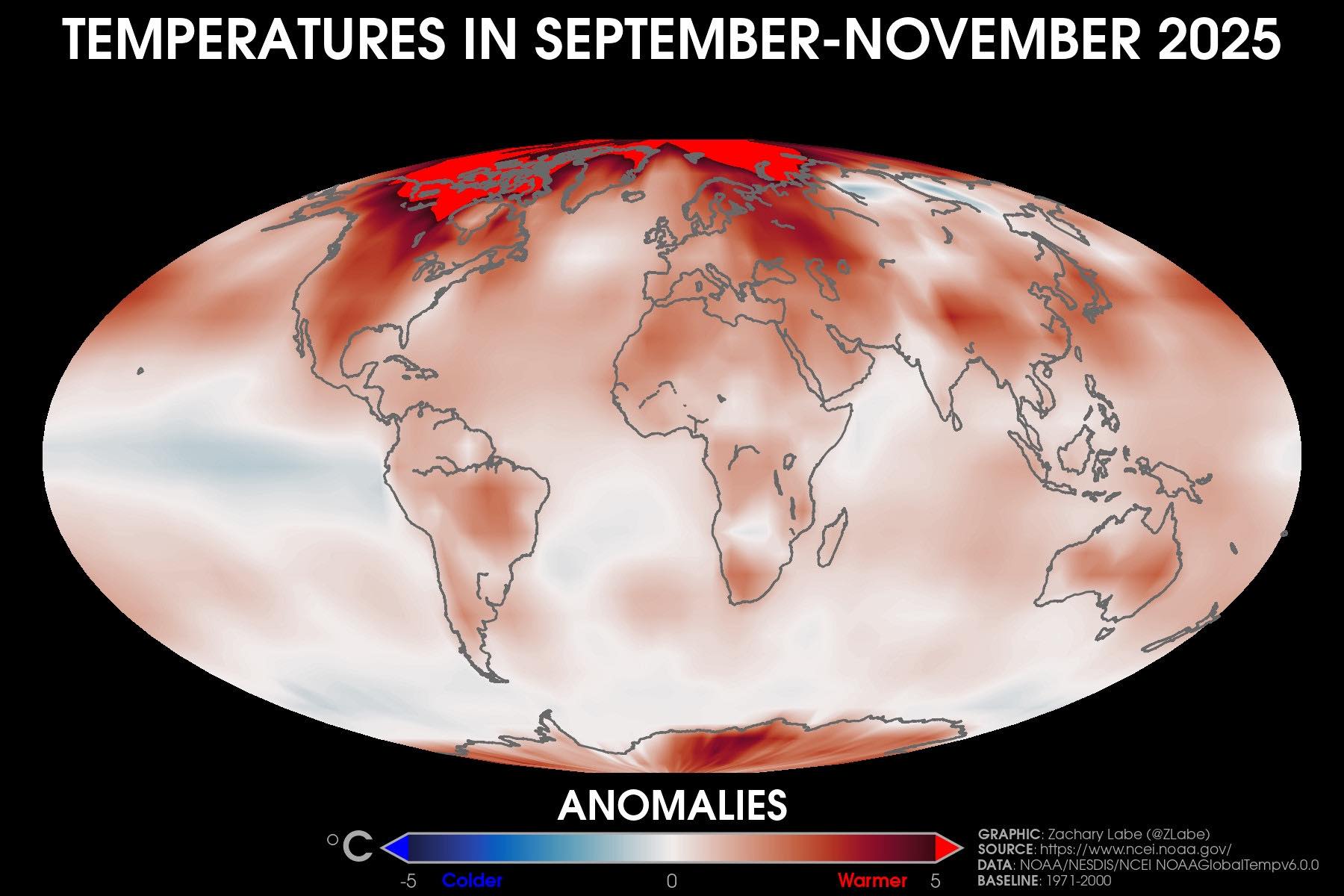
Q3 2025: Extreme Global Temperature Anomalies

Autumn (September–November) climate data reveal two features that matter far more than the global average: what is happening at the poles and what is happening at the equator.

Both the Arctic and Antarctic are experiencing record-breaking temperatures—warming at rates up to 20 times faster than much of the rest of the planet, visible as deep red anomalies on global maps. This extreme polar amplification is not a regional curiosity; it is destabilizing the foundational circulation systems that regulate Earth’s climate, including the jet stream, the Atlantic Meridional Overturning Circulation (AMOC), and the Pacific Meridional Overturning Circulation (PMOC).

As a direct consequence, the Northeastern United States is now experiencing sharp climate whiplash: record cold conditions this week, followed by unseasonably warm temperatures days later. These are not random swings—they are signatures of a circulation system that is losing coherence.

The Poles: Where Climate Change Is Accelerating Fastest

The polar regions act as the planet’s thermal anchors. Normally, the large temperature contrast between the equator and the poles powers a fast, stable jet stream and robust ocean circulation. But as the Arctic warms nearly four times faster than the global average, and Antarctic ice loss accelerates, that temperature gradient is collapsing.

With less contrast to drive it, the jet stream weakens and becomes increasingly wavy and prone to stalling. This allows weather patterns to linger—producing prolonged heatwaves, extended cold outbreaks, persistent flooding, and flash droughts. At the same time, freshwater from polar melt is disrupting deep-water formation in the North Atlantic, weakening the AMOC and altering global heat transport.

The Equator: The Illusion of Cooling

The other key feature in the data is a small blue patch along the equatorial Pacific—a weak La Niña signal. This localized cooling will likely prevent 2025 from being recorded as the single hottest year on record by slightly suppressing the global mean temperature.

But this is precisely where the global average becomes misleading.

Oceans absorb the vast majority of excess heat and require far more energy to warm than air or land. A small cooling anomaly in the tropical Pacific can therefore offset massive heating elsewhere in the global average—especially at the poles—without reducing actual climate risk.

In other words, the planet can appear “less hot” on paper while becoming far more dangerous in reality.

Why “Global Average Temperature” Misleads

A 3 °C increase in the global average temperature sounds abstract and manageable. In reality, it masks extreme regional outcomes that determine human survivability.

  • The Arctic is already warming more than four times faster than the global mean, with localized increases exceeding 10 °C. In 2025, parts of the Arctic are running as much as 20 °C above normal.

  • Land and air temperatures rise far faster than ocean averages.

  • Human limits are governed not by global means, but by regional extremes and wet-bulb temperatures—the point at which heat and humidity overwhelm the body’s ability to cool itself.

When policymakers talk about “holding warming below 1.5 °C,” they are referring to a blended average across oceans, land, and atmosphere. But oceans absorb over 90% of the excess heat trapped by greenhouse gases, heavily damping the apparent rise in the global mean.

This creates a dangerous illusion of control.

The Ocean Heat Mask

Recent deep-ocean studies show that even the deepest layers of the ocean are warming. A change of just 0.1 °C in ocean temperature represents an enormous amount of stored energy. If that heat were redistributed over land, it would be equivalent to roughly a 35 °C increase—a level incompatible with large-scale human survival.

The oceans are acting as a temporary buffer, hiding the true magnitude of warming while simultaneously destabilizing themselves through:

  • Increased stratification

  • Slowing circulation

  • Oxygen loss

  • Ecosystem collapse

During 2025, the Pacific Ocean has been running approximately 1.6 °C above its long-term average—a deviation of six standard deviations above the mean. In climate science, values this far from normal variability are essentially off the charts.

The Thresholds That Matter

Two temperature thresholds now demand urgent attention:

  • ~1.5 °C global average warming
    This marks the widespread activation of major climate tipping points—ice sheet instability, circulation slowdown, ecosystem collapse.

  • ~9 °C land and air warming
    This represents the upper boundary of human physiological survivability across much of the planet.

These are not distant, theoretical limits. They are rapidly approaching—and in some regions, already being exceeded.

The climate crisis is no longer about slow, linear warming. It is about where the heat is accumulating, how it is destabilizing Earth’s life-support systems, and how misleading averages are masking the speed and severity of the transformation now underway.

* Our probabilistic, ensemble-based climate model — which incorporates complex socio-economic and ecological feedback loops within a dynamic, nonlinear system — projects that global temperatures are becoming unsustainable this century. This far exceeds earlier estimates of a 4°C rise over the next thousand years, highlighting a dramatic acceleration in global warming. We are now entering a phase of compound, cascading collapse, where climate, ecological, and societal systems destabilize through interlinked, self-reinforcing feedback loops.

We examine how human activities — such as deforestation, fossil fuel combustion, mass consumption, industrial agriculture, and land development — interact with ecological processes like thermal energy redistribution, carbon cycling, hydrological flow, biodiversity loss, and the spread of disease vectors. These interactions do not follow linear cause-and-effect patterns. Instead, they form complex, self-reinforcing feedback loops that can trigger rapid, system-wide transformations — often abruptly and without warning. Grasping these dynamics is crucial for accurately assessing global risks and developing effective strategies for long-term survival.

Tipping points and feedback loops drive the acceleration of climate change. When one tipping point is breached and triggers others, the cascading collapse is known as the Domino Effect.

The Climate Crisis: Violent Rain | Deadly Humid Heat | Health Collapse | Extreme Weather Events | Insurance | Trees and Deforestation | Rising Sea Level | Food and Water

The Human Induced Climate Change Experiment

Runaway Feedbacks: Can Earth Warm 9°C This Century?