The two most important components of US fiscal and monetary policy are the national debt and the Federal Reserve’s ‘Credit and Liquidity Programs and the Balance Sheet’.
National Debt
The national debt of the United States has increased significantly under both Republican and Democratic administrations, although the contributing factors have varied. Under Republican presidents, Ronald Reagan’s administration saw the debt rise by over $1.6 trillion due to tax cuts and increased military spending. George W. Bush added about $5.8 trillion to the debt, driven by tax cuts, the costs of the wars in Afghanistan and Iraq, and the financial crisis of 2008. Donald Trump’s presidency further increased the debt by approximately $7.8 trillion, influenced by the 2017 tax cuts and the response to the COVID-19 pandemic.
In contrast, Democratic presidents have also seen substantial increases. During Bill Clinton’s tenure, budget surpluses were achieved in later years, but the national debt still grew. Under Barack Obama, the debt rose by around $9.3 trillion, largely due to economic stimulus measures following the Great Recession, including the American Recovery and Reinvestment Act. The debt increase continued under Joe Biden, with significant spending on COVID-19 relief measures, including the American Rescue Plan.
Comparatively, the debt increased by approximately $15.2 trillion under Republican administrations (Reagan, Bush, and Trump) and by about $9.3 trillion under Democratic administrations (Obama and Biden), with Clinton achieving a relative fiscal balance during his presidency. This comparison underscores that both parties have contributed to the growing national debt, often influenced by external crises and policy choices.
Federal Reserve’s ‘Credit and Liquidity Programs and the Balance Sheet’
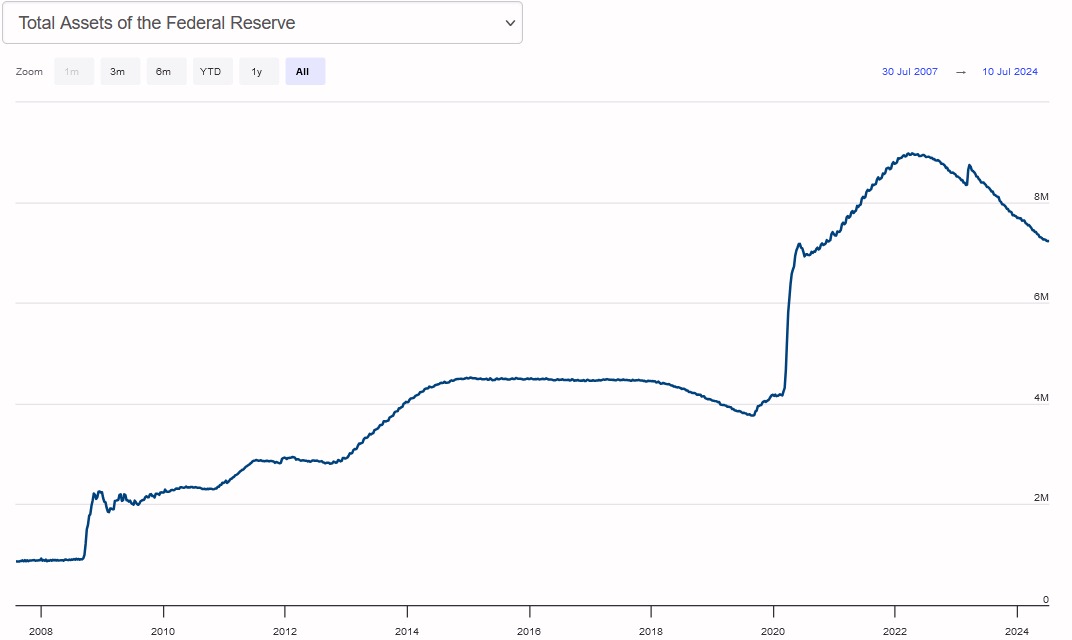
When the Federal Reserve ‘prints money’ (quantitative easing) to buy treasury securities, it acts as a money multiplier. To start with, the Fed shouldn’t own any treasury securities for the long-term. However, two times in the past the Fed has created $4 trillion dollars to buy assets. The first $4 trillion quantitative easing started in August of 2006 under President George W. Bush. The second $4 trillion round of quantitative easing began in August of 2019 under President Donald Trump. The combined $8 trillion dollars in quantitative easing is further exacerbated by the ‘money multiplier effect’. The end result of quantitative easing exacerbates the national debt. Additionally, the printing of money is one of the most significant drivers of inflation, as it increases the money supply and can lead to higher prices across the economy.
“Perhaps most importantly is the repeated use of the phrase ‘Drill, Baby, Drill’.”
Economic Update:
If Trump wins, great news for the very few people whose primary income comes from government securities interest! Unfortunately, very, very bad news for everyone else.
Tariffs, protectionism, lack of immigration, and nationalism are all detrimental to the economy. Tariffs and protectionist policies can lead to trade wars, higher consumer prices, and disruptions in the supply chain, which can stifle economic growth. Limiting immigration reduces the labor force and can slow down innovation and productivity, as immigrants often contribute significantly to economic dynamism. Nationalism can lead to isolationist policies that hinder international cooperation and trade, further damaging the economy. Over the last several years, approximately 80% of economic growth can be attributed to immigration.
Should Trump win, there is a concern that the U.S. may face economic decline similar to his six personal bankruptcies. His previous administration’s policies on tariffs, immigration restrictions, and nationalist rhetoric have already shown signs of economic strain. Continued implementation of such policies could exacerbate these issues, leading to a weakened economy and reduced global competitiveness for the U.S. It is crucial to adopt inclusive and cooperative economic strategies to foster sustainable growth and stability.
Interest rates are likely to spike and remain high for an extended period. In 2019, under the Trump administration, the Federal Reserve balance sheet saw a massive increase of $4 trillion in a very short period. This unprecedented expansion of the money supply, combined with the administration’s tax cuts and significant government spending, contributed to record inflation levels. The rapid increase in the money supply, aimed at stimulating the economy, led to an oversupply of currency, diminishing its value and driving prices up.
Federal Reserve’s Balance Sheet / Assets
The former President has also made claims that he will lower interest rates if he returns to office. The good news is that he doesn’t have the authority to directly lower rates, as this is the Federal Reserve’s responsibility. However, what used to be reassuring news is now less so. With the rollback of Chevron regulations, potential economic instability could lead to disastrous consequences, including further inflationary pressures and financial market disruptions.
Additionally, the tax cuts, while boosting short-term economic growth, significantly reduced federal revenue, leading to increased borrowing and higher national debt. The substantial government spending further exacerbated this issue, creating a fiscal environment prone to inflation. As a result, the Federal Reserve had to raise interest rates to combat inflation and stabilize the economy.
High interest rates can slow down economic growth by making borrowing more expensive for consumers and businesses, potentially leading to reduced investments and spending. This can create a challenging economic environment, underscoring the need for balanced fiscal policies that promote sustainable growth without leading to excessive inflation.
The former President recently stated that he wants a ‘weaker dollar.’ A devalued dollar on international markets can lead to numerous economic challenges, including significant impacts on inflation and interest rates. A weaker dollar makes U.S. exports cheaper and more competitive abroad, potentially boosting manufacturing and trade. However, it also increases the cost of imports, leading to higher prices for consumer goods and contributing to inflation.
Additionally, a weaker dollar can affect interest rates as the Federal Reserve may adjust monetary policy to manage inflationary pressures, impacting borrowing costs for consumers and businesses. Another concern is the impact on foreign investment. Treasury securities are popular among foreign investors because they are considered a safe investment. However, if the dollar devalues, the return on these investments may decrease when converted back to the investor’s local currency. To attract foreign investment despite the weaker dollar, the U.S. may need to offer higher interest rates on Treasury securities.
These economic landmines highlight the complexities and potential risks associated with currency devaluation.
Perhaps most importantly is the repeated use of the phrase ‘Drill, Baby, Drill’. The phrase encapsulates a harmful approach to energy policy that prioritizes fossil fuel extraction over sustainable practices. Climate change, exacerbated by such policies, poses the most severe threat not only to our environment but also to our economy.
In 2023, the U.S. experienced a record number of climate disasters, each exceeding one billion dollars in damages, with a total of 28 separate weather and climate-related events. Some of these individual events cost the U.S. economy hundreds of billions of dollars. The frequency and severity of these events are alarming, reflecting the accelerating pace of climate change.
The economic impact of climate change is expected to be staggering, with projections indicating it could cost the U.S. economy trillions of dollars. The financial burdens arise from various sources, including the destruction of infrastructure, increased healthcare costs due to climate-related illnesses, disruptions to agriculture and food supply, and the need for extensive disaster relief and recovery efforts. One of the primary drivers of the current inflation spike is the rising cost of homeowners insurance due to climate disaster-related claims. Short sellers anticipate that within ten years, 25% of U.S. properties will be uninsurable. These costs will continue to rise unless significant measures are taken to mitigate climate change and transition to a more sustainable energy system.
Moreover, the long-term economic effects of climate change can hinder economic growth, reduce productivity, and increase social inequalities. Proactive investments in renewable energy, climate resilience, and sustainable practices are essential to curtail the financial and environmental impacts of climate change. These measures are crucial to protect both the environment and the economy from the devastating impacts of climate change.
The Federal Reserve chairman was questioned in Congress today about the potential impacts of the ‘Chevron Decision’ on the Fed. Although he mentioned that it was too early to determine the full effects, he acknowledged that numerous frivolous lawsuits could become a significant hindrance. This uncertainty clearly poses challenges for the future stability of our economy. It was not a reassuring day for economic prospects.
The Chevron Decision refers to the landmark Supreme Court case Chevron U.S.A., Inc. v. Natural Resources Defense Council, Inc. (1984). This decision established the principle of judicial deference to administrative agencies’ interpretations of ambiguous statutes that they administer. The ruling essentially meant that courts should defer to agencies’ expertise unless their interpretations are unreasonable.
However, recent shifts in judicial philosophy and subsequent rulings, often termed “Chevron deference rollback,” seek to limit this deference. This change could significantly impact how agencies, including the Federal Reserve, operate.
Here’s how the erosion of Chevron deference could result in lawsuits every time the Federal Reserve makes a decision:
1. Increased Legal Challenges
Without Chevron deference, every decision or rule made by the Federal Reserve that involves interpreting ambiguous statutes could be more easily challenged in court. Previously, courts would defer to the Fed’s expertise, but now, they might feel more empowered to overrule the Fed’s interpretations. This invites more lawsuits from parties who disagree with the Fed’s decisions.
2. Reduced Predictability and Stability
Chevron deference provided a level of predictability and stability, as agencies knew their interpretations would likely be upheld if reasonable. With this predictability diminished, every decision becomes a potential legal battleground. This can disrupt the consistency and effectiveness of the Fed’s policies, as they could be constantly tied up in litigation.
3. Resource Strain
The Federal Reserve would likely face a significant increase in legal challenges, requiring more resources to defend its decisions in court. This could divert time, money, and effort away from its primary functions of managing monetary policy, regulating banks, and ensuring financial stability.
4. Policy Hesitation
Knowing that decisions could be frequently overturned, the Fed might become more hesitant or conservative in its policy-making. This could stifle innovation and responsiveness in addressing economic issues, as the fear of legal repercussions might outweigh the need for proactive measures.
Example Scenario
Imagine the Federal Reserve decides to implement a new regulation on bank capital requirements based on its interpretation of an ambiguous provision in the Dodd-Frank Act. Without Chevron deference, banks could challenge this interpretation in court, arguing that the Fed overstepped its authority. If the court agrees, the regulation could be struck down, leading to regulatory uncertainty and potentially undermining financial stability.
Conclusion
The potential rollback of Chevron deference could expose the Federal Reserve to frequent lawsuits over its interpretive decisions, hampering its ability to effectively manage the economy. This shift could lead to a more contentious and litigious regulatory environment, challenging the Fed’s authority and efficiency.
Chevron Deference Rollback and the Environment
In June 2024, the Supreme Court significantly expanded its authority and severely curtailed the Environmental Protection Agency’s (EPA) ability to enforce environmental protection laws. This ruling represents a dramatic shift in the balance of power, undermining decades of regulatory progress aimed at mitigating environmental damage and climate change. The court’s decision essentially nullifies the EPA’s mandate to regulate emissions and enforce compliance with existing environmental standards.
This judicial overreach is viewed by many as an act of arrogance and ignorance, resulting in a scenario where “worst-case” predictions for climate change have become the “best-case” expectations. The ramifications of this decision are dire, prompting a revision of climate models to reflect a much grimmer outlook. The new projections indicate a potential maximum global temperature increase of 9°C within this century, a stark rise from the previously estimated 4°C over the next millennium.
Such an unprecedented increase in global temperatures would push Earth toward a wet-bulb temperature threshold that is incompatible with human life. Wet-bulb temperature, which combines heat and humidity, represents a critical limit beyond which the human body can no longer effectively cool itself through perspiration, leading to potentially fatal heat stress.
The two major contributors to today’s inflation that a President can influence are insufficient immigration and federal budget deficits. Both Trump and Biden administrations have played significant roles in these issues.
Through May of 2024, average hourly wage growth has exceeded inflation for 12 straight months.
Economic Facts on Inflation and Wage Inflation
Current Impacts of Wage Inflation
1. Increased Consumer Prices: Wage inflation leads to higher costs for businesses, which often pass these costs onto consumers in the form of higher prices for goods and services. This contributes to overall inflation, affecting the purchasing power of consumers.
Consumer Price Index (CPI): Rising wages can lead to an increase in the Consumer Price Index, a measure of the average change over time in the prices paid by urban consumers for a market basket of consumer goods and services. When wages increase significantly, the CPI often follows suit.
Examples: Recent data has shown significant price increases in various sectors, including food, housing, and healthcare, driven in part by higher labor costs .
2. Business Profit Margins: Higher wages can squeeze profit margins for businesses, particularly in labor-intensive industries. Companies may face challenges in maintaining profitability if they cannot pass the increased costs onto consumers.
Impact on Small Businesses: Small businesses, which often operate with thinner profit margins, may struggle more than larger corporations to absorb the increased costs associated with wage inflation. This can lead to reduced hiring or even business closures in extreme cases .
Corporate Responses: Larger corporations might respond by investing in automation and technology to reduce dependency on human labor, thereby mitigating the impact of wage inflation on their bottom lines .
3. Employment and Job Market Dynamics: Wage inflation can have mixed effects on the job market. While higher wages can attract more workers and reduce turnover, they can also lead to cost-cutting measures such as layoffs or reduced hiring.
Job Cuts and Automation: Some businesses may reduce their workforce or turn to automation to manage increased labor costs. This can result in job losses or slower job growth in certain sectors .
Labor Force Participation: On the positive side, higher wages can draw more individuals into the labor force, potentially reducing unemployment rates and increasing overall economic productivity .
4. Economic Inequality: Wage inflation can impact income inequality in various ways. While higher wages can improve living standards for low- and middle-income workers, the overall benefits may be unevenly distributed.
Living Wage Increases: Efforts to raise the minimum wage or provide living wages can significantly benefit low-income workers, improving their economic stability and reducing poverty levels .
Disparities: However, wage inflation can exacerbate disparities if high-wage sectors see more significant increases compared to low-wage sectors, potentially widening the gap between high and low earners .
Economics of Immigration and Wage Inflation
1. Wage Inflation as a Driver of Overall Inflation: Wage inflation occurs when wages increase, leading to higher costs for businesses, which often pass these costs onto consumers through higher prices for goods and services. This process contributes to overall inflation, which is the rate at which the general level of prices for goods and services rises.
Impact on Businesses: When wages increase, businesses face higher labor costs. To maintain profitability, they may increase the prices of their products or services, contributing to inflation.
Consumer Purchasing Power: As prices rise, the purchasing power of consumers can decrease unless wage growth keeps pace with inflation. This dynamic can create a cycle where higher wages lead to higher prices, which then necessitate further wage increases.
2. Insufficient Immigration as a Contributor to Wage Inflation: Immigration plays a critical role in the labor market by providing a supply of workers that can help meet demand in various industries. When immigration levels are insufficient, it can lead to labor shortages, which in turn drive up wages as employers compete for a limited pool of workers.
Labor Market Dynamics: A decrease in immigration can exacerbate labor shortages in key industries such as agriculture, construction, and healthcare. This shortage forces employers to offer higher wages to attract and retain workers.
Economic Growth: Insufficient immigration can limit economic growth by restricting the labor force available to support business expansion and innovation. This constraint can lead to increased costs for businesses and higher prices for consumers.
Sources and Further Reading:
Wage Inflation and Its Impact:
Federal Reserve Bank of San Francisco. (2022). “Wage Growth and Inflation: Insights from Economic Research.”
U.S. Bureau of Labor Statistics. (2023). “Wage Growth and Its Implications for Inflation.”
Immigration and Labor Market:
National Bureau of Economic Research. (2021). “The Effects of Immigration on the United States Economy.”
Pew Research Center. (2022). “U.S. Immigration Trends and Workforce Impact.”
Expanded Explanation
Wage Inflation as a Top Driver of Overall Inflation:
Economic Theory: According to the cost-push inflation theory, when wages rise, production costs for companies increase. These companies, in turn, raise prices to maintain profit margins, leading to higher overall inflation.
Historical Context: Historical data shows periods where wage increases have led to significant inflationary pressures, such as during the 1970s in the United States, a time characterized by high inflation and wage growth.
Insufficient Immigration and Its Role in Wage Inflation:
Labor Supply: Immigration contributes to the labor supply, particularly in sectors that rely heavily on immigrant workers. When immigration is restricted, these sectors face labor shortages, pushing wages higher.
Economic Integration: Immigrants often take jobs that are complementary to those held by native-born workers, enhancing productivity and economic growth. Insufficient immigration can disrupt this balance, leading to inefficiencies and higher costs.
Policy Implications: Policies that restrict immigration can have unintended consequences on the labor market and inflation. Understanding the balance between immigration and wage dynamics is crucial for policymakers aiming to manage inflation and economic growth effectively.
By examining these factors, it becomes clear that both wage inflation and immigration policies play significant roles in shaping the economic landscape, influencing both inflation and broader economic performance.
How Federal Budget Deficits Impact Inflation
The federal budget deficit has increased under both Trump and Biden due to a combination of tax cuts, increased spending, and the economic impact of the COVID-19 pandemic. While Trump’s administration saw a significant increase in the deficit due to tax cuts and pandemic relief measures, Biden’s administration has continued high levels of spending on recovery and infrastructure.
1. Increased Aggregate Demand: Federal budget deficits typically occur when government spending exceeds revenue. This increased government spending can boost aggregate demand in the economy, leading to higher prices if the economy is operating near or at full capacity.
Demand-Pull Inflation: When government expenditures increase, it injects more money into the economy. If this additional demand outstrips the economy’s ability to produce goods and services, it can lead to demand-pull inflation, where the overall demand in the economy exceeds the supply, causing prices to rise .
2. Higher Interest Rates: To finance a budget deficit, the government often borrows money by issuing bonds. This increased demand for borrowing can drive up interest rates, as the government competes with the private sector for available funds.
Crowding Out Effect: Higher interest rates can make borrowing more expensive for businesses and consumers, potentially leading to reduced investment and spending in the private sector. This can mitigate some of the inflationary pressures but can also slow economic growth .
3. Money Supply and Monetary Policy: If the central bank (e.g., the Federal Reserve in the United States) accommodates the deficit by increasing the money supply, this can lead to inflation. An increased money supply can reduce the value of money, causing prices to rise.
Monetary Policy Response: Central banks may respond to fiscal deficits by tightening monetary policy, such as raising interest rates to combat inflation. This can help control inflation but may also slow down economic growth .
4. Inflation Expectations: Persistent budget deficits can influence inflation expectations. If businesses and consumers expect higher future inflation due to continued deficit spending, they may adjust their behavior accordingly, such as demanding higher wages or increasing prices.
Expectations and Behavior: Inflation expectations can become self-fulfilling. If workers expect higher inflation, they might demand higher wages, leading businesses to raise prices to cover these higher costs, thus perpetuating inflation .
Politicians in conservative, rural parts of the USA have often hindered progress in the fight against climate change due to several reasons:
1. Denial of Climate Science
Many conservative politicians in rural areas deny the existence or severity of climate change, dismissing it as a hoax or exaggerated. This denial stems from skepticism about scientific consensus and the influence of fossil fuel industries.
Example: Some politicians have publicly questioned the validity of climate science, which undermines efforts to implement necessary policies to address climate change .
2. Legislative Actions
Conservative lawmakers have taken legislative actions that block or roll back environmental regulations. This includes efforts to:
Weaken EPA Regulations: Attempting to reduce the power and funding of the Environmental Protection Agency (EPA), which is responsible for enforcing environmental laws and regulations .
Oppose Renewable Energy Initiatives: Blocking or limiting subsidies and incentives for renewable energy projects such as wind and solar power, which are essential for reducing greenhouse gas emissions .
3. Support for Fossil Fuels
Many conservative politicians support the fossil fuel industry, which is a significant contributor to climate change. This support manifests in various ways:
Subsidies and Tax Breaks: Providing substantial subsidies and tax breaks to coal, oil, and gas companies, making it financially easier for them to continue their operations .
Blocking Clean Energy Legislation: Opposing legislation that aims to reduce carbon emissions or promote clean energy alternatives. This includes resisting carbon pricing mechanisms like carbon taxes or cap-and-trade systems .
4. Cultural and Economic Factors
In many rural areas, fossil fuel industries are major employers and economic contributors. Politicians in these regions often prioritize short-term economic gains over long-term environmental benefits.
Job Protection: Fear of job losses in coal mining, oil drilling, and related industries leads politicians to resist policies that might threaten these jobs, despite the potential for green jobs in renewable energy sectors .
Cultural Identity: There is a strong cultural attachment to traditional industries and a skepticism towards perceived “elite” climate policies that are seen as disconnected from rural realities .
5. Public Opinion
Public opinion in many conservative, rural areas tends to be less supportive of climate change policies compared to urban or liberal areas. Politicians often reflect the views of their constituents.
Voter Pressure: Politicians face pressure from their voter base to oppose climate action, particularly when climate policies are framed as harmful to the local economy or way of life .
Conclusion
The combination of climate change denial, legislative actions that favor fossil fuels, cultural and economic priorities, and public opinion in conservative, rural areas of the USA has significantly hindered progress in the fight against climate change. Addressing these challenges requires a multifaceted approach, including education, economic transition plans for affected communities, and bipartisan cooperation to develop sustainable solutions.
The Need for Urgency
Previous climate models have inadequately incorporated “social-ecological systems” as human involvement was not a significant factor in past climate changes. Regrettably, the United States ranks among the least prepared countries globally, with the highest percentage of climate deniers. The Republican party dismisses it as a manufactured crisis and plans to increase fossil fuel production, exacerbating the situation. Political extremists asserting that the climate crisis is manufactured employ an ironic term, considering that human manufacturing activities are the primary driver of climate change. Both political parties have concurred to allocate unlimited emergency funding for climate disasters instead of proactively preventing them. Last year, the US witnessed a record number of over a billion-dollar climate disasters, totaling 28 separate weather and climate-related events. It is due to this arrogance and ignorance that “worst-case scenarios” are now “best-case scenarios” for the acceleration of climate change. These factors have altered our climate model, shifting the projected maximum temperature rise from 4 degrees Celsius over the next millennium to a probable increase of 9 degrees Celsius this century.
Human-induced climate change is a dynamic component of an intricate and unordered system, as per chaos theory. This implies that global warming is accelerating exponentially in a complex manner. Over the period from 1992 to 2023, we have presented compelling evidence, proposed remedies to mitigate climate change, and amassed valuable information through the engagement of millions with this climate model. Your participation has been invaluable. The incontrovertible data underscores that human-induced climate change is rapidly deteriorating our habitat.
Our climate model / experiment employs chaos theory to comprehensively consider human impacts and projects a potential global average temperature increase of 9℃ above pre-industrial levels. Global warming is a consequence of elevated thermal energy in the climate system, which comprises various subsystems. Chaos theory underscores the intricate and nonlinear nature of dynamic systems. Human well-being is compromised above a 1.5-degree temperature rise, rendering much of the Earth uninhabitable. A 9-degree Celsius increase would bring the Earth close to a wet-bulb temperature incapable of sustaining human life.
The Guardian reports, “Many of the scientists envisage a ‘semi-dystopian’ future, with famines, conflicts and mass migration, driven by heatwaves, wildfires, floods and storms of an intensity and frequency far beyond those that have already struck.”
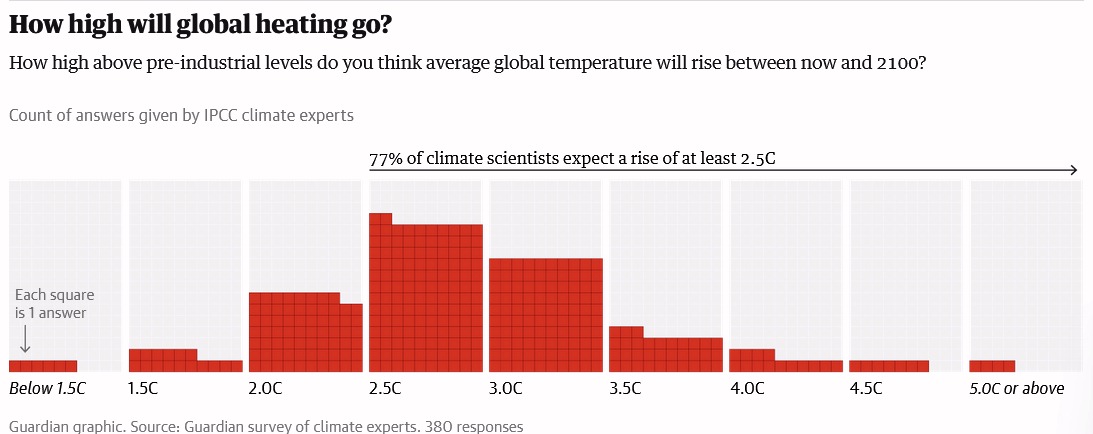
In a recent survey of climate scientists, the consensus suggests that global warming is on track to exceed 2.5 degrees Celsius this century, with some projections indicating a rise of over 5 degrees.
“I foresee significant societal upheaval within the next five years,” stated Gretta Pecl from the University of Tasmania. “We’ll face overwhelming challenges as extreme events become the norm, disrupting food production and beyond. The future seems increasingly bleak.”
Peter Cox from the University of Exeter emphasized, “Climate change isn’t waiting to become dangerous at 1.5 degrees Celsius – it already poses severe risks. Surpassing 2 degrees Celsius won’t signal ‘game over,’ but the urgency for action is dire.”
Nathalie Hilmi, representing the Monaco Scientific Centre, echoed the sentiment, asserting, “Limiting warming to 1.5 degrees Celsius is imperative. We cannot afford to exceed this threshold.”
The experts unanimously stressed the urgent need for extensive preparations to safeguard communities from impending climate catastrophes. Leticia Cotrim da Cunha from the State University of Rio de Janeiro expressed deep concern, particularly regarding the potential human toll.
The 1.5 degrees Celsius target, intended to avert the worst impacts of the climate crisis, has served as a crucial reference point in global climate negotiations. However, with current policies setting the world on a trajectory for around 2.7 degrees Celsius of warming, the survey indicates widespread skepticism among IPCC experts regarding the likelihood of sufficient action to curb emissions.
Litigation seeking compensation for loss and damage caused by the actions of oil companies and governments has the potential to reshape global economics. In the past year, several legal rulings have held governments accountable for their role in exacerbating the climate crisis, signaling a shift in legal accountability and prompting broader discussions on environmental responsibility.
The latest example, on May 3, 2024, a High Court judge delivered a significant ruling, declaring the U.K. government’s actions unlawful in approving a climate plan aimed at meeting crucial emission reduction targets without sufficient evidence of its feasibility. This marked the second occasion in two years where the government’s primary climate strategy faced legal challenge and was deemed inadequate in aligning with legally-binding commitments to curb greenhouse gas emissions.
Justice Clive Sheldon’s decision, following a case brought forth by three environmental organizations, underscored the government’s failure to substantiate its approval of the Carbon Budget Delivery Plan from the previous year. The judge concluded that the government lacked justification and the plan was “simply not justified by the evidence.”
Tipping points are Critical Milestones that directly impact the rate of acceleration in climate change by multiplying the number and intensity of feedback loops. Identifying and understanding these tipping points is crucial for climate science and policymaking. Crossing multiple tipping points could lead to a domino effect, resulting in a much more rapid and severe climate change than currently projected.
A look at nine (9) of the multiple tipping points that are in play during 2024. The first dominoes have fallen and will continue to knock down more tiles with each escalating step. The crossing of these nine climate tipping points represents a critical threshold in the Earth’s climate system, with potentially irreversible consequences for global ecosystems and human societies:
Greenland Ice Sheet Collapse: The melting of the Greenland Ice Sheet has accelerated in recent years, leading to increased rates of ice loss and sea level rise. As glaciers retreat and ice shelves collapse, vast quantities of freshwater enter the ocean, disrupting marine ecosystems and contributing to global sea level rise.
West Antarctic Ice Sheet Collapse: Similar to Greenland, the West Antarctic Ice Sheet is experiencing rapid melting and destabilization. The collapse of this ice sheet has the potential to raise sea levels by several meters, inundating coastal areas and triggering widespread impacts on infrastructure, agriculture, and human populations.
Labrador-Irminger Seas/SPG Convection Collapse: The collapse of convection in the Labrador-Irminger Seas, part of the North Atlantic Ocean, could disrupt the Atlantic Meridional Overturning Circulation (AMOC). This circulation pattern plays a crucial role in regulating global climate and ocean circulation, influencing weather patterns and heat distribution worldwide.
East Antarctic Subglacial Basins Collapse: The East Antarctic Ice Sheet contains vast quantities of ice, much of which is grounded below sea level. The collapse of subglacial basins in East Antarctica could lead to rapid ice loss and contribute to sea level rise, with potentially far-reaching consequences for coastal regions and global climate stability.
Arctic Winter Sea Ice Collapse: Arctic sea ice has been declining rapidly in extent and thickness due to rising temperatures. The loss of winter sea ice in the Arctic not only accelerates regional warming but also affects global weather patterns, ocean circulation, and biodiversity in the Arctic ecosystem.
East Antarctic Ice Sheet Collapse: While traditionally considered more stable than its western counterpart, the East Antarctic Ice Sheet is also vulnerable to collapse under continued warming. The disintegration of ice shelves and glaciers in East Antarctica could significantly contribute to sea level rise and alter ocean circulation patterns.
Amazon Rainforest Dieback: Deforestation, drought, and climate change threaten the resilience of the Amazon Rainforest, the world’s largest tropical rainforest. The dieback of the Amazon could result in decreased rainfall, increased carbon emissions, and loss of biodiversity, impacting regional and global climate systems.
Boreal Permafrost Collapse: Permafrost in the northern regions of the globe contains vast stores of carbon in the form of frozen organic matter. As permafrost thaws due to rising temperatures, it releases greenhouse gases such as methane and carbon dioxide, further exacerbating climate change and creating a feedback loop of increased warming.
Atlantic Meridional Overturning Circulation Collapse: The collapse of the AMOC, driven by changes in ocean temperature and salinity, could have profound consequences for global climate stability. Disruption of this circulation pattern could lead to abrupt shifts in weather patterns, including changes in temperature, precipitation, and ocean currents, with far-reaching impacts on ecosystems and human societies.
The crossing of these tipping points underscores the urgent need for decisive action to mitigate climate change and adapt to its impacts. Without concerted efforts to reduce greenhouse gas emissions and protect vulnerable ecosystems, the consequences of these tipping points could pose significant challenges to the well-being of present and future generations.
Climate change is primarily driven by the escalation of thermal energy affecting biogeophysical and socio-economic systems. While biogeophysical factors can be studied using math, physics, and historical records, socio-economic systems pose greater challenges due to the unpredictable consequences of human behavior and inexplicable consumer choices.
Inexplicable consumer behavior in the face of known consequences of anthropogenic climate change can manifest in various ways. Some examples include:
Excessive Consumption: Despite awareness of the environmental impact of overconsumption, some individuals continue to engage in excessive buying behaviors, contributing to resource depletion, waste generation, and carbon emissions.
Preference for Non-sustainable Products: Despite the availability of sustainable alternatives, some consumers may choose products with high environmental footprints due to perceived convenience, lower cost, or brand loyalty, ignoring the long-term consequences.
Disregard for Energy Efficiency: Despite the availability of energy-efficient appliances and technologies, some consumers may prioritize other factors (e.g., aesthetics, initial cost) over energy savings, leading to higher energy consumption and greenhouse gas emissions.
Single-Use Plastic Consumption: Despite widespread knowledge of the detrimental effects of single-use plastics on the environment, some consumers continue to use disposable plastic products excessively, contributing to plastic pollution in oceans and ecosystems.
Inefficient Transportation Choices: Despite awareness of the environmental impact of fossil fuel-powered vehicles, some consumers may prefer inefficient modes of transportation (e.g., driving alone in gas-guzzling vehicles) over sustainable alternatives (e.g., public transit, biking, walking).
Food Waste: Despite understanding the environmental consequences of food waste, some consumers may continue to waste food due to overbuying, improper storage, or disregard for expiration dates, contributing to greenhouse gas emissions from landfills.
Fast Fashion Consumption: Despite awareness of the environmental and social impacts of fast fashion, including water pollution, chemical usage, and labor exploitation, some consumers continue to support the industry by purchasing cheap, disposable clothing.
Reluctance to Adopt Sustainable Practices: Despite increasing awareness of sustainable living practices (e.g., recycling, composting, reducing meat consumption), some consumers may be resistant to change due to inertia, lack of knowledge, or perceived inconvenience.
These examples illustrate how consumer behavior can sometimes defy logic or go against the imperative of addressing climate change and environmental degradation. Addressing these behaviors often requires a combination of education, policy interventions, market incentives, and societal norms to encourage more sustainable choices.
A significant factor contributing to both increased costs and decreased availability of homeowners insurance is climate change. The surge in insurance costs is primarily driven by the unprecedented number of climate-related disasters. States like California, Louisiana, and Florida now heavily rely on government aid to manage the financial burdens associated with residential property insurance.
In 2023, the United States faced 28 separate weather and climate disasters, each costing at least 1 billion dollars, marking it as the year with the highest number of billion-dollar disasters on record. Single extreme weather events are also becoming more costly. Hurricane Ida alone caused an estimated $75 billion in damages, making it the costliest disaster of 2021. Insurers paid out a staggering $99 billion in claims related to natural disasters in 2022, leading to a substantial 21 percent increase in premiums from May 2022 to May 2023.
The rising premiums aren’t just a matter of cost; it’s also becoming increasingly difficult to find coverage, especially in disaster-prone areas. Major insurers are reconsidering where they underwrite policies, with some, like State Farm General Insurance Company, halting the acceptance of new applications for property insurance due to rapidly growing catastrophe exposure.
Government officials have acknowledged the link between the availability of homeowners insurance and climate change. Ohio Senator Sherrod Brown and US Treasury Secretary Janet Yellen have both highlighted the decline in insurance affordability and availability due to more frequent and severe natural disasters.
Even regions traditionally less prone to disasters are experiencing insurance challenges. The reinsurance market, influenced by events worldwide, impacts rates offered by insurers, subsequently increasing costs for homeowners.
In states like Louisiana, hurricanes such as Laura and Ida have severely impacted the insurance market, reminiscent of the aftermath of Hurricane Katrina. Flood insurance, overseen by FEMA, is facing significant challenges, with premiums expected to double for many policyholders under FEMA’s new rating system.
FEMA is actively seeking recommendations to modify flood risk assessment procedures to better reflect the evolving climate challenges. Their efforts aim to equip communities with better tools to handle the increasing risks associated with climate change.
Insurance Cost and Availability
Climate change is profoundly impacting homeowners’ and flood insurance costs and availability in several ways:
Increased Frequency and Severity of Natural Disasters: Climate change is leading to more frequent and severe weather events such as hurricanes, floods, wildfires, and storms. These events result in higher insurance payouts due to increased property damage, leading insurance companies to raise premiums to cover their costs.
Rising Sea Levels: As sea levels rise due to climate change, coastal areas become more prone to flooding and storm surges. This increased risk of flood damage prompts insurance companies to adjust their pricing models, often resulting in higher premiums for properties in flood-prone zones.
Changing Risk Assessment: Insurers are reassessing risk models to account for the changing climate conditions. Areas once considered low-risk may now be reclassified as high-risk due to increased vulnerability to weather-related events. As a result, homeowners in these areas may face higher insurance premiums or even difficulty obtaining coverage.
Reduced Availability of Coverage: In regions heavily impacted by climate change-induced disasters, insurance companies may reduce or withdraw coverage altogether. This can leave homeowners in high-risk areas struggling to find affordable insurance options, particularly for flood insurance.
Government Intervention: Government-backed flood insurance programs, such as the National Flood Insurance Program (NFIP) in the United States, face financial strain due to increased claims resulting from climate-related disasters. This may lead to reforms in insurance programs, such as adjustments to premium rates or eligibility criteria, impacting homeowners’ access to affordable coverage.
Overall, climate change is exacerbating the risks and costs associated with homeowners’ and flood insurance, posing significant challenges for individuals and communities vulnerable to its effects.