bookmark_borderSlate Auto: Reinventing the EV With a “Blank Slate” Approach

by Daniel Brouse
August 28, 2025

Founded in 2022, Slate Auto is an American startup with a bold mission: to deliver an affordable, highly customizable electric vehicle that challenges traditional automaking. At the center of its strategy is the company’s first product, the Slate Truck—a modular electric pickup designed to transform seamlessly into an SUV. This dual-purpose design reflects Slate’s vision of giving consumers flexibility and control over how they use and personalize their vehicles.

A Different Kind of Affordability

Unlike established automakers that load vehicles with expensive add-ons, Slate aims to bring the base cost of ownership down to earth. With a starting price of $25,000, the Slate Truck undercuts most competitors in the EV market. Affordability is achieved not by compromising core functionality but by eliminating traditional overheads. For example:

  • No costly paint shop: instead, vehicles come in a neutral molded-gray base designed to be “wrapped” in a wide range of colors, patterns, and finishes.

  • A lean manufacturing model: leveraging a reindustrialized factory in Warsaw, Indiana, Slate avoids the legacy costs that weigh down older automakers.

  • Simplified design: fewer built-in extras mean lower production costs and more room for owner-driven customization.

Customization at the Core

The company brands its philosophy as the “blank slate” approach—a stripped-down, modular vehicle that consumers can personalize through aftermarket kits, accessories, and wraps. Buyers can choose whether they want a rugged work truck, a family-ready SUV, or something entirely unique. This flexibility not only appeals to DIY enthusiasts but also taps into growing consumer demand for products that reflect individual identity and lifestyle.

Manufacturing and Market Timeline

Production is slated to begin at the Indiana facility with the first consumer-ready models expected by late 2026. Slate Auto is positioning itself at the intersection of affordability, sustainability, and personalization—offering a product that could disrupt both the EV market and broader consumer expectations of what a vehicle can be.

A Startup With Big Implications

If Slate succeeds, it could redefine not just EV affordability but the relationship between automaker and consumer. Rather than dictating every feature and finish, Slate is betting that future car buyers want control, creativity, and cost savings. The Slate Truck may not just be another EV—it could be the blueprint for a new era of modular, user-customized vehicles.

The Human Induced Climate Change Experiment

bookmark_borderCape Coral’s Collapse: How Climate Risk and Insurance Costs Broke Florida’s Hottest Housing Market

by Daniel Brouse
August 21, 2025

Cape Coral, Florida, has gone from one of the fastest-rising housing markets in the country to arguably the worst real estate market in the United States.

During the early years of the pandemic, the city experienced a frenzy of demand. Median home prices skyrocketed nearly 75% in just three years, climbing to $419,000 and transforming the character of a middle-income community long known as a haven for retirees and small investors. The rapid appreciation brought an illusion of prosperity—until the reality of climate risk and soaring costs set in.

Today, the streets tell a very different story. “For Sale” signs crowd nearly every block. Open houses sit empty for hours. Foreclosures are beginning to tick upward. Even homebuilders—once bullish on Cape Coral’s growth—are cutting their losses, unloading half-finished projects at steep discounts.

The Insurance Crisis Driving the Collapse

At the heart of Cape Coral’s downturn is an insurance crisis that threatens the entire state. Over the past several years, dozens of private insurers have withdrawn from Florida, citing mounting climate risks, skyrocketing reinsurance costs, and devastating losses from hurricanes like Ian and Idalia.

This exodus has left the state-owned Citizens Property Insurance Corporation as Florida’s insurer of last resort—and now its largest provider. But even state-backed coverage is not cheap. The average annual cost of homeowner’s insurance in Florida has exploded from $2,520 to $7,667 in just a few years, and that figure does not include hurricane or windstorm coverage. For many families, this cost alone makes homeownership untenable.

A Market on the Edge

Cape Coral is now emblematic of a broader reckoning. A city once marketed as “affordable paradise” faces a toxic mix of:

  • Soaring insurance costs that outpace incomes.

  • Declining availability of coverage, with exclusions leaving homeowners exposed.

  • Increasing flood and storm risk, magnified by rising seas and violent rain.

  • Eroding investor confidence, as builders and buyers walk away from projects.

In short, Cape Coral is ground zero for the collision between climate change and the housing market. It foreshadows what other coastal communities may face as climate-driven disasters intensify and insurers retreat.

The dream of Florida living—sunshine, affordability, and security—is unraveling. And unless systemic reforms address both climate resilience and insurance affordability, Cape Coral may be just the beginning of a much larger national housing crisis.

The Human Induced Climate Change Experiment

bookmark_borderAntarctica, Inevitable Sea-Level Rise, and the Cascading Impacts of Climate Change

By Daniel Brouse and Sidd Mukherjee
August 21, 2025

Introduction

The destabilization of Antarctica represents the single greatest existential threat to humanity. What was once viewed as a slow-moving process unfolding over millennia is now accelerating at a pace that outstrips scientific projections. The August 2025 paper,“Emerging Evidence of Abrupt Changes in the Antarctic Environment,” confirms that Antarctica is destabilizing far faster than anticipated, with abrupt and potentially irreversible shifts already underway.

This is not a distant warning—it is a present reality. Antarctica’s collapse threatens to unleash catastrophic sea-level rise, disrupt global ocean circulation, amplify planetary warming, and destabilize ecosystems on which billions of people depend. Its fate is intertwined with the fate of every coastal city, every agricultural system, and every human community on Earth.

For decades, scientists warned of tipping points in the Antarctic system. Today, evidence shows those tipping points have been crossed. What follows is not a gradual decline, but a cascade of rapid, nonlinear changes: collapsing ice shelves, accelerating glacial outflows, and the weakening of the Antarctic Overturning Circulation that regulates Earth’s climate balance.

The conclusion is unavoidable: the destabilization of Antarctica is not only the largest existential threat to humanity—it is the defining crisis of our time.

The Inevitable

For decades, Sidd Mukherjee has regarded Antarctica as the single greatest threat posed by climate change. As he often says, “Antarctica is the big one.”

If history is our guide, he’s right. During past warming periods, sea levels have risen episodically—long stretches of stability punctuated by sudden, dramatic surges. In the fastest episodes, sea levels rose as much as three feet every twenty years for five hundred years straight.

The Long View: 270 Feet of Sea-Level Rise

Scientific consensus expects that sea level rise will ultimately total around 270 feet over the next several millennia. This estimate accounts not only for the melting of Greenland and Antarctica but also for thermal expansion of the oceans.

Back in 1998, the State of New Jersey published Sea Level Rise in New Jersey, which depicted the Statue of Liberty partially submerged under 270 feet of water. The message was clear: coastal civilization as we know it cannot endure.

When the last Ice Age ended, the Earth experienced “Meltwater Pulse 1A”—a dramatic period roughly 14,500 years ago when sea levels surged upward by about 66 feet in just 500 years. Data from Barbados, Tahiti, and Sunda confirm that the ocean rose at astonishing rates—sometimes more than 40 mm per year. We should expect similar patterns again.

Why 270 Feet Is “The Safe Minimum”

Our estimate of 270 feet as the “safe” elevation to live is conservative. High tides, waves, storm surge, and coastal flooding make it unsafe to live anywhere below that elevation in the long run. Even at 270 feet, hazards persist:

  • Biohazards: As the waters overtake sewage plants, landfills, farms, and industrial sites, contamination will make coastal waters toxic.

  • Soil Salinization: Saltwater intrusion will sterilize farmland, destroying food supplies.

  • Islandization: Communities below ~800 feet elevation risk being cut off, effectively becoming islands. This raises issues of food, water, healthcare, and security. History suggests piracy and lawlessness could accompany widespread displacement.

For these reasons, our recommendation is blunt: managed retreat must begin now. Florida, for example, has already seen storm surges of 14–20 feet in recent years, with projections of temporary surges reaching 20–40 feet this century. Billions spent rebuilding after Hurricane Ida and other storms will ultimately be lost. It is irresponsible to continue building where retreat is the only rational option.

The Antarctic “Regime Shift”

Recent research published in Nature confirms that Antarctica is already undergoing abrupt and potentially irreversible changes:

  • Regime Shift: The continent is moving into a new climate state, characterized by drastically reduced sea ice.

  • Accelerated Melting: Glacial outflow from Thwaites and others has doubled since the 1990s.

  • Tipping Point: The West Antarctic Ice Sheet may soon pass the point of no return for unstoppable collapse.

  • Ocean Circulation Slowdown: The Antarctic Overturning Circulation—which regulates heat transport and CO₂ absorption—is weakening, undermining a key planetary stabilizer.

  • Wildlife Collapse: Emperor penguins and other species face extinction as their habitats vanish.

Planetary Consequences

  • Amplified Warming: With less ice, the Antarctic reflects less sunlight, accelerating global warming.

  • Rapid Sea-Level Rise: Even temporary pulses of 20–40 feet this century will devastate coasts. The long-term inevitability is hundreds of feet.

  • Ecosystem Disruption: Warming and acidifying Southern Ocean waters threaten krill, penguins, whales, and entire food webs.

The Driving Force

At the heart of all this is human-caused climate change. Fossil fuel emissions continue to trap heat, warming both atmosphere and ocean. Unlike the Arctic, the Antarctic is responding with alarming speed, its feedback loops less understood and far harder to predict.

The Bottom Line

The Earth has crossed tipping points that make extreme sea-level rise both inevitable and irreversible within our lifetimes. The exact timing and scale will vary by location due to gravity, isostatic rebound, and thermal expansion. But the direction is clear:

  • Coastal communities must plan for retreat.

  • Governments must end fossil fuel dependency immediately.

  • Planners must recognize that rebuilding low-lying infrastructure is wasted effort.

The world is entering a new geological epoch shaped by rising seas. The only question left is whether we plan for it—or drown in denial.

The Future Is Now

Melting ice, rising seas, and intensifying climate impacts are not distant possibilities—they are unfolding before our eyes. Each impact amplifies others, pushing the climate system into dangerous new territory.

In October 2023, Sidd Mukherjee remarked, “Now I am thinking the violent rain will be a bigger problem before we die.” His words have proven prophetic. By 2025, the world is experiencing a record-shattering year of violent rain events, marked by atmospheric rivers, catastrophic flash floods, and rainfall extremes that overwhelm infrastructure, agriculture, and human safety.

Cascading Failures, Not Gradual Change

The climate system does not degrade in a smooth, linear way. Instead, it behaves like a network of interconnected subsystems—when one falters, it destabilizes others. These interactions create cascading feedback loops that accelerate collapse.

For instance:

  • AMOC Collapse Loop: Melting at the poles injects massive amounts of freshwater into the North Atlantic, lowering salinity and density. This slows the Atlantic Meridional Overturning Circulation (AMOC), reducing the ocean’s ability to transport heat and regulate the climate. A weaker AMOC intensifies warming in the tropics and Arctic, which then accelerates ice melt, further destabilizing the system.

  • Jet Stream & Weather Extremes: Polar warming reduces the temperature gradient between the poles and the equator. This weakens and destabilizes the jet stream, causing it to meander. Stalled or “stuck” jet streams lead to prolonged droughts, heat domes, atmospheric rivers, or weeks of torrential rainfall in the same region.

  • Albedo Feedback: As reflective ice vanishes, darker land and ocean surfaces absorb more solar radiation, amplifying warming. This in turn accelerates ice melt and further reduces albedo—a reinforcing loop with no natural brake.

  • Rossby & Polar Vortex Disruptions: These shifts send frigid Arctic air southward and lock extreme weather in place, producing events like the deadly Texas freeze, followed months later by record-breaking heat waves in the same region.

The Violent Rain Era

The hydrological cycle itself is now destabilizing. A warmer atmosphere holds more moisture, and when that water is released, it falls with unprecedented intensity. We are entering what might be called the Violent Rain Era:

  • Cities flood in hours from rainfall amounts once considered “1,000-year events.”

  • Agricultural systems collapse under alternating extremes—parching droughts followed by soil-eroding floods.

  • Infrastructure built for the 20th century fails under the weight of 21st-century storms.

2025 stands as a stark marker: atmospheric rivers in California, monsoon extremes in South Asia, and deluge-level storms in Europe have all set records in rainfall intensity, duration, and damage.

From Stability to Chaos

This is only one example in a larger mosaic. Each subsystem—cryosphere, ocean, atmosphere, biosphere—feeds into the others. Their breakdown is already shifting Earth from a relatively stable climate state into a chaotic, self-reinforcing collapse.

The future is not centuries away—it is here now, arriving in the form of violent rain, collapsing coastlines, failing crops, and shattered infrastructure. The challenge is no longer about preventing climate change, but about surviving the acceleration already underway.

Ignite a Domino Effect: Albedo, Brown Carbon, AMOC, Permafrost, Amazon Rainforest Dieback, Sea Level Rise Pulses, Hydroclimate Whiplash, and Arctic Sea Ice

The Human Induced Climate Change Experiment

bookmark_borderAlaska’s Mendenhall Glacier Outburst: A Glacial Flood Emergency

by Daniel Brouse
August 13, 2025

A massive upstream basin of rainwater and snowmelt, dammed by Alaska’s Mendenhall Glacier, began releasing on Tuesday, prompting officials to urge residents in parts of Juneau to evacuate ahead of a potentially dangerous surge of floodwater.

The National Weather Service (NWS) Juneau office issued a flood warning for areas along the Mendenhall River near Auke Bay. The released water from this glacial outburst is flowing downstream, putting riverside homes and properties at immediate risk.

As of Tuesday afternoon local time, river levels were measured at 9.85 feet, with major flooding classified at 14 feet. Officials expect the river to crest Wednesday afternoon at near-record levels of 16.3 to 16.8 feet, setting a new historic high. NWS meteorologist Nicole Ferrin stated, “This will be a new record, based on all of the information that we have.”

The City and Borough of Juneau issued a public advisory confirming that the glacial outburst originated from Suicide Basin. Flooding is expected to continue along Mendenhall Lake and River from late Tuesday through Wednesday. Residents in areas at risk are strongly encouraged to evacuate immediately. A Red Cross shelter is open at Floyd Dryden Gymnasium (3800 Mendenhall Loop Road). Important notices for pet owners: The Red Cross shelter cannot accommodate pets. Evacuated animals should be taken to Juneau Animal Rescue at (907) 789-6997. Safety warning: Do not approach the river. Floodwaters are extremely dangerous, and entering the area endangers both residents and first responders. Stay away from the river to allow safe evacuations and emergency response efforts.

Ignite a Domino Effect: Albedo, Brown Carbon, AMOC, Permafrost, Amazon Rainforest Dieback, Sea Level Rise Pulses, Hydroclimate Whiplash, and Arctic Sea Ice 

Tipping points and feedback loops drive the acceleration of climate change. When one tipping point is toppled and triggers others, the cascading collapse is known as the Domino Effect.

bookmark_borderEvaporation: Death by Corn Sweat

by Daniel Brouse and Sidd Mukherjee
August 10, 2025

Introduction: Observing a Vanishing Pool

I’ve been researching evaporation for decades, but sometimes the most telling experiments happen in my own backyard. At the start of this pool season, rainfall far exceeded evaporation. Then, for the past two months, the balance flipped: with little rain and intense heat, the pool lost about 10 inches of water solely from evaporation. This small observation mirrors what’s happening globally — a shift toward higher net water loss as temperatures climb.

The 2003 Invention: Cooling Through Evaporation

In 2003, I invented Solar Powered Climate Control: Energy Transfer Through Evaporation. The idea was simple: collect rainwater and drip it over the roof on hot days. As the water evaporated, it absorbed heat from the structure, removing massive amounts of energy from the building.

When water evaporates, it transitions from liquid to vapor, a phase change that requires a huge energy input. In our experiments, Sidd calculated:

“For every cubic foot of water that evaporated, it took 61,000 BTU with it.”

The results were remarkable: my electric bill dropped by two-thirds. Back then, I saw evaporation as a potential climate solution. Now, I see how climate change itself is supercharging evaporation — and in ways that can harm as much as help.

The Physics of Evaporation

Evaporation is among the most powerful natural cooling mechanisms on Earth. The latent heat of evaporation, L, measures the energy required to transform water into vapor without changing its temperature:

  • L = 8,094 BTU per gallon

  • 1 BTU = 1,055 Joules

  • 1 calorie raises the temperature of 1 gram of water by 1°C

  • Levaporation = 536 calories/gram

This means that even small amounts of evaporating water move massive amounts of energy from the surface into the atmosphere — energy that doesn’t just disappear, but fuels storms and weather extremes.

Climate Change and Evaporation’s Double-Edged Sword

Evaporation cools surfaces locally, but globally it adds more water vapor to the atmosphere. According to the Clausius-Clapeyron equation, for every 1°C increase in temperature, air can hold about 7% more water vapor. In regions of the U.S. that are experiencing +10°C seasonal anomalies, the atmosphere can now hold about 70% more water vapor than in the past.

This fuels several dangerous trends:

  • Stronger storms — The extra moisture is energy for hurricanes, atmospheric rivers, and severe thunderstorms.

  • More intense rainfall — Raindrops are becoming larger and faster, increasing their momentum (p = mv). Higher drop count per second boosts total impact force.

  • Flash flood severity — With more raindrops falling at higher velocities, momentum and destructive power increase significantly.

  • Erosion & soil degradation — Heavy rains strip away topsoil, reducing agricultural capacity.

Flow Dynamics: Scaling Forces with Climate Change

The drag equation shows that force increases with the square of velocity and is proportional to fluid density. This means:

  • Doubling wind speed quadruples its force.

  • Water is ~800× denser than air, so water flow at the same speed exerts ~800× the force of wind.

As climate change drives higher wind and water speeds, the destructive potential grows exponentially. A modest increase in velocity can translate into catastrophic increases in force — toppling trees, collapsing infrastructure, and scouring soil.

Evaporation, Drought, and the Feedback Loop

Warming oceans — particularly in the tropics — are releasing increasing amounts of water vapor into the atmosphere. Atmospheric rivers transport this moisture and energy inland, fueling more intense rainfall events.

On land, rising temperatures are accelerating evaporation from both plants and soil. By 2025, “corn sweat” had even entered weather forecasts. This term refers to the large amounts of water vapor released by corn plants through transpiration—the process by which plants draw water from their roots, move it up through the stalk, and release it into the air from tiny pores in their leaves.

A mature cornfield can release several thousand gallons of water per acre per day into the atmosphere during peak growing season. The effect is so pronounced that meteorologists now factor corn sweat into heat index forecasts for states like Iowa, Illinois, and Nebraska.

While this moisture can increase local humidity to dangerous levels for people, it’s also a sign of stress for the plants themselves. High heat and increased transpiration can sap soil moisture, reduce yields, and inflict economic losses across agricultural regions already strained by climate change.

But here’s the climate “whiplash” problem:

  • More extreme rainfall events lead to floods, soil loss, and infrastructure collapse.

  • More extreme droughts follow because warmer air strips moisture from the ground faster, especially when relative humidity remains low despite higher absolute humidity.

As soil moisture evaporates away, ecosystems degrade. Once soil structure collapses, desertification can set in — a feedback loop that is much harder to reverse than to prevent.

From My Pool to the Planet

Measuring the water loss in my swimming pool is straightforward. Measuring the net evaporation of the Earth’s soils, forests, and croplands is far more complex — but the trend is clear. Net evaporation is rising. Precipitation is becoming more extreme but also less reliable. Soil degradation is accelerating.

What began as an experiment in using evaporation to mitigate heat now reveals a stark reality: climate change is pushing evaporation into a new role as a driver of instability.

Soil Degradation and Desertification
The Rapid Acceleration of Soil Degradation and Desertification Part II
The Converging Collapse: AMOC, Jet Streams, and Deadly Wet-Bulb Temperatures
Climate Change and Deadly Humid Heat
Burning to Stay Cool: How Our Fight Against Heat Is Fueling Climate Collapse
Solar Powered Climate Control: Energy Transfer Through Evaporation
Understanding Urban Heat Islands: Causes, Data, and Climate Context
Ignite a Domino Effect: Albedo, Brown Carbon, AMOC, Permafrost, Amazon Rainforest Dieback, Sea Level Rise Pulses, Hydroclimate Whiplash, and Arctic Sea Ice
The Human Induced Climate Change Experiment

bookmark_borderWhat Happens If the AMOC Stops?

by Daniel Brouse
August 10, 2025

The AMOC (Atlantic Meridional Overturning Circulation) is one of the planet’s most important climate engines, moving warm water from the tropics northward and sending cold, dense water back south at depth. It’s also deeply intertwined with a giant climate feedback loop — the kind that can trigger sudden, far-reaching changes once certain thresholds are crossed.

If the AMOC slows or stops, the effects won’t be uniform, and they certainly won’t be simple. Models suggest that in North America, especially the Northeastern United States, winters could turn brutally cold, even as summers become hotter than ever. While some wonder whether sea ice might return to the Arctic under these conditions, it’s unlikely. The intensity of summer heat in a warming world would still prevent the reformation of stable, long-lasting ice cover.

Europe’s Outlook
For Europe, the story changes with geography — and the result is a continent split between chill and scorch:

  • Northwestern Europe (UK, Scandinavia, northern France, Germany): Colder, stormier winters with shorter growing seasons and more frequent severe winter weather events.

  • Southern Europe (Spain, Italy, Balkans): Drier and hotter overall, with summer heatwaves growing even more extreme.

  • Eastern Europe: Alternating between harsh winter cold snaps and scorching summer heat, making seasonal predictability far more difficult.

Stormier Skies and Unstable Patterns
One of the most disruptive consequences of an AMOC collapse would be the atmospheric chaos it unleashes. Jet stream patterns could warp and meander, fueling stronger, more frequent winter storms barreling in from the Atlantic, while southern regions face prolonged drought.

Not an Ice Age — But a Roller Coaster
Despite colder winters in the north, this isn’t a return to the last glacial period. Rising greenhouse gas concentrations will still push global temperatures upward, offsetting some of the cooling. Instead, Europe could face a highly unstable climate — bitterly cold and stormy in the north, scorching and drought-prone in the south — a seasonal whiplash that challenges agriculture, infrastructure, and ecosystems alike.

Ignite a Domino Effect: Albedo, Brown Carbon, AMOC, Permafrost, Amazon Rainforest Dieback, Sea Level Rise Pulses, Hydroclimate Whiplash, and Arctic Sea Ice

The Human Induced Climate Change Experiment

bookmark_borderSudden Sea Level Pulses: How “Cork Release” Events Could Rapidly Reshape Coastlines

by Daniel Brouse
August 9, 2025

Greenland Subglacial Flood Sheds Light on a Dangerous Climate Feedback

The Earth’s climate system is a tightly woven network of interdependent processes. Disturb one, and you risk setting off a cascade of reinforcing feedback loops. Consider just one example: the potential collapse of the Atlantic Meridional Overturning Circulation (AMOC).

When the AMOC slows, tropical waters grow hotter while the Arctic warms even faster. This accelerates polar ice melt, raising global sea levels more quickly and injecting vast amounts of freshwater into the North Atlantic. The added freshwater disrupts ocean salinity and density, further weakening the AMOC in a dangerous feedback cycle.

Meanwhile, elsewhere in the system, Amazon droughts intensify under the altered climate, pushing the rainforest toward dieback and eventual desertification. This reduces the Amazon’s ability to recycle rainfall and sequester carbon, further amplifying global warming—and thus accelerating ice melt, sea level rise, and AMOC destabilization.

The Albedo Effect and Ice Melt

One of the most powerful feedbacks in the polar regions is the albedo effect. As bright, reflective ice melts, it reveals darker land or ocean surfaces that absorb far more solar energy. This speeds up further melting. While melting sea ice mainly changes heat balance without directly raising sea levels, the melting of land-based ice—especially from Greenland and Antarctica—not only raises global seas but also changes ocean salinity and temperature, further destabilizing circulation systems like the AMOC.

These ice sheets hold vast “corks” of land ice restraining enormous reservoirs of meltwater. When these corks break, sudden sea level rise pulses—sometimes 1–3 feet per year for multiple consecutive years—could occur. The impacts on coastlines, global weather, and ocean currents would be both severe and unpredictable.

The Greenland Ice Sheet Outburst Flood

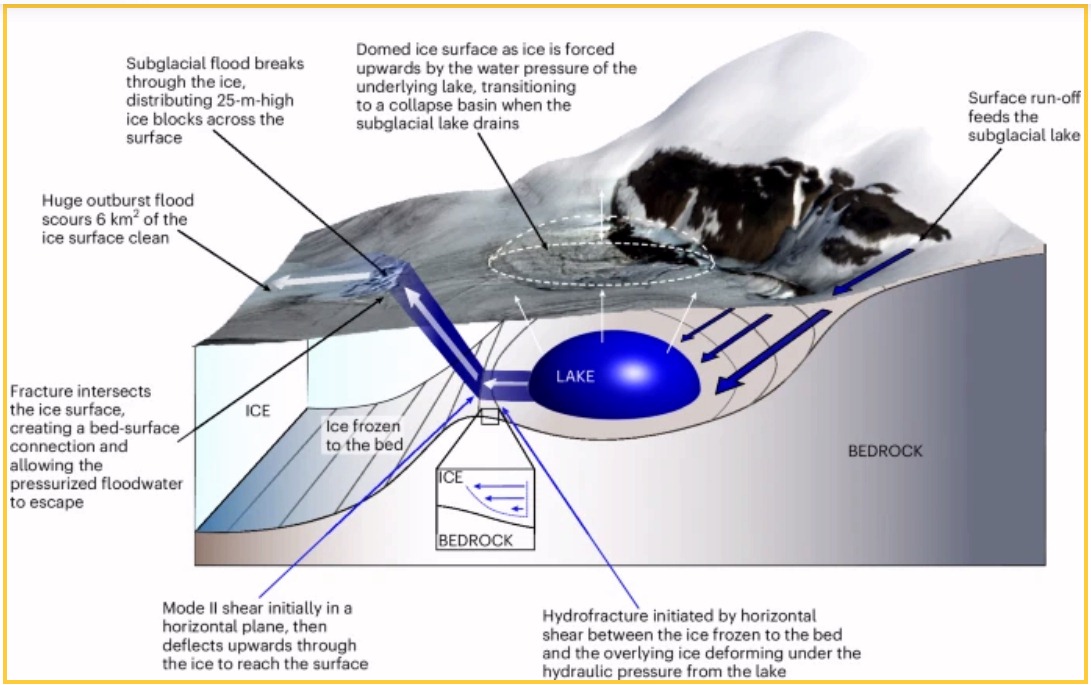
Recent research has identified a startling example of this process. In the paper Outburst of a subglacial flood from the surface of the Greenland Ice Sheet (2025), scientists documented a 90-million-cubic-meter flood that forced its way upward through the ice sheet, bursting out at the surface. This was caused by the rapid drainage of a subglacial lake in a region where the bed was thought to be frozen solid—an event that current ice sheet models do not account for.

The flood’s upward path fractured the ice sheet, disrupting the downstream marine-terminating glacier and altering its flow. This bi-directional coupling between surface and basal hydrology highlights just how complex—and poorly understood—ice sheet dynamics truly are.

Over the last three decades, Greenland has lost roughly 169 billion tons of ice per year on average, contributing about 14 mm to global sea level rise. Roughly half of this loss comes from surface melting and runoff, which are projected to increase sharply as Arctic warming intensifies.

Why This Matters

If hydrofracture events like this outburst become more frequent, the world could face abrupt, multi-foot-per-year sea level jumps—not the gradual rise most models currently project. This would leave little time for adaptation in coastal cities and could unleash profound economic, humanitarian, and ecological consequences.

Current ice sheet models typically treat meltwater movement as predictable and gradual. The Greenland event shows that under certain conditions, trapped subglacial water can build enough pressure to fracture ice and erupt at the surface—what could be called a “cork release” event. These sudden failures are not fully understood, but they could represent one of the most dangerous tipping points in the cryosphere.

Understanding and integrating these processes into predictive models is urgent. The more we learn, the more it becomes clear that the climate system is capable of abrupt, nonlinear shifts—far faster than human infrastructure, economies, or governance can adapt.

Ignite a Domino Effect: Albedo, Brown Carbon, AMOC, Permafrost, Amazon Rainforest Dieback, Sea Level Rise Pulses, Hydroclimate Whiplash, and Arctic Sea Ice Brouse and Mukherjee (2025)

The Human Induced Climate Change Experiment

bookmark_borderUnderstanding Urban Heat Islands: Causes, Data, and Climate Context

by Daniel Brouse
August 7, 2025

Urban heat islands (UHIs) are a well-documented phenomenon in which cities and densely developed areas experience significantly higher temperatures than surrounding rural environments. This temperature disparity is not the result of long-term climate change, but rather of localized factors that alter how heat is absorbed, stored, and released.

The Albedo Effect and Surface Materials

At the core of the UHI effect is the albedo effect—the ability of a surface to reflect or absorb solar energy. Natural landscapes, such as forests and grassy fields, typically reflect more sunlight and also benefit from evaporative cooling due to moisture in the soil and vegetation. In contrast, urban environments are dominated by low-albedo surfaces such as asphalt, concrete, and dark rooftops, which absorb large amounts of solar radiation during the day and slowly release that heat at night.

This shift in surface composition dramatically alters local energy balances. Measuring direct solar irradiance and surface reflectivity (albedo) is essential for assessing how much thermal energy is being retained in a given environment.

Traffic and Heat Pollution from Vehicles

Another often-overlooked contributor to urban heating is thermal pollution from internal combustion engine (ICE) vehicles. Cars, trucks, and buses release significant heat as a byproduct of fuel combustion—only about 25–30% of the fuel’s energy is converted into mechanical power, while the rest is dissipated as waste heat. In areas with dense traffic and limited airflow, this heat can accumulate, compounding the effects of surface absorption.

As cities continue to struggle with traffic congestion, this vehicular heat output becomes a growing contributor to localized temperature increases, especially in poorly ventilated areas like urban canyons or below-grade roadways.

The Role of Wind in Heat Distribution

Wind patterns are equally important in shaping the urban thermal landscape. Wind speed and direction influence how heat and pollutants are dispersed or trapped. In calm or low-wind conditions, heat can become confined, especially in dense cityscapes where tall buildings disrupt natural air circulation. This can lead to pockets of intense warmth, poor air quality, and discomfort for residents.

On the other hand, steady wind flow can help moderate temperatures by promoting convective cooling and enhancing the evaporation of surface moisture. Therefore, including real-time wind data is vital for any comprehensive study of urban temperature dynamics.

Humidity and Evaporation

Humidity and evaporation play a crucial role in regulating local temperatures, especially in the context of urban heat islands (UHIs). Here’s a detailed explanation of why these processes matter—and just how powerful evaporative cooling is compared to surfaces that don’t evaporate moisture:

Why Evaporation and Humidity Matter

Evaporation is a phase-change process that absorbs large amounts of energy from the environment. When water evaporates from soil, vegetation, or water bodies, it draws heat from the surrounding air and surfaces, thereby cooling them down. This is known as latent heat flux—the energy absorbed during evaporation is stored in the water vapor as “latent heat” and removed from the surface without raising its temperature.

Humidity, or the amount of water vapor in the air, affects the potential for further evaporation. In dry environments, evaporation happens rapidly, enhancing cooling. In contrast, when humidity is high, the air is closer to saturation and evaporation slows, reducing this cooling effect.

How Much Energy Does Evaporation Use? (Compared to Non-Evaporative Surfaces)

To understand the power of evaporation, consider this key fact:

 It takes about 2,260 kJ (or 540 kcal) to evaporate 1 kilogram (1 liter) of water at 100°C.

This is five times more energy than what’s needed to heat that same amount of water from 0°C to 100°C (which takes only 418 kJ or 100 kcal).

Let’s compare:

Process Energy Dissipated
Heating 1 kg of water by 1°C 4.18 kJ
Heating 1 kg from 0°C to 100°C 418 kJ
Evaporating 1 kg of water 2,260 kJ (5.4× more)

Now compare this to non-evaporative surfaces like asphalt or metal roofs, which do not use energy to evaporate water. Instead, nearly all the incoming solar radiation is converted to sensible heat, which raises the surface and ambient air temperature.

This means that in green or moist landscapes (lawns, trees, wetlands), much of the solar energy goes into evaporation rather than heating, while in dry, impervious urban areas, it goes directly into warming the environment.

The Urban Green Advantage

  • Vegetated areas (lawns, trees, wetlands) act like natural air conditioners.

  • On a hot summer day, a single large tree can evaporate over 100 liters of water, dissipating over 225,000 kJ of heat—enough to offset the heat output of several cars.

  • Green roofs and permeable surfaces further enhance evaporation, providing localized cooling benefits.

Bottom Line

Evaporation is an energy-intensive process that removes heat from surfaces and air, dramatically reducing urban temperatures. In contrast, dry, impermeable surfaces only reflect or absorb heat, contributing to the intensity of the urban heat island effect.

Incorporating more water-retaining surfaces, vegetation, and green infrastructure into urban planning is one of the most effective ways to dissipate solar energy through evaporation rather than allowing it to accumulate as heat.

Integrating Data for Smarter Models

To fully understand and predict UHI behavior, researchers must integrate a variety of environmental data sources, including:

  • Solar radiation and surface reflectivity

  • Traffic patterns and vehicle density

  • Wind speed and direction

  • Surface temperature and humidity levels

  • Vegetative cover and soil moisture

Such an integrated approach allows for more accurate modeling of localized weather effects and offers insights into how city design, land use, and transportation infrastructure influence microclimates.

Urban Heat Islands vs. Climate Change

It’s critical to differentiate between urban heat islands and global climate change. While UHIs are driven by local factors and fluctuate with development patterns, climate change is a planetary-scale phenomenon linked to rising greenhouse gas concentrations, oceanic and atmospheric changes, and long-term warming trends.

UHIs do not cause global warming—but they do amplify its effects locally, making cities more vulnerable to heatwaves, public health crises, and increased energy demand for cooling.

Toward Resilient Urban Design

Understanding UHIs is not just a scientific exercise—it has practical implications for city planners, architects, and policymakers. Mitigation strategies include:

  • Using high-albedo roofing and paving materials

  • Expanding urban tree canopies and green spaces

  • Installing green roofs and reflective surfaces

  • Reducing ICE vehicle traffic through public transit and electrification

  • Designing cities that facilitate natural airflow

By incorporating environmental data into planning and design, we can build cities that are not only cooler and more comfortable but also more resilient to the larger threats posed by climate change.

Solar Powered Climate Control: Energy Transfer Through Evaporation

The Human Induced Climate Change Experiment

bookmark_borderBreathing in Danger: The Health Crisis of Air Pollution and How to Protect Yourself

by Daniel Brouse
August 6, 2025

Over the past several years, extreme air pollution events have become alarmingly common across the United States and beyond. If you’ve been noticing hazy skies, itchy eyes, or difficulty breathing, you’re not alone—and you’re not imagining things. With increasingly frequent wildfires, industrial emissions, and fossil fuel combustion, the air we breathe is becoming more dangerous by the day.

In these conditions, checking your home’s air purification systems is not just advisable—it’s essential. The list of diseases and health disorders linked to poor air quality is long and alarming. According to the World Health Organization, the following have all been directly associated with exposure to airborne pollutants:

  • Respiratory and cardiovascular diseases: asthma, bronchitis, COPD, emphysema, pneumonia, strokes, and heart attacks

  • Neurological and developmental impacts: Alzheimer’s disease, dementia, impaired brain development in children, cognitive decline

  • Cancers and systemic illnesses: lung cancer, liver disease, kidney disease, gastrointestinal disorders, and reproductive harm

  • Skin and eye damage: cataracts, dry eyes, corneal inflammation, permanent vision damage, and various skin diseases

  • Immune system dysfunction: increased susceptibility to infections and autoimmune disorders

  • Premature death: due to heart, lung, and systemic organ failure

Eye Irritation and Vision Loss

One of the most immediate effects of poor air quality is eye irritation. Short-term symptoms include burning, itching, dryness, blurred vision, watery eyes, and sensitivity to light. Long-term exposure to airborne particulates—especially PM2.5 and ozone—has been linked to chronic inflammation of the eyes, conjunctivitis, corneal abrasion, and even degenerative conditions such as cataracts and macular degeneration, which can lead to irreversible vision loss.

Particulate matter and chemical pollutants can accumulate in the tear film and on the surface of the eye, leading to persistent inflammation and oxidative stress. These conditions are especially dangerous for those with preexisting eye issues or contact lens wearers.

Eye Protection During Pollution Events

To reduce your risk:

  • Avoid going outside during high AQI events, especially when AQI is above 100.

  • Wear wraparound protective eyewear or sealed goggles if you’re outdoors for extended periods.

  • Use lubricating eye drops (artificial tears) to flush out irritants and relieve dryness.

  • Avoid rubbing your eyes, which can worsen inflammation and increase the risk of infection.

  • Indoors, maintain good air filtration to reduce indoor pollutants that can irritate your eyes.

Air Quality Maintenance and Indoor Protection

To protect your lungs and heart, clean or change your HVAC and air conditioner filters every two weeks, especially during high-pollution events. Better yet, use air purification units with HEPA filters or build your own Corsi-Rosenthal Box for a low-cost, high-efficiency solution.

What Is Particulate Matter?

The U.S. Environmental Protection Agency (EPA) defines particulate matter (PM) as a mixture of solid particles and liquid droplets suspended in the air. These particles range in size from visible dust and soot to microscopic toxins that can only be seen with an electron microscope. PM2.5—the finest and most dangerous type—can penetrate deep into your lungs, bloodstream, and even your eyes.

Breathing particle-laden air is comparable to smoking cigarettes. On days with an Air Quality Index (AQI) in the “Unhealthy” range, simply breathing can be as harmful as smoking a half-pack of cigarettes per day. Engaging in physical activity outdoors can magnify this damage, potentially reaching the equivalent of two packs a day.

The Cumulative Effect

The more particulate matter you inhale—or absorb through the eyes or skin—the greater your risk. Vulnerable populations—such as children, the elderly, and those with preexisting conditions—face an even higher danger. Long-term exposure increases the odds of strokes, heart disease, cancer, dementia, and chronic lung damage.

However, there’s hope. Just like quitting smoking reduces health risks over time, limiting your exposure to pollution can significantly lower your chance of developing serious complications.

Prevention: The Best Medicine

Here are key steps to take:

  • Avoid outdoor exercise on days with an AQI over 50.

  • On moderate to poor air quality days, wear an N95 mask and protective eyewear when outside.

  • Indoors, use HEPA purifiers or build a Corsi-Rosenthal Box—a DIY air purifier made from a box fan and high-efficiency filters. It is more affordable and, in many cases, more effective than commercial air purifiers.

How to Build a Corsi-Rosenthal Box

The Corsi-Rosenthal Box is an innovative, community-designed air filter that uses MERV-13 filters arranged in a cube with a box fan mounted on top. It’s a highly effective and inexpensive way to reduce indoor particle pollution. You can build one at home for under $100 with simple materials available at most hardware stores.

Build and run a Corsi-Rosenthal Box filter.

Final Thoughts

Air pollution is not just a distant environmental concern—it is an active and worsening public health emergency. From vision loss to heart failure, its reach is systemic and deadly. In the absence of meaningful political leadership on air quality, it is crucial for individuals and families to take personal protective action.

If you’re breathing—or seeing—today, you have a reason to act.

Health Impacts of Air Pollution
Build a Corsi-Rosenthal Box filter
Indoor Air Pollution: How to Purify the Air, Aromatic Plants, and Phytoncides

The Human Induced Climate Change Experiment

bookmark_borderTariffs, Hypocrisy, and Geopolitical Backfire: Trump Slaps 50% Tariffs on Indian Goods Over Russian Oil

In a move that is already sparking backlash among global trade experts and U.S. allies, former President Donald Trump has issued a directive to impose an additional 25% tariff on a wide array of Indian goods—raising the total tariff rate to 50%. This decision, according to Trump, is a response to India’s ongoing purchases of oil from Russia, despite the global push to isolate the Kremlin economically due to its actions in Ukraine.

But the rationale behind this punitive measure appears deeply flawed and hypocritical. The United States itself continues to import Russian commodities, most notably palladium, a rare and strategically important metal used in catalytic converters for gasoline-powered cars. Fertilizer components and other essential minerals from Russia are also still entering U.S. markets through direct or indirect channels.

India, on the other hand, has consistently argued that its purchases of Russian oil are both legal under international law and necessary to ensure energy security for its 1.4 billion citizens. Indian officials have questioned the sensibility and fairness of U.S. trade policy, pointing out the double standard at play. Why should India be punished for buying oil, while the U.S. continues trading in Russian metals essential for its fossil fuel economy?

More broadly, this action raises serious questions about U.S. strategic coherence, economic independence, and long-term competitiveness. If the U.S. truly wants to reduce reliance on Russian imports, the logical path forward is to accelerate the transition away from internal combustion engine (ICE) vehicles—which would reduce the need for palladium entirely. In that sense, India’s critique is not just diplomatic posturing; it highlights a genuine lack of economic sensibility in America’s reactive, ad hoc tariff policy.

The new 50% tariff could significantly disrupt U.S.–India trade relations, which had been steadily improving, and potentially alienate an important ally in the Indo-Pacific region. It also introduces unnecessary inflationary pressure at a time when the U.S. economy is already grappling with rising prices, job market cooling, and growing fears of stagflation.

At its core, this tariff escalation appears more about political optics than economic logic. Unfortunately, global markets and working families may once again bear the brunt of short-sighted, inconsistent trade policy.


The Human Induced Climate Change Experiment

Trumpenomics: The Decline of the US