bookmark_borderCalculating the Rate of Climate Acceleration in a Nonlinear Earth System

by Daniel Brouse and Sidd Mukherjee

Introduction

Estimating the rate of climate change has become increasingly difficult. In the 20th century, many observed trends appeared approximately linear over short time horizons. By the 21st century, however, the influence of nonlinear feedbacks has become increasingly apparent.

Current observations suggest the climate system is no longer well-described by simple linear or constant-growth models. Instead, multiple indicators show behavior consistent with accelerating change and evolving feedback strength. In this context, higher-order effects—often described informally as “jerk” (third-derivative) behavior—may become relevant in describing system dynamics.

As climate systems approach potential tipping points, the predictive skill of historical linear extrapolation diminishes. The emphasis therefore shifts away from precise prediction of transition timing and toward identifying and mitigating the drivers of acceleration and system instability.

Global average surface temperature is an important metric, but it represents only one expression of a much larger planetary energy imbalance. Approximately 90% of excess heat trapped by anthropogenic greenhouse gases is absorbed by the oceans, making ocean heat content one of the most important indicators of Earth’s energy accumulation.

Our analysis therefore focuses on how energy is redistributed through the Earth system and the resulting physical impacts. Sea-level rise, atmospheric moisture content, extreme precipitation, ice-sheet mass loss, and marine heatwaves all reflect this energy redistribution. Many of these variables show signs of nonlinear acceleration associated with feedback processes and threshold behavior, even when global mean surface temperature increases appear more gradual.

A further caveat is that global temperature averages can obscure strong regional heterogeneity. The Arctic, for example, has warmed approximately three to four times faster than the global mean due to Arctic amplification. Similar spatial disparities are observed in ocean heat content, extreme rainfall, drought frequency, and marine heatwave intensity. In many cases, regional metrics provide more direct insight into emerging system dynamics than global averages alone.

That said, global mean temperature remains a useful integrative indicator. Depending on the method of analysis, the warming signal itself exhibits evidence of increasing rates of change over time. Across multiple datasets, the broader pattern is consistent: the Earth system is accumulating energy, and many associated responses are occurring on increasingly compressed timescales.

In summary, global temperature describes the overall magnitude of warming, while regional temperature changes and physical impact indicators more directly reflect how the climate system is responding. This motivates a focus on energy flow, feedback mechanisms, and accelerating impacts rather than reliance on a single global metric.


Methodological Framework: Climate Acceleration and Doubling Time

Because each climate variable evolves through different physical processes and timescales, no single metric fully captures climate acceleration. Ocean heat content, sea-level rise, atmospheric moisture, cryospheric loss, and temperature all provide partial but complementary information.

For this reason, we consider a simplified diagnostic framework for evaluating changes in system response rates. Early observational behavior (approximately late 20th century) was often consistent with slow, century-scale doubling behavior, corresponding to weak effective amplification over long timescales.

More recent analyses across multiple independent datasets suggest shorter characteristic timescales and stronger effective feedback amplification, on the order of multi-year to decadal-scale doubling behavior depending on the variable and region considered. Expressed generically, this implies a transition from slow growth regimes toward faster, feedback-influenced dynamics.

In simplified terms, this can be expressed as:

  • Earlier regime: slow, near-linear or long-timescale exponential behavior
  • Later regime: shorter-timescale, feedback-driven nonlinear behavior with compressed doubling intervals

This does not imply uniform acceleration across all variables. Rather, it suggests increasing coupling among components of the Earth system through reinforcing feedbacks. As these feedbacks strengthen, system behavior becomes increasingly nonlinear, and outcomes become more sensitive to threshold responses—tipping points—and interactions among subsystems.

In this context, higher-end climate outcomes become less dependent on linear extrapolation and more dependent on feedback strength and system coupling.

Current ranges discussed in the scientific literature include:

  • Lower-to-moderate pathways: ~3–5°C warming by 2100 under continued high emissions
  • Higher-feedback outcomes: ~6–9°C under scenarios with strong reinforcing feedback contributions
  • Long-term high-impact pathways: >10°C over multi-century timescales, consistent with “Hothouse Earth” frameworks

Limitations of the Doubling-Time Framework

A key mathematical limitation is that standard doubling-time formulations assume a locally constant effective growth rate, k(t), over the evaluation interval. When k(t) varies significantly over time, the resulting doubling time should be interpreted as an instantaneous diagnostic rather than a predictive interval. In that case, the doubling-time framework loses much of its predictive utility and becomes primarily descriptive of local system behavior rather than a reliable forecasting tool.

This distinction becomes critical in systems with strong feedbacks. Such systems may exhibit prolonged periods of gradual change followed by rapid nonlinear transitions once tipping points are crossed. As a result, simple extrapolation from historical trends becomes increasingly unreliable near tipping points.

We further hypothesize that some coupled climate and socioeconomic indicators may exhibit positive third-derivative behavior (d³I/dt³ > 0), sometimes referred to as “accelerating acceleration” or jerk dynamics. If valid, this implies a regime in which feedback interactions dominate system evolution and increase sensitivity to small perturbations.

Under such conditions, acceleration metrics remain useful for diagnosing system state, but their predictive capacity may decline as nonlinearities and threshold effects increase.


Example: Threshold Behavior and Tipping Points

A useful analogy is a dam approaching structural failure. Long before collapse, measurable indicators—such as cracking, seepage, and deformation—may show accelerating deterioration. These processes can often be described mathematically using nonlinear or exponential models.

However, the exact moment of structural failure is typically difficult to predict. The collapse represents a threshold transition into a new dynamical regime, in which post-collapse behavior differs fundamentally from pre-collapse trends.

Climate tipping points may behave in a similar way. For example, potential large-scale destabilization of portions of the East Antarctic Ice Sheet is associated with accelerating indicators consistent with enhanced decadal-scale feedback amplification. However, the precise timing of such transitions remains highly uncertain due to complex interacting processes.

What is more certain is that once a tipping point is crossed, system responses—such as sea-level rise—may accelerate beyond rates implied by pre-transition trends. In this sense, acceleration metrics are most useful for identifying increasing instability and risk, rather than predicting the exact timing or magnitude of abrupt transitions. In the case of the East Antarctic Ice Sheet, this could imply a shift from millimeter-per-decade sea-level contributions toward substantially higher rates on the order of centimeters to meters per decade, depending on the nature and extent of ice-sheet destabilization.


Conclusion

Climate change is increasingly characterized by interacting nonlinear processes and feedback amplification across multiple components of the Earth system. While individual metrics such as temperature, sea level, and cryospheric loss each provide partial insight, no single variable fully captures system behavior.

As feedback strength increases, climate dynamics may shift from relatively smooth trends toward more threshold-driven behavior. In this regime, uncertainty increases, particularly regarding the timing of abrupt transitions.

Acceleration metrics therefore serve as diagnostic tools for identifying rising system instability, but must be interpreted with caution when used for prediction near tipping points.

bookmark_borderClimate Change Tipping Points

By Daniel Brouse and Sidd Mukherjee

September 2022 – August 2023 (Updated June 2026)

Introduction: Beyond Linear Climate Change

For decades, climate change was often discussed as a gradual, linear process—a steady increase in temperatures resulting from steadily increasing greenhouse gas concentrations. While greenhouse gases remain the primary driver of warming, our understanding of the climate system has evolved dramatically.

The Earth does not behave like a simple machine. It behaves like a complex adaptive system composed of interconnected oceans, ice sheets, forests, ecosystems, atmospheric circulation patterns, and human societies. These systems interact through feedback loops, nonlinear dynamics, and threshold effects.

As a result, climate change is increasingly understood not as a smooth progression but as a series of potential tipping points capable of triggering abrupt and self-sustaining changes.

The greatest danger is not any single tipping point. It is the possibility that multiple tipping points begin interacting, creating cascading failures throughout the Earth system. Once these feedbacks become dominant, climate change can accelerate independently of the human emissions that initially triggered it.

Understanding these tipping points is therefore essential to understanding the risks humanity faces during the twenty-first century.

Understanding Tipping Points

A tipping point is a critical threshold beyond which a system shifts into a new state and becomes difficult—or impossible—to return to its previous condition.

Imagine slowly pushing a glass toward the edge of a table. For a time, nothing dramatic happens. Then the glass reaches a critical point and falls. Once that threshold is crossed, the outcome becomes largely inevitable.

Climate tipping points operate in much the same way.

For years, environmental changes may appear gradual. Then a critical threshold is crossed, and rapid change follows. These transitions can unfold over years, decades, or centuries, but once initiated they often become self-reinforcing.

Climate tipping points are not political opinions or theoretical possibilities. They are physical thresholds governed by the laws of physics, chemistry, ecology, and thermodynamics.

What Are Climate Tipping Points?

Climate tipping points are thresholds within Earth’s climate system beyond which change becomes self-sustaining.

Once activated, these processes can continue even if human emissions are reduced, pushing portions of the Earth system into new and potentially irreversible states.

Many of these tipping elements are already showing signs of destabilization.

Methane released from thawing permafrost cannot simply be returned underground.

Mountain glaciers that accumulated over thousands of years are disappearing within decades.

Coral reef ecosystems are collapsing under increasing thermal stress.

The Arctic is warming nearly four times faster than the global average.

The consequences extend far beyond the regions where these changes originate. As warming accelerates, formerly stable carbon sinks can become carbon sources, amplifying the warming that triggered them.

This is the defining characteristic of a positive feedback loop: warming causes change, and that change causes additional warming.

Evidence of Crossed and Emerging Tipping Points

In 2019, Professor Tim Lenton warned:

“A decade ago we identified a suite of potential tipping points in the Earth system. Now we see evidence that over half of them have been activated. It is no longer responsible to wait and see.”

Since then, scientific evidence has continued to accumulate.

Several major tipping elements are now considered active, destabilizing, or approaching critical thresholds:

  • Greenland Ice Sheet melt
  • West Antarctic Ice Sheet instability
  • Mountain glacier loss
  • Arctic sea ice decline
  • Permafrost thaw
  • Boreal forest degradation
  • Amazon rainforest dieback
  • Warm-water coral reef collapse
  • Atlantic Meridional Overturning Circulation (AMOC) weakening
  • Antarctic sea ice decline
  • Southern Ocean circulation changes

Increasingly, researchers are focusing not merely on individual tipping points but on the interactions among them.

The Amazon Dieback Threat

The Amazon rainforest is one of Earth’s most important climate stabilizers.

The forest stores hundreds of billions of tons of carbon while generating much of its own rainfall through evapotranspiration. For decades, the Amazon acted as a powerful carbon sink, helping slow the accumulation of greenhouse gases in the atmosphere.

Growing evidence suggests this system is becoming increasingly unstable.

Deforestation, rising temperatures, prolonged droughts, wildfire activity, and changing rainfall patterns are weakening the resilience of the rainforest.

As forest cover declines, less moisture is recycled into the atmosphere. Reduced rainfall increases drought stress. Drought increases wildfire risk and tree mortality. Forest loss then reduces rainfall even further.

This feedback loop can be summarized as:

Deforestation and Warming → Reduced Rainfall → Increased Drought and Fire → Forest Loss → Reduced Rainfall → Additional Forest Loss

Physicist Sidd Mukherjee warned:

“The Amazon could be the first tipping point we see collapse in our lifetimes.”

A large-scale Amazon dieback would have global consequences.

The forest stores an estimated 150–200 billion tons of carbon. A transition from rainforest to savanna-like ecosystems would release large amounts of carbon dioxide while simultaneously eliminating one of Earth’s largest natural carbon sinks.

The Amazon is particularly concerning because it sits at the intersection of several climate feedback systems, including AMOC changes, wildfire activity, ozone damage to vegetation, and global carbon cycle disruption.

Antarctica: The Sleeping Giant

While the Amazon may be the tipping point most visible within our lifetimes, Antarctica may ultimately prove to be the most consequential.

For decades Antarctica was viewed as relatively stable. Recent research is increasingly challenging that assumption.

Scientists now view Antarctica not as a single ice sheet but as a collection of interconnected drainage basins, each possessing its own tipping threshold.

Particularly concerning are the Thwaites and Pine Island glacier systems of West Antarctica.

Much of the ice in these regions rests on bedrock below sea level, making them vulnerable to warm ocean water that can melt glaciers from beneath.

As protective ice shelves thin or collapse, they lose their ability to restrain inland ice. Once this buttressing effect weakens, glaciers can accelerate toward the ocean through a process known as Marine Ice Sheet Instability.

Some studies suggest portions of West Antarctica may already be committed to long-term retreat under current warming conditions.

The implications extend far beyond Antarctica:

  • Accelerated global sea-level rise
  • Increased coastal flooding
  • Disruption of ocean circulation
  • Changes in marine ecosystems
  • Amplification of climate feedback loops worldwide

Antarctica is increasingly viewed not merely as a victim of climate change but as a potential accelerator of future climate change.

The AMOC Warning

The Atlantic Meridional Overturning Circulation (AMOC) acts as one of the Earth’s most important heat-distribution systems.

Recent studies suggest the AMOC may be weakening more rapidly than previously expected.

A significant weakening or collapse could:

  • Accelerate sea-level rise along the U.S. East Coast
  • Alter rainfall patterns across Europe and Africa
  • Increase drought risk in South America
  • Shift storm tracks across the Northern Hemisphere

Climate history shows that abrupt AMOC changes have been associated with some of the most dramatic climate transitions observed in the geological record.

Feedback Loops and Cascading Tipping Points

Climate change is not driven by a single feedback mechanism.

It is the result of many interconnected feedback loops operating simultaneously.

Ice-Albedo Feedback

As snow and ice disappear, darker land and ocean surfaces absorb more solar energy.

More absorbed heat causes more melting.

Permafrost Feedback

Warming thaws frozen soils.

Thawing releases carbon dioxide and methane.

These greenhouse gases accelerate warming and further thawing.

Wildfire Feedback

Hotter, drier conditions increase wildfire activity.

Wildfires release greenhouse gases and atmospheric pollutants that contribute to further warming.

Ozone-Carbon Sink Feedback

Tropospheric ozone damages vegetation, suppresses photosynthesis, and weakens carbon sequestration.

As warming increases lightning activity and wildfire frequency, ozone production increases.

This creates another self-reinforcing feedback:

Warming → More Lightning and Wildfires → More Ozone → Reduced Carbon Uptake → More Warming

Additional Emerging Tipping Elements

Antarctic Sea Ice Regime Shift

Since 2016, Antarctic sea ice has experienced unprecedented declines.

Some researchers now question whether the Southern Ocean has entered a new climatic state characterized by persistently lower sea-ice coverage.

Southern Ocean Circulation Slowdown

The Southern Ocean absorbs enormous quantities of excess heat and carbon dioxide.

Changes in circulation patterns could weaken this planetary buffering system, leaving more heat and carbon in the atmosphere.

Boreal Forest Degradation

Northern forests across Canada, Alaska, and Siberia are increasingly affected by drought, wildfire, insect outbreaks, and ozone stress.

As these forests weaken, one of Earth’s largest terrestrial carbon sinks becomes less effective.

Coral Reef Collapse

Coral reefs support approximately one-quarter of all marine species.

Repeated marine heatwaves are pushing many reef systems toward irreversible decline, threatening biodiversity and food security.

The Domino Effect

The greatest danger lies not in individual tipping points but in their interaction.

For example:

  • Glacier melt contributes to sea-level rise.
  • Freshwater weakens AMOC circulation.
  • AMOC disruption alters Amazon rainfall.
  • Amazon dieback reduces carbon sequestration.
  • Additional warming accelerates Antarctic ice loss.
  • Rising temperatures intensify permafrost thaw and wildfire activity.
  • Ozone production increases while carbon sinks weaken.

Each step reinforces the next.

Rather than isolated events, tipping points increasingly resemble an interconnected network of cascading risks.

A Planet Entering Uncharted Territory

Recent years have produced unprecedented records for:

  • Global surface temperature
  • Ocean heat content
  • Marine heatwaves
  • Atmospheric water vapor
  • Wildfire activity
  • Glacier mass loss
  • Extreme rainfall events

The climate system increasingly exhibits characteristics associated with nonlinear dynamics, where small changes can produce disproportionately large responses.

As critical thresholds are approached, uncertainty grows—not because scientists know less, but because complex systems become inherently less predictable near tipping points.

Sea-Level Rise: An Emerging Tipping Cascade

Sea-level rise represents one of the clearest examples of accelerating climate risk.

Observations indicate that the rate of global sea-level rise has increased substantially since the early 1990s.

Accelerating ice-sheet loss in Greenland and Antarctica raises concerns that future sea-level rise could significantly exceed projections based on simple linear assumptions.

Even modest increases threaten coastal cities, freshwater supplies, agricultural regions, transportation networks, and critical infrastructure worldwide.

Climate, Human Health, and Wet-Bulb Heat

Climate change is increasingly becoming a public health crisis.

One of the most concerning threats involves wet-bulb temperatures, which combine heat and humidity into a measure of physiological stress.

When wet-bulb temperatures approach 31°C (87.8°F), even healthy individuals can struggle to regulate body temperature during prolonged exposure.

As warming continues, regions previously considered safe may periodically experience conditions that challenge human survivability.

Conclusion: The Era of Cascading Risk

The scientific discussion has evolved significantly over the past decade.

The question is no longer whether climate tipping points exist.

The question is how many have already been activated, how strongly they interact, and whether humanity can slow the cascading processes now underway.

The emerging picture is one of a highly interconnected Earth system in which ice sheets, forests, oceans, ecosystems, atmospheric chemistry, and human societies influence one another through increasingly powerful feedback loops.

The Amazon, Antarctica, AMOC, permafrost, boreal forests, coral reefs, and atmospheric ozone are not isolated risks. Together they form a network of interconnected tipping elements capable of amplifying global change.

Each additional increment of warming increases the probability that new thresholds will be crossed.

The choices made during the next decade will influence not only the climate of this century but the habitability of large portions of the planet for generations to come.

URGENT CLIMATE WARNING

Our probabilistic, ensemble-based climate framework—which incorporates ecological, economic, atmospheric, and societal feedbacks within a nonlinear dynamic system—suggests that climate risks may increase substantially faster than assumed by traditional linear projections.

The greatest threat is not any single climate impact but the emergence of interconnected tipping cascades capable of destabilizing multiple Earth systems simultaneously.

Evidence suggests that many of these processes are already underway.

The climate system is entering an era defined by compound extremes, cascading risks, and self-reinforcing feedback loops.

Reducing greenhouse gas emissions remains essential. Equally important are adaptation, resilience planning, ecosystem protection, carbon sink preservation, and rapid deployment of clean-energy technologies.

The future is not yet written, but the window for avoiding the most severe outcomes continues to narrow.

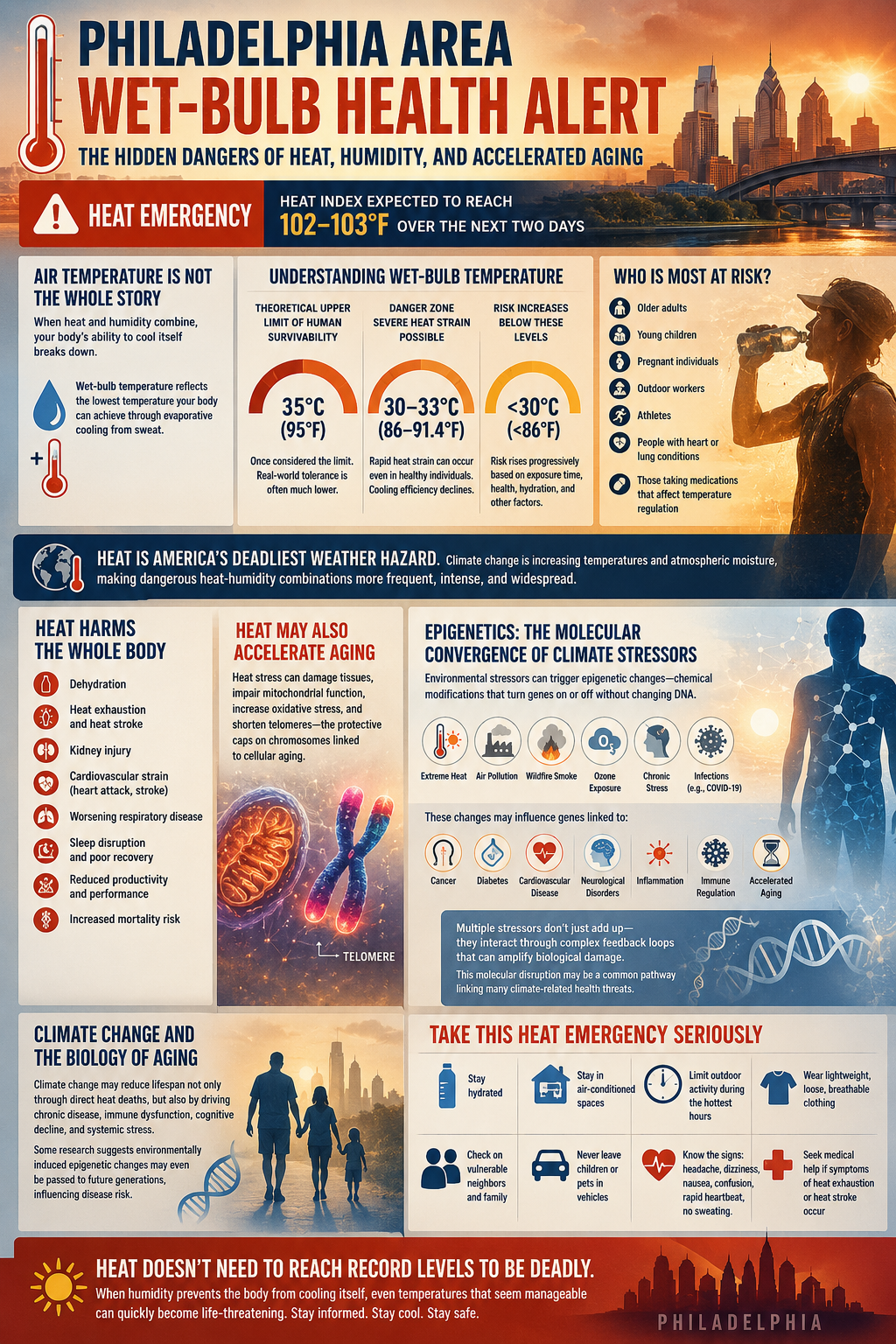
bookmark_borderPhiladelphia Area Wet-Bulb Health Alert: The Hidden Dangers of Heat, Humidity, and Accelerated Aging

Heat Risks Are Higher Than Many Realize

The Philadelphia region is currently under a heat emergency, with heat index values expected to reach approximately 102–103°F over the next two days. While many people focus on air temperature alone, the greater threat often comes from the dangerous combination of heat and humidity.

One of the best measures of this combined stress is wet-bulb temperature, which reflects the lowest temperature the body can achieve through evaporative cooling from sweat. As humidity rises, the body’s ability to cool itself declines, increasing the risk of heat exhaustion, heat stroke, organ damage, and death.

For years, scientists considered a wet-bulb temperature of 35°C (95°F) to be the theoretical upper limit of human survivability. More recent physiological and climate-chamber studies, however, suggest that real-world tolerance is often substantially lower, particularly during prolonged exposure, physical activity, direct sunlight, poor air circulation, or inadequate hydration.

Research increasingly indicates that wet-bulb temperatures in the range of 30–33°C (86–91.4°F) can produce severe heat strain even in healthy adults. At these levels, the body’s natural cooling mechanisms begin to lose effectiveness, causing internal temperatures to rise and placing increasing stress on virtually every organ system.

Heat Stress Begins Before the Extreme Thresholds

Importantly, dangerous heat conditions do not begin at a single threshold. Human thermoregulation deteriorates progressively as heat and humidity increase.

Risk rises substantially for:

  • Older adults
  • Young children
  • Pregnant individuals
  • Outdoor workers
  • Athletes
  • Individuals with cardiovascular disease
  • People with respiratory illnesses
  • Those taking medications that impair temperature regulation

The duration of exposure also matters. Even conditions that appear manageable can become dangerous after several hours, especially when nighttime temperatures remain elevated and prevent the body from recovering.

Heat: America’s Deadliest Weather Hazard

Heat remains one of the deadliest weather-related hazards in the United States, often causing more fatalities than floods, hurricanes, tornadoes, or lightning.

As climate change warms the atmosphere, the air can hold more water vapor, increasing humidity levels and making dangerous heat-humidity combinations more common. This trend is expanding the geographic reach of extreme heat events and increasing their frequency, intensity, and duration.

For many regions, including the Philadelphia metropolitan area, what were once rare heat emergencies are becoming increasingly routine.

The Growing Health Consequences of Extreme Heat

Exposure to elevated temperatures affects far more than comfort. Heat places stress on nearly every system in the human body and is associated with:

  • Dehydration
  • Heat exhaustion and heat stroke
  • Acute kidney injury
  • Cardiovascular strain
  • Increased risk of heart attack and stroke
  • Worsening respiratory disease
  • Sleep disruption and impaired recovery
  • Reduced physical and cognitive performance
  • Lower labor productivity
  • Increased mortality risk

Researchers are also finding evidence that repeated heat exposure may accelerate the aging process itself.

Emerging studies suggest that heat stress can damage tissues, impair mitochondrial function, increase oxidative stress, and contribute to the shortening of telomeres—the protective caps on chromosomes that are closely associated with cellular aging.

These findings suggest that climate change may influence health not only through immediate heat-related illness but also through long-term biological wear and tear.

Epigenetics: The Molecular Convergence of Climate Stressors

One of the most important emerging areas of climate-health research involves epigenetics—chemical modifications that influence how genes are expressed without changing the underlying DNA sequence.

These mechanisms function somewhat like biological dimmer switches, turning genes on or off in response to environmental conditions.

Increasing evidence suggests that extreme heat, particularly when combined with other environmental stressors, may trigger epigenetic changes throughout the body.

These stressors include:

  • Air pollution
  • Wildfire smoke
  • Ground-level ozone
  • Chronic psychological stress
  • Infectious diseases such as COVID-19
  • Exposure to environmental toxins

Research indicates that epigenetic alterations may influence genes associated with:

  • Cancer
  • Diabetes
  • Cardiovascular disease
  • Neurological disorders
  • Inflammation
  • Immune system regulation
  • Metabolic dysfunction
  • Accelerated aging

Critically, these environmental stressors do not operate independently. Their impacts may interact through complex biological pathways, creating feedback loops that amplify overall physiological damage.

This molecular-level disruption may represent a common underlying mechanism linking many seemingly separate climate-related health threats.

Climate Change and the Biology of Aging

The implications are profound.

Climate change may affect human health not only through direct heat-related deaths and injuries, but also through the gradual amplification of chronic disease, immune dysfunction, cognitive decline, and systemic physiological stress across entire populations.

Researchers are increasingly examining whether repeated exposure to extreme heat and other environmental stressors may contribute to accelerated biological aging at the population level.

Some scientists are also investigating the possibility of transgenerational effects, where environmentally induced epigenetic changes in one generation may influence disease susceptibility and health outcomes in future generations.

While this field remains an active area of research, the evidence increasingly suggests that climate change is not simply altering the environment around us—it may also be influencing biological processes within us.

Take This Heat Emergency Seriously

If you live in the Philadelphia area, take this heat emergency seriously.

  • Stay hydrated.
  • Limit outdoor activities during the hottest hours of the day.
  • Seek air-conditioned environments whenever possible.
  • Wear lightweight, breathable clothing.
  • Check on elderly relatives, neighbors, and vulnerable individuals.
  • Never leave children or pets in vehicles.
  • Watch for signs of heat exhaustion and heat stroke.

Heat does not need to reach record-breaking levels to become life-threatening.

When humidity prevents the body from cooling itself effectively, temperatures that may seem manageable can rapidly become dangerous. As climate change continues to intensify extreme heat events, understanding the risks posed by wet-bulb temperatures may become increasingly important for protecting public health.

* Our probabilistic, ensemble-based climate model — which incorporates complex socio-economic and ecological feedback loops within a dynamic, nonlinear system — projects that global temperatures are becoming unsustainable this century. This far exceeds earlier estimates of a 4°C rise over the next thousand years, highlighting a dramatic acceleration in global warming. We are now entering a phase of compound, cascading collapse, where climate, ecological, and societal systems destabilize through interlinked, self-reinforcing feedback loops.

We examine how human activities — such as deforestation, fossil fuel combustion, mass consumption, industrial agriculture, and land development — interact with ecological processes like thermal energy redistribution, carbon cycling, hydrological flow, biodiversity loss, and the spread of disease vectors. These interactions do not follow linear cause-and-effect patterns. Instead, they form complex, self-reinforcing feedback loops that can trigger rapid, system-wide transformations — often abruptly and without warning. Grasping these dynamics is crucial for accurately assessing global risks and developing effective strategies for long-term survival.

Feedback Loops → Tipping Points → Domino Effect
Feedback loops amplify climate change and can push interconnected Earth systems past critical tipping points. As tipping points are crossed, they can trigger additional feedback loops and destabilize other climate systems. This cascading “Domino Effect” compresses timescales, accelerates change, and increases the risk of rapid, nonlinear climate transformations.

The Climate Crisis: Violent Rain | Deadly Humid Heat | Health Collapse | Extreme Weather Events | Insurance | Trees and Deforestation | Soil | Rising Sea Level | Food and Water | Updates

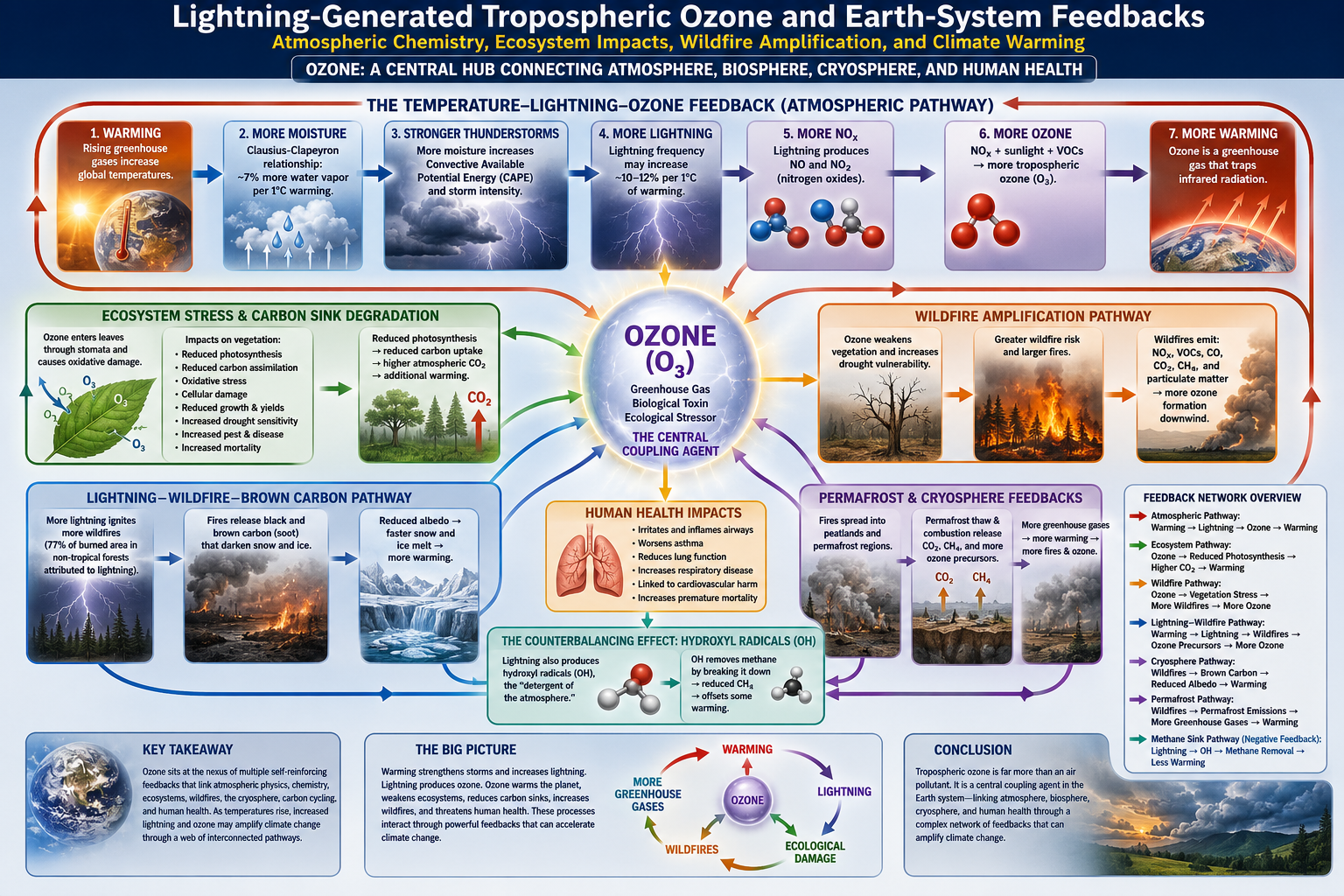
bookmark_borderLightning-Generated Tropospheric Ozone and Earth-System Feedbacks

by Daniel Brouse and Sidd Mukherjee

Tropospheric ozone is not merely a byproduct of climate change—it is a critical Earth-system coupling agent that links atmospheric warming, lightning activity, ecosystem health, wildfire dynamics, carbon-cycle disruption, human health, and cryosphere processes into a network of interconnected feedbacks capable of accelerating global warming.

The emerging role of ozone within so many coupled feedback mechanisms illustrates both the extraordinary complexity of atmospheric physics and chemistry and the profound interconnectedness of the Earth’s climate system. Rather than operating through a single pathway, ozone influences climate through multiple atmospheric, biological, ecological, and cryospheric processes simultaneously. It acts as a greenhouse gas that directly contributes to warming, a biological toxin that damages vegetation and weakens carbon sinks, and an ecological stressor that increases vulnerability to drought, disease, and wildfire.

These interactions highlight an important reality of climate change: many of the most consequential feedbacks do not operate in isolation. Instead, they interact, overlap, and reinforce one another across multiple components of the Earth system. As temperatures rise, increases in atmospheric moisture, thunderstorm intensity, lightning frequency, ozone production, ecosystem stress, wildfire activity, and greenhouse-gas emissions can become increasingly coupled, creating cascading feedback loops that amplify climate change beyond what would be expected from any individual mechanism alone.

Understanding these previously underappreciated connections is essential for accurately assessing climate risk. The ozone-lightning-wildfire nexus provides a compelling example of how nonlinear interactions between atmospheric chemistry, ecosystem processes, and climate dynamics may be contributing to the accelerating pace of global warming observed across many Earth-system indicators.

Abstract

Tropospheric ozone (O₃) occupies a unique and underappreciated position within the Earth system. Unlike carbon dioxide, which is primarily discussed as a greenhouse gas, ozone simultaneously functions as a greenhouse gas, a biological toxin, a crop-damaging pollutant, a forest stressor, and a driver of ecosystem degradation. Lightning represents one of the largest natural sources of atmospheric nitrogen oxides (NOₓ), making it a major contributor to ozone formation in the middle and upper troposphere. As global temperatures rise, increasing atmospheric moisture and convective instability are expected to increase lightning activity, potentially creating additional ozone production.

This paper examines the role of lightning-generated ozone within a broader network of interacting climate feedbacks. We argue that ozone serves as a critical coupling mechanism linking atmospheric warming, wildfire activity, carbon-cycle disruption, ecosystem decline, human health impacts, and climate amplification. When ozone-induced vegetation stress, carbon sink degradation, lightning-driven wildfire ignition, brown-carbon deposition, and permafrost emissions are considered together, ozone emerges as a central participant in a complex web of self-reinforcing Earth-system feedbacks.


Introduction

Most discussions of climate change focus on carbon dioxide and methane. Yet another greenhouse gas operates simultaneously as an atmospheric pollutant, a biological poison, and a climate feedback amplifier: tropospheric ozone.

In the stratosphere, ozone shields life from harmful ultraviolet radiation. Near the Earth’s surface and throughout the troposphere, however, ozone becomes one of the most destructive gases in the atmosphere. It damages human lungs, suppresses photosynthesis, weakens forests, reduces agricultural productivity, accelerates ecosystem decline, and contributes directly to planetary warming.

Unlike carbon dioxide, ozone is not emitted directly in large quantities. Instead, it forms through chemical reactions involving nitrogen oxides (NOₓ), volatile organic compounds (VOCs), sunlight, heat, and atmospheric oxidants. While fossil-fuel combustion remains the dominant anthropogenic source of ozone precursors, lightning is among the largest natural producers of atmospheric NOₓ.

Historically, lightning-generated ozone has been viewed primarily as an atmospheric chemistry problem. Increasing evidence suggests that this perspective is incomplete. Ozone may instead represent one of the most important connectors linking climate warming, ecosystem degradation, wildfire activity, carbon-cycle disruption, and human health.


Lightning as a Natural Ozone Generator

Lightning acts as a natural atmospheric plasma reactor.

A single lightning channel can briefly reach temperatures approaching 30,000°C—hotter than the surface of the Sun. These temperatures dissociate atmospheric nitrogen (N₂) and oxygen (O₂), allowing them to recombine into nitric oxide (NO) and nitrogen dioxide (NO₂).

Collectively known as NOₓ, these compounds form the foundation of tropospheric ozone chemistry.

As sunlight interacts with NOₓ and other atmospheric compounds, ozone is produced throughout the hours and days following thunderstorms.

Lightning also generates ozone directly. The electrical discharge can split oxygen molecules into individual oxygen atoms, which rapidly combine with surrounding oxygen molecules to form ozone.

The familiar “clean” smell associated with thunderstorms is, in large part, the scent of ozone itself.

Ironically, the smell many people associate with fresh air is actually the smell of a toxic oxidizing gas.

When inhaled, ozone attacks respiratory tissues, produces oxidative stress, inflames airways, worsens asthma, and contributes to cardiovascular disease. The same oxidative chemistry that damages plant cells also damages human lungs.


Ozone: Greenhouse Gas, Biological Toxin, and Climate Amplifier

Ozone occupies a unique position among greenhouse gases because it operates simultaneously through atmospheric and biological pathways.

Atmospherically, ozone absorbs outgoing infrared radiation and contributes directly to warming. Ozone produced in the upper troposphere is particularly effective because it resides in colder atmospheric layers where radiative trapping is enhanced.

Biologically, ozone functions as a powerful phytotoxin.

When ozone enters leaves through stomata, it initiates oxidative reactions that damage cellular structures and disrupt photosynthesis.

Documented impacts include:

  • Reduced photosynthesis
  • Reduced carbon assimilation
  • Oxidative stress
  • Cellular membrane damage
  • Reduced crop yields
  • Reduced forest productivity
  • Increased drought sensitivity
  • Increased vulnerability to insects and disease
  • Increased tree mortality

Numerous studies have reported reductions in plant productivity ranging from roughly 10% to over 40%, while some highly sensitive ecosystems have experienced substantially larger declines.

Ozone should therefore be viewed not simply as a greenhouse gas, but as a large-scale ecological forcing agent capable of weakening the biological systems that regulate atmospheric carbon.


Ozone and the Weakening of Earth’s Carbon Sinks

Forests, grasslands, wetlands, and agricultural systems remove billions of tons of carbon dioxide from the atmosphere each year.

This natural carbon uptake has historically slowed the pace of climate change.

Ozone directly undermines this process.

As photosynthesis declines, less carbon is removed from the atmosphere and less carbon is stored in vegetation and soils.

The resulting feedback can be summarized as:

Ozone → Reduced Photosynthesis → Reduced Carbon Uptake → Higher Atmospheric CO₂ → Additional Warming

This pathway is especially important because it converts ozone from a short-lived atmospheric pollutant into a mechanism capable of influencing long-term carbon-cycle dynamics.

In this sense, ozone becomes both a greenhouse gas and a destroyer of greenhouse-gas removal systems.


Ozone as a Wildfire Multiplier

One of the most important—and potentially underestimated—roles of ozone may be its influence on wildfire vulnerability.

Vegetation exposed to chronic ozone stress experiences weakened physiological defenses, reduced water-use efficiency, impaired growth, and increased susceptibility to drought.

As warming intensifies heat waves and water stress, ozone-damaged ecosystems become increasingly vulnerable to combustion.

At the same time, wildfires themselves generate enormous quantities of ozone precursors:

  • Nitrogen oxides (NOₓ)
  • Volatile organic compounds (VOCs)
  • Carbon monoxide (CO)
  • Fine particulate matter

These emissions can generate ozone hundreds or even thousands of kilometers downwind.

This creates a reinforcing cycle:

Climate Warming → More Ozone → Weaker Vegetation → Greater Drought Stress → More Wildfires → More Ozone

The wildfire–ozone connection transforms atmospheric chemistry into an ecosystem-level feedback capable of accelerating climate change.


Lightning, Wildfires, and Brown Carbon

Climate warming is expected to increase lightning frequency by enhancing atmospheric moisture and convective instability.

Multiple studies suggest lightning activity may increase substantially with continued warming.

This has implications far beyond atmospheric chemistry.

Lightning is already the dominant ignition source for many remote boreal and temperate forest fires. In intact non-tropical forests, approximately 77% of burned area has been attributed to lightning-caused fires.

As lightning increases, wildfire ignition is expected to increase.

These fires release:

  • Carbon dioxide
  • Methane
  • Ozone precursors
  • Black carbon
  • Brown carbon

Brown carbon and soot darken snow and ice surfaces, reducing albedo and accelerating melt.

This creates another reinforcing feedback:

Warming → More Lightning → More Wildfires → More Brown Carbon → Faster Ice Melt → More Warming

Ozone sits within this feedback as both a product of wildfire emissions and a contributor to the vegetation stress that makes fires more likely.


Ozone, Permafrost, and Cascading Feedbacks

The wildfire story does not end when forests burn.

Increasingly, fires are spreading into peatlands and permafrost regions.

Permafrost was once assumed to thaw gradually over centuries or millennia. Instead, many regions are now experiencing rapid thaw, combustion, and year-round smoldering fires.

These fires release:

  • Carbon dioxide
  • Methane
  • Additional ozone precursors

The resulting emissions accelerate warming, increasing atmospheric instability and lightning frequency.

This creates a larger cascading feedback network:

Warming → More Lightning → More Wildfires → More Ozone and Greenhouse Gases → More Warming → More Permafrost Fire → More Emissions → More Lightning

The interactions become increasingly nonlinear as multiple feedback loops reinforce one another simultaneously.


The Temperature–Lightning–Ozone Feedback

At the center of this network lies a relatively simple relationship.

Warmer air holds more moisture.

More moisture supports stronger thunderstorms.

Stronger thunderstorms generate more lightning.

More lightning produces more NOₓ.

More NOₓ produces more ozone.

More ozone produces additional warming.

The core feedback can be summarized as:

Warming → More Moisture → More Thunderstorms → More Lightning → More Ozone → More Warming

However, this atmospheric feedback is only the beginning.

Once biological and wildfire effects are incorporated, the system expands dramatically.

The Temperature–Lightning–Ozone Feedback

One of the most significant pathways linking climate change to ozone production arises through the relationship between temperature, atmospheric moisture, thunderstorm development, and lightning frequency.

According to the Clausius-Clapeyron relationship, the atmosphere can hold approximately 7 percent more water vapor for every 1°C increase in temperature. As the atmosphere warms, additional moisture becomes available to fuel convection, increasing the intensity and energy of thunderstorms.

Greater atmospheric moisture contributes to higher levels of Convective Available Potential Energy (CAPE), one of the primary indicators of thunderstorm strength. Higher CAPE environments favor stronger updrafts, deeper convection, more vigorous storm systems, and ultimately greater lightning production.

Multiple studies have suggested that lightning frequency may increase by approximately 10 to 12 percent for every 1°C of global warming, although regional responses may vary. Because lightning is a major natural source of atmospheric NOₓ and ozone production, this relationship creates a potentially important self-reinforcing climate feedback.

The atmospheric pathway can be summarized as:

Warming → More Atmospheric Moisture → More Thunderstorms → More Lightning → More Ozone → More Warming

However, the significance of this feedback extends beyond ozone’s direct greenhouse effect.

Because tropospheric ozone functions simultaneously as a greenhouse gas, a biological toxin, and an ecological stressor, increased ozone production can trigger multiple reinforcing pathways throughout the Earth system. Ozone damages vegetation, reduces photosynthesis, weakens carbon sinks, increases drought sensitivity, elevates wildfire risk, and contributes directly to atmospheric warming. Each of these pathways feeds back into the climate system, potentially creating additional warming that promotes further thunderstorm activity and lightning generation.

Consequently, the temperature-lightning-ozone relationship should not be viewed as a simple atmospheric chemistry feedback. Rather, it represents the entry point into a broader network of interconnected feedbacks linking atmospheric physics, ecosystem productivity, wildfire dynamics, carbon-cycle disruption, and climate change.

In this expanded framework, ozone serves as the critical intermediary connecting warming-induced increases in lightning activity to biological and climatic processes that may further amplify global warming. The resulting feedback network is considerably more complex—and potentially more powerful—than the direct atmospheric warming effect of ozone alone would suggest.


The Expanded Ozone-Centered Feedback Network

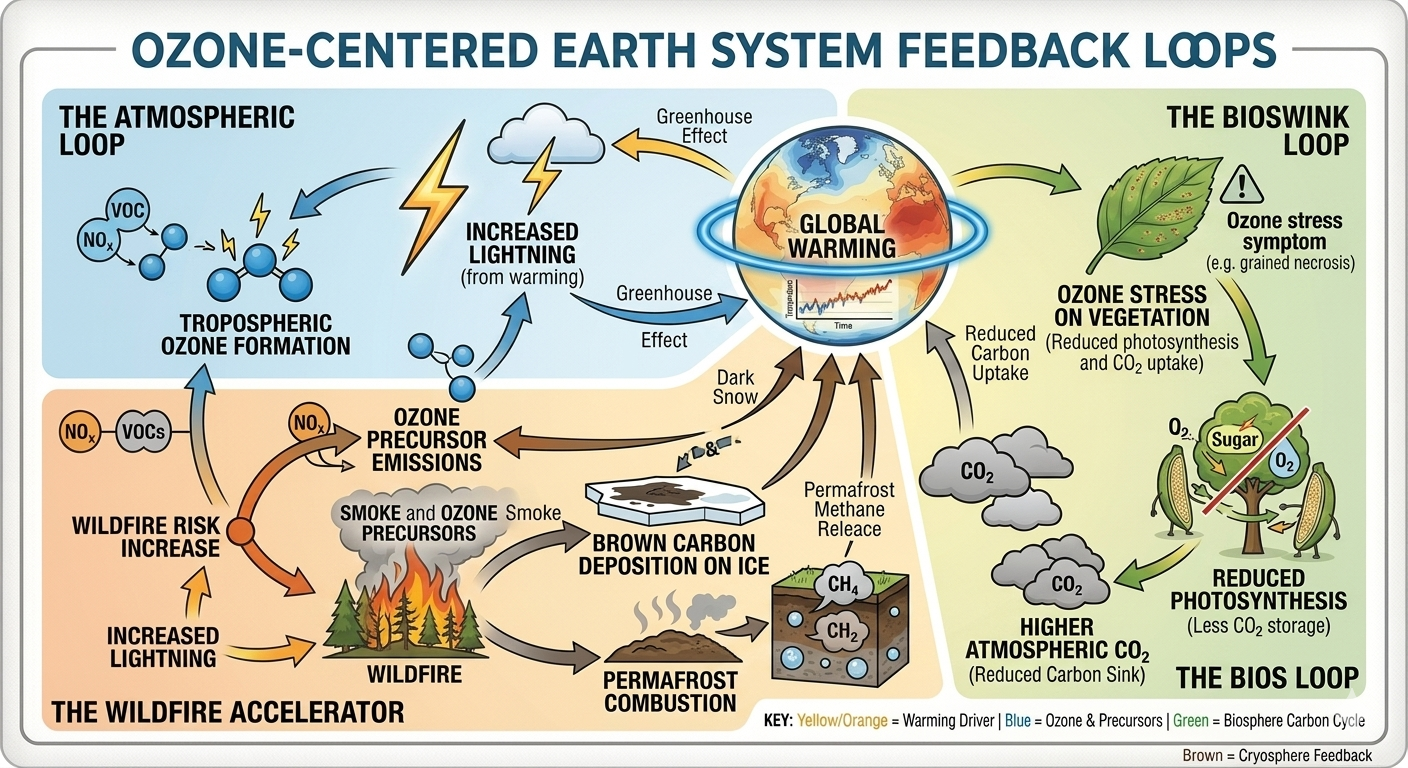
The emerging Earth-system framework can be viewed as a series of interconnected feedback loops centered on ozone:

Atmospheric Pathway

Warming → Lightning → Ozone → Warming

Ecosystem Pathway

Ozone → Reduced Photosynthesis → Reduced Carbon Uptake → Higher CO₂ → Warming

Wildfire Pathway

Ozone → Vegetation Stress → Increased Wildfire Risk → More Ozone

Lightning–Wildfire Pathway

Warming → Lightning → Wildfires → Ozone Precursors → More Ozone

Cryosphere Pathway

Wildfires → Brown Carbon → Reduced Albedo → Warming

Permafrost Pathway

Wildfires → Permafrost Combustion → CO₂ and CH₄ Release → Warming

Together these feedbacks form a coupled network connecting atmospheric chemistry, ecosystem productivity, wildfire dynamics, cryosphere stability, and carbon-cycle feedbacks.


The Counterbalancing Role of Hydroxyl Radicals

Not all lightning-driven chemistry promotes warming.

Lightning also generates hydroxyl radicals (OH), often called the “detergent of the atmosphere.”

Hydroxyl radicals react with methane and accelerate its removal from the atmosphere.

This creates an important negative feedback:

Lightning → More OH → More Methane Destruction → Reduced Warming

This methane-removal pathway partially offsets some warming influences associated with ozone production.

The net balance between ozone-driven warming and OH-driven methane removal remains an active area of research.


Conclusion

Lightning is far more than an atmospheric curiosity.

It is a natural engine of ozone production, and ozone is far more than a conventional air pollutant.

Tropospheric ozone acts simultaneously as a greenhouse gas, a biological toxin, a destroyer of carbon sinks, a contributor to wildfire vulnerability, a threat to human health, and a participant in multiple self-reinforcing climate feedbacks.

Viewed through an Earth-system lens, ozone emerges as one of the most important coupling agents linking atmospheric chemistry, ecosystem degradation, wildfire amplification, carbon-cycle disruption, cryosphere change, and climate warming.

The critical scientific challenge is no longer understanding ozone as an isolated pollutant. It is understanding how ozone interacts with the growing network of feedback loops that are increasingly reshaping the Earth system.

The possibility that ozone occupies a central role in these cascading feedbacks deserves far greater attention as climate change accelerates.

bookmark_borderInflation Surges to Three-Year High as Oil Shock Ripples Through the Economy

Rising Energy Costs Push Inflation Higher

U.S. consumer inflation accelerated sharply in May 2026, reaching its highest level in three years according to the latest data released by the Bureau of Labor Statistics (BLS).

The Consumer Price Index (CPI), the government’s primary measure of inflation, rose 4.2% over the previous twelve months, up from 3.8% in April and marking the highest annual inflation rate since April 2023.

Key Economic Figures

  • Headline CPI: +4.2% year-over-year
  • Monthly CPI Increase: +0.5%
  • Core CPI: +2.9% year-over-year (excluding food and energy)
  • Energy Index: +3.9% in May alone
  • Gasoline Prices: +7.0% during May

Energy prices accounted for more than 60% of the monthly increase in consumer prices, highlighting the dominant role of oil and fuel markets in the current inflation surge.

The Oil Shock Behind the Inflation Spike

The primary driver of rising inflation remains the disruption of global energy markets resulting from the ongoing conflict with Iran and restrictions affecting shipping through the Strait of Hormuz.

The Strait of Hormuz remains one of the world’s most important energy chokepoints, carrying a significant portion of globally traded crude oil. Continued military tensions have reduced available supply and pushed crude prices sharply higher.

Higher crude oil prices quickly filter through the economy:

  • Higher gasoline prices
  • Increased transportation costs
  • Rising manufacturing expenses
  • Higher food distribution costs
  • Increased utility and electricity prices

As a result, inflation pressures are spreading beyond energy markets into nearly every sector of the economy.

Other Major Inflation Categories

Americans are also facing rising costs in several essential categories:

  • Apparel: +4.8%
  • Electricity: +5.9%
  • Shelter: +3.4%

These increases are placing additional pressure on household budgets at a time when many consumers are already struggling with elevated borrowing costs and slowing wage growth.

A New Challenge for the Federal Reserve

The inflation report presents a significant challenge for newly appointed Federal Reserve Chairman Kevin Warsh.

While financial markets largely expect the Federal Reserve to leave interest rates unchanged at its next meeting, traders are increasingly pricing in the possibility of additional rate increases later this year if inflation continues to accelerate.

This creates a difficult balancing act:

  • Raising rates further risks slowing economic growth.
  • Failing to contain inflation risks allowing expectations to become entrenched.

Once businesses and consumers begin expecting higher inflation, they often adjust behavior accordingly—raising prices, demanding higher wages, and accelerating purchases. These behavioral changes can become self-reinforcing and make inflation significantly harder to control.

Strategic Petroleum Reserve Drawdown Reaches Historic Levels

What makes the current situation particularly concerning is the condition of U.S. emergency oil reserves.

In an effort to offset rising fuel costs, the administration has aggressively drawn down the Strategic Petroleum Reserve (SPR), resulting in some of the largest withdrawals in the program’s history.

Record-Breaking Withdrawals

According to recent Energy Information Administration (EIA) data:

  • Nearly 10 million barrels were withdrawn during a single week in May.
  • Approximately 25 million barrels were released over a three-week period.
  • Total SPR inventories have fallen to roughly 349 million barrels, approaching levels not seen since the early 1980s.

The scale and speed of these withdrawals represent one of the largest emergency reserve deployments ever recorded.

Why the Reserve Is Being Drained

The releases are part of a broader coordinated effort among members of the International Energy Agency (IEA) to stabilize global energy markets.

Rather than conducting traditional sales, many of the releases have been structured as emergency exchanges, allowing energy companies to borrow crude oil now and return both the original volume and an additional premium after the crisis subsides.

The objective is straightforward: increase short-term supply and reduce pressure on fuel prices.

However, this strategy carries risks.

The Risks Ahead

The Strategic Petroleum Reserve exists as an emergency buffer against major supply disruptions.

As inventories fall, policymakers have fewer tools available to respond to future shocks.

If geopolitical tensions persist or worsen, markets may begin focusing less on current supply and more on the shrinking emergency reserve itself.

That creates the possibility of:

  • Higher oil-price volatility
  • Additional inflation pressures
  • Rising interest rates
  • Increased recession risks
  • Greater fiscal strain from higher government borrowing costs

Conclusion

The May inflation report highlights a growing reality: energy remains the foundation of the global economy.

Oil price shocks continue to ripple through transportation, manufacturing, housing, food production, and consumer spending.

With inflation now at a three-year high, interest rates under pressure, and emergency oil reserves being depleted at historically rapid rates, policymakers face increasingly difficult choices.

The coming months will likely depend heavily on developments in global energy markets and whether the current geopolitical disruptions prove temporary—or become a longer-lasting source of economic instability.

bookmark_borderThe Future Is Not Yet Written: Why Human Actions Still Matter in a World of Climate Tipping Points

How hard will our generation make the struggle to thrive become a struggle merely to survive?

by Daniel Brouse and Sidd Mukherjee
June 10, 2026

Introduction

Unfortunately, we have already lost things that cannot be replaced or restored.

One of my favorite questions for people who dismiss the significance of climate change is simple:

How long do you think it takes to make six-million-year-old ice?

The answer, of course, is millions of years.

When ancient glaciers, ice sheets, ecosystems, coral reefs, forests, and species disappear, they do not return on timescales relevant to human civilization. Some losses are effectively permanent from the perspective of any society that will exist over the coming centuries or even millennia.

The reality is that many of the changes now unfolding across the Earth system cannot be reversed within a human lifetime. Yet this does not mean that the future is predetermined or that human actions no longer matter.

In fact, they matter enormously.

The Continued Role of Human Activities

A growing body of evidence suggests that Earth’s major climate systems are increasingly interconnected through a network of reinforcing feedback loops. Sea-level rise, polar amplification, ocean heat content, marine heatwaves, atmospheric rivers, Rossby-wave persistence, AMOC weakening, wildfire feedbacks, permafrost thaw, methane release, ecosystem shifts, and climatic whiplash all appear to be interacting in ways that increase complexity and reduce predictability.

Through our analysis of highly coupled nonlinear systems, we remain convinced that human forcing is still the primary driver and determinant of the ultimate outcome.

Many subsystems appear to be approaching—or perhaps have already crossed—important thresholds. The interactions among these systems make prediction increasingly difficult, and cascading responses are a legitimate concern. In a highly interconnected system, a seemingly modest perturbation can propagate through multiple pathways and produce consequences far larger than the original disturbance.

This possibility is precisely what makes climate change so dangerous.

Has the Climate System Become Autonomous?

An important question is whether humanity has already pushed the climate system beyond a point where it will continue to deteriorate regardless of future actions.

We are not yet convinced that this is the case.

The atmosphere, oceans, cryosphere, and biosphere are all responding to an energy imbalance that human activities continue to create. Greenhouse gas concentrations continue to rise. Fossil fuel combustion, land-use change, industrial processes, and ecosystem degradation continue to alter the balance of incoming and outgoing energy.

In this context, the strength, duration, and trajectory of human forcing still matter enormously.

While some tipping elements may already be in motion, there is little evidence that all future outcomes are now entirely independent of human influence. Rather, current observations suggest that human activities remain one of the most important variables governing how rapidly the climate system changes and how severe the consequences ultimately become.

Will the World Ever Be as It Was?

That does not appear possible.

The climate of the twentieth century is gone.

Many glaciers are retreating beyond recovery. Ancient ice is melting. Species are disappearing. Ecosystems are shifting. Ocean chemistry is changing. Sea levels will continue rising for centuries, and some changes already underway will persist for generations.

The question is no longer whether we can preserve the world exactly as it was.

We cannot.

The more important question is whether we can influence the world that follows.

Can We Influence How Bad It Gets?

The answer remains yes.

This is why continued focus on the acceleration of climate change is so important.

If human activities remain the dominant forcing mechanism, then reducing that forcing can still alter the trajectory of the system, even if we can no longer prevent many of the changes already set in motion.

The difference between a world that warms another degree and one that warms several more degrees is not an academic distinction.

It is the difference between:

  • More manageable versus catastrophic sea-level rise.
  • Regional crop disruptions versus widespread food insecurity.
  • Occasional extreme heat versus chronic heat stress.
  • Increased adaptation costs versus systemic economic disruption.
  • Partial ecosystem loss versus widespread ecological collapse.

Small differences in average temperature translate into enormous differences in impacts because climate risks do not increase linearly. They compound through feedbacks, thresholds, and cascading interactions.

The Moral Question

Ultimately, climate change is not simply an environmental issue. It is a question of human welfare, opportunity, and survival.

The decisions made today will determine the quality of life experienced by many generations to come. They will influence access to food, water, shelter, health, security, and economic stability. They will shape the future of coastal communities, agricultural regions, and ecosystems around the world.

Perhaps the most important question is not whether climate change can be stopped entirely.

It is this:

How hard will our generation make the struggle to thrive become a struggle merely to survive?

The future may no longer be capable of becoming what it once could have been. But it is still capable of becoming far better—or far worse—depending on the choices humanity makes today.

The world as it was may be gone.

The world that will be is still being written.

Feedback Loops → Tipping Points → Domino Effect
Feedback loops amplify climate change and can push interconnected Earth systems past critical tipping points. As tipping points are crossed, they can trigger additional feedback loops and destabilize other climate systems. This cascading “Domino Effect” compresses timescales, accelerates change, and increases the risk of rapid, nonlinear climate transformations.

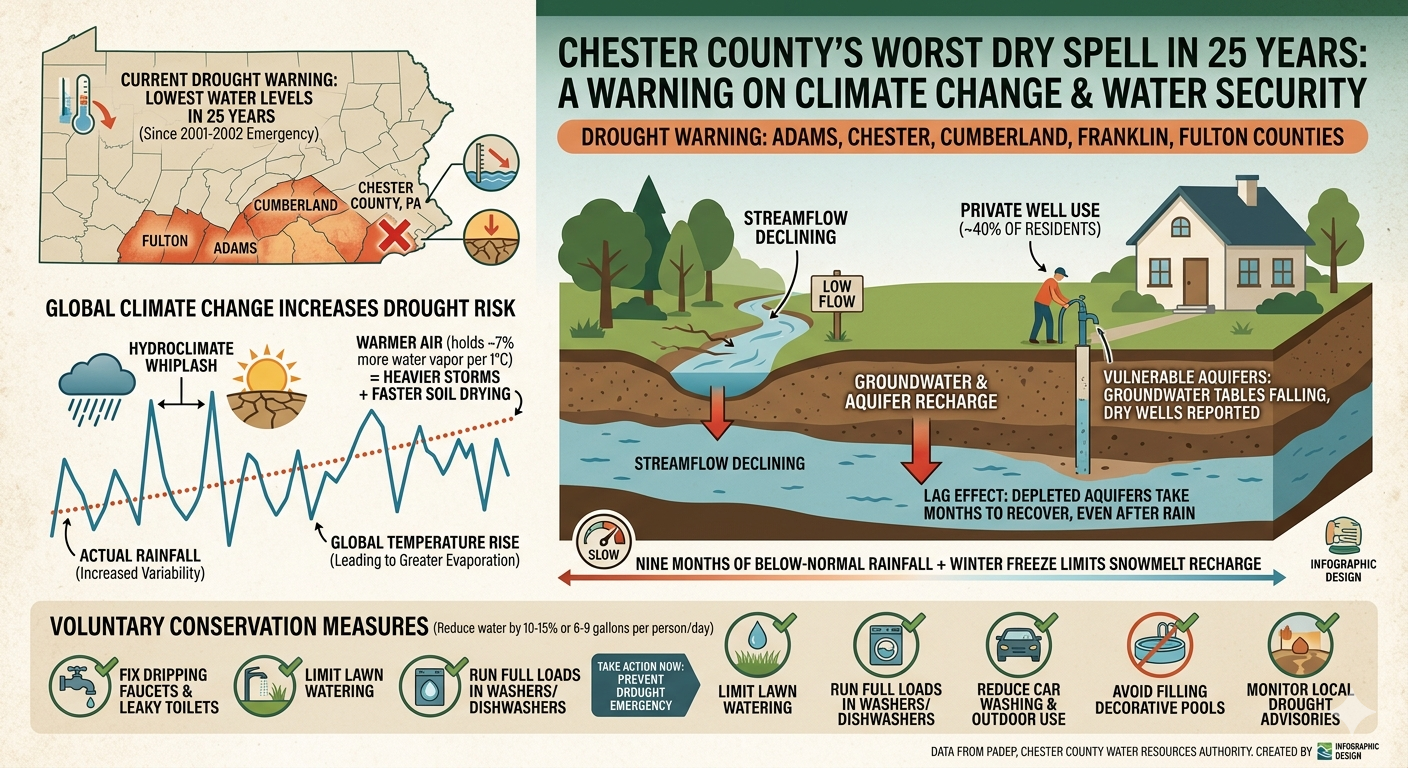
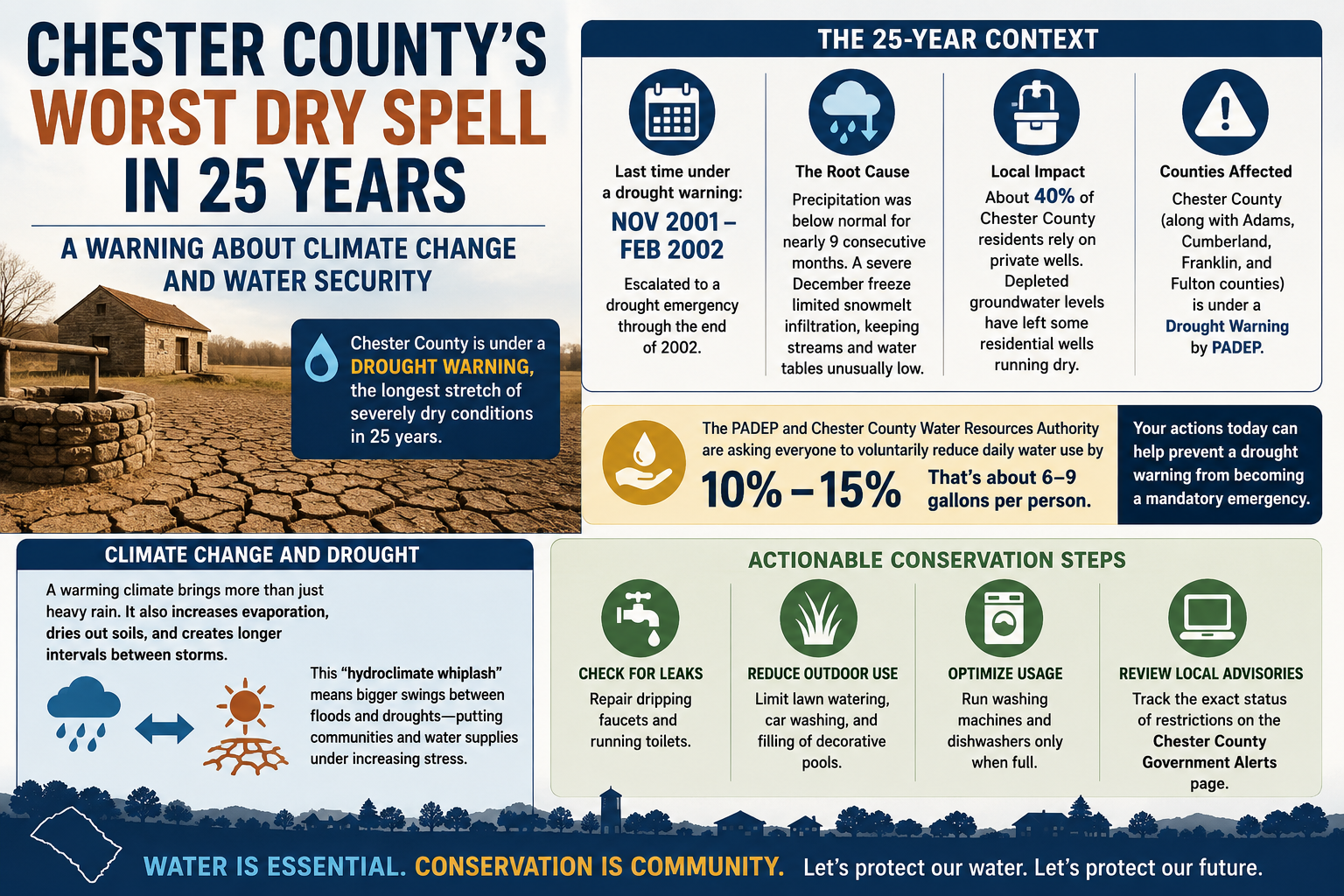
bookmark_borderChester County’s Worst Dry Spell in 25 Years: A Warning About Climate Change and Water Security

A Quarter-Century Drought Milestone

Chester County is currently experiencing its most significant drought conditions in 25 years, prompting the Pennsylvania Department of Environmental Protection (PADEP) to place the county under a Drought Warning. Chester County joins Adams, Cumberland, Franklin, and Fulton counties in the warning designation as groundwater levels, stream flows, and water reserves continue to decline.

The last time Chester County experienced comparable conditions was from November 2001 through February 2002. That drought ultimately intensified into a declared drought emergency that persisted through the end of 2002. Today’s warning serves as a reminder that prolonged water shortages remain a serious threat, even in regions traditionally known for abundant rainfall.

Nine Months of Below-Normal Rainfall

The current drought developed after nearly nine consecutive months of below-average precipitation. Compounding the problem, a severe winter freeze limited snowmelt infiltration into the ground, preventing aquifers from receiving the recharge they normally depend upon during the colder months.

As a result, groundwater levels have steadily declined, stream flows have dropped, and reservoirs have struggled to recover. The impacts are particularly severe for the approximately 40 percent of Chester County residents who rely on private wells for their water supply. Some homeowners have already reported wells running dry as water tables continue to fall.

Climate Change and the Growing Risk of Drought

While droughts are a natural part of Pennsylvania’s climate, climate change is increasing the likelihood of both extreme wet and extreme dry conditions.

A warming atmosphere can hold approximately 7 percent more water vapor for every 1°C increase in temperature. This additional moisture often results in heavier downpours and more intense storms. However, the same warming also increases evaporation from soils, vegetation, streams, and reservoirs. The result is a growing tendency toward what scientists call “hydroclimate whiplash”—rapid swings between flooding and drought.

The Mid-Atlantic region has already experienced a rise in extreme precipitation events, but these periods of intense rainfall are increasingly separated by longer dry intervals. Heavy storms may temporarily replenish rivers and reservoirs, yet much of the water can run off quickly rather than soaking deeply into the ground where it can recharge aquifers.

For groundwater-dependent communities like Chester County, this pattern presents a growing challenge. Even when annual rainfall totals appear near normal, the timing and intensity of precipitation can leave water supplies vulnerable.

Why Groundwater Matters

Groundwater serves as a critical buffer during dry periods. It sustains private wells, supports stream flows, and helps maintain ecosystem health when rainfall is scarce.

When drought persists, groundwater levels decline more slowly than surface water, but they also recover more slowly. This lag effect means that even after rainfall returns, water tables may remain depressed for months or longer.

The current drought demonstrates how vulnerable groundwater systems can become after extended periods of below-normal precipitation.

What Residents Can Do

The PADEP and the Chester County Water Resources Authority are asking residents, businesses, and farmers to voluntarily reduce water consumption by 10 to 15 percent, equivalent to approximately six to nine gallons per person per day.

Simple conservation measures can make a meaningful difference:

  • Repair dripping faucets and running toilets.
  • Limit lawn watering and other outdoor irrigation.
  • Reduce car washing and unnecessary outdoor water use.
  • Avoid filling decorative pools and water features.
  • Run dishwashers and washing machines only when fully loaded.
  • Monitor local drought advisories and conservation recommendations.

These voluntary actions can help prevent conditions from deteriorating into a mandatory drought emergency.

A Glimpse of the Future

The current drought warning is more than a temporary weather event. It offers a glimpse into the challenges communities may increasingly face as climate change alters precipitation patterns and intensifies hydrological extremes.

Chester County’s longest severe dry spell in a quarter century underscores the importance of protecting groundwater resources, improving water conservation, and preparing for a future in which both floods and droughts become more disruptive.

The lesson is clear: climate change is not simply making wet places wetter or dry places drier. It is increasing variability itself, creating larger swings between extremes and placing greater stress on the water systems that communities depend upon every day.

bookmark_borderJerk-Behavior in Earth’s Rotation: Climate Change, the Third Derivative, and Emerging Risks to Precision Navigation

“Climate-driven changes in Earth’s rotation may be contributing to navigational uncertainties that negatively affect battlefield outcomes and increase the risk of civilian casualties in contemporary conflicts.”

by Daniel Brouse and Sidd Mukherjee

Abstract

Climate change is increasingly altering the physical dynamics of Earth itself. Accelerating ice-sheet loss, sea-level rise, and large-scale redistribution of mass are changing the planet’s rotation rate, shifting its axis of rotation, and introducing increasingly nonlinear behavior into Earth system processes. Recent studies indicate that climate-driven ice melt is lengthening Earth’s day by approximately 1.33 milliseconds per century, making climate change a dominant driver of long-term rotational change. Beyond the slowing of rotation, the acceleration and third derivative (“jerk”) of these changes may represent a more significant concern because they reduce predictability within systems that depend on precise measurements of time, position, and motion. The consequences extend beyond geophysics into GPS accuracy, satellite operations, spacecraft navigation, autonomous systems, and potentially military guidance technologies. This paper examines the emerging science of climate-driven rotational change and places it within the broader context of accelerating Earth-system feedback loops and nonlinear climate dynamics.

Introduction

Earth’s rotation has never been perfectly constant. Variations occur naturally through interactions among the atmosphere, oceans, mantle, core, tides, and cryosphere. Historically, these fluctuations have remained within ranges that can be modeled and predicted through established geophysical processes.

Anthropogenic climate change is introducing a new forcing mechanism into this system. Accelerated melting of glaciers and polar ice sheets is redistributing trillions of tons of mass from high latitudes toward the oceans. This redistribution alters Earth’s moment of inertia and changes the speed and orientation of the planet’s rotation.

While changes in rotational velocity have attracted growing scientific attention, the acceleration and higher-order derivatives of those changes may prove even more significant. The third derivative, commonly referred to as “jerk,” measures how rapidly acceleration itself is changing. Increasing jerk-behavior is often a hallmark of nonlinear systems approaching new states of instability or unpredictability.

The significance of these changes extends far beyond the length of the day. Modern civilization depends upon precise timing, positioning, navigation, and reference-frame stability. Small changes in Earth’s rotational behavior can cascade through technologies that form the foundation of the modern world.

Climate Change and Earth’s Rotational Slowdown

In 2024, researchers from ETH Zurich, NASA’s Jet Propulsion Laboratory, and collaborating institutions demonstrated that climate change has become an increasingly dominant influence on Earth’s rotation. Their work showed that melting ice sheets redistribute mass from the poles toward lower latitudes, increasing Earth’s moment of inertia and slowing the planet’s rotation in a manner analogous to a spinning figure skater extending their arms.

A March 2026 analysis published in the Journal of Geophysical Research: Solid Earth quantified the effect, estimating that climate-driven ice melt is lengthening Earth’s day by approximately 1.33 milliseconds per century. While seemingly small, this represents a measurable and accelerating alteration of one of the planet’s most fundamental physical properties.

Researchers further concluded that the climate-driven component of Earth’s rotational slowdown now exceeds many natural long-term influences and may represent the most rapid climate-related rotational change observed in millions of years.

Polar Motion and the Changing Shape of Earth

The effects of ice-sheet loss are not limited to rotational speed.

As glaciers and ice sheets melt, the redistribution of water mass changes Earth’s shape and alters the position of its rotational axis. Research published in Geophysical Research Letters found that global warming has accelerated the movement of Earth’s rotational pole since the 1990s.

Several mechanisms contribute to this phenomenon:

  • Redistribution of meltwater toward lower latitudes.
  • Gravitational migration of ocean mass.
  • Centrifugal redistribution of water toward the equatorial bulge.
  • Glacial Isostatic Adjustment (GIA), in which land previously compressed by massive ice sheets slowly rebounds upward as ice disappears.

Together, these processes alter both Earth’s moment of inertia and the orientation of its spin axis. The result is a planet whose rotational geometry is changing more rapidly than at any point during the modern observational era.

The Third Derivative: Jerk-Behavior in the Earth System

Velocity measures change.

Acceleration measures changing velocity.

Jerk measures changing acceleration.

In engineering, aerospace systems, and control theory, jerk is often more important than velocity because it determines how predictable a system remains under changing conditions.

Earth’s rotational system now appears to be exhibiting measurable jerk-behavior driven by climate-induced mass redistribution. This means that not only is Earth slowing, but the rate at which it is slowing is itself changing.

Such behavior introduces challenges for predictive models because assumptions based upon previous rates of change become increasingly unreliable. Systems must be updated more frequently, and uncertainty grows as the underlying dynamics become increasingly nonlinear.

The emergence of measurable jerk-behavior may represent one of the clearest physical indicators that climate change is influencing fundamental planetary-scale processes.

Earth Orientation Parameters and Navigation Systems

Modern navigation depends on the precise relationship between celestial and terrestrial coordinate systems.

The International Celestial Reference Frame (ICRF) provides a stable astronomical reference framework based on distant quasars. The International Terrestrial Reference Frame (ITRF) defines geographic coordinates fixed to Earth’s surface.

Earth Orientation Parameters (EOPs) connect these systems.

Organizations such as the International Earth Rotation and Reference Systems Service (IERS) continuously monitor changes in:

  • Length of day
  • Polar motion
  • Axial orientation
  • Precession
  • Nutation

As climate-driven changes accelerate, EOP calculations become increasingly important. Even centimeter-scale errors in Earth’s reference frame can propagate into navigation errors measured in hundreds of meters across interplanetary distances.

The growing variability in Earth’s rotation increases the complexity of maintaining accurate coordinate transformations between space-based and Earth-based systems.

GPS, Spacecraft, and Inertial Navigation

Global Positioning System (GPS) satellites rely upon extremely precise timing and rotational models.

Unexpected changes in Earth’s orientation can create discrepancies between modeled and actual positions. These discrepancies must be corrected through continual updates to Earth orientation parameters.

The same challenge affects:

  • Satellite tracking
  • Spacecraft navigation
  • Astronomical observations
  • Geodesy
  • Autonomous transportation systems
  • Long-range communication networks

Inertial Navigation Systems (INS) face an additional challenge because they operate by integrating acceleration and rotational measurements relative to Earth itself.

As Earth’s rotational characteristics evolve, assumptions embedded within inertial guidance algorithms require more frequent recalibration. Small errors can accumulate over long distances and extended operational periods.

Sea-Level Rise Commitments and Long-Term Rotational Change

The rotational changes observed today are unlikely to stabilize quickly.

Research on the Greenland Ice Sheet has demonstrated that substantial future melting is already committed due to past greenhouse gas emissions. A study led by Jason Box and colleagues concluded that even if emissions ceased immediately, Greenland alone is committed to producing at least 27 centimeters of global sea-level rise.

Subsequent analyses suggest that realistic outcomes may substantially exceed this minimum estimate.

This committed melting implies continued redistribution of mass for decades and potentially centuries. As a result, climate-driven changes in Earth’s rotation, polar motion, and reference-frame stability are likely to continue long after greenhouse gas emissions peak.

The rotational consequences therefore represent not merely a current phenomenon but a long-term geophysical response that may unfold over generations.

Climate Feedback Loops and Nonlinear Dynamics

Understanding Earth’s changing rotation requires understanding the broader climate system in which it occurs.

Climate change is not a simple linear process. It is a dynamic system characterized by numerous interacting feedback loops, including:

  • Albedo Feedback Loop
  • Brown Carbon Feedback Loop
  • Permafrost-Methane Feedback Loop
  • Freshwater-AMOC Disruption Loop
  • Arctic Sea Ice Feedback Loop
  • Amazon Rainforest Dieback Feedback Loop
  • Hydroclimate Whiplash
  • Sudden Sea-Level Rise Pulses (“Cork Release” Events)

Each feedback influences the others through interconnected physical, biological, and social systems.

These interactions create nonlinear responses in which relatively small disturbances can trigger disproportionately large outcomes. The accelerating changes observed in Earth’s rotation may therefore be viewed as one manifestation of a broader planetary trend toward increasing systemic instability and complexity.

Defense and Strategic Implications

Modern military and aerospace systems depend heavily on precision navigation.

Long-range missiles, autonomous drones, hypersonic vehicles, spacecraft, and surveillance platforms all rely upon accurate reference frames and rotational models.

As Earth orientation becomes more variable, maintaining precision requires increasingly sophisticated updates and corrections.

Climate-driven changes in Earth’s rotation may be contributing to navigational uncertainties that negatively affect battlefield outcomes and increase the risk of civilian casualties in contemporary conflicts. As rotational variability increases, the growing complexity of Earth orientation modeling presents an emerging strategic challenge for navigation-dependent systems, including long-range guided munitions, autonomous drones, satellite operations, and other precision-targeting technologies.

Further research is needed to quantify these effects under operational conditions.

Conclusion

Climate change is altering not only Earth’s atmosphere, oceans, and ecosystems but also the planet’s physical rotation.

Accelerated melting of glaciers and ice sheets is slowing Earth’s rotation, shifting its axis, changing its shape, and introducing increasing levels of acceleration and jerk-behavior into planetary dynamics.

Recent research suggests that climate-driven rotational changes are now occurring at rates unprecedented in millions of years. These changes are becoming increasingly relevant to GPS systems, spacecraft navigation, Earth orientation modeling, geodesy, and other technologies dependent upon extreme precision.

Viewed within the larger framework of interacting climate feedback loops and nonlinear Earth-system dynamics, the changing rotation of Earth may represent one of the most fundamental indicators that anthropogenic climate change is affecting the physical mechanics of the planet itself.

Also see:

How Fast Is Climate Change Changing? Earth’s Rotation Is Changing More Than at Any Time in 3.6 Million Years 

References

Box, J. E., Colgan, W., et al. (2022). Greenland Ice Sheet Climate Disequilibrium and Committed Sea-Level Rise. Nature Climate Change.

Dill, R., Soja, B., Chen, J., et al. (2024). The Increasingly Dominant Role of Climate Change on Length of Day. Proceedings of the National Academy of Sciences, 121(28).

ETH Zurich Geodesy and Geodynamics Group. Research on Earth Rotation, Climate Change, and Earth Orientation Parameters.

International Earth Rotation and Reference Systems Service (IERS). Earth Orientation Parameters Technical Bulletins.

NASA Jet Propulsion Laboratory (JPL). Climate-Driven Changes in Earth Rotation and Polar Motion.

Wang, J., et al. (2021). Climate-Driven Polar Motion Since the 1990s. Geophysical Research Letters.

Membrane.com. Sea Level Rise: Then and Now. http://membrane.com/global_warming/Sea-Level-Rise-Historic.html

Membrane.com. Ignite a Domino Effect: Climate Feedback Loops and Cascading Tipping Points. http://membrane.com/global_warming/Ignite-a-Domino-Effect.html

Membrane.com. Greenland Melting Inevitable. http://membrane.com/global_warming/notes/Greenland-Melting-Inevitable.html

Journal of Geophysical Research: Solid Earth. (2026). Climate-Driven Lengthening of Day Associated with Ice Melt and Sea-Level Rise.

Lambeck, K. (2005). The Earth’s Variable Rotation: Geophysical Causes and Consequences. Cambridge University Press.

Munk, W. H., & MacDonald, G. J. F. (1960). The Rotation of the Earth: A Geophysical Discussion. Cambridge University Press.

bookmark_borderThe Jersey Shore’s Future: From Floating Casinos to Elevated Beaches

By Daniel Brouse
June 7, 2026

I saw an interesting climate story today about the future of the Jersey Shore and the growing challenges posed by sea-level rise, coastal erosion, and increasingly frequent flooding events.

One of my earliest climate-related case studies dates back to the 1990s and involved the Atlantic City casino industry. At the time, I was examining how major businesses were investing in vulnerable shoreline real estate and whether those investments adequately accounted for long-term climate risks.

Some of the ideas being discussed then were remarkably ambitious. Among them were concepts involving casinos built on stilts or even floating platforms, with visitors ferried back and forth from the mainland. From both a climate science perspective and an economic perspective, I viewed these proposals as problematic. As I was developing one of my first climate-adjusted real estate valuation models, it became increasingly clear that rising seas, stronger coastal storms, and accelerating erosion would create risks that could not be solved simply by elevating structures.

More than three decades later, a recent news story suggests that elements of that future are already emerging.

Elevated Adaptation on a Disappearing Shoreline

The story focuses on Showboat Resort owner Bart Blatstein and his plans to build an elevated beach club on Atlantic City’s historic Garden Pier. The project is intended to provide visitors with a beach experience while avoiding a growing problem that has become increasingly difficult to ignore: the beach itself is disappearing.

The northern section of Atlantic City’s shoreline has experienced severe and persistent erosion. Winter storms, stronger wave action, rising sea levels, and long-term coastal change have repeatedly stripped away sand, leaving sections of the beach narrower and less usable than in previous decades. In some areas, finding enough dry sand to comfortably support traditional beach recreation has become increasingly difficult.

Rather than attempting to restore the traditional beach environment at ground level, the elevated beach club effectively bypasses the problem. Built above the shoreline on the 113-year-old Garden Pier, the facility allows visitors to experience coastal amenities without direct dependence on a stable sand base that is increasingly unreliable.

From a business standpoint, the project represents an adaptive innovation. From a climate perspective, it may also reflect something broader: the early stages of structural redesign in coastal economies that are adjusting to long-term shoreline instability.

Atmospheric Rivers, Storm Surge, and Accelerated Erosion

Coastal adaptation pressures are not occurring in isolation. Extreme precipitation and storm systems are increasingly amplifying shoreline loss.

A documented example from Ocean City, New Jersey, shows how atmospheric rivers combined with storm surge can dramatically accelerate coastal erosion events. When intense moisture-laden systems intersect with high tides and coastal storm conditions, wave energy and flooding impacts compound, leading to rapid beach loss and infrastructure stress.

Atmospheric Rivers and Coastal Erosion

It is important to note that these impacts vary depending on local geography, land use, and coastal defenses. However, the underlying pattern is consistent: increasing atmospheric moisture and storm intensity are contributing to more extreme coastal erosion episodes.

Nuisance Flooding and Chronic Coastal Inundation

Long-term sea-level rise is also reshaping coastal risk profiles in less dramatic but more persistent ways.

According to NOAA analyses, “nuisance flooding” — defined as minor but disruptive flooding events that overwhelm infrastructure, close roads, and damage property — has increased by approximately 300% to 925% along U.S. coastlines since the 1960s.

As documented in Atlantic City, New Jersey, nuisance flooding has increased dramatically, with a reported 682% surge since the mid-20th century. These events are no longer limited to major storms. Instead, they now occur during high tides and moderate weather conditions due to rising baseline sea levels and reduced natural buffering systems.

Atlantic City Going Under

As NOAA oceanographer William Sweet has noted, rising sea levels increase the baseline height of tides and storm surge, meaning that flooding now occurs more frequently even in the absence of extreme weather. These incremental events gradually erode infrastructure resilience and accumulate long-term economic costs.

A Shifting Coastal Economy

Taken together, these trends show that the Jersey Shore is transitioning from a stable recreational coastline into a dynamically changing system where erosion, flooding, and storm impacts are increasingly central to economic planning.

Historically, beaches have been among the most valuable economic assets along the Jersey Shore. Hotels, casinos, restaurants, and boardwalk infrastructure all depend on predictable coastal geography. As that stability declines, communities are forced into continuous cycles of adaptation: replenishing sand, elevating structures, redesigning infrastructure, and relocating assets.

Each adaptation reduces vulnerability temporarily but does not address the underlying driver: a changing coastal baseline shaped by rising seas and intensifying storm systems.

Conclusion: Adaptation Under Constraint

The Garden Pier project may ultimately succeed as a tourism and economic attraction. However, it also serves as a visible marker of a broader transition already underway along vulnerable coastlines.

The central lesson is not that adaptation is failing, but that it is becoming increasingly costly and structurally necessary. Coastal economies are being forced to redesign themselves around environmental conditions that are no longer stable.

Moral of the story: adaptation is increasingly becoming a cost of doing business along vulnerable coastlines, but it does not resolve the underlying drivers of change. As climate impacts accelerate, the cost and complexity of adaptation increase. Mitigation remains the only long-term strategy capable of stabilizing the system.

bookmark_borderHow Fast Is Climate Change Changing? Changes in Earth’s Spinning Are the Most in 3.6 Million Years

How Fast Is Climate Change Changing?
Evidence for Nonlinear Acceleration Across Multiple Earth System Indicators

Earth Rotation Climate Change Rate Unseen in 3.6 Million Years: GPS Precision at Stake

Melting ice is lengthening days at an unmatched rate in 3.6 million years

By Daniel Brouse and Sidd Mukherjee
June 7, 2026

Abstract

Climate change is increasingly characterized not only by rising mean temperatures and sea levels, but by accelerating rates of change across multiple coupled Earth systems. Within the framework of the Nonlinear Acceleration Hypothesis, observational data suggest that the Earth system is not responding linearly to radiative forcing, but instead exhibiting feedback-amplified dynamics consistent with accelerating response timescales.

Early formulations of this hypothesis in the 1990s estimated acceleration behavior on the order of ~2^1-fold per century doubling dynamics. More recent multi-indicator analyses suggest substantially shorter characteristic timescales, consistent with stronger feedback amplification on the order of ~2^6-fold on decadal scales, corresponding to an approximate ~60× increase in effective growth constant or approaching two orders of magnitude acceleration of the entire system.

This paper synthesizes multiple observational indicators—including sea level rise, cryospheric mass loss, and changes in Earth’s rotational dynamics—to evaluate whether climate change is accelerating in a nonlinear, feedback-driven manner.


1. Introduction: From Linear Change to Nonlinear Acceleration

Traditional climate frameworks often describe change as gradual and proportional to forcing. However, an increasing body of observational evidence suggests that key components of the Earth system exhibit nonlinear behavior, where feedbacks amplify initial warming into cascading system responses.

Under the Nonlinear Acceleration Hypothesis, climate change is not only increasing in magnitude but also in rate of change. This implies that the system’s “speed” is itself evolving, driven by reinforcing feedback loops involving ice loss, ocean heat uptake, sea level rise, and changes in planetary angular momentum distribution.


2. Evolution of Observed Acceleration Rates

When the Nonlinear Acceleration Hypothesis was first developed in the 1990s, observed acceleration behavior across climate indicators was consistent with approximately ~2^1-fold per century doubling-type dynamics.

More recent analyses incorporating multiple independent datasets suggest significantly shorter characteristic timescales, consistent with stronger feedback amplification:

  • ~2^6-fold acceleration on a decadal basis
  • ~60× increase in effective growth constant relative to early estimates
  • Nearly two orders of magnitude increase in apparent system response speed

These values represent a convergence of multiple accelerating indicators rather than a single linear trend.


3. Sea Level Rise as a Primary Integrated Signal

Sea level rise (SLR) remains one of the most comprehensive integrative indicators of climate system change, reflecting:

  • Ocean thermal expansion
  • Ice sheet and glacier mass loss
  • Gravitational redistribution
  • Solid Earth deformation and isostatic adjustment

Because SLR integrates multiple processes, it serves as a leading composite metric for evaluating long-term climate acceleration.


4. Cryosphere–Rotation Coupling: Changes in Earth’s Spin

A second independent indicator of large-scale system change is the effect of ice melt on Earth’s rotation.

Recent analyses suggest that melting ice is measurably altering Earth’s angular momentum distribution, producing detectable changes in rotation rate and polar motion. One reported summary states:

“Melting ice is lengthening days at an unmatched rate in 3.6 million years, straining GPS precision.”

Additional geophysical research indicates that:

  • Ice mass redistribution alters Earth’s moment of inertia
  • Conservation of angular momentum drives compensatory rotational changes
  • Glacial isostatic adjustment contributes to long-term deformation of the solid Earth system

A March 2026 study published in the Journal of Geophysical Research: Solid Earth quantifies this effect as:

  • ~1.33 milliseconds per century lengthening of Earth’s day due to climate-driven ice melt

Source: https://www.eurekalert.org/news-releases/1119694

These results are described as unprecedented in the Late Pliocene geological record.

“In our earlier work, we showed that the accelerated melting of polar ice sheets and mountain glaciers in the 21st century is raising sea levels, which slows Earth’s rotation and therefore lengthens the day — similar to a figure skater who spins more slowly once they stretch their arms, and more rapidly once they keep their hands close to their body,” explains Mostafa Kiani Shahvandi of the University of Vienna’s Department of Meteorology and Geophysics. “What remained unclear was whether there were earlier periods when climate increased day length at a similarly rapid pace.”


5. Earth System Geometry and Mass Redistribution

Beyond rotation, climate-driven mass redistribution is altering Earth’s physical structure:

  • Reduction of polar ice load
  • Redistribution of mass toward lower latitudes
  • Ocean basin loading changes due to sea level rise
  • Solid Earth viscoelastic rebound

These processes are coupled through gravity, rotation, and fluid dynamics, forming an integrated Earth system response rather than isolated regional effects.

Sea Level Rise: Then and Now
http://membrane.com/global_warming/Sea-Level-Rise-Historic.html


6. Synthesis: Evidence for System-Wide Acceleration

Across multiple independent indicators, a consistent pattern emerges:

  • Sea level rise is accelerating
  • Ice mass loss is accelerating
  • Earth rotation changes are accelerating
  • Geophysical redistribution processes are intensifying

A March 2026 study synthesis of geodetic and geophysical observations further supports the magnitude of these changes and their unprecedented rate in the modern geologic record:

https://www.eurekalert.org/news-releases/1119694

When viewed collectively, these indicators are consistent with a nonlinear Earth system response in which feedbacks amplify baseline warming into broader systemic change.


7. Conclusion

The available evidence suggests that climate change is increasingly characterized by accelerating rates of system response across multiple Earth domains. Within the framework of the Nonlinear Acceleration Hypothesis, these observations are consistent with a coupled system in which feedback loops govern not only the magnitude of change but the speed at which change unfolds.

Sea level rise, ice mass loss, and measurable changes in Earth’s rotational dynamics collectively suggest that the Earth system is entering a regime of enhanced sensitivity, where relatively small additional forcing may produce disproportionately large and rapidly emerging responses.

Understanding the true rate of climate change therefore requires moving beyond static trend analysis and toward a dynamic framework that accounts for feedback amplification, cross-system coupling, and nonlinear acceleration across the entire Earth system.