A recent Reuters report highlighted a familiar concern in Alberta: another wildfire season threatening Canada’s oil sands region. The article focused primarily on risks to energy production, facility shutdowns, and the economic impacts of increasingly severe wildfire activity. Yet an important aspect of these events often goes overlooked. Beyond the immediate threats to infrastructure and public safety lies a much larger atmospheric consequence: ozone formation.
Wildfires and fossil fuel production intersect in ways that can amplify air pollution, damage ecosystems, and accelerate climate change. The resulting ozone feedback may be one of the least recognized but most significant consequences of recurring wildfire seasons in Canada’s oil sands region.
Wildfires Are Also Ozone Events
When boreal forests burn, they release enormous quantities of atmospheric pollutants, including nitrogen oxides (NOₓ), volatile organic compounds (VOCs), carbon monoxide (CO), methane (CH₄), and fine particulate matter.
These emissions are the raw ingredients required for the formation of ground-level, or tropospheric, ozone.
Unlike smoke, ozone is not emitted directly by a fire. Instead, it forms downwind as wildfire emissions react in sunlight. As smoke plumes age and travel, ozone concentrations can continue to increase hundreds or even thousands of miles from the fire itself.
This means that a wildfire burning near Fort McMurray is not merely a local event. It can become an ozone-producing system affecting air quality across much of North America.
The Oil Sands Region as an Ozone Amplifier
The Alberta oil sands region contains a vast network of industrial facilities, including extraction operations, upgraders, power generation facilities, transportation systems, and processing plants.
These activities emit additional nitrogen oxides, volatile organic compounds, and methane.
When wildfire emissions mix with industrial emissions, atmospheric chemistry becomes even more favorable for ozone production. In effect, wildfire smoke and fossil fuel emissions can work together to create enhanced ozone formation.
The result is not simply more smoke, but more ozone—a pollutant that affects human health, agricultural productivity, forest growth, and climate.
Long-Distance Impacts
The greatest ozone impacts may occur far from the fires themselves.
Canadian wildfire smoke routinely travels across the United States, reaching cities such as Chicago, New York, Philadelphia, Washington, and Boston. While residents often notice visible haze, they may be less aware of the invisible ozone that develops as those smoke plumes age.
Recent studies suggest that wildfire-driven ozone is increasingly offsetting decades of progress made through reductions in vehicle and industrial emissions.
In other words, communities may experience worsening ozone pollution despite continued improvements in traditional air-quality controls.
Ozone Damage to Boreal Forests
The Reuters article understandably focused on the threat wildfires pose to oil production. However, the surviving forests face another threat after the flames pass.
Ozone is toxic to vegetation.
When ozone enters leaves through plant stomata, it damages cellular structures involved in photosynthesis. The result is reduced growth, increased stress, greater vulnerability to disease, and diminished carbon uptake.
This self-reinforcing cycle links wildfire activity directly to ecosystem decline and climate acceleration.
Methane and the Global Ozone Pathway
The oil sands region also contributes methane emissions associated with extraction, processing, transportation, and storage.
Methane plays two climate roles.
First, it acts as a powerful greenhouse gas.
Second, methane oxidation contributes to the formation of background tropospheric ozone on a global scale.
Unlike wildfire-generated ozone, which forms over hours or days, methane-driven ozone develops over months and years. The result is a persistent increase in global ozone concentrations that affects ecosystems far from the original emission source.
This means the oil sands region can contribute simultaneously to both short-term wildfire-driven ozone events and long-term methane-driven ozone accumulation.
The Hidden Climate Feedback
Viewed through the lens of atmospheric chemistry, the story of Canada’s oil sands and wildfires extends far beyond threats to energy production.
Three interconnected systems are converging:
Climate change is increasing wildfire frequency and intensity.
Wildfires are releasing massive quantities of ozone precursors.
Oil and gas operations contribute additional precursor emissions and methane.
Together, these processes increase ozone concentrations, damage ecosystems, weaken carbon sinks, and contribute to additional warming.
The result is a powerful climate feedback loop in which wildfires, ozone formation, ecosystem decline, and fossil fuel emissions reinforce one another.
While the flames themselves draw the headlines, the ozone produced in their wake may represent one of the most significant long-term consequences of wildfire activity in the oil sands region. Invisible, widespread, and persistent, ozone serves as a critical link connecting wildfires, fossil fuel development, ecosystem degradation, and climate change.
Global wildfire trends are more complicated than simply counting the number of fires. Scientists are increasingly concerned about the growth of extreme, high-intensity fires, the amount of carbon released, the length of fire seasons, and the expansion of fires into ecosystems that historically burned less frequently.
Did you know that major Canadian wildfires can generate ozone and ozone precursors that are transported into the United States, degrading air quality and affecting public health hundreds or even thousands of miles away? The smoke doesn’t just contain particulate pollution—it also contributes to the formation of ground-level ozone, a pollutant linked to respiratory disease, climate warming, reduced plant productivity, and diminished CO₂ sequestration. Ozone damages vegetation by impairing photosynthesis and weakening plant health, and prolonged exposure can contribute to forest decline and increased tree mortality.
And then there are the so-called “zombie fires” in parts of Canada and Siberia. These fires can smolder underground in carbon-rich peat and permafrost through the winter, re-emerging when temperatures rise. They release carbon that has been locked away for centuries or even millennia, creating an additional climate feedback that many people are unaware of.
A meaningful discussion isn’t about whether someone can find a statistic showing fewer fires in one dataset or region. It’s about understanding what is actually happening in the Earth system: larger extreme fires, longer fire seasons, increased carbon emissions, long-range ozone pollution, and emerging feedbacks from thawing permafrost. Those are the trends scientists are paying attention to.
Tropospheric ozone is one of the most dangerous yet least understood environmental threats facing modern society. Invisible to the eye, it functions simultaneously as an air pollutant, a greenhouse gas, and a climate feedback amplifier. Ozone exposure is associated with millions of illnesses and premature deaths worldwide, while also damaging crops, forests, and other ecosystems that serve as critical carbon sinks. Emerging research suggests that ozone is an important component of several self-reinforcing climate feedback loops involving wildfires, forest decline, methane emissions, permafrost thaw, and so-called “zombie fires” that can smolder underground for months or even years, similar in some respects to the long-burning coal fires of Centralia, Pennsylvania. Because tropospheric ozone is produced through atmospheric reactions involving emissions from fossil fuel combustion, biomass burning, and methane oxidation, it serves as a critical link between atmospheric chemistry, ecosystem health, and climate change. Diesel combustion remains a major contributor to localized ozone formation through its emissions of nitrogen oxides (NOₓ), while natural gas systems, particularly those associated with electric power generation, contribute to a broader global ozone pathway through methane leakage, combustion-related methane slip, and the atmospheric chemical processes that convert methane into tropospheric ozone. Together, these processes position ozone not merely as a consequence of climate change, but as a significant multiplier of its impacts.
Introduction
Discussions about transportation fuels and electricity generation often focus almost exclusively on carbon dioxide (CO₂) emissions. While CO₂ remains the dominant long-lived greenhouse gas produced by human activities, evaluating fuels solely through a carbon dioxide lens overlooks important atmospheric processes that influence climate, air quality, ecosystem health, and public health.
Among these processes, tropospheric ozone (O₃) occupies a unique position. Ozone is both a harmful air pollutant and a significant short-lived climate forcer. It damages crops and forests, impairs human respiratory health, reduces carbon uptake by vegetation, and contributes directly to warming. Because ozone is formed through complex atmospheric chemistry rather than emitted directly, different fuels can produce dramatically different ozone-related impacts even when their carbon dioxide emissions appear similar.
The choice between diesel fuel and natural gas provides a useful example. Diesel and natural gas create distinct atmospheric signatures that influence local air pollution, global atmospheric chemistry, and climate feedbacks through different pathways. Understanding these differences reveals why the true environmental footprint of a fuel extends far beyond the carbon dioxide emitted at the point of combustion.
Ozone: A Secondary Climate Pollutant
Unlike carbon dioxide or methane, ozone is not emitted directly from vehicle tailpipes or power plant stacks. Instead, it is a secondary pollutant formed through photochemical reactions involving two primary ingredients:
Nitrogen Oxides (NOₓ)
Volatile Organic Compounds (VOCs)
When these compounds interact in the presence of sunlight, they produce ground-level ozone. The amount, location, and persistence of ozone formation depend heavily on the chemical composition of the emissions. As a result, fuel choice can significantly influence both local air quality and broader climate impacts.
Diesel: The NOₓ-Dominated Pathway
Diesel engines operate under extremely high pressures and combustion temperatures. These conditions promote the formation of large quantities of nitrogen oxides.
As a result, diesel exhaust typically contains:
High concentrations of NOₓ
Complex aromatic VOCs
Fine particulate matter
Black carbon (soot)
This combination creates highly reactive atmospheric chemistry that efficiently generates local ground-level ozone. In urban and industrial regions, diesel emissions can become a major driver of ozone pollution episodes and smog formation.
The climate impact extends beyond ozone. Diesel engines also emit black carbon, one of the most powerful short-lived climate pollutants. Black carbon absorbs solar radiation directly, warming the atmosphere while accelerating snow and ice melt when deposited on reflective surfaces. Consequently, diesel’s climate footprint includes not only carbon dioxide emissions but also localized ozone production and direct atmospheric heating from soot.
Natural Gas: The Methane Pathway
Natural gas combustion follows a very different atmospheric pathway. In transportation applications, natural gas vehicles generally emit substantially less nitrogen oxide pollution than comparable diesel engines, often reducing NOₓ emissions by 75% to 94%.
This reduction can significantly decrease local ozone formation and improve urban air quality. However, natural gas introduces a different atmospheric challenge.
The primary hydrocarbon associated with natural gas is methane (CH₄). Unlike the highly reactive VOCs commonly associated with diesel exhaust, methane reacts slowly in the atmosphere. Rather than generating immediate local smog, methane can persist for more than a decade, circulating globally before participating in atmospheric reactions that contribute to tropospheric ozone formation.
As a result, natural gas may reduce local ozone pollution while simultaneously contributing to increases in global background ozone concentrations through methane-driven atmospheric chemistry.
Direct Greenhouse Emissions
When only tailpipe or stack emissions are considered, natural gas appears to offer a significant climate advantage.
Diesel is a carbon-dense fuel that produces relatively large quantities of carbon dioxide during combustion. Natural gas, composed primarily of methane, contains a higher hydrogen-to-carbon ratio and therefore releases approximately 20% to 30% less CO₂ per unit of energy produced.
Under a narrow carbon accounting framework, this makes natural gas appear to be the cleaner option.
However, direct combustion emissions represent only part of the overall climate footprint.
The Supply Chain Problem
The greatest climate risk associated with natural gas often occurs before the fuel reaches an engine, turbine, or boiler.
Methane is an extraordinarily potent greenhouse gas, possessing a global warming potential roughly 28 to 36 times greater than carbon dioxide over a 100-year timeframe and substantially higher over shorter periods.
Because natural gas must be extracted, processed, compressed, transported, stored, and distributed through extensive infrastructure networks, leakage can occur at numerous points throughout the supply chain.
Even relatively small leakage rates can have significant climate consequences. Studies have shown that methane losses of only 1% to 2% can substantially reduce—or in some cases eliminate—the greenhouse advantage that natural gas enjoys through lower carbon dioxide emissions.
In effect, a fuel that appears cleaner at the point of combustion may produce a substantially larger overall climate footprint once upstream emissions are included.
The Global Ozone Pathway
An often-overlooked consequence of methane leakage is its contribution to the global background ozone burden.
Methane emissions are not confined to the regions where they are released. Once emitted, methane becomes part of the global atmospheric reservoir and circulates throughout the planet. During its atmospheric lifetime, methane undergoes chemical reactions that contribute to the formation of tropospheric ozone over vast geographic areas.
Unlike nitrogen oxides and highly reactive VOCs, which often generate ozone near their source within hours or days, methane influences atmospheric chemistry over years and across continents. The result is a diffuse but persistent increase in background ozone concentrations throughout much of the world’s atmosphere.
This distinction becomes clear when comparing methane-driven ozone formation with wildfire-related ozone transport. Ozone and ozone precursors generated by major Canadian wildfires can be transported into cities such as Philadelphia, creating measurable air-quality impacts for days or weeks. These events are visible, immediate, and regional.
Methane associated with natural gas used to generate electricity in Philadelphia follows a very different pathway. The methane does not travel directly to the Amazon rainforest as ozone. Instead, it becomes globally mixed in the atmosphere and later participates in chemical reactions that elevate ozone concentrations throughout the troposphere, including over remote ecosystems such as the Amazon Basin.
In this sense, wildfire smoke and methane represent two different forms of atmospheric connectivity. Wildfires transport ozone and ozone precursors directly across regions through smoke plumes and weather systems. Methane transport is slower, less visible, and more diffuse, yet potentially broader in scope. A methane leak in Pennsylvania may eventually contribute, in a small but measurable way, to ozone-related stress on forests in South America, crop productivity in Africa, or ecosystem health in Asia.
The wildfire impact is acute, visible, and episodic. The methane impact is diffuse, persistent, and global.
Ozone and the Climate Multiplier Effect
The distinction between diesel and natural gas is therefore not simply a comparison of carbon dioxide emissions.
Diesel tends to generate:
Higher local ozone concentrations
Greater NOₓ pollution
Significant black carbon emissions
Natural gas tends to generate:
Lower local ozone formation
Reduced NOₓ emissions
Greater dependence on methane management
Increased potential for global background ozone formation through methane oxidation
Both fuels contribute to climate warming, but through different mechanisms.
Diesel’s climate multiplier arises primarily from black carbon emissions and localized ozone production. Natural gas’s climate multiplier emerges through methane leakage, long-range atmospheric transport, and the gradual formation of background tropospheric ozone on a global scale.
Conclusion
The choice between diesel and natural gas is often framed as a simple comparison of carbon dioxide emissions. In reality, the decision involves fundamentally different atmospheric pathways that influence air quality, ecosystem health, and climate feedbacks.
Diesel generates substantial nitrogen oxide pollution, localized ozone formation, and black carbon emissions that contribute directly to warming and regional environmental damage. Natural gas reduces many of these local pollutants, but its dependence on methane creates a different set of risks. Methane leakage not only amplifies greenhouse warming directly but also contributes to a global increase in tropospheric ozone, extending the environmental consequences of natural gas use far beyond the point of combustion.
As climate science increasingly recognizes the importance of atmospheric feedbacks, carbon sink degradation, and short-lived climate pollutants, evaluating fuels solely on carbon dioxide emissions becomes increasingly inadequate. The full climate footprint must include methane leakage, ozone chemistry, black carbon emissions, and the broader atmospheric processes that connect local energy choices to global environmental outcomes. Understanding these interconnected pathways is essential for developing energy policies that address not only carbon emissions but the full spectrum of climate-forcing mechanisms operating throughout the Earth system.
Addendum 1: Methane Slip, Combustion Limits, and the Hidden Ozone Pathway
One of the most frequently overlooked aspects of natural gas combustion is that complete combustion is physically unattainable. While modern power plants are remarkably efficient, engineering and thermodynamic constraints ensure that a small fraction of methane always escapes oxidation and enters the atmosphere. This phenomenon, known as methane slip, creates climate consequences that extend well beyond the direct carbon dioxide emissions typically used to evaluate natural gas.
Why Methane Escapes Combustion
Several physical processes limit combustion efficiency even in the most advanced systems:
Boundary Layer Effects (Flame Quenching)
The interior walls of combustion chambers must be actively cooled to prevent structural damage. As methane-air mixtures approach these cooler surfaces, flame temperatures can fall below the threshold required to sustain combustion. This process, known as flame quenching, creates microscopic regions where methane remains unburned and escapes into the exhaust stream.
Incomplete Turbulent Mixing
Efficient combustion requires methane (CH₄) and oxygen (O₂) molecules to mix at extremely small scales. Although modern burners are designed to maximize turbulence, high-velocity flows inevitably create localized pockets where fuel and oxygen concentrations are uneven. Some methane molecules therefore pass through the combustion zone without fully reacting.
Transient Operating Conditions
Methane slip increases substantially during startup, shutdown, load-following operations, and other transient conditions. As electric grids incorporate greater amounts of variable renewable generation, gas-fired plants are increasingly required to ramp output up and down rapidly. These operating conditions often reduce combustion stability and temporarily increase methane emissions.
How Much Methane Escapes?
Methane slip varies considerably depending on technology and operating conditions.
Modern Combined-Cycle Gas Turbines
Large utility-scale combined-cycle plants can achieve combustion efficiencies approaching 99.98% under steady-state operation. Methane slip is typically around 0.02% of fuel input, although rates may increase during startup and load transitions.
Reciprocating Internal Combustion Engines
Smaller gas-fired engines commonly used in peaker plants, compressor stations, and industrial facilities generally exhibit significantly higher methane slip rates. Emissions often range from 1.5% to 3% of fuel input and can be substantially higher under certain operating conditions.
Upstream Leakage
Combustion-related methane slip represents only part of the problem. Additional methane leakage occurs during extraction, processing, storage, transmission, and distribution. When these losses are included, total methane emissions from natural gas systems can become a significant contributor to climate forcing.
Climate and Ozone Implications
Methane is a highly potent greenhouse gas with a warming effect more than 80 times greater than carbon dioxide over a 20-year time horizon. Because methane exerts much of its influence during the critical decades immediately ahead, even relatively small leakage rates can substantially erode the climate advantages often attributed to natural gas.
However, methane’s climate impact extends beyond its direct greenhouse effect.
Once released into the atmosphere, methane becomes globally distributed and persists for approximately a decade before being oxidized through reactions involving hydroxyl radicals (OH). These reactions produce a chain of atmospheric chemical processes that contribute to the formation of tropospheric ozone (O₃).
Unlike ozone generated directly downwind of urban pollution or wildfire smoke, methane-driven ozone formation occurs on a planetary scale. Methane emissions released in one location can influence background ozone concentrations thousands of miles away. Consequently, methane leakage from a natural gas power plant in Pennsylvania can ultimately contribute to ozone formation over the Amazon rainforest, African tropical forests, agricultural regions, or remote ecosystems far removed from the original source.
This distinction is critical because tropospheric ozone is not merely an air pollutant. It is also a greenhouse gas, a phytotoxin, and an increasingly important driver of ecosystem decline.
As ecosystems lose productivity, their ability to absorb atmospheric carbon dioxide declines. The resulting carbon sink failure allows additional greenhouse gases to accumulate in the atmosphere, amplifying warming and creating a reinforcing feedback loop.
In this way, methane slip represents far more than a simple fuel loss. It functions as a delayed, globally distributed climate multiplier that contributes simultaneously to greenhouse warming, tropospheric ozone formation, ecosystem degradation, and the weakening of natural carbon sinks. These interconnected effects illustrate why evaluating fuels solely on direct carbon dioxide emissions can underestimate their true climate impact.
Addendum 2: Wildfires, Ozone, Carbon Sink Failure, and the Climate Feedback Loop
One of the clearest examples of the Ozone Feedback Theory can be observed in the rapidly intensifying wildfire systems of North America and the Arctic.
Major Canadian wildfires routinely generate enormous quantities of smoke containing nitrogen oxides (NOₓ), volatile organic compounds (VOCs), carbon monoxide (CO), methane, and particulate matter. Under sunlight, these emissions participate in complex atmospheric reactions that produce large quantities of ground-level ozone.
Importantly, the impacts of wildfire smoke extend far beyond the visible plume. Atmospheric transport can carry ozone and ozone precursors hundreds or even thousands of miles from their source. Smoke generated in western Canada has repeatedly degraded air quality across the United States, exposing millions of people to elevated ozone concentrations long after the visible smoke has dispersed.
The consequences extend beyond human health.
Tropospheric ozone damages vegetation by impairing photosynthesis, disrupting stomatal regulation, accelerating oxidative stress, and reducing plant productivity. Forests exposed to elevated ozone often exhibit slower growth, increased susceptibility to drought and disease, and higher mortality rates.
As ozone concentrations rise, forests absorb less carbon dioxide from the atmosphere. This reduction in carbon sequestration weakens one of Earth’s most important natural climate-regulating systems.
The feedback loop then begins to accelerate:
Warming temperatures increase wildfire frequency, duration, and intensity.
Wildfires release carbon dioxide, methane, NOₓ, VOCs, and particulate matter.
These emissions generate additional tropospheric ozone.
Ozone damages forests, crops, and other ecosystems.
Additional warming increases the likelihood of future extreme fires.
The cycle repeats and intensifies.
The Role of Zombie Fires and Permafrost Carbon
An additional and particularly concerning feedback involves so-called “zombie fires” found in portions of Canada, Alaska, and Siberia.
Unlike conventional surface fires, zombie fires can smolder underground within carbon-rich peat soils and thawing permafrost throughout the winter months. Hidden beneath snow cover, these fires may persist for months before re-emerging the following spring.
These systems are especially important because they release carbon that has been stored for centuries, millennia, or even longer.
Permafrost regions contain vast reservoirs of ancient organic carbon accumulated over thousands of years. When thawing and burning occur simultaneously, carbon dioxide and methane that were previously isolated from the atmosphere become available for rapid release.
The resulting emissions contribute to several reinforcing feedbacks:
• Direct greenhouse warming from carbon dioxide and methane. • Additional methane-driven tropospheric ozone formation. • Increased wildfire activity through warmer and drier conditions. • Further ecosystem degradation and carbon sink loss.
A Cascading Climate Multiplier
Viewed collectively, wildfire smoke, ozone formation, forest decline, carbon sink failure, methane emissions, and permafrost degradation are not isolated phenomena. They represent interconnected components of a larger feedback system.
Tropospheric ozone serves as a particularly important coupling mechanism within this system because it links atmospheric chemistry, ecosystem health, carbon cycling, and climate change. By simultaneously acting as a greenhouse gas and a biological stressor, ozone helps transform warming-driven disturbances into broader ecological and climatic consequences.
This cascading interaction illustrates how climate change can become self-reinforcing. The concern is not merely that warming causes more fires. Rather, fires generate atmospheric pollutants and greenhouse gases that weaken natural carbon sinks, accelerate ozone formation, and create conditions that favor even greater warming in the future.
In this framework, wildfire-driven ozone production becomes both a symptom of climate change and a mechanism that contributes to its acceleration.
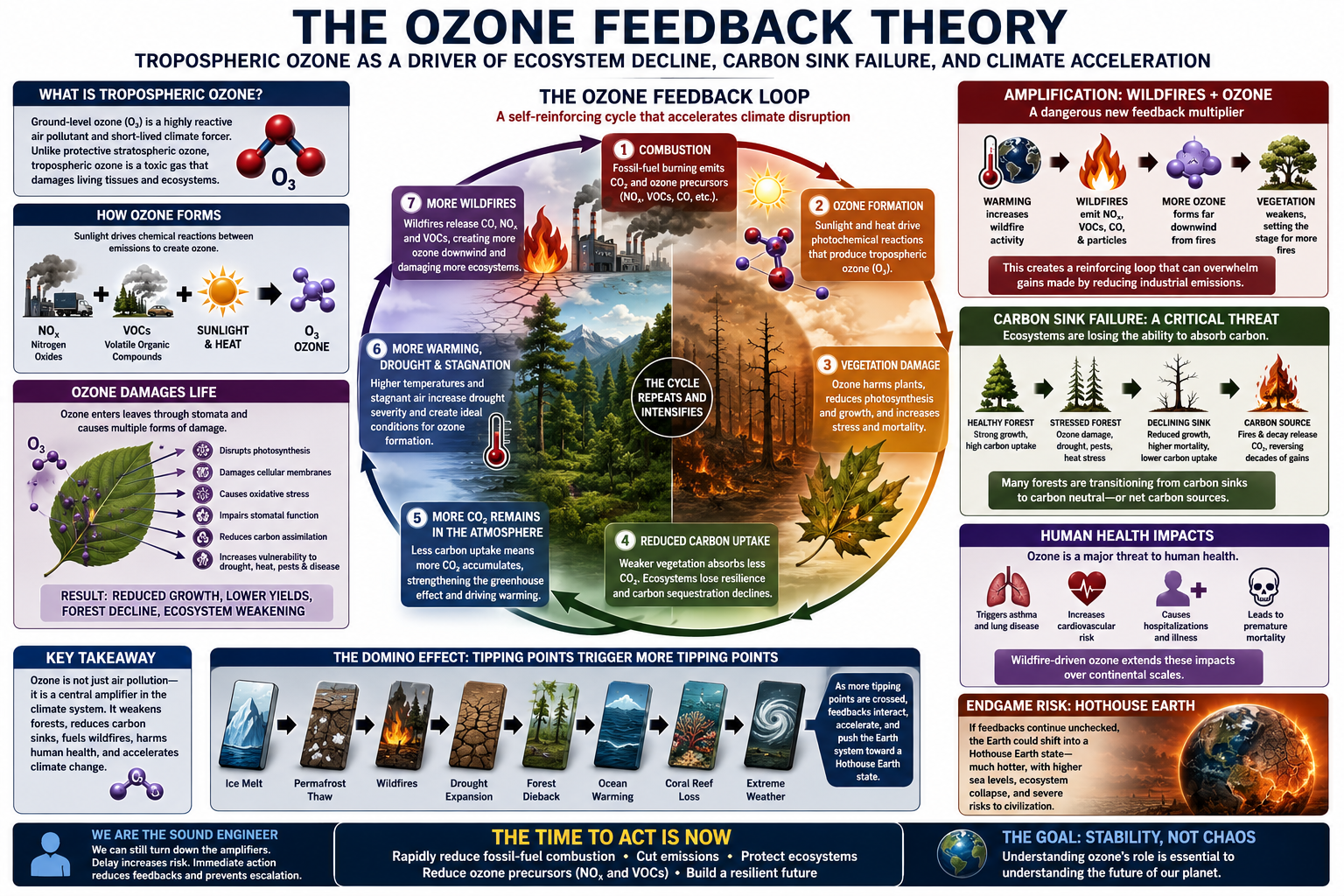
Tropospheric ozone is a major air pollutant, a significant short-lived climate forcer, and an increasingly recognized driver of ecosystem decline. While carbon dioxide (CO₂) remains the dominant anthropogenic greenhouse gas, growing evidence demonstrates that ozone plays a critical role in accelerating climate disruption through its impacts on vegetation, carbon cycling, wildfire activity, atmospheric chemistry, and human health. This paper introduces the Ozone Feedback Theory, which describes how fossil-fuel combustion simultaneously increases atmospheric CO₂ concentrations and ozone precursors, creating interconnected feedbacks that weaken terrestrial carbon sinks, reduce ecosystem resilience, increase wildfire risk, and amplify climate change. Recent observations showing widespread declines in forest productivity, increasing wildfire-driven ozone formation, and the emerging transition of forests from net carbon sinks to net carbon sources provide strong support for this framework. The evidence increasingly indicates that ozone is not merely a secondary pollutant but a central amplifier within the Earth system.
1. Introduction
Tropospheric ozone is among the most underestimated drivers of ecological degradation and climate acceleration.
For decades, climate discussions have focused primarily on carbon dioxide, methane, and other greenhouse gases. While these gases remain fundamental to understanding climate change, this emphasis has often obscured the broader consequences of combustion. Fossil-fuel combustion does not simply release CO₂; it also produces the atmospheric precursors that generate ground-level ozone, one of the most biologically destructive pollutants in the modern environment.
Over the past two decades, a growing body of evidence has demonstrated that ozone damages forests, reduces agricultural productivity, weakens ecosystem resilience, increases susceptibility to drought and wildfire, and contributes significantly to human disease and premature mortality. What initially emerged as a working hypothesis has matured into a broader theoretical framework supported by observations from atmospheric chemistry, ecology, forestry, agronomy, public health, and climate science.
This framework, referred to here as the Ozone Feedback Theory, proposes that ozone functions not merely as an environmental pollutant but as an active participant in a network of self-reinforcing climate feedbacks. Through its impacts on vegetation and carbon sequestration, ozone contributes directly to the weakening of natural carbon sinks while simultaneously increasing vulnerability to drought, pests, disease, and wildfire. These processes, in turn, generate additional greenhouse gases and ozone precursors, creating a cascading cycle of environmental degradation.
The significance of this theory has increased dramatically in recent years as evidence accumulates that many of the world’s major forest systems are experiencing declining productivity, increasing mortality, and reduced carbon uptake. The emerging reversal of forests from net carbon sinks to net carbon sources represents one of the most consequential developments in modern climate science.
2. Origins of the Theory
The origins of the Ozone Feedback Theory were rooted in long-term observation.
Beginning in the early 2000s, repeated observations of mature forest canopies revealed a gradual but persistent decline in canopy density and overall forest health. Initially subtle, the changes became increasingly difficult to ignore. Trees that had stood for generations exhibited thinning crowns, reduced foliage, and declining vigor. Over time, measurable reductions in canopy density and height became evident.
Subsequent investigation suggested that these observations could not be adequately explained by a single factor. Instead, they appeared consistent with the combined effects of warming temperatures, drought stress, ecological disruption, and chronic ozone exposure.
What began as a localized observation eventually aligned with a growing body of scientific literature documenting ozone-induced declines in forest productivity, agricultural yields, and ecosystem resilience across multiple continents.
3. Tropospheric Ozone: A Potent Biological Toxin
Ground-level ozone forms through photochemical reactions involving nitrogen oxides (NOₓ), volatile organic compounds (VOCs), sunlight, and heat.
Unlike stratospheric ozone, which shields life from harmful ultraviolet radiation, tropospheric ozone is highly reactive and directly toxic to living tissues.
Ozone damages plants through multiple pathways:
Disruption of photosynthesis;
Damage to cellular membranes;
Oxidative stress;
Impairment of stomatal function;
Reduction in carbon assimilation;
Increased vulnerability to drought, heat, pests, and disease.
The consequences extend far beyond temporary stress. Numerous studies have documented significant reductions in plant growth, crop yields, forest productivity, and net primary productivity (NPP). Depending on species sensitivity and exposure levels, productivity losses ranging from 10% to more than 40% have been observed, with some ecosystems experiencing substantially greater impacts.
Ozone is therefore not simply a pollutant. It is a large-scale ecological forcing agent.
4. The Ozone Feedback Theory
The central premise of the Ozone Feedback Theory is straightforward:
Combustion generates both greenhouse gases and ozone precursors.
Those emissions simultaneously accelerate warming and increase ozone formation.
The resulting ozone damages vegetation, weakening ecosystems and reducing their capacity to absorb atmospheric carbon.
Reduced carbon uptake allows more CO₂ to remain in the atmosphere, contributing to additional warming.
Additional warming increases drought severity, wildfire activity, and atmospheric stagnation events, which further increase ozone formation.
Unlike traditional climate frameworks that often treat ozone as a secondary pollutant, the Ozone Feedback Theory places ozone near the center of an interconnected network of biological, atmospheric, and climatic feedbacks.
5. Carbon Sink Failure and Ecosystem Destabilization
One of the most important implications of the theory is its relationship to carbon sink stability.
Forests, wetlands, and other ecosystems have historically absorbed a substantial fraction of anthropogenic carbon emissions. This natural buffering capacity has slowed the pace of climate change.
However, growing evidence suggests that this buffering capacity is weakening.
Multiple studies have documented:
Declining forest productivity;
Increased tree mortality;
Reduced carbon sequestration;
Expansion of drought stress;
Increased wildfire activity;
Large-scale ecosystem degradation.
Ozone contributes to each of these processes.
By reducing photosynthetic capacity and weakening plant defenses, ozone lowers ecosystem resilience precisely when climate stress is increasing. The result is a gradual erosion of the natural systems that have historically moderated atmospheric carbon accumulation.
The recent transition of many forest systems from carbon sinks toward carbon neutrality—or even net carbon emissions—represents one of the strongest lines of evidence supporting the theory.
6. Wildfires, Ozone, and Emerging Amplification Loops
Recent research has strengthened the theoretical framework considerably.
The 2026 Science paper, Fires Reverse Progress Toward Ozone Air Quality Standards in the United States, demonstrated that wildfire emissions are increasingly offsetting decades of improvements in ozone pollution achieved through reductions in industrial and transportation emissions.
The study showed that wildfire smoke generates substantial quantities of carbon monoxide, nitrogen oxides, and volatile organic compounds. These emissions undergo photochemical reactions that produce ozone far downwind from the original fire source.
This finding is critically important because it reveals a previously underestimated amplification mechanism:
Climate warming increases wildfire activity.
Wildfires increase ozone formation.
Ozone weakens vegetation.
Weakened vegetation becomes increasingly vulnerable to drought, heat stress, and future fires.
Future fires become more likely and more severe.
The result is a reinforcing feedback system operating across atmospheric, ecological, and climatic domains simultaneously.
7. Human Health Implications
The ozone feedback is not limited to ecosystems.
Tropospheric ozone is a major contributor to respiratory and cardiovascular disease worldwide. Chronic exposure increases the incidence of asthma, chronic obstructive pulmonary disease, cardiovascular stress, hospitalization, and premature mortality.
Wildfire-driven ozone formation extends these impacts over continental scales.
As wildfire activity increases, the health burden associated with ozone exposure is expected to increase as well.
The Ozone Feedback Theory therefore describes a dual crisis:
The degradation of natural systems that support life.
The deterioration of human health caused by the same atmospheric processes.
8. Conclusion
The evidence increasingly supports the conclusion that tropospheric ozone is not a peripheral component of the climate system. It is a major amplifier operating at the intersection of atmospheric chemistry, ecosystem function, human health, and climate dynamics.
The Ozone Feedback Theory provides a framework for understanding how combustion-driven ozone formation contributes simultaneously to ecosystem decline, carbon sink failure, wildfire amplification, and accelerating climate change.
The critical question is no longer whether these interactions exist. They are now directly observable across forests, agricultural systems, atmospheric measurements, wildfire records, and public-health statistics.
The challenge before climate science is to quantify the strength of these feedbacks, identify emerging tipping points, and determine how rapidly they are reshaping the Earth system.
Understanding ozone’s role in these processes may prove essential to understanding the trajectory of climate change itself.
The references above collectively examine the role of tropospheric ozone as a climate forcing agent, ecosystem stressor, public-health hazard, and amplifier of climate feedbacks. Particular attention is given to ozone-induced reductions in forest productivity, weakening carbon sinks, wildfire-driven ozone formation, and the interaction between atmospheric chemistry and nonlinear climate-system responses.
This paper is focused on the definitions of three key concepts: runaway climate changefeedbacks, Hothouse Earth, Venus Syndrome, and singularity. Understanding the distinctions between these terms is essential because they describe different stages and mechanisms of large-scale system change.
I think part of the confusion stems from the distinction between runaway climate change feedbacks and the Hothouse Earth framework.
Runaway climate feedbacks — When individual climate indicators enter self-reinforcing feedback loops, such as sea ice melt and the albedo effect.
Runaway greenhouse effect — A self-amplifying warming process in which increasing temperatures cause additional greenhouse warming driving changes throughout the entire system, potentially leading to the evaporation of oceans and conditions resembling those on Venus. This is the classic “Venus scenario.”
Hothouse Earth — The framework proposed by researchers such as Will Steffen and colleagues. It does not describe a true Venus-style runaway greenhouse. Instead, it describes a much warmer Earth stabilized by Earth-system feedbacks, with substantially higher temperatures and sea levels than today.
Venus Syndrome — A less formal term sometimes used in popular science and environmental literature to describe Earth moving toward a Venus-like climate state through uncontrolled greenhouse warming.
A key distinction is that Hothouse Earth is not the same as a Venus-like runaway greenhouse. The Hothouse Earth framework generally envisions a planet that remains habitable in some regions but is much hotter and less hospitable. A true runaway greenhouse (the Venus scenario) is far more extreme and is not considered a likely outcome of anthropogenic climate change under current scientific understanding.
Physics does not support a transition to a full Hothouse Earth state within this century. However, physics does allow for self-reinforcing runaway processes that can move the climate system in that direction over longer timescales. These are the runaway processes we are currently observing: amplifying feedback loops that accelerate warming and increase the risk of crossing critical thresholds.
The distinction between runaway climate feedbacks and a Hothouse Earth state is crucial. Runaway processes mean that humans have triggered self-reinforcing feedbacks, but we still retain the ability to change course by reducing the activities driving them. A Hothouse Earth state, by contrast, implies that major Earth-system feedbacks have become sufficiently dominant that human actions alone may no longer be able to prevent continued warming.
If we still have a window of opportunity, it is now. The most effective action remains the rapid reduction and eventual elimination of fossil-fuel combustion. Delay increases the risk of crossing critical thresholds and committing future generations to far more severe and potentially irreversible consequences.
The easiest way for me to understand it is this:
Tipping points and feedback loops drive the acceleration of climate change. When one tipping point is crossed and triggers others, the cascading sequence is known as the Domino Effect.
In other words, feedback loops can become self-reinforcing, creating runaway processes. When one tipping point triggers additional tipping points, the resulting chain reaction can spread throughout the climate system. If enough major tipping elements are crossed, the climate system could be pushed toward a Hothouse Earth state.
A Simplified Framework
Tipping point crossed → feedback loop activated → runaway process
The Domino Effect
The Domino Effect occurs when multiple tipping points trigger additional tipping points and feedbacks. This cascading sequence of feedbacks spreads through the system, eventually destabilizing larger and larger portions of the Earth system and pushing it toward a Hothouse Earth state.
Another way to describe it is:
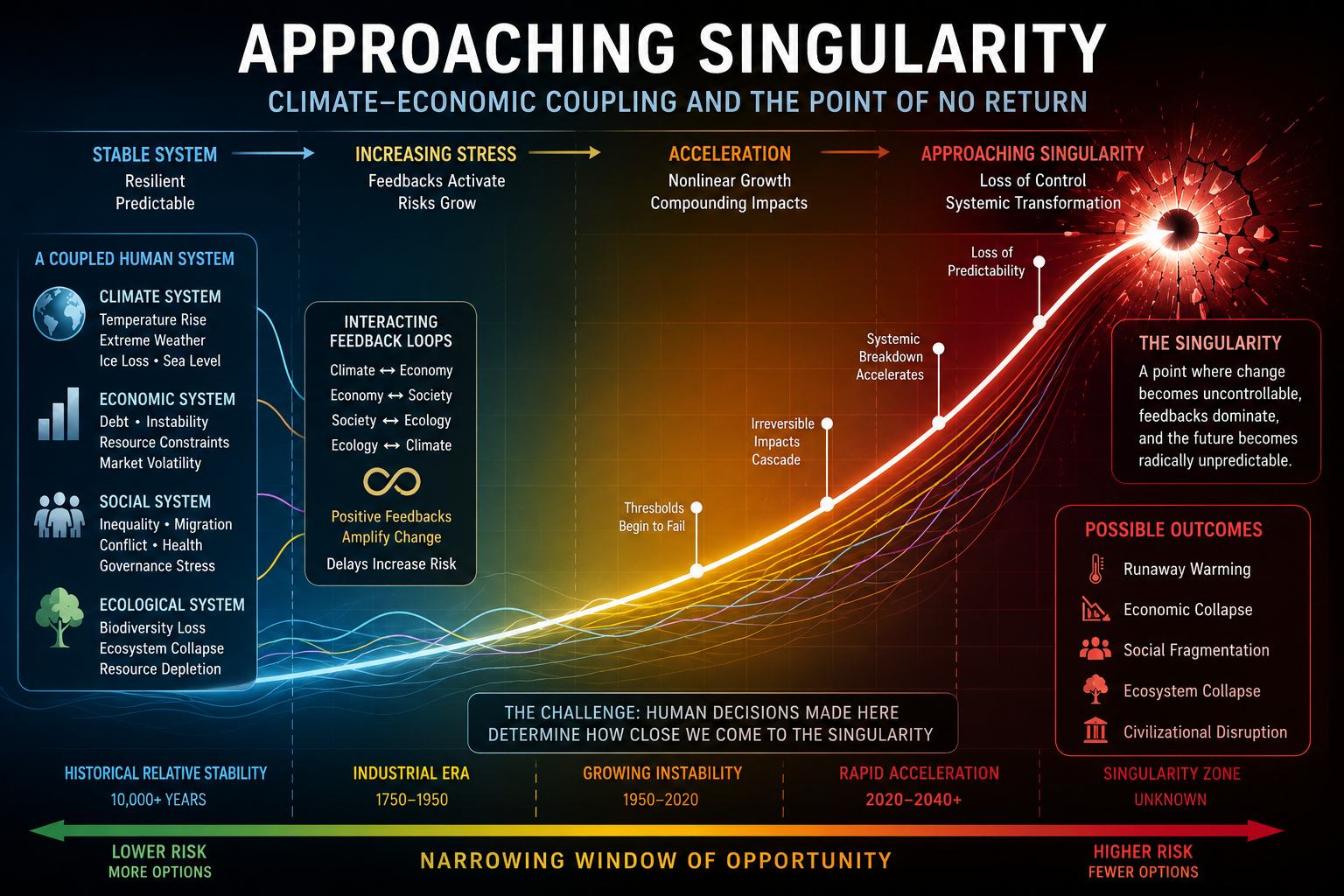
Tipping points trigger self-reinforcing feedback loops that enter a runaway state. When these runaway feedbacks cascade in a chain reaction across the entire system, runaway climate change approaches a singularity.
Amplifier Feedback Example
One last analogy for musicians.
A band is on stage, and a guitar amp begins to feed back. Left unchecked, the feedback becomes self-reinforcing. As it grows more intense, it triggers feedback in the vocalist’s microphone, which in turn triggers feedback in the stage monitors. The cascading feedbacks spread throughout the sound system, resulting in pure chaos across the entire arena – “approaching” singularity.
So when the sound engineer yells at the guitarist to “turn it down,” that’s essentially where we are today.
The Earth has at least several dozen major tipping points. At present, roughly nine appear to have entered self-reinforcing feedback loops. This is like having a large band with nine guitarists, each trying to hear themselves over the others. As a result, each guitarist turns up their amplifier a little louder. Soon, all nine amps are feeding back.
Humanity is the sound engineer. We must take immediate action because these feedbacks can spill over and trigger additional feedbacks. Those new feedbacks can then amplify the original ones, creating a cascading network of self-reinforcing processes.
A simple real-world example is sea ice melt and the albedo effect. As highly reflective sea ice melts, it exposes darker ocean water that absorbs more solar energy. This is analogous to the first guitarist turning the amplifier up too loud and creating feedback. The darker ocean surface warms more rapidly, accelerating the melting of additional ice and exposing even more dark water.
It is possible that this process has entered a self-reinforcing runaway feedback loop. However, it is important to recognize that not all runaway processes continue indefinitely. Once the sea ice is largely gone, that particular feedback will eventually reach its limit and stabilize. In the meantime, however, it can amplify numerous other feedbacks throughout the climate system, including those that affect carbon storage and carbon dioxide sequestration.
Conclusion
Climate change appears to have entered a phase in which multiple self-reinforcing feedback processes are becoming increasingly important. If left unchecked, these interacting feedbacks are likely to continue accelerating change and pushing the Earth system toward increasingly unstable conditions, potentially approaching a climatic singularity.
Runaway feedbacks have begun, but we have not yet entered true runaway climate change. That’s an important difference. Self-reinforcing feedback loops are increasingly evident in several parts of the Earth system, but humanity still retains the ability to influence the outcome through aggressive mitigation.
That’s why I believe our primary focus must remain on mitigation. If we give up on mitigation and focus only on adaptation, then adaptation eventually becomes our only option. The goal is to prevent that future, not simply prepare for it.
The accompanying graphic includes a timeline along the bottom that illustrates the concept. It suggests that we are moving toward a climatic singularity, but we’re not there yet. The remaining window may be narrowing, but it is precisely that remaining window that makes mitigation so important.
Singularity
Advances in technology, modeling, and artificial intelligence have significantly improved our ability to understand and track the accelerating dynamics of climate change. These tools have provided new insight into how quickly complex systems can evolve—and how difficult it may be to keep pace with that acceleration.
Our latest analysis suggests that the climate–economic system is now exhibiting third-derivative behavior, indicating that not only are impacts increasing, and accelerating, but the acceleration itself is increasing. This places the system within a singularity-like regime, characterized by nonlinear amplification, rising instability, and reduced predictability.
Historically, such transitions were assumed to unfold over tens of thousands to millions of years based on paleoclimate evidence. However, current observations indicate that these dynamics may be occurring on dramatically compressed timescales, raising the possibility that singularity-like behavior could emerge within contemporary time horizons.
Given the importance and accessibility of these findings, this work is presented in three formats:
Each version conveys the same core insight: complex, coupled systems can shift rapidly from stable to unstable behavior, and understanding this transition is critical to anticipating future climate and economic risk.
Hansen’s recent analyses provide evidence consistent with accelerating climate change and increasing climate sensitivity, findings that align with several aspects of our nonlinear acceleration framework. While interpretations differ regarding magnitude and future trajectories, the growing body of observational evidence suggests that multiple climate indicators are exhibiting nonlinear behavior and interacting feedbacks.
Baldwin, M. P., et al. (2021). Climate system variability and atmospheric circulation changes. Reviews of Geophysics, 59(1).
Caesar, L., McCarthy, G. D., Thornalley, D. J. R., Cahill, N., & Rahmstorf, S. (2021). Current Atlantic Meridional Overturning Circulation weakest in the last millennium. Nature Geoscience, 14, 118–120.
Francis, J. A., & Vavrus, S. J. (2012). Evidence linking Arctic amplification to extreme weather in mid-latitudes. Geophysical Research Letters, 39(6).
IMBIE Team. (2020). Mass balance of the Greenland Ice Sheet from 1992–2018. Nature, 579, 233–239.
Khan, S. A., Aschwanden, A., Bjørk, A. A., et al. (2016). Greenland ice sheet mass balance and sea-level contribution. Science Advances, 2(11), e1600931.
Mann, M. E., Rahmstorf, S., Kornhuber, K., et al. (2017). Influence of anthropogenic climate change on planetary wave resonance and extreme weather events. Scientific Reports, 7, 45242.
Overland, J. E., Hanna, E., Hanssen-Bauer, I., et al. (2019). The urgency of Arctic climate change. Nature Climate Change, 9, 181–184.
Serreze, M. C., & Barry, R. G. (2011). Processes and impacts of Arctic amplification. Global and Planetary Change, 77(1–2), 85–96.
Svennevig, K., et al. (2023). Climate-driven slope failures and cryosphere destabilization in Greenland. Geophysical Research Letters, 50.
Major Assessments and Data Sources
IPCC. (2021). Climate Change 2021: The Physical Science Basis. Contribution of Working Group I to the Sixth Assessment Report. Cambridge University Press.
NASA. (2025). Global Mean Sea Level from Satellite Altimetry. National Aeronautics and Space Administration. Retrieved from https://sealevel.nasa.gov
National Oceanic and Atmospheric Administration (NOAA). (2025). Climate Indicators and Global Monitoring Data. Retrieved from https://www.noaa.gov
World Meteorological Organization (WMO). (2024). State of the Global Climate 2024. Geneva, Switzerland.
Copernicus Climate Change Service (C3S). (2025). Global Climate Highlights. European Union.
Additional Recent Literature Relevant to Nonlinear Climate Dynamics
Armstrong McKay, D. I., Staal, A., Abrams, J. F., et al. (2022). Exceeding 1.5°C global warming could trigger multiple climate tipping points. Science, 377(6611), eabn7950.
Boers, N. (2021). Observation-based early-warning signals for a collapse of the Atlantic Meridional Overturning Circulation. Nature Climate Change, 11, 680–688.
Lenton, T. M., Rockström, J., Gaffney, O., et al. (2019). Climate tipping points — too risky to bet against. Nature, 575, 592–595.
Ripple, W. J., Wolf, C., Gregg, J. W., et al. (2024). The 2024 State of the Climate Report: Perilous times on planet Earth. BioScience.
Steffen, W., Rockström, J., Richardson, K., et al. (2018). Trajectories of the Earth System in the Anthropocene. Proceedings of the National Academy of Sciences, 115(33), 8252–8259.
Richardson, K., Steffen, W., Lucht, W., et al. (2023). Earth beyond six of nine planetary boundaries. Science Advances, 9(37), eadh2458.
Reaching Net Zero: Practical Steps That Save Money
I’ve already gone net zero, and in the process I’ve saved—and earned—thousands of dollars. Reducing your impact on climate change is not only possible, it can improve your quality of life, increase resilience, and lower long-term costs.
One of the most important factors is reducing unnecessary consumption. Consumerism is a primary driver of climate change, fueling energy demand, resource extraction, pollution, and habitat destruction. The less we consume, the less pressure we place on both the climate and the ecosystems that support us.
Consume Less
Reduce unnecessary purchases.
Avoid fast fashion and disposable products.
Reduce travel when practical.
Consume less meat and other resource-intensive products.
Minimize the use of fossil fuels and hydrocarbon-based products whenever possible.
Buy durable, repairable products instead of replacing them frequently.
Energy and Heating
Choose electricity providers that utilize nuclear, solar, wind, or other low-carbon energy sources.
Insulate your home while maintaining proper ventilation.
Practice zone heating: keep the overall house cooler and heat only occupied rooms as needed.
Use heat-recovery and humidity-exchange ventilation systems.
Plant trees, shrubs, and windbreaks to reduce winter heating demand.
Use potted trees and seasonal landscaping to help insulate foundations and reduce energy loss.
Energy, Cooling, and Air Quality
Use natural cooling strategies whenever possible.
Practice zone cooling by cooling only occupied spaces.
Maintain indoor temperatures efficiently rather than overcooling entire buildings.
Paint roofs and exterior surfaces white or lighter colors where appropriate to reduce heat absorption.
Plant shade trees to block direct sunlight and lower cooling demand.
Create a movable canopy using potted trees that can be repositioned seasonally.
Build Corsi-Rosenthal boxes to improve indoor air quality with minimal energy use.
Use indoor plants and natural ventilation to improve air quality.
Food and Land Use
Support local and regional food systems.
Grow some of your own food when possible.
Preserve mature and old-growth trees.
Reduce impervious surfaces that increase runoff and heat retention.
Improve soil health through composting and regenerative practices.
Transportation
Use electric vehicles or high-efficiency vehicles when practical.
Reduce unnecessary trips.
Use public transportation, cycling, or walking when possible.
Limit air travel and choose lower-carbon alternatives when feasible.
Climate Resilience Around the Home
Create a climate-resilient landscape using trees, gardens, native plants, and healthy soils.
Retain moisture naturally through vegetation and soil protection.
Reduce erosion and flooding with rain gardens, rain barrels, trees, and permeable surfaces.
Improve stormwater management before extreme weather occurs.
Health and Resilience
Improve indoor air quality through filtration, ventilation, and natural purification methods.
Optimize health, nutrition, and physical fitness to improve resilience to climate-related stresses.
Reduce pollution exposure whenever possible.
Invest in prevention rather than treatment whenever practical.
The good news is that many of these actions save money rather than cost money. In many cases, the most climate-friendly choices are also the most economically efficient. The first step is often the simplest: consume less, waste less, and use energy more wisely.
We examine how human activities — such as deforestation, fossil fuel combustion, mass consumption, industrial agriculture, and land development — interact with ecological processes like thermal energy redistribution, carbon cycling, hydrological flow, biodiversity loss, and the spread of disease vectors. These interactions do not follow linear cause-and-effect patterns. Instead, they form complex, self-reinforcing feedback loops that can trigger rapid, system-wide transformations — often abruptly and without warning. Grasping these dynamics is crucial for accurately assessing global risks and developing effective strategies for long-term survival.
What Can I Do? The single most important action you can take to help address the climate crisis is simple: stop burning fossil fuels. There are numerous actions you can take to contribute to saving the planet. Each person bears the responsibility to minimize pollution, discontinue the use of fossil fuels, reduce consumption, and foster a culture of love and care. The Butterfly Effect illustrates that a small change in one area can lead to significant alterations in conditions anywhere on the globe. Hence, the frequently heard statement that a fluttering butterfly in China can cause a hurricane in the Atlantic. Be a butterfly and affect the world.
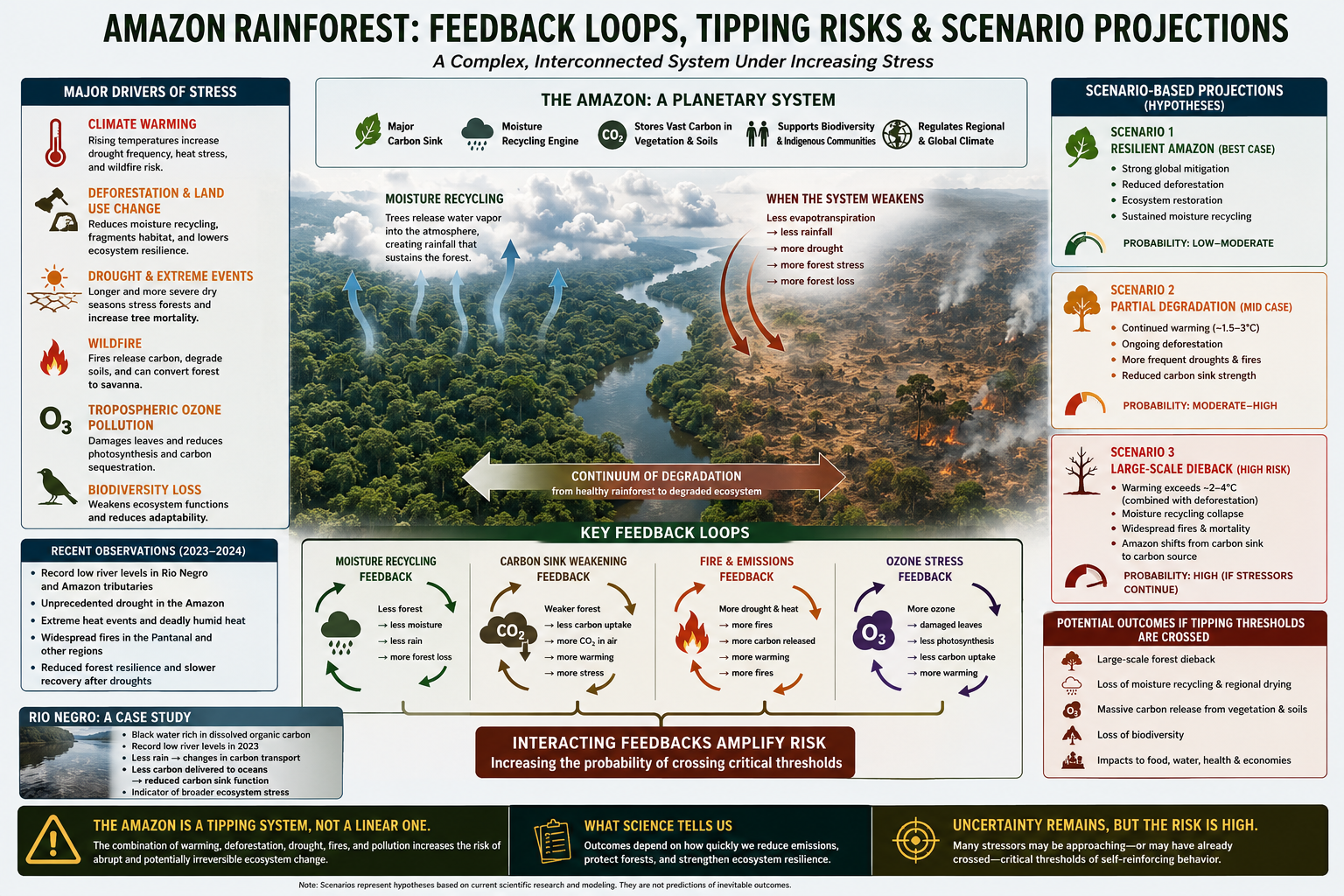
The Amazon rainforest is widely recognized as one of Earth’s most important climate-regulating ecosystems. It functions as a major carbon sink, stores vast quantities of carbon in vegetation and soils, recycles moisture across South America, and supports extraordinary biodiversity.
A growing body of research suggests that the interaction of climate warming, deforestation, drought, wildfire, and atmospheric pollution may be reducing the resilience of the Amazon system. While large-scale Amazon collapse has not occurred, several studies identify the rainforest as a potential climate tipping element whose stability could be compromised under continued environmental stress.
The central scientific question is not whether the Amazon faces increasing risk—it clearly does—but rather how close the system may be to critical thresholds and how multiple stressors interact to influence that risk.
Observations
Several observations have raised concerns among researchers:
Severe droughts have become more frequent in portions of the Amazon Basin.
Record-low river levels were observed in several Amazon tributaries during 2023, including the Rio Negro.
Elevated temperatures and reduced rainfall have increased wildfire risk in parts of Brazil.
Some studies report declining resilience in portions of the rainforest, including slower recovery following drought events.
Deforestation continues to reduce forest cover and disrupt regional moisture recycling.
These observations do not demonstrate imminent Amazon collapse. However, they are consistent with trends expected in systems experiencing increasing environmental stress.
Scenario 1: Moisture-Recycling Feedback and Amazon Dieback
One widely studied hypothesis involves the weakening of the Amazon’s internal moisture-recycling system.
The rainforest generates a significant portion of its own rainfall through evapotranspiration. Trees release water vapor into the atmosphere, helping sustain regional precipitation. Continued deforestation reduces this moisture recycling, potentially extending dry seasons and increasing drought stress.
Under this scenario:
Deforestation → Reduced evapotranspiration → Less rainfall → More forest stress → Additional forest loss
Climate warming may amplify this process by increasing temperatures, evaporative demand, and drought frequency.
Several modeling studies suggest that combined warming and deforestation may lower the threshold at which large-scale forest degradation becomes possible. The precise threshold remains uncertain and varies substantially among models.
Scenario 2: Carbon Sink Weakening
A second hypothesis involves a gradual weakening of the Amazon’s carbon-storage function.
Historically, the Amazon absorbed substantial quantities of atmospheric carbon dioxide. However, increasing heat stress, drought, fire activity, and ecosystem degradation may reduce this capacity.
Under this scenario:
Reduced forest productivity → Lower carbon uptake → More atmospheric CO₂ → Additional warming → Further forest stress
This represents a positive feedback loop, although the magnitude and timing remain active areas of research.
Importantly, a weakened carbon sink does not necessarily imply complete forest collapse. Partial reductions in carbon uptake could still have significant implications for global climate stabilization efforts.
Scenario 3: Tropospheric Ozone Amplification
Another emerging area of research examines the role of ground-level (tropospheric) ozone.
Unlike stratospheric ozone, which protects life from ultraviolet radiation, tropospheric ozone can damage plant tissues and impair photosynthesis.
Several studies have found that ozone exposure can:
Reduce photosynthetic efficiency.
Lower net primary productivity.
Increase vulnerability to drought and heat stress.
Reduce carbon sequestration capacity.
Under this hypothesis, ozone acts as a stress multiplier rather than a primary driver. Its effects may become increasingly important when combined with warming, drought, wildfire smoke, and land-use change.
The degree to which ozone contributes to large-scale carbon-sink decline remains an active research question.
Rio Negro as a Case Study
The Rio Negro provides an interesting example of how climate and carbon-cycle processes may interact.
The river’s dark coloration results from high concentrations of dissolved organic carbon derived from surrounding forests. During severe drought conditions, river discharge declines substantially, potentially altering carbon transport processes.
Researchers continue to investigate how changes in precipitation, drought frequency, and river flow influence regional carbon cycling and ecosystem resilience.
While these observations are scientifically important, direct links between individual river events and large-scale Amazon tipping behavior remain the subject of ongoing study.
Climate-Risk Interpretation
From a systems perspective, the Amazon is best viewed as a coupled climate–ecological system.
The concern is not any single stressor in isolation. Rather, the risk emerges from interactions among:
Climate warming
Deforestation
Drought
Wildfire
Atmospheric pollution / ozone
Carbon-cycle disruption
Biodiversity loss
These interacting forces create nonlinear behavior in which risks may increase more rapidly than expected from any individual factor alone.
Conclusion
Current evidence does not demonstrate that Amazon rainforest collapse is inevitable. However, a growing body of research indicates that the system’s resilience may be declining under the combined influence of climate warming and land-use change.
Several scenario-based projections suggest that continued warming, ongoing deforestation, and additional environmental stressors could increase the probability of large-scale forest degradation during the coming decades.
The key scientific uncertainty is not whether risks exist, but where critical thresholds lie, how close the system may be to them, and whether mitigation efforts can strengthen resilience before those thresholds are crossed.
Climate observations, ocean monitoring, weather extremes, and long-term environmental datasets.
Important Note on Scenario-Based Projections
Several discussions in this paper—including Amazon dieback, carbon-sink failure, ozone-amplified feedbacks, and coupled climate–economic instability—should be understood as scenario-based projections and working hypotheses derived from published research, observational trends, and systems modeling. They represent plausible future pathways under continued environmental stress rather than established predictions of inevitable outcomes.
The precise timing, magnitude, and interactions of these processes remain active areas of scientific investigation.
Nevertheless, a growing body of observational evidence suggests that the risk is substantial. Multiple climate, ecological, and socio-economic systems are exhibiting behaviors consistent with increasing stress, declining resilience, and the emergence of self-reinforcing feedback mechanisms.
While significant uncertainties remain regarding specific thresholds and outcomes, there is increasing concern that some underlying stressors may be approaching—or in certain cases may have already crossed—critical tipping points beyond which system responses become increasingly difficult to predict, manage, or reverse.
Reduced Moisture Recycling and Lowered Tipping Thresholds Increase Amazon Rainforest Dieback Risk Under Combined Deforestation and Climate Warming
Abstract
Recent research synthesis indicates that the stability of the Amazon rainforest is increasingly threatened by the interaction of global warming and regional land-use change. Deforestation is reducing evapotranspiration-driven moisture recycling, weakening regional precipitation patterns and extending dry seasons. These changes amplify forest stress, increase fire susceptibility, and reduce ecosystem resilience. Modeling results suggest that while warming alone may not be sufficient to trigger large-scale dieback at lower temperature thresholds, the addition of deforestation substantially lowers the warming level at which critical transitions become possible. Together, these interacting drivers increase the probability of partial or large-scale Amazon forest collapse under scenarios of continued warming and land conversion.
1. Introduction
The Amazon rainforest is a coupled climate–biosphere system that plays a critical role in global carbon cycling and regional hydrological stability. Increasing attention has been directed toward its potential as a climate tipping element, in which gradual external forcing could produce abrupt or large-scale ecosystem transitions.
2. Moisture Recycling and System Feedbacks
A defining feature of the Amazon system is internal moisture recycling, driven by evapotranspiration from forest vegetation. This process sustains regional precipitation by maintaining atmospheric humidity and cloud formation. Deforestation reduces evapotranspiration capacity, weakening this feedback loop and increasing the likelihood of prolonged dry seasons.
3. Interaction Between Deforestation and Warming
Recent modeling studies indicate that the Amazon’s resilience is highly sensitive to the combined effects of land-use change and global temperature increase. In simulations, intact forest systems show higher resistance to warming-induced dieback, while deforested or fragmented landscapes exhibit earlier and more abrupt transitions.
Importantly, deforestation lowers the effective temperature threshold for large-scale ecosystem destabilization by reducing moisture availability and amplifying heat stress.
4. Evidence for Declining Ecosystem Resilience
Independent observational studies support a decline in Amazon resilience over recent decades, including:
Reduced recovery rates following drought events
Increasing duration and severity of dry seasons in some regions
Expansion of fire-prone conditions in degraded forest areas
Early-warning signals consistent with critical slowing down in vegetation dynamics
5. Implications for Tipping Dynamics
The combined influence of warming and deforestation introduces nonlinear risk behavior. Rather than responding independently, these stressors interact in ways that may accelerate ecosystem degradation once critical thresholds are approached.
This suggests that the probability of crossing a tipping threshold is not fixed, but increases under continued land conversion even at relatively moderate global warming levels.
6. Conclusion
The Amazon rainforest is best understood as a coupled climate–ecological system with emerging nonlinear vulnerability. While large-scale dieback is not inevitable, current evidence indicates that the combination of deforestation and global warming significantly lowers stability margins and increases the risk of abrupt or extensive ecosystem transition.
Robust projections of risks to the Amazon rainforest
Amazonian deforestation is altering atmospheric moisture transport; as a result, even low levels of global warming could trigger dieback of most of the remaining forest.
A Public-Access Discussion of Nonlinear Climate Risk
Abstract
Climate change is often discussed in terms of gradual warming. However, growing evidence suggests that many climate impacts may be accelerating through interacting feedback loops and nonlinear system behavior. This raises an important question:
Is climate change entering a runaway state?
The answer depends largely on how the term runaway is defined. While current observations do not support the conclusion that Earth is undergoing a Venus-like runaway greenhouse effect, numerous climate, ecological, and economic subsystems are exhibiting increasingly self-reinforcing dynamics. Understanding these dynamics is essential for evaluating future risks and identifying effective mitigation and adaptation strategies.
What Does “Runaway” Mean?
The word runaway is often interpreted as an absolute condition: a system that has become completely uncontrollable.
In reality, complex systems rarely transition from stable to unstable in a single step. Instead, they often move through a spectrum of increasingly nonlinear behavior as feedback mechanisms strengthen and begin interacting with one another.
One of the challenges facing climate science is that there is no universally accepted definition of what constitutes a runaway state in the Earth system, nor is there a single observable threshold that clearly indicates when such a transition has occurred.
This uncertainty is scientifically important.
In many complex systems, critical transitions are only fully recognized in hindsight, after the system response is already underway.
The scientific question is therefore not whether Earth has entered a fully runaway state. Rather, the question is:
To what extent are self-reinforcing feedbacks becoming dominant drivers of system behavior?
The Train Analogy
A useful way to think about climate change is through the analogy of an accelerating train.
Imagine riding on a train.
Looking out the window, you can clearly see that the train is moving faster than it was before. That increase in speed is observable and largely undisputed.
At the same time, the ride is becoming less smooth. There is more vibration, more instability, and greater variability throughout the system.
The train is still on the tracks.
The engineer still has control.
But momentum is increasing.
The critical question is not whether the train is moving. The critical question is what lies ahead.
A train can safely accelerate for a very long time under favorable conditions. Problems arise when increasing speed encounters constraints that the system was not designed to handle.
A steep decline.
A sharp curve.
A damaged bridge.
The faster the train is moving when it reaches those conditions, the more difficult it becomes to avoid derailment.
Climate change presents a similar risk-management challenge.
The prudent course is not to wait until the curve becomes visible.
The prudent course is to reduce risk while options remain available.
Evidence of Increasing Nonlinearity
A growing number of climate indicators exhibit behavior that appears inconsistent with simple linear change.
Examples include:
accelerating sea-level rise,
increasing atmospheric moisture,
intensifying precipitation extremes,
expanding wildfire activity,
growing ocean heat content,
ice-sheet instability,
ecosystem degradation,
climate-related insurance losses,
and increasing infrastructure vulnerability.
Each of these processes is influenced by multiple interacting feedback mechanisms.
The concern is not any single indicator in isolation.
The concern is the coupling among many indicators simultaneously.
As feedbacks strengthen, the response of the overall system may become increasingly nonlinear, making future outcomes more difficult to predict using historical trends alone.
Climate, Economics, and Systemic Risk
Climate change is not solely an environmental issue.
It is increasingly becoming an economic risk-management problem.
My own research background is in economics, complex systems, and climate risk management. My research partner, Sidd Mukherjee, is a physicist. Although our disciplines differ, we have independently arrived at similar conclusions regarding the growing importance of coupled climate–economic feedbacks.
One of the clearest examples may be found in the insurance industry.
Insurance functions as society’s primary mechanism for distributing risk. When insurers withdraw from regions, significantly increase premiums, or reduce coverage availability, they are responding to observed changes in risk rather than theoretical possibilities.
These responses can propagate through:
housing markets,
mortgage systems,
infrastructure investment,
municipal finance,
migration patterns,
and broader economic networks.
Understanding how climate risks move through these interconnected systems remains a major focus of our research.
The Nonlinear Acceleration Framework
Our work has explored what we call the Nonlinear Acceleration Framework.
The central idea is simple:
Climate impacts are not driven solely by direct warming. They are also influenced by interactions among physical, ecological, social, and economic feedback loops.
When feedbacks interact, change may occur faster than expected from temperature trends alone.
Whether specific acceleration estimates ultimately prove accurate is less important than the broader observation:
Many climate indicators appear to be changing at rates that challenge assumptions of gradual, linear progression.
This possibility deserves serious scientific attention.
What We Think
Although uncertainty remains substantial, both Sidd and I believe several major climate-related systems are already experiencing significant destabilization.
My greatest concern is the increasing fragility of climate-linked economic systems, particularly insurance and real estate.
Sidd’s greatest concern is the potential destabilization of large ecological systems, especially the Amazon rainforest, which plays a critical role in global carbon cycling, hydrology, and biodiversity.
Where we strongly agree is that many of these processes are not future possibilities waiting to begin.
They are already observable today.
The debate increasingly concerns magnitude, timing, interaction, and ultimate consequences.
In 2023 and 2024 much of the scientific community came to the conclusion that multiple major tipping points had entered self-reinforcing feedbacks. 2024 was the hottest year on record. The Antarctic saw recording breaking ice sheet destabilization. Large portions of Siberia caught on fire. The most alarming signal was Canada’s borreal forests catching on fire. In 2023, Sidd said, “Do you remember back in the early 2000’s when we thought we wouldn’t live to see the extreme changes due to global warming?”
Daniel replied, “I think 2023 is the most significant year so far. We saw confirmation of tipping points being crossed for Mountain Glacier Loss, Greenland Ice Sheet Collapse, Antarctic Ice Sheet Collapse, and potentially the Collapse of AMOC.”
Sidd continued, “We already knew that. It was Canada catching on fire that I could not believe. I never thought I’d live to see the day.”
Daniel asked, “Do you think the permafrost and peatlands will have zombie fires and cause the permafrost tipping point?”
Sidd responded, “Yes. They are gone, too. We already know from the permafrost peatland fires in Siberia.”
2023 was the year we saw confirmation that multiple tipping points were accelerating and feeding each other.
Conclusion
Climate change is not a runaway greenhouse catastrophe unfolding overnight.
Nor is it a simple linear process that can be understood by extending historical trends indefinitely into the future.
The evidence increasingly points toward a complex system characterized by interacting feedback loops, threshold behavior, and growing nonlinear responses.
The most important question is no longer whether climate change is occurring.
The question is how rapidly interconnected climate, ecological, economic, and social systems will respond as feedbacks continue to strengthen.
Understanding that response may determine how effectively humanity navigates the century ahead.
Important Scientific Note
A full “Hothouse Earth” or Venus-like runaway greenhouse scenario is not considered plausible within the next century based on current scientific understanding.
However, present-day emissions and feedback processes may commit future generations to long-term warming pathways that become increasingly difficult to reverse.
Some research has explored high-end warming outcomes exceeding 10°C over multi-century timescales under strong feedback participation. The key issue is not whether such outcomes occur in the near term, but whether current decisions influence long-term climate trajectories in ways that constrain future options.
The central challenge is therefore not immediate runaway warming, but the possibility of crossing thresholds that commit the Earth system to progressively more difficult and costly futures.
We examine how human activities — such as deforestation, fossil fuel combustion, mass consumption, industrial agriculture, and land development — interact with ecological processes like thermal energy redistribution, carbon cycling, hydrological flow, biodiversity loss, and the spread of disease vectors. These interactions do not follow linear cause-and-effect patterns. Instead, they form complex, self-reinforcing feedback loops that can trigger rapid, system-wide transformations — often abruptly and without warning. Grasping these dynamics is crucial for accurately assessing global risks and developing effective strategies for long-term survival.