bookmark_borderTipping Points, Feedback Loops, and the Accelerating Collapse of Earth’s Climate Systems

By Daniel Brouse and Sidd Mukherjee
July 16, 2025

Introduction

Research and development incorporating complex social-ecological feedback loops within a dynamic, non-linear system is profoundly challenging. A small window into this complexity can be seen in the interactions among the Albedo Feedback Loop, Brown Carbon Feedback Loop, Freshwater–AMOC Disruption Loop, Permafrost–Methane Feedback Loop, Amazon Rainforest Dieback Feedback Loop, Sudden Sea Level Rise Pulses (“Cork Release” Events), Hydroclimate Whiplash, and Arctic Sea Ice Feedback.

Combined Consequences

These interlinked, reinforcing feedbacks can:

  • Drive non-linear, abrupt climate shifts.

  • Cause sudden sea level rise pulses (feet per year for consecutive years).

  • Collapse the AMOC, disrupting weather, food systems, and rainfall patterns.

  • Trigger Amazon dieback, increasing global CO₂.

  • Result in mass displacement, famine, and water crises.

Tipping Points Igniting a Domino Effect

We knew tipping points would eventually trigger self-sustaining feedback loops in the climate system—and now, they have arrived. I was prepared for that part.

What I could not fully envision was how rapidly the interplay among these tipping points would ignite a domino effect—so, so fast.

Now, I see it clearly: the nonlinear, dynamic dance of economic, physical, and ecological systems unfolding in real time. Abstract models are transforming into undeniable, measurable reality before our eyes.

Cascading System Failures

The breakdown of climate subsystems will not follow a smooth, linear decline. Instead, as one subsystem fails, it accelerates the failure of others, creating cascading, compounding effects across the entire climate system.

There are too many interconnected subsystems to list exhaustively, but consider one example:
The collapse of the AMOC slows ocean circulation, leading to hotter tropics and a warmer Arctic. This accelerates polar ice melt, causing sea levels to rise more rapidly while injecting large volumes of freshwater into the North Atlantic, further destabilizing the AMOC in a reinforcing loop.

At the same time, a disrupted climate system increases droughts in the Amazon, pushing the rainforest toward dieback and desertification. As the Amazon loses its ability to recycle rainfall and sequester carbon, it further amplifies global warming, which then accelerates ice melt, sea level rise, and AMOC collapse.

This example is just one piece of a much larger mosaic of cascading feedback loops already unfolding, shifting the climate system from a stable state to a chaotic, accelerating collapse.:

Albedo Feedback and Ice Melt

As ice melts, darker surfaces are exposed, absorbing more heat and causing further melt. Sea ice melt increases ocean heat but does not directly raise sea levels, whereas land ice melt in Greenland and Antarctica not only raises sea levels but alters ocean salinity and temperature, destabilizing the AMOC.

Greenland and Antarctica contain “corks” holding vast meltwater reservoirs. Once these corks break, sudden sea level pulses of 1–3 feet per year for multiple years could occur, with unpredictable impacts on the AMOC and global climate systems.

East Antarctic Ice Sheet: The Giant Unknown

The East Antarctic Ice Sheet (EAIS) holds enough ice to raise global sea levels by 170 feet if fully destabilized. Will it collapse slowly over centuries or could warming oceans and ice cliff instabilities trigger rapid collapse, displacing massive water volumes and causing tsunamis? We do not know, but early destabilization within the next 100 years is increasingly likely.

Sidd Mukherjee’s Perspective: Context and Probabilities

Sidd Mukherjee frames it this way:

“Mmmm… how long is ‘ever’? I don’t think there is enough ice globally to do more than ~200 feet of sea level rise total.”

He estimates:

  • Greenland: Effectively lost, 100–300 years, +20 feet.

  • West Antarctica: Likely to collapse within decades to a century, +10 feet.

This implies ~20–30 feet over the next century (~2 inches/year, 10x today’s rate), with potential for “pulse” events:

“We could dawdle along at half an inch a year, then see a few years at a foot per year.”

The wildcard remains the EAIS: stable under <500 ppm CO₂ equivalents, but if destabilized, catastrophic sea level rise would follow.

What is the AMOC?

The Atlantic Meridional Overturning Circulation (AMOC), including the Gulf Stream, transports warm surface water northward and cold, dense water southward at depth, regulating regional climates, distributing heat, and driving the global nutrient cycle.

How Melting Greenland Ice Affects the AMOC

  • Freshwater Injection reduces salinity and density, inhibiting North Atlantic sinking.

  • Sea Level Rise alters pressure gradients and stratifies waters, weakening the AMOC.

  • Cooling Surface Waters from meltwater can inhibit sinking even if cooled.

  • Gravitational Redistribution from Greenland’s mass loss pulls water away toward the equator, subtly impacting current patterns.

How Antarctic Melt Impacts the AMOC Indirectly

  • Freshwater input reduces Southern Ocean salinity, altering deep water formation.

  • Global sea level rise shifts ocean stratification.

  • Gravitational effects from Antarctic melt redistribute water toward the equator.

Combined, these impacts weaken the AMOC, alter heat distribution, shift weather patterns, and create feedback loops affecting ice melt and rainfall.

How Polar Melting Accelerates Amazon Dieback

Feedback Loops in Motion

  • Albedo Effect & Ice Melt accelerate warming, leading to further ice loss.

  • AMOC Slowing disrupts rainfall patterns in the tropics, increasing Amazon drought.

  • Reduced Rainfall & Higher Temperatures stress Amazon trees, reducing transpiration and rainfall recycling.

  • Storm Pattern Changes damage forests and increase vulnerability.

  • Hydroclimate Whiplash—rapid swings between drought and heavy rain—erode soils, reduce regrowth, and increase mortality, leading to more CO₂ emissions.

The Rio Negro Case Study

The Rio Negro’s black waters, rich in dissolved organic carbon (DOC), typically aid long-term carbon sequestration as DOC is flushed to the ocean. Record-low river levels in 2023 reduced this export while exposing DOC to sunlight, increasing CO₂ emissions. The Rio Negro and Amazon Rivers now serve as a live case study for how hydroclimate whiplash, Amazon dieback, and carbon cycle disruptions interact with AMOC slowdown.

Drought → Fire → Dieback → Carbon Feedback

Drought stresses trees, increasing flammability and reducing CO₂ uptake. Fires release stored carbon, turning the Amazon from a carbon sink into a carbon source. Brown carbon from wildfires darkens snow and ice globally, accelerating melt and AMOC slowdown, feeding back into the system.

Why It Matters

The Amazon dieback is not an isolated crisis; it is tied to polar processes through atmospheric and oceanic feedback loops. Without rapid fossil fuel reduction, the interconnected:

  • Albedo feedback,

  • Ice melt and sea level rise,

  • AMOC slowdown,

  • Amazon drought-fire-carbon feedback,

will accelerate the collapse of Earth’s climate regulators, threatening global food systems, weather stability, and habitability.
The Human Induced Climate Change Experiment

bookmark_borderRethinking Collapse: Cascading Feedbacks

by Daniel Brouse and Sidd Mukherjee
July 16, 2025

Introduction

The Interaction of: Albedo Feedback Loop, Brown Carbon Feedback Loop, Freshwater–AMOC Disruption Loop, Permafrost–Methane Feedback Loop, Amazon Rainforest Dieback Feedback Loop, Sudden Sea Level Rise Pulses (“Cork Release” Events), Hydroclimate Whiplash, and Arctic Sea Ice Feedback

Combined Consequences

These interlinked, reinforcing feedbacks can:
* Drive non-linear, abrupt climate shifts.
* Cause sudden sea level pulses (feet/year for consecutive years).
* Collapse AMOC and disrupt weather, food systems, and rainfall patterns.
* Trigger Amazon dieback, increasing global CO₂.
* Result in mass displacement, famine, and water crises.

Research and Development Incorporating Complex Social-Ecological Feedback Loops Within a Dynamic, Non-Linear System is an extremely complex subject. A small example of this complexity can be seen in the interaction of the Albedo Feedback Loop, Brown Carbon Feedback Loop, Freshwater–AMOC Disruption Loop, Permafrost–Methane Feedback Loop, Amazon Rainforest Dieback Feedback Loop, Sudden Sea Level Rise Pulses (“Cork Release” Events), Hydroclimate Whiplash, and Arctic Sea Ice Feedback.

Lately, my deep reflection has centered on how tipping points have triggered self-sustaining feedback loops within the climate system. We knew this was coming—and now it is here. I was prepared for that part.

What I could not fully envision was how quickly the interplay of these tipping points would ignite a domino effect—so, so fast.

Now, I can see it clearly: the nonlinear, dynamic dance of economic, physical, and ecological systems in real time. This is pure math and science visibly unfolding, transforming abstract models into undeniable, measurable reality.

I’ve been reflecting further on the collapse of Atlantic currents and want to share another angle. The breakdown of these subsystems will not follow a smooth, linear decline. As one subsystem fails, it accelerates the failure of others, creating cascading, compounding effects within the climate system. There are too many interconnected subsystems to count, but let’s consider one example involving AMOC collapse and sea level rise.

We can start with the “albedo” feedback loop: as ice melts, it exposes darker surfaces, which absorb more heat, warming the surface further, and causing even more ice to melt. When this happens with sea ice, it increases ocean temperatures, which can affect the AMOC, but it doesn’t directly raise sea levels.

Land ice, however, is far more concerning. The albedo feedback loop accelerates glacier melt in Greenland and Antarctica, which not only raises sea levels but also changes the temperature and salinity of the ocean, having a much more direct and significant impact on the AMOC’s stability.

Many people don’t realize that Greenland and Antarctica contain giant “corks” holding back enormous quantities of fresh water in the form of ice and meltwater lakes. These corks, created by the underlying topography and ice dams, are precarious. For example, Greenland is shaped like a bowl, with meltwater pooling inside it. Once these corks break, we could see sudden pulses of sea level rise—potentially 1–3 feet per year for several consecutive years.

At that point, we truly do not know what will happen to the AMOC and other climate systems, as nothing like this has occurred within human history. What is clear is that as these cascading, nonlinear feedback loops accelerate, the climate system will become increasingly unstable, with each tipping point amplifying the next. We could likely see this within the next 50 years.

East Antarctic Ice Sheet Collapse: The Largest Unknown

An even larger, deeply unsettling unknown is the potential collapse of the East Antarctic Ice Sheet (EAIS)—a colossal risk with consequences we can barely begin to model. The EAIS holds the largest single store of ice on the planet, containing enough to raise global sea levels by over 170 feet if fully destabilized.

But what happens when it begins to go? Will it gradually slide off over centuries, or could destabilization occur much faster, driven by warming oceans, ice cliff instabilities, and subglacial melt? Could sections of the ice sheet collapse abruptly, displacing massive volumes of water and triggering tsunamis? How quickly would sea levels rise simply from displacement alone, before the ice even begins to melt in the ocean?

We do not yet know exactly how this will unfold, but it is likely we will witness the early stages within the next 100 years, if not sooner. Could this result in the fastest sea level rise in human history? It is not out of the question.


Sidd Mukherjee’s Perspective: Context and Probabilities

Sidd Mukherjee replied with his characteristically precise perspective:

“Mmmm… how long is ‘ever’? I don’t think there is enough ice globally to do more than ~200 feet of sea level rise total.”

He estimates:

  • Greenland: Effectively lost, will melt in place over 100–300 years, raising sea levels by ~20 feet.

  • West Antarctica: Also lost, could collapse rapidly—within decades to a century—adding ~10 feet.

  • Combined, this suggests ~20–30 feet of sea level rise over the next century, translating to an average of ~2 inches per year (10x the current rate).

However, Sidd highlights the pulse nature of collapse:

“We could dawdle along at half an inch a year, then see a few years at a foot per year.”

The wildcard is the East Antarctic Ice Sheet. If we manage to hold atmospheric CO₂ equivalents to ~500 ppm, it may remain largely stable. But if destabilized, it could eventually contribute another 170–200 feet of sea level rise, with catastrophic consequences for coastal cities, food systems, and global infrastructure.

What is the AMOC?

The Atlantic Meridional Overturning Circulation (AMOC) is a system of ocean currents, including the Gulf Stream, that transports warm, salty surface water northward and cold, dense water southward at depth. It is critical for:

  • Regulating regional climates (e.g., warming Europe)

  • Distributing heat across the planet

  • Driving the global nutrient cycle.

How melting Greenland land ice affects the AMOC

Freshwater Injection Reduces Salinity

  • Greenland’s glaciers and ice sheet are land ice, so when they melt, they add freshwater directly into the North Atlantic.

  • This reduces the salinity and density of surface waters, making them less likely to sink in the North Atlantic (the “engine” of the AMOC).

 Sea Level Rise and Pressure Changes

  • Melting ice increases local sea level in the North Atlantic, which can reduce vertical mixing and stratify the water column, further weakening the sinking mechanism.

  • It also changes pressure gradients across the Atlantic, potentially altering current speeds.

Cooling of Surface Waters

  • Melting ice cools local sea surface temperatures near Greenland, which can at first counteract warming, but if the surface water is too fresh, it still won’t sink even if cooled.

Gravitational Redistribution (“Water Pull”)

  • Greenland’s ice mass exerts gravitational pull on surrounding water. As Greenland loses mass, water is pulled away toward the equator, which raises sea levels in the Southern Hemisphere and equatorial regions while initially lowering local sea level near Greenland. This redistribution can alter ocean current patterns and the AMOC’s stability.

How Antarctica’s melt impacts the AMOC indirectly

 Southern Freshwater Input

  • Antarctic land ice melt primarily affects the Southern Ocean, reducing salinity and potentially impacting the formation of Antarctic Bottom Water, which feeds into global deep ocean currents.

Global Sea Level Rise

  • As Antarctic land ice melts, global sea levels rise, subtly changing pressure balances and stratification patterns across ocean basins, including the Atlantic.

Equatorial Water Pull

  • Like Greenland, Antarctica’s mass loss reduces its gravitational pull on water, causing water to redistribute away from Antarctica toward the equator, raising sea levels in equatorial regions.

Combined Impact on the AMOC

  • Stratification & Reduced Sinking: Freshwater from Greenland (and eventually Antarctica’s indirect influence) leads to less dense surface waters in the North Atlantic, preventing sinking and weakening the AMOC.

  • Altered Heat Distribution: A weakened AMOC means less warm water is transported north, leading to regional cooling in Europe but potential warming of tropical Atlantic waters.

  • Feedback Loops: Weakened AMOC can affect precipitation patterns, Arctic sea ice melt, and storm tracks, which can further influence ice melt, creating feedback loops.

Why it matters

If the AMOC weakens significantly or collapses:

  • Europe may face extreme cold spells despite global warming.

  • Tropical regions may see intensified storms and heatwaves.

  • Global weather patterns could shift abruptly.

  • Marine ecosystems would be disrupted by changes in nutrient and heat distribution.

The melting of Greenland and Antarctica’s land ice is thus not only a driver of sea level rise but a key destabilizer of Earth’s climate regulation systems like the AMOC, with cascading impacts on global habitability.

How Arctic and Antarctic Melting Accelerate Amazon Rainforest Dieback

The Feedback Loops In Motion

Albedo Effect & Ice Melt

  • As Arctic and Antarctic ice melts, darker ocean/land surfaces are exposed, absorbing more solar energy.

  • This accelerates local and global warming, leading to faster ice melt in Greenland and Antarctica.

  • Ice melt increases sea level rise and changes ocean salinity, contributing to AMOC weakening.

AMOC Slowing

  • The AMOC distributes heat globally; when it slows due to freshwater from melting ice, it disrupts weather patterns:

    • Alters rainfall distribution in the tropics.

    • Contributes to regional drying in the Amazon basin.

    • Shifts the Intertropical Convergence Zone (ITCZ), which impacts the Amazon’s rainfall cycles.

Impacts on the Amazon Rainforest

Reduced Rainfall & Longer Droughts

  • The Amazon depends on consistent rainfall, much of which it recycles itself.

  • AMOC weakening and altered tropical rainfall patterns reduce moisture transport into the basin, increasing the frequency and severity of droughts.

Higher Temperatures

  • Global and regional warming driven by greenhouse gases and the albedo feedback increase surface temperatures in the Amazon.

  • Higher temperatures increase evaporation and plant stress, compounding drought impacts.

Storm Pattern Changes

  • Shifting storm tracks can:

    • Decrease rainfall in the Amazon.

    • Increase extreme weather events, leading to tree damage and forest vulnerability.

Hydroclimate Whiplash

Hydroclimate whiplash—the rapid swings between extreme drought and intense rainfall—creates a destructive feedback loop accelerating Amazon dieback. Droughts stress trees, leading to increased mortality, while intense rains after droughts can erode nutrient-poor soils and wash away organic matter before it can contribute to healthy regrowth. In the Amazon, these rapid shifts weaken the forest’s resilience, leading to more vegetation death, less transpiration, and therefore less rainfall, perpetuating the cycle. As trees die and decompose during prolonged droughts, they release more carbon into the atmosphere, intensifying global warming and further drying conditions that continue to reduce rainfall across the basin. This dynamic is critical in the context of the Rio Negro, whose black waters are rich in dissolved organic carbon (DOC) sourced from forest soils and decaying vegetation. Under normal rainfall conditions, much of this DOC is flushed toward the ocean, aiding in long-term carbon sequestration as the carbon sinks to the seafloor. However, record-low river levels in 2023 due to drought reduced this export, while exposing more DOC to photo-oxidation under intense sunlight, leading to additional CO₂ emissions. As the Rio Negro and Amazon Rivers continue to experience these unprecedented drought conditions, they serve as a case study for how hydroclimate whiplash, Amazon dieback, and disruptions in the carbon cycle may interact with broader climate systems, including the slowing or collapse of the AMOC, underscoring the interconnected risks we now face.

Positive Feedback: Drought → Fire → Dieback

Drought & Heat Stress:

  • Stressed trees close stomata, reducing CO₂ uptake and weakening forest resilience.

  • Warmer, drier conditions make forests more flammable.

Fire & Mortality:

  • Drought conditions lead to more frequent and intense forest fires.

  • Fires release stored carbon, turning the Amazon from a carbon sink to a carbon source.

 Ozone Poisoning:

  • Ozone pollution, driven by fossil fuel combustion, further reduces plant CO₂ uptake, compounding forest decline.

Brown Carbon from Wildfires

  • As climate change and droughts increase wildfires globally (including in the Amazon, boreal forests, and other regions), they produce “brown carbon” (light-absorbing organic particles) that travel via wind currents.

  • When this brown carbon settles on snow and ice in Greenland, Antarctica, and mountain glaciers, it darkens the ice surface, reducing reflectivity (albedo), causing faster melting

Carbon Feedback Loop:

  • Dying and burning forests release CO₂, further warming the planet, which accelerates polar ice melt and deepens the AMOC slowdown, feeding back into the cycle.

Why It Matters

The Amazon dieback is not an isolated crisis:

  • It is tied to polar processes through atmospheric and oceanic feedback loops.

  • It represents a tipping point where global systems interact, pushing each other toward collapse.

Without rapid fossil fuel reduction, the interconnected:

  • Albedo feedback,

  • Ice melt and sea level rise,

  • AMOC slowdown,

  • and Amazon drought-fire-carbon feedback

will accelerate the collapse of one of Earth’s most critical climate regulators, impacting global food systems, weather stability, and habitability.

The Human Induced Climate Change Experiment

bookmark_borderStorms, Heat, and the End of the Road: Why Steve Miller Canceled His Tour

by Daniel Brouse
July 17, 2025

Steve Miller has canceled all upcoming tour plans, citing the escalating threat of climate-driven natural disasters as making the risk “unacceptable” for his band, crew, and fans.

The Steve Miller Band was set to launch a 28-date U.S. tour on August 15 in Bethel, New York. Instead, Miller announced Wednesday night that he is trusting his instincts over profits, prioritizing safety over the show:

“You make music with your instincts. You live your life by your instincts. Always trust your instincts… The combination of extreme heat, unpredictable flooding, tornadoes, hurricanes, and massive forest fires make these risks for you our audience, the band, and the crew unacceptable. So… You can blame it on the weather… The tour is cancelled. Don’t know where, don’t know when… We hope to see you all again.”

Miller closed with a message of peace and care for fans as the climate crisis reshapes not only daily life but the culture we share:

“Wishing you all Peace, Love and Happiness, Please take care of each other.”

Concerts Collapsing Under Climate Pressure

Miller’s decision arrives just weeks after Chrissie Hynde of the Pretenders predicted the imminent end of outdoor concerts due to extreme heat. On June 23, Hynde wrote:

“Hope you’re all surviving the heat wave. I realized then that outdoor events are going to come to an end. It’s too hot.”

They are not alone. On June 13, this year’s Bonnaroo Music and Arts Festival in Manchester, Tennessee was canceled due to severe weather conditions after completing only one of the four planned nights, reflecting the increasing vulnerability of large-scale events to climate volatility.

Heat Takes Lives: The Tragedy at a Taylor Swift Concert

The risks are not theoretical. In November 2023, during a Taylor Swift concert in Rio de Janeiro, 23-year-old fan Ana Clara Benevides tragically died from heat stroke after standing for hours in temperatures that soared above 100°F (38°C) with high humidity and inadequate access to water. Dozens of other fans were hospitalized as the sweltering heat turned a joyful event into a disaster zone. This heartbreaking incident underscores the direct human toll of extreme heat on live music audiences and highlights the urgent need for climate adaptation in event planning. The tragedy served as a wake-up call to many artists and organizers about the limits of human tolerance under rising temperatures and the need to prioritize fan safety over profit as the climate crisis escalates.

The Bigger Picture: Climate Change Hits Culture

Concert tours are not just logistical feats; they are climate-sensitive endeavors that require stable conditions for transportation, power, water, and human safety. As global temperatures rise, the atmosphere holds 7% more water vapor per 1°C increase, supercharging storms and intensifying flash flooding. This is now playing out in record heatwaves, stronger hurricanes, and atmospheric rivers sweeping across regions that once felt immune.

What was once considered “extreme weather” is becoming a new normal—destabilizing global supply chains, agriculture, and now the music industry.

A Tipping Point for Music and Society

Steve Miller’s decision is a cultural tipping point, a reflection of the moment when even veteran musicians acknowledge that the climate emergency is here, now, and personal. It is not about politics; it is about safety, physics, and the escalating risks that threaten live music, festivals, and the social glue they provide.

As heat domes and storms intensify, outdoor events face escalating insurance costs, audience health risks, and logistical uncertainties that can no longer be managed through hope and planning alone.

“Don’t Know Where, Don’t Know When”

Miller’s words echo a truth that many are beginning to grasp: there is no certainty about when or where live music can continue safely in an era of climate disruption.

For now, the music stops, not because artists want it to, but because physics and Earth systems no longer allow it.

Takeaway

  • The climate crisis is not a future scenario; it is actively reshaping our culture, economy, and safety today.

  • Artists like Steve Miller and Chrissie Hynde are among the first public figures acknowledging that climate change is shutting down live events.

  • Adaptation, mitigation, and systemic change are essential if we wish to preserve art, community, and life itself.

The Human Induced Climate Change Experiment

bookmark_borderThe Optimism Paradox: Climate Collapse vs. Capitalism Collapse

by Daniel Brouse
July 16, 2025

The future forecast is, paradoxically, more optimistic than it has been in decades—but not for reasons most would celebrate.

The Brutal Climate Reality

The reality is that most humans will not survive the climate collapse if we continue on our current path. We are likely facing a future where 90% of mammals will perish and 100% of humans could be wiped out due to heat stress, crop failures, water scarcity, flooding, disease spread, and social collapse as warming accelerates.

Any survival guidance shared now is only for a short-term window to buy time, not as a permanent solution. Based on current trajectories:

  • There is an 80% chance catastrophic climate collapse will begin within 30 years.

  • There is a 98% probability it will occur within this century if we do not immediately end fossil fuel combustion and deforestation.

The Irony of Hope: Capitalism’s Imminent Collapse

Ironically, there is “good news” regarding breaking the climate trajectory—the collapse of capitalism may outpace climate collapse, reducing emissions and consumption by force rather than choice.

The climate crisis itself is cracking the foundations of capitalism:

  • The insurance industry forecasts its own collapse within 30 years due to uninsurable climate risks.

  • States like Florida, California, and Louisiana have abandoned private market capitalism for socialized hazard insurance as large swathes of zip codes become uninsurable.

  • Agricultural yields and supply chains are failing, destabilizing food markets.

  • Migration crises triggered by heat and flooding are straining labor markets and social systems.

Timing: Climate vs. Capitalism Collapse

However, capitalism’s collapse remains too slow relative to the pace of climate breakdown.

  • Since 2024, the domino effect of tipping points—glacier melt, AMOC slowdown, Amazon dieback, and wet-bulb heat events—has become undeniably visible, accelerating climate collapse exponentially.

  • This means even if emissions stopped today, feedback loops will continue to intensify warming.

To meaningfully slow climate breakdown, capitalism would need to collapse within the next 2–5 years to halt emissions and consumption rapidly enough to matter.

Trump to the Rescue (Ironically)

Who would have thought Trump could be the “savior” here?

His policies—exponential national debt expansion, reckless fiscal decisions, the largest regressive tax (tariff) increases in history, anti-immigration crackdowns, and mass deportations—have accelerated systemic instability.

The net effect:

  • The probability of capitalism collapsing within the next 2–5 years has now risen to 78%.

If this collapse occurs before the climate dominoes irreversibly lock in additional degrees of warming, it may reduce emissions by force, giving the planet a slim chance to stabilize below the worst thresholds of uninhabitability.

The Takeaway

We are living in the optimism paradox:

  • The collapse of capitalism may be the only thing that can slow the collapse of climate systems.

  • But the window for capitalism to collapse in time is narrow and closing.

We must prepare for what comes next, both to navigate the collapse and to envision what system might replace capitalism in a way that aligns with planetary limits.

Trumpenomics: The Decline of the US

The Human Induced Climate Change Experiment

bookmark_borderTwo Foreign Policy Failures That Should Alarm Every American

There are two unfolding foreign policy crises that should deeply trouble every U.S. citizen, not only for their moral implications but for their severe impacts on national security, economic stability, and America’s global standing.

An American Killed by Settlers in the West Bank

A U.S. citizen was recently beaten to death in the West Bank by illegal Israeli settlers who, along with the Israeli military, blocked medical assistance for over three hours, causing the victim to die a slow, agonizing death. Disturbingly, no representative from the U.S. government has contacted the victim’s family, and Ambassador to Israel Huckabee merely suggested that the Israeli government “investigate themselves.” Predictably, there has been no meaningful investigation or accountability, reflecting a complete abdication of America’s responsibility to protect its citizens abroad.

This incident exposes the moral bankruptcy and geopolitical weakness of current U.S. policy in the region, where human rights abuses are ignored, and American lives are devalued to maintain political alliances. It signals to the world that the U.S. will not defend its own citizens if doing so might upset an ally, further eroding U.S. credibility and inviting more violence against Americans overseas.

Trump’s Russia Tariff Ultimatum Backfires

Meanwhile, Trump’s foreign policy blunder with Russia is setting up a catastrophic economic and geopolitical crisis. Trump has imposed a 50-day ultimatum demanding that Russia agree to a ceasefire in Ukraine. In response, Putin openly mocked Trump, calling him “dramatic” and declaring he would ignore the demand.

This has placed Trump in a devastatingly weak position, as he has threatened to impose a new 100% “secondary tariff” on any country conducting business with Russia. This includes India, China, and EU member states currently purchasing discounted Russian oil and gas under sanctions exemptions. If enforced, these tariffs would likely trigger retaliatory measures, spike global energy prices, and grind the U.S. economy to a halt, potentially triggering a deep recession or depression.

Far from isolating Russia, this policy would fracture global alliances, push India and Europe closer to China, and punish American consumers with skyrocketing energy and goods prices. It would also encourage de-dollarization in global trade as nations seek to avoid U.S. sanctions and tariffs, accelerating the decline of the dollar as the world’s reserve currency and further eroding U.S. economic power.


A Pattern of Self-Destructive Isolation

Both of these incidents reveal a dangerous pattern: the reckless abandonment of American citizens and values abroad while implementing self-destructive policies that isolate the U.S., destabilize the global economy, and erode America’s standing in the world.

The administration’s approach to foreign policy is neither strategic nor principled—it is reactive, driven by domestic political calculations rather than a coherent vision for peace, stability, and prosperity. Americans should demand accountability and a complete rethinking of these destructive foreign policies before they inflict further irreparable damage on the country and the world.

Trumpenomics: The Decline of the US

bookmark_borderWetlands at the Edge: Climate, Collapse, and a $39 Trillion Warning

The global destruction of wetlands—which sustain fisheries, agriculture, water purification, and flood control—could result in the loss of $39 trillion in economic benefits by 2050, warns the Global Wetland Outlook 2025 from the Convention on Wetlands.

Wetlands are disappearing faster than any other ecosystem on Earth. Since 1970, the world has lost 22% of its wetlands, including critical freshwater systems such as peatlands, rivers, and lakes, as well as coastal marine ecosystems like mangroves, seagrass beds, and coral reefs. These natural systems not only provide habitat for 40% of the world’s biodiversity but also play a vital role in storing carbon, protecting coastlines, and buffering communities from floods and droughts.

The hidden cost of wetland loss extends beyond immediate economic impacts. Wetlands store double the carbon of the world’s forests, making their degradation a powerful accelerator of climate change. Their destruction also disrupts water cycles, increases the risk of devastating floods and droughts, and undermines food security for millions who depend on inland and coastal fisheries.

The Global Wetland Outlook emphasizes that the pace of wetland loss is accelerating, and the time it takes for impacts to double is shrinking—a warning that the $39 trillion projected loss by 2050 may, in reality, be an optimistic estimate if current trends continue.

Why Wetlands Matter in a Warming World

Wetlands help mitigate climate change by sequestering carbon while simultaneously protecting against its impacts:

  • Flood protection: Wetlands absorb excess rainfall and storm surges, reducing the risk of urban and coastal flooding.

  • Drought resilience: By storing water, wetlands help maintain water availability during dry periods.

  • Water purification: Wetlands filter pollutants, improving water quality for agriculture, fisheries, and human consumption.

  • Biodiversity hotspots: They sustain essential ecosystems that support fisheries, agriculture, and wildlife.

A Critical Tipping Point

Like glaciers, rainforests, and ocean currents, wetlands are reaching tipping points. The collapse of wetlands can trigger feedback loops:

  • Degraded peatlands emit stored CO₂ and methane, intensifying global warming.

  • Loss of mangroves and reefs removes coastal protection, leading to more erosion and flooding, which in turn further degrades ecosystems.

  • Reduced water storage capacity increases drought vulnerability, leading to fires and further wetland destruction.

As climate change intensifies, wetlands face additional pressures from sea-level rise, saltwater intrusion, and extreme weather events, placing even intact wetlands at risk of collapse.

Urgent Action Needed

The report calls for:

  • Restoration of degraded wetlands to enhance resilience and carbon storage.

  • Stronger legal protections and integrated water management across local, national, and global scales.

  • Incentives for nature-based solutions, recognizing wetlands as critical infrastructure for climate adaptation and mitigation.

Without urgent action, the continued destruction of wetlands will not only result in a catastrophic economic loss but also accelerate the collapse of other interconnected systems, threatening global climate stability and human habitability.

The Human Induced Climate Change Experiment

bookmark_borderThe New Inflation-Deflation Trap: Tariffs Drive Prices Up While AI Pushes Wages Down

by Daniel Brouse
July 15, 2025

Today’s CPI report came in hotter than expected, while wage growth fell below expectations. This confirms two major trends that have long been forecast but had yet to materialize simultaneously. Now, they have—and the implications are profound for the economy, markets, and policy.

First, inflation is rising, driven not by wage pressures, but by the Trump administration’s tariffs. Categories such as men’s apparel and women’s dresses showed some of the sharpest price increases, reflecting the pass-through costs of import taxes on clothing, textiles, and raw materials from countries like China, Vietnam, and Mexico. Tariffs, which function as hidden sales taxes on consumers, are now firmly embedded in the CPI, meaning prices are rising even as demand slows.

Second, wages are stagnating—and in many sectors, declining—as artificial intelligence replaces human work hours. Employers are increasingly turning to AI for customer service, content generation, and even skilled analytical tasks, reducing demand for human labor. This deflationary pressure on wages is beginning to show in official data, as lower-income and middle-class workers see slower pay growth while their cost of living increases due to tariff-driven inflation.

This combination—inflation in goods due to protectionist trade policies, coupled with wage deflation from technological displacement—creates a dangerous trap for policymakers and workers alike. The Federal Reserve faces a tightening dilemma: higher prices without the wage growth needed to sustain consumption will slow the economy while keeping inflation elevated, reducing the effectiveness of interest rate cuts.

The bottom line:

  • Tariffs are not a solution to inflation; they are a primary driver of it.

  • AI is not simply a tool for efficiency; it is now actively suppressing wage growth across broad sectors of the economy.

  • The combination of these forces will reduce real purchasing power for most Americans, compress margins for businesses reliant on consumer spending, and further erode economic stability.

If these trends continue, they will reshape the economic landscape, accelerating inequality while undermining demand. Policymakers and investors must prepare for an era of tariff-driven inflation and AI-driven wage stagnation, a combination that threatens the sustainability of U.S. economic growth in the decade ahead.

Trumpenomics: The Decline of the US

bookmark_borderWhere Will Be Safe? The Future of Human Habitation on a Rapidly Collapsing Earth

by Daniel Brouse and Sidd Mukherjee
July 15, 2025


Q: Where will be safe to live in the coming years as climate change accelerates?

Great question.

The simple answer is: “Underground.”

The habitability of Earth’s surface will become increasingly complicated as tipping points and cascading system failures accelerate. For the next 30 years, it will likely still be possible to live above ground if you remain nomadic with enough money and power—but keep in mind, the value of money will rapidly erode, and what counts as “wealth” will change, becoming increasingly difficult to protect and secure.

In this part of the world, the Appalachian Trail will likely become a primary trade and migration route, but it will be extremely dangerous due to raping, pillaging, and collapse of social structures. If cannibalism becomes widespread, you will need to ensure you do not become livestock.

Sea Level “Surges” Will Accelerate Collapse

We are going to start seeing “surges” in sea level rise where, instead of millimeters of rise per year, some years will suddenly see feet of rise in a single year, likely 2–3 feet per year for several consecutive years. When this happens, places like Philadelphia and Camden will become uninhabitable overnight. Infrastructure, sewer systems, water treatment, and energy grids will fail in these low-lying regions, forcing mass migration and amplifying societal collapse.

These surges will not only drown infrastructure but will contaminate freshwater systems, disable transport routes, and spread disease. Expect these rapid shifts to happen episodically and without much warning, making it impossible for most people to adapt in place.

Underground: The Last Option

Within 30 years, much of Earth’s surface will likely become uninhabitable due to deadly wet-bulb heat, violent storms, flooding, and societal collapse. At that point, finding a secure underground living space will become the objective.

However, underground living brings its own challenges:

  • Food production without sunlight.

  • Water access and purification.

  • Sanitation: The hardest part will be sewage removal and flood control.

  • Flash floods will increase, contaminating underground spaces with sewage and disease.

  • Underground dwellings will be at risk of collapse or drowning during extreme weather.

  • People living in below-grade housing already have the highest mortality during flash floods, a risk that will only increase.

The Short Window of Nomadism

In the coming decades, if you have the means, nomadic relocation may temporarily work as you chase the last habitable microclimates. However, this window is closing quickly as tipping points and system failures compound.

Local community resilience, underground flood-resistant infrastructure, and developing off-grid water and food systems will matter far more than money in the world we are heading toward.

Conclusion

Where will it be safe? Nowhere for long. The collapse will come in waves:

  • Economic collapse,

  • Infrastructure collapse,

  • Social collapse,

  • Environmental collapse.

The final wave will be surface uninhabitability, forcing humanity underground if it wishes to survive. This will be a harsh, disease-ridden, and resource-constrained existence requiring preparation far beyond bug-out bags and solar panels.

If you want to survive, think beyond climate denial and political distraction. Think engineering, hydrology, sanitation, and nutrition, not just “location.” The sooner we face this reality, the better we can prepare.

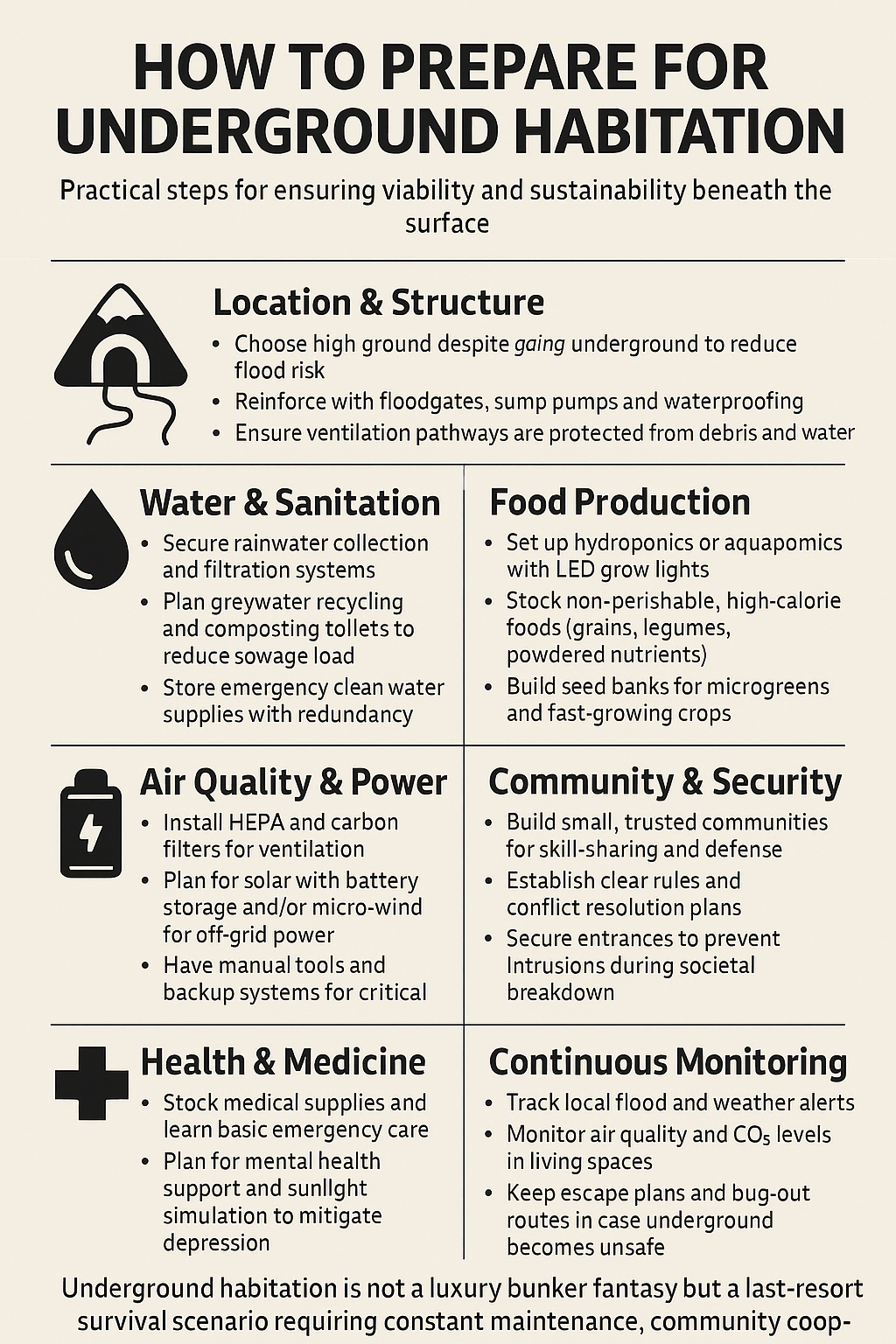
How to Prepare for Underground Habitation

 Location & Structure

  • Choose high ground despite going underground to reduce flood risk.

  • Reinforce with floodgates, sump pumps, and waterproofing.

  • Ensure ventilation pathways are protected from debris and water.

Water & Sanitation

  • Secure rainwater collection and filtration systems.

  • Plan greywater recycling and composting toilets to reduce sewage load.

  • Store emergency clean water supplies with redundancy.

Food Production

  • Set up hydroponics or aquaponics with LED grow lights.

  • Stock non-perishable, high-calorie foods (grains, legumes, powdered nutrients).

  • Build seed banks for microgreens and fast-growing crops.

Air Quality & Power

  • Install HEPA and carbon filters for ventilation.

  • Plan for solar with battery storage and/or micro-wind for off-grid power.

  • Have manual tools and backup systems for critical needs.

 Community & Security

  • Build small, trusted communities for skill-sharing and defense.

  • Establish clear rules and conflict resolution plans.

  • Secure entrances to prevent intrusions during societal breakdown.

Health & Medicine

  • Stock medical supplies and learn basic emergency care.

  • Plan for mental health support and sunlight simulation to mitigate depression.

  • Maintain physical fitness to handle manual labor and emergencies.

Continuous Monitoring

  • Track local flood and weather alerts.

  • Monitor air quality and CO2 levels in living spaces.

  • Keep escape plans and bug-out routes in case underground becomes unsafe.

Remember:
Underground habitation is not a luxury bunker fantasy; it is a last-resort survival scenario requiring constant maintenance, community cooperation, and adaptability in a rapidly collapsing climate system.


Underground Living Guide

Underground Living Guide

The Human Induced Climate Change Experiment

bookmark_borderNine Tipping Points Crossed: The Domino Collapse of Earth’s Climate Systems

by Daniel Brouse and Sidd Mukherjee
July 13, 2025

Human-induced climate change has now crossed at least nine critical tipping points, each triggering irreversible shifts in the Earth’s climate system. These tipping points are not isolated; they are interconnected, and their cascading effects amplify each other in a self-reinforcing feedback loop that accelerates global climate disruption.

The nine tipping points include:

  1. Greenland Ice Sheet Collapse

  2. West Antarctic Ice Sheet Collapse

  3. Labrador-Irminger Seas / SPG Convection Collapse

  4. East Antarctic Subglacial Basins Collapse

  5. Arctic Winter Sea Ice Collapse

  6. East Antarctic Ice Sheet Collapse

  7. Amazon Rainforest Dieback

  8. Boreal Permafrost Collapse

  9. Atlantic Meridional Overturning Circulation (AMOC) Collapse

These are not in strict chronological order, as the tipping points are dynamically interconnected, but the sequence of total collapse impacts the severity and global reach of the consequences.

As my colleague Sidd noted, “Number 7 might be first.”

The Amazon Rainforest Dieback

For decades, Sidd and I have researched the ozone feedback loop, an often-overlooked but critical piece of the climate crisis puzzle. Ozone, a byproduct of carbon combustion, does not act as a greenhouse gas itself but severely disrupts the Earth’s ability to manage greenhouse gases indirectly.

Tropospheric ozone pollution damages the stomata of plant leaves, which are microscopic openings essential for absorbing CO₂ during photosynthesis. This impairment drastically reduces plant productivity, health, and growth, weakening one of the planet’s most vital carbon sinks. Recent studies indicate that ozone poisoning has already reduced the productivity of plant CO₂ absorption by approximately 30%, undermining the natural carbon removal capacity of the Amazon and other forests.

As the Amazon’s ability to sequester carbon weakens, it becomes increasingly vulnerable to higher temperatures and intensified droughts, which are themselves driven by regional deforestation and climate change. Ozone-induced reductions in CO₂ uptake further weaken tree health, making the forest more susceptible to wildfires, pest outbreaks, and large-scale mortality.

Once the Amazon crosses its tipping threshold, large-scale dieback becomes irreversible, releasing immense quantities of stored carbon from vegetation and soils into the atmosphere. This shifts the Amazon from being a powerful carbon sink to a significant carbon source, accelerating global warming and reinforcing a destructive feedback loop that drives further regional drying and forest decline.

The Amazon also plays a critical role in recycling water across South America. As forest cover declines, this water recycling function weakens, reducing rainfall locally and regionally, amplifying drought, and hastening the ecosystem’s collapse. If current trends continue, the Amazon is poised to transform from the world’s largest carbon sink into a catastrophic carbon emitter, with devastating consequences for global climate stability and biodiversity.

Why This Matters Now

These tipping points are no longer theoretical warnings—they are unfolding in real time, compounding their effects and accelerating systemic collapse. Each tipping point increases the likelihood of crossing additional tipping points, fueling the domino effect of climate destabilization.

From the loss of polar ice sheets raising sea levels, to the collapse of ocean circulation patterns disrupting weather and food systems, to the dieback of the Amazon intensifying warming and reducing rainfall, these interlinked crises are now reshaping our world at a pace faster than traditional models predicted.

We are witnessing the transition from linear climate change to non-linear, system-wide collapse. It is critical for policymakers, scientists, and the public to recognize that mitigation and adaptation strategies must account for these cascading tipping points to avoid deeper, irreversible damage to the Earth’s systems and human civilization.

The Human Induced Climate Change Experiment

bookmark_borderTipping Cascades: The Nonlinear Dominoes of Climate Collapse

by Daniel Brouse
July 14, 2025

My latest deep reflection has centered on how tipping points have triggered self-sustaining feedback loops in the climate system. We knew this was coming—and it is now here. Luckily, I was prepared for that part.

What I could not fully envision in my mind’s eye was how the interplay of different tipping points would ignite a domino effect so rapidly—so, so fast.

Now, I can see it clearly: the nonlinear, dynamic dance of economic, physical, and ecological unordered systems in real time. This is pure math and science, visibly unfolding for all to see, transforming abstract models into undeniable, measurable reality.

To understand unordered systems, you must “zoom out.” Imagine standing in the eye of a hurricane, unable to grasp its structure from within, then pulling back to see the swirling system from a satellite view. Only then can you perceive its shape, patterns, and momentum. Climate science and economics share this paradox: from within, the chaos feels incomprehensible, but from a higher vantage, the pattern is clear.

I offer this perspective to help you grasp the critical reality of where we stand today:

We are witnessing at least nine major tipping points that are already in play, with dominoes falling and each accelerating the collapse of the next. Crossing these tipping points represents a threshold beyond which impacts on global ecosystems and human societies become irreversible within human timescales.

The Nine Tipping Points in Motion:

1. Greenland Ice Sheet Collapse
Accelerated melting is injecting vast freshwater into the ocean, disrupting marine ecosystems, weakening the AMOC, and raising sea levels.

2. West Antarctic Ice Sheet Collapse
Rapid destabilization threatens to raise sea levels by meters, displacing populations and eroding infrastructure globally.

3. Labrador-Irminger Seas / Subpolar Gyre Convection Collapse
Collapse of this convection disrupts the AMOC, a critical regulator of global heat distribution, weather stability, and ocean health.

4. East Antarctic Subglacial Basins Collapse
Grounded below sea level, these basins are vulnerable to rapid ice loss, accelerating sea level rise and destabilizing coastal regions.

5. Arctic Winter Sea Ice Collapse
Shrinking winter ice amplifies Arctic warming, disrupting jet streams, altering ocean currents, and triggering further heat absorption.

6. East Antarctic Ice Sheet Collapse
Long considered stable, sections of the East Antarctic are showing vulnerability to collapse, with the potential to significantly raise sea levels.

7. Amazon Rainforest Dieback
Deforestation and warming threaten the Amazon’s water recycling and carbon storage roles, turning it from a carbon sink to a carbon source.

8. Boreal Permafrost Collapse
Thawing permafrost is releasing methane and CO₂ in massive quantities, creating a powerful feedback loop of accelerated warming.

9. Atlantic Meridional Overturning Circulation (AMOC) Collapse
Potential collapse of the AMOC could lead to abrupt weather pattern shifts, including intensified droughts, storms, and regional cooling in some areas, while exacerbating global climate instability.


Tipping Cascades and The Domino Effect

These tipping points do not act in isolation. Each collapse amplifies stress on others, triggering tipping cascades:

  • Melting Greenland ice weakens the AMOC, which alters weather patterns, drying the Amazon, triggering dieback that releases CO₂, further warming the Arctic, collapsing permafrost, and amplifying ocean heating.

  • Changes in Arctic sea ice affect jet stream patterns, causing persistent heat domes, droughts, and flooding cycles, which destabilize ecosystems and food systems.

  • The weakening of the AMOC is linked to increased East Coast flooding, European storm intensification, and droughts in the Sahel, while simultaneously accelerating Antarctic ice melt.

We are seeing chaotic systems align into self-perpetuating loops, moving climate change from linear, human-driven emissions to nonlinear, nature-driven escalation.


Why This Matters Now

It is now clear: climate change has entered a phase where natural systems themselves are the drivers. Even if humans ceased all emissions today, these processes will continue for centuries or millennia, while continuing emissions add fuel to the fire.

Understanding and communicating the urgency of these tipping cascades is essential not only for scientists but for policymakers, businesses, and every individual. We must accelerate adaptation strategies while urgently reducing emissions to slow additional triggers.

The sooner we act, the more we can reduce the damage of the tipping cascades that are now unstoppable but can still be limited in scope and speed.

The Human Induced Climate Change Experiment