by Daniel Brouse and Sidd Mukherjee
How Compound Flooding Is Reshaping Property Values, Insurance Availability, and Coastal Habitability
Climate change is creating a new class of real-estate risk in which the physical hazards of flooding increasingly interact with financial, insurance, infrastructure, and housing systems. Sea-level rise, heavier precipitation, and more intense or slower-moving hurricanes are not independent threats. They can interact to produce compound flooding, while the increasing frequency of damaging events can compress the time available for communities, property owners, insurers, and governments to recover.
The consequences extend far beyond the immediate cost of flood damage. As flood frequency increases, historical assumptions about property risk, insurance pricing, mortgage security, infrastructure design, and long-term property values become progressively less reliable. A property that was once considered a low-probability flood risk can become repeatedly exposed to flooding without the physical structure itself changing. As risk is repriced, insurance can become more expensive, less available, or unavailable altogether. Declining insurability can then reduce property values, constrain mortgage lending, discourage investment, weaken local tax bases, and reduce the resources available for infrastructure maintenance and adaptation.
This creates a coupled socioeconomic feedback loop:
Climate Warming → Hazard Intensification → Hazard Coupling → Compound Flooding → Damage and Losses → Insurance Stress → Property-Value Pressure → Reduced Investment → Infrastructure and Resilience Erosion → Greater Vulnerability → Greater Future Losses
A second feedback develops as recovery intervals contract:
Flood Frequency ↑ → Recovery Time Available ↓ → Unresolved Damage ↑ → Vulnerability ↑ → Subsequent Losses ↑
The resulting process is not simply an increase in flood risk. It is a potential transformation of real estate from a relatively stable store of household and institutional wealth into an increasingly climate-sensitive asset whose value, insurability, and financing depend upon the interaction of physical hazards and socioeconomic resilience.
The central argument of this paper is that real estate and insurance may become among the earliest and most visible indicators of cascading climate risk. When insurance becomes unaffordable or unavailable, property values weaken, lenders reassess collateral, investment retreats, and municipalities lose portions of their tax base, the effects of climate change have moved from the physical environment into the financial structure of communities.
1. Introduction: Climate Risk Is Becoming Real-Estate Risk
Climate change is often described in terms of rising temperatures, heavier rainfall, stronger storms, sea-level rise, and increasingly frequent flooding. Yet for households and communities, the most consequential effects may be transmitted through a different system:
Real Estate → Insurance → Mortgage Finance → Investment → Municipal Revenue → Infrastructure → Property Risk
A flood does not have to destroy a property to damage its economic value.
A property can lose value because:
- flooding becomes more frequent;
- flood insurance becomes more expensive;
- insurance coverage becomes difficult to obtain;
- insurers withdraw from the market;
- lenders become more cautious;
- infrastructure becomes less reliable;
- buyers perceive increasing future risk;
- investors demand higher returns for greater exposure;
- municipal finances deteriorate;
- repeated flooding reduces confidence in long-term habitability.
This changes the nature of climate risk.
The relevant question is no longer simply:
How much physical damage will the next flood cause?
It becomes:
What happens to the economic value and insurability of property when floods repeatedly occur before the community has fully recovered from previous events?
That is a fundamentally different risk problem.
2. Hurricane Harvey: The Beginning of the Feedback Chain
Hurricane Harvey provides a useful illustration of the physical mechanism underlying this emerging financial risk.
In August 2017, Harvey stalled over Texas and produced more than 40 inches of rainfall across a large area. At Nederland, Texas, 60.58 inches of rain was recorded, the largest single rainfall total associated with a tropical cyclone or its remnants in the United States. Damage was estimated at approximately $164 billion in 2026 dollars, with flooding responsible for most of the losses.
Harvey was also a compound-flood event.
Runoff from extreme rainfall moved toward the Gulf while storm surge pushed seawater inland. The elevated coastal water interfered with drainage, producing flooding through the interaction of rainfall runoff and storm surge.
The physical mechanism can therefore be expressed as:
Extreme Rainfall + Runoff + Storm Surge → Drainage Impairment → Compound Flooding
Climate change adds additional forcing:
Climate Warming → Heavier Rainfall + Higher Sea Level + More Intense/Slower Storms → Greater Compound Flood Risk
But the economic cascade begins after the water arrives:
Compound Flooding → Property Damage → Insurance Claims → Insurance Losses → Higher Insurance Costs and Reduced Availability
This is where physical climate risk begins to transform into financial risk.
3. The Three-Way Climate Pressure on Property
Three major mechanisms increasing compound flood risk along the U.S. Atlantic and Gulf coasts:
- More intense and slower-moving hurricanes
- Increased heavy precipitation as warmer air holds more water vapor
- Sea-level rise.
These mechanisms vary geographically.
Across the Gulf of Mexico and Florida, increased rainfall is projected to be the dominant driver in many locations. Across portions of the Southeast and Mid-Atlantic, changes in intense or slow-moving hurricanes become more important. Along the upper Mid-Atlantic and New England coasts, sea-level rise becomes increasingly dominant.
From a real-estate perspective, however, the distinction between the individual drivers may matter less than their combined effect.
The property does not experience three separate balance sheets.
It experiences one risk environment.
The resulting relationship is:
Sea-Level Rise + Extreme Rainfall + Storm Intensification → Compound Flood Risk → Property Risk
The financial system then responds:
Property Risk ↑ → Insurance Risk ↑ → Financing Risk ↑ → Property Value Pressure ↑
This is the beginning of the real-estate cascade.
4. Compound Flooding Creates Nonlinear Property Risk
The Harvey evidence demonstrates why conventional property-risk calculations can become inadequate.
A 2023 study found that approximately 19% of the flood area around Port Arthur, Texas, during Harvey resulted from compound flooding.
Under a scenario involving 0.57 meters of additional sea-level rise and 18% more rainfall, described as plausible around 2050, the compound-flooding area increased to 33%.
Under a scenario involving 1.6 meters of sea-level rise and 50% additional rainfall, described as plausible by 2100, compound flooding increased to 46%, while the number of structures affected was estimated to increase by approximately 23 times compared with 2017.
This is important for property markets because exposure can increase much faster than any single climate variable.
The relevant relationship is:
Climate Forcing ↑ → Hazard Interaction ↑ → Flood Exposure ↑↑ → Property Risk ↑↑
A property market that prices risk based primarily on historical flood frequency may therefore systematically underestimate future exposure.
5. The Return-Period Problem Becomes a Property-Valuation Problem
Real estate depends heavily on expectations about future risk.
A home buyer, mortgage lender, insurer, developer, or investor is effectively making a long-term assessment:
What is the probability that this property will suffer damaging losses during the period in which I own or finance it?
Historically rare floods can become much more frequent as the physical baseline changes.
Research found that human-driven sea-level rise has quadrupled the frequency of coastal sea-level extremes since 1900. At several locations, relative sea-level rise transformed a coastal flood that was a 100-year event in 1900 into an event occurring every five years or less frequently by 2005.
Recent examples illustrate the magnitude of this transformation.
A flood that historically occurred approximately once every ten years occurred:
Charleston → 17 times in 2025
Galveston → 9 times in 2024
Atlantic City → 10 times in 2024
Miami → 14 consecutive days in October 2025
Key West → 26 of 27 days in October 2025
For real estate, this represents a fundamental repricing problem.
A property does not need to be destroyed for its value proposition to change.
If the frequency of disruptive flooding changes from:
Rare → Occasional → Frequent → Persistent
then the economic characteristics of the property can change correspondingly.
6. The Insurance Market Is the First Financial Transmission Mechanism
Insurance is designed to transfer risk.
But insurance markets depend upon the ability to estimate and diversify that risk.
When climate change causes historical loss probabilities to change rapidly, insurers face a fundamental problem:
Historical Risk Models → Changing Climate Baseline → Increasing Loss Uncertainty
The response can take several forms:
Risk ↑ → Premiums ↑
Risk ↑ → Deductibles ↑
Risk ↑ → Coverage Restrictions ↑
Risk ↑ → Capacity ↓
Risk ↑ → Insurer Withdrawal ↑
For individual homeowners, the immediate consequence is affordability.
For the real-estate market, the deeper consequence is insurability.
Insurance availability is not simply another household expense.
It is part of the financial infrastructure supporting property ownership.
7. Insurance Availability Can Become a Property-Value Constraint
A property with affordable insurance can be financed, sold, and occupied relatively normally.
A property with extremely expensive insurance is economically less attractive.
A property that cannot obtain insurance may become difficult to finance.
The chain becomes:
Flood Risk ↑ → Insurance Cost ↑ → Ownership Cost ↑ → Buyer Demand ↓ → Property Value Pressure ↑
But the cascade can become stronger:
Flood Risk ↑ → Insurance Availability ↓ → Mortgage Financing Constraints ↑ → Buyer Pool ↓ → Property Liquidity ↓ → Property Values ↓
This produces a potentially powerful feedback.
As property values decline:
Property Values ↓ → Tax Base ↓ → Municipal Revenue ↓ → Infrastructure Investment Capacity ↓
If infrastructure resilience subsequently deteriorates:
Infrastructure Resilience ↓ → Flood Vulnerability ↑ → Property Risk ↑
The cycle closes:
Property Values ↓ → Tax Base ↓ → Infrastructure Capacity ↓ → Flood Risk ↑ → Insurance Stress ↑ → Property Values ↓
This is a coupled socioeconomic feedback loop.
8. The Insurance–Mortgage–Real Estate Feedback
Insurance and mortgage finance are closely connected.
A mortgage is a long-duration financial claim secured by an asset expected to retain sufficient value to protect the lender.
As flood risk increases, the financial system therefore confronts several interconnected questions:
Can the property be insured?
At what cost?
Will the property retain its value?
Will future buyers be able to obtain financing?
Will the property remain inhabitable?
The resulting feedback can be represented as:
Flood Risk ↑ → Insurance Risk ↑ → Insurance Cost/Availability Deteriorates → Mortgage Risk ↑ → Lending Constraints ↑ → Buyer Demand ↓ → Property Values ↓
The consequences can extend beyond individual homeowners.
Banks and mortgage investors may increasingly need to evaluate climate exposure at the portfolio level.
A geographic concentration of properties exposed to the same flood hazard creates correlated risk.
Unlike independent household losses, a major regional flood can affect thousands or millions of properties simultaneously.
That makes diversification more difficult.
9. Compound Flooding Creates Correlated Insurance Losses
This is one of the most important implications of compound hazards.
Insurance works most effectively when losses are sufficiently diversified.
But compound climate events can create geographically concentrated losses:
Extreme Rainfall + Storm Surge + High Sea Level → Regional Flooding → Thousands of Simultaneous Claims
A major hurricane can therefore produce simultaneous losses across:
- homes
- commercial properties
- vehicles
- infrastructure
- businesses
- utilities
- municipal facilities
As compound events become more frequent, the financial system can face increasingly correlated losses.
That creates a feedback:
Compound Events ↑ → Correlated Claims ↑ → Insurer Losses ↑ → Pricing Pressure ↑ → Capacity Constraints ↑
This is fundamentally different from a world in which extreme floods are rare and geographically isolated.
10. Return-Period Compression Changes the Insurance Equation
Research examined extreme compound flooding defined as a one-in-100-year storm surge occurring simultaneously with a one-in-100-year rainfall event.
Historically, the combined event had a return period of approximately 200–500 years along the Gulf and southeastern Atlantic coasts and up to 1,000 years or more in parts of New England. Under an extreme warming scenario for 2100, the frequency increased by approximately 7–36 times in the South and 30–195 times farther north.
For insurance markets, the key issue is not the terminology “100-year event.”
The key issue is the frequency of claims-producing events.
If an event once expected to occur once in several centuries begins occurring multiple times within an insurance portfolio’s planning horizon, historical loss assumptions become increasingly unreliable.
Thus:
Return Interval ↓ → Claims Frequency ↑ → Expected Losses ↑ → Premium Pressure ↑ → Insurance Availability ↓
11. Stronger and Slower Hurricanes Increase Insurance Exposure
Our modeling projects the strongest hurricanes could become approximately 15–30% more intense while moving 20–30% more slowly along much of the U.S. coast. The combination increases the probability of simultaneous extreme rainfall and storm tide.
For property markets, this produces multiple simultaneous threats:
Intensity ↑ → Wind Damage ↑
Intensity ↑ → Storm Surge ↑
Intensity ↑ → Rainfall Potential ↑
Translation Speed ↓ → Rainfall Duration ↑
The combined result is:
Stronger + Slower Storms → Wind + Surge + Rainfall → Compound Property Losses
The insurance consequences can therefore be substantially larger than those associated with a simple increase in storm frequency.
12. Inland Property Markets Are Increasingly Exposed
Flood risk is not confined to oceanfront real estate.
Research finds substantial compound-flooding risks farther inland, including along Gulf Coast rivers where high streamflow can interact with storm surge. Increasing evidence suggests compound flooding can be greatest inland near the limit of tidal influence rather than directly at the coast.
A 2026 preprint found substantial increases in the probability of compound wind and precipitation extremes both within 100 kilometers of the coast and 100–500 kilometers inland under an extreme warming projection.
The significance for real estate is considerable.
Flood risk can migrate geographically.
Coastal Risk → Inland Watershed Risk → Inland Property Exposure
Communities that historically considered themselves outside the principal flood-risk zone can increasingly encounter climate-driven flooding.
That creates a major valuation problem because local markets may have little historical experience with these events.
13. Urban Flooding Creates a New Real-Estate Risk
Urban flooding introduces another dimension.
Extreme precipitation can overwhelm drainage systems even where properties are far from coastlines and major rivers.
The risk can become particularly acute in below-grade housing.
Extreme Rainfall → Stormwater System Overload → Rapid Urban Flooding → Basement/Below-Grade Exposure → Life-Safety Risk
This matters to real estate because conventional flood-risk perceptions often emphasize proximity to rivers, coastlines, or mapped floodplains.
But intense rainfall can create dangerous flooding through overwhelmed urban drainage systems.
As a result:
Flood Risk ≠ Coastal Risk Alone
Increasingly:
Flood Risk = Coastal + Riverine + Pluvial + Urban + Compound Risk
This expansion complicates property valuation, insurance underwriting, and municipal planning.
14. Recovery Deficit Is the Hidden Variable
The most important variable in cascading real-estate risk may not be flood magnitude.
It may be recovery time.
Consider:
Flood A → Damage → Partial Recovery → Flood B → Additional Damage → Partial Recovery → Flood C
If each event arrives before full recovery, unresolved losses accumulate.
A conceptual relationship is:
Resilience(t+1) = Resilience(t) + Recovery(t) − Damage(t)
When:
Recovery > Damage → Resilience Restored
But when:
Damage > Recovery → Resilience Declines
This creates a critical threshold:
Damage Rate > Recovery Rate
Once that condition persists, the system enters a recovery deficit.
For real estate, the consequences include:
Unrepaired Properties → Deferred Maintenance → Lower Property Quality → Lower Values → Reduced Investment → Greater Vulnerability
The property market therefore becomes a mechanism through which physical climate shocks can accumulate.
15. Repeated Flooding Can Produce a Negative Wealth Feedback
Homeownership represents a substantial component of household wealth.
Repeated climate-related losses can therefore create a feedback involving household balance sheets.
Flooding ↑ → Repair Costs ↑ → Insurance Costs ↑ → Property Values ↓ → Household Equity ↓ → Financial Resilience ↓
Lower household financial resilience can make recovery more difficult:
Financial Resilience ↓ → Delayed Repairs → Property Condition ↓ → Property Value ↓
The resulting loop becomes:
Flood Risk ↑ → Property Damage ↑ → Household Wealth ↓ → Recovery Capacity ↓ → Property Vulnerability ↑ → Future Losses ↑
This is particularly significant in communities where property represents a large share of household net worth.
Climate risk can therefore become wealth risk.
16. The Municipal Feedback Loop
The consequences do not stop at individual properties.
Municipal governments depend heavily on property values and economic activity.
A potential cascade is:
Flood Frequency ↑ → Property Damage ↑ → Property Values ↓ → Tax Base ↓ → Municipal Revenue ↓
The municipality then has fewer resources available for:
- drainage improvements
- flood defenses
- road repair
- stormwater systems
- emergency response
- public infrastructure maintenance
- adaptation
This can produce:
Municipal Revenue ↓ → Infrastructure Investment ↓ → Resilience ↓ → Flood Damage ↑
The feedback closes:
Flood Risk ↑ → Property Values ↓ → Tax Base ↓ → Infrastructure Capacity ↓ → Flood Vulnerability ↑ → Property Risk ↑
At this point, the climate hazard has become embedded in the fiscal condition of the community.
17. The Insurance–Property–Infrastructure Feedback
The major feedback loops can be integrated into a single system:
Climate Warming → Hazard Intensification → Hazard Coupling → Compound Flooding → Physical Damage → Insurance Losses → Premiums/Availability Pressure → Property Value Decline → Investment Decline → Tax Base Erosion → Infrastructure Investment Decline → Resilience Erosion → Greater Flood Vulnerability → Greater Future Losses
This is the core cascading-risk mechanism.
The system is not linear.
Each component can alter the conditions affecting the next component.
The physical climate hazard creates the initial disturbance.
The socioeconomic system can then amplify the disturbance.
18. Insurance May Become an Early-Warning System for Climate Risk
Insurance markets have an unusual role in this transition.
They continuously translate physical risk into financial pricing.
Consequently, insurance-market changes may provide an early indicator of emerging real-estate instability.
The sequence may be:
Physical Risk ↑ → Actuarial Risk ↑ → Premiums ↑ → Deductibles ↑ → Coverage Restrictions ↑ → Insurer Withdrawal ↑
These signals can appear before large-scale property abandonment.
A community may therefore be approaching a real-estate resilience threshold even when most houses remain physically intact.
The early warning may instead appear as:
Insurance Availability ↓
Insurance Affordability ↓
Mortgage Availability ↓
Property Transactions ↓
Investment ↓
Property Values ↓
This suggests that insurance markets should be viewed not merely as financial institutions absorbing climate losses, but as risk sensors embedded within the real-estate system.
19. The Property-Value Feedback Can Accelerate
Once buyers begin incorporating future flood risk into property decisions, market expectations can change.
The feedback can become:
Flood Frequency ↑ → Risk Perception ↑ → Buyer Demand ↓ → Property Values ↓
Lower values can then produce additional effects:
Property Values ↓ → Equity ↓ → Investment ↓ → Maintenance ↓ → Vulnerability ↑
And:
Property Values ↓ → Tax Base ↓ → Public Infrastructure Investment ↓ → Vulnerability ↑
And:
Flood Risk ↑ → Insurance Costs ↑ → Total Cost of Ownership ↑ → Buyer Demand ↓ → Property Values ↓
The system therefore contains multiple reinforcing loops operating simultaneously.
This is what distinguishes a coupled-feedback system from a simple hazard-impact model.
20. The Sandy Example: An Accelerating Financial Risk Clock
Research found that a Sandy-like event in New York City, estimated at approximately once every 150 years in the current climate, could become approximately a once-in-65-year event by 2050 and once-in-30-year event by 2100 under the emissions scenario studied.
From a real-estate perspective, the significance is not simply that the probability of flooding increases.
The economic life of a mortgage, insurance policy, or property investment may span decades.
A hazard that occurs once every 150 years has a very different economic significance from one occurring once every 30 years.
Thus:
Return Interval ↓ → Probability of Loss During Ownership ↑ → Insurance Risk ↑ → Mortgage Risk ↑ → Property Risk ↑
The longer the investment horizon, the more consequential the changing hazard frequency becomes.
21. Sea-Level Rise Creates a Persistent Baseline Shift
Sea-level rise differs from many episodic hazards because it permanently alters the starting point from which future storms occur.
A higher ocean means:
Higher Baseline Water Level → Greater Storm-Surge Reach → Greater Flood Exposure
And:
Sea-Level Rise → Less Drainage Capacity → Greater Interaction Between Runoff and Surge
This means that even if a future storm were identical to a historical storm, its consequences could be different because it would occur against a changed physical baseline.
For property markets:
Sea-Level Rise → Persistent Risk Increase → Long-Term Property Exposure ↑
This is particularly important for real estate because buildings and infrastructure have long lifetimes.
22. The Coastal Property Paradox
Coastal property can remain economically attractive even while its physical risk is increasing.
That creates a potential divergence:
Amenity Value ↑
while:
Climate Risk ↑
For a period, rising demand may conceal increasing physical risk.
But eventually the financial system may begin incorporating the changing risk more aggressively.
The transition can be:
Physical Risk ↑ → Insurance Cost ↑ → Ownership Cost ↑ → Market Awareness ↑ → Buyer Demand ↓ → Property Values ↓
The result may be a delayed repricing.
Real estate markets do not necessarily respond immediately to slowly accumulating physical risk.
Insurance markets, however, may respond sooner because they must continually price expected losses.
This creates the possibility that:
Insurance repricing precedes real-estate repricing.
23. When Insurance Becomes Unaffordable, the Market Changes
Insurance affordability is particularly important because homeowners do not experience insurance as an abstract actuarial variable.
They experience it as part of the cost of owning a property.
The relevant relationship is:
Mortgage + Property Tax + Insurance + Maintenance + Expected Climate Losses = Cost of Ownership
If insurance premiums rise dramatically:
Insurance Cost ↑ → Total Cost of Ownership ↑
The property must either:
Price ↓
or:
Buyer Demand ↓
or both.
If insurance becomes unavailable:
Insurance Availability ↓ → Financing Constraints ↑ → Buyer Pool ↓ → Market Liquidity ↓
The property may remain physically valuable, but its economic utility as a financed asset declines.
24. From Insurability to Habitability
Insurance is not the only threshold.
Eventually, repeated flooding can affect whether a community remains economically and physically viable.
At the most susceptible U.S. sites, the odds of a one-in-50-year coastal flood could approximately double every five years under continuing sea-level rise. It also notes that many U.S. coastal engineering systems were designed around return periods of roughly 50–100 years.
As historically rare floods become increasingly frequent, the question changes.
It is no longer:
Can we recover from a flood?
It becomes:
Can we maintain a functioning community between floods?
That is the transition from flood risk to habitability risk.
25. The Real-Estate Resilience Threshold
A useful conceptual threshold is:
Insurance Cost + Expected Flood Losses + Infrastructure Costs > Property’s Economic Value Proposition
When this condition becomes persistent, the property may remain physically habitable while becoming economically unattractive.
A second threshold occurs when:
Damage Rate > Recovery Rate
At that point, the property or community cannot fully restore itself between successive events.
A third threshold may emerge when:
Protection Cost > Property Value / Tax Base / Available Capital
At that point, continued protection may become economically difficult.
These thresholds can interact:
Flood Risk ↑ → Insurance Cost ↑ → Property Value ↓ → Tax Base ↓ → Protection Capacity ↓ → Flood Risk ↑
This is a cascading threshold system.
26. From Property Decline to Retreat
The ultimate consequence need not be sudden abandonment.
A more realistic process may occur gradually:
Flood Frequency ↑ → Insurance Stress ↑ → Property Values Stagnate → Investment Declines → Maintenance Declines → Infrastructure Deteriorates → Insurance Availability Declines Further → Property Values Fall → Population Outmigration ↑
Eventually:
Population Decline → Tax Base Decline → Infrastructure Capacity Decline → Resilience Decline
At some point, adaptation may become economically preferable to continued protection.
This can lead to:
Protection → Adaptation → Managed Retreat → Abandonment
The timing and geographic extent of such transitions will vary considerably by location.
The key point is that the transition can be driven not by a single catastrophic flood but by cumulative climate risk interacting with economic feedbacks.
27. The Complete Coupled-Feedback / Cascading Real-Estate Framework
The emerging system can be represented as:
Warming → Hazard Intensification → Hazard Coupling → Compound Flooding → Damage → Insurance Losses → Insurance Cost/Availability Pressure → Property-Value Pressure → Reduced Investment → Tax-Base Erosion → Infrastructure Resilience Decline → Greater Vulnerability → Greater Future Losses
A second loop operates through recovery:
Flood Frequency ↑ → Recovery Window ↓ → Unresolved Damage ↑ → Resilience ↓ → Vulnerability ↑ → Subsequent Damage ↑ → Recovery Window ↓
A third loop operates through insurance:
Flood Risk ↑ → Expected Losses ↑ → Premiums ↑ / Coverage ↓ → Cost of Ownership ↑ → Buyer Demand ↓ → Property Values ↓ → Insurer/Lender Risk ↑ → Insurance and Financing Constraints ↑
A fourth operates through municipal finance:
Property Values ↓ → Tax Base ↓ → Municipal Revenue ↓ → Infrastructure Investment ↓ → Resilience ↓ → Flood Risk ↑ → Property Values ↓
These feedbacks are interconnected.
Together they create:
Climate Forcing → Physical Hazard Coupling → Financial Amplification → Resilience Erosion → Cascading Real-Estate Risk
28. A New Definition of Climate-Exposed Property Risk
Traditional real-estate risk often focuses on:
Location + Structure + Historical Flood Zone
A future-oriented model must incorporate additional variables:
Flood Frequency
Compound-Hazard Probability
Sea-Level Rise
Extreme Precipitation
Storm Intensity and Translation Speed
Insurance Availability
Insurance Affordability
Mortgage Availability
Infrastructure Resilience
Recovery Capacity
Property-Value Trajectory
Municipal Fiscal Capacity
The risk of a property is therefore not simply its probability of flooding.
A more comprehensive conceptual formulation is:
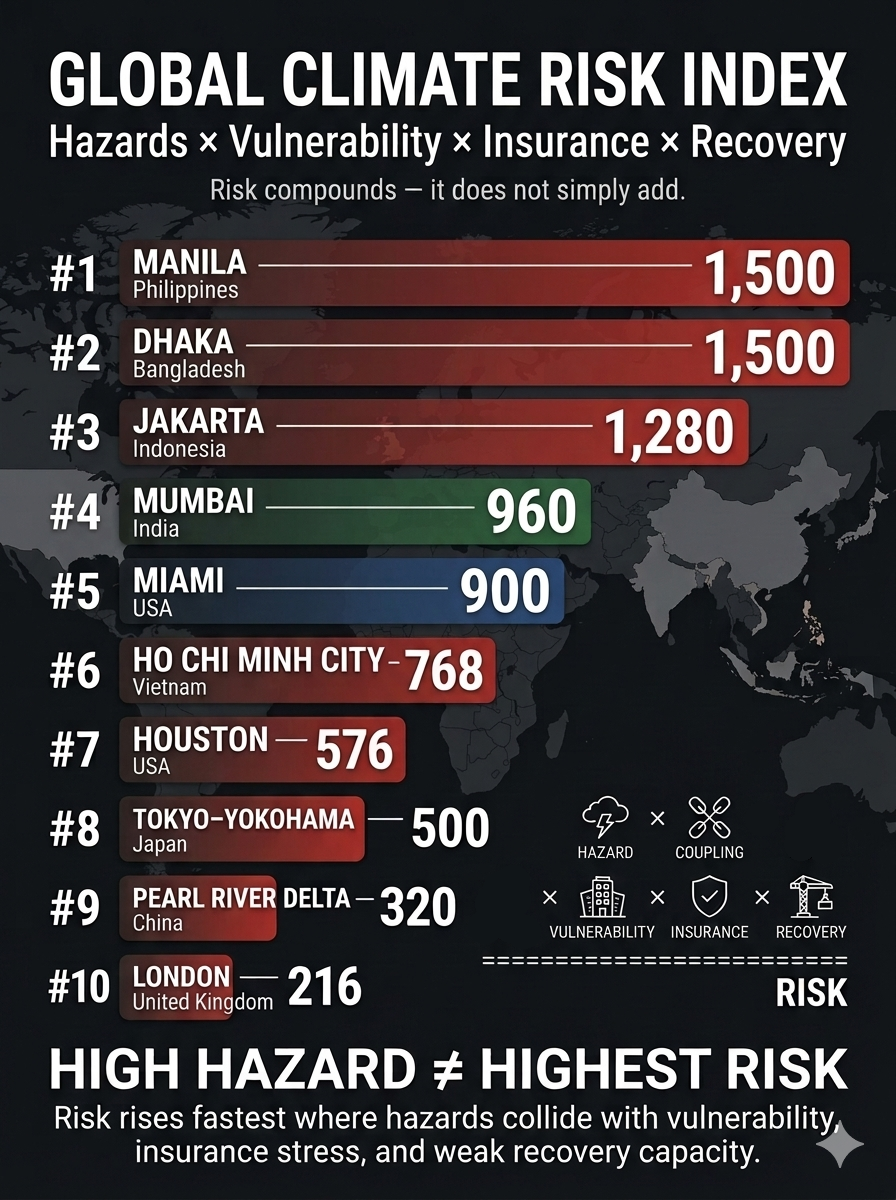
Real-Estate Climate Risk ∝ Hazard Exposure × Hazard Coupling × Vulnerability × Insurance Stress × Recovery Deficit
Again, this is a conceptual framework rather than a validated predictive equation.
Its purpose is to recognize that physical exposure and financial vulnerability can amplify one another.
29. Why Historical Property Valuation Models May Become Increasingly Unreliable
A property valuation based heavily on historical comparable sales assumes that the past provides meaningful information about future risk.
But if the climate baseline is changing:
Historical Flood Frequency ≠ Future Flood Frequency
And therefore:
Historical Property Risk ≠ Future Property Risk
This creates the potential for a valuation lag.
A property may continue selling at prices based on historical assumptions even as:
Flood Frequency ↑
Insurance Cost ↑
Infrastructure Stress ↑
Future Risk ↑
The market can therefore experience a delayed repricing once these factors become visible to buyers, lenders, and insurers.
The longer the delay, the greater the possibility of a discontinuous adjustment.
30. The Central Role of Insurance in Price Discovery
Insurance markets can force climate risk into property economics because they must continually reassess expected losses.
This creates a potentially important sequence:
Physical Climate Change → Insurance Repricing → Mortgage Reassessment → Buyer Reassessment → Property Repricing
In this framework, insurance functions as an intermediary between the climate system and the real-estate market.
This makes insurance availability and affordability among the most important indicators to monitor.
A deteriorating insurance market can signal that the physical risk has become financially material even before large-scale property abandonment occurs.
31. The Emerging Climate-Real-Estate Feedback
The broader system can therefore be summarized as:
Physical System
Warming → Sea-Level Rise + Heavier Rainfall + Stronger/Slower Storms → Compound Flooding
Insurance System
Compound Flooding → Claims → Losses → Premium Increases + Coverage Restrictions + Reduced Capacity
Real-Estate System
Insurance Stress → Cost of Ownership ↑ → Buyer Demand ↓ → Property Values ↓
Financial System
Property Values ↓ → Mortgage Risk ↑ → Lending Constraints ↑ → Investment ↓
Municipal System
Property Values ↓ → Tax Base ↓ → Infrastructure Investment ↓
Resilience System
Infrastructure Investment ↓ → Flood Vulnerability ↑
The loop closes:
Flood Vulnerability ↑ → Compound Flood Risk ↑
This is a coupled climate-financial feedback loop.
32. The Difference Between a Disaster and a Cascading Risk
A conventional disaster model begins and ends with the event:
Storm → Flood → Damage → Recovery
The cascading-risk model is different:
Storm → Compound Flood → Damage → Insurance Loss → Financial Stress → Property-Value Decline → Tax-Base Erosion → Infrastructure Stress → Reduced Resilience → Greater Vulnerability → Next Flood → Greater Damage
The disaster is therefore no longer an isolated event.
It becomes a state-changing event.
Each major flood can alter the economic and physical conditions under which the next flood occurs.
This makes the system path dependent.
33. The Most Important Variable May Be the Time Between Disasters
“The Floods of the Future Won’t Come One at a Time”—captures the central problem.
The issue is not simply that flood events become more severe.
It is that the interval between them can become shorter.
The resulting relationship is:
Flood Frequency ↑ + Recovery Time Constant → Recovery Window ↓
Then:
Recovery Window ↓ + Damage Per Event ↑ → Recovery Deficit ↑
Then:
Recovery Deficit ↑ → Property Condition ↓ + Infrastructure Condition ↓ + Financial Resilience ↓
Then:
Resilience ↓ → Consequences of the Next Flood ↑
This is the mechanism through which frequency becomes amplification.
34. From Compound Flooding to Cascading Real-Estate Instability
The complete process can now be expressed in one horizontal chain:
Warming → Hazard Intensification → Hazard Coupling → Compound Flooding → More Frequent Losses → Insurance Stress → Higher Cost of Ownership → Reduced Buyer Demand → Property-Value Decline → Mortgage and Investment Stress → Tax-Base Erosion → Infrastructure Resilience Decline → Recovery Deficit → Greater Future Flood Vulnerability → Cascading Real-Estate Instability
This is the central thesis of the paper.
The most important climate consequence for real estate may not be the destruction of individual properties.
It may be the progressive deterioration of the economic conditions that make those properties insurable, financeable, maintainable, and desirable.
35. Conclusion: When Climate Risk Becomes Property Risk
The emerging flood threat is fundamentally different from the historical model of isolated disasters.
Climate change is increasing the potential for:
Sea-Level Rise + Heavy Rainfall + Stronger/Slower Hurricanes → Compound Flooding
At the same time:
Flood Frequency ↑ → Recovery Windows ↓
These physical changes increasingly interact with:
Insurance
Mortgage Finance
Property Markets
Municipal Finance
Infrastructure
Household Wealth
The resulting system can develop reinforcing feedbacks:
Flood Risk ↑ → Insurance Stress ↑ → Property Values ↓ → Investment ↓ → Infrastructure Resilience ↓ → Flood Vulnerability ↑
and:
Flood Frequency ↑ → Recovery Deficit ↑ → Resilience ↓ → Future Losses ↑
These feedbacks create the possibility of nonlinear and cascading consequences.
The immediate manifestation may be rising insurance premiums, shrinking insurance availability, higher deductibles, declining property demand, or increasing difficulty obtaining mortgages.
The next stage may be declining property values and reduced investment.
The subsequent stage may involve weakening municipal tax bases, deteriorating infrastructure, and increasing difficulty financing adaptation.
The final stage in the most vulnerable locations could involve managed retreat, population displacement, and abandonment.
The critical transition is therefore:
Climate Risk → Insurance Risk → Real-Estate Risk → Financial Risk → Municipal Risk → Resilience Risk → Cascading Systemic Risk
This suggests that real estate and insurance markets should be treated as critical components of the climate system’s socioeconomic response.
Insurance is not merely a mechanism for paying claims after a disaster. It is a mechanism for translating physical risk into financial information.
Real estate is not merely a collection of buildings. It is a store of household wealth, collateral for debt, a source of municipal revenue, and the foundation of local economic activity.
When the physical climate changes, these interconnected systems change with it.
The most consequential question is therefore not simply:
Will a property flood?
It is:
Will the property remain insurable, financeable, valuable, maintainable, and economically viable as the probability of flooding changes?
That is the central real-estate question of the emerging climate era.
The ultimate risk is not a single catastrophic flood.
It is the transition from:
Rare Disaster → Recurrent Hazard → Compound Flooding → Insurance Stress → Property Repricing → Investment Retreat → Resilience Erosion → Cascading Real-Estate Risk
When floods begin arriving faster than properties, infrastructure, insurers, lenders, governments, and communities can adapt, the flood itself becomes only the initiating event.
The deeper crisis is the progressive erosion of the economic and institutional systems that allow a place to remain habitable and investable.
In that sense, the future of climate-exposed real estate may be determined less by whether a property floods once than by whether the surrounding system can continue to recover between floods.
The flood becomes the trigger.
Insurance becomes the transmission mechanism.
Real estate becomes the financial amplifier.
Resilience becomes the limiting factor.
And cascading risk becomes the ultimate consequence.