bookmark_borderThe AMOC in a Coupled Earth System: Weakening, Feedback Coupling, and the Emerging Risk of Cascading Climate Instability

Daniel Brouse¹ and Sidd Mukherjee²
¹Independent Climate Researcher, Economist, Membrane Institute, USA
²Independent Physicist, Membrane Institute, USA

Overview

The AMOC is weakening.

But the bigger climate story may be what happens when that weakening begins to interact with other parts of the Earth system.

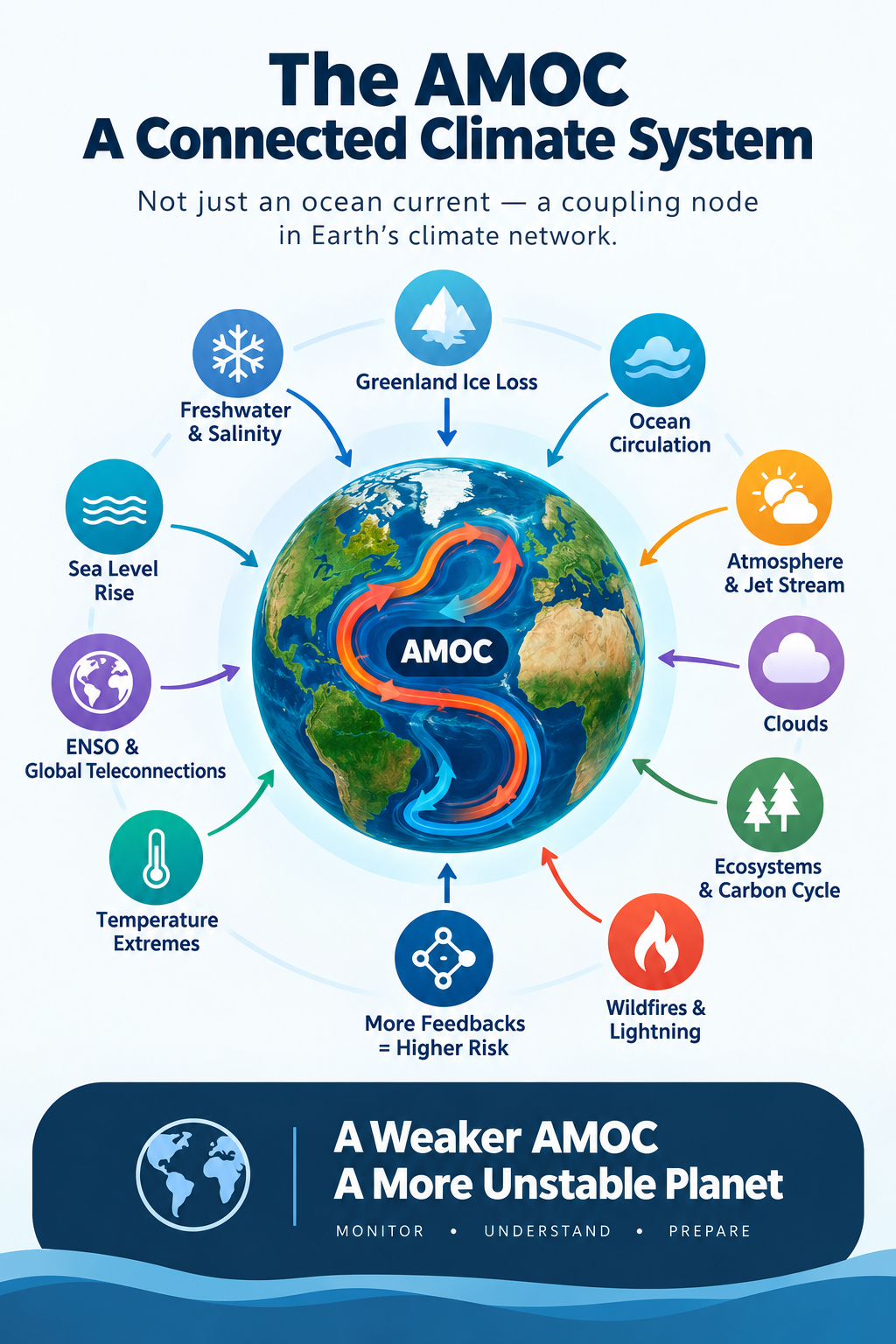
AMOC weakening can interact with declining low-level clouds, tropospheric ozone, ocean warming, sea-ice loss, atmospheric circulation, wildfires, lightning, and other processes—creating pathways for feedbacks to become coupled rather than operating independently.

The concern isn’t simply that the AMOC may weaken.

It’s that a weakening circulation can become one link in a larger feedback cascade.

Climate change isn’t a collection of isolated problems.

It’s a coupled Earth system.

And when feedbacks begin coupling, the risk isn’t merely more warming.

It’s instability.

Read the paper:

Abstract

The Atlantic Meridional Overturning Circulation (AMOC) is one of Earth’s principal mechanisms for redistributing heat, carbon, freshwater, and nutrients between the tropics and the North Atlantic. Its future behavior has consequently become one of the most consequential uncertainties in climate science. Multiple observational reconstructions and model studies indicate that the AMOC has weakened or experienced substantial changes in recent decades, although the magnitude, timing, and attribution of that weakening remain debated. The Intergovernmental Panel on Climate Change (IPCC) assesses that the AMOC will very likely weaken during the twenty-first century but assigns medium confidence that an abrupt collapse will not occur before 2100.

This synthesis advances a broader systems perspective. Rather than treating AMOC weakening as an isolated oceanographic response to greenhouse-gas forcing, we examine it as a component of a coupled network involving Greenland ice loss, North Atlantic freshening, ocean stratification, atmospheric circulation, clouds, tropospheric ozone, the jet stream, Rossby waves, ENSO, the North Atlantic Oscillation, wildfires, carbon-cycle feedbacks, and other tipping elements. Within this framework, the critical scientific question is not simply whether the AMOC will “collapse,” but whether declining circulation resilience is increasing the probability of interactions among multiple climate feedbacks.

Evidence for early-warning behavior has been reported in observational AMOC indices, including changes in variance and autocorrelation interpreted as potential indicators of declining resilience. However, these indicators remain contested, and alternative analyses have demonstrated that some apparent early-warning signals can arise from changing observational coverage rather than an approaching tipping point. Similarly, a statistical analysis published by Ditlevsen and Ditlevsen estimated a likely transition during the twenty-first century under continued emissions, while emphasizing the uncertainty surrounding the underlying assumptions.

We therefore propose that AMOC risk should be evaluated using a coupled-feedback framework. A weakening AMOC may simultaneously alter North Atlantic heat transport, sea level, atmospheric circulation, precipitation, storm tracks, carbon uptake, and remote climate variability. Conversely, those altered conditions can feed back upon the AMOC itself. The result is potentially nonlinear behavior in which the significance of AMOC weakening cannot be inferred from circulation strength alone.

The AMOC may therefore represent not merely a tipping element, but a major coupling node within the planetary climate system.


1. Introduction

The Atlantic Meridional Overturning Circulation is often described as a giant conveyor belt transporting warm surface waters northward and returning colder, denser water southward at depth. Although this analogy is useful for public communication, it obscures the complexity of the actual system.

The AMOC is a three-dimensional circulation structure involving temperature, salinity, density, winds, ocean mixing, convection, freshwater fluxes, boundary currents, deep-water formation, and interactions between the ocean and atmosphere.

Its importance extends far beyond the Atlantic.

The circulation transports enormous quantities of heat toward the North Atlantic, influences European climate, affects tropical rainfall, interacts with atmospheric circulation, contributes to regional sea-level patterns, and participates in the global carbon and nutrient cycles.

Consequently, a substantial AMOC weakening represents more than a change in ocean current velocity.

It represents a redistribution of energy and mass throughout the Earth system.

The scientific literature increasingly supports the expectation that continued greenhouse-gas warming will weaken the AMOC. The IPCC concludes that the AMOC will very likely decline during the twenty-first century under continued warming. At the same time, the IPCC assigns medium confidence that an abrupt collapse will not occur before 2100 and emphasizes uncertainty in the magnitude of historical and future changes.

This distinction is fundamental.

AMOC weakening is not equivalent to AMOC collapse.

Yet the absence of certainty about an abrupt collapse does not imply the absence of risk.

The central question is whether a gradual weakening can itself destabilize other components of the climate system and thereby create pathways toward nonlinear change.

That is the focus of this synthesis.


2. The Physical Engine of the AMOC

The AMOC depends strongly on the formation and sinking of dense North Atlantic waters.

Warm, salty surface waters are transported northward. In the high-latitude Atlantic, cooling increases seawater density. Where sufficiently dense water forms, it sinks and contributes to the deep limb of the overturning circulation.

This creates an important relationship:

Temperature + salinity → density → sinking → overturning circulation

Global warming interferes with this mechanism through several pathways.

Warming increases the temperature of surface waters.

At the same time, increased precipitation, river runoff, Arctic freshwater export, and Greenland ice-sheet melt can reduce North Atlantic salinity.

The resulting freshwater input makes surface waters less dense.

Thus:

Greenhouse warming → ice loss + precipitation + runoff → North Atlantic freshening → reduced density → reduced deep-water formation → AMOC weakening

This is one of the most important feedback pathways in the AMOC system.

Recent research provides evidence that subarctic freshening has contributed to AMOC weakening since the mid-twentieth century, although the magnitude of historical AMOC change remains an active area of research.


3. Greenland as an AMOC Amplifier

Greenland occupies a uniquely important position within this system.

Warming increases surface melting and ice discharge from the Greenland Ice Sheet. The resulting freshwater enters the North Atlantic, where it can alter salinity and density.

The relationship is therefore potentially self-reinforcing:

Warming → Greenland ice loss → freshwater input → North Atlantic freshening → weaker convection → weaker AMOC

But the feedback does not stop there.

A weaker AMOC transports less heat northward.

That changes the distribution of ocean heat.

Changes in North Atlantic sea-surface temperature alter atmospheric pressure gradients, storm tracks, evaporation, precipitation, and heat exchange.

The atmosphere then acts back upon the ocean.

Thus the AMOC is embedded within a two-way ocean-atmosphere feedback system rather than operating as an isolated current.


4. The Labrador–Irminger Seas and the Subpolar Convection Problem

One of the most important regional components of the system is deep convection in the Labrador and Irminger Seas and surrounding subpolar North Atlantic.

Freshening can inhibit the formation of dense surface water and reduce convection.

This provides a potential regional pathway into larger-scale circulation change:

Greenland melt + Arctic freshwater

↓

Subpolar North Atlantic freshening

↓

Reduced convection

↓

Reduced deep-water formation

↓

AMOC weakening

The significance of this mechanism is that AMOC weakening does not necessarily require the entire Atlantic circulation system to change simultaneously.

A relatively localized disruption of deep convection can propagate through the circulation architecture.

This is characteristic of a complex coupled system: a regional perturbation can modify the operating conditions of a much larger system.


5. AMOC Weakening Is Not Necessarily a Single Event

A conventional tipping-point narrative often implies a sequence such as:

Stable → threshold → collapse

The physical climate system is unlikely to be so simple.

A more realistic representation is:

Stable regime → weakening → loss of resilience → increasing variability → feedback coupling → threshold behavior → possible transition

This distinction matters because a system can become increasingly unstable before an abrupt transition occurs.

Boers found statistically significant early-warning signals in eight independent AMOC indices derived from sea-surface-temperature and salinity observations. These included patterns consistent with increased variance and declining resilience. The study concluded that the AMOC may have evolved from relatively stable conditions toward a critical transition.

Ditlevsen and Ditlevsen subsequently used statistical early-warning methods to estimate a likely AMOC transition during the twenty-first century, with their central estimate falling around mid-century under continued high emissions. Their published confidence interval was broad, however, extending from approximately 2037 to 2109.

A major scientific objection is that changing observational coverage can itself create apparent increases in variance. Chen and Tung demonstrated that apparent early-warning signals can arise from increasing observational coverage, raising important questions about the reliability of proxy-based AMOC tipping indicators.

The appropriate conclusion is therefore not that AMOC collapse has been proven imminent.

The stronger conclusion is:

The AMOC exhibits enough evidence of weakening and possible loss of resilience that treating abrupt change as impossible would be scientifically unjustified.


6. The AMOC–Jet Stream Connection

The AMOC and atmosphere form a coupled climate system.

The North Atlantic ocean temperature field influences atmospheric pressure and circulation. Changes in the AMOC can therefore alter the distribution of heat between the ocean and atmosphere.

At the same time, atmospheric circulation affects the ocean through winds, evaporation, precipitation, and surface heat exchange.

This creates a feedback architecture:

AMOC weakening

↓

North Atlantic heat redistribution

↓

Sea-surface-temperature changes

↓

Atmospheric pressure-gradient changes

↓

Jet-stream and storm-track changes

↓

Changed surface winds and heat exchange

↓

Further ocean-circulation modification

The jet stream is particularly important because it provides a pathway through which ocean changes can influence weather far beyond the Atlantic.

Our earlier analysis of Rossby-wave behavior proposes that Arctic amplification and changes in ocean circulation are contributing to increasingly amplified and persistent atmospheric waves. Such behavior can promote blocking, stalled weather systems, prolonged heat, drought, and precipitation extremes.

The AMOC should therefore be considered part of a larger ocean-atmosphere circulation system.


7. AMOC, Rossby Waves, and Climatic Whiplash

The conventional view of climate impacts often focuses on changes in average temperature.

That approach misses an important characteristic of a destabilizing circulation system:

persistence.

A storm that moves normally through a region is fundamentally different from a storm that stalls.

A heat wave that lasts three days is different from one that lasts three weeks.

A flood followed by a normal return to dry conditions is different from a flood followed immediately by drought.

Changes in Rossby-wave amplitude and atmospheric blocking can increase persistence and produce these compound events.

The resulting sequence can be represented as:

AMOC / Arctic changes

↓

Altered North Atlantic temperature gradients

↓

Atmospheric wave amplification

↓

Blocking and stalled circulation

↓

Persistent heat / drought / precipitation

↓

Hydroclimatic whiplash

This does not mean that every extreme event is caused by AMOC weakening.

It means that AMOC changes can modify the background state in which atmospheric extremes develop.


8. AMOC and ENSO: The Planetary Connection

One of the most important developments in the AMOC framework is the recognition that the relationship is not confined to the Atlantic.

Recent work summarized in our AMOC synthesis indicates that AMOC weakening can alter the behavior of ENSO. In particular, a weakening AMOC has been associated in climate-model experiments with changes in eastern equatorial Pacific sea-surface-temperature variability and an increase in ENSO variability. Our synthesis has estimated an approximately 11% amplification under the modeled mechanism.

This creates a striking possibility:

AMOC weakening → altered Pacific variability

while the reverse pathway also exists:

El Niño → atmospheric circulation changes → North Atlantic circulation changes

The relationship is therefore potentially bidirectional.

El Niño reorganizes tropical convection and the Walker circulation.

That atmospheric disturbance can generate planetary-scale circulation responses affecting the Atlantic.

Changes in Atlantic winds can alter ocean upwelling and sea-surface temperatures.

Those changes can then influence atmospheric circulation again.

The climate system therefore contains a network rather than a chain.


9. The Pacific–Atlantic Atmospheric Bridge

The developing relationship between Pacific El Niño and Atlantic Niña provides a useful illustration of this network.

A simplified pathway is:

Pacific warming

↓

Shifted tropical convection

↓

Walker circulation reorganization

↓

Atmospheric pressure changes

↓

Atlantic trade-wind changes

↓

Ocean upwelling

↓

Atlantic sea-surface-temperature response

The important point is that the Pacific does not directly “cause” the Atlantic to cool.

The atmosphere provides the bridge.

This is an example of climate-energy redistribution through coupled circulation.

It also demonstrates why an AMOC-centered analysis cannot be restricted to the North Atlantic.

The AMOC exists inside a planetary circulation system.


10. The AMOC–Cloud Feedback Network

Clouds provide another potentially important coupling mechanism.

Clouds affect the radiation budget by reflecting incoming solar radiation and interacting with outgoing terrestrial radiation. Their net climate effect depends strongly on cloud altitude, optical properties, location, and type.

Changes in North Atlantic sea-surface temperatures and atmospheric circulation can alter cloud distributions.

Conversely, changes in cloud cover alter the amount of solar energy reaching the ocean.

A simplified feedback is:

AMOC change → SST change → atmospheric circulation → cloud change → radiative forcing → SST change

Declining low-level clouds are particularly important because their loss can reduce reflected shortwave radiation and increase solar absorption at the surface.

Thus cloud changes can transform an ocean-circulation perturbation into an additional radiative forcing.

This is an example of why feedbacks cannot necessarily be treated independently.


11. Tropospheric Ozone as a Potential AMOC Coupling Agent

Tropospheric ozone introduces another layer of complexity.

Ozone is both a greenhouse gas and a powerful ecological pollutant. Elevated ozone concentrations can damage vegetation, reduce photosynthetic productivity, alter stomatal behavior, and weaken terrestrial carbon uptake.

Within the broader feedback framework developed in our research, this creates a pathway connecting atmospheric chemistry to ocean circulation:

warming → wildfire + lightning + atmospheric chemistry → tropospheric ozone → vegetation damage → reduced carbon uptake → additional atmospheric CO₂ → additional warming

That warming can increase Greenland melt and North Atlantic freshwater input.

Thus a feedback that begins in the atmosphere and biosphere can eventually affect the AMOC.

The proposed connection is:

Ozone / ecosystem stress

↓

Reduced carbon uptake

↓

Additional greenhouse forcing

↓

Additional warming

↓

Greenland and Arctic ice loss

↓

North Atlantic freshening

↓

AMOC weakening

The AMOC therefore potentially becomes one downstream component of a much larger chemistry–biosphere–cryosphere–ocean feedback network.

This pathway requires further quantitative investigation. It should presently be treated as a research hypothesis rather than an established causal AMOC mechanism.


12. Wildfires and Lightning

Wildfires add another coupling pathway.

Warming increases the likelihood of heat and drought conditions conducive to wildfire.

Wildfires release carbon dioxide and other gases and aerosols. They also alter atmospheric chemistry and cloud formation.

Lightning can contribute to nitrogen-oxide production, which participates in tropospheric ozone chemistry.

The resulting network can be represented as:

Warming → drought → wildfire

↓

CO₂ + aerosols + reactive gases

↓

Atmospheric chemistry + cloud modification

↓

Ozone + radiation changes

↓

Vegetation stress

↓

Reduced carbon uptake

↓

Additional warming

At sufficiently large scales, the resulting forcing can feed back into cryospheric and oceanic processes.

The significance is not that wildfire “causes” AMOC collapse.

The significance is that a weakening AMOC can occur simultaneously with changes in several other feedback systems that alter the background forcing experienced by the Atlantic.


13. The Carbon-Cycle Connection

The AMOC also participates in the carbon cycle.

Ocean circulation transports dissolved carbon and nutrients through the ocean interior. Changes in vertical mixing and overturning can therefore alter ocean carbon uptake and storage.

A weakening circulation can reduce aspects of vertical transport and modify biological productivity and carbon sequestration.

This creates a potentially important feedback:

AMOC weakening

↓

Changed vertical mixing and nutrient transport

↓

Changed biological productivity / carbon uptake

↓

Atmospheric CO₂ response

↓

Additional warming

↓

Further pressure on the AMOC

The magnitude and sign of individual carbon-cycle responses depend on region and timescale, so this feedback should not be simplified into a universally positive AMOC–CO₂ loop.

Nevertheless, the possibility reinforces a central point:

AMOC dynamics cannot be separated cleanly from the global carbon cycle.


14. AMOC and Sea-Level Rise Along the U.S. East Coast

AMOC weakening also has a direct physical consequence for regional sea level.

A slower northward transport of Atlantic waters changes the distribution of ocean mass and dynamic sea level.

This can contribute to additional sea-level rise along portions of the North American Atlantic coast beyond the globally averaged rise produced by thermal expansion and land-ice melt.

Consequently:

AMOC weakening → altered ocean dynamics → regional sea-level rise

This creates an important societal feedback.

Higher coastal water levels increase the baseline upon which storms operate.

A storm that historically produced moderate coastal flooding can therefore produce major flooding under a higher sea-level baseline.

AMOC change thus interacts with another climate multiplier:

circulation change + sea-level rise + storm surge

rather than producing an isolated oceanographic consequence.


15. Why “Collapse” Is the Wrong Single Question

The scientific debate surrounding the AMOC frequently becomes a binary argument:

Will the AMOC collapse this century?

That question is too narrow.

A more useful sequence of questions is:

  1. Is the AMOC weakening?
  2. Is its variability changing?
  3. Is its resilience changing?
  4. Are North Atlantic freshwater inputs increasing?
  5. Is deep convection weakening?
  6. Are atmospheric responses changing?
  7. Are AMOC-linked feedbacks becoming more strongly coupled?
  8. Are changes in one subsystem increasing the probability of changes in another?
  9. Is the climate system approaching a regime in which small additional perturbations produce disproportionately large responses?

The IPCC provides strong support for the first question: the AMOC is expected to weaken under continued warming.

The remaining questions contain substantially greater uncertainty.

That uncertainty should motivate observation, not complacency.


16. From Tipping Element to Coupling Node

The most important conceptual contribution of this synthesis is a change in how the AMOC is represented.

The conventional framework is:

Climate warming → AMOC weakening → climate impacts

The coupled Earth-system framework is:

Greenhouse forcing

↓

Arctic amplification + Greenland melt + precipitation changes

↓

North Atlantic freshening

↓

Deep-convection changes

↓

AMOC weakening

↓

North Atlantic heat redistribution

↓

Atmospheric circulation changes

↓

Jet-stream / Rossby-wave changes

↓

Persistent weather extremes

↓

Ecosystem and carbon-cycle impacts

↓

Additional greenhouse forcing

↓

Further warming

↓

Additional cryosphere loss

↓

Additional freshwater

↓

Further AMOC stress

This is no longer a simple linear chain.

It is a feedback network.

And within that network, the AMOC functions as a coupling node.


17. The Domino Effect

The concept of cascading climate tipping points follows naturally from this framework.

One system does not need to completely collapse before affecting another.

Instead:

System A weakens

↓

Operating conditions for System B change

↓

System B becomes less resilient

↓

System B weakens

↓

System C is exposed to new forcing

↓

Feedback returns to System A

This can produce what we have termed the Domino Effect.

For the AMOC, one possible cascade is:

Global warming

→ Greenland melt

→ North Atlantic freshening

→ Labrador–Irminger convection weakening

→ AMOC weakening

→ North Atlantic temperature redistribution

→ atmospheric circulation changes

→ jet-stream/Rossby-wave amplification

→ persistent extremes

→ drought and wildfire

→ ecosystem degradation

→ reduced carbon uptake

→ additional greenhouse forcing

→ additional warming

→ additional Greenland melt

→ further North Atlantic freshening

This is not a prediction that every link will operate with equal strength.

It is a systems hypothesis identifying pathways that should be monitored together.


18. The Nonlinear Acceleration Hypothesis

The AMOC provides an especially useful test case for the Nonlinear Acceleration Hypothesis.

If climate impacts were purely linear, a gradual increase in forcing would produce a roughly proportional response.

But if feedbacks become activated as warming progresses, the response can change:

forcing → response → feedback → amplified response → additional feedback

The resulting trajectory may exhibit acceleration.

Our broader climate research describes this as a transition from:

change

to

accelerating change

to

acceleration of acceleration

or, mathematically, increasing higher-order derivatives of the climate trajectory.

For the AMOC, the critical question is not whether its strength is declining at a constant rate.

It is whether the rate of change itself is changing because the circulation is entering an increasingly constrained or unstable state.

This is where early-warning indicators, variance, autocorrelation, spatial fingerprints, freshwater forcing, deep convection, and direct observations become particularly important.


19. Reconciling the Scientific Disagreement

A credible AMOC synthesis must explicitly acknowledge the disagreement in the literature.

There are at least three broad positions.

Position 1: Gradual Weakening

The AMOC will weaken substantially as greenhouse-gas concentrations rise, but an abrupt twenty-first-century collapse remains unlikely.

This is broadly consistent with the IPCC assessment.

Position 2: Early-Warning Evidence

Observation-based indicators suggest that the AMOC may be losing resilience and approaching a critical transition.

This is supported by Boers and related work.

Position 3: Statistical Collapse Risk

Statistical inference from observed AMOC fingerprints indicates that a transition could occur during the twenty-first century, potentially around mid-century under continued high emissions.

This is the conclusion advanced by Ditlevsen and Ditlevsen, although the large uncertainty range and methodological assumptions are important.

Counterarguments demonstrate that some apparent early-warning behavior may result from observational artifacts and that a pending collapse cannot presently be established from observations alone.

These positions are not necessarily mutually exclusive.

A system can be weakening without being immediately on the verge of collapse.

A system can also become less resilient without the exact timing of a transition being predictable.

The scientifically defensible position is therefore:

AMOC weakening is a robust climate risk; the timing and probability of abrupt collapse remain uncertain; the consequences of substantial weakening justify treating nonlinear transition risk seriously.


20. What Should Be Monitored?

A coupled-AMOC early-warning system should monitor considerably more than AMOC strength.

Ocean

  • North Atlantic salinity
  • Greenland freshwater flux
  • Labrador Sea convection
  • Irminger Sea convection
  • Subpolar gyre temperature
  • Deep-water formation
  • Ocean stratification
  • Atlantic heat transport
  • Vertical mixing

Atmosphere

  • North Atlantic Oscillation
  • Jet-stream position
  • Rossby-wave amplitude
  • Atmospheric blocking
  • Storm-track displacement
  • Atmospheric moisture transport
  • Low-level cloud cover

Cryosphere

  • Greenland mass balance
  • Arctic sea-ice extent and thickness
  • Glacier melt
  • Arctic freshwater export

Biosphere and chemistry

  • Tropospheric ozone
  • Vegetation productivity
  • Carbon uptake
  • Wildfire activity
  • Lightning-generated NOx
  • Atmospheric CO₂

Global circulation

  • ENSO behavior
  • Atlantic Niño/Niña
  • Walker circulation
  • Pacific–Atlantic teleconnections
  • Southern Ocean circulation

The purpose of such monitoring is not to search for a single magic number.

It is to determine whether multiple independent indicators begin moving coherently.


21. A Coupled AMOC Risk Index

The next generation of AMOC risk assessment could therefore move beyond a single circulation-strength metric.

A conceptual Coupled AMOC Risk Index (CARI) could combine normalized indicators of:

Freshwater forcing

  • ocean stratification
  • deep-convection decline
  • AMOC strength
  • AMOC variance
  • autocorrelation
  • Greenland mass loss
  • North Atlantic SST structure
  • jet-stream instability
  • low-level cloud decline
  • tropospheric ozone
  • carbon-sink deterioration
  • ENSO coupling

The purpose would not be to manufacture a false precision.

Instead, it would identify periods in which multiple components of the AMOC system simultaneously move toward conditions associated with reduced resilience.

The most significant signal would therefore not necessarily be:

AMOC = X Sverdrups

“AMOC = X Sverdrups” means the volume of seawater transported by the Atlantic Meridional Overturning Circulation (AMOC) is being expressed in Sverdrups (Sv).

  • 1 Sverdrup (Sv) = 1 million cubic meters of water per second
  • So 15 Sv = 15 million m³ of seawater transported per second.
  • 20 Sv = 20 million m³/s.
  • 10 Sv = 10 million m³/s.

It could be:

AMOC weakening + freshening + convection loss + atmospheric reorganization + rising variability

occurring simultaneously.

That would be evidence of coupling.


22. From Tipping-Point Hunting to System Monitoring

The emerging scientific challenge is therefore changing.

Early climate tipping-point research asked:

Where are the thresholds?

The next question should be:

How do systems interact as they approach those thresholds?

A tipping point viewed in isolation may appear remote.

The same tipping point embedded in a network of increasingly stressed systems may represent a substantially greater risk.

The AMOC is particularly important because it sits at the intersection of:

  • ocean circulation,
  • atmospheric circulation,
  • cryosphere change,
  • sea-level dynamics,
  • carbon cycling,
  • tropical climate,
  • European climate,
  • North American climate,
  • and global energy redistribution.

It is therefore one of the most consequential coupling points in the Earth system.


23. Conclusions

The scientific evidence does not justify claiming that an abrupt AMOC collapse has already occurred or that its exact collapse date is known.

It does justify concern.

The AMOC is expected to weaken under continued global warming. Multiple observational studies have identified possible changes in its stability and resilience, while other analyses have challenged the interpretation of those signals. The timing and probability of an abrupt transition remain uncertain.

That uncertainty is precisely why the AMOC should not be treated as an isolated tipping point.

Greenland melt can freshen the North Atlantic.

Freshening can reduce density and deep convection.

Reduced convection can weaken the AMOC.

AMOC weakening can redistribute heat.

That redistribution can alter atmospheric circulation.

Atmospheric circulation can modify clouds, storm tracks, Rossby waves, precipitation, and the jet stream.

Those changes can influence ecosystems, wildfires, carbon uptake, and atmospheric chemistry.

Meanwhile, AMOC changes can interact with ENSO and other planetary circulation modes.

The resulting system is not a chain with one beginning and one end.

It is a network.

The critical scientific transition is therefore from asking:

“Will the AMOC collapse?”

to asking:

“Is the climate system becoming less resilient because AMOC weakening is coupling with other feedbacks?”

That is a much more consequential question.

A tipping point does not need to arrive as a single spectacular event.

It may first appear as a loss of stability:

more variability,

slower recovery,

stronger feedbacks,

altered teleconnections,

persistent atmospheric patterns,

and increasing interaction among previously separable climate processes.

The AMOC may ultimately prove to be less important as an isolated “tipping point” than as a coupling node through which changes in the cryosphere, ocean, atmosphere, biosphere, and carbon cycle propagate.

That perspective changes how the risk should be studied.

We should not wait for the conveyor belt to stop.

We should watch the entire system around it.


References

Boers, N. (2021). Observation-based early-warning signals for a collapse of the Atlantic Meridional Overturning Circulation. Nature Climate Change, 11, 680–688.

Brouse, D. (2025). The Accelerating Collapse of the AMOC–Jet Stream Feedback Loop. Membrane Institute.

Brouse, D., & Mukherjee, S. (2026). Rossby Waves, Climatic Whiplash, and the Nonlinear Destabilization of Atmospheric Circulation. Membrane Institute.

Brouse, D. (2026). Tipping Point Season: See the AMOC Sea. Membrane Institute.

Brouse, D., & Mukherjee, S. (2026). Tipping Point Season: Comingling Tipping Points and Proliferating Feedbacks. Membrane Institute.

Chen, X., & Tung, K.-K. (2024). Evidence lacking for a pending collapse of the Atlantic Meridional Overturning Circulation. Nature Climate Change, 14, 40–42.

Ditlevsen, P., & Ditlevsen, S. (2023). Warning of a forthcoming collapse of the Atlantic meridional overturning circulation. Nature Communications, 14, 4254.

IPCC. (2021). Climate Change 2021: The Physical Science Basis. Chapter 9: Ocean, Cryosphere and Sea Level Change.

Pontes, G. M., & Menviel, L. (2024). Weakening of the Atlantic Meridional Overturning Circulation driven by subarctic freshening since the mid-twentieth century. Nature Geoscience, 17, 1291–1298.

Yeager, S. et al. (2024). A pause in the weakening of the Atlantic meridional overturning circulation since the early 2010s. Nature Communications, 15, 10642.
bookmark_borderAMOC Overview

 Atlantic Meridional Overturning Circulation Slowdown • AMOC Simplified

Glacial Retreat and the AMOC Slowdown

What Happens If the AMOC Stops?

The Accelerating Collapse of the AMOC–Jet Stream Feedback Loop

The Converging Collapse: AMOC, Jet Streams, and Deadly Wet-Bulb Temperatures 

East Coast Atmospheric Rivers and AMOC (Atlantic Meridional Overturning Circulation)

Ignite a Domino Effect: Albedo, Brown Carbon, AMOC, Permafrost, Amazon Rainforest Dieback, Sea Level Rise Pulses, Hydroclimate Whiplash, and Arctic Sea Ice

Polar amplification → weakened equator-to-pole temperature gradients → reduced thermal contrast → atmospheric circulation changes → accelerated Arctic and Greenland ice melt → ICE–ALBEDO FEEDBACK: ice loss → darker surface → greater solar absorption → more warming → more ice loss ↺ → MELT–ELEVATION FEEDBACK: ice loss → lower ice-sheet elevation → warmer air → faster surface melt → further elevation loss ↺ → LAPSE-RATE FEEDBACK: Arctic warming → weaker vertical temperature gradient → reduced atmospheric cooling efficiency → additional near-surface warming → more ice melt ↺ → COUPLED CRYOSPHERIC AMPLIFICATION → freshwater input into the North Atlantic → reduced salinity + density → AMOC weakening →

AMOC–CLOUD FEEDBACK: AMOC weakening → North Atlantic sea-surface temperature + atmospheric circulation changes → altered moisture transport + low-level cloud formation → declining low-level clouds → reduced reflection of incoming solar radiation → increased ocean heating → additional North Atlantic warming → further AMOC weakening ↺ →

AMOC–OZONE FEEDBACK: warming + circulation changes → altered atmospheric chemistry + precursor transport → increased tropospheric ozone under favorable conditions → vegetation damage → reduced stomatal conductance + photosynthesis → reduced evapotranspiration → lower atmospheric moisture → further low-level cloud decline → increased solar absorption → additional warming → further AMOC stress ↺ →

AMOC–ICE-MELT FEEDBACK: AMOC weakening → altered North Atlantic heat transport → regional ocean-atmosphere temperature redistribution → changes in Greenland + Arctic melt dynamics → increased freshwater discharge → reduced North Atlantic salinity + density → weaker deep-water formation → further AMOC weakening ↺ →

GLACIAL-RETREAT FEEDBACK: warming → glacier + ice-sheet retreat → reduced surface reflectivity + altered elevation → greater solar absorption + enhanced surface melt → additional warming + ice loss ↺ → SEA-LEVEL FEEDBACK: land-ice melt → sea-level rise → coastal inundation + saltwater intrusion + altered ocean circulation → additional stress on coastal ecosystems, infrastructure, ice shelves, and cryospheric systems →

AMOC weakening → North Atlantic pressure-field + temperature-gradient reorganization → interaction with the polar jet stream + subtropical jet stream → altered jet-stream position, strength, and wave structure → greater jet-stream waviness + amplified Rossby waves → slower progression → persistent blocking + omega blocks + meridional flow → stalled atmospheric rivers + prolonged heat domes + drought–flood swings → hydroclimatic whiplash → agriculture + infrastructure + ecosystems + public health stress →

JET-STREAM COUPLING: weakened Arctic-to-midlatitude thermal contrast → altered polar jet → amplified Rossby-wave amplitude → interaction with subtropical jet + storm tracks → jet splitting, merging, or displacement → persistent ridges + troughs → extreme precipitation, heat, cold, and storm persistence → increased regional climate extremes → further ice loss + ecosystem stress ↺ →

PERMAFROST TIPPING ELEMENT: Arctic warming → permafrost thaw → CO₂ + CH₄ release → additional greenhouse forcing → Arctic warming ↺ →

BOREAL FOREST TIPPING ELEMENT: warming + drought + wildfire → forest degradation → reduced carbon uptake + carbon release → additional warming ↺ →

AMAZON RAINFOREST TIPPING ELEMENT: warming + drought + fire + ozone damage → reduced stomatal function + evapotranspiration → reduced rainfall recycling + low-level cloud formation → greater drought → forest loss + carbon release → additional warming ↺ →

LOW-LEVEL CLOUD–OZONE COUPLING: tropospheric ozone → vegetation damage → reduced stomatal conductance → reduced transpiration → reduced atmospheric moisture → declining low-level clouds → increased shortwave solar absorption → warming → enhanced ozone formation/persistence under favorable conditions → additional vegetation damage ↺ → independent climate feedbacks become coupled → atmospheric chemistry → vegetation → hydrology → clouds → cryosphere → ocean circulation → carbon cycle → atmospheric chemistry ↺ →

WEST ANTARCTIC ICE-SHEET TIPPING ELEMENT: ice instability → accelerated ice loss → sea-level rise → additional cryospheric stress → global land-ice loss + groundwater redistribution → planetary mass redistribution → altered moment of inertia → rotational dynamics → slight rotational slowing → changes in length of day.

bookmark_borderLow-Level Ozone and Declining Low-Level Cloud Feedback Coupling

Daniel Brouse and Sidd Mukherjee

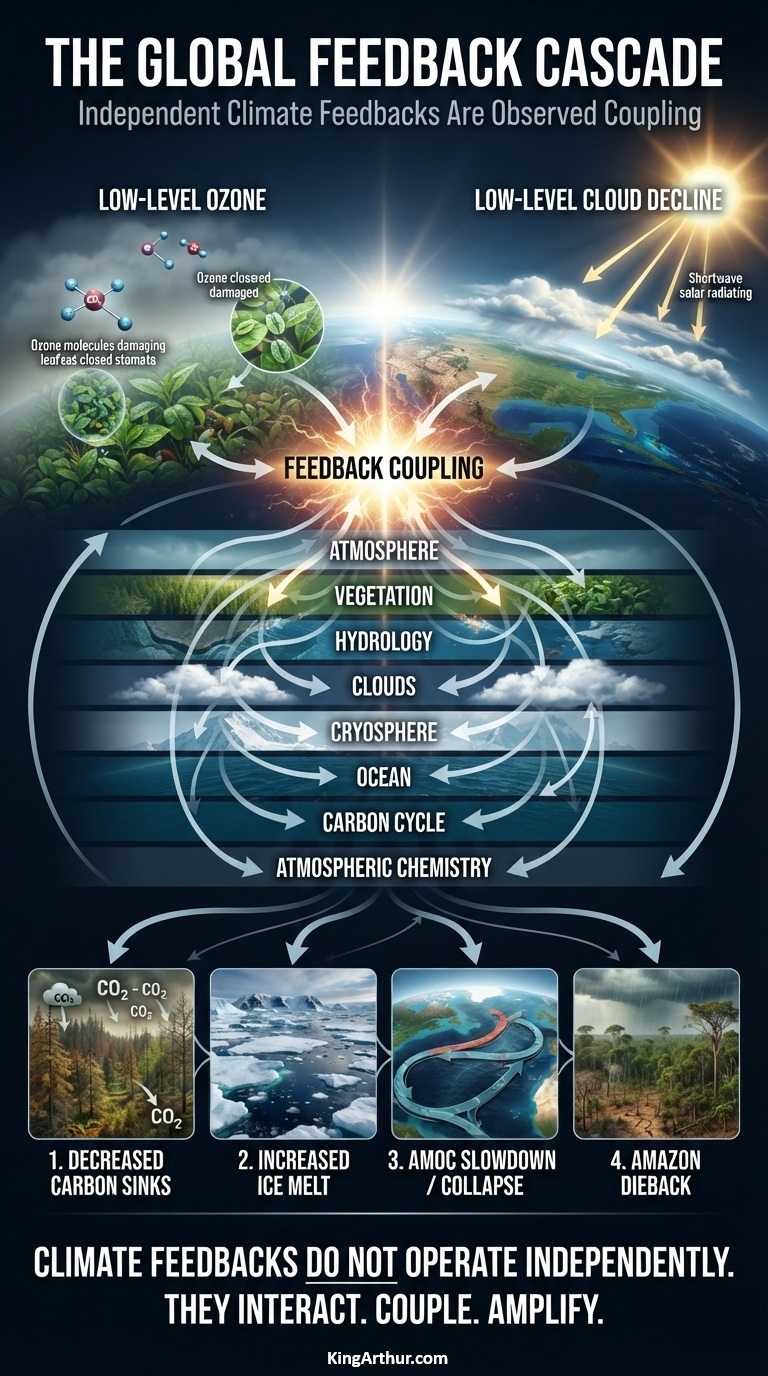
Introduction: The Global Feedback Cascade

Two of the strongest emerging climate feedbacks are low-level tropospheric ozone and declining low-level clouds.

Independently, each can accelerate warming. But the more important discovery is that these independent feedbacks are observed coupling.

Once coupled, they can transfer energy and disruption across Earth-system boundaries, from atmospheric chemistry and vegetation to clouds, the cryosphere, oceans, and the carbon cycle.

The result is a cascading system that can contribute to decreased carbon sinks, increased ice melt, Amazon dieback, and a slowing or collapse of the AMOC.

Climate feedbacks do not operate independently.

They interact. Couple. Amplify.

Overview

Independently, low-level tropospheric ozone and declining low-level clouds are two of the strongest emerging climate feedbacks. Now, evidence is growing that these independent feedbacks are observed coupling.

The coupling between tropospheric ozone (O₃) and the decline of low-level clouds operates as a powerful positive climate feedback loop driven by the interaction between atmospheric chemistry, plant biology, hydrology, and meteorology.

The core mechanism connects ozone pollution, reduced plant transpiration, declining atmospheric moisture, and a subsequent decrease in low-level cloud cover, which ultimately accelerates global warming.

The Feedback Mechanisms

PhaseProcess & MechanismClimate Impact
1. Vegetation DamageSurface-level tropospheric ozone acts as a toxic greenhouse gas and phytotoxic pollutant. It enters plant leaves through stomata and damages cells, forcing plants to constrict their stomata to protect themselves. This severely reduces stomatal conductance and photosynthesis.Decreases the plant’s ability to pull carbon dioxide out of the atmosphere, compounding warming.
2. Moisture SuppressionBecause plant stomata are restricted, the amount of water vapor released from land into the atmosphere through transpiration drops significantly. This suppresses the land-to-atmosphere moisture flux.The lower atmosphere becomes drier, lowering regional atmospheric moisture and relative humidity.
3. Cloud DeclineWith less humidity and moisture rising from vegetation, atmospheric conditions necessary for the formation and persistence of low-level clouds are compromised. This triggers a reduction in shortwave cloud forcing.Fewer clouds mean less sunlight is reflected back into space and more solar energy reaches Earth’s surface.
4. Amplified WarmingThe reduction in low-level cloud cover allows a massive influx of shortwave solar radiation to reach Earth’s surface instead of being reflected or scattered back toward space. Earth system modeling indicates that this specific feedback can produce regional temperature increases of up to +1.5°C.The surface and lower atmosphere warm intensely.
5. Closing the LoopPhotochemical production of tropospheric ozone relies on precursors, particularly NOₓ and VOCs, reacting in the presence of sunlight and heat. Increased solar radiation and higher temperatures can accelerate ozone formation under favorable chemical conditions.Warmer, sunnier conditions contribute to additional tropospheric ozone, reinforcing the vegetation-damage and moisture-suppression cycle.

The Chemical Destruction Counterweight

While the vegetation-to-cloud feedback creates a powerful positive warming loop, clouds also affect tropospheric ozone directly through atmospheric physics and chemistry.

Under a normal atmosphere:

  • Aqueous-phase chemistry: When clouds are present, liquid water droplets absorb ozone precursors and provide an environment for chemical reactions that destroy or transform tropospheric ozone.
  • The impact of cloud loss: As cloud cover declines, this natural chemical sink diminishes. Fewer clouds mean less aqueous-phase destruction, leaving more ozone to persist in the troposphere and further exacerbating the vegetation-damage cycle.

This creates another reinforcing connection:

Less cloud cover → less aqueous-phase ozone destruction → greater ozone persistence → greater vegetation damage → less transpiration → further cloud decline.

The coupling between tropospheric ozone and cloud decline therefore does not act in a vacuum.

It interacts with the broader climate system by stripping away cloud reflectivity, increasing solar energy absorption, disrupting terrestrial moisture cycling, and injecting additional thermal energy into an already warming Earth system.

This creates the potential for a cascading domino effect that accelerates some of Earth’s most vulnerable biosphere and cryosphere tipping points.

[O₃ & Low-Level Cloud Decline]
              │
       ┌──────┴──────┐
       ▼             ▼
Regional Drying   Increased Solar
 & Heat Waves      Absorption
       │             │
       ▼             ▼
[Amazon Dieback] [Ocean Albedo /
   Tipping Point] [Sea-Ice Collapse]

1. Accelerating the Amazon Dieback Tipping Point

The Amazon rainforest acts as a giant biological “air conditioner,” recycling moisture from the Atlantic Ocean and generating up to 75% of its own rainfall through transpiration.

The ozone-cloud coupling directly attacks this survival mechanism on two fronts.

The Double-Whammy on Water Cycling

Under high tropospheric ozone exposure, Amazonian trees constrict their stomata to prevent cellular damage, immediately reducing regional transpiration.

Simultaneously, the resulting decline in low-level clouds removes some of the shading that helps keep the forest cooler.

The forest therefore experiences two simultaneous stresses:

less transpiration + less cloud cover = less atmospheric moisture + more surface heating.

The Transition to Severe Drought

This combination increases local heating while reducing regional humidity.

Without sufficient moisture being transferred from vegetation into the atmosphere, and with fewer clouds moderating incoming solar radiation, the conditions necessary to sustain the Amazon’s rainfall cycle become increasingly compromised.

Wet-season rainfall can weaken or become delayed, increasing drought stress and fire susceptibility.

Crossing the Tipping Point

The Amazon is moving closer to a potentially irreversible tipping threshold, with some scientific estimates placing significant risk as early as 2050, depending on the degree of warming, deforestation, and hydrological disruption.

Once the forest can no longer sustain its own rainfall cycle, widespread dieback can become self-reinforcing.

Massive forest degradation, intense wildfires, and tree mortality would convert portions of the Amazon from a vital global carbon sink into a net carbon emitter.

That would release additional carbon into the atmosphere while simultaneously destroying one of Earth’s major biological mechanisms for removing atmospheric CO₂.

The result would be an additional acceleration of global warming.

2. Accelerating the Ocean Albedo and Sea-Ice Tipping Point

The reduction in cloud cover caused by the ozone-vegetation loop does not necessarily remain confined to land.

The broader warming and altered atmospheric circulation associated with the feedback can extend into marine environments, directly increasing pressure on polar and sub-polar sea ice.

Enhanced Downwelling Radiation

Low-level clouds normally reflect a substantial portion of incoming solar radiation back toward space.

As the low-cloud shield degrades, a significantly higher percentage of shortwave solar radiation penetrates the atmosphere and reaches the ocean surface.

Supercharging the Melting Cycle

Highly reflective sea ice has a high albedo, reflecting a large fraction of incoming solar energy back into space.

When the ozone-cloud feedback forces additional solar energy onto the ocean, sea ice melts more rapidly.

This exposes the dark open ocean beneath.

Open ocean has a dramatically lower albedo and absorbs far more solar radiation.

The feedback therefore becomes:

cloud decline → increased solar absorption → sea-ice loss → darker ocean surface → greater solar absorption → additional warming.

The initial cloud-driven increase in absorbed solar energy can therefore supercharge the existing ice-albedo feedback.

Thermal Cascades

As the ocean warms, heat can accelerate sea-ice loss from below as well as from above.

The loss of reflective ice exposes increasingly large areas of dark ocean, which absorb additional solar energy and further increase regional warming.

This creates a thermal cascade that can extend beyond the cryosphere.

Increasing ocean temperatures, freshwater input from melting ice, and changing temperature and density gradients can disrupt major ocean circulation systems, including the Atlantic Meridional Overturning Circulation (AMOC).

The result is a potential chain extending from atmospheric chemistry to vegetation, clouds, sea ice, ocean warming, and ocean circulation.

3. The Slowing AMOC and Collapse

The coupling of tropospheric ozone and declining low-level clouds can contribute to the weakening of the Atlantic Meridional Overturning Circulation (AMOC) by intensifying two fundamental stresses on its circulation: thermal suppression of surface-water density and freshwater-driven disruption of salinity and buoyancy.

The AMOC depends on a delicate balance of temperature and salinity—known as thermohaline circulation. For the ocean conveyor system to function, warm surface waters traveling northward must eventually cool and become sufficiently dense to sink in the subpolar North Atlantic.

The ozone-cloud coupling adds additional heat to this system while simultaneously accelerating cryospheric melting and freshwater input. Together, these processes can weaken the density-driven sinking that powers the AMOC.

An influx of freshwater can create a relatively fresh, buoyant surface layer over the subpolar North Atlantic.

That layer acts as a freshwater cap, increasing stratification and making it more difficult for cold surface waters to mix downward and participate in deep-water formation.

The vertical circulation loop is therefore disrupted from both directions:

warming reduces density through temperature, while freshwater reduces density through salinity.

The combined effect is substantially more dangerous than either mechanism acting alone.

The Danger of the “Salt-Advection” Catch-22

The most important threat from this interaction may be the possibility of triggering the AMOC’s own internal reinforcing feedback: the salt-advection feedback.

The AMOC transports relatively warm, salty water northward from lower latitudes. This northward salt transport contributes to maintaining the salinity of the North Atlantic and helps sustain the density required for deep-water formation.

When warming and freshwater input weaken the AMOC, the circulation transports less salt northward.

That creates a potentially self-reinforcing sequence:

AMOC slowdown → reduced northward salt transport → fresher North Atlantic → reduced surface-water density → weaker deep-water formation → further AMOC slowdown.

The ozone-cloud coupling can add additional forcing at the beginning of this chain by increasing solar absorption and warming while simultaneously contributing to cryospheric melt and freshwater input.

The result is a potential feedback within a feedback:

         [O₃–Cloud Coupling]
                  ↓
       ┌──────────┴──────────┐
       ↓                     ↓
[More Solar Heating]   [More Cryosphere Melt]
       ↓                     ↓
[Warmer Surface Water] [Freshwater Input]
       ↓                     ↓
[Lower Density]        [Lower Salinity]
       └──────────┬──────────┘
                  ↓
       [Weaker Deep-Water Formation]
                  ↓
             [AMOC Slows]
                  ↓
       [Less Northward Salt Transport]
                  ↓
       [North Atlantic Freshens]
                  ↓
       [Density Declines Further]
                  ↓
          [AMOC Weakens Further]

This creates a potentially dangerous AMOC tipping-point pathway.

The critical issue is not that the ozone-cloud coupling is the sole cause of AMOC weakening. It is that the coupling can add another reinforcing source of heat and freshwater to a circulation system already vulnerable to warming, ice-sheet loss, and freshwater disruption.

As independent climate feedbacks begin coupling, their effects can compound.

Ozone damages vegetation.
Vegetation loses transpiration.
Clouds decline.
Solar absorption increases.
The North Atlantic warms.
Greenland melts.
Freshwater increases.
Surface-water density falls.
Deep-water formation weakens.
The AMOC slows.
Northward salt transport declines.
The North Atlantic freshens further.

The feedbacks then begin reinforcing one another.

That is the danger of a coupled climate system: a feedback that begins in atmospheric chemistry and plant biology can ultimately reach deep into the ocean circulation system and accelerate the approach to an AMOC tipping point.

Probabilistic Climate Change Impacts

Under high-emissions, business-as-usual scenarios such as SSP5-8.5, the cumulative effects of the ozone–vegetation–cloud coupling could contribute an estimated additional 0.2°C to 0.4°C of global average warming by 2100. This should not be viewed as a simple linear addition. The interaction functions as a structural climate multiplier, with potentially much larger regional effects. The direct pathway—ozone damage to vegetation, reduced transpiration, declining low-level clouds, increased solar absorption, and subsequent warming—could account for approximately 0.15°C to 0.2°C of additional global warming, while the resulting suppression of the terrestrial carbon sink could contribute another ~0.1°C to 0.15°C.

The greater concern is the feedback’s potential to trigger secondary tipping points. Ozone-induced vegetation damage and cloud decline can reinforce regional drying, while increased solar absorption can accelerate sea-ice loss and ocean warming. These processes can interact with Amazon dieback, Greenland and Arctic melting, and AMOC weakening, creating additional carbon, albedo, hydrological, and ocean-circulation feedbacks. Because atmospheric chemistry, vegetation physiology, cloud dynamics, cryosphere processes, and ocean circulation are often represented separately in Earth-system models, the full effect of their coupling may not be captured by conventional projections. If the interaction accelerates one or more secondary tipping points, its contribution could therefore extend well beyond 0.5°C before the end of the century.

The critical issue is consequently not simply how much warming the ozone–cloud coupling produces directly, but how much additional warming it can trigger. The potential outcome exists along an asymmetric probability distribution: a lower-end response dominated by direct radiative and carbon-sink effects, a central estimate of approximately 0.2°C–0.4°C, and a high-end outcome in which coupled feedbacks push the contribution substantially higher. In a nonlinear climate system, the tail of that distribution matters enormously. The detailed evidence, modeling basis, uncertainties, and probability ranges for these estimates are examined separately in [Probabilistic Climate Impacts of the Ozone–Vegetation–Cloud Coupling].

The Global Feedback Cascade

Ultimately, the ozone–cloud coupling acts as a climate threat multiplier. Tropospheric ozone damages vegetation, forcing plants to restrict their stomata and reducing transpiration. Less transpiration suppresses the transfer of moisture into the atmosphere, contributing to declining low-level cloud cover. As the cloud shield weakens, more shortwave solar radiation reaches Earth’s surface, increasing surface and ocean heating. At the same time, declining cloud cover can reduce aqueous-phase chemical removal of ozone, while warmer and sunnier conditions can promote additional ozone formation under favorable atmospheric chemistry. The result is a self-reinforcing cycle:

O₃ → vegetation damage → reduced transpiration → cloud decline → increased solar absorption → warming → increased ozone formation and persistence → additional vegetation damage.

The consequences extend far beyond the original atmosphere–vegetation interaction. Over land, increased heat and reduced atmospheric moisture can accelerate Amazon drying and forest dieback, reducing one of Earth’s major carbon sinks and potentially converting portions of the Amazon into a net carbon source. Over the ocean and cryosphere, increased solar absorption accelerates sea-ice loss, exposing darker ocean water and strengthening the ice-albedo feedback. Additional high-latitude warming also increases pressure on the Greenland Ice Sheet, adding freshwater to the North Atlantic. At the same time, warming of North Atlantic surface waters and freshwater dilution reduce the density required for deep-water formation, potentially weakening the AMOC. A slower AMOC transports less salt northward, creating a further freshening and density-loss feedback that can reinforce the circulation slowdown.

These processes create feedbacks within feedbacks. The ozone–cloud coupling can therefore connect atmospheric chemistry to terrestrial carbon storage, hydrological cycling, sea-ice albedo, Greenland melt, ocean heat, and Atlantic circulation. The potential warming contribution is consequently not simply the sum of individual effects. Under high-emissions scenarios, the coupled ozone–vegetation–cloud system could contribute an estimated 0.2°C–0.4°C of additional global-average warming by 2100, while regional effects could be substantially larger. More importantly, if the coupling accelerates secondary tipping points such as Amazon dieback, rapid sea-ice loss, Greenland melt, or AMOC weakening, nonlinear amplification could push its contribution well beyond 0.5°C before the end of the century.

The resulting cascade can be represented as:

                    [TROPOSPHERIC OZONE]
                            │
                            ▼
                  [VEGETATION DAMAGE]
                            │
                ┌───────────┴───────────┐
                ▼                       ▼
       [LESS CO₂ UPTAKE]         [LESS TRANSPIRATION]
                │                       │
                ▼                       ▼
      [CARBON-SINK DECLINE]      [ATMOSPHERIC DRYING]
                │                       │
                │                       ▼
                │                [LOW-LEVEL CLOUD
                │                    DECLINE]
                │                       │
                │                       ▼
                │               [MORE SOLAR ENERGY
                │                   ABSORBED]
                │                       │
                └───────────┬───────────┘
                            ▼
                       [WARMING]
                            │
              ┌─────────────┼─────────────┐
              ▼             ▼             ▼
       [AMAZON DRYING] [SEA-ICE LOSS] [GREENLAND MELT]
              │             │             │
              ▼             ▼             ▼
       [FOREST DIEBACK] [LOWER ALBEDO] [FRESHWATER
              │             │            INPUT]
              ▼             ▼             │
       [CARBON RELEASE] [MORE OCEAN       ▼
                         HEATING]    [NORTH ATLANTIC
              │             │          FRESHENING]
              └──────┬──────┘               │
                     ▼                       ▼
              [ADDITIONAL WARMING]    [WEAKER DEEP-WATER
                                            FORMATION]
                                              │
                                              ▼
                                      [AMOC SLOWDOWN]
                                              │
                                              ▼
                                   [LESS NORTHWARD SALT
                                        TRANSPORT]
                                              │
                                              ▼
                                   [FURTHER FRESHENING]
                                              │
                                              ▼
                                      [AMOC WEAKENING]
                                              │
                         ┌────────────────────┘
                         ▼
                 [CLIMATE FEEDBACK
                     CASCADES]
                         │
                         ▼
              [NONLINEAR AMPLIFICATION]

The significance of this system is therefore not simply that ozone and declining low-level clouds represent two additional climate forcings.

The independent feedbacks are observed coupling.

Once coupled, they can transfer energy and disruption across Earth-system boundaries—atmosphere → vegetation → hydrology → clouds → cryosphere → ocean → carbon cycle → atmospheric chemistry—creating pathways for one feedback to activate another.

This is the fundamental danger of a nonlinear climate system.

Climate feedbacks do not operate independently. They interact, couple, and amplify one another.

The critical question is no longer simply how strong each individual feedback is.

It is whether the coupling among feedbacks is accelerating faster than our models, observations, and mitigation systems can respond.

If it is, then the climate threat is not merely warming.

It is accelerating climate disruption through a cascading system of interconnected feedbacks and tipping points.

bookmark_borderOzone-Cloud Coupling Probabilistic Climate Change Impacts

by Daniel Brouse

Under high-emissions, business-as-usual climate scenarios such as SSP5-8.5, Earth-system modeling and observational evidence indicate that the cumulative effects of the ozone–vegetation–cloud coupling could contribute an estimated additional 0.2°C to 0.4°C of global average warming by 2100.

However, this estimate should not be interpreted as a simple linear addition to projected warming.

The ozone–vegetation–cloud interaction functions as a structural multiplier. Its effects are therefore highly asymmetric, with relatively modest global-average changes capable of producing much larger regional temperature responses.

Regional warming associated with the coupled feedback could reach approximately +1.0°C to +1.5°C over heavily vegetated and highly ozone-sensitive regions, including portions of the Eastern United States, Eastern China, and the Amazon.

The potential warming contribution can be understood as three increasingly consequential layers of compounding feedback.

1. Direct Ozone–Cloud Radiative Forcing

~0.15°C to 0.2°C

The core physical coupling begins when ozone damages vegetation, causing plants to constrict their stomata and suppress transpiration.

That reduction in transpiration decreases moisture transfer from vegetation to the atmosphere, contributing to lower boundary-layer humidity and declining low-level cloud cover.

The resulting loss of cloud reflectivity directly alters Earth’s energy budget.

Mid-Century Baseline

Recent atmospheric modeling indicates that changes in ground-level ozone and tropospheric chemistry can contribute approximately 0.27 W/m² of additional radiative forcing.

As background ground-level ozone concentrations increase and low-level marine and terrestrial cloud cover declines, the loss of this natural cloud “shield” allows more shortwave solar radiation to reach Earth’s surface.

By 2100, under high-emissions conditions, the resulting increase in absorbed solar energy could contribute approximately 0.15°C to 0.2°C of additional global-average warming, before accounting for the secondary carbon-cycle and tipping-point effects.

This represents the first layer of the feedback:

O₃ → vegetation damage → reduced transpiration → cloud decline → increased solar absorption → warming.

2. The Stunted Carbon-Sink Multiplier

~0.1°C to 0.15°C

The feedback becomes more serious because ozone does not merely alter cloud formation.

It simultaneously damages one of Earth’s most important carbon-removal systems: the terrestrial biosphere.

By forcing plants to restrict their stomata and reducing photosynthetic activity, ozone pollution reduces the capacity of vegetation to remove CO₂ from the atmosphere.

This creates a second warming pathway.

Earth-system simulations examining vegetation responses over the twentieth and twenty-first centuries illustrate the scale of this effect. Under a clean-air scenario, rising atmospheric CO₂ can substantially increase plant productivity and carbon uptake.

When ozone pollution is included, however, ozone-induced cellular damage and photosynthetic suppression significantly reduce that potential carbon storage.

The difference represents carbon that would otherwise have been removed from the atmosphere but instead remains available to contribute to greenhouse-gas accumulation.

A reduction on the order of 30 billion metric tons of carbon per year in potential biospheric uptake represents an enormous atmospheric carbon-cycle disruption.

The consequence is not simply a loss of future carbon sequestration.

It is a carbon-sink feedback:

O₃ → plant damage → reduced photosynthesis → reduced CO₂ uptake → greater atmospheric CO₂ → additional warming.

That additional warming then strengthens the environmental conditions under which the ozone–cloud feedback operates.

The estimated contribution from this carbon-sink multiplier is approximately 0.1°C to 0.15°C by 2100.

3. The Unaccounted Tipping-Point Risk

The most dangerous component of this feedback is not necessarily the initial 0.2°C–0.4°C contribution.

It is what happens if the coupled system begins triggering secondary climate tipping points.

Standard climate projections do not necessarily capture the full strength of this interaction because atmospheric chemistry, vegetation physiology, cloud dynamics, ocean circulation, and cryospheric processes are often represented through separate parameterizations and model components.

A coupled ozone–vegetation–cloud feedback that crosses those boundaries can therefore produce emergent behavior that is substantially larger than the sum of its individual components.

This is where the probabilistic risk becomes highly asymmetric.

If the feedback remains relatively weak, its contribution may remain near the estimated 0.2°C–0.4°C range.

If, however, it helps accelerate secondary tipping points—including Amazon dieback, rapid sea-ice loss, Greenland melt, or AMOC weakening—the resulting feedbacks can amplify one another.

For example:

O₃–cloud coupling → Amazon drying → forest dieback → carbon release → additional warming

and:

O₃–cloud coupling → increased solar absorption → sea-ice loss → lower albedo → additional warming

and:

O₃–cloud coupling → North Atlantic warming + freshwater input → weaker AMOC → circulation changes → additional regional climate disruption.

Once these secondary feedbacks become strongly coupled, the system is no longer responding linearly.

The release of stored biospheric carbon, loss of highly reflective ice, changes in ocean circulation, and continued atmospheric chemical feedbacks could push the total contribution of the coupled system well beyond 0.5°C before the end of the century.

The Probability Distribution Matters

The key issue is therefore not a single deterministic number.

The potential contribution of the ozone–vegetation–cloud coupling exists along a probability distribution.

At the lower end, the feedback adds additional warming through reduced cloud reflectivity and diminished carbon uptake.

At the higher end, the coupling acts as a climate multiplier, triggering secondary feedbacks that dramatically increase the rate of warming.

This creates an asymmetric risk profile:

Low-end outcome:
Additional warming remains relatively limited and largely contained within the direct radiative and carbon-sink effects.

Central-risk outcome:
The ozone–cloud coupling reinforces existing warming sufficiently to produce an additional ~0.2°C–0.4°C of global-average warming by 2100.

High-end outcome:
The coupling accelerates one or more secondary tipping points, producing nonlinear amplification and potentially pushing its contribution above 0.5°C.

The distinction is critical.

The greatest danger is not that ozone and declining clouds add another small increment to global warming.

The danger is that they are observed coupling with other climate feedbacks, creating pathways through which a relatively modest initial forcing can propagate through the biosphere, cryosphere, hydrosphere, and atmosphere.

In a nonlinear climate system, the tail of the probability distribution matters more than the average.

A feedback capable of triggering cascading tipping points cannot be evaluated solely by its mean temperature contribution.

The critical question is therefore:

How much additional warming does the ozone–cloud coupling produce?

But the more important question is:

How much additional warming can it trigger?

bookmark_borderLow-Level Ozone – Clouds = Slowing AMOC and Collapse

by Daniel Brouse

The coupling of tropospheric ozone and declining low-level clouds can contribute to the weakening of the Atlantic Meridional Overturning Circulation (AMOC) by intensifying two fundamental stresses on its circulation: thermal suppression of surface-water density and freshwater-driven disruption of salinity and buoyancy.

The AMOC depends on a delicate balance of temperature and salinity—known as thermohaline circulation. For the ocean conveyor system to function, warm surface waters traveling northward must eventually cool and become sufficiently dense to sink in the subpolar North Atlantic.

The ozone-cloud coupling adds additional heat to this system while simultaneously accelerating cryospheric melting and freshwater input. Together, these processes can weaken the density-driven sinking that powers the AMOC.

Mechanism 1: Thermal Suppression of Sinking — The Albedo Connection

As tropospheric ozone damages terrestrial vegetation, plant transpiration declines. This reduces the transfer of moisture from land into the atmosphere and can contribute to declining low-level cloud cover over adjacent regions.

The resulting reduction in cloud reflectivity creates an additional pathway for solar energy to enter the climate system.

1. Unshielded Solar Heating

As low-level cloud cover declines, shortwave solar radiation that would otherwise be reflected back toward space reaches the surface in greater amounts.

Additional solar energy is absorbed by the North Atlantic and surrounding high-latitude ocean surface, increasing upper-ocean heat content and surface temperatures.

2. Loss of Surface-Water Density

For North Atlantic surface waters to sink, they must become sufficiently dense through cooling and, importantly, through maintaining adequate salinity.

Additional warming makes the surface waters less dense and therefore more buoyant.

The extra thermal energy introduced by declining cloud cover therefore works directly against the cooling process required for deep-water formation.

3. The Result: Weakened Sinking

When surface waters remain warmer and more buoyant, the density contrast required for deep convection becomes harder to achieve.

The vertical sinking component of the AMOC is consequently weakened.

The causal chain is:

[O₃ Damages Vegetation]
          ↓
[Transpiration Declines]
          ↓
[Low-Level Clouds Decline]
          ↓
[More Solar Radiation Reaches Ocean]
          ↓
[North Atlantic Surface Waters Warm]
          ↓
[Surface-Water Density Declines]
          ↓
[Deep-Water Formation Weakens]
          ↓
[AMOC Slows]

This is an important additional pathway because the ozone-cloud coupling does not merely add warming to the climate system—it can add warming where changes in surface-water density directly affect a major component of ocean circulation.


Mechanism 2: The Meltwater “Freshwater Cap” Paradox

The additional warming generated by the ozone-cloud coupling does not only heat the ocean directly.

It also increases pressure on the cryosphere, accelerating the loss of Arctic sea ice and contributing to Greenland Ice Sheet melt. This introduces a second major threat to AMOC stability: freshwater dilution.

Accelerated Greenland and Arctic Melting

Additional solar absorption and high-latitude warming increase the energy available for cryospheric melting.

Greenland Ice Sheet melt is particularly important because freshwater released from the ice sheet enters the North Atlantic, directly altering the salinity of the waters involved in deep-water formation.

The Density Trap

Freshwater is substantially less dense than seawater.

When large quantities of freshwater enter the North Atlantic, they dilute surface salinity and make the affected waters less dense.

This means that even if the surface water cools, it may still fail to become dense enough to sink efficiently.

The “Freshwater Cap” Effect

An influx of freshwater can create a relatively fresh, buoyant surface layer over the subpolar North Atlantic.

That layer acts as a freshwater cap, increasing stratification and making it more difficult for cold surface waters to mix downward and participate in deep-water formation.

The vertical circulation loop is therefore disrupted from both directions:

warming reduces density through temperature, while freshwater reduces density through salinity.

The combined effect is substantially more dangerous than either mechanism acting alone.

[O₃–Cloud Feedback]
          ↓
   [Additional Warming]
          ↓
[Greenland / Arctic Melt]
          ↓
[Freshwater Enters North Atlantic]
          ↓
[Surface Salinity Declines]
          ↓
[Surface Water Becomes More Buoyant]
          ↓
[Deep-Water Formation Weakens]
          ↓
[AMOC Slows]

The Danger of the “Salt-Advection” Catch-22

The most important threat from this interaction may be the possibility of triggering the AMOC’s own internal reinforcing feedback: the salt-advection feedback.

The AMOC transports relatively warm, salty water northward from lower latitudes. This northward salt transport contributes to maintaining the salinity of the North Atlantic and helps sustain the density required for deep-water formation.

When warming and freshwater input weaken the AMOC, the circulation transports less salt northward.

That creates a potentially self-reinforcing sequence:

AMOC slowdown → reduced northward salt transport → fresher North Atlantic → reduced surface-water density → weaker deep-water formation → further AMOC slowdown.

The ozone-cloud coupling can add additional forcing at the beginning of this chain by increasing solar absorption and warming while simultaneously contributing to cryospheric melt and freshwater input.

The result is a potential feedback within a feedback:

         [O₃–Cloud Coupling]
                  ↓
       ┌──────────┴──────────┐
       ↓                     ↓
[More Solar Heating]   [More Cryosphere Melt]
       ↓                     ↓
[Warmer Surface Water] [Freshwater Input]
       ↓                     ↓
[Lower Density]        [Lower Salinity]
       └──────────┬──────────┘
                  ↓
       [Weaker Deep-Water Formation]
                  ↓
             [AMOC Slows]
                  ↓
       [Less Northward Salt Transport]
                  ↓
       [North Atlantic Freshens]
                  ↓
       [Density Declines Further]
                  ↓
          [AMOC Weakens Further]

This creates a potentially dangerous AMOC tipping-point pathway.

The critical issue is not that the ozone-cloud coupling is the sole cause of AMOC weakening. It is that the coupling can add another reinforcing source of heat and freshwater to a circulation system already vulnerable to warming, ice-sheet loss, and freshwater disruption.

As independent climate feedbacks begin coupling, their effects can compound.

Ozone damages vegetation.
Vegetation loses transpiration.
Clouds decline.
Solar absorption increases.
The North Atlantic warms.
Greenland melts.
Freshwater increases.
Surface-water density falls.
Deep-water formation weakens.
The AMOC slows.
Northward salt transport declines.
The North Atlantic freshens further.

The feedbacks then begin reinforcing one another.

That is the danger of a coupled climate system: a feedback that begins in atmospheric chemistry and plant biology can ultimately reach deep into the ocean circulation system and accelerate the approach to an AMOC tipping point.

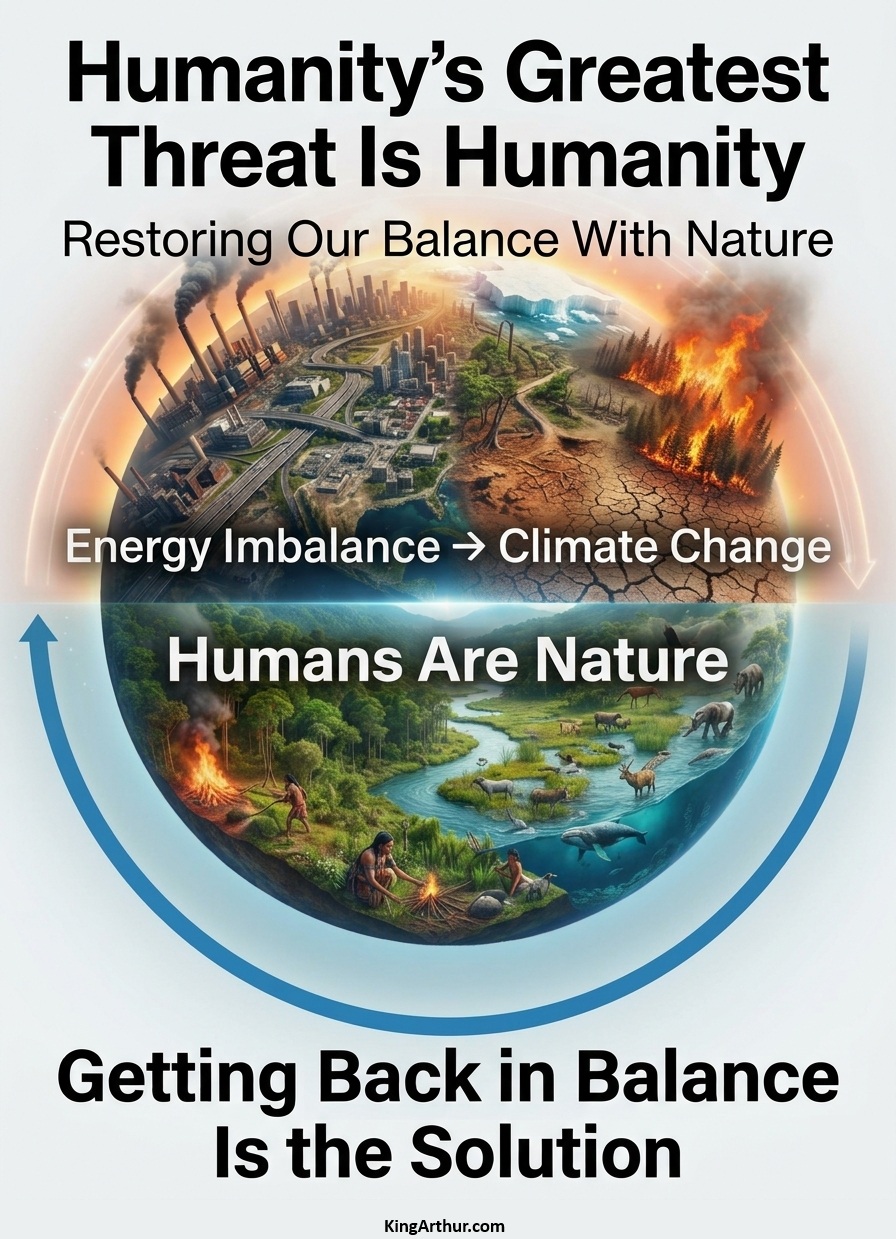
bookmark_borderHumanity’s Greatest Threat Is Humanity

by Daniel Brouse

Humans are part of nature. Yet much of modern society has become fundamentally out of balance with the natural world that sustains us.

The energy imbalance is the cause of climate change. Human activity has disrupted the Earth’s natural energy balance, creating an accelerating accumulation and redistribution of energy throughout the climate system.

Getting back into balance with nature is therefore not simply an environmental objective. It is the only sustainable solution.

Indigenous Peoples: Stewards of the Earth’s Ecosystems

Indigenous Peoples protect an estimated 80% of the world’s remaining biodiversity while representing less than 5% of the global population. For millennia, Indigenous communities have lived in structural balance with the natural world, managing roughly a quarter of the Earth’s surface.

Today, their traditional ecological knowledge is increasingly recognized by international bodies such as the United Nations Framework Convention on Climate Change (UNFCCC) as a critical pillar in addressing climate change, protecting ecosystems, and maintaining planetary carbon sinks.

Scientific assessments repeatedly show that ecosystems managed by Indigenous Peoples are often in significantly better condition than ecosystems outside their territories.

Carbon and Forest Custodians

Indigenous territories cover roughly 37% of the planet’s remaining natural land and overlap with at least 36% of the world’s intact forests. Securing Indigenous land rights and legal land tenure has been shown to reduce deforestation rates, in some regions by as much as a quarter below broader regional or national averages.

These territories therefore serve not only as homes and cultural landscapes but also as major reservoirs of biodiversity and carbon.

Active Adaptation

Indigenous knowledge also represents thousands of years of practical observation and adaptation to changing environmental conditions.

Traditional controlled forest burning, for example, can reduce the accumulation of combustible material and substantially lower wildfire intensity and emissions. Indigenous communities have also developed localized agroforestry systems and cultivated highly resilient, drought-resistant crops adapted to specific environmental conditions.

These practices demonstrate an important principle: ecological knowledge is not simply about preserving nature. It is about actively managing human relationships with natural systems in ways that allow both communities and ecosystems to persist.

Cultivating Harmony: Examples of Balanced Practices

Around the world, Indigenous and local communities have developed customary laws and practices that actively protect ecological systems.

Kichwa — Ecuador

Kichwa communities maintain protected buffer zones around major rivers, giving aquatic ecosystems room to regenerate and reducing human disturbance.

Yukir — Russia

The Yukir maintain ritual silence near waterways during salmon spawning, recognizing that even temporary human disturbance can affect vulnerable life cycles.

Pocut — Kenya

The Pocut prohibit fires in designated areas during sensitive seasons, protecting pollinators and other species during critical ecological periods.

Sámi — Fennoscandia

Sámi communities work with organizations such as the Snowchange Cooperative to rewet degraded peatlands, restoring carbon storage, water systems, and fish habitat.

Kayapó — Amazon

Kayapó communities manage large Indigenous territories using traditional knowledge of forests, rivers, fire, and seasonal resources. Their territories help protect some of the Amazon’s remaining intact forests while supporting food, medicine, and cultural practices.

Māori — New Zealand

Māori communities use customary systems such as rāhui, temporary restrictions on harvesting or access, to allow fish, shellfish, forests, and other resources to recover.

Australian Aboriginal Communities

Traditional Indigenous fire management uses carefully timed, low-intensity burns to reduce fuel loads, protect biodiversity, and limit the destructive potential of larger wildfires.

Andean Indigenous Communities

Traditional agricultural systems—including terracing, water harvesting, and the cultivation of diverse crop varieties—help conserve soil and water while increasing resilience to drought and changing climate conditions.

Community Forests — Himalayas

Community-based forest management in the Himalayas has restored degraded forests, improved watersheds, and strengthened local control over natural resources through collective rules governing harvesting and regeneration.

Together, these examples reveal a common principle:

Balance with nature requires understanding that human communities are participants in ecosystems—not observers standing outside them.

The goal is not to eliminate human interaction with nature.

It is to make that interaction sustainable.

Together, these examples illustrate a broader principle:

Balance with nature requires understanding that human communities are participants in ecosystems, not external observers standing outside them.

The Lesson of Indigenous Stewardship

Indigenous communities do not represent a single culture or a single approach to nature. Their knowledge systems, customs, economies, and environments are extraordinarily diverse.

But many share a fundamental understanding that modern industrial society has increasingly forgotten:

Human beings are part of nature.

The natural world is not an unlimited storehouse of resources existing solely for human consumption. Forests, oceans, rivers, soils, wetlands, wildlife, and the atmosphere form interconnected systems upon which human civilization ultimately depends.

When those systems are pushed beyond their limits, humans do not stand outside the consequences.

We experience them.

Climate change is one manifestation of that fundamental imbalance.

The energy imbalance created by human activity is altering atmospheric circulation, ocean conditions, ice systems, ecosystems, weather patterns, and biological cycles. As individual changes interact, feedbacks can amplify the original disturbance and produce increasingly disruptive consequences.

The solution is therefore not simply to manage individual symptoms.

We must restore the balance.

That means recognizing that economic systems, technological systems, agricultural systems, and human communities all operate within the larger Earth system.

Indigenous and community-led stewardship provides thousands of examples of what that relationship can look like.

The objective is not to return humanity to the past.

It is to recover an understanding that the past has preserved:

We cannot separate ourselves from the natural systems that sustain us.

We are nature.

And if humanity is to survive and prosper, we must learn to live in balance with it.

bookmark_borderG7 Releases 100 Million Barrels: Will It Lower U.S. Diesel Prices?

On October 2, 2026, President Trump announced that he had pressed European allies to release diesel reserves in an effort to bring down soaring fuel prices ahead of the November midterm elections.

The effort culminated in a coordinated G7 agreement to release up to 100 million barrels of crude oil and refined fuels from emergency reserves through the International Energy Agency (IEA) over the next four months.

The agreement places particular emphasis on diesel. G7 leaders said a substantial portion of the diesel release will be front-loaded within the first 20 days, providing an immediate increase in available refined-product supplies.

The precise allocation of the entire 100-million-barrel package between diesel and crude is important because crude oil must still be refined before it becomes diesel. Reuters reported that the European Union agreed to release about 50 million barrels of diesel, while IEA members would provide an additional roughly 50 million barrels of crude oil.

Truckers in Trouble

At least 16 American trucking and logistics companies have filed for Chapter 7 or Chapter 11 bankruptcy in just the past month. This rapid wave of insolvencies has directly impacted more than 250 jobs and hundreds of individual drivers.

The primary trigger is a severe margin squeeze from record-high diesel costs. The national average diesel price recently peaked at an all-time high of $6.53 per gallon (up over 70% from $3.71 last year) due to global geopolitical disruptions.

An Immediate Market Reaction

Oil prices initially fell by roughly $2 per barrel following news of the agreement. Brent crude fell to around $100.50 per barrel, while West Texas Intermediate dropped to about $90.85.

But the initial decline proved short-lived, with prices subsequently recovering much of the loss.

That reaction illustrates the central problem: announcing additional emergency supply does not necessarily translate into a sustained reduction in retail diesel prices.

bookmark_borderCognitive Ability, Christian Nationalism, and Climate Change Denial

Simplified Introduction

Cognitive Ability, Christian Nationalism & Climate Change Denial

A new 2026 study by sociologist S. L. Perry finds a significant negative association between verbal cognitive ability and Christian nationalist beliefs in the United States.

That finding raises an important question:

What does cognition have to do with climate change denial?

Climate science is extraordinarily complex. Understanding it requires processing interconnected systems, probabilities, feedbacks, long-term trends, and evidence that cannot simply be evaluated through everyday experience.

This creates several pathways toward climate skepticism:

🧠 Intuitive thinking can favor simple narratives over complex scientific evidence.

✝️ Christian nationalist ideology can reinforce distrust of secular scientific and academic institutions.

🛡️ Motivated reasoning can allow people with substantial cognitive ability to construct sophisticated defenses of beliefs that are deeply connected to their political, religious, or cultural identity.

The result is a paradox: Less cognitive capacity can make complex science harder to process. Greater cognitive capacity can make existing beliefs harder to dislodge.

The problem is therefore not simply ignorance.

It is the interaction of cognition, ideology, identity, institutional trust, and reasoning.

Cognitive Ability, Christian Nationalism, and Climate Change Denial

The 2026 study “Cognitive Ability and Christian Nationalism” by sociologist S. L. Perry, published in the Journal for the Scientific Study of Religion, establishes a significant negative association between cognitive ability—specifically verbal intelligence—and Christian nationalist beliefs in the United States.

Perry’s findings intersect directly with the psychology and sociology of climate change denialism through shared cognitive mechanisms, ideological alignments, and patterns of scientific skepticism.

The relationship can be understood through three primary connections.

1. The Common Thread: Lower Cognitive Ability and Intuitive Thinking

Perry’s study establishes that lower cognitive ability, specifically verbal intelligence, is associated with a greater likelihood of adopting Christian nationalist beliefs.

This finding intersects with psychological research on climate change denial, where lower cognitive ability and reliance on intuitive rather than analytical thinking have also been identified as factors associated with rejection of climate science.

Climate science presents an unusually difficult cognitive problem. It is abstract, global, highly interconnected, probabilistic, and dependent on scientific concepts that cannot be directly observed by most people. Atmospheric chemistry, radiative forcing, feedback mechanisms, ocean heat uptake, ice dynamics, and long-term statistical trends are not matters that can be evaluated through everyday intuition alone.

As a result, people with fewer cognitive resources—or those who rely more heavily on intuitive reasoning—may be more likely to substitute simple cognitive shortcuts for complex scientific analysis.

Instead of evaluating atmospheric data, climate models, physical mechanisms, and multiple independent lines of evidence, an individual may rely on a familiar narrative:

“It doesn’t feel warmer.”

“The climate has always changed.”

“Scientists have been wrong before.”

“God controls the weather.”

These shortcuts provide simple answers to a highly complex scientific problem. The important connection is therefore not simply intelligence. It is the interaction between cognitive ability, reasoning style, and the complexity of the information being evaluated.

2. Christian Nationalism as an Ideological Driver of Climate Skepticism

Christian nationalism is not simply a religious belief. It is a cultural and political framework that can overlap with broader anti-science attitudes and distrust of secular institutions.

Sociological research has identified Christian nationalism as an important predictor of climate skepticism. The connection is particularly apparent when environmental and climate issues become associated with secular scientific institutions, universities, government agencies, international organizations, and political movements perceived as threatening traditional cultural values.

The “God Is in Control” Narrative

One mechanism is theological.

Within some Christian nationalist frameworks, there is a strong emphasis on God’s absolute sovereignty over the Earth. This can manifest in the belief that humans cannot fundamentally alter the climate because God controls the weather and ultimately determines the Earth’s fate.

When taken to its logical extreme, such a worldview can conflict directly with climate science. Climate science does not claim that humans control the climate absolutely. It demonstrates that human activities—particularly the emission of greenhouse gases—alter the Earth’s energy balance and therefore alter the climate system.

The conflict is consequently not necessarily between Christianity and climate science. It is between particular interpretations of religious sovereignty and the scientific evidence demonstrating that human activity is a major driver of contemporary climate change.

Anti-System Sentiments

Christian nationalism can also overlap with populist political movements characterized by distrust of secular institutions, academia, government agencies, international organizations, and scientific authorities.

Climate change becomes particularly vulnerable to this form of institutional distrust because accepting the scientific evidence requires trusting multiple scientific institutions and disciplines operating across national boundaries. Consequently, rejecting climate science can become an extension of a broader rejection of the institutions that produce, evaluate, and communicate scientific knowledge.

The result is a powerful ideological feedback:

Distrust the institution → distrust the science → reject the evidence → reinforce the ideology.

3. The Paradox of Motivated Reasoning

There is, however, an important paradox. Lower cognitive ability and intuitive thinking may help explain some forms of initial resistance to complex scientific information. But climate denial on the political right cannot be explained entirely by lower cognitive ability.

For highly complex political issues such as climate change, individuals with higher cognitive ability can sometimes use those cognitive resources not to discover objective truth, but to rationalize and defend conclusions consistent with their existing political or cultural identity.

This is commonly described as motivated reasoning or, in some research, Motivated System 2 Reasoning (MS2R).

The mechanism is straightforward. A person first arrives at a conclusion because it is consistent with the beliefs and values of their social group. The person’s cognitive abilities then become available to defend that conclusion. The more sophisticated the individual, the more sophisticated the defense can become.

This can produce highly elaborate arguments based on selective evidence:

  • emphasizing isolated periods of cooling while ignoring the long-term warming trend;
  • selecting individual scientists or studies that challenge the consensus while dismissing the larger body of evidence;
  • focusing on uncertainty in climate projections while ignoring the underlying physical certainty of greenhouse-gas warming;
  • demanding impossible standards of proof for climate science;
  • identifying errors or controversies within individual studies and treating them as evidence against the entire scientific framework.

The issue is therefore not simply whether someone possesses the cognitive ability to understand climate science. It is also what that cognitive ability is being used to accomplish.

If accepting climate change threatens an individual’s political, religious, economic, or cultural identity, sophisticated reasoning can become a tool for protecting that identity rather than challenging it.

Summary of the Relationship

FactorChristian NationalismClimate Change Denialism
Cognitive ProfileHigher correlation with lower verbal intelligence and intuitive cognitive styles.Higher correlation with lower cognitive ability and intuitive cognitive styles.
Cognitive ShortcutsComplex social and political questions can be reduced to familiar religious or cultural narratives.Complex climate science can be reduced to familiar narratives that contradict or dismiss scientific evidence.
Institutional TrustGreater rejection of secular academic, governmental, and scientific authority.Greater rejection of mainstream climate science and international scientific institutions.
Core IdeologyFusion of American identity with conservative Christian cultural and political dominance.Often reinforced by conservative political identity, distrust of institutions, and religious interpretations of human responsibility for the Earth.
Religious FrameworkDivine sovereignty can be interpreted as placing ultimate control of the Earth in God’s hands.“God is in control” can become an argument against the possibility or significance of human-caused climate change.
Motivated ReasoningCognitive resources can be used to defend existing religious and political identities.Higher cognitive ability can sometimes facilitate sophisticated arguments defending climate skepticism when climate action conflicts with group identity.

The Larger Pattern

Taken together, these relationships reveal a potentially important common structure.

Climate denialism is not necessarily produced by a single cognitive deficiency or a single political ideology. It can emerge from the interaction of cognitive ability, intuitive reasoning, ideological identity, religious worldview, institutional distrust, and motivated reasoning.

At one end of the spectrum, limited cognitive resources and intuitive thinking can make a highly complex scientific problem easier to process through simple ideological narratives.

At the other end, sophisticated cognitive abilities can be deployed to construct increasingly elaborate defenses of those same narratives.

The result is a paradox:

Less cognitive capacity can make complex scientific information harder to understand, while greater cognitive capacity can make an existing ideological conclusion harder to dislodge.

This helps explain why climate change denial persists even as the physical evidence becomes increasingly extensive.

The fundamental conflict is therefore not simply between science and ignorance.

It can become a conflict between evidence and identity.

And when scientific evidence threatens a deeply embedded religious, political, or cultural identity, the human capacity for reasoning can become not merely a mechanism for discovering what is true—but a mechanism for defending what one already believes.

bookmark_borderHow Is Climate Energy Hitting You? Disruption in Penn’s Sylvania

by Daniel Brouse

Pennsylvania’s forests are being disrupted by accelerating seasonal expansion—the lengthening of warm-season conditions into spring and autumn. The change is doing more than making individual days warmer. It is altering the timing of tree life cycles, increasing ecological vulnerabilities, and shifting which species can successfully survive and reproduce.

As summer-like conditions expand into early spring and late autumn, biological events known as phenology are increasingly occurring outside the historical weather conditions to which Pennsylvania’s forests evolved.

The result is a cascade of ecological disruptions.

1. The “False Spring” Trap

Warmer late winters and early springs can trigger tree activity prematurely.

The process:
Early warmth stimulates sap flow and causes trees to break dormancy and open their buds earlier than their historical timing.

The impact:
When freezing temperatures return, newly developed leaves, flowers, and fruit are vulnerable to frost damage. The result can be severe losses to both natural vegetation and agriculture.

Pennsylvania experienced a striking example during the spring 2026 freeze, when unusually early-season warmth was followed by sharp freezes. Some Pennsylvania orchards reported losses of 70% to 90% for certain fruit crops.

The problem is not simply that spring is warmer. It is that spring is becoming less predictable relative to the biological clocks of trees.

2. Disrupted Fall Foliage Cycles

The expansion of summer-like heat into September and October can delay or disrupt the transition to autumn.

The process:
Trees respond to shortening day length and cooler temperatures by reducing chlorophyll production. The resulting chemical changes produce the familiar autumn colors.

The impact:
When unusually warm conditions persist, particularly when combined with late-summer drought, trees can remain under prolonged heat and water stress.

Instead of a gradual transition from green to brilliant autumn colors, stressed foliage may turn brown, shrivel, or drop prematurely.

Pennsylvania’s famous fall foliage season can therefore become shorter, less synchronized, and more variable from year to year.

3. Pests and Pathogens Thrive

Shorter, milder winters combined with longer, warmer summers can create more favorable conditions for many forest pests.

The eastern hemlock (Tsuga canadensis)—Pennsylvania’s official state tree—is particularly vulnerable. The invasive hemlock woolly adelgid has devastated hemlock populations throughout the eastern United States. Warmer conditions can increase winter survival and permit the insect to expand into areas where historically colder conditions provided greater limitations.

The emerald ash borer presents another example. This invasive beetle has killed millions of ash trees across North America, including Pennsylvania’s native ash species. Longer warm seasons can accelerate insect development and increase the number of generations that can occur during a year.

Climate energy therefore interacts with existing biological threats: warming does not have to create a pest or pathogen to make the damage worse—it can make an existing threat more effective.

4. Shifting Forest Demographics

As Pennsylvania’s growing season lengthens and temperatures rise, the climatic conditions suitable for different tree species are shifting.

The result is not an overnight replacement of Pennsylvania forests. Instead, the competitive balance among species can gradually change as seedlings establish, mature trees experience increasing stress, and disturbances create opportunities for different species to expand.

In some locations, Pennsylvania’s forests may increasingly favor species associated with warmer regions, while cool-adapted species face greater stress.

Cool-Loving Species Under Greater StressHeat-Tolerant or More Adaptable Species
Sugar mapleRed oak
American beechWhite oak
Yellow birchChestnut oak
Eastern hemlockHickories
Other northern hardwoodsSome southern Appalachian species

The transition will vary considerably by elevation, soil, moisture, latitude, and local microclimate. Forest composition is therefore likely to change unevenly across the Commonwealth rather than shifting uniformly from one species group to another.

The Larger Pattern

These changes are interconnected.

Earlier spring → premature growth → late-freeze vulnerability

Longer summer → heat and drought stress → weakened trees

Milder winter → greater pest survival → increased forest damage

Warmer autumn → delayed or disrupted dormancy → altered foliage cycles

Repeated stress → changing regeneration → shifting forest composition

Pennsylvania’s forests are adapted to seasonal variation. The emerging problem is that the seasons themselves are changing.

Climate energy is reaching Pennsylvania’s forests not simply as higher temperatures, but as changes in timing, duration, intensity, and ecological relationships.

The forest that future generations inherit may therefore look different from the forest Pennsylvania has known for centuries—not because one species suddenly disappears, but because the entire system is being gradually reorganized.

The seasons are moving. The forest is responding.

bookmark_borderHow Is Climate Energy Hitting You? Forever Summer

by Daniel Brouse

Summer is getting longer.

A study by researchers at the University of British Columbia found that, between 1990 and 2023, summer-like conditions across the regions between the tropics and the polar circles expanded by roughly six days per decade. That rate is substantially faster than earlier estimates.

The researchers did not define summer by the calendar. Instead, they identified summer as the period when temperatures rise above a location’s historically typical threshold for the warmest part of the year. Using this temperature-based definition, they found that summers across the midlatitudes now last roughly 30 days longer than they did in the 1960s.

The change is occurring at both ends of summer: warm conditions are arriving earlier in the year and lingering later into autumn. The result is not simply a longer calendar season, but a longer period of accumulated heat.

A Longer Summer

• Accelerating seasonal expansion — The UBC study, published in Environmental Research Letters, found that summer length increased by roughly six days per decade from 1990 to 2023. Across the midlatitudes, summer is now about 20 days longer than it was in 1990 and roughly 30 days longer than in the 1960s.

• Summer heat lingering into fall — Climate Central analyzed temperature records from 246 major U.S. cities and found that summer-like temperatures now extend an average of 10 days later into autumn in 227 cities—92% of those analyzed—compared with the early 1970s.

What Does a Longer Summer Mean?

A longer warm season can affect much more than the calendar.

More days of heat can mean:

  • Longer periods of air-conditioning demand
  • Greater heat-related health risks
  • Longer wildfire seasons
  • Extended allergy and mosquito seasons
  • Earlier snowmelt and altered water supplies
  • Greater stress on agriculture and ecosystems

Climate Central’s analysis notes that later-lasting summer heat can also increase cooling demand and household energy costs.

The seasons are not simply getting warmer. They are changing duration, timing, and intensity.

What once felt like a three-month summer is increasingly becoming something closer to a moving season of heat—arriving earlier, lasting longer, and accumulating more energy along the way.