Why the Age of Artificial Intelligence Requires a New Economic Model
By Daniel Brouse
The Economic Challenge of Artificial Intelligence
We need a new economic model that separates people’s ability to earn a living from the necessity of working for a living.
As artificial intelligence (AI) and automation transform the economy, traditional employment may no longer provide a reliable source of income for everyone. Machines can increasingly perform tasks that once required human labor, raising productivity while potentially eliminating jobs and weakening the link between employment and economic security.
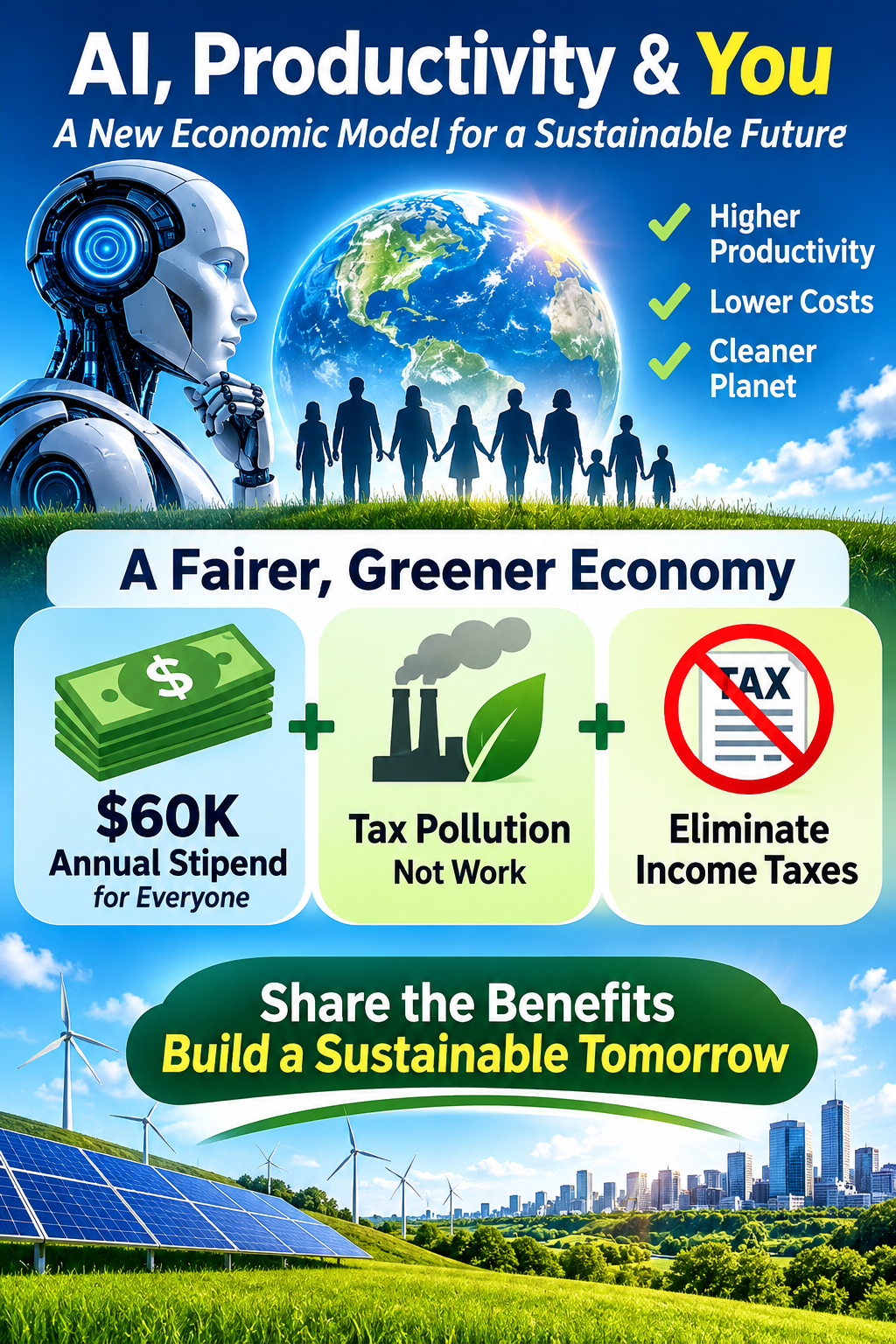
One approach worth serious consideration is a $60,000 annual government stipend per person, funded in part by taxing pollution while eliminating income taxes. This would shift the tax burden away from human productivity and toward activities that impose environmental costs, while providing people with a more secure share of the economy’s productive output.
This is a proposed economic model, not an established policy. Its implementation would require careful consideration of funding, inflation, eligibility, existing public benefits, and the distribution of economic gains.
The Productivity and Disinflation Wildcard
Another important variable is the relationship between productivity gains and disinflation.
AI-driven improvements in productivity and efficiency could sharply reduce the cost of producing goods and services. As automation reduces labor requirements and technological advances improve resource utilization, prices could decline even as total economic output increases.
This creates an important possibility: We could produce more while requiring less human labor and fewer resources.
If these productivity gains translate into lower consumer prices, a given income could purchase more goods and services. The result could be a substantial improvement in living standards, provided the benefits reach consumers rather than being captured primarily as corporate profits.
However, lower production costs do not automatically translate into lower prices. Market competition, ownership, energy costs, access to resources, and corporate pricing decisions will influence how much of the savings consumers receive. Nor does greater productivity guarantee that every sector will experience falling prices.
The central economic challenge is to ensure that the benefits of technological progress are broadly shared rather than concentrated among a small number of business owners and investors.
We cannot stop technological progress, but we can redesign our economic system to distribute its benefits more equitably.
Global Responses: Policies Already Under Consideration
The economic transition driven by AI is not a distant possibility. It is already underway. Governments worldwide are considering different ways to address technological disruption, economic inequality, and the distribution of productivity gains.
These initiatives differ in their objectives and scope. Some involve direct cash payments, others explore basic income, and still others seek to capture more public revenue from digital economic activity. They provide examples of the policy options emerging as governments respond to a changing economy.
Taiwan: Proposed Cash Distribution
In August 2026, President Lai Ching-te announced plans for a NT$10,000 cash payment to eligible residents through the 2027 budget. The government cited strong economic growth driven by global demand for AI-related products and sought to share some of the benefits of that growth.
The proposal was referred for legislative review in October 2026. The planned distribution should therefore be understood as a proposed measure, not a completed payment program.
European Union: Debate Over AI Taxation
European policymakers and tax experts are examining how AI-driven automation could erode payroll-tax revenue used to fund pensions, healthcare, and other social programs.
Proposals include shifting more taxation toward corporate profits and exploring ways to capture economic value generated by AI. Direct taxation of AI systems or AI-generated work has also entered the policy debate, although no EU-wide AI-worker tax has been enacted.
The underlying concern is straightforward: If machines perform a growing share of economically valuable work, governments may need to reconsider how they fund public services traditionally financed through taxes on human employment.
South Korea: Basic-Income Proposals
South Korean political leaders, including Lee Jae-myung, have advocated basic-income policies amid concerns about economic inequality, automation, and employment disruption.
These proposals reflect a broader debate about whether traditional employment-based income distribution will remain adequate as AI changes the relationship between labor, productivity, and economic output.
The policy question is how to ensure that technological progress improves living standards across society, including for people whose jobs are displaced or whose bargaining power declines.
The Marshall Islands: Nationwide Universal Basic Income
In November 2025, the Marshall Islands launched its ENRA universal basic income program, providing regular distributions to eligible citizens.
The program uses multiple payment channels, including a dedicated digital wallet. It demonstrates how modern financial infrastructure can support nationwide cash transfers.
The program is funded through the country’s Compact Trust Fund rather than an AI-specific tax. Although it was not created as a response to AI-driven unemployment, it provides a real-world example of a government implementing regular, broadly distributed public payments.
Kenya: Taxation of the Digital Economy
Kenya has pursued taxation of digital economic activity as governments seek to capture revenue from an increasingly digital global economy.
In December 2024, Kenya replaced its 1.5% digital services tax with a 3% significant economic presence tax applying to qualifying nonresident digital businesses, subject to the relevant rules.
This approach illustrates one way to tax economic activity that may not fit traditional models of physical presence and employment. It is not specifically an AI tax or a universal basic-income funding mechanism, but it contributes to the broader discussion about how tax systems must evolve as technology changes how businesses generate revenue.
The United States: A Proposed AI Sovereign Wealth Fund
In June 2026, Senator Bernie Sanders introduced the American AI Sovereign Wealth Fund Act, proposing public ownership of a portion of qualifying AI companies through a federally managed sovereign wealth fund.
The proposal calls for a one-time transfer of 50% of the stock of qualifying AI companies with at least $200 million in annual AI sales. The fund would hold these shares and distribute public benefits, including annual dividends, while supporting priorities such as healthcare, education, and housing.
The legislation remains a proposal, not enacted law. Its approach differs from a universal stipend funded through environmental taxation, but it addresses the same fundamental question: Who should benefit from the wealth created by increasingly powerful technologies?
A sovereign wealth fund could give the public a direct financial stake in AI-generated economic value. A universal stipend funded through taxation would pursue a similar distributional objective through a different mechanism.
Both approaches raise important questions about implementation, governance, funding, and the long-term relationship between private ownership and public benefit.
The Broader Economic Implication
These examples represent different approaches to a common challenge: distributing the benefits of economic growth when technological progress reduces the need for human labor.
They are not all AI-specific initiatives, and none establishes that a permanent $60,000 annual stipend is already a widely adopted policy. Nevertheless, they demonstrate that governments are exploring alternatives to relying exclusively on employment-based income and conventional payroll taxation.
The essential question is becoming increasingly important:
As AI and automation increase productivity while reducing the need for human labor in some occupations, how should society distribute the resulting economic gains and finance essential public services?
Universal basic income, public dividends, sovereign wealth funds, digital-economy taxation, and environmental tax reform are among the approaches worth examining.
Productivity, Human Welfare, and Environmental Sustainability
AI presents both an economic challenge and an opportunity.
If technological progress allows society to produce more goods and services with fewer labor hours and less resource consumption, the potential benefits extend beyond corporate profitability. People could enjoy greater economic security, more free time, lower living costs, and improved access to essential goods and services.
Realizing those benefits requires more than technological innovation. It requires economic institutions that translate productivity gains into broadly shared prosperity.
Environmental taxation offers a complementary opportunity. Taxing pollution while reducing or eliminating taxes on income could encourage cleaner production while reducing the financial penalty on human work. The actual environmental and economic results would depend on tax design, implementation, and how revenues are distributed.
The goal should be an economic system that rewards innovation, supports human welfare, and accounts for environmental costs rather than treating them as someone else’s problem.
Conclusion: Adapt the Economy to the Technology
The transition to AI-driven productivity is already underway. Attempting to preserve every existing job or slow technological obsolescence indefinitely is not a sustainable strategy.
The more important task is to prepare society for an economy in which human labor may no longer be the primary constraint on production.
A guaranteed annual stipend, pollution-based taxation, reduced reliance on income taxes, and mechanisms for distributing AI-generated wealth are possible elements of a new economic model. Productivity-driven disinflation could further improve affordability if lower production costs translate into lower consumer prices.
None of these outcomes is automatic. They depend on policy choices, economic incentives, market structures, and how society chooses to distribute the benefits of innovation.
We cannot stop technological progress. We can decide whether its benefits are concentrated among a few or shared throughout society.
The objective should be clear: an economy that turns technological productivity into human prosperity while advancing environmental sustainability.
Note From the Author
We are likely facing the most profound economic revolution in human history, and we are dangerously unprepared for its consequences.
Ironically, the U.S. has ignored our most significant existential risk: climate change. The acceleration of Earth’s energy imbalance is already well underway, with consequences that extend far beyond rising temperatures. The economic damage is enormous and growing, with estimates reaching trillions of dollars annually and potentially tens of trillions by midcentury, depending on the scenario and methodology.
Here’s the irony: AI may be our best hope for solving the climate crisis. Its ability to accelerate scientific research, optimize energy systems, improve efficiency, and develop new technologies could help us respond at the scale and speed required.
But just as with climate change, technological capability alone isn’t enough. We need the political will and economic framework to put those capabilities to work for the public good.