bookmark_borderSystemic Infrastructure Risk in a Nonlinear Climate: Economic and Public Safety Implications for the United States

Daniel Brouse and Sidd Mukherjee
February 8, 2026

Abstract

One of the largest and fastest-growing economic costs of climate change in the United States is infrastructure degradation and failure. Intensifying extreme weather events — including flooding, windstorms, heat waves, and heavy precipitation — are stressing systems that were designed for a more stable 20th-century climate. Because many of the nation’s most densely populated cities are located along coasts and low-lying river systems, the risks are both geographically concentrated and nationally significant. This paper examines emerging infrastructure failures as indicators of systemic climate risk and outlines the compounding economic and public health implications.

1. Infrastructure Exposure in Coastal and Riverine Cities

Urban America is disproportionately situated in vulnerable zones: coastal plains, estuaries, and floodplains. These regions now face accelerating risks from sea-level rise, storm surge, extreme rainfall, and groundwater intrusion.

Philadelphia represents a clear example of multi-directional vulnerability. Located at the confluence of the Delaware and Schuylkill Rivers and influenced by tidal dynamics, the city faces increasing flood frequency alongside saltwater intrusion into drinking water and wastewater systems.

The historic Fairmount Water Works, a symbol of early American engineering, now faces what local officials describe as an existential threat — “adapt or collapse.” Pennsylvania already endures more flooding events than any other U.S. state, and the intensity of rainfall has measurably increased in recent decades. Aging stormwater and combined sewer systems were not engineered for present precipitation extremes.

(See also:
http://membrane.com/global_warming/Brandywine-Creek.html)

2. Compounding Costs: Pollution and Public Health

Infrastructure damage is only one dimension of climate-related economic cost. Air pollution — amplified by heat, wildfire smoke, and stagnant atmospheric conditions — compounds healthcare burdens.

Fine particulate matter (PM2.5) remains one of the leading contributors to premature mortality in the United States. Tropospheric ozone, formed through photochemical reactions intensified by heat, damages lung tissue and reduces agricultural productivity. These are not isolated environmental concerns; they represent measurable costs in healthcare expenditures, lost labor productivity, and long-term morbidity.

(See also:
http://membrane.com/global_warming/Trees-for-Climate-Change.html)

3. Cascading Infrastructure Failure: Washington, D.C. Sewer Collapse

On January 19, 2026, a major sewer pipeline collapsed near Washington, D.C., triggering a cascading infrastructure emergency. Following the structural failure, snowmelt and ice increased groundwater infiltration into the system, raising flow volumes beyond temporary bypass capacity.

Subsequent pump clogging caused additional sewage overflows even after the main break had been rerouted. This sequence illustrates a broader pattern: infrastructure failures are no longer isolated mechanical breakdowns but compound events intensified by climate-driven hydrological volatility.

Such cascading stress reveals systemic fragility in aging urban systems under nonlinear climate pressure.

4. Record Wind Extremes: Wyoming, December 2025

On December 17, 2025, Wyoming experienced one of the most extreme wind events in its recorded history.

  • Peak Gust: 144 mph near Smoot, Wyoming
  • Location: Mount Coffin weather station
  • Additional Extremes: 123 mph in Red Canyon; 121 mph in Lincoln County

These wind speeds approach Category 4 hurricane intensity — occurring inland, outside tropical systems. Such events signal increasing atmospheric energy within mid-latitude systems.

Transportation and Public Safety Impacts

  • Dozens of semi-trucks were blown over on December 17 alone.
  • Between December 9–12, Wyoming Highway Patrol responded to 39 blowovers.
  • Major freight corridors (I-80, I-25) required closures.

These events are not merely episodic disruptions. They expose freight systems, insurance structures, and roadway design standards that were calibrated to historical wind distributions — distributions that are shifting.

5. Insurance and Fiscal Implications

Infrastructure stress is increasingly socialized through public insurance systems. Florida now operates effectively as the largest insurer of residential property in the state after repeated private insurer withdrawals. This represents implicit public assumption of escalating climate risk.

Nationally, approximately 10% of high-risk ZIP codes have become effectively uninsurable or subject to severe premium escalation. This trend signals market recognition of structural climate exposure before federal policy fully accounts for it.

As climate volatility accelerates, risk is transferred from private capital markets to taxpayers.

6. Conclusion

Climate change is no longer a distant environmental issue; it is an infrastructure and fiscal stability issue. Extreme weather events are interacting with aging systems, increasing failure frequency and repair costs. Urban water systems, transportation networks, freight corridors, and insurance markets are all experiencing structural stress.

As current trends continue, large portions of U.S. infrastructure — particularly in coastal and riverine regions — are becoming economically and physically unsustainable. Adaptation investments are no longer optional; they are prerequisites for maintaining fiscal stability, public safety, and long-term economic viability.

The central economic question is no longer whether infrastructure will be affected, but whether adaptation can proceed quickly enough to prevent cascading fiscal and public safety crises. Equally important is a more difficult policy question: should strategic managed retreat be implemented sooner rather than later to minimize long-term losses and systemic risk?
The Human Induced Climate Change Experiment

bookmark_borderEconomic Collapse and the Trump Card: When Leverage, Confidence, and Credibility Fail

by Daniel Brouse
February 4, 2026

Past Performance Does Not Necessarily Predict Future Performance

Every prospectus carries the familiar warning: “Past performance does not guarantee future results.” It is a mandatory SEC disclosure reminding investors that historical returns — whether strong or weak — do not reliably predict what comes next.

That disclaimer guards against naïve extrapolation. It does not require us to ignore patterns of behavior, capital structure, or governance. In periods of financial stress, history often serves less as prophecy and more as a diagnostic tool — a way to identify recurring risk dynamics before they become systemic failures.

A Case Study in Leverage: The Original DJT

The original stock trading under the ticker symbol DJT belonged to Trump Hotels & Casino Resorts (THCR), founded in the 1990s. The company operated high-profile properties including Trump Plaza, Trump Taj Mahal, and Trump Marina in Atlantic City. When it went public in 1995, the primary objective was not organic growth, but debt refinancing and balance sheet expansion.

From the beginning, the business model depended heavily on leverage. Junk bond financing and high interest obligations left the company acutely vulnerable to downturns in revenue and shifts in demand.

Financial distress predated the IPO. In 1991, the Trump Taj Mahal filed for Chapter 11 bankruptcy after failing to service more than $1 billion in debt. Trump surrendered roughly half of his ownership stake but retained operational control.

In 2004, Trump Hotels & Casino Resorts — by then publicly traded under DJT — entered bankruptcy again. Creditors took greater control, though Trump remained chairman. In 2009, after rebranding as Trump Entertainment Resorts, the company filed for Chapter 11 a third time. Trump resigned as chairman and exited the board, retaining only a minority stake.

The final collapse came in 2014. The company entered bankruptcy for the fourth time, shuttering Trump Plaza and Trump Taj Mahal. DJT equity was wiped out. Assets were sold. Shareholders absorbed the losses.

Across Trump’s broader business portfolio, bankruptcy counts vary depending on methodology. Most mainstream sources cite at least six corporate bankruptcies, with broader accounting placing the total higher. What remains consistent is the pattern: aggressive leverage, restructuring through bankruptcy, and the transfer of financial losses to creditors, investors, and employees.

This history is not a moral judgment. It is a structural one.

Highly leveraged systems perform well during expansion and fail rapidly during contraction. When debt exceeds sustainable cash flow, restructuring becomes inevitable. When confidence erodes, capital exits.

The disclaimer is technically correct. But capital structures, incentives, and decision-making patterns tend to rhyme.

The Anatomy of Economic Collapse

Economic collapse rarely arrives without warning. It follows a recognizable sequence:

  1. Excessive leverage

  2. Rising borrowing costs

  3. Policy distortion

  4. Erosion of institutional credibility

  5. Loss of confidence

  6. Liquidity failure

Systems built on debt can appear stable — even prosperous — for extended periods. But when revenue growth fails to keep pace with obligations, fragility becomes exposed. Collapse is rarely caused by a single shock. It is the cumulative result of unsustainable fiscal practices, mispriced risk, delayed correction, and declining trust.

When confidence breaks, capital moves quickly. Liquidity evaporates. Asset values reset. What once appeared resilient reveals itself as structurally overextended.

History does not predict timing. It reveals mechanics. And those mechanics are always governed by math — debt arithmetic, cash flow constraints, and the psychology of confidence.

Trumpenomics: Private-Sector Logic Applied to a Nation-State

Trump’s approach to national economic policy mirrors his private-sector playbook: maximize leverage, defer reckoning, and rely on confidence and branding to sustain financing.

His policies are actively reshaping — and in key respects destabilizing — the post–World War II economic order. As of January 2026, central bank gold holdings by market value have surpassed official U.S. Treasury holdings as the world’s largest reserve asset class for the first time since the mid-1990s, exceeding $4 trillion. That shift reflects accelerating reserve diversification and growing concern over U.S. fiscal sustainability and geopolitical reliability.

Repeated disruptions of trade agreements and alliance structures have weakened international trust in U.S. policy continuity. Confidence is the foundation of any reserve system. When credibility erodes, diversification accelerates.

At the same time, sustained political pressure on the Federal Reserve risks undermining perceptions of central bank independence — another core pillar supporting global confidence in U.S. financial leadership.

The central question is no longer whether structural imbalances exist, but whether policy actions can delay their visible consequences.

Delay Mechanisms and Their Limits

Several mechanisms may temporarily cushion stress:

  • Political pressure on the Fed to absorb blame

  • Regulatory adjustments that artificially increase Treasury demand

  • Promotion of stablecoins backed by U.S. government debt

  • Public encouragement of domestic bond purchases

Each may buy time. None alters the underlying arithmetic.

There is also evidence that the Fed itself is attempting to pre-empt growing strain. Cutting short-term rates — despite political pressure for more aggressive easing — has not relieved market stress. Long-term Treasury yields have risen since rate cuts began, signaling that markets are pricing fiscal risk and inflation expectations independently of policy rates.

More important than interest rates is the balance sheet. The Fed has resumed purchasing billions of dollars in Treasuries each month and is adjusting its holdings of mortgage-backed securities. These are liquidity management operations — stabilizing funding markets beneath the surface.

Simultaneously, the administration is moving to reorganize Fannie Mae (FNMA) and Freddie Mac (FMAC), which underpin most U.S. mortgages. Here, systemic risk deepens. Public denial of climate risk does not remove it. Climate change is already one of the largest long-term threats to mortgage markets — from coastal flooding and wildfire exposure to extreme heat and insurance withdrawal. If underwriting, insurance markets, and federal backstops remain misaligned with physical reality, mortgage risk can reprice abruptly.

Monetary policy can manage liquidity. It cannot erase structural exposure — fiscal, environmental, or credibility-based.

Warning Signals in Plain Sight

Recent data provide concrete examples of stress masking:

  • Employment reporting: While the Bureau of Labor Statistics maintains core methodology, unusually large revisions and methodological shifts are revealing that hundreds of thousands of jobs previously reported no longer exist.

  • Agriculture: The chair of the U.S. Senate Agriculture Committee has warned of heavy losses across farming sectors. More than two dozen former industry leaders have cautioned of a potential “widespread collapse of American agriculture,” prompting a $12 billion emergency bailout amid falling commodity prices, rising input costs, trade disruptions, and tightening credit.

These interventions do not change rollover risk, deficit arithmetic, or rising interest expense. Financial history is clear: interventions may delay reckoning, but they rarely eliminate it.

The Trump Card

The defining risk is not messaging or political theater. It is whether fiscal sustainability and institutional credibility can be restored before confidence thresholds are crossed.

Trump’s private-sector history demonstrates a strategy of postponing collapse through leverage, restructuring, and narrative control. Applied at the scale of a nation-state, that strategy becomes exponentially more dangerous.

Past performance does not guarantee future results.

But when leverage, confidence, and credibility all deteriorate at once, the math becomes unforgiving.

Trumpenomics

bookmark_borderStorm Warnings Over America’s Heartland: Senate Leaders and Industry Veterans Warn of Agricultural Crisis

The chair of the U.S. Senate Agriculture Committee issued a stark warning Tuesday: American farmers are absorbing heavy losses across multiple sectors, and the financial strain is intensifying. At the same time, more than two dozen former agricultural industry leaders released a joint statement cautioning that the nation faces the risk of a “widespread collapse of American agriculture” if structural pressures are not addressed.

Their concerns come as a $12 billion federal bailout package is expected to reach growers this month — an emergency measure intended to stabilize farm incomes amid falling commodity prices, rising input costs, trade disruptions, and tightening credit conditions.

Mounting Financial Strain

Farmers are confronting a convergence of pressures:

  • High input costs for fuel, fertilizer, equipment, and labor
  • Volatile commodity prices and shrinking margins
  • Trade instability limiting export markets
  • Rising interest rates increasing the cost of operating loans and land financing
  • Extreme weather events damaging crops and livestock

Many producers operate on thin margins even in strong years. When multiple stressors hit simultaneously, liquidity evaporates quickly. Debt servicing becomes harder, refinancing options narrow, and generational farms become vulnerable to consolidation or foreclosure.

Bailout or Bandage?

The $12 billion aid package may provide short-term relief, but critics argue it functions more as a stopgap than a solution. Emergency payments can stabilize cash flow temporarily, yet they do not resolve structural issues such as:

  • Long-term trade realignment
  • Climate-related crop volatility
  • Market concentration among processors and distributors
  • Escalating insurance and reinsurance costs

Former industry leaders warning of collapse argue that without systemic reform — including trade clarity, supply chain resilience, and climate adaptation strategies — federal assistance will become recurring rather than exceptional.

The Broader Economic Risk

Agriculture is not an isolated sector. It underpins rural economies, food security, export revenues, transportation networks, and credit markets. A sustained contraction would ripple outward:

  • Rural banks exposed to farm loans could face elevated default risk.
  • Equipment manufacturers and input suppliers would see demand decline.
  • Food prices could become more volatile.
  • Land values — often used as collateral — could weaken.

In short, stress in agriculture can migrate into the broader financial system.

A Structural Crossroads

The warning from lawmakers and former industry leaders signals more than a bad season. It reflects a deeper reckoning over how American agriculture adapts to:

  • Changing global trade dynamics
  • Climate variability and extreme weather
  • Technological transition and consolidation
  • Rising financial leverage

Whether the current bailout acts as a stabilizer or merely delays a larger adjustment remains uncertain. What is clear is that confidence — in trade policy, credit markets, and long-term sustainability — is becoming as critical to farmers as rainfall and soil quality.

The heartland is sending a signal. Policymakers now face the question: will they treat it as a temporary setback, or as an early warning of structural transformation?

Trumpenomics

bookmark_borderCracked Fractals: Climate Thermodynamics, Insurance Instability, and Sovereign Debt Transmission in Late-Stage Capitalism

by Daniel Brouse (February 2, 2026 update to an ongoing study)

Abstract

The relationships between climate physics and modern financial structure are complex, dynamic, and fundamentally non-linear. This paper examines the transmission mechanisms linking climate destabilization to structural fragility within advanced capitalist economies. Drawing on thermodynamics, actuarial science, and sovereign debt dynamics, it argues that the insurance sector functions as the primary systemic tripwire between physical climate risk and financial abstraction. Evidence from Florida and California demonstrates how accelerating climate losses are already migrating from private balance sheets to public backstops. As these liabilities propagate through municipal bonds, mortgage-backed securities, and ultimately federal debt, the system exhibits the instability patterns of complex systems approaching critical thresholds—what I describe as “cracked fractals.” The convergence of climate acceleration and fiscal overextension suggests not isolated sectoral stress, but the emergence of systemic collapse dynamics.

1. Introduction: Nonlinear Coupling of Climate and Capital

Climate systems and financial systems share defining characteristics: feedback loops, lag structures, threshold behavior, and sensitivity to compounding shocks. Both are governed by non-linear dynamics. Small perturbations can produce outsized consequences when systems are near critical states.

In previous work, I have described the interaction between climate destabilization and financial fragility through a “Domino Effect” framework. The metaphor applies equally to ice sheets and balance sheets. When one structural support fails, stress redistributes across the network. In tightly coupled systems, redistribution accelerates failure elsewhere.

The central analytical question is not whether climate change affects the economy—it demonstrably does—but how physical climate risk transmits into financial architecture, and where the first irreversible fractures appear.

2. Insurance as Systemic Tripwire

The insurance sector occupies the interface between physical risk and financial abstraction. It translates meteorological volatility into actuarial pricing and reserve allocation. When tail risks accelerate beyond historical probability distributions, actuarial tables lose predictive reliability. At that point, the system’s shock absorbers begin to fail.

This failure mode is already visible in:

  • Property insurance withdrawals from high-risk geographies
  • Rapid repricing of premiums
  • Reinsurance market tightening
  • Escalating deductibles and coverage exclusions

Insurance does not create climate risk; it prices it. When pricing becomes impossible, risk migrates.

3. Florida and California: Real-Time Case Studies

Florida and California provide contemporary illustrations of this transmission dynamic.

Florida:
Repeated hurricane losses have driven private insurers into insolvency or retreat. Citizens Property Insurance Corporation—the state-backed insurer of last resort—has become the largest property insurer in the state. Citizens is ultimately backed by policyholder surcharges and post-event assessments that function as a quasi-tax. Climate risk has therefore migrated from private capital to public balance sheets. This model is politically expedient but structurally fragile: if losses outpace premium growth and reserve accumulation, the public backstop itself becomes a destabilizing liability.

California:
Escalating wildfire losses have led major carriers to pause or withdraw new policies. Exposure has shifted toward the California FAIR Plan, increasing the state’s implicit fiscal exposure. As in Florida, the public sector has become the de facto reinsurer of last resort.

In both cases, actuarial strain precedes broader financial contagion. Insurance is the first derivative that breaks.

4. Contagion Pathways

Once insurance destabilizes, transmission channels are straightforward:

  1. Municipal Infrastructure Bonds
    Communities facing repeated disasters encounter rising borrowing costs and impaired credit ratings.
  2. Mortgage-Backed Securities (MBS)
    Real estate values depend on insurability. If coverage becomes unaffordable or unavailable, collateral assumptions underlying MBS structures erode.
  3. Federal Backstops and U.S. Treasuries
    Disaster recovery increasingly migrates to federal balance sheets. As sovereign exposure rises, climate risk becomes embedded in national debt markets.

Bond markets rarely collapse in isolation. They absorb and socialize losses until confidence fractures. Insurance is simply the earliest visible fracture plane.

5. Cracked Fractals and Statistical Deviation

The U.S. economy and climate system increasingly resemble complex systems approaching critical thresholds—what I term “cracked fractals.” These fragile branching patterns represent fragmented stability and inflection points beyond which recovery becomes progressively constrained.

Key indicators—including federal deficits, disaster recovery expenditures, housing unaffordability, and insurance exposure—are now running 2 to 3 standard deviations above historical norms. When multiple independent systems deviate simultaneously at that magnitude, the signal is structural, not cyclical.

Through the lens of chaos theory and nonlinear dynamics, such clustering of extreme deviations indicates tightening feedback loops. Climate volatility increases fiscal strain; fiscal strain reduces adaptive capacity; diminished adaptation increases climate damages. The system begins to fracture along its weakest seams.

6. Integrating Thermodynamics, Actuarial Science, and Sovereign Debt

Climate acceleration is thermodynamically grounded. Greenhouse gas accumulation increases radiative forcing, intensifies energy imbalances, and drives nonlinear physical responses. These physical processes do not negotiate with financial models.

Simultaneously, sovereign debt expansion in advanced economies has accelerated. Aging populations and slowing labor-force growth undermine the growth assumptions that traditionally support debt sustainability. In several Western nations, restrictive immigration policies further weaken demographic resilience, while rapid advances in automation and AI introduce structural labor displacement that complicates income growth, tax base stability, and long-term fiscal balance.

Overlaying these trends are trillions of dollars in climate-related healthcare expenditures, infrastructure repair, disaster recovery, and supply chain disruption. As these costs compound, fiscal space narrows. When exponential climate acceleration meets expanding sovereign liabilities, the result is a coupled instability—what can be described as a domino effect across thermodynamic and financial domains.

Both systems—climate and sovereign debt—exhibit trajectories that are unsustainable under current structural assumptions.

7. Conclusion

The destabilization of insurance markets in high-risk states is not a regional anomaly; it is an early-stage manifestation of a broader structural convergence. Climate thermodynamics and financial architecture are not separate systems—they are dynamically coupled.

Insurance represents the first systemic derivative to fail because it directly translates physical volatility into financial liability. As that failure propagates through municipal finance, mortgage markets, and sovereign debt, the risk becomes nationalized and eventually globalized.

The emerging pattern is not cyclical stress but nonlinear convergence toward structural thresholds. Recognizing insurance instability as the primary transmission mechanism clarifies both the scale of the risk and the urgency of structural reform.


References and Related Work

Brouse, D. (2025). Deviation, Cracked Fractals, Climate, and Economics.
http://membrane.com/global_warming/Cracked-Fractals-Deviations.html

Brouse, D. et al. Insurance Collapse – Introduction.
http://membrane.com/global_warming/Insurance-Collapse-intro.html

Brouse, D. Systemic Collapse.
http://membrane.com/global_warming/Systemic-Collapse.html

Brouse, D. Social-Ecological Feedbacks.
http://membrane.com/global_warming/Social-Ecological-Feedbacks.html

Brouse, D. Dollars and Demise.
http://membrane.com/global_warming/Dollars-Demise.html

Additional materials available at:
http://membrane.com/global_warming/

bookmark_borderExtreme Energy Events: How a Warming Planet Converts Heat Into Destruction

by Daniel Brouse and Sidd Mukherjee
December 18, 2025

From “Global Warming” to System-Wide Energy Overload

The phrase global warming is widely misunderstood. While it accurately describes a rise in Earth’s average temperature, it fails to capture the true source of risk: a rapid increase in total energy within the Earth system. Heat is only the entry point. Once added, that energy is transformed, transferred, and amplified through atmospheric, oceanic, and terrestrial processes.

In 2025, global mean temperatures exceeded the long-recognized 1.5 °C threshold. To a lay observer, this may sound insignificant. It is not. Earth’s climate is a nonlinear system. Small average increases translate into large, destabilizing changes in circulation, moisture, pressure, and momentum—producing what are better described as extreme energy events.

What Are Extreme Energy Events?

Terms like heat waves or extreme weather describe symptoms, not mechanisms. The real driver is energy—thermal, kinetic, latent, and gravitational—moving through a destabilized system.

Extreme energy events include:

  • Violent precipitation and flash flooding
  • Extreme winds and pressure-gradient-driven storms
  • Rapid thermal and moisture swings (“climate whiplash”)
  • Coastal storm surge and marine heatwaves
  • Convective, solid, and chemical energy releases (hail, microbursts, wildfire)

These events are becoming more frequent and more destructive because energy scales nonlinearly.

Violent Rain: When Moisture Becomes Momentum

A critical mistake is equating climate change solely with heat. As air warms, it holds more water vapor—about 7% more moisture per 1 °C of warming. Over a 10 °C increase, moisture capacity nearly doubles.

This excess moisture does not fall gently.

Larger and more numerous raindrops increase mass (m), and falling from greater heights increases velocity (v). Momentum (p = mv) rises sharply. Upon impact, that momentum transfers to surfaces and to runoff, increasing erosion, infrastructure failure, and flood velocity.

Flow forces scale with the square of velocity (v²). Even modest increases in rainfall intensity dramatically increase destructive power.

Because water is ~800 times denser than air, fast-moving floodwater exerts exponentially greater force than wind at the same speed.

In July 2025 alone, hundreds of flash floods occurred across the United States, including multiple so‑called 1‑in‑1,000‑year rainfall events in Texas, New Mexico, North Carolina, Florida, and Illinois—statistics that no longer describe rarity, but systemic change.

Extreme Wind: Pressure, Acceleration, and Failure

As temperature gradients shift and circulation destabilizes, pressure contrasts intensify and reorganize. The result is stronger, more erratic winds.

Wyoming Wind Event — December 17, 2025

  • Peak gust: 144 mph near Smoot, Wyoming
  • Location: Mount Coffin weather station—one of the windiest sites in the state
  • Context: One of the strongest recorded gusts in Wyoming history

Transportation Impacts

  • Dozens of tractor‑trailers blown over statewide
  • 39 blowover incidents responded to by Wyoming Highway Patrol between December 9–12
  • Repeated closures of I‑80 and I‑25 to high‑profile vehicles

These were not isolated anomalies; they were the mechanical outcome of a hotter, more unstable atmosphere.

Rapid Pressure Gradients: The Hidden Engine

Wind is driven by pressure gradients. As climate energy increases, these gradients sharpen.

Bomb Cyclones (Explosive Cyclogenesis)

  • Defined by pressure drops ≥ 24 mb in 24 hours
  • Produce hurricane‑force winds and extreme precipitation

Notable examples include record‑breaking North Atlantic and Pacific storms whose pressures rival major hurricanes.

Hurricanes and Tropical Cyclones

These systems are extreme pressure machines. Tight gradients around the eye wall accelerate winds to catastrophic speeds. Rapid intensification has become increasingly common as ocean heat content rises.

Localized Gradient Events

  • Derechos and squall lines: Long‑lived straight‑line windstorms
  • Santa Ana winds: Pressure‑driven downslope accelerations fueling megafires
  • Tornadoes: Among the steepest pressure gradients on Earth, capable of 300‑knot winds

Coastal Storm Surge: When Pressure Lifts the Sea

Atmospheric pressure alone can raise sea level. Roughly 1 cm of sea‑level rise occurs for every 1 mb pressure drop.

Deep low‑pressure systems can elevate ocean levels by half a meter before wind is even considered. When combined with wave energy and rising baseline seas, the result is catastrophic coastal flooding.

Climate Whiplash: Rapid Energy Reversals

A destabilized system oscillates.

  • Hydroclimate whiplash: Drought rapidly followed by extreme flooding
  • Flash freezes: Sudden thermal energy loss causing infrastructure collapse

These shifts strain ecosystems and human systems designed for gradual change.

Marine, Solid, and Convective Energy Events

  • Marine heatwaves: Long‑lasting ocean heat anomalies devastating fisheries and coral reefs
  • Rogue waves: Spontaneous high‑energy wave convergence
  • Severe hail: Sustained by intense convective updrafts
  • Microbursts: Localized downdrafts exceeding 90 mph
  • Wildfires: Massive chemical energy releases enabled by heat, dryness, and wind

Alignment With Tipping Points and Cascading Collapse

This framework of extreme energy events directly aligns with—and physically underpins—tipping-point theory and cascading-collapse dynamics.

Extreme Energy as the Mechanism of Tipping Points

Tipping points are not abstract thresholds; they are energy thresholds. A system appears stable while excess energy is absorbed internally—through ocean heat uptake, cryosphere melt, soil moisture loss, or atmospheric moisture loading. Once buffering capacity is exhausted, the system reorganizes abruptly.

Examples include:

  • Jet stream destabilization once polar amplification erodes the equator-to-pole temperature gradient
  • AMOC weakening as freshwater input disrupts density-driven circulation
  • Cryosphere collapse when latent heat thresholds are exceeded and albedo feedbacks flip sign

Extreme energy events are therefore the observable phase transition—the moment when stored energy is released into motion, flow, and force.

Cascading Collapse: When One Failure Accelerates the Next

Earth’s climate is a tightly coupled system. When one component crosses a tipping point, it injects energy or removes stability from adjacent systems, accelerating their failure.

For example:

  • Arctic amplification weakens the jet stream → stalled Rossby waves → prolonged heat domes and floods → soil moisture loss → wildfire → atmospheric aerosol loading → further circulation disruption.
  • Ocean heat uptake delays surface warming → stratification increases → circulation slows → marine heatwaves intensify → ecosystem collapse → reduced carbon uptake → accelerated atmospheric warming.

Each collapse feeds energy forward, amplifying stress on the next subsystem. This is why observed change is no longer sequential—it is simultaneous.

Nonlinearity: Why Change Appears Sudden

In nonlinear systems, stress accumulates invisibly. The release is abrupt.

Extreme energy events mark the transition from:

  • Energy accumulation → energy expression
  • Buffering → breakdown
  • Variability → instability

This explains why multiple “once-in-1,000-year” events are now occurring within the same season, across unrelated regions, and through different physical mechanisms.

From Climate Risk to Systems Failure

Our tipping-point and cascading-collapse work emphasizes a critical insight: the danger is not the magnitude of warming alone, but the synchronization of failures.

Extreme energy events are the connective tissue between:

  • Climate physics
  • Infrastructure collapse
  • Economic destabilization
  • Ecological failure
  • Human habitability limits

They are how abstract thresholds become lived reality.

The Core Reality

Climate change is not simply warming the planet—it is pushing multiple Earth systems past energetic thresholds simultaneously.

Once tipping points are crossed, the system no longer returns to its prior state. Energy flows reconfigure permanently, cascades accelerate, and collapse becomes self-reinforcing.

We are no longer approaching this phase.

We are inside it.


* Our probabilistic, ensemble-based climate model — which incorporates complex socio-economic and ecological feedback loops within a dynamic, nonlinear system — projects that global temperatures are becoming unsustainable this century. This far exceeds earlier estimates of a 4°C rise over the next thousand years, highlighting a dramatic acceleration in global warming. We are now entering a phase of compound, cascading collapse, where climate, ecological, and societal systems destabilize through interlinked, self-reinforcing feedback loops.

We examine how human activities — such as deforestation, fossil fuel combustion, mass consumption, industrial agriculture, and land development — interact with ecological processes like thermal energy redistribution, carbon cycling, hydrological flow, biodiversity loss, and the spread of disease vectors. These interactions do not follow linear cause-and-effect patterns. Instead, they form complex, self-reinforcing feedback loops that can trigger rapid, system-wide transformations — often abruptly and without warning. Grasping these dynamics is crucial for accurately assessing global risks and developing effective strategies for long-term survival.

What Can I Do?
The single most important action you can take to help address the climate crisis is simple: stop burning fossil fuels. There are numerous actions you can take to contribute to saving the planet. Each person bears the responsibility to minimize pollution, discontinue the use of fossil fuels, reduce consumption, and foster a culture of love and care. The Butterfly Effect illustrates that a small change in one area can lead to significant alterations in conditions anywhere on the globe. Hence, the frequently heard statement that a fluttering butterfly in China can cause a hurricane in the Atlantic. Be a butterfly and affect the world.

Tipping points and feedback loops drive the acceleration of climate change. When one tipping point is breached and triggers others, the cascading collapse is known as the Domino Effect.

The Climate Crisis: Violent Rain | Deadly Humid Heat | Health Collapse | Extreme Weather Events | Insurance Collapse | Forest Collapse | Soil Collapse | Rising Sea Level | Food and Water Collapse | Updates

The Human Induced Climate Change Experiment

bookmark_borderTrump’s Second Term, Year One: Forecast Confirmed, Damage Accelerated

December 18, 2025

Executive Summary

When Donald Trump took office in January 2025 for his second term, we issued a clear forecast: a rapid deterioration in U.S. economic performance driven by protectionism, institutional erosion, policy uncertainty, and hostility toward science and immigration. That forecast has not only proven accurate—it has materialized well ahead of schedule.

The first year of Trump’s second term has been defined by broken promises, contracting manufacturing, weakening employment, rising inflationary pressure, exploding debt, and systemic damage to U.S. credibility. What was presented as economic nationalism has functioned instead as economic self‑harm.

Historical Context: Smoot–Hawley Revisited

History provides a cautionary parallel. The Smoot–Hawley Tariff Act of 1930, which sharply raised U.S. tariffs, triggered retaliatory trade barriers worldwide and materially deepened the Great Depression. Trump’s second‑term policies echo this mistake—only now compounded by executive overreach, the bypassing of Congress, and routine disregard for constitutional constraints.

As a result, the current downturn appears not only real, but accelerating. Many global leaders and economists are not reacting with panic precisely because they expect U.S. instability to be self‑limiting: policy paralysis, electoral backlash, and institutional resistance are likely to curb further damage after the midterms. In that sense, global tolerance reflects grim confidence that the U.S. economy will absorb the shock internally.

Promises Made, Promises Broken

Trump entered his second term claiming he would:

  • Bring down prices on Day One
  • Reshore U.S. manufacturing
  • Increase employment
  • Increase GDP
  • Reduce the national debt
  • Cut taxes

He has failed on every count.

Inflation: Moving the Wrong Direction

Inflation has increased at a time when it should have been declining. Relative to economic conditions, inflationary pressure is now higher than at any point since the pandemic recovery period. Tariffs, supply‑chain disruption, labor shortages, and policy volatility have combined to reverse progress that had already been achieved.

Manufacturing: Contraction, Not Reshoring

U.S. manufacturing has consistently declined since Trump took office in 2025. While the administration has claimed credit for large manufacturing investments, nearly all of the facilities cited were planned, announced, or contractually committed before the election.

More damaging still, Trump’s anti‑science and anti‑immigration posture has convinced much of the world that the United States is no longer a reliable place to invest or trade. This loss of confidence has had concrete consequences:

  • Multiple domestic and foreign firms have cancelled or delayed U.S. manufacturing projects.
  • Hyundai’s U.S. operations were disrupted by enforcement actions that left the company unable to staff skilled positions needed to complete its plant.
  • GM and Ford announced cancellations or significant scale‑backs of U.S. investments following Trump’s reversal on climate policy and electric vehicles.

In a striking contradiction to free‑market rhetoric, Trump has socialized large segments of the economy, with the federal government now holding stakes or exerting direct control over portions of:

  • Steel production
  • Rare earth mineral supply chains
  • Defense contracting
  • Semiconductor manufacturing

This represents one of the most aggressive expansions of state ownership and control in U.S. history. At the same time, Trump’s tariff regime has devastated multiple U.S. sectors—most notably agriculture—by triggering retaliatory trade actions and collapsing export markets. In response to the damage his own policies created, the administration has resorted to large-scale, socialized bailouts totaling tens of billions of dollars, effectively transferring private market losses to taxpayers.

Employment: Softening and Rising Unemployment

Labor market conditions have weakened throughout Trump’s first year back in office. Unemployment reached a new high in November, and forward‑looking indicators suggest further softening. The combination of trade disruption, investment pullbacks, and labor shortages tied to immigration policy has undermined job growth rather than strengthened it.

GDP and Markets: Artificially Propped Up

Headline GDP growth and equity markets are being artificially supported by massive AI‑related capital spending. Strip out this single speculative sector, and the U.S. economy would already be in recession.

Even more concerning, the AI boom bears all the hallmarks of a classic asset bubble. The pattern closely mirrors the speculative excesses that preceded:

  • The dot‑com collapse (2000–2002)
  • The global financial crisis (2008–2009)

In both cases, apparent growth masked deep structural weakness—until the correction arrived.

Debt: Exploding at Record Speed

The national debt has increased faster and by larger absolute amounts than at any point in U.S. history, with repeated trillion‑dollar surges. This expansion has occurred despite promises of fiscal discipline and without corresponding investments that would raise long‑term productivity or growth.

Taxes by Another Name: Tariffs and Uncertainty

Trump has effectively imposed the largest tax increase in U.S. history through tariffs. Tariffs function as a consumption tax, raising prices for households and businesses alike.

Compounding the damage, persistent policy whiplash—often summarized as “TACO” (Tariffs, Abrupt Changes, and Overreach aka Trump Always Chickens Out)—has created extreme uncertainty. Trump has broken or abandoned every major free‑trade agreement with U.S. allies, shredding decades of trust. Rebuilding that credibility will take years, if it is possible at all.

White Nationalism

Finally, and most importantly:
This discussion keeps circling back to selective facts while ignoring the broader ideological context. Trump’s economic program is inseparable from white-nationalist protectionism, xenophobia, and hostility to science and immigration — all of which directly harm labor markets, innovation, and long-term growth. Treating isolated projects as proof of success while ignoring those systemic harms is precisely how propaganda works: narrow focus, emotional certainty, and resistance to contradictory evidence.

Conclusion

One year into Trump’s second term, the results are unmistakable. The economy is weaker, more fragile, and less trusted than it was in 2024. Manufacturing is contracting, inflation is rising, employment is softening, debt is exploding, and growth rests on a narrow speculative bubble.

This outcome was not inevitable. It was forecast—and then fulfilled—by a policy agenda rooted in white nationalism, bigotry, xenophobia, hostility to expertise, and disregard for institutions. The damage done in this first year will outlast the term itself, negatively impacting the U.S. economy for at least a generation.

Trumpenomics

bookmark_borderHow the “Global Average” Is Hiding the Real Climate Emergency

by Daniel Brouse
December 16, 2025

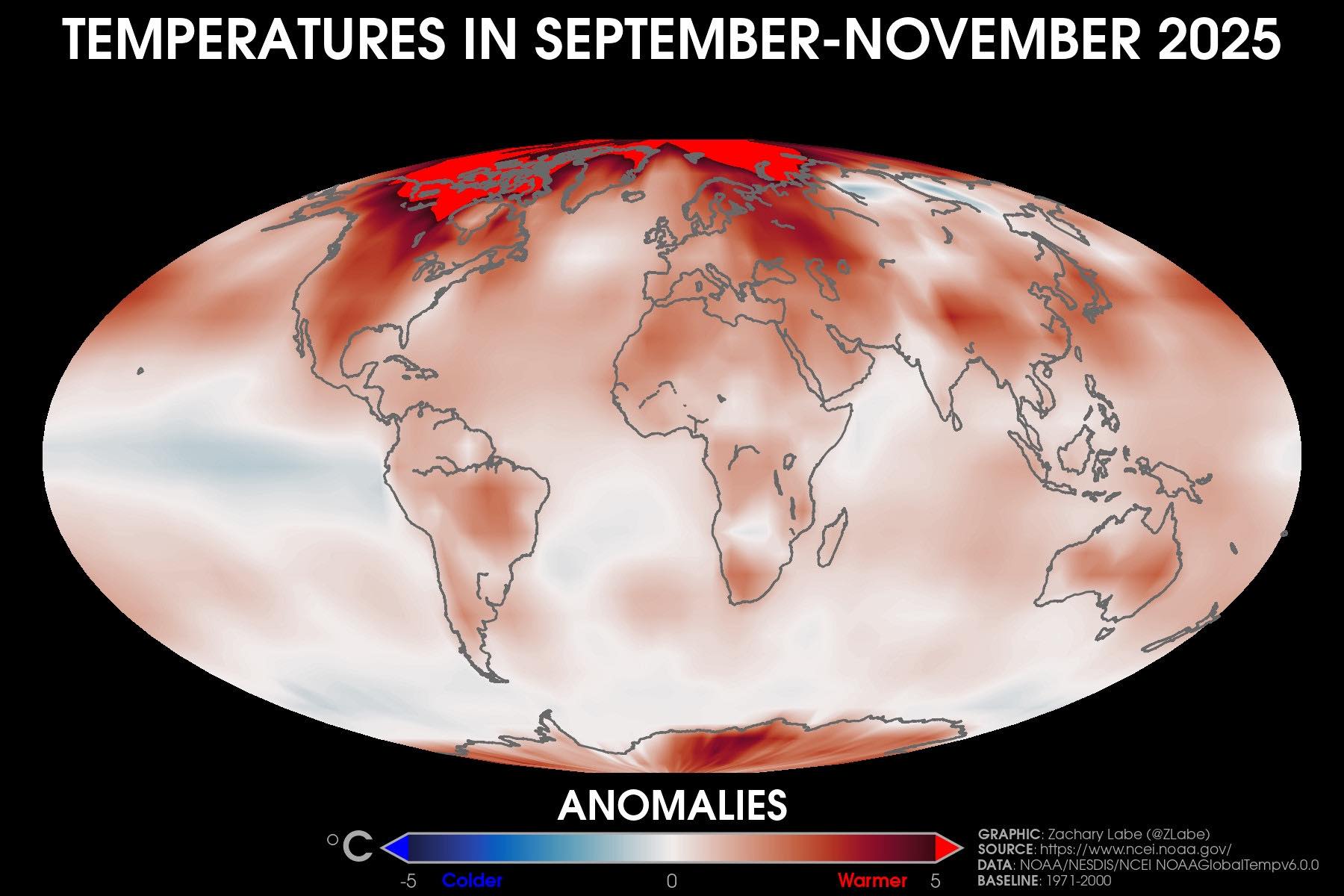
Q3 2025: Extreme Global Temperature Anomalies

Autumn (September–November) climate data reveal two features that matter far more than the global average: what is happening at the poles and what is happening at the equator.

Both the Arctic and Antarctic are experiencing record-breaking temperatures—warming at rates up to 20 times faster than much of the rest of the planet, visible as deep red anomalies on global maps. This extreme polar amplification is not a regional curiosity; it is destabilizing the foundational circulation systems that regulate Earth’s climate, including the jet stream, the Atlantic Meridional Overturning Circulation (AMOC), and the Pacific Meridional Overturning Circulation (PMOC).

As a direct consequence, the Northeastern United States is now experiencing sharp climate whiplash: record cold conditions this week, followed by unseasonably warm temperatures days later. These are not random swings—they are signatures of a circulation system that is losing coherence.

The Poles: Where Climate Change Is Accelerating Fastest

The polar regions act as the planet’s thermal anchors. Normally, the large temperature contrast between the equator and the poles powers a fast, stable jet stream and robust ocean circulation. But as the Arctic warms nearly four times faster than the global average, and Antarctic ice loss accelerates, that temperature gradient is collapsing.

With less contrast to drive it, the jet stream weakens and becomes increasingly wavy and prone to stalling. This allows weather patterns to linger—producing prolonged heatwaves, extended cold outbreaks, persistent flooding, and flash droughts. At the same time, freshwater from polar melt is disrupting deep-water formation in the North Atlantic, weakening the AMOC and altering global heat transport.

The Equator: The Illusion of Cooling

The other key feature in the data is a small blue patch along the equatorial Pacific—a weak La Niña signal. This localized cooling will likely prevent 2025 from being recorded as the single hottest year on record by slightly suppressing the global mean temperature.

But this is precisely where the global average becomes misleading.

Oceans absorb the vast majority of excess heat and require far more energy to warm than air or land. A small cooling anomaly in the tropical Pacific can therefore offset massive heating elsewhere in the global average—especially at the poles—without reducing actual climate risk.

In other words, the planet can appear “less hot” on paper while becoming far more dangerous in reality.

Why “Global Average Temperature” Misleads

A 3 °C increase in the global average temperature sounds abstract and manageable. In reality, it masks extreme regional outcomes that determine human survivability.

  • The Arctic is already warming more than four times faster than the global mean, with localized increases exceeding 10 °C. In 2025, parts of the Arctic are running as much as 20 °C above normal.

  • Land and air temperatures rise far faster than ocean averages.

  • Human limits are governed not by global means, but by regional extremes and wet-bulb temperatures—the point at which heat and humidity overwhelm the body’s ability to cool itself.

When policymakers talk about “holding warming below 1.5 °C,” they are referring to a blended average across oceans, land, and atmosphere. But oceans absorb over 90% of the excess heat trapped by greenhouse gases, heavily damping the apparent rise in the global mean.

This creates a dangerous illusion of control.

The Ocean Heat Mask

Recent deep-ocean studies show that even the deepest layers of the ocean are warming. A change of just 0.1 °C in ocean temperature represents an enormous amount of stored energy. If that heat were redistributed over land, it would be equivalent to roughly a 35 °C increase—a level incompatible with large-scale human survival.

The oceans are acting as a temporary buffer, hiding the true magnitude of warming while simultaneously destabilizing themselves through:

  • Increased stratification

  • Slowing circulation

  • Oxygen loss

  • Ecosystem collapse

During 2025, the Pacific Ocean has been running approximately 1.6 °C above its long-term average—a deviation of six standard deviations above the mean. In climate science, values this far from normal variability are essentially off the charts.

The Thresholds That Matter

Two temperature thresholds now demand urgent attention:

  • ~1.5 °C global average warming
    This marks the widespread activation of major climate tipping points—ice sheet instability, circulation slowdown, ecosystem collapse.

  • ~9 °C land and air warming
    This represents the upper boundary of human physiological survivability across much of the planet.

These are not distant, theoretical limits. They are rapidly approaching—and in some regions, already being exceeded.

The climate crisis is no longer about slow, linear warming. It is about where the heat is accumulating, how it is destabilizing Earth’s life-support systems, and how misleading averages are masking the speed and severity of the transformation now underway.

* Our probabilistic, ensemble-based climate model — which incorporates complex socio-economic and ecological feedback loops within a dynamic, nonlinear system — projects that global temperatures are becoming unsustainable this century. This far exceeds earlier estimates of a 4°C rise over the next thousand years, highlighting a dramatic acceleration in global warming. We are now entering a phase of compound, cascading collapse, where climate, ecological, and societal systems destabilize through interlinked, self-reinforcing feedback loops.

We examine how human activities — such as deforestation, fossil fuel combustion, mass consumption, industrial agriculture, and land development — interact with ecological processes like thermal energy redistribution, carbon cycling, hydrological flow, biodiversity loss, and the spread of disease vectors. These interactions do not follow linear cause-and-effect patterns. Instead, they form complex, self-reinforcing feedback loops that can trigger rapid, system-wide transformations — often abruptly and without warning. Grasping these dynamics is crucial for accurately assessing global risks and developing effective strategies for long-term survival.

Tipping points and feedback loops drive the acceleration of climate change. When one tipping point is breached and triggers others, the cascading collapse is known as the Domino Effect.

The Climate Crisis: Violent Rain | Deadly Humid Heat | Health Collapse | Extreme Weather Events | Insurance | Trees and Deforestation | Rising Sea Level | Food and Water

The Human Induced Climate Change Experiment

Runaway Feedbacks: Can Earth Warm 9°C This Century?

bookmark_borderPolar Bear Plunge: Will Humans Follow? (Adaptation Part II)

Polar Bear Plunge: Will Humans Follow?

Adaptation Part II

Daniel Brouse
December 14, 2025

Abstract

In The Plight of the Penguin: Will Humans Follow? (Adaptation Part I), I examined how multiple penguin species—despite short-term behavioral flexibility—are failing to adapt to the pace and scale of anthropogenic climate change. This second paper extends that analysis to the Arctic, focusing on polar bears as a living stress test for biological adaptation under rapid warming. Together, penguins and polar bears frame the planetary poles as early-warning systems for human survivability. While limited genetic and epigenetic responses are emerging in some species, the evidence suggests that nonlinear climate dynamics and cascading feedback loops are outpacing adaptive capacity—first in wildlife, and increasingly in humans.

I. From Penguins to Polar Bears: A Shared Signal

Penguin populations across the Southern Hemisphere are undergoing rapid collapse as climate change, ocean warming, disrupted food webs, and direct human exploitation destabilize their ecosystems. While a handful of species show limited, short-term adaptability, the majority are now projected to decline irreversibly within this century.

The Emperor Penguin, African Penguin, Yellow-eyed Penguin, Erect-crested Penguin, Galápagos Penguin, Macaroni Penguin, and Southern Rockhopper Penguin have all failed to adapt to accelerating environmental change. Current projections place several of these species on extinction trajectories within decades—some potentially much sooner.

These collapses are not isolated ecological tragedies. They are biological signals. Penguins evolved for cold, stable systems; when those systems destabilize beyond critical thresholds, even highly specialized and once-resilient species fail. This same pattern—rapid environmental change overwhelming adaptive capacity—now appears in the Arctic.

II. Polar Bears: The Arctic’s Canary

Polar bears (Ursus maritimus) provide one of the clearest real-time examples of how climate change drives species toward physiological and ecological limits. The Arctic is warming between three and twenty times faster than the global average, making it an early indicator of future conditions elsewhere.

Sea ice loss is the single most important driver of polar bear decline. Bears depend on stable ice platforms to hunt seals; as these platforms vanish, bears are forced into longer swims, nutritional stress, isolation, and reproductive failure. This season alone, polar bears have been documented swimming up to 80 miles in search of ice and prey. Many juveniles do not survive these journeys.

As a result, polar bear populations across most regions are declining rapidly, with increasing mortality among cubs and subadults.

III. A Glimmer of Adaptation — and Its Limits

There is, however, a narrow and sobering glimmer of hope: genetic response under extreme stress.

Recent research led by Alice Godden, building on earlier University of Washington work, examined blood samples from polar bear populations in northeastern and southeastern Greenland. The southeastern group inhabits a significantly warmer climate zone—conditions similar to what much of the Arctic is expected to experience later this century.

In this southern population, researchers identified differences in gene activity related to:

  • Heat stress response
  • Aging
  • Metabolism and digestion

These findings suggest that climate stress is actively influencing gene regulation. As Godden noted, this may represent the first documented case of rising temperatures driving genomic change in a mammal.

In the Springer Nature paper “Diverging transposon activity among polar bear sub-populations inhabiting different climate zones,” the authors describe how transposable elements (TEs)—mobile sections of DNA—are behaving differently across subpopulations. These elements can accelerate genetic change under environmental stress.

In essence, different groups of polar bears are experiencing different sections of their DNA being activated or altered at different rates, closely linked to their local climate conditions. Godden described this as a form of the species being forced to “rewrite its own DNA”—a desperate survival mechanism in response to melting sea ice.

IV. Why This Does Not Mean Polar Bears Are Safe

Despite this remarkable finding, the implications are grim. The same research estimates that two-thirds of the global polar bear population could be gone by 2050, with total extinction likely by the end of the century if current warming trends continue.

The Arctic Ocean has repeatedly recorded record-high temperatures in recent years. Reduced sea ice has:

  • Eliminated hunting platforms
  • Increased fasting duration
  • Forced dietary shifts toward low-fat, plant-based or scavenged food sources

These changes are driving physiological stress and may be altering body composition and morphology. Adaptation, in this context, does not mean recovery—it means buying time.

As Godden emphasized, these findings do not reduce extinction risk. At best, they offer a narrow genetic blueprint for how adaptation might occur—if warming slows enough to allow it.

V. Humans and the Myth of Superior Adaptation

A common assumption is that humans, by virtue of intelligence and technology, will adapt where other species fail. This belief is not supported by the bulk of current scientific evidence.

Unlike polar bears, whose genetic shifts may offer limited resilience, human biological changes under climate stress are increasingly maladaptive. Even more troubling, many of these changes are epigenetic and transgenerational—meaning they can be passed on to future generations.

Adaptation, in humans, is beginning to resemble degradation.

VI. Climate Extremes and Cellular Breakdown

The health impacts of climate change are no longer abstract projections; they are measurable and accelerating.

  • One death per minute: Heat-related mortality now averages roughly one fatality per minute worldwide.
  • Rising exposure: Over the past four years, the average person has experienced 19 days per year of life-threatening heat, nearly all attributable to human-caused warming.
  • Severe health impacts: Extreme heat causes heatstroke, dehydration, kidney injury, and exacerbates cardiovascular and respiratory disease.

Prolonged heat exposure accelerates biological aging, damages tissues, and shortens telomeres at the cellular level. These processes increase the risk of:

  • Cancer
  • Dementia
  • Diabetes
  • Cardiovascular disease

Mental health is also affected. Heat stress correlates with increased rates of depression, anxiety, aggression, and suicide.

VII. Epigenetics: The Molecular Convergence of Climate Stressors

A critical mechanism linking these outcomes is epigenetic change—chemical modifications that regulate gene expression without altering DNA sequences. These changes act like dimmer switches, activating or silencing genes in response to environmental conditions.

Climate-related stressors that drive epigenetic change include:

  • Extreme heat
  • Ozone and air pollution exposure
  • Infectious disease, including COVID-19

All three are directly connected to fossil fuel combustion and climate destabilization.

When multiple stressors act simultaneously, epigenetic effects compound rather than add, increasing vulnerability across multiple organ systems. Genes associated with cancer, metabolic disease, cardiovascular dysfunction, and neurological disorders become more likely to activate.

Of particular concern is evidence that some epigenetic changes are heritable, raising the specter of transgenerational decline—where reduced health, shortened lifespan, and heightened disease risk are passed forward even if environmental conditions later stabilize.

VIII. Conclusion: A Narrowing Window

Penguins and polar bears are not merely victims of climate change; they are indicators. Their struggles reveal the limits of biological adaptation under rapid, nonlinear environmental change.

Polar bears show that even when genetic flexibility exists, it may only delay extinction—not prevent it. Humans, meanwhile, appear to be accumulating biological damage faster than beneficial adaptation.

The lesson is stark: adaptation without mitigation is failure postponed. The window for preserving both human health and planetary biodiversity is closing, and no species—no matter how intelligent—can out-evolve a collapsing climate system.

The choice is no longer whether change is coming, but whether we act quickly enough to remain biologically capable of surviving it.

* Our climate model — which incorporates complex social-ecological feedback loops within a dynamic, non-linear system — projects that global temperatures could rise by up to 9°C (16.2°F) within this century. This far exceeds earlier estimates of a 4°C rise over the next thousand years, signaling a dramatic acceleration of warming.

We analyze how human activities (such as deforestation, fossil fuel use, and land development) interact with ecological processes (including carbon cycling, water availability, and biodiversity loss) in ways that amplify one another. These interactions do not follow simple cause-and-effect patterns; instead, they create cascading, interconnected impacts that can rapidly accelerate system-wide change, sometimes abruptly. Understanding these dynamics is essential for assessing risks and designing effective climate adaptation and mitigation strategies.

The Climate Crisis: Violent Rain | Deadly Humid Heat | Health Collapse | Extreme Weather Events | Insurance | Trees and Deforestation | Soil | Rising Sea Level | Food and Water | Updates

Tipping points and feedback loops drive the acceleration of climate change. When one tipping point is breached and triggers others, the cascading collapse is known as the Domino Effect.

The Human Induced Climate Change Experiment

bookmark_borderTipped Tipping Points: The Non-Linearity of Climate Collapse

By Daniel Brouse and Sidd Mukherjee
December 12, 2025

Introduction

The non-linearity of collapse describes how complex systems can appear stable for long periods before experiencing a sudden, rapid, and often unexpected breakdown. Instead of declining gradually, systems absorb stress quietly until they cross a critical threshold—after which deterioration becomes abrupt, exponential, and irreversible.

This dynamic applies across climate, ecological, infrastructural, and socio-economic systems. Understanding it is essential to recognizing why global stability is now unraveling faster than most projections anticipated.

The Dynamics of Non-Linear Collapse

1. Accumulation of Stress

Systems absorb increasing stress—pollution, inequality, biodiversity loss, deferred maintenance—while appearing stable. This creates a false sense of resilience.

2. Hidden Thresholds (Tipping Points)

Every system has limits. Once a critical boundary is crossed, stabilizing mechanisms fail, and the system’s condition changes abruptly.

3. Rapid Breakdown

After tipping, feedback loops accelerate the collapse. Decline becomes exponential, not linear, and happens far faster than the stress buildup.

Examples of Non-Linearity in Climate Collapse

1. Arctic Sea Ice Collapse

Gradual decline for decades → sudden record-shattering drops in 2007 and 2012.
Once thinning breached a threshold, albedo feedback caused nonlinear, runaway melt.

2. Greenland & West Antarctic Ice Sheet Disintegration

Ice sheets remain stable until basal melt or grounding-line retreat passes a ridge.
After that, collapse becomes self-sustaining—even if warming stopped today.

3. AMOC (Atlantic Meridional Overturning Circulation)

A slow weakening over decades now signals proximity to a rapid shutdown.
When AMOC collapses, it will likely shift within years—not centuries.

4. Permafrost Thaw & Methane Bursts

Frozen ground remains stable until a thermal threshold is crossed.
Collapse into thermokarst landscapes releases methane in nonlinear spikes.

5. Amazon Rainforest Dieback

Appears stable until deforestation exceeds ~20–25%.
Then rapid savannification triggers massive carbon release.

6. Coral Reef Bleaching

Warm 1°C above normal → reefs shift from healthy to 80–90% dead in weeks.

7. Monsoon System Destabilization

A disrupted heat gradient can trigger rapid monsoon failure, collapsing food systems suddenly.

8. Boreal Forest Die-Off

Years of subtle stress → explosive multi-million-acre mortality once thresholds are crossed.

9. Global Food Supply Shock

Small yield declines → sudden global famine risk when multiple breadbaskets fail at once.

10. Extreme Weather Frequency Surge

“Stored” ocean heat enables sudden leaps in storm intensity and flood frequency.

11. Fisheries & Ocean Food Web Collapse

Ocean conditions shift past survivability limits → abrupt die-offs and trophic collapse.

12. Wildfire Regime Shifts

Forests tolerate warming until vapor-pressure thresholds trigger continent-scale megafires.

Summary: What Nonlinear Collapse Means

A system experiencing nonlinear collapse:

  • Absorbs stress invisibly
  • Appears stable
  • Crosses hidden thresholds
  • Then collapses abruptly and irreversibly

Multiple Earth systems are simultaneously approaching these thresholds—an unprecedented situation.


Compound, Cascading Collapse: The New Phase of Global Destabilization

We are no longer dealing with isolated climate impacts. The world has entered a phase of compound, cascading collapse, where failures in one system destabilize others. These collapses occur simultaneously and accelerate each other through interconnected feedback loops.

1. Climate Tipping Points Trigger Other Tipping Points

Examples of tipping cascades:

  • Arctic warming → sea ice loss → jet stream disruption → persistent heat domes and rainfall extremes
  • Warming oceans → weakened AMOC → shifting rainfall → Amazon dieback
  • Amazon dieback → carbon release → more warming → more Arctic ice loss

Each tipping point pushes others toward collapse.

2. Physical Hazards Now Stack and Multiply

Recent disasters increasingly involve multiple extremes at once:

  • Heatwave + drought + wildfire + crop failure
  • Storm surge + extreme rain + soil saturation + infrastructure collapse
  • Marine heatwave + coral mortality + fishery collapse + famine risk

These don’t simply add—they multiply one another’s impacts.

3. Infrastructure Failures Cascade

Modern systems were built for a stable climate:

  • Flood → power failure → water treatment failure → health crisis
  • Heat wave → grid overload → blackout → hospital failure
  • River flooding → sewage overflow → contamination → compounding damage

One failure weakens all connected sectors.

4. Ecological Collapses Reinforce Each Other

Examples:

  • Coral death → fishery decline → food insecurity
  • Insect loss → reduced pollination → crop losses → increased deforestation
  • Permafrost thaw → carbon release → biodiversity loss → ecosystem destabilization

Collapsed ecosystems heighten the risk of human system failure.

5. Economic and Social Systems Amplify Collapse

Climate shocks now interact with global fragility:

  • Crop failures → price spikes → political unrest → supply disruptions → more spikes
  • Insurance withdrawal → property market instability → municipal insolvency
  • Repeated disasters → displacement → extremism → policy paralysis

Social instability becomes both cause and effect.

6. Feedback Loops Across All Domains

Climate → ecology → infrastructure → economy → governance → climate.

Each domain amplifies the others, forming a global cascade.

This is why collapse is no longer linear—it is self-reinforcing acceleration.


Model-Based Assessment

Our probabilistic, ensemble-based climate model—integrating socio-economic and ecological feedbacks within a nonlinear system—indicates that global temperatures are accelerating toward conditions incompatible with modern civilization. Earlier estimates projected ~4°C warming over a millennium. Current projections show similar or higher warming this century.

We now face a world where multiple tipping elements destabilize at once.

Human activities—deforestation, fossil fuel combustion, urbanization, industrial agriculture—interact with ecological processes like carbon cycling, thermal redistribution, hydrology, and species decline. These are not linear cause-and-effect relationships. They are emergent, interlocking feedback loops capable of sudden, irreversible transformation.

Understanding these dynamics is essential for assessing global risk and planning human survival in the 21st century.

bookmark_borderComplex Social-Ecological Feedback Loops and You

by Daniel Brouse
December 11, 2025

Complex social-ecological feedback loops arise when human systems and natural systems react to climate change in ways that amplify one another. Because the Earth’s climate operates as a nonlinear, chaotic system, these interactions don’t unfold gradually—they can accelerate suddenly, compound unpredictably, and push the system toward irreversible shifts.

1. Ecological Feedbacks That Intensify Climate Forcing

As ecosystems are stressed, they begin amplifying the very forces that destabilize them.
Examples include:

  • Drought → wildfire → CO₂ release → more warming
    Forests that once absorbed carbon burn or die back, turning into major carbon sources.
  • Warming → permafrost thaw → methane release → more warming
    Methane spikes accelerate heat faster than CO₂, deepening the cycle.
  • Ocean warming → ice melt → reduced albedo → more ocean heat absorption
    Each stage magnifies the next, speeding polar destabilization.

These loops accelerate themselves: warming causes ecosystem loss, which causes further warming, which accelerates ecosystem loss even faster.

2. Social Feedbacks That Magnify Ecological Stress

Human systems also respond in ways that reinforce the crisis:

  • Heatwaves → crop failures → food price spikes → land conversion and deforestation
    Emergency agricultural expansion destroys carbon sinks, increasing emissions.
  • Extreme weather → infrastructure damage → increased fossil-fuel rebuilding
    Disasters force societies back into carbon-intensive solutions, deepening the root problem.
  • Climate migration → political instability → delays in mitigation and adaptation
    Political polarization slows climate action, allowing impacts to intensify and trigger more migration.

These are self-reinforcing: stress triggers human responses that generate more stress.

3. Coupled Social-Ecological Feedbacks: Acceleration Through Interaction

When ecological loops and social loops interact, their effects compound:

  • Water scarcity drives conflict and unsustainable groundwater extraction, which collapses ecosystems, worsening scarcity.
  • Heat-related crop loss drives fertilizer overuse, which degrades soils and increases nitrous oxide emissions, further accelerating warming.
  • Economic disruptions prompt short-term fossil expansion (“energy security”), raising emissions that amplify the disruptions.

Each of these interactions is nonlinear—meaning small increases in stress can cause enormous increases in impact. They also shorten the doubling time of climate damages.

4. The Nonlinear System: Why Everything Speeds Up

Because climate, ecological, and social systems are tightly coupled:

  • A shift in one system (ice loss, jet-stream distortion, coral collapse, crop failure) changes boundary conditions for every connected system.
  • These new conditions accelerate the next shift.
  • That shift accelerates the next.

This produces runaway co-acceleration, where loops reinforce not just each other but their own prior states, driving the compound collapse we now observe.

* Our probabilistic, ensemble-based climate model — which incorporates complex socio-economic and ecological feedback loops within a dynamic, nonlinear system — projects that global temperatures are becoming unsustainable this century. This far exceeds earlier estimates of a 4°C rise over the next thousand years, highlighting a dramatic acceleration in global warming. We are now entering a phase of compound, cascading collapse, where climate, ecological, and societal systems destabilize through interlinked, self-reinforcing feedback loops.

What Can I Do?
The single most important action you can take to help address the climate crisis is simple: stop burning fossil fuels.

Tipping points and feedback loops drive the acceleration of climate change. When one tipping point is breached and triggers others, the cascading collapse is known as the Domino Effect.

The Climate Crisis: Violent Rain | Deadly Humid Heat | Health Collapse | Extreme Weather Events | Insurance | Trees and Deforestation | Soil | Rising Sea Level | Food and Water | Updates

The Human Induced Climate Change Experiment