bookmark_borderSouth Korea: Climate Law Fails to Protect Basic Rights

South Korea’s top court ruled in August of 2024 that the country’s climate change law does not adequately protect basic human rights and lacks sufficient targets to safeguard future generations. This landmark decision comes after activists accused the government of failing to effectively address the climate crisis.

Since 2020, more than 200 plaintiffs, including young climate activists and even infants, filed petitions to the Constitutional Court. They argued that the government was violating citizens’ human rights by not taking sufficient action against climate change. The ruling was met with emotional responses from plaintiffs, activists, and lawyers, who celebrated with cheers, tears, and applause, chanting slogans like, “The verdict is not the end, but the beginning.”

Han Je-ah, a 12-year-old plaintiff, expressed hope that the ruling would lead to broader change: “I hope today’s decision will lead to a bigger change so that children do not have to file this kind of constitutional appeal,” she told reporters. “The climate crisis is having a huge impact on our lives, and there is no time to delay.”

Kim Young-hee, a lawyer representing the plaintiffs, called the decision “an important milestone for society’s efforts to reduce greenhouse gas emissions.” The court criticized South Korea’s Carbon Neutrality Act, originally enacted in 2010 and later revised to set emissions targets for 2030 and achieve carbon neutrality by 2050. The court found that the law failed to specify “any quantitative levels” for emissions reductions between 2031 and 2049, effectively leaving future generations with an undue burden.

The court stated, “Since there is no mechanism that can effectively ensure gradual and continuous reductions until 2050, it stipulates reduction targets that would transfer an excessive burden to the future.” The South Korean environment ministry responded by saying it respects the court’s decision and will implement follow-up measures accordingly.

Koh Moon-hyun, a law professor at Soongsil University, noted that the ruling could have global implications: “The court must have looked at rulings in Europe and changed its stance,” he said. “It has created a chance for South Korea to drop its nickname as a climate villain.” The decision is seen as a critical turning point, potentially influencing other countries to strengthen their own climate policies and better protect the rights of future generations.

Loss and damage litigation against oil companies and governments will change world economics.

The Human Induced Climate Change Experiment

bookmark_borderCanadian Wildfires: Over the Tipping Point

by Daniel Brouse
August 28, 2024

A study published in the Journal Nature found Canada’s 2023 wildfires released more carbon into the atmosphere than the annual emissions of all but three countries, underscoring a troubling trend. A new study raises serious concerns that Canada’s forests, long considered crucial carbon sinks, may no longer reliably absorb carbon in the long term.

This signals a dangerous acceleration of global warming, pushing us over a tipping point. Permafrost, once thought to be a stable, frozen barrier, is now thawing and burning year-round, releasing even more carbon and methane into the atmosphere. The resulting domino effect exacerbates climate instability, leading to more extreme weather, rising sea levels, and declining air quality.

These human-driven changes are not just ecological crises — they pose direct threats to human health, increasing the likelihood of premature death due to heatwaves, pollution, and the cascading impacts of an increasingly volatile climate.

The Study: Carbon emissions from the 2023 Canadian wildfires

Abstract
The 2023 Canadian forest fires have been extreme in scale and intensity with more than seven times the average annual area burned compared to the previous four decades. Here, we quantify the carbon emissions from these fires from May to September 2023 on the basis of inverse modelling of satellite carbon monoxide observations. We find that the magnitude of the carbon emissions is 647 TgC (570–727 TgC), comparable to the annual fossil fuel emissions of large nations, with only India, China and the USA releasing more carbon per year. We find that widespread hot–dry weather was a principal driver of fire spread, with 2023 being the warmest and driest year since at least 1980. Although temperatures were extreme relative to the historical record, climate projections indicate that these temperatures are likely to be typical during the 2050s, even under a moderate climate mitigation scenario (shared socioeconomic pathway, SSP 2–4.5). Such conditions are likely to drive increased fire activity and suppress carbon uptake by Canadian forests, adding to concerns about the long-term durability of these forests as a carbon sink.

About Feedback Loops and Tipping Points

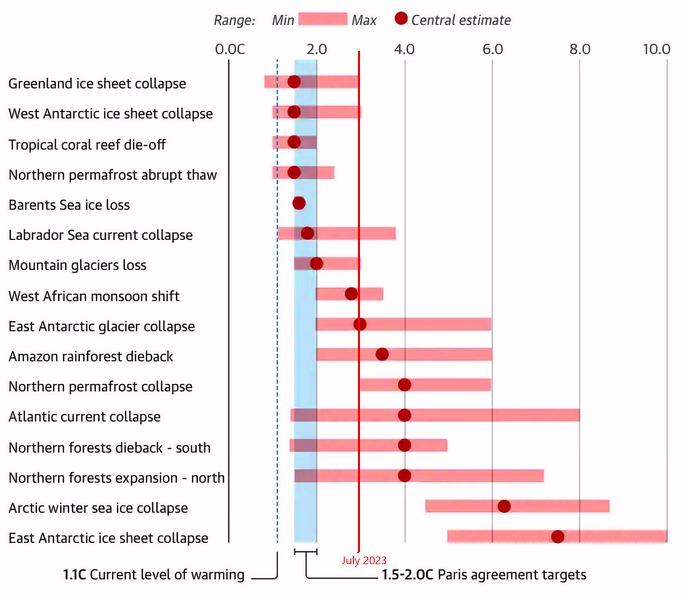
Tipping cascades have emerged between biogeophysical and social-ecological systems. This Domino Effect is causing climate change to accelerate at an exponential rate.

Tipping points are Critical Milestones that directly impact the rate of acceleration in climate change by multiplying the number and intensity of feedback loops. Identifying and understanding these tipping points is crucial for climate science and policymaking. Crossing multiple tipping points could lead to a domino effect, resulting in a much more rapid and severe climate change than currently projected.

Tipping Points

Push a glass toward the edge of a table and eventually it will fall off on its own. No matter how slowly or meticulously you push… no matter how you weight or fill the glass, it will reach a tipping point and fall off before being pushed completely off the table. No matter whether you believe the glass is half-empty or half-full, when the tipping point is reached it will plummet out-of-control to its end. This is science not fate, faith, nor belief. Human induced climate change has resulted in environmental tipping points being breached.

Tipping points, when crossed, trigger self-sustaining feedback loops that are no longer dependent on human activity. Similar to when a domino topples over hitting two more dominoes that in turn fall hitting more dominoes. Thus, the name The Domino Effect. It can also be visualized as The Snowball Effect. A tipping point is like a snowball rolling down a hill growing in mass and velocity (momentum). When a tipping point is crossed, it results in cumulative and reinforced global warming.

The Human Induced Climate Change Experiment

bookmark_borderElection 2024: The Decline of Economic Sensibility

I began writing this after listening to Harris’ recent speeches — first on drug prices and then on the broader economic policy of her campaign. My concerns arise from a general disappointment with the direction of the campaign’s economic strategy.

Unfortunately, the “deal to cut Medicare prices on popular drugs” is misleading. The claim of a 50% reduction in drug prices is based on the list price, which few people actually pay. Medicare already benefits from discounted rates, and this new legislation won’t have much impact on those prices. In truth, the new rule is unlikely to significantly affect pharmaceutical companies’ profits, which explains why their stock prices have remained stable. This legislation is more about political posturing than genuinely lowering drug costs for consumers.

Regarding the economic policy laid out in Harris’ second speech, blaming inflation on ‘corporate greed’ is a simplistic and misleading narrative that every serious investor and economist recognizes as nonsense. The real drivers of inflation are far more complex, with a significant portion—around 75%-85%—traceable to the Trump administration’s policies. Failing to accurately identify and address the true causes of inflation undermines the administration’s economic credibility. This misstep, coupled with the questionable drug price control regulations announced the day before, paints an increasingly concerning picture for the economy. Markets are already reacting negatively to these policy directions, which doesn’t bode well for the future. If possible, the campaign needs to adjust its messaging—because Trump’s policies would be even worse. After these two days of speeches, I’m seriously reconsidering my vote, and I’m not alone. Many others who prioritize the economy are having second thoughts as well.

When asked if I could ever vote for Trump, I replied: No, I would never vote for Trump. He stole money from our business ethics experiment back in the ’90s. If you read my papers on him, you’ll see that Trump is largely responsible for the current inflation due to his disastrous fiscal and monetary policies. However, I also can’t support Harris if she continues to advocate for policies that contradict basic economic principles. Protectionism, price controls, and tariffs are major red flags for the entire business community. My goal is to convey what the financial markets are signaling. Right now, they seem to prefer Trump’s lack of regulation over Harris’ market interventions. It’s troubling when markets lean towards Trump’s deregulation, despite the significant damage he’s caused.

A friend mentioned that Harris cited two major factors contributing to inflation: Trump’s mishandling of the pandemic and supply chain disruptions, along with ‘corporate greed’ and ‘price gouging.’ While Biden has supposedly addressed the first, Harris claims she’ll tackle the second. From an economist’s perspective, there are several issues with that viewpoint. My goal is to help Democrats win the election with solid economic facts, not alienate independents who were leaning towards supporting her. At the very least, it’s better to stay silent on certain points and ideally avoid catering to the base’s misguided notions. For example, avoid terms like ‘corporate greed,’ ‘price gouging,’ or discussions on ‘supply chain disruptions.’

My friend insisted that these issues are real and not up for debate. However, I replied that none of these things—’corporate greed,’ ‘price gouging,’ or ‘supply chain disruptions’ — are as straightforward as they’re often portrayed. Labeling them that way is misleading and oversimplifies the issues. Such terms are often used to incite the base rather than address the real, complex economic factors at play. I strongly suggest avoiding these simplistic labels as they risk alienating informed voters who recognize the deeper economic realities.

There is certainly a lack of economic understanding among Democrats, which is why I’m trying to provide some clarity. Corporate profit margins have remained relatively stable. The reason corporate profits seem to be at ‘record levels’ is due to inflation. As prices rise with inflation, the absolute dollar amount of profits increases, but the percentage of profits remains the same. As for prices coming down, that would indicate deflation, which is generally a sign of severe economic problems—not something we should hope for. Also, corporations are not capable of being ‘greedy’ by definition; attributing morals or ethics to non-human entities is nonsensical. Promoting these false and misleading ideas is detrimental to politicians, the economy, and only serves to sow division and hate.

Conclusion:
A friend asked me, “Okay, I hear you, but if you’re reconsidering your vote, who would you vote for?”

I replied that, as of now, I’m not planning to vote for either presidential or senatorial candidates. Both Harris and Casey have proposed highly detrimental economic policies, just as Trump and McCormick have. In my view, the Democrats have made a serious mistake in their messaging, turning these races into a battle of the bases.

Most importantly, neither party is addressing the most serious economic threat to humanity—climate change. While both sides sow division with false and misleading economic rhetoric, they are completely ignoring the accelerating impact of anthropogenic global warming. In fact, the policies proposed by both parties seem poised to exacerbate climate change, leading to a permanent decline in the U.S. economy and potentially rendering our planet mostly uninhabitable within a generation.

The Human Induced Climate Change Experiment

bookmark_borderClimate Science: Love and Hate

by Daniel Brouse
August 9 ,2024

As an economist, I have spent my career studying risk management, and in the process, I have also become a climate scientist—because climate change is the greatest risk to humanity. Climate science is closely tied to our emotions, particularly hate and love. The hatred of scientists and intelligence is one of the most significant factors contributing to the potential demise of modern civilization. If you’re over 8 years old, you should NOT be reposting memes. Most memes are generated by foreign actors (e.g. Russia) attempting to sow division through hate. Memes promoting class warfare, taxing the rich, and criticizing philanthropy are prime examples, as are those demonizing immigrants. If you’re under 8 years old, you shouldn’t be on social media at all. STOP REPOSTING HATEFUL MEMES.

The solution lies in increased education and LOVE.

From a paper I coauthored: The government’s actions, or lack thereof, reflect a dangerous combination of arrogance and ignorance, making worst-case predictions for climate change seem like best-case scenarios. Revised climate models now suggest that global temperatures could rise by as much as 9°C within this century, compared to earlier projections of a 4°C increase over the next millennium. Such a dramatic temperature rise could push Earth toward a “wet-bulb” temperature threshold, where the combination of heat and humidity makes it impossible for the human body to cool itself through perspiration, leading to potentially fatal heat stress.

What Can I Do?
There are plenty of things you can do to help save the planet: stop using fossil fuels, consume less, and love more.

Love has the transformative power to save the world in numerous ways:

  1. Fostering Connection and Unity: Love brings people together, transcending boundaries of race, religion, nationality, and ideology. By fostering a sense of empathy, compassion, and understanding, love promotes unity and solidarity among diverse individuals and communities. When people come together in love, they can work collaboratively to address shared challenges and create positive change on a global scale.
  2. Promoting Peace and Harmony: Love is the antidote to hatred, conflict, and violence. By promoting forgiveness, reconciliation, and mutual respect, love can help heal deep-seated divisions and promote peace and harmony within and between societies. When individuals and nations choose love over fear and hostility, they pave the way for peaceful coexistence and cooperation.
  3. Inspiring Empathy and Altruism: Love cultivates a sense of empathy and concern for the well-being of others. When individuals act out of love, they are motivated to alleviate suffering, promote justice, and advance the common good. Love inspires acts of kindness, generosity, and selflessness, creating a ripple effect of positive change that spreads throughout communities and across borders.
  4. Protecting the Environment: Love for the natural world motivates individuals to protect and preserve the planet for future generations. When people recognize their interconnectedness with all living beings and the delicate balance of ecosystems, they are inspired to adopt sustainable lifestyles, promote conservation efforts, and advocate for environmental stewardship. Love for the Earth compels us to take action to address climate change, protect biodiversity, and ensure a healthy and sustainable future for all.
  5. Empowering Social Justice: Love is inherently egalitarian, valuing the inherent worth and dignity of every individual. When people act out of love, they are committed to promoting social justice, equality, and human rights for all. Love drives efforts to dismantle systems of oppression, combat discrimination, and create inclusive societies where everyone has the opportunity to thrive. By standing up for justice and advocating for marginalized communities, love can help create a more just and equitable world for future generations.

In summary, love has the power to save the world by fostering connection and unity, promoting peace and harmony, inspiring empathy and altruism, protecting the environment, and empowering social justice. When individuals and communities choose love as their guiding principle, they can create a world where compassion, understanding, and cooperation prevail, paving the way for a brighter and more sustainable future for all.

The Human Induced Climate Change Experiment

bookmark_borderReal Estate Market Update

By Daniel Brouse
August 5, 2024

Short sellers in the real estate market are currently anticipating a significant downturn, driven by a combination of factors. The recent trend of private investment groups purchasing large quantities of real estate has led to concerns about a potential future liquidation of these assets. As these investment groups may eventually seek to offload properties, this could flood the market, potentially driving down prices and creating an oversupply.

Additionally, the looming impact of climate change on the housing market cannot be overlooked. There is increasing concern that within the next decade, around 25% of the U.S. housing market could become uninsurable due to the heightened risk of natural disasters such as floods, hurricanes, and wildfires. Properties in vulnerable areas are likely to face skyrocketing insurance premiums or become entirely uninsurable, making them less attractive to buyers and investors alike. This scenario is expected to create a more challenging environment for real estate investments, as properties in these high-risk areas may experience significant depreciation in value.

As a result, short sellers are betting on a decline in real estate prices, anticipating that these combined pressures will lead to a market correction. The long-term outlook for real estate investments, particularly in climate-sensitive regions, is fraught with uncertainty, prompting investors to reconsider their strategies. This situation underscores the importance of considering both market dynamics and environmental factors in real estate decision-making.

The Human Induced Climate Change Experiment

Business and Economics

bookmark_borderThe Politics of Climate Change

By Daniel Brouse

As a climate scientist, I have studied the impact of politics on the climate for decades, and the United States ranks among the least prepared countries globally. It also has one of the highest percentages of climate change deniers. Politicians exacerbate this issue by obstructing necessary efforts to combat climate change. The Republican Party, in particular, often dismisses climate change as a manufactured crisis and advocates for increased fossil fuel production. This stance is ironic, as human industrial activities, which are heavily dependent on fossil fuels, are a primary driver of climate change.

Despite some efforts under President Biden to address these issues, the U.S. continues to be the world’s largest producer of oil, including crude oil, natural gas liquids, and other petroleum products. Both political parties have largely opted to provide unlimited emergency funding for climate disasters rather than investing in preventive measures. In 2023, the United States experienced an unprecedented number of climate-related disasters, with 28 major weather and climate events, each causing over a billion dollars in damages. These ranged from hurricanes and wildfires to severe storms and flooding, with some events costing hundreds of billions of dollars individually.

In June 2024, a significant Supreme Court decision severely restricted the Environmental Protection Agency’s (EPA) authority, limiting its ability to enforce environmental protection laws. This ruling marked a drastic shift, undermining decades of regulatory progress aimed at mitigating environmental damage and climate change. It effectively nullified the EPA’s power to regulate emissions and enforce environmental standards, which is a critical setback in the fight against climate change.

The government’s actions, or lack thereof, reflect a dangerous combination of arrogance and ignorance. This situation makes the worst-case predictions for climate change seem like optimistic scenarios. Revised climate models now suggest that global temperatures could rise by as much as 9°C within this century, compared to earlier projections of a 4°C increase over the next millennium. Such a dramatic temperature rise could push Earth toward a “wet-bulb” temperature threshold, where the combination of heat and humidity makes it impossible for the human body to cool itself through perspiration, leading to potentially fatal heat stress.

* Our climate model uses chaos theory in an attempt to adequately account for humans and forecasts a global average temperature increase of 9 degrees Celsius above pre-industrial levels. Everybody has the responsibility not to pollute. There are plenty of things you can do to help save the planet. Stop using fossil fuels. Consume less. Love more. Here is a list of additional actions you can take.

The Human Induced Climate Change Experiment

bookmark_borderWealth Taxes Are Illogical

By Daniel Brouse
July 30, 2024

There are numerous reasons why a wealth tax can be a self-defeating fiasco, and the case of taxing someone like Elon Musk vividly illustrates this. A wealth tax on high-net-worth individuals could create a complex and problematic feedback loop involving the sale of Tesla stock and the associated capital gains taxes. To meet his wealth tax obligations, Musk might be compelled to sell a significant portion of his Tesla shares. This large-scale sale could depress the stock price, particularly if the volume of shares sold is substantial, thereby reducing the value of his remaining holdings. As a result, Musk might need to sell even more shares to cover the same wealth tax amount.

Moreover, each sale of shares generates capital gains, which are subject to additional taxes. To pay these capital gains taxes, Musk would need to sell even more shares, perpetuating a cycle where each sale incurs further tax liabilities and necessitates additional sales. This continuous process could exacerbate the decline in Tesla’s stock price, compounding the need for further sales. Over time, this cycle could severely erode Musk’s holdings in Tesla and significantly diminish his overall wealth.

The ramifications of this feedback loop extend beyond Musk. The decline in Tesla’s stock price could adversely affect a wide range of stakeholders, including individual investors such as widows, orphans, and those with retirement accounts. Their investments could lose value as a result of the cascading effect of share sales driven by the wealth tax.

Furthermore, applying a wealth tax to other ventures like SpaceX and Neuralink could be even more detrimental. Such a tax could stifle innovation and growth in these groundbreaking companies, potentially leading to broader economic repercussions and undermining the very objectives the tax aims to achieve. Overall, the unintended consequences of a wealth tax could be far-reaching, affecting not just the wealthy but also impacting the broader economy and investment landscape.

The other impacts of such taxes on a larger portion of the population are likely to lead to even more devastating economic outcomes. Unlike any previous period of excessive taxation in the U.S., it is now much easier for capital to flee the country. The internet and technological advances make it simpler for wealth to move to less hostile environments. As a result, instead of creating more equity, these taxes could accelerate inequality.

Q: How much is Musk’s income, net worth, and projected wealth tax? Your scenario assumes that the wealth tax is onerous.

A: This scenario was based on a one-time net worth tax of 3.4%. It references a still circulating meme from 2021 that stated the $11 billion in income taxes Musk paid that year amounted to only 3.4% of his net wealth, suggesting that more should be paid. In any event, all wealth taxes, regardless of the rate, would present significant challenges. As soon as you tax wealth, it inherently declines. But even before that point, determining the value of assets is fraught with difficulties. For example, how do you accurately assess the value of companies like SpaceX or Neuralink? Their worth isn’t easily defined, especially given their potential for future growth and the speculative nature of their industries. If the wealth tax were applied annually, the challenges would be even greater. Yearly valuations would be required, and the volatility of asset prices could lead to significant fluctuations in tax liabilities, creating further complications for both the taxpayer and the tax authorities. Additionally, the administrative burden of assessing and enforcing such a tax could be substantial, potentially outweighing the benefits. More importantly, even if all their money were taken, it would do almost nothing to reduce the national debt. In fact, it could potentially have the opposite effect. This can be observed at the state level, with Tesla moving out of Delaware and California. Imposing a wealth tax could lead to wealth fleeing the U.S. A much better idea would be to tax pollution.

Q: What about a flat tax?

Actually, the US has a progressive income tax. In recent years, the top 10% of income earners in the United States have contributed significantly more to federal income tax revenues. Specifically, for the 2020 tax year, the top 10% paid 73.7% of all federal income taxes. This concentration of tax liability has increased over time, reflecting a greater share of total income and taxable income among the wealthiest individuals.

For comparison, the top 1% of taxpayers alone paid 42.3% of all federal income taxes in 2020, while the bottom 50% of earners contributed only 2.3%. Generally, progressive taxes on productivity can be detrimental to an economy and disproportionately affect the poorest individuals.

A Much, Much Better Approach
A more effective approach would be to tax negative externalities, similar to the taxation on cigarettes. For example, imposing a 100% tax on a barrel of oil and a 1,000% tax on a ton of coal could significantly disincentivize the use of fossil fuels. Such high taxes would make fossil fuels much more expensive, encouraging industries and consumers to transition to cleaner energy alternatives like wind, solar, and nuclear power. This shift would not only reduce greenhouse gas emissions but also mitigate the broader environmental harm caused by fossil fuel extraction and consumption, including air and water pollution.

Pollution from fossil fuels is the leading cause of death globally, contributing significantly to respiratory and cardiovascular diseases. The impact is disproportionately felt by the poorest and most disenfranchised populations, who often live in areas with higher pollution levels and have less access to healthcare. These communities are also more likely to suffer from the environmental and health consequences of fossil fuel extraction and burning, such as air and water contamination, leading to a cycle of poverty and illness. The burden of fossil fuel pollution is not evenly distributed; it exacerbates existing social and economic inequalities, making it a pressing issue for both public health and social justice. Addressing this challenge requires comprehensive policies that not only reduce emissions but also protect and uplift the most vulnerable populations.

Climate change will continue to exacerbate existing inequalities. As extreme weather events, rising sea levels, and other climate-related disruptions increase, those with fewer resources will struggle the most to adapt and recover. This growing inequality calls for a two-pronged approach: actively working to mitigate global warming and preparing for the socio-economic disparities it will inevitably deepen.

The Real Threat to Economic Security
Regrettably, the United States ranks among the least prepared countries globally, with the highest percentage of climate deniers. Politicians exacerbate the problem by hindering efforts against climate change. The Republican Party dismisses it as a manufactured crisis and plans to increase fossil fuel production. Political extremists asserting that the climate crisis is manufactured employ an ironic term, considering that human manufacturing activities are the primary driver of climate change.

Under President Biden, the United States continues to be the world’s largest producer of oil, including crude oil, natural gas liquids, and other petroleum products. Both political parties have concurred to allocate unlimited emergency funding for climate disasters instead of proactively preventing them. In 2023, the U.S. witnessed a record number of climate disasters exceeding one billion dollars each, totaling 28 separate weather and climate-related events.

In June 2024, the Supreme Court significantly expanded its authority and severely curtailed the Environmental Protection Agency’s (EPA) ability to enforce environmental protection laws. This ruling represents a dramatic shift in the balance of power, undermining decades of regulatory progress aimed at mitigating environmental damage and climate change. The court’s decision essentially nullifies the EPA’s mandate to regulate emissions and enforce compliance with existing environmental standards.

This judicial overreach is viewed by many as an act of arrogance and ignorance, resulting in a scenario where “worst-case” predictions for climate change have become the “best-case” expectations. The ramifications of this decision are dire, prompting a revision of climate models to reflect a much grimmer outlook. The new projections indicate a potential maximum global temperature increase of 9°C within this century, a stark rise from the previously estimated 4°C over the next millennium.

CONCLUSION
The national debt currently stands at $36 trillion. Even if we taxed 100% of the wealth of the top 1%, we would still owe more than $36 trillion at the end of the year. Additionally, this move would eliminate approximately 45.8% of all federal individual income tax revenue. The only viable solution is to address the existential crises we face, as failing to do so means risking widespread early deaths, poverty, and a lack of healthcare for everyone.

Balancing the Books: How Public-Private Healthcare Models Can Sustain Economic Growth

Taxation in a Changing World: Challenges, Inefficiencies, and Paths to Sustainability

Wealth Taxes Are Illogical

Business and Economics

The Human Induced Climate Change Experiment

bookmark_borderDrill, Baby, Drill (How Hate and Ignorance Distort Economic Perspectives)

By Daniel Brouse
July 19, 2024

“Perhaps most importantly is the repeated use of the phrase ‘Drill, Baby, Drill’.”

Economic Update:
If Trump wins, great news for the very few people whose primary income comes from government securities interest! Unfortunately, very, very bad news for everyone else.

Tariffs, protectionism, lack of immigration, and nationalism are all detrimental to the economy. Tariffs and protectionist policies can lead to trade wars, higher consumer prices, and disruptions in the supply chain, which can stifle economic growth. Limiting immigration reduces the labor force and can slow down innovation and productivity, as immigrants often contribute significantly to economic dynamism. Nationalism can lead to isolationist policies that hinder international cooperation and trade, further damaging the economy. Over the last several years, approximately 80% of economic growth can be attributed to immigration.

Should Trump win, there is a concern that the U.S. may face economic decline similar to his six personal bankruptcies. His previous administration’s policies on tariffs, immigration restrictions, and nationalist rhetoric have already shown signs of economic strain. Continued implementation of such policies could exacerbate these issues, leading to a weakened economy and reduced global competitiveness for the U.S. It is crucial to adopt inclusive and cooperative economic strategies to foster sustainable growth and stability.

Interest rates are likely to spike and remain high for an extended period. In 2019, under the Trump administration, the Federal Reserve balance sheet saw a massive increase of $4 trillion in a very short period. This unprecedented expansion of the money supply, combined with the administration’s tax cuts and significant government spending, contributed to record inflation levels. The rapid increase in the money supply, aimed at stimulating the economy, led to an oversupply of currency, diminishing its value and driving prices up.

Federal Reserve's Balance Sheet / Assets
Federal Reserve’s Balance Sheet / Assets

The former President has also made claims that he will lower interest rates if he returns to office. The good news is that he doesn’t have the authority to directly lower rates, as this is the Federal Reserve’s responsibility. However, what used to be reassuring news is now less so. With the rollback of Chevron regulations, potential economic instability could lead to disastrous consequences, including further inflationary pressures and financial market disruptions.

Additionally, the tax cuts, while boosting short-term economic growth, significantly reduced federal revenue, leading to increased borrowing and higher national debt. The substantial government spending further exacerbated this issue, creating a fiscal environment prone to inflation. As a result, the Federal Reserve had to raise interest rates to combat inflation and stabilize the economy.

High interest rates can slow down economic growth by making borrowing more expensive for consumers and businesses, potentially leading to reduced investments and spending. This can create a challenging economic environment, underscoring the need for balanced fiscal policies that promote sustainable growth without leading to excessive inflation.

The former President recently stated that he wants a ‘weaker dollar.’ A devalued dollar on international markets can lead to numerous economic challenges, including significant impacts on inflation and interest rates. A weaker dollar makes U.S. exports cheaper and more competitive abroad, potentially boosting manufacturing and trade. However, it also increases the cost of imports, leading to higher prices for consumer goods and contributing to inflation.

Additionally, a weaker dollar can affect interest rates as the Federal Reserve may adjust monetary policy to manage inflationary pressures, impacting borrowing costs for consumers and businesses. Another concern is the impact on foreign investment. Treasury securities are popular among foreign investors because they are considered a safe investment. However, if the dollar devalues, the return on these investments may decrease when converted back to the investor’s local currency. To attract foreign investment despite the weaker dollar, the U.S. may need to offer higher interest rates on Treasury securities.

These economic landmines highlight the complexities and potential risks associated with currency devaluation.

Perhaps most importantly is the repeated use of the phrase ‘Drill, Baby, Drill’. The phrase encapsulates a harmful approach to energy policy that prioritizes fossil fuel extraction over sustainable practices. Climate change, exacerbated by such policies, poses the most severe threat not only to our environment but also to our economy.

In 2023, the U.S. experienced a record number of climate disasters, each exceeding one billion dollars in damages, with a total of 28 separate weather and climate-related events. Some of these individual events cost the U.S. economy hundreds of billions of dollars. The frequency and severity of these events are alarming, reflecting the accelerating pace of climate change.

The economic impact of climate change is expected to be staggering, with projections indicating it could cost the U.S. economy trillions of dollars. The financial burdens arise from various sources, including the destruction of infrastructure, increased healthcare costs due to climate-related illnesses, disruptions to agriculture and food supply, and the need for extensive disaster relief and recovery efforts. One of the primary drivers of the current inflation spike is the rising cost of homeowners insurance due to climate disaster-related claims. Short sellers anticipate that within ten years, 25% of U.S. properties will be uninsurable. These costs will continue to rise unless significant measures are taken to mitigate climate change and transition to a more sustainable energy system.

Moreover, the long-term economic effects of climate change can hinder economic growth, reduce productivity, and increase social inequalities. Proactive investments in renewable energy, climate resilience, and sustainable practices are essential to curtail the financial and environmental impacts of climate change. These measures are crucial to protect both the environment and the economy from the devastating impacts of climate change.

Trumpenomics: The Decline of the US

Economic Outlook 2025 – 2035

Protectionism 101: Trump Economics

The Human Induced Climate Change Experiment

bookmark_borderThe Federal Reserve and the Chevron Decision

by Daniel Brouse
July 10, 2024

The Federal Reserve chairman was questioned in Congress today about the potential impacts of the ‘Chevron Decision’ on the Fed. Although he mentioned that it was too early to determine the full effects, he acknowledged that numerous frivolous lawsuits could become a significant hindrance. This uncertainty clearly poses challenges for the future stability of our economy. It was not a reassuring day for economic prospects.

The Chevron Decision refers to the landmark Supreme Court case Chevron U.S.A., Inc. v. Natural Resources Defense Council, Inc. (1984). This decision established the principle of judicial deference to administrative agencies’ interpretations of ambiguous statutes that they administer. The ruling essentially meant that courts should defer to agencies’ expertise unless their interpretations are unreasonable.

However, recent shifts in judicial philosophy and subsequent rulings, often termed “Chevron deference rollback,” seek to limit this deference. This change could significantly impact how agencies, including the Federal Reserve, operate.

Here’s how the erosion of Chevron deference could result in lawsuits every time the Federal Reserve makes a decision:

1. Increased Legal Challenges

Without Chevron deference, every decision or rule made by the Federal Reserve that involves interpreting ambiguous statutes could be more easily challenged in court. Previously, courts would defer to the Fed’s expertise, but now, they might feel more empowered to overrule the Fed’s interpretations. This invites more lawsuits from parties who disagree with the Fed’s decisions.

2. Reduced Predictability and Stability

Chevron deference provided a level of predictability and stability, as agencies knew their interpretations would likely be upheld if reasonable. With this predictability diminished, every decision becomes a potential legal battleground. This can disrupt the consistency and effectiveness of the Fed’s policies, as they could be constantly tied up in litigation.

3. Resource Strain

The Federal Reserve would likely face a significant increase in legal challenges, requiring more resources to defend its decisions in court. This could divert time, money, and effort away from its primary functions of managing monetary policy, regulating banks, and ensuring financial stability.

4. Policy Hesitation

Knowing that decisions could be frequently overturned, the Fed might become more hesitant or conservative in its policy-making. This could stifle innovation and responsiveness in addressing economic issues, as the fear of legal repercussions might outweigh the need for proactive measures.

Example Scenario

Imagine the Federal Reserve decides to implement a new regulation on bank capital requirements based on its interpretation of an ambiguous provision in the Dodd-Frank Act. Without Chevron deference, banks could challenge this interpretation in court, arguing that the Fed overstepped its authority. If the court agrees, the regulation could be struck down, leading to regulatory uncertainty and potentially undermining financial stability.

Conclusion

The potential rollback of Chevron deference could expose the Federal Reserve to frequent lawsuits over its interpretive decisions, hampering its ability to effectively manage the economy. This shift could lead to a more contentious and litigious regulatory environment, challenging the Fed’s authority and efficiency.

Chevron Deference Rollback and the Environment

In June 2024, the Supreme Court significantly expanded its authority and severely curtailed the Environmental Protection Agency’s (EPA) ability to enforce environmental protection laws. This ruling represents a dramatic shift in the balance of power, undermining decades of regulatory progress aimed at mitigating environmental damage and climate change. The court’s decision essentially nullifies the EPA’s mandate to regulate emissions and enforce compliance with existing environmental standards.

This judicial overreach is viewed by many as an act of arrogance and ignorance, resulting in a scenario where “worst-case” predictions for climate change have become the “best-case” expectations. The ramifications of this decision are dire, prompting a revision of climate models to reflect a much grimmer outlook. The new projections indicate a potential maximum global temperature increase of 9°C within this century, a stark rise from the previously estimated 4°C over the next millennium.

Such an unprecedented increase in global temperatures would push Earth toward a wet-bulb temperature threshold that is incompatible with human life. Wet-bulb temperature, which combines heat and humidity, represents a critical limit beyond which the human body can no longer effectively cool itself through perspiration, leading to potentially fatal heat stress.

The Human Induced Climate Change Experiment


bookmark_borderLooming Deadlines for Coastal Resilience: Rising Seas, Disruptive Tides, and Risks

Looming Deadlines for Coastal Resilience: Rising Seas, Disruptive Tides, and Risks to Coastal Infrastructure

The report “Looming Deadlines for Coastal Resilience: Rising Seas, Disruptive Tides, and Risks to Coastal Infrastructure” highlights the critical challenges and timelines faced by coastal communities in addressing the impacts of climate change. Key points include:

  1. Rising Sea Levels: Coastal regions are increasingly vulnerable to higher sea levels, which expand floodplains and deepen floodwaters. This intensifies the frequency and severity of coastal flood events.
  2. Infrastructure at Risk: By 2080, major increases in the number of residents and buildings exposed to extreme coastal flooding are projected. For instance, the number of homes exposed to major flooding is expected to rise from 360,000 to 943,000, and annual flood damages could surge from $0.4 billion to $5.1 billion.
  3. Critical Infrastructure: The number of miles of roadways prone to chronic coastal flooding could grow from 500 to nearly 2,800 miles, drastically affecting transportation and emergency response capabilities.
  4. Environmental Impact: Significant loss of tidal wetlands and dunes is anticipated, with nearly 89% of existing tidal wetlands and 38% of dunes expected to be permanently inundated by 2080.
  5. Resilience Strategies: The report emphasizes the need for comprehensive and adaptive strategies to manage and mitigate these risks, including improved coastal planning, investment in resilient infrastructure, and community engagement.
  6. Financial and Policy Support: To support resilience efforts, mechanisms like the Community Flood Preparedness Fund (CFPF) have been established to provide funding and resources for projects aimed at enhancing coastal resilience, particularly prioritizing low-income communities.

The report underscores the urgent need for action and substantial investment to protect coastal regions from the accelerating impacts of climate change.

For more detailed information, you can access the full report here​ (VA Dept of Conservation)​.


Resources

Flood Insurance Brouse and Mukherjee (1995-present)

Insurance Cost and Availability Brouse (2024)

Create a Climate-Resilient Environment in and Around Your Home Brouse (2024)

Managed Retreat: Relocating Due to Climate Change Extreme Weather Events Brouse (2023)

Stormwater Runoff Management for Your House Brouse (2024)

Atmospheric Rivers Mukherjee and Brouse (2022-2023)

Violent Rain and the Substrate Brouse and Laden (2024)

Real Estate Underwater: A Florida Climate Change Case Study Daniel Brouse (2023)

Climate Change Impacts on Flood Risks and Real Estate Values Sidd Mukherjee and Daniel Brouse (2023)

Real Estate and Climate Change: Stranded on an Island Daniel Brouse (2023)

Climate Change: What Can I Do?

Human Induced Climate Change