bookmark_borderClimate Change: Climax and Succession Forests

by Daniel Brouse
June 25, 2024

Climate change has profound effects on both climax and succession forests, altering their composition, structure, and ecological dynamics. Here’s how these impacts unfold:

Climax Forests

Climax forests are stable, mature ecosystems that have reached a late stage of ecological succession. They are characterized by a stable species composition and structure that persists until disrupted by a disturbance. Climate change impacts these forests in several ways:

  1. Temperature Increases: Warmer temperatures can stress species that are adapted to cooler climates, leading to shifts in species composition. For example, in boreal climax forests, species like spruce and fir may decline, while more temperate species like maple and oak may increase .
  2. Altered Precipitation Patterns: Changes in precipitation can affect soil moisture levels, influencing tree growth and survival. In areas experiencing increased drought, such as some temperate and Mediterranean forests, species that are less drought-tolerant may decline, altering the forest structure and function .
  3. Increased Frequency of Disturbances: Climate change can lead to more frequent and intense disturbances, such as wildfires, storms, and pest outbreaks. These disturbances can reset succession processes, pushing climax forests back to earlier successional stages and altering their long-term stability .
  4. Pest and Disease Proliferation: Warmer temperatures can facilitate the spread of pests and diseases. For instance, the mountain pine beetle has devastated large areas of climax forests in North America, leading to widespread tree mortality and changes in forest composition .

Succession Forests

Succession forests are in various stages of recovery following a disturbance. Climate change affects these forests by altering the rates and trajectories of succession:

  1. Altered Growth Rates: Changes in temperature and CO2 levels can influence the growth rates of different species. Some pioneer species may grow faster under higher CO2 concentrations, potentially accelerating early successional stages but also potentially leading to different competitive dynamics later on .
  2. Species Shifts: Climate change can influence which species dominate during different successional stages. For example, increased temperatures and altered moisture regimes can favor different sets of pioneer and mid-successional species, leading to novel successional pathways .
  3. Disturbance Regimes: More frequent disturbances can prevent succession forests from reaching climax stages, maintaining them in earlier stages of succession for longer periods. This can alter the landscape mosaic and the biodiversity it supports .
  4. Seed Dispersal and Establishment: Climate change can affect seed dispersal mechanisms and the establishment success of seedlings. Changes in wind patterns, animal behaviors, and soil conditions can influence which species successfully establish in succession forests .

Ecological and Management Implications

  • Biodiversity: Changes in species composition and structure can affect biodiversity at multiple levels. Some species may thrive while others decline, potentially leading to losses in overall biodiversity.
  • Ecosystem Services: The ability of forests to provide ecosystem services, such as carbon sequestration, water regulation, and habitat provision, can be altered. For example, changes in species composition can influence the carbon storage capacity of forests.
  • Conservation and Management: Adaptive management strategies are needed to address the impacts of climate change on both climax and succession forests. This includes monitoring changes, facilitating species migration, and managing disturbances to maintain forest health and resilience.

Sources

These impacts underscore the complex and dynamic nature of forest ecosystems in the face of climate change, highlighting the need for adaptive management and conservation strategies.
From the album “Wood You Save the Trees?” by The Beatless Sense Mongers

The Human Induced Climate Change Experiment

bookmark_borderHead North: Climate Change and Tree Migration

by Daniel Brouse
June 25, 2024
Trees “move” through a process of gradual migration, which occurs over generations through the dispersal of seeds. This migration is driven by environmental changes, such as climate change, and can be observed in the expansion of greenery into new areas, such as the tundra, and the invasion of southern species into regions like the Mid-Atlantic USA. Here’s how these processes work:

Expansion into the Tundra

In Arctic and sub-Arctic regions, warming temperatures have led to the expansion of tree lines into previously barren tundra areas. This process involves several steps:

  1. Seed Dispersal: Trees like spruce and birch produce seeds that are dispersed by wind, animals, or water. As temperatures rise, seeds can survive and germinate in areas further north where they previously could not.
  2. Seedling Establishment: Once seeds land in a suitable area, they must germinate and grow. Warmer temperatures and a longer growing season improve the chances for seedlings to establish.
  3. Growth and Maturation: As seedlings grow, they gradually form new tree stands, expanding the forested area northward. This process is slow but cumulative, leading to noticeable changes over decades.
  4. Ecosystem Changes: The establishment of trees in the tundra brings changes to the local ecosystem. Trees provide shade, alter soil composition, and affect the local microclimate, making it more suitable for additional plant and animal species.

Studies and observations have documented this greening effect in regions like Alaska and Siberia, where satellite imagery shows an increase in vegetation cover in the tundra over recent decades​ (ExelonCorp)​​ (Exelon Corporation)​.

Invasion of Southern Species in the Mid-Atlantic USA

In the Mid-Atlantic USA, climate change has facilitated the northward movement of species traditionally found in more southern regions. This invasion is marked by several factors:

  1. Temperature Increase: Warmer temperatures allow species that thrive in warmer climates to survive and reproduce in more northern areas.
  2. Seed Dispersal Mechanisms: Southern species, such as the loblolly pine or the southern pine beetle, spread through natural dispersal mechanisms. Birds, wind, and animals carry seeds northward.
  3. Competitive Advantage: These southern species often have competitive advantages in warmer conditions, allowing them to outcompete native species. For example, the southern pine beetle has expanded its range northward, affecting forests in New Jersey and Pennsylvania.
  4. Changes in Phenology: Warmer temperatures can change the timing of life cycle events. For example, earlier springs can favor the growth of southern species over native species, giving them a head start in the growing season.

Research has shown that the ranges of many tree species are shifting northward in response to climate change. For instance, the U.S. Forest Service has observed that species like the sweetgum and the live oak are becoming more common in areas where they were previously rare or absent​ (ExelonCorp)​​ (Exelon Corporation)​.

Sources

These examples illustrate how trees migrate by gradually expanding their range into new areas as environmental conditions change, driven by factors such as temperature increases, changes in precipitation patterns, and altered ecosystems.

Invasive Tree Species in North America

Several southern tree species have migrated northward in North America due to the impacts of climate change. Here are some notable examples:

1. Loblolly Pine (Pinus taeda)

  • Description: Native to the southeastern United States, the loblolly pine has been observed moving into more northern regions.
  • Migration Evidence: Studies have documented its establishment in areas like the Mid-Atlantic and even parts of the northeastern U.S., driven by warmer temperatures and changing precipitation patterns.
  • Sources: USDA Forest Service

2. Southern Magnolia (Magnolia grandiflora)

  • Description: Traditionally found in the southeastern U.S., this tree is known for its large, fragrant flowers and evergreen leaves.
  • Migration Evidence: Its range is expanding northward, and it is increasingly found in areas like the Mid-Atlantic due to milder winters and warmer growing seasons.
  • Sources: National Park Service

3. Sweetgum (Liquidambar styraciflua)

  • Description: Native to the southeastern U.S., sweetgum trees are known for their star-shaped leaves and spiky fruit.
  • Migration Evidence: They are moving into the northern parts of their range, such as the Mid-Atlantic and even parts of New England, as temperatures rise.
  • Sources: Forest Ecology and Management Journal

4. American Holly (Ilex opaca)

  • Description: This evergreen tree, native to the southeastern U.S., is known for its distinctive red berries and glossy leaves.
  • Migration Evidence: Its range is expanding northward, with more frequent sightings in the Mid-Atlantic and northeastern regions.
  • Sources: USDA Forest Service

5. Live Oak (Quercus virginiana)

  • Description: Native to the southeastern coastal plains, live oaks are known for their sprawling branches and long lifespan.
  • Migration Evidence: There are reports of live oaks being planted and surviving in areas further north than their traditional range, reflecting milder winters.
  • Sources: U.S. Global Change Research Program

Migration Mechanisms

  • Warmer Temperatures: As global temperatures rise, the climates of northern regions become more suitable for these southern species.
  • Changing Precipitation Patterns: Altered rainfall patterns can create conditions more favorable to southern species in northern areas.
  • Extended Growing Seasons: Longer growing seasons in northern regions due to climate change allow southern species more time to establish and grow.

Ecological Implications

  • Competition with Native Species: The migration of southern species can lead to increased competition with native northern species, potentially altering local ecosystems.
  • Biodiversity Changes: The influx of new species can change the composition of forests, affecting biodiversity and ecosystem services.

These examples illustrate the dynamic nature of forest ecosystems in response to climate change, with southern tree species moving into new territories as they seek suitable habitats.

From the album “Wood You Save the Trees?” by The Beatless Sense Mongers

The Human Induced Climate Change Experiment

bookmark_borderClimate Change: The Migration of Tree Species

by Daniel Brouse
June 25, 2024

The migration of tree species in temperate zones is significantly impacted by climate change through several mechanisms:

  1. Shifts in Suitable Habitats: As temperatures rise, the suitable habitats for many tree species are moving poleward and to higher elevations. Trees that thrive in cooler climates are finding their current habitats increasingly inhospitable, pushing them to migrate towards cooler areas. However, the speed of climate change often outpaces the natural migration capabilities of many tree species, leading to potential mismatches between trees and their optimal environments.
  2. Changes in Phenology: Climate change alters the timing of biological events such as leaf-out, flowering, and seed dispersal. These changes can affect the success of tree species in establishing themselves in new areas. For instance, if spring arrives earlier, trees that cannot adjust their growth cycles might struggle to compete with species that can, impacting their ability to migrate successfully.
  3. Barrier to Movement: Physical barriers such as mountains, rivers, and human-made structures like roads and urban areas can impede the migration of tree species. Even without these barriers, the fragmented nature of modern landscapes often means that contiguous suitable habitats are rare, complicating the migration process.
  4. Soil and Ecosystem Interactions: Tree species are part of complex ecosystems and their successful migration depends on the migration of associated species like soil microbes, fungi (mycorrhizae), and pollinators. If these organisms do not migrate at the same rate or to the same new areas, tree species may struggle to establish in new habitats.
  5. Competition and Predation: As tree species migrate, they encounter new competitors and predators. These interactions can affect their ability to establish and thrive in new areas. For example, a migrating tree species might be less competitive in its new habitat or might face predation from herbivores that it did not encounter in its original range.
  6. Genetic Diversity: The genetic diversity of tree populations affects their ability to adapt to new conditions. Populations with high genetic diversity are more likely to have individuals that can survive and reproduce in changing conditions. However, many tree species have low rates of natural genetic mutation and long lifespans, which can slow their adaptive responses to rapid climate changes.

Examples and Studies

  • North American Forests: In North America, studies have shown that tree species such as sugar maple and American beech are migrating northward as temperatures increase. However, this migration is often slower than needed to keep pace with climate change predictions​ (ExelonCorp)​.
  • European Forests: European beech and Norway spruce are also showing signs of northward migration and moving to higher elevations in response to warming climates​ (Exelon Corporation)​.
  • Modeling and Predictions: Various climate models predict significant shifts in tree species distributions. For instance, a study using the Species Distribution Model (SDM) predicts that suitable habitats for many European tree species will shift northwards and upwards by several hundred kilometers over the next century​ (Exelon Corporation)​.

Sources

These impacts demonstrate the complex interplay between climate change and the migration of tree species, highlighting the challenges and uncertainties faced by forests in temperate zones.

From the album “Wood You Save the Trees?” by The Beatless Sense Mongers

The Human Induced Climate Change Experiment

bookmark_borderReferences for “Carbon Offsets: Planting Trees is Greenwashing”

By Daniel Brouse
June 21, 2024

Carbon Offsets and Sequestration: Planting Trees is Greenwashing — Brouse (2023)

To support the statement “Giving carbon offsets for planting trees and allowing for the continued use of fossil fuels is greenwashing and accelerates the pace of climate change,” here are some references:

  1. Carbon Offsets and Greenwashing:
    • Kollmuss, A., & Agyeman, J. (2002). “Mind the Gap: Why do people act environmentally and what are the barriers to pro-environmental behavior?” Environmental Education Research. This paper discusses the concept of greenwashing and the ineffectiveness of certain carbon offset schemes.
    • Gillenwater, M. (2012). “What is Additionality? Part 1: A Long Standing Problem.” Greenhouse Gas Management Institute. This paper critiques the concept of additionality in carbon offset projects, which is crucial for understanding greenwashing.
  2. Ineffectiveness of Tree Planting as Offsets:
    • Bastin, J.-F., et al. (2019). “The global tree restoration potential.” Science. This study discusses the limitations and potential of tree planting for carbon sequestration.
    • Houghton, R. A. (2013). “The emissions of carbon from deforestation and degradation in the tropics: past trends and future potential.” Carbon Management. This paper highlights the challenges and limited impact of reforestation projects.
  3. Fossil Fuels and Climate Change:
    • Intergovernmental Panel on Climate Change (IPCC). (2021). “Climate Change 2021: The Physical Science Basis.” This report provides comprehensive evidence on the impact of fossil fuels on climate change.
    • International Energy Agency (IEA). (2021). “Net Zero by 2050: A Roadmap for the Global Energy Sector.” This report emphasizes the need to reduce fossil fuel usage to meet climate targets.
  4. Accelerating Climate Change:
    • Anderson, K., & Peters, G. (2016). “The trouble with negative emissions.” Science. This article discusses the reliance on future technologies, like carbon offsets, and their impact on current fossil fuel use and climate change acceleration.
    • Harvey, F. (2021). “Climate crisis: the massive impact of global warming on the Arctic.” The Guardian. This article explores how ongoing fossil fuel use exacerbates climate change impacts, particularly in sensitive regions like the Arctic.

These references provide a foundation for understanding how carbon offsets, particularly through tree planting, can be seen as greenwashing when they allow for the continued use of fossil fuels, thus accelerating climate change.

The fossil fuel industry uses carbon offsets as a strategy to maintain and even expand the use of fossil fuels while attempting to address concerns about climate change. Here’s how this works:

  1. Promoting Carbon Offsets: The fossil fuel industry invests in or purchases carbon offsets, which are credits representing reductions in greenhouse gas emissions achieved by others. These offsets can come from various projects such as reforestation, renewable energy, or methane capture.
  2. Continuing Emissions: By purchasing carbon offsets, fossil fuel companies claim to neutralize their own emissions. This allows them to argue that they can continue extracting, refining, and burning fossil fuels without increasing their net carbon footprint.
  3. Public Relations: The industry uses carbon offsets as part of their public relations strategy to portray themselves as environmentally responsible. This helps to counter criticism and regulatory pressure related to their contributions to climate change.
  4. Regulatory Compliance: In some regions, carbon offsets are part of cap-and-trade systems or carbon pricing mechanisms. By using offsets, fossil fuel companies can meet regulatory requirements without reducing their actual fossil fuel production and consumption.
  5. Delaying Transition: By relying on carbon offsets, the fossil fuel industry can delay transitioning to renewable energy sources. Offsets can be cheaper and less disruptive to their current business models compared to investing heavily in clean energy technologies.
  6. Economic Benefits: Investing in carbon offset projects can also bring economic benefits to fossil fuel companies. For instance, they might invest in projects that align with their other business interests or use offsets to enter new markets.

In summary, the fossil fuel industry uses carbon offsets to give the appearance of reducing their environmental impact while continuing to produce and use fossil fuels. This approach helps them meet regulatory requirements, maintain public support, and delay the transition to a low-carbon economy.

THE REAL PROBLEM

The exact amount of O2 contributed and CO2 absorbed is a complicated equation on a daily or yearly basis. Trees both absorb and emit CO2. However, this calculation is relatively meaningless because CO2 has an average lifespan in the atmosphere of 100 years. In contrast, 99% of a tree’s carbon has an average cycle of 7 years. Essentially, 0% of the CO2 causing climate change is stored in a tree. The importance of trees and forests lies in their role within the soil ecosystem. Trees act as caretakers for the CO2 stored in the soil.

For a frightening example, look at the forest fires in Canada. These fires are more intense and frequent due to human CO2 emissions. Last year, Canada’s largest contributor to CO2 emissions was wildfires. While this may not be a significant factor in the long term, as that CO2 would have returned to the atmosphere within 50 years anyway, it creates a feedback loop that accelerates climate change.

But it gets worse. The real feedback loop problem is the permafrost. Forest fires and a warming climate have ignited the permafrost, causing ‘zombie fires’ that burned all winter under the snow and continue to burn this year. Millions of years of CO2 are stored in the permafrost. While we do not know exactly how much carbon is stored in nature, it is reasonable to assume that temperatures could be pushed from 3 degrees to 6 degrees above pre-industrial levels. Humans cannot thrive above a rise of 1.5 degrees. Much of the Earth will be uninhabitable if the temperature rises an additional 6 degrees Celsius. If humans also add 3 degrees Celsius, the temperature and humidity will approach a wet-bulb temperature that will not sustain human life.

CANADIAN WILDFIRE CASE STUDY
For a frightening example, look at the forest fires in Canada. These fires are more intense and frequent due to human CO2 emissions. Last year, Canada’s largest contributor to CO2 emissions was wildfires. While this may not be a significant factor in the long term, as that CO2 would have returned to the atmosphere within 50 years anyway, it creates a feedback loop that accelerates climate change.

But it gets worse. The real feedback loop problem is the permafrost. Forest fires and a warming climate have ignited the permafrost, causing ‘zombie fires’ that burned all winter under the snow and continue to burn this year. Millions of years of CO2 are stored in the permafrost. While we do not know exactly how much carbon is stored in nature, it is reasonable to assume that temperatures could be pushed from 3 degrees to 6 degrees above pre-industrial levels. Humans cannot thrive above a rise of 1.5 degrees. Much of the Earth will be uninhabitable if the temperature rises an additional 6 degrees Celsius. If humans also add 3 degrees Celsius, the temperature and humidity will approach a wet-bulb temperature that will not sustain human life.

Also see: Soil Degradation and Desertification

The Human Induced Climate Change Experiment

bookmark_borderThe Deadly Dog Days of Summer

by Daniel Brouse and Sidd Mukherjee

A dog panting helps with thermal regulation primarily through evaporative cooling. Here’s how it works:

  1. Evaporative Cooling: When a dog pants, it increases the airflow over the moist surfaces of its tongue and the lining of its upper respiratory tract. This enhances evaporation of moisture from these surfaces, which cools the blood vessels lying just beneath. As the blood circulates through the body, it helps to lower the overall body temperature.
  2. Heat Dissipation: Panting allows the dog to expel heat from its body. Dogs do not sweat through their skin as humans do, except for a minimal amount through their paw pads, so panting is their primary method of cooling down.

As for the wet-bulb temperature, it does impact a dog’s ability to cool itself through panting:

  • Wet-Bulb Temperature: This measurement takes into account both temperature and humidity. High wet-bulb temperatures indicate high humidity, which reduces the efficiency of evaporative cooling. When the humidity is high, the air already holds a lot of moisture, making it harder for the moisture on the dog’s tongue and respiratory tract to evaporate. This reduces the effectiveness of panting as a cooling mechanism.

In summary, dog panting helps with thermal regulation by facilitating evaporative cooling. However, its effectiveness can be impacted by the wet-bulb temperature, particularly in high-humidity conditions where evaporative cooling is less efficient.


Why is the wet-bulb temperature becoming so important?

The greatest short term climate change risk to human health is deadly humid heat (wet-bulb temperature) caused by a warmer average temperature enabling the air to hold more moisture. Increased moisture leads to higher humidity.

The Water Vapor Feedback Problem
Water vapor is a powerful greenhouse gas. Since the 1970s, its rise likely increased global heating by an amount comparable to that from rising carbon dioxide. We are now seeing the consequences. In the current climate, for average all-sky conditions, water vapour is estimated to account for 50% of the total greenhouse effect, carbon dioxide 19%, ozone 4% and other gases 3%. Clouds make up about a quarter of the greenhouse effect.

The main greenhouse gases — carbon dioxide, methane, nitrous oxide and ozone — don’t condense and precipitate. Water vapor does, which means its lifetime in the atmosphere is much shorter, by orders of magnitude, compared to other greenhouse gases. On average, water vapor only lasts nine days. The increased intensity of precipitation often results in violent rain.

Sidd said, “The biggest feedback loop is water vapor. Humans put CO2 in the air. CO2 is a greenhouse gas, so the earth gets warmer. Warmer air can hold more water vapor soaking up more water vapor from the oceans. Water vapor is a greenhouse gas, so it gets even warmer… rinse (sorry!) and repeat. Another interesting thing is that the precipitation (rain, snow, sleet) intensity is increasing.”

Due to climate change humans will experience greater loss and damage to life and quality of life from air pollution, decreasing supply of potable water, extreme weather events, and disease. The greatest short term climate change risk to human health is deadly humid heat (wet-bulb temperature).

* Our climate model uses chaos theory in an attempt to adequately account for humans and forecasts a global average temperature increase of 9 degrees Celsius above pre-industrial levels. Everybody has the responsibility not to pollute. There are plenty of things you can do to help save the planet. Stop using fossil fuels. Consume less. Love more. Here is a list of additional actions you can take.


Climate Change and Health

What you can do today. How to save the planet.

The Human Induced Climate Change Experiment


bookmark_borderPoliticians in Conservative, Rural USA Hinder Freedom

by Daniel Brouse

Politicians in conservative, rural parts of the USA have often hindered progress in the fight against climate change due to several reasons:

1. Denial of Climate Science

Many conservative politicians in rural areas deny the existence or severity of climate change, dismissing it as a hoax or exaggerated. This denial stems from skepticism about scientific consensus and the influence of fossil fuel industries.

  • Example: Some politicians have publicly questioned the validity of climate science, which undermines efforts to implement necessary policies to address climate change .

2. Legislative Actions

Conservative lawmakers have taken legislative actions that block or roll back environmental regulations. This includes efforts to:

  • Weaken EPA Regulations: Attempting to reduce the power and funding of the Environmental Protection Agency (EPA), which is responsible for enforcing environmental laws and regulations .
  • Oppose Renewable Energy Initiatives: Blocking or limiting subsidies and incentives for renewable energy projects such as wind and solar power, which are essential for reducing greenhouse gas emissions .

3. Support for Fossil Fuels

Many conservative politicians support the fossil fuel industry, which is a significant contributor to climate change. This support manifests in various ways:

  • Subsidies and Tax Breaks: Providing substantial subsidies and tax breaks to coal, oil, and gas companies, making it financially easier for them to continue their operations .
  • Blocking Clean Energy Legislation: Opposing legislation that aims to reduce carbon emissions or promote clean energy alternatives. This includes resisting carbon pricing mechanisms like carbon taxes or cap-and-trade systems .

4. Cultural and Economic Factors

In many rural areas, fossil fuel industries are major employers and economic contributors. Politicians in these regions often prioritize short-term economic gains over long-term environmental benefits.

  • Job Protection: Fear of job losses in coal mining, oil drilling, and related industries leads politicians to resist policies that might threaten these jobs, despite the potential for green jobs in renewable energy sectors .
  • Cultural Identity: There is a strong cultural attachment to traditional industries and a skepticism towards perceived “elite” climate policies that are seen as disconnected from rural realities .

5. Public Opinion

Public opinion in many conservative, rural areas tends to be less supportive of climate change policies compared to urban or liberal areas. Politicians often reflect the views of their constituents.

  • Voter Pressure: Politicians face pressure from their voter base to oppose climate action, particularly when climate policies are framed as harmful to the local economy or way of life .

Conclusion

The combination of climate change denial, legislative actions that favor fossil fuels, cultural and economic priorities, and public opinion in conservative, rural areas of the USA has significantly hindered progress in the fight against climate change. Addressing these challenges requires a multifaceted approach, including education, economic transition plans for affected communities, and bipartisan cooperation to develop sustainable solutions.

The Need for Urgency

Previous climate models have inadequately incorporated “social-ecological systems” as human involvement was not a significant factor in past climate changes. Regrettably, the United States ranks among the least prepared countries globally, with the highest percentage of climate deniers. The Republican party dismisses it as a manufactured crisis and plans to increase fossil fuel production, exacerbating the situation. Political extremists asserting that the climate crisis is manufactured employ an ironic term, considering that human manufacturing activities are the primary driver of climate change. Both political parties have concurred to allocate unlimited emergency funding for climate disasters instead of proactively preventing them. Last year, the US witnessed a record number of over a billion-dollar climate disasters, totaling 28 separate weather and climate-related events. It is due to this arrogance and ignorance that “worst-case scenarios” are now “best-case scenarios” for the acceleration of climate change. These factors have altered our climate model, shifting the projected maximum temperature rise from 4 degrees Celsius over the next millennium to a probable increase of 9 degrees Celsius this century.

Human-induced climate change is a dynamic component of an intricate and unordered system, as per chaos theory. This implies that global warming is accelerating exponentially in a complex manner. Over the period from 1992 to 2023, we have presented compelling evidence, proposed remedies to mitigate climate change, and amassed valuable information through the engagement of millions with this climate model. Your participation has been invaluable. The incontrovertible data underscores that human-induced climate change is rapidly deteriorating our habitat.

Our climate model / experiment employs chaos theory to comprehensively consider human impacts and projects a potential global average temperature increase of 9℃ above pre-industrial levels. Global warming is a consequence of elevated thermal energy in the climate system, which comprises various subsystems. Chaos theory underscores the intricate and nonlinear nature of dynamic systems. Human well-being is compromised above a 1.5-degree temperature rise, rendering much of the Earth uninhabitable. A 9-degree Celsius increase would bring the Earth close to a wet-bulb temperature incapable of sustaining human life.

References

  1. National Geographic. Climate Change Denial.
  2. The Guardian. EPA Regulations.
  3. Forbes. Renewable Energy Policies.
  4. Center for American Progress. Fossil Fuel Subsidies.
  5. The New York Times. Public Opinion and Climate Policies.

The Human Induced Climate Change Experiment

bookmark_borderConvincing a Climate Change Denier of Reality

By Daniel Brouse

Our climate model uses chaos theory in an attempt to adequately account for humans and forecasts a global average temperature increase of 9 degrees Celsius above pre-industrial levels. Everybody has the responsibility not to pollute. There are plenty of things you can do to help save the planet. Stop using fossil fuels. Consume less. Love more. Here is a list of additional actions you can take.

Convincing a climate change denier of the reality and urgency of the climate crisis can be challenging, but a strategic approach using clear, relatable, and credible information can be effective. Here are some steps to consider:

1. Personalize the Impact

People are often more convinced by information that directly affects them or their loved ones.

Example:

  • Extreme Weather Events: Discuss recent extreme weather events, such as the record heatwaves, wildfires, or hurricanes, and how these events have affected their local area or places they care about. Use data and visuals to show the increasing frequency and intensity of these events.
  • Health Impacts: Explain how climate change is affecting air quality, leading to respiratory issues, allergies, and other health problems. Highlight any local air quality alerts and their impacts on health.

2. Present Credible Scientific Evidence

Use data and statements from reputable scientific organizations and experts.

Example:

  • IPCC Reports: Refer to the Intergovernmental Panel on Climate Change (IPCC) reports, which are comprehensive reviews by thousands of scientists worldwide. Highlight key findings that show the human influence on climate change.
  • NASA and NOAA: Use data from NASA and the National Oceanic and Atmospheric Administration (NOAA) that show trends in global temperatures, sea-level rise, and shrinking ice sheets.

3. Economic and Security Arguments

Frame climate change in terms of its economic and national security impacts, which can be more persuasive for some individuals.

Example:

  • Economic Costs: Discuss the financial impact of climate change-related disasters. For instance, the billions of dollars spent on recovery from hurricanes, floods, and wildfires.
  • Job Creation: Highlight how investing in renewable energy and green technologies can create jobs and drive economic growth.
  • National Security: Cite statements from defense agencies and experts who warn that climate change poses significant risks to national and global security, leading to conflicts over resources and mass migrations.

4. Visual Evidence

Visuals can be more powerful than words. Use before-and-after images, graphs, and videos to illustrate the changes in the environment.

Example:

  • Glacier Retreat: Show time-lapse images of glaciers shrinking over the past few decades.
  • Sea Level Rise: Use maps and simulations that show the impact of rising sea levels on coastal communities.

5. Testimonials and Personal Stories

Personal stories from people affected by climate change can be very compelling.

Example:

  • Farmers and Fishermen: Share stories from farmers who are experiencing changes in growing seasons and crop yields or fishermen who are seeing changes in fish populations.
  • Residents of Impacted Areas: Use testimonials from residents of areas hit by severe weather events or rising sea levels.

6. Addressing Misconceptions

Directly address common misconceptions with clear, factual explanations.

Example:

  • Climate vs. Weather: Explain the difference between weather (short-term) and climate (long-term trends). Use analogies like comparing the daily fluctuations of the stock market (weather) to long-term economic growth (climate).
  • Historical Climate Change: Clarify that while the Earth’s climate has changed in the past, the current rate of change is unprecedented and largely driven by human activities.

References

  1. IPCC Reports
  2. NASA Global Climate Change
  3. NOAA Climate

Example Conversation

  • You: “Have you noticed how our summers are getting hotter and the winters less predictable? That’s climate change in action. Scientists from NASA and NOAA have been tracking these changes for decades.”
  • Denier: “But the climate has always changed.”
  • You: “True, but the rate at which it’s changing now is much faster. For example, the IPCC report shows that the current warming is about ten times faster than the average rate of ice-age-recovery warming. And it’s largely due to human activities like burning fossil fuels.”

By combining personal relevance, credible scientific evidence, economic implications, visual aids, personal stories, and addressing misconceptions, you can create a compelling argument to help a climate change denier understand the reality and urgency of the issue.

Some people appear numb or compassion-less about climate change for several reasons:

Psychological Distance

  1. Temporal Distance:
    • People perceive climate change impacts as happening in the distant future, reducing their sense of urgency and immediate concern .
  2. Spatial Distance:
    • Climate change effects are often seen as occurring in far-off places, affecting other people rather than one’s immediate environment .
  3. Social Distance:
    • Individuals might think climate change primarily impacts people who are different from them, such as those in different countries or socio-economic groups .

Cognitive Dissonance and Denial

  1. Cognitive Dissonance:
    • Confronting the reality of climate change can create psychological discomfort due to the conflict between awareness of the problem and the continuation of behaviors contributing to it. This can lead to denial or downplaying of the issue to reduce this discomfort .
  2. Denial and Defense Mechanisms:
    • Some people use denial as a defense mechanism to avoid the anxiety and fear associated with the overwhelming nature of climate change .

Lack of Awareness and Misinformation

  1. Information Deficit:
    • A lack of understanding or misinformation about climate change can lead to apathy. Many people might not fully grasp the science behind climate change or the severity of its impacts .
  2. Misinformation:
    • The spread of false information and climate change denial campaigns can confuse the public and diminish the perceived importance of the issue .

Psychological Barriers

  1. Perceived Inefficacy:
    • Feelings of helplessness or the belief that individual actions cannot make a difference can lead to disengagement. When people feel their efforts are futile, they are less likely to care or act .
  2. Optimism Bias:
    • Some individuals believe that technological advancements or future solutions will solve the problem without requiring immediate personal or societal changes .

Socio-Political Influences

  1. Political Ideology:
    • Political beliefs and affiliations significantly influence one’s stance on climate change. Conservative ideologies often correlate with skepticism about climate change, influenced by party lines and media sources .
  2. Economic Concerns:
    • Fear of economic repercussions, such as job losses in certain industries, can lead to resistance against acknowledging or addressing climate change .

Social Norms and Peer Influence

  1. Social Norms:
    • People tend to conform to the beliefs and behaviors of their social group. If climate change concern is not a norm within their community, they are less likely to prioritize it .
  2. Peer Influence:
    • The attitudes of peers and influential figures in one’s life can significantly impact one’s views on climate change. Lack of concern among peers can lead to similar attitudes .

References

  1. PsyPost – Temporal distance reduces concern about climate change
  2. Environmental Research Communications – Spatial distance affects climate change risk perception
  3. Climate Outreach – Climate change and social distance
  4. American Psychological Association – Cognitive Dissonance and Climate Change
  5. Psychology Today – Denial and Climate Change
  6. National Geographic – Lack of knowledge and climate change
  7. Nature – Misinformation and Climate Change
  8. ScienceDirect – Perceived Inefficacy and Climate Change
  9. Pew Research Center – Optimism Bias and Climate Change
  10. The Guardian – Political Ideology and Climate Change
  11. Forbes – Economic Concerns and Climate Change
  12. Journal of Environmental Psychology – Social Norms and Climate Change
  13. Harvard Business Review – Peer Influence and Climate Change

The Human Induced Climate Change Experiment

bookmark_borderUnderstanding Straight-Line Winds and Climate Change

By Daniel Brouse
May 18, 2024

Weather Like the Deadly Houston Windstorm Is Being Fueled in Part by Climate Change

Scientists have detected an increase since the 1980s in what are known as straight-line winds, and climate change is playing a significant role. These winds, which are often associated with severe thunderstorms, can reach speeds exceeding 100 mph and cause damage similar to that of a tornado, but they move along a straight path.

Understanding Straight-Line Winds

Straight-line winds, also known as derechos when they cover a particularly large area, are powerful, sustained winds that originate from downdrafts in thunderstorms. Unlike the rotating winds of a tornado, straight-line winds blow in a single direction, hence their name. These winds can flatten trees, knock down power lines, and cause extensive damage to buildings and infrastructure.

The Role of Climate Change

Recent studies indicate that climate change is contributing to an increase in the frequency and intensity of these wind events. The following factors explain how climate change is influencing straight-line winds:

  1. Increased Atmospheric Instability: As global temperatures rise, the atmosphere becomes more unstable. Warmer air holds more moisture, leading to more intense thunderstorms, which are a primary source of straight-line winds. The increased energy in the atmosphere enhances the formation of severe weather systems capable of producing strong downdrafts.
  2. Enhanced Convective Available Potential Energy (CAPE): CAPE is a measure of the energy available for convection, which is a key process in the formation of thunderstorms. Higher CAPE values are associated with more vigorous updrafts and downdrafts, resulting in stronger winds. Climate change is leading to higher CAPE values in many regions, contributing to more powerful straight-line winds.
  3. Changing Wind Patterns: Climate change is altering global wind patterns, which can influence the development and movement of severe weather systems. These changes can result in more frequent and intense straight-line wind events, particularly in areas that are becoming more prone to severe thunderstorms.

The Impact of Straight-Line Winds

The deadly Houston windstorm is a stark reminder of the destructive power of straight-line winds. The storm left a trail of devastation, with thousands of residents losing power and homes being damaged or destroyed. The aftermath of such storms can be particularly dangerous during extreme weather events like heatwaves, which are also becoming more common due to climate change.

Conclusion

As the climate continues to change, the occurrence of extreme weather events like straight-line winds is expected to increase. This poses significant challenges for communities, infrastructure, and emergency response systems. Understanding the role of climate change in these events is crucial for developing strategies to mitigate their impact and enhance resilience against future storms. Scientists and policymakers must work together to address the root causes of climate change and implement measures to protect vulnerable populations from the growing threat of severe weather.

What Can I Do?
Our climate model uses chaos theory in an attempt to adequately account for humans and forecasts a global average temperature increase of 9℃ above pre-industrial levels. Everybody has the responsibility not to pollute. There are plenty of things you can do to help save the planet. Stop using fossil fuels. Consume less. Love more. Here is a list of additional actions you can take.

How is All Real Estate at Risk From Climate Change?

The Human Induced Climate Change Experiment

bookmark_borderSurvey of Experts: Climate Crisis Going Past 2.5 Degrees

by Daniel Brouse

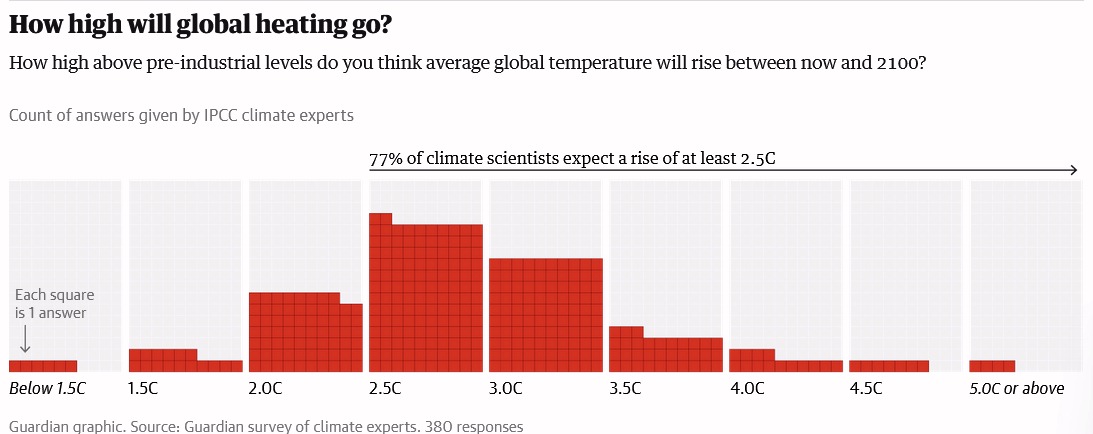
The Guardian reports, “Many of the scientists envisage a ‘semi-dystopian’ future, with famines, conflicts and mass migration, driven by heatwaves, wildfires, floods and storms of an intensity and frequency far beyond those that have already struck.”

In a recent survey of climate scientists, the consensus suggests that global warming is on track to exceed 2.5 degrees Celsius this century, with some projections indicating a rise of over 5 degrees.

“I foresee significant societal upheaval within the next five years,” stated Gretta Pecl from the University of Tasmania. “We’ll face overwhelming challenges as extreme events become the norm, disrupting food production and beyond. The future seems increasingly bleak.”

Peter Cox from the University of Exeter emphasized, “Climate change isn’t waiting to become dangerous at 1.5 degrees Celsius – it already poses severe risks. Surpassing 2 degrees Celsius won’t signal ‘game over,’ but the urgency for action is dire.”

Nathalie Hilmi, representing the Monaco Scientific Centre, echoed the sentiment, asserting, “Limiting warming to 1.5 degrees Celsius is imperative. We cannot afford to exceed this threshold.”

The experts unanimously stressed the urgent need for extensive preparations to safeguard communities from impending climate catastrophes. Leticia Cotrim da Cunha from the State University of Rio de Janeiro expressed deep concern, particularly regarding the potential human toll.

The 1.5 degrees Celsius target, intended to avert the worst impacts of the climate crisis, has served as a crucial reference point in global climate negotiations. However, with current policies setting the world on a trajectory for around 2.7 degrees Celsius of warming, the survey indicates widespread skepticism among IPCC experts regarding the likelihood of sufficient action to curb emissions.

Climate Scientist Survey 2024

The Human Induced Climate Change Experiment

bookmark_borderClimate Change: Ruled Against UK

Litigation seeking compensation for loss and damage caused by the actions of oil companies and governments has the potential to reshape global economics. In the past year, several legal rulings have held governments accountable for their role in exacerbating the climate crisis, signaling a shift in legal accountability and prompting broader discussions on environmental responsibility.

The latest example, on May 3, 2024, a High Court judge delivered a significant ruling, declaring the U.K. government’s actions unlawful in approving a climate plan aimed at meeting crucial emission reduction targets without sufficient evidence of its feasibility. This marked the second occasion in two years where the government’s primary climate strategy faced legal challenge and was deemed inadequate in aligning with legally-binding commitments to curb greenhouse gas emissions.

Justice Clive Sheldon’s decision, following a case brought forth by three environmental organizations, underscored the government’s failure to substantiate its approval of the Carbon Budget Delivery Plan from the previous year. The judge concluded that the government lacked justification and the plan was “simply not justified by the evidence.”

Climate Change Law Suits