bookmark_border99% of Population Breathes Air Pollution

7 Million people die from air pollution related illness every year.

“After surviving a pandemic, it is unacceptable to still have 7 million preventable deaths and countless preventable lost years of good health due to air pollution,” said Dr. Maria Neira, head of WHO’s department of environment, climate change and health. “Yet too many investments are still being sunk into a polluted environment rather than in clean, healthy air.”

WHO reports:
Almost the entire global population (99%) breathes air that exceeds WHO air quality limits, and threatens their health. A record number of over 6000 cities in 117 countries are now monitoring air quality, but the people living in them are still breathing unhealthy levels of fine particulate matter and nitrogen dioxide, with people in low and middle-income countries suffering the highest exposures.

The findings have prompted the World Health Organization to highlight the importance of curbing fossil fuel use and taking other tangible steps to reduce air pollution levels.

WHO Air Quality Database and Report 2022

The Human Induced Climate Change Experiment

bookmark_borderAir Pollution: the Baby Killer

Air pollution, both inside and outside the home, contributed to the deaths of about 500,000 newborns in 2019, as reported in the State of Global Air 2020. State Of Global Air 2020 PDF

“The number is just staggering,” reports the epidemiologist that led the stufy, Rakesh Ghosh of the University of California, San Francisco. The study suggests air pollution contributes to about 20% of infant deaths.

“I think you can easily dismiss this finding as something that only happens to people who live far away in thatched roof houses and not to us,” says Niermeyer, a professor at the University of Colorado Medicine. “But air pollution effects our babies, as well.”

bookmark_borderAir Pollution And Asthma

Air Quality News reports, “Air pollution responsible for half of childhood asthma cases in Barcelona”

Air pollution is responsible for nearly half of all childhood asthma cases in Barcelona, according to research published by the Barcelona Institute of Global Health (ISGlobal).

Asthma is the most common chronic childhood disease, and although it is known to be linked to air pollution, this is the first study to assess the link between asthma and the three pollutants: nitrogen dioxide (NO2), particulate matter (PM2.5) and black carbon (BC).

‘Barcelona urgently needs interventions to reduce the amount of motor-vehicle traffic, which has a negative impact on the health of the city’s children.

‘Reducing traffic does not only reduce air pollution but also reduce noise and heat island effects and increases physical activity which is all beneficial to health.’

bookmark_borderPollution Kills

by Daniel Brouse and Sidd Mukherjee

Pollution will kill you. Usually, it is a slow, painful death.

For the last 20 years, the American Lung Association has analyzed data from official air quality monitors to compile the “State of the Air” report. The most recent report found the United States recorded more days with hazardous air quality than ever. “Hazardous” as air that reaches “emergency conditions” on the government’s air quality index. “More than 4 in 10 people live where pollution levels are too often dangerous to breathe.”

Philadelphia-Reading-Camden, PA-NJ-DE-MD rank as the 21st worst city for ozone and the 18th worst for “Year Round Particle Pollution”. Pittsburgh-New Castle-Weirton, PA-OH-WV ranked 7th worst for year round particle pollution. Lancaster, PA ranked 15th worst for particle pollution.

“Two types of air pollution dominate in the U.S.: ozone and particle pollution1. These two pollutants threaten the health and the lives of millions of Americans. Thanks to the Clean Air Act, the U.S. has far less of both pollutants now than in the past. Still, nearly 141.1 million people live in counties where monitors show unhealthy levels of one or both—meaning the air a family breathes could shorten life or cause lung cancer and other harmful effects. It may be hard to imagine that pollution could be invisible, but ozone is. It is currently one of the least-well-controlled pollutants in the United States. And, it is also one of the most dangerous” the Association reports.

Air Pollution, Health and Wellness

The Institute of Health Metrics and Evaluation at the University of Washington that 5 million deaths per year could be attributed to stroke, heat attack, diabetes, lung cancer and chronic lung disease that resulted from air pollution.

The journal Lancet Planetary Health found air pollution is linked to diabetes.

The National Academy of Sciences published a study that found a significant impact from exposure to air pollution on cognitive performance.

“Today it feels like the future of our kids and our country is at stake,” said former Obama EPA chief Gina McCarthy, now director of the Center for Climate, Health and the Global Environment at the Harvard School of Public Health. “We do not have the cleanest air and we have not crossed the finish line when it comes to pollution.”

Vote for parks. Trees and plants help abate pollution.
If you can, move away from the traffic.
Consider wearing masks.

bookmark_borderAir Quality And Asthma

A report published in JAMA entitled “Association of Changes in Air Quality With Incident Asthma in Children in California, 1993-2014” confirms air pollution increases childhood asthma incidence.

“Conclusions and Relevance: Among children in Southern California, decreases in ambient nitrogen dioxide and PM2.5 between 1993 and 2014 were significantly associated with lower asthma incidence.”

“There’s been a concerted effort in California over the period of this study to reduce motor vehicle emissions in general and diesel emissions in particular,” John Balmes, an environmental health professor at the University of California, says. “And I think this study shows that it’s paying off.”

When LA’s Air Got Better, Kids’ Asthma Cases Dropped NPR

Deaths and Ailments Attributed to Climate Change and Pollution

bookmark_border9 Out of 10 People Breath Polluted Air

In a new release from the World Health Organization (WHO), “air pollution levels remain dangerously high.” Updated estimations reveal an alarming death toll of 7 million people every year caused by ambient (outdoor) and household air pollution.

Dr. Tedros Adhanom Ghebreyesus, Director-General of WHO said, “It is unacceptable that over 3 billion people – most of them women and children – are still breathing deadly smoke every day from using polluting stoves and fuels in their homes. If we don’t take urgent action on air pollution, we will never come close to achieving sustainable development.”

Key findings:

  • WHO estimates that around 90% of people worldwide breathe polluted air. Over the past 6 years, ambient air pollution levels have remained high and approximatively stable, with declining concentrations in some part of Europe and in the Americas.
  • The highest ambient air pollution levels are in the Eastern Mediterranean Region and in South-East Asia, with annual mean levels often exceeding more than 5 times WHO limits, followed by low and middle-income cities in Africa and the Western Pacific.
  • Africa and some of the Western Pacific have a serious lack of air pollution data. For Africa, the database now contains PM measurements for more than twice as many cities as previous versions, however data was identified for only 8 of 47 countries in the region.
  • Europe has the highest number of places reporting data.
  • In general, ambient air pollution levels are lowest in high-income countries, particularly in Europe, the Americas and the Western Pacific.In cities of high-income countries in Europe, air pollution has been shown to lower average life expectancy by anywhere between 2 and 24 months, depending on pollution levels.

Climate Change and Air Quality

bookmark_borderPollution And Health: 9 Million Deaths Per Year

The Lancet Commission published a report on October 19, 2017 that outlined the results of pollution and health. The report concluded that 9 million people suffered premature deaths due to pollution in 2015.

“Pollution is the largest environmental cause of disease and premature death in the world today. Diseases caused by pollution were responsible for an estimated 9 million premature deaths in 2015—16% of all deaths worldwide—three times more deaths than from AIDS, tuberculosis, and malaria combined and 15 times more than from all wars and other forms of violence. In the most severely affected countries, pollution-related disease is responsible for more than one death in four,” the report states.

Air pollution is the leading cause of death followed by water pollution. The financial cost from pollution-related death, sickness and welfare costs about $4.6 trillion in annual losses.

The report highlights:

  • Air pollution was linked to 6.5 million premature deaths;
  • Water pollution was linked to 1.8 million premature deaths;
  • Workplace pollution was linked to 1 million premature deaths;
  • Premature deaths resulting from pollution-related diseases like heart disease and cancer outnumbered AIDS, tuberculosis, and malaria combined 3 to 1;
  • About 92% of all premature deaths linked to pollution occur in low and middle-income countries.
  • Up to one in four deaths can be attributed to pollution in countries like China, India, Pakistan, or Bangladesh.
  • In absolute numbers, China (1.8 million) and India (2.5 million) had the most pollution-related deaths for the year 2015.
  • The United States, home to the world’s biggest economy, saw 155,000 premature deaths linked to pollution in 2015.


MORE REFERENCES
Death By Ozone
Health And Air Quality
Air Pollution Deaths
Air Pollution Killing Millions
Largest Health Risk

bookmark_borderAir Pollution: Getting All Choked Up

By Daniel Brouse

Air pollution may be the largest problem facing the world. Emissions of CO2, methane and other greenhouse gases are causing irreversible climate change. Since the effects of global warming take years to become apparent, many people don’t even notice the change; however, air pollution is already the leading cause of death worldwide. Again, since the pollution can’t be seen with the naked eye, many people are in denial of the dire consequences. 92% of the world’s population lives where outdoor air quality fails to meet the World Health Organization (WHO) guidelines.

In March of 2017, Dr. Margaret Chan, director general of the World Health Organization, said air pollution is “one of the most pernicious threats” facing global public health today and is on a much bigger scale than HIV or Ebola. Dr. Chan attributed the deaths of 600,000 children per year to indoor and outdoor air pollution.

UNICEF Executive Director Anthony Lake said, “Pollutants don’t only harm children’s developing lungs, they can actually cross the blood-brain barrier and permanently damage their developing brains, and, thus, their futures. No society can afford to ignore air pollution.”

“Protecting children from air pollution is not only in their best interests; it is also in the best interests of their societies — a benefit realized in reduced health costs, in increased productivity, in a cleaner, safer environment, and thus, in more sustainable development,” Lake said.

It is estimated that 5-7 million people are dying prematurely every year as a result of air pollution.

The American Lung Association says, “Two types of air pollution dominate in the U.S.: ozone and particle pollution. These two pollutants threaten the health and the lives of millions of Americans. Thanks to the Clean Air Act, the U.S. has far less of both pollutants now than in the past. Ozone pollution is the most widespread pollutant in the U.S. and is also one of the most dangerous.”

Ozone Action Alert Days are a frequent occurrence throughout the United States. During an Ozone Alert, you should not breath outside. During any days near metropolitan areas, you should limit outdoor physical activities as deep breathing causes more severe damage. The young and old are at greater risk at all times.

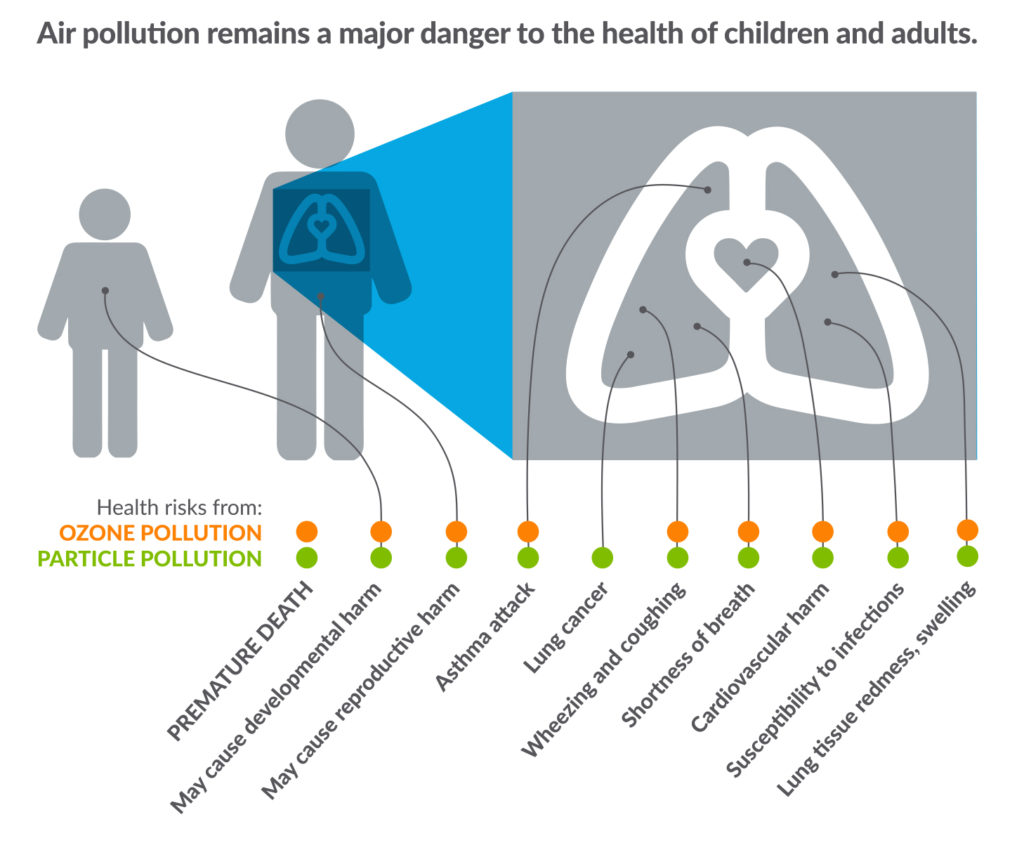
Particle pollution comes from small particles in exhaust and increase the risk of heart disease, lung cancer and asthma attacks. Particulates can interfere with the growth and work of the lungs.

The Environ Health Perspect Study states, “First and foremost, short-term exposure to particle pollution can kill. Peaks or spikes in particle pollution can last for hours to days. Deaths can occur on the very day that particle levels are high, or within one to two months afterward. Particle pollution does not just make people die a few days earlier than they might otherwise—these are deaths that would not have occurred if the air were cleaner.”

In February of 2017, the EPA released an update on air quality in the U.S.:

Today, pollution levels in many areas of the United States exceed national air quality standards for at least one of the six common pollutants:

  • Although levels of particle pollution and ground-level ozone pollution are substantially lower than in the past, levels are unhealthy in numerous areas of the country. Both pollutants are the result of emissions from diverse sources, and travel long distances and across state lines.

    An extensive body of scientific evidence shows that long- and short-term exposures to fine particle pollution, also known as fine particulate matter (PM2.5), can cause premature death and harmful effects on the cardiovascular system, including increased hospital admissions and emergency department visits for heart attacks and strokes. Scientific evidence also links PM to harmful respiratory effects, including asthma attacks.

    Ozone can increase the frequency of asthma attacks, cause shortness of breath, aggravate lung diseases, and cause permanent damage to lungs through long-term exposure. Elevated ozone levels are linked to increases in hospitalizations, emergency room visits and premature death.

    Both pollutants cause environmental damage, and fine particles impair visibility.

    Fine particles can be emitted directly or formed from gaseous emissions including sulfur dioxide or nitrogen oxides. Ozone, a colorless gas, is created when emissions of nitrogen oxides and volatile organic compounds react.

  • For unhealthy peak levels of sulfur dioxide and nitrogen dioxide, EPA is working with states and others on ways to determine where and how often unhealthy peaks occur. Both pollutants cause multiple adverse respiratory effects including increased asthma symptoms, and are associated with increased emergency department visits and hospital admissions for respiratory illness. Both pollutants cause environmental damage, and are byproducts of fossil fuel combustion.
  • Airborne lead pollution, a nationwide health concern before EPA phased out lead in motor vehicle gasoline under Clean Air Act authority, now meets national air quality standards except in areas near certain large lead-emitting industrial facilities. Lead is associated with neurological effects in children, such as behavioral problems, learning deficits and lowered IQ, and high blood pressure and heart disease in adults.
  • The entire nation meets the carbon monoxide air quality standards, largely because of emissions standards for new motor vehicles under the Clean Air Act.

MORE REFERENCES
Health And Air Quality
Air Pollution Deaths
Air Pollution Killing Millions
Largest Health Risk
bookmark_borderAir Pollution Deaths

A report from the World Bank found: Air pollution has emerged as the deadliest form of pollution and the fourth leading risk factor for premature deaths worldwide. Those deaths cost the global economy about US$225 billion in lost labor income in 2013, a new study finds, pointing toward the economic burden of air pollution.

The Cost of Air Pollution: Strengthening the economic case for action, a joint study of the World Bank and the Institute for Health Metrics and Evaluation (IHME), seeks to estimate the costs of premature deaths related to air pollution, to strengthen the case for action and facilitate decision making in the context of scarce resources. An estimated 5.5 million lives were lost in 2013 to diseases associated with outdoor and household air pollution, causing human suffering and reducing economic development.

While pollution-related deaths strike mainly young children and the elderly, premature deaths also result in lost labor income for working-age men and women. The report finds that annual labor income losses cost the equivalent of almost 1 percent – 0.83 percent — of Gross Domestic Product (GDP) in South Asia. In East Asia and the Pacific, where the population is ageing, labor income losses represent 0.25 percent of GDP, while in Sub-Saharan Africa, where air pollution impairs the earning potential of younger populations, annual labor income losses represent the equivalent of 0.61 percent of GDP.

When looking at fatalities across all age groups through the lens of “welfare losses”, an approach commonly used to evaluate the costs and benefits of environmental regulations in a given country context, the aggregate cost of premature deaths was more than US$5 trillion worldwide in 2013. In East and South Asia, welfare losses related to air pollution were the equivalent of about 7.5 percent of GDP.

“Air pollution is a challenge that threatens basic human welfare, damages natural and physical capital, and constrains economic growth. We hope this study will translate the cost of premature deaths into an economic language that resonates with policy makers so that more resources will be devoted to improving air quality. By supporting healthier cities and investments in cleaner sources of energy, we can reduce dangerous emissions, slow climate change, and most importantly save lives,” said Laura Tuck, Vice President for Sustainable Development at the World Bank.

Deaths related to ambient air pollution have risen in heavily populated, fast-urbanizing regions, while deaths related to cooking and heating homes with solid fuels have remained constant despite development gains and improvements in health services. Diseases attributed to both types of air pollution caused 1 in 10 deaths in 2013, or more than six times the number of deaths caused by malaria.

“This report and the burden of disease associated with air pollution are an urgent call to action,” said Dr. Chris Murray, Director of IHME. “Of all the different risk factors for premature deaths, this is one area, the air we breathe, over which individuals have little control. Policy makers in health and environment agencies, as well as leaders in various industries, are facing growing demands – and expectations – to address this problem.”

About 90 percent of the population in low and middle income countries are exposed to dangerous levels of ambient air pollution. The World Bank works with developing countries and development partners to reduce pollution by supporting monitoring and analysis, regulatory reforms, and investments. In 2016 for example, the Bank committed US$1 billion to help China improve air quality by reducing emissions of specific air pollutants from industrial, transport and rural sources in the province of Hebei, and by increasing energy efficiency and clean energy through innovative financing in the Beijing-Tianjin-Hebei region (also known as Jing-Jin-Ji region) that covers the capital area and neighboring provinces.

bookmark_borderAir Pollution Killing Millions

by Daniel Brouse

It is estimated by the World Health Organization that 7 million people per year die as a result of air pollution. “According to the latest urban air quality database, 98% of cities in low- and middle income countries with more than 100,000 inhabitants do not meet WHO air quality guidelines. Over 80% of those living in urbanized regions with air-quality monitoring breathe air featuring pollution levels that exceed World Health Organization safety limits.”

“Air pollution is a major cause of disease and death. It is good news that more cities are stepping up to monitor air quality, so when they take actions to improve it they have a benchmark,” says Dr Flavia Bustreo, WHO Assistant-Director General, Family, Women and Children’s Health. “When dirty air blankets our cities the most vulnerable urban populations—the youngest, oldest and poorest—are the most impacted.”

“Urban air pollution continues to rise at an alarming rate, wreaking havoc on human health,” says Dr Maria Neira, WHO Director, Department of Public Health, Environmental and Social Determinants of Health.

“It is crucial for city and national governments to make urban air quality a health and development priority,” says WHO’s Dr Carlos Dora. “When air quality improves, health costs from air pollution-related diseases shrink, worker productivity expands and life expectancy grows. Reducing air pollution also brings an added climate bonus, which can become a part of countries’ commitments to the climate treaty.”

The problem was thought to be mostly a problem in cities; however, new research show that parts of the world with the most farming are a big problem, too. In the study by by scientists at NASA and several universities, it was found that emissions from farms are greater than all other industrial sources of particulate air pollution in the United States, Europe, Russia and China.

“What we found surprising is simply the large amount that is attributed to farming that leads to near-surface air pollution,” said Susanne Bauer, an atmospheric scientist at Columbia University and NASA’s Goddard Institute for Space Studies. The largest U.S. impact is on the Northeastern United States “where nitrogen emissions from fertilizer and ammonia from animal waste combine with sulfates and nitrogen oxides from industries and automobiles.”

The article “Significant atmospheric aerosol pollution caused by world food cultivation” was published by Susan Bauer, Kostas Tsigaridis and Ron Miller:

Particulate matter is a major concern for public health, causing cancer and cardiopulmonary mortality. Therefore, governments in most industrialized countries monitor and set limits for particulate matter. To assist policy makers, it is important to connect the chemical composition and severity of particulate pollution to its sources. Here we show how agricultural practices, livestock production, and the use of nitrogen fertilizers impact near-surface air quality. In many densely populated areas, aerosols formed from gases that are released by fertilizer application and animal husbandry dominate over the combined contributions from all other anthropogenic pollution. Here we test reduction scenarios of combustion-based and agricultural emissions that could lower air pollution. For a future scenario, we find opposite trends, decreasing nitrate aerosol formation near the surface while total tropospheric loads increase. This suggests that food production could be increased to match the growing global population without sacrificing air quality if combustion emission is decreased.

More of the Human Induced Climate Change Experiment