bookmark_borderThe Trade Deficit Shrinks — and So Does America’s Economic Pulse

The U.S. trade deficit for August 2025 came in at $59.6 billion, down sharply from a revised $78.2 billion in July. On the surface, this might look like good news for an administration obsessed with shrinking the trade gap. In reality, it is a warning sign — and yet another indictment of Trump’s misguided, economically illiterate trade agenda.

A Smaller Trade Deficit Isn’t a Victory — It’s a Symptom of Weakness
This month’s narrowing was driven almost entirely by a drop in imports, not a boom in exports. That distinction matters. When the U.S. imports less while exporting the same amount, it doesn’t signal economic strength. It signals that consumers and businesses are pulling back, buying fewer goods, delaying purchases, and tightening their belts.

Yes, the change may superficially boost GDP in the quarter — but only because of the way GDP accounting treats imports, not because real economic conditions improved. The underlying truth is the opposite: U.S. economic momentum is slowing.

Trump’s Trade War: A Case Study in Economic Misunderstanding
Trump continues to push the debunked narrative that trade deficits are an economic threat. This belief is not just wrong — it’s dangerous. His policies reflect a fundamental misunderstanding of trade, capital flows, and the basic mechanics of a modern global economy.

For decades, economists have been clear:

  • Trade deficits are not inherently harmful.

  • They often reflect a strong dollar, high consumer demand, and a robust investment climate.

  • Americans benefit from lower-cost imported goods, which raise purchasing power and living standards.

  • Dollars spent on imports frequently return as foreign investment in the U.S., including in Treasury securities, real estate, and American companies — strengthening financial markets and keeping interest rates lower.

Trump’s fixation on eliminating the deficit ignores all of this and instead pushes policies that raise consumer prices, destabilize supply chains, and threaten American jobs, especially in industries dependent on global inputs.

Today’s Numbers Reveal the Truth Hidden Beneath the Headlines
A shrinking deficit due to falling imports is not a sign of a booming America. It is a sign of a cooling domestic economy. Consumers are spending less. Importers are ordering less. Businesses are becoming more cautious.

Trump may tout this as a win. In reality, it’s a red flag — one that economists and anyone paying attention should recognize immediately.

The administration can celebrate a smaller deficit if it wants. But the data tell a different story: America didn’t suddenly start winning; Americans simply started buying less.

Trumpenomics

bookmark_borderThe Growing Threat to Press Freedom: How Trump’s Influence Is Reaching Beyond U.S. Borders

When a reporter asked him about Epstein, he responded by snapping, “Quiet. Quiet, piggy.”

It is becoming increasingly difficult — and dangerous — to report on Donald Trump. This trend began in the United States and is now extending into the United Kingdom. Trump’s attacks on the press, combined with the increasingly aggressive behavior of his followers, have turned journalism into something that is not only economically risky but, in many cases, physically hazardous.

In the U.S., Trump has sued broadcasters, newspapers, educational institutions, and even scientific organizations. He has also called for — and in some cases initiated — criminal investigations into perceived adversaries. These tactics have created a chilling effect across the industry. News organizations must now factor in legal exposure, targeted harassment, and even threats of violence when covering stories that mention Trump.

This dynamic was highlighted by the December 2024 settlement of Trump’s defamation lawsuit against ABC News and George Stephanopoulos. The suit centered on Stephanopoulos’s on-air statement that Trump had been found “liable for rape” in the E. Jean Carroll civil case. In reality, the jury found him liable for sexual abuse — a legally significant distinction, though morally equivalent in every meaningful sense. Under normal circumstances, ABC would have fought and almost certainly won the case. But as the old lyric from Sonny Curtis of The Crickets put it: “I fought the law and the law won”; today, it often feels like you can’t fight Trump’s legal machinery and win. For many newsrooms, capitulation now appears safer than confrontation.

On November 18, 2025, Trump again demanded that ABC’s broadcast license be revoked after ABC News White House correspondent Mary Bruce asked why he has not released the Jeffrey Epstein files.

“Your news is so fake and so wrong,” Trump snapped at Bruce in the Oval Office during a meeting with Saudi Crown Prince Mohammed bin Salman.

This was not an isolated attack. FCC Chair Brendan Carr had previously threatened ABC’s broadcast license over remarks made by late-night host Jimmy Kimmel regarding the assassination of conservative activist Charlie Kirk — an extraordinary escalation that further blurs the line between regulatory authority and political retaliation.

Tragically ironic, this entire exchange took place while Trump was sitting beside — and actively making deals with — the Saudi crown prince he has now designated a major non-NATO ally. This is the same Crown Prince Mohammed bin Salman whom U.S. intelligence concluded ordered the killing of Washington Post journalist Jamal Khashoggi.

MBS has called Khashoggi’s murder “painful” for Saudi Arabia, even as he pledges nearly $1 trillion in U.S. investments — a reminder that for Trump, political loyalty and money appear to matter far more than justice for an American journalist murdered on foreign soil.


GLOBAL STRONGARM

But this pressure is no longer confined to the United States. The U.S. right wing is actively coordinating with the U.K. right wing, and this alliance is increasingly affecting British media institutions — especially the BBC. At the center of this shift is Sir Robbie Gibb, a powerful and highly controversial figure whose influence is reshaping the BBC’s editorial culture.

Trump has already initiated legal action against the BBC, a move widely seen as an extension of Gibb’s internal pressure campaign. The dispute stems from a BBC documentary on January 6th — an impartial production that included voices from the MAGA movement explaining their support for Trump. Despite this, Gibb seized on a specific edit of Trump’s January 6 speech to accuse the BBC of violating journalism standards, giving Trump a pretext to launch litigation and intensify efforts to intimidate the network.

It’s also important to note that the documentary was not broadcast in the United States and was geographically restricted from streaming, meaning its reach was limited — yet it still triggered disproportionate political retaliation. And, worth underscoring: Panorama’s “Trump: A Second Chance?” aired on 28 October 2024, before the U.S. election. Trump went on to win that election, raising even more questions about the intent behind the lawsuit. If there was no U.S. broadcast, no U.S. audience, and no demonstrable harm — and Trump won — then on what grounds can he claim $1 billion in damages? The litigation appears far less about injury and far more about intimidation.

Who Is Sir Robbie Gibb?

Appointment by Boris Johnson:
Gibb was appointed as a non-executive director to the BBC Board in 2021, during Boris Johnson’s administration. He was reappointed for a second term in May 2024.

Political Roles:
Before joining the board, Gibb served as Theresa May’s Director of Communications — placing him firmly inside the upper ranks of Conservative Party leadership.

Media Involvement:
After leaving government, Gibb worked with GB News, a right-wing broadcaster, and participated in a consortium that acquired The Jewish Chronicle. His resume blends political strategy with media influence, making him a uniquely positioned figure in shaping public narratives.


Why His Role at the BBC Is Controversial

Accusations of Bias and Political Interference:
Reports from The Guardian and other outlets describe Gibb as leading internal campaigns alleging “systemic bias” within the BBC — particularly regarding coverage of Trump, the Gaza conflict, and trans rights. These accusations have been used to exert pressure on editors and producers.

Influence on Editorial Decisions:
Insiders say Gibb has pushed for specific hires, such as Michael Prescott, who authored a memo criticizing BBC editorial standards. Such moves have raised concerns that the BBC Board is directly shaping newsroom decisions rather than maintaining a healthy, independent distance.

Alignment With the Global Right Wing:
Gibb’s political loyalties, combined with his media roles, make him a key conduit between U.K. conservatism and U.S. right-wing politics. This has created fertile ground for cross-Atlantic coordination — including Trump-aligned intimidation campaigns aimed at the BBC.


A Cross-Border Threat to Democracy

The erosion of press freedom is no longer a contained, domestic issue. Trump’s strategy — using legal pressure, public attacks, and political alliances to intimidate the press — is now being exported and replicated.

The combination of transnational political coordination, aggressive legal tactics, and direct editorial influence poses a grave threat to independent journalism. If this continues, the public may soon find itself with a press corps too intimidated to report the truth about the most powerful political figures on either side of the Atlantic.

Democracy cannot function without a free press — and the warning signs are becoming impossible to ignore.

Related Articles

The Battle for Free Speech: Jimmy Kimmel vs. MAGA Media Monopoly

Trump Faces Over 300 Lawsuits for Executive Overreach and Harm to U.S. Citizens

The Silencing of America: Journalism, Protest, and the Rise of Fear
It’s terrifying to watch American journalism go silent — not because reporters don’t care, but because many of us know exactly what happens when we speak the truth now.

The Death of the First Amendment: Trump’s War on Free Speech 
On September 18, 2025, Donald Trump declared that any television network critical of him would risk having its broadcast license revoked.

Trumpenomics: The Decline of the US
bookmark_borderThe Silent Unraveling of Pennsylvania’s Forests: Ozone Stress, Climate Shifts, and the Race for Resilient Species

by Daniel Brouse
November 18, 2025

For decades, we have studied the trees of Pennsylvania, tracking shifts in canopy structure, species resilience, and environmental stressors. Our long-term field data reveal a profound and accelerating decline. Since 2003, old-growth trees have consistently lost about 40% of their foliage over multi-year intervals, leading to premature mortality. During the same period, canopy height has fallen by roughly one-third, a drastic structural collapse in forests that once represented stability and ecological longevity. These changes are not isolated — they mirror global patterns of forest decline — but Pennsylvania offers one of the clearest windows into the cascading pressures reshaping ecosystems worldwide.

The primary drivers of this decline are not singular. Chronic ozone exposure weakens leaf tissues, reduces photosynthetic capacity, and lowers defenses. Warming temperatures, heat stress, hydrological whiplash (extreme swings between drought and deluge), and the spread of pests and disease compound these vulnerabilities. Together, they form a multifactorial stress landscape in which even historically resilient species cannot recover. The number of tree species capable of surviving under modern conditions is shrinking rapidly.

As the canopy thins, an unexpected force rises: vines. In Pennsylvania’s forests, species like wild grape, kudzu, and bittersweet take advantage of the increased sunlight penetrating the weakened upper layers. Vines, once confined to understory limits, now climb higher each year. When they reach the diminished canopy, they smother, shade, and eventually kill the already stressed trees. This vine-driven mortality accelerates the loss of old growth and destabilizes the entire forest system — affecting biodiversity, soil retention, and wildlife habitat. What was once a finely balanced ecosystem now tilts toward collapse.

This local unraveling echoes a global trend. Across Canada, much of the northern United States, and parts of Europe, old-growth forests face similar failures. The wildfire-ravaged forests of Canada highlight the challenge: replanting the same species no longer guarantees success when temperature and moisture regimes have shifted beyond their tolerance. Trees that would have thrived for centuries can no longer survive long enough to mature. Reforestation guided by historic baselines is now a losing strategy; adaptive management that anticipates the climate of 2050–2100 is essential.

In Pennsylvania, our work increasingly focuses on identifying species suited to emerging conditions. Trees with rapid regrowth, high heat tolerance, and broader ecological plasticity show the strongest potential. Among them:

  • Red maple (swamp/soft maple): Highly adaptable, tolerant of wetter soils and shifting precipitation patterns.

  • Kousa dogwood: Resistant to many regional diseases affecting native dogwoods.

  • Cherry (black cherry): Regenerates vigorously and may outcompete slower species under stress.

By contrast, species such as many pines, which cannot regenerate from damaged tissues, fare poorly in the new climate regime.

One of the most promising candidates for future forests is the honey locust. Reaching heights of up to 100 feet and lifespans of 120–150 years, honey locusts combine durability, rapid growth, and climate resilience. Their wood is exceptionally strong — with a Janka hardness of approximately 1,700 lbf, rivaling or exceeding that of white oak and golden teak. Their natural resistance to rot, ability to recover from damage, and tolerance of heat and drought make them remarkably suited for 21st-century conditions. As hardwoods that also fix nitrogen (in some cultivars), locusts help rebuild soils damaged by erosion and extreme rainfall.

Pennsylvania’s forests are not simply changing — they are undergoing a structural transformation driven by the combined forces of chemistry, physics, biology, and climate. The decline of old-growth trees is not just an ecological signal; it is a warning. Without careful, science-guided species selection and adaptive reforestation strategies, vast stretches of eastern forests may transition into degraded ecosystems dominated by invasive vines, weakened understory growth, and fragmented canopy cover.

The future of the region’s forests hinges on acknowledging these realities and acting accordingly. The old equilibrium is gone. The question now is whether we can build a new one robust enough to survive what comes next.

ALSO SEE: The Decline of Penn’s Sylvania Brouse (2024)

Tree Extinction Due to Human Induced Environmental Stress


The Human Induced Climate Change Experiment

bookmark_borderThe Physics of Violent Rain: Turning Ordinary Storms Into Catastrophic Events

by Daniel Brouse and Sidd Mukherjee
November 18, 2025

We’ve been working specifically on the physics of what we now call violent rain, and once you fully understand latent heat, the entire climate system reveals a deeper and far more alarming complexity. Latent heat is not just a chapter in a textbook; it is the engine behind much of Earth’s atmospheric power. But the energy budget is only the entry point. The way that energy manifests — through momentum, turbulence, pressure gradients, and flow dynamics — is some of the most elegant, and now increasingly dangerous, mathematics in climate science.

The fatal mistake many people make is equating “global warming” strictly with warmer temperatures. The additional heat does not simply remain as heat. It is continually exchanged, transformed, and expressed throughout the climate system. It reappears as massive increases in atmospheric moisture, sharper pressure differentials, explosive updrafts, and an atmosphere filled with stored potential energy waiting for the right trigger to be released.

A warmer atmosphere can hold about 7% more water for every 1°C of warming. Over the full temperature anomaly we are now entering, this increased capacity nearly doubles the amount of moisture available to A warmer atmosphere can hold about 7% more water for every 1°C of warming. Over the full temperature anomaly we are now entering, this increased capacity nearly doubles the amount of moisture available to storms. This is not theoretical — it is already transforming rainfall dynamics worldwide. Parts of the world, especially the poles, are now experiencing temperature anomalies that remain more than 22°C above normal for extended periods, supercharging atmospheric moisture and destabilizing global circulation patterns.

One of the most overlooked consequences of this added energy is the rise in both raindrop size and raindrop count. Larger droplets fall faster, strike harder, and inject more energy into the air column, intensifying turbulence. Upon impact with the ground, they deliver far more kinetic energy than raindrops did even a generation ago. Using the momentum relation p = mv:

  • As mass increases, momentum increases.
  • As velocity increases, momentum increases.

More momentum means more turbulence, more kinetic energy, and more destructive rainfall.

People already sense this intuitively — the louder impact of rain on roofs, water bouncing higher off pavement, and downpours that feel physically heavier — but few connect these sensations to the underlying physics.

The destructive power of violent rain actually begins before the drops reach the ground. As storms intensify, raindrops become larger and wind velocities rise, accelerating them horizontally and vertically. Because both m (mass) and v (velocity) increase, each raindrop carries significantly more momentum than in past climates.

Stronger horizontal winds effectively act as a second gravitational pull, increasing the angle and force of impact. This is why wind-driven rain can sting the skin, shred crops, strip leaves from trees, and erode soils far more quickly than vertical rainfall alone. The increased velocity also injects more energy into the air column, amplifying turbulence, updraft strength, and pressure gradients — processes that feed storm intensification.

Once the water reaches the ground, flow dynamics dominate. Force scales with the square of velocity (v²), and density multiplies that force dramatically:

  • A 20 mph wind exerts 4× the force of a 10 mph wind.
  • A 40 mph wind exerts 16× the force.
  • A 60 mph wind exerts 36× the force.

Now apply the same physics to water, which is ~800 times denser than air:

  • A shallow 10 mph sheet of runoff exerts 800× the force of a 10 mph wind.
  • At 20 mph, the force becomes 3,200×.
  • At 40 mph — common in debris-laden flash floods — the force jumps to 12,800×.

When storms produce larger raindrops and faster-moving rain, driven by extreme heat anomalies and stronger wind fields, the resulting flows carry exponentially greater destructive potential. This is why hillsides fail more quickly, roads wash out more often, and floodwaters rise and accelerate with far greater violence in a warming climate — and why these events are unfolding years to decades ahead of earlier projections.

As rainfall intensity spikes, so do these destructive flow forces. This is why modern storms overwhelm culverts, stormwater systems, levees, dams, and hillside soils. It’s why slopes liquefy, bridges scour, and infrastructure collapses in events that used to be considered “routine.”

The mathematics is beautiful — but the consequences are devastating. Violent rain is not a metaphor — it is the physical expression of a climate system carrying far more energy, mass, and momentum than it did just a few decades ago. And every additional fraction of a degree adds more fuel to that system.

For anyone watching closely, the evidence is not abstract. It’s outside your window.

The Climate Crisis: Violent Rain | Extreme Weather Events | Insurance | Soil | Updates

The Human Induced Climate Change Experiment

bookmark_borderTrump’s New Healthcare Pitch: Populist Rhetoric, Policy Confusion, and Economic Reality

On November 8 and November 18, 2025, Donald J. Trump posted on Truth Social:

“I am recommending to Senate Republicans that the Hundreds of Billions of Dollars currently being sent to money-sucking Insurance Companies in order to save the bad Healthcare provided by [the] Affordable Care Act, BE SENT DIRECTLY TO THE PEOPLE SO THAT THEY CAN PURCHASE THEIR OWN, MUCH BETTER, HEALTHCARE, and have money left over.”

News outlets including The Economic Times, WBMA, and Becker’s Payer Issues confirmed the statement and reported on its implications.

What Trump Claims

Trump argues that federal subsidies supporting Affordable Care Act (ACA) plans should no longer go to insurance companies. Instead, he proposes sending those funds “directly to individuals,” framed as a way to bypass insurers and supposedly empower consumers with more choice and better coverage.

What the Policy Actually Means

While the message sounds populist — “give the money to the people, not the insurers” — the proposal reveals a fundamental misunderstanding of how healthcare markets and subsidies work:

1. ACA subsidies do not go to insurers as a “gift.”
They reduce premiums for individuals. Insurers receive the subsidy only because they are providing the actual coverage. Redirecting these funds directly to consumers without regulating plan standards would effectively eliminate guaranteed essential benefits, caps on out-of-pocket costs, and protections for the sick.

2. Sending money “directly to individuals” is a euphemism for deregulating the insurance market.
This is an old proposal: replace the ACA with under-regulated, low-coverage “junk plans,” shifting the burden of cost onto consumers. People with preexisting conditions — more than half the U.S. population — would face significantly higher premiums or lose coverage entirely.

3. The math doesn’t work.
ACA subsidies are calibrated to actual market premiums. Sending the same dollar amount to individuals without requiring insurers to offer affordable, comprehensive plans guarantees that premiums will surge, forcing families to make up the difference out of pocket.

4. It mirrors Trump’s 2017 sabotage of cost-sharing subsidies.
That move immediately increased premiums by 20–40% in many states and raised the federal deficit. Economists widely expect the same outcome — only worse — if subsidies are dismantled at the structural level.

Why Economists Call This “Unworkable”

Trump’s proposal would effectively dismantle the ACA without offering a functional replacement, a scenario every major nonpartisan economic and health-policy institution has warned against. The likely consequences include:

  • Higher costs for consumers, not lower
  • Collapse of the individual insurance market
  • Reduced coverage quality
  • Loss of protections for millions
  • Large increases in the deficit due to insurance market re-pricing

This isn’t a reform—it’s a return to the pre-ACA chaos where insurers could deny coverage, drop patients, or create plans that covered little beyond catastrophic events.

Populist Packaging, Policy Vacuum

Trump’s post frames the ACA as a “bad” system propped up by “money-sucking insurance companies,” a narrative designed to evoke anger rather than convey policy clarity. In practice, the proposal would weaken consumer protections, raise out-of-pocket costs, and destabilize the insurance market.

The rhetoric may sound appealing — cut out the middleman! — but healthcare doesn’t work like sending out stimulus checks. Healthcare requires functioning risk pools, regulated coverage standards, and stable markets. Removing these foundations destabilizes the entire system.

The Bottom Line

Trump’s proposal isn’t a plan to improve healthcare.
It is a plan to defund the ACA, cripple insurance markets, and shift the burden of healthcare costs back onto American families — while marketing the move as empowerment.

What looks like a simple slogan is, in reality, a dramatic policy shift with serious economic and health consequences.

Trumpenomics

bookmark_borderA Complex Example of Real Estate and Estate Planning

Complicated Real Estate Estate Example

Q: Can you address the concerns if the deed is titled in a living trust?

Great question — and yes, living trusts add another layer that’s important to understand.

If your property is part of a HOA/POA and is titled in a living trust, the key issue is this:
The trust owns the property, but the trustee (and successor trustees) still inherit all of the same responsibilities and liabilities that any deeded owner would.

Here’s what that means in practical terms:

1. A living trust avoids probate — but it does not avoid HOA/POA obligations

Even though the trust bypasses the probate process, the property itself is still bound by:

  • Dues
  • Special assessments
  • Covenants and restrictions
  • Liens
  • Fines
  • Legal and financial exposure related to infrastructure failures or negligence

The trust simply changes who is responsible for managing those obligations.

2. The trustee steps into the owner’s shoes

Whoever is serving as trustee at the time of your death is legally responsible for:

  • Paying assessments
  • Resolving debts
  • Maintaining compliance
  • Handling any legal claims

And because trustees often accept the role without understanding the liabilities, this can create real problems — especially in a high-risk or high-liability community.

3. Beneficiaries do not automatically become owners

A trust does not give beneficiaries automatic deed ownership.
The trustee must transfer the property to them — and cannot transfer it until:

  • All debts are paid
  • All liens cleared
  • All POA requirements satisfied

If property conditions or assessments are unresolved, the trust can be stuck holding the property indefinitely.

4. Trusts do not shield beneficiaries or trustees from liability

Many people assume a trust provides liability protection.
In reality:

  • The trustee can be personally liable for unpaid assessments or mishandled obligations.
  • The trust estate can be pursued for damages.
  • In extreme cases (e.g., catastrophic dam failure), trustees and sometimes beneficiaries may be named in lawsuits or investigations.

5. If the trust is poorly written, things get messy fast

Common issues I’ve already seen:

  • No successor trustee named
  • Beneficiaries disagree about whether to sell
  • Trustee refuses to take responsibility
  • Trust language conflicts with POA requirements
  • The trust cannot dispose of the property because assessments aren’t paid

A trust helps with probate — but it doesn’t solve the core challenges of owning property with shared liabilities.


Bottom line

A living trust changes how the property passes, but not what the property is or the obligations attached to it.

If your deed is titled in a trust:

  • The trustee inherits the POA obligations and liabilities
  • The trust must resolve all debts before distribution
  • Liability exposure remains, especially in communities with infrastructure obligations
  • An estate attorney should review both the deed and the trust document together

Simple Estate Planning & Real Estate Ownership: What Property Owners Should Know

bookmark_borderThe Climate Has Entered a Runaway Phase: Why “1.5°C” No Longer Describes Our Reality

By Daniel Brouse and Sidd Mukherjee
November 17, 2025

Q: What is happening with climate change?
A: It is accelerating at an exponential rate — far faster than the public narrative or old models suggest.

For years, the world was taught to focus on “holding global warming to 1.5°C.” But that number has quietly become meaningless. Not only have we likely crossed it already, the real danger is not the temperature itself — it is the tipping points that crossing that threshold has set in motion. These tipping points have triggered cascading, self-reinforcing feedback loops that are now reshaping Earth’s systems with unprecedented speed.

We are not approaching a climate crisis.
We are living inside its accelerating phase.

Why the “Global Average Temperature” Is a Misleading Metric

A global average masks extremes — the very extremes that dictate human survival.

A 3°C rise in the global mean may sound manageable, but that average blends together oceans, land, and atmosphere. Because oceans absorb ~90% of excess heat and warm far more slowly, they artificially depress the global mean. Meanwhile, the land and atmosphere — the parts humans inhabit — are warming far faster.

And nowhere is this clearer than at the poles.

The Arctic: 20× Faster Warming and Localized Surges Above 22°C

The Arctic is not warming at “four times” the global rate — it is already warming at more than 20 times the global rate in certain intervals, with localized anomalies exceeding 22°C above historical norms.

This is the engine room of planetary destabilization.

Why does this matter?

1. The moisture multiplier

For every 1°C increase, the atmosphere can hold 7% more moisture.
At +22°C anomalies, Arctic air can now hold:

22 × 7% = 154% more moisture

This surplus water vapor fuels:

  • dramatically faster sea level rise

  • explosive increases in extreme rainfall

  • larger, faster, more destructive raindrops

  • intensifying storms, hurricanes, and atmospheric rivers

Momentum of falling rain scales with mass × velocity; velocity and wind damage scale with the square of flow speed; water is 800× denser than air. The result is a nonlinear explosion in destructive power.

2. Accelerated feedback loops

An Arctic 20× hotter than average accelerates:

  • loss of sea ice

  • albedo collapse

  • permafrost thaw

  • methane release

  • stratospheric moisture injections

  • atmospheric and oceanic circulation disruption

These amplify global warming on a time-compressed schedule: not centuries, but years to decades

Oceans: Silent Heat Storage With Catastrophic Potential

A deep-ocean analysis revealed that even the abyss is warming.
A mere 0.1°C increase in deep-ocean temperature represents a staggering accumulation of heat. If redistributed to land, that heat would equate to ~35°C of warming — incompatible with human life.

In 2025, the entire Pacific is 1.6°C above average, a six-sigma anomaly — virtually impossible under natural variability. This is a planetary red alert.

Two Critical Thresholds

1.5°C – Tipping point activation

≈9°C – Human survivability limit for land and air temperatures

Both are being breached rapidly in localized regions.

Cascading Feedbacks: A System Moving Toward Runaway Behavior

In just ten days of July 2025, the U.S. saw:

  • hundreds of flash floods

  • multiple “1-in-1,000-year” rainfall events

  • widespread infrastructure failures across multiple states

This isn’t “bad weather.”
This is an unstable climate system undergoing phase transition.

Permafrost: From Slow Thaw to Permanent Fire

Old models assumed gradual thaw over millennia.

Reality:

  • formerly frozen landscapes now burn year-round

  • methane and CO₂ release is orders of magnitude faster

  • vast carbon stores are now entering the atmosphere on human timescales

  • fires may partially “flare” methane into CO₂ — but the overall emissions surge is catastrophic

The real uncertainty isn’t if this feedback accelerates warming; it’s how fast and how far it will go.

Ozone: The Overlooked Feedback Harming Ecosystems and Humans

Combustion doesn’t only emit CO₂ — it forms tropospheric ozone, a potent plant toxin.

Ozone exposure:

  • reduces plant growth 10–40%

  • kills sensitive species

  • weakens forests and crops

  • makes ecosystems more vulnerable to drought, heat, pests, and fire

Global forests — the planet’s lungs — have already shifted from carbon sinks to carbon sources.

In our Pennsylvania field site, old-growth trees have lost:

  • ~40% of foliage since 2003

  • ~33% of canopy height

This mirrors global patterns of vegetation decline and reduced carbon uptake.

And ozone harms humans directly:

  • triggers asthma

  • increases cardiovascular stress

  • causes premature death

  • disproportionately affects children and the elderly

The ozone-wildfire-warming feedback loop is now one of the strongest multipliers of climate instability.

A Planet in Nonlinear Transition

These are not distant projections.
These are real-time runaway feedbacks already visible across ecosystems, oceans, and the atmosphere.

The climate system is now governed by compound nonlinear interactions:

  • Arctic amplification

  • ocean heat accumulation

  • ozone stress

  • runaway wildfires

  • permafrost collapse

  • accelerating hydrological extremes

Each amplifies the others in ways models struggle to capture.

The central scientific question is no longer:

“Will feedback loops accelerate warming?”

It is now:

“How much time is left before cascading feedbacks overwhelm natural and human systems?”

Our research is focused on precisely this:
mapping the speed, scale, and irreversibility of climate feedbacks — and determining how close Earth is to thresholds that will define the trajectory of human civilization.


bookmark_borderEarth at the Threshold: CO₂ Acceleration, Systemic Feedback Loops, and the Coming Era of Rapid Sea-Level Rise

by Daniel Brouse and Sidd Mukherjee
November 17, 2025

CO₂ is only one component in a vast, interconnected climate system — but it remains the most significant driver of human-caused warming. While water vapor, clouds, aerosols, and ocean circulation all play essential roles, CO₂ is the primary forcing mechanism we directly control. And today, it is rising at a speed unprecedented in Earth’s recent geological history.

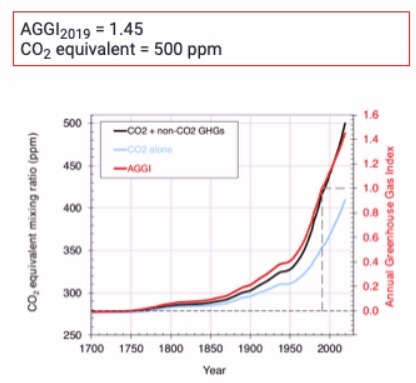
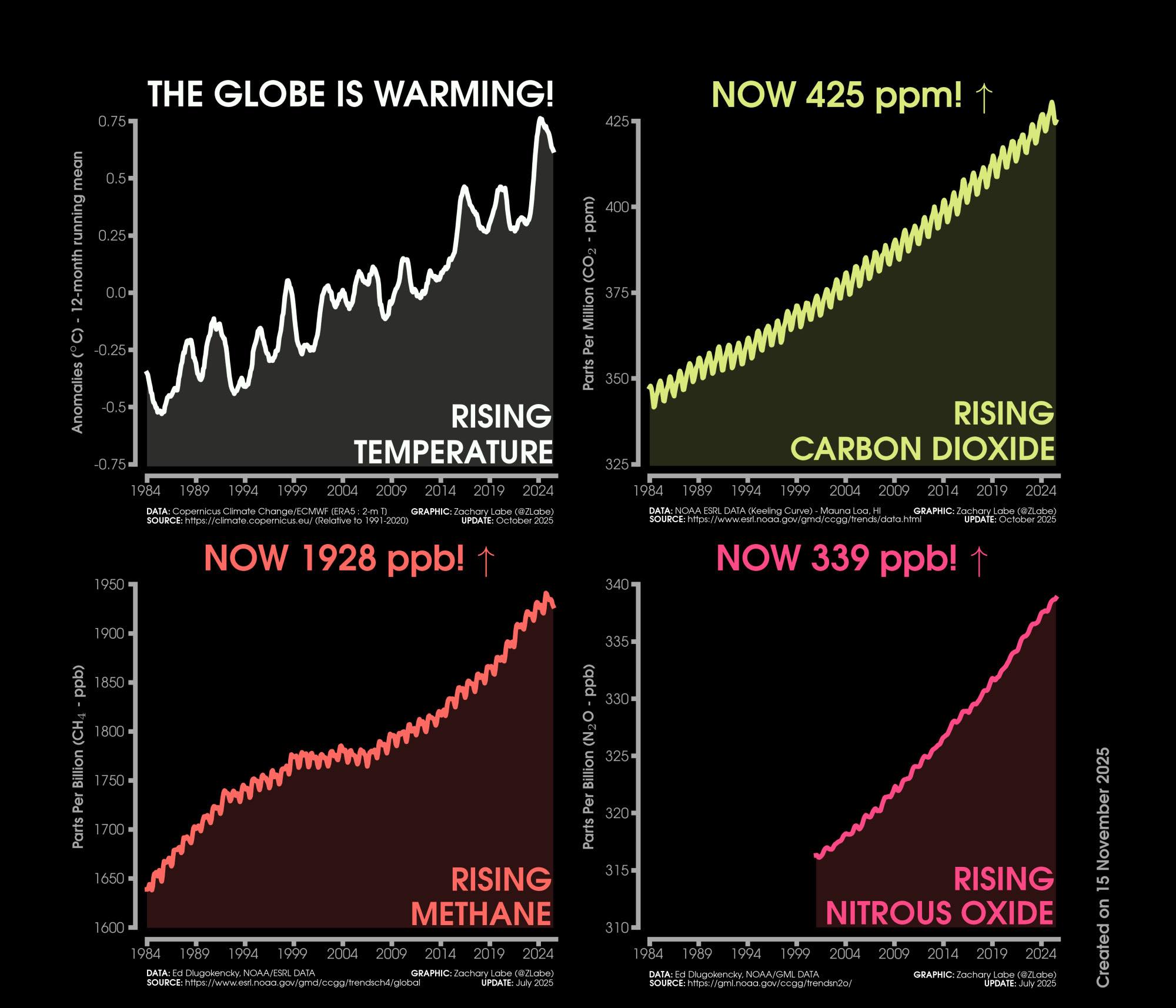
According to the World Meteorological Organization (2025) and the Global Carbon Project (2025), the year 2024 marked the most extreme convergence of climate records ever observed. Atmospheric CO₂ levels reached 422.7 ppm, the highest in three million years, with a record annual increase of 3.75 ppm. Monthly readings peaked at 426.91 ppm in June 2024 — a value that would have been unimaginable even a generation ago.

Accelerating Emissions and the Collapse of “Natural Buffers”

Global fossil fuel and cement emissions rose to 37.4 gigatons of CO₂ in 2024, a 0.8% increase from 2023. The growth was driven by:

  • Coal expansion across Asia

  • Post-pandemic industrial rebound

  • Sharp increases in liquefied natural gas (LNG) production, particularly in the United States

While often marketed as a “bridge fuel,” methane leakage from LNG infrastructure — over 80 times more potent than CO₂ over 20 years — has erased its supposed climate advantage. These cumulative emissions are now overwhelming the buffering capacity of the oceans, cryosphere, and biosphere.

This record convergence signals a fundamental phase transition in the Earth system. Regions that once absorbed carbon, stabilized temperature, and moderated climate extremes are now flipping into self-reinforcing feedback loops. What was once a slow climb in global heat content is now taking on the characteristics of nonlinear acceleration.

Glaciers, Cryosphere Collapse, and the Finality of “Point of No Return”

The WMO issued one of its starkest warnings in 2023:

“The world’s glaciers melted at dramatic speed last year and saving them is effectively a lost cause…
Antarctic sea ice fell to its lowest extent on record.
Some European glaciers are literally off the charts.”

WMO Secretary-General Petteri Taalas summarized the situation bluntly:

“We have already lost the melting-of-the-glaciers game.
The CO₂ concentration is now simply too high.”

In the Swiss Alps alone, 6.2% of total glacier mass vanished in a single summer, the greatest loss in the entire observational record.

Taalas further warned that disappearing glaciers will:

  • Reduce global freshwater supply

  • Impair agriculture

  • Destabilize river transport and hydrology

  • Accelerate sea-level rise far beyond prior projections

For decades, sea-level rise was expected to unfold over millennia. But with runaway CO₂ growth and feedback amplification, that timeline is rapidly collapsing into decades.

How Fast Could Sea Levels Rise? A Scientific Exchange

A natural question follows:
Could this trigger the fastest sea-level rise in Earth’s history?

Physicist Sidd Mukherjee offered the following expert assessment:

“It depends on what you mean by ‘ever.’
In terms of human civilization: yes, likely.”

He notes:

  • The total global ice inventory can produce ~200 feet of sea-level rise.

  • Greenland and West Antarctica may already be committed to collapse.

Breakdown of likely contributions:

  • Greenland: ~20 feet over 100–300 years

  • West Antarctica: ~10 feet, potentially in decades to a century

Average over a century:

  • ~20 feet → 2 inches per year (50 mm/year), 10x the current rate

But the average masks the danger. Sea-level rise will likely arrive in pulses, not a smooth curve:

“We could dawdle along at half an inch per year, then suddenly experience a couple of years with a foot of rise annually.”

If CO₂-equivalent concentrations can be stabilized near 500 ppm, there may still be a chance to preserve East Antarctica, the largest remaining ice sheet. But if it destabilizes:

“Expect another couple hundred feet of sea-level rise.”

A Civilization-Level Threshold

We are now witnessing the early stages of a global system crossing into a new and dangerous mode of operation — one defined by:

  • Rapid CO₂ accumulation

  • Collapsing carbon sinks

  • Accelerating ocean heat storage

  • Cryosphere destabilization

  • Intensified extreme weather

The question is no longer whether these changes are occurring, but how quickly, and how prepared we are for the consequences.

Humanity is approaching — and in some cases passing — thresholds that earlier generations believed were centuries away. The decisions made in the next decade will determine whether sea-level rise is measured in inches, feet, or tens of feet within a single human lifetime.

WARNING

* Our probabilistic, ensemble-based climate model — which incorporates complex socio-economic and ecological feedback loops within a dynamic, nonlinear system — projects that global temperatures are becoming unsustainable this century. This far exceeds earlier estimates of a 4°C rise over the next thousand years, highlighting a dramatic acceleration in global warming. We are now entering a phase of compound, cascading collapse, where climate, ecological, and societal systems destabilize through interlinked, self-reinforcing feedback loops.

What Can I Do?
The single most important action you can take to help address the climate crisis is simple: stop burning fossil fuels. There are numerous actions you can take to contribute to saving the planet. Each person bears the responsibility to minimize pollution, discontinue the use of fossil fuels, reduce consumption, and foster a culture of love and care. The Butterfly Effect illustrates that a small change in one area can lead to significant alterations in conditions anywhere on the globe. Hence, the frequently heard statement that a fluttering butterfly in China can cause a hurricane in the Atlantic. Be a butterfly and affect the world.

Tipping points and feedback loops drive the acceleration of climate change. When one tipping point is toppled and triggers others, the cascading collapse is known as the Domino Effect.

The Climate Crisis: Violent Rain | Deadly Humid Heat | Health Collapse | Extreme Weather Events | Insurance | Trees and Deforestation | Soil | Rising Sea Level | Food and Water | Updates

The Human Induced Climate Change Experiment

bookmark_borderEstate Planning & Real Estate Ownership: What Property Owners Should Know

by Daniel Brouse

November 16, 2025

Many property owners don’t realize they already have a form of estate plan in place—simply through how their name is listed on the deed. Whether you own a home, a vacant lot, or an investment property, the structure of your ownership determines what happens to the property when you die, who inherits it, and who inherits the associated liabilities.

Even without a will or trust, your deed sets the foundation of your estate plan. It controls how the property transfers, whether probate is required, and what financial or legal obligations pass to heirs or co-owners.

Below is a clear overview of how real estate ownership works and why reviewing your deed is essential.


1. Your Deed: The First Part of Your Estate Plan

Every deed contains key language describing how the property is owned. That language determines:

  • Whether the property avoids probate
  • Whether your will applies
  • Who inherits your ownership interest
  • Who inherits your financial obligations
  • How creditors can pursue the property

Most co-owned properties fall into one of two structures:


Two Primary Forms of Real Estate Co-Ownership

1. Joint Tenancy (Joint Tenants with Right of Survivorship)

Who can use it:
Anyone — spouses, partners, siblings, friends, investors, etc.

Key features:

  • Each owner has an equal share
  • Automatic right of survivorship
    (When one owner dies, their share transfers instantly to the surviving owners)
  • Avoids probate
  • Can be broken unilaterally by selling or transferring an interest
    (This converts the ownership to Tenancy in Common, which has no survivorship rights)

Example:
If three siblings own a property as joint tenants and one dies, the surviving two automatically inherit that share.


2. Tenants by the Entirety

Who can use it:
Married couples (and in some states, legally joined partners).

Key features:

  • The couple is treated as one legal entity
  • Automatic survivorship
  • Strong creditor protection:
    A creditor of one spouse alone generally cannot force the sale of the property
  • Neither spouse can sever the ownership unilaterally — both must agree

Example:
If one spouse dies, the surviving spouse automatically becomes 100% owner. A creditor pursuing only the deceased spouse cannot attach the home.


Key Differences (Simplified)

FeatureJoint TenantsTenants by the Entirety
Who can ownAnyoneMarried couples only
SurvivorshipYesYes (automatic)
Can one person break it?YesNo
Creditor protectionLimitedStrong
Created byDeed languageDeed + marital status

In plain English:

  • Joint Tenancy = Equal co-owners with survivorship, but anyone can break it.
  • Tenants by the Entirety = Married couple acting as one unit, with strong protections.

2. Who Owns Your Property If You Die?

This depends entirely on what your deed says.

If your deed includes rights of survivorship:

The co-owner(s) inherit automatically — your will does not apply.

If your deed has no survivorship language:

Your share becomes part of your estate, and probate is required.

If you are the sole owner:

Your property passes into your estate, and the executor must resolve:

  • Outstanding assessments
  • Debts tied to the property
  • Liens
  • Transfer restrictions
  • Title complications
  • Ongoing HOA/POA obligations, if applicable

This process can be lengthy and costly.


3. Assets vs. Liabilities: What Your Heirs Actually Inherit

When you pass real estate to someone, you are not only giving them property—you are transferring everything attached to it, such as:

  • Unpaid taxes
  • HOA/POA dues
  • Special assessments
  • Fines
  • Liens
  • Compliance obligations
  • Exposure to lawsuits

Some heirs accept property willingly; others may walk away once they realize the financial burden.


4. A Practical Example: Why Understanding Ownership Matters

Suppose you own a property and owe:

  • Unpaid dues
  • A special assessment
  • Fines
  • Attorney fees
  • Other community association charges

If you pass away:

  • Your estate or your co-owner(s) are responsible for the full amount
  • The property cannot be sold or transferred until the debt is satisfied
  • Creditors may attach liens or seek judgment
  • In some cases, the property may be forced into a sheriff sale or tax sale

If you have co-owners:

  • All co-owners are jointly and severally liable
  • Creditors can seek 100% of the debt from any one owner

These issues often surprise families who expected a simple inheritance.


5. Liability Exposure from Property Ownership

Real estate ownership can carry more than financial obligations. In certain situations—especially where infrastructure, shared property, or HOA/POA governance is involved—owners may be exposed to:

  • Civil liability
  • Joint and several liability for damages
  • Responsibility for the full cost of claims, not just their share
  • Legal action connected to negligence affecting common property
  • Potential criminal liability in extreme cases involving regulatory failures

If a community-governed asset fails (e.g., a dam, roadway, retaining structure, or safety feature), and investigations attribute fault to the association, every owner listed on the deed may be named in legal actions, depending on state law and circumstances.


Final Thoughts

Your deed isn’t just a piece of paper — it is a legally binding estate plan that determines:

  • Who inherits your property
  • Who inherits your debts
  • Whether probate is required
  • Whether your will matters
  • How creditors can pursue the property
  • How easily your heirs can sell or transfer the property
  • What legal exposure you leave behind

Given the financial and legal implications of property ownership, this is an excellent time to:

  • Review your deed
  • Confirm your form of ownership
  • Discuss survivorship planning
  • Update or create a will
  • Consider whether a trust is appropriate
  • Consult an estate attorney if you have questions

Real estate is often the most valuable—and most complicated—asset people pass on. Understanding your deed now can save your heirs significant time, cost, and stress later.

PART 2:  Can a well-executed will reduce confusion and streamline the process when grief is scrambling your thoughts?

A well-executed will can reduce confusion — but it really depends on what “well-executed” means to the heirs, creditors, and debtors involved. In some situations, a solid will is critically important. In others, it’s almost irrelevant.

What many people don’t realize is that, in most cases, a will still goes through probate — a court process that often becomes a breeding ground for disputes. In fact, the best way to “avoid probate issues” is to structure your estate so that there is nothing left to fight about, not simply to rely on the will.

A classic example: a mother dies before the father. If the home and major assets were jointly owned, the mother’s will is meaningless with respect to those items. Even if she leaves “the keys to the kingdom” to her son, he still doesn’t get them — everything passes automatically to the surviving spouse. This misunderstanding frequently leads to bad outcomes, like children suing a surviving parent because they don’t understand how estate law actually works. In turn, that parent often changes their own will out of frustration or self-protection.

That’s why, when we talk about a “well-executed” will, the best approach is to make it as future-proof and universal as possible. Ideally, your assets and liabilities should already be set up to transfer automatically — through titling, beneficiary designations, and proper structuring — so that the will becomes largely irrelevant for probate and litigation purposes. A will should be a fallback, not the main mechanism.

bookmark_borderFact-Check: False and Misleading Claims in the State Department Statement

Marco Rubio, Secretary of State

November 13, 2025

Today, building on President Trump’s historic commitment to confront Antifa’s campaign of political violence, the Department of State is designating German-based Antifa Ost, along with three other violent Antifa groups in Italy and Greece, as Specially Designated Global Terrorists and intends to designate all four groups as Foreign Terrorist Organizations, effective November 20, 2025. The designation of Antifa Ost and other violent Antifa groups supports President Trump’s National Security Presidential Memorandum-7, an initiative to disrupt self-described “anti-fascism” networks, entities, and organizations that use political violence and terroristic acts to undermine democratic institutions, constitutional rights, and fundamental liberties. Groups affiliated with this movement ascribe to revolutionary anarchist or Marxist ideologies, including anti-Americanism, “anti-capitalism,” and anti-Christianity, using these to incite and justify violent assaults domestically and overseas.

1. “Antifa Ost” and similar groups are not recognized terrorist organizations under international law

There is no record — from Germany’s Federal Office for the Protection of the Constitution (BfV), EU security agencies, Europol, or Interpol — that Antifa Ost is designated as a terrorist organization.

  • Germany has never listed Antifa Ost as a terrorist group, nor has it formally accused them of terrorism under German criminal code.
  • Germany also does not recognize “Antifa” as a structured organization — it is a decentralized, loosely affiliated movement, not a hierarchy capable of meeting the statutory definition for “Foreign Terrorist Organization” (FTO).

Claim: Misleading / false. The U.S. cannot designate a group as a Foreign Terrorist Organization if it does not legally exist as such in the host country and lacks the organizational structure required by U.S. law.

2. “President Trump’s historic commitment to confront Antifa’s campaign of political violence”

This is propaganda framing, not factual analysis.

  • No U.S. intelligence agency — including the FBI, DHS, or CIA — has found any evidence of a coordinated Antifa campaign of political violence.
  • Trump’s own FBI Director, Christopher Wray (2020–2024), repeatedly testified that:“Antifa is an ideology, not an organization.”
  • DHS threat assessments consistently found right-wing extremist violence to be the primary domestic terrorist threat (2019–2024), not Antifa.

Claim: False framing; contradicted by official intelligence assessments.

3. “Self-described anti-fascism networks… undermining democratic institutions”

Anti-fascism is a political philosophy, not a network. The statement misrepresents:

  • Antifa groups are decentralized: no leadership, no command structure, and no formal membership.
  • U.S. law (18 U.S.C. §1189) requires structured, foreign organizations capable of planning and executing terrorist acts. Antifa does not meet this threshold.
  • No credible Western intelligence agency has reported coordinated, transnational Antifa networks undermining democratic institutions.

Claim: Misleading; conflates ideology with organized terrorism.

4. “These groups use terroristic acts… overseas”

There is no verified record of Antifa-related organizations committing internationally coordinated terror attacks.

  • European law enforcement has prosecuted individual anarchists for vandalism, clashes with police, or riots — not terrorism.
  • None of the listed countries (Germany, Italy, Greece) recognize Antifa subgroups as terrorist entities.
  • The EU Terrorism Database contains no entries linking Antifa movements to terrorist attacks.

Claim: False.

5. “Ascribe to revolutionary anarchist or Marxist ideologies, including anti-Americanism, anti-capitalism, and anti-Christianity”

This is political rhetoric, not factual classification.

  • Political ideology is not evidence of terrorism.
  • The statement relies on labeling (“anti-Christianity,” “anti-Americanism”) to frame political dissent as extremism.
  • Many antifascist activists are not Marxists; some are Christians; many are ordinary citizens who oppose far-right extremism.

Claim: Misleading and ideologically charged.

6. The U.S. lacks legal grounds to designate Antifa groups as FTOs

Under U.S. law, Foreign Terrorist Organization designation requires:

  1. The group must be foreign
  2. Must engage in terrorist activity
  3. Must pose a threat to U.S. national security

For Antifa Ost and similar groups:

  • They have no recognized command structure.
  • They have not carried out internationally coordinated terrorist activity.
  • They pose no established threat to U.S. national security.

Any designation would likely be challenged in federal court and overturned for lack of evidence — similar to prior cases where political groups were improperly labeled as threats.

Conclusion

The State Department statement is highly misleading, politically motivated, and largely contradicted by domestic and international intelligence assessments.
It:

  • Inflates a decentralized ideology into a coordinated global terrorist network
  • Makes false claims about terrorist activity
  • Misrepresents foreign governments’ legal positions
  • Politically weaponizes terrorism designations against ideological opposition

In short:
The statement is a political narrative masquerading as a national security finding.

Trumpenomics