bookmark_borderFrom Climate Denial to Climate Authoritarianism: Fossil Fascism, Ecofascism, and Petro-Masculinity

by Daniel Brouse

Introdution

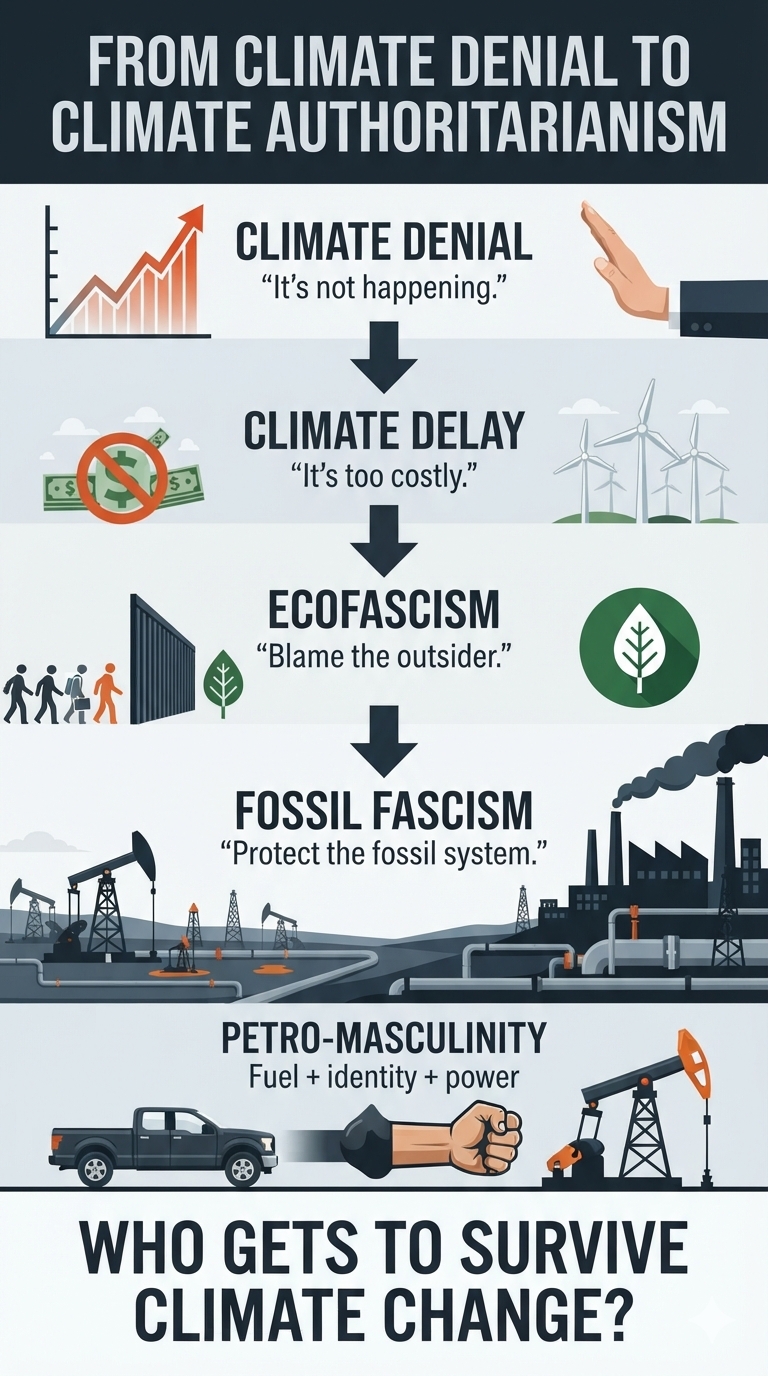
🌎 FROM CLIMATE DENIAL TO CLIMATE AUTHORITARIANISM

Climate politics is evolving.

As outright denial becomes harder to sustain, the narrative can shift from:

“Climate change isn’t happening.”
→ “Fixing it will cost too much.”
→ “Blame the outsiders.”
→ “Protect our resources.”

This article examines four related concepts:

🔹 Climate denial & climate delay
🔹 Ecofascism
🔹 Fossil fascism
🔹 Petro-masculinity

These aren’t interchangeable terms. Each describes a different way climate change, energy, identity, economics, and political power can become intertwined.

The central question is increasingly not simply whether the climate is changing—but how society explains the change, assigns responsibility, and responds to it.

Who gets to survive climate change?

Read the full report:

Fossil Fascism, Ecofascism, and Petro-Masculinity

Climate misinformation is no longer limited to simply denying that the planet is warming. As climate change becomes increasingly difficult to dismiss, the political narratives surrounding it have evolved—from outright denial, to attacks on climate science, to opposition to climate policy, and, in more extreme forms, to narratives that blame immigrants and other marginalized populations for environmental decline.

These narratives are not identical. They operate through different mechanisms and identify different enemies. But they can overlap, creating a broader political strategy in which climate science, energy policy, immigration, race, gender, and national identity become interconnected.

The International Panel on the Information Environment’s 2025 assessment concluded that powerful actors—including corporations, governments, and political parties—intentionally spread inaccurate or misleading narratives about anthropogenic climate change, contributing to declining public trust and political inaction.

Four concepts help describe different parts of this landscape: climate denial and delay, ecofascism, fossil fascism, and petro-masculinity.

1. Climate Denial and Climate Delay

The most familiar form of climate misinformation is outright denial: rejecting the existence, severity, or human cause of climate change.

Political rhetoric has also attacked renewable energy through claims that wind turbines, solar power, or other clean-energy technologies are inherently dangerous or economically destructive. Some of these claims have been challenged by scientific evidence, while others involve legitimate questions about environmental impacts that require quantitative comparison rather than political rhetoric.

As public acceptance of climate change has increased, however, the political emphasis has increasingly shifted from denying the problem to opposing proposed solutions. Researchers commonly describe this strategy as climate delay.

The basic argument changes from:

“Climate change isn’t happening.”

to:

“Climate change may be happening, but addressing it will cause even greater economic or social damage.”

This framing can emphasize immediate costs—higher energy prices, job losses, grid reliability, restrictions on vehicles or industrial activity—while giving less attention to the long-term economic costs of continued warming.

Government-sponsored challenges to climate science

A prominent recent example was the U.S. Department of Energy’s July 2025 publication of A Critical Review of Impacts of Greenhouse Gas Emissions on the U.S. Climate. The report was produced by five scientists assembled by Energy Secretary Chris Wright and argued, among other things, that the economic damages from COâ‚‚-induced warming may be smaller than commonly believed and that aggressive mitigation policies could be more harmful than beneficial.

Carbon Brief subsequently conducted a detailed fact-check with climate scientists and reported more than 100 statements it characterized as false or misleading, including claims involving the economic consequences of climate change, extreme weather, and the interpretation of scientific literature.

The significance of such disputes is not simply whether individual claims are correct. It is also about which scientific evidence is selected, which uncertainties are emphasized, and how those choices are translated into public policy.

2. Ecofascism: Climate Change as a Scapegoating Narrative

Ecofascism represents a fundamentally different approach.

Rather than denying climate change, ecofascist narratives accept environmental collapse but attribute it to supposedly undesirable populations—particularly immigrants, refugees, or people in the Global South.

The “overpopulation” narrative

One recurring theme is the claim that environmental degradation is primarily caused by population growth among poorer or non-white populations.

This can obscure the enormous differences in consumption and greenhouse-gas emissions between populations. High-income populations have historically produced far greater per-capita emissions than the world’s poorest populations.

The political transformation occurs when legitimate concerns about ecological limits are converted into arguments about which people supposedly deserve access to resources.

Blaming immigrants for environmental degradation

A related narrative links immigration directly to pollution, resource depletion, or greenhouse-gas emissions.

This is sometimes described as eco-bordering: using environmental concerns to justify more restrictive borders.

The danger of this framing is not the discussion of the environmental consequences of population growth or migration itself. Those are legitimate subjects for analysis. The problem arises when immigrants are treated as the primary ecological threat while the much larger effects of industrial energy systems, fossil-fuel consumption, land use, and unequal resource consumption are displaced from the discussion.

“Lifeboat ethics”

At its most extreme, ecofascist thinking adopts a form of “lifeboat ethics”: the assumption that resources are becoming so scarce that societies must protect their own populations by excluding outsiders.

Climate disasters can intensify this mentality. As droughts, floods, heat waves, sea-level rise, and food insecurity increase displacement, refugees can be portrayed not as people affected by climate change but as the cause of further environmental decline.

In its most extreme forms, this worldview has intersected with white-supremacist and accelerationist movements. Researchers have documented cases in which perpetrators of mass violence invoked “Great Replacement” ideas alongside environmental or resource-based fears.

The resulting political question changes from:

How do we respond to climate change?

to:

Who gets to survive climate change?

That is a profound shift in the political meaning of climate change.

3. Fossil Fascism: Protecting Fossil Capital

Fossil fascism is related to, but distinct from, ecofascism.

The term has been used by scholars studying the intersection of fossil-fuel dependence, authoritarian politics, nationalism, racism, and opposition to climate action. Recent scholarship defines fossil fascism as a political, legal, and cultural system centered on an ultra-nationalist defense of fossil-fuel extraction while suppressing opposition to it.

In simplified terms:

Ecofascism accepts ecological crisis but blames the “outsider.”

Fossil fascism protects the fossil-fuel system and attacks those who seek to change it.

From “Blood and Soil” to “Black Fuel”

The historical roots of ecofascist thought are often connected to European romantic nationalism and the “Blood and Soil” tradition, in which land, national identity, and racial identity became intertwined.

Fossil fascism has a different historical lineage.

Political scientist Cara Daggett and other scholars have used the concept to examine the relationship between fossil fuels, authoritarian politics, nationalism, and racialized power. Andreas Malm and the Zetkin Collective further developed the concept in White Skin, Black Fuel, connecting fossil-fuel development to the history of European imperialism, colonialism, and racial hierarchy.

The underlying argument is that fossil fuels are not simply an energy source. They can also become embedded in political institutions, economic power, national identity, and cultural ideas about social hierarchy.

Two different responses to ecological crisis

FeatureFossil FascismEcofascism
Climate positionOften characterized by denial, obstruction, or minimizationAccepts the reality of ecological crisis
Primary targetClimate scientists, activists, regulators, and opponents of fossil extractionImmigrants, refugees, minorities, and supposedly “overpopulated” populations
Economic orientationDefends fossil-fuel production and associated economic powerOften hostile to aspects of industrial globalization
Environmental visionNature treated primarily as a resource for economic and national powerNature portrayed as a homeland requiring protection from perceived outsiders
Political expressionDeregulation, fossil-fuel expansion, political obstruction, and suppression of oppositionAnti-immigration politics, exclusionary nationalism, and, at its extreme, violent white-supremacist movements

These categories are analytical concepts, not descriptions that apply automatically to every politician, government, or person who opposes a particular climate policy.

4. The Dangerous Crossover

Although fossil fascism and ecofascism can be distinguished conceptually, they can also overlap.

A political movement can simultaneously defend fossil-fuel extraction, oppose climate regulation, promote authoritarian nationalism, and blame immigrants or minorities for environmental problems.

As climate impacts become increasingly difficult to deny, the political narrative can therefore move through several stages:

Denial → Delay → Scapegoating → Authoritarian Protection

The first stage says the problem does not exist.

The second says the problem exists but solving it is too expensive.

The third says the problem exists because of particular groups of people.

The fourth argues that extraordinary political power is necessary to protect the nation and its resources.

This does not mean every instance of climate skepticism follows this progression. Rather, it illustrates how different narratives can reinforce one another.

5. Petro-Masculinity: The Cultural Engine

A related concept helps explain the cultural dimension of fossil-fuel politics: petro-masculinity.

Political scientist Cara Daggett introduced the term in her 2018 paper Petro-Masculinity: Fossil Fuels and Authoritarian Desire. Daggett argues that fossil-fuel systems can become connected not only to economic interests but also to identity, masculinity, authority, and resistance to social change.

The central idea is that fossil fuels can represent more than energy.

They can represent:

  • independence
  • personal freedom
  • economic security
  • traditional gender roles
  • national power
  • resistance to perceived cultural change

Fossil-fuel identity

During the twentieth century, American masculinity became closely associated with breadwinning, industrial employment, suburban development, automobile ownership, and inexpensive gasoline.

As a result, challenges to fossil-fuel consumption can sometimes be interpreted culturally rather than simply economically.

An electric vehicle, public transportation, reduced meat consumption, or restrictions on fossil-fuel use can be portrayed not merely as policy choices but as attacks on traditional identity.

This helps explain the cultural significance of behaviors such as “rolling coal,” in which modified diesel vehicles deliberately produce large quantities of exhaust smoke. The behavior can function as a form of political or cultural expression rather than transportation alone.

Petro-masculinity and authoritarianism

Daggett’s framework connects fossil-fuel dependence with authoritarian desire, particularly where climate action is interpreted as a threat to established gender roles, economic autonomy, or social status.

The connection to fossil fascism can therefore be understood at two levels:

Petro-masculinity is the cultural and identity dimension.

Fossil fascism is the political and institutional dimension.

The former can help create emotional resistance to changes in the energy system; the latter describes political structures and movements that defend fossil-fuel power.

6. Putting the Concepts Together

The four concepts describe different mechanisms rather than four interchangeable labels.

Climate denial rejects or minimizes the underlying science.

Climate delay accepts some degree of climate change while arguing against effective or rapid responses.

Ecofascism accepts ecological crisis but redirects blame toward immigrants, minorities, or other supposedly threatening populations.

Fossil fascism describes the fusion of fossil-fuel interests with authoritarian, nationalist, racialized, and anti-climate-action politics.

Petro-masculinity describes one cultural mechanism through which fossil-fuel dependence can become tied to identity, masculinity, autonomy, and authoritarian desire.

The concepts can overlap, but they should not be treated as synonyms.

The broader pattern is important because climate change is not merely a scientific problem. It is also a struggle over how societies interpret risk, distribute responsibility, allocate resources, and respond to disruption.

The critical question is therefore not only whether people acknowledge that the climate is changing.

It is also how they explain why it is changing, who they hold responsible, and what solutions they believe are legitimate.

That is where climate science, economics, energy policy, nationalism, race, gender, and political power increasingly intersect.
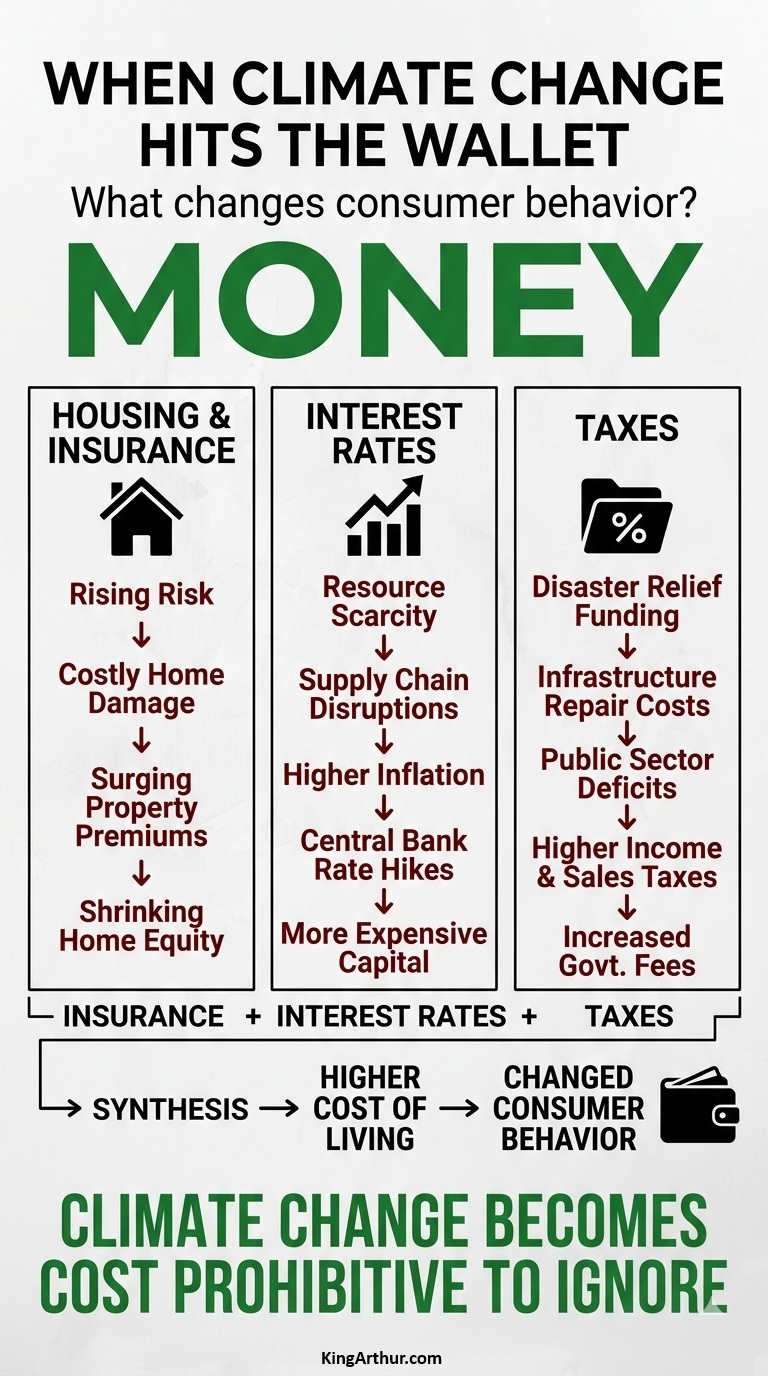
bookmark_borderWhen Climate Change Hits the Wallet: Insurance, Interest Rates, and Taxes

by Daniel Brouse

What will change consumer behavior when it comes to climate change?

Money. Insurance, interest rates, and taxes.

Most consumers do not substantially change their behavior until doing nothing becomes cost prohibitive.

For years, we assumed that climate change was unlikely to change consumer behavior in the near term. Climate change seemed too distant, too gradual, and too abstract to overcome the immediate economic incentives that drive everyday decisions.

That is now observably changing.

Climate change is increasingly entering the household economy through three powerful financial mechanisms:

Insurance. Interest rates. Taxes.

These mechanisms can transform climate change from an environmental issue that consumers can ignore into an economic reality they cannot.

Insurance

The United States, Australia, and parts of Asia and Latin America face some of the heaviest disruptions in insurance markets from climate change. The climate-driven insurance crisis is no longer just a problem for insurance companies. It has triggered a massive shift in housing and financial markets.

As climate risks increase, insurers are raising premiums, increasing deductibles, restricting coverage, and withdrawing from markets where losses have become too great.

That directly affects consumers.

Because most people rely on banks and mortgages to purchase homes, the withdrawal of insurers directly threatens both property values and mortgage stability. A home that cannot be affordably insured becomes more difficult to finance, sell, and maintain as an investment.

The chain is straightforward:

Climate change → insurance losses → higher premiums → reduced insurability → declining property values → mortgage disruption

This creates a powerful economic incentive for consumers to change where they live, what they buy, how they build, and how they protect their property.

Insurance therefore has become one of the first places where climate change forces consumer behavior to change—not through persuasion, but through price.

Interest Rates

Climate change is also becoming a financial problem through the cost of borrowing.

Developing and climate-vulnerable nations bear the heaviest burden. Climate change directly drives up sovereign bond yields, contributes to credit-rating downgrades, and locks vulnerable countries into a punishing vicious cycle of debt and disaster. A landmark 2026 report by ActionAid International revealed that across 65 of the world’s most climate-vulnerable countries, debt servicing is projected to consume a staggering 65% of all government revenue in 2026.

The mechanism is another accelerating feedback loop:

Climate disaster → economic losses → declining government revenue → increased borrowing → higher debt costs → reduced adaptive capacity → greater vulnerability

The consequences do not remain confined to developing nations.

The approximately $2 trillion annual climate-driven fiscal drain acts as a massive structural accelerator for interest rates in the United States. It does not directly determine daily Federal Reserve rate decisions. Instead, this enormous and growing economic burden alters the underlying macroeconomic conditions that the Federal Reserve and bond markets use to price capital.

Climate damage requires money. Rebuilding requires money. Infrastructure adaptation requires money. Insurance losses require money. Government deficits require money. And when the demand for capital rises while economic productivity and fiscal capacity are simultaneously pressured, the cost of capital rises.

Consumers ultimately experience that cost through mortgages, automobile loans, credit cards, business financing, and other forms of debt.

Taxes

Climate change affects taxation at both ends of the global economic spectrum.

Low-income developing nations face catastrophic losses in baseline tax revenue as climate disasters destroy crops, businesses, infrastructure, and productive capacity.

At the same time, wealthy economies are rapidly restructuring their tax systems around carbon emissions, energy production, subsidies, and the transition to lower-carbon energy.

The result is another financial feedback loop:

Climate damage → economic losses → reduced tax base → increased government spending → greater fiscal pressure → higher taxes and fees

In the United States, the financial impact of climate change is not represented by a single “climate tax.”

Instead, the costs are absorbed across federal, state, and local tax systems.

Local governments face increasing costs for damaged infrastructure, emergency response, stormwater management, roads, bridges, utilities, and other public services. Those costs ultimately have to be paid by taxpayers.

Property taxes can therefore become another mechanism through which climate change reaches the household balance sheet.

At the federal and state levels, climate-related disaster costs, infrastructure requirements, energy policies, and changes in taxation can add additional fiscal pressure.

Consumers may never see a line on their tax bill labeled “climate change.” They do not have to. They simply see the bill go up.

The Consumer Climate Feedback Loop

Insurance, interest rates, and taxes are not isolated financial effects.

They interact.

A homeowner faces higher insurance premiums because of increasing climate risk. Higher insurance costs increase the cost of homeownership. Reduced insurance availability threatens property values and mortgage financing. Climate-related disasters increase government expenditures. Government spending increases borrowing and tax pressure. Higher borrowing costs increase the cost of mortgages and other consumer debt.

The feedback loop becomes:

Climate disruption → financial losses → insurance increases → property and mortgage pressure → government spending → higher taxes and borrowing costs → higher household costs → changed consumer behavior

This is the critical transition.

Consumers do not necessarily have to become convinced by climate science before climate change changes their behavior. They only have to experience its economic consequences. A homeowner who can no longer afford insurance behaves differently. A buyer who cannot obtain a mortgage behaves differently. A family facing higher property taxes behaves differently. A business facing higher borrowing costs behaves differently. A community facing rapidly increasing infrastructure costs behaves differently.

The financial system can therefore become the transmission mechanism through which climate change reaches individual consumer decisions.

Ending Synthesis: When Climate Change Becomes Cost Prohibitive

The question is not whether climate change will eventually affect consumer behavior.

The question is when the financial consequences become large enough that consumers can no longer ignore them.

That threshold is already being crossed in parts of the world.

Insurance makes climate risk visible through premiums and availability.

Interest rates transmit climate-related economic and fiscal disruption into the cost of capital.

Taxes distribute the growing costs of climate damage, adaptation, infrastructure, and energy transition across households and businesses.

Together, they create a socioeconomic feedback loop:

Climate change → economic disruption → financial disruption → higher household costs → consumer behavior → market disruption → further economic pressure

This may prove far more powerful than climate messaging alone.

People can ignore a temperature graph.

They can dismiss a scientific projection.

They can debate climate policy.

But they cannot easily ignore an insurance cancellation, a mortgage that costs hundreds of dollars more each month, or a tax bill that keeps rising.

That is why money may ultimately become the mechanism that changes consumer behavior on climate change.

Climate change does not have to become universally accepted before it changes what people do.

It only has to become cost prohibitive to ignore.

Simplified Social Media Version

đź’° WHEN CLIMATE CHANGE HITS THE WALLET

What will actually change consumer behavior when it comes to climate change?

Money.

Insurance. Interest rates. Taxes.

For years, climate change was largely treated as an environmental issue. But that is changing as climate risk increasingly enters the household economy.

🏠 Insurance premiums and availability are being affected by rising climate risks.

đź’° Climate-related economic and fiscal pressures are affecting the cost of capital.

đź§ľ The growing costs of climate damage, adaptation, infrastructure, and energy transition are increasingly flowing through tax systems.

These forces can reinforce one another:

Climate change → financial disruption → higher household costs → changed consumer behavior

Consumers may ignore a temperature graph. They are much less likely to ignore an insurance cancellation, a higher mortgage payment, or a rising tax bill.

Climate change does not have to be universally accepted before it changes behavior.

It only has to become cost prohibitive to ignore.

New paper:
“When Climate Change Hits the Wallet: Insurance, Interest Rates, and Taxes”

bookmark_borderClimate Denialism, Obfuscation, Suppression and Normalization

By Daniel Brouse

Simplified Introduction

UK Climate Security: From Suppression to the Domino Effect

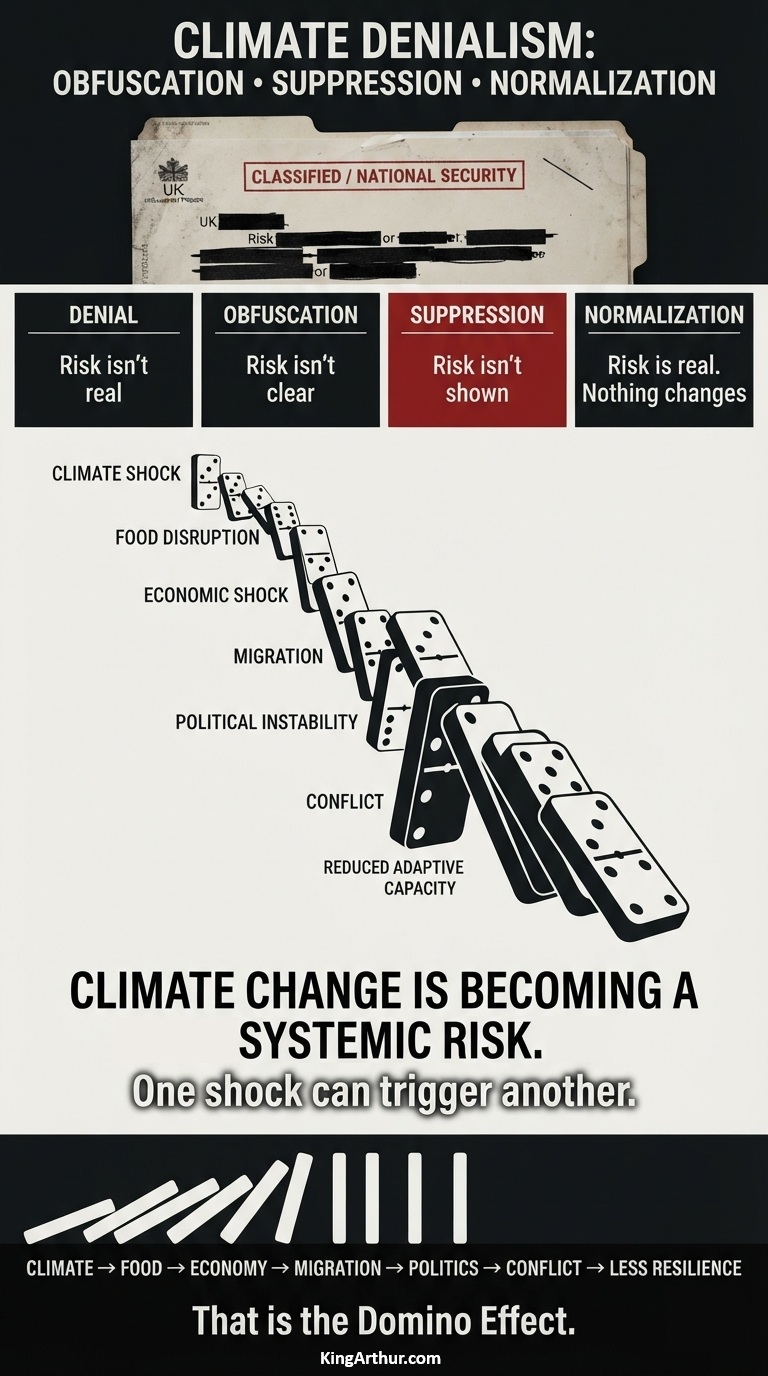
Climate change is increasingly moving from the category of environmental problem into the category of systemic risk.

A recently reported UK national-security assessment warned that climate and ecological disruption can cascade across borders—affecting food security, economies, migration, and political stability.

The problem is not simply the initial climate shock.

It is what happens afterward:

Climate shock → food disruption → economic shock → migration → political instability → conflict → reduced adaptive capacity

That is the Domino Effect. Denialism has become part of the feedback loop—delaying recognition, obstructing action, weakening resilience, and ultimately amplifying the consequences and accelerating the climate crisis.

The four stages of climate information failure are also important:

Denial — “The risk isn’t real.”
Obfuscation — “The risk isn’t clear.”
Suppression — “The evidence isn’t shown.”
Normalization — “The risk is real, but nothing fundamentally changes.”

When systemic risks are fragmented, delayed, or hidden from public discussion, society loses valuable time to prepare.

Climate risk is no longer just about what happens to the climate.
It is about what climate disruption does to everything connected to it.

🌎 Climate change → systemic risk → cascading consequences

Read the full report:

From Climate Shock to Food Disruption, Economic Shock, Migration, Political Instability, and Conflict

The climate crisis is increasingly being treated not simply as an environmental problem, but as a national-security and systemic-risk problem.

On September 23, 2026, UK Foreign Secretary Ed Miliband briefed foreign ministers from the European Union, Kenya, and other countries at the United Nations General Assembly on the findings of a UK intelligence assessment concerning climate change, nature loss, and national security. The assessment, prepared by the Joint Intelligence Committee, had reportedly been withheld from publication under the previous government and later released only in redacted form.

The assessment warned that the degradation of natural systems could cascade across borders through food shortages, migration, economic disruption, and conflict. Miliband specifically warned that the emerging El Niño could intensify these pressures, saying that climate shocks can “compound and cascade across borders,” threatening food and water security, displacing communities, putting pressure on markets, and damaging economies.

The significance of this assessment is not simply that climate change creates individual hazards. It is that climate shocks can propagate through interconnected physical, economic, and political systems.

That is the foundation of the Domino Effect:

Climate disruption
↓
Ecosystem degradation
↓
Crop losses and food disruption
↓
Food-price shocks
↓
Economic instability
↓
Migration
↓
Political instability
↓
Conflict
↓
Reduced adaptive capacity

The critical point is that none of these systems operates independently.

Denialism Depends on Fragmentation

Climate denialism often works by fragmenting a systemic problem into isolated questions.

Someone might argue:

“Climate change isn’t going to destroy my country.”

But that is not the relevant question.

A drought in one agricultural region can reduce global commodity supplies. A crop failure can increase prices in food-importing countries. Food-price inflation can destabilize governments. Migration can create political pressure far beyond the original climate impact. Conflict can disrupt energy, food, fertilizer, and commodity markets.

The original climate shock does not have to occur everywhere to produce consequences elsewhere.

That is precisely what the UK assessment is describing when it warns that climate and nature shocks can compound and cascade across borders.

The appropriate unit of analysis is therefore not simply the individual country—or even the individual climate hazard.

It is the coupled system.

The Domino Effect

The basic sequence is straightforward:

Drought
→ lower agricultural production
→ higher food prices
→ inflation
→ economic stress
→ political instability
→ migration
→ conflict
→ infrastructure destruction
→ reduced adaptive capacity
→ greater vulnerability to the next climate shock

Each stage can amplify the consequences of the previous one.

This creates a feedback loop between the physical Earth system and the socioeconomic system.

Climate disruption damages ecosystems and infrastructure. Economic disruption reduces the resources available for adaptation. Political instability makes coordinated adaptation more difficult. Conflict destroys infrastructure and institutional capacity. Those losses increase vulnerability to subsequent climate shocks.

The result is not simply:

climate change → damage

It can become:

climate shock → socioeconomic shock → reduced resilience → greater vulnerability → larger subsequent shock.

This is the essence of the Domino Effect.

The Weakness of the “Adaptation Only” Argument

If climate change were essentially linear and locally contained, adaptation could theoretically remain local:

warming → local impact → local adaptation

But a coupled system behaves differently:

warming
→ ecological disruption
→ economic disruption
→ geopolitical disruption
→ reduced adaptive capacity
→ greater vulnerability to subsequent climate disruption

At that point, adaptation is no longer simply a matter of building a seawall, installing air conditioning, changing crops, or relocating infrastructure.

The system’s capacity to adapt is itself being affected.

A country experiencing repeated crop failures, food inflation, infrastructure damage, capital losses, migration pressures, and political instability has fewer resources with which to prepare for the next shock.

Adaptation therefore has a socioeconomic limit.

Denial, Obfuscation, Suppression, and Normalization

Denialism does not always require an explicit rejection of climate science.

It can operate through several forms of information failure:

Denial:
“The risk isn’t real.”

Obfuscation:
“The evidence isn’t sufficiently important to discuss.”

Suppression:
“The evidence exists, but it should not receive public attention.”

Normalization:
“The evidence is real, but nothing fundamental needs to change.”

These mechanisms have different forms but can produce a similar result: society fails to recognize the systemic consequences of a known risk.

Climate denialism can therefore be understood broadly as systematic rhetorical, institutional, or informational behavior that prevents scientifically supported climate risks from being accurately recognized, communicated, or acted upon.

That definition shifts attention away from whether an individual literally believes climate change exists.

The more important question is whether society is capable of recognizing the consequences of climate change as an interconnected system.

The Irony of Climate Denialism

There is an important irony in the way climate risk is often framed.

Climate policy is frequently presented as a potential threat to:

  • economic growth
  • national sovereignty
  • energy security
  • food security
  • employment
  • military strength
  • financial stability

But the emerging national-security analysis increasingly identifies climate disruption itself as a threat to those same systems.

The causal relationship is therefore reversed.

The question is no longer simply:

“Can we afford climate action?”

It becomes:

“What happens to the economic, social, and security systems we are trying to protect if climate disruption continues to intensify?”

That is the central problem exposed by the Domino Effect.

Climate change is not merely an environmental externality.

It is becoming a systemic economic, social, and security risk.

From Climate Shock to Conflict

The most important feature of the Domino Effect is that the final outcome does not have to resemble the original cause.

A climate shock may begin as a drought.

The drought becomes a crop failure.

The crop failure becomes a food-price shock.

The food-price shock becomes inflation and economic instability.

Economic instability can contribute to migration and political unrest.

Political instability can increase the risk of conflict.

Conflict then destroys infrastructure, institutions, and productive capacity—reducing the ability of affected populations to adapt to the next climate shock.

The original climate event has therefore propagated through the socioeconomic system and returned as greater vulnerability to future climate disruption.

This is why climate risk cannot be assessed solely by examining temperature, precipitation, sea level, or any other individual physical variable.

The relevant question is also:

How does the shock propagate through the systems connected to it?

Denialism and Ecofascism

Denialism attempts to preserve existing systems by denying, minimizing, delaying, or obscuring the consequences of climate disruption.

A more extreme response is ecofascism: accepting environmental or ecological crisis while responding through authoritarian, exclusionary, or coercive ideas about who should receive resources, security, or protection.

The distinction matters because the two responses can appear opposite while sharing a failure to address the underlying systems problem.

Denial says, in effect:

The crisis is not serious enough to require fundamental change.

Ecofascist responses say, in effect:

The crisis is unavoidable, so survival must be allocated unequally.

Neither addresses the central systemic challenge: climate disruption affects interconnected populations through interconnected systems.

Conclusion

Climate change is increasingly moving from the category of environmental problem into the category of systemic risk.

A climate shock can become a food shock.

A food shock can become an economic shock.

An economic shock can contribute to migration and political instability.

Political instability can contribute to conflict.

Conflict can destroy infrastructure and institutions, reducing adaptive capacity and increasing vulnerability to the next climate shock.

Climate shock → food disruption → economic shock → migration → political instability → conflict → reduced adaptive capacity.

That is the Domino Effect. Denialism has become part of the feedback loop—delaying recognition, obstructing action, weakening resilience, and ultimately amplifying the consequences and accelerating the climate crisis.

The emerging national-security response is significant because governments are beginning to recognize that climate and nature loss can propagate through the systems on which economic and political stability depend. The UK government’s September 2026 statement explicitly described climate and nature crises as security risks and emphasized the need to prevent shocks from feeding through to food prices, supply chains, and security.

The challenge for climate policy is therefore larger than reducing emissions or adapting to individual hazards.

It is preserving the capacity of interconnected human systems to absorb shocks without cascading into systemic failure.

Denialism delays recognition of that problem.

Exclusionary responses attempt to decide who survives it.

The alternative is to recognize the interconnectedness of the Earth and socioeconomic systems—and build resilience before individual shocks become cascading crises.

bookmark_borderOil Shipping Costs Explode: From ~$16,000 to More Than $1.2 Million a Day

The cost of transporting crude oil by the world’s largest oil tankers has reached extraordinary levels.

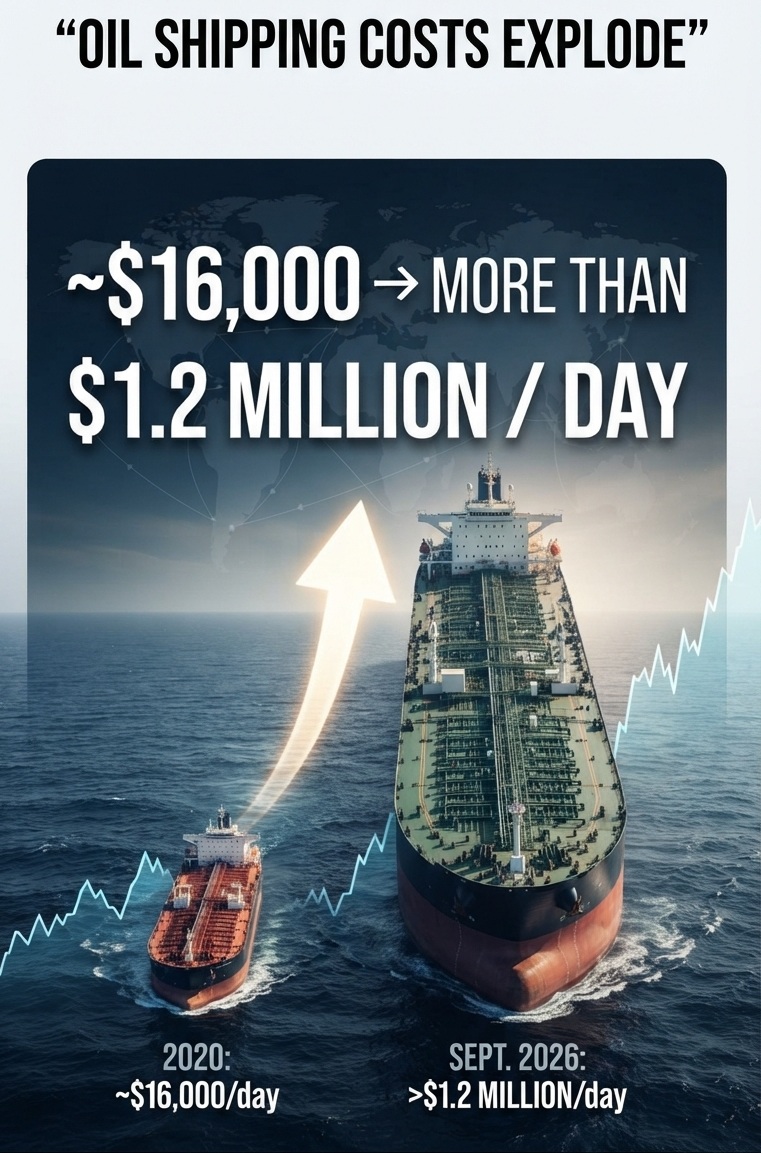
On the benchmark TD3C route — a 270,000-metric-ton Very Large Crude Carrier (VLCC) traveling from the Middle East Gulf to China — daily time-charter-equivalent (TCE) earnings have surged from roughly $16,000/day in 2020 to more than $1.2 million/day in September 2026.

That is not simply a large increase. It represents an extraordinary transformation in the economics of moving oil by sea.

From $16,000 to $1.2 Million a Day

PeriodApprox. TD3C Daily Rate/TCEWhat Was Driving the Market
2020~$16,000/dayPandemic-era demand collapse and abundant tanker capacity
2025~$35,000/day average*Tightening tanker fundamentals, geopolitical rerouting and limited fleet growth
September 2026$1,212,503/dayMiddle East conflict, disruption around the Strait of Hormuz, rerouting and severe tanker scarcity

*McQuilling reported a TD3C average earning of approximately $35,136/day for the first eight months of 2025, rather than $160,000/day.

The 2020 figure is also consistent with contemporary tanker-market estimates. McQuilling projected the TD3C round-trip voyage at approximately $16,200/day for 2020.

Then came 2026.

The $1.2 Million-a-Day Shock

In September 2026, the TD3C benchmark moved into territory rarely seen in modern tanker shipping.

The Baltic Exchange reported that the TD3C rate rose to Worldscale 1,140, corresponding to a round-trip TCE of approximately $1,212,503 per day for a standard Baltic VLCC.

Earlier in September, the same benchmark had already exceeded $1 million/day, with the Baltic assessment reaching approximately $1.099 million/day on September 15.

The surge reflects an extraordinary combination of factors:

  • disruption to Middle Eastern oil-export routes;
  • sharply reduced traffic through the Strait of Hormuz;
  • attacks and security risks affecting regional shipping;
  • longer and more complicated voyages;
  • ships being tied up in shuttle and ship-to-ship operations;
  • and a limited number of immediately available VLCCs.

Reuters reported on September 21 that only 17 commodity vessels transited the Strait of Hormuz over the weekend, compared with 37 the previous week and a pre-conflict average of about 125 vessels per day.

Why Shipping Costs Matter

Oil does not simply move from the wellhead to the refinery.

It has to be transported.

When the cost of transporting a cargo of crude suddenly multiplies, the consequences extend through the entire energy system.

At today’s extreme tanker rates, transportation itself can represent a substantial portion of the delivered cost of crude. The Wall Street Journal reported that VLCC charter costs had exceeded $1 million/day, equivalent to roughly $26 per barrel on the affected voyages.

That means the disruption is not merely a problem for shipowners and oil traders.

It can affect:

oil producers → tanker operators → refiners → fuel distributors → consumers

Higher transportation costs can therefore add pressure to gasoline, diesel, jet fuel and other petroleum products even when the underlying price of crude oil is moving differently.

An Extraordinary Comparison

The scale of the change is easier to see this way:

2020: ~$16,000/day
↓
2025: ~$35,000/day average
↓
September 2026: $1,212,503/day

From the approximate 2020 level to the September 2026 TD3C assessment, the daily TCE increased by roughly 75Ă—.

That is an extraordinary change in the economics of moving a single cargo of oil.

And it demonstrates something important about modern energy systems:

When a critical transportation chokepoint is disrupted, the cost of moving energy can become a crisis of its own.

A market under extreme stress

The current rate should not be interpreted as a normal annual shipping cost. It is a spot-market benchmark during an exceptional geopolitical disruption. Rates can move dramatically in either direction as vessel availability, security conditions, oil flows and trade routes change.

But the magnitude of the September 2026 spike is unmistakable.

The cost of moving oil by VLCC has gone from tens of thousands of dollars per day to more than $1.2 million per day.

That is a remarkable indicator of just how much stress has entered the global oil-transportation system.

bookmark_borderAbout the Price of Oil: The Price You Don’t See

What Does a Barrel of Oil Cost—and What Does It Mean to You?

When you hear the price of oil reported on the news, you are usually hearing the futures price.

But what does that number actually mean?

The futures price is essentially a “paper” price. Very little physical oil actually changes hands through the futures market. The price that matters to consumers and businesses buying and using petroleum products is the spot price—the price of physical oil being purchased today. And right now, there is a significant difference between the two.

Today, the futures price of oil is roughly $102–$107 per barrel. But the spot price—the actual price being paid for physical oil—is approximately $125–$150 per barrel.

That is the price that ultimately matters to everyone buying refined petroleum products, including gasoline, diesel, and heating oil.

The Pain at the Pump

This is why diesel has reached approximately $6 per gallon, making it the highest price in history. It is also why gasoline is currently averaging approximately $4.32 per gallon. Yes—this is the highest average gasoline price ever recorded for this time of year.

And what’s next?

Heating oil.

As we move toward the winter months, parts of the Northern Hemisphere are already seeing heating oil prices averaging between $5.15 and $5.75 per gallon. Yes. Just like gasoline, heating oil is trading at an absolute record high for the month of September.

Historically, heating oil prices have hovered around $3.50 to $4.00 per gallon during a typical winter season. The current offseason surge above $5.00 per gallon is unprecedented. And this is happening before winter has even arrived.

For millions of households that depend on heating oil, the implications are obvious. The price shock at the pump can become a much larger household energy shock when temperatures fall and heating demand rises.

Adding Fuel to the Fire

There is another problem developing in the background. Oil borrowed from the Strategic Petroleum Reserve (SPR) under the 2026 emergency exchanges is scheduled to be repaid in tranches between November 1, 2026, and September 30, 2028.

Under the 2026 SPR emergency exchange program managed by the U.S. Department of Energy (DOE), companies are contractually required to return approximately 1.18 to 1.24 barrels for every barrel they borrowed.

In other words, oil that was taken out of the reserve during an emergency must eventually be replaced—and companies are not simply returning the same amount of oil they received. They have to return more. That creates another future demand on the physical oil market.

So when you look at the oil price reported on television, don’t assume that the futures number tells the whole story.

The price of oil isn’t just a number on a screen.

It flows directly through the economy. It becomes diesel. It becomes gasoline. It becomes heating oil. It becomes transportation costs, food costs, manufacturing costs, electricity costs, and ultimately the cost of living.

And if physical oil is already trading substantially above the futures price, while heating demand is about to increase and SPR repayment obligations are beginning to come due, the question isn’t simply:

“What does oil cost today?”

The more important question is:

“What is the price of oil going to cost you tomorrow?”

bookmark_borderInflation Is Moving From Diesel to the Consumer

esterday brought the latest Producer Price Index (PPI) measure of inflation. Today, the focus shifts to consumer inflation.

The U.S. Bureau of Labor Statistics released the August 2026 Consumer Price Index (CPI) report, showing headline consumer inflation rising 0.4% in August on a seasonally adjusted basis and increasing 3.4% over the past 12 months.

Core inflation, which excludes volatile food and energy prices, rose 0.3% for the month. That was hotter than expected and is particularly important when viewed alongside yesterday’s PPI report.

The Diesel Problem

Historically, the Federal Reserve has placed considerable emphasis on core inflation because food and energy prices can be highly volatile. The logic is straightforward: temporary energy-price spikes can distort the underlying inflation trend.

But this energy shock is different.

The problem is diesel.

According to the latest BLS PPI data, the price of diesel fuel jumped an extraordinary 24.1% in August alone. BLS reported that more than one-third of the August increase in final-demand goods was attributable to diesel, while nearly two-thirds of the increase in processed goods for intermediate demand was also attributable to the 24.1% surge in diesel prices.

This is not simply a higher price at the pump for people who drive diesel vehicles. Diesel is embedded throughout the economy.

Trucks move food, consumer products, construction materials, manufactured goods, and virtually everything else through the nation’s supply chain. Diesel also powers agricultural machinery, construction equipment, mining equipment, generators, and other industrial machinery.

When diesel prices rise sharply and remain elevated, the increased cost of transportation and production eventually works its way into the prices consumers pay.

Why “Core” Inflation May Miss the Coming Shock

Energy is normally removed from core inflation because energy prices are volatile.

But removing energy from the calculation does not make its economic effects disappear.

A prolonged energy shock can become a supply-chain shock.

That distinction matters.

If gasoline or diesel prices briefly spike and then fall, businesses may absorb some of the increase. But if fuel costs remain elevated, businesses eventually have to recover those higher costs through higher prices for their products and services.

That means today’s diesel inflation can become tomorrow’s food inflation, transportation inflation, construction inflation, manufacturing inflation, and service inflation.

In other words, the energy shock can migrate into core inflation.

This is why the current situation deserves particular attention. The 24.1% monthly increase in diesel prices reported by BLS is large enough to create significant downstream pressure throughout the economy.

$6 Diesel Changes the Equation

Diesel prices have also reached extraordinary levels at the retail pump.

AAA data reported in early September showed the national diesel price approaching the $6-per-gallon threshold, with some markets already reaching or exceeding that level. In several markets, diesel prices were more than 60% above year-earlier levels.

That is a massive increase in one of the economy’s most important transportation and production inputs.

And there is another problem approaching.

Heating Oil Season Is Coming

Northern Hemisphere heating season is about to begin.

Heating oil and diesel are closely related middle-distillate petroleum products and compete for refinery capacity. BLS’s August PPI report also showed a substantial increase in home heating oil and distillates.

That means the diesel shock is arriving just as seasonal demand for heating fuel begins to increase.

For households in the Northeast and other regions that rely on heating oil, this could become a direct household expense. For everyone else, higher heating and transportation costs can still work their way through the prices of goods and services.

Yesterday’s PPI May Be Today’s Warning

The sequence of the data is important.

Yesterday’s PPI showed an enormous producer-level shock concentrated in energy, particularly diesel.

Today’s CPI shows consumer inflation remaining elevated.

The critical question is not simply whether headline CPI is 3.4% or whether core inflation is 0.3% for the month.

The bigger question is what happens when a massive energy-cost shock persists long enough to propagate through the entire economy.

Core inflation may initially appear relatively contained because energy is excluded from its calculation.

But the economy cannot exclude energy from its production and transportation costs.

Eventually, somebody pays the diesel bill.

And increasingly, that somebody is the consumer.

The current inflation story therefore may not be about an isolated spike in energy prices. It may be the beginning of an inflationary transmission process—from diesel, to producers, to transportation, to supply chains, and ultimately to consumer prices.

bookmark_borderInflation’s Fiscal Engine: How Government Spending Keeps Price Pressures Alive

How Fiscal Policy Is Becoming a Driving Force of Inflation

The U.S. Bureau of Labor Statistics (BLS) released its August 2026 Producer Price Index (PPI) report on September 10, revealing a renewed acceleration in wholesale prices. According to the report, headline PPI rose 0.4 percent month over month and climbed 5.4 percent over the year, with a significant increase in final-demand goods helping drive the advance. The PPI measures prices received by domestic producers and therefore provides an early look at price pressures moving through the production and distribution system.

The important question is not simply why did producer prices rise this month? It is a larger question:

Why does inflation continue to find fuel in an economy that has already experienced years of elevated prices?

One increasingly important answer is fiscal policy.

Inflation is not produced by a single variable. Energy prices, tariffs, supply disruptions, wages, housing costs, commodity prices, exchange rates, expectations, and monetary policy can all affect the price level. But fiscal policy determines another fundamental component of the inflation equation: how much purchasing power the government injects into the economy relative to the economy’s ability to supply goods and services.

When government spending persistently exceeds government revenues, the resulting deficit represents a substantial fiscal impulse. That impulse can support economic activity—and that is sometimes exactly what policymakers intend. But if demand is already strong, additional fiscal stimulus can also intensify competition for labor, materials, transportation, construction capacity, housing, and other scarce resources.

In other words:

Fiscal policy can become an inflation engine.

The Government Is Part of Aggregate Demand

It is easy to think of inflation as something caused primarily by consumers spending too much money.

But consumers are only one component of aggregate demand.

Businesses spend. Consumers spend. State and local governments spend. And the federal government spends.

The Federal Reserve defines aggregate demand as the combined demand for goods and services from households, businesses, and governments. Government purchases therefore enter the economy alongside private consumption and investment.

That matters because a government does not need to increase taxes to spend more money.

It can borrow.

When federal expenditures exceed federal revenues, the government finances the difference through borrowing. The resulting deficit does not automatically create inflation—particularly when the economy has substantial unused capacity. But persistent, large deficits can become inflationary when they add demand faster than the economy can expand its real supply of goods and services.

The distinction is crucial:

Deficit spending is not synonymous with inflation.

But under the right—or wrong—economic conditions, deficit spending can be an important source of inflationary pressure.

America’s Fiscal Imbalance Is Enormous

The scale of current federal deficits makes this more than an abstract theoretical issue.

The Congressional Budget Office estimated in August that the federal government had accumulated a $1.8 trillion deficit during the first ten months of fiscal year 2026. During that period, federal revenues increased by about 3 percent while outlays increased by about 5 percent. CBO subsequently estimated that the full-year 2026 deficit would reach approximately $2.1 trillion.

CBO’s longer-term projections similarly show deficits remaining historically large. Its February baseline projected a 2026 deficit of $1.9 trillion, equivalent to 5.8 percent of GDP, compared with a 50-year historical average deficit of 3.8 percent of GDP. Federal outlays were projected at 23.3 percent of GDP, substantially above their 50-year average of 21.2 percent.

That is a fiscal environment in which policymakers need to take seriously the possibility that government demand is contributing to persistent price pressure.

And there is another complication.

Fiscal Policy and Monetary Policy Can Pull in Opposite Directions

The Federal Reserve controls monetary policy. Congress and the Administration control fiscal policy.

These are different policy levers, but they interact.

The Federal Reserve explicitly notes that fiscal policy affects the economic outlook and that the Fed considers current and projected fiscal policy when determining the appropriate stance of monetary policy.

Consider the policy feedback:

Government spends more → aggregate demand increases → resource competition increases → prices rise → inflation persists → Federal Reserve faces greater pressure to maintain restrictive monetary policy.

This can create a peculiar policy conflict.

Fiscal policy may be pushing demand upward at the same time monetary policy is attempting to restrain demand.

The Fed can raise interest rates to cool borrowing, investment, housing, and consumption. But monetary policy cannot directly decide how much Congress spends or how much revenue the federal government collects.

Consequently, monetary policy can be forced to compensate for fiscal policy.

That is an important reason why blaming the Federal Reserve alone for inflation can miss half of the equation.

The Fiscal Multiplier Matters

Government spending does not necessarily have a one-for-one effect on economic activity.

Money spent by the government becomes income for someone else. That recipient spends some of it, creating income for another person or business, which can generate another round of spending.

This is the basic idea behind the fiscal multiplier.

When the economy has substantial unused capacity, that multiplier can increase real output without producing an equivalent increase in prices.

But when the economy is operating close to capacity, the same additional demand can produce a different result.

There may simply not be enough additional workers, factories, trucks, construction crews, housing, electricity, raw materials, or other productive resources available to satisfy the additional demand.

At that point, more nominal demand begins chasing a relatively constrained supply.

The result can be higher prices rather than proportionately higher real output.

That is the fiscal-inflation connection.

Deficits Can Also Keep Pressure on the Economy Longer

There is another reason persistent deficits matter.

A temporary fiscal expansion can be appropriate during a recession, emergency, war, financial crisis, or other period of severe economic weakness. The government can deliberately borrow and spend to prevent a collapse in demand.

The problem arises when emergency-style fiscal policy becomes structurally embedded after the emergency has passed.

If spending remains elevated while revenues remain insufficient to finance it, the government continues injecting fiscal demand into the economy.

The issue then becomes less about one year’s stimulus and more about the persistent fiscal stance.

That persistence matters for inflation expectations, interest rates, government borrowing costs, private investment, and the Federal Reserve’s policy response.

Government Spending Can Also Raise the Cost of Producing Things

Fiscal policy does not affect inflation only by stimulating demand.

Government policy can also affect the cost structure of the economy.

Government borrowing contributes to demand for credit. Large and persistent borrowing needs can put upward pressure on interest rates, particularly when private borrowers are competing for the same pool of financial resources.

Government spending can also increase demand for construction, engineering, defense production, transportation, technology, health care, energy, and other services.

When government becomes a very large buyer, private-sector buyers may have to compete for the same resources.

The result can be higher wages, higher input costs, higher financing costs, and higher prices.

In that sense, fiscal policy can influence both sides of the inflation equation:

More demand + constrained supply = greater price pressure.

The PPI Is an Important Warning Signal

This is why the August PPI deserves attention.

Producer prices are not consumer prices, and a single monthly PPI increase does not prove that fiscal policy caused the increase. Prices can move because of commodity markets, tariffs, energy shocks, supply disruptions, weather, transportation costs, exchange rates, or changes in margins.

But the PPI provides a useful window into the price pressures confronting businesses before those pressures are fully transmitted through the economy.

The July PPI data already showed that producer prices remained elevated: final-demand prices were up 4.7 percent over the year, while final-demand goods were up 6.5 percent and final-demand services were up 3.9 percent.

The August acceleration therefore raises a broader question about whether inflation is merely experiencing temporary disturbances—or whether the economy continues to contain structural forces capable of sustaining price increases.

Fiscal policy belongs prominently in that discussion.

Inflation Is a Policy Interaction, Not a Single-Agency Failure

It is tempting to divide economic policy into simple categories:

The Fed causes inflation.

Or:

Government spending causes inflation.

Or:

Tariffs cause inflation.

Or:

Corporations cause inflation.

Reality is considerably more complicated.

Inflation is an interaction among monetary policy, fiscal policy, supply, demand, expectations, financial conditions, international trade, energy markets, labor markets, and productivity.

But acknowledging complexity should not obscure responsibility.

If fiscal policy continually stimulates demand while monetary policy is attempting to suppress it, the two policies are working at cross-purposes.

And if the government repeatedly runs enormous deficits while the economy is operating near capacity, fiscal policy can become a persistent contributor to inflation rather than merely a temporary response to economic weakness.

The Fiscal Policy Question

The central economic question should therefore be expanded beyond:

“What is the Federal Reserve doing about inflation?”

It should also be:

“What is fiscal policy doing to inflation?”

That question is especially important when federal spending is growing faster than federal revenues and when deficits are measured in trillions of dollars.

The Federal Reserve can raise interest rates.

It can reduce them.

It can tighten.

It can ease.

But the Fed cannot balance the federal budget.

Congress and the Administration determine the government’s spending and taxation policies. As the Federal Reserve itself explains, fiscal policy is fundamentally the government’s tax-and-spending policy, while monetary policy is conducted independently by the central bank.

That division of responsibility matters.

If fiscal policy continually pushes aggregate demand upward, monetary policy may have to work harder to restrain it.

And that creates a potentially damaging cycle:

Large deficits → stronger aggregate demand → persistent inflation → tighter monetary policy → higher borrowing costs → greater federal interest expense → larger deficits.

The last step is particularly troubling because rising interest costs can themselves enlarge future deficits.

Inflation’s Fiscal Feedback Loop

This creates the possibility of a fiscal feedback loop:

Deficits increase → debt increases → interest expense increases → federal spending increases → deficits increase further.

CBO’s projections already show the importance of this mechanism. In its 2026 baseline, net federal interest costs were projected at roughly $1 trillion, or 3.3 percent of GDP. CBO projected that interest costs would continue rising as a share of the economy over the following decade.

That does not mean interest expense itself automatically creates consumer-price inflation.

It means that debt service becomes another claim on federal resources and another component of federal spending that must ultimately be financed through taxes, borrowing, or reductions elsewhere.

The larger the debt burden becomes, the less fiscal flexibility policymakers have when the next recession, financial crisis, war, pandemic, or climate disaster arrives.

The Bottom Line

The August 2026 PPI report is more than another monthly inflation statistic.

It is a reminder that inflationary pressure remains embedded in the U.S. economy.

Some of that pressure comes from supply-side forces. Some comes from international events. Some comes from tariffs, energy markets, labor costs, and other factors.

But fiscal policy should not be treated as an innocent bystander.

Government spending is demand.

Deficits finance spending that exceeds current revenues.

Persistent deficits can sustain aggregate demand even when inflation is already elevated.

And when that fiscal expansion collides with constrained productive capacity, the result can be continued upward pressure on prices.

The United States therefore faces a policy problem that cannot be solved by monetary policy alone.

If policymakers want durable price stability, they eventually have to address not only the price of money, but also the size and composition of government spending, taxation, borrowing, and deficits.

The inflation debate should consequently move beyond the familiar question of whether the Federal Reserve is tightening enough.

The harder question is:

Is fiscal policy itself helping to keep the inflation fire burning?

In 2026, the evidence says that question deserves considerably more attention.

bookmark_borderThe Economics of an Ultimatum: Trade Deficits, the Fed, and the Price of Political Pressure

On September 4, 2026, President Donald Trump escalated his ongoing pressure campaign against the Federal Reserve following a stronger-than-expected August jobs report. The unexpectedly strong labor-market data increased market expectations that the Federal Reserve could raise interest rates as was already expected.

Trump responded with a sweeping threat on Truth Social: if the Federal Reserve does not lower interest rates, he said he would stop trading with countries with which the United States runs a trade deficit. He demanded that the Fed “get smart” and “BE PATRIOTS for a change,” while arguing that the United States should have the lowest interest rate in the world.

As one prominent economist associated with the Wharton School put it, this is insane.

The problem begins with a fundamental misunderstanding of the role of the Federal Reserve.

The Federal Reserve Must Remain Independent
The Federal Reserve’s operational independence exists for a reason. Congress established a framework that gives the Fed significant independence in conducting monetary policy while holding it accountable to its statutory objectives of maximum employment and stable prices.

This independence is not an inconvenience to be overcome by political pressure. It is one of the foundations of monetary credibility.

A central bank that is perceived as responding directly to the political demands of the president risks losing the credibility that allows it to control inflation expectations and maintain confidence in the currency. Federal Reserve officials have repeatedly emphasized that institutional credibility is essential to effective monetary policy.

That matters enormously for the United States because the dollar remains the world’s dominant reserve currency. The Federal Reserve reported in 2026 that the dollar remains the most widely used currency in foreign-exchange transactions and cross-border payments and the leading currency in official reserve holdings. That position is supported not only by the size of the American economy and the depth of U.S. financial markets, but also by confidence in U.S. institutions.

The independence of the Federal Reserve is therefore not merely an institutional technicality. It is part of the infrastructure supporting confidence in the dollar.

The Trade-Deficit Fallacy
The second problem is the premise that a U.S. trade deficit is inherently a loss for America.

It isn’t.

A trade deficit means that the United States imports more goods and services than it exports. But that is only one side of the accounting identity. The other side is the flow of foreign capital into the United States.

The Federal Reserve Bank of Dallas explains that trade deficits are the mirror image of foreign capital inflows. They can reflect strong domestic investment, fiscal expansion, global savings flows, and the unique role of the U.S. dollar as the world’s dominant reserve currency.

In other words, foreigners do not simply “take” something from America when they sell us more goods than they buy from us. The dollars ultimately flow back into American financial assets, businesses, real estate, government securities and other investments.

That capital finances American consumption and investment.

The Congressional Research Service similarly notes that the trade deficit allows Americans to consume more goods than they produce and allows the United States to finance more investment with foreign capital. It can therefore benefit U.S. consumers and borrowers, including the federal government.

The trade deficit is not automatically a sign of economic weakness. In many circumstances, it is a consequence of America’s economic strength, investment opportunities, capital markets and the global demand for dollar-denominated assets.

Trying to eliminate a trade deficit by simply eliminating trade would therefore attack the symptom rather than the underlying economic relationships.

Threatening Higher Inflation to Force Lower Rates
The third problem is perhaps the most fundamental.

If the objective is to reduce borrowing costs, threatening policies that undermine confidence in the Federal Reserve, disrupt international trade and increase inflationary pressure is precisely the wrong direction.

The president’s demand for lower short-term interest rates does not determine long-term borrowing costs. Bond investors ultimately price Treasury securities based on their expectations for inflation, economic growth, fiscal conditions, monetary policy and institutional credibility.

If investors begin to believe that monetary policy is being subordinated to political demands, they can demand greater compensation for holding dollar-denominated debt.

That means higher—not lower—long-term interest rates.

The irony is profound: an attempt to force interest rates lower can produce the very conditions that push market rates higher.

The Market’s Immediate Message
The financial markets reacted to both the jobs report and Trump’s threat, with futures markets increasing the implied probability of a September rate increase while spot-market interest rates rose almost immediately.
The broader message from the bond market is important.

Markets do not simply obey political demands.

They price risk.

And when political pressure raises questions about the future independence of monetary policy, investors can respond by demanding higher yields and a larger risk premium.

That raises borrowing costs throughout the economy—from the federal government to corporations to households.

The Economic Contradiction
The contradiction is difficult to miss. The stated objective is lower interest rates. But forcing the Federal Reserve to cut rates through political pressure could undermine confidence in the institution.

The stated objective is to eliminate trade deficits. But eliminating trade with deficit countries would also eliminate the imports that American consumers and businesses purchase and disrupt the foreign capital flows associated with those trade relationships.

The stated objective is to strengthen the American economy. But deliberately creating uncertainty around monetary policy and international trade risks increasing inflation, raising borrowing costs and reducing investment.

The United States did not become the world’s largest economy by treating every trade deficit as a financial loss. Nor did the dollar become the world’s dominant reserve currency because American monetary policy was subordinated to short-term political demands.

The strength of the American economic system rests on something much larger: deep and liquid capital markets, open international commerce, property rights, the rule of law, institutional credibility and confidence in the stability of the dollar.

Those are assets that can take generations to build. They can be damaged much faster.

The central question is therefore not whether interest rates should be higher or lower at any particular moment.

The question is whether monetary policy will be determined by economic conditions and the Federal Reserve’s statutory mandate—or by political ultimata.

That distinction matters because the price of undermining confidence in America’s economic institutions is ultimately paid not by the Federal Reserve, but by Americans through higher inflation, higher borrowing costs, reduced investment and a less reliable dollar.

bookmark_borderHow Is Climate Energy Hitting You? Socio-Economic-Ecological Feedbacks

by Daniel Brouse

From Biodiversity to Monoculture: The Socio-Economic-Ecological Feedback Loop

Climate change is often described as a problem of rising temperatures, but temperature is only one expression of the additional energy entering the Earth system.

That energy moves through the atmosphere, hydrologic cycle, soils, vegetation, ecosystems, agriculture, forests, and human economies. As each system responds, it can alter the conditions experienced by the others.

This creates feedback loops.

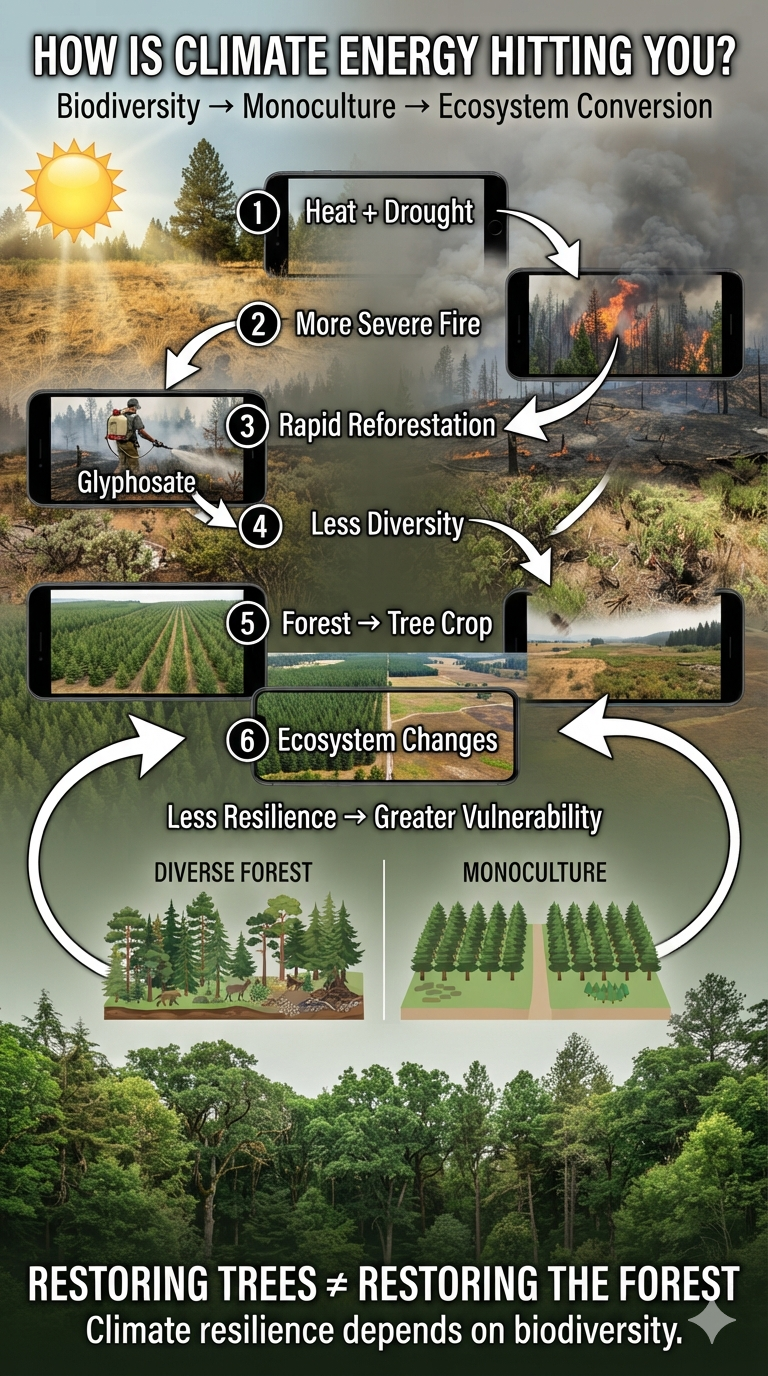
A recent investigation by the Center for Investigative Reporting found that glyphosate is being sprayed in California forests at record levels. The U.S. Forest Service, timber companies, and other land managers use glyphosate after wildfire or timber harvest to suppress competing vegetation and improve the establishment of commercially valuable conifers.

At first glance, this may appear to be a straightforward forestry practice: kill competing plants, plant trees, and accelerate forest recovery.

But viewed through the lens of climate-system dynamics, it raises a much larger question:

What happens when our response to climate disruption further simplifies the ecosystems we depend upon for resilience?

Climate Energy Is Changing the Recovery Environment

Western forests are already experiencing a combination of higher temperatures, increasing atmospheric moisture demand, changing precipitation and snowpack, declining soil moisture, drought stress, and increasingly severe wildfire.

Our earlier paper, Western U.S. Woodlands Ecosystem Conversion, examines what happens when these pressures push a forest beyond its ability to regenerate.

A forest can experience increasing stress for years without an obvious transformation. Then a threshold can be crossed.

Trees die.

Seed sources disappear.

Regeneration fails.

Shrubs and grasses occupy the landscape.

The ecosystem begins transitioning from one state to another.

As the paper explains, under moderate emissions scenarios, up to 40% of western conifer forests could convert to shrubland or grassland by 2100.

That is not simply forest damage.

It is ecosystem conversion.

And once we recognize that distinction, the economics of post-fire forest management look different.

The Economics of Reforestation

After a major wildfire, rapidly growing shrubs, grasses, ferns, and deciduous vegetation can compete with planted conifer seedlings for water, nutrients, and sunlight.

From a timber-production perspective, that competition is a problem.

Glyphosate provides an efficient way to remove it.

The Forest Service has used herbicide treatments as part of regeneration efforts because suppressing competing vegetation can improve the early survival and growth of desired seedlings. Forest research acknowledges that this is one reason herbicides have been used in reforestation.

The economic objective is therefore understandable:

reduce competition → increase seedling survival → accelerate timber production.

But that is not necessarily the same objective as:

restore biodiversity → restore ecological function → increase climate resilience.

Those two objectives can overlap.

They can also conflict.

A Forest Is Not a Tree Farm

The distinction matters because a forest is not simply a collection of trees.

A functioning forest contains an enormous biological network:

  • multiple tree species
  • shrubs
  • grasses
  • flowering plants
  • fungi and mycorrhizal networks
  • insects and pollinators
  • birds
  • mammals
  • reptiles and amphibians
  • soil organisms
  • decomposers
  • streams and wetlands
  • genetic diversity

Each component participates in the functioning of the ecosystem.

When glyphosate is applied to eliminate “competing” vegetation, those plants are competitors only from the perspective of the desired crop.

From the perspective of the ecosystem, they may be food, shelter, habitat, soil cover, pollinator resources, firebreaks, nutrient sources, or participants in water and carbon cycling.

This creates a fundamental difference between restoration and production.

Production asks:

How efficiently can we produce the desired commodity?

Ecological restoration asks:

How effectively can we restore the biological relationships that make the ecosystem resilient?

Biodiversity Is Infrastructure

Biodiversity is often treated as an aesthetic or conservation issue.

It is much more than that.

Biodiversity is a form of ecological infrastructure.

Different species respond differently to drought, heat, insects, disease, fire, and changing precipitation. A diverse ecosystem therefore contains multiple biological responses to disturbance.

If one species performs poorly, another may survive.

If one food source disappears, another may remain.

If one plant cannot regenerate under new climatic conditions, another may occupy the available ecological niche.

This is one reason biological diversity can provide resilience.

A simplified ecosystem has fewer alternatives.

A diverse ecosystem has more.

That distinction becomes increasingly important as climate variability increases.

From Biodiversity to Monoculture

The problem becomes more obvious when forestry is compared with modern industrial agriculture.

Large-scale agriculture often relies on monocultures: enormous areas devoted to a single crop or a very small number of genetically similar crops. Monoculture creates economic efficiencies. Machines can plant, fertilize, spray, harvest, and transport a standardized product at enormous scale. But biological simplification creates vulnerabilities.

A pest that specializes in the crop has an enormous continuous food supply. A disease can spread rapidly through genetically similar plants. Soil nutrients can become depleted. Pollinator and insect diversity can decline. Herbicide and pesticide dependence can increase.

The economic system becomes increasingly dependent upon external inputs to maintain productivity.

The result can be a feedback loop:

biodiversity declines → ecological resistance declines → pests and disease become more consequential → chemical inputs increase → biodiversity declines further.

This is not an argument that all monoculture agriculture inevitably fails.

It is an argument that efficiency and resilience are not the same thing.

The same distinction applies to forestry.

The Forest Monoculture

When post-fire management suppresses naturally regenerating vegetation in order to establish commercially desirable conifers, the landscape can move toward a forest plantation rather than a naturally regenerating forest.

A plantation can contain thousands of trees and still possess considerably less biodiversity than the ecosystem it replaced.

This creates a dangerous semantic trap. We see trees. We call it a forest. But ecological function depends upon far more than tree cover.

A plantation of one or a few commercially valuable species can look green from above while functioning very differently from a diverse forest.

And in a warming climate, that distinction can become critical.

Ecosystem Conversion Versus Reforestation

This is where the concept of ecosystem conversion becomes important.

Suppose a severe wildfire destroys a mature conifer forest.

The original ecosystem does not necessarily return.

Under the warmer and drier conditions described in my Western U.S. Woodlands paper, grasses and shrubs may become better adapted to the post-fire environment than the trees that previously occupied it.

The landscape may therefore transition:

forest → wildfire → shrubland/grassland

That is climate-driven ecosystem conversion.

Now introduce intensive human intervention:

forest → wildfire → herbicide → removal of natural competitors → planted conifers → managed timber plantation

This is something different.

The second pathway is not simply allowing the ecosystem to respond to its new climate. It is imposing an economic land-use objective upon that response. That distinction should be explicit in public policy.

The Carbon Question

There is another important distinction. A green landscape is not necessarily equivalent to the forest that existed before. Grasslands and shrublands photosynthesize and absorb carbon.

So do plantations.

But carbon uptake is not the same thing as carbon storage.

A mature forest contains carbon in:

  • trunks
  • branches
  • roots
  • dead wood
  • forest soils
  • long-lived biomass

The Ecosystem Conversion paper makes this distinction explicitly:

carbon uptake ≠ carbon storage capacity

and

positive carbon flux ≠ preservation of the previous carbon stock.

A plantation may therefore satisfy a narrow definition of reforestation while failing to reproduce the carbon reservoir, biodiversity, hydrology, and ecological complexity of the original forest.

The Glyphosate Feedback

This brings us back to glyphosate. The current controversy is not simply about a herbicide. It is about the interaction between climate disruption, economic incentives, land management, biodiversity, and ecosystem resilience.

The emerging feedback looks something like this:

Climate warming

↓

Heat + drought + atmospheric moisture demand

↓

More severe wildfire

↓

Loss of mature forest

↓

Economic pressure to recover timber production

↓

Herbicide use to suppress competing vegetation

↓

Reduced vegetation diversity

↓

Simplified forest structure

↓

Greater dependence on managed inputs

↓

Potentially reduced ecological resilience

↓

Greater vulnerability to future climate disturbances

This does not mean glyphosate necessarily causes every subsequent step.

The feedback is systemic.

The larger point is that a management strategy designed to optimize one component of a complex system can unintentionally weaken other components.

The Scientific Evidence Must Be Independent

There is also a legitimate question about the evidence used to evaluate glyphosate. The recent investigation found that a study heavily relied upon by the Forest Service in assessing glyphosate safety was subsequently retracted after concerns about Monsanto’s involvement in the research process.That does not establish that every use of glyphosate is unsafe. It does establish why the underlying evidence should be independently reviewed.

When government policy determines what chemicals can be sprayed across public landscapes, the scientific foundation for those decisions should be exceptionally transparent.

Public land requires public confidence. And public confidence requires independent science.

From Wildfire Recovery to a National Policy

The issue also has a national economic dimension.

On February 18, 2026, President Donald Trump signed an executive order titled “Promoting the National Defense by Ensuring an Adequate Supply of Elemental Phosphorus and Glyphosate-Based Herbicides.”

The order invokes the Defense Production Act and directs federal action to ensure an adequate domestic supply of glyphosate-based herbicides. That places glyphosate within a much larger economic framework involving agriculture, forestry, chemical manufacturing, supply chains, and national security.

The feedback becomes:

climate disruption → increased agricultural and forestry stress → greater dependence on chemical intervention → greater economic importance of chemical production → stronger incentives to maintain chemical availability.

The system becomes self-reinforcing.

The Bigger Problem: Optimizing the Wrong Variable

Climate change forces us to rethink what we mean by efficiency. A system can be economically efficient while being ecologically fragile. A monoculture can produce enormous quantities of a commodity while containing very little biological diversity. A plantation can produce timber while failing to reproduce the ecological functions of a natural forest. A landscape can be covered in green vegetation while holding substantially less carbon than the forest it replaced. And a post-fire intervention can accelerate tree planting while simultaneously simplifying the ecosystem that must survive the next climate shock.

The central question is therefore not:

How quickly can we replace the trees we lost?

It is:

What kind of ecosystem will survive the climate that is coming?

The Resilience Test

Climate change is increasing the importance of resilience.

A resilient ecosystem does not necessarily maximize production under ideal conditions.

It maintains function when conditions become abnormal.

That means diversity matters.

Species diversity.

Genetic diversity.

Structural diversity.

Age diversity.

Habitat diversity.

Landscape diversity.

Biological diversity is effectively a portfolio of responses to uncertainty.

Industrial systems tend to reduce that diversity because standardization creates efficiency.

Climate instability does the opposite.

It increases the value of diversity.

That creates one of the central contradictions of the climate era:

The more unstable the climate becomes, the more we need ecological diversity—and the more economic pressure we may face to simplify ecosystems for efficiency.

Climate Energy Is Hitting the Whole System

This is ultimately what I mean by How Is Climate Energy Hitting You?

Climate energy does not stop with a thermometer reading or a measurement of atmospheric carbon dioxide. It moves through the entire coupled human-Earth system.

Heat changes water demand.

Water stress changes forests.

Forest stress changes wildfire.

Wildfire changes ecosystems.

Ecosystem disruption changes economic decisions.

Economic decisions change land management.

Land management changes biodiversity.

Biodiversity changes resilience.

And declining resilience feeds back into the next disturbance.

The resulting system is not a collection of unrelated environmental problems. It is a coupled socio-economic-ecological feedback system in which changes in one component propagate through the others.

Wildfire becomes an economic loss.

Economic loss creates pressure for rapid recovery.

Rapid recovery creates demand for herbicides, machinery, labor, and planted timber.

Those interventions alter ecosystems.

Altered ecosystems influence water, biodiversity, soil, carbon storage, and future fire behavior.

Government policy can then reinforce the economic system that produced the intervention in the first place.

The feedback can therefore become self-reinforcing.

The challenge is to recognize when a short-term economic solution becomes a long-term ecological feedback.

That distinction becomes especially important when an ecosystem crosses a threshold. Restoring the trees may not be the same thing as restoring the forest.

And once biodiversity has been converted into monoculture, replanting the landscape does not necessarily recreate the ecosystem that was lost.

Climate change is not simply changing the weather.

It is changing the decisions we make about the world around us—and those decisions can become feedbacks that determine how resilient that world remains.

bookmark_borderWhere’s the Beef? Tariffs, Inflation, and the Climate Cost of Meat

On August 21, 2026, President Donald Trump announced a temporary 90-day waiver of out-of-quota tariffs on imported ground beef, allowing up to 300,000 metric tons to enter the U.S. market tariff-free in an effort to reduce grocery prices. The president said he had secured a commitment that the imported meat would be sold at 25% below current market prices, providing relief from persistent food inflation.

The move is intended to address a dramatic increase in the cost of ground beef, which has risen roughly 57% over the past five years. But the policy immediately drew backlash from domestic cattle ranchers and rural-state Republicans, including Senator Tim Sheehy, who warned that flooding the market with cheaper foreign beef could undermine American cattle producers.

There is another problem that may be even more important to consumers: much of the imported beef affected by the policy is frozen beef destined for commercial and restaurant use, rather than the fresh ground beef consumers typically purchase at the grocery store. That means the immediate impact on household grocery bills may be considerably smaller than the headline numbers suggest.

More importantly, the tariff waiver does little to address the underlying forces driving higher beef prices.

Climate Change Is Becoming an Inflation Problem

The cattle industry is increasingly exposed to the economic consequences of climate extremes. Drought, extreme heat, wildfires, water scarcity, degraded pasture, and volatile feed supplies all increase the cost of raising cattle. When these pressures become severe enough, ranchers may be forced to reduce their herds, further constraining beef supplies and pushing prices higher.

This creates a feedback loop. Climate extremes increase production costs and reduce the supply of cattle. Reduced supply raises beef prices. Higher prices then encourage producers to rebuild their herds, but rebuilding takes years. Another drought or extreme-weather event during that process can once again force herd reductions.

This is why simply importing cheaper beef may treat the symptom without addressing the disease.

The larger economic issue is what I call climate inflation: the gradual—and increasingly rapid—incorporation of climate-related costs into the prices of food, energy, insurance, housing, transportation, and other necessities.

For the past several years, inflation discussions have focused primarily on monetary policy, supply chains, labor costs, tariffs, and government spending. Those factors certainly matter. But climate-driven disruptions are becoming an increasingly important component of the cost structure of the economy.

And unlike a temporary tariff or a change in interest rates, climate pressures can compound over time.

The Beef Problem Is Bigger Than Beef

A 90-day tariff waiver may provide some temporary relief. It may even benefit restaurants and commercial food purchasers if imported frozen beef reaches the market at substantially lower prices.

But it does not create more water, restore drought-stricken grazing land, prevent wildfires, reduce extreme heat, or rebuild cattle herds that have been lost to climate-driven conditions.

Nor does it address the increasingly expensive insurance, infrastructure, agricultural, and supply-chain consequences of a changing climate.

If climate extremes continue to intensify, we should expect more of these conflicts. Policymakers will repeatedly face the same choice: temporarily suppress prices by opening markets to cheaper imports, or address the underlying conditions that are making domestic production increasingly expensive.

Where’s the beef?

It may increasingly be somewhere else.

And that is the larger warning. Climate change is no longer simply an environmental issue. It is becoming an economic variable—and climate inflation may prove to be one of the most consequential economic developments of the next decade.