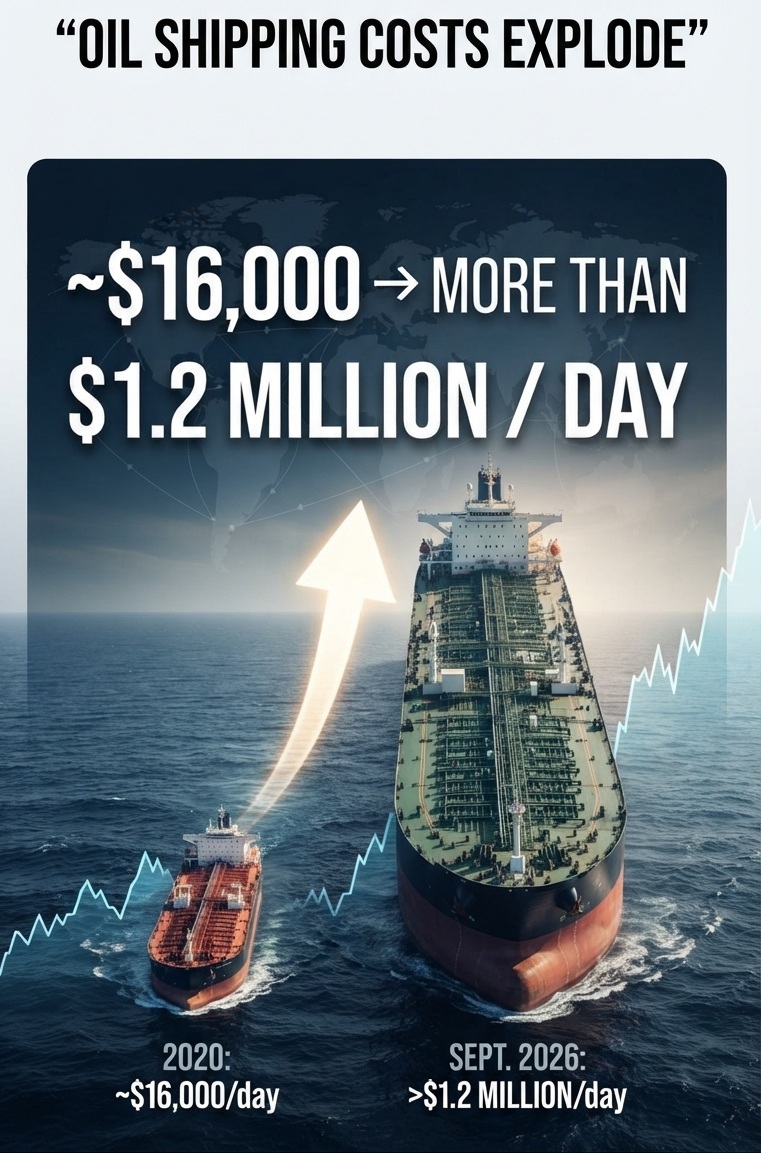
The cost of transporting crude oil by the world’s largest oil tankers has reached extraordinary levels.
On the benchmark TD3C route — a 270,000-metric-ton Very Large Crude Carrier (VLCC) traveling from the Middle East Gulf to China — daily time-charter-equivalent (TCE) earnings have surged from roughly $16,000/day in 2020 to more than $1.2 million/day in September 2026.
That is not simply a large increase. It represents an extraordinary transformation in the economics of moving oil by sea.
From $16,000 to $1.2 Million a Day
| Period | Approx. TD3C Daily Rate/TCE | What Was Driving the Market |
|---|---|---|
| 2020 | ~$16,000/day | Pandemic-era demand collapse and abundant tanker capacity |
| 2025 | ~$35,000/day average* | Tightening tanker fundamentals, geopolitical rerouting and limited fleet growth |
| September 2026 | $1,212,503/day | Middle East conflict, disruption around the Strait of Hormuz, rerouting and severe tanker scarcity |
*McQuilling reported a TD3C average earning of approximately $35,136/day for the first eight months of 2025, rather than $160,000/day.
The 2020 figure is also consistent with contemporary tanker-market estimates. McQuilling projected the TD3C round-trip voyage at approximately $16,200/day for 2020.
Then came 2026.
The $1.2 Million-a-Day Shock
In September 2026, the TD3C benchmark moved into territory rarely seen in modern tanker shipping.
The Baltic Exchange reported that the TD3C rate rose to Worldscale 1,140, corresponding to a round-trip TCE of approximately $1,212,503 per day for a standard Baltic VLCC.
Earlier in September, the same benchmark had already exceeded $1 million/day, with the Baltic assessment reaching approximately $1.099 million/day on September 15.
The surge reflects an extraordinary combination of factors:
- disruption to Middle Eastern oil-export routes;
- sharply reduced traffic through the Strait of Hormuz;
- attacks and security risks affecting regional shipping;
- longer and more complicated voyages;
- ships being tied up in shuttle and ship-to-ship operations;
- and a limited number of immediately available VLCCs.
Reuters reported on September 21 that only 17 commodity vessels transited the Strait of Hormuz over the weekend, compared with 37 the previous week and a pre-conflict average of about 125 vessels per day.
Why Shipping Costs Matter
Oil does not simply move from the wellhead to the refinery.
It has to be transported.
When the cost of transporting a cargo of crude suddenly multiplies, the consequences extend through the entire energy system.
At today’s extreme tanker rates, transportation itself can represent a substantial portion of the delivered cost of crude. The Wall Street Journal reported that VLCC charter costs had exceeded $1 million/day, equivalent to roughly $26 per barrel on the affected voyages.
That means the disruption is not merely a problem for shipowners and oil traders.
It can affect:
oil producers → tanker operators → refiners → fuel distributors → consumers
Higher transportation costs can therefore add pressure to gasoline, diesel, jet fuel and other petroleum products even when the underlying price of crude oil is moving differently.
An Extraordinary Comparison
The scale of the change is easier to see this way:
2020: ~$16,000/day
↓
2025: ~$35,000/day average
↓
September 2026: $1,212,503/day
From the approximate 2020 level to the September 2026 TD3C assessment, the daily TCE increased by roughly 75×.
That is an extraordinary change in the economics of moving a single cargo of oil.
And it demonstrates something important about modern energy systems:
When a critical transportation chokepoint is disrupted, the cost of moving energy can become a crisis of its own.
A market under extreme stress
The current rate should not be interpreted as a normal annual shipping cost. It is a spot-market benchmark during an exceptional geopolitical disruption. Rates can move dramatically in either direction as vessel availability, security conditions, oil flows and trade routes change.
But the magnitude of the September 2026 spike is unmistakable.
The cost of moving oil by VLCC has gone from tens of thousands of dollars per day to more than $1.2 million per day.
That is a remarkable indicator of just how much stress has entered the global oil-transportation system.