bookmark_borderThe Impending Economic Impact of April 2 Tariff Announcement: A Global Crisis in the Making

by Daniel Brouse
April 1, 2025

The Washington Post has reported that sources indicate the April 2 tariff announcement is set to impose an across-the-board 20% tariff on a broad range of imports. Such a drastic move would have far-reaching implications for the global economy, potentially triggering the most significant worldwide economic downturn since the Great Depression.

Understanding the Scope of the 20% Tariff

Tariffs are taxes on imported goods, usually levied by governments to protect domestic industries or to encourage certain economic behaviors. A 20% across-the-board tariff means that the cost of many goods entering the U.S. from other countries will increase by 20%. This would apply to various sectors, from electronics and consumer goods to industrial materials and food products. As a result, the prices of everyday items could surge, straining consumers and businesses alike.

The immediate impact of such a policy would be felt in the U.S., as companies pass on the added costs to consumers. But the ramifications would not stop at U.S. borders. Trade is a two-way street, and countries affected by these tariffs are likely to retaliate. This could lead to a global trade war, where countries impose tariffs on each other’s exports, resulting in widespread disruptions to the global supply chain.

Potential Global Economic Consequences

  1. Rising Prices and Inflation
    A 20% tariff would lead to higher prices on a wide array of goods. Manufacturers and retailers would face increased costs for materials and products, which would, in turn, be passed on to consumers in the form of higher prices. For everyday consumers, this would result in reduced purchasing power, further exacerbating inflationary pressures already present in many economies. The cost of living would rise, leading to decreased consumer spending and potentially slowing down economic growth.

  2. Global Trade Disruption
    Global trade relies on the free flow of goods between nations. A sudden imposition of tariffs of this magnitude would disrupt supply chains, as businesses would need to find new suppliers or production methods to avoid the increased costs. Countries that rely heavily on exports to the U.S. could face severe economic hardships, while other nations may retaliate with tariffs of their own, creating a cycle of protectionist measures that harms all parties involved.

  3. Risk of Recession
    The last time the global economy faced a crisis of this magnitude was during the Great Depression. The widespread implementation of tariffs back in the 1930s triggered a global trade collapse, leading to massive economic contractions, rising unemployment, and a dramatic decrease in global output. Similarly, a modern-day trade war could push the world economy into recession, as countries become more isolated and less able to collaborate on international economic growth.

  4. Impact on Developing Economies
    Developing economies, which often rely on exports to wealthier nations, would be especially vulnerable to the effects of a 20% tariff. Countries like China, Mexico, and those in Southeast Asia could see their exports significantly reduced, hurting their GDP growth. This could lead to a rise in poverty and unemployment in these nations, which may also result in political instability and unrest.

  5. Financial Market Volatility
    The announcement of such a significant tariff could lead to considerable volatility in global financial markets. Investors would likely respond with caution, retreating from stocks and other risky assets in favor of safer investments like government bonds or gold. This could cause major declines in stock market indices worldwide and exacerbate economic instability. The uncertainty around trade relations could also harm long-term business planning and investment decisions.

Historical Precedents and the Global Economic Landscape

The Great Depression remains the most well-known example of how tariffs can spiral into a global economic collapse. The Smoot-Hawley Tariff Act of 1930, which raised U.S. tariffs on over 20,000 imported goods, is often cited as a contributing factor to the global depression. The resulting trade barriers reduced global trade by more than 60% and deepened the economic crisis. History has shown that protectionist policies, while sometimes aimed at shielding domestic industries, can often backfire, leading to a reduction in global trade, lower economic growth, and widespread hardship.

The global economy today is more interconnected than ever, with supply chains that stretch across borders and trade that plays a central role in most nations’ economic health. A tariff policy that disrupts this interconnectedness would likely have a ripple effect, leading to job losses, lower productivity, and declining standards of living for people around the world.

Conclusion

The April 2 tariff announcement, with its proposed 20% across-the-board levy, carries immense risks for the U.S. and the world. While the goal of such tariffs is often to protect domestic industries, the broader economic consequences could be catastrophic. With the potential to trigger a global trade war, increase inflation, and push the world into recession, the decision to impose such tariffs could very well be seen as a turning point in the global economic landscape. As businesses and consumers brace for these impacts, the world faces a future that is increasingly uncertain, with the specter of the Great Depression looming once more.
Trumpenomics: The Decline of the US

bookmark_borderTrump Economic Facts

Amazingly, some still suffer from Trump Delusionment Syndrome, defending his economic policies while claiming Biden ‘destroyed the economy’ or insisting that Trump needs to ‘break some eggs’ to bake a cake—meaning we need to endure pain. No, we don’t need pain. The economy performed the best in history during Biden’s term, in sharp contrast to both Trump 1.0 and the early signs of Trump 2.0.

Let’s look at the numbers: During Trump’s first term (2017–2021), the national debt increased by about $7.8 trillion, mainly due to tax cuts that didn’t pay for themselves and pandemic-related spending. Under Biden (2021–2025), the debt rose by about $6.3 trillion—but a significant portion of that came from legislation and tax policies enacted under Trump.

Now, three months into Trump’s second term (2025–2029), debt projections are looking even worse. Estimates suggest Trump 2.0 will add an additional $10 trillion, driven by an extension of his tax cuts and increasing deficits. By the end of Trump 2.0, Trump will have added more to the national debt than all Democratic presidents combined.

So if debt is your concern, you might want to rethink which administration is actually running up the tab. On the other hand, if you’re talking about GDP, we are currently experiencing the sharpest decline since Trump’s last term—when he oversaw the fastest economic contraction in U.S. history.

Protectionism is one of the worst economic policies. Tariffs are regressive taxes that disproportionately harm marginalized communities while failing to boost the economy or reduce the deficit. The last time a president imposed broad tariffs, it contributed to the Great Depression—a global economic catastrophe that took decades to recover from and provided no lasting benefits to society.

Trumpenomics: The Decline of the US

bookmark_borderGold: A Growing Influence in Today’s Market

by Daniel Brouse
March 28, 2025

Gold: A Growing Influence in Today’s Market

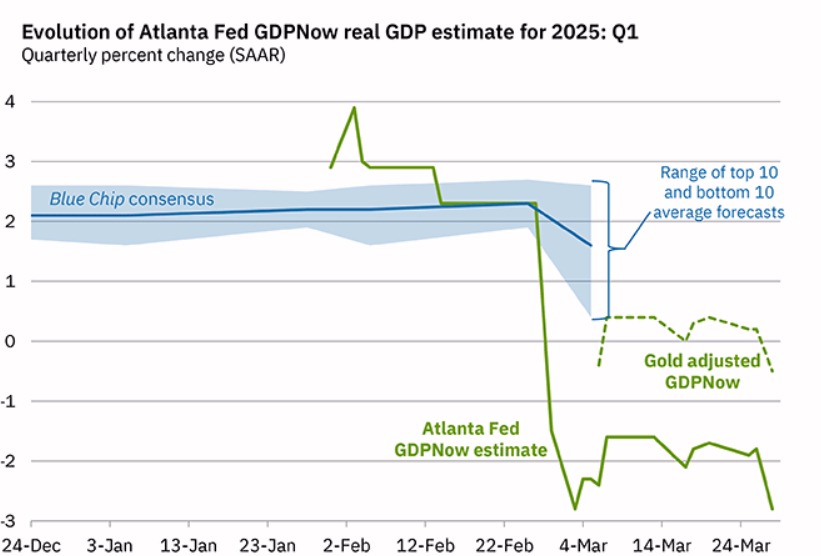
Gold has always been a significant asset in the global financial landscape, but recently, its influence has grown in ways not seen for quite some time. One key reason for this increased attention is its impact on the Atlanta Federal Reserve’s GDPNow tracker. In fact, the Fed had to add a special line in its graph to account for the significant influence of net gold imports on U.S. GDP. This is not a typical occurrence and signals that gold is playing a more prominent role in the economy than it has in recent decades.

Why is Gold Significant?

Gold is generally considered in two primary ways: as a store of wealth and as a commodity used in products such as jewelry and electronics. Traditionally, gold flows have been relatively stable. That means the Fed typically does not focus much on gold as it doesn’t typically cause significant economic disruption or fluctuation. However, recent trends have shown an increase in gold imports that is disproportionate to other sectors of the economy. This surge has been so large that it has skewed GDP calculations, prompting the Fed to specifically acknowledge it.

The challenge with accurately tracking gold’s economic impact stems from how it is measured and classified. Imports and exports of gold can be difficult to track, especially considering the different forms in which gold is used. It is not always clear whether gold is entering the country for industrial use or simply as a hedge against economic uncertainty, making it harder for analysts to determine its full economic impact.

The Fed’s Usual Disregard for Gold

So why doesn’t the Federal Reserve usually pay more attention to gold? In past decades, gold flows were relatively predictable and static. It was a safe asset that largely served as a store of value, with only small fluctuations in demand. Therefore, gold didn’t play a significant role in influencing broader economic data like GDP growth. This predictability, combined with the move away from the gold standard, meant that gold was seen as less relevant in day-to-day monetary policy decisions.

However, recent patterns have changed. A combination of global economic uncertainties, inflation fears, and geopolitical tensions has led to a surge in demand for gold as a safe haven asset. As a result, huge gold imports have recently overshadowed other aspects of the GDP, pushing the Federal Reserve to reconsider its influence.

What Does This Mean for You?

For the average investor, the growing prominence of gold has several potential implications. The most significant impact could be felt if you have a 401(k), invest in mutual funds, or hold ETFs. Many of these investment vehicles, particularly index funds and mutual funds, are required to stay fully invested in the market. This can leave investors vulnerable during periods of market volatility or when certain asset classes, like stocks, are underperforming.

In these times, it might be wise to consider reducing risk, or “beta,” in your portfolio. This means adjusting your investment strategy to become more defensive, moving away from riskier equities, and diversifying into other assets—such as gold. By reallocating a portion of your investments into gold, you can help hedge against volatility, preserve wealth, and potentially capitalize on gold’s rising demand. This is especially pertinent when traditional markets experience instability, and gold continues to serve as a long-standing safeguard against inflation and market turmoil.

The Bottom Line

The growing significance of gold in today’s economic environment is not a passing trend. As illustrated by the Fed’s GDPNow tracker, the surge in gold imports is not merely a statistical anomaly but a clear indication of broader economic shifts. Such movements in asset flows are valuable signals for individual investors, offering insight into changing market dynamics. Other key indicators to watch include currency and credit flows, which also provide clues about the direction of the economy. However, for small investors, participating directly in many of these trades can be challenging—especially with issues like storing gold, soy, or pork bellies.

In times like these, your best investment strategy is likely to focus on tangible assets. Housing should remain your largest asset, offering long-term stability and growth potential. For additional savings and retirement funds, consider allocating 90% to short-term treasuries, 5% to Treasury I Bonds, and 5% to gold and other real assets. This diversified approach can help protect your wealth and provide a hedge against economic uncertainty.


GDPnow 3-28-2025
GDPnow 3-28-2025

Capital Preservation During Trumpenomics

Trumpenomics: The Decline of the US

bookmark_borderTrump’s Sweeping Tariff Plan Threatens to Reverse Decades of Trade Progress

by Daniel Brouse
March 20, 2025

Trump aides are preparing to implement a sweeping new set of tariffs on imports valued in the trillions of dollars, aligning with the administration’s push for a more protectionist trade policy. This plan, part of Trump’s so-called “reciprocal” trade agenda, is expected to significantly alter U.S. trade relations by targeting countries that impose tariffs or non-tariff barriers on American goods.

According to Edward Gresser, a trade policy expert, Trump’s proposed tariff plan could push the average U.S. tariff rate to levels not seen since the early 1930s—approximately 20 percent. Such a shift would mark a dramatic departure from decades of trade liberalization, reversing much of the progress made in reducing global trade barriers since World War II.

This is the first indication of the scope and magnitude of the April 2nd tariffs.

Economic and Historical Concerns

Critics warn that imposing tariffs at such high levels could trigger retaliatory measures from trading partners, leading to increased costs for American consumers and businesses. Economists and industry leaders have expressed concerns that a tariff regime reminiscent of the 1930s could result in supply chain disruptions, inflationary pressures, and reduced global economic growth. Historically, these types of tariffs were a significant factor in exacerbating the Great Depression.

There is no evidence that tariffs protect American industries or bring manufacturing back to the U.S. During Trump’s first term, the administration imposed 25% tariffs on steel and 10% on aluminum under the justification of protecting American jobs and reducing reliance on foreign imports. However, studies, including one from the Peterson Institute for International Economics, found that these policies were a net negative for the economy.

The Economic Damage of Trump’s First Tariffs

  • Net Loss of 75,000 U.S. Manufacturing Jobs – While a handful of domestic steel jobs were temporarily created, the broader manufacturing sector suffered significantly. Industries reliant on steel and aluminum, such as automotive production, construction, and appliance manufacturing, faced higher input costs, leading to layoffs and production cuts.
  • Each Job Saved Cost Taxpayers $900,000 – The few jobs protected by tariffs came at an extraordinarily high cost, making it one of the least efficient job protection policies in U.S. history.
  • Higher Prices for American Businesses and Consumers – U.S. companies paid 15-20% more for steel and aluminum compared to international competitors, leading to price increases for consumer goods, vehicles, and infrastructure projects.
  • Decline in U.S. Exports Due to Retaliatory Tariffs – In response to Trump’s tariffs, major trading partners—including Canada, China, and the European Union—imposed retaliatory tariffs on U.S. goods. This particularly hurt the agriculture sector, leading to billions in lost revenue for American farmers.
  • Stock Market and Business Uncertainty – The tariffs increased economic volatility, with markets reacting negatively to heightened trade tensions and uncertainty in key manufacturing industries.

As Trump pushes forward with his sweeping tariff agenda, the potential consequences for the U.S. economy, global trade relations, and domestic industries remain a significant concern.

Trumpenomics: The Decline of the US

bookmark_borderEscalating Climate Crisis: Extreme Weather Displaces Hundreds of Thousands in 2024

by Daniel Brouse
March 19, 2025

Not only was 2024 the hottest year on record, but it also set a record for the number of people displaced, including in the U.S.

  • The World Meteorological Organization (WMO) reported that 2024 was the hottest year on record, with global temperatures averaging 1.55°C above pre-industrial levels. This unprecedented heat contributed to the acceleration of glacier and sea ice loss, leading to a rise in sea levels. The temperature exceeds the 1.5°C limit set by the Paris Accord which is an important threshold for triggering tipping points. Nine tipping points have likely been crossed in the last 5 years. Tipping points are Critical Milestones that directly impact the rate of acceleration in climate change by multiplying the number and intensity of feedback loops. Identifying and understanding these tipping points is crucial for climate science and policymaking. Crossing multiple tipping points could lead to a domino effect, resulting in a much more rapid and severe climate change than currently projected.

  • The WMO also noted that extreme weather events in 2024, such as heatwaves, floods, and storms, displaced more than 800,000 people and caused significant crop losses. In the U.S., displacement was driven by multiple climate disasters, including an unprecedented hurricane season, widespread flooding, and prolonged heatwaves.

    Hurricanes Helene and Milton were among the most devastating storms to make landfall in 2024, forcing hundreds of thousands of people to evacuate in coastal regions, particularly in Florida, Louisiana, and the Carolinas. The hurricanes caused extensive infrastructure damage, with some communities still struggling to rebuild months later. Meanwhile, record-breaking flooding in the Midwest, exacerbated by heavier rainfall and rising river levels, displaced thousands of residents, washing away homes and farmlands.

    As 2025 began, the crisis continued with massive wildfires in California, driven by persistent drought and extreme heat. Entire towns were forced to evacuate, with some residents losing their homes permanently due to the rapidly spreading blazes. The Midwest and Southeast were also hit hard in March 2025 by one of the worst tornado outbreaks in recent history, leaving entire neighborhoods uninhabitable and displacing thousands. The increasing frequency and intensity of these disasters underscore the growing impact of climate change on population displacement in the U.S. and the urgent need for stronger adaptation measures.

  • Additionally, a study revealed that ‘climate whiplash’—abrupt shifts between extreme wet (violent rain) and dry conditions—is increasingly affecting major cities worldwide. This phenomenon complicates disaster preparedness and recovery efforts, underscoring the urgent need for global action to adapt to these changes.

    Mass, velocity, and density determine the severity of extreme rain events, and all three are increasing as both wind and rainfall intensify. The interaction of these factors amplifies flow forces, with wind and water forces scaling proportionally to the square of velocity. This means that as wind speeds rise due to more intense heating or heavier rainfall, the resulting damage increases exponentially. According to drag physics, force is proportional to density times the square of velocity.

    For example, a 20-mile-per-hour wind exerts four times the force of a 10-mile-per-hour wind, while a 40-mile-per-hour wind exerts 16 times the force. At 50 miles per hour, the force is 25 times greater, and at 60 miles per hour, it is 36 times greater than at 10 miles per hour. When factoring in density, the impact becomes even more severe: water is approximately 800 times denser than air, meaning that a 10-mile-per-hour water flow exerts 800 times the force of a 10-mile-per-hour wind.

    As climate change accelerates, increasing flow velocities will lead to exponentially greater destructive forces. While the precise extent of future velocity increases remains uncertain, the consequences are already visible—overwhelmed flood and sewage systems, collapsing hillsides, and widespread infrastructure failures. Without urgent adaptation measures, these escalating forces will continue to cause greater damage to communities and ecosystems.

    The increasing frequency of extreme rain events is occurring alongside cycles of severe drought, creating a destructive feedback loop. Prolonged drought leaves the land parched and less able to absorb water, making it highly susceptible to erosion, flash flooding, and landslides when heavy rains arrive. This combination intensifies devastation, as dry, compacted soil repels water, leading to rapid runoff, more severe flooding, and long-term degradation of topsoil, which further reduces the land’s ability to recover.

These findings emphasize the escalating impact of climate change on human displacement and the critical importance of implementing effective climate adaptation and mitigation strategies.


The Human Induced Climate Change Experiment

bookmark_borderEconomic and Security Implications of Trump Policies

by Daniel Brouse
March 18, 2025

Recent policy decisions by the Trump administration have led Canada and Australia to reconsider significant defense contracts with the United States.

Canada’s Reassessment of the F-35 Fighter Jet Deal

Canada is reevaluating its C$19 billion contract for 88 Lockheed Martin F-35 fighter jets. This reconsideration stems from escalating trade tensions, particularly the Trump administration’s imposition of tariffs on steel and aluminum imports. Prime Minister Mark Carney has directed Defense Minister Bill Blair to explore alternatives, though switching to other aircraft could entail increased costs and operational complexities.

Bombardier CEO Eric Martel expressed concerns that canceling the F-35 deal might prompt the U.S. to target Canadian firms’ contracts, potentially affecting Bombardier’s U.S. agreements.

Australia’s Scrutiny of the AUKUS Submarine Pact

Australia is reassessing its involvement in the AUKUS pact, which includes acquiring up to five Virginia-class submarines from the U.S. Former Prime Minister Malcolm Turnbull criticized the agreement, arguing it compromises Australia’s sovereignty and security without guaranteeing submarine delivery. He emphasized that despite Australia’s financial commitment, there’s no assurance of receiving the submarines, potentially leaving the nation dependent on U.S. military support.

Additionally, a nominee for the U.S. Undersecretary for Defense Policy suggested that selling submarines to Australia could be unwise amid rising tensions with China over Taiwan, indicating potential reluctance within the U.S. defense establishment.

These developments reflect growing unease among U.S. allies regarding recent American policy decisions, leading to potential shifts in longstanding defense and economic partnerships.

Protectionism 101: Trump Economics

bookmark_borderBYD’s Breakthrough Charging Tech Exposes the Pitfalls of U.S. Protectionism in the EV Market

by Daniel Brouse
March 18, 2025

BYD, China’s leading electric vehicle (EV) manufacturer, has unveiled a groundbreaking ultra-fast charging system capable of delivering 1,000 kilowatts (kW) of power. This advancement allows EVs to gain 400 kilometers (approximately 248 miles) of range in just five minutes, effectively matching the refueling time of traditional gasoline vehicles. This technology is set to debut in BYD’s latest Han L sedan and the upcoming Tang L SUV models.

In contrast, the United States has implemented protectionist policies, including substantial tariffs on Chinese-made EVs and components. These measures aim to shield domestic manufacturers from foreign competition but have led to increased costs for EV parts and materials. Consequently, American consumers face higher prices, potentially slowing the adoption rate of EVs and hindering the expansion of charging infrastructure.

Moreover, such protectionism may inadvertently discourage domestic innovation. With reduced competition, U.S. automakers might have less incentive to pursue rapid technological advancements, potentially causing them to lag behind global competitors like BYD. This scenario underscores how protectionist policies can stifle innovation and competitiveness within the domestic EV industry.

BYD’s new charging technology exemplifies the strides made by manufacturers operating in more open and competitive markets. It highlights the potential drawbacks of U.S. protectionist measures, which, while intended to bolster domestic industries, may instead result in higher consumer prices and a slowdown in technological progress.

Protectionism 101: Trump Economics

bookmark_borderThe Inflationary Impact of Trump Tariffs and the Decline of the Dollar

by Daniel Brouse
March 18, 2025

According to the U.S. Bureau of Labor Statistics, import prices rose 0.4% in February 2025, following a 0.6% increase in January. This marks the largest two-month advance since mid-2022. The February increase was primarily driven by higher fuel prices, which advanced 1.7% after a 2.9% rise in January. Nonfuel import prices also edged up 0.3% in February, continuing the upward trend from the previous month.

Over the past year, import prices have increased by 3.4%, reflecting ongoing inflationary pressures in the economy.

These rising import prices are contributing to broader inflation concerns, as higher costs for imported goods can lead to increased prices for consumers and businesses alike. This trend underscores the importance of monitoring trade policies and global economic conditions that influence import costs.

The decline in the U.S. dollar is contributing to import inflation in several key ways:

  1. Higher Costs for Foreign Goods – A weaker dollar means it takes more U.S. dollars to buy the same amount of foreign currency. Since imports are priced in the currency of the exporting country, the cost of these goods rises when converted into dollars.

  2. Increased Raw Material Prices – Many imported raw materials, such as oil and industrial metals, are priced in dollars on global markets. When the dollar weakens, foreign suppliers may demand higher prices to maintain their profit margins, driving up costs for U.S. buyers.

  3. Supply Chain Price Pass-Through – Foreign manufacturers that rely on U.S. demand may pass higher exchange-rate-related costs onto American consumers. If businesses cannot absorb the additional costs, they raise prices on imported goods, fueling inflation.

  4. Reduced Purchasing Power – A weaker dollar diminishes the real value of American incomes when purchasing imported goods. This limits the ability of businesses and consumers to shop for lower-cost alternatives abroad, reinforcing inflationary pressures.

  5. Higher Transportation and Logistics Costs – Since global trade often involves transactions in multiple currencies, a depreciating dollar can increase the cost of shipping and logistics, further raising the final price of imported products.

As import prices rise due to the weaker dollar, businesses either absorb the costs (reducing profit margins) or pass them on to consumers, contributing to overall inflation in the U.S. economy.

Stagflation

In addition, U.S. steel manufacturers raised their prices last week to match the tariffs on imported steel, reducing any cost advantage for domestic buyers. This increase in steel prices had ripple effects throughout the economy, driving up costs for industries that rely on steel, such as construction, automotive, and manufacturing. Higher material costs forced businesses to either absorb the added expenses, reducing profit margins, or pass them on to consumers, contributing to broader inflation. Additionally, retaliatory tariffs from trading partners further disrupted supply chains, increasing costs for raw materials and intermediate goods, exacerbating inflationary pressures across multiple sectors.

These developments highlight the growing likelihood of a slowing economy coupled with persistent inflation, a condition known as “stagflation,” which is one of the worst-case scenarios for economic stability.

Trumpenomics: The Decline of the US


bookmark_borderGlobal Economic Outlook Dims Amid Rising Trade Barriers and Geopolitical Tensions

by Daniel Brouse
March 17, 2025

On March 17, 2025, the Organization for Economic Co-operation and Development (OECD) released its latest Interim Economic Outlook, revising downward its global economic growth forecasts. This worldwide slowdown is attributed to higher trade barriers in several G20 economies, which are expected to dampen global growth and contribute to inflationary pressures, elevated geopolitical tensions and policy uncertainties. For the United States, the OECD has notably reduced its GDP growth forecasts, anticipating a multiyear decline with a meager 1.6% growth rate in 2026.

Atlanta Fed's GDP Tracker
Atlanta Fed’s GDP Tracker

Additionally, the Atlanta Fed’s GDP tracker for real GDP growth also was revised downward today to -2.1% for the first quarter of 2025 indicating a possible recession in the first half of this year.

These forecasts highlight both the immediate and long term decline in global economies, as well as the severe impacts to the US economy due to Trump’s economic policies.

Ironically, a sharp decline in the U.S. economy could help counteract the ‘drill, baby, drill’ policy and slow fossil fuel consumption, which would be beneficial for the environment. An economic slowdown typically leads to reduced demand for oil and fossil fuels, resulting in lower emissions. This decreased demand often causes oil prices to fall. When the price of a barrel of oil drops below certain thresholds, drilling new wells can become unprofitable. For instance, in 2022, the average breakeven price to profitably drill a new well in the United States was approximately $56 per barrel, with regional variations ranging from $48 to $69 per barrel.  Therefore, sustained oil prices below these breakeven points can discourage new drilling activities.

Explanation of the ‘Drill, Baby, Drill’ Policy:
The phrase “drill, baby, drill” emerged as a political slogan advocating for increased domestic oil and gas production in the United States. It gained prominence during the 2008 Republican National Convention and has been associated with policies aiming to boost fossil fuel extraction to achieve energy independence and economic growth. In recent years, this slogan has been revitalized to support expansive fossil fuel production initiatives. Proponents argue that such measures can lead to lower energy prices and reduced reliance on foreign oil. However, critics express concerns that this approach undermines efforts to combat climate change by perpetuating dependence on carbon-intensive energy sources.

President Donald Trump’s stance on climate change has been characterized by skepticism and policy actions that deprioritize environmental concerns in favor of economic and energy interests.

Public Statements:

  • Historically, Trump has referred to climate change as a “hoax.”
  • More recently, he has dismissed concerns about rising sea levels, stating, “That is not our problem,” and has emphasized “nuclear warming” as a more pressing threat.
  • Trump has repeatedly referred to the climate crisis as the Green New Scam.

Policy Actions:

  • Upon his inauguration in January 2025, President Trump withdrew the United States from the Paris Agreement and pledged to roll back executive orders and policies from the previous administration aimed at addressing climate change.

  • He issued an executive order titled “Promoting Energy Independence and Economic Growth,” aiming to dismantle many federal actions addressing climate change.

  • The administration has proposed cuts to agencies like FEMA, which could significantly impact disaster response capabilities in states vulnerable to climate-related events, such as California.

Impact on Environmental Policies:

  • The administration’s stance has led to reduced funding for clean energy projects and transportation initiatives. Major financial institutions have withdrawn from net-zero alliances, and the Securities and Exchange Commission (SEC) has implemented rules making it more challenging for investors to address environmental, social, and governance (ESG) issues within companies.

Trumpenomics: The Decline of the US

The Human Induced Climate Change Experiment

bookmark_borderTrumpenomics: How Tariffs, Policy Cuts, and Labor Shortages Are Devastating American Farmers

by Daniel Brouse
March 13, 2025

Recent policies enacted by the President have had significant financial repercussions on American farmers, leading to substantial economic losses.​

1. Impact of Tariffs and Retaliatory Measures

The Trump 2.0 administration’s imposition of tariffs, particularly on steel and aluminum, has triggered retaliatory tariffs from major trading partners such as China, Canada, and the European Union. These countermeasures have significantly reduced demand for U.S. agricultural exports, exacerbating existing challenges like droughts, supply chain disruptions, and low commodity prices. Texas farmers, many of whom have historically supported the President, are now voicing concerns over the mounting economic pressures caused by these policies.

The precedent for these economic consequences was set during Trump’s first administration. The 1.0 tariffs, particularly those targeting steel and aluminum, prompted severe retaliatory measures, notably from China. The impact on U.S. agriculture was devastating:

  • Soybean Exports: In 2018, U.S. soybean exports to China plummeted by $9.4 billion. While some alternative markets were found, they only recovered $4.7 billion in lost revenue, leaving a net loss of $4.7 billion for American soybean farmers.
  • Regional Losses: Major agricultural states like Iowa, Illinois, and Kansas saw significant financial hits. Iowa farmers alone lost $1.46 billion, Illinois suffered $1.41 billion in losses, and Kansas endured a $955 million decline in revenue.
  • Federal Bailouts: In an attempt to compensate for the damages, the U.S. Department of Agriculture (USDA) issued $23 billion in direct payments to farmers between 2018 and 2020. However, these subsidies often fell short, leaving many farmers struggling with long-term economic setbacks.

The Trump 2.0 tariffs are broader in scope, applying to more countries at higher rates, making the expected economic fallout far more devastating than before. With supply chain disruptions, climate-related hardships, and rising input costs already squeezing farmers, these new tariffs threaten to push many agricultural operations to the brink of collapse.

So far in 2025, several countries and trading blocs imposed retaliatory tariffs on U.S. agricultural imports in response to the current administration’s tariffs on steel, aluminum, and other goods. The European Union (EU) announced €26 billion in countermeasures against U.S. products, including agricultural goods. The first phase, effective April 1, targets €4.5 billion worth of U.S. consumer goods such as bourbon whiskey, jeans, and Harley-Davidson motorcycles. The second phase, set for mid-April, will impose tariffs on €18 billion worth of U.S. steel and agricultural products. Canada followed suit, imposing 25% tariffs on $21 billion worth of U.S. imports, including steel, aluminum, and various other goods. This action builds on earlier tariffs of $30 billion enacted on March 4. Meanwhile, China announced 10-15% tariffs on U.S. meat and agricultural products, suspended imports of U.S. lumber, and revoked soybean import licenses for three major U.S. firms.

Important to note, the bulk of the Trump tariffs have not yet been announced and are expected to be implemented on April 2, 2025. The President has stated that these tariffs will be applied to all countries and may be as high as 250%.

2. Cancellation of USAID’s Programs

The recent termination of local food programs, including USAID’s “Food for Peace,” has further strained farmers:

  • Loss of Funding: Since 2021, local school lunch programs have provided over $2 billion to various states, supporting local food purchases for schools and food banks. Their cancellation removes a critical revenue stream for farmers, exacerbating financial challenges.

  • Food for Peace: The USAID “Food for Peace” program, which operated with an annual budget of approximately $1.7 billion, has been terminated as part of the broader dismantling of USAID. This program purchased U.S.-grown commodities, such as rice, wheat, lentils, and peas, for distribution to populations facing food insecurity worldwide. Its cancellation not only impacts global hunger relief efforts but also removes a significant market for American farmers.

These program cancellations have disrupted supply chains, leading to financial instability for farmers who previously relied on these initiatives. The sudden loss of funding has left many agricultural producers without alternative markets, intensifying the economic challenges within the farming community.

3. Labor Shortages Due to Immigration Policies

Stricter immigration policies have led to a shortage of immigrant workers, who are essential to the agricultural workforce. This scarcity has resulted in increased labor costs and challenges in harvesting crops, thereby reducing overall productivity and profitability for farmers.​

4. Economic Uncertainty and Market Instability

The combination of trade tensions, program cancellations, and labor shortages has created an environment of economic uncertainty. Farmers are facing volatile market conditions, making it difficult to plan for the future and invest in their operations. This instability threatens the sustainability of the agricultural sector and the rural communities that depend on it.​

In summary, the current administration’s policies have introduced significant challenges for American farmers, affecting export markets, domestic program support, labor availability, and overall economic stability.

ALSO SEE:

Trumpenomics: The Decline of the US