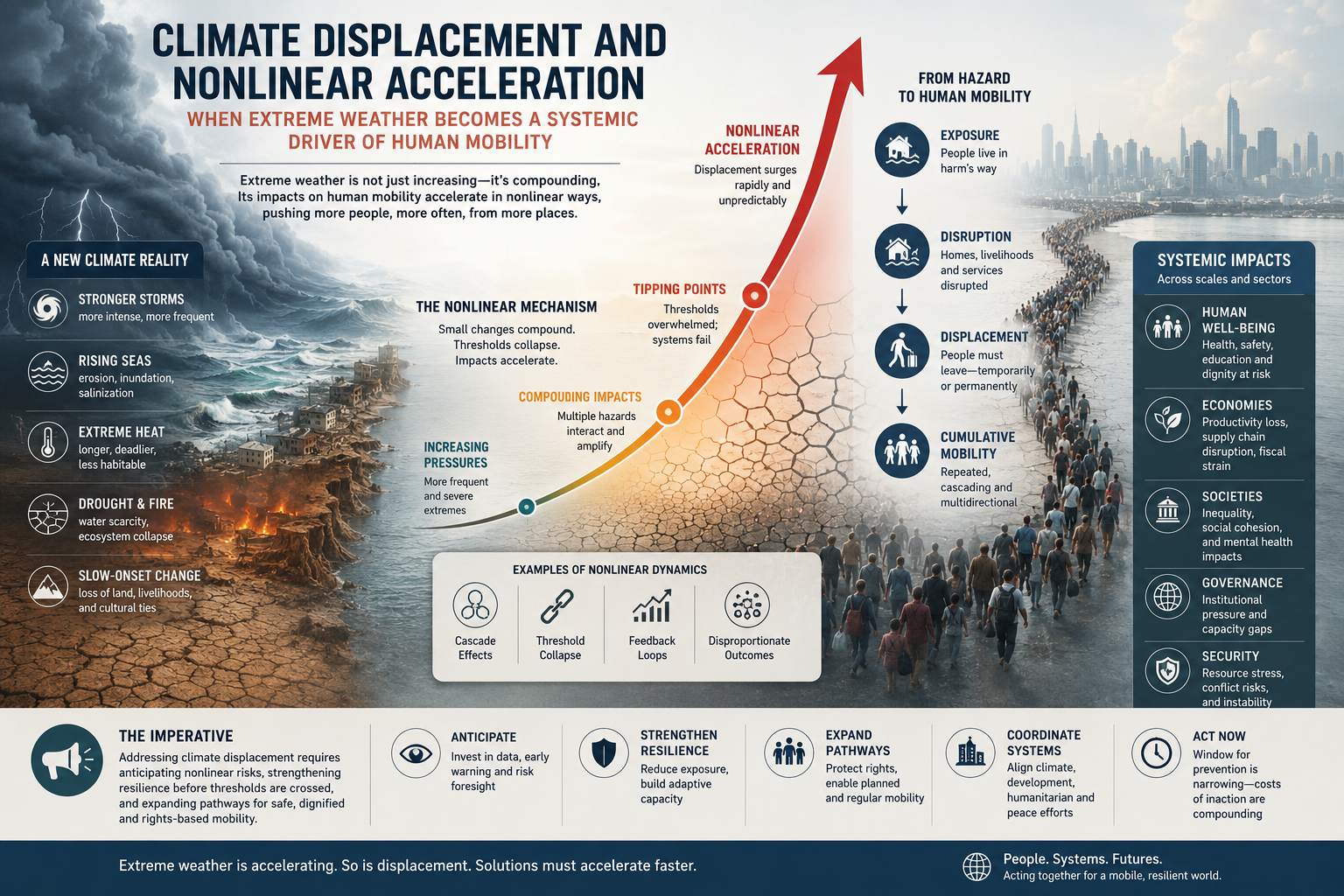
Complex social-ecological feedback loops arise when human systems and natural systems react to climate change in ways that amplify one another. Because Earth’s climate operates as a nonlinear system, these interactions do not unfold gradually — they can accelerate suddenly, compound unpredictably, and push the system toward irreversible shifts.
This nonlinear, cross-regional feedback behavior is something we have been modeling for decades — where climate physics couples directly with economic networks.
In the 1990s we underestimated one variable: human delay. We assumed mitigation would begin in earnest. It did not.
Now we observe potential doubling in the intensity or frequency of certain climate impacts on timescales of 2–10 years rather than centuries. The apparent acceleration has compressed from millennial-scale shifts to multi-decade nonlinear surges.
Denialism and Ecofascism
One factor we drastically underestimated was the influence of organized denialism and emerging ecofascist ideology.
Initially the investigation focused on a straightforward institutional question:
Were challenges to the EPA’s Endangerment Finding and coordinated regulatory rollbacks primarily driven by economic motives — specifically the fossil-fuel industry’s long-documented strategy of financing climate denial narratives?
Organizations such as the CO₂ Coalition and the Department of Energy’s Climate Working Group were key nodes of analysis. The economic motive was clear and well documented: protect fossil capital, delay regulation, and manufacture doubt.
But as correspondence, affiliations, and rhetoric were analyzed, a second pattern emerged.
This was not simply economic denialism. It was the normalization of ecofascist ideology.
Ecofascism reframes environmental collapse as beneficial — even desirable — if it reduces populations deemed inferior, excessive, or expendable. It merges environmental crisis with authoritarian hierarchy, racialized survival logic, and elite domination theory.
This is not speculation. It is visible in the language used by some elite circles revealed through the Epstein files.
Examples include statements attributed to Jeffrey Epstein such as:
“I liked the argument that more CO₂ is good for plants.”
“Maybe climate change is a good way of dealing with overpopulation — the Earth’s forest fire. Potentially a good thing for the species.”
Combined with statements reflecting explicit eugenic ideology:
“Executions of the elderly and infirm make sense.”
“African music has lots of beats and little development — no accident. It mirrors their learning process.”
This is not conventional policy disagreement. This is eliminationist logic.
Where traditional denial protects capital investment, ecofascism rationalizes unequal human survival.
The unexpectedly rapid release of more than $100 billion in tariff refunds is likely amplifying an already sharp increase in U.S. imports, contributing to a much wider trade deficit reported today by the Bureau of Economic Analysis.
According to the U.S. Bureau of Economic Analysis (BEA), the international trade deficit jumped 42.2% to $77.6 billion in May, up from a revised $54.6 billion in April. Imports climbed 3.3% to $395.3 billion, while exports fell 3.2% to $317.7 billion.
While businesses also accelerated purchases ahead of potential new tariffs and supply chain disruptions, the rapid release of tariff refunds appears to have become a major source of liquidity that enabled importers to dramatically increase orders from overseas.
Tariff Refunds Are Moving Much Faster Than Expected
The current refund program stems from the February 2026 U.S. Supreme Court ruling that invalidated many emergency tariffs imposed under the International Emergency Economic Powers Act (IEEPA). Since then, U.S. Customs and Border Protection (CBP) has been processing one of the largest customs refund programs in U.S. history.
The pace of payments has exceeded many expectations:
Approximately $166 billion in refund claims have been filed.
More than $104.3 billion has already been accepted.
Roughly $71 billion has been finalized and paid.
On June 29, CBP launched Phase 2 of its automated CAPE refund portal to process an additional 2.8 million older and more complex import entries.
The unexpectedly rapid return of more than $100 billion to importers has significantly improved corporate cash flow, allowing companies to replenish inventories and increase imports almost immediately.
Refund Liquidity Is Expanding the Trade Deficit
The refund process has created a powerful economic chain reaction:
More than $104 billion in accepted refund claims → Increased importer liquidity → Accelerated foreign purchasing → Larger U.S. trade deficit
Instead of remaining tied up in government accounts, tariff revenue is now flowing back into corporate balance sheets, enabling businesses to front-load imports while attempting to stay ahead of replacement tariff policies.
Tariff Revenue Has Effectively Disappeared
The refund program is also dramatically reducing federal customs revenue.
In May 2026, the U.S. Treasury paid out $21.97 billion in tariff refunds while collecting $21.93 billion in gross customs duties. The result was a net customs outflow of approximately $42 million, effectively eliminating tariff revenue for the month.
Growing Pressure on the Federal Budget
The reversal from collecting tariffs to issuing massive refunds is widening the federal fiscal deficit.
Because tariffs had become a significant source of government revenue, refunding those collections represents both a loss of expected receipts and a substantial increase in federal expenditures.
Moody’s Analytics estimates the immediate fiscal impact could exceed $133 billion.
The Congressional Budget Office (CBO) projects that related policy changes could increase federal deficits by roughly $2 trillion over the next decade.
Consumers See Little Benefit
Although corporations are receiving billions in refund payments, consumers are unlikely to see corresponding price reductions.
Several major retailers—including Nike, Amazon, and Costco—are facing class-action lawsuits alleging they retained tariff-related price increases while also receiving refund payments, allowing them to benefit from both higher prices and government reimbursements.
New Tariffs Could Offset the Windfall
Following the Supreme Court decision, the U.S. Trade Representative introduced new tariffs under alternative statutory authorities, including Section 122 and Section 301.
Many importers warn that these replacement tariffs could quickly erode the financial gains created by the current refund program. In the meantime, however, the rapid pace of tariff refunds is injecting substantial liquidity into import markets, contributing to a wider trade deficit and placing additional pressure on the federal budget.
The original purpose of Solutions to the Fossil Fuel Economy and the Myths Accelerating Climate and Economic Collapse was to focus on practical solutions rather than assigning blame. Since its publication, however, many readers have interpreted that emphasis as minimizing the responsibility of fossil fuel companies. This addendum clarifies that both interpretations can be true simultaneously.
I began my career as an economist specializing in risk management before turning my attention to humanity’s largest systemic risk—climate change. My work spans economics, systems science, statistics, and climate physics. Together with physicist Sidd Mukherjee, I co-originated the Nonlinear Acceleration Hypothesis, a framework describing how interacting physical, ecological, health, and socioeconomic feedbacks can accelerate climate impacts beyond traditional linear projections.
My work has consistently argued that climate change is both a physical and an economic problem. It cannot be understood through atmospheric science alone, nor through economics alone. Rather, it emerges from the interaction of nonlinear Earth-system processes and human decision-making.
Shared Responsibility Does Not Eliminate Corporate Accountability
Fossil fuel consumption is fundamentally a supply-and-demand system. Producers cannot exist without consumers, and consumers cannot purchase what is not supplied. Responsibility therefore exists on multiple levels.
Recognizing consumer responsibility does not absolve fossil fuel companies of their own responsibilities.
Oil and gas companies have exercised enormous influence through lobbying, political advocacy, public relations campaigns, strategic communications, and efforts to delay or weaken climate policy. Those actions deserve careful scrutiny and, where appropriate, legal accountability.
At the same time, it is equally inaccurate to argue that consumers possess no agency whatsoever. While choices are often constrained by infrastructure, income, geography, and available technology, millions of individuals, businesses, and governments have successfully reduced fossil fuel dependence through efficiency improvements, electrification, renewable energy adoption, and changes in consumption patterns.
The issue is therefore not one of assigning exclusive blame to either producers or consumers. Climate change is the product of interacting economic incentives, political institutions, technological development, consumer behavior, and physical climate feedbacks.
Understanding that complexity is essential if society intends to solve the problem rather than merely redistribute blame.
Corporate Accountability
My work has also extensively examined legal and economic mechanisms for holding fossil fuel companies accountable, including:
climate litigation,
consumer protection law,
human rights frameworks,
carbon pricing and taxation,
restitution,
treble-damage recovery, and
broader climate liability frameworks.
Those topics are discussed in detail throughout the following papers, which complement the original economics article rather than contradict it.
The Fossil Fuel Industry
Oil and gas companies unquestionably bear significant responsibility for the climate crisis. Decades of internal research, lobbying, public relations campaigns, political influence, and efforts to delay emissions reductions have been extensively documented. Protecting market share and shareholder value frequently took precedence over communicating known climate risks or accelerating the transition to lower-carbon energy sources.
Those actions deserve public scrutiny and, where appropriate, legal accountability.
However, acknowledging corporate misconduct does not eliminate the role of consumer demand. Energy markets function through supply and demand. Producers extract, refine, and distribute fossil fuels because governments, businesses, and consumers continue to purchase them across transportation, electricity generation, manufacturing, agriculture, aviation, shipping, and residential heating.
This is not a moral judgment; it is an economic reality.
Consumers often operate within real constraints. Infrastructure, housing, public transportation, income, local utility policies, and technology availability all influence individual choices. Some households possess far greater flexibility than others. Nevertheless, constrained choice is not the same as no choice. Millions of households and businesses have reduced fossil fuel consumption through energy efficiency, electrification, renewable energy, improved building design, vehicle selection, and changes in consumption patterns. Each reduction weakens demand at the margin.
Likewise, governments influence both supply and demand through regulation, taxation, subsidies, infrastructure investments, and public procurement. Climate policy therefore operates across every level of society rather than through a single actor.
The climate crisis emerged from interacting physical, economic, technological, and political systems. Effective solutions require addressing each component simultaneously.
Existing Work on Corporate Accountability
Contrary to claims that emphasizing consumer responsibility somehow absolves fossil fuel producers, much of my work focuses specifically on legal and economic accountability for corporate misconduct.
The following papers examine those issues in detail.
Climate Change and Accountability
Climate Change and Accountability: Legal Challenges, Consumer Rights, and Human Rights in the Fight Against Fossil Fuels
This paper examines the legal foundations for climate litigation, including consumer fraud, public nuisance, deceptive marketing, human rights claims, restitution, and the application of legal principles similar to those successfully employed against the tobacco industry.
The Economics of Climate Change
Climate change is fundamentally different from most economic shocks.
Traditional recessions eventually recover. Financial crises stabilize. Commodity shortages resolve. Climate change does not naturally return to equilibrium within human timescales because excess greenhouse gases and accumulated ocean heat continue influencing the climate system for decades to centuries.
As University of Cape Town researcher Christopher Trisos observed:
“For people, other species, ecosystems, and the world we live in, we’ve entered the Age of Loss and Damage, but we’re just at the start.”
Likewise, following the record-breaking Northern Hemisphere summer of 2023, United Nations Secretary-General António Guterres warned:
“Climate breakdown has begun.”
These statements reflect a growing recognition that climate damages are no longer primarily future risks—they have become ongoing economic realities.
The Age of Loss and Damage
Climate economics must therefore evolve beyond traditional Integrated Assessment Models (IAMs), many of which assume smooth, gradual damage functions that underestimate systemic risk.
My work argues that climate damages arise from interacting nonlinear feedbacks operating simultaneously across physical, ecological, health, financial, insurance, agricultural, infrastructure, and geopolitical systems.
Understanding those interactions requires integrating:
economics,
systems science,
statistics,
atmospheric physics,
ecology,
public health, and
risk management.
The resulting framework is consistent with the Nonlinear Acceleration Hypothesis, which recognizes that climate impacts increasingly reinforce one another through cascading feedback loops rather than simple linear cause-and-effect relationships.
Accounting for Climate Damages
One objective of climate economics is not merely estimating annual losses, but accounting for the full societal burden imposed by delayed mitigation and continued emissions.
Quantifying the Climate Tax
Quantifying the Climate Tax: The Full Ledger of Harm
This paper estimates the annual economic burden currently imposed by climate change on American households.
The analysis concludes that the direct annual climate burden already approaches $6,000 per person, while the broader long-term burden—including infrastructure degradation, ecosystem loss, health impacts, insurance instability, productivity losses, and deferred damages imposed on future generations—is substantially larger.
Climate change is therefore functioning as an invisible tax already embedded throughout the economy.
The Legal Foundation for Treble Damages
American law has long recognized that ordinary compensation is insufficient when misconduct is deliberate, deceptive, or socially destructive.
Treble damages appear throughout U.S. law, including:
Sherman Act antitrust litigation,
RICO actions,
False Claims Act enforcement, and
numerous state consumer protection statutes.
Their purpose extends beyond compensation. They deter future misconduct while recognizing that direct damages frequently underestimate total societal harm.
A comparable framework may be appropriate when evaluating climate-related damages if plaintiffs establish that institutions knowingly delayed mitigation while externalizing foreseeable risks onto the public.
Justice, Restitution, and Climate Liability
Applying a justice framework to climate economics raises three related questions:
Did organizations knowingly externalize foreseeable climate damages?
Have those damages fallen disproportionately upon vulnerable populations and future generations?
Should legal remedies reflect deterrence as well as compensation?
These questions extend beyond economics into ethics, law, and public policy, but they are increasingly becoming central to climate litigation worldwide.
The Cost of Inaction
The companion paper,
The Full Economic Burden: An Ensemble-Based Probabilistic Framework
develops an ensemble-based probabilistic framework for estimating the long-term economic consequences of accelerating climate change.
Under the median ensemble projection, annual U.S. climate-related economic losses increase nearly tenfold, rising from approximately $2.1 trillion in 2025 to $19.5 trillion by 2050 (constant 2025 dollars).
Rather than projecting a steady increase in damages, the analysis demonstrates how interacting physical, ecological, health, financial, and socioeconomic feedbacks can transform climate change into an accelerating systemic economic burden.
Under the median ensemble scenario, cumulative U.S. climate-related losses between 2025 and 2050 approach $200 trillion (constant 2025 dollars).
These projections illustrate a central conclusion of the Nonlinear Acceleration Hypothesis: delayed responses, thermal inertia, interacting feedbacks, and tipping cascades can produce economic impacts that grow substantially faster than traditional linear or quadratic damage models anticipate.
Conclusion
Climate responsibility should never be framed as an either-or proposition.
Corporations that knowingly delayed climate action should be held accountable through transparent governance, appropriate regulation, and where justified, legal remedies.
Governments bear responsibility for designing policies that correctly price externalities, accelerate innovation, and remove barriers to decarbonization.
Businesses bear responsibility for reducing emissions throughout their operations and supply chains.
Consumers also retain agency through the choices they make within the constraints they face.
Climate change emerged from the interaction of all of these systems. Lasting solutions will require accountability and action across all of them.
A newly surfaced U.S. military intelligence debriefing from a downed F-15 pilot has ignited debate within defense and intelligence circles after describing what appears to be a highly synchronized Iranian drone formation operating as a single coordinated system during combat operations over Iran in April.
According to a report published June 23, 2026, the pilot — who later ejected and was recovered after being shot down for the second time in the conflict — observed what he described as an anomalous aerial structure before going down, raising questions about whether Iran has demonstrated a new level of autonomous drone coordination.
The “Jellyfish” Formation
Intelligence sources familiar with the debriefing say the pilot described the drone configuration as resembling a “jellyfish” in structure: a larger grouping of drones positioned above with smaller units suspended beneath, forming what appeared to be a layered, interconnected system.
Rather than behaving as independent aircraft, the drones reportedly moved in tight synchronization, acting “completely as one cohesive unit.” The pilot described flying into what felt like a densely packed “minefield of drones,” characterizing the encounter in stark and highly unusual terms.
The pilot allegedly referred to the formation as “real alien sh*t,” reflecting both the visual complexity and the unexpected coordination observed in the engagement.
If accurate, the sighting could represent a significant leap in Iranian drone warfare capability, potentially indicating advanced swarm networking that allows multiple UAVs to maintain rigid spatial geometry while executing coordinated maneuvers. Such behavior would imply a high level of autonomy, distributed control systems, and real-time coordination far beyond Iran’s publicly understood drone doctrine.
Strategic Implications
Iran’s established drone doctrine has historically emphasized low-cost mass deployment, particularly through delta-wing Shahed-style systems designed to saturate air defenses through volume rather than coordination.
If the “jellyfish” formation reflects a real capability rather than a perceptual artifact, it would suggest a marked shift toward networked autonomous swarm warfare, where drones operate as a dynamically coordinated system rather than dispersed expendable assets.
Such a capability would represent a potentially significant evolution in regional airpower dynamics — moving from mass attrition tactics toward structured, adaptive, and possibly semi-autonomous airspace denial systems.
Conventional climate-risk analysis often treats impacts as the downstream consequence of physical hazard
intensification alone. In this framing, rising losses, displacement, mortality, infrastructure disruption,
and systemic instability are interpreted primarily as a function of increasing temperature, precipitation
extremes, sea-level rise, or other physical forcing variables. While useful, that approach increasingly fails
to explain the observed acceleration of climate damages in the real world, where losses are shaped not only
by changing hazards, but by the interaction of hazards with exposure, governance capacity, adaptation limits,
and broader socio-economic fragility.
This paper proposes a revised socio-ecological framework for climate impact dynamics:
D(t) = H(t)E(t) − P(t) + S(t)
where:
D(t) represents realized climate damages or disruption
H(t) is hazard forcing
E(t) is exposure
P(t) is protection, governance, and adaptation capacity
S(t) is socio-economic stress amplification
We argue that climate impacts should be understood not as the output of a stationary hazard-loss relationship,
but as the emergent behavior of a non-stationary coupled system whose internal interactions increasingly amplify
the effects of physical climate forcing.
Within this framework, the relevant measure is not merely the rate of warming or the trend in a single physical
variable, but the compression of effective doubling times for climate impact indicators. We show
that a wide range of impact metrics—including insured losses, flood damages, infrastructure failures,
agricultural disruptions, heat mortality, displacement, and adaptation costs—can be interpreted as manifestations
of an accelerating effective growth constant generated by the coupling of H, E, P, and S. Under this interpretation, the characteristic doubling time of major climate impacts appears to have
contracted from roughly century-scale behavior in the late nineteenth and early twentieth centuries to
decadal-scale behavior in the contemporary era.
We define this compression in effective timescales as a form of climate jerk: the acceleration
of the acceleration of realized climate damages within a socio-ecological system. Climate jerk is not a purely
meteorological quantity. It is the emergent signature of a civilization encountering intensifying hazards with
increasing exposure, uneven protection, and mounting systemic stress. This framework helps explain why climate
impacts now appear to accelerate faster than hazard-only models would predict, and why adaptation strategies that
focus narrowly on physical climate variables may systematically underestimate future risk.
1. Introduction
Climate change is often described through the language of physical forcing: rising temperatures, increasing
atmospheric moisture, shifting precipitation patterns, stronger heat extremes, sea-level rise, and intensifying
hydrologic and ecological disruption. These changes are real and well-established. Yet the most socially relevant
outcomes of climate change—flood losses, infrastructure failures, heat mortality, wildfire destruction, crop
losses, migration, insurance withdrawal, public-health crises, and governance strain—do not arise from hazard
forcing alone. They emerge from the interaction of physical hazards with where people live, how wealth and
infrastructure are distributed, how resilient institutions are, and how much stress a society can absorb before
nonlinear breakdown begins.
The prevailing hazard-centric framing tends to assume that damages are some relatively stable function of physical
forcing. In its simplest form, this can be represented as a loss function tied directly to hazard magnitude or to
a small set of physical indicators. That approach is increasingly inadequate. The observed growth of climate
damages over the past several decades cannot be fully understood without accounting for the rapid expansion of
exposed assets, the concentration of populations in high-risk geographies, the uneven performance of adaptation
and governance systems, and the feedback loops through which repeated shocks degrade social and economic
resilience.
A coastal flood in 1920 and a coastal flood of comparable meteorological character in 2025 do not produce
equivalent outcomes. The latter strikes a vastly larger and more interconnected system of homes, roads,
hospitals, ports, grids, insurance structures, supply chains, and politically stressed communities. Similarly,
a heat wave or wildfire event today unfolds in a world of denser urbanization, tighter agricultural margins,
aging infrastructure, more expensive real estate, higher debt burdens, and increasingly polarized governance
environments. The same physical perturbation therefore generates a larger and often more persistent social impact.
This paper proposes that climate damages should be modeled as the output of a coupled socio-ecological
system rather than as a simple hazard response function. We define realized climate damages or disruption D(t) as:
D(t) = H(t)E(t) − P(t) + S(t)
where:
H(t) = hazard forcing, including the frequency, intensity, persistence, and spatial extent of physical climate extremes
E(t) = exposure, including the distribution of people, infrastructure, agriculture, insured value, and economic assets in hazard-prone environments
P(t) = protection, governance, and adaptation capacity, including physical defenses, institutional competence, emergency response, social safety nets, and long-term planning
S(t) = socio-economic stress amplification, including fragility induced by inequality, debt, migration pressures, insurance retreat, infrastructure interdependence, public-health strain, political dysfunction, and cascading failures
The purpose of this formulation is not to claim that these terms are fully separable or universally measurable in
a single closed form. Rather, it is to establish a more realistic conceptual and analytical framework for
understanding why climate impacts are accelerating faster than hazard-only approaches imply.
The central claim of this paper is that the most important observable signature of this coupled system is the compression of effective doubling times in climate impact indicators. A system whose losses double
every century behaves very differently from one whose losses double every decade. Even if the physical climate
signal evolves more gradually, the socio-ecological damage signal can accelerate much faster because the system
itself is changing: exposure grows, adaptation saturates, and stress amplification compounds each shock. The
result is a shortening of the effective timescale of damage growth.
We refer to this shortening—and the underlying increase in the rate of increase—as climate jerk.
In mechanics, jerk is the derivative of acceleration with respect to time. In climate socio-ecological systems,
climate jerk refers to the increasing acceleration of realized impacts as hazards, exposure, governance limits,
and systemic fragility interact. It is a way of naming the phenomenon in which the climate damage function itself
becomes more nonlinear over time.
The framework developed here does not replace physical climate science. Rather, it extends it into the domain
where climate change is actually experienced: not only in degrees Celsius, but in destroyed infrastructure,
uninsurable neighborhoods, repeated crop failures, overwhelmed emergency systems, migration pressure, and
cascading economic instability. If the aim of climate analysis is to understand the future trajectory of
real-world damages, then the hazard must be studied together with the system it strikes.
2. From Hazard-Centric Models to Coupled Damage Dynamics
2.1 The limitation of hazard-only framing
Traditional climate-impact discussions often begin from a hazard function of the form:
D(t) ≈ f(H(t))
D(t) ∝ H(t)
Such formulations are not inherently wrong. In many narrow contexts, hazard magnitude is indeed the dominant
explanatory variable. But as a general framework for long-horizon climate damages, it is incomplete because it
assumes that the relationship between hazard and impact is sufficiently stable to be described primarily through
physical forcing.
In reality, the same hazard can produce radically different outcomes depending on exposure and social conditions.
A floodplain with sparse settlement and minimal capital stock is not equivalent to a floodplain dense with
suburban development, industrial infrastructure, electrical substations, data centers, hospitals, and
transportation corridors. Nor is a society with strong public-health systems, ample fiscal reserves, and robust
evacuation capacity equivalent to one with weakened institutions, unaffordable insurance, and high preexisting
stress.
Thus, hazard-only models tend to understate the degree to which impacts can accelerate even if the underlying
climate forcing evolves more smoothly. The hazard may be the trigger, but the realized damage is produced by the
coupled system the hazard encounters.
2.2 The coupled socio-ecological formulation
We therefore define realized climate damages as:
D(t) = H(t)E(t) − P(t) + S(t)
This equation is best interpreted as a framework equation rather than a final calibrated model. It formalizes four intuitions:
Hazard alone does not create damage; hazard must strike something.
The term H(t)E(t) captures the multiplicative effect of physical extremes acting upon exposed
populations, infrastructure, and assets.
Protection and adaptation can suppress realized damage.
The term P(t) represents all forms of buffering capacity: seawalls, drainage, building codes,
early warning systems, evacuation logistics, crop switching, grid hardening, public-health systems, insurance
mechanisms, and competent governance.
Socio-economic stress can amplify damage independently of hazard magnitude.
The term S(t) represents the extent to which existing fragility turns a severe event into a
systemic crisis. A flood striking a financially stressed municipality, an uninsured household sector, or an
already overloaded emergency system can generate much larger downstream disruption than the hazard alone would imply.
The system is non-stationary.
None of these terms is constant. Hazards intensify, exposure grows and relocates, protection improves unevenly
and may saturate, and social stress can accumulate through repeated shocks. The relationship between forcing and
damages is therefore not fixed.
3. The Four Components of the Framework
3.1 Hazard forcing: H(t)
H(t) represents the physical climate hazard environment. This includes, but is not limited to:
extreme precipitation intensity and persistence
flood frequency and compound flood risk
heat extremes and humidity stress
wildfire-conducive heat, drought, and wind regimes
drought persistence and agricultural water stress
tropical cyclone rainfall, storm surge, and wind damage potential
sea-level rise and tidal inundation
ecological destabilization affecting disease vectors, food systems, and fire regimes
In a warming world, H(t) is not simply a linear trend in average temperature. It is a changing
hazard field characterized by intensifying tails, altered persistence, compounding events, and growing background
conditions that make extremes more destructive.
3.2 Exposure: E(t)
E(t) represents the amount and distribution of people, infrastructure, assets, and economic activity located in harm’s way. Exposure includes:
population growth in coastal, fluvial, and wildland-urban interface zones
concentration of high-value property and infrastructure in risk-prone areas
growth of insured value and replacement costs
supply-chain dependence on vulnerable transport and logistics nodes
agricultural exposure to heat, drought, or flood-sensitive regions
urban heat exposure due to dense built environments
Exposure matters because climate losses are not driven solely by stronger hazards; they are also driven by the
increasing value and complexity of what those hazards strike.
3.3 Protection and governance: P(t)
P(t) represents the ability of societies to reduce or absorb impacts. It includes:
engineered defenses and resilient infrastructure
land-use planning and retreat from high-risk areas
emergency response and disaster preparedness
public-health capacity
insurance and financial backstops
social safety nets
institutional competence and long-term governance
P(t) can delay or reduce damages, but it does not necessarily scale in proportion to H(t) and E(t). In many jurisdictions, adaptation is underfunded, politically
delayed, or structurally incapable of matching the speed of risk accumulation.
3.4 Socio-economic stress amplification: S(t)
S(t) is the term most often omitted from conventional climate-impact analysis. It captures the degree to which underlying social and economic fragility magnifies the consequences of hazard events. Examples include:
insurance withdrawal and rising underinsurance
household debt and inability to recover after repeated shocks
strained municipal finances
political dysfunction and delayed response
health-system overload during heat or smoke events
labor disruptions, supply-chain breakdowns, and cascading infrastructure failure
displacement, migration pressure, and social conflict
compounding disasters that strike before recovery from prior events is complete
S(t) is not merely a residual. It is a dynamic amplifier. A society repeatedly struck by
expensive disasters may become more fragile over time, which means later events produce disproportionately larger
damage even if hazard growth is modest.
4. Climate Jerk: The Compression of Impact Timescales
4.1 Why doubling time matters
If climate damages were growing at a constant proportional rate, we could write:
D(t) = D0ekt
Td = ln(2) / k
But the socio-ecological system described above implies that the effective growth rate k is
itself changing through time. Hazard forcing intensifies, exposure accumulates, protection struggles to keep pace,
and stress amplification rises. The relevant quantity is therefore the effective growth constant:
keff(t) = d/dt ln D(t)
Td(t) = ln(2) / keff(t)
The central empirical question is not simply whether climate damages are increasing. It is whether the characteristic timescale of their increase is shrinking.
4.2 Defining climate jerk
In classical mechanics, jerk is the time derivative of acceleration. Translating that intuition into climate
socio-ecological dynamics, we define climate jerk as the tendency for the acceleration of
realized climate damages to increase over time because the system generating those damages is becoming more
strongly coupled and more fragile.
In practical terms, climate jerk is visible when:
major impact indicators begin doubling faster than they did in prior eras
damages rise faster than physical hazard trends alone would suggest
repeated shocks produce larger secondary and tertiary losses
the lag between hazard intensification and social disruption shortens
adaptation capacity falls progressively behind the combined growth of hazard, exposure, and stress
Climate jerk is therefore not a claim that every climate variable follows a smooth higher-order derivative. It is
a systems-level descriptor of accelerating impact dynamics.
5. Compression of Climate Impact Doubling Times Since 1890
5.1 A historical interpretation
Under the coupled framework, the long-run history of climate damages can be understood as a sequence of regimes:
Regime I: Low-coupling industrial climate risk (late 19th century to mid-20th century)
Hazards were increasing more slowly, exposed capital stocks were smaller, urban systems were less dense, and
although governance was often weak, the absolute scale of climate-linked losses relative to total societal
complexity was lower. Effective doubling times for aggregate climate damages were likely on the order of a century.
Regime II: Great acceleration and expanding exposure (mid-20th century to late 20th century)
Rapid urbanization, suburbanization, industrial growth, coastal development, and asset concentration increased
exposure dramatically. Hazards intensified in a warming world, but damages rose faster than hazards because the
target system grew denser and more expensive. Effective doubling times shortened substantially.
Regime III: Nonlinear coupled disruption (late 20th century to present)
In the contemporary era, exposure is deeply concentrated, infrastructure is highly interdependent, insured and
uninsured losses are enormous, adaptation is uneven, and repeated shocks feed social and economic fragility. The
result is a further compression in effective doubling times, with many impact indicators now behaving on decadal
rather than multi-decadal or century-scale horizons.
5.2 Approximate compression estimates
A conceptual reconstruction consistent with the coupled-system interpretation is:
Period
Character of system
Approximate effective doubling time of major climate-impact indicators
1890–1950
weakly coupled hazard-exposure system
100–120 years
1950–1990
accelerating exposure and hazard interaction
40–60 years
1990–2010
strongly coupled damage growth
20–30 years
2010–present
nonlinear socio-ecological amplification regime
8–15 years
This implies that the effective doubling time of climate impact indicators has compressed by roughly an order of magnitude since the late nineteenth century.
If the characteristic impact doubling time was approximately 110 years in the early industrial period and is now
on the order of 10–12 years, then the compression factor is approximately:
110 / 11 ≈ 10
This is the core result of the framework:
The characteristic doubling time of climate impact indicators has compressed by roughly 10× since 1890.
6. Why the Compression Occurs
6.1 Hazard forcing is striking a larger target
The term H(t)E(t) makes clear that damage growth is not proportional to hazard growth alone.
Even if hazard forcing were rising “only” steadily, the multiplication by rapidly expanding exposure would
accelerate realized losses.
6.2 Protection does not scale linearly with risk
Protection and adaptation do matter, but they often scale too slowly. Infrastructure upgrades, governance reform,
managed retreat, insurance restructuring, and social resilience investments are expensive, politically difficult,
and slow to implement. As a result, P(t) often grows more slowly than the combined growth of H(t), E(t), and S(t).
6.3 Stress amplification turns disasters into systemic crises
The rise of S(t) explains why losses can accelerate faster than the hazard itself. When repeated
events weaken fiscal capacity, drive insurance retreat, deepen inequality, or overload emergency systems, the
system becomes more damage-sensitive. This means that each new event lands on a more fragile base.
6.4 Repeated shocks reduce recovery time
One of the defining features of the present regime is that new shocks increasingly arrive before recovery from
previous shocks is complete. This creates overlap between disasters, transforming what once would have been
isolated losses into rolling crises. In such a system, adaptation capacity is not merely insufficient; it is
continuously eroded by the cadence of events.
7. Implications for Climate Risk Assessment
7.1 Hazard-only projections may systematically understate future damages
If impact projections are anchored primarily to hazard trends, they may fail to capture the additional
acceleration generated by rising exposure and socio-economic fragility. This can lead to persistent
underestimation of flood losses, wildfire costs, heat mortality, migration pressures, and infrastructure
disruption.
7.2 Adaptation must be evaluated as a dynamic race, not a static buffer
In a coupled system, adaptation is not a one-time adjustment. It is an ongoing contest between the growth of H(t)E(t) + S(t) and the ability of P(t) to keep pace. If protection lags, the
system can transition into a regime where damages accelerate despite nominal adaptation spending.
7.3 Insurance and finance become climate sensors
Insurance withdrawal, premium escalation, municipal credit stress, and repeated reconstruction costs are not
peripheral phenomena. They are indicators that S(t) is rising and that the socio-economic system
is amplifying climate damages faster than conventional models anticipate.
7.4 Climate policy must target the whole damage function
Mitigation remains essential because it constrains H(t) at the source. But adaptation policy must
also reduce exposure and fragility directly: retreat from high-risk zones, resilient infrastructure, public-health
strengthening, emergency governance, and economic systems capable of absorbing repeated shocks.
8. Methodological Implications
The framework presented here is intentionally synthetic. It is designed to reorganize how climate impacts are
interpreted rather than to claim a single universal calibrated model. Its value lies in the fact that it aligns
the analytical unit with the observed phenomenon. The object of concern is not hazard in isolation, but realized socio-ecological damage.
Future work should therefore focus on:
constructing empirical proxies for H(t), E(t), P(t), and S(t) across regions and sectors
testing whether climate-loss indicators exhibit systematic shortening of effective doubling times
identifying thresholds where protection saturation causes abrupt upward shifts in damage trajectories
integrating climate-jerk metrics into adaptation planning, insurance modeling, and fiscal risk analysis
evaluating whether certain regions are entering high-S(t) regimes where socio-economic fragility dominates hazard growth as the driver of realized losses
This framework is compatible with formal econometric, catastrophe-modeling, and systems-dynamics approaches. It
is not intended to replace them, but to provide a more realistic conceptual architecture for their integration.
9. Discussion
The language of climate change has long been dominated by warming trajectories, emissions scenarios, and physical
thresholds. Those remain indispensable. Yet the lived reality of climate change is increasingly a reality of damage acceleration: faster-rising losses, faster-rising recovery costs, faster-rising insurance
stress, faster-rising displacement, and faster-rising governance overload.
A hazard-centric perspective struggles to explain why the social damage function can steepen so dramatically in
advance of any single “catastrophic” physical threshold. The coupled framework developed here explains that
steepening as the emergent product of hazard intensification, expanding exposure, lagging protection, and rising
socio-economic stress. The result is not simply more damage, but a compression in the timescale of damage
growth.
This is why climate change can feel discontinuous even when some physical trends remain gradual. The discontinuity
lies not only in the hazard, but in the system it encounters. As the socio-ecological architecture of modern
civilization becomes more concentrated, more interconnected, more indebted, and more politically strained, the
same increment of physical warming can produce disproportionately larger social consequences.
The concept of climate jerk offers a language for that transition. It identifies the shift from a world in which
climate damages rise slowly enough to be treated as background risk, to a world in which damages accelerate
quickly enough to destabilize the institutions, markets, and governance systems meant to manage them.
10. Conclusion
Climate damages should no longer be modeled primarily as a direct and stable function of physical hazard forcing.
They are better understood as the emergent output of a non-stationary socio-ecological system:
D(t) = H(t)E(t) − P(t) + S(t)
In this framework, hazards matter enormously, but they do not act alone. They act upon a civilization
characterized by rapidly changing exposure, uneven adaptation, and mounting socio-economic fragility. The
resulting damage dynamics are nonlinear and increasingly compressed in time.
The key observable consequence is a shortening of the effective doubling times of climate impact indicators—from
roughly century-scale behavior in the late nineteenth and early twentieth centuries to decadal-scale behavior in
the present era. This order-of-magnitude contraction in impact timescales is the signature of what we call climate jerk: the acceleration of the acceleration of realized climate damages in a coupled
socio-ecological system.
Recognizing climate jerk matters because it changes the policy problem. The challenge is not merely to reduce
emissions or to defend against isolated hazards. It is to manage a rapidly accelerating damage system in which
physical climate forcing, exposure, adaptation limits, and social fragility interact. In that system, delay is
not neutral. Delay allows the timescale of impacts to compress further, making future adaptation more expensive,
more difficult, and in some cases structurally impossible.
Suggested Figures
Figure 1.
Conceptual diagram of the coupled framework
D(t) = H(t)E(t) − P(t) + S(t)
with arrows showing hazard forcing and exposure multiplying damages, protection damping them, and socio-economic
stress amplifying them.
Figure 2.
Compression of effective doubling times for climate impact indicators, 1890–present
A curve or stepped bar chart showing the shift from ~100–120 years to ~8–15 years.
Figure 3.
Hazard-only model vs. coupled socio-ecological model
A graph showing hazard growth, impact growth, and the rising effective growth constant keff(t), highlighting the shrinking doubling time Td(t).
Short Author Summary
We argue that climate damages are not determined by hazards alone. They arise from the interaction of physical
extremes with exposure, adaptation capacity, and social fragility. Using the framework D(t) = H(t)E(t) − P(t) + S(t), we show how the effective doubling time of climate impacts can
compress from century-scale behavior to decadal-scale behavior. We describe this shortening of impact timescales
as climate jerk: the increasing acceleration of realized climate damages in a coupled
socio-ecological system.
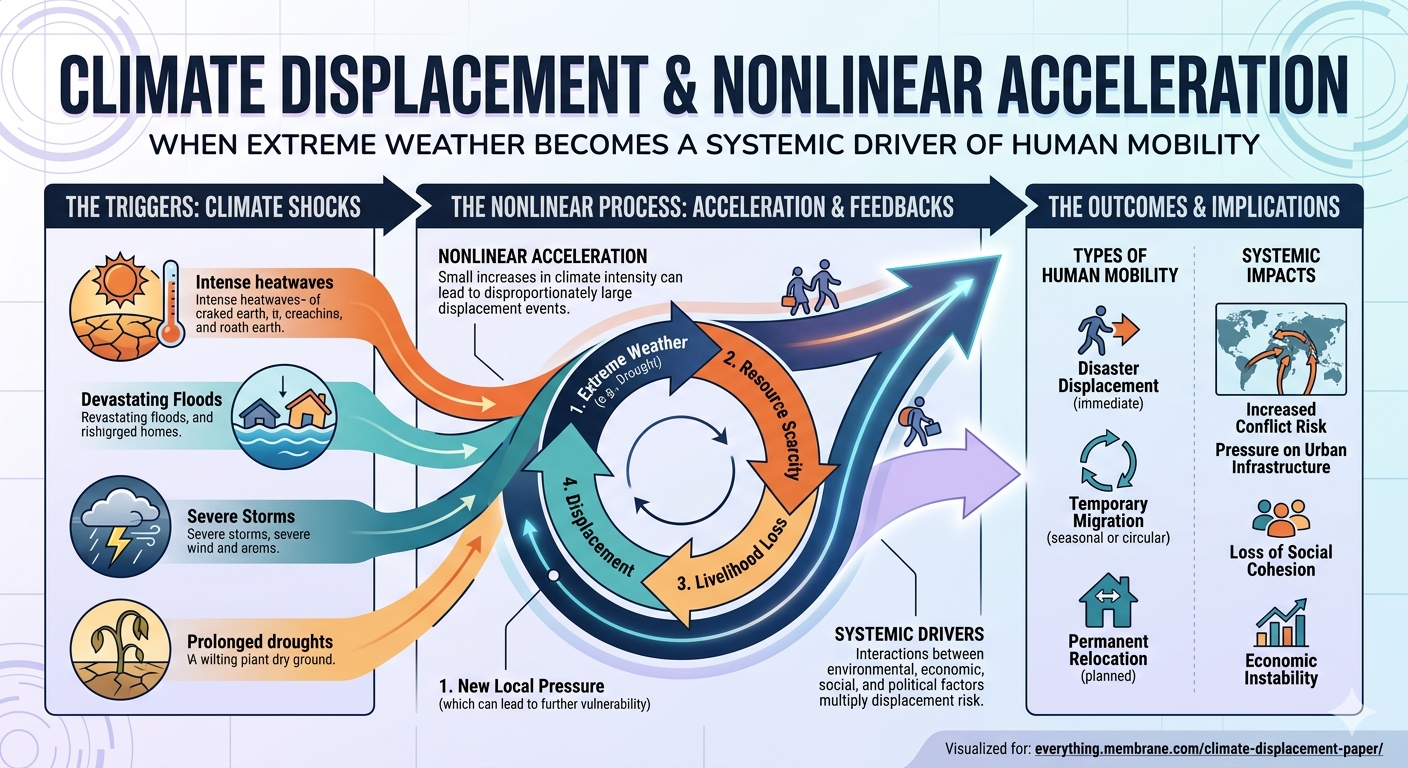
Climate displacement is often framed as a humanitarian consequence of storms, floods, droughts, wildfires, and sea-level rise. That framing is correct but incomplete. The deeper problem is that climate displacement is increasingly emerging from a nonlinear Earth system in which multiple climate hazards are intensifying simultaneously and interacting with preexisting social, political, economic, and infrastructural vulnerabilities.
Recent displacement data suggest that the world may be entering a new phase of climate-driven mobility. According to the Internal Displacement Monitoring Centre (IDMC), 13.6 million people were living in internal displacement because of disasters at the end of 2025, up sharply from roughly 9.9 million at the end of 2024. At the same time, 82.2 million people worldwide were living away from their home communities because of conflict, violence, or disasters, the second-highest figure ever recorded. These numbers do not merely reflect isolated weather events. They reflect a world in which climatic shocks are becoming more frequent, more intense, and increasingly entangled with food insecurity, weak infrastructure, repeated recovery failures, and declining social resilience.
This paper argues that climate displacement should be understood not as a linear byproduct of warming, but as a nonlinear acceleration problem. As the climate system warms, extreme events do not simply increase in number; they increasingly interact across sectors and timescales. Drought is followed by flood. Heat is followed by crop failure. Wildfire is followed by erosion and debris flows. Sea-level rise magnifies storm surge. Water scarcity amplifies political instability. The result is not a single hazard but a cascade of hazards capable of overwhelming adaptation systems and forcing repeated human movement. In that sense, displacement is one of the clearest social indicators that climate change is no longer acting as a distant environmental stressor. It is becoming a systemic destabilizer.
1. Introduction: Displacement as a Climate-System Signal
Most climate discussions still treat displacement as a downstream consequence of weather disasters. A cyclone strikes, homes are destroyed, and people flee. A flood submerges cropland, and communities relocate. A drought persists, livelihoods collapse, and migration follows.
That sequence is real, but it understates the scale of what is now occurring.
Displacement is increasingly best understood as a systems-level indicator. It measures not only the physical impact of a storm, flood, drought, wildfire, or heatwave, but also the failure of social and ecological buffers that once absorbed those shocks. When households are forced to move, it means a threshold has been crossed: infrastructure failed, livelihoods failed, food systems failed, water systems failed, governance failed, or some combination of the above failed at once.
The 2026 Global Report on Internal Displacement provides a stark snapshot of this process. By the end of 2025, 82.2 million people were living in internal displacement across 104 countries and territories. Of those, 68.6 million were displaced by conflict and violence and 13.6 million by disasters. The global total remained near historic highs, while the stock of people displaced by disasters rose sharply. Meanwhile, IDMC recorded 65.8 million internal displacements during 2025, including disaster- and conflict-related movements, underscoring the scale of repeated uprooting in a single year.
The central question is not simply how many people are displaced by climate-related disasters in a given year. The more important question is whether the underlying drivers of displacement are themselves accelerating nonlinearly.
2. The Data: A Sharp Rise in Disaster Displacement
According to IDMC, nearly 13.6 million people were still living in internal displacement at the end of 2025 because of disasters, compared with roughly 9.9 million at the end of 2024. That is an increase of about 3.7 million people in a single year, or approximately 37–38 percent.
This matters for two reasons.
First, it suggests that the consequences of disasters are becoming more persistent. Many people are not simply evacuating and returning home after a storm. They are remaining displaced for longer periods because homes, farmland, water systems, roads, and local economies are not recovering quickly enough.
Second, it highlights the difference between flows and stocks in displacement analysis. IDMC distinguishes between:
internal displacements: the number of forced movements recorded during a year, including repeated movements by the same person; and
internally displaced people (IDPs): the number of people still living in displacement at a given point in time, usually at the end of the year.
This distinction is crucial in a nonlinear climate context. A single extreme event can trigger a large flow of short-term displacements, but a system under sustained stress generates something more dangerous: a rising stock of people who remain uprooted because return, recovery, and resettlement become progressively harder.
That is the deeper warning embedded in the recent numbers.
3. From Linear Hazard to Nonlinear Displacement
A linear view of climate displacement assumes a relatively simple chain of causation:
warming → more extreme weather → more damage → more displacement
But the real system increasingly looks more like this:
In other words, displacement is not driven by one variable. It emerges from coupled feedbacks.
3.1 Hydrologic whiplash
One of the clearest nonlinear pathways is hydrologic whiplash—the growing tendency for regions to swing rapidly between drought and flood. A warmer atmosphere increases evaporation, drying soils and intensifying drought. At the same time, warmer air holds more water vapor, increasing the likelihood of extreme rainfall when storms do occur. The result is not simply “more drought” or “more flooding,” but a destabilizing oscillation between the two.
For vulnerable populations, this matters enormously. Drought can destroy crops, livestock, and local water supplies. Flooding can then destroy the roads, bridges, homes, sanitation systems, and clinics needed for recovery. The second disaster lands before recovery from the first is complete. Communities are not merely hit harder; they are hit before they have time to recover. That is a nonlinear displacement engine.
3.2 Repeated displacement
Climate displacement is often not a one-time movement. A household may flee a floodplain, return months later, then flee again during the next storm season, then relocate after drought destroys agricultural income, then move again after conflict or price shocks intensify. The same family can be counted multiple times in annual displacement flows, but the deeper reality is repeated social dislocation.
Repeated displacement erodes savings, fragments families, interrupts schooling, worsens health outcomes, and depletes community resilience. Over time, it converts temporary mobility into chronic instability.
3.3 Coupled climate-conflict systems
Climate displacement and conflict displacement are not cleanly separable in the real world. Drought can weaken agriculture. Flooding can destroy infrastructure. Food insecurity and water stress can intensify social instability. In fragile settings, those pressures can contribute to violence and forced movement. The categories may differ administratively; the systems do not.
4. Nonlinear Acceleration and Threshold Behavior
The central argument of this paper is that climate displacement is increasingly governed by threshold behavior rather than smooth linear change.
A household can often absorb one bad harvest. A town can sometimes recover from one flood. A region may survive one year of drought.
But nonlinear systems change character when repeated shocks arrive faster than recovery can occur. Once adaptation capacity is exceeded, the response is no longer incremental. It becomes discontinuous.
A few examples illustrate this threshold logic:
Water threshold: A city or agricultural basin can function under water stress up to a point. Once aquifers collapse, reservoirs fail, or snowpack loss undermines irrigation, displacement risk rises abruptly rather than gradually.
Food threshold: Households can absorb modest food-price increases or crop losses. But once food insecurity becomes chronic, migration becomes a survival strategy.
Infrastructure threshold: A road washed out once is a repair problem. Roads, bridges, ports, and power systems repeatedly damaged by extreme weather become a regional collapse problem.
Livelihood threshold: Smallholder farmers can survive a poor season. They cannot survive repeated crop failures, rising heat stress, declining water availability, and fertilizer or fuel price shocks indefinitely.
The importance of thresholds is that they help explain why displacement can rise sharply even if average warming appears gradual. The forcing may be smooth; the social response is not.
5. Doubling-Time Compression in Climate Displacement
Based on the currently cited modern displacement record, climate/disaster displacement appears to be entering a phase of rapid compression in effective doubling times.
Using the year-end stock of people displaced by disasters:
2024: ~9.9 million
2025: 13.6 million
The one-year growth factor is:
g = 13.6 / 9.9 ≈ 1.374
The implied doubling time is:
T_d = ln(2) / ln(13.6 / 9.9)
Substituting the observed values:
T_d ≈ 0.6931 / 0.3178 ≈ 2.18 years
In other words, the latest year-over-year increase implies an effective doubling time of roughly 2.2 years.
This does not mean climate displacement will literally double every 2.2 years in a stable exponential fashion. One year does not establish a long-run law of motion. But it does signal that displacement may be entering a regime in which recovery times are being compressed faster than adaptation systems can respond.
That distinction matters. The significance of the calculation is not that it proves a permanent exponential trend. The significance is that it reveals how quickly displacement pressure can rise once multiple hazards, infrastructure losses, and repeated recovery failures begin interacting in the same period.
In a linear system, displacement might rise gradually as climate hazards intensify. In a nonlinear system, displacement can remain manageable for a time and then surge when thresholds are crossed. The recent IDMC numbers suggest the latter risk is becoming more plausible.
6. U.S. Impacts: Property Loss, Real Estate Values, and Insurance Stress
Climate displacement is often framed as a problem of distant coastlines, small island states, or conflict-prone regions in the Global South. That framing is increasingly obsolete. Climate displacement is already affecting the United States through property loss, real estate repricing, insurance instability, and internal migration pressures.
6.1 Property loss and recurrent disaster exposure
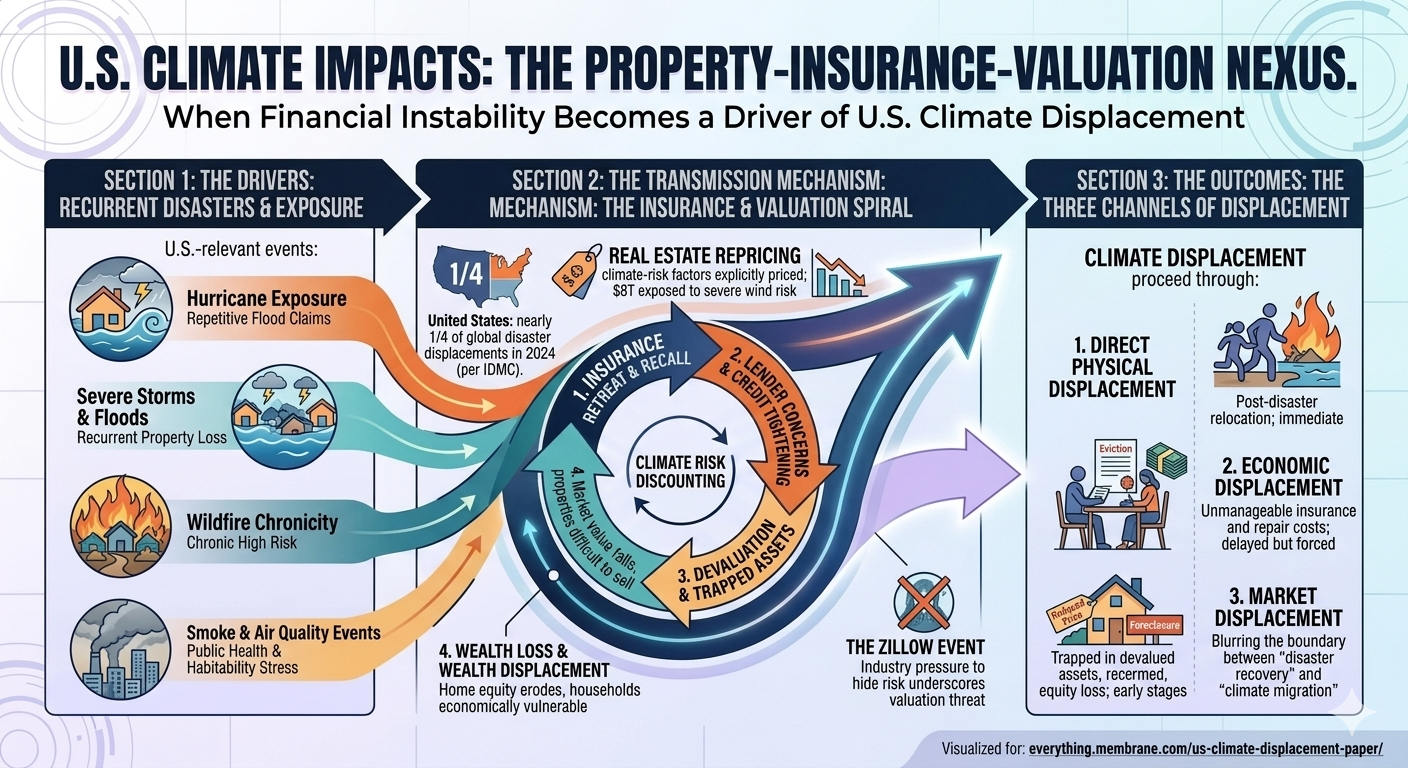
The United States has experienced repeated waves of large-scale disaster displacement from hurricanes, floods, wildfires, severe storms, and smoke-related emergencies. IDMC reported that the United States accounted for nearly one-quarter of all disaster displacements globally in 2024, driven by severe floods and storms.
What matters economically is not only the immediate property damage, but the way repeated exposure changes the viability of living in certain regions. Once homes flood multiple times, or wildfire risk becomes chronic, the relevant question is no longer just repair cost. It becomes whether the property remains insurable, financeable, and marketable.
6.2 Real estate repricing and climate-risk discounting
Climate risk is increasingly being priced into housing markets, though unevenly and often belatedly. Realtor.com analysis cited by Axios found that nearly 20 percent of U.S. homes—worth about $8 trillion—face severe or extreme hurricane wind risk, illustrating the scale of housing-market exposure.
Private climate-risk firms such as First Street have argued that rising insurance costs and underpriced climate risk could drive substantial housing-value losses over coming decades. The controversy surrounding Zillow’s 2025 removal of embedded climate-risk scores from property listings is revealing. Zillow had integrated climate-risk data for floods, wildfire, wind, heat, and air quality, but removed those ratings after industry complaints that they were hurting sales. The episode matters because it shows that climate risk is not only a physical threat but a valuation threat. Once buyers, lenders, and insurers begin to price hazard exposure more explicitly, some properties will lose value not because they are uninhabitable today, but because the market increasingly recognizes that they may become financially fragile tomorrow.
6.3 Insurance retreat as a displacement mechanism
Insurance may become one of the most important near-term transmission mechanisms linking climate change to displacement in the United States. A home does not need to be destroyed to become effectively displaced from the market. If premiums become unaffordable, deductibles become unmanageable, or insurers withdraw from a region entirely, households can be forced to move even before a catastrophic event occurs.
This creates a new category of climate displacement: financial displacement driven by insurability collapse.
In that sense, climate displacement in the United States may increasingly proceed through three channels:
direct physical displacement after storms, fires, floods, or heat-related infrastructure failures;
economic displacement as repeated damage, maintenance costs, and insurance premiums overwhelm household budgets; and
market displacement as property values fall and homeowners become trapped in devalued or difficult-to-sell assets.
These dynamics blur the boundary between “disaster recovery” and “climate migration.” A family may still occupy the same home today while already experiencing the early stages of displacement through rising insurance costs, declining home equity, and a shrinking set of exit options.
7. Mental Health, Social Stress, and Climate Policy Feedbacks
Climate displacement is not only a housing or migration problem. It is also a mental-health and socio-economic destabilization problem with direct implications for climate politics and public policy.
Extreme weather exposure, chronic climate disruption, and perceived governmental inaction are increasingly associated with post-traumatic stress disorder (PTSD), depression, anxiety, grief, chronic stress, and climate-related distress. The psychological burden is not limited to those who lose homes outright. It extends to people living under repeated evacuation orders, communities facing chronic smoke or heat exposure, farmers confronting repeated crop losses, and households watching insurance premiums, utility bills, and rebuilding costs climb year after year.
7.1 Trauma after extreme events
Disaster research has long shown elevated rates of PTSD, depression, and anxiety following hurricanes, floods, wildfires, and prolonged displacement. Climate change amplifies this burden by increasing the frequency of events and by reducing the time available for psychological recovery between them. A household displaced once by a flood may eventually recover. A household displaced by a flood, then smoke, then heat, then another flood enters a very different mental-health regime.
The cumulative burden matters because trauma is not merely an individual health outcome. It affects work capacity, school performance, family stability, substance use, physical health, and community cohesion.
7.2 Chronic disruption and “pre-traumatic” stress
Climate-related mental-health impacts are not limited to post-disaster trauma. Chronic exposure to climate risk can generate persistent anxiety even before a disaster occurs. People living in high-risk regions may experience what is increasingly described as anticipatory or pre-traumatic stress: the psychological strain of knowing that another wildfire season, another hurricane, or another flood is coming, while also suspecting that public institutions are unprepared to protect them.
This can produce a form of climate dread with economic teeth. Families delay investment. Young adults reconsider where to live or whether to have children. Retirees reassess whether fixed incomes can survive escalating insurance and utility costs. Farmers and small businesses become less willing to invest in long-lived assets. In that sense, mental-health stress feeds back into economic behavior and local resilience.
7.3 Perceived governmental inaction and policy instability
Perceived governmental inaction is itself a destabilizing variable. When people repeatedly experience disasters, property loss, insurance shocks, or displacement while seeing little meaningful adaptation, planning, or support, trust in institutions erodes. That erosion can produce several policy effects at once:
political polarization, as climate impacts become refracted through grievance and distrust;
policy whiplash, as short-term emergency spending substitutes for long-term adaptation planning;
maladaptation, where communities rebuild into high-risk zones because retreat, relocation, and buyout programs remain politically or financially inaccessible;
social fragmentation, as households with resources leave while lower-income residents remain exposed to escalating risk.
These are not side effects. They are part of the climate-displacement system itself. A society experiencing repeated disasters without credible adaptation pathways may become less capable of implementing coherent climate policy precisely because the social stress of climate disruption is eroding the institutional capacity required to respond.
8. Climate Displacement as an Indicator of Systemic Instability
Climate displacement should therefore be viewed not merely as a humanitarian outcome but as a diagnostic signal of Earth-system destabilization interacting with human vulnerability.
In the same way that ocean heat content reveals accumulating thermal energy in the climate system, displacement reveals accumulating social stress in human systems. It tells us that environmental shocks are no longer being absorbed locally. They are crossing thresholds and reorganizing human geography.
Seen this way, displacement is one of the clearest real-world indicators that climate change is moving beyond “environmental change” and into civilizational risk.
When millions of people are forced to move because water disappears, crops fail, coasts flood, storms intensify, and recovery systems collapse, the issue is no longer whether the climate is changing. The issue is whether the political, economic, and humanitarian systems built for the twentieth century can withstand the pace and nonlinearity of twenty-first century climate disruption.
9. Conclusion
The latest displacement data should not be read as isolated humanitarian statistics. They should be read as evidence that climate change is increasingly acting through nonlinear social pathways.
The rise in disaster-related internal displacement from roughly 9.9 million to 13.6 million in a single year does not, by itself, prove a permanent exponential trajectory. But it does imply an effective short-term doubling time of about 2.2 years, a warning that climate displacement may be entering a phase of rapid compression in recovery times and rising systemic instability.
In a linear world, displacement would rise gradually as hazards gradually intensified.
In the world we are actually entering, climate forcing interacts with thresholds, feedbacks, and repeated shocks. Drought is followed by flood. Recovery is interrupted by the next disaster. Conflict overlays crop failure. Property values fall as risk becomes visible. Insurance costs become a displacement mechanism of their own. Trauma, anxiety, and distrust weaken the very institutions needed to adapt.
Climate displacement is therefore not merely one consequence of warming. It is one of the clearest manifestations of nonlinear acceleration in the human dimensions of climate change.
The real question is no longer whether climate change will displace people. It already is.
The real question is how many social, economic, and political thresholds will be crossed before the world recognizes that displacement is not a side story to climate change.
It is one of its central outcomes.
References
1. Climate displacement, internal displacement, and disaster mobility
Pietrostefani, E., Mason, M., Iradukunda, R., Tran-Jones, H., Loktieva, I., & Rowe, F. (2025). Dynamic estimates of displacement in disaster regions: A policy-driven framework triangulating data. arXiv. https://arxiv.org/abs/2511.01955
Idzalika, R., Muztahid, M. R., & Prasojo, R. E. (2026). Context-aware displacement estimation from mobile phone data: A methodological framework. arXiv. https://arxiv.org/abs/2604.21457
2. Climate migration, human mobility, and climate vulnerability framing
Intergovernmental Panel on Climate Change. (2022). Climate change 2022: Impacts, adaptation and vulnerability. Contribution of Working Group II to the Sixth Assessment Report of the Intergovernmental Panel on Climate Change. Cambridge University Press.
Intergovernmental Panel on Climate Change. (2021). Climate change 2021: The physical science basis. Contribution of Working Group I to the Sixth Assessment Report of the Intergovernmental Panel on Climate Change. Cambridge University Press.
World Bank. (2021). Groundswell Part 2: Acting on internal climate migration. Washington, DC: World Bank.
Black, R., Bennett, S. R. G., Thomas, S. M., & Beddington, J. R. (2011). Migration as adaptation. Nature, 478(7370), 447–449.
McLeman, R. A. (2014). Climate and human migration: Past experiences, future challenges. Cambridge University Press.
Adger, W. N., de Campos, R. S., Siddiqui, T., et al. (2020). Migration, displacement and mobility. In Climate change 2022: Impacts, adaptation and vulnerability (IPCC WGII chapter).
3. Nonlinear acceleration, compound climate extremes, and hydrologic whiplash
Chun, K. P., Octavianti, T., Papacharalampous, G., Tyralis, H., Sutanto, S. J., Terskii, P., Mazzoglio, P., Treppiedi, D., Rivera, J., Dogulu, N., Olusola, A., Dieppois, B., Dembélé, M., Moulds, S., Li, C., Morales-Marin, L. A., Macdonald, N., Amoussou, T. O., Yonaba, R., Obahoundje, S., Hannah, D. M., Chidepudi, S. K. R., & Hamududu, B. (2024). Unravelling compound risks of hydrological extremes in a changing climate: Typology, methods and futures. arXiv. https://arxiv.org/abs/2409.19003
Green, J., Haigh, I. D., Quinn, N., Neal, J., Wahl, T., Wood, M., Eilander, D., de Ruiter, M., Ward, P., & Camus, P. (2024). A comprehensive review of coastal compound flooding literature. arXiv. https://arxiv.org/abs/2404.01321
Kleidon, A. (2024). Droughts in Germany—Why global climate change amplifies hydrological extremes. arXiv. https://arxiv.org/abs/2403.16551
Murphy-Barltrop, C. J. R., Richards, J., Poschlod, B., Sasse, A., & Zscheischler, J. (2026). Exploring climate change effects on concurrent floods and concurrent droughts via statistical deep learning. arXiv. https://arxiv.org/abs/2604.21647
Zscheischler, J., Westra, S., van den Hurk, B. J. J. M., et al. (2018). Future climate risk from compound events. Nature Climate Change, 8, 469–477.
Ridder, N. N., Ukkola, A. M., Pitman, A. J., et al. (2022). Increased occurrence of high-impact compound events under climate change. Nature Climate Change, 12, 600–606.
Swain, D. L., et al. (2018). Increasing precipitation volatility in a warming climate. Nature Climate Change, 8, 427–433.
Touma, D., Stevenson, S., Camargo, S. J., Horton, D. E., & Diffenbaugh, N. S. (2022). Climate change increases risk of extreme rainfall following drought. Science Advances, 8(32), eabn6301.
4. Climate displacement as nonlinear acceleration / doubling-time compression
Brouse, D., & Mukherjee, S. (2026). Climate displacement and nonlinear acceleration: When extreme weather becomes a systemic driver of human mobility. [Working paper / manuscript].
Brouse, D., & Mukherjee, S. (2026). Emergent climate dynamics: The nonlinear acceleration of climate impacts. [Manuscript].
Brouse, D., & Mukherjee, S. (2026). A unified energetics framework for nonlinear climate acceleration. [Manuscript].
Brouse, D., & Mukherjee, S. (2025). Runaway climate feedbacks and systemic collapse. [Manuscript].
5. U.S. property loss, housing-market repricing, and insurance retreat
Bernstein, A., Gustafson, M. T., & Lewis, R. (2019). Disaster on the horizon: The price effect of sea level rise. Journal of Financial Economics, 134(2), 253–272.
Bakkensen, L. A., & Barrage, L. (2021). Flood risk beliefs and coastal home price dynamics. Review of Financial Studies, 34(10), 1–41. (Use whichever final journal version you have access to; there are several closely related working-paper/journal versions in this literature.)
Keys, B. J., Mulder, P., & Vissing-Jorgensen, A. (2024). Climate risk and the U.S. housing market. Annual Review of Financial Economics / working paper literature as applicable.
Keenan, J. M., Hill, T., & Gumber, A. (2018). Climate gentrification: From theory to empiricism in Miami-Dade County, Florida. Environmental Research Letters, 13(5), 054001.
First Street Foundation. (2025). Climate risk, mortgage exposure, and U.S. property vulnerability [Risk analysis / research releases]. New York, NY: First Street Foundation. (Use the specific First Street report or white paper you cite.)
Realtor.com. (2025). Climate-risk exposure in U.S. housing markets [Market analysis / research brief]. (Use the specific report behind the $8 trillion severe or extreme hurricane wind exposure figure if you cite that number.)
Wall Street Journal. (2025). The climate-disaster scores that could make or break your home sale. (Add exact author/date if you want strict APA completeness.)
Washington Post. (2025, December 9). Hurricanes and wildfires influence homebuyers, if only for a minute. (Add author if available in your final bibliography draft.)
6. Insurance stress, retreat, and financial displacement
Kousky, C. (2019). The role of natural disaster insurance in recovery and risk reduction. Annual Review of Resource Economics, 11, 399–418.
Kousky, C., & Shabman, L. (2016). Flood risk and property values: Examining the role of flood insurance. Natural Hazards Review, 17(3).
Botzen, W. J. W., Deschenes, O., & Sanders, M. (2019). The economic impacts of natural disasters: A review of models and empirical studies. Review of Environmental Economics and Policy, 13(2), 167–188.
Kunreuther, H., & Michel-Kerjan, E. (2011). At war with the weather: Managing large-scale risks in a new era of catastrophes. Cambridge, MA: MIT Press.
First Street Foundation. (2025). Climate risk and insurance affordability in U.S. housing markets. (Insert the exact report title you use if citing insurer retreat or affordability estimates.)
7. Mental health, PTSD, anxiety, and climate-related distress
Berry, H. L., Bowen, K., & Kjellstrom, T. (2010). Climate change and mental health: A causal pathways framework. International Journal of Public Health, 55(2), 123–132.
Clayton, S., Manning, C., Krygsman, K., & Speiser, M. (2017). Mental health and our changing climate: Impacts, implications, and guidance. Washington, DC: American Psychological Association and ecoAmerica.
Cianconi, P., Betrò, S., & Janiri, L. (2020). The impact of climate change on mental health: A systematic descriptive review. Frontiers in Psychiatry, 11, 74.
Hayes, K., & Poland, B. (2018). Addressing mental health in a changing climate: Incorporating mental health indicators into climate change and health vulnerability and adaptation assessments. International Journal of Environmental Research and Public Health, 15(9), 1806.
Lawrance, E. L., Thompson, R., Newberry Le Vay, J., Page, L., Jennings, N., & McBride, M. (2022). The impact of climate change on mental health and emotional wellbeing: A narrative review of current evidence, and its implications. International Review of Psychiatry, 34(5), 443–498.
Pihkala, P. (2020). Eco-anxiety and environmental education. Sustainability, 12(23), 10149.
Charlson, F., Ali, S., Benmarhnia, T., Pearl, M., Massazza, A., Augustinavicius, J., & Scott, J. G. (2021). Climate change and mental health: A scoping review. International Journal of Environmental Research and Public Health, 18(9), 4486.
Thoma, M. V., et al. (2021). The psychological consequences of climate-related disasters and displacement. Current Psychiatry Reports, 23, 82. (Use a final journal article that best matches the PTSD/disaster-displacement angle you want.)
8. Disaster trauma, repeated exposure, and post-event psychiatric burden
Goldmann, E., & Galea, S. (2014). Mental health consequences of disasters. Annual Review of Public Health, 35, 169–183.
Neria, Y., Nandi, A., & Galea, S. (2008). Post-traumatic stress disorder following disasters: A systematic review. Psychological Medicine, 38(4), 467–480.
Lowe, S. R., & Galea, S. (2017). The mental health consequences of mass shootings and natural disasters. Current Psychiatry Reports, 19, 64. (Use selectively if you want repeated-trauma framing across disaster types.)
Vins, H., Bell, J., Saha, S., & Hess, J. J. (2015). The mental health outcomes of drought: A systematic review and causal process diagram. International Journal of Environmental Research and Public Health, 12(10), 13251–13275.
Bryant, R. A. (2019). Post-traumatic stress disorder: A state-of-the-art review of evidence and challenges. World Psychiatry, 18(3), 259–269. (Useful for grounding the PTSD language in the paper’s mental-health section.)
9. Climate anxiety, anticipatory stress, and perceived governmental inaction
Hickman, C., Marks, E., Pihkala, P., et al. (2021). Climate anxiety in children and young people and their beliefs about government responses to climate change: A global survey. The Lancet Planetary Health, 5(12), e863–e873.
Ojala, M. (2012). Hope and climate change: The importance of hope for environmental engagement among young people. Environmental Education Research, 18(5), 625–642.
Pihkala, P. (2022). Toward a taxonomy of climate emotions. Frontiers in Climate, 3, 738154.
Reser, J. P., Bradley, G. L., & Ellul, M. C. (2014). Encountering climate change: “Seeing” is more than “believing.” WIREs Climate Change, 5(4), 521–537.
Wang, S., Leviston, Z., Hurlstone, M., Lawrence, C., & Walker, I. (2018). Emotions predict policy support: Why it matters how people feel about climate change. Global Environmental Change, 50, 25–40.
10. Climate policy, social destabilization, and governance stress
Adger, W. N., Barnett, J., Brown, K., Marshall, N., & O’Brien, K. (2013). Cultural dimensions of climate change impacts and adaptation. Nature Climate Change, 3, 112–117.
Mach, K. J., Kraan, C. M., Adger, W. N., et al. (2019). Climate as a risk factor for armed conflict. Nature, 571, 193–197.
Abel, G. J., Brottrager, M., Crespo Cuaresma, J., & Muttarak, R. (2019). Climate, conflict and forced migration. Global Environmental Change, 54, 239–249.
Hsiang, S. M., Burke, M., & Miguel, E. (2013). Quantifying the influence of climate on human conflict. Science, 341(6151), 1235367.
Stern, N. (2007). The economics of climate change: The Stern review. Cambridge University Press.
11. Climate-risk communication, valuation, and disclosure in housing markets
Zillow. (2024). Zillow integrates climate-risk data into home listings [Corporate / platform announcement]. (If you use the rollout itself as part of the story, cite the original Zillow announcement or newsroom page.)
First Street Foundation. (2024–2025). Climate risk data for U.S. properties [Methodology and risk score documentation]. (Use the exact methodology page or report behind the risk metrics if cited in the paper.)
San Francisco Chronicle. (2025). Zillow is dropping climate risk scores. Here’s why it matters. (Add author/date if you use this source in the final paper.)
12. Optional contemporary media sources for very recent 2025–2026 developments
Use these only for contemporary market developments or examples, not as the backbone of the scientific argument.
President Donald Trump announced that the United States and Iran have reached what he described as a “great settlement” that could bring an end to the current conflict and lead to a formal agreement as early as this weekend.
According to Trump, the breakthrough came after intense negotiations and recent military pressure. He characterized the development as a major diplomatic victory and suggested that Iran had ultimately agreed to terms favored by the United States.
Iranian officials, however, have offered a different account. According to their statements, the framework under discussion is largely the same memorandum of understanding that Tehran reportedly proposed weeks earlier. Iranian sources describe the arrangement as a temporary 60-day agreement that includes a ceasefire in Lebanon and the release of billions of dollars in previously frozen Iranian assets.
The differing narratives have fueled skepticism among analysts, policymakers, and observers across the political spectrum. While supporters of the administration view the announcement as a potentially significant step toward de-escalation, critics argue that the details remain unclear and that multiple previous declarations of imminent diplomatic breakthroughs have failed to produce lasting agreements. In fact, with each previous announcement, Iran appeared to strengthen its negotiating position and gain additional leverage.
“Climate-driven changes in Earth’s rotation may be contributing to navigational uncertainties that negatively affect battlefield outcomes and increase the risk of civilian casualties in contemporary conflicts.”
by Daniel Brouse and Sidd Mukherjee
Abstract
Climate change is increasingly altering the physical dynamics of Earth itself. Accelerating ice-sheet loss, sea-level rise, and large-scale redistribution of mass are changing the planet’s rotation rate, shifting its axis of rotation, and introducing increasingly nonlinear behavior into Earth system processes. Recent studies indicate that climate-driven ice melt is lengthening Earth’s day by approximately 1.33 milliseconds per century, making climate change a dominant driver of long-term rotational change. Beyond the slowing of rotation, the acceleration and third derivative (“jerk”) of these changes may represent a more significant concern because they reduce predictability within systems that depend on precise measurements of time, position, and motion. The consequences extend beyond geophysics into GPS accuracy, satellite operations, spacecraft navigation, autonomous systems, and potentially military guidance technologies. This paper examines the emerging science of climate-driven rotational change and places it within the broader context of accelerating Earth-system feedback loops and nonlinear climate dynamics.
Introduction
Earth’s rotation has never been perfectly constant. Variations occur naturally through interactions among the atmosphere, oceans, mantle, core, tides, and cryosphere. Historically, these fluctuations have remained within ranges that can be modeled and predicted through established geophysical processes.
Anthropogenic climate change is introducing a new forcing mechanism into this system. Accelerated melting of glaciers and polar ice sheets is redistributing trillions of tons of mass from high latitudes toward the oceans. This redistribution alters Earth’s moment of inertia and changes the speed and orientation of the planet’s rotation.
While changes in rotational velocity have attracted growing scientific attention, the acceleration and higher-order derivatives of those changes may prove even more significant. The third derivative, commonly referred to as “jerk,” measures how rapidly acceleration itself is changing. Increasing jerk-behavior is often a hallmark of nonlinear systems approaching new states of instability or unpredictability.
The significance of these changes extends far beyond the length of the day. Modern civilization depends upon precise timing, positioning, navigation, and reference-frame stability. Small changes in Earth’s rotational behavior can cascade through technologies that form the foundation of the modern world.
Climate Change and Earth’s Rotational Slowdown
In 2024, researchers from ETH Zurich, NASA’s Jet Propulsion Laboratory, and collaborating institutions demonstrated that climate change has become an increasingly dominant influence on Earth’s rotation. Their work showed that melting ice sheets redistribute mass from the poles toward lower latitudes, increasing Earth’s moment of inertia and slowing the planet’s rotation in a manner analogous to a spinning figure skater extending their arms.
A March 2026 analysis published in the Journal of Geophysical Research: Solid Earth quantified the effect, estimating that climate-driven ice melt is lengthening Earth’s day by approximately 1.33 milliseconds per century. While seemingly small, this represents a measurable and accelerating alteration of one of the planet’s most fundamental physical properties.
Researchers further concluded that the climate-driven component of Earth’s rotational slowdown now exceeds many natural long-term influences and may represent the most rapid climate-related rotational change observed in millions of years.
Polar Motion and the Changing Shape of Earth
The effects of ice-sheet loss are not limited to rotational speed.
As glaciers and ice sheets melt, the redistribution of water mass changes Earth’s shape and alters the position of its rotational axis. Research published in Geophysical Research Letters found that global warming has accelerated the movement of Earth’s rotational pole since the 1990s.
Several mechanisms contribute to this phenomenon:
Redistribution of meltwater toward lower latitudes.
Gravitational migration of ocean mass.
Centrifugal redistribution of water toward the equatorial bulge.
Glacial Isostatic Adjustment (GIA), in which land previously compressed by massive ice sheets slowly rebounds upward as ice disappears.
Together, these processes alter both Earth’s moment of inertia and the orientation of its spin axis. The result is a planet whose rotational geometry is changing more rapidly than at any point during the modern observational era.
The Third Derivative: Jerk-Behavior in the Earth System
Velocity measures change.
Acceleration measures changing velocity.
Jerk measures changing acceleration.
In engineering, aerospace systems, and control theory, jerk is often more important than velocity because it determines how predictable a system remains under changing conditions.
Earth’s rotational system now appears to be exhibiting measurable jerk-behavior driven by climate-induced mass redistribution. This means that not only is Earth slowing, but the rate at which it is slowing is itself changing.
Such behavior introduces challenges for predictive models because assumptions based upon previous rates of change become increasingly unreliable. Systems must be updated more frequently, and uncertainty grows as the underlying dynamics become increasingly nonlinear.
The emergence of measurable jerk-behavior may represent one of the clearest physical indicators that climate change is influencing fundamental planetary-scale processes.
Earth Orientation Parameters and Navigation Systems
Modern navigation depends on the precise relationship between celestial and terrestrial coordinate systems.
The International Celestial Reference Frame (ICRF) provides a stable astronomical reference framework based on distant quasars. The International Terrestrial Reference Frame (ITRF) defines geographic coordinates fixed to Earth’s surface.
Earth Orientation Parameters (EOPs) connect these systems.
Organizations such as the International Earth Rotation and Reference Systems Service (IERS) continuously monitor changes in:
Length of day
Polar motion
Axial orientation
Precession
Nutation
As climate-driven changes accelerate, EOP calculations become increasingly important. Even centimeter-scale errors in Earth’s reference frame can propagate into navigation errors measured in hundreds of meters across interplanetary distances.
The growing variability in Earth’s rotation increases the complexity of maintaining accurate coordinate transformations between space-based and Earth-based systems.
GPS, Spacecraft, and Inertial Navigation
Global Positioning System (GPS) satellites rely upon extremely precise timing and rotational models.
Unexpected changes in Earth’s orientation can create discrepancies between modeled and actual positions. These discrepancies must be corrected through continual updates to Earth orientation parameters.
The same challenge affects:
Satellite tracking
Spacecraft navigation
Astronomical observations
Geodesy
Autonomous transportation systems
Long-range communication networks
Inertial Navigation Systems (INS) face an additional challenge because they operate by integrating acceleration and rotational measurements relative to Earth itself.
As Earth’s rotational characteristics evolve, assumptions embedded within inertial guidance algorithms require more frequent recalibration. Small errors can accumulate over long distances and extended operational periods.
Sea-Level Rise Commitments and Long-Term Rotational Change
The rotational changes observed today are unlikely to stabilize quickly.
Research on the Greenland Ice Sheet has demonstrated that substantial future melting is already committed due to past greenhouse gas emissions. A study led by Jason Box and colleagues concluded that even if emissions ceased immediately, Greenland alone is committed to producing at least 27 centimeters of global sea-level rise.
Subsequent analyses suggest that realistic outcomes may substantially exceed this minimum estimate.
This committed melting implies continued redistribution of mass for decades and potentially centuries. As a result, climate-driven changes in Earth’s rotation, polar motion, and reference-frame stability are likely to continue long after greenhouse gas emissions peak.
The rotational consequences therefore represent not merely a current phenomenon but a long-term geophysical response that may unfold over generations.
Climate Feedback Loops and Nonlinear Dynamics
Understanding Earth’s changing rotation requires understanding the broader climate system in which it occurs.
Climate change is not a simple linear process. It is a dynamic system characterized by numerous interacting feedback loops, including:
Each feedback influences the others through interconnected physical, biological, and social systems.
These interactions create nonlinear responses in which relatively small disturbances can trigger disproportionately large outcomes. The accelerating changes observed in Earth’s rotation may therefore be viewed as one manifestation of a broader planetary trend toward increasing systemic instability and complexity.
Defense and Strategic Implications
Modern military and aerospace systems depend heavily on precision navigation.
Long-range missiles, autonomous drones, hypersonic vehicles, spacecraft, and surveillance platforms all rely upon accurate reference frames and rotational models.
As Earth orientation becomes more variable, maintaining precision requires increasingly sophisticated updates and corrections.
Climate-driven changes in Earth’s rotation may be contributing to navigational uncertainties that negatively affect battlefield outcomes and increase the risk of civilian casualties in contemporary conflicts. As rotational variability increases, the growing complexity of Earth orientation modeling presents an emerging strategic challenge for navigation-dependent systems, including long-range guided munitions, autonomous drones, satellite operations, and other precision-targeting technologies.
Further research is needed to quantify these effects under operational conditions.
Conclusion
Climate change is altering not only Earth’s atmosphere, oceans, and ecosystems but also the planet’s physical rotation.
Accelerated melting of glaciers and ice sheets is slowing Earth’s rotation, shifting its axis, changing its shape, and introducing increasing levels of acceleration and jerk-behavior into planetary dynamics.
Recent research suggests that climate-driven rotational changes are now occurring at rates unprecedented in millions of years. These changes are becoming increasingly relevant to GPS systems, spacecraft navigation, Earth orientation modeling, geodesy, and other technologies dependent upon extreme precision.
Viewed within the larger framework of interacting climate feedback loops and nonlinear Earth-system dynamics, the changing rotation of Earth may represent one of the most fundamental indicators that anthropogenic climate change is affecting the physical mechanics of the planet itself.
Box, J. E., Colgan, W., et al. (2022). Greenland Ice Sheet Climate Disequilibrium and Committed Sea-Level Rise. Nature Climate Change.
Dill, R., Soja, B., Chen, J., et al. (2024). The Increasingly Dominant Role of Climate Change on Length of Day. Proceedings of the National Academy of Sciences, 121(28).
ETH Zurich Geodesy and Geodynamics Group. Research on Earth Rotation, Climate Change, and Earth Orientation Parameters.
International Earth Rotation and Reference Systems Service (IERS). Earth Orientation Parameters Technical Bulletins.
NASA Jet Propulsion Laboratory (JPL). Climate-Driven Changes in Earth Rotation and Polar Motion.
Wang, J., et al. (2021). Climate-Driven Polar Motion Since the 1990s. Geophysical Research Letters.
Rapid Arctic amplification, accelerating Antarctic ice loss, and weakening ocean circulation are increasingly destabilizing Earth’s atmospheric circulation systems. One of the clearest manifestations of this destabilization is the amplification and persistence of Rossby waves — large-scale meanders in the jet stream that regulate heat transport, storm movement, and regional weather stability.
Historically, strong equator-to-pole temperature gradients maintained a relatively fast, organized jet stream and stable atmospheric circulation regime. However, as polar regions warm substantially faster than the global average, these gradients are weakening. The result is a slower, more amplified, and increasingly persistent jet stream characterized by stronger atmospheric blocking, prolonged weather extremes, and increasing climatic whiplash.
This paper examines the relationship between Rossby-wave amplification, Arctic amplification, Sudden Stratospheric Warming (SSW) events, and nonlinear atmospheric destabilization within the framework of the Nonlinear Acceleration Hypothesis. Evidence suggests that atmospheric persistence and circulation instability may now be compressing on nonlinear timescales, contributing to unprecedented heat domes, stalled flooding events, prolonged droughts, polar intrusions, and compound climate disasters.
1. Introduction
Historically, large temperature differences between the tropics and the polar regions helped maintain a fast-moving, organized jet stream in the upper atmosphere. These thermal gradients also supported the Atlantic Meridional Overturning Circulation (AMOC), one of the Earth’s most important oceanic heat redistribution systems.
Together, the jet stream and AMOC helped:
redistribute planetary heat,
reduce atmospheric stagnation,
moderate regional climate variability,
and maintain relatively stable seasonal patterns.
However, this equilibrium is increasingly destabilizing.
The Arctic is now warming approximately four times faster than the global average, while Antarctica is experiencing accelerating ice-sheet destabilization and record cryospheric loss. As these polar regions warm disproportionately, the equator-to-pole temperature gradient weakens.
This weakening fundamentally alters atmospheric dynamics.
2. Jet Stream Destabilization and Rossby-Wave Amplification
Under historically stable conditions, the jet stream generally flowed in a relatively progressive west-to-east pattern across the United States and southern Canada.
As thermal gradients weaken:
zonal winds slow,
the jet stream elongates,
Rossby waves become more amplified,
wave propagation slows,
and atmospheric blocking becomes increasingly persistent.
The result is a circulation regime characterized by “stuck” weather patterns and amplified climatic extremes.
Observed Consequences Include:
persistent heat domes,
prolonged cold-air outbreaks,
stalled storm systems,
multi-day severe weather outbreaks,
extreme rainfall persistence,
prolonged droughts,
and compound climate disasters.
Many of the most extreme recent weather events globally exhibit these characteristics.
3. Climatic Whiplash
One of the defining signatures of Rossby-wave amplification is climatic whiplash — rapid transitions between opposing weather extremes.
Examples include:
severe drought followed by catastrophic flooding,
unseasonable warmth followed by polar intrusions,
prolonged stagnation followed by explosive cyclogenesis,
and abrupt oscillations between heatwaves and cold outbreaks.
These transitions reflect increasing instability within atmospheric circulation systems rather than isolated weather anomalies.
The atmosphere increasingly appears to be shifting from:
a fast-moving progressive flow regime
toward:
a slower, more amplified, and more persistent nonlinear circulation regime.
4. Sudden Stratospheric Warming Events
Sudden Stratospheric Warming (SSW) events represent another major component of atmospheric destabilization.
During SSW events:
polar stratospheric temperatures can increase by as much as 50°C within only a few days,
the polar vortex weakens or destabilizes,
and Arctic air masses can plunge far southward while anomalous warmth penetrates polar regions.
These disruptions increase atmospheric volatility and are increasingly associated with:
severe winter storms,
tornado outbreaks,
bomb cyclones,
prolonged southern cold spells,
historic flooding,
and early-season heat extremes.
As atmospheric circulation destabilizes, SSW behavior itself may become increasingly nonlinear and persistent.
5. The Nonlinear Acceleration Hypothesis
Rossby waves have always existed. The critical issue is not the mere existence of Rossby waves, but rather the observed shift toward:
larger amplitudes,
slower propagation,
longer persistence,
and stronger atmospheric blocking.
Within the framework of the Nonlinear Acceleration Hypothesis, atmospheric destabilization follows nonlinear dynamics:
Small increases in forcing can therefore generate disproportionately large responses once critical thresholds are crossed.
Interacting feedback systems include:
Arctic amplification,
weakening thermal gradients,
sea-ice decline,
ocean circulation instability,
latent heat amplification,
land-atmosphere coupling,
drought feedbacks,
and altered planetary-wave resonance.
The result is increasingly unstable atmospheric behavior.
6. Compression of Atmospheric Doubling Times
Evidence suggests that atmospheric persistence and Rossby-wave amplification may now be compressing on increasingly short timescales.
Estimated effective doubling intervals for persistence and intensity metrics have evolved approximately as follows:
Period
Approximate Doubling Time
1990s
~40 years
2000s
~20 years
2010s
~10 years
Early 2020s
~5 years
Mid-2020s
~2–3 years
Using:Td(t)=k(t)ln(2)
where:
Td(t) = doubling time,
k(t) = time-dependent growth constant,
ln(2) = natural logarithm of 2,
the implied atmospheric instability growth constant rises nonlinearly as doubling intervals compress.
7. Approximate Decadal Amplification
If effective atmospheric doubling intervals approach approximately 2–3 years:
Over One Decade:
2(10/2.5)=24=16
This implies a potential:
~16-fold increase in persistence or intensity metrics per decade.
Using a 2-year interval:2(10/2)=25=32
Using a 1.5-year interval:2(10/1.5)≈26.67≈102
These calculations illustrate why nonlinear atmospheric destabilization can appear gradual for decades before suddenly producing:
unprecedented heat domes,
stalled megafloods,
prolonged droughts,
polar intrusions,
and compound climate catastrophes within compressed timescales.
8. Atmospheric Blocking and Extreme Weather Persistence
The most significant climate signal may not simply be “more storms” or “more Rossby waves.”
Rather, it is the increasing persistence of atmospheric patterns.
Persistent blocking systems dramatically increase:
heatwave duration,
rainfall accumulation,
drought intensity,
wildfire risk,
agricultural disruption,
and infrastructure stress.
The atmosphere is increasingly exhibiting quasi-stationary circulation patterns capable of locking regions into prolonged extremes.
This persistence amplifies societal, ecological, and economic vulnerability.
9. Conclusion
The destabilization of atmospheric circulation represents one of the clearest emerging manifestations of nonlinear climate acceleration.
Rossby-wave amplification, atmospheric blocking, Arctic amplification, and Sudden Stratospheric Warming events are increasingly interacting within a destabilizing Earth system characterized by:
weakening thermal gradients,
slower circulation,
amplified persistence,
and accelerating climatic whiplash.
The central issue is no longer whether atmospheric instability is increasing, but rather:
how rapidly nonlinear feedback systems may continue compressing climatic timescales.
The emerging evidence suggests that Earth’s atmospheric circulation is transitioning away from historically stable progressive flow patterns toward a slower, more amplified, and increasingly nonlinear regime capable of generating unprecedented compound climate extremes.
This is exactly what many of us feared when defense officials and political leaders turned against Palantir Technologies over concerns surrounding autonomous weapons systems and mass surveillance capabilities.
According to critics, Palantir resisted efforts to fully embrace autonomous lethal decision-making systems and broad domestic surveillance applications targeting U.S. citizens. Now, instead of slowing the development of AI-driven warfare, lawmakers appear to be accelerating it.
Pennsylvania Senators Dave McCormick and John Fetterman have introduced legislation aimed at rapidly expanding U.S. military drone and autonomous systems capabilities.
As Senator McCormick stated:
“Autonomous drone systems are reshaping modern warfare — China is moving fast, and America can’t afford to play catch-up.”
The proposed legislation calls for a comprehensive strategy to accelerate deployment of autonomous military technologies in order to “protect our troops” and preserve U.S. military dominance.
Supporters argue these systems are necessary to compete with rapidly advancing drone and AI warfare programs in countries like China and Russia. Critics, however, warn that the world is moving dangerously close to normalizing autonomous killing systems where machines — not humans — increasingly make battlefield targeting decisions.
The concern is not simply military competition. It is the long-term ethical and societal implications of handing life-and-death decisions to algorithmic systems while simultaneously expanding surveillance infrastructure, predictive targeting, and AI-driven warfare capabilities.
History shows that once such technologies are normalized in foreign conflicts, pressure often grows to expand their use domestically in the name of “security,” “stability,” or “public safety.”
The world is rapidly entering an era where the line between defense technology, autonomous warfare, and mass surveillance is becoming increasingly blurred — and far too few leaders are seriously debating the consequences.