bookmark_borderWhen Hypothesis Becomes Theory: Trump’s Trade War Has Triggered a Global Credit War

by Daniel Brouse
April 11, 2025

For decades, economists have quietly asked a disturbing hypothetical: What happens if the U.S. launches a trade war and a credit war at the same time? It was an academic curiosity — a thought experiment for textbooks, not real life. Until now.

Donald Trump has turned that hypothesis into reality.

During Trump’s first term (Trump 1.0), he laid the groundwork — tearing up trade agreements, undermining global institutions, and threatening America’s economic alliances. But now, in Trump 2.0, he’s gone from testing the waters to executing a full-scale economic experiment on a global stage.

What was once theory is now practice. And the world is starting to buckle under the strain.

Trade War Meets Credit War: A Dangerous Combination

Most people think of tariffs as isolated tools — a tax on imported goods here, a protectionist policy there. But in a global economy powered by complex capital flows, the consequences are far more sweeping. Tariffs don’t just hit goods — they hit trust, stability, and most importantly: liquidity.

By weaponizing trade, Trump has triggered a second, even more dangerous war: a global credit war.

Here’s why that matters.

The U.S. dollar has long been the world’s reserve currency because global trade flows through it. Countries that export goods to the U.S. accumulate dollars — and those dollars flow right back into U.S. assets like Treasury bonds. That system keeps interest rates low, funds U.S. debt, and stabilizes the global economy.

But what happens when that trade flow is deliberately choked off?

The Early Signs of System Failure

If foreign countries export less to the U.S., they earn fewer dollars. If they have fewer dollars, they buy fewer U.S. Treasuries. And if they buy fewer Treasuries, U.S. borrowing costs go up — triggering higher interest rates, tighter credit, and financial instability.

This is not just a theoretical concern anymore. We are seeing early evidence that this credit war is underway:

  • Bond market liquidity is evaporating.

  • Foreign demand for U.S. Treasuries is declining.

  • Global central banks are diversifying away from the dollar.

  • Gold, commodities, and non-dollar assets are surging.

  • Interest rates are rising — not because of growth, but because of risk.

Chaos Theory in Action

This is a classic example of a complex, non-linear dynamic system at work — the domain of chaos theory. The parts are all connected, but not in simple, linear ways. A shock in one area — tariffs — is now producing unpredictable disruptions in areas that may seem unrelated but are fundamentally tied together.

The variables in this system include:

  • The value of the U.S. dollar

  • U.S. debt and Treasury markets

  • Interest rates (both domestic and global)

  • Inflation and deflation pressures

  • Recession — or worse, depression

  • Foreign cash flows and investment patterns

  • Trade wars and their escalation

  • Climate disasters exacerbating supply shocks

  • Immigration pressures triggered by economic collapse

The Big Question: What If the Dollar Loses Its Reserve Status?

Ultimately, the darkest scenario is no longer unthinkable: What happens if the U.S. dollar loses its status as the world’s reserve currency?

This would unleash a profound economic reset, marked by:

  • Exploding U.S. borrowing costs

  • A collapse in consumer purchasing power

  • Global capital flight from U.S. assets

  • Severe contraction in both trade and credit

  • Domestic political and economic instability unlike anything in modern history

Conclusion: We Are In the Experiment Now

This is no longer just economic theory.

This is real.

Trump’s trade war has metastasized into a global credit war. The feedback loops are forming. The shocks are compounding. And the system is starting to behave exactly as economists long feared: chaotically, violently, and unpredictably.

Welcome to the experiment. We’re all in it now. The only question left is whether the damage is reversible — or if we’ve already crossed the tipping point.

Capital Preservation During Trumpenomics

The Inevitable Collapse: How Trump’s Policies and Climate Neglect Will Reshape the Economy
Trumpenomics: The Decline of the US

bookmark_borderClimate Collapse Will Break Capitalism

by Daniel Brouse
April 11, 2025

As extreme weather accelerates, the world is nearing a tipping point where insurance — and capitalism itself — can no longer function.

The climate crisis is on track to destabilize and ultimately destroy global capitalism, according to a stark warning from one of the world’s largest insurers. Allianz SE board member Günther Thallinger has sounded the alarm: the growing cost of climate-driven disasters threatens to break the financial sector’s ability to operate — starting with insurance.

Speaking as both a top executive of Allianz and chair of its investment board, Thallinger said the world is fast approaching temperature thresholds beyond which many climate risks will simply become uninsurable. And without insurance, critical sectors of modern finance — from mortgages and real estate to infrastructure and industry — will cease to function.

“Heat and water destroy capital,” Thallinger wrote in a widely discussed LinkedIn post. “Flooded homes lose value. Overheated cities become uninhabitable. Entire asset classes are degrading in real time.”

A Financial System on the Brink

Current government policies still allow global carbon emissions to rise, putting the world on track for a temperature increase between 2.2°C and 3.4°C above pre-industrial levels. The damage expected at 3°C is so severe, Thallinger warned, that it will overwhelm governments’ ability to provide financial relief or adaptation measures.

Already, the scale of climate-related damage is staggering. Insurance company Aviva estimated that extreme weather caused $2 trillion in damages globally between 2013 and 2023. In 2024 alone, GallagherRE reported climate losses of $400 billion. Insurers like Zurich have declared it “essential” to reach net-zero emissions by 2050 to avoid systemic collapse.

But Thallinger warns that time is running out — and that the breakdown is already underway. In parts of California, for example, insurers have stopped covering homes due to escalating wildfire risks. Entire regions, he said, are becoming “uninsurable.”

The Math No Longer Works

“As temperatures rise to 1.5°C, 2°C, 3°C, insurers will no longer be able to offer coverage for many of these risks,” Thallinger said. “The math breaks down: the premiums required exceed what people or companies can pay. This is already happening.”

Our updated climate model, now integrating complex social-ecological factors as part of a dynamic and non-linear system, shows that global temperatures could rise by up to 9°C within this century—far beyond previous predictions of a 4°C rise over the next thousand years. This level of warming will render much of the world uninhabitable within this century.

Without insurance, the ripple effects spread rapidly through the financial system. Mortgages, infrastructure investment, agriculture, and transportation all rely on insurance to manage risk. Remove that foundation, and the global credit system starts to seize up — a “climate-induced credit crunch.”

“This is a systemic risk threatening the very foundation of the financial sector,” Thallinger warned.

Nick Robins, chair of the Just Transition Finance Lab at the London School of Economics, called the analysis “devastating,” adding that it highlights not only a financial crisis but a civilizational one.

The End of Adaptation Myths

Thallinger also pushed back on the comforting narrative that humanity can simply adapt its way through climate breakdown.

“There is no way to ‘adapt’ to temperatures beyond human tolerance,” he wrote. “Whole cities built on flood plains cannot simply pick up and move uphill.”

Australia’s disaster recovery spending has already increased sevenfold between 2017 and 2023. No government, Thallinger argued, will be able to cover the cost when multiple extreme events strike in rapid succession — something climate models increasingly predict.

At 3°C, Capitalism Fails

At 3°C of warming, the damage becomes uninsurable, governments become financially crippled, and adaptation becomes largely impossible.

“That means no more mortgages, no new real estate development, no long-term investment, no financial stability,” Thallinger concluded. “The financial sector as we know it ceases to function. And with it, capitalism as we know it ceases to be viable.”

The Solution? Urgent, Global Decarbonization

The only solution, Thallinger said, is to end fossil fuel burning at unprecedented speed and scale. Everything else — delay, half-measures, false comforts — will only hasten systemic collapse.

“The good news is we already have the technologies to switch from fossil combustion to zero-emission energy,” he said. “The only thing missing is speed and scale. This is about saving the conditions under which markets, finance, and civilization itself can continue to operate.”

Or, as Janos Pasztor, former UN assistant secretary-general for climate change, put it: “The insurance sector is a canary in the coal mine when it comes to climate impacts.”

This canary is no longer just singing — it’s screaming.

The Human Induced Climate Change Experiment

bookmark_borderWall Street: When First is Last

by Daniel Brouse
April 10, 2025

How Some of the Biggest Market Gains Are Actually Signs of the Worst Losses

Those who appeared to be first, ended up last. Those who appeared to be last, ended up first.

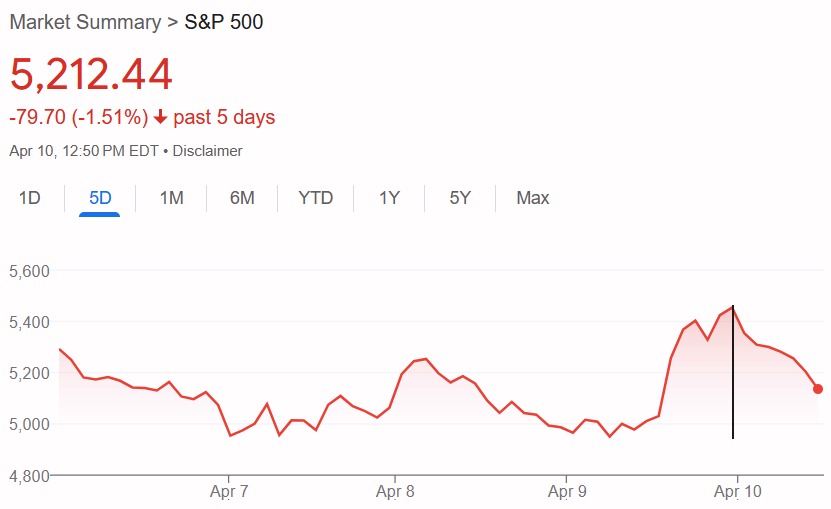
April 9 wasn’t just another volatile day on Wall Street — it was a near-perfect example of how markets behave during a crash, and why some of the biggest one-day rallies in history often happen inside brutal bear markets.

It’s one of the great paradoxes of investing:

The biggest up-days don’t mean recovery — they often signal panic, forced liquidation, and deeper instability ahead.

What Actually Happened?

In essence, the trillions of dollars that appeared to be gains in the market were really losses for short sellers. That’s the hidden truth of sharp rallies during a crash — the money didn’t come from real investment demand; it came from forced buying.

The key difference is this: when markets rise under normal conditions, long-term investors have unrealized gains — profits on paper, but not yet cashed out. But in a short squeeze, those unrealized gains for stockholders are directly matched by realized losses for short sellers who are forced to buy at any price to cover their positions.

It’s not wealth creation — it’s wealth transfer under pressure. In the chaos of a market crash, those who looked like winners became losers — and those who looked like losers became winners.

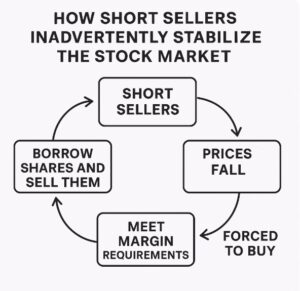
Short Sellers Help Stabilize the Stock Market

The Mechanics

Markets spiked sharply after a sudden and dramatic policy reversal was announced — a move investors hoped might slow down the economic freefall.

But here’s the key:
This initial surge wasn’t organic buying. It was mechanical.

→ Short sellers — traders betting against the market — suddenly got squeezed.
→ When prices jump too fast, short sellers face margin calls — demands from brokers to put up more money or buy back the stock they bet against.
→ Since short-selling carries unlimited loss potential, these traders are forced to buy shares no matter the price to avoid catastrophic losses.

That panic buying drives prices even higher, triggering more margin calls in a dangerous feedback loop.

Why Does This Matter?

Because once those short positions are closed (covered), the artificial buying pressure evaporates.

And here’s the brutal part:
→ Many of those same shares bought in a panic are quickly sold again by longer-term bearish investors or funds desperate to raise cash.

That’s what you saw today — the so-called “pullback” was not just natural volatility; it was the aftershock of forced buying unwinding itself.

Markets gave back much of yesterday’s gains. And worse, they are now at risk of retesting — or breaking — the recent lows.

The Illusion of Safety

In chaotic markets like this, price action becomes non-linear and unpredictable.

Massive rallies during a downturn are not necessarily signs of strength — they are often signs of extreme stress within the system.

This is why some of the biggest single-day gains in market history occurred during the Great Depression, the 2008 Financial Crisis, and the early phases of COVID’s market panic.

It’s not recovery.
It’s chaos.

Why Crashes Look Like This: Forced Buyers Meet Forced Sellers

Several key forces converge during these phases:

  • Short-sellers covering in panic.

  • Margin calls across hedge funds and leveraged traders.

  • Index funds and mutual funds, required to stay fully invested, reluctantly buying dips.

  • Passive investing structures amplifying volatility both directions.

  • Algorithmic trading chasing momentum.

These dynamics create a dangerous loop:
→ Sharp rallies from forced buying.
→ Followed by brutal reversals from forced selling.

The result?
A jagged, chaotic pattern — not a smooth decline.

And the Most Important Lesson:

In a true crash, there is no guaranteed floor.

Support levels only exist until panic overwhelms them. Fundamentals don’t matter when liquidity disappears.

Markets become driven by positioning, margin calls, and liquidity — not valuation.

This is why the old phrase still applies:
“Bear market rallies are designed to fool the maximum number of people in the minimum amount of time.”

Closing Thought:

The real danger today isn’t just volatility — it’s the fact that this is largely self-inflicted economic destruction.

Policy mistakes — from trade wars to immigration freezes to climate inaction to protectionist tariffs — have combined into a global slowdown unlike anything since the Great Depression.

And unlike past crashes, there is a real risk this time that the damage is structural — not cyclical.

Recovery is not guaranteed.

One-Week Chart Highlighting Record One-Day Spike

Trumpenomics: The Decline of the US

bookmark_borderTariff Turmoil: The Chaos and Confusion Surrounding U.S. Trade Policies in 2025

by Daniel Brouse
April 9, 2025

From Sector-Specific Levies to Unpredictable Pauses, Determining What Tariffs Remain in Effect Has Never Been More Complex

In a stunning reversal, the Trump administration just announced a 90-day pause on its controversial reciprocal tariffs policy — a clear sign that recent market chaos is starting to bite. With a record spike in interest rates overnight and global investors fleeing U.S. debt, the pause appears to be a desperate attempt to calm financial markets rattled by the escalating trade war.
For months, Trump’s tariff strategy has been framed as strength — but today’s move signals growing recognition that aggressive trade policies are now directly threatening U.S. economic stability. The world is no longer automatically turning to U.S. Treasuries in a crisis, and investors are demanding higher rates to hold American debt — a dangerous shift for the global economy.
While the pause buys time, it underscores a bigger problem: trust, once lost in global markets, is hard to recover.

Current Situation
As of April 9, 2025, the United States has implemented a series of tariffs under President Trump’s “reciprocal tariff” policy. Initially, a universal 10% tariff on all imports was set to take effect on April 5, 2025. However, on April 9, 2025, President Trump announced a 90-day pause on tariffs for over 75 countries that opted to negotiate rather than impose retaliatory measures.

Despite this pause, tariffs remain in effect for certain countries, most notably China. The tariffs on Chinese imports have been increased to a total of 145%, escalating the U.S.-China trade conflict.

The situation is dynamic, with ongoing negotiations and potential policy adjustments. For the most accurate and current information, it is advisable to consult official communications from the U.S. Trade Representative or the White House.

There are still significant tariff measures affecting imports from various countries and specific sectors; however, it is not at all transparent as to the actual law. Following is our best guess:

1. Canada and Mexico Tariffs:

  • 25% Tariff on Non-USMCA-Compliant Goods: On March 4, 2025, the U.S. imposed a 25% tariff on imports from Canada and Mexico that do not meet United States-Mexico-Canada Agreement (USMCA) standards.

  • Energy Imports: Canadian energy resources are subject to a reduced tariff of 10%, as per the adjustments made on March 4, 2025.

  • Reciprocal Tariffs: In response, Canada has imposed a 25% tariff on U.S. vehicle imports that do not meet USMCA standards.

2. Sector-Specific Tariffs:

  • Steel and Aluminum: Effective March 12, 2025, a 25% tariff was applied to imports of steel and aluminum articles, as well as certain derivative products, from all countries.

  • Energy Sector: While specific details on energy-related tariffs are limited, the White House has indicated that energy imports may be subject to new tariffs to promote domestic production.

  • Lumber: Lumber imports are among the sectors that could face new tariffs, as the administration has warned of potential measures to support domestic industries. ​

3. Tariff Status and Exemptions:

  • USMCA-Compliant Goods: Products that comply with USMCA standards are exempt from certain tariffs, including those on vehicles and specific goods from Canada and Mexico.

  • De Minimis Threshold: The U.S. has removed the de minimis exemption for low-value shipments from China, Hong Kong, and Macau, effective May 2, 2025, eliminating the $800 duty-free threshold for these regions.

4. Ongoing Developments:

  • Retaliatory Measures: Affected countries, including China, the EU and Canada, have announced retaliatory tariffs in response to U.S. measures, further complicating the trade landscape. ​

  • Future Tariff Considerations: The administration has indicated that additional tariffs may be imposed on sectors such as copper, pharmaceuticals, semiconductors, and lumber to encourage domestic production.

China: Although challenging to calculate precisely, this appears to bring the total tax on imports from China to 165% (updated). It also remains unclear whether the tax on EVs will now rise to 265%.

A 30-35% Tariff Rate

The Economic Reality Behind the Tariff ‘Pause’: A 35% Tariff Rate

On April 9, the effective tariff rate without factoring in China, the United States’ largest trading partner, shifted to 18%. This rate was still the highest we’ve seen since the 1940s. While this sounds like a notable shift, it doesn’t fully capture the broader impact. When we include China in the equation, the story takes an even more dramatic turn. The total effective tariff rate, including both the general tariffs and consumption taxes on Chinese imports, skyrocketed to a range of 30-35%

Resources:

Trumpenomics: The Decline of the US

bookmark_borderThe Destructive Legacy of Trump’s Climate and Economic Policies: A Call for Urgent Action

by Daniel Brouse
April 9, 2025

Donald Trump’s dismissal of climate science and his aggressive promotion of fossil fuel extraction have resulted in a harmful and increasingly unsustainable energy policy. By labeling climate change as a “hoax” and referring to policies designed to combat it as “The Green New Scam,” Trump has ignored the overwhelming scientific consensus that climate change is real and accelerating. His catchphrase, “Drill, Baby, Drill,” is emblematic of an energy policy that favors short-term profits from fossil fuel extraction over the long-term health of the planet. This approach has not only worsened the climate crisis but has also contributed to growing economic instability. If left unchecked, the policies enacted during Trump’s administration will likely render the planet uninhabitable for future generations, causing irreversible damage to both the environment and the economy.

Trump’s Climate-Defying Actions: A Clear Threat to the U.S.

One of the most glaring examples of Trump’s failure to address climate change is his active support for policies that encourage fossil fuel extraction, even in the face of overwhelming evidence of its destructive impacts. While news broke about a major leak in the Keystone pipeline, causing widespread environmental damage, Trump was busy pandering to coal executives at a Republican fundraiser, celebrating the reopening of coal mining on public lands. At the same time, his Energy Secretary went on financial news outlets and falsely claimed that coal-fired power plants emit nothing but water vapor. This blatant ignorance and the spread of misinformation not only mislead the public but also accelerate the environmental degradation that is already threatening our future.

“Drill, Baby, Drill”: The Policy That Puts Us All at Risk

Perhaps no phrase better encapsulates Trump’s approach to energy policy than “Drill, Baby, Drill.” This mantra, which prioritizes fossil fuel extraction, is a cornerstone of an energy strategy that ignores the overwhelming evidence of climate change and its economic consequences. The immediate result of this policy is an increase in carbon emissions, which exacerbates the very climate crisis that threatens to destabilize both our environment and economy.

Climate change, driven by such policies, presents the most severe threat to not only our ecosystems but also to the global economy. The fallout from unchecked environmental destruction will have far-reaching effects, from agricultural disruptions to significant increases in healthcare costs and the destruction of vital infrastructure.

The Economic Consequences of Climate Change: A Perfect Storm of Inflation and Instability

Trump’s climate-denying energy policies are not just harmful to the planet—they have also created a volatile economic environment. The first inflationary shock tied to climate change occurred in 2019, when a devastating drought in Taiwan crippled the semiconductor industry. Taiwan, a global leader in microchip production, saw critical manufacturing facilities forced to shut down due to water shortages. This disruption, which impacted the global supply chain, marked the beginning of a series of economic challenges tied to climate-induced disasters.

In the years since, climate-related disasters have continued to escalate. From severe hurricanes and wildfires to prolonged droughts, each event has intensified the economic instability caused by climate change. These disasters have driven up insurance premiums, adding to the financial burden on homeowners and businesses alike. President Trump’s “Drill, Baby, Drill” approach has only fueled this instability by perpetuating fossil fuel dependency, accelerating climate change, and deepening the economic crisis.

The Price of Inaction: U.S. Faces Trillions in Economic Losses

In 2023, the United States experienced a record-breaking number of climate-related events, each causing damage exceeding one billion dollars. The cumulative impact of these events is staggering, with some individual disasters costing hundreds of billions of dollars. The frequency and severity of these events highlight the accelerating pace of climate change and the urgent need for intervention.

Projections suggest that the long-term economic costs of climate change could reach trillions of dollars for the U.S. alone. These costs stem from a range of factors, including the destruction of infrastructure, increased healthcare expenditures due to climate-related illnesses, and disruptions to agriculture and the food supply chain. Perhaps most concerning of all is the projected rise in homeowners’ insurance premiums, driven by the growing frequency of climate disasters. Short sellers predict that, within the next decade, up to 25% of U.S. properties could become uninsurable. Without significant policy changes, these costs will continue to rise, exacerbating the inflationary pressures already plaguing the U.S. economy.

A Future at Risk: The Need for Urgent Action

The economic effects of climate change go beyond financial losses—they have the potential to undermine future growth, reduce productivity, and deepen social inequalities. Proactive investments in renewable energy, climate resilience, and sustainable practices are not just necessary to protect the environment—they are also critical to safeguarding economic stability and future prosperity. Without a dramatic shift in policy direction, the U.S. risks a future where economic growth is stunted, natural disasters become the new normal, and entire communities are left to cope with the aftermath.

As a climate scientist with decades of experience developing climate models, I have seen firsthand the alarming projections of global warming. Our updated climate model, now integrating complex social-ecological factors as part of a dynamic and non-linear system, suggests that global temperatures could rise by as much as 9°C within this century. This is far beyond previous estimates of a 4°C increase over the next thousand years, and such an extreme rise in temperature would render much of the world uninhabitable within our lifetimes.

Without urgent intervention, the accelerating pace of climate change will surpass our ability to adapt, leading to widespread ecological collapse, economic destabilization, and loss of human life on a scale never before seen. The time to act is now. Climate change is not a distant threat—it is happening right now, and the choices we make today will determine whether or not future generations will inherit a livable planet.

Conclusion: A Call for Immediate Change

Donald Trump’s policies, which have ignored the science of climate change and prioritized fossil fuel extraction, have exacerbated the environmental and economic challenges facing the world. These policies, driven by ignorance and short-term profit motives, have intensified the climate crisis and undermined global efforts to transition to a more sustainable future. It is critical that we shift away from such destructive policies and invest in solutions that will not only protect our environment but also safeguard the future of the global economy. The window for action is closing, and the time for change is now.

The Persistence of Climate Change Denial: Impact and Consequences
Politicians Hinder Fight Against Climate Change
Insurance Cost and Availability

The Human Induced Climate Change Experiment

Trumpenomics: The Decline of the US

bookmark_borderEU’s Trade Counterattack: Tariffs Designed to Target U.S. Red States

by Daniel Brouse
April 9, 2025

In response to the U.S. administration’s recent implementation of reciprocal tariffs affecting numerous trading partners, the European Union (EU) has enacted counter-tariffs targeting a broad range of American goods. These measures aim to pressure the U.S. by focusing on exports from states that traditionally support the Republican Party, often referred to as “red states.”​

Scope and Implementation of EU Tariffs:

  • Targeted Products: The EU’s tariffs encompass a variety of U.S. exports, including motorcycles, bourbon, peanut butter, and jeans. Additionally, agricultural commodities such as soybeans, beef, and poultry, as well as industrial goods like tobacco, iron, steel, and aluminum, are affected. Notably, Louisiana’s soybean exports, Kansas’s beef, and Southern states’ poultry are among the products targeted.

  • Economic Impact: These countermeasures impact U.S. exports valued at approximately €26 billion ($28 billion), aligning with the economic scale of the U.S. tariffs. The EU’s strategy appears to be a calculated effort to influence U.S. trade policy by affecting regions that are politically significant to the current administration. ​

  • Implementation Timeline: The EU’s tariffs are being rolled out in phases, with the initial measures starting in mid-April 2025. This staggered approach allows for potential negotiations between the EU and the U.S. to resolve trade disputes before further escalation occurs.

By strategically targeting exports from Republican-leaning states, the EU seeks to apply economic pressure on the U.S. administration, potentially influencing future trade negotiations and policies. Additionally, EU citizens are increasingly boycotting U.S. products and travel as part of their response to the ongoing trade tensions.

Trumpenomics: The Decline of the US

bookmark_borderChina Hits Back: 84% Tariff Targets U.S. Farmers First

by Daniel Brouse
April 9, 2025

In response to President Trump’s recent tariff increases on Chinese imports, China has retaliated by imposing an 84% tariff on U.S. goods. This escalation significantly impacts American farmers, as agricultural products are primary targets in China’s countermeasures.

Impact on U.S. Farmers:

  • Loss of Competitive Edge: The steep tariffs make U.S. agricultural products substantially more expensive in the Chinese market. Consequently, Chinese buyers are likely to turn to alternative suppliers from other countries, diminishing the market share for American farmers.

  • Financial Strain: The increased tariffs exacerbate existing financial pressures on U.S. farmers, who are already contending with high input costs and low commodity prices. The added burden threatens their profitability and overall financial stability. ​

  • Ripple Effect on Rural Economies: Agriculture plays a crucial role in the economic health of rural communities. Reduced exports due to tariffs can lead to decreased income for farmers, which in turn affects local businesses and services that rely on the agricultural sector.

This development underscores the escalating trade tensions between the U.S. and China, with American farmers bearing significant repercussions.

Trumpenomics: The Decline of the US

bookmark_borderDumbfoundingly Dumb Tariffs

by Daniel Brouse
April 9, 2025

The Peterson Institute for International Economics (PIIE) calculated that the cumulative average tariff rate on Chinese imports would reach nearly 125% following the implementation of an additional 84% tariff by the Trump administration. This calculation accounts for the compounding effect of successive tariff increases over time.​

Here’s a breakdown of how this figure is derived:

  1. Initial Average Tariff Rate: Before the recent tariff announcement, the average tariff rate on Chinese imports was approximately 20.8%. This figure includes tariffs imposed during President Trump’s first term and subsequent adjustments under President Biden.

  2. Additional Tariff Imposed: An additional 84% tariff is set to be applied to Chinese imports.

  3. Compounded Tariff Calculation: The new tariff is applied on top of the existing tariffs, leading to a compounded effect. The formula to calculate the cumulative tariff rate is

Total Tariff Rate = (1 + Existing Tariff Rate) * (1 + Additional Tariff Rate) – 1

Total Tariff Rate = (1 + 0.208) * (1 + 0.84) – 1
Total Tariff Rate = 1.208 * 1.84 – 1
Total Tariff Rate = 2.22472 – 1
Total Tariff Rate = 1.22472 or 122.472%

Rounding this figure gives approximately 122.5%, which aligns with PIIE’s calculation of nearly 125%.

This compounding effect illustrates how successive tariff increases can significantly elevate the overall tariff rate, leading to substantial impacts on trade dynamics and economic relations between the involved countries.

The new wave of tariffs on Chinese imports isn’t just economically misguided — it’s economically self-destructive. Far from punishing China, these tariffs act as a massive tax on American consumers and businesses. Tariffs are paid by U.S. importers, not by China. The costs inevitably flow downstream, driving up prices on everything from electronics and cars to construction materials, clothing, and medical equipment. In other words, tariffs are inflation accelerators — hitting American families directly at a time when inflation is already a concern.

Worse, these policies cripple the very U.S. manufacturers they claim to protect. American factories depend heavily on Chinese parts and materials to remain globally competitive. By driving up input costs, tariffs make U.S. manufacturing less competitive, not more. The likely result is fewer U.S. factory jobs, higher consumer prices, and a growing incentive for companies to offshore even more production.

China will not sit idly by, either. Retaliatory tariffs targeting U.S. exports — especially agricultural products like soybeans, pork, and corn — are almost guaranteed. U.S. farmers, already vulnerable in a highly competitive global market, will feel the squeeze first. Exporters of aircraft, cars, and technology are next in line.

Over time, this kind of trade policy encourages global supply chains to bypass the United States altogether. Multinational companies hate uncertainty and will naturally redirect investment to more stable environments like Mexico, Vietnam, or Indonesia. This risks isolating the U.S. economy from global trade flows and eroding its long-standing central role in the global economy.

Economically, the U.S. faces a toxic mix: rising prices alongside slowing growth — the classic recipe for stagflation. Inflation accelerates because of higher import costs, while growth slows as manufacturing, exports, and consumer demand contract under the weight of higher prices. Rising unemployment in key sectors becomes a real risk.

Perhaps most ironically, this tariff policy undermines America’s own technological leadership. Many U.S. innovations, from iPhones to solar panels, rely on Chinese components. Disrupting these supply chains increases costs for R&D, slows the adoption of green technologies, and handicaps U.S. efforts to lead the world in the next generation of tech.

Strategically, it’s even worse. The more the U.S. behaves like an unreliable or hostile trading partner, the more it pushes other countries — including allies — toward China’s orbit. China gains a propaganda victory, portraying itself as the stable alternative to an erratic and isolationist America.

Ultimately, these tariffs function less like economic policy and more like economic self-sabotage. They tax Americans, hurt U.S. businesses, fuel inflation, slow growth, threaten jobs, and weaken America’s position in the world. It’s like burning down your own house because you don’t like the neighbor’s paint color.

White House Tariff Clarification — The Executive Order outlines that the total tariffs on China under Trump 2.0 amount to 145%, on top of approximately 20% imposed during Trump 1.0, resulting in an effective tariff rate of around 165%. However, most economists agree that tariffs exceeding 50% function effectively as a trade embargo, severely limiting or eliminating imports altogether.

Protectionism 101: Trump Economics

It’s honestly hard to watch this and understand how any of his followers are falling for what has to be the worst attempt at “Don the Con” yet. I can’t find a single credible economist who agrees with Trump on this. Eliminating immigration and launching a trade war at the same time isn’t strategy — it’s economic suicide. It’s like going nuclear on your own economy. I’d say someone needs to take the “codes” out of his hands — but it’s too late. He’s already launched them.

Trumpenomics: The Decline of the US

bookmark_borderIntegrating Chaos: New Climate Models Project Up to 9°C Warming This Century

by Daniel Brouse
April 6, 2025

How can the climate breakdown and collapse of the climate system be explained through chaos theory?

Great question — this is one of those rare cases where chaos theory isn’t just useful — it’s necessary to understand what’s happening with the climate system.

In a nutshell:

The climate system is a non-linear, complex, feedback-driven system — exactly the kind of system chaos theory was developed to describe.

Chaos Theory Basics (quick refresher)

Chaos theory studies how small changes in initial conditions can lead to wildly different outcomes in complex systems. This is often called sensitive dependence on initial conditions — or famously, the butterfly effect.

In chaotic systems:

  • Behavior looks random, but is deterministic underneath.

  • Predictability breaks down over time.

  • Feedback loops accelerate instability.

  • Thresholds or tipping points matter more than averages.

The Climate System is a Classic Chaotic System

Climate Feature Chaos Theory Concept Example in Climate Breakdown
Feedback Loops Positive/Negative Feedback Melting ice reduces reflectivity → warms faster. Dying forests release CO₂ → warms faster.
Sensitive Dependence Butterfly Effect Tiny changes in Arctic ice cover alter the jet stream → extreme weather thousands of miles away.
Non-linearity Disproportionate Outcomes +1°C doesn’t mean “a little worse” → it can mean entirely new weather patterns, droughts, floods, collapse.
Tipping Points Critical Thresholds Collapse of Greenland Ice Sheet or Amazon rainforest sets off irreversible global changes.
Attractors Shifting Stability Zones The climate might “prefer” certain stable states (ice age vs warm period) — human forcing could push us into a new, hostile attractor.

Chaos Theory Explains Why Climate Collapse Feels Sudden

  1.  Long period of relative stability (homeostasis in chaos theory terms).

  2.  Hidden stresses build slowly (greenhouse gases, deforestation, pollution).

  3.  System nears a critical threshold (edge of chaos).

  4.  Seemingly small trigger (like a bad El Niño year) causes cascading failures:

    • ocean currents stall

    • food systems fail

    • regional collapses emerge

    • global feedbacks accelerate

The Frightening Part (but also the scientific truth)

Climate breakdown isn’t a slow, smooth, linear decline.
It’s a chaotic, non-linear system heading for phase shifts, tipping points, and potential collapse.

That’s why decades of “x degrees = y impacts” models are failing.
Real-world climate disruption is jumping ahead faster than expected — because the system is moving into a chaotic regime.

A Final Visual Metaphor (from chaos theory)

Imagine Earth’s climate as a ball rolling in a valley:

  • Stable = ball stays in the valley bottom.

  • We’ve pushed the ball up the slope (burning fossil fuels).

  • The higher it goes, the more unstable.

  • At some point the ball tips over into another valley — a new stable state (but maybe hostile to life as we know it).

 This is what collapse looks like in chaos theory.

Bottom Line

Climate change isn’t just “getting hotter.”
It’s a chaotic transition, where:

  • Local events become global.

  • Predictability evaporates.

  • System stability breaks.

  • Collapse happens not slowly — but in lurches, jumps, and phase changes.

Our updated climate model, which integrates complex social-ecological dynamics with the non-linear, feedback-driven behavior of physical systems, indicates global temperatures could rise by as much as 9°C this century.

bookmark_borderThe Silencing of America: Journalism, Protest, and the Rise of Fear

by Anonymous
April 6, 2025, updated July 2025

It is terrifying to watch American journalism go silent — not because reporters don’t care, but because many of us know exactly what happens when we speak the truth now.

I know. I’ve been an investigative journalist for over 45 years, filming police corruption, government lies, and abuse of power across this country. I have faced threats before. But this — this is something darker.

On election day, I realized I could no longer safely use my real name. The night before, I dreamed I was arrested at a protest. That is not paranoia. That is preparation in Trump’s America.

Since returning to power, Trump has wasted no time weaponizing the legal system against his perceived enemies — especially the press. Major networks like ABC and independent journalists face a relentless barrage of lawsuits, not because Trump expects to win, but because he wants to bleed them dry and silence them. Under a Justice Department now resembling a political death squad, who will stop him?

And it’s not just lawsuits. State and federal crackdowns on peaceful protests are increasing, targeting Americans exercising their constitutional rights. Their crime? Daring to oppose genocide, war, or environmental destruction. At the Hands Off! protests, the loudest chants weren’t just against war — they demanded the release of political prisoners held in America today.

This is no longer creeping fascism. It is marching down Main Street with impunity.

Anyone who knows history sees the signs. This is how it starts: with fear. With silence. With people convincing themselves, “It can’t happen here.”

But it is happening here.

A Coordinated Assault on Truth

Trump is not alone. In Israel, Netanyahu’s far-right government has banned journalists from reporting in Gaza and outlawed Al Jazeera, the region’s most reliable independent outlet. Reporters who attempt to document atrocities face arrest or worse.

Both leaders understand that silencing truth is essential to maintaining authoritarian power. Their tactics are deliberate: demonize the press, weaponize courts, spread disinformation, and make public dissent a punishable offense.

Meanwhile, as these leaders dismantle democratic institutions, they fuel crises that demand accountability: genocide in Gaza, escalating wars, environmental collapse, and economic ruin. Silencing journalists silences the evidence.

Why This Moment Matters

We have entered a dangerous feedback loop: authoritarian regimes suppress dissent, allowing them to escalate violence and repression, which in turn demands more suppression to avoid accountability.

Independent journalism is the last line of defense. Without it, people will not know the full extent of the atrocities being committed in their name, the corruption draining their futures, or the environmental collapse accelerating under deregulation.

We, as journalists, continue to report — even if anonymously — because silence is complicity.

And we, as citizens, must decide if we will let fear dictate our future.

Citizen, beware.

Journalist, beware.

Truth is now treason in Trump’s America, and in Netanyahu’s Israel.

If we allow the silencing of journalism, the silencing of democracy will follow.


Silencing Truth: The War on Journalism by Netanyahu and Trump

Trumpenomics: The Decline of the US