bookmark_borderClimate Denial, Drought, and the Death of Capitalism: How Trump’s Anti-Science Policies Are Driving Economic Collapse

President Trump recently claimed that his administration is working to reduce record-high beef prices — a crisis he attributed to drought impacting U.S. cattle ranchers. Yet what he failed to acknowledge is that the drought itself is a direct consequence of the very climate crisis his administration continues to deny. The irony is stark: the same policies that prop up fossil fuel production and reject climate science are now dismantling the foundations of American capitalism.

The Western U.S. — once a global breadbasket and livestock powerhouse — is facing a multi-decade megadrought, worsened by rising temperatures, declining snowpack, and shifting precipitation patterns. Extreme heat accelerates evaporation, depleting both soil moisture and surface water. Pastures have withered, feed costs have soared, and cattle herds have been culled to historic lows. This has driven beef prices to record highs, threatening not just ranchers but the entire food supply chain — from processing plants to grocery shelves.

Under normal circumstances, capitalism adjusts through innovation and efficiency. But when leadership denies the root cause — in this case, anthropogenic climate change — markets cannot adapt. Trump’s policies of fossil fuel expansion, regulatory rollbacks, and environmental deregulation amount to state-sponsored self-sabotage. His administration’s energy and agricultural agendas reward short-term extraction while destroying the long-term natural capital — clean water, arable soil, and stable climate — that all economic systems depend on.

Trump’s climate denial isn’t just anti-scientific; it’s anti-capitalist in the truest sense. A functioning market requires stable conditions and predictable risk. Climate chaos destroys both. Droughts, floods, and fires are driving up insurance costs, collapsing crop yields, and creating food insecurity. Supply shocks ripple through every industry — from beef to banking — as climate volatility erodes investor confidence and undermines global trade.

By rejecting climate science, Trump’s administration is ensuring that capitalism itself becomes unsustainable. The free market cannot function on a dying planet. The laws of physics do not yield to political ideology or corporate lobbying. As the drought deepens and prices rise, the invisible hand of the market is being scorched by the very flames of denial it helped ignite.

If America wants capitalism to survive, it must end the illusion that economic growth and climate denial can coexist. The longer Trump and his allies cling to fossil-fueled delusion, the faster both our environment — and our economy — will collapse.

Trumpenomics

Climate Science

bookmark_border2024: The Year Earth Crossed a Critical Climate Threshold

by Daniel Brouse
October 15, 2025

Research released in 2025 confirmed that 2024 was the year the planet broke multiple climate records — none of them good. Atmospheric carbon dioxide (CO₂) concentrations, fossil fuel emissions, and global average temperatures all soared to unprecedented highs, marking the moment humanity officially breached the 1.5°C warming threshold established by the Paris Agreement. This convergence of record-setting trends underscores a sobering reality: Earth’s climate system has entered a phase of self-reinforcing instability, where runaway feedback loops — from melting ice and collapsing ecosystems to ocean and atmospheric disruptions — are beginning to overpower human mitigation efforts.

Atmospheric CO₂ Concentration at Record Highs

The global average concentration of atmospheric CO₂ reached approximately 422.7 parts per million (ppm) in 2024 — the highest level in at least three million years. Even more alarming was the record-breaking annual increase of 3.75 ppm, the largest jump since modern measurements began in 1959. Monthly concentrations peaked in June 2024 at 426.91 ppm, reflecting a steep and accelerating rise.

Several compounding factors contributed to this unprecedented spike. Record-breaking air and ocean temperatures intensified carbon release from both terrestrial and marine environments. Heatwaves, droughts, and wildfires — especially across the tropics and boreal regions — released massive quantities of stored carbon while simultaneously weakening the ecosystems that usually absorb it.

The result is a dangerous new feedback: as the planet warms, its capacity to regulate CO₂ diminishes, which in turn drives further warming — a loop now gaining speed.

CO₂ Emissions from Fossil Fuels and Cement Continue to Rise

Despite decades of scientific warnings, global CO₂ emissions from fossil fuels and cement production climbed to yet another record high in 2024. Projections estimate a total of 37.4 billion tons (gigatons) of CO₂, representing a 0.8% increase over 2023 levels. Much of this growth stemmed from rising coal consumption across Asia, increased oil use in transportation, and a continued post-pandemic rebound in global industrial activity.

The United States also played a major role in driving 2024’s record atmospheric CO₂ levels through its high fossil fuel consumption, expanded production, and record exports. In particular, the rapid growth of liquefied natural gas (LNG) production and export — often marketed as a “cleaner” alternative to coal — became a significant driver of global emissions growth. While natural gas combustion releases less CO₂ per unit of energy than coal, the methane leakage across the U.S. extraction, processing, and transport chain — a greenhouse gas over 80 times more potent than CO₂ over a 20-year period — has sharply undercut those supposed climate benefits. The result is a double impact: rising global CO₂ emissions and an accelerating surge in methane-driven warming.

These numbers underscore a troubling contradiction: while renewable energy capacity is expanding rapidly, fossil fuel use continues to rise at nearly the same pace. The gap between emissions and global absorption is widening, and natural systems once capable of buffering this excess carbon are faltering under the strain.

Emissions vs. Absorption: The Planet’s Carbon Sinks Are Failing

Historically, forests, soils, and oceans have acted as vast carbon sinks, absorbing roughly half of all human-generated CO₂. But that balance is shifting. In 2024, mounting evidence suggested that key ecosystems may have crossed critical tipping points, transitioning from net absorbers to net emitters of greenhouse gases.

Forests — long the planet’s most dependable carbon reservoirs — are being systematically weakened. Ozone pollution impairs photosynthesis, while prolonged droughts, heat waves, and invasive pests have reduced resilience and accelerated tree mortality. Meanwhile, wildfires, now more frequent and ferocious, are releasing billions of tons of CO₂ annually. In the Amazon Basin, scientists have confirmed that large portions of the rainforest are now emitting more carbon than they sequester — a stunning reversal of one of Earth’s primary climate regulators.

The crisis extends beyond the land. In the Arctic, thawing permafrost is releasing immense stores of methane and CO₂ previously locked in frozen soils, sometimes reigniting “zombie fires” that smolder beneath the surface through winter. In the oceans, coral reef die-offs and rising surface temperatures are disrupting marine carbon cycles and weakening the ocean’s ability to absorb CO₂. Compounding these effects, the slowing of the Atlantic Meridional Overturning Circulation (AMOC) — a key driver of global ocean currents — is reducing vertical mixing, which limits both carbon sequestration and nutrient flow essential for marine life.

Crossing the Line: Cascading Climate Feedbacks

These trends are not isolated events but interconnected system failures that amplify one another. As forests burn, permafrost melts, reefs collapse, and ocean currents weaken, each feedback loop accelerates the others. The cumulative result is a cascade of tipping points, pushing the Earth toward a less stable, hotter state.

The transformation of natural carbon sinks into carbon sources represents one of the most profound shifts in Earth’s recent history. It means that even if human emissions were to plateau, atmospheric CO₂ could continue to rise — locking in further warming, sea-level rise, and extreme weather.

Conclusion: The Window for Prevention Is Closing

The year 2024 will be remembered not only for breaking records but for revealing the limits of incremental change. Climate stabilization now demands more than emissions reductions — it requires active carbon removal, ecosystem restoration, and the rapid phase-out of fossil fuels on a global scale.

As natural systems that once shielded us begin to fail, humanity faces a stark choice: continue to rationalize short-term convenience, or act decisively to preserve a habitable planet. The data from 2024 make clear that hesitation is no longer an option.

* Our climate model employs chaos theory to comprehensively consider human impacts and projects a potential global average temperature increase of 9℃ above pre-industrial levels. Global warming is a consequence of elevated thermal energy in the climate system, which comprises various subsystems. Chaos theory underscores the intricate and nonlinear nature of dynamic systems. Human well-being is compromised above a 1.5-degree temperature rise, rendering much of the Earth uninhabitable. A 9-degree Celsius increase would bring the Earth close to a wet-bulb temperature incapable of sustaining human life.
Tipping points and feedback loops drive the acceleration of climate change. When one tipping point is toppled and triggers others, the cascading collapse is known as the Domino Effect.

The Human Induced Climate Change Experiment

bookmark_borderGlobal Energy Shift and the Climate Crisis: The U.S. Falling Behind

by Daniel Brouse
October 7, 2025

Over the past year, solar and wind energy worldwide generated more electricity than coal, marking a historic milestone in global renewable energy deployment. China alone added more solar and wind capacity than the rest of the world combined, highlighting how rapidly the United States is losing both economic and energy security to China. Meanwhile, U.S. policy and trade decisions have undermined domestic gains in electric vehicle (EV) and battery technology, stifling innovation, increasing costs, and allowing China to dominate critical supply chains.

On the domestic front, fossil fuel dependence has increased. False claims and deliberate misinformation promoted by the Trump administration have destroyed public confidence in climate science while exacerbating the environmental and economic costs of energy mismanagement.

The climate itself continues to accelerate beyond what many policymakers and the public grasp. The year 2024 was confirmed as the hottest year on record, with global average temperatures approximately 1.55°C above the pre-industrial 1850–1900 baseline. This new record surpassed the previous high in 2023, meaning that all ten of the hottest years on record have occurred in the last decade. Organizations including NASA, NOAA, the World Meteorological Organization (WMO), and the EU’s Copernicus Climate Change Service all confirm these findings, marking the first calendar year to exceed the 1.5°C warming threshold.

Relying on global averages can be dangerously misleading. A 3°C rise in global mean temperature may sound modest, but it masks severe regional extremes. The Arctic, for example, is warming at more than four times the global rate, with localized increases exceeding 10°C. Human habitability depends on these regional extremes and wet-bulb thresholds—the combined heat and humidity levels that overwhelm the body’s ability to cool itself.

Oceans, which absorb over 90% of excess heat trapped by greenhouse gases, are hiding the true extent of warming. Deep-ocean studies reveal rapid warming even in the lowest layers. Though a fraction of a degree increase may seem small, it represents an enormous accumulation of thermal energy—enough, if transferred to land, to theoretically raise surface temperatures by as much as 35°C. This thermal storage masks immediate warming while destabilizing ocean circulation, driving stratification, ecosystem collapse, and extreme weather events. In 2025, the entire Pacific Ocean is running approximately 1.6°C above its long-term average—roughly six standard deviations above the mean—a level far outside historical variability.

Two critical thresholds demand immediate attention: roughly 1.5°C of global average warming, signaling major climate tipping points, and approximately 9°C of warming over land and air, representing the upper limit of human survivability. These thresholds are not distant projections; they are being approached rapidly, with feedback loops accelerating the pace of change.

Meanwhile, U.S. trade policies have undermined domestic EV and battery production. Tariffs, restrictive import rules, and inconsistent incentives have driven up costs for American manufacturers, slowing adoption and innovation. While other nations, particularly China, scale up production and refine next-generation battery technology, the U.S. risks losing its competitive edge in a sector critical to both energy security and climate mitigation.

In short, the world is transitioning to renewables at an unprecedented pace. Solar and wind are surpassing coal globally, but the U.S. is falling behind due to poor policy, mismanagement, and trade decisions. Meanwhile, the climate crisis is intensifying faster than anticipated, threatening regional stability, human survival, and economic security. The need for immediate, informed action—both in energy policy and climate mitigation—has never been more urgent.

* Our probabilistic, ensemble-based climate model — which incorporates complex socio-economic and ecological feedback loops within a dynamic, nonlinear system — projects that global temperatures are becoming unsustainable this century. This far exceeds earlier estimates of a 4°C rise over the next thousand years, highlighting a dramatic acceleration in global warming. We are now entering a phase of compound, cascading collapse, where climate, ecological, and societal systems destabilize through interlinked, self-reinforcing feedback loops.

We examine how human activities — such as deforestation, fossil fuel combustion, mass consumption, industrial agriculture, and land development — interact with ecological processes like thermal energy redistribution, carbon cycling, hydrological flow, biodiversity loss, and the spread of disease vectors. These interactions do not follow linear cause-and-effect patterns. Instead, they form complex, self-reinforcing feedback loops that can trigger rapid, system-wide transformations — often abruptly and without warning. Grasping these dynamics is crucial for accurately assessing global risks and developing effective strategies for long-term survival.

What Can I Do? → “Solutions to the Fossil Fuel Economy and the Myths Accelerating Climate and Economic Collapse.“
There are numerous actions you can take to contribute to saving the planet. Each person bears the responsibility to minimize pollution, discontinue the use of fossil fuels, reduce consumption, and foster a culture of love and care. The Butterfly Effect illustrates that a small change in one area can lead to significant alterations in conditions anywhere on the globe. Hence, the frequently heard statement that a fluttering butterfly in China can cause a hurricane in the Atlantic. Be a butterfly and affect the world.

What you can do today. How to save the planet.

Tipping points and feedback loops drive the acceleration of climate change. When one tipping point is toppled and triggers others, the cascading collapse is known as the Domino Effect.

The Human Induced Climate Change Experiment

bookmark_borderNeptune Flood IPO: Riding the Rising Tide of Climate Risk

by Daniel Brouse
October 1, 2025

Neptune Flood, the largest private flood insurance company in the U.S., went public today, October 1, 2025, with its initial public offering (IPO) on the New York Stock Exchange under the ticker symbol “NP.” The St. Petersburg, Florida-based company raised $368 million by selling over 18 million shares at $20 per share, pricing at the top of its marketed range.

The IPO underscores the growing intersection between climate change, financial markets, and technological disruption. For decades, the flood insurance sector in the United States has been dominated by the National Flood Insurance Program (NFIP), a government-run system long criticized for outdated risk maps, cross-subsidized premiums, and mounting losses as extreme weather intensifies.

Neptune Flood is positioning itself as a market-based alternative. By leveraging artificial intelligence, machine learning, and big data, the company provides instant, risk-adjusted quotes—a major departure from the slow, bureaucratic processes of traditional insurance systems. Its model appeals to homeowners and businesses seeking coverage in areas where climate-driven flooding has rendered NFIP or private insurers either too slow, too expensive, or unwilling to underwrite risk.

But the company’s growth also highlights a troubling trend: vast regions of the U.S. are becoming increasingly uninsurable due to climate change. Rising sea levels, heavier rainfall, and stronger hurricanes are driving up both the frequency and severity of flood events. Where government-backed programs once absorbed much of the cost, private insurers like Neptune are stepping in with higher-cost policies tailored to high-risk consumers willing to pay for coverage.

While investors are attracted to Neptune’s profitability and data-driven underwriting, critics argue that its model may accelerate inequality in climate resilience. Wealthier homeowners and businesses may be able to afford Neptune’s “climate risk premium,” while middle- and lower-income households are left exposed or priced out of protection entirely. This could widen the gap between those who can adapt financially to climate change and those who cannot.
As Neptune Flood begins its life as a publicly traded company, its trajectory will serve as a bellwether for how private capital navigates the growing risks of climate change. Whether it represents a genuine solution or simply a profitable adaptation to a failing system remains to be seen—but one thing is clear: the tide of climate risk is rising, and financial markets are now deeply invested in who sinks and who swims.

Is this a good stock to short?

Actually, it’s not that simple. Neptune’s AI model incorporates climate risk directly into its premium setting, which gives it a built-in hedge—if people are willing (or forced) to pay the extraordinary premiums, Neptune stays profitable. As FEMA gradually steps back from subsidized coverage and shifts toward managed retreat, the private flood insurance market is only going to grow.

That said, there’s a real wild card here: states like Florida are already socializing homeowners’ insurance with taxpayer money. That creates a distorted market where Neptune may find itself competing not just with other insurers, but with its own state government’s artificially underpriced coverage.

So, shorting them might not be as obvious as it looks. This is one of those stocks where climate, policy, and economics will collide in unpredictable ways. Definitely worth watching.

* Our climate model employs chaos theory to comprehensively consider human impacts and projects a potential global average temperature increase of 9℃ above pre-industrial levels.

Tipping points and feedback loops drive the acceleration of climate change. When one tipping point is breached and triggers others, the cascading collapse is known as the Domino Effect.

The Human Induced Climate Change Experiment

bookmark_borderImelda and Humberto: Climate Chaos, the Fujiwhara Effect, and the Web of Feedback Loops

by Daniel Brouse
September 30, 2025

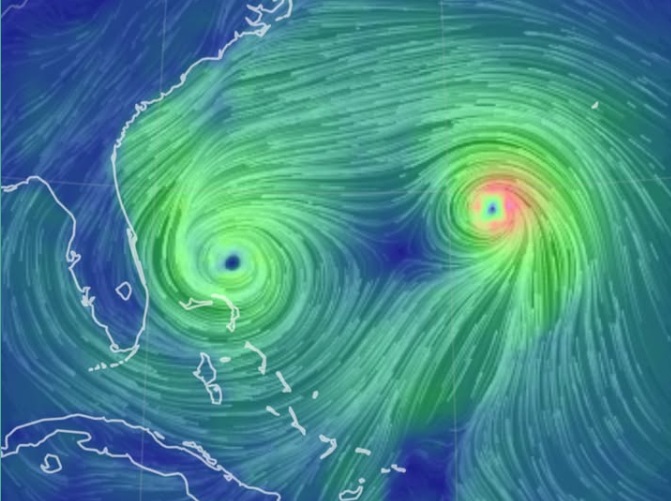
It is rare enough to see two hurricanes simultaneously spinning in the Mid-Atlantic. Even rarer still when those storms interact with a sagging jet stream and the disruption of the polar vortex. Yet this is precisely the kind of increasingly bizarre atmospheric alignment we are witnessing in the age of climate change. As human-driven warming accelerates, the complexity of interactions between climate systems grows—and so does the risk of compounding disasters.

Both Hurricane Imelda and Hurricane Humberto drew strength from the same underlying driver: climate change. Rising ocean temperatures provide hurricanes with more latent heat, acting as high-octane fuel that allows storms to intensify rapidly. Meanwhile, higher sea levels amplify the destructive power of storm surge. But the story does not end with simple cause and effect. Instead, these storms highlight a web of feedback loops that are making Earth’s climate system more volatile.

The Web of Feedback Loops

  1. Ocean Warming → Stronger Storms → More Heat Released
    Hurricanes act as massive heat engines, pulling energy from the ocean and releasing it into the atmosphere. Stronger storms churn up deeper warm water and transfer even more heat into the air, which in turn influences atmospheric circulation patterns, creating a self-reinforcing cycle.

  2. Jet Stream Disruption and Polar Vortex Instability
    The warming of the Arctic is reducing the temperature gradient between the poles and the tropics. This weakens and destabilizes the jet stream, causing it to meander and sometimes stall. A sluggish jet stream allows storms to linger, dumping catastrophic amounts of rain in one place, or, in this case, to align with other anomalies like a displaced polar vortex. The interactions multiply, making storm tracks less predictable and more destructive.

  3. Storm Interactions – The Fujiwhara Effect
    The Fujiwhara effect occurs when two cyclones rotate around a common center, sometimes merging, sometimes slingshotting one another into unexpected paths. While this phenomenon has long been known, climate change is increasing the probability of such interactions by raising the baseline frequency and intensity of storms. What was once an outlier may become a recurring feature of a warmer planet.

  4. Moisture Feedbacks
    Warmer air holds more water vapor, itself a potent greenhouse gas. As hurricanes intensify, they release enormous amounts of moisture into the atmosphere, which not only fuels heavier rainfall but also reinforces global warming by amplifying the greenhouse effect.

The Complexity Problem

Each of these processes alone would be troubling. Together, they weave a feedback network where one climate anomaly feeds into another, raising the odds of compound events. Instead of single, isolated extremes, we are entering an era defined by overlapping crises: two hurricanes colliding while the jet stream buckles and the polar vortex slumps southward. The result is not linear change but exponential escalation in intensity, frequency, and absurdity.

Strange Times, Stranger Storms

The case of Imelda and Humberto illustrates how climate change is no longer about gradual warming alone—it’s about destabilization. As feedback loops interact, they amplify chaos in ways our models struggle to fully capture. The Fujiwhara effect may be the headline here, but the deeper story is the tangled web of reinforcing climate feedbacks now shaping the 21st century.

We have entered a strange new climate era, where storms no longer follow familiar rules and extremes overlap in ways that strain our infrastructure, economies, and imagination. If Imelda and Humberto are any indication, the future will not only bring more powerful storms but increasingly bizarre interactions that defy precedent.

Hurricanes Imelda and Humberto Wind Pattern

Tipping points and feedback loops drive the acceleration of climate change. When one tipping point is toppled and triggers others, the cascading collapse is known as the Domino Effect.

The Human Induced Climate Change Experiment

bookmark_borderTrump Faces Over 300 Lawsuits for Executive Overreach and Harm to U.S. Citizens

Donald Trump is now facing more than 300 lawsuits challenging his executive overreach, authoritarian policies, and actions that have caused widespread harm to American citizens. The sheer volume of litigation is unprecedented in modern U.S. history and reflects the growing backlash against his administration’s unchecked power and disregard for constitutional limits.

A large portion of these lawsuits stem from Trump’s implementation of the largest regressive tax policies in U.S. history, which disproportionately burden working families, individuals, and small businesses while offering sweeping benefits to billionaires and multinational corporations. Small businesses across the country argue that Trump’s tax structure and tariffs have left them at a competitive disadvantage, forcing layoffs, closures, and in some cases, permanent shutdowns.

The tariff wars have also crushed American farmers, driving up input costs, cutting off access to foreign markets, and leaving crops unsold. Instead of addressing the damage caused by his own policies, Trump has announced that he will use billions in taxpayer money for bailouts—a form of economic intervention he derides as “socialism” when practiced by other countries. Critics point out that this hypocrisy not only undercuts U.S. credibility on trade policy but also exposes farmers to greater long-term instability as markets realign away from American agriculture.

Other lawsuits target Trump’s executive actions undermining democratic norms, including restrictions on immigration, the use of federal agents without identification in domestic operations, and policies that have weaponized federal agencies for political gain. Civil rights groups, state attorneys general, and advocacy organizations have joined the litigation, arguing that these actions not only violate the Constitution but also set dangerous precedents that erode the rule of law.

Additionally, several cases allege that Trump’s decisions have resulted in direct violations of individual rights—including denial of due process, infringement on free speech and assembly, and discriminatory practices rooted in racism and bigotry. Plaintiffs point to travel bans, detention practices, and the rollback of environmental and labor protections as examples of executive overreach that harm both people and the planet.

Legal experts note that while many of these cases will take years to wind through the courts, the sheer number and diversity of lawsuits illustrate a nation in deep conflict with its own leadership. If successful, these challenges could redefine limits on executive authority and reshape the balance of power between the presidency, the judiciary, and the people.

Trumpenomics: The Decline of the USA

bookmark_borderThe Science They Refuse to See: Debunking Climate Denial and the Accelerating Crisis

by Daniel Brouse
September 23, 2025

Debunking Common Climate Science Denial Claims: A Scientist’s Rebuttal

Climate science denial often takes the form of oversimplified analogies or misrepresentations of complex physical processes. One common line of attack is the claim that greenhouse gases and potent molecules like methane cannot significantly affect global temperatures. Here, I provide a fact-based response that can help anyone encountering similar arguments.

The Claim

A climate denier recently argued:

  • “Without greenhouse gases, place a container of ‘greenhouse gas’ in sunlight and see if it warms 33°C more than normal air—prove it!”

  • “Methane is too rare and short-lived to matter; its atmospheric concentration is under 2 ppm.”

  • “Theoretical physics is imagination; your climate predictions are politically motivated and have not come true.”

At first glance, these statements might appear plausible to the uninformed. But a deeper look reveals serious scientific inaccuracies.

Who I Am

I am a climate scientist and economist with over 45 years of experience in research and applied systems analysis. I’ve co-authored papers on:

  • Carbon cycles

  • Jet stream dynamics

  • Albedo and brown carbon

  • Atlantic Meridional Overturning Circulation (AMOC)

  • Permafrost thaw and Amazon rainforest dieback

  • Sea-level rise pulses

  • Hydroclimate whiplash and Arctic sea ice loss

  • Tipping points in climate systems

My work employs probabilistic, ensemble-based climate models, integrating socio-economic and ecological feedbacks within dynamic, nonlinear frameworks.

In the 1990s, my lab partner—a Doctor of Physics from Ohio State—and I first hypothesized the non-linear acceleration of climate change. This theory was experimentally and observationally supported by the early 2000s and has since been independently validated, forming the foundation of the current scientific consensus.

Why the Claims Are False

1. Greenhouse Gases and Surface Warming

The assertion that greenhouse gases cannot warm the Earth unless demonstrated in a small container experiment ignores decades of physics, spectroscopy, satellite measurements, and paleoclimate data.

  • Earth’s average surface temperature of +15°C vs. -18°C without greenhouse gases comes from planetary energy balance and radiative transfer physics, not trivial experiments.

  • The greenhouse effect is directly observed in the atmosphere: infrared radiation is absorbed and re-emitted by CO₂, methane, water vapor, and other gases.

Container experiments are not needed to validate this well-established, observable process.


2. Methane is Highly Potent

It is true that methane has an atmospheric half-life of 7–12 years, but this is irrelevant to its radiative impact:

  • Methane’s molecule-for-molecule warming potential is ~80 times CO₂ over 20 years.

  • At even 2 ppm, methane significantly contributes to warming due to secondary chemical effects, including ozone formation and stratospheric water vapor.

  • Ignoring these feedback loops is scientifically inaccurate.

3. Climate Impacts Are Accelerating

The denier’s claim that “predictions have not come true” is demonstrably false. Observations show:

  • In just ten days in July 2025, the U.S. experienced hundreds of flash floods, multiple “1-in-1,000-year” and “500-year” rainfall events, hundreds of deaths, and billions of dollars in damage.

  • These extreme events are consistent with rapidly accelerating climate change, as projected by climate models integrating nonlinear feedbacks.

4. Doubling Time of Climate Impacts

  • Initially, climate effects doubled roughly every 100 years. Today, the doubling time is just two years.

  • This means the damage we see now is twice as severe as two years ago; in a decade, it could be 64 times worse.

  • These trends are observed, not theoretical, and they underscore the urgency of immediate mitigation.

The Real Political Motivation

The political bias is on the side of denial, not science:

  • Groups like the CO₂ Coalition deliberately cherry-pick data, misrepresent feedback loops, and misinform the public.

  • Denial campaigns often pose as “objective skepticism” while ignoring overwhelming evidence, downplaying the real and escalating risks of climate change.

Conclusion

Climate change is not a theoretical imagination; it is an accelerating, well-documented phenomenon backed by decades of rigorous research. Attempts to dismiss it with flawed analogies, incomplete chemistry knowledge, or misrepresented physics are propaganda, not science.

Anyone seeking to understand the climate crisis must rely on:

  • Peer-reviewed research

  • Observational data

  • Predictive modeling validated across decades

Ignoring these facts is dangerous, not clever.

The Human Induced Climate Change Experiment

bookmark_borderTrump’s Climate Lies at the UN: Misinformation on a Global Stage

by Daniel Brouse
September 23, 2025

During his speech at the UN General Assembly on September 23, 2025, Donald Trump once again spread false and misleading claims about climate change, echoing statements he made while in office and on the campaign trail. His rhetoric not only undermines science but also threatens global efforts to combat climate disasters.

Key False Claims

  • “Climate change is the ‘greatest con job ever perpetuated on the world’”
    Trump dismissed overwhelming scientific consensus. In 2023, over 99% of peer-reviewed studies confirmed that climate change is real and human-driven. Calling it a “con job” ignores decades of rigorous research from scientists worldwide.

  • “Carbon footprint is a hoax”
    By denying the concept of a carbon footprint, Trump rejects a basic tool for measuring human contributions to global warming. Carbon accounting is fundamental to understanding emissions and implementing policies to reduce them.

  • “Climate predictions are wrong, made by stupid people”
    This attacks the credibility of climate scientists who follow strict peer-reviewed methodologies. The IPCC and other expert bodies provide consensus-based predictions grounded in decades of observations and climate modeling.

  • “The Green New Deal is a green scam”
    Trump characterized climate policies as a “scam,” dismissing the real costs of extreme weather events, which have already cost businesses and taxpayers billions globally.

Scientific Consensus vs. Trump’s Claims

  • Government reports: A November 2018 report from 13 U.S. federal agencies warned that unchecked climate change could cost the U.S. hundreds of billions annually. Trump dismissed this, saying, “I don’t believe it.”

  • Expert analysis: In August 2025, experts called a climate report from Trump’s Department of Energy “a farce” riddled with misinformation and based on debunked research.

  • Physical evidence: Satellite data show declining Arctic and Antarctic ice, accelerating sea-level rise, and increasing extreme weather events — contrary to Trump’s claims that polar ice is “at a record level.”

  • International condemnation: Trump’s 2025 withdrawal from the Paris Agreement drew formal UN criticism, reflecting global concern over the U.S. abandoning international climate commitments.

Potential Consequences

Experts warn that Trump’s misinformation carries real risks:

  • Distraction from action: The International Panel on the Information Environment (IPIE) warned that climate misinformation “turn[s the] crisis into a catastrophe” by delaying urgent interventions.

  • Policy distortion: Suppressing data on climate costs benefits polluters while ignoring the societal and economic consequences of global warming.

  • Disruptive rhetoric: During his first term, Trump rolled back over 100 environmental regulations. His anti-climate messaging, amplified by sympathetic media, signals a likely repeat of harmful policy decisions in a second term.

  • Unreliable and Untrustworthy: Most importantly, Trump has undermined the U.S.’s reputation as a credible and dependable global partner. His attacks on science and scientists will not be forgotten and have significantly contributed to the accelerating decline of American leadership and credibility.

Conclusion

Trump’s statements at the UN are not harmless bluster — they are part of a broader pattern of denial and obstruction that jeopardizes scientific integrity, global cooperation, and public safety. The world faces increasingly urgent climate challenges, and misinforming the public only makes the crisis harder to solve.

Trumpenomics: The Decline of America

The Human Induced Climate Change Experiment

bookmark_borderThe Deep Ocean’s Silent Warning: Why Rapid Warming Signals a Climate Emergency

by Daniel Brouse
September 17, 2025

A new deep-ocean study has revealed that even the deepest layers of the ocean are warming at a rapid rate. Since the oceans absorb and store over 90% of the excess heat trapped by greenhouse gases, even a tiny increase — as little as one-tenth of a degree — represents an enormous amount of additional stored thermal energy.

The physics is stark: if that accumulated ocean heat were distributed across land surfaces, it would equate to an estimated 35°C increase in land temperatures — a level that would make most of the planet uninhabitable. This highlights how oceans have been masking the true extent of surface warming, acting as a temporary buffer while silently destabilizing their own systems through stratification, circulation slowdown, and ecosystem collapse.

Right now, the entire Pacific Ocean is running 1.6°C above its long-term average — a shocking six standard deviations above the mean. In climate science, deviations of this magnitude are virtually off the charts, underscoring just how far outside of “normal variability” our planet has moved.

The consequences are already deadly. The last three summers have been the hottest ever recorded globally, with Europe bearing some of the worst impacts. This summer alone, thousands died across European cities and towns from severe heat. According to attribution studies, three times as many people perished from extreme heat than would have in a world without human-driven warming. The death toll is no longer hypothetical — it is measurable, mounting, and accelerating.

Yet even as evidence mounts, political obstruction continues. The Trump administration, officials repeatedly downplays or denies the dangers of rising temperatures. One of the United States’ most respected scientific bodies, the National Academy of Sciences, flatly rejected those claims, affirming that the evidence for dangerous climate change is “beyond scientific dispute” and that the impacts on the nation are worsening year by year.

The deep ocean is not just a passive reservoir; it is a warning system. The rapid heating of its most remote depths is telling us, in no uncertain terms, that we are burning through our margin of safety. The oceans may have shielded us from the full brunt of global warming so far, but that shield is cracking — and when it fails, the true scale of the climate crisis will be unleashed.

Footnote:
Sidd and I have been discussing the difference between ocean and land temperatures. I thought I understood it before, but when this new study came out, it really clicked. When people talk about keeping global warming below 1.5°C, that figure is just a global average — across land, oceans, and the atmosphere. In reality, it’s a misleading benchmark. What truly matters is that even a one-tenth of a degree rise in the deep oceans represents an immense increase in stored heat, with far-reaching consequences for the entire climate system.

* Our probabilistic, ensemble-based climate model — which incorporates complex socio-economic and ecological feedback loops within a dynamic, nonlinear system — projects that global temperatures are becoming unsustainable this century. This far exceeds earlier estimates of a 4°C rise over the next thousand years, highlighting a dramatic acceleration in global warming. We are now entering a phase of compound, cascading collapse, where climate, ecological, and societal systems destabilize through interlinked, self-reinforcing feedback loops.

We examine how human activities — such as deforestation, fossil fuel combustion, mass consumption, industrial agriculture, and land development — interact with ecological processes like thermal energy redistribution, carbon cycling, hydrological flow, biodiversity loss, and the spread of disease vectors. These interactions do not follow linear cause-and-effect patterns. Instead, they form complex, self-reinforcing feedback loops that can trigger rapid, system-wide transformations — often abruptly and without warning. Grasping these dynamics is crucial for accurately assessing global risks and developing effective strategies for long-term survival.

What Can I Do? → “Solutions to the Fossil Fuel Economy and the Myths Accelerating Climate and Economic Collapse.“
There are numerous actions you can take to contribute to saving the planet. Each person bears the responsibility to minimize pollution, discontinue the use of fossil fuels, reduce consumption, and foster a culture of love and care. The Butterfly Effect illustrates that a small change in one area can lead to significant alterations in conditions anywhere on the globe. Hence, the frequently heard statement that a fluttering butterfly in China can cause a hurricane in the Atlantic. Be a butterfly and affect the world.

The Human Induced Climate Change Experiment

bookmark_borderEnergy Secretary Disbands Controversial Climate Working Group After Scientific Rebuke

by Daniel Brouse
September 16, 2025

Energy Secretary Chris Wright has officially disbanded the Department of Energy’s controversial Climate Working Group (CWG), a body that came under fire for producing a climate report riddled with inaccuracies and scientific distortions.

The move, first reported by CNN and later confirmed by NPR, follows months of scrutiny over how the CWG was formed and how its report was produced. On September 3rd, Wright sent a letter to the group’s five members — all hand-picked climate skeptics — thanking them for their service and formally dissolving the group.

The CWG’s report immediately sparked outrage in the scientific community. Dozens of independent climate scientists issued a joint rebuttal, stating the report was filled with errors, selective use of data, and misrepresentations of established climate science. Many characterized the report not as science, but as propaganda designed to cast doubt on the overwhelming consensus that human-driven greenhouse gas emissions are destabilizing the planet’s climate system.

The decision to disband the CWG comes against the backdrop of an ongoing lawsuit filed by the Environmental Defense Fund (EDF) and the Union of Concerned Scientists (UCS). As NPR previously reported, the lawsuit alleges that Wright and the Department of Energy violated federal law by secretly assembling the group and excluding qualified experts with diverse scientific perspectives. By limiting authorship to five individuals who shared a narrow, skeptical view of climate science, critics argue, the administration attempted to manufacture doubt where there is none.

For many observers, the CWG represented yet another attempt by the Trump administration to sideline mainstream climate science and replace it with industry-aligned skepticism. The episode illustrates the political battles surrounding climate science in the U.S., where overwhelming peer-reviewed evidence of warming, extreme weather intensification, and feedback-driven risks continues to clash with efforts to delay meaningful action on fossil fuel dependence.

By dissolving the CWG, Wright has effectively acknowledged the group’s lack of credibility. But for environmental advocates and scientists, the damage done by such efforts lingers: each attempt to undermine climate science erodes public trust, delays urgently needed climate policy, and deepens the crisis at hand.

* Our probabilistic, ensemble-based climate model — which incorporates complex socio-economic and ecological feedback loops within a dynamic, nonlinear system — projects that global temperatures are becoming unsustainable this century. This far exceeds earlier estimates of a 4°C rise over the next thousand years, highlighting a dramatic acceleration in global warming. We are now entering a phase of compound, cascading collapse, where climate, ecological, and societal systems destabilize through interlinked, self-reinforcing feedback loops.

We examine how human activities — such as deforestation, fossil fuel combustion, mass consumption, industrial agriculture, and land development — interact with ecological processes like thermal energy redistribution, carbon cycling, hydrological flow, biodiversity loss, and the spread of disease vectors. These interactions do not follow linear cause-and-effect patterns. Instead, they form complex, self-reinforcing feedback loops that can trigger rapid, system-wide transformations — often abruptly and without warning. Grasping these dynamics is crucial for accurately assessing global risks and developing effective strategies for long-term survival.

What Can I Do? → “Solutions to the Fossil Fuel Economy and the Myths Accelerating Climate and Economic Collapse.“

Tipping points and feedback loops drive the acceleration of climate change. When one tipping point is toppled and triggers others, the cascading collapse is known as the Domino Effect.

The Climate Crisis: Violent Rain | Deadly Humid Heat | Health Collapse | Extreme Weather Events | Insurance | Trees and Deforestation | Rising Sea Level | Food and Water | Updates