bookmark_borderThe Physics Behind the 252-mph Gust: Why Hurricane Melissa Signals a New Era of Extreme Storms

By Daniel Brouse / November 19, 2025

Hurricane Melissa recorded a 252 mph wind gust, which shatters the previous highest record of 248 mph from Typhoon Megi in 2010, according to UCAR.

If you’re interested in flow dynamics… this is the highest verified hurricane wind speed ever recorded on Earth.

Climate change is increasing both the frequency and the intensity of extreme systems because the added thermal energy in the climate system does not stay as “heat” — it expresses itself through non-linear atmospheric dynamics. Warmer oceans load storms with more latent heat, more moisture, and stronger pressure gradients. That extra energy then appears as faster wind velocities, more violent updrafts, tighter eyewalls, and explosive rapid intensification cycles that didn’t occur at today’s frequency in the past.

In other words, we aren’t just “warming the air.”
We’re supercharging the fundamental physics of storms — momentum, turbulence, vorticity, and flow — which is why records like this are being broken more often and with greater severity.

The atmosphere is running on a different set of rules now — not because anyone “believes” in climate change, but because the math and the measurements leave no room for debate.

Start with the simplest fact in atmospheric science:
A warmer atmosphere holds about 7% more water vapor per 1°C of warming. That’s not a theory — that’s the Clausius–Clapeyron relation, a physical law.

We’ve warmed the planet more than 1°C already. That means storms today have 10–15% more moisture available, which translates directly into dramatically more energy and more violent rain.

Now connect this to flow dynamics:

1. Violent Rain: Mass × Velocity = Momentum

Raindrop size is increasing. Raindrop count is increasing.
And storms are producing higher wind velocities, which accelerate the droplets further.

Momentum p=mv.

More mass → more momentum.
More velocity → more momentum.
More momentum → more turbulence, more kinetic energy, more destructive power.

This isn’t speculation — it’s measurable.

2. Energy Release: Latent Heat

That extra water vapor carries enormous latent heat.
When it condenses, it releases energy that intensifies updrafts, pressure gradients, and storm organization. This creates:

  • faster strengthening
  • more explosive rainfall rates
  • more dangerous mesoscale convective systems
  • more catastrophic flash floods

This is why storms that used to drop 1–3 inches now dump 5–15 inches in a day.

3. Flow Dynamics After Rainfall

Once water hits the ground, the physics get even more brutal.

Force scales with the square of velocity (v²).

A 40 mph flow has 16× the force of a 10 mph flow.
And water is ~800× denser than air.

That is why modern flash floods move cars, rip out culverts, scour foundations, and carve out roads in seconds.

4. What You’re Calling “Not Climate Change”

The real world says otherwise:

  • Record-breaking rainfall events are happening at 4× the historical rate.
  • “1,000-year floods” are now occurring every few years.
  • Storms are intensifying faster and producing higher peak rainfall.
  • Several regions have already documented rainfall rates once considered meteorologically impossible.

This isn’t politics.
This isn’t a belief system.
This is physics — and we are watching it unfold in real time.

So yes… Climate change. Absolutely climate change.

Footnotes

NCAR has confirmed the 252 mph dropsonde gust in Hurricane Melissa as legitimate. Yes — it’s the highest ever recorded by a dropsonde and essentially tied with Cyclone Olivia’s 253 mph gust measured with ground instruments.

But focusing on whether it’s 1 mph higher or lower is meaningless in context. A 1 mph difference is statistically irrelevant when you’re dealing with storms undergoing record-breaking rapid intensification, unprecedented energy transfer, and historic drops in barometric pressure. These are the metrics that matter scientifically — and they’re the ones that are changing fastest.

The real story isn’t the bragging rights of a single gust measurement.
It’s that we are now routinely seeing:

  • extreme pressure falls that used to be once-in-a-lifetime events,
  • rapid intensification windows that defy past climatology,
  • and nonlinear energy spikes driven by warm SSTs and excess atmospheric moisture.

Melissa’s 252 mph gust is just one data point in a larger pattern: tropical cyclones are entering regimes of intensity that were virtually unknown in the pre-warming climate.

Recent Papers

The Human Induced Climate Change Experiment

bookmark_borderThe Silent Unraveling of Pennsylvania’s Forests: Ozone Stress, Climate Shifts, and the Race for Resilient Species

by Daniel Brouse
November 18, 2025

For decades, we have studied the trees of Pennsylvania, tracking shifts in canopy structure, species resilience, and environmental stressors. Our long-term field data reveal a profound and accelerating decline. Since 2003, old-growth trees have consistently lost about 40% of their foliage over multi-year intervals, leading to premature mortality. During the same period, canopy height has fallen by roughly one-third, a drastic structural collapse in forests that once represented stability and ecological longevity. These changes are not isolated — they mirror global patterns of forest decline — but Pennsylvania offers one of the clearest windows into the cascading pressures reshaping ecosystems worldwide.

The primary drivers of this decline are not singular. Chronic ozone exposure weakens leaf tissues, reduces photosynthetic capacity, and lowers defenses. Warming temperatures, heat stress, hydrological whiplash (extreme swings between drought and deluge), and the spread of pests and disease compound these vulnerabilities. Together, they form a multifactorial stress landscape in which even historically resilient species cannot recover. The number of tree species capable of surviving under modern conditions is shrinking rapidly.

As the canopy thins, an unexpected force rises: vines. In Pennsylvania’s forests, species like wild grape, kudzu, and bittersweet take advantage of the increased sunlight penetrating the weakened upper layers. Vines, once confined to understory limits, now climb higher each year. When they reach the diminished canopy, they smother, shade, and eventually kill the already stressed trees. This vine-driven mortality accelerates the loss of old growth and destabilizes the entire forest system — affecting biodiversity, soil retention, and wildlife habitat. What was once a finely balanced ecosystem now tilts toward collapse.

This local unraveling echoes a global trend. Across Canada, much of the northern United States, and parts of Europe, old-growth forests face similar failures. The wildfire-ravaged forests of Canada highlight the challenge: replanting the same species no longer guarantees success when temperature and moisture regimes have shifted beyond their tolerance. Trees that would have thrived for centuries can no longer survive long enough to mature. Reforestation guided by historic baselines is now a losing strategy; adaptive management that anticipates the climate of 2050–2100 is essential.

In Pennsylvania, our work increasingly focuses on identifying species suited to emerging conditions. Trees with rapid regrowth, high heat tolerance, and broader ecological plasticity show the strongest potential. Among them:

  • Red maple (swamp/soft maple): Highly adaptable, tolerant of wetter soils and shifting precipitation patterns.

  • Kousa dogwood: Resistant to many regional diseases affecting native dogwoods.

  • Cherry (black cherry): Regenerates vigorously and may outcompete slower species under stress.

By contrast, species such as many pines, which cannot regenerate from damaged tissues, fare poorly in the new climate regime.

One of the most promising candidates for future forests is the honey locust. Reaching heights of up to 100 feet and lifespans of 120–150 years, honey locusts combine durability, rapid growth, and climate resilience. Their wood is exceptionally strong — with a Janka hardness of approximately 1,700 lbf, rivaling or exceeding that of white oak and golden teak. Their natural resistance to rot, ability to recover from damage, and tolerance of heat and drought make them remarkably suited for 21st-century conditions. As hardwoods that also fix nitrogen (in some cultivars), locusts help rebuild soils damaged by erosion and extreme rainfall.

Pennsylvania’s forests are not simply changing — they are undergoing a structural transformation driven by the combined forces of chemistry, physics, biology, and climate. The decline of old-growth trees is not just an ecological signal; it is a warning. Without careful, science-guided species selection and adaptive reforestation strategies, vast stretches of eastern forests may transition into degraded ecosystems dominated by invasive vines, weakened understory growth, and fragmented canopy cover.

The future of the region’s forests hinges on acknowledging these realities and acting accordingly. The old equilibrium is gone. The question now is whether we can build a new one robust enough to survive what comes next.

ALSO SEE: The Decline of Penn’s Sylvania Brouse (2024)

Tree Extinction Due to Human Induced Environmental Stress


The Human Induced Climate Change Experiment

bookmark_borderThe Physics of Violent Rain: Turning Ordinary Storms Into Catastrophic Events

by Daniel Brouse and Sidd Mukherjee
November 18, 2025

We’ve been working specifically on the physics of what we now call violent rain, and once you fully understand latent heat, the entire climate system reveals a deeper and far more alarming complexity. Latent heat is not just a chapter in a textbook; it is the engine behind much of Earth’s atmospheric power. But the energy budget is only the entry point. The way that energy manifests — through momentum, turbulence, pressure gradients, and flow dynamics — is some of the most elegant, and now increasingly dangerous, mathematics in climate science.

The fatal mistake many people make is equating “global warming” strictly with warmer temperatures. The additional heat does not simply remain as heat. It is continually exchanged, transformed, and expressed throughout the climate system. It reappears as massive increases in atmospheric moisture, sharper pressure differentials, explosive updrafts, and an atmosphere filled with stored potential energy waiting for the right trigger to be released.

A warmer atmosphere can hold about 7% more water for every 1°C of warming. Over the full temperature anomaly we are now entering, this increased capacity nearly doubles the amount of moisture available to A warmer atmosphere can hold about 7% more water for every 1°C of warming. Over the full temperature anomaly we are now entering, this increased capacity nearly doubles the amount of moisture available to storms. This is not theoretical — it is already transforming rainfall dynamics worldwide. Parts of the world, especially the poles, are now experiencing temperature anomalies that remain more than 22°C above normal for extended periods, supercharging atmospheric moisture and destabilizing global circulation patterns.

One of the most overlooked consequences of this added energy is the rise in both raindrop size and raindrop count. Larger droplets fall faster, strike harder, and inject more energy into the air column, intensifying turbulence. Upon impact with the ground, they deliver far more kinetic energy than raindrops did even a generation ago. Using the momentum relation p = mv:

  • As mass increases, momentum increases.
  • As velocity increases, momentum increases.

More momentum means more turbulence, more kinetic energy, and more destructive rainfall.

People already sense this intuitively — the louder impact of rain on roofs, water bouncing higher off pavement, and downpours that feel physically heavier — but few connect these sensations to the underlying physics.

The destructive power of violent rain actually begins before the drops reach the ground. As storms intensify, raindrops become larger and wind velocities rise, accelerating them horizontally and vertically. Because both m (mass) and v (velocity) increase, each raindrop carries significantly more momentum than in past climates.

Stronger horizontal winds effectively act as a second gravitational pull, increasing the angle and force of impact. This is why wind-driven rain can sting the skin, shred crops, strip leaves from trees, and erode soils far more quickly than vertical rainfall alone. The increased velocity also injects more energy into the air column, amplifying turbulence, updraft strength, and pressure gradients — processes that feed storm intensification.

Once the water reaches the ground, flow dynamics dominate. Force scales with the square of velocity (v²), and density multiplies that force dramatically:

  • A 20 mph wind exerts 4× the force of a 10 mph wind.
  • A 40 mph wind exerts 16× the force.
  • A 60 mph wind exerts 36× the force.

Now apply the same physics to water, which is ~800 times denser than air:

  • A shallow 10 mph sheet of runoff exerts 800× the force of a 10 mph wind.
  • At 20 mph, the force becomes 3,200×.
  • At 40 mph — common in debris-laden flash floods — the force jumps to 12,800×.

When storms produce larger raindrops and faster-moving rain, driven by extreme heat anomalies and stronger wind fields, the resulting flows carry exponentially greater destructive potential. This is why hillsides fail more quickly, roads wash out more often, and floodwaters rise and accelerate with far greater violence in a warming climate — and why these events are unfolding years to decades ahead of earlier projections.

As rainfall intensity spikes, so do these destructive flow forces. This is why modern storms overwhelm culverts, stormwater systems, levees, dams, and hillside soils. It’s why slopes liquefy, bridges scour, and infrastructure collapses in events that used to be considered “routine.”

The mathematics is beautiful — but the consequences are devastating. Violent rain is not a metaphor — it is the physical expression of a climate system carrying far more energy, mass, and momentum than it did just a few decades ago. And every additional fraction of a degree adds more fuel to that system.

For anyone watching closely, the evidence is not abstract. It’s outside your window.

The Climate Crisis: Violent Rain | Extreme Weather Events | Insurance | Soil | Updates

The Human Induced Climate Change Experiment

bookmark_borderThe Climate Has Entered a Runaway Phase: Why “1.5°C” No Longer Describes Our Reality

By Daniel Brouse and Sidd Mukherjee
November 17, 2025

Q: What is happening with climate change?
A: It is accelerating at an exponential rate — far faster than the public narrative or old models suggest.

For years, the world was taught to focus on “holding global warming to 1.5°C.” But that number has quietly become meaningless. Not only have we likely crossed it already, the real danger is not the temperature itself — it is the tipping points that crossing that threshold has set in motion. These tipping points have triggered cascading, self-reinforcing feedback loops that are now reshaping Earth’s systems with unprecedented speed.

We are not approaching a climate crisis.
We are living inside its accelerating phase.

Why the “Global Average Temperature” Is a Misleading Metric

A global average masks extremes — the very extremes that dictate human survival.

A 3°C rise in the global mean may sound manageable, but that average blends together oceans, land, and atmosphere. Because oceans absorb ~90% of excess heat and warm far more slowly, they artificially depress the global mean. Meanwhile, the land and atmosphere — the parts humans inhabit — are warming far faster.

And nowhere is this clearer than at the poles.

The Arctic: 20× Faster Warming and Localized Surges Above 22°C

The Arctic is not warming at “four times” the global rate — it is already warming at more than 20 times the global rate in certain intervals, with localized anomalies exceeding 22°C above historical norms.

This is the engine room of planetary destabilization.

Why does this matter?

1. The moisture multiplier

For every 1°C increase, the atmosphere can hold 7% more moisture.
At +22°C anomalies, Arctic air can now hold:

22 × 7% = 154% more moisture

This surplus water vapor fuels:

  • dramatically faster sea level rise

  • explosive increases in extreme rainfall

  • larger, faster, more destructive raindrops

  • intensifying storms, hurricanes, and atmospheric rivers

Momentum of falling rain scales with mass × velocity; velocity and wind damage scale with the square of flow speed; water is 800× denser than air. The result is a nonlinear explosion in destructive power.

2. Accelerated feedback loops

An Arctic 20× hotter than average accelerates:

  • loss of sea ice

  • albedo collapse

  • permafrost thaw

  • methane release

  • stratospheric moisture injections

  • atmospheric and oceanic circulation disruption

These amplify global warming on a time-compressed schedule: not centuries, but years to decades

Oceans: Silent Heat Storage With Catastrophic Potential

A deep-ocean analysis revealed that even the abyss is warming.
A mere 0.1°C increase in deep-ocean temperature represents a staggering accumulation of heat. If redistributed to land, that heat would equate to ~35°C of warming — incompatible with human life.

In 2025, the entire Pacific is 1.6°C above average, a six-sigma anomaly — virtually impossible under natural variability. This is a planetary red alert.

Two Critical Thresholds

1.5°C – Tipping point activation

≈9°C – Human survivability limit for land and air temperatures

Both are being breached rapidly in localized regions.

Cascading Feedbacks: A System Moving Toward Runaway Behavior

In just ten days of July 2025, the U.S. saw:

  • hundreds of flash floods

  • multiple “1-in-1,000-year” rainfall events

  • widespread infrastructure failures across multiple states

This isn’t “bad weather.”
This is an unstable climate system undergoing phase transition.

Permafrost: From Slow Thaw to Permanent Fire

Old models assumed gradual thaw over millennia.

Reality:

  • formerly frozen landscapes now burn year-round

  • methane and CO₂ release is orders of magnitude faster

  • vast carbon stores are now entering the atmosphere on human timescales

  • fires may partially “flare” methane into CO₂ — but the overall emissions surge is catastrophic

The real uncertainty isn’t if this feedback accelerates warming; it’s how fast and how far it will go.

Ozone: The Overlooked Feedback Harming Ecosystems and Humans

Combustion doesn’t only emit CO₂ — it forms tropospheric ozone, a potent plant toxin.

Ozone exposure:

  • reduces plant growth 10–40%

  • kills sensitive species

  • weakens forests and crops

  • makes ecosystems more vulnerable to drought, heat, pests, and fire

Global forests — the planet’s lungs — have already shifted from carbon sinks to carbon sources.

In our Pennsylvania field site, old-growth trees have lost:

  • ~40% of foliage since 2003

  • ~33% of canopy height

This mirrors global patterns of vegetation decline and reduced carbon uptake.

And ozone harms humans directly:

  • triggers asthma

  • increases cardiovascular stress

  • causes premature death

  • disproportionately affects children and the elderly

The ozone-wildfire-warming feedback loop is now one of the strongest multipliers of climate instability.

A Planet in Nonlinear Transition

These are not distant projections.
These are real-time runaway feedbacks already visible across ecosystems, oceans, and the atmosphere.

The climate system is now governed by compound nonlinear interactions:

  • Arctic amplification

  • ocean heat accumulation

  • ozone stress

  • runaway wildfires

  • permafrost collapse

  • accelerating hydrological extremes

Each amplifies the others in ways models struggle to capture.

The central scientific question is no longer:

“Will feedback loops accelerate warming?”

It is now:

“How much time is left before cascading feedbacks overwhelm natural and human systems?”

Our research is focused on precisely this:
mapping the speed, scale, and irreversibility of climate feedbacks — and determining how close Earth is to thresholds that will define the trajectory of human civilization.


bookmark_borderEarth at the Threshold: CO₂ Acceleration, Systemic Feedback Loops, and the Coming Era of Rapid Sea-Level Rise

by Daniel Brouse and Sidd Mukherjee
November 17, 2025

CO₂ is only one component in a vast, interconnected climate system — but it remains the most significant driver of human-caused warming. While water vapor, clouds, aerosols, and ocean circulation all play essential roles, CO₂ is the primary forcing mechanism we directly control. And today, it is rising at a speed unprecedented in Earth’s recent geological history.

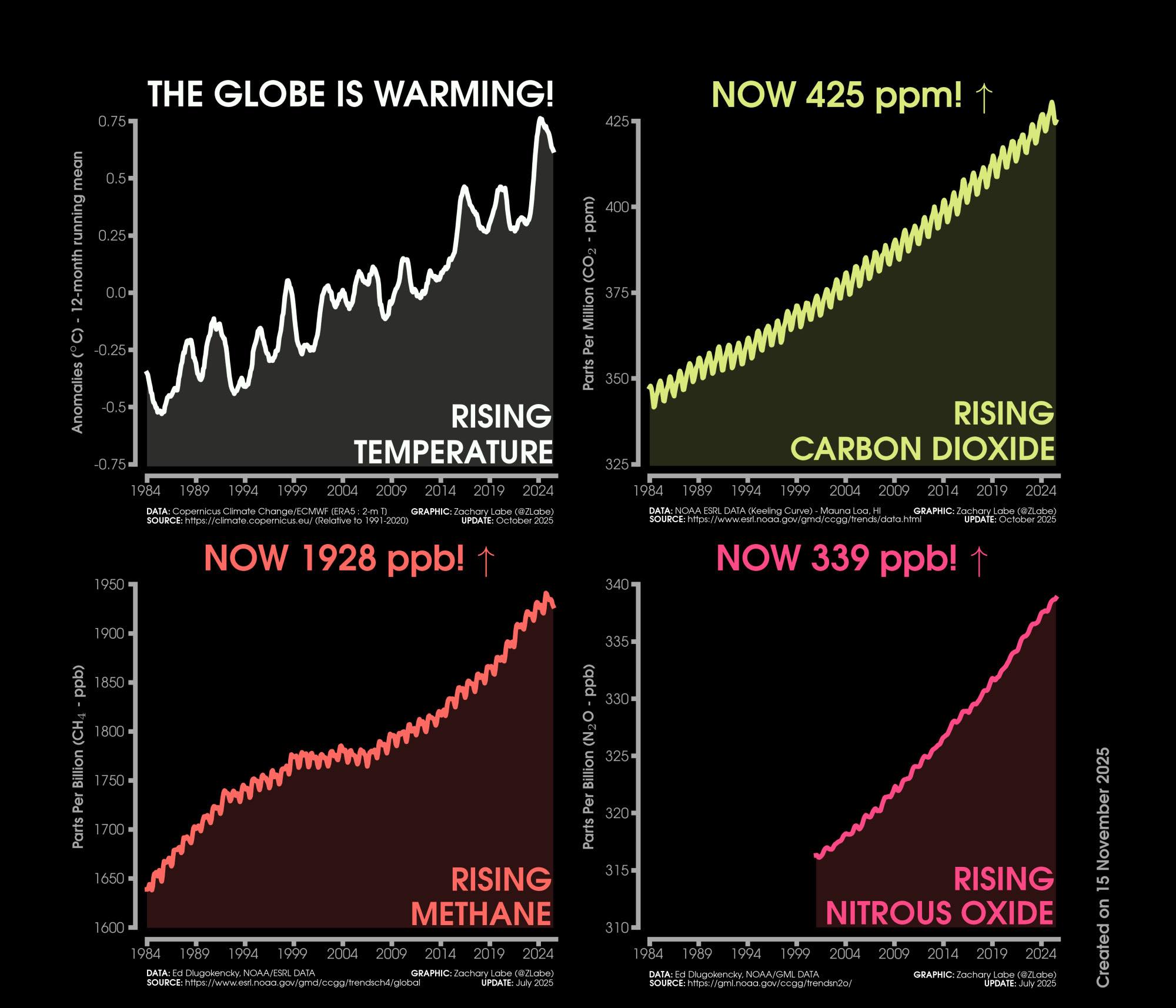
According to the World Meteorological Organization (2025) and the Global Carbon Project (2025), the year 2024 marked the most extreme convergence of climate records ever observed. Atmospheric CO₂ levels reached 422.7 ppm, the highest in three million years, with a record annual increase of 3.75 ppm. Monthly readings peaked at 426.91 ppm in June 2024 — a value that would have been unimaginable even a generation ago.

Accelerating Emissions and the Collapse of “Natural Buffers”

Global fossil fuel and cement emissions rose to 37.4 gigatons of CO₂ in 2024, a 0.8% increase from 2023. The growth was driven by:

  • Coal expansion across Asia

  • Post-pandemic industrial rebound

  • Sharp increases in liquefied natural gas (LNG) production, particularly in the United States

While often marketed as a “bridge fuel,” methane leakage from LNG infrastructure — over 80 times more potent than CO₂ over 20 years — has erased its supposed climate advantage. These cumulative emissions are now overwhelming the buffering capacity of the oceans, cryosphere, and biosphere.

This record convergence signals a fundamental phase transition in the Earth system. Regions that once absorbed carbon, stabilized temperature, and moderated climate extremes are now flipping into self-reinforcing feedback loops. What was once a slow climb in global heat content is now taking on the characteristics of nonlinear acceleration.

Glaciers, Cryosphere Collapse, and the Finality of “Point of No Return”

The WMO issued one of its starkest warnings in 2023:

“The world’s glaciers melted at dramatic speed last year and saving them is effectively a lost cause…
Antarctic sea ice fell to its lowest extent on record.
Some European glaciers are literally off the charts.”

WMO Secretary-General Petteri Taalas summarized the situation bluntly:

“We have already lost the melting-of-the-glaciers game.
The CO₂ concentration is now simply too high.”

In the Swiss Alps alone, 6.2% of total glacier mass vanished in a single summer, the greatest loss in the entire observational record.

Taalas further warned that disappearing glaciers will:

  • Reduce global freshwater supply

  • Impair agriculture

  • Destabilize river transport and hydrology

  • Accelerate sea-level rise far beyond prior projections

For decades, sea-level rise was expected to unfold over millennia. But with runaway CO₂ growth and feedback amplification, that timeline is rapidly collapsing into decades.

How Fast Could Sea Levels Rise? A Scientific Exchange

A natural question follows:
Could this trigger the fastest sea-level rise in Earth’s history?

Physicist Sidd Mukherjee offered the following expert assessment:

“It depends on what you mean by ‘ever.’
In terms of human civilization: yes, likely.”

He notes:

  • The total global ice inventory can produce ~200 feet of sea-level rise.

  • Greenland and West Antarctica may already be committed to collapse.

Breakdown of likely contributions:

  • Greenland: ~20 feet over 100–300 years

  • West Antarctica: ~10 feet, potentially in decades to a century

Average over a century:

  • ~20 feet → 2 inches per year (50 mm/year), 10x the current rate

But the average masks the danger. Sea-level rise will likely arrive in pulses, not a smooth curve:

“We could dawdle along at half an inch per year, then suddenly experience a couple of years with a foot of rise annually.”

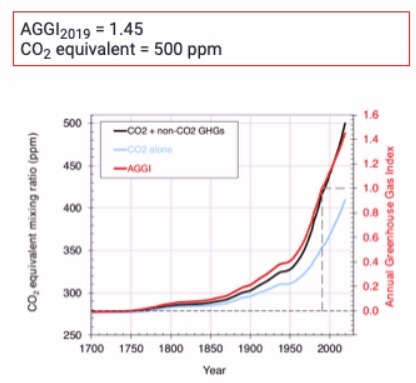
If CO₂-equivalent concentrations can be stabilized near 500 ppm, there may still be a chance to preserve East Antarctica, the largest remaining ice sheet. But if it destabilizes:

“Expect another couple hundred feet of sea-level rise.”

A Civilization-Level Threshold

We are now witnessing the early stages of a global system crossing into a new and dangerous mode of operation — one defined by:

  • Rapid CO₂ accumulation

  • Collapsing carbon sinks

  • Accelerating ocean heat storage

  • Cryosphere destabilization

  • Intensified extreme weather

The question is no longer whether these changes are occurring, but how quickly, and how prepared we are for the consequences.

Humanity is approaching — and in some cases passing — thresholds that earlier generations believed were centuries away. The decisions made in the next decade will determine whether sea-level rise is measured in inches, feet, or tens of feet within a single human lifetime.

WARNING

* Our probabilistic, ensemble-based climate model — which incorporates complex socio-economic and ecological feedback loops within a dynamic, nonlinear system — projects that global temperatures are becoming unsustainable this century. This far exceeds earlier estimates of a 4°C rise over the next thousand years, highlighting a dramatic acceleration in global warming. We are now entering a phase of compound, cascading collapse, where climate, ecological, and societal systems destabilize through interlinked, self-reinforcing feedback loops.

What Can I Do?
The single most important action you can take to help address the climate crisis is simple: stop burning fossil fuels. There are numerous actions you can take to contribute to saving the planet. Each person bears the responsibility to minimize pollution, discontinue the use of fossil fuels, reduce consumption, and foster a culture of love and care. The Butterfly Effect illustrates that a small change in one area can lead to significant alterations in conditions anywhere on the globe. Hence, the frequently heard statement that a fluttering butterfly in China can cause a hurricane in the Atlantic. Be a butterfly and affect the world.

Tipping points and feedback loops drive the acceleration of climate change. When one tipping point is toppled and triggers others, the cascading collapse is known as the Domino Effect.

The Climate Crisis: Violent Rain | Deadly Humid Heat | Health Collapse | Extreme Weather Events | Insurance | Trees and Deforestation | Soil | Rising Sea Level | Food and Water | Updates

The Human Induced Climate Change Experiment

bookmark_borderMichael Burry Pulls the Plug: “The Only Winning Move Is Not to Play”

by Daniel Brouse
November 13, 2025

Michael Burry — the contrarian investor immortalized in The Big Short for predicting the 2008 housing collapse — appears to be stepping away from outside capital once again. In a recent move that has caught the attention of Wall Street and retail investors alike, Burry reportedly closed his fund to external investors, signing off with the cryptic message: “The only winning move is not to play.”

Burry’s warning seems aimed squarely at what he views as an unsustainable artificial intelligence (AI) bubble — one that echoes the euphoria of the dot-com era. Tech valuations, he argues, have divorced from fundamentals, with speculative capital chasing narratives rather than earnings. His message suggests that investors have learned little from history — only this time, the correction could be accelerated by broader economic and environmental pressures.

In addition to his bearish view on AI, Burry has taken an aggressive stance against U.S. real estate — a market he once famously shorted. But this time, his rationale isn’t limited to overvaluation or interest rate risk. Burry has cited climate change as a structural threat to real estate itself. Rising sea levels, extreme weather, and infrastructure degradation, he predicts, will render vast portions of American property uninsurable and ultimately uninhabitable.

According to Burry, the trajectory is grim: Almost all U.S. real estate is going to go from worth less to worthless. It’s a statement that cuts against decades of belief in property as the safest store of value — and one that challenges the very foundation of the “American Dream.”

Whether his latest retreat marks a temporary pause or a permanent exit remains to be seen. But if Burry’s track record is any indication, his warnings deserve attention. In 2008, he was mocked before being proven right. If history rhymes, today’s exuberance may again meet tomorrow’s reckoning — and once more, Michael Burry will be the man who saw it coming.

Insurance

bookmark_borderPennsylvania’s Budget: A Step Forward in Education, a Step Backward on Climate

Governor Josh Shapiro signed Pennsylvania’s long-delayed $50 billion state budget into law Wednesday, ending a four-month stalemate in Harrisburg. The spending plan, which increases expenditures by $2.27 billion over last year, was shaped through difficult negotiations in a politically divided legislature.

While the budget delivers much-needed funding for public education and workforce development, it simultaneously enacts one of the most environmentally regressive decisions in the state’s modern history: Pennsylvania’s formal withdrawal from the Regional Greenhouse Gas Initiative (RGGI).

RGGI Withdrawal: An Expensive Mistake for Pennsylvania’s Future

Exiting the RGGI is more than a political statement — it’s a financial and public health miscalculation. The multi-state carbon trading program, launched in 2009, was designed to reduce greenhouse gas emissions from power plants through a market-based mechanism that generates revenue for participating states. Those funds have been used to lower energy bills, create jobs, and invest in renewable infrastructure.

By walking away, Pennsylvania has effectively abandoned hundreds of millions in potential revenue and forfeited leadership in clean energy innovation. Worse still, the state’s withdrawal signals to polluters that short-term profit outweighs long-term sustainability — a dangerous precedent in a state still burdened by coal, methane leaks, and fossil fuel dependence.

Hidden Costs: Insurance, Infrastructure, and Health

The decision carries steep economic and social costs that go far beyond lost carbon credits.

  • Insurance premiums across the state — already climbing due to intensified storms and floods — will continue to rise as climate-related risks escalate.

  • Infrastructure spending will balloon, as aging roads, bridges, and stormwater systems face more frequent and severe weather damage.

  • Public health impacts will worsen as air pollution increases, leading to higher rates of asthma, heart disease, and heat-related illness — costs that ultimately fall on taxpayers.

In essence, Pennsylvania residents are being handed the bill for political negligence. By rejecting RGGI, the state isn’t saving money; it’s socializing the cost of pollution while privatizing the profits.

A Tale of Two Priorities

Governor Shapiro’s commitment to public education and fiscal stability deserves credit, but his climate policy marks a troubling contradiction. Investments in schools and communities will mean little if those same communities face increasing floods, crop losses, and pollution-related illness.

Pennsylvania, the birthplace of American coal, had an opportunity to redefine itself as a leader in clean energy transition. Instead, the state’s exit from RGGI moves it backward — environmentally, economically, and morally.

The Bigger Picture

At a time when climate change is accelerating faster than predicted, this decision isolates Pennsylvania from its regional allies and undermines national efforts to decarbonize the power sector. The costs will not be measured in partisan victories but in lives, livelihoods, and lost opportunities.

History will not look kindly on this moment.
By withdrawing from RGGI, Pennsylvania’s leaders have chosen to side with polluters rather than the people they serve — and the consequences will unfold across generations.

* Our probabilistic, ensemble-based climate model — which incorporates complex socio-economic and ecological feedback loops within a dynamic, nonlinear system — projects that global temperatures are becoming unsustainable this century. This far exceeds earlier estimates of a 4°C rise over the next thousand years, highlighting a dramatic acceleration in global warming. We are now entering a phase of compound, cascading collapse, where climate, ecological, and societal systems destabilize through interlinked, self-reinforcing feedback loops.

What Can I Do?
The single most important action you can take to help address the climate crisis is simple: stop burning fossil fuels. There are numerous actions you can take to contribute to saving the planet. Each person bears the responsibility to minimize pollution, discontinue the use of fossil fuels, reduce consumption, and foster a culture of love and care. The Butterfly Effect illustrates that a small change in one area can lead to significant alterations in conditions anywhere on the globe. Hence, the frequently heard statement that a fluttering butterfly in China can cause a hurricane in the Atlantic. Be a butterfly and affect the world.

→ “Solutions to the Fossil Fuel Economy and the Myths Accelerating Climate and Economic Collapse.“

Tipping points and feedback loops drive the acceleration of climate change. When one tipping point is toppled and triggers others, the cascading collapse is known as the Domino Effect.

The Human Induced Climate Change Experiment

bookmark_border2025’s Catastrophic Triple‐Threat: EF-5 Tornado, Category 5 Hurricane & G5 Geomagnetic Storm

By Daniel Brouse
November 13, 2025

If confirmed, 2025 would be the first year in recorded history to experience an EF-5 tornado, a Category 5 hurricane, and a G5 geomagnetic storm all within the same calendar year — a convergence of atmospheric and space-weather extremes unlike anything previously documented.

Earth’s Systems in Overdrive

While each of these events operates in distinct domains — atmospheric, oceanic, and heliophysical — their occurrence within a single year underscores the accelerating volatility of Earth’s interconnected systems.

  • EF-5 tornadoes represent the most violent wind events on the planet, with speeds exceeding 200 mph and capable of leveling entire communities.
  • Category 5 hurricanes are the apex of tropical cyclone intensity, driven by ocean surface temperatures that have now repeatedly shattered records due to climate-induced warming.
  • G5 geomagnetic storms arise from the Sun’s eruptions — particularly coronal mass ejections (CMEs) — which slam into Earth’s magnetosphere, generating auroras visible across continents and posing risks to satellites, power grids, and communications systems.

Solar Storm Update: The First Potential G5 of 2025

If confirmed, this event would be the first recorded G5 geomagnetic storm of 2025. Currently, forecasts indicate the storm could reach G5 levels, though as of now it remains at G4 (severe) intensity pending final assessment by NOAA’s Space Weather Prediction Center (SWPC).

This storm has already produced multiple X-class solar flares and “cannibal CMEs” — instances where fast eruptions overtake slower ones, merging into powerful shock waves. If the storm is officially upgraded, it will join the small handful of G5-class events observed since measurements began in the 20th century, including the May 2024 event that caused widespread auroras and satellite disruptions.

A Year of Extreme Energy

2025 has already shattered climate and space-weather norms.

  • Global sea surface temperatures have remained at all-time highs for over a year, fueling record-strength hurricanes and flash droughts.
  • Atmospheric CO₂ concentrations are now above 427 ppm, continuing the steep rise that drives planetary energy imbalance.
  • Tornado and flood activity in the U.S. have been intensified by shifting jet streams and atmospheric instability tied to warming patterns.
  • In parallel, the Sun is nearing its Solar Maximum, with heightened solar activity expected through 2026.

A Warning from Nature and Physics

These converging extremes — in the atmosphere, oceans, and magnetosphere — demonstrate how Earth’s energy systems are now operating closer to physical and thermodynamic limits.
The EF-5, Category 5, and potential G5 are not random coincidences; they’re manifestations of a planet under compound stress, where terrestrial and solar dynamics can amplify one another through complex feedbacks.

If confirmed, 2025 will stand as a pivotal year — one that highlights both the escalating instability of Earth’s climate system and the profound vulnerability of our technological civilization to forces far beyond our control.

The Human Induced Climate Change Experiment

bookmark_borderThe Silent Surge: Climate Change and the Acceleration of Food Price Inflation

Recent data indicates a clear acceleration in food price inflation — a trend now supported by both formal statistics and everyday observation. What once appeared to be temporary pandemic-era disruptions have evolved into structural pressures driven by deeper forces — among them, climate change, trade policy distortions, and systemic supply vulnerabilities.

From the perspective of both macroeconomic and climate systems analysis, the current surge in food prices is not an isolated event. Instead, it reflects the convergence of multiple feedback loops: extreme weather events, global trade realignments, and shifting ecological baselines that are altering both supply and cost structures.

Anecdotal data aligns with the statistics. Consumers are not only facing rising sticker prices but also a noticeable reduction in sales, promotions, and price competition. Items subject to international tariffs — such as bananas, coffee, and other imported produce — have seen disproportionately higher increases, suggesting that trade policy continues to amplify global cost pass-throughs.

Meanwhile, protein prices — particularly beef and poultry — have climbed at an accelerated rate, and the underlying cause is more complex than supply chain inefficiency. Climate change–driven droughts have reduced feed and water availability; fires have disrupted grazing and farmland; and floods have destroyed crop cycles critical for livestock production. Additionally, zoonotic diseases — emerging and reemerging due to warming temperatures and habitat shifts — are further reducing herd sizes and increasing production costs.

This compounding effect — where climate disruption intensifies agricultural volatility, which in turn feeds back into global markets — represents a new phase in food inflation dynamics. It suggests that food inflation is becoming not only more persistent but also more climate-sensitive, resistant to traditional monetary and fiscal interventions.

Unless aggressive adaptation and mitigation strategies are implemented — from resilient agriculture and decarbonized logistics to equitable trade frameworks — food inflation will remain one of the clearest and most immediate economic manifestations of the global climate crisis.

bookmark_borderDon the Con: How Trump Cemented His Legacy as the Dumbest World Leader in History

Trump said it best, “Smart people don’t like me.”

Trump is going down in history as the dumbest president in American history; however, that title may not be “biggly” enough for him. He is now being recognized globally as the dumbest world leader in history — a man who has willfully ignored, denied, and lied about established science, accelerating a planetary crisis that has already cost millions of lives. Trump’s science denial directly resulted in millions of preventable COVID deaths in his first term. Now, he is endangering the entire population of the world.

Trump has repeatedly dismissed climate science as a “hoax,” “bullshit,” and “the green scam.” At the United Nations, he called climate change a “con” — an irony lost on no one, coming from “Don the Con” himself, a man whose business empire was built on deceit, bankruptcies, and fraud. His record now includes criminal convictions, civil judgments, and an unparalleled legacy of scientific ignorance.

This year, Trump refused to cooperate with the COP30 global climate summit in Brazil, further cementing America’s retreat from global climate leadership. With global emissions nearly doubling in the last 33 years, few would argue that progress has met expectations. Worse, the post-COVID global consensus on tackling climate change is fracturing — led by Trump’s renewed campaign of climate disinformation and economic coercion. His administration’s new trade tariffs pressure allies such as Japan, the EU, and South Korea to buy more U.S. fossil fuels, directly undermining global decarbonization efforts.

Trump’s absence from COP30 drew sharp rebukes from world leaders. “For small island states, the climate crisis is not past tense or future tense. It is our reality. We have no way to run, no way to hide,” said Antigua and Barbuda’s Prime Minister Gaston Browne. Chilean President Gabriel Boric accused Trump of spreading “lies” about the climate crisis, while Colombian President Gustavo Petro declared, “Mr. Trump is against humankind.”

As Trump abandons both people and planet, others are stepping into the leadership void. California Governor Gavin Newsom announced he will attend COP30 in Brazil, representing the world’s fourth-largest economy. Newsom aims to strengthen climate partnerships, promote clean-energy investments, and showcase California’s model for creating jobs while cutting toxic pollution.

“As the President of the United States turns his back on people and the planet, California is inking global partnerships focused on creating jobs and cutting toxic pollution,” Newsom said. “The economic winners of the 21st century are those who build the clean-energy future. We’re doing that right now — and showing the world that climate action means jobs, clean air, and lower costs.”

While Trump clings to fossil-fueled fantasies and falsehoods, California and the world are moving forward without him. History will remember Trump not as a leader, but as a warning — a living example of how ignorance, arrogance, and greed can conspire to imperil the planet itself.

The Great Race Against Time: Trump vs. Mother Nature

Donald Trump has consistently dismissed the science of climate change, calling it a hoax and dismissing policies aimed at addressing it as “The Green New Scam.” His repeated use of the phrase “Drill, Baby, Drill” symbolizes an energy policy that prioritizes fossil fuel extraction over sustainable alternatives. These policies have only intensified the climate crisis, posing severe risks not only to the environment but to the global economy as well. If left unchecked, Donald Trump’s economic and environmental policies will render the planet uninhabitable for future generations.

The evidence is irrefutable: climate change is accelerating at an alarming pace, and the associated costs—both economic and human—are rising exponentially. Immediate, decisive action is essential to reduce greenhouse gas emissions and prevent further environmental collapse. Our updated climate model, now grounded in chaos theory and incorporating complex social-ecological factors within a dynamic, non-linear framework, predicts that global temperatures could increase by up to 9°C this century—far surpassing the previous estimate of a 4°C rise over the next thousand years. Such extreme warming will render large portions of the planet uninhabitable within this century, threatening the stability of ecosystems and human societies alike.


* Our probabilistic, ensemble-based climate model — which incorporates complex socio-economic and ecological feedback loops within a dynamic, nonlinear system — projects that global temperatures are becoming unsustainable this century. This far exceeds earlier estimates of a 4°C rise over the next thousand years, highlighting a dramatic acceleration in global warming. We are now entering a phase of compound, cascading collapse, where climate, ecological, and societal systems destabilize through interlinked, self-reinforcing feedback loops.

What Can I Do?
The single most important action you can take to help address the climate crisis is simple: stop burning fossil fuels. There are numerous actions you can take to contribute to saving the planet. Each person bears the responsibility to minimize pollution, discontinue the use of fossil fuels, reduce consumption, and foster a culture of love and care. The Butterfly Effect illustrates that a small change in one area can lead to significant alterations in conditions anywhere on the globe. Hence, the frequently heard statement that a fluttering butterfly in China can cause a hurricane in the Atlantic. Be a butterfly and affect the world.

→ “Solutions to the Fossil Fuel Economy and the Myths Accelerating Climate and Economic Collapse.“

The Human Induced Climate Change Experiment