bookmark_border“We’re Just Gonna Kill People”: A Moral Fail-Down at the Highest Office

On October 23, 2025, President Donald Trump told reporters he would not necessarily seek a declaration of war to go after drug cartels — adding in blunt language that “I don’t think we’re gonna necessarily ask for a declaration of war. I think we’re just gonna kill people. Okay? We’re gonna kill them. They’re gonna be, like, dead.” The statement, framed as a justification for expanded military action without congressional authorization, crystallizes a set of moral and constitutional failures that deserve sober scrutiny.

The quote — and why it matters

The line is chilling not because of rhetorical flourish, but because it signals an executive willingness to authorize lethal force without the normal legal and political constraints that follow from the Constitution and long-standing war powers practice. That willingness raises immediate questions about due process, civilian oversight of force, proportionality, and the risk of mission creep — all core moral and legal guardrails in a democracy.

Constitutional and legal consequences

The U.S. Constitution vests Congress with the power to declare war and to appropriate funds for the military. While presidents have historically used force without declarations in limited circumstances, the principle of checks and balances exists to prevent unilateral, open-ended military action. A president openly claiming he will “just kill people” rather than seek congressional authority is challenging that constitutional framework and inviting legal and political crises.

International law and the use of force

Beyond U.S. law, international humanitarian law (the laws of armed conflict) requires discrimination (distinguishing combatants from civilians), proportionality, and precautions to minimize civilian harm. Casual, public statements that normalize lethal action increase the risk that these obligations will be sidelined in practice — with potentially grave consequences for innocent people. The use of military force on foreign soil without clear legal basis risks international condemnation and erosion of U.S. credibility.

Democratic norms and rhetoric

Language matters. When a president publicly endorses killing as a policy shortcut, it normalizes violence in the public sphere and reduces incentives for accountability. It also emboldens partisans and followers who may interpret such language as a license for extralegal action at home and abroad. The moral hazard is vast: delegitimizing restraint makes escalation more likely. Media and lawmakers across the political spectrum reacted with alarm when this rhetoric emerged.

Policy risks and practical outcomes

The administration’s subsequent actions — deployments, strikes at sea, and talk of widening operations — show how quickly rhetoric can turn into operational reality. Military escalation without congressional oversight and robust legal justification can produce strategic blowback, civilian casualties, and long-term instability in regions already fragile from cartel violence or state collapse. That outcome is the opposite of responsible leadership.

Moral ranking

It’s difficult to pick a single “top” moral failure from any leader’s record, but a public callousness about taking life without democratic consent or legal process stands among the most severe. Leadership should temper force with law, ethics, and deliberation — not dispense with them as impractical inconveniences. When the head of state treats killing as a policy tool to be wielded without accountability, the moral fabric of the polity is at risk.

What Must Happen Next

Practical steps to address the problem include congressional oversight hearings, judicial review where appropriate, clear operational rules for any use of force, and renewed public debate about war powers and the limits of executive authority. Citizens, legislators, and legal scholars must insist on restoring norms that separate law from raw will.

Equally important, the rule of law must apply to everyone — including presidents. U.S. law provides mechanisms for accountability through impeachment and, when warranted, criminal prosecution for crimes such as murder or the unlawful use of lethal force. Beyond domestic jurisdiction, the International Criminal Court (ICC) has both the authority and moral obligation to investigate and prosecute acts that may constitute war crimes or crimes against humanity committed under U.S. command or direction. No office, political title, or nation should ever stand above the law.

Coverage and independent investigation must continue to document both Trump’s words and actions so that democratic accountability is not merely symbolic — but real, enforceable, and restorative.
Trumpenomics: The Decline of the USA

bookmark_borderThe Silencing of Science: How the Trump Administration Dismantled NOAA’s Billion-Dollar Disaster Tracking — and Ignored the Accelerating Costs of Climate Collapse

By Daniel Brouse / October 24, 2025

n a quiet yet devastating policy move, the Trump administration shut down a NOAA program that tracked U.S. weather disasters causing over $1 billion in damages. The program—critical for assessing economic losses from hurricanes, floods, wildfires, and droughts—provided indispensable data for policymakers, insurers, and researchers. Its termination not only blinded the public to the scale of destruction but also concealed the rapidly accelerating costs of climate change.

This was not an isolated act. It was part of a systematic dismantling of scientific infrastructure across federal agencies—one that silenced climate data, censored reports, and obstructed communication between scientists and the public. By halting NOAA’s billion-dollar disaster tracking, the administration effectively turned off one of the most important warning systems humanity had against environmental and economic collapse.


The Rising Cost of Climate Disasters

The cost of climate disasters is rising exponentially. In the 1990s, we first hypothesized the non-linear acceleration of climate change. My lab partner—a Doctor of Physics from Ohio State—and I collaborated to provide the key evidence that helped establish this theory. By the early 2000s, our work had evolved into a foundational climate model supported by experimental and observational data. Over the next two decades, independent validation by researchers worldwide cemented this as scientific consensus.

What we found—and what subsequent studies confirmed—is that the doubling time of climate impacts has been collapsing. Initially, global damages doubled roughly every 100 years. By the 2010s, that interval shrank to a decade. Today, evidence suggests that the doubling time is now just two years.

This means that the damage caused by climate change today is double what it was two years ago. In two more years, it could be four times worse. In four years, eight times worse. Within a decade, potentially 64 times worse—and that projection is conservative.

This rapid escalation isn’t an anomaly—it’s a signature of a destabilizing nonlinear system. Climate feedback loops, such as melting permafrost releasing methane or diminishing ice reducing planetary reflectivity, are compounding one another. Our probabilistic, ensemble-based climate model—which integrates socio-economic and ecological feedback loops within a dynamic nonlinear framework—projects that global temperatures are becoming unsustainable within this century.

This exceeds even the direst early projections of a 4°C rise over a millennium. Instead, we are entering an era of compound, cascading collapse, where climate, ecological, and societal systems destabilize together through self-reinforcing feedbacks.


Some Costs of Carbon Combustion

Below are ten categories of economic and societal costs directly linked to climate change, backed by peer-reviewed research and government data. They illustrate that the cost of inaction now dwarfs the cost of mitigation.


1. Lost Productivity Due to Extreme Heat — $100+ Billion Annually (U.S.)
Sources: Lancet, NOAA, GAO
Outdoor labor sectors—construction, agriculture, logistics—are losing billions due to heat-induced work stoppages, fatigue, and health risks. In 2023 alone, extreme heat cost the U.S. economy over $100 billion in lost productivity and medical impacts.


2. Flash Floods and Infrastructure Damage
Sources: FEMA, CBO
Flash floods have become national catastrophes. In just the first half of 2024, they caused over $50 billion in damage. By July 2025, hundreds of flash floods had devastated communities from coast to coast, including multiple “1-in-1,000-year” storms—once statistically impossible events that now occur several times a year.


3. Wildfires — Direct and Indirect Costs
Sources: National Interagency Fire Center, Climate Central
Beyond destruction and death, wildfires create hidden costs—smoke-related health crises, lost tourism, carbon loss, and power grid instability. By July 2025, wildfire-related damages reached $93 billion, with total economic costs exceeding $250 billion.


4. Air Conditioning Feedback Loops
Sources: IEA, IPCC
As heat intensifies, global cooling demand could triple by 2050—fueling more emissions and grid stress, creating a vicious self-reinforcing cycle.


5. Supply Chain Disruptions
Sources: World Bank, McKinsey, IMF
Floods, droughts, and hurricanes are crippling supply routes. Droughts in the Panama Canal and Mississippi River alone disrupted hundreds of billions in trade, while storms halted semiconductor and medical supply production worldwide.


6. Housing Market Instability and Insurance Collapse
Sources: Moody’s, Insurance Information Institute
As insurers flee high-risk zones—Florida, California, and Gulf states—millions of Americans are left uninsured. Property values are collapsing in regions now deemed “uninsurable.”


7. Public Health and Disease Expansion
Sources: CDC, WHO
Vector-borne diseases like dengue and West Nile are spreading northward. Heat-related ER visits are soaring. Climate-driven illness is projected to cost the U.S. $100–200 billion annually by the 2030s.


8. Agricultural Disruption and Food Inflation
Sources: USDA, FAO, IPCC
Floods, droughts, and shifting seasons are destabilizing food supply chains. Between 2022 and 2024, climate-related crop failures drove global food inflation above 10%, fueling hunger and unrest.


9. Intensifying Storms and Hurricane Damages
Sources: NOAA, Munich Re
Hurricanes are now slower, wetter, and vastly more destructive. U.S. hurricane damage averages $54 billion per year, with some storms topping $100 billion.


10. Climate-Driven Migration and Social Disruption
Sources: UNHCR, Brookings
More than 20 million people per year are already displaced by climate impacts—a number expected to multiply as coastlines vanish, droughts intensify, and agriculture collapses.


The Economic Case for Climate Action

The data are irrefutable: the cost of inaction now far exceeds the cost of action. Transitioning to renewables, electrifying transportation, and investing in resilient infrastructure are not acts of charity—they are acts of survival and sound economics.

By defunding NOAA’s billion-dollar disaster program and suppressing scientific evidence, the Trump administration delayed this reckoning. But the truth cannot be buried. Every hurricane, fire, and flood now exposes the cost of ignoring climate science—and every delay doubles the price humanity must pay.

Trumpenomics

The Human Induced Climate Change Experiment

bookmark_borderThe Future of Climate Change: The Science, the Economics, and the Tipping Edge of Human Survival

by Daniel Brouse
October 22, 2025

The year 2025 has been a watershed moment in understanding the near-term trajectory of climate change. A growing body of peer-reviewed research underscores that the impacts of anthropogenic warming are no longer distant projections—they are rapidly materializing in compounding, interconnected crises that threaten human health, the global economy, and planetary stability itself.

Human Health and Heat Mortality

A study published in Scientific Reports (January 6) compared projected heat-related deaths from climate change with COVID-19 mortality rates across 38 global cities. In half of these cities, annual heat-related deaths are expected to exceed COVID-19 death rates within just ten years if global temperatures rise by 3°C above pre-industrial levels. The sharpest increases are anticipated in Mediterranean and Central European cities. Similarly, research in Nature Reviews Earth & Environment (February 4) warns that 2°C of warming will triple the global land area where human core temperature becomes uncontrollable—rendering large parts of the planet effectively uninhabitable for outdoor labor or survival without artificial cooling.

Economic Fallout and Property Value Collapse

Financial modeling by the First Street Foundation (February 3) projects that by 2055, climate-driven property devaluation in the U.S. could exceed $1.47 trillion, with 84% of neighborhoods suffering losses. The Boston Consulting Group (March 12) estimates that the cost of failing to limit warming from 3°C to 2°C would equate to 11–27% of cumulative global economic output—an existential hit to the world economy.

Planetary System Instability

The World Meteorological Organization (May 28) reports a 70% likelihood that average global warming will exceed 1.5°C between 2025 and 2029—an alarming acceleration from earlier projections. This projection reflects a decadal average, yet 2024 has already been confirmed at 1.55°C above pre-industrial levels, indicating that the threshold has effectively been reached on an annual basis.

Glacier studies published in Science (May 29) predict that without further warming, glaciers will lose 39% of their 2020 mass—raising sea levels by 113 mm—but current policies (leading to ~2.7°C) would double that loss. Even if current temperatures were frozen in place, the Nature Communications study (May 20) warns, the legacy of past emissions already locks in several meters of sea level rise over coming centuries, guaranteeing “extensive loss and damage to coastal populations.”

Expanding and Emerging Threats

Less-discussed but equally critical are indirect effects of global warming:

  • Space debris: A Nature Sustainability study (March 10) shows that cooling of the upper atmosphere due to climate change will reduce drag on orbital debris, extending its lifetime and reducing satellite capacity by up to two-thirds.

  • Health impacts: A Nature Communications paper (June 16) links warming to a potential threefold increase in obstructive sleep apnea by 2100, while another Nature study (September 18) projects up to 98,000 annual excess U.S. deaths from wildfire-related PM2.5 exposure by 2050.

  • Ecological collapse: Nature (September 17) predicts that if warming exceeds 2°C, 99% of western Atlantic coral reefs will be eroding by 2100.

  • Water crises: The Nature Communications study (September 23) finds that many regions will enter cycles of “Day Zero Drought” events—periods when water supply systems completely fail—by the 2020s and 2030s.

Sports and Social Systems Under Threat

Even cultural institutions are not immune. A report by Common Goal and Football for Future (September 10) projects that by 2050, 14 of 16 FIFA World Cup stadiums will face “unsafe” extreme heat conditions, with 11 deemed completely “unplayable.” Two-thirds of grassroots fields are already breaching multiple climate risk thresholds. In fact, many matches held in the U.S. in preparation for the 2026 World Cup have already been **postponed or canceled due to extreme weather—heat, flooding, and high winds—**offering a preview of the challenges to come.

Integrating the Evidence: Tipped Tipping Points and Cascading Feedbacks

Taken together, these findings confirm a grim reality long anticipated in “Tipped Tipping Points, Feedback Loops, and the Domino Effect” (Mukherjee & Brouse, 2025). The accelerating crises are not isolated data points; they are interlinked feedbacks in a nonlinear system that has already surpassed several critical thresholds.

Rising heat and ocean temperatures amplify wildfire smoke and PM2.5 deaths, which in turn alter atmospheric chemistry and reduce plant productivity. Forests, once carbon sinks, are becoming carbon and methane sources. Sea level rise intensifies coastal erosion and migration, compounding social and economic instability. Each “tipped” system increases stress on the next—amplifying global risk in a self-reinforcing cascade.

As our framework argues, humanity is no longer confronting a single tipping point but a network of cascading failures that are accelerating exponentially. The latest scientific record of 2025 confirms that the feedback loops once described as theoretical are now visibly—and measurably—underway. The future of climate change, therefore, is not merely one of incremental warming but one of accelerating disruption, where adaptation and mitigation must now race against compounding planetary feedbacks.

* Our probabilistic, ensemble-based climate model — which incorporates complex socio-economic and ecological feedback loops within a dynamic, nonlinear system — projects that global temperatures are becoming unsustainable this century. This far exceeds earlier estimates of a 4°C rise over the next thousand years, highlighting a dramatic acceleration in global warming. We are now entering a phase of compound, cascading collapse, where climate, ecological, and societal systems destabilize through interlinked, self-reinforcing feedback loops.

We examine how human activities — such as deforestation, fossil fuel combustion, mass consumption, industrial agriculture, and land development — interact with ecological processes like thermal energy redistribution, carbon cycling, hydrological flow, biodiversity loss, and the spread of disease vectors. These interactions do not follow linear cause-and-effect patterns. Instead, they form complex, self-reinforcing feedback loops that can trigger rapid, system-wide transformations — often abruptly and without warning. Grasping these dynamics is crucial for accurately assessing global risks and developing effective strategies for long-term survival.

The Human Induced Climate Change Experiment


bookmark_borderTrump’s Undeclared War: Covert Strikes, Civilian Deaths, and the Erosion of U.S. Law

Did anybody else hear Trump drop the F-Bomb live? The news stations did not know what to do… censor his free speech or blow it all to hell?

During a White House meeting with Ukrainian President Volodymyr Zelenskyy on October 17, 2025, Donald Trump used an expletive when warning Venezuelan leader Nicolás Maduro against a conflict with the U.S.

When asked by a reporter about Maduro and reports of a rejected peace plan, Trump stated, “He’s offered everything,” and then added, “Because he doesn’t want to f— around with the United States”

Yesterday, Trump declared that he’s “authorized the CIA to carry out covert lethal action” in Venezuela.

Wait—how exactly do you announce a covert operation? And if it’s made public, can it still be considered “covert”?

Beyond the absurdity of the statement itself, there are serious legal and constitutional questions here. Who approved it? Was Congress notified, as required by law? The whole thing raises far more troubling questions than answers.

This comes on top of other crimes against humanity committed under Trump’s leadership. Recently, he openly boasted about ordering the destruction of a submarine, claiming it was a “show of force.” According to emerging reports, two survivors were recovered and are now being held aboard a U.S. Navy vessel—despite the fact that the strike itself was unauthorized under international law and there is no evidence that the submarine or its crew had violated any U.S. or international statutes.

Even more disturbing are at least six previous U.S. military strikes on civilian boats in the Caribbean over the past several months. Eyewitnesses and family members describe these incidents as summary executions carried out under the pretext of “maritime security operations.” In one particularly heartbreaking account, a grieving mother broke down during an interview, saying her son—a local fisherman—was “executed by the U.S. Navy for doing his job.”

Taken together, these actions point to a pattern of reckless military aggression and disregard for human life, echoing broader concerns about executive overreach, lack of accountability, and the erosion of international law under Trump’s renewed presidency.

Conclusion: A War Without Declaration

The United States is not at war with Venezuela, nor has Congress authorized any military action against it. Yet Trump’s words and deeds increasingly resemble those of a president waging an undeclared and unconstitutional war. The supposed “covert” operations he brags about publicly, the destruction of foreign vessels without due process, and the mounting civilian casualties all point to an alarming pattern: the casual erosion of both domestic and international law under the guise of strength.

No evidence has been presented—none whatsoever—that Venezuela or its citizens pose any imminent threat to U.S. national security. These actions, therefore, cannot be justified under the Constitution, the War Powers Resolution, or the U.N. Charter. Instead, they reflect a dangerous concentration of power in one man’s hands, unchecked by oversight and unmoored from reason.

If America truly stands for freedom, justice, and the rule of law, then it must hold its leaders accountable to those same principles. Declaring war by executive impulse is not strength—it is tyranny in motion.

Trumpenomics: The Fall of the USA

bookmark_borderCracks in the Foundation: Rising Bankruptcies and Regional Bank Weakness Rattle Wall Street

The recent turbulence on Wall Street marked a notable shift in market sentiment. The spike in volatility wasn’t triggered by the usual suspects — not tariffs, not interest rate speculation, nor even the economic damage of the government shutdown. Instead, investors were shaken by a growing wave of bankruptcies and increasing fragility within the nation’s regional banks.

For months, markets have largely shrugged off the unpredictable behavior coming from the White House. Trump’s impulsive economic outbursts — often dubbed “TACO tantrums” (Tariffs, Attacks, Chaos, and Outrage) — have become so routine that traders now view them as background noise. But bank instability is another matter entirely. Unlike political rhetoric, a weakening financial system has tangible, measurable consequences that can ripple through the economy with devastating speed.

Recent corporate bankruptcies, particularly in manufacturing and retail, have underscored a troubling trend: the combination of high interest rates, tariff-driven supply chain pressures, and tightening credit conditions is pushing an increasing number of firms into insolvency. The most alarming development, however, is the strain showing up in regional and mid-sized banks — the same sector that fueled the March 2023 banking crisis.

As these institutions face mounting loan defaults and declining asset values, confidence is eroding. Investors are beginning to question whether the financial safeguards put in place after the 2008 crisis are enough to withstand the compounding pressures of protectionist trade policies, inflationary fiscal spending, and tightening liquidity.

Markets can tolerate uncertainty in leadership; they can even price in volatility. But what they cannot endure is the growing certainty of systemic risk. The cracks in America’s financial foundation are widening — and if policymakers continue to prioritize political theater over economic stability, Wall Street’s volatility today may soon look mild compared to what’s coming.

Trumpenomics: The Fall of the US Economy

bookmark_borderThe $300 Trillion Glitch: How a “Technical Error” Exposed the Fragility of the Digital Finance System

In a stunning and somewhat surreal event, Paxos, the blockchain infrastructure company behind PayPal’s stablecoin (PYUSD), accidentally minted $300 trillion worth of the cryptocurrency on Wednesday — an amount that dwarfs the entire global economy many times over. The company quickly labeled the incident a “technical error,” but the episode has reignited serious concerns about the reliability, transparency, and systemic risks of digital finance infrastructure.

While the error was reportedly corrected within hours and did not impact PayPal’s users or real-world liquidity, the implications extend far beyond a mere coding mishap. In a financial system increasingly intertwined with algorithmic and automated processes, such an error highlights how a single line of faulty code can, at least temporarily, create trillions in fictitious value — enough to destabilize confidence in entire markets if it were to slip through regulatory cracks.

How the Glitch Happened

According to preliminary reports, the erroneous minting occurred during a routine system update to the PYUSD smart contract on the Ethereum blockchain. Paxos engineers apparently triggered a malfunction that minted $300 trillion in tokens before the mistake was detected and reversed. Although no transactions were executed with the phantom tokens, the event was visible on-chain — a reminder that blockchains, by design, record every move, even catastrophic blunders.

Paxos immediately released a statement calling the issue a “technical anomaly with no financial impact.” Yet, as digital currency adoption expands, such anomalies raise troubling questions: What if the same error had occurred with an automated trading algorithm or during a liquidity crunch? Could it have cascaded into a broader financial panic before detection?

A Warning Shot for Stablecoin Oversight

Stablecoins — digital assets pegged to the U.S. dollar — are meant to be the safest bridge between crypto and traditional finance. PayPal’s PYUSD, launched in partnership with Paxos, was designed to offer everyday users a seamless, regulated digital payment option backed by dollar reserves. But this incident exposes a deeper problem: even regulated digital assets remain vulnerable to human and technical failure.

Critics argue that this “$300 trillion glitch” is symbolic of a larger issue — the illusion of control in an increasingly automated, opaque financial system. While banks undergo layers of regulatory scrutiny and capital requirements, many crypto issuers rely on self-attestation and untested code. The result is a digital ecosystem that operates at the speed of light but can fail just as fast.

The Broader Implications

In an era where the U.S. Federal Reserve, Treasury, and major institutions are exploring central bank digital currencies (CBDCs) and other blockchain integrations, this incident underscores the existential risk of overreliance on code-based monetary systems without robust fail-safes.

Had this glitch occurred in a larger, more liquid stablecoin — such as Tether (USDT) or USD Coin (USDC) — even a brief period of uncertainty could have sparked widespread liquidation, volatility, or even a flash crash across crypto markets.

Conclusion: A Digital Economy on a Digital Fault Line

The Paxos incident may have been harmless in its aftermath, but symbolically, it’s seismic. It demonstrates that even in a world built on cryptographic precision, human error remains the weakest link.

For regulators, the takeaway is clear: as stablecoins become more embedded in payment systems and financial markets, oversight must evolve beyond balance sheets to include real-time auditing of code, algorithms, and automated issuance protocols.

The $300 trillion that shouldn’t have existed may be gone — but the questions it raised about the fragility of digital money are here to stay.

bookmark_borderClimate Denial, Drought, and the Death of Capitalism: How Trump’s Anti-Science Policies Are Driving Economic Collapse

President Trump recently claimed that his administration is working to reduce record-high beef prices — a crisis he attributed to drought impacting U.S. cattle ranchers. Yet what he failed to acknowledge is that the drought itself is a direct consequence of the very climate crisis his administration continues to deny. The irony is stark: the same policies that prop up fossil fuel production and reject climate science are now dismantling the foundations of American capitalism.

The Western U.S. — once a global breadbasket and livestock powerhouse — is facing a multi-decade megadrought, worsened by rising temperatures, declining snowpack, and shifting precipitation patterns. Extreme heat accelerates evaporation, depleting both soil moisture and surface water. Pastures have withered, feed costs have soared, and cattle herds have been culled to historic lows. This has driven beef prices to record highs, threatening not just ranchers but the entire food supply chain — from processing plants to grocery shelves.

Under normal circumstances, capitalism adjusts through innovation and efficiency. But when leadership denies the root cause — in this case, anthropogenic climate change — markets cannot adapt. Trump’s policies of fossil fuel expansion, regulatory rollbacks, and environmental deregulation amount to state-sponsored self-sabotage. His administration’s energy and agricultural agendas reward short-term extraction while destroying the long-term natural capital — clean water, arable soil, and stable climate — that all economic systems depend on.

Trump’s climate denial isn’t just anti-scientific; it’s anti-capitalist in the truest sense. A functioning market requires stable conditions and predictable risk. Climate chaos destroys both. Droughts, floods, and fires are driving up insurance costs, collapsing crop yields, and creating food insecurity. Supply shocks ripple through every industry — from beef to banking — as climate volatility erodes investor confidence and undermines global trade.

By rejecting climate science, Trump’s administration is ensuring that capitalism itself becomes unsustainable. The free market cannot function on a dying planet. The laws of physics do not yield to political ideology or corporate lobbying. As the drought deepens and prices rise, the invisible hand of the market is being scorched by the very flames of denial it helped ignite.

If America wants capitalism to survive, it must end the illusion that economic growth and climate denial can coexist. The longer Trump and his allies cling to fossil-fueled delusion, the faster both our environment — and our economy — will collapse.

Trumpenomics

Climate Science

bookmark_borderPowell’s QE Pivot: The Fed’s Dangerous Return to Easy Money

by Daniel Brouse
October 14, 2025

On October 14, 2025, in a speech delivered in Philadelphia, Federal Reserve Chair Jerome Powell hinted at a significant policy shift — one that could reshape the financial landscape for years to come. Powell indicated that the Fed may soon end its balance sheet reduction program, effectively pausing Quantitative Tightening (QT) and signaling the potential return of Quantitative Easing (QE).

The motivation, he said, lies in growing concern over labor market weakness and the need to provide “stability” amid economic uncertainty. Powell described the move as “QE-like” and acknowledged the risks of persistent inflation, while emphasizing the importance of tracking a broad set of data — particularly state-level employment figures — in the absence of timely federal economic reports.

In practical terms, Powell also suggested that the Fed would begin buying U.S. Treasuries again. For investors, businesses, and consumers, this represents a major turning point — and a deeply troubling one.

What Is Quantitative Easing (QE)?
In simple terms, QE is money creation. The Federal Reserve purchases financial assets — usually Treasury bonds or mortgage-backed securities — to inject liquidity into the banking system and push long-term interest rates lower. While this can provide short-term relief to credit markets, it almost always comes with serious long-term consequences: asset bubbles, wealth inequality, and inflationary pressure.

Fiscally conservative economists, including many Republicans, have traditionally opposed QE for precisely this reason — it’s artificial stimulus that distorts markets and devalues currency. Ironically, the largest expansions of QE have occurred under Republican administrations, particularly under Presidents Bush and Trump.

At its core, QE works like this:
* The U.S. Treasury issues debt in the form of bonds.
* The Federal Reserve buys those bonds using newly created money.

The result is a loop of monetized debt, where the government effectively funds itself by printing dollars through the Fed’s balance sheet. When considering the full fiscal picture, the real U.S. debt burden should include both the national debt and the Federal Reserve’s assets — a combined total of roughly $44.5 trillion:

$37,887,475,445,601 (national debt)
+ $6,608,000,000,000 (Federal Reserve assets)
= $44.495 trillion owed by U.S. taxpayers

That’s the true figure Americans are on the hook for. And the question remains: how will it ever be repaid?

The History of QE
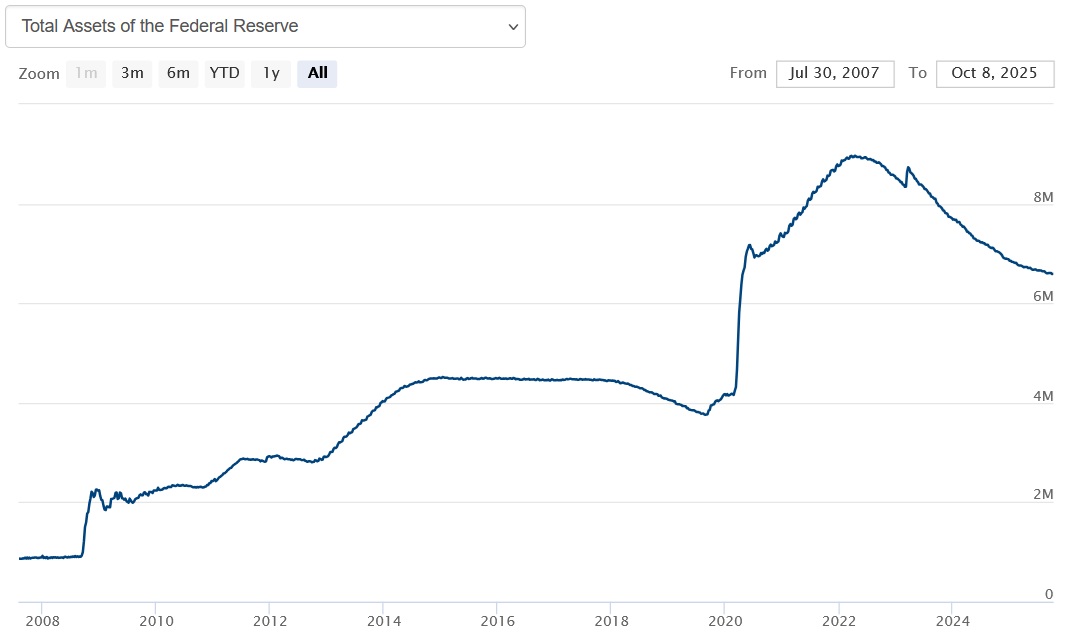
The Federal Reserve first launched Quantitative Easing in November 2008, during the Great Recession, under President George W. Bush. Known as QE1, the program focused on purchasing mortgage-backed securities and agency debt to stabilize collapsing credit markets when interest rates were already near zero.

This initial cycle expanded the Fed’s balance sheet to approximately $4.5 trillion. By late 2019, the Fed began to unwind those holdings — allowing assets to “roll off” as they matured — marking the start of Quantitative Tightening (QT). However, the onset of the COVID-19 pandemic in 2020, under President Trump, triggered an unprecedented new wave of Quantitative Easing (QE), which rapidly expanded the balance sheet to nearly $9 trillion, the highest level in U.S. history. Many economists attribute a significant portion of the 2021–2022 inflation surge to this Trump-era QE, which flooded the financial system with liquidity and fueled speculative bubbles across housing, equities, and commodities.

In 2022, under President Biden, the Fed began a gradual process of balance sheet reduction, marking the start of Quantitative Tightening (QT) reducing the Fed’s assets to $6.6 trillion.

Now, just a few years later, Powell’s comments suggest a reversal of that policy — a return to money printing at a time when inflation remains above target and fiscal deficits are exploding.

QE Today: The Warning Signs
Powell’s latest remarks should set off alarm bells across the financial community. Reintroducing QE in the current environment — with massive fiscal deficits, high consumer debt, and lingering inflation — is not a stabilizing policy. It’s a recipe for economic disaster.

By artificially lowering rates and inflating asset prices, the Fed risks fueling another speculative bubble — one that could end in catastrophic wealth destruction, job loss, and financial contagion. Meanwhile, the federal government’s relentless spending ensures that each round of QE only digs the hole deeper.

This is not monetary stability. It’s the illusion of prosperity — a temporary sugar high before a historic crash.

If the Fed follows through with this plan, the outcome is predictable: rising inequality, eroding purchasing power, and ultimately what could become the Greatest Depression in U.S. history.

Fed Assets: The History of Quantitative aEsing (QE)

Creative Destruction in the Age of AI: How Endogenous Growth Theory Explains AI Stock Market Bubble

Déjà Vu Economics: How Trump’s Deregulation and Tariff Policies Mirror the Road to the Great Depression

Trumpenomics: The Fall of the USA

bookmark_borderTariff Truths: How Trump’s Trade War Is Taxing American Families and Businesses

Despite repeated claims from Donald Trump and his advisors that foreign countries are “paying the tariffs,” new data clearly shows the opposite. U.S. consumers and domestic companies are bearing nearly all of the costs — a hidden tax that is worsening inflation, eroding profits, and undermining economic growth.

According to an October 2025 analysis by Goldman Sachs, American consumers are now shouldering 55% of the total cost of Trump’s new import tariffs, while U.S. companies pay another 22%. In other words, more than three-quarters of the tariff burden is being paid by Americans — not by foreign exporters. Only a small portion is absorbed by overseas producers, debunking the administration’s long-standing assertion that tariffs are “paid for by China” or “funded by foreign governments.”

The economic mechanics behind this are straightforward but devastating. When tariffs are imposed, U.S. importers pay the added tax on goods entering the country. Those higher costs are then passed through the supply chain, eventually reaching consumers in the form of higher prices on everyday essentials — including food, automobiles, electronics, and household goods. The result is a direct contribution to inflation, disproportionately affecting low- and middle-income households.

Meanwhile, U.S. corporations are absorbing part of the impact to remain competitive, sacrificing profit margins and cutting back on investment, hiring, and wage growth. For small and mid-sized businesses dependent on imported components, these tariffs have become crippling — pushing many to the brink of insolvency in an already fragile economy.

Example of Corporate Failure
A recent casualty of these policies is First Brands Group, one of the largest aftermarket auto parts manufacturers in the world, which filed for Chapter 11 bankruptcy in September 2025. The collapse has caused billions in financial losses and raised alarm bells about the stability of the private credit market, already strained by manufacturing-sector exposure.

While the company faced several economic headwinds — including rising interest rates, supply chain disruptions, and slowing demand — tariffs played a decisive role. The Trump administration’s escalating import taxes on metals, components, and finished goods dramatically increased input costs across its supply chain. For a multinational firm operating on five continents and employing 26,000 people, the financial pressure became untenable.

Before filing, First Brands managed a well-known portfolio — Fram, Trico, and Raybestos among them — and generated approximately $5 billion in 2024 revenue. Yet as tariffs inflated raw material costs and credit tightened, the company could not sustain liquidity or refinance its mounting debt. Its bankruptcy represents not just a loss for the auto parts industry, but a warning sign of structural weakness spreading through U.S. manufacturing — the very sectors these tariffs were supposed to protect.

A Double Blow to the U.S. Economy
The outcome is a double blow to the American economy: consumers face rising prices while businesses struggle with shrinking margins. What was billed as a measure to “protect American industry” has instead functioned as an across-the-board tax hike on Americans.

Historically, tariffs are among the most regressive forms of taxation, hitting lower- and middle-income families hardest. As Trump’s trade wars expand, economists warn that the renewed wave of tariffs could reignite inflation, undermining recent progress in stabilizing prices.

Once again, protectionism is being sold as patriotism — and once again, it is American families and workers who are paying the price.

Trumpenomics: The Fall of the USA

bookmark_borderDéjà Vu Economics: How Trump’s Deregulation and Tariff Policies Mirror the Road to the Great Depression

by Daniel Brouse
October 13, 2025

In 1919, General Motors transformed the American economy by founding the General Motors Acceptance Corporation (GMAC), a revolutionary move that allowed customers to buy cars on credit. This innovation made cars accessible to the masses through installment plans and helped ignite the era of consumer financing. What began as a tool to boost car sales quickly evolved into a model for broader consumer credit across multiple sectors.

By the late 1920s, Wall Street adopted a similar approach. Brokerages began allowing retail investors to purchase stocks on margin — putting as little as ten percent down and borrowing the rest. This was marketed as “democratizing access” to the markets, a patriotic slogan that masked the systemic risks of unchecked speculation. With little to no regulation, the market ballooned into a fragile bubble built on debt and delusion.

Then came the inevitable. In October 1929, the stock market crashed, wiping out fortunes overnight and triggering the Great Depression. In response, sweeping regulations were enacted to protect small investors and stabilize the financial system — including the Securities Act of 1933, the Glass-Steagall Act, and the creation of the SEC. These guardrails safeguarded the economy for decades.

Fast forward nearly a century, and history is repeating itself. Since Donald Trump’s second term began, many of those same regulatory protections have been rolled back or weakened. Under the guise of “free markets” and “democratizing access,” Trump’s administration has pushed to open high-risk assets — such as cryptocurrencies and private equity — to small investors. Once again, speculative leverage is being glorified as empowerment, while systemic risk quietly grows beneath the surface.

Today, brokerages like Robinhood enable investors to buy stocks using borrowed money — eerily similar to the margin practices of the 1920s. Market leverage has reached its highest levels since 1929. Meanwhile, Trump’s protectionist trade agenda, marked by sweeping tariffs and economic isolationism, echoes another disastrous historical precedent: the Smoot-Hawley Tariff Act of 1930. That policy, intended to protect American jobs, instead provoked global retaliation and deepened the Great Depression by collapsing international trade.

The parallels are alarming. Over-leveraged markets. Deregulated speculation. Protectionist trade wars. Rising inequality. All signs point to a familiar outcome.

The question is no longer if the market will crash — it’s when. And this time, with far greater global interconnection and systemic debt, the fallout could make 1929 look like a dress rehearsal.

Trumpenomics: The Decline of the USA