It is terrifying to watch American journalism go silent — not because reporters don’t care, but because many of us know exactly what happens when we speak the truth now.
I know. I’ve been an investigative journalist for over 45 years, filming police corruption, government lies, and abuse of power across this country. I have faced threats before. But this — this is something darker.
On election day, I realized I could no longer safely use my real name. The night before, I dreamed I was arrested at a protest. That is not paranoia. That is preparation in Trump’s America.
Since returning to power, Trump has wasted no time weaponizing the legal system against his perceived enemies — especially the press. Major networks like ABC and independent journalists face a relentless barrage of lawsuits, not because Trump expects to win, but because he wants to bleed them dry and silence them. Under a Justice Department now resembling a political death squad, who will stop him?
And it’s not just lawsuits. State and federal crackdowns on peaceful protests are increasing, targeting Americans exercising their constitutional rights. Their crime? Daring to oppose genocide, war, or environmental destruction. At the Hands Off! protests, the loudest chants weren’t just against war — they demanded the release of political prisoners held in America today.
This is no longer creeping fascism. It is marching down Main Street with impunity.
Anyone who knows history sees the signs. This is how it starts: with fear. With silence. With people convincing themselves, “It can’t happen here.”
But it is happening here.
A Coordinated Assault on Truth
Trump is not alone. In Israel, Netanyahu’s far-right government has banned journalists from reporting in Gaza and outlawed Al Jazeera, the region’s most reliable independent outlet. Reporters who attempt to document atrocities face arrest or worse.
Both leaders understand that silencing truth is essential to maintaining authoritarian power. Their tactics are deliberate: demonize the press, weaponize courts, spread disinformation, and make public dissent a punishable offense.
Meanwhile, as these leaders dismantle democratic institutions, they fuel crises that demand accountability: genocide in Gaza, escalating wars, environmental collapse, and economic ruin. Silencing journalists silences the evidence.
Why This Moment Matters
We have entered a dangerous feedback loop: authoritarian regimes suppress dissent, allowing them to escalate violence and repression, which in turn demands more suppression to avoid accountability.
Independent journalism is the last line of defense. Without it, people will not know the full extent of the atrocities being committed in their name, the corruption draining their futures, or the environmental collapse accelerating under deregulation.
We, as journalists, continue to report — even if anonymously — because silence is complicity.
And we, as citizens, must decide if we will let fear dictate our future.
Citizen, beware.
Journalist, beware.
Truth is now treason in Trump’s America, and in Netanyahu’s Israel.
If we allow the silencing of journalism, the silencing of democracy will follow.
On April 2, 2025, President Donald Trump announced a series of new tariffs under the “Liberation Day” initiative, targeting multiple countries and sectors. The key measures include:
Universal Tariff: A minimum 10% tariff on all U.S. imports.
Country-Specific Tariff Examples:
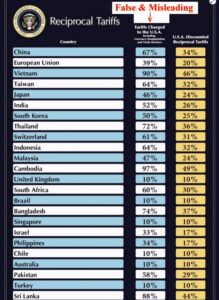
China: 34% tariff on imports. Although challenging to calculate precisely, this appears to bring the total tax on imports from China to 165% (updated). It also remains unclear whether the tax on EVs will now rise to 265%.
Taiwan: 32% tariff on imports. Taiwan’s semiconductors are currently exempt; however, the U.S. administration is still evaluating the possibility of imposing tariffs of up to 100% on Taiwanese chips and related electronic devices.
European Union: 20% tariff on imports.
Japan: 24% tariff on imports.
Vietnam: 46% tariff on imports.
United Kingdom: 10% tariff on all goods.
Canada: 25% tariff on goods, with a 10% tariff specifically on energy products.
Mexico: 25% tariff on all products.
Australia: Tariffs imposed on beef exports to the U.S., citing Australia’s ban on American beef due to mad cow disease concerns.
There are at least 180 country-specific tariffs, in addition to sector-specific tariffs on industries such as automobiles, steel, and aluminum. Calculating the total sales tax impact requires complex assessments, factoring in tariffs on individual components, the country of origin for each part, and any additional sector-based levies. This layered tariff structure makes it difficult for businesses to accurately predict final costs and pricing for imported goods, especially since most products contain some imported materials. For example, 55% of fresh fruits and 32% of fresh vegetables consumed in the U.S. are imported, meaning the price of a salad could rise by 45%. In Pennsylvania, where there is a 6% sales tax, the new tariffs on a purchase from China could result in a total sales tax of 172%, including the state’s 6%. If it’s an electric vehicle (EV), the tax could reach 272%. Another estimate suggests that the cost of lumber for new construction could rise by $25,000. Most drywall comes from Mexico or China, so this would add a substantial tax burden. Metals, such as aluminum, steel, and copper, are also being taxed on a sector basis, adding to the overall cost. All of these factors are likely to double the cost of building a home.
Tariff Theater: Trump’s Economic War on the World — Including Penguins
Tariff Theater: Trump’s Economic War on the World — Including Penguins
The tariffs announced on what Trump dubbed “Liberation Day” featured a chart titled Tariffs Charged to the U.S.A., purporting to show the crushing rates foreign countries supposedly impose on American goods. But these numbers were completely fabricated — not grounded in trade data or economic principles. Instead, Trump’s team appears to have confused tariffs with trade deficits, using the size of the U.S. trade deficit with each country to create a fictional “tariff rate.”
This fundamental misunderstanding is emblematic of much of Trump’s economic worldview — one that runs counter to decades of established economic theory.
In reality, U.S. trade deficits have long benefited American consumers by allowing access to cheaper foreign goods, while the strength of the dollar fuels domestic spending. The U.S. essentially trades inexpensive paper money for real goods — raw materials, finished products, and even luxury items — while foreign countries often recycle those dollars back into U.S. Treasuries, helping finance America’s debt.
Yet Trump continues to argue that trade deficits equal theft.
Trump’s Trade Narrative: Economic Victimhood
In speeches and social media posts in April 2025, Trump has claimed:
“For too long, corrupt foreign leaders — even from the poorest countries — have slapped massive tariffs on American products while flooding our markets with their goods, often duty-free. It’s been a one-sided scam — they’ve taken our jobs, stolen our industries, and destroyed entire American communities.”
Trump alleges that:
Foreign tariffs make U.S. farmers and manufacturers uncompetitive.
The U.S. has been the “piggy bank” of the world.
New tariffs will “level the playing field” and force “fair deals.”
Supporters call this economic justice. Critics call it economic vandalism.
Lesotho: Targeting One of the World’s Poorest Nations
Among the most striking examples of Trump’s tariff policy is Lesotho — a tiny, landlocked kingdom in southern Africa and one of the poorest nations in the world. The U.S. has imposed a staggering 50% tariff on its exports — the highest tariff applied to any sovereign country.
Lesotho’s economy depends heavily on textiles exported under the African Growth and Opportunity Act (AGOA), and diamond exports to the U.S. are another vital revenue source. In 2024, Lesotho exported about $237 million in goods to the U.S.
The 50% tariff threatens to devastate Lesotho’s fragile economy, potentially wiping out thousands of jobs in a country where nearly half the population already lives below the poverty line.
Tariffs on Penguins: Heard and McDonald Islands
In perhaps the most surreal example of Trump’s trade war, a 10% tariff was imposed on the Heard and McDonald Islands — an uninhabited Australian territory in the sub-Antarctic populated only by penguins and seals.
With no human population and no meaningful exports, the islands became a global punchline. Memes exploded online mocking Trump’s “penguin tariff” as the ultimate symbol of policy absurdity.
Economic Isolation — and Global Backlash
Trump’s tariff strategy has triggered a wave of retaliatory measures, trade disruptions, and diplomatic backlash. Analysts warn that the U.S. is rapidly isolating itself from global supply chains, allies, and markets.
The economic damage has been swift and severe — not just abroad but at home, as higher consumer prices, supply shortages, and market instability ripple through the U.S. economy.
As one critic put it:
“Trump didn’t just pick a trade war — he picked one with the entire planet.”
Full List of Countries Hit With Reciprocal Tariffs
Trade War!
On April 2, President Trump unilaterally declared a trade war against the rest of the world, imposing protectionist tariffs on 180 countries — calling it “Liberation Day.” This action was taken without congressional approval and in direct violation of the Constitution.
In the 1990s, we first hypothesized the non-linear acceleration of climate change. By the early 2000s, this hypothesis had evolved into established climate theory, now widely recognized as scientific fact. My lab partner, a Doctor of Physics from Ohio State, and I collaborated to provide key evidence supporting this theory. Over the years, we have observed a dramatic reduction in the doubling time of climate change impacts — the rate at which these effects intensify. Initially, the doubling time was approximately 100 years, but it has since decreased to 10 years and, more recently, to just 2 years. This trend implies that the damage caused by climate change today is double what it was two years ago. In two years, it could be four times worse; in four years, eight times worse; and within a decade, potentially 64 times worse. These projections are conservative, assuming the doubling period does not continue to shrink further. Alarmingly, this rapid acceleration does not appear to be an anomaly. If this trajectory persists, the consequences will likely be far more catastrophic than previously anticipated.
Dr. James E. Hansen’s paper Global Warming Acceleration: Impact on Sea Ice confirms our theory with an analysis of the acceleration of global warming and its impact on sea ice, ice sheets, and ocean circulation, with a particular focus on the Atlantic Meridional Overturning Circulation (AMOC). Climate sensitivity is higher than previously estimated (ECS = 4.5 ± 0.5°C for doubled CO₂), which fundamentally alters expectations for future climate change. IPCC models fail to account for freshwater effects on sea ice cover, leading to an underestimation of climate sensitivity and feedback processes.
AMOC Shutdown Risk: Hanson emphasizes that accelerated warming increases the likelihood of AMOC shutdown by reducing surface water density in deepwater formation regions. A shutdown would trigger severe long-term consequences, including rapid sea level rise.
An AMOC shutdown would have severe and far-reaching impacts worldwide. For instance, on the U.S. East Coast it would lead to rapid sea level rise, stronger storms, and extreme weather shifts. As the AMOC slows or stops, warm water would no longer be transported northward, causing ocean water to pile up along the East Coast, which could raise sea levels by 1-3 feet (30-90 cm) almost immediately, on top of global sea level rise. This would have particularly devastating effects on the Northeast U.S. (New York, Boston, DC, Miami), where flooding would be most severe.
The weakening or shutdown of the AMOC would also impact hurricane formation. With warmer waters off the East Coast, hurricanes would become more intense and slower-moving, leading to longer-lasting and more destructive storms, like Hurricane Sandy. As the Gulf Stream weakens, hurricanes could linger longer over coastal cities, causing catastrophic flooding. Additionally, the disruption of weather patterns would lead to a stark contrast: the Northeast and Europe could experience much colder winters while the Southeast U.S. (Florida, Georgia, Carolinas) would face more extreme heat and droughts.
Increased rainfall and flooding would also become more common. With the Gulf Stream weakened, storms could stall over cities, dumping massive amounts of rainfall, similar to what occurred during Hurricane Harvey in Texas but along the East Coast. Nor’easters and stronger winter storms would become more frequent, particularly in New England. The disruption of the AMOC would also have catastrophic consequences for marine ecosystems. The circulation helps distribute nutrients in the ocean, and its shutdown could disrupt fish migration patterns and collapse major fisheries, especially in the Northeast U.S., where industries like cod fishing and lobster harvesting would be devastated.
In a Climate Crisis
Since the Earth’s equilibrium climate sensitivity (ECS) is 4.5 ± 0.5°C for a doubling of CO₂, the likely temperature rise this century under current emission levels will be significantly higher than IPCC estimates. Here’s a breakdown of how that translates into global warming:
1. CO₂ Projections & Radiative Forcing
Pre-industrial CO₂ (~280 ppm) to Present (~420 ppm): We’ve already experienced a ~1.2°C rise in global temperature.
Business-as-Usual Scenario (High Emissions, ~800-1000 ppm CO₂ by 2100): If emissions continue at current levels, CO₂ could more than double from pre-industrial levels, reaching or exceeding 560 ppm (the doubling threshold for ECS calculations).
Additional non-CO₂ greenhouse gases (methane, nitrous oxide, etc.) also contribute to warming.
2. Temperature Increase by 2100
Using ECS = 4.5 ± 0.5°C, and considering:
Climate sensitivity refers to long-term equilibrium response (centuries), but transient warming occurs within this century.
The Transient Climate Response (TCR), which is lower than ECS, typically ranges ~60-70% of ECS, meaning near-term warming may be slightly less than equilibrium projections.
Projected Warming by 2100 Based on ECS = 4.5°C
Lower-End Case (~550-600 ppm CO₂, with significant mitigation efforts)
Optimistic warming: ~3.5–4.5°C
Comparable to IPCC’s worst-case scenarios (RCP 6.0–7.0 range)
High-Emissions Case (~800-1000 ppm CO₂, with some mitigation)
Potential warming: ~5–7°C
This is significantly worse than IPCC’s RCP 8.5 projection, which assumes ECS = 3°C.
Business as Usual Case (Feedbacks Accelerate Warming: AMOC Shutdown, Ice-Albedo, Methane Releases, etc.)
Expected warming: 7-9°C or more
This would resemble past hyperthermal events like the Paleocene-Eocene Thermal Maximum (PETM).
3. Policy & Adaptation Implications
If ECS is higher than IPCC estimates, it means current climate policies are underestimating risk.
The IPCC’s mid-range scenarios (projecting ~3°C by 2100) may be too optimistic if ECS is truly ~4.5°C.
Higher ECS implies faster and more extreme tipping points, including AMOC collapse, rapid sea level rise, and uninhabitable regions.
4. Urgency for Rapid Emission Cuts
Even immediate aggressive action (net-zero by mid-century) would still result in ~2.5-3°C warming due to existing CO₂ levels and slow response time.
Avoiding catastrophic warming (>4°C) requires drastic reductions in fossil fuel use this decade.
Bottom Line: At Current Emissions, Warming by 2100 is Likely 6°C or Higher
This level of warming would lead to massive global disruptions, including widespread droughts, stronger hurricanes, agricultural collapse, and displacement of hundreds of millions due to rising sea levels. If ECS is truly 4.5°C, the window to prevent catastrophic warming is far smaller than most policymakers assume.
* Our climate model employs chaos theory to comprehensively consider human impacts and projects a potential global average temperature increase of 9℃ above pre-industrial levels.
The Washington Post has reported that sources indicate the April 2 tariff announcement is set to impose an across-the-board 20% tariff on a broad range of imports. Such a drastic move would have far-reaching implications for the global economy, potentially triggering the most significant worldwide economic downturn since the Great Depression.
Understanding the Scope of the 20% Tariff
Tariffs are taxes on imported goods, usually levied by governments to protect domestic industries or to encourage certain economic behaviors. A 20% across-the-board tariff means that the cost of many goods entering the U.S. from other countries will increase by 20%. This would apply to various sectors, from electronics and consumer goods to industrial materials and food products. As a result, the prices of everyday items could surge, straining consumers and businesses alike.
The immediate impact of such a policy would be felt in the U.S., as companies pass on the added costs to consumers. But the ramifications would not stop at U.S. borders. Trade is a two-way street, and countries affected by these tariffs are likely to retaliate. This could lead to a global trade war, where countries impose tariffs on each other’s exports, resulting in widespread disruptions to the global supply chain.
Potential Global Economic Consequences
Rising Prices and Inflation A 20% tariff would lead to higher prices on a wide array of goods. Manufacturers and retailers would face increased costs for materials and products, which would, in turn, be passed on to consumers in the form of higher prices. For everyday consumers, this would result in reduced purchasing power, further exacerbating inflationary pressures already present in many economies. The cost of living would rise, leading to decreased consumer spending and potentially slowing down economic growth.
Global Trade Disruption Global trade relies on the free flow of goods between nations. A sudden imposition of tariffs of this magnitude would disrupt supply chains, as businesses would need to find new suppliers or production methods to avoid the increased costs. Countries that rely heavily on exports to the U.S. could face severe economic hardships, while other nations may retaliate with tariffs of their own, creating a cycle of protectionist measures that harms all parties involved.
Risk of Recession The last time the global economy faced a crisis of this magnitude was during the Great Depression. The widespread implementation of tariffs back in the 1930s triggered a global trade collapse, leading to massive economic contractions, rising unemployment, and a dramatic decrease in global output. Similarly, a modern-day trade war could push the world economy into recession, as countries become more isolated and less able to collaborate on international economic growth.
Impact on Developing Economies Developing economies, which often rely on exports to wealthier nations, would be especially vulnerable to the effects of a 20% tariff. Countries like China, Mexico, and those in Southeast Asia could see their exports significantly reduced, hurting their GDP growth. This could lead to a rise in poverty and unemployment in these nations, which may also result in political instability and unrest.
Financial Market Volatility The announcement of such a significant tariff could lead to considerable volatility in global financial markets. Investors would likely respond with caution, retreating from stocks and other risky assets in favor of safer investments like government bonds or gold. This could cause major declines in stock market indices worldwide and exacerbate economic instability. The uncertainty around trade relations could also harm long-term business planning and investment decisions.
Historical Precedents and the Global Economic Landscape
The Great Depression remains the most well-known example of how tariffs can spiral into a global economic collapse. The Smoot-Hawley Tariff Act of 1930, which raised U.S. tariffs on over 20,000 imported goods, is often cited as a contributing factor to the global depression. The resulting trade barriers reduced global trade by more than 60% and deepened the economic crisis. History has shown that protectionist policies, while sometimes aimed at shielding domestic industries, can often backfire, leading to a reduction in global trade, lower economic growth, and widespread hardship.
The global economy today is more interconnected than ever, with supply chains that stretch across borders and trade that plays a central role in most nations’ economic health. A tariff policy that disrupts this interconnectedness would likely have a ripple effect, leading to job losses, lower productivity, and declining standards of living for people around the world.
Conclusion
The April 2 tariff announcement, with its proposed 20% across-the-board levy, carries immense risks for the U.S. and the world. While the goal of such tariffs is often to protect domestic industries, the broader economic consequences could be catastrophic. With the potential to trigger a global trade war, increase inflation, and push the world into recession, the decision to impose such tariffs could very well be seen as a turning point in the global economic landscape. As businesses and consumers brace for these impacts, the world faces a future that is increasingly uncertain, with the specter of the Great Depression looming once more.
The devastating floods occurring in Australia today have been significantly influenced by climate change.As global temperatures rise, the atmosphere can hold more moisture, leading to more intense and prolonged rainfall events.This increase in heavy precipitation elevates the risk of severe flooding.
In Queensland, for instance, the recent deluge has resulted in unprecedented rainfall, with Townsville nearing its annual rainfall record within just three months.This excessive rainfall has caused rivers to overflow, inundating vast areas and leading to the loss of over 100,000 livestock.
Climate change not only intensifies rainfall but also contributes to more extreme weather patterns, including prolonged droughts followed by sudden, heavy downpours.This variability exacerbates the severity of flooding, as parched soils are less able to absorb water, increasing runoff into rivers and floodplains.
The economic and social impacts of these climate-induced floods are profound.Beyond the immediate damage to property and infrastructure, the agricultural sector faces significant losses, with livestock casualties and crop destruction leading to increased food prices and economic hardship for communities.
Addressing the root causes of climate change by reducing greenhouse gas emissions is crucial to mitigate the frequency and severity of such extreme weather events in the future.
The Hidden Climate Threat: How Low-Level Ozone Weakens Vegetation and Accelerates Global Warming
Recent studies have shown that low-level ozone (O₃)—a major air pollutant formed by the reaction of sunlight with vehicle and industrial emissions—negatively affects vegetation in several ways, leading to a climate feedback loop that worsens global warming.
1. Reduced CO₂ Intake by Vegetation
Plants and trees absorb carbon dioxide (CO₂) from the atmosphere through photosynthesis. However, exposure to tropospheric ozone damages leaf tissues, reducing their ability to take in CO₂. This occurs in several ways:
Stomatal damage: Ozone causes stomata (tiny pores on leaves) to malfunction, reducing gas exchange.
Reduced photosynthetic efficiency: Ozone exposure disrupts chloroplast function, lowering the rate of photosynthesis.
Premature leaf senescence: Ozone accelerates leaf aging, shortening the period during which plants can absorb CO₂.
As a result, vegetation becomes a less effective carbon sink, leading to higher atmospheric CO₂ concentrations.
2. Early Tree Mortality
Chronic ozone exposure weakens trees by:
Reducing their ability to produce and store energy.
Making them more susceptible to pests, disease, and drought.
Increasing rates of dieback and premature death.
Studies have shown that trees in areas with high ozone pollution experience reduced growth rates and shorter lifespans. The death of trees reduces biomass available for CO₂ absorption, further contributing to higher atmospheric carbon levels.
3. Climate Feedback Loop
This process creates a self-reinforcing cycle:
Higher CO₂ levels lead to more warming.
Higher temperatures can increase ozone formation.
More ozone damages vegetation, reducing CO₂ absorption.
Less CO₂ absorption means even higher atmospheric CO₂.
Increased tree mortality leads to the release of stored carbon, further accelerating climate change.
Conclusion
Low-level ozone is not just a pollutant but a direct climate amplifier—weakening Earth’s natural ability to regulate CO₂ levels. Addressing ozone pollution through stricter air quality regulations could help slow this damaging feedback loop and support climate mitigation efforts.
Amazingly, some still suffer from Trump Delusionment Syndrome, defending his economic policies while claiming Biden ‘destroyed the economy’ or insisting that Trump needs to ‘break some eggs’ to bake a cake—meaning we need to endure pain. No, we don’t need pain. The economy performed the best in history during Biden’s term, in sharp contrast to both Trump 1.0 and the early signs of Trump 2.0.
Let’s look at the numbers: During Trump’s first term (2017–2021), the national debt increased by about $7.8 trillion, mainly due to tax cuts that didn’t pay for themselves and pandemic-related spending. Under Biden (2021–2025), the debt rose by about $6.3 trillion—but a significant portion of that came from legislation and tax policies enacted under Trump.
Now, three months into Trump’s second term (2025–2029), debt projections are looking even worse. Estimates suggest Trump 2.0 will add an additional $10 trillion, driven by an extension of his tax cuts and increasing deficits. By the end of Trump 2.0, Trump will have added more to the national debt than all Democratic presidents combined.
So if debt is your concern, you might want to rethink which administration is actually running up the tab. On the other hand, if you’re talking about GDP, we are currently experiencing the sharpest decline since Trump’s last term—when he oversaw the fastest economic contraction in U.S. history.
Protectionism is one of the worst economic policies. Tariffs are regressive taxes that disproportionately harm marginalized communities while failing to boost the economy or reduce the deficit. The last time a president imposed broad tariffs, it contributed to the Great Depression—a global economic catastrophe that took decades to recover from and provided no lasting benefits to society.
Climate change is accelerating soil degradation at an alarming rate, pushing once-productive land toward desertification much faster than historical trends. While natural desertification can take centuries, human-induced climate change and land mismanagement are speeding up the process, with significant consequences.
What makes soil so crucial to addressing the climate crisis is its unique role in these interactions — soil is alive. Unlike the atmosphere or oceans, which are primarily composed of inorganic matter and operate as passive systems, soil is a living, dynamic medium that supports a vast array of organisms, from microbes to plant roots. These organisms play a central role in processes like carbon sequestration, nutrient cycling, and water retention, all of which directly influence climate stability. Soil offers the most adaptable and interactive mechanisms for slowing or preventing a wide range of climate feedback loops.
Key Indicators of Acceleration
Rising Global Temperatures
Higher temperatures increase evaporation, drying out soil and reducing its ability to sustain plant life.
Extreme heat waves, which have doubled in frequency since the 1980s, weaken soil structure and make it more prone to erosion.
More Intense and Erratic Rainfall
Heavier rainfall leads to flash floods that wash away topsoil before it can absorb moisture.
Longer dry spells between storms cause soil to become crusted and less able to retain water.
Expanding Drylands & Desertification
The UN estimates that over 100 million hectares of fertile land turn into desert each decade—an area about the size of Egypt.
Regions such as the Sahel in Africa, the American Southwest, and parts of China are experiencing rapid desertification, with productive land vanishing within decades rather than centuries.
Soil Carbon Loss & Microbial Death
Soil degradation has already released about 135 gigatons of carbon into the atmosphere since the start of industrial agriculture.
Warming soils kill microbial life that is essential for soil regeneration, further accelerating the transition to barren land.
Global Agricultural Impact
The FAO estimates that 90% of the world’s topsoil could be degraded by 2050 if current trends continue.
Each year, about 24 billion tons of fertile soil are lost due to erosion, much of it linked to climate change-driven weather extremes.
The Bottom Line
Climate change is turning living soil into dead dust in a matter of decades instead of centuries. Without urgent intervention—such as regenerative agriculture, reforestation, and improved water management—desertification could push billions of people into food insecurity and climate-driven migration within this century.
Global warming is driven by an increase in thermal energy within the Earth’s climate system. This system is made up of interconnected subsystems, including the atmosphere, oceans, and land. Chaos theory highlights the complexity and nonlinearity of these dynamic systems, and this complexity is particularly evident in the intricate interactions between soil, the atmosphere, and the oceans.
What makes soil so crucial to addressing the climate crisis is its unique role in these interactions — soil is alive. Unlike the atmosphere or oceans, which are primarily composed of inorganic matter and operate as passive systems, soil is a living, dynamic medium that supports a vast array of organisms, from microbes to plant roots. These organisms play a central role in processes like carbon sequestration, nutrient cycling, and water retention, all of which directly influence climate stability.
Soil’s importance lies in its ability to store carbon. Healthy soil acts as a carbon sink, capturing and holding carbon dioxide from the atmosphere. However, when soil becomes degraded or erodes, this carbon is released back into the atmosphere, amplifying the effects of global warming.
When soil “dies,” it undergoes a process known as desertification. Desertification is a critical state where once-fertile land becomes barren and incapable of supporting life, leading to the loss of its carbon sequestration capacity. This transformation not only reduces the soil’s ability to mitigate climate change but also accelerates it, as barren land is often more prone to erosion and less able to retain moisture.
In this way, soil acts as both a barometer and a buffer in the climate system. Its health and vitality are intrinsically linked to the Earth’s overall climate stability. Protecting and restoring soil is, therefore, not only about ensuring food security and biodiversity — it is about addressing one of the most pivotal elements of the climate crisis. Without healthy soil, efforts to mitigate climate change become far more challenging.
Soil is a vital component of the climate system and highly vulnerable to change. Erosion and degradation have severe short-term impacts and can ultimately lead to desertification.
Erosion Feedback Loop
Climate change accelerates erosion by altering weather patterns, increasing extreme weather events, and disrupting land and water interactions. More intense rainfall, rising sea levels, and prolonged droughts all contribute to faster soil loss and degradation.
In turn, erosion exacerbates climate change through multiple feedback mechanisms:
Reduced Vegetation Cooling: The loss of plant cover decreases evapotranspiration, which helps regulate temperatures, leading to further warming.
Albedo Changes: As fertile, dark soil is stripped away, exposed lighter-colored subsoil or sand reflects more or less sunlight, disrupting local and global climate patterns.
Carbon Release: Erosion exposes and breaks down organic matter in soil, releasing stored carbon dioxide and methane into the atmosphere, further fueling climate change.
Water Cycle Disruptions: Degraded soils hold less moisture, reducing cloud formation and precipitation in some areas while increasing flood risks elsewhere.
This self-reinforcing cycle makes erosion not just a consequence of climate change but also a driver, worsening environmental instability over time.
Climate change intensifies erosion in multiple ways by altering weather patterns, increasing extreme weather events, and changing land and water interactions. Here are the key mechanisms:
1. Increased Rainfall Intensity
Heavier Downpours: Warmer air holds more moisture, leading to more intense rainfall. This enhances surface runoff, stripping away topsoil and deepening gullies.
More Frequent Storms: Stronger storms produce flash floods that erode riverbanks, coastal areas, and hillsides more aggressively.
2. Rising Sea Levels & Coastal Erosion
Stronger Waves & Storm Surges: Rising sea levels push tides further inland, eroding coastlines at an accelerated rate.
Saltwater Intrusion: Weakens coastal soils, making them more vulnerable to erosion.
Loss of Protective Barriers: Higher temperatures contribute to coral reef and ice cap loss, reducing natural barriers against wave action.
3. Increased Droughts & Vegetation Loss
Soil Drying & Cracking: Frequent droughts cause soils to dry out and become less cohesive, making them more prone to wind erosion.
Vegetation Decline: Heat stress, wildfires, and shifting climate zones kill plants that anchor the soil, leading to more erosion from wind and water.
More Landslides: Unstable, thawing soils on slopes increase the risk of landslides, especially in mountainous regions.
5. Glacial Retreat & River Erosion
Faster Glacier Melting: Increases sediment transport in rivers, leading to changes in riverbanks and deltas.
Altered River Courses: More meltwater can change river flow patterns, leading to unexpected erosion and sedimentation.
6. Stronger Wind Erosion
Desertification Expansion: Hotter, drier conditions turn more land into deserts, exposing it to wind erosion.
Dust Storms: More frequent and intense, carrying away nutrient-rich topsoil and worsening land degradation.
Overall Impact
Erosion worsened by climate change not only depletes fertile soils and damages infrastructure but also increases sedimentation in rivers, harming aquatic ecosystems. Coastal communities face greater risks, and agricultural lands lose productivity, exacerbating food insecurity.