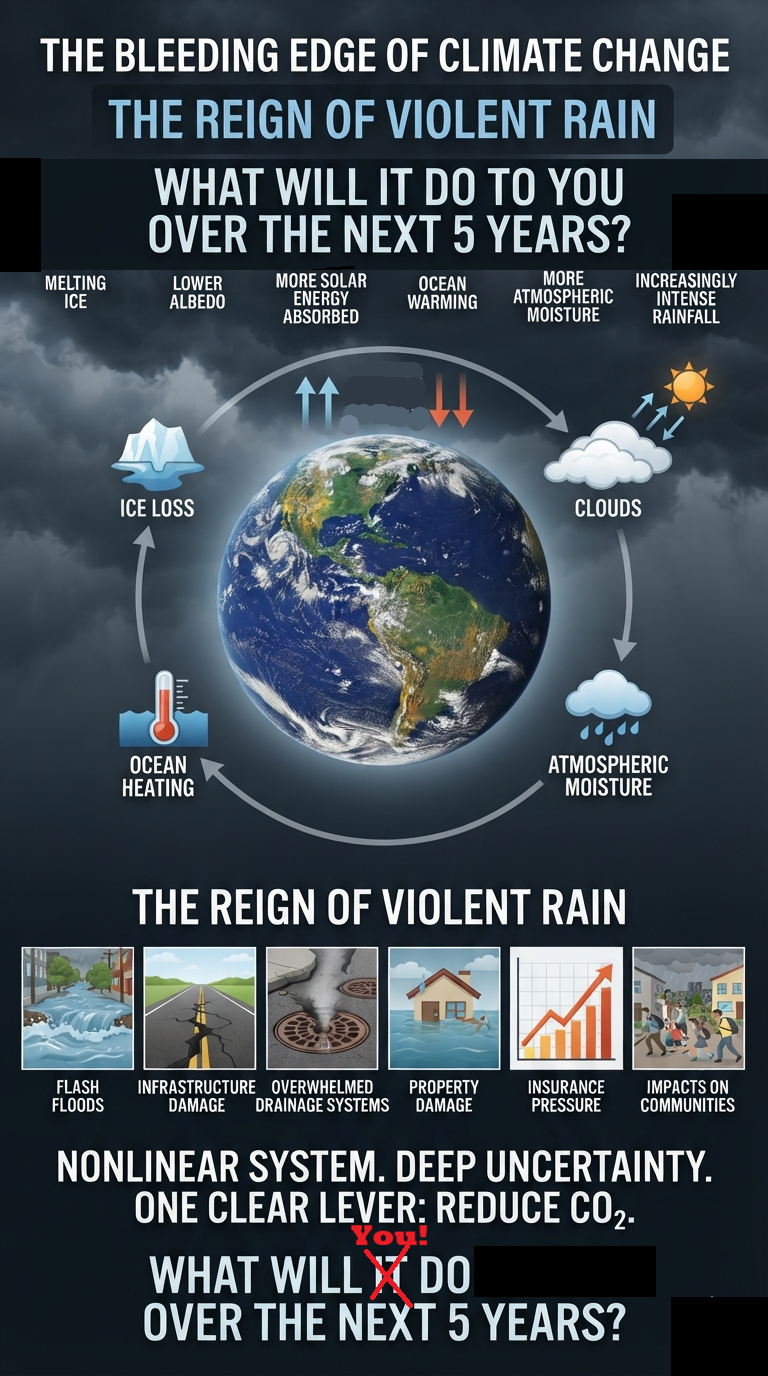
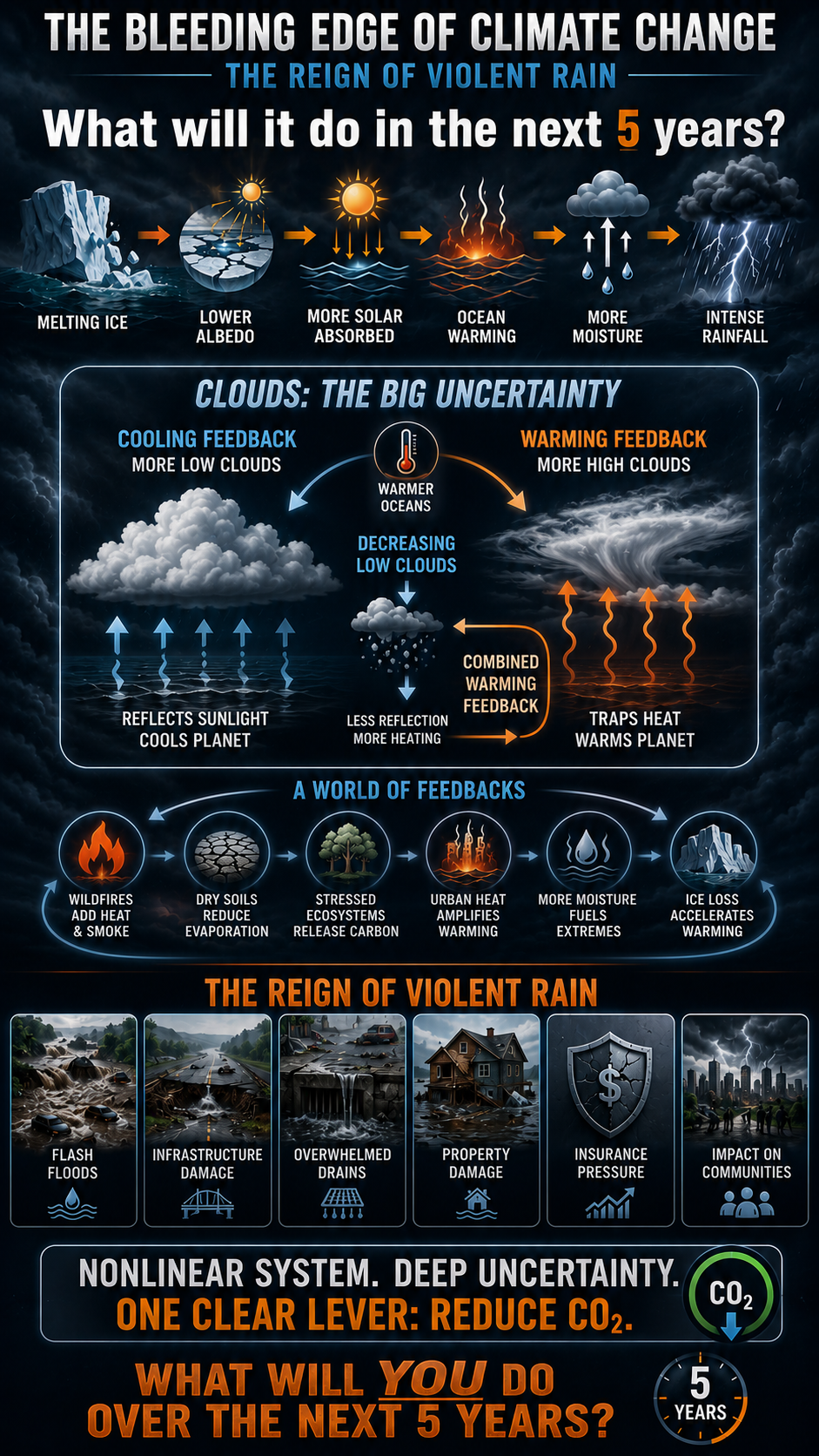
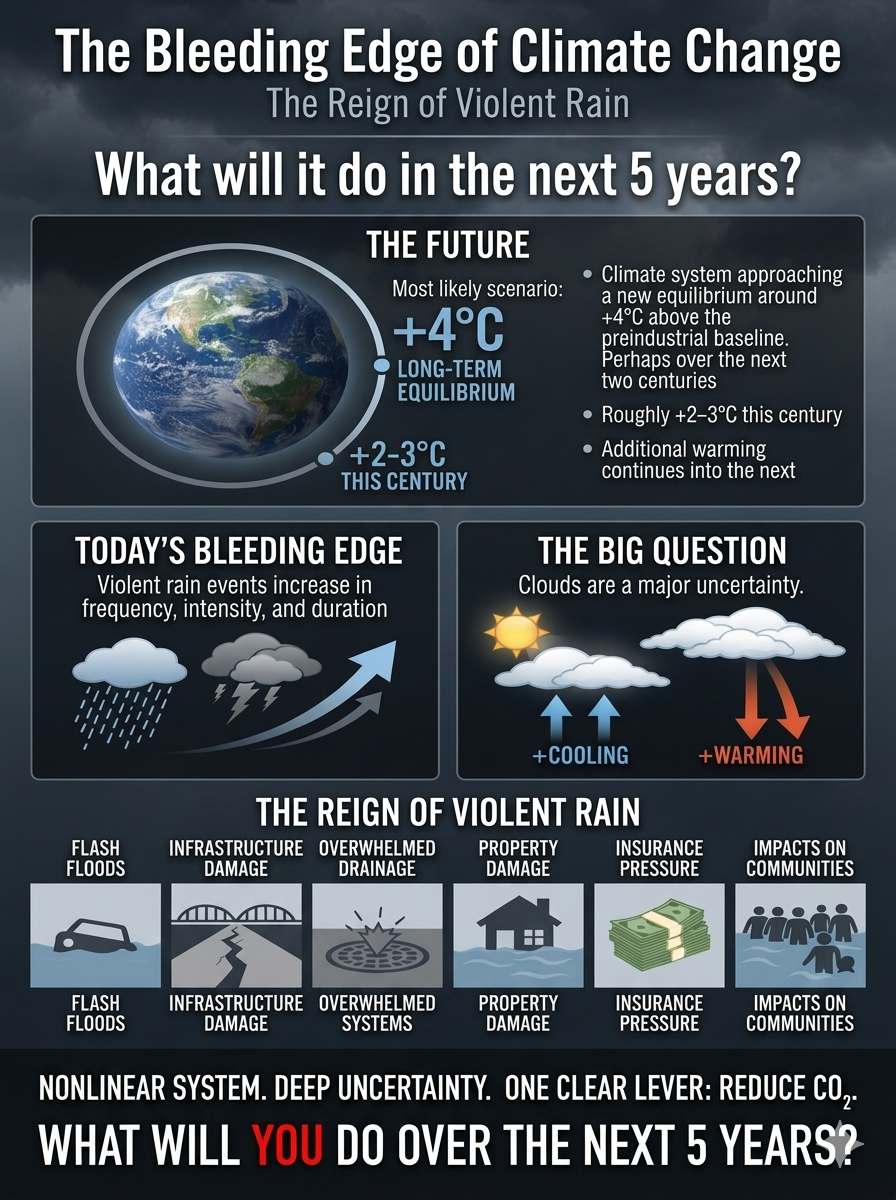
Many people believe that planting trees is one of the most important ways to help save the planet and reverse climate change. Planting trees can certainly help—but planting a tree and growing a healthy, mature forest are two very different things.
The problem is that climate change is increasing the stresses that kill trees and changing where forests can survive. Rising temperatures, increasing vapor pressure deficits, drought, extreme heat, wildfire, flooding, disease, and insect outbreaks are interacting in ways that can overwhelm trees faster than forests can adapt.
Wildfire is an increasingly important part of the problem. Climate-driven increases in fire weather have contributed to substantially greater forest and tree-cover losses in many regions. Drought and extreme heat compound that damage by reducing soil moisture and increasing atmospheric demand for water. In warmer air, a higher vapor pressure deficit (VPD) increases the drying power of the atmosphere, causing trees to lose water through their leaves faster and potentially creating hydraulic stress when roots cannot keep up.
Tree mortality is also occurring through less spectacular but equally important pathways. Long-term studies have documented increasing mortality in some tropical forests, while drought, heat, insects, and disease have produced severe die-offs in temperate and boreal forests. In California, prolonged drought and heat have contributed to the death of tens of millions of trees. Elsewhere, drought and increasingly volatile weather have reduced the survival of newly planted trees and complicated reforestation efforts.
This creates a fundamental problem with the simple “plant more trees” solution.
A planted seedling must first survive. Then it must grow large enough to become ecologically significant, reproduce, and ultimately become part of a functioning forest. A tree that dies after a few years has absorbed only a fraction of the carbon it might have stored over decades—and the resources invested in planting it may accomplish little. Multiple prominent scientific studies and forestry reports confirm that replanted saplings face staggering failure rates, with mortality exceeding 70% to 80% within 5-to-10-years.
That is why tree survival matters as much as tree planting.
Multiple studies of reforestation and tree establishment have found substantial seedling mortality, particularly under drought, heat, competition, poor site conditions, and other environmental stresses. Mortality can become extremely high when newly planted trees encounter conditions outside the climate range to which they are adapted.
The question for the future, therefore, is not simply:
How many trees can we plant?
It is:
Which trees can survive long enough to become the forests of tomorrow?
That is the question behind this experiment.
Penn’s Sylvania: Penn’s Woods
On March 4, 1681, King Charles II granted William Penn a royal charter for a vast tract of land in North America. The grant contained more than 28 million acres, making it one of the largest private land grants in history. The King awarded the territory to Penn partly to settle a debt of £16,000 owed to Penn’s late father, Admiral Sir William Penn.
But the story behind the name is especially fitting for a state whose identity is so closely tied to its forests.
William Penn wanted to call his new territory “Sylvania,” from the Latin silva, meaning woodland or forest. In other words, Penn envisioned a land defined by its woods.
King Charles II, however, insisted that “Penn” be placed before Sylvania to honor Admiral William Penn. The result was Pennsylvania—literally, “Penn’s Woods.”
Penn reportedly worried that people would assume he had named the colony after himself, when the name was actually the King’s tribute to his father.
More than three centuries later, the name remains remarkably appropriate.
Penn’s Sylvania was a land of forests.
The question now is whether the forests that gave Pennsylvania its name can survive the rapidly changing climate of the land itself.
Penn’s Sylvania Experiment
Since the 1960s, I have studied trees in Pennsylvania. Over the decades, I have watched the conditions affecting our forests change—and, more recently, deteriorate rapidly. Several factors are driving this decline, including ozone pollution, hydroclimatic whiplash, and ecosystem conversion.
The goal is not simply to document what is happening, but to find ways to adapt to the conditions we have now while working to change the trajectory that is producing them.
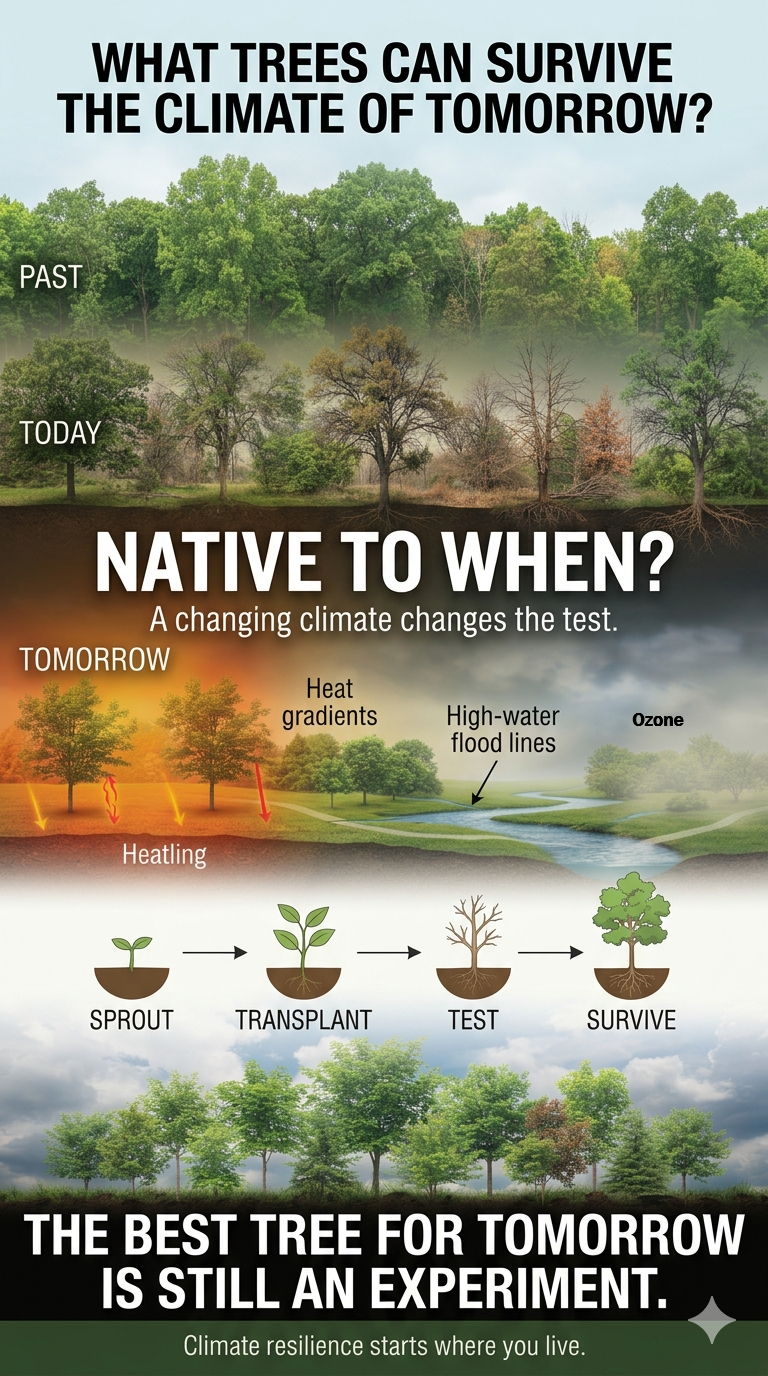
Unfortunately, “native species” is not necessarily the answer—at least not without defining what we mean by native and, more importantly, native to when? A species that evolved in Pennsylvania under the climate of the past may not necessarily be well suited to Pennsylvania’s rapidly changing climate today.
That is the premise behind this experiment.
I transplanted trees that began sprouting naturally around my property, along with trees I obtained for free or on special occasions. Some were Arbor Day giveaways. Others were small ornamental trees purchased at post-Christmas sales. Nothing particularly scientific or selective went into acquiring them. They were simply trees that became available to me.
For several years, I have been testing these trees for climate resilience in my location.
That may be one of the most useful ways to identify the trees of the future: an evolving experiment conducted where you actually live. There is no single “best tree” for tomorrow because tomorrow’s climate is still changing—and the speed and acceleration of that change remain uncertain.
One of the most troubling findings is that many of the species we traditionally regard as Pennsylvania’s native trees are struggling under today’s conditions. Some of the old-growth species that once thrived here may no longer be capable of surviving, much less thriving, under the climate they now face.
The question, then, is not simply “What trees are native here?”
It is:
“What trees can survive here as the climate continues to change?”
by Daniel Brouse and Sidd Mukherjee
In memoriam of Anne
When Mountains Crumble to the Sea: Glacial Retreat, Permafrost Thaw, Hydrostatic Pressure, and Landslides
Mountains may look permanent. They are not.
Across Alaska, Greenland, Norway, Chile, New Zealand, and the European Alps, glaciers are retreating, permafrost is thawing, and mountain slopes that were stabilized by ice for centuries or millennia are becoming increasingly unstable.
The result is a dangerous transformation of the high mountains: rockfalls, landslides, glacier collapses, debris flows, and landslide-generated tsunamis.
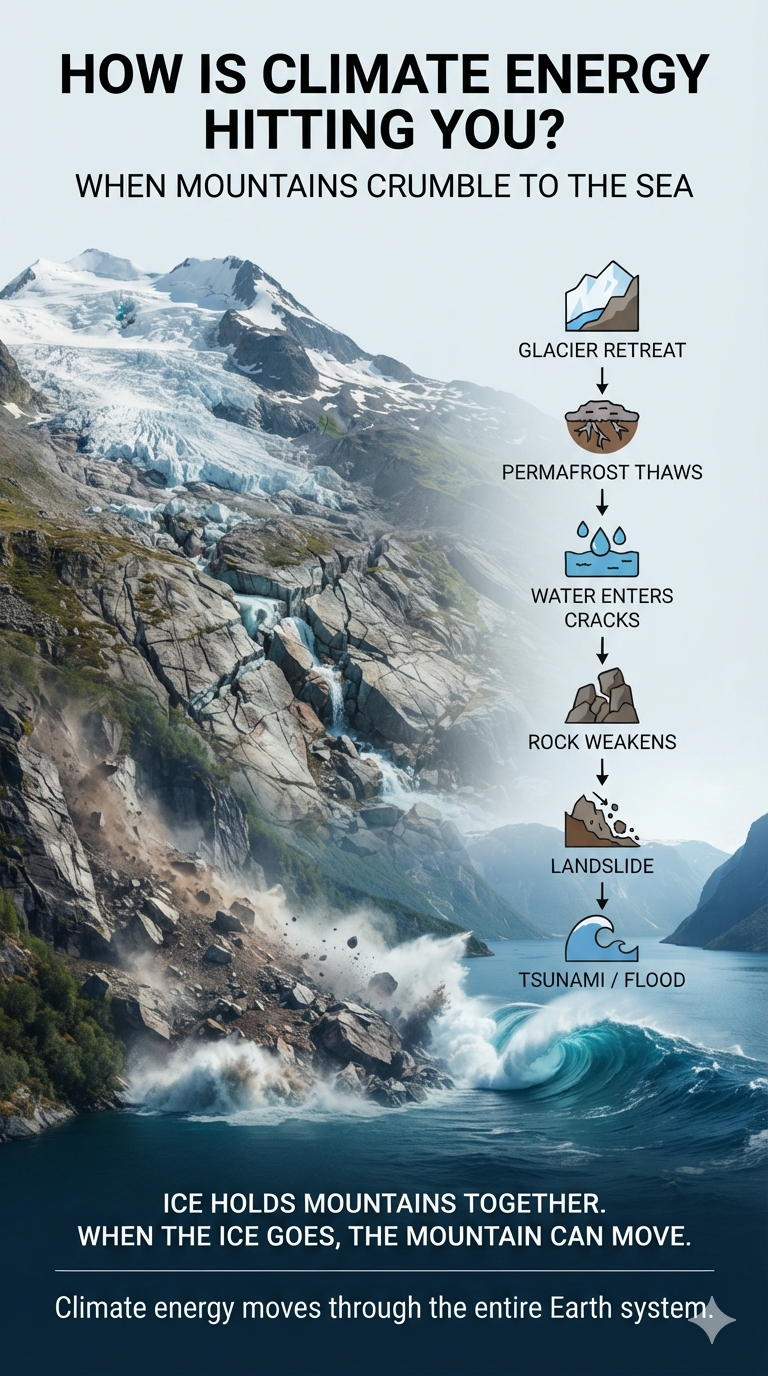
These are not simply isolated geological curiosities. They are examples of a larger climate-driven interaction among the cryosphere—the frozen part of the Earth system—the hydrosphere, and the lithosphere. As ice disappears, water enters places where it previously could not. As frozen ground thaws, fractures that were once reinforced by ice can weaken. As glaciers retreat, steep slopes can lose part of the support and confinement that helped stabilize them.
The mountains can begin to crumble.
And when they do, enormous amounts of stored gravitational energy can suddenly become kinetic energy.
A Mountain Can Become a Climate Hazard
One of the clearest examples occurred in East Greenland in September 2023.
A massive rock-and-ice avalanche, involving approximately 25 million cubic meters of material, plunged into Dickson Fjord. The impact generated an initial tsunami with a runup of approximately 200 meters—about 650 feet. The confined fjord then acted like a gigantic bathtub, allowing the water to oscillate back and forth as a seiche.
That oscillation continued for nine days.
The movement was powerful enough to generate seismic waves detectable around the world. Scientists eventually determined that the mysterious nine-day signal recorded by seismometers globally was produced by the fjord’s oscillating water.
In other words, a climate-related change in a glacierized mountain landscape produced a chain reaction:
Glacial thinning → slope destabilization → rock-and-ice avalanche → tsunami → seiche → global seismic signal
This is what a climate cascade looks like.
The Mechanics of Destabilization
1. Loss of Glacial Support
Glaciers are not merely passive sheets of ice sitting on mountains. They interact mechanically with the surrounding landscape.
When glaciers occupy steep valleys, their mass and geometry influence the stresses acting on adjacent slopes. When glaciers thin and retreat, formerly ice-confined slopes can become exposed and mechanically reorganized.
Retreat can therefore contribute to slope destabilization, particularly where steep, fractured rock has been exposed or where the glacier previously helped buttress or constrain unstable terrain.
The process does not mean that every retreating glacier automatically causes a landslide. Rather, glacier retreat can remove one of several stabilizing factors from a mountain system already close to failure.
2. Permafrost Degradation
At high elevations, permafrost can exist not only in soil but within fractured bedrock.
Ice occupying those fractures can function as a natural cement, binding blocks of rock together and increasing the strength of the mountain mass.
When temperatures rise sufficiently for that ice to thaw, the mechanical properties of the rock mass can change.
The mountain has not suddenly become a pile of loose rocks. Instead, a complex system of fractures, joints, ice, water, and rock begins to respond differently to gravity.
That difference can be critical.
3. Meltwater and Hydrostatic Pressure
When ice melts, water has to go somewhere.
Meltwater can infiltrate fractures and joints in rock. Once inside a confined fracture, water can exert pressure on the surrounding rock surfaces. This is known as hydrostatic or pore-water pressure, depending on the physical setting.
Increasing water pressure can reduce the effective forces holding fractured rock surfaces together. In simplified terms, water can help pry apart a structure that was already mechanically compromised.
This is especially important when meltwater penetrates deeply into a mountain containing extensive fracture networks.
4. Freeze-Thaw Fracturing
Water entering fractures can also amplify mechanical damage through freeze-thaw processes.
When water freezes, it expands. Repeated freezing and thawing can progressively widen existing fractures and create new pathways through the rock.
At elevations where temperatures repeatedly cross the freezing point, this process can become an important agent of mechanical weathering.
The result is not necessarily one dramatic failure.
It can be thousands of small failures accumulating until the mountain reaches a critical state.
Then the failure can become very large.
From Rockfall to Megatsunami
Once a large mountain mass begins moving, the consequences can extend far beyond the slope itself.
A collapsing mountain can:
bury communities;
destroy roads and bridges;
dam rivers;
create unstable lakes;
generate debris flows;
trigger secondary landslides;
produce glacial-lake outburst flood hazards;
and, when the collapse enters a fjord or lake, generate a tsunami.
The last mechanism is particularly important because a landslide-generated tsunami does not require an earthquake.
A sufficiently large mass entering confined water can displace enormous quantities of water almost instantaneously.
Recent Examples
Greenland — 2023
A rock-and-ice avalanche entered Dickson Fjord and generated an approximately 200-meter-high tsunami. The resulting seiche continued oscillating for nine days and produced a globally detected seismic signal. Scientists concluded that climate-change-driven glacial thinning preconditioned the slope for failure.
Alaska — 2025
On August 10, 2025, a more than 64-million-cubic-meter landslide struck Tracy Arm near the terminus of South Sawyer Glacier. The event generated a tsunami with a measured maximum runup of approximately 481 meters (1,578 feet)—the second-highest landslide-tsunami runup ever documented, behind the 1958 Lituya Bay event.
The landslide was preconditioned by glacial retreat associated with climate change. The resulting tsunami generated a global seismic signal, while a landslide-induced seiche persisted for as long as 36 hours.
The danger was particularly significant because Tracy Arm is frequented by cruise ships and other vessels. More than 20 vessels, including large cruise ships, can travel through Tracy and Endicott arms during the summer. Fortunately, no large vessel was in the upper fjord when the landslide occurred.
Switzerland — 2025
On May 28, 2025, part of the Birch Glacier and the unstable slope of the Kleine Nesthorn above it collapsed in the Lötschental Valley.
The resulting rock-and-ice avalanche buried approximately 90 percent of the village of Blatten. Scientific estimates put the total volume of the moving rock and ice at roughly 20 million tonnes, with approximately 6.4 million cubic meters of rock and 2.9 million cubic meters of glacier ice involved in the main event.
The village had been evacuated nine days earlier because deformation and other warning signs had been detected. That evacuation almost certainly prevented a far greater loss of life. The debris also blocked the Lonza River, creating a temporary lake and producing a secondary flooding hazard.
Blatten demonstrates another important feature of climate-driven hazards:
The first disaster may not be the last disaster.
A landslide can dam a river. The dam can create a lake. The lake can flood surviving structures. Additional slope failures can destabilize the new landscape.
One failure can therefore create the conditions for another.
The Spitze Stei Crisis: Kandersteg, Switzerland
One of the most closely watched unstable mountain formations in Switzerland is Spitze Stei, above the Alpine village of Kandersteg in the Bernese Oberland.
Scientists estimate that approximately 15–20 million cubic meters of unstable rock could potentially move. The mountain’s instability is associated with the degradation of permafrost and the progressive weakening of the fractured rock mass.
Mountain failures are often progressive. A slope can shed smaller pieces while simultaneously becoming more unstable. Alternatively, smaller failures can reduce the amount of material available for a larger collapse.
The challenge is determining which trajectory the mountain will follow.
That is why Kandersteg is under continuous monitoring, with radar and other systems providing information about movement and deformation. Evacuation plans are part of the community’s preparedness.
The mountain is effectively being watched in real time.
The Emerging Pattern
Blatten and Kandersteg are not identical geological situations. Nor is every landslide in a warming mountain environment caused exclusively by climate change.
Mountains fail for many reasons.
Earthquakes, rainfall, erosion, geological structure, gravity, and natural weathering have always produced landslides.
The climate connection is different.
Warming can alter the background conditions under which these geological processes operate.
A retreating glacier can expose a previously confined slope.
Thawing permafrost can weaken fractured bedrock.
Increasing meltwater can infiltrate fractures.
More intense rainfall can increase pore-water pressure.
Freeze-thaw cycles can enlarge cracks.
And a warming atmosphere can alter the timing, duration, and intensity of snowmelt and precipitation.
These processes can interact.
That interaction is what makes the problem particularly difficult.
Hydroclimatic Whiplash in the Mountains
The larger story is therefore not simply “global warming causes landslides.”
The more scientifically useful description is:
Climate warming changes the physical conditions that govern mountain stability.
Those changes can interact with water, ice, rock, gravity, and topography to produce cascading hazards.
A mountain slope does not care whether the energy destabilizing it came from a warming atmosphere, melting glacier, rainfall event, or gravitational unloading.
It responds to the physical forces acting upon it.
That is the essence of climate energy.
The energy added to the climate system does not remain confined to the atmosphere.
It moves through the Earth system.
It melts ice.
It thaws frozen ground.
It changes water.
It alters pressure.
It weakens structures.
And sometimes, it converts a mountain into a landslide.
Atmospheric Rivers: More Water, Less Snow, Faster Runoff
The mountains are being reshaped not only by warming temperatures, but by a changing water cycle.
As the atmosphere warms, it can hold more water vapor. This increases the potential for powerful atmospheric rivers—long, narrow corridors of concentrated moisture that transport enormous quantities of water vapor from the oceans toward land.
The important change is not simply that atmospheric rivers may become stronger. The form in which their moisture reaches the mountains is changing.
Warmer air means more precipitation falls as rain rather than snow, particularly at elevations near the freezing level. Snowpack that once stored winter precipitation for months can instead become immediate runoff.
That changes the mountain’s hydrology.
From Snow Reservoir to Water Pulse
Historically, mountain snowpack has acted as a natural reservoir:
When a warm atmospheric river arrives on top of an existing snowpack, the consequences can become even more dramatic. Rain adds water directly to the landscape while warmer conditions accelerate snowmelt. The result can be a rain-on-snow event—a rapid release of water from both precipitation and the mountain’s frozen reservoir.
Changing Moisture Gradients
There is another piece of the puzzle: moisture gradients.
A warming atmosphere does not simply add moisture uniformly everywhere. The capacity of air to hold water increases with temperature, while ocean temperatures, atmospheric circulation, mountain barriers, and regional drying patterns redistribute that moisture.
This can sharpen contrasts between very dry and very wet conditions.
One region may experience prolonged atmospheric drying and declining snowpack while, nearby or later in the season, a moisture-rich atmospheric river delivers an extraordinary pulse of precipitation.
That is hydroclimatic whiplash:
Dry → wet → dry → extreme precipitation
The problem for mountain systems is that they must absorb these rapidly changing conditions while their physical structure is already being altered by warming.
The Mountain Feedback
This creates another cascading pathway:
Warming → more atmospheric moisture → stronger atmospheric-river potential
↓
More rain, less snow
↓
Reduced snow storage
↓
Rapid runoff and rain-on-snow events
↓
Higher pore-water pressure and erosion
↓
Greater landslide and debris-flow potential
↓
More sediment, flooding, and infrastructure damage
At the same time, warming and permafrost thaw can weaken the rock and sediment structures through which that water moves.
The result is a mountain system being hit from several directions at once:
Less frozen storage. More liquid water. Faster runoff. Greater precipitation extremes. Weaker slopes.
The atmosphere is changing the mountain’s plumbing while warming is changing the mountain itself.
That is hydroclimatic whiplash in the mountains.
And when an atmospheric river arrives at a mountain that has less snow, more meltwater, thawing permafrost, and increasingly unstable slopes, the question is no longer simply how much rain will fall?
It becomes:
What will the mountain do with it?
So, How Is Climate Energy Hitting You?
You do not have to live beneath a glacier to experience this process.
A landslide can block a highway.
A debris flow can destroy a bridge.
A mountain collapse can dam a river.
A landslide-generated tsunami can threaten vessels in a fjord.
A new glacial lake can become a flood hazard.
And a community that has existed for centuries can suddenly find itself living beneath an unstable mountain.
The most important lesson from Greenland, Alaska, and the Swiss Alps is not that every mountain is about to collapse.
It is that the frozen components that helped stabilize many high-mountain environments are changing rapidly.
The mountains are responding.
And sometimes the response is spectacular.
The ice retreats. The permafrost thaws. Water enters the fractures. Hydrostatic pressure rises. Rock begins to move. Gravity takes over.
How Is Climate Energy Hitting You?
Western U.S. Woodlands: Ecosystem Conversion or Vegetation Type Conversion
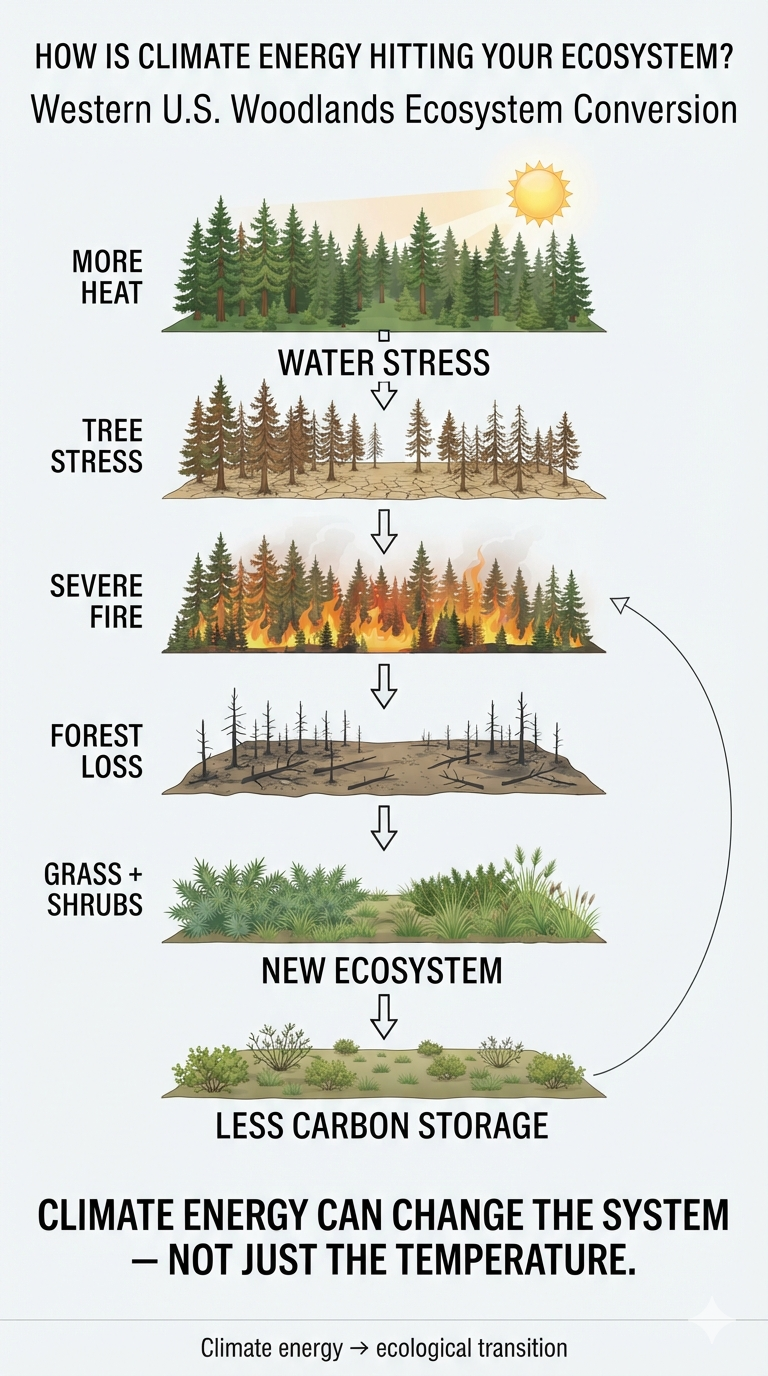
Towering woodlands across the Western U.S. are being permanently replaced by spiky shrubs as bigger and hotter wildfires sweep through forests that have not evolved to survive such high-intensity blazes and a warmer climate. Conditions “just aren’t normal anymore,” said researchers from Lehigh University. “Bigger, Hotter Fires Are Slowly Erasing America’s Great Forests” references a 2024 modeling study published in Communications Earth & Environment titled “Future transition from forests to shrublands and grasslands in the western United States is expected to reduce carbon storage”. Conducted by researchers from Lehigh University, the study projects that up to 40% of Western conifer forests could convert to shrubland or grassland by 2100 under moderate emissions scenarios.
by Daniel Brouse and Sidd Mukherjee
Introduction
Climate change is often described as a gradual increase in temperature. That description is technically correct but scientifically incomplete.
The climate system does not distribute additional energy uniformly or produce consequences that increase smoothly with temperature. Additional energy changes the behavior of the atmosphere, the hydrologic cycle, soils, vegetation, fire regimes, and biological systems. As those systems respond, their responses can feed back into the climate and into one another.
This creates a more consequential question:
What happens when an ecosystem can no longer absorb the changing climate without changing its fundamental structure?
Forests in the western United States provide an important example.
The issue is not simply that trees experience warmer temperatures. The larger problem is that warming changes the entire environmental system in which forests exist. Higher temperatures increase atmospheric moisture demand. Changes in precipitation and snowpack alter the timing and availability of water. Soil moisture is depleted more rapidly. Trees become increasingly stressed. Drought weakens regeneration. Wildfires become more severe. Severe fires remove mature trees and seed sources. Grasses and shrubs then occupy the newly opened landscape.
The result can be more than forest damage.
It can become an ecosystem transition.
The system can move from one relatively stable state—forest—to another state dominated by shrubs and grasses.
That distinction is central to understanding nonlinear climate change.
1. Climate Energy Is More Than Temperature
Temperature is one observable expression of energy within the climate system.
But biological systems do not respond to temperature alone.
They respond to a combination of:
temperature
atmospheric moisture demand
precipitation
soil moisture
snowpack
evapotranspiration
fire
growing-season conditions
carbon availability
biological competition
disturbance frequency
regeneration conditions
Consequently, a modest increase in average temperature can produce a much larger ecological response when several variables move simultaneously.
A warmer atmosphere can demand more water from vegetation and soils. Earlier snowmelt can shift water availability away from the period when forests need it most. Hotter and drier conditions can increase fire risk. Fire removes vegetation that previously stored carbon and provided shade and moisture retention.
The important variable therefore becomes not simply:
How much warmer is it?
but:
How much additional energy is moving through the system, and what does that energy do to the processes that maintain ecosystem stability?
2. The Forest Is a System, Not a Collection of Trees
A forest exists because a particular combination of environmental conditions permits trees to survive, reproduce, compete, and regenerate.
That means the persistence of a forest depends on a chain of conditions.
A simplified representation is:
Climate → water availability → tree health → regeneration → competition → disturbance resistance → forest persistence
Climate change can stress several links simultaneously.
High-severity fire removes mature trees and seed sources.
After the fire, hotter and drier conditions can prevent the forest from regenerating.
At that point, the question is no longer whether the original trees can survive.
The question becomes whether the forest state itself remains viable.
3. Hydroclimatic Stress Can Become a Threshold
One of the most important characteristics of complex systems is that their response to forcing does not have to be linear.
A forest may tolerate increasing stress for years.
Then a threshold is crossed.
Before the threshold:
More heat → more stress
After the threshold:
More heat → mortality → reduced regeneration → vegetation change
The distinction is crucial.
A forest can therefore appear relatively resilient while conditions deteriorate beneath the surface.
Trees may survive while seedlings increasingly fail.
Older trees may remain while regeneration collapses.
The landscape can therefore retain the appearance of a functioning forest even as its ability to reproduce itself is being lost.
This creates what can be described as a climate–vegetation mismatch.
The climate has changed faster than the ecosystem can reorganize.
4. Fire Can Transform a Stress Response Into a Feedback Loop
Fire is particularly important because it can convert gradual environmental stress into rapid structural change.
Consider the sequence:
Warming
↓
Greater atmospheric moisture demand
↓
Declining soil moisture
↓
Vegetation stress
↓
Greater fire susceptibility
↓
High-severity fire
↓
Loss of mature forest
↓
Reduced seed sources
↓
Poor forest regeneration
↓
Expansion of grasses and shrubs
The process does not necessarily stop there.
Grasses and shrubs can create different fuel structures from forests. In some environments, this can support more frequent burning.
The system can therefore become:
forest → fire → grass/shrub → fire → grass/shrub
The disturbance has become part of the mechanism maintaining the new ecosystem.
This is a classic positive feedback.
5. Disturbance Can Become an Ecological Accelerator
Climate change does not have to directly eliminate an ecosystem.
It can instead increase the frequency and severity of disturbances that eliminate the ecosystem’s ability to recover.
This distinction is extremely important.
Imagine a forest that normally experiences periodic fire.
If a fire occurs and the climate remains favorable, trees regenerate.
But if the same fire occurs under hotter and drier conditions, regeneration may fail.
The fire itself may therefore not be fundamentally different.
The recovery environment is different.
This means that climate change can transform a disturbance from a temporary event into a state transition.
The same principle can apply to:
drought
flooding
heatwaves
hurricanes
insect outbreaks
disease
agricultural failure
coral bleaching
wetland loss
The disturbance becomes more consequential because the background state of the system has changed.
6. The Carbon Cycle Contains a Critical Asymmetry
Forests illustrate another important feature of nonlinear climate dynamics.
A landscape can continue absorbing carbon while simultaneously losing its long-term carbon-storage capacity.
These are not the same thing.
Grasslands and shrublands can remain productive. They can photosynthesize, grow, and absorb atmospheric CO₂.
But a mature forest stores carbon in:
trunks
branches
roots
dead wood
forest soils
long-lived biomass
When a forest is replaced by lower-biomass vegetation, the ecosystem can continue to exchange carbon with the atmosphere while carrying a substantially smaller carbon reservoir.
Therefore:
carbon uptake ≠ carbon storage capacity
and:
positive carbon flux ≠ preservation of the previous carbon stock
This distinction is essential when evaluating ecosystems as natural climate buffers.
7. A Carbon Sink Can Become a Smaller Carbon Reservoir
This creates a potentially misleading observation.
Suppose a forest is replaced by grassland.
The grassland grows rapidly.
Its net ecosystem productivity may increase.
One might therefore conclude:
The ecosystem is still absorbing carbon, so the transition is not particularly important.
That conclusion would be wrong.
The relevant question is not simply how much carbon the ecosystem absorbs during a particular period.
The larger question is:
How much carbon can the ecosystem retain over the long term?
A forest can represent a large accumulated carbon reservoir.
A grassland may cycle carbon more rapidly while maintaining a much smaller standing stock.
The transition therefore represents a change in the architecture of the carbon cycle.
That is precisely the type of distinction required by a climate-energy framework.
8. The Feedback Extends Beyond the Forest
The consequences do not stop at vegetation.
Forest loss can alter:
surface energy balance
evapotranspiration
local humidity
soil temperatures
runoff
erosion
snow retention
water availability
biodiversity
carbon storage
fire behavior
The ecosystem is therefore not merely responding to climate.
It can begin changing the conditions under which the climate interacts with the landscape.
This creates another feedback structure:
Climate forcing
↓
Hydroclimatic stress
↓
Vegetation change
↓
Surface and hydrologic changes
↓
Disturbance changes
↓
Carbon-storage changes
↓
Further alteration of the climate–ecosystem relationship
The system becomes increasingly coupled.
9. Elevation Becomes a Moving Boundary
One observable consequence of warming is the movement of climate zones.
As temperatures rise, species may attempt to occupy higher elevations or move toward cooler environments.
This creates an ecological migration problem.
The climate envelope moves.
The ecosystem must follow.
But ecosystems do not move like atmospheric air masses.
Trees require:
seeds
suitable soil
time
reproduction
dispersal
successful establishment
adequate moisture
protection from subsequent disturbances
If climate conditions move faster than species can migrate, the suitable habitat effectively moves away from the organism.
This produces another form of mismatch:
The climate is moving faster than the ecosystem.
That is potentially much more important than the simple statement that temperatures are increasing.
10. The Nonlinear Acceleration Problem
This provides a useful example of why climate impacts can appear to accelerate.
Suppose warming produces only modest ecological stress during the first phase.
The system may appear stable.
But as stress accumulates:
Phase 1:
Temperature increases.
↓
Phase 2:
Moisture stress increases.
↓
Phase 3:
Tree growth and regeneration decline.
↓
Phase 4:
Fire vulnerability increases.
↓
Phase 5:
High-severity disturbances remove mature forest.
↓
Phase 6:
Regeneration fails.
↓
Phase 7:
Grass and shrub systems expand.
↓
Phase 8:
The new vegetation regime modifies future fire behavior.
The forcing has not necessarily increased eightfold.
The response pathway has changed.
That is the critical distinction.
Nonlinear acceleration can occur because each stage changes the conditions governing the next stage.
11. From Climate Change to State Change
This suggests a more useful hierarchy for understanding climate impacts.
Level 1 — Climate forcing
Greenhouse gases increase radiative forcing.
Level 2 — Physical response
Temperature, atmospheric moisture demand, precipitation patterns and snowpack change.
Level 3 — Hydroclimatic response
Soils dry more rapidly, drought stress increases and water availability becomes less synchronized with biological demand.
Level 4 — Biological stress
Growth, survival and regeneration are affected.
Level 5 — Disturbance amplification
Fire and other disturbances become more consequential.
Level 6 — Ecosystem restructuring
Forest becomes shrubland or grassland.
Level 7 — Feedback
The new ecosystem modifies carbon storage, fuels, hydrology and future disturbance behavior.
Heat + intense rainfall → infrastructure stress → flooding → system damage → reduced resilience to subsequent events.
In each case, the critical question is:
Does the system recover, or does the disturbance alter the system itself?
Conclusion
The most consequential climate impacts may not occur when a physical variable reaches an unprecedented value.
They may occur when the relationships that hold a system together begin to fail.
A forest does not need to experience a single catastrophic temperature to disappear.
It can be progressively destabilized by warming, increasing atmospheric moisture demand, declining soil moisture, altered snowpack, drought, severe fire and failed regeneration.
At some point, the system can cross a threshold.
The forest is replaced by another vegetation state.
Carbon storage declines.
Fire behavior changes.
Hydrology changes.
Biological communities change.
The ecosystem becomes different.
This is the central lesson for a climate-energy framework:
Climate change does not merely add energy to an existing system. It can change the rules governing how the system behaves.
That distinction separates ordinary climate variability from nonlinear climate-system transformation.
The important question is therefore not simply:
How much has the climate warmed?
It is:
How much additional energy has entered the system, how has that energy altered the interactions among its components, and have those interactions begun pushing the system toward a different state?
When the answer is yes, climate change is no longer merely producing stress.
Reno, Nevada: Hydroclimatic Whiplash, Flash Droughts, Extreme Winds, and Wildfires
Reno, Nevada, is experiencing some of the most pronounced climate stresses in the American West. Rapid warming is intensifying the region’s existing desert and alpine vulnerabilities, while simultaneously altering snowpack, water supplies, vegetation, wildfire conditions, and extreme precipitation.
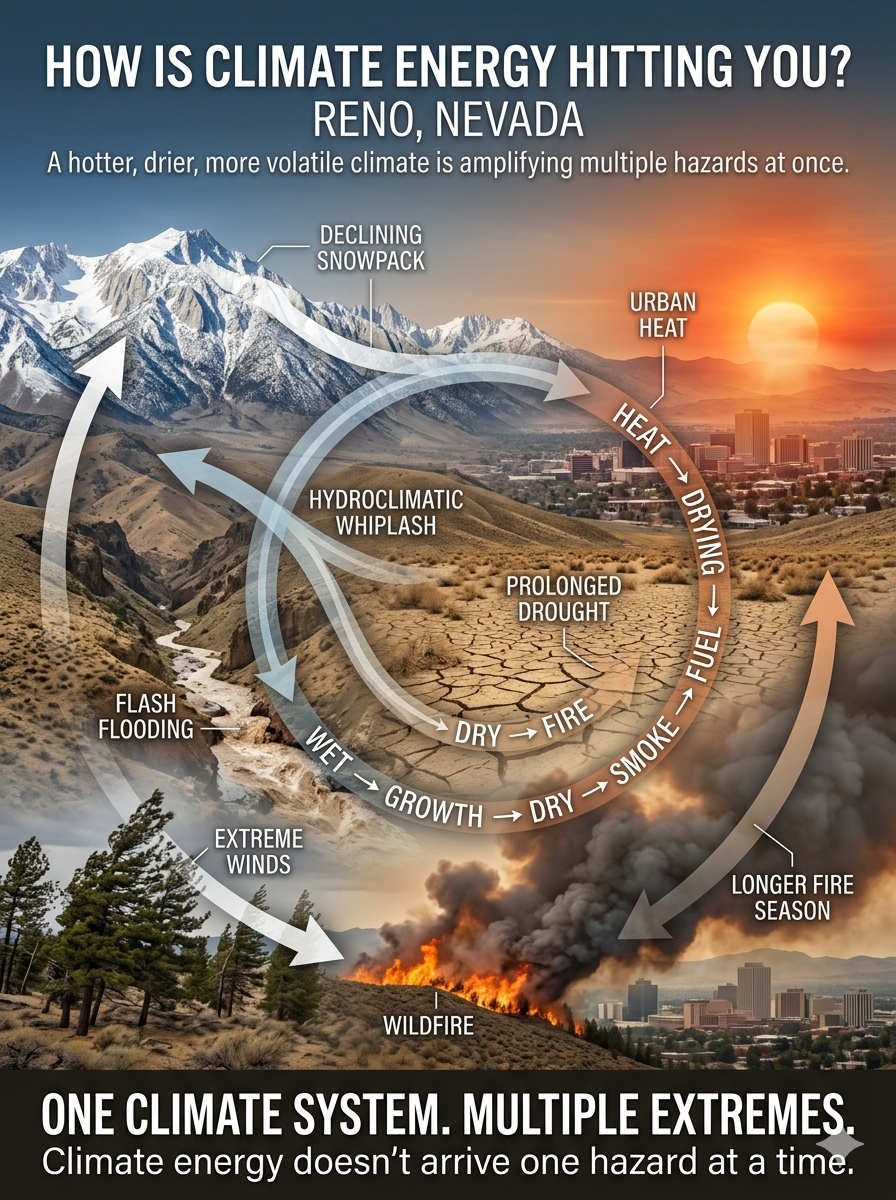
For the Reno–Sparks region, the major climate pressures include extreme urban heat, declining Sierra Nevada snowpack, prolonged drought, abrupt swings between wet and dry conditions, extreme winds, flash flooding, and an expanding wildfire season.
These impacts do not occur independently. They interact, creating compound hazards in which one climate extreme can prepare the landscape for another.
Extreme Urban Heat and Season Shifts
Rapid Temperature Increases
Reno has experienced substantial long-term warming, with average temperatures increasing by approximately 7.9°F overall. Average summer temperatures have increased by more than 11°F since 1970, intensifying heat stress across the region.
Urban Heat Island Effect
Rapid population growth has replaced natural landscapes with pavement, buildings, roads, and other heat-absorbing surfaces. The resulting urban heat island effect can substantially increase temperatures within developed areas, placing the greatest burden on residents and communities with fewer resources to adapt.
A Later First Freeze
Reno’s autumn is warming particularly rapidly. The average date of the first winter freeze has shifted later by nearly six weeks, extending the period during which heat-sensitive ecosystems, agriculture, and disease vectors remain active.
Longer Mosquito Seasons
Warmer autumn conditions can delay the seasonal die-off of mosquitoes. In Washoe County, mosquito abundance has increased dramatically, with reports of an eight-fold increase in mosquitoes per trap.
The result is more than a warmer city. The seasonal timing of biological systems is changing.
Snowpack, Water Supply, and Flooding
Diminishing Snowpack
Warming at higher elevations is reducing the amount of winter precipitation stored as snow. Sierra Nevada snowpack has reached exceptionally low levels, at times falling to approximately 48% of the historical median.
Snowpack is not simply frozen precipitation. It is a natural reservoir that stores water through winter and releases it gradually during spring and summer.
Earlier Snowmelt
Warmer winters are shortening the snow season and causing snow to melt earlier. That shifts runoff toward earlier months, leaving less water available during the hot, dry summer period when vegetation, ecosystems, agriculture, and communities need it most.
Lake Tahoe Under Stress
Nearby Lake Tahoe is also responding to a warming climate. Increased thermal stratification can reduce mixing between surface and deeper waters, affecting oxygen distribution, water quality, and ecosystem conditions while creating opportunities for invasive species.
From Drought to Flash Flood
Climate change does not simply mean “more drought.”
A warmer atmosphere can hold more water vapor, increasing the potential for intense precipitation when storms occur. An +11°F increase in temperature equates to an approximate 43% increase in the atmosphere’s maximum capacity to hold moisture. After prolonged dry periods, intense rainfall can produce rapid runoff, flash flooding, erosion, and debris flows across steep mountain terrain.
The same landscape can therefore experience both water scarcity and dangerous excess water—sometimes within a relatively short period.
Wildfires and Public Health
The Invisible Dual Disaster
Reno increasingly faces the convergence of extreme heat and wildfire smoke.
Wildfire smoke can severely degrade outdoor and indoor air quality. During smoke events, poorly sealed buildings and certain cooling systems can allow polluted outdoor air to enter indoor spaces, creating an additional public-health burden precisely when residents are trying to escape the heat.
A Longer Fire-Weather Season
Climate change has contributed to a substantial increase in fire-weather conditions across the region, with estimates of approximately 28 additional fire-weather days annually.
A longer period of hot, dry, windy conditions creates a larger window for vegetation to dry out and fires to spread rapidly.
But temperature alone does not explain the danger.
Water availability, vegetation growth, drought, snowpack, humidity, and wind interact to determine how much fuel is available—and how quickly that fuel can burn.
The Hawk Fire: Hydroclimatic Whiplash in Action
The Hawk Fire, threatening communities northwest of Reno, illustrates how multiple climate and weather processes can converge into a rapidly escalating wildfire emergency.
The fire has expanded dramatically across the Peavine Peak area and threatened residential communities and the University of Nevada, Reno campus. It is occurring amid a broader sequence of major wildfires across northern Nevada.
The immediate fire emergency is being amplified by dry fuels, limited snowpack, extreme fire-weather conditions, and powerful, shifting winds.
This is where the concept of hydroclimatic whiplash becomes important.
Hydroclimatic Whiplash
Hydroclimatic whiplash describes rapid swings between substantially wetter and substantially drier conditions.
The danger is not simply the wet period or the dry period individually.
It is what happens when they occur in succession.
1. Priming the Landscape
An unusually wet period can produce explosive growth of grasses, brush, and other fine fuels.
2. Rapid Dry-Down
If that period is followed by an exceptionally hot and dry summer, the newly produced vegetation can cure rapidly, transforming abundant biomass into highly flammable fuel.
3. Ignition
Once the landscape is sufficiently dry, a single ignition source can rapidly transform a fuel-rich environment into a fast-moving wildfire.
The climate hazard is therefore not one isolated extreme. It is the interaction between extremes.
Extreme and Shifting Winds
Wind can turn a dangerous wildfire into an urban emergency.
Powerful red-flag conditions can push flames rapidly across foothills and directly toward residential neighborhoods. At the same time, shifting winds can cause fire behavior to change direction with little warning.
For firefighters, this creates extraordinary tactical difficulties.
Rapidly changing winds can:
accelerate fire spread;
generate intense fire runs;
loft embers ahead of the main fire;
ignite new fires across containment lines;
block access routes;
change evacuation conditions;
and place firefighters and equipment in rapidly changing danger zones.
Reports of extreme fire behavior underscore the interaction between wind, dry fuels, topography, and heat.
The result is a wildfire that does not simply spread outward.
It can surge, jump, change direction, and accelerate.
Mitigation and Policy Adaptation
Reno’s climate risks are forcing governments to rethink how cities are designed and how resources are managed.
Heat Mitigation
Nevada’s Assembly Bill 96 establishes requirements for incorporating heat-mitigation strategies into local planning. Measures can include cool roofs, exterior shading, and drought-tolerant landscaping and trees.
These interventions address an important reality: climate adaptation increasingly has to occur at the neighborhood and building scale.
Resource-Demand Feedback
The rapid increase in extreme heat is also increasing pressure on water supplies, electricity demand, energy storage, and grid reliability.
During extreme heat, demand for air conditioning and other cooling systems can rise sharply—at the same time that drought and declining water availability place additional pressure on regional water resources.
This creates a reinforcing feedback:
More heat → More cooling → More electricity demand → Greater grid stress
At the same time:
More development → More water demand → Greater pressure on limited water supplies
These pressures can compound one another. A rapidly growing population and expanding technology sector increase demand for both electricity and water, while extreme heat makes both resources more critical.
Climate adaptation, therefore, cannot be separated from infrastructure planning, resource management, and the capacity of the electric grid and water systems to withstand increasingly extreme conditions.
The Bigger Picture
Reno’s climate challenge is not simply that the city is becoming hotter.
The more important change is that multiple parts of the climate system are beginning to interact in ways that amplify risk.
A warmer atmosphere changes precipitation.
Warmer winters reduce snowpack.
Reduced snowpack changes runoff.
Earlier runoff increases summer dryness.
Summer heat dries vegetation.
Drought converts vegetation into fuel.
Wind accelerates fire.
Wildfire produces smoke.
Smoke threatens public health.
And intense rainfall following dry periods can produce flash floods and debris flows.
This is hydroclimatic whiplash: not merely more extreme weather, but increasingly abrupt transitions between opposing extremes.
For Reno, the question is therefore not simply:
How much warmer will it become?
The more consequential question is:
How will all of these changes interact—and how quickly will they compound one another?
That is how climate energy is hitting Reno.
Hotter. Drier. Windier. More volatile. And increasingly difficult to manage one hazard at a time.
How Is the Climate Energy Hitting You? is a collection of backyard experiments conducted in conjunction with you—the reader. The goal is simple: to look at how the increased energy in the climate system is showing up in our everyday lives.
Is it becoming more extreme, more frequent, and more persistent? Are the changes becoming stranger—or even disturbing?
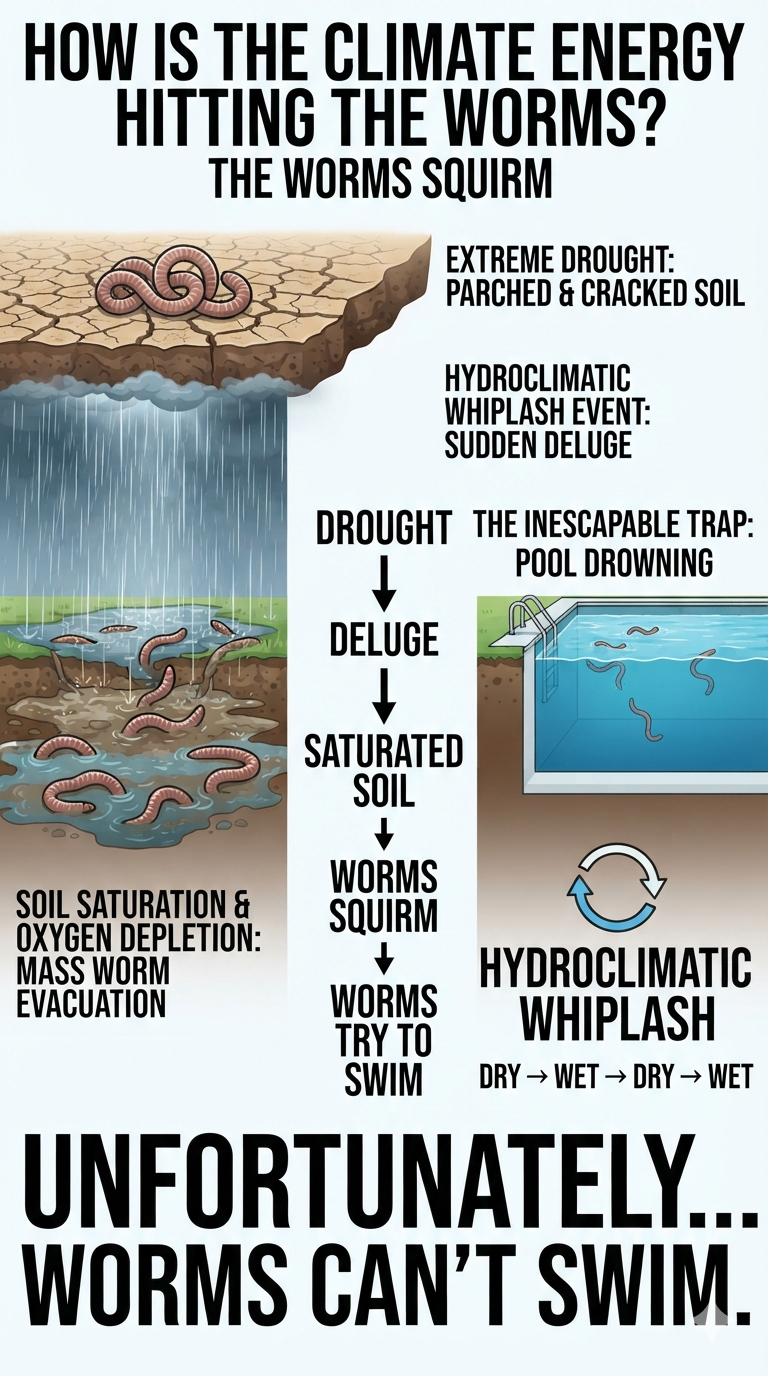
The Worms Squirm experiment checks all the boxes.
It started with a simple backyard observation: an increasing number of earthworms turning up in the swimming pool. What seems like a strange and seemingly insignificant nuisance may actually be a small, visible signal of a much larger change in the way water is moving through the environment.
Sometimes, you don’t need a laboratory to see climate energy at work.
Sometimes, you just need to look in the pool.
The Worms Squirm
Climate change is altering the conditions that earthworms depend on—soil temperature, moisture, oxygen availability, and precipitation patterns. These changes can affect earthworm survival, reproduction, abundance, and geographic distribution. At the same time, earthworm activity influences soil carbon cycling and greenhouse-gas emissions, creating another connection between life in the soil and the climate system.
Temperature and Moisture Effects
Warming temperatures: Rising soil temperatures can shift the ranges of some earthworm species toward higher latitudes and elevations. However, excessive heat can reduce activity, growth, reproduction, and survival, particularly when warming is accompanied by drying.
Drought: Prolonged dry conditions can sharply reduce earthworm activity and abundance. Because earthworms breathe through their moist skin, severe soil drying can force them deeper into the soil or into a dormant, low-activity state. Extended drought can produce substantial local population losses.
Flooding: Intense rainfall can saturate soils and dramatically reduce the amount of oxygen available in pore spaces. Earthworms may respond by moving toward the surface, where oxygen is more readily available. Prolonged waterlogging, however, can become lethal.
The Climate Feedback Beneath Our Feet
Earthworms are ecosystem engineers. As they consume organic material and move through the soil, they alter soil structure, redistribute nutrients, and stimulate microbial activity. These processes can affect carbon dioxide and nitrous oxide production, although the magnitude and direction of the greenhouse-gas effect depend heavily on soil type, moisture, temperature, vegetation, and earthworm species.
Climate change can also alter where different earthworm species can survive. In some regions, warming and changing precipitation patterns may allow non-native earthworms to expand into new forests and other ecosystems. Their arrival can dramatically alter soil structure, nutrient cycling, and forest-floor communities.
And Then There Are the Worms in My Pool
Over the past five years, I’ve noticed a significant increase in drowned earthworms showing up in my swimming pool. This year has been the most dramatic.
One explanation is that increasingly intense rainfall is changing the conditions that cause earthworms to come to the surface. Earthworms commonly move toward the surface when soils become saturated, and heavy rain can produce much larger and more rapid changes in soil moisture and oxygen than a gentle, prolonged rainfall.
The swimming pool then becomes an accidental trap.
Once an earthworm reaches the pool deck, there is little it can do to escape the water. What begins as a survival response to changing soil conditions can therefore end with a dead worm in the pool.
Hydroclimate Whiplash: From Drought to Deluge
The bigger story may be hydroclimate whiplash—rapid swings between unusually dry conditions and unusually wet conditions.
A soil ecosystem experiencing prolonged drought is fundamentally different from one receiving regular, moderate rainfall. When an intense rain event arrives after an extended dry period, several processes can occur simultaneously.
1. Parched Soil Can Change How Rainwater Moves
Extended drying can cause some soils to become water-repellent, while clay-rich soils can shrink and develop large cracks. When intense rainfall arrives, water may initially run across the surface or rapidly enter cracks rather than infiltrating uniformly through the soil profile.
The result can be a sudden change in the physical environment surrounding earthworm burrows.
Rather than gradually replenishing soil moisture, an extreme rain burst can produce rapid saturation in some areas and intense surface runoff in others. The sudden loss of available oxygen in saturated soil can encourage earthworms to move toward the surface.
2. Drought Can Damage Soil Structure
Severe drying can cause soils to shrink, crack, and harden. Burrows and other soil structures can become unstable.
When intense rainfall follows, those structures may partially collapse or become flooded. Earthworms that have retreated deeper into the soil during drought can suddenly find their normal pathways altered or inundated.
That can increase surface movement at exactly the time when rainfall is producing large amounts of surface water.
3. Earthworms Depend on Moisture—but Not Too Much
Earthworms need moisture because they exchange gases through their skin. Dry conditions can therefore be dangerous, but complete saturation creates a different problem: oxygen becomes much less available in the soil.
This produces an important paradox.
Too dry → physiological stress.
Too wet → oxygen stress.
Rapidly switching between the two → repeated physiological and behavioral stress.
It is therefore more accurate to think of hydroclimate whiplash as repeatedly pushing soil organisms between environmental extremes rather than simply “more rain” or “more drought.”
4. Wet Conditions Can Trigger Reproduction and Activity
Earthworm populations also respond to favorable moisture conditions. After periods of drought, renewed moisture can allow surviving worms and newly hatched individuals to become active again.
The exact population response varies considerably by species and local conditions, so it would be too strong to assume that every drought is followed by a synchronized population explosion. But when favorable moisture arrives after a dry period, increased earthworm activity near the surface can coincide with subsequent heavy rainfall.
That creates another possible pathway to the pool:
I can’t prove that climate change is responsible for the worms in my pool.
But the observation is consistent with a changing hydroclimate.
If rainfall is becoming more intense, if dry periods are becoming more pronounced, and if the transition between those conditions is becoming more abrupt, then the soil environment is experiencing larger and faster swings in moisture and oxygen availability.
Earthworms respond to those conditions.
And sometimes, their response puts them on the surface.
Unfortunately for the worms, my swimming pool is right there.
What looks like a bizarre little nuisance at the edge of the pool may therefore be a small-scale example of a much larger climate phenomenon: extreme changes in the movement of water through the environment can produce biological responses that we encounter in surprisingly personal ways.
The climate system doesn’t just change temperature.
It changes where the water goes, how fast it moves, and how abruptly conditions change.
Sometimes, you notice that change when the worms start squirming.
Conclusion
How is the climate energy hitting the worms?
Hydroclimatic whiplash makes the worms squirm—and try to swim.
Unfortunately, worms can’t swim.
Even more unfortunately, the lesson applies to humans, too.
Climate-driven increases in extreme rainfall can amplify urban flooding, overwhelming drainage systems and turning streets, basements, and low-lying buildings into dangerous traps. People living in basement apartments can be especially vulnerable when floodwaters rise faster than they can escape.
From South Korea to New York City, deadly urban floods have demonstrated the danger of extreme rainfall in densely populated areas.
The worms may be small, but the lesson is not:
When the water comes faster and harder, there may be nowhere to go.
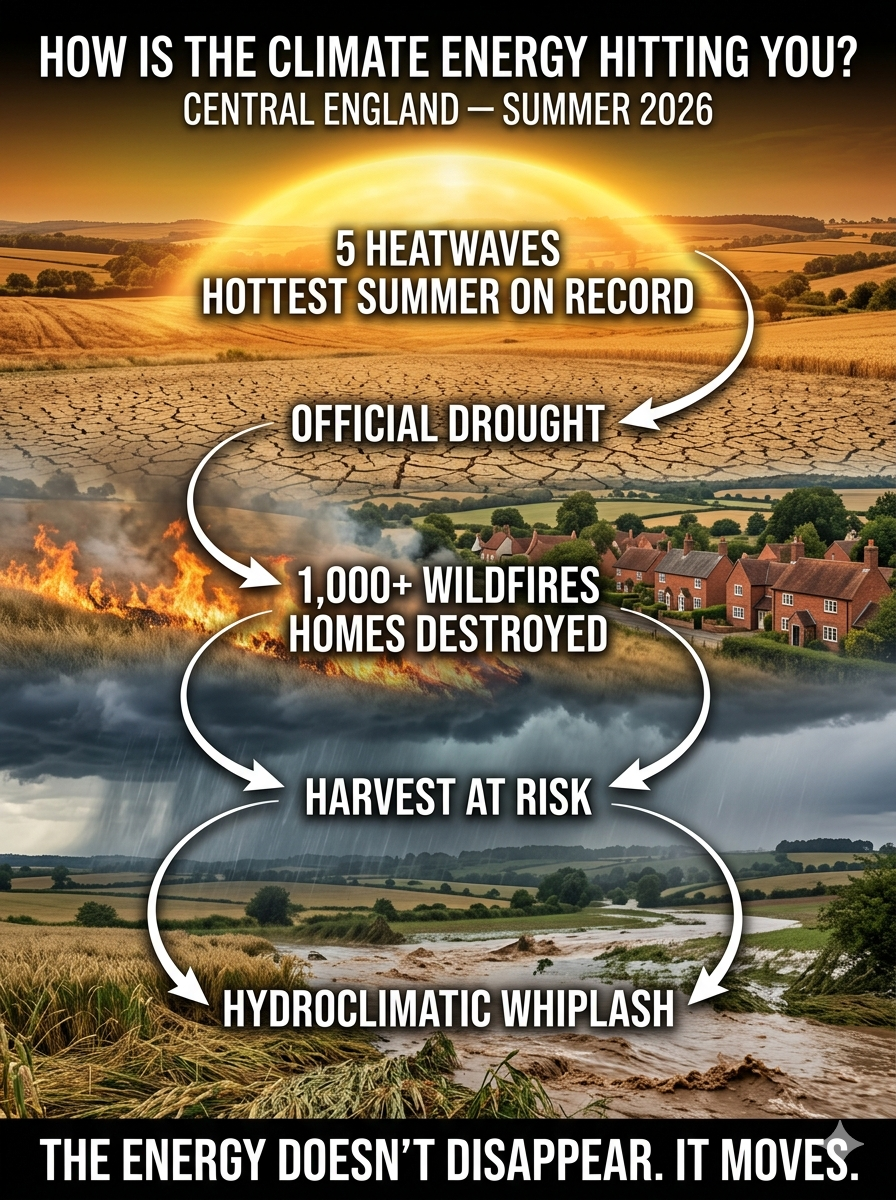
Central England is providing a very tangible demonstration of what climate energy looks like when it moves through a real landscape.
Not as an abstract temperature anomaly. Not as a number on a graph.
As heatwaves. Drought. Wildfires. Crop losses. Water restrictions. And then sudden, intense rainfall arriving on ground that has been baked hard by weeks of exceptional heat and dryness.
This is hydroclimatic whiplash: the rapid swing between one extreme hydrological condition and another.
Five Heatwaves — and Counting
Summer 2026 has already delivered a remarkable sequence of heatwaves across the United Kingdom. By August, the country had experienced a fifth heatwave, with the latest episode producing temperatures above 38°C in parts of England. Fire chiefs described the conditions as a sustained and escalating wildfire risk.
The Met Office has indicated that 2026 is on course to become the UK’s hottest summer on record, with the outlook particularly strong for England and Wales.
This isn’t simply five isolated hot spells.
Repeated heatwaves mean the landscape has less opportunity to recover between events. Soil moisture is depleted. Vegetation dries out. Rivers and reservoirs fall. Crops reach critical developmental stages under heat stress. Livestock experience thermal stress. And every subsequent heatwave starts from a more vulnerable baseline.
The energy isn’t disappearing when the thermometer comes back down.
It has already been transferred into the land, atmosphere, vegetation, water system and human infrastructure.
Drought: The Landscape Runs Out of Water
On July 29, the UK government officially declared drought across seven areas of England, including large portions of central, eastern and southern England. The government described much of the region as experiencing “flash drought,” driven by exceptionally low rainfall combined with high temperatures. Rivers were running low, farmers were harvesting early, wildfire risk was increasing and millions of people were facing water restrictions.
The situation continued to deteriorate.
By August, more than two-thirds of England had entered drought conditions. Reservoir storage had fallen to 69% and was declining, while more than 27 million people were living under water restrictions.
Official data for August 7–13 showed England receiving only 6% of its long-term average rainfall for the month to that point. Reservoir storage had fallen to 65.9%, 13.8 percentage points below the long-term average, while five reservoirs were classified as exceptionally low.
That is what a drought looks like when climate energy works through the water cycle.
The problem isn’t merely that it hasn’t rained.
It is that extraordinary heat increases evaporation and atmospheric demand for moisture while rainfall fails to replenish the system.
Then Comes the Deluge
And this is where the story gets particularly interesting.
After weeks of heat and dryness, rainfall doesn’t necessarily mean the drought is over.
When soils become severely dried and hardened, intense rainfall can run across the surface rather than infiltrating efficiently. Heavy showers and thunderstorms can therefore produce flash flooding even while the broader region remains in drought.
That apparent contradiction is becoming increasingly important.
England can simultaneously experience:
Drought underground.
Flooding on the surface.
Low reservoirs.
Overflowing drains.
Dry vegetation.
Rapid runoff.
This is hydroclimatic whiplash.
Recent forecasts and observations have already raised concerns that heavy rainfall following the prolonged drought could generate surface-water flooding without providing enough sustained precipitation to restore depleted soil moisture, groundwater and reservoirs.
A few hours of intense rain is not equivalent to weeks or months of accumulated rainfall.
The water has to be absorbed, stored and retained.
If it arrives too quickly, much of it simply moves downstream.
Wildfire: When the Landscape Becomes Fuel
The drought has also transformed the wildfire environment.
By August 10, firefighters in England and Wales had already responded to 966 wildfires in 2026, including 185 during the first ten days of August alone. July was the busiest month on record for wildfire incidents.
By August 16, the number had reached 1,132 wildfires across the UK—already exceeding the entire 2025 total, with months of the fire season still remaining.
The government eventually issued a national emergency alert warning of a very high wildfire risk across England and Wales.
And this was no longer simply a countryside problem.
In Stourbridge in the West Midlands, a grass fire spread rapidly into residential areas. Nineteen homes were destroyed and another 18 were damaged. Nearly 40 properties were affected.
The lesson is brutally simple:
When the countryside becomes tinder-dry, the boundary between wildfire and urban fire can disappear remarkably quickly.
Agriculture Takes the Hit
Perhaps the most consequential impact will not be visible in the flames.
It will be visible in the harvest.
The Energy and Climate Intelligence Unit’s August analysis found that the 2026 UK arable harvest was on track to become the worst on record. Initial yield estimates were already below the 10-year average for wheat, spring barley and oats.
Then the forecast deteriorated further.
Updated figures released August 14 put UK arable production at just 18.5 million tonnes, below the previous estimate of 19.5 million tonnes and approximately 1.35 million tonnes below the previous record-low harvest in 2020. ECIU estimated that the 2026 harvest could therefore become the smallest on record.
This is what happens when climate energy arrives at the wrong time.
Heat during crop development.
Drought during critical growth periods.
Accelerated maturation.
Reduced soil moisture.
Poor grass growth.
Heat-stressed livestock.
And then, potentially, heavy rainfall arriving after crops have already suffered.
The damage is not necessarily one spectacular event.
It is the accumulation of energy transfers occurring faster than agricultural systems can adapt.
The Climate Energy Doesn’t Disappear
This is the part of the story I think we frequently miss.
When the heatwave ends, we tend to assume the problem has ended.
It hasn’t.
The energy has moved.
Heat increases evaporation.
Evaporation removes water from soils and vegetation.
Dry vegetation becomes fuel.
Drought lowers river flows and reservoirs.
Wildfires transfer enormous amounts of energy into the atmosphere and destroy ecosystems and property.
Then storms can transfer atmospheric moisture into intense rainfall.
That rainfall can become runoff and flooding rather than useful groundwater recharge.
The system keeps moving.
One extreme can help create the conditions for the next.
Central England is not experiencing one climate problem.
It is experiencing a cascade.
Five heatwaves.
Official drought.
Record-low rainfall.
Depleted water resources.
Extreme wildfire conditions.
Homes destroyed.
Agricultural losses.
And now the possibility of intense rainfall and flash flooding arriving before the underlying drought has been repaired.
That is the important distinction.
Climate change isn’t simply about making today’s weather “hotter.”
It is about changing the amount of energy available to the climate system and altering how quickly that energy can move between the atmosphere, land, water and living systems.
The result can be greater volatility.
Longer extremes.
More rapid transitions.
And increasingly destructive combinations of events.
Central England is showing us what that looks like.
The question isn’t whether the climate energy is hitting us.
It is.
The question is:
Where does it go next?
And what happens when the next transfer arrives before the system has recovered from the last one?
Sea-level rise is not simply a matter of the ocean getting higher. Climate change is altering the physical forces that move water toward and onto the shoreline. Rising seas, changing atmospheric pressure, stronger winds, altered ocean circulation, storm surge, king tides, and saltwater intrusion can interact to turn gradual sea-level rise into a much more immediate coastal threat.
A Real-World Warning: The Wetlands Institute
The experience of The Wetlands Institute in Stone Harbor, New Jersey, provides a striking example of how quickly coastal conditions can change.
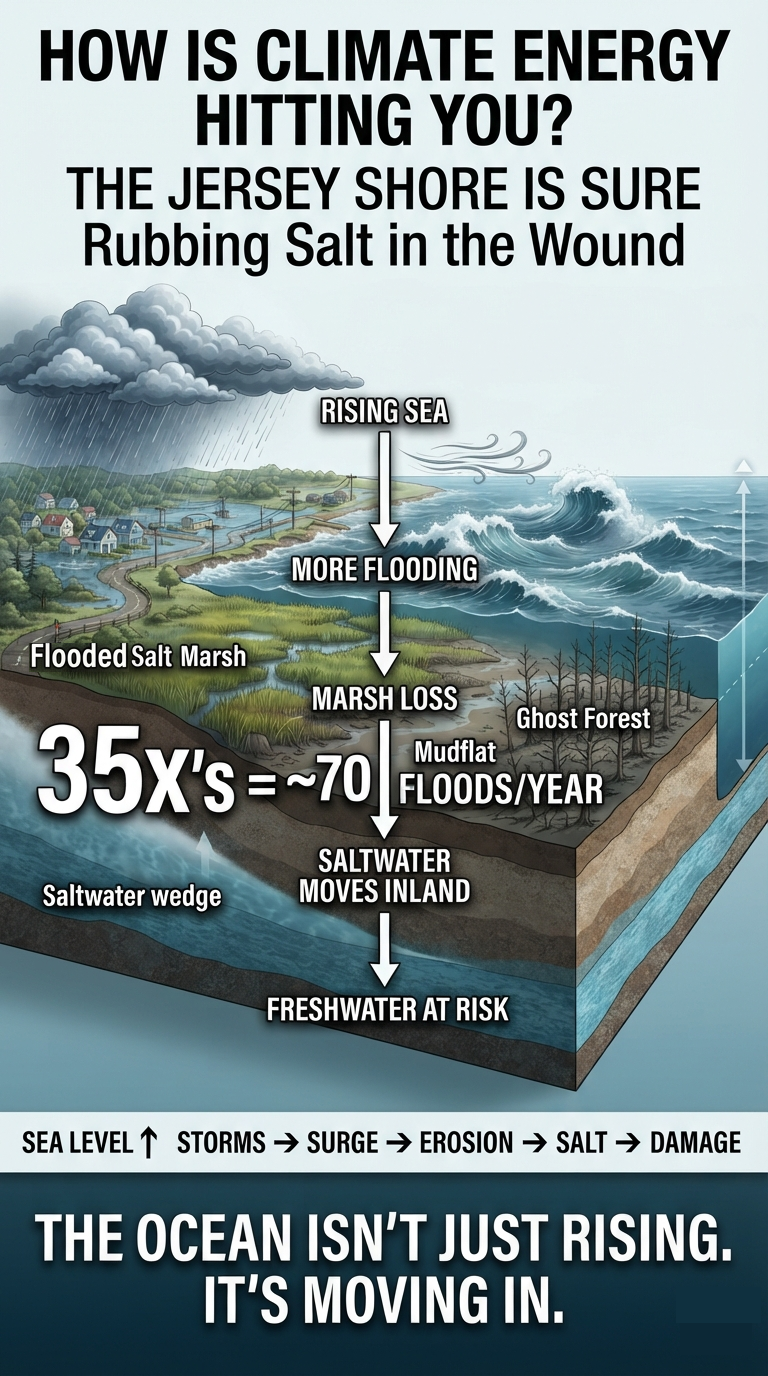
The institute’s Salt Marsh Trail reportedly flooded only a few times a year around 2000. Over the past five years, flooding has averaged nearly 70 times annually. The institute is closing its headquarters on September 7, 2026, to begin a major coastal-resilience transformation.
The response includes raising the Salt Marsh Trail by two to three feet using clean dredged material, temporarily relocating operations and educational programs, and pursuing a broader campaign to replace and elevate the existing campus buildings.
This is more than an inconvenience. Increasingly frequent inundation can fundamentally alter the coastal ecosystem itself.
The Climate Shift
Accelerated sea-level rise: Sea levels along parts of the New Jersey coast are rising faster than the global average.
Marsh degradation: Repeated inundation can overwhelm salt-marsh vegetation, converting productive marsh into mudflats and eventually open water.
Wildlife disruption: More frequent flooding threatens habitats used by marsh-dependent birds and can interfere with diamondback terrapin nesting.
Infrastructure exposure: Roads, buildings, trails, drainage systems, and utilities face increasingly frequent flooding even without a major storm.
The critical point is that the climate signal is not experienced as a smooth, uniform rise in water level. It is experienced as more frequent encounters with water.
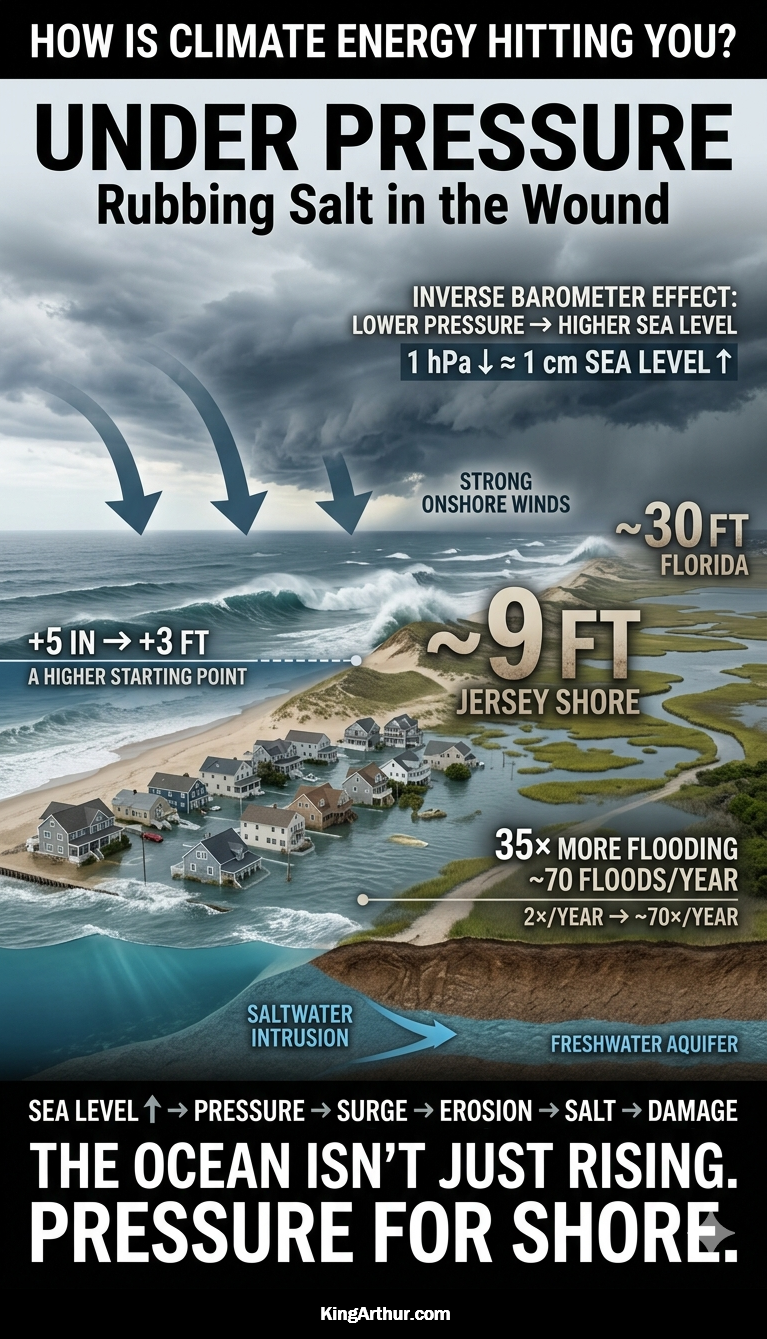
1. The Inverse Barometer Effect: Atmospheric Pressure Pushes the Ocean
Atmospheric pressure exerts physical force on the ocean surface. When a deep low-pressure system moves over the coast, the reduced atmospheric weight allows the ocean surface to rise.
The approximate relationship is:
A 1-hectopascal (hPa) decrease in atmospheric pressure produces roughly a 1-centimeter rise in sea level.
A very deep storm can therefore raise the local ocean surface substantially before the effects of wind-driven storm surge are even considered.
This is known as the inverse barometer effect.
Climate change does not simply “raise the sea.” It can alter the atmospheric conditions that determine how that elevated ocean is distributed along the coastline at any particular moment.
Inverse Barometer Effect Examples
Storm type
Approx. pressure near coast
Pressure drop from 1013 hPa
Inverse-barometer rise
Ordinary coastal storm
990–1000 hPa
13–23 hPa
5–9 in
Strong nor’easter
970–985 hPa
28–43 hPa
11–17 in
Very strong coastal storm
950–965 hPa
48–63 hPa
19–25 in
Sandy-type extreme
~945 hPa
~68 hPa
~27 in / 2.2 ft
Exceptional low-pressure event
930–940 hPa
73–83 hPa
29–33 in / 2.4–2.8 ft
The Combined Impact
The inverse barometer effect combines with wind stress, coastline shape, bathymetry, wave setup, tides, and storm track can produce much larger water-level changes. Hurricane Sandy’s actual coastal water levels were dramatically higher because the pressure effect was combined with enormous wind-driven surge, wave action, tide, and the storm’s exceptionally favorable track. At Sandy Hook, water reached about 8.9 feet above ground level, while the storm produced major surge throughout the central and northern Jersey Shore.
An additional 5 inches to 3 feet of sea-level rise represents a new baseline of climate energy impacting coastal communities. The inverse barometer effect then combines with wind stress, coastline shape, bathymetry, wave setup, tides, and storm track to produce much larger water-level changes. The result can be extreme coastal flooding, with observed water levels reaching roughly 9 feet above ground level along parts of the Jersey Shore and as much as 30 feet in parts of Florida during major storms.
2. Wind and Wave Energy: Turning Pressure Gradients Into Coastal Damage
Atmospheric pressure gradients—the differences between areas of high and low pressure—drive winds.
When those gradients become stronger, winds can become stronger and more persistent. Strong winds transfer energy to the ocean, generating larger waves and increasing wind setup, the piling of water against the coast.
The consequences can include:
Higher water levels along exposed shorelines
Larger and more destructive waves
Increased dune erosion
Offshore transport of beach sand
Overtopping of coastal defenses
Greater storm-surge penetration
The shoreline therefore experiences not only a higher baseline sea level but also increasingly energetic ways of moving that water around.
3. Altered Ocean Circulation: When Water Piles Up
Changes in large-scale atmospheric circulation can alter ocean currents and regional sea levels.
The relationship between the Gulf Stream, the North Atlantic circulation, winds, and coastal sea level is particularly important along the U.S. East Coast. Changes in ocean circulation can redistribute enormous volumes of water, producing dynamic sea-level changes that may differ substantially from the global average.
In simplified terms, when ocean circulation changes, water can accumulate against a coastline rather than being transported away from it.
That means a community can experience a rapid increase in local relative sea level even when the global mean is changing much more slowly.
4. Compound Coastal Flooding: When Everything Arrives Together
The most dangerous coastal flooding occurs when multiple processes reinforce one another.
Imagine a high tide occurring while:
Global sea level is already elevated.
A low-pressure storm raises the ocean through the inverse barometer effect.
Strong onshore winds push additional water toward land.
Large waves increase water levels and erode dunes.
Heavy rainfall overwhelms drainage systems.
Rivers are already elevated and cannot discharge efficiently.
These processes can combine into compound flooding.
The problem is not simply that the water is higher. The problem is that multiple pathways for moving water onto the land are operating simultaneously.
Salt marshes normally provide a natural buffer. But repeated inundation and erosion can eventually overwhelm the marsh itself. Once protective wetlands deteriorate, more wave energy reaches infrastructure, creating a feedback loop of increasing exposure and increasing damage.
Saltwater Intrusion: When the Ocean Moves Underground
Sea-level rise has another consequence that is much less visible than coastal flooding: saltwater intrusion.
Saltwater intrusion occurs when seawater moves into freshwater systems, including groundwater aquifers, rivers, wetlands, agricultural soils, and drinking-water supplies.
Two forces are especially important:
Rising sea level increases the hydraulic pressure and inland reach of seawater.
Drought and reduced groundwater recharge weaken the freshwater pressure pushing outward toward the sea.
Together, these forces can shift the boundary between freshwater and saltwater inland.
Research has projected that saltwater contamination could affect a very large proportion of coastal aquifers by 2100, although the extent varies substantially by geography, aquifer characteristics, groundwater use, and future climate conditions.
How the Saltwater Wedge Moves Inland
Under normal conditions, rainfall replenishes groundwater. Freshwater flows toward the coast and maintains a hydraulic gradient that helps resist seawater intrusion.
Because freshwater is less dense than seawater, a freshwater lens can exist above denser saltwater beneath coastal areas.
But the balance can shift.
1. Underground Aquifer Intrusion
As sea level rises, the hydraulic pressure exerted by seawater increases. At the same time, climate-driven drought and higher temperatures can reduce groundwater recharge in some regions.
Less freshwater flowing toward the ocean means less outward pressure resisting seawater.
The underground saltwater boundary can therefore migrate inland.
This process can occur largely out of sight until a well begins producing water with elevated salinity.
2. Surface and Vertical Infiltration
Storm surge, king tides, and coastal flooding can push seawater onto land.
If that water remains on the surface, it can infiltrate downward through soils and shallow geological formations, contaminating groundwater.
Repeated flooding is especially important because a single event may be temporary, while dozens of inundation events each year can progressively alter soil and groundwater chemistry.
3. The “Highway Effect”
Human modifications to coastal landscapes can provide pathways for seawater to travel inland.
Agricultural drainage ditches, shipping channels, tidal creeks, canals, and other engineered waterways can connect coastal waters with areas that were historically protected by natural terrain.
When sea level rises or storm surge moves inland, these channels can function as highways for saltwater.
The Ecological and Economic Consequences
Saltwater intrusion does not stop at the shoreline.
Ghost Forests
As saltwater enters coastal soils and groundwater, freshwater-dependent trees can die from prolonged salt stress. The result can be stands of dead trees known as ghost forests.
These landscapes provide visible evidence that the boundary between marine and terrestrial ecosystems is moving inland.
Agricultural Damage
Salt deposited on agricultural land can accumulate in the root zone.
Excessive soil salinity interferes with plants’ ability to absorb water and can reduce crop productivity. Persistent salinization can make valuable coastal farmland increasingly difficult—or eventually impossible—to farm without expensive remediation and freshwater management.
Infrastructure Corrosion
Saltwater and brackish groundwater are highly corrosive.
Repeated exposure can accelerate deterioration of underground pipes, electrical infrastructure, concrete, foundations, roads, and other infrastructure.
The damage can occur beneath the surface long before it becomes visually obvious.
Drinking-Water Threats
Coastal communities that depend on groundwater face a particularly serious vulnerability.
Pumping already lowers groundwater levels around wells. If the freshwater table is lowered too far, the hydraulic gradient resisting seawater intrusion weakens further.
This can create another feedback:
More pumping → lower freshwater pressure → greater saltwater intrusion → less usable freshwater.
The Larger Picture: Climate Energy Does Not Disappear
Sea-level rise is one expression of a much larger physical process.
The additional energy accumulating in the climate system does not simply produce a higher average temperature. Energy moves through the atmosphere, ocean, land, ice, and biosphere.
The critical distinction is between average conditions and actual events.
A few inches of average sea-level rise may sound modest. But those inches can determine whether a high tide remains below a road or flows across it. They can determine whether a storm surge is absorbed by a functioning marsh or reaches buildings and infrastructure.
The climate system does not deliver its additional energy evenly.
It delivers it through water, wind, waves, heat, storms, erosion, flooding, and ecological disruption.
And along the coast, the ocean is increasingly finding more ways to come ashore—and stay there.
I thought it might be a fun experiment to see how the extreme weather fueled by climate change is impacting you—and me.
I’ll start with “What I Did on My Summer Vacation.”
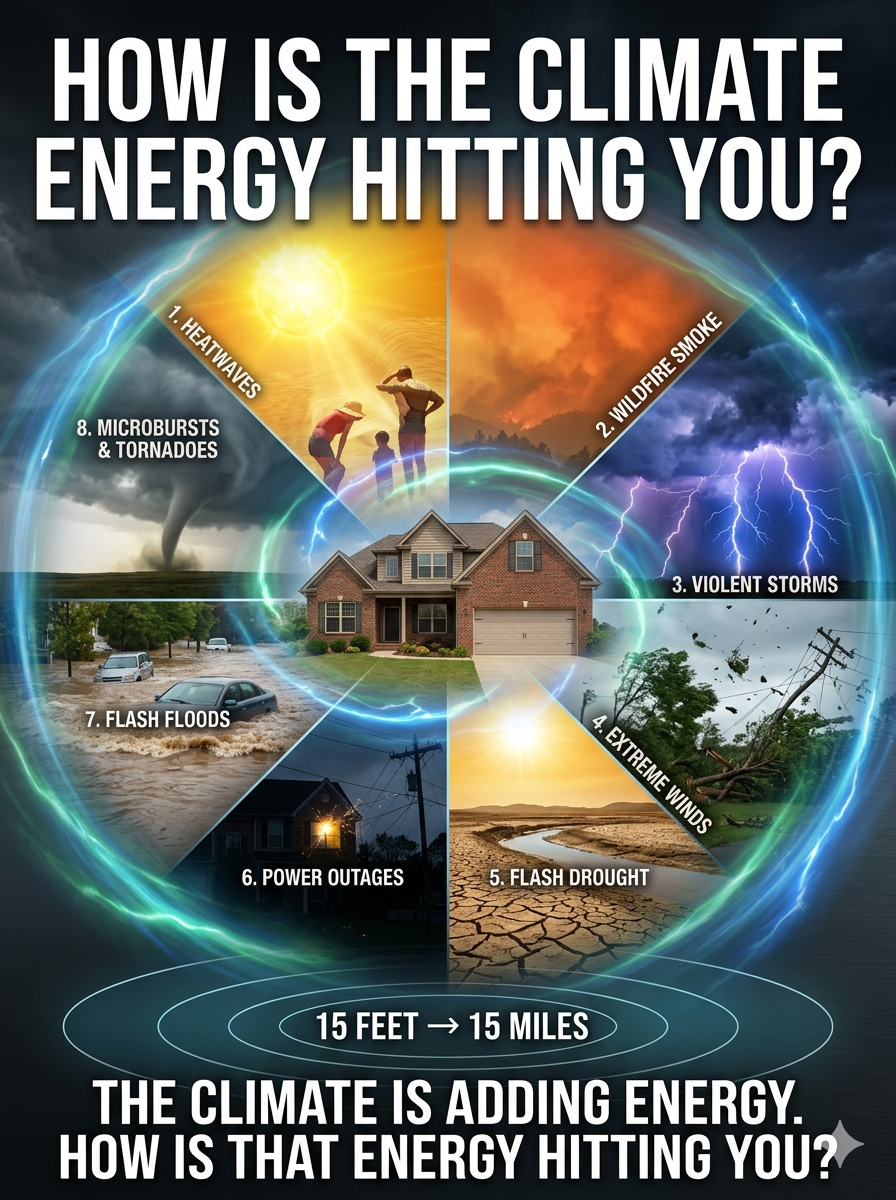
Within 15 feet of my backdoor, we’ve experienced more violent storms than ever. Events that used to happen once every thirty years seem to be happening right now.
The violent storms at my house have produced only about three inches of rain in total. But a couple of times, when the rain became truly extreme, it was giant p = mv pain rain. Thank the god of physics for friction and wind resistance—or we all might have been dead.
But the rain was the least of it.
The winds and lightning have been even more extreme. Winds have taken down branches and sections of trees on an almost daily basis, creating an unusual amount of chainsaw work for me. Lightning has been nearly daily as well.
We’ve had more power outages in these three months than we normally experience in a dozen years. Fortunately, the local infrastructure was upgraded recently, so most outages have been brief. New technology allows the utility to install breakers along the lines, helping isolate problems and restore power more quickly.
But that has presented a new problem: power surges.
Lights flicker, breakers trip, and electronic equipment gets hit with sudden changes in voltage. I hadn’t really considered surge protection for something as mundane as my room lighting. Now I do.
Another new extreme has been the flash drought.
Even with all these thunderstorms, the new climate atmosphere seems capable of sucking water out of everything—the soil, the plants, even the pool—within days, sometimes within a day, and occasionally within hours.
Overall, it has been one of the worst years for my home garden.
Oh, I almost forgot.
There were six heatwaves.
And then there were the days when the wildfire smoke made the air practically unbreathable. The smoke wasn’t coming from a fire in my backyard, but the atmosphere doesn’t care much about property lines. Wildfires hundreds or thousands of miles away can turn the local air quality into a serious problem.
And this is just what has happened within 15 feet of my backdoor.
For the next installment of this show-and-tell, I’ll expand the circle to the more exciting energy events that have occurred within 15 miles of my house: microbursts and straight-line winds powerful enough to collapse buildings, furious flash floods in town after town, and, of course, tornadoes.
The point isn’t that every storm, heatwave, drought, or wildfire is caused by climate change.
It isn’t.
The point is that the climate system is changing the amount of energy and moisture available to extreme events—and we are increasingly experiencing what that extra energy can do.
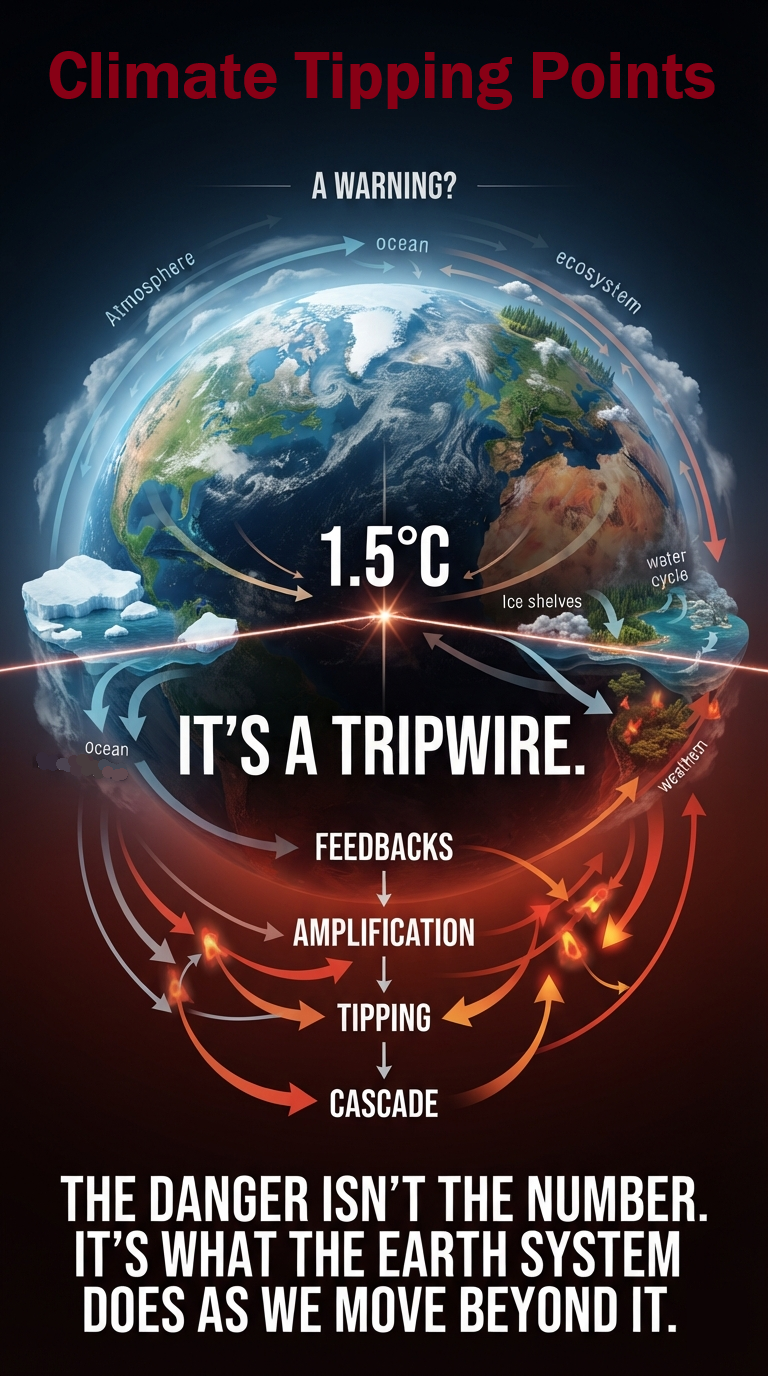
One reason the public has become so focused on this number is its simplicity. A 1.5°C (2.7°F) increase sounds like a straightforward, easily understood concept. It also doesn’t sound particularly frightening. After all, what’s the big deal about a couple of degrees of warming? Some people even portray it as potentially beneficial.
Scientists take a very different view.
There are many ways to look at climate change. At the micro level, millions of individual feedbacks are operating throughout the Earth system—between the atmosphere, oceans, ice, land, ecosystems, and human systems. At the macro level, all of those interactions combine to form a single, interconnected climate system.
The critical question is not simply how much the planet warms, but what happens as warming changes the system itself.
Understanding how these feedbacks interact—and, more importantly, how they amplify one another—is at the bleeding edge of climate science. The climate system is not a simple thermostat in which each additional degree produces a proportionally larger but otherwise predictable effect. It is a complex, nonlinear system capable of crossing thresholds and shifting into fundamentally different states.
That is why 1.5°C matters.
The 1.5°C threshold identified in the Paris Agreement—and the roughly 2°C level generally regarded as an even more dangerous boundary—is not important because the difference between 1.4°C and 1.5°C is somehow magical. These numbers matter because increasing global temperatures raise the probability of triggering major climate tipping points.
And once tipping points begin to activate, the question of whether warming ultimately reaches 2°C, 3°C, or even 4–7°C becomes much less relevant for two fundamental reasons:
First, tipping points can initiate self-reinforcing feedbacks that continue driving change even after the original forcing changes.
Second, the impacts do not necessarily increase gradually with temperature. They can accelerate, compound, and cascade as interconnected systems begin to destabilize.
In other words, 1.5°C is not a destination. It is not merely a warning sign or an alarm. It is a tripwire.
A warning sign tells you that danger is ahead. An alarm tells you that danger may already be present. A tripwire is different: it marks a threshold at which crossing the line can trigger a chain of events that becomes increasingly difficult to control or reverse.
That is the critical distinction that can be lost when climate change is reduced to a single temperature number.
The real danger lies not in the number itself, but in what the Earth system is doing as we move beyond it.
We are not simply adding another fraction of a degree to a static planet. We are increasing the energy entering a dynamic, interconnected system—and that additional energy is altering the very processes that determine how the system responds.
The question, therefore, is not simply, “How many degrees warmer will Earth become?”
The more important question is:
“What happens as we cross the tripwires?”
1. The Ocean Holds Most of the Energy Imbalance
The ocean holds most of the excess energy accumulating in the climate system. A deep-ocean study has revealed that even the deepest layers of the ocean are warming at a measurable rate.
The oceans absorb and store more than 90% of the excess heat trapped by greenhouse gases. In 2025, a tiny increase—one-tenth of a degree—was observed. That seemingly insignificant change represents an enormous amount of additional stored thermal energy. This represents an amount of stored thermal energy roughly equivalent to a 2°C increase in the atmosphere and surface system.
If the accumulated ocean heat were distributed across land surfaces, it would equate to an estimated 35°C increase in land temperatures—a level that would make much of the planet uninhabitable.
This illustrates how the oceans have been masking the full extent of the Earth’s energy imbalance, acting as a temporary thermal buffer while simultaneously undergoing changes of their own, including increased stratification, circulation changes, and ecosystem disruption.
The entire Pacific Ocean is running approximately 1.6°C above its long-term average—roughly six standard deviations above the mean. In climate science, deviations of this magnitude are virtually off the charts, underscoring just how far outside what we would consider normal variability the climate system has moved.
2. Tipping Points Take Over the Coupling and Acceleration
Tipping points can fundamentally change how the climate system responds by coupling positive and negative feedbacks across multiple components of the Earth system.
The overriding concern for humanity should not simply be the average surface temperature. It should be how the millions of interconnected feedbacks within the climate system will respond.
We have a pretty good understanding of some of these feedbacks. For many others, we don’t.
One of the simplest examples is the albedo effect.
The physics of albedo is straightforward: bright, reflective surfaces send a portion of incoming solar energy back into space, while darker surfaces absorb more of it. Less ice means more exposed dark surfaces, more absorbed energy, and therefore more warming.
But the system quickly becomes much more complicated.
How does changing albedo affect cloud formation, particularly over the tropics? And what happens to the climate if those clouds increase—or decrease?
Low clouds are especially important because they can reflect substantial amounts of incoming sunlight back into space. If tropical low clouds diminish, the ocean could absorb significantly more solar energy, accelerating warming.
This is where the bleeding edge of climate science begins.
Clouds are arguably the largest remaining uncertainty in our understanding of climate sensitivity. They can reflect incoming solar radiation, producing a cooling effect, while high, thin clouds can allow incoming sunlight through while trapping outgoing heat.
Which effect dominates—and how that balance changes as the planet warms—is one of the great unanswered questions in climate science.
Our expectation is that the climate system could eventually approach a new equilibrium around +4°C above the preindustrial baseline, perhaps over the course of a couple of centuries. That would imply roughly +2–3°C this century, with additional warming continuing into the next.
The important point is that climate change is not a simple linear equation.
It is a massively interconnected system in which a change in one component can alter another, which then feeds back into the first.
Ice affects albedo. Albedo affects heating. Heating affects clouds. Clouds affect radiation. Radiation affects ocean temperatures. Ocean temperatures affect evaporation and atmospheric moisture. And the cycle continues.
Conclusion
What matters most for human habitability is not simply the temperature we measure at the surface. It is the amount of energy remaining in the climate system and how that energy is redistributed.
If the temperature “only” rises 2°C while energy accumulation continues, the surface temperature becomes much less informative by itself. What becomes increasingly urgent is how that additional energy—measured in joules—is redistributed to your location.
The most obvious example is the supercharged water cycle.
For every 1°C increase in temperature, air can hold approximately 7% more water vapor. The atmosphere doesn’t care about the global average temperature. Many places can experience temperatures 10°C above their local average. That creates the potential for dramatically greater atmospheric moisture and, consequently, more intense rain, hail, and snow events when that moisture is released.
And indeed, we are seeing extreme flood events occurring with increasing frequency, including events described as having return periods of hundreds of years. Hail has also become one of the largest sources of insurance claims affecting homes, automobiles, and agriculture.
While the long-term equilibrium matters, there is a much more immediate question.
What happens to you over the next five years?
We are already seeing rainfall becoming more intense and, in many places, more destructive—violent. A warmer atmosphere can hold more water vapor, increasing the potential for extreme precipitation. The question isn’t simply how hot the planet might become over the next 50 years.
The more immediate question is:
What is the violent rain going to do to your home, your community, your infrastructure, your insurance—and you—over the next five years?
That is where climate change stops being a distant projection and starts becoming a personal reality.
Welcome to the future. Climate change is accelerating—and the acceleration itself is accelerating.
As tipping points become increasingly coupled and reinforce one another, the amount of energy moving through the climate system is accelerating—and the rate of acceleration itself is increasing.
At this point, the question is no longer simply, “How many degrees warmer will the planet become?”
The more important questions are: How much additional energy are we going to continue trapping? Where is all that energy going? And what will it do when it gets there?
We are already beginning to see the answers—in floods, heatwaves, flash droughts, wildfires, hailstorms, extreme precipitation, and increasingly volatile swings between opposing extremes.
These are not separate problems.
They are different manifestations of an increasingly energized climate system.
The planet does not experience climate change as a number on a thermometer.
It experiences it as energy moving through the system.
And that energy has to go somewhere.
The climate system is being supercharged.
The question is no longer whether that energy will affect us.
The question is where it will hit—and what it will do when it gets there.
Postscript: Where Does All That Energy Go?
Q: I don’t quite understand part of the paper. What does a “35 degree increase” in temperature mean? Where I live, a summer day can be around 30 degrees Celsius. Would this mean a summer day at around 65 degrees? (30+35=65). Wouldn’t that be lethal?
A: Good question. The answer is yes—and no. That’s actually part of the point of the paper.
A 65°C temperature at your location would obviously be lethal. But the 35°C figure is an energy-equivalent thought experiment, not a prediction that your local summer temperature would simply go from 30°C to 65°C.
The bigger problem with using average temperatures is just that—they are averages. An average of 65°C across a large area could mean one location is 30°C, another is 40°C, and another is far beyond either. The distribution of that energy matters far more to human habitability than the average itself.
And that’s where I don’t expect all of the already stored energy to behave “on average.” I don’t know exactly how that energy will hit you. It could manifest as violent rainfall, hail, heatwaves, wildfires, flash droughts, or any number of other energy transfers we haven’t fully anticipated.
But as long as that energy remains trapped in the Earth system, it doesn’t simply disappear. It continues moving through the system and interacting with everything else. You cannot create or destroy energy—you can only experience its feedbacks.
And yes, we would have to adapt. If conditions outside became routinely lethal, people might increasingly move underground or into heavily climate-controlled environments to survive.
In any event, an average of 65°C would be pretty close to hell—whether you’re experiencing it alive or studying it after the fact. 😏
While Sidd was in town, I took some notes. Somehow, they turned into this:
Climate Change: The Big Picture
There are many ways to look at climate change. From a micro perspective, there are millions of individual feedbacks operating throughout the Earth system. From a macro perspective, there is the climate system as a whole.
Understanding how those feedbacks interact—and, more importantly, how they feed back into one another—is at the bleeding edge of climate science.
One of the simplest examples is the albedo effect. The physics of ice is straightforward: bright, reflective ice sends a portion of incoming solar energy back into space, while darker ocean absorbs it. Less ice means more absorbed energy and, therefore, more warming.
But the system quickly becomes much more complicated.
How does changing albedo affect cloud formation, particularly over the tropics? And what happens to the climate if those clouds increase—or decrease?
The low clouds are especially important. They can reflect substantial amounts of incoming sunlight back into space. If tropical low clouds diminish, the ocean could absorb significantly more solar energy, accelerating warming.
This is where the bleeding edge begins.
Clouds are arguably the largest remaining uncertainty in our understanding of climate sensitivity. They can both reflect incoming solar radiation and trap outgoing heat. Which effect dominates—and how that balance changes as the planet warms—is one of the great questions in climate science.
My expectation is that the climate system could eventually approach a new equilibrium around +4°C above the preindustrial baseline, perhaps over the course of a couple centuries. That would imply roughly +2–3°C this century, with additional warming continuing into the next.
But that remains uncertain.
The important point is that climate change is not a simple linear equation. It is a massively interconnected system in which changes in one component can alter another, which then feeds back into the first. Ice affects albedo. Albedo affects heating. Heating affects clouds. Clouds affect radiation. Radiation affects ocean temperatures. Ocean temperatures affect evaporation and atmospheric moisture. And the cycle continues.
Everything is nonlinear.
Yet uncertainty about the exact trajectory does not mean uncertainty about what we should do.
The clearest lever we have is still the same: reduce CO₂ emissions and slow the accumulation of greenhouse gases in the atmosphere.
And while the long-term equilibrium matters, there is a much more immediate question.
What happens to you over the next five years?
We are already seeing rainfall becoming more intense and, in many places, more destructive—violent. A warmer atmosphere can hold more water vapor, increasing the potential for extreme precipitation. The question isn’t simply how hot the planet might become over the next 50 years.
The more immediate question is:
What is the violent rain going to do to your home, your community, your infrastructure, your insurance—and you—over the next five years?
That is where climate change stops being a distant projection and starts becoming a personal reality.