bookmark_border“It Ain’t Me”: Trump’s Military Parade Backfires Amid Global Criticism and Domestic Protest

In a stunning series of events, President Donald Trump’s long-anticipated military parade proved to be an embarrassing misfire—both symbolically and politically. Despite the millions of taxpayer dollars spent on tanks, flyovers, and carefully choreographed pageantry, the turnout was underwhelming. According to multiple international news sources, only several thousand attendees appeared, leaving large swaths of the National Mall sparsely populated.

But it wasn’t just the empty space that spoke volumes. The most unforgettable—and ironic—moment came as the infantry passed while the military band played Creedence Clearwater Revival’s iconic antiwar anthem, “Fortunate Son.”

“Some folks are born made to wave the flag / Hoo, they’re red, white, and blue…
And when the band plays ‘Hail to the Chief’ / Ooh, they point the cannon at you, Lord…”

“It ain’t me, it ain’t me / I ain’t no senator’s son, son…”

The lyrics—an unmistakable rebuke of privileged political elites who send others to war—clashed starkly with the image of Trump, a man who dodged the Vietnam War with multiple deferments, basking in military grandeur as soldiers marched before him.

A Parade of Contradictions
While billed as a tribute to the troops, the parade laid bare the contradictions of the Trump administration. The event reportedly cost tens of millions of dollars, even as the administration continues to push for deep cuts to food stamps, healthcare subsidies, and housing assistance—programs that disproportionately serve veterans, working families, and the very communities from which most enlisted soldiers come.

Even more ironic: the vast majority of the marching service members were people of color, and many were women—groups that have borne the brunt of Trump’s political rhetoric, policy rollbacks, and immigration crackdowns. According to estimates, roughly 90% of enlisted personnel involved in the parade were non-white.

“No Kings” Protests Sweep the Nation
As Trump looked out over a military procession designed to evoke strength and loyalty, millions of Americans were in the streets holding signs that read “No Kings.” In more than 150 cities, demonstrators gathered to protest what they describe as Trump’s authoritarian tendencies, including his attempts to undermine the judiciary, intimidate the press, and flout congressional oversight.

These protests weren’t just political opposition; they were a direct rejection of Trump’s growing embrace of militarized nationalism—a move many see as an attempt to normalize strongman tactics in the United States.

Global News Coverage and Condemnation
International outlets seized on the event to highlight what many foreign commentators described as the ongoing decline of American democratic norms. European and Asian broadcasters ran montages of the parade alongside footage of mass protests, immigrant detentions, and civil rights rollbacks. Several outlets highlighted the choice of “Fortunate Son” in particular, noting the irony of its anti-elitist message being played for a President often described as an embodiment of wealth, privilege, and populist manipulation.

Critics around the globe continued to spotlight the administration’s open ties to white nationalist rhetoric, from immigration bans and voter suppression to the President’s refusal to denounce far-right militias. One BBC commentator noted, “When a leader embraces the trappings of monarchy and silences opposition, even parades begin to look like warnings.”

The Cost of Spectacle
The parade may have been designed to boost morale, project strength, and rally Trump’s base. But instead, it drew global attention to a White House increasingly isolated both at home and abroad. The optics—a President standing amid rain and dwindling crowds, with antiwar lyrics echoing in the background—did not project dominance. They projected disconnect.

And for millions of Americans—marching in the streets, struggling with basic needs, or simply watching with unease—the parade served as a painful reminder of what’s being lost: not just money, but values, dignity, and direction.

Even more disturbingly, the stage itself was plastered with corporate sponsorships—from Coinbase and Palantir to Lockheed Martin and UFC—further commercializing what was falsely billed as a patriotic celebration. News reports confirm that these companies helped fund the parade, turning a national military display into an ad-laden marketing event.

So, not only were soldiers demeaned and marched like extras in a rain-drenched propaganda show—they were also used to sell products, cover political costs, and give legitimacy to a regime that pardons insurrectionists and undermines democracy.

In the end, it wasn’t strength that defined the day—it was irony. And irony, unlike patriotism, can’t be choreographed.

Parade of Profit: How Trump Turned Military Sacrifice into Corporate Spectacle

VA Policy Shift Enables VA Doctors to Refuse Care to Democrats and Hire by Politics
Trumpenomics: The Decline of the US

bookmark_borderMarket Reactions to Bombs and Babies: What’s No Longer Surprising — And What Should Be Alarming

by Daniel Brouse
June 13, 2025

The most recent geopolitical shock—marked by yet another bombing campaign with tragic civilian casualties, including children—once again shook global financial markets. While the human toll is heartbreaking, the market’s response offers a revealing glimpse into shifting investor psychology and the erosion of long-standing economic assumptions.

What Was Not Surprising:

The immediate market reaction followed a familiar pattern:

  • Major stock market indexes dropped sharply, as expected during times of escalating global conflict.

  • Defense contractors soared, including General Dynamics (GD), Lockheed Martin (LMT), and BAE Systems (BAESY), reflecting investor bets on prolonged military engagement.

  • The VIX volatility index spiked, signaling heightened fear and uncertainty.

  • Oil prices surged, as conflict in key regions raised concerns over supply disruptions and energy security.

These responses are in line with historical precedent. When bombs fall, markets get jittery, investors retreat from risk, and defense and energy stocks rally.

What Was Surprising:

However, what didn’t happen is more significant than what did.

There was no flight to safety in the U.S. Treasury markets. Historically, Treasury securities—especially 10-year notes and longer-term bonds—rally during geopolitical crises, as investors seek the safety of stable, liquid government debt. But this time, Treasury prices fell, and yields rose.

This break from tradition is both unexpected and troubling. It suggests that U.S. government debt is no longer perceived as the safe haven it once was. Whether due to ballooning deficits, political instability, erosion of institutional trust, or the long-term effects of America’s increasingly isolationist and unilateral foreign policy, the failure of Treasuries to attract capital in a time of crisis is a flashing red warning sign.

A Broader Decline in Confidence?

This development may signal a deeper issue: the decline of American Exceptionalism. For decades, U.S. markets, institutions, and the dollar were seen as global anchors in times of chaos. But under the economic and geopolitical shadow of Trump-era policies—marked by trade wars, weakened alliances, and inward-looking nationalism—those anchors appear to be losing their grip.

If markets no longer reflexively turn to U.S. Treasuries in times of turmoil, it could indicate a long-term shift in global investor confidence. And if that’s the case, we are not just witnessing volatility—we may be entering a new paradigm in which America’s financial and geopolitical dominance is no longer taken for granted.

Trumpenomics: The Decline of the US

bookmark_borderAI as a Creative Ally: How Technology Is Helping Artists Thrive

by Daniel Brouse
June 13, 2025

Several companies and artists are now using AI and robotic arms to assist in marble sculpting—not only to increase speed and precision, but also to help prolong their ability to create. Many sculptors and musicians suffer from repetitive motion disorders and other debilitating injuries.

Last year, I developed tendonitis in my shoulder from playing guitar and bass. Fortunately, around the same time, the first practical and accessible AI tool for musicians became available for free. Within three months of incorporating it into my workflow, my shoulder had recovered.

Critics of AI in music are often musicians themselves—but many are simply uninformed. Most have never tried training with a model or practicing alongside one. Can AI do all the creating? Yes. But that’s not how true innovators use it.

For me, AI has significantly improved both my health and my creative output. It’s helped me better capture and record what’s in my head—and in doing so, it’s expanded the very boundaries of what I thought was possible in my art.

60 Minutes recently featured a segment on sculptors who view AI and robotics as valuable tools, and shared their perspectives on whether this technology diminishes the role of the artist.
Watch the segment here.

This article is in response to:
AI… is It Ethical? is It the Future? Can It Be Used for Good? (Jack Brouse, 2025)

KingArthur.com

bookmark_borderNavigating Volatility: Why I’m Avoiding U.S. Equities and Trading UVIX Instead

For some time now, I’ve advised minimizing exposure to U.S. equities, particularly while the economic and political landscape remains clouded by trade wars and anti-immigration policies. These ongoing disruptions have created a level of uncertainty that makes traditional equity investing unusually risky. My recommendation remains the same: pay close attention to the bond market and the value of the U.S. dollar, rather than being distracted by short-term moves in the stock market.

That said, if you’re an active investor—someone who closely monitors the markets—there are still compelling ways to trade. One of my preferred instruments right now is the 2X Long VIX Futures ETF (ticker: UVIX). This is a leveraged Exchange-Traded Product (ETP) designed to deliver twice the daily return of the S&P 500 VIX Short-Term Futures Index. Essentially, UVIX tracks market volatility, often spiking during times of economic, geopolitical, or financial stress.

Because UVIX is leveraged and resets daily, it is not suitable for buy-and-hold investors. It’s a trading vehicle, not an investment. Positions should be monitored as frequently as daily, and trades should be based on short-term market dynamics. However, for those who understand the risks and can manage the volatility, the rewards can be significant.

For example, I recently purchased UVIX at $24 per share and sold at a 12% gain in just one week. If annualized using compound interest, that’s an eye-popping yield of 28,800%—though to be clear, such returns are unlikely to be consistently replicated and come with substantial risk.

Given the backdrop of global instability—including trade tensions and developments like the recent bombing in Iran—market volatility is likely to remain elevated. This makes UVIX an attractive opportunity for disciplined traders who understand the instrument and can act swiftly.

In short, while broad equity exposure may not be prudent under current conditions, targeted, tactical trades in volatility products like UVIX offer a way to capitalize on market uncertainty. Just proceed with caution, clear strategy, and a keen eye on the exits.

This isn’t an investment recommendation—it’s a trading recommendation. Any capital used should be considered fully “at risk.”

That said, I executed a second trade that yielded a 31% gain in just 5 days, which theoretically equates to an annualized compound return of about 24.75 billion percent.

And the good thing about taxes? They only take a portion of the “free” money you just made.

In fact, if you had timed things right yesterday, you could have captured a 21% gain in a single day—which translates to a theoretical annualized compound rate of approximately 678,000,000,000,000,000,000,000,000,000,000% (that’s 6.78 decillion percent).

Of course, a 12% gain from a buy-and-sell trade over one week qualifies as a short-term capital gain, which is taxed at your regular income rate. By contrast, long-term capital gains (on assets held for more than one year) and qualified dividends can be taxed at much lower rates—as low as 0%, depending on your income.

If taxes are a bigger concern than immediate income, you might consider making these kinds of trades in a tax-deferred retirement account (such as an IRA or 401(k)), where gains can compound without immediate tax consequences.

Trumpenomics: The Decline of the US

bookmark_borderThe Math Behind Sequential Tariffs

by Daniel Brouse
June 11, 2025

The math of sequential tariffs is both interesting and economically significant. The complexity adds to business uncertainty. For instance, to calculate the total duties on Chinese steel imports — subject to a combined 132.5% tariff rate — you can break it down like this:

Starting Point: A $100 shipment of Chinese steel
Step 1: Apply Section 301 Tariff (55%)
55% of $100 = $55

New subtotal: $100 + $55 = $155

Step 2: Apply Section 232 Steel Tariff (50%)
50% of $155 = $77.50

New subtotal: $155 + $77.50 = $232.50

Final Import Cost: $232.50

Summary:
Description Amount
Original Invoice Value $100.00
Total Tariffs Paid $132.50
Effective Tariff Rate 132.5%

Would the sequential tariffs on steel and aluminum apply to washers and dryers made in China?

Washers and dryers made in China do face stacked tariffs, but not all of the same ones that apply to steel and aluminum. Instead, they’re subject to a specific tariff framework that includes:

1. Section 201 Safeguard Tariff
Specifically targets large residential washers (like top-load/front-load machines).

Originally 20% tariff in 2018, phased down over time — but was reimposed and increased in 2025 under Trump’s new trade policy.

Current estimate: 20%–30% depending on category.

2. Section 301 Tariff (China-specific)
As of June 2025: 55% total (25% original + 20% fentanyl-related + 10% universal tariff).

Applies to most appliances and electronics imported from China.

3. Section 232 (Steel & Aluminum) Tariff
Only applies to raw materials or unfinished parts, not finished consumer goods like assembled washers/dryers.

However, if imported as parts or unfinished assemblies, Section 232 may apply.

4. Universal 10% Tariff
Included in the 55% Section 301 total, not double-counted.

Applies to all imports, including appliances.

Example Calculation: Chinese Washer ($100 FOB value)
Let’s assume:
It qualifies as a large residential washer
No exclusions or exemptions apply

Step 1: Apply Section 201 Tariff (25%)
25% of $100 = $25

Subtotal = $125

Step 2: Apply Section 301 Tariff (55%)
55% of $125 = $68.75

Subtotal = $193.75

Final Import Cost = $193.75
Result Summary
Description Amount
Original Value $100.00
Section 201 Tariff $25.00
Section 301 Tariff $68.75
Total Tariffs Paid $93.75
Effective Tariff Rate 93.75%

Additional Notes
Dryers (not washers) may not fall under Section 201 but still face the full 55% Section 301 tariff.

Steel/aluminum content inside these appliances does not trigger Section 232 if the item is fully assembled.

The HS classification code used by U.S. Customs determines which tariff layers apply.

What would the sequential tariff be on a BYD electric vehicle?

Section 301 (China-specific, EV-focused)
Initially 27.5% (Trump era) and raised to 100% under Biden on May 14, 2024

Section 232 (Auto Tariff)
A 25% steel/aluminum tariff also applies to vehicles and parts imported from China, enacted April 3, 2025 under Section 232

Universal 10% Tariff
Part of the broader Section 301 package or standalone under “reciprocal” policy. Likely factored, but could stack separately

Sequential Tariff Calculation – Hypothetical $30,000 BYD EV
Step 1: Section 301 – 100%
$30,000 × 100% = +$30,000 → Subtotal: $60,000

Step 2: Section 232 – 25% on New Subtotal
$60,000 × 25% = +$15,000 → Subtotal: $75,000

Step 3: Universal 10% Tariff
$75,000 × 10% = +$7,500 → Final Cost: $82,500

Final Tallies
Tariff Component Rate Amount
Original Vehicle Price – $30,000
Section 301 Duty 100% $30,000
Section 232 Duty 25% $15,000
Universal Tariff (est.) 10% $7,500
Total Duties Paid – $52,500
Effective Tariff Rate – 175%

Conclusion
The examples above demonstrate how sequential tariffs can significantly inflate the final cost of imported goods—sometimes more than doubling or tripling the original price. While these tariffs are often justified as tools for protecting national industries or pressuring foreign governments, their economic consequences are far-reaching. Tariffs act as a regressive tax, disproportionately impacting lower-income consumers who spend a higher share of their income on goods affected by price hikes. They also introduce business uncertainty, discourage investment, and strain global supply chains. Perhaps most damaging in the long term, the increasing use of unilateral and stacked tariffs undermines the United States’ credibility as a reliable trading partner, encouraging allies and rivals alike to pursue trade relationships elsewhere. As trade policy becomes more complex and politically charged, understanding the math—and the unintended consequences—of sequential tariffs is more important than ever.

Trumpenomics: The Decline of the US

bookmark_borderTrump’s FEMA Cutbacks: Disaster for Homeowners or Wake-Up Call on Climate Policy?

by Daniel Brouse
June 11, 2025

In a recent statement, President Donald Trump declared, “We want to wean off of FEMA, and we want to bring it down to the state level. A governor should be able to handle it, and frankly, if they can’t handle the aftermath, then maybe they shouldn’t be governor.” He added that the federal government would begin scaling back disaster recovery aid, with funding instead coming directly from the president’s office—signaling a major shift in how emergency response may be handled going forward.

This announcement comes as the National Oceanic and Atmospheric Administration (NOAA) projects an unusually intense and potentially deadly Atlantic hurricane season, which officially runs through November 30. With warmer oceans and atmospheric instability driven by climate change, stronger and more frequent storms are becoming the norm.

The implications of Trump’s remarks—and the broader policy direction they suggest—are both alarming and potentially transformative.

The Bad News: Soaring Risk for Homeowners

For homeowners in vulnerable areas such as Florida, California, and Louisiana, the move could trigger a crisis. Insurance premiums in disaster-prone zones are already rising dramatically. Some homeowners are being dropped altogether by private insurers and forced into state-run programs that are under increasing financial strain. If FEMA’s support is withdrawn or reduced, many states may be unable to shoulder the burden alone.

Flood insurance is especially concerning. Almost all flood insurance in the United States is currently underwritten by FEMA through the National Flood Insurance Program (NFIP). If the federal government pulls out, coverage may become unaffordable or unavailable, making it impossible for homeowners in flood zones to obtain mortgages. The result could be a collapse in property values and a surge in foreclosures—effectively rendering entire neighborhoods economically unviable.

The Potential Silver Lining: A Long-Overdue Climate Reckoning

Yet, there could be an upside. If the federal government stops subsidizing climate denial—by rebuilding homes and infrastructure in increasingly dangerous areas—it might finally push individuals and governments to take serious climate action. Repeatedly rebuilding in high-risk zones, with taxpayer dollars, has long enabled reckless development and delayed the need for difficult conversations around managed retreat.

Redirecting disaster relief funds toward proactive climate measures—such as transitioning off fossil fuels, upgrading infrastructure, restoring natural buffers like wetlands, and supporting voluntary relocation—could help slow the pace of global warming and increase long-term resilience.

But this transformation must be guided thoughtfully. Abrupt cuts to FEMA without a corresponding increase in state capacity and investment in resilience will disproportionately harm the poor, elderly, and marginalized communities—those least responsible for climate change but most vulnerable to its effects.

Conclusion: A Defining Moment in Climate and Disaster Policy

President Trump’s proposal to devolve disaster response to the states represents a radical rethinking of federal responsibility. It could either catalyze long-overdue changes in climate and land-use policy—or unleash widespread chaos in the wake of increasingly destructive disasters.

The real test will be whether this shift leads to smarter, more sustainable approaches—or whether it simply abandons millions of Americans to face growing climate threats with shrinking support. As the 2025 hurricane season intensifies, the answer may soon become painfully clear.

Trumpenomics: The Decline of the US

The Human Induced Climate Change Experiment

bookmark_borderTrump’s Steel Tariff Déjà Vu: Doubling Down on Economic Damage

by Daniel Brouse
June 1, 2025

On May 30, 2025, Donald Trump announced that he would raise tariffs on imported steel and aluminum from 25% to 50%. The announcement took place in Pittsburgh, Pennsylvania—ironically, at the headquarters of U.S. Steel, a company now under foreign ownership after being acquired by Japan-based Nippon Steel.

Despite Trump’s attempts to frame the acquisition as something other than a foreign takeover, his administration supported the deal—effectively relinquishing one of the last iconic symbols of American industrial independence. The political optics of standing in front of a foreign-owned U.S. Steel to promote tariffs supposedly aimed at protecting American manufacturing highlight the contradictions at the core of Trump’s economic strategy.

Trump’s Tariff Folly: Round One

Trump’s earlier imposition of steel tariffs in 2018 under his “America First” policy was marketed as a way to revive domestic industry. But in reality, it delivered a net blow to the broader U.S. economy. Here’s what happened:

  • Net Loss of 75,000 U.S. Manufacturing Jobs
    While a small number of domestic steel jobs were created, the broader manufacturing sector was hit hard. Industries like automotive, construction, and appliances faced soaring input costs, resulting in layoffs, reduced investment, and production slowdowns.

  • $900,000 Cost Per Job Saved
    According to independent economic analyses, each job preserved by the steel tariffs cost American taxpayers nearly $900,000, making it one of the least cost-effective job protection strategies in recent memory.

  • Higher Prices Across the Economy
    U.S. firms paid 15–20% more for steel and aluminum than their international competitors. These increased costs rippled across industries, raising prices on everything from cars to washing machines to public infrastructure projects.

  • Retaliatory Tariffs and Export Declines
    Countries like Canada, China, and the EU responded with their own tariffs, particularly targeting U.S. agricultural exports. Farmers, already struggling from shifting global markets, saw billions in lost revenue.

  • Increased Market Volatility and Business Uncertainty
    The erratic nature of Trump’s trade policies created uncertainty that dampened business investment and contributed to increased market instability.

Why Trump’s 2025 Tariffs Could Be Even More Destructive

Trump’s new 50% tariff—double the rate from 2018—comes at a time when the global economy is more interconnected than ever and inflationary pressures remain sensitive to supply chain disruptions. The risks are even greater now:

  • More Global Retaliation: Other countries may once again hit back with tariffs of their own—this time potentially broader and more aggressive. The U.S. could face compounded export losses, especially in tech, energy, and agriculture.

  • Greater Downstream Harm: U.S. manufacturers are already competing on thin margins and globalized supply chains. A 50% tariff will push many over the edge, leading to offshoring, layoffs, and consolidation.

  • Foreign Ownership Undermines the Premise: Supporting a foreign takeover of U.S. Steel while implementing protectionist tariffs is not just contradictory—it’s economically incoherent. Tariffs that raise domestic prices now benefit a Japanese-owned firm at the expense of U.S. manufacturers and consumers.

  • Inflationary Effects at the Worst Possible Time: Adding significant cost pressures to critical materials like steel and aluminum may worsen inflation at a time when the Federal Reserve is trying to stabilize prices.

Conclusion: America Last, Not First

Rather than revitalizing American industry, Trump’s steel tariffs have proven to be an expensive exercise in economic nationalism. They harm the very sectors they aim to protect, misallocate resources, and isolate the U.S. from global trade benefits.

Trump’s doubling down on tariffs in 2025—combined with a tacit approval of foreign acquisitions—only magnifies the disconnect between his rhetoric and reality. In doing so, he’s not making America great again—he’s making it less competitive, more isolated, and economically unstable.

Trumpenomics: The Decline of the US

bookmark_borderFederal Court Rebukes Trump’s Tariff Plan as an “Unprecedented” Executive Overreach

by Daniel Brouse
May 29, 2025

In a landmark decision, a three-judge panel of the U.S. Court of International Trade has struck down President Donald Trump’s sweeping 2025 tariffs, ruling that he unilaterally overstepped his authority by imposing blanket tariffs on all imported goods under a disputed claim of national security. The court called the move “legally untenable” and a violation of the constitutional separation of powers.

A First in Modern History: Blanket Tariffs on All Imports

On April 2, 2025, the Trump administration began enforcing unilateral tariffs on all imported goods, with rates starting at 10% and rising to 50%. This marked the most extensive use of presidential trade power in U.S. history, applying broadly to all imports from every trading partner, including NATO allies.

President Trump invoked Section 232 of the Trade Expansion Act of 1962, a statute that allows limited import restrictions if national security is genuinely at risk. He argued that decades of deindustrialization and overreliance on foreign suppliers had left the U.S. vulnerable in times of crisis.

Critics said the move was a gross distortion of the law’s intent—using a narrow national defense exemption to pursue full-scale economic nationalism without congressional approval.

The Court’s Ruling: “No Statutory Basis”

In a unanimous decision, the U.S. Court of International Trade ruled that Trump’s action exceeded the authority granted by Congress.

Judge Jane Restani, writing for the panel, stated:

“Section 232 provides targeted authority to address real threats to national security. It does not authorize the president to impose tariffs on all imports in pursuit of broader policy goals. To do so is to legislate without Congress.”

The court faulted the administration for:

  • Lack of Evidence: It found no clear connection between many of the affected imports and actual threats to national security.

  • Violation of Constitutional Structure: By imposing universal tariffs, the administration had assumed powers explicitly delegated to Congress under the Commerce Clause.

Reaction from Legal Experts and Industry

Legal Scholars:
Trade and constitutional law scholars applauded the decision as a critical defense of legislative authority. Professor Eli Mendelsohn of Columbia Law School called it “the strongest signal yet that courts will not rubber-stamp national security justifications for sweeping economic actions.”

Business Groups:
Retailers, manufacturers, and agricultural importers expressed relief. The American Apparel & Footwear Association said the ruling would “prevent a cost shock that would have rippled through every household in the country.”

The White House:
A spokesperson for the Trump administration denounced the ruling, saying:

“President Trump acted to defend American sovereignty, jobs, and strength. This ruling undermines national security and invites economic sabotage.”

They confirmed the White House will appeal the decision to the U.S. Court of Appeals for the Federal Circuit.

Broader Implications for Trade and Governance

This ruling carries significant weight for the future of U.S. trade policy:

  • Reins in Presidential Power: Courts are no longer willing to allow open-ended executive authority on trade under vague legal provisions.

  • Reaffirms Congressional Role: The decision reasserts that only Congress can overhaul tariff policy—especially on such a sweeping scale.

  • Raises Legal Bar for Section 232: Future administrations must show clear, product-specific, and defensible links to national security threats.

Conclusion:
Futures markets responded with cautious optimism to the court’s ruling. While investors welcomed the reaffirmation of constitutional limits on presidential power—and the prospect of a more restrained executive—they remain concerned about the lasting economic fallout. Significant damage has already been inflicted: global supply chains are disrupted, long-standing trade agreements with allies have been unilaterally nullified, and international trust in U.S. trade reliability has been eroded. Additionally, tariffs on key sectors such as automobiles, steel, and aluminum remain firmly in place. Substantial and economically impactful tariffs on China continue to persist, including product-specific Section 301 tariffs ranging from 25% to 100%, 25% Section 232 tariffs on steel, aluminum, and automobiles, and the closure of the de minimis exemption on all retail shipments from China. The court ordered the Trump administration to issue revised directives reflecting the permanent injunction within 10 days. However, minutes later, the administration filed a notice of appeal and publicly challenged the court’s authority, framing the intervention as a matter of national sovereignty.

Bond markets reacted negatively, with interest rates rising amid concerns that the Trump administration’s “Big Beautiful Bill” will further increase the deficit and exacerbate the already unsustainable national debt.

Trumpenomics: The Decline of the US

bookmark_borderClimate Risk: The Sixth ‘C’ Transforming Credit and Mortgage Markets

The First Street Foundation’s report, “Climate, the Sixth ‘C’ of Credit,” introduces climate risk as a critical factor in credit assessments, alongside the traditional five Cs: character, capacity, capital, conditions, and collateral. This addition reflects the growing impact of climate-related events on mortgage markets and financial stability.

Key Findings

1. Climate Risk as a Credit Factor

The report emphasizes that climate-related hazards—such as floods, wildfires, and hurricanes—are increasingly influencing mortgage defaults and loan viability. This necessitates the inclusion of climate risk in credit evaluations to accurately assess potential losses.

2. Rising Financial Losses

Projections indicate that climate-driven foreclosures could result in $1.21 billion in bank losses by 2025, escalating to $5.36 billion by 2035 during severe weather years. These figures represent a significant portion of total foreclosure losses, highlighting the financial risks posed by climate change.

3. Insurance Market Strain

The increasing frequency and severity of natural disasters have led to higher insurance premiums and reduced availability of coverage in high-risk areas. This shift places a greater financial burden on homeowners, increasing the likelihood of mortgage defaults.

4. Flooding as a Primary Driver

Flood events, particularly in areas outside FEMA’s Special Flood Hazard Areas (SFHAs), are identified as the leading cause of climate-related foreclosures. Properties in these regions often lack mandatory flood insurance, exacerbating financial vulnerabilities.

5. Historical Precedents

The aftermath of Hurricane Sandy in 2012 serves as a case study, where unaccounted flood risks led to unexpected credit losses of approximately $68 million. This example underscores the need for incorporating climate risk into credit models.

Implications for Stakeholders

  • Lenders and Financial Institutions: Integrating climate risk assessments can enhance the accuracy of credit evaluations and mitigate potential losses.

  • Homeowners and Buyers: Awareness of climate risks can inform property decisions and preparedness measures.

  • Policymakers and Regulators: Developing policies that address climate-related financial risks can strengthen economic resilience.


For a comprehensive understanding, you can access the full report here: Climate, the Sixth “C” of Credit.

The Human Induced Climate Change Experiment

bookmark_borderWhen AI Attacks Itself: The Strange New World of Automated Copyright Warfare

by Daniel Brouse
May 25, 2025

In our last R&D and A&R deep dive, “AI, Copyrights, and the Music Industry: A Glimpse into the Future of Intellectual Property,” we explored the growing legal and ethical complexities facing artists who use artificial intelligence in their creative workflows. But as complicated as things were then, the latest development pushes us even further into absurdity: welcome to the era of automated and self-inflicted copyright enforcement.

In that previous case, my digital music distributor had flagged one of my own AI-generated releases, questioning whether I owned the rights. That was odd enough—essentially, my distribution partner was getting into a dispute with my AI assistant over something I had created. But now, the situation has taken a new turn.

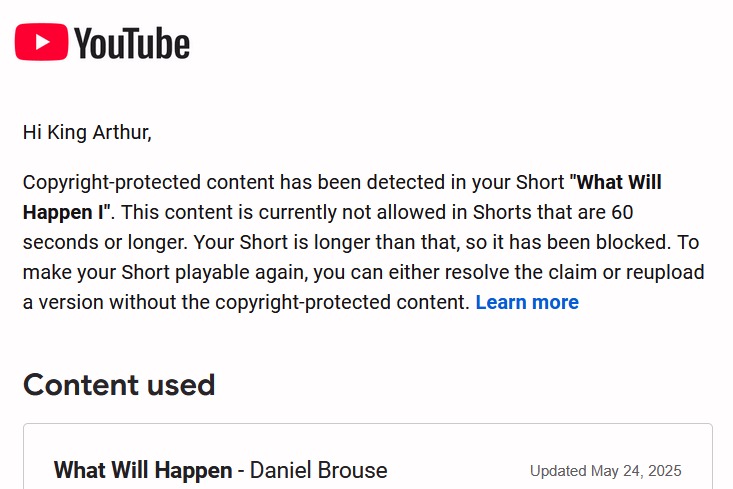
This week, I was notified that my YouTube channel removed one of my own videos—because the background music in the video was “owned” by me through my digital distributor. Yes, you read that correctly: my distributor triggered a Content ID claim against me, on behalf of me.

To restore the video, YouTube now requires that I “submit a dispute to the content owner if you have the rights to the content.” The process continues: “When you dispute a Content ID claim, the person that claimed your video (the claimant) is notified. The claimant has 30 days to respond.”

So now I must formally dispute myself to restore a song that I composed, performed, and uploaded.

The track in question, “What Will Happen Pt. 1,” was created with the help of my AI assistant, trained with my own musical data over the course of a year. That means I now have three virtual agents—my AI assistant, my distributor’s AI system, and YouTube’s Content ID—all fighting each other over a song that I indisputably own.

This is no longer a legal or technical nuance. It’s an existential glitch in the new digital music ecosystem. None of these systems were designed to resolve ownership at this level of nuance or context—and certainly not to understand when they are attacking their own creator.

I never instructed any of these tools to act against me. But the automation is now operating independently, enforcing policies that treat creators as potential infringers, even when there is no infringement. This is more than inconvenient; it’s reputational damage, business disruption, and the beginning of a deeply flawed feedback loop.

What we’re seeing is the early chaos of a system that’s automating enforcement faster than it’s developing the intelligence to understand context. As AI becomes more entrenched in content creation, content distribution, and content policing, the potential for misfires like this will only grow.

It raises urgent questions:

  • Who is ultimately responsible when automated systems attack legitimate creators?

  • What recourse do independent artists have when the enforcement tools are in conflict with each other—and themselves?

  • And most fundamentally, how can we create digital ecosystems where creators aren’t penalized by their own tools?

One thing is clear: we need new protocols for authorship, ownership, and automated enforcement—before the machines get too far ahead of the musicians.

When AI Attacks Itself

KingArthur.com