bookmark_borderDumbfoundingly Dumb Tariffs

by Daniel Brouse
April 9, 2025

The Peterson Institute for International Economics (PIIE) calculated that the cumulative average tariff rate on Chinese imports would reach nearly 125% following the implementation of an additional 84% tariff by the Trump administration. This calculation accounts for the compounding effect of successive tariff increases over time.​

Here’s a breakdown of how this figure is derived:

  1. Initial Average Tariff Rate: Before the recent tariff announcement, the average tariff rate on Chinese imports was approximately 20.8%. This figure includes tariffs imposed during President Trump’s first term and subsequent adjustments under President Biden.

  2. Additional Tariff Imposed: An additional 84% tariff is set to be applied to Chinese imports.

  3. Compounded Tariff Calculation: The new tariff is applied on top of the existing tariffs, leading to a compounded effect. The formula to calculate the cumulative tariff rate is

Total Tariff Rate = (1 + Existing Tariff Rate) * (1 + Additional Tariff Rate) – 1

Total Tariff Rate = (1 + 0.208) * (1 + 0.84) – 1
Total Tariff Rate = 1.208 * 1.84 – 1
Total Tariff Rate = 2.22472 – 1
Total Tariff Rate = 1.22472 or 122.472%

Rounding this figure gives approximately 122.5%, which aligns with PIIE’s calculation of nearly 125%.

This compounding effect illustrates how successive tariff increases can significantly elevate the overall tariff rate, leading to substantial impacts on trade dynamics and economic relations between the involved countries.

The new wave of tariffs on Chinese imports isn’t just economically misguided — it’s economically self-destructive. Far from punishing China, these tariffs act as a massive tax on American consumers and businesses. Tariffs are paid by U.S. importers, not by China. The costs inevitably flow downstream, driving up prices on everything from electronics and cars to construction materials, clothing, and medical equipment. In other words, tariffs are inflation accelerators — hitting American families directly at a time when inflation is already a concern.

Worse, these policies cripple the very U.S. manufacturers they claim to protect. American factories depend heavily on Chinese parts and materials to remain globally competitive. By driving up input costs, tariffs make U.S. manufacturing less competitive, not more. The likely result is fewer U.S. factory jobs, higher consumer prices, and a growing incentive for companies to offshore even more production.

China will not sit idly by, either. Retaliatory tariffs targeting U.S. exports — especially agricultural products like soybeans, pork, and corn — are almost guaranteed. U.S. farmers, already vulnerable in a highly competitive global market, will feel the squeeze first. Exporters of aircraft, cars, and technology are next in line.

Over time, this kind of trade policy encourages global supply chains to bypass the United States altogether. Multinational companies hate uncertainty and will naturally redirect investment to more stable environments like Mexico, Vietnam, or Indonesia. This risks isolating the U.S. economy from global trade flows and eroding its long-standing central role in the global economy.

Economically, the U.S. faces a toxic mix: rising prices alongside slowing growth — the classic recipe for stagflation. Inflation accelerates because of higher import costs, while growth slows as manufacturing, exports, and consumer demand contract under the weight of higher prices. Rising unemployment in key sectors becomes a real risk.

Perhaps most ironically, this tariff policy undermines America’s own technological leadership. Many U.S. innovations, from iPhones to solar panels, rely on Chinese components. Disrupting these supply chains increases costs for R&D, slows the adoption of green technologies, and handicaps U.S. efforts to lead the world in the next generation of tech.

Strategically, it’s even worse. The more the U.S. behaves like an unreliable or hostile trading partner, the more it pushes other countries — including allies — toward China’s orbit. China gains a propaganda victory, portraying itself as the stable alternative to an erratic and isolationist America.

Ultimately, these tariffs function less like economic policy and more like economic self-sabotage. They tax Americans, hurt U.S. businesses, fuel inflation, slow growth, threaten jobs, and weaken America’s position in the world. It’s like burning down your own house because you don’t like the neighbor’s paint color.

White House Tariff Clarification — The Executive Order outlines that the total tariffs on China under Trump 2.0 amount to 145%, on top of approximately 20% imposed during Trump 1.0, resulting in an effective tariff rate of around 165%. However, most economists agree that tariffs exceeding 50% function effectively as a trade embargo, severely limiting or eliminating imports altogether.

Protectionism 101: Trump Economics

It’s honestly hard to watch this and understand how any of his followers are falling for what has to be the worst attempt at “Don the Con” yet. I can’t find a single credible economist who agrees with Trump on this. Eliminating immigration and launching a trade war at the same time isn’t strategy — it’s economic suicide. It’s like going nuclear on your own economy. I’d say someone needs to take the “codes” out of his hands — but it’s too late. He’s already launched them.

Trumpenomics: The Decline of the US

bookmark_borderThe Chaos Theory of Crashing Markets

by Daniel Brouse
April 8, 2025

The stock market — especially during a crash — behaves like a chaotic system, not a linear or purely random one.

Here’s How Chaos Theory Explains a Market Crash:

1. Sensitive Dependence on Initial Conditions (Butterfly Effect)

Tiny changes → outsized effects.

  • In normal markets: news moves prices somewhat predictably.

  • In a panic, it doesn’t take much — bad earnings, a tweet, or just a rumor — to set off a chain reaction of selling or buying.

This is why crashes often start small — then suddenly snowball.

2. Feedback Loops Amplify Instability

Chaos systems are full of feedback loops.

Market Example:

  • Price drops → triggers margin calls → triggers forced selling → drives price lower → triggers more margin calls → repeat.

Other Feedback Loops:

  • Algorithmic selling.

  • Stop-loss triggers.

  • ETF outflows.

  • Option hedging gone wrong (gamma squeezes in reverse).

Result → Violent, non-linear moves.

3. Fractal Patterns in Price Movement

Market crashes often show self-similarity at different time scales — a classic fractal trait.

  • 1-minute chart → sharp drops & rebounds.

  • Daily chart → same jagged patterns.

  • Weekly chart → still looks like chaos.

Chaos theory predicts this — because the forces driving action at all scales are structurally similar.

4. No Predictable Floor

In chaotic systems:

  • Patterns emerge…

  • But exact outcomes cannot be predicted.

→ This explains why technical support levels sometimes work — but often fail spectacularly in a true crash.

“The floor only exists until everyone agrees it doesn’t.”

5. Order Emerges After Disorder

Chaos systems often self-organize into new stable patterns — but not on a predictable schedule.

In markets:

  • Stabilizers eventually overpower panic.

  • Valuation buyers step in.

  • Forced selling exhausts itself.

But when this happens is unknowable in advance.

In Summary:

A market crash is the perfect real-world example of chaos theory in action.

→ Small triggers lead to huge consequences.
→ Feedback loops accelerate instability.
→ Non-linear, jagged price moves dominate.
→ Short-term randomness — long-term pattern formation.
→ Order only emerges after volatility burns itself out.

Additional Resources:

Trumpenomics: The Decline of the US

bookmark_borderMandated Buyers vs Emotional Sellers: The Battle Behind Every Crash

by Daniel Brouse
April 8, 2025

Primer: The Chaos Theory of Crashing Markets

Why doesn’t the stock market just crash in a straight line?

Short Sellers in Short:

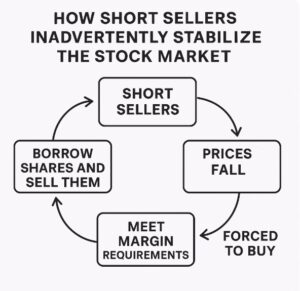
Short sellers inadvertently stabilize the market because when prices fall too far, too fast → their margin requirements force them to buy stock to cover losses → creating upward buying pressure → which puts a floor under falling prices.

This happens automatically even if short sellers are betting against a stock — because their broker doesn’t care about their opinion, only about risk.

Step-by-step: How it works

1. Short sellers borrow shares and sell them

→ They hope to buy back later at a lower price.

Example:

  • Short seller borrows and sells 100 shares at $50 = $5,000 proceeds.

2. If the stock price rises, losses are unlimited

→ If price goes from $50 → $75 → $100 → $200 → Losses grow exponentially.

3. Brokers set margin requirements

→ Short sellers must have enough collateral (cash or assets) to cover potential losses.

→ If stock price rises or becomes volatile, margin calls happen.

4. Forced buying happens on margin calls

→ If a short seller can’t meet the margin requirement, the broker will buy back the stock on their behalf to close the position.

→ This buying happens regardless of fundamentals — it’s a risk-control mechanism.

5. The stabilizing effect

→ When markets are falling and lots of people are short → at some point, shorts must take profit or cover losses.

→ That buying pressure offsets panic selling.

→ Result: Short sellers, ironically, help prevent free-fall crashes from going on indefinitely.

Why is this stabilizing?

  • Short sellers add liquidity on the way down (by selling into overvalued prices).

  • They add demand on the way up (when forced to cover or take profits).

It’s like a shock absorber:
→ They accelerate down-moves initially → but put a floor under them eventually.

Caveat:

If too many people are short → this can create short squeezes — where forced buying causes prices to overshoot upward. (See: GameStop 2021)

Bottom line:

Short sellers stabilize the market — not because they want to — but because risk management rules force them to act in ways that counter extreme price moves.

→ Sell high → Buy low
→ But margin rules ensure that “buy low” can’t wait forever.

Short Sellers Help Stabilize the Stock Market

Flow:

  1. → Short Sellers borrow shares & sell

  2. → Prices fall — their bet is working

  3. → But if Prices rise or get volatile

  4. → They hit Margin Requirements

  5. → Forced to Buy Back shares

  6. → That buying pressure helps Stabilize Prices


Structural, Non-Emotional Buyers

Another big stabilizing force: Structural, non-emotional buyers — like mutual funds, index funds, pensions, and insurance companies — that must stay invested due to their mandates.

Even when panic selling hits, there are built-in sources of demand that automatically slow or reverse sell-offs — not because they “like the market” — but because of rules, math, and fiduciary responsibility.

Key Stabilizing Forces in a Sell-Off

1. Index Funds (Passive Funds)

  • Mandate: Match an index (S&P 500, Nasdaq, etc.)

  • Sell-off impact: When markets drop, they often receive inflows from 401(k)s, IRAs, target-date funds.

  • Result: They are forced to buy proportional amounts of every stock in the index — including the falling ones.

2. Mutual Funds (Active Funds)

  • Mandate: Typically must stay 90%-100% invested.

  • Sell-off impact: If they get cash inflows from investors seeing a dip as a buying opportunity → they have to deploy that cash → buying falling stocks.

3. Target-Date Retirement Funds

  • Mandate: Automatically reallocate to equities after big drops (to maintain stock/bond ratios).

  • Sell-off impact: If stocks crash and bonds stay flat → they rebalance → forced stock buyers.

4. Insurance Companies & Pensions

  • Mandate: Long-term liabilities require long-term assets → stocks are part of that.

  • Sell-off impact: They may be value buyers in panic sell-offs to lock in future returns.

5. Corporate Buybacks

  • Mandate: Pre-approved buyback plans often accelerate when shares fall below certain levels (seen as “cheap”).

  • Sell-off impact: Automatic buy demand from companies themselves.

Visualizing the Market Feedback Loop in a Crash:

↓ Panic Selling
Retail → Hedge Funds Selling
↓
Short Sellers Covering (forced buying)
↓
Index Funds Rebalancing (forced buying)
↓
Mutual Funds Deploying Cash (mandated buying)
↓
Corporate Buybacks Engaging (value-based buying)
↓
Stabilization → Recovery

Bottom Line:

Sharp sell-offs don’t happen in a vacuum.

The deeper and faster the drop:

  • The more forced buyers appear due to structural mandates.

  • The more cash gets deployed automatically.

  • The more short-sellers are forced to buy back.

This is why stock market crashes — unless driven by systemic financial collapse — often slow down or reverse before valuations hit absurd lows.

Here’s how a crash works:

1. Stabilizers Create “Speed Bumps,” Not Floors

  • Short-seller covering, passive fund buying, and corporate buybacks don’t prevent a crash.

  • They just create temporary demand pockets → slowing or reversing declines briefly.

  • These speed bumps make the crash feel chaotic, not orderly.

→ Sharp Drop
→ Violent Bounce (forced buying, covering, rebalancing)
→ New Selling Pressure (fund redemptions, fear returns)
→ Another Drop
→ Another Bounce
→ Capitulation (selling exhaustion)
→ Bottom (nobody left to sell)

This is why crashes often feel like:

→ “Crash → Bounce → False Hope → New Lows → Panic → Stabilization”

2. No Guaranteed Floor

Even with all these stabilizing forces, there is no rule that says:

“The market must bottom here.”

If:

  • Fear overwhelms forced buying

  • Credit markets seize

  • Massive fund redemptions hit

  • Systemic risk (Lehman, 2008 style) emerges

→ Those stabilizers can get run over.

3. Stabilizers Work Best in Liquidity-Driven Sell-Offs

They work poorly in:

  • Credit crises

  • Systemic failures

  • Policy mistakes

  • Liquidity completely drying up

They work best when:

  • It’s a valuation correction

  • Sentiment-driven panic

  • Over-leveraged speculators unwinding positions

Visual: What the Price Path Looks Like

Smooth drop? Nope.

Price
^
| bounce
| /¯¯¯¯¯¯\
|                      \bounce /¯¯¯¯¯¯ \___
|                                                                    \/ \
|                                                                             / \__
|                                                                                         / \
|————————————————————-> Time

Bottom Line:

→ Stabilizers don’t prevent crashes.
→ They just interrupt them.
→ They inject buying at unpredictable moments → creating volatility spikes, not smooth declines.
→ If fear or liquidity risk is greater than the stabilizing force → new lows come.
→ But the deeper the drop, the stronger those stabilizing forces eventually become.

Why This Crash is Different

What makes this crash different? It’s self-inflicted. Unlike past downturns driven by credit bubbles or external shocks, this slowdown is the result of deliberate policy choices. The combination of restrictive immigration, escalating tariffs, and poorly coordinated climate responses has created a global drag on growth unlike anything since the Great Depression. This isn’t just a business cycle — it’s structural. If nationalist, isolationist, and protectionist policies persist, it’s possible that markets won’t fully recover for a generation — or at all.

REFERENCES:

Primer: The Chaos Theory of Crashing Markets


Protectionism 101: Trump Economics

It’s honestly hard to watch this and understand how any of his followers are falling for what has to be the worst attempt at “Don the Con” yet. I can’t find a single credible economist who agrees with Trump on this. Eliminating immigration and launching a trade war at the same time isn’t strategy — it’s economic suicide. It’s like going nuclear on your own economy. I’d say someone needs to take the “codes” out of his hands — but it’s too late. He’s already launched them.

FORECASTS COME TO FRUITION
Drill, Baby, Drill (How Hate and Ignorance Distort Economic Perspectives)
July 2024 – Pre-Election Warning: Concerns were raised about candidate Trump’s proposed economic policies, highlighting potential unintended consequences such as heightened inflation and increased national debt—both of which could undermine economic stability. Additionally, experts cautioned that his administration’s environmental stance, including withdrawing from the Paris Agreement and rolling back over 100 environmental regulations, could have devastating effects on both the economy and the environment. Now, much of this forecast is unfolding before our very eyes.

Economic Outlook 2025 – 2035
November 2024 – Post-Election Analysis: Concerns are mounting over the potential consequences of President Elect Trump’s proposed economic policies, particularly their impact on inflation, national debt, and climate change. The Committee for a Responsible Federal Budget estimates these policies could add $7.75–$10 trillion to the national debt over the next decade. Additionally, projections suggest inflation could rise to at least 6% by 2026, with consumer prices potentially increasing by 20% by 2028. These forecasts have since been revised, reflecting higher inflation and slower economic growth, compounded by the significant fallout of an ill-conceived trade war.

Financial Disclosure: Trump’s Crimes and Conflicts of Interest
This article examines financial disclosure and conflict-of-interest regulations for U.S. presidents and officials, highlighting the ethical expectations and legal requirements for transparency. It discusses President Donald Trump’s failure to meet traditional financial disclosure norms, including his refusal to divest from business interests, his lack of transparency in financial reporting, and documented conflicts of interest.

Trumpenomics: The Decline of the US

bookmark_borderA Recession by Any Other Name: Why the Coming Downturn May Not Look Like Past Crises — But Will Feel Even Worse

by Daniel Brouse
April 6, 2025

What are the chances of a recession?

It really comes down to how one defines a recession. Traditional recessions are often characterized by rising unemployment, but with Trump’s immigration policies severely restricting the labor force, the job market may appear tighter than usual — even as the underlying economy deteriorates.

When you factor in these artificial constraints on labor supply, there’s easily a 90%+ probability of a U.S. recession this year. And given the ripple effects of tariffs, trade wars, and global uncertainty, I’d estimate a 95% chance of a global recession as well. This won’t look like past recessions on the surface — but in terms of slowing growth, rising costs, reduced output, and widespread economic strain, it absolutely qualifies.

For the past several years, immigration has contributed roughly 80% of U.S. GDP growth. Even before factoring in the tariffs, the U.S. economy was already facing the prospect of slow — if not flat — growth this year. Now, with the addition of what amounts to the largest regressive tax increase in U.S. history, the outlook has gone from concerning to potentially catastrophic. While the full impact of these tariffs remains uncertain, the risks are clear: higher consumer prices, reduced purchasing power, supply chain disruptions, and broad-based economic strain — especially for lower- and middle-income households. The combination of anti-immigration policies choking labor supply and tariffs imposing massive new costs on consumers and businesses creates a perfect storm of stagnation and inflation. Together, these policies could produce the most damaging U.S. economy in over a century.

Trumpenomics: The Decline of the US

bookmark_borderIntegrating Chaos: New Climate Models Project Up to 9°C Warming This Century

by Daniel Brouse
April 6, 2025

How can the climate breakdown and collapse of the climate system be explained through chaos theory?

Great question — this is one of those rare cases where chaos theory isn’t just useful — it’s necessary to understand what’s happening with the climate system.

In a nutshell:

The climate system is a non-linear, complex, feedback-driven system — exactly the kind of system chaos theory was developed to describe.

Chaos Theory Basics (quick refresher)

Chaos theory studies how small changes in initial conditions can lead to wildly different outcomes in complex systems. This is often called sensitive dependence on initial conditions — or famously, the butterfly effect.

In chaotic systems:

  • Behavior looks random, but is deterministic underneath.

  • Predictability breaks down over time.

  • Feedback loops accelerate instability.

  • Thresholds or tipping points matter more than averages.

The Climate System is a Classic Chaotic System

Climate Feature Chaos Theory Concept Example in Climate Breakdown
Feedback Loops Positive/Negative Feedback Melting ice reduces reflectivity → warms faster. Dying forests release CO₂ → warms faster.
Sensitive Dependence Butterfly Effect Tiny changes in Arctic ice cover alter the jet stream → extreme weather thousands of miles away.
Non-linearity Disproportionate Outcomes +1°C doesn’t mean “a little worse” → it can mean entirely new weather patterns, droughts, floods, collapse.
Tipping Points Critical Thresholds Collapse of Greenland Ice Sheet or Amazon rainforest sets off irreversible global changes.
Attractors Shifting Stability Zones The climate might “prefer” certain stable states (ice age vs warm period) — human forcing could push us into a new, hostile attractor.

Chaos Theory Explains Why Climate Collapse Feels Sudden

  1.  Long period of relative stability (homeostasis in chaos theory terms).

  2.  Hidden stresses build slowly (greenhouse gases, deforestation, pollution).

  3.  System nears a critical threshold (edge of chaos).

  4.  Seemingly small trigger (like a bad El Niño year) causes cascading failures:

    • ocean currents stall

    • food systems fail

    • regional collapses emerge

    • global feedbacks accelerate

The Frightening Part (but also the scientific truth)

Climate breakdown isn’t a slow, smooth, linear decline.
It’s a chaotic, non-linear system heading for phase shifts, tipping points, and potential collapse.

That’s why decades of “x degrees = y impacts” models are failing.
Real-world climate disruption is jumping ahead faster than expected — because the system is moving into a chaotic regime.

A Final Visual Metaphor (from chaos theory)

Imagine Earth’s climate as a ball rolling in a valley:

  • Stable = ball stays in the valley bottom.

  • We’ve pushed the ball up the slope (burning fossil fuels).

  • The higher it goes, the more unstable.

  • At some point the ball tips over into another valley — a new stable state (but maybe hostile to life as we know it).

 This is what collapse looks like in chaos theory.

Bottom Line

Climate change isn’t just “getting hotter.”
It’s a chaotic transition, where:

  • Local events become global.

  • Predictability evaporates.

  • System stability breaks.

  • Collapse happens not slowly — but in lurches, jumps, and phase changes.

Our updated climate model, which integrates complex social-ecological dynamics with the non-linear, feedback-driven behavior of physical systems, indicates global temperatures could rise by as much as 9°C this century.

bookmark_borderThe Silencing of America: Journalism, Protest, and the Rise of Fear

by Anonymous
April 6, 2025, updated July 2025

It is terrifying to watch American journalism go silent — not because reporters don’t care, but because many of us know exactly what happens when we speak the truth now.

I know. I’ve been an investigative journalist for over 45 years, filming police corruption, government lies, and abuse of power across this country. I have faced threats before. But this — this is something darker.

On election day, I realized I could no longer safely use my real name. The night before, I dreamed I was arrested at a protest. That is not paranoia. That is preparation in Trump’s America.

Since returning to power, Trump has wasted no time weaponizing the legal system against his perceived enemies — especially the press. Major networks like ABC and independent journalists face a relentless barrage of lawsuits, not because Trump expects to win, but because he wants to bleed them dry and silence them. Under a Justice Department now resembling a political death squad, who will stop him?

And it’s not just lawsuits. State and federal crackdowns on peaceful protests are increasing, targeting Americans exercising their constitutional rights. Their crime? Daring to oppose genocide, war, or environmental destruction. At the Hands Off! protests, the loudest chants weren’t just against war — they demanded the release of political prisoners held in America today.

This is no longer creeping fascism. It is marching down Main Street with impunity.

Anyone who knows history sees the signs. This is how it starts: with fear. With silence. With people convincing themselves, “It can’t happen here.”

But it is happening here.

A Coordinated Assault on Truth

Trump is not alone. In Israel, Netanyahu’s far-right government has banned journalists from reporting in Gaza and outlawed Al Jazeera, the region’s most reliable independent outlet. Reporters who attempt to document atrocities face arrest or worse.

Both leaders understand that silencing truth is essential to maintaining authoritarian power. Their tactics are deliberate: demonize the press, weaponize courts, spread disinformation, and make public dissent a punishable offense.

Meanwhile, as these leaders dismantle democratic institutions, they fuel crises that demand accountability: genocide in Gaza, escalating wars, environmental collapse, and economic ruin. Silencing journalists silences the evidence.

Why This Moment Matters

We have entered a dangerous feedback loop: authoritarian regimes suppress dissent, allowing them to escalate violence and repression, which in turn demands more suppression to avoid accountability.

Independent journalism is the last line of defense. Without it, people will not know the full extent of the atrocities being committed in their name, the corruption draining their futures, or the environmental collapse accelerating under deregulation.

We, as journalists, continue to report — even if anonymously — because silence is complicity.

And we, as citizens, must decide if we will let fear dictate our future.

Citizen, beware.

Journalist, beware.

Truth is now treason in Trump’s America, and in Netanyahu’s Israel.

If we allow the silencing of journalism, the silencing of democracy will follow.


Silencing Truth: The War on Journalism by Netanyahu and Trump

Trumpenomics: The Decline of the US

bookmark_borderTrump, Debt, and the Art of Losing Other People’s Money

Company Profile

Donald J. Trump (DJT) Hotels & Casinos was an entertainment company that owned and operated the Trump Plaza Hotel and Casino, Trump Taj Mahal Casino Resort, Trump’s Castle Casino Resort and Trump Indiana.

Besides revenues from gambling, the properties offered other forms of entertainment. The Taj Mahal was an experience unto itself. Just the entrance had $1 million in 24-karat gold leaf… and, millions of dollars worth of German crystal chandeliers sparkled over the lobby’s Carrera marble-floor.

I’m an economist. In the 1990s, I conducted a moral and ethics experiment involving the stock DJT for a widows and orphans fund, during which Trump misappropriated the funds. A business bankruptcy impacts more people than a personal bankruptcy and is seen as a more significant violation of business ethics and morals.

The original stock with the ticker symbol DJT belonged to Trump Hotels & Casino Resorts (THCR), a company founded by Donald Trump in the 1990s. It operated various casinos and resorts, including Trump Plaza, Trump Taj Mahal, and Trump Marina in Atlantic City. THCR faced ongoing financial difficulties, which eventually led to four major bankruptcies. In 1995, the company went public under the ticker DJT, aiming to raise funds to refinance debts and expand its casino ventures. However, the company quickly became over-leveraged with high-interest debt, which plagued its operations.

The first bankruptcy in the timeline occurred in 1991, before DJT went public, when Trump’s Taj Mahal casino filed for Chapter 11 bankruptcy after failing to generate enough revenue to service its over $1 billion debt from junk bonds. Trump had to give up half of his ownership in the Taj Mahal but retained control of the casino. In 2004, Trump Hotels & Casino Resorts (by then public under DJT) filed for bankruptcy a second time due to its massive debt load and struggling casino operations. During this bankruptcy, Trump gave up more control of the company to creditors, though he stayed on as chairman.

In 2009, the company, rebranded as Trump Entertainment Resorts, filed for Chapter 11 again, marking the third bankruptcy. Trump resigned as chairman and left the board of directors, maintaining only a small ownership stake. Despite these efforts, the financial situation worsened, and in 2014, the company filed for bankruptcy a fourth time, leading to the closure of the Trump Plaza and Trump Taj Mahal casinos. This final bankruptcy signaled the end of Trump’s casino ventures, though his name remained on some properties through branding agreements.

The successive bankruptcies decimated the value of DJT stock, and Trump’s stake in the company dwindled over time. By the time of the 2014 bankruptcy, Trump had little control over the company. Eventually, DJT stock ceased to exist as the company’s assets were sold off. The bankruptcies are often cited as part of Trump’s controversial financial history, where he used bankruptcy laws to restructure debts, often at the cost of shareholders and creditors.

Conclusion

It’s difficult to determine the exact number of corporate bankruptcies associated with Donald Trump’s business ventures, in part because of how some analysts count them. In this particular case, there were four separate bankruptcy filings, though many analysts count them collectively as a single event. Broadly, most sources agree that Trump’s companies have filed for bankruptcy at least six times, with some estimates — depending on how repeat filings by the same entity are treated — placing the total closer to 12 to 14.

In each instance, critics have argued that Trump personally profited despite the financial losses borne by shareholders, lenders, and employees. These allegations typically focus on patterns of aggressive debt use, questionable fiscal management, and the transfer of risk from Trump to investors and creditors.

Now, he is doing it worldwide.

As one economist put it:

“Trump didn’t just pick a trade war — he picked one with the entire planet.”

A Crisis of This Magnitude Has Not Been Seen in Nearly 100 Years

While past recessions were driven by financial collapses (such as 2008’s mortgage crisis or the dot-com bubble in 2000), this economic crisis is entirely policy-driven. The sheer scale of the tariffs, combined with global retaliation and the isolation of the U.S., has created a trade collapse not seen since the 1930s. If history is any guide, the consequences could be severe, with prolonged economic hardship, market instability, and lasting damage to U.S. credibility in global trade.

Capital Preservation During Trumpenomics

Trumpenomics: The Decline of the US

bookmark_borderEconomic Survival 101: Liquidity & Long-Term Strategy

by Daniel Brouse

Capital Preservation is Survival Rule #1

Capital preservation has always been important — but in today’s economic environment, it has become absolutely critical. The phrase dominating Wall Street has been “The Wealth Effect.” Normally, the stock market and the real economy are loosely connected — the ups and downs of stock prices don’t immediately ripple through everyday life. But these aren’t normal times.

The sharp contraction in wealth is not just a stock market story anymore — it’s spreading. It’s affecting real people, real spending, and real businesses.

This is The Wealth Effect in action.

Why It Matters

When people feel poorer, they spend less — not just on luxuries, but on everything. Airline stocks, hotel chains, cruise lines, car companies, and even high-end retailers are feeling the squeeze. Discretionary spending is collapsing.

Remember: the stock market is often called a “leading indicator” — it signals where the economy is heading, not where it’s been. But right now, it’s more like a real-time broadcast of wealth destruction.

Preserving capital was the first step.

Now comes step two:

Liquidity Testing: What Good Are Assets If You Can’t Use Them?

Liquidity is a word investors throw around, but in times of crisis, liquidity becomes survival.

Liquidity simply means: How fast — and with how little friction — can you turn something into usable cash?

But here’s the catch: liquidity isn’t just theoretical. You need to test it.

Practical Liquidity Drills

  1. Bank Accounts:
    Can you access your money digitally (debit card, online transfer)?
    Can you physically withdraw it (ATMs, branch visits)?

  2. Brokerage Accounts:
    Sell a single share of stock.
    Move that money to your checking account.
    Then, physically withdraw it.

See how long that takes. Time every step. Note every fee. Every delay. Every “unexpected problem.” This is your liquidity test.

  1. Retirement Accounts:
    Try withdrawing $1. Even if there’s a penalty, learn the process now — not when you’re desperate.

  2. Alternative Assets:
    Gold: Can you sell an ounce and get cash today? Where? How?
    Bitcoin or Crypto: Can you convert $1 worth to local currency — and then get that in your hand?

  3. Physical Cash:
    Do you have enough for at least 2-4 weeks of emergency needs — but not so much that it creates storage and theft risk?

This is not paranoia. This is rehearsal. When you’re hungry, the person with practice will eat first.

Long-Term Economic Survival Planning

Liquidity is for short-term survival. But what about the long-term?

There’s an uncomfortable possibility investors need to consider: If current economic policies — particularly those championed by Trump and his allies — stay in place, we could be heading toward intentional dollar devaluation.

Trump has openly said he favors a weaker dollar to juice exports and reduce debt burdens. That sounds fine on cable news. But in the real world, a falling dollar means your savings buy less and less — possibly very quickly.

What Happens If The Dollar Weakens Dramatically?

In that environment, capital preservation shifts from holding dollars to holding value — and that’s a very different skillset.

But each alternative comes with its own risks:

Asset Challenge
Gold Heavy, hard to store, risk of theft
Bitcoin Not physical, depends on electricity/internet, no intrinsic value
Real Estate Illiquid, maintenance costs, tax exposure
Commodities (Food/Fuel) Perishable, storage issues, not scalable
Foreign Currencies Complex, geopolitical risks
Precious Metals (Silver, Platinum) Similar to gold, but less portable

Bottom Line: Adapt or Lose

→ First, protect your assets. Preserve what you have.
→ Second, test your liquidity. Don’t assume. Verify.
→ Third, begin developing an exit strategy from the dollar — not out of fear, but out of discipline.

This is Economic Survival 101.

The people who survive economic storms are not always the richest. They’re the most prepared, the most adaptable, and the most liquid.

Are you?

RESOURCES:

Capital Preservation

Trumpenomics: The Decline of the US

bookmark_borderTariff Theater: Trump’s Economic War on the World — Including Penguins

by Daniel Brouse
April 5, 2025

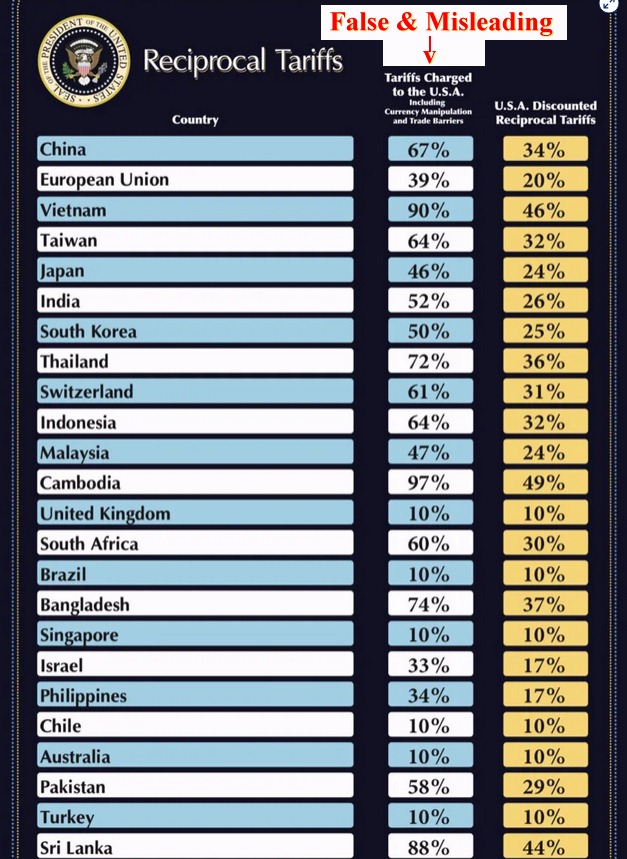
The tariffs announced on what Trump dubbed “Liberation Day” featured a chart titled Tariffs Charged to the U.S.A., purporting to show the crushing rates foreign countries supposedly impose on American goods. But these numbers were completely fabricated — not grounded in trade data or economic principles. Instead, Trump’s team appears to have confused tariffs with trade deficits, using the size of the U.S. trade deficit with each country to create a fictional “tariff rate.”

This fundamental misunderstanding is emblematic of much of Trump’s economic worldview — one that runs counter to decades of established economic theory.

In reality, U.S. trade deficits have long benefited American consumers by allowing access to cheaper foreign goods, while the strength of the dollar fuels domestic spending. The U.S. essentially trades inexpensive paper money for real goods — raw materials, finished products, and even luxury items — while foreign countries often recycle those dollars back into U.S. Treasuries, helping finance America’s debt.

Yet Trump continues to argue that trade deficits equal theft.

Trump’s Trade Narrative: Economic Victimhood

In speeches and social media posts in April 2025, Trump has claimed:

“For too long, corrupt foreign leaders — even from the poorest countries — have slapped massive tariffs on American products while flooding our markets with their goods, often duty-free. It’s been a one-sided scam — they’ve taken our jobs, stolen our industries, and destroyed entire American communities.”

Trump alleges that:

  • Foreign tariffs make U.S. farmers and manufacturers uncompetitive.

  • The U.S. has been the “piggy bank” of the world.

  • New tariffs will “level the playing field” and force “fair deals.”

Supporters call this economic justice. Critics call it economic vandalism.  Wall Street has already rebranded “Liberation Day” as The Big Mistake.

Tariff Theater: Trump’s Economic War on the World — Including Penguins

Lesotho: Targeting One of the World’s Poorest Nations

Among the most striking examples of Trump’s tariff policy is Lesotho — a tiny, landlocked kingdom in southern Africa and one of the poorest nations in the world. The U.S. has imposed a staggering 50% tariff on its exports — the highest tariff applied to any sovereign country.

Lesotho’s economy depends heavily on textiles exported under the African Growth and Opportunity Act (AGOA), and diamond exports to the U.S. are another vital revenue source. In 2024, Lesotho exported about $237 million in goods to the U.S.

The 50% tariff threatens to devastate Lesotho’s fragile economy, potentially wiping out thousands of jobs in a country where nearly half the population already lives below the poverty line.

Tariffs on Penguins: Heard and McDonald Islands

In perhaps the most surreal example of Trump’s trade war, a 10% tariff was imposed on the Heard and McDonald Islands — an uninhabited Australian territory in the sub-Antarctic populated only by penguins and seals.

With no human population and no meaningful exports, the islands became a global punchline. Memes exploded online mocking Trump’s “penguin tariff” as the ultimate symbol of policy absurdity.

Economic Isolation — and Global Backlash

Trump’s tariff strategy has triggered a wave of retaliatory measures, trade disruptions, and diplomatic backlash. Analysts warn that the U.S. is rapidly isolating itself from global supply chains, allies, and markets.

The economic damage has been swift and severe — not just abroad but at home, as higher consumer prices, supply shortages, and market instability ripple through the U.S. economy.

As one critic put it:

“Trump didn’t just pick a trade war — he picked one with the entire planet.”


RESOURCES:

Dumbfoundingly Dumb Tariffs

China Hits Back: 84% Tariff Targets U.S. Farmers First

Protectionism 101: Trump Economics

Capital Preservation During Trumpenomics

bookmark_borderDump Trump: Buy and Hold Doesn’t Hold Anymore

by Daniel Brouse
April 4, 2025

For those relying solely on the “buy and hold” investment strategy, it’s time to seriously question whether that approach still makes sense. I’ve previously advised a gradual and orderly withdrawal from the equities market in preparation for what I’ve referred to as “Trump 2.0.”

Is it too late to get out? No — but time may be running out. If you haven’t lived through times like these before, you need to understand that many companies won’t survive what’s coming. Whatever wealth you still have invested in stocks could ultimately go to zero. For many, it will.

A perfect historical example is Donald J. Trump (DJT) Hotels & Casinos in the late 1990s. As part of a business ethics experiment, I created a “widows and orphans” portfolio that included DJT stock. Trump later drove the company into bankruptcy, and shareholders — many of them retirees and low-risk investors — lost everything. The stock’s value went to zero and never came back.

History has a way of repeating itself for those who forget its lessons. Now is the time to rethink blind faith in any one strategy — especially one built for a different era.

Capital Preservation During Trumpenomics

Trumpenomics: The Decline of the US