bookmark_borderWall Street: When First is Last

by Daniel Brouse
April 10, 2025

How Some of the Biggest Market Gains Are Actually Signs of the Worst Losses

Those who appeared to be first, ended up last. Those who appeared to be last, ended up first.

April 9 wasn’t just another volatile day on Wall Street — it was a near-perfect example of how markets behave during a crash, and why some of the biggest one-day rallies in history often happen inside brutal bear markets.

It’s one of the great paradoxes of investing:

The biggest up-days don’t mean recovery — they often signal panic, forced liquidation, and deeper instability ahead.

What Actually Happened?

In essence, the trillions of dollars that appeared to be gains in the market were really losses for short sellers. That’s the hidden truth of sharp rallies during a crash — the money didn’t come from real investment demand; it came from forced buying.

The key difference is this: when markets rise under normal conditions, long-term investors have unrealized gains — profits on paper, but not yet cashed out. But in a short squeeze, those unrealized gains for stockholders are directly matched by realized losses for short sellers who are forced to buy at any price to cover their positions.

It’s not wealth creation — it’s wealth transfer under pressure. In the chaos of a market crash, those who looked like winners became losers — and those who looked like losers became winners.
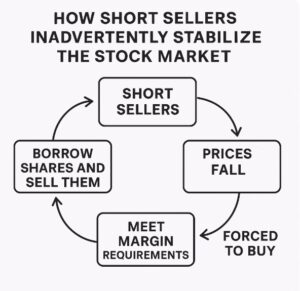
Short Sellers Help Stabilize the Stock Market

The Mechanics

Markets spiked sharply after a sudden and dramatic policy reversal was announced — a move investors hoped might slow down the economic freefall.

But here’s the key:
This initial surge wasn’t organic buying. It was mechanical.

→ Short sellers — traders betting against the market — suddenly got squeezed.
→ When prices jump too fast, short sellers face margin calls — demands from brokers to put up more money or buy back the stock they bet against.
→ Since short-selling carries unlimited loss potential, these traders are forced to buy shares no matter the price to avoid catastrophic losses.

That panic buying drives prices even higher, triggering more margin calls in a dangerous feedback loop.

Why Does This Matter?

Because once those short positions are closed (covered), the artificial buying pressure evaporates.

And here’s the brutal part:
→ Many of those same shares bought in a panic are quickly sold again by longer-term bearish investors or funds desperate to raise cash.

That’s what you saw today — the so-called “pullback” was not just natural volatility; it was the aftershock of forced buying unwinding itself.

Markets gave back much of yesterday’s gains. And worse, they are now at risk of retesting — or breaking — the recent lows.

The Illusion of Safety

In chaotic markets like this, price action becomes non-linear and unpredictable.

Massive rallies during a downturn are not necessarily signs of strength — they are often signs of extreme stress within the system.

This is why some of the biggest single-day gains in market history occurred during the Great Depression, the 2008 Financial Crisis, and the early phases of COVID’s market panic.

It’s not recovery.
It’s chaos.

Why Crashes Look Like This: Forced Buyers Meet Forced Sellers

Several key forces converge during these phases:

  • Short-sellers covering in panic.

  • Margin calls across hedge funds and leveraged traders.

  • Index funds and mutual funds, required to stay fully invested, reluctantly buying dips.

  • Passive investing structures amplifying volatility both directions.

  • Algorithmic trading chasing momentum.

These dynamics create a dangerous loop:
→ Sharp rallies from forced buying.
→ Followed by brutal reversals from forced selling.

The result?
A jagged, chaotic pattern — not a smooth decline.

And the Most Important Lesson:

In a true crash, there is no guaranteed floor.

Support levels only exist until panic overwhelms them. Fundamentals don’t matter when liquidity disappears.

Markets become driven by positioning, margin calls, and liquidity — not valuation.

This is why the old phrase still applies:
“Bear market rallies are designed to fool the maximum number of people in the minimum amount of time.”

Closing Thought:

The real danger today isn’t just volatility — it’s the fact that this is largely self-inflicted economic destruction.

Policy mistakes — from trade wars to immigration freezes to climate inaction to protectionist tariffs — have combined into a global slowdown unlike anything since the Great Depression.

And unlike past crashes, there is a real risk this time that the damage is structural — not cyclical.

Recovery is not guaranteed.
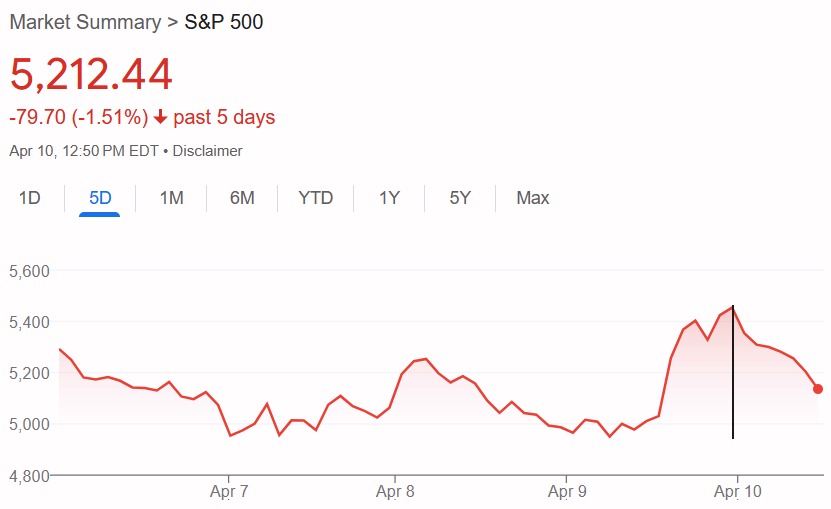
One-Week Chart Highlighting Record One-Day Spike

Trumpenomics: The Decline of the US

bookmark_borderState of the Economic Union: Still Horrible

by Daniel Brouse
April 10, 2025

April 9th’s unprecedented bounce in the stock market was nothing more than a temporary sugar high — a dead cat bounce in market jargon. It was fleeting, emotional, and utterly disconnected from the underlying economic reality. Fundamentally, nothing positive has changed. In fact, the situation is worse. Far worse.

Why Did Trump Blink on Tariffs?

The reason for Trump’s abrupt about-face on his tariffs wasn’t because of some grand negotiation tactic or economic strategy. It was panic. The night before, the U.S. Treasury bond market suffered one of its worst liquidity crises in modern history. The collapse in bond demand triggered fears that the Federal Reserve might have to step in with emergency intervention. At that exact moment, Trump announced a 90-day “pause” on certain tariffs — a clear attempt to calm the waters.

This pause was not a sign of strength. It was a sign of weakness and desperation.

Traders took the opportunity to buy oversold stocks, but longer-term investors smartly used the bounce to sell into strength. And this morning? Futures were already down again, signaling that smart money knows this isn’t over.

Tariffs Are Still in Place — And More Are Coming

Many of these countries already have long-standing trade agreements with the U.S. — agreements that Trump has repeatedly violated or unilaterally torn up. So why would anyone believe he’s negotiating in good faith now? The pattern is clear: deals don’t mean much if one side keeps changing the rules.

Nothing about the structural trade conflict has improved. The tariff pause doesn’t change the fact that the U.S. and China, the world’s two largest economies, are escalating toward a full-blown economic war. The new tariff structure is estimated to create an effective 145% tariff on Chinese imports into the U.S., and an 84% tariff on U.S. exports to China.

Global trade between the two countries could fall by 80% or more — a staggering figure that would destroy supply chains, eliminate jobs, increase consumer prices, and plunge the global economy into recession.

This is already happening.

Canceled CapEx and Collapsing Investment

We are seeing the damage show up in real-time across corporate America. Capital expenditures (CapEx) — the lifeblood of future economic growth — are being slashed or outright canceled:

  • Microsoft abandoned its $1 billion data center project in Ohio citing “market uncertainty.”

  • Ford shelved expansion plans in Michigan and cut thousands of jobs due to tariffs increasing steel and aluminum costs.

  • Harley-Davidson moved part of its production overseas to avoid retaliatory tariffs — killing U.S. factory jobs.

  • Boeing warned of major losses and delayed production schedules as global aircraft orders stall.

  • Caterpillar and Deere both cut forward guidance citing collapsing demand in agriculture and construction tied directly to the trade war.

  • Tesla scaled back its China expansion plans, warning of higher costs and lower demand.

  • Semiconductor manufacturers like Intel and Nvidia cut CapEx due to weakening global tech demand.

  • Even Apple hinted at slowing investment in U.S. facilities as its supply chain costs spiral higher.

This is just the tip of the iceberg. Thousands of small and medium businesses — the true backbone of the economy — are quietly canceling investments, freezing hiring, and shelving growth plans. Why build or expand if tomorrow’s rules are unknown and changing by tweet?

The Elephant in the Room: The Bond Market

The most misunderstood part of this entire crisis is the bond market — and Trump’s obsession with the 10-year Treasury yield.

Foreign countries like China and Japan hold the largest reserves of U.S. Treasuries. These reserves come from trade surpluses — dollars earned from selling goods to the U.S. But as Trump deliberately shrinks trade with the world, those dollar flows disappear. Less trade means fewer dollars. Fewer dollars means less buying of U.S. debt. Less demand for Treasuries means higher interest rates — even in the face of a slowing economy.

Ironically, this amounts to a self-inflicted credit war. Trump is attacking the very trade flows that fund the U.S. deficit. Worse, foreign countries are starting to invest their existing reserves elsewhere — in gold, in Euros, in commodities — anything but the U.S. dollar.

This isn’t just about trade anymore. This is about credit strength, reserve status, and financial stability.

Conclusion: The Real State of the Economic Union

The market bounce was a head fake.

  • The trade war is still escalating.

  • Global CapEx is collapsing.

  • Treasury demand is weakening.

  • Interest rates are likely to stay elevated despite recession risks.

  • Foreign capital is leaving.

  • Inflation remains persistent due to tariffs and a weaker dollar.

  • Corporate earnings are declining.

  • Uncertainty is growing.

Tariffs didn’t just disrupt goods and supply chains — they shattered America’s credibility. The so-called “reciprocal tariff” numbers were pure fiction, rooted in a fundamental misunderstanding of how global trade and capital flows actually work. Worse, they injected chaos into global markets and made U.S. trade policy look reckless, arbitrary, and unmoored from reality. Longtime allies and trading partners, faced with unpredictability from Washington, began hedging their bets and reducing their exposure to the U.S. economy. Suddenly, what was once considered the world’s most reliable safe haven didn’t feel so safe anymore.

This is not a healthy economy. This is an economy headed for stagflation — slow growth, high inflation, and rising interest rates — the worst possible scenario.

The State of the Economic Union?

Still horrible. And likely to get worse.


Trumpenomics: The Decline of the US

bookmark_borderCredit War!

by Daniel Brouse
April 9, 2025

Trump’s fixation on the 10-year Treasury bond comes down to a perfect storm of contradictions — and desperation. Here’s why it matters:

  1. He promised lower interest rates but has no real ability to deliver them.

  2. He can’t control interest rates — the market does.

  3. His budgets don’t work with elevated rates — every tick higher adds billions (or even trillions) to the national debt through higher borrowing costs.

  4. Higher interest rates, combined with a weakening dollar, fuel persistent inflation — creating a vicious feedback loop of rising prices and rising rates.

  5. Foreign countries — especially Japan and China — hold massive amounts of U.S. Treasuries. The overnight spike in bond yields started in Asian markets, signaling not just a financial crisis, but the possibility of a global credit war layered on top of the existing trade war.

Bottom line: The 10-year bond rate isn’t just a financial number — it’s a pressure gauge on Trump’s entire economic strategy. And right now, that gauge is flashing red — Credit War!

Ironically, this would be a completely self-inflicted credit war. By wrongly insisting that trade deficits are somehow tied to national budget deficits and debt, Trump is essentially forcing foreign countries to accept fewer U.S. dollars through reduced trade. And when those countries accumulate fewer dollars, they naturally invest less in U.S. assets — especially safe-haven investments like Treasuries. Less demand for Treasuries means higher interest rates, weaker credit strength, and greater financial instability — all triggered by a fundamental misunderstanding of how global trade and capital flows actually work.

April 10 State of the Economic Union: Still Horrible


Trumpenomics: The Decline of the US

bookmark_borderStock Market Update: A Worsening Economic Landscape

by Daniel Brouse
April 9, 2025

At this point, I wouldn’t pay much attention to the stock market. The bond market has effectively become what some are calling the “Trump Put” — a term that suggests Trump will only alter his damaging policies when the pain from a market collapse becomes too severe. That’s essentially what happened today, as a sharp reaction in the bond market forced a pause in his reckless policy-making. However, this is merely an indicator of the kind of knee-jerk reactions we can expect from Trump in the future. Unfortunately, the stock market is no longer a reliable indicator of overall economic health.

The truth is, much of the economic damage has already been done, and the fallout continues to worsen despite any attempts at intervention. The ripple effects of the Trump administration’s policies are visible across various sectors, and they are causing long-term harm to the economy. A clear example of this can be seen in Microsoft’s recent decision to cancel its $1 billion data center project in Ohio. The tech giant had initially committed to the development as part of its efforts to expand its cloud infrastructure, but the escalating uncertainty around tariffs and trade policies made the investment untenable.

This cancellation is far from an isolated incident. Companies across industries are pulling back on capital expenditures (CapEx) as they deal with the volatility created by these policies. For example, automakers are delaying or scrapping plans to expand production in the U.S. due to rising material costs from tariffs on steel and aluminum. Many manufacturers are cutting back on factory upgrades and hiring freezes, as uncertainty about future trade relations with key partners like China and Europe looms large.

Retailers, too, are feeling the squeeze. Large retail chains, which were already grappling with declining foot traffic and shifting consumer behavior, are now having to rethink expansion plans due to supply chain disruptions and the growing cost of imports. In addition to scaling back on new store openings, some are halting infrastructure investments, such as distribution centers and technology upgrades, as their financial outlook worsens.

The real estate sector is also suffering. Construction projects across the country have been delayed or canceled as developers face rising costs for materials like lumber and steel — costs driven up by tariffs. The uncertainty surrounding trade agreements and the broader economic landscape has led to a slowdown in both commercial and residential real estate development. High-profile projects, including those planned for large metropolitan areas, are now on hold indefinitely, as developers and investors await clearer signals from Washington.

This widespread reduction in CapEx is a clear indicator of the long-term economic damage caused by policies that prioritize short-term political gain over long-term stability. Companies aren’t just scaling back; they are actively preparing for an unpredictable future where market conditions could remain volatile. As this domino effect continues, it’s likely we will see even more industries scaling back their investments, further exacerbating the economic decline.

In short, while the stock market may see short-term corrections and rallies, the underlying damage to the economy continues to unfold. Corporate America is reacting with caution, and the full scope of the consequences is likely to play out over the coming months and years. The Trump administration’s approach to economic management has left a trail of uncertainty that companies are not willing to ignore. The impact of these decisions will likely be felt for much longer than the stock market’s momentary shifts suggest.

bookmark_borderTariff Turmoil: The Chaos and Confusion Surrounding U.S. Trade Policies in 2025

by Daniel Brouse
April 9, 2025

From Sector-Specific Levies to Unpredictable Pauses, Determining What Tariffs Remain in Effect Has Never Been More Complex

In a stunning reversal, the Trump administration just announced a 90-day pause on its controversial reciprocal tariffs policy — a clear sign that recent market chaos is starting to bite. With a record spike in interest rates overnight and global investors fleeing U.S. debt, the pause appears to be a desperate attempt to calm financial markets rattled by the escalating trade war.
For months, Trump’s tariff strategy has been framed as strength — but today’s move signals growing recognition that aggressive trade policies are now directly threatening U.S. economic stability. The world is no longer automatically turning to U.S. Treasuries in a crisis, and investors are demanding higher rates to hold American debt — a dangerous shift for the global economy.
While the pause buys time, it underscores a bigger problem: trust, once lost in global markets, is hard to recover.

Current Situation
As of April 9, 2025, the United States has implemented a series of tariffs under President Trump’s “reciprocal tariff” policy. Initially, a universal 10% tariff on all imports was set to take effect on April 5, 2025. However, on April 9, 2025, President Trump announced a 90-day pause on tariffs for over 75 countries that opted to negotiate rather than impose retaliatory measures.

Despite this pause, tariffs remain in effect for certain countries, most notably China. The tariffs on Chinese imports have been increased to a total of 145%, escalating the U.S.-China trade conflict.

The situation is dynamic, with ongoing negotiations and potential policy adjustments. For the most accurate and current information, it is advisable to consult official communications from the U.S. Trade Representative or the White House.

There are still significant tariff measures affecting imports from various countries and specific sectors; however, it is not at all transparent as to the actual law. Following is our best guess:

1. Canada and Mexico Tariffs:

  • 25% Tariff on Non-USMCA-Compliant Goods: On March 4, 2025, the U.S. imposed a 25% tariff on imports from Canada and Mexico that do not meet United States-Mexico-Canada Agreement (USMCA) standards.

  • Energy Imports: Canadian energy resources are subject to a reduced tariff of 10%, as per the adjustments made on March 4, 2025.

  • Reciprocal Tariffs: In response, Canada has imposed a 25% tariff on U.S. vehicle imports that do not meet USMCA standards.

2. Sector-Specific Tariffs:

  • Steel and Aluminum: Effective March 12, 2025, a 25% tariff was applied to imports of steel and aluminum articles, as well as certain derivative products, from all countries.

  • Energy Sector: While specific details on energy-related tariffs are limited, the White House has indicated that energy imports may be subject to new tariffs to promote domestic production.

  • Lumber: Lumber imports are among the sectors that could face new tariffs, as the administration has warned of potential measures to support domestic industries. ​

3. Tariff Status and Exemptions:

  • USMCA-Compliant Goods: Products that comply with USMCA standards are exempt from certain tariffs, including those on vehicles and specific goods from Canada and Mexico.

  • De Minimis Threshold: The U.S. has removed the de minimis exemption for low-value shipments from China, Hong Kong, and Macau, effective May 2, 2025, eliminating the $800 duty-free threshold for these regions.

4. Ongoing Developments:

  • Retaliatory Measures: Affected countries, including China, the EU and Canada, have announced retaliatory tariffs in response to U.S. measures, further complicating the trade landscape. ​

  • Future Tariff Considerations: The administration has indicated that additional tariffs may be imposed on sectors such as copper, pharmaceuticals, semiconductors, and lumber to encourage domestic production.

China: Although challenging to calculate precisely, this appears to bring the total tax on imports from China to 165% (updated). It also remains unclear whether the tax on EVs will now rise to 265%.

A 30-35% Tariff Rate

The Economic Reality Behind the Tariff ‘Pause’: A 35% Tariff Rate

On April 9, the effective tariff rate without factoring in China, the United States’ largest trading partner, shifted to 18%. This rate was still the highest we’ve seen since the 1940s. While this sounds like a notable shift, it doesn’t fully capture the broader impact. When we include China in the equation, the story takes an even more dramatic turn. The total effective tariff rate, including both the general tariffs and consumption taxes on Chinese imports, skyrocketed to a range of 30-35%

Resources:

Trumpenomics: The Decline of the US

bookmark_borderAmerica’s Trade War Is Costing More Than We Realize — It’s Costing Global Trust

by Daniel Brouse
April 9, 2025

Today’s record spike in U.S. interest rates is grabbing headlines — but it’s a symptom, not the disease. The real crisis is deeper and far more dangerous: America’s trade war has shattered the trust that once made U.S. financial markets the safest in the world.

For decades, the U.S. enjoyed an extraordinary advantage. No matter what turmoil rocked the world — wars, recessions, pandemics — foreign investors would rush to buy U.S. Treasuries. It wasn’t just about returns. It was about trust. The U.S. was stable, predictable, and reliable. That trust kept our borrowing costs low, our dollar strong, and our economy resilient.

But Trump’s trade war changed everything.

Tariffs didn’t just hit goods and supply chains — they hit America’s credibility. They introduced chaos into global markets, made U.S. policy look arbitrary, and forced long-time allies and trading partners to start hedging their bets. Suddenly, the “safe haven” didn’t feel so safe anymore.

And now we’re seeing the fallout.

Today’s bond market shock — one of the sharpest interest rate spikes in history — is part of a larger shift. Foreign investors aren’t rushing to U.S. Treasuries like they used to. Some are moving to gold. Others to European bonds. Some are simply staying home.

That shift comes at a staggering cost. Without foreign demand for our debt, the U.S. has to offer higher and higher interest rates to attract buyers. That means rising borrowing costs across the entire economy — for the government, for businesses, for homeowners.

This isn’t just about tariffs on steel or soybeans. This is about America losing its greatest economic weapon: trust.

And once trust is gone, it doesn’t come back easily — or quickly. No matter what happens next with Trump’s tariff policies, the damage is done. The U.S. has moved from “most trusted” to “no longer reliable” in the eyes of global investors.

That’s a legacy of the trade war we’ll be paying for long after the headlines move on.

Tariffs and the Liquidity Crisis in Long U.S. Treasuries

Trumpenomics: The Decline of the US

bookmark_borderThe Destructive Legacy of Trump’s Climate and Economic Policies: A Call for Urgent Action

by Daniel Brouse
April 9, 2025

Donald Trump’s dismissal of climate science and his aggressive promotion of fossil fuel extraction have resulted in a harmful and increasingly unsustainable energy policy. By labeling climate change as a “hoax” and referring to policies designed to combat it as “The Green New Scam,” Trump has ignored the overwhelming scientific consensus that climate change is real and accelerating. His catchphrase, “Drill, Baby, Drill,” is emblematic of an energy policy that favors short-term profits from fossil fuel extraction over the long-term health of the planet. This approach has not only worsened the climate crisis but has also contributed to growing economic instability. If left unchecked, the policies enacted during Trump’s administration will likely render the planet uninhabitable for future generations, causing irreversible damage to both the environment and the economy.

Trump’s Climate-Defying Actions: A Clear Threat to the U.S.

One of the most glaring examples of Trump’s failure to address climate change is his active support for policies that encourage fossil fuel extraction, even in the face of overwhelming evidence of its destructive impacts. While news broke about a major leak in the Keystone pipeline, causing widespread environmental damage, Trump was busy pandering to coal executives at a Republican fundraiser, celebrating the reopening of coal mining on public lands. At the same time, his Energy Secretary went on financial news outlets and falsely claimed that coal-fired power plants emit nothing but water vapor. This blatant ignorance and the spread of misinformation not only mislead the public but also accelerate the environmental degradation that is already threatening our future.

“Drill, Baby, Drill”: The Policy That Puts Us All at Risk

Perhaps no phrase better encapsulates Trump’s approach to energy policy than “Drill, Baby, Drill.” This mantra, which prioritizes fossil fuel extraction, is a cornerstone of an energy strategy that ignores the overwhelming evidence of climate change and its economic consequences. The immediate result of this policy is an increase in carbon emissions, which exacerbates the very climate crisis that threatens to destabilize both our environment and economy.

Climate change, driven by such policies, presents the most severe threat to not only our ecosystems but also to the global economy. The fallout from unchecked environmental destruction will have far-reaching effects, from agricultural disruptions to significant increases in healthcare costs and the destruction of vital infrastructure.

The Economic Consequences of Climate Change: A Perfect Storm of Inflation and Instability

Trump’s climate-denying energy policies are not just harmful to the planet—they have also created a volatile economic environment. The first inflationary shock tied to climate change occurred in 2019, when a devastating drought in Taiwan crippled the semiconductor industry. Taiwan, a global leader in microchip production, saw critical manufacturing facilities forced to shut down due to water shortages. This disruption, which impacted the global supply chain, marked the beginning of a series of economic challenges tied to climate-induced disasters.

In the years since, climate-related disasters have continued to escalate. From severe hurricanes and wildfires to prolonged droughts, each event has intensified the economic instability caused by climate change. These disasters have driven up insurance premiums, adding to the financial burden on homeowners and businesses alike. President Trump’s “Drill, Baby, Drill” approach has only fueled this instability by perpetuating fossil fuel dependency, accelerating climate change, and deepening the economic crisis.

The Price of Inaction: U.S. Faces Trillions in Economic Losses

In 2023, the United States experienced a record-breaking number of climate-related events, each causing damage exceeding one billion dollars. The cumulative impact of these events is staggering, with some individual disasters costing hundreds of billions of dollars. The frequency and severity of these events highlight the accelerating pace of climate change and the urgent need for intervention.

Projections suggest that the long-term economic costs of climate change could reach trillions of dollars for the U.S. alone. These costs stem from a range of factors, including the destruction of infrastructure, increased healthcare expenditures due to climate-related illnesses, and disruptions to agriculture and the food supply chain. Perhaps most concerning of all is the projected rise in homeowners’ insurance premiums, driven by the growing frequency of climate disasters. Short sellers predict that, within the next decade, up to 25% of U.S. properties could become uninsurable. Without significant policy changes, these costs will continue to rise, exacerbating the inflationary pressures already plaguing the U.S. economy.

A Future at Risk: The Need for Urgent Action

The economic effects of climate change go beyond financial losses—they have the potential to undermine future growth, reduce productivity, and deepen social inequalities. Proactive investments in renewable energy, climate resilience, and sustainable practices are not just necessary to protect the environment—they are also critical to safeguarding economic stability and future prosperity. Without a dramatic shift in policy direction, the U.S. risks a future where economic growth is stunted, natural disasters become the new normal, and entire communities are left to cope with the aftermath.

As a climate scientist with decades of experience developing climate models, I have seen firsthand the alarming projections of global warming. Our updated climate model, now integrating complex social-ecological factors as part of a dynamic and non-linear system, suggests that global temperatures could rise by as much as 9°C within this century. This is far beyond previous estimates of a 4°C increase over the next thousand years, and such an extreme rise in temperature would render much of the world uninhabitable within our lifetimes.

Without urgent intervention, the accelerating pace of climate change will surpass our ability to adapt, leading to widespread ecological collapse, economic destabilization, and loss of human life on a scale never before seen. The time to act is now. Climate change is not a distant threat—it is happening right now, and the choices we make today will determine whether or not future generations will inherit a livable planet.

Conclusion: A Call for Immediate Change

Donald Trump’s policies, which have ignored the science of climate change and prioritized fossil fuel extraction, have exacerbated the environmental and economic challenges facing the world. These policies, driven by ignorance and short-term profit motives, have intensified the climate crisis and undermined global efforts to transition to a more sustainable future. It is critical that we shift away from such destructive policies and invest in solutions that will not only protect our environment but also safeguard the future of the global economy. The window for action is closing, and the time for change is now.

The Persistence of Climate Change Denial: Impact and Consequences
Politicians Hinder Fight Against Climate Change
Insurance Cost and Availability

The Human Induced Climate Change Experiment

Trumpenomics: The Decline of the US

bookmark_borderEU’s Trade Counterattack: Tariffs Designed to Target U.S. Red States

by Daniel Brouse
April 9, 2025

In response to the U.S. administration’s recent implementation of reciprocal tariffs affecting numerous trading partners, the European Union (EU) has enacted counter-tariffs targeting a broad range of American goods. These measures aim to pressure the U.S. by focusing on exports from states that traditionally support the Republican Party, often referred to as “red states.”​

Scope and Implementation of EU Tariffs:

  • Targeted Products: The EU’s tariffs encompass a variety of U.S. exports, including motorcycles, bourbon, peanut butter, and jeans. Additionally, agricultural commodities such as soybeans, beef, and poultry, as well as industrial goods like tobacco, iron, steel, and aluminum, are affected. Notably, Louisiana’s soybean exports, Kansas’s beef, and Southern states’ poultry are among the products targeted.

  • Economic Impact: These countermeasures impact U.S. exports valued at approximately €26 billion ($28 billion), aligning with the economic scale of the U.S. tariffs. The EU’s strategy appears to be a calculated effort to influence U.S. trade policy by affecting regions that are politically significant to the current administration. ​

  • Implementation Timeline: The EU’s tariffs are being rolled out in phases, with the initial measures starting in mid-April 2025. This staggered approach allows for potential negotiations between the EU and the U.S. to resolve trade disputes before further escalation occurs.

By strategically targeting exports from Republican-leaning states, the EU seeks to apply economic pressure on the U.S. administration, potentially influencing future trade negotiations and policies. Additionally, EU citizens are increasingly boycotting U.S. products and travel as part of their response to the ongoing trade tensions.

Trumpenomics: The Decline of the US

bookmark_borderTariffs and the Liquidity Crisis in Long U.S. Treasuries

by Daniel Brouse
April 9, 2025

The tariffs, particularly those imposed during the trade war with China and Japan, are indirectly contributing to a liquidity issue for U.S. Treasury bonds in several key ways:

1. Higher Borrowing Costs and Inflationary Pressure

Tariffs raise the cost of imports, driving up prices for American consumers and businesses. This, in turn, creates inflationary pressure. To combat this, the Federal Reserve may increase interest rates. Higher rates mean higher borrowing costs for the U.S. government when issuing new Treasury bonds. As a result, demand for these bonds could decrease as investors seek higher returns elsewhere.

2. Declining Foreign Demand

China and Japan, two of the largest holders of U.S. Treasury bonds, have shown increasing reluctance to purchase these bonds due to tariffs and trade tensions. If these countries — or others — reduce their purchases as part of a broader effort to decouple from the U.S. economy or as retaliation, foreign demand for Treasuries could significantly drop. This decrease in demand reduces bond liquidity, making it harder for the U.S. to sell them at favorable rates.

3. Reduced Global Confidence in U.S. Debt

Ongoing tariffs and trade tensions, combined with uncertainty about the U.S. economic outlook, may prompt global investors to question the stability of U.S. fiscal policies. This reduced confidence could further decrease demand for U.S. Treasuries, especially in an environment where global debt and fiscal imbalances are on the rise.

4. Increased Government Borrowing

The economic fallout from tariffs may require the U.S. government to increase its borrowing to cover rising costs, such as subsidies for affected industries like agriculture or manufacturing. This increased borrowing adds more Treasury bonds to the market. However, if demand does not increase proportionally, this oversupply reduces bond liquidity and could push down bond prices.

5. Risk of Credit Rating Downgrade

If tariffs are perceived to exacerbate the U.S. fiscal deficit or lead to long-term economic harm, credit rating agencies may downgrade the U.S. credit rating. A downgrade would increase the perceived risk of holding U.S. debt, making investors less willing to buy Treasury bonds at current prices. This would further harm the liquidity of U.S. Treasuries.

6. Shifting Investor Preferences

Amid rising tariffs and geopolitical uncertainty, global investors may seek safer, more stable assets. Although U.S. Treasuries have traditionally been seen as a “safe haven,” prolonged economic stress from tariffs may lead investors to look for less risky alternatives. This shift in preference further reduces liquidity in the Treasury market.

In summary, tariffs indirectly affect Treasury bond liquidity by raising borrowing costs, reducing foreign demand, fostering fiscal uncertainty, and potentially increasing government borrowing. These factors combine to create an environment where Treasury bonds become less liquid, making it harder for the U.S. government to issue debt at favorable terms.


How Tariffs Drive Up Mortgage Rates and Impact Homebuyers

The negative impact of tariffs on mortgage interest rates is largely indirect but can still have significant consequences for homeowners and potential buyers. Here’s a breakdown of how tariffs can lead to higher mortgage rates:

1. Rising Inflationary Pressures

Tariffs increase the cost of imported goods, which drives up the prices of everyday products for consumers. This inflationary pressure can lead the Federal Reserve to raise interest rates in an attempt to cool the economy and control inflation. When the Fed hikes its benchmark interest rates, it becomes more expensive for banks to borrow money, which in turn raises the cost of loans, including mortgages. As a result, mortgage interest rates rise, making homeownership less affordable.

2. Increased Borrowing Costs for the U.S. Government

When tariffs are imposed, they often lead to higher government spending or borrowing (e.g., subsidies for affected industries like agriculture). The U.S. government may increase its debt issuance to cover these expenses, which can put upward pressure on long-term interest rates, including mortgage rates. When there are more U.S. Treasury bonds in circulation, yields may rise, influencing mortgage rates, since mortgages are closely tied to the yield on 10-year Treasury bonds.

3. Weakening of the U.S. Dollar

Trade wars and tariffs can cause the U.S. dollar to weaken. A weaker dollar can increase the cost of imports, fueling inflation. To counteract this, the Federal Reserve might raise interest rates, as discussed earlier. Additionally, a weaker dollar can lead to higher yields on U.S. bonds to make them more attractive to foreign investors. This rise in yields on U.S. Treasury bonds can push mortgage rates higher as well.

4. Increased Uncertainty and Risk

Tariffs introduce economic uncertainty, as businesses face higher input costs and reduced trade access. This uncertainty can make investors more risk-averse. As a result, investors may demand higher returns on U.S. government debt to compensate for the perceived risk, pushing up Treasury yields. Since mortgage rates are closely linked to these yields, an increase in bond yields due to tariff-induced uncertainty can directly lead to higher mortgage interest rates.

5. Global Investment Shifts

As tariffs raise the cost of doing business in the U.S. and disrupt trade relations, global investors might seek safer or more stable investment opportunities. If they pull back from U.S. assets, including Treasury bonds, this can raise the cost of borrowing for the U.S. government and businesses, again putting upward pressure on mortgage rates. The global capital flow can impact the availability of capital for U.S. homeowners, driving rates higher.

6. Slower Economic Growth

The combination of higher costs for businesses, less international trade, and reduced consumer spending due to inflationary pressures from tariffs can lead to slower overall economic growth. Slower growth increases the risk of economic instability, prompting the Fed to adjust rates in response. Even if the Fed lowers interest rates to stimulate the economy, the global effects of tariffs on inflation and uncertainty may prevent any significant relief for mortgage rates in the short term.

Tariffs create a chain reaction that drives up inflation, raises borrowing costs for the U.S. government, weakens the dollar, and creates economic uncertainty. All of these factors push up mortgage interest rates, making it harder for prospective homebuyers and homeowners refinancing to afford their homes.

Would you like to expand on how this could affect housing markets in different regions or for specific income brackets?

America’s Trade War Is Costing More Than We Realize — It’s Costing Global Trust

Capital Preservation During Trumpenomics

The Inevitable Collapse: How Trump’s Policies and Climate Neglect Will Reshape the Economy

Trumpenomics: The Decline of the US

bookmark_borderChina Hits Back: 84% Tariff Targets U.S. Farmers First

by Daniel Brouse
April 9, 2025

In response to President Trump’s recent tariff increases on Chinese imports, China has retaliated by imposing an 84% tariff on U.S. goods. This escalation significantly impacts American farmers, as agricultural products are primary targets in China’s countermeasures.

Impact on U.S. Farmers:

  • Loss of Competitive Edge: The steep tariffs make U.S. agricultural products substantially more expensive in the Chinese market. Consequently, Chinese buyers are likely to turn to alternative suppliers from other countries, diminishing the market share for American farmers.

  • Financial Strain: The increased tariffs exacerbate existing financial pressures on U.S. farmers, who are already contending with high input costs and low commodity prices. The added burden threatens their profitability and overall financial stability. ​

  • Ripple Effect on Rural Economies: Agriculture plays a crucial role in the economic health of rural communities. Reduced exports due to tariffs can lead to decreased income for farmers, which in turn affects local businesses and services that rely on the agricultural sector.

This development underscores the escalating trade tensions between the U.S. and China, with American farmers bearing significant repercussions.

Trumpenomics: The Decline of the US