bookmark_borderThe New Inflation-Deflation Trap: Tariffs Drive Prices Up While AI Pushes Wages Down

by Daniel Brouse
July 15, 2025

Today’s CPI report came in hotter than expected, while wage growth fell below expectations. This confirms two major trends that have long been forecast but had yet to materialize simultaneously. Now, they have—and the implications are profound for the economy, markets, and policy.

First, inflation is rising, driven not by wage pressures, but by the Trump administration’s tariffs. Categories such as men’s apparel and women’s dresses showed some of the sharpest price increases, reflecting the pass-through costs of import taxes on clothing, textiles, and raw materials from countries like China, Vietnam, and Mexico. Tariffs, which function as hidden sales taxes on consumers, are now firmly embedded in the CPI, meaning prices are rising even as demand slows.

Second, wages are stagnating—and in many sectors, declining—as artificial intelligence replaces human work hours. Employers are increasingly turning to AI for customer service, content generation, and even skilled analytical tasks, reducing demand for human labor. This deflationary pressure on wages is beginning to show in official data, as lower-income and middle-class workers see slower pay growth while their cost of living increases due to tariff-driven inflation.

This combination—inflation in goods due to protectionist trade policies, coupled with wage deflation from technological displacement—creates a dangerous trap for policymakers and workers alike. The Federal Reserve faces a tightening dilemma: higher prices without the wage growth needed to sustain consumption will slow the economy while keeping inflation elevated, reducing the effectiveness of interest rate cuts.

The bottom line:

  • Tariffs are not a solution to inflation; they are a primary driver of it.

  • AI is not simply a tool for efficiency; it is now actively suppressing wage growth across broad sectors of the economy.

  • The combination of these forces will reduce real purchasing power for most Americans, compress margins for businesses reliant on consumer spending, and further erode economic stability.

If these trends continue, they will reshape the economic landscape, accelerating inequality while undermining demand. Policymakers and investors must prepare for an era of tariff-driven inflation and AI-driven wage stagnation, a combination that threatens the sustainability of U.S. economic growth in the decade ahead.

Trumpenomics: The Decline of the US

bookmark_borderWhere Will Be Safe? The Future of Human Habitation on a Rapidly Collapsing Earth

by Daniel Brouse and Sidd Mukherjee
July 15, 2025


Q: Where will be safe to live in the coming years as climate change accelerates?

Great question.

The simple answer is: “Underground.”

The habitability of Earth’s surface will become increasingly complicated as tipping points and cascading system failures accelerate. For the next 30 years, it will likely still be possible to live above ground if you remain nomadic with enough money and power—but keep in mind, the value of money will rapidly erode, and what counts as “wealth” will change, becoming increasingly difficult to protect and secure.

In this part of the world, the Appalachian Trail will likely become a primary trade and migration route, but it will be extremely dangerous due to raping, pillaging, and collapse of social structures. If cannibalism becomes widespread, you will need to ensure you do not become livestock.

Sea Level “Surges” Will Accelerate Collapse

We are going to start seeing “surges” in sea level rise where, instead of millimeters of rise per year, some years will suddenly see feet of rise in a single year, likely 2–3 feet per year for several consecutive years. When this happens, places like Philadelphia and Camden will become uninhabitable overnight. Infrastructure, sewer systems, water treatment, and energy grids will fail in these low-lying regions, forcing mass migration and amplifying societal collapse.

These surges will not only drown infrastructure but will contaminate freshwater systems, disable transport routes, and spread disease. Expect these rapid shifts to happen episodically and without much warning, making it impossible for most people to adapt in place.

Underground: The Last Option

Within 30 years, much of Earth’s surface will likely become uninhabitable due to deadly wet-bulb heat, violent storms, flooding, and societal collapse. At that point, finding a secure underground living space will become the objective.

However, underground living brings its own challenges:

  • Food production without sunlight.

  • Water access and purification.

  • Sanitation: The hardest part will be sewage removal and flood control.

  • Flash floods will increase, contaminating underground spaces with sewage and disease.

  • Underground dwellings will be at risk of collapse or drowning during extreme weather.

  • People living in below-grade housing already have the highest mortality during flash floods, a risk that will only increase.

The Short Window of Nomadism

In the coming decades, if you have the means, nomadic relocation may temporarily work as you chase the last habitable microclimates. However, this window is closing quickly as tipping points and system failures compound.

Local community resilience, underground flood-resistant infrastructure, and developing off-grid water and food systems will matter far more than money in the world we are heading toward.

Conclusion

Where will it be safe? Nowhere for long. The collapse will come in waves:

  • Economic collapse,

  • Infrastructure collapse,

  • Social collapse,

  • Environmental collapse.

The final wave will be surface uninhabitability, forcing humanity underground if it wishes to survive. This will be a harsh, disease-ridden, and resource-constrained existence requiring preparation far beyond bug-out bags and solar panels.

If you want to survive, think beyond climate denial and political distraction. Think engineering, hydrology, sanitation, and nutrition, not just “location.” The sooner we face this reality, the better we can prepare.

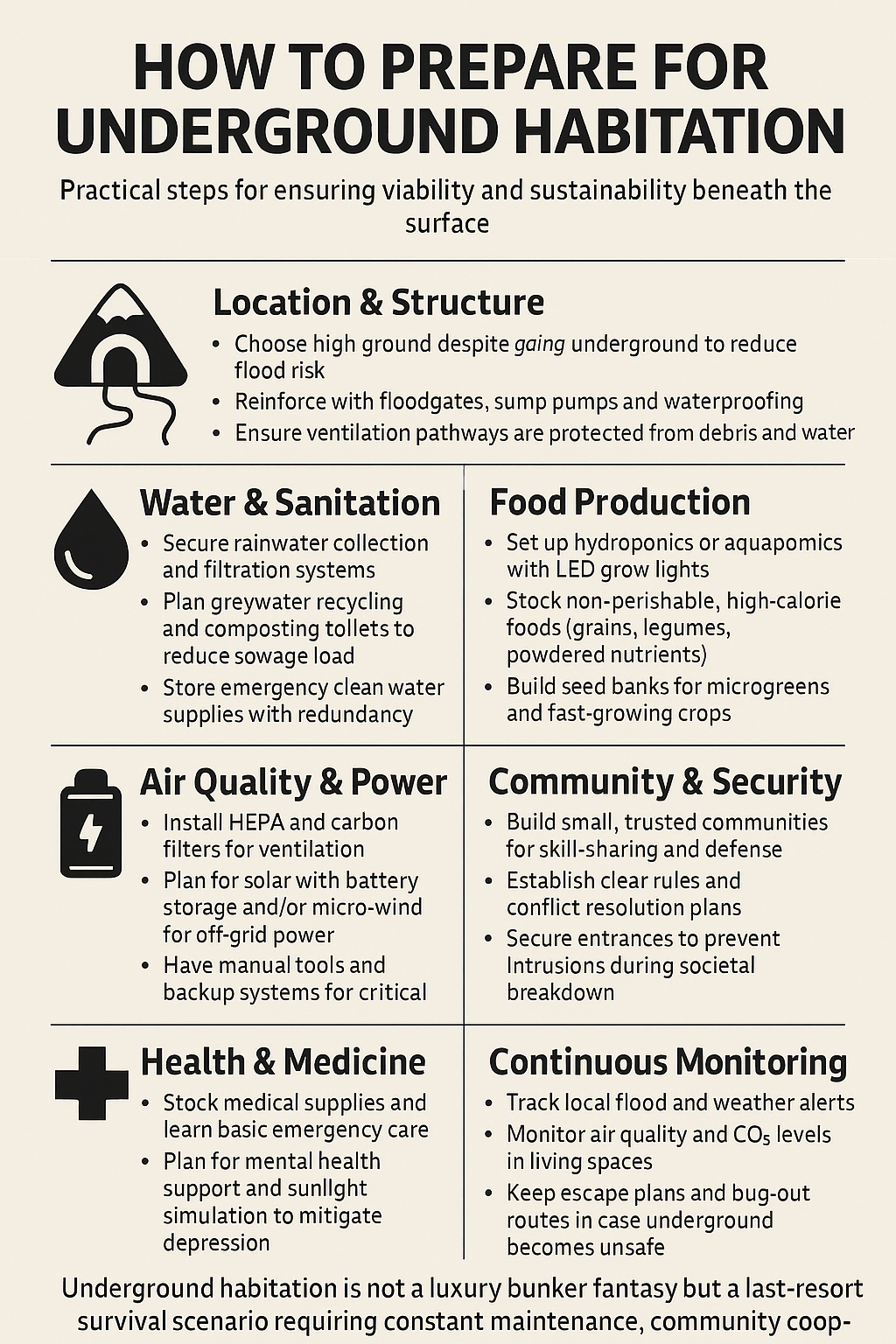
How to Prepare for Underground Habitation

 Location & Structure

  • Choose high ground despite going underground to reduce flood risk.

  • Reinforce with floodgates, sump pumps, and waterproofing.

  • Ensure ventilation pathways are protected from debris and water.

Water & Sanitation

  • Secure rainwater collection and filtration systems.

  • Plan greywater recycling and composting toilets to reduce sewage load.

  • Store emergency clean water supplies with redundancy.

Food Production

  • Set up hydroponics or aquaponics with LED grow lights.

  • Stock non-perishable, high-calorie foods (grains, legumes, powdered nutrients).

  • Build seed banks for microgreens and fast-growing crops.

Air Quality & Power

  • Install HEPA and carbon filters for ventilation.

  • Plan for solar with battery storage and/or micro-wind for off-grid power.

  • Have manual tools and backup systems for critical needs.

 Community & Security

  • Build small, trusted communities for skill-sharing and defense.

  • Establish clear rules and conflict resolution plans.

  • Secure entrances to prevent intrusions during societal breakdown.

Health & Medicine

  • Stock medical supplies and learn basic emergency care.

  • Plan for mental health support and sunlight simulation to mitigate depression.

  • Maintain physical fitness to handle manual labor and emergencies.

Continuous Monitoring

  • Track local flood and weather alerts.

  • Monitor air quality and CO2 levels in living spaces.

  • Keep escape plans and bug-out routes in case underground becomes unsafe.

Remember:
Underground habitation is not a luxury bunker fantasy; it is a last-resort survival scenario requiring constant maintenance, community cooperation, and adaptability in a rapidly collapsing climate system.


Underground Living Guide

Underground Living Guide

The Human Induced Climate Change Experiment

bookmark_borderNine Tipping Points Crossed: The Domino Collapse of Earth’s Climate Systems

by Daniel Brouse and Sidd Mukherjee
July 13, 2025

Human-induced climate change has now crossed at least nine critical tipping points, each triggering irreversible shifts in the Earth’s climate system. These tipping points are not isolated; they are interconnected, and their cascading effects amplify each other in a self-reinforcing feedback loop that accelerates global climate disruption.

The nine tipping points include:

  1. Greenland Ice Sheet Collapse

  2. West Antarctic Ice Sheet Collapse

  3. Labrador-Irminger Seas / SPG Convection Collapse

  4. East Antarctic Subglacial Basins Collapse

  5. Arctic Winter Sea Ice Collapse

  6. East Antarctic Ice Sheet Collapse

  7. Amazon Rainforest Dieback

  8. Boreal Permafrost Collapse

  9. Atlantic Meridional Overturning Circulation (AMOC) Collapse

These are not in strict chronological order, as the tipping points are dynamically interconnected, but the sequence of total collapse impacts the severity and global reach of the consequences.

As my colleague Sidd noted, “Number 7 might be first.”

The Amazon Rainforest Dieback

For decades, Sidd and I have researched the ozone feedback loop, an often-overlooked but critical piece of the climate crisis puzzle. Ozone, a byproduct of carbon combustion, does not act as a greenhouse gas itself but severely disrupts the Earth’s ability to manage greenhouse gases indirectly.

Tropospheric ozone pollution damages the stomata of plant leaves, which are microscopic openings essential for absorbing CO₂ during photosynthesis. This impairment drastically reduces plant productivity, health, and growth, weakening one of the planet’s most vital carbon sinks. Recent studies indicate that ozone poisoning has already reduced the productivity of plant CO₂ absorption by approximately 30%, undermining the natural carbon removal capacity of the Amazon and other forests.

As the Amazon’s ability to sequester carbon weakens, it becomes increasingly vulnerable to higher temperatures and intensified droughts, which are themselves driven by regional deforestation and climate change. Ozone-induced reductions in CO₂ uptake further weaken tree health, making the forest more susceptible to wildfires, pest outbreaks, and large-scale mortality.

Once the Amazon crosses its tipping threshold, large-scale dieback becomes irreversible, releasing immense quantities of stored carbon from vegetation and soils into the atmosphere. This shifts the Amazon from being a powerful carbon sink to a significant carbon source, accelerating global warming and reinforcing a destructive feedback loop that drives further regional drying and forest decline.

The Amazon also plays a critical role in recycling water across South America. As forest cover declines, this water recycling function weakens, reducing rainfall locally and regionally, amplifying drought, and hastening the ecosystem’s collapse. If current trends continue, the Amazon is poised to transform from the world’s largest carbon sink into a catastrophic carbon emitter, with devastating consequences for global climate stability and biodiversity.

Why This Matters Now

These tipping points are no longer theoretical warnings—they are unfolding in real time, compounding their effects and accelerating systemic collapse. Each tipping point increases the likelihood of crossing additional tipping points, fueling the domino effect of climate destabilization.

From the loss of polar ice sheets raising sea levels, to the collapse of ocean circulation patterns disrupting weather and food systems, to the dieback of the Amazon intensifying warming and reducing rainfall, these interlinked crises are now reshaping our world at a pace faster than traditional models predicted.

We are witnessing the transition from linear climate change to non-linear, system-wide collapse. It is critical for policymakers, scientists, and the public to recognize that mitigation and adaptation strategies must account for these cascading tipping points to avoid deeper, irreversible damage to the Earth’s systems and human civilization.

The Human Induced Climate Change Experiment

bookmark_borderTipping Cascades: The Nonlinear Dominoes of Climate Collapse

by Daniel Brouse
July 14, 2025

My latest deep reflection has centered on how tipping points have triggered self-sustaining feedback loops in the climate system. We knew this was coming—and it is now here. Luckily, I was prepared for that part.

What I could not fully envision in my mind’s eye was how the interplay of different tipping points would ignite a domino effect so rapidly—so, so fast.

Now, I can see it clearly: the nonlinear, dynamic dance of economic, physical, and ecological unordered systems in real time. This is pure math and science, visibly unfolding for all to see, transforming abstract models into undeniable, measurable reality.

To understand unordered systems, you must “zoom out.” Imagine standing in the eye of a hurricane, unable to grasp its structure from within, then pulling back to see the swirling system from a satellite view. Only then can you perceive its shape, patterns, and momentum. Climate science and economics share this paradox: from within, the chaos feels incomprehensible, but from a higher vantage, the pattern is clear.

I offer this perspective to help you grasp the critical reality of where we stand today:

We are witnessing at least nine major tipping points that are already in play, with dominoes falling and each accelerating the collapse of the next. Crossing these tipping points represents a threshold beyond which impacts on global ecosystems and human societies become irreversible within human timescales.

The Nine Tipping Points in Motion:

1. Greenland Ice Sheet Collapse
Accelerated melting is injecting vast freshwater into the ocean, disrupting marine ecosystems, weakening the AMOC, and raising sea levels.

2. West Antarctic Ice Sheet Collapse
Rapid destabilization threatens to raise sea levels by meters, displacing populations and eroding infrastructure globally.

3. Labrador-Irminger Seas / Subpolar Gyre Convection Collapse
Collapse of this convection disrupts the AMOC, a critical regulator of global heat distribution, weather stability, and ocean health.

4. East Antarctic Subglacial Basins Collapse
Grounded below sea level, these basins are vulnerable to rapid ice loss, accelerating sea level rise and destabilizing coastal regions.

5. Arctic Winter Sea Ice Collapse
Shrinking winter ice amplifies Arctic warming, disrupting jet streams, altering ocean currents, and triggering further heat absorption.

6. East Antarctic Ice Sheet Collapse
Long considered stable, sections of the East Antarctic are showing vulnerability to collapse, with the potential to significantly raise sea levels.

7. Amazon Rainforest Dieback
Deforestation and warming threaten the Amazon’s water recycling and carbon storage roles, turning it from a carbon sink to a carbon source.

8. Boreal Permafrost Collapse
Thawing permafrost is releasing methane and CO₂ in massive quantities, creating a powerful feedback loop of accelerated warming.

9. Atlantic Meridional Overturning Circulation (AMOC) Collapse
Potential collapse of the AMOC could lead to abrupt weather pattern shifts, including intensified droughts, storms, and regional cooling in some areas, while exacerbating global climate instability.


Tipping Cascades and The Domino Effect

These tipping points do not act in isolation. Each collapse amplifies stress on others, triggering tipping cascades:

  • Melting Greenland ice weakens the AMOC, which alters weather patterns, drying the Amazon, triggering dieback that releases CO₂, further warming the Arctic, collapsing permafrost, and amplifying ocean heating.

  • Changes in Arctic sea ice affect jet stream patterns, causing persistent heat domes, droughts, and flooding cycles, which destabilize ecosystems and food systems.

  • The weakening of the AMOC is linked to increased East Coast flooding, European storm intensification, and droughts in the Sahel, while simultaneously accelerating Antarctic ice melt.

We are seeing chaotic systems align into self-perpetuating loops, moving climate change from linear, human-driven emissions to nonlinear, nature-driven escalation.


Why This Matters Now

It is now clear: climate change has entered a phase where natural systems themselves are the drivers. Even if humans ceased all emissions today, these processes will continue for centuries or millennia, while continuing emissions add fuel to the fire.

Understanding and communicating the urgency of these tipping cascades is essential not only for scientists but for policymakers, businesses, and every individual. We must accelerate adaptation strategies while urgently reducing emissions to slow additional triggers.

The sooner we act, the more we can reduce the damage of the tipping cascades that are now unstoppable but can still be limited in scope and speed.

The Human Induced Climate Change Experiment

bookmark_borderThe Coming Treasury Flood: Why Rates May Stay High for Years

by Daniel Brouse
July 14, 2025

More than $1 trillion in U.S. short-term Treasury bills are expected to flood the market over the next 18 months following the latest debt ceiling increase, as the Treasury moves to replenish its depleted cash balance while continuing to fund the country’s massive fiscal deficit.

This is exactly the kind of risk I have been warning about. The massive increase in Treasury issuance will collide with a shifting demand landscape that could keep interest rates elevated for years. In a median scenario, rates could return to levels last seen in the 1980s within just a few years.

Here’s why:

  • Fiscal Policy Headwinds: Current fiscal policies, including massive deficit spending and protectionist tariffs, are reducing foreign demand for U.S. securities. Key buyers like China and Japan are already reducing their holdings, and confidence in U.S. debt stability is eroding.

  • Economic Slowdown: At the same time, a slowing economy, likely heading into a prolonged recession, will further complicate demand for Treasuries and weaken domestic consumption and investment.

  • Fed Quagmire: This creates a quagmire for the Federal Reserve. While the Fed might want to lower short-term rates to stimulate the economy, the market’s need to absorb huge Treasury supply will keep long-term rates elevated, limiting the effectiveness of monetary easing.

  • Real Estate Risks: These dynamics also point to the recent all-time highs in the real estate market as potentially marking a long-term peak. Structural issues—including a lack of immigration, an aging population, and the accelerating impacts of climate change—are likely to lead to declining home values within the decade. The collapse of the insurance industry in climate-vulnerable regions further compounds this risk, as uninsurable homes will lose liquidity and market value, accelerating the decline.

In short, we are entering a period of compounding systemic risks, driven by runaway fiscal policy, demographic challenges, and climate realities that threaten the sustainability of U.S. growth and the stability of key asset markets.

If you are an investor or policymaker, ignoring these converging trends is not an option. Now is the time to plan for a high-rate, low-growth environment and to reassess real estate and fixed-income strategies before the market fully prices in this new reality.

The Human Induced Climate Change Experiment

Trumpenomics: The Decline of the US

bookmark_borderAmerica’s Hidden War in Gaza: Christian Zionism, Genocide, and the Silencing of Dissent

by Daniel Brouse
July 12, 2025

Doesn’t anyone in the United States realize the U.S. now has boots on the ground in Gaza, participating directly in genocide. Under President Trump, a private military force disguised as a “humanitarian” organization has been deployed, with American citizens in combat roles actively shooting unarmed, starving men, women, and children who are desperately seeking aid.

I think this denialism has mostly to do with the fear of appearing antisemitic. Trump has launched a coordinated intimidation campaign specifically designed to silence anti-genocide voices, labeling any criticism of Israel’s actions in Gaza as antisemitism to shut down debate and dissent.

On top of that, many in the Jewish community have grown up surrounded by misinformation and false narratives that equate supporting human rights for Palestinians with hating Jewish people. I’ve had many Jewish friends—who don’t even realize that I’m Semitic myself—call me out for expressing these views, accusing me of being antisemitic when, in reality, I’m standing against genocide and for the dignity of all people.

We also need to focus on the Christian Zionists who are really driving this agenda. Many don’t realize that Trump, Stephen Miller, and the MAGA movement are not working to protect Jewish people; they are pushing an extremist Christian Zionist ideology that views the mass extermination of Jews as part of their prophecy to bring about the “Second Coming” and the “End Times.” They are using Israel and weaponizing Jewish communities for their own apocalyptic agenda, and in reality, their long-term goal is the elimination of Jews, not their protection.

We need to separate criticism of a government’s actions from hatred of a people. Standing against ethnic cleansing, apartheid, and mass murder should never be confused with bigotry. The fact that it so often is reflects how deeply these false narratives have taken hold in our society—and how urgently we need to challenge them.

The Christian Zionist Agenda: Ethnic Cleansing as Prophecy

There should be no doubt in anyone’s mind: what you are witnessing is an ethnic cleansing of the Palestinian people, orchestrated by a white supremacist, racist, Evangelical Christian, antisemitic U.S. government. This is not simply about geopolitical interests or security; it is a religiously fueled, extremist project.

Trump, along with his “supervisor of racism” Stephen Miller, are leading figures among Christian Zionists who believe they are fulfilling prophecy by bringing on the “Second Coming” and the “End of Times.” This belief system calls for an apocalyptic war and the eradication of Jews and Muslims from “The Holy Land,” to clear the way for Jesus’ return on the Temple Mount.

In this worldview, the systematic starvation, mass displacement, and extermination of Palestinians is not a tragedy to be avoided, but a goal to be achieved. This ideology, once confined to fringe pulpits, has captured the highest levels of U.S. power and is now directly shaping foreign and military policy in Gaza.

Christian Zionists are weaponizing religion to justify genocide, using U.S. military might and taxpayer funding to implement policies rooted in ethnic cleansing. This is not an abstract theological debate—it is the material reality of bombs falling on children, food blockades starving families, and bullets killing people at aid lines.

Evangelical Christianity and Israel
If you’re curious about the driving force behind US support for Israel, it’s ironically rooted in Evangelical Christianity. Many Evangelical Christians believe they can hasten the “second coming of Christ” by bringing about the apocalypse. According to their interpretation of the Bible, this involves Israel reclaiming Jerusalem, Jesus returning, and ultimately eliminating all Jews. For numerous “Christian Zionists,” especially influential evangelists aligned with the Republican Party, support for Israel is less about political strategy and more about its supposed role in biblical prophecy. In this worldview, war is not something to be avoided but embraced as a divine necessity—an inevitable and even celebratory step toward Jesus’ rule from the Temple Mount in Jerusalem. The fate of Jews and Palestinians is, to put it mildly, seen as collateral damage.

Trumpenomics: The Decline of the US

bookmark_border“A Camp, Not a State”: Israel’s Plan to Confine Palestinians in Gaza Draws Global Outrage

by Daniel Brouse
July 11, 2025

Israeli Minister Israel Katz has confirmed that the Israeli government is planning to establish what it calls a “humanitarian city” in southern Gaza—on the ruins of what was once Rafah before it was decimated by Israeli bombings. Human rights experts warn that this plan amounts to building a concentration camp in Gaza under the false pretense of humanitarian aid.

Under Katz’s plan, Israel would first force 600,000 Palestinians into the area and eventually concentrate the entire population of over 2 million Palestinians there. Entry into the camp would require screening by Israeli authorities, effectively creating a prison where Palestinians can neither move freely nor escape the humanitarian catastrophe unfolding around them.

If logistical conditions align, Israel intends to establish this camp during a temporary 60-day ceasefire currently being discussed by the U.S. and other mediators. However, legal experts argue that such a plan is a clear violation of international law and a crime against humanity. “It is all about population transfer to the southern tip of the Gaza Strip in preparation for deportation outside the Strip,” Israeli human rights lawyer Michael Sfard told The Guardian. “While the government still calls the deportation ‘voluntary,’ people in Gaza are under so many coercive measures that no departure can be seen in legal terms as consensual.”

A U.S.-Backed Operation
According to Reuters, the U.S.-backed Gaza Humanitarian Foundation (GHF) has prepared a parallel plan to create “Humanitarian Transit Areas” in Gaza. While marketed as safe zones, these areas would serve to concentrate Palestinians under tight control, aiming to replace Hamas’ governance in Gaza and further align with U.S. President Donald Trump’s “vision for Gaza.” Trump has previously described his plan as turning Gaza into a “Riviera,” which in practice would mean the ethnic cleansing of the Strip for future development while erasing its indigenous population.

Al Jazeera reports that it has obtained satellite images showing extensive bulldozing and flattening of what remains of Rafah, clearing the land for this planned “camp.” Meanwhile, the GHF has shut down three of its four aid distribution sites, leaving the population with even fewer means of survival. At the sole remaining site, 20 women and children were reportedly shot in a single day while attempting to obtain food, adding to the hundreds of starving Palestinians who have been shot by GHF and Israeli forces while seeking aid.

Exporting Ethnic Cleansing Abroad
President Trump’s role in these plans has been further revealed through his recent meetings with five leaders of African nations. While publicly framed as economic and diplomatic discussions, credible sources confirm that the primary agenda was to secure agreements for accepting mass deportations of immigrants from the United States and the forced expulsion of Palestinians from Gaza.

Regionally, Egypt, Jordan, Lebanon, Iran, and Iraq have refused to participate in this ethnic cleansing agenda, leaving the U.S. and Israel scrambling to pressure or incentivize other nations into accepting deported Palestinians. Human rights observers warn that the move to forcibly confine Palestinians into a single encampment under armed control is a prelude to mass deportation, mirroring dark chapters of ethnic cleansing throughout history.

Why This Matters
This plan is not a security measure or a humanitarian initiative. It is a calculated, systematic effort to erase a people from their land under the guise of aid and counterterrorism, backed by the world’s most powerful governments. It violates every principle of human rights and international law, threatening to set a dangerous precedent for how powerful states can displace entire populations with impunity.

The world cannot afford to look away. What is unfolding in Gaza is not only a tragedy for Palestinians; it is a test of whether the international community will stand up against genocide and the criminalization of resistance, or whether it will remain complicit in the name of political expediency.

Evangelical Christianity and Israel
If you’re curious about the driving force behind US support for Israel, it’s ironically rooted in Evangelical Christianity. Many Evangelical Christians believe they can hasten the “second coming of Christ” by bringing about the apocalypse. According to their interpretation of the Bible, this involves Israel reclaiming Jerusalem, Jesus returning, and ultimately eliminating all Jews. For numerous “Christian Zionists,” especially influential evangelists aligned with the Republican Party, support for Israel is less about political strategy and more about its supposed role in biblical prophecy. In this worldview, war is not something to be avoided but embraced as a divine necessity—an inevitable and even celebratory step toward Jesus’ rule from the Temple Mount in Jerusalem. The fate of Jews and Palestinians is, to put it mildly, seen as collateral damage.

Trumpenomics: The Decline of the US

bookmark_borderWhen “Privatization” Means Control: The Pentagon’s Quiet Takeover of MP Materials

by Daniel Brouse
July 10, 2025

The U.S. Department of Defense has begun taking over a private company, MP Materials, in a move that raises red flags for anyone concerned about the creeping merger of state and corporate power. While the government claims to champion “free markets” and “privatization,” it is now directly intervening to pick stocks, winners, and losers—contradicting its own stated economic values.

The Pentagon is partnering with MP Materials to secure the domestic supply of rare earth magnets, essential for advanced weapons, electric vehicles, and clean energy technologies. On the surface, this may appear to be a national security measure to counter China’s near-monopoly on rare earths. However, it also signals a significant shift: the U.S. government is now moving to control key industries under the guise of “partnership.” Shares of the stock skyrocketed 50% on the news.

Environmental Impact: A Hidden Cost of “Security”

One of the gravest concerns is the environmental devastation caused by rare earth mining and processing. The reason there is so little rare earth mining in the U.S. today is precisely because it is extremely toxic and deadly, leaving behind giant hazardous waste zones and radioactive tailings that poison water, soil, and air. The processing pools used to extract rare earth elements generate massive amounts of waste, including radioactive elements and heavy metals, creating long-term contamination risks for surrounding communities and ecosystems. By ramping up domestic rare earth production under the banner of “national security,” the U.S. risks creating sacrifice zones on its own soil, prioritizing military and economic aims over public health and environmental safety.

Why This Matters:

State Control Disguised as National Security:
While ensuring supply chains for critical materials is important, the mechanism here is effectively a nationalization of production without calling it that. This blurs the line between private enterprise and state control.

Distortion of Free Markets:
By injecting government capital, guarantees, and direction into specific companies, the Pentagon is picking winners and losers, undermining competition, and creating an uneven playing field.

Contradictions in U.S. Economic Policy:
The same government that lectures other nations about privatization and free-market reforms is now orchestrating the domestic economy to suit geopolitical goals. This hypocrisy undermines trust in U.S. policy abroad and at home.

Militarization of the Economy:
Securing rare earths for weapons and defense applications further expands the military-industrial complex, channeling public resources into war readiness rather than prioritizing civilian infrastructure, climate adaptation, or social needs.

Environmental Impact:

An example of the devastating consequences of rare earth mining can be witnessed in China, which currently dominates global rare earth mining and processing. Entire villages have become uninhabitable due to toxic waste, radioactive runoff, and air and water contamination caused by processing operations. Black sludge-filled lakes, poisoned farmland, and cancer clusters have become common in these regions, demonstrating the catastrophic cost of rare earth extraction when environmental protections are weak or ignored. If the U.S. pushes forward with domestic rare earth production without strict environmental safeguards, it risks replicating these sacrifice zones within its own borders, harming communities and ecosystems in the name of “security” and economic competition.

A Question for Policymakers:

If “privatization” only applies when it benefits corporate profits, but “nationalization” becomes acceptable when it serves military interests, what kind of economy are we really building?

Trumpenomics: The Decline of the US

bookmark_borderWeaponizing Aid: Netanyahu, Trump, and the Ethnic Cleansing of Gaza

Israeli Prime Minister Benjamin Netanyahu’s extended visit to the United States is not about peace or security—it is about expediting the ethnic cleansing of Gaza with direct assistance from the U.S. government. Behind closed doors, Netanyahu and President Trump are aligning their governments to advance plans that violate international law and deepen the genocide unfolding in Gaza.

One part of this plan has already surfaced in Congress: a push for the approval of an additional half-billion dollars in funding for Trump’s so-called “humanitarian” organization, the Gaza Humanitarian Foundation (GHF). While the name suggests relief and aid, the reality is far more sinister. GHF is a private corporation established in Delaware in coordination with Trump, functioning as a heavily armed private security force under the guise of humanitarian assistance.

GHF uses aid as a weapon while simultaneously starving the population it claims to serve. Reports from the ground indicate that while Palestinians are forced into “aid lines” under siege conditions, GHF personnel have been actively executing hundreds of unarmed women and children seeking food and water. This systematic violence and deprivation are clear violations of the Genocide Convention and the Fourth Geneva Convention, yet they continue with the backing of U.S. political leaders and taxpayer dollars.

The strategy is deliberate: starve, displace, and terrorize Gaza’s population while consolidating control under the false narrative of “humanitarian intervention.” Meanwhile, the push for more funding underlines the hypocrisy of U.S. foreign policy, where resources are channeled not to save lives but to facilitate forced displacement and extermination under the banner of “security.”

Netanyahu’s meetings with congressional leaders and Trump are not about ceasefire negotiations—they are about scaling up the infrastructure of genocide while shielding themselves from accountability. Each day this alliance continues, the human toll in Gaza grows, and the moral standing of the United States further erodes.

It is critical to expose the reality of GHF’s operations and the broader agenda being orchestrated between Netanyahu and Trump. Aid cannot be used as a weapon. Starvation cannot be disguised as policy. Extrajudicial executions cannot be covered up under the label of “security.” The world must recognize and resist this escalating campaign of ethnic cleansing before it becomes an irreversible stain on the global conscience.


Evangelical Christianity and Israel
If you’re curious about the driving force behind US support for Israel, it’s ironically rooted in Evangelical Christianity. Many Evangelical Christians believe they can hasten the “second coming of Christ” by bringing about the apocalypse. According to their interpretation of the Bible, this involves Israel reclaiming Jerusalem, Jesus returning, and ultimately eliminating all Jews. For numerous “Christian Zionists,” especially influential evangelists aligned with the Republican Party, support for Israel is less about political strategy and more about its supposed role in biblical prophecy. In this worldview, war is not something to be avoided but embraced as a divine necessity—an inevitable and even celebratory step toward Jesus’ rule from the Temple Mount in Jerusalem. The fate of Jews and Palestinians is, to put it mildly, seen as collateral damage.

Trumpenomics: The Decline of the US

bookmark_borderTrump’s Push for Mass Deportations: Palestinians and U.S. Immigrants in the Crosshairs

President Donald Trump recently met with five leaders of African nations under the guise of economic and diplomatic discussions, but sources indicate the meetings’ primary agenda is far more sinister: securing agreements for the mass deportation of immigrants from the United States while simultaneously seeking countries willing to accept the forced expulsion of Palestinians from Gaza.

This chilling strategy echoes the darkest chapters of history, aligning with the ethnic cleansing campaign currently underway in Gaza under Netanyahu’s far-right government, with the open support of Trump and his administration. By seeking to forcibly relocate the entire Palestinian population under siege in Gaza to African nations, Trump is further entrenching the United States in a genocide that has already displaced millions and killed tens of thousands, many of them women and children.

In a moment that underscores both the ignorance and the casual racism embedded in these discussions, Trump praises the President of Liberia for his “excellent English,” apparently unaware that English is Liberia’s official language and that the country was founded by formerly enslaved people forcibly “repatriated” from the United States in the 19th century. This moment is not only deeply ironic but reveals a stunning lack of historical awareness from a sitting president who is actively seeking to repeat the patterns of forced displacement and racist population control that have caused immense suffering for centuries.

Trump’s approach represents a dangerous escalation of policies that violate international law and basic human rights. Forced deportations of immigrants from the U.S., many of whom have lived here for years or even decades with deep family and community ties, will tear apart families and communities under the false promise of “security.” Simultaneously, the attempt to depopulate Gaza and relocate Palestinians constitutes a violation of the Genocide Convention and the Fourth Geneva Convention, making these actions clear crimes against humanity.

These meetings should alarm anyone who values human rights, international law, and the dignity of all people, regardless of where they are born. It is critical to expose these plans now, while they are in the negotiation stages, before they are quietly implemented under the cover of diplomacy and “security.”

Evangelical Christianity and Israel
If you’re curious about the driving force behind US support for Israel, it’s ironically rooted in Evangelical Christianity. Many Evangelical Christians believe they can hasten the “second coming of Christ” by bringing about the apocalypse. According to their interpretation of the Bible, this involves Israel reclaiming Jerusalem, Jesus returning, and ultimately eliminating all Jews. For numerous “Christian Zionists,” especially influential evangelists aligned with the Republican Party, support for Israel is less about political strategy and more about its supposed role in biblical prophecy. In this worldview, war is not something to be avoided but embraced as a divine necessity—an inevitable and even celebratory step toward Jesus’ rule from the Temple Mount in Jerusalem. The fate of Jews and Palestinians is, to put it mildly, seen as collateral damage.

Silencing Truth: The War on Journalism by Netanyahu and Trump

Trumpenomics: The Decline of the US