bookmark_borderProfit Over Patriotism: How Trump’s Second Term Blurred the Line Between Presidency and Personal Gain

Donald Trump’s second term in office marked a sharp escalation in the merger of political power and personal profit. From crypto schemes and cell service ventures to corporate-sponsored parades and questionable foreign deals, Trump turned the presidency into a revenue-generating enterprise, prioritizing his brand and wallet over democratic norms and military integrity.

1. Trump Meme Coin: $TRUMP & $MELANIA

  • In January 2025, Trump launched a meme coin, $TRUMP, on Solana, followed by $MELANIA—all tied to his personal holdings.

  • The coin ballooned to a $27–70 billion market cap within days, netting over $350 million in sales and fees, much of which flowed back into Trump-affiliated entities.

  • He dangled “private dinner and White House tour” incentives for top holders—an action that fueled accusations of quid pro quo and insider manipulation .

  • Repeated investors lost billions as the coin collapsed—leaving Trump’s circle as the embedded winners .

2. Tesla Showcase on the South Lawn

  • Trump turned the White House lawn into a Tesla showroom, promoting EV models alongside CEO Elon Musk—an act many critics labeled a “sales pitch”.

  • Meanwhile, the State Dept quietly edited out a planned $400 million armored Tesla contract, igniting suspicion of conflict-of-interest favor trading .

  • Perhaps the most jarring moment came when Trump arranged for a Tesla Cybertruck—reportedly owned by a private donor—to be displayed and auctioned on the White House lawn. While the administration claimed it was for charity, proceeds were partially funneled into Trump PACs and the America250 Foundation.

3. Trump Mobile (“T1 Mobile”)

  • The Trump Organization launched Trump Mobile, offering a patriotic $47.45/month plan and licensing arrangement for phones built in the U.S.

  • Critics raised alarms around ethical boundaries and regulatory fairness, especially due to FCC oversight of telecoms .

4. Tariffs & Private Deals

  • Trump imposed sweeping tariffs on Canada, Mexico, and China, even tying exceptions to private negotiations—a structure experts flagged as a potential personal leverage strategy.

  • His economic pivot aligned with personal business posture—suggesting that policy decisions may have reflected private interests (e.g. boosting T1 Mobile or energy deals) .

5. Foreign Gifts & Deals

  • Qatar gifted a $400 million luxury jet to serve as a future presidential library asset—raising questions under the Constitution’s Emoluments Clause.

  • Additional real estate and defense deals with Middle Eastern entities further deepened concerns of foreign influence tied to Trump-linked business interests.

Undermining Public Institutions

Within the first months of his second term, Trump’s behavior was drawing comparisons not to presidents but to autocrats. He inserted loyalists into federal agencies, tried to reshape the DOJ into a personal legal defense team, and continued attacking the press while praising authoritarian leaders abroad.

His military parade, held on his birthday, underscored this shift. It wasn’t just a show of force—it was a show for Trump. Featuring tanks, flyovers, and meticulously curated imagery, the event borrowed from strongman aesthetics. But it was the details—advertisements from defense contractors, crypto firms, and campaign donors—that revealed the true purpose: a celebration of profit, not patriotism.

Conclusion: A Presidency for Sale

Trump’s second term is less about governance than self-enrichment. Every major move seemed designed to elevate his brand, increase his assets, and reward his backers. Patriotism was reduced to a marketing strategy; public service, a tool for personal gain.

In the end, Trump did not drain the swamp—he monetized it. And in doing so, he blurred the line between President and pitchman, leaving behind a legacy not of public leadership but private profit and disgust.
Trumpenomics: The Decline of the US

bookmark_border“It Ain’t Me”: Trump’s Military Parade Backfires Amid Global Criticism and Domestic Protest

In a stunning series of events, President Donald Trump’s long-anticipated military parade proved to be an embarrassing misfire—both symbolically and politically. Despite the millions of taxpayer dollars spent on tanks, flyovers, and carefully choreographed pageantry, the turnout was underwhelming. According to multiple international news sources, only several thousand attendees appeared, leaving large swaths of the National Mall sparsely populated.

But it wasn’t just the empty space that spoke volumes. The most unforgettable—and ironic—moment came as the infantry passed while the military band played Creedence Clearwater Revival’s iconic antiwar anthem, “Fortunate Son.”

“Some folks are born made to wave the flag / Hoo, they’re red, white, and blue…
And when the band plays ‘Hail to the Chief’ / Ooh, they point the cannon at you, Lord…”

“It ain’t me, it ain’t me / I ain’t no senator’s son, son…”

The lyrics—an unmistakable rebuke of privileged political elites who send others to war—clashed starkly with the image of Trump, a man who dodged the Vietnam War with multiple deferments, basking in military grandeur as soldiers marched before him.

A Parade of Contradictions
While billed as a tribute to the troops, the parade laid bare the contradictions of the Trump administration. The event reportedly cost tens of millions of dollars, even as the administration continues to push for deep cuts to food stamps, healthcare subsidies, and housing assistance—programs that disproportionately serve veterans, working families, and the very communities from which most enlisted soldiers come.

Even more ironic: the vast majority of the marching service members were people of color, and many were women—groups that have borne the brunt of Trump’s political rhetoric, policy rollbacks, and immigration crackdowns. According to estimates, roughly 90% of enlisted personnel involved in the parade were non-white.

“No Kings” Protests Sweep the Nation
As Trump looked out over a military procession designed to evoke strength and loyalty, millions of Americans were in the streets holding signs that read “No Kings.” In more than 150 cities, demonstrators gathered to protest what they describe as Trump’s authoritarian tendencies, including his attempts to undermine the judiciary, intimidate the press, and flout congressional oversight.

These protests weren’t just political opposition; they were a direct rejection of Trump’s growing embrace of militarized nationalism—a move many see as an attempt to normalize strongman tactics in the United States.

Global News Coverage and Condemnation
International outlets seized on the event to highlight what many foreign commentators described as the ongoing decline of American democratic norms. European and Asian broadcasters ran montages of the parade alongside footage of mass protests, immigrant detentions, and civil rights rollbacks. Several outlets highlighted the choice of “Fortunate Son” in particular, noting the irony of its anti-elitist message being played for a President often described as an embodiment of wealth, privilege, and populist manipulation.

Critics around the globe continued to spotlight the administration’s open ties to white nationalist rhetoric, from immigration bans and voter suppression to the President’s refusal to denounce far-right militias. One BBC commentator noted, “When a leader embraces the trappings of monarchy and silences opposition, even parades begin to look like warnings.”

The Cost of Spectacle
The parade may have been designed to boost morale, project strength, and rally Trump’s base. But instead, it drew global attention to a White House increasingly isolated both at home and abroad. The optics—a President standing amid rain and dwindling crowds, with antiwar lyrics echoing in the background—did not project dominance. They projected disconnect.

And for millions of Americans—marching in the streets, struggling with basic needs, or simply watching with unease—the parade served as a painful reminder of what’s being lost: not just money, but values, dignity, and direction.

Even more disturbingly, the stage itself was plastered with corporate sponsorships—from Coinbase and Palantir to Lockheed Martin and UFC—further commercializing what was falsely billed as a patriotic celebration. News reports confirm that these companies helped fund the parade, turning a national military display into an ad-laden marketing event.

So, not only were soldiers demeaned and marched like extras in a rain-drenched propaganda show—they were also used to sell products, cover political costs, and give legitimacy to a regime that pardons insurrectionists and undermines democracy.

In the end, it wasn’t strength that defined the day—it was irony. And irony, unlike patriotism, can’t be choreographed.

Parade of Profit: How Trump Turned Military Sacrifice into Corporate Spectacle

VA Policy Shift Enables VA Doctors to Refuse Care to Democrats and Hire by Politics

Trumpenomics: The Decline of the US

bookmark_borderThe Math Behind Sequential Tariffs

by Daniel Brouse
June 11, 2025

The math of sequential tariffs is both interesting and economically significant. The complexity adds to business uncertainty. For instance, to calculate the total duties on Chinese steel imports — subject to a combined 132.5% tariff rate — you can break it down like this:

Starting Point: A $100 shipment of Chinese steel
Step 1: Apply Section 301 Tariff (55%)
55% of $100 = $55

New subtotal: $100 + $55 = $155

Step 2: Apply Section 232 Steel Tariff (50%)
50% of $155 = $77.50

New subtotal: $155 + $77.50 = $232.50

Final Import Cost: $232.50

Summary:
Description Amount
Original Invoice Value $100.00
Total Tariffs Paid $132.50
Effective Tariff Rate 132.5%

Would the sequential tariffs on steel and aluminum apply to washers and dryers made in China?

Washers and dryers made in China do face stacked tariffs, but not all of the same ones that apply to steel and aluminum. Instead, they’re subject to a specific tariff framework that includes:

1. Section 201 Safeguard Tariff
Specifically targets large residential washers (like top-load/front-load machines).

Originally 20% tariff in 2018, phased down over time — but was reimposed and increased in 2025 under Trump’s new trade policy.

Current estimate: 20%–30% depending on category.

2. Section 301 Tariff (China-specific)
As of June 2025: 55% total (25% original + 20% fentanyl-related + 10% universal tariff).

Applies to most appliances and electronics imported from China.

3. Section 232 (Steel & Aluminum) Tariff
Only applies to raw materials or unfinished parts, not finished consumer goods like assembled washers/dryers.

However, if imported as parts or unfinished assemblies, Section 232 may apply.

4. Universal 10% Tariff
Included in the 55% Section 301 total, not double-counted.

Applies to all imports, including appliances.

Example Calculation: Chinese Washer ($100 FOB value)
Let’s assume:
It qualifies as a large residential washer
No exclusions or exemptions apply

Step 1: Apply Section 201 Tariff (25%)
25% of $100 = $25

Subtotal = $125

Step 2: Apply Section 301 Tariff (55%)
55% of $125 = $68.75

Subtotal = $193.75

Final Import Cost = $193.75
Result Summary
Description Amount
Original Value $100.00
Section 201 Tariff $25.00
Section 301 Tariff $68.75
Total Tariffs Paid $93.75
Effective Tariff Rate 93.75%

Additional Notes
Dryers (not washers) may not fall under Section 201 but still face the full 55% Section 301 tariff.

Steel/aluminum content inside these appliances does not trigger Section 232 if the item is fully assembled.

The HS classification code used by U.S. Customs determines which tariff layers apply.

What would the sequential tariff be on a BYD electric vehicle?

Section 301 (China-specific, EV-focused)
Initially 27.5% (Trump era) and raised to 100% under Biden on May 14, 2024

Section 232 (Auto Tariff)
A 25% steel/aluminum tariff also applies to vehicles and parts imported from China, enacted April 3, 2025 under Section 232

Universal 10% Tariff
Part of the broader Section 301 package or standalone under “reciprocal” policy. Likely factored, but could stack separately

Sequential Tariff Calculation – Hypothetical $30,000 BYD EV
Step 1: Section 301 – 100%
$30,000 × 100% = +$30,000 → Subtotal: $60,000

Step 2: Section 232 – 25% on New Subtotal
$60,000 × 25% = +$15,000 → Subtotal: $75,000

Step 3: Universal 10% Tariff
$75,000 × 10% = +$7,500 → Final Cost: $82,500

Final Tallies
Tariff Component Rate Amount
Original Vehicle Price – $30,000
Section 301 Duty 100% $30,000
Section 232 Duty 25% $15,000
Universal Tariff (est.) 10% $7,500
Total Duties Paid – $52,500
Effective Tariff Rate – 175%

Conclusion
The examples above demonstrate how sequential tariffs can significantly inflate the final cost of imported goods—sometimes more than doubling or tripling the original price. While these tariffs are often justified as tools for protecting national industries or pressuring foreign governments, their economic consequences are far-reaching. Tariffs act as a regressive tax, disproportionately impacting lower-income consumers who spend a higher share of their income on goods affected by price hikes. They also introduce business uncertainty, discourage investment, and strain global supply chains. Perhaps most damaging in the long term, the increasing use of unilateral and stacked tariffs undermines the United States’ credibility as a reliable trading partner, encouraging allies and rivals alike to pursue trade relationships elsewhere. As trade policy becomes more complex and politically charged, understanding the math—and the unintended consequences—of sequential tariffs is more important than ever.

Trumpenomics: The Decline of the US

bookmark_borderThreatening the Constitution: How Trump’s Warnings Against Protest Violate the First Amendment

Trump’s threats to use force against all protestors at the upcoming military parade in Washington, D.C. represent a direct violation of the First Amendment of the U.S. Constitution, which guarantees the right to freedom of speech, peaceful assembly, and petitioning the government for redress of grievances.

Here’s why:

  1. Right to Peaceful Assembly
    The First Amendment explicitly protects the right of individuals to gather peacefully in public spaces, including for the purpose of protest. The government cannot prohibit or punish peaceful protest simply because it is critical of those in power. Threatening to use force against all protestors—regardless of whether they are peaceful—amounts to a blanket suppression of constitutionally protected expression.
  2. Prohibition on Prior Restraint and Retaliation
    Government threats of violence or punishment in response to anticipated protest serve as a form of prior restraint—an attempt to chill speech and deter participation through fear. Courts have consistently ruled that the government cannot criminalize or threaten constitutionally protected activity before it happens, particularly if it’s based on political content.
  3. Content and Viewpoint Discrimination
    If Trump’s threats are targeted specifically at protestors who oppose his policies or political message—while allowing supporters to attend without risk—this constitutes viewpoint discrimination, which is strictly forbidden under First Amendment jurisprudence. The government must remain neutral toward the content of speech, even if it is unpopular or critical of officials.
  4. Abuse of State Power
    Using state or military force to intimidate or harm protestors violates not only constitutional protections but also democratic norms. Peaceful dissent is a cornerstone of a functioning democracy. Threatening force against civilians for exercising this right moves the nation closer to authoritarianism.

In summary, Trump’s threats are not just inappropriate—they are unconstitutional. They reveal a dangerous disregard for the foundational principles of American democracy and further undermine the rule of law. Peaceful protest is not a crime. It is a right.

The Human Induced Climate Change Experiment

bookmark_borderDemocracy in Decline: Unconstitutional ICE Raids, Military Force, and Attacks on the Press Under Trump

Under the direction of President Donald Trump, the United States is experiencing a sharp and alarming erosion of democratic norms and the rule of law. Reports have surfaced across the country of Immigration and Customs Enforcement (ICE) agents conducting unconstitutional raids and sweeps, targeting both undocumented immigrants and U.S. citizens alike.

Eyewitness accounts and legal organizations have documented that ICE officers, dressed in military-style gear, are operating without identification, often wearing masks to conceal their identities. In scenes reminiscent of authoritarian regimes, individuals have been forcibly taken off the streets and placed into unmarked vans—without warrants, without charges, and without access to legal counsel. Many are being detained for indefinite periods without due process, in clear violation of constitutional protections.

In response, tens of thousands of citizens have taken to the streets in protest, demanding an end to the raids and calling for accountability. The demonstrations have remained largely peaceful. However, protestors have been met with increasingly aggressive tactics from law enforcement. Tear gas, rubber bullets, and mass arrests have been used in what civil liberties groups call a blatant attempt to silence dissent.

Escalating the crisis, President Trump has ordered the National Guard into California—against the explicit objections of the state’s governor. In an even more dramatic and potentially unconstitutional move, he has now authorized the deployment of U.S. Marines on American soil, a decision that legal scholars say could violate the Posse Comitatus Act, which prohibits the use of military forces for domestic policing.

Perhaps most troubling of all is the administration’s apparent hostility toward a free press. In the last 48 hours, Australia’s ABC News has reported two separate attacks on its journalists covering the protests. One reporter was shot with a rubber bullet; another was tear-gassed while on the air. These incidents follow a disturbing pattern of escalating aggression toward the media, including lawsuits against major U.S. outlets like ABC and CBS, and sanctions targeting the Associated Press.

These developments mark a dangerous turning point. The combined use of federal force against civilians, targeted suppression of the press, and disregard for state sovereignty signals an erosion of foundational democratic principles. As legal and constitutional experts warn, the United States may be entering a period of authoritarian overreach, where power is exercised without accountability and civil liberties are cast aside in the name of “order.”

Whether the courts—or Congress—will intervene remains uncertain. But one thing is clear: the pillars of American democracy are under unprecedented strain.

The Human Induced Climate Change Experiment

bookmark_borderConstitutional Crisis Brews as President Trump Deploys National Guard Over ICE Protests in California

by Daniel Brouse
June 8, 2025

In a volatile and potentially unconstitutional series of events, President Donald Trump has ordered the deployment of the National Guard in California in response to growing protests against controversial Immigration and Customs Enforcement (ICE) operations on U.S. soil.

The protests erupted after reports surfaced of military-style ICE raids targeting immigrant communities, sparking public outrage and civil unrest in several California cities, including Los Angeles, San Francisco, and Sacramento. Critics argue that the ICE actions—described by some as resembling military occupation tactics—violate both civil liberties and the separation of federal and state powers.

Governor Gavin Newsom has strongly condemned both the raids and the federal response, stating, “California will not stand by while its residents are terrorized by federal agencies acting outside the bounds of constitutional authority.” Legal experts and civil rights groups have also raised alarms, suggesting the President’s use of the National Guard to quell protests could breach the Posse Comitatus Act, which restricts the use of the U.S. military for domestic law enforcement.

“This is not just about immigration anymore,” said ACLU legal director Maya Walker. “This is about whether the President can use federal force to suppress dissent in a state that disagrees with his policy.”

The Trump administration, however, maintains that the actions are necessary to maintain public order and enforce immigration laws, with the President tweeting, “We will not allow lawlessness and anarchy to take over our cities. ICE is doing a great job protecting our borders.” Meanwhile, the Secretary of Defense has confirmed that the Marines are on standby.

Constitutional scholars warn this confrontation could lead to a historic legal battle between state and federal authority. With tensions escalating and the legality of Trump’s actions being called into question, the situation represents one of the most significant challenges to American federalism in recent memory.

As protests continue and legal challenges mount, the nation watches closely to see whether the courts—or Congress—will intervene in what may become a defining constitutional moment of the Trump presidency. Yes, this is deeply troubling. Many political observers have long warned about the potential for such outcomes. The use of the military to suppress protests represents an extreme and dangerous escalation. Additionally, actions such as sanctioning Harvard, deporting activists, and filing lawsuits against ABC and CBS News — along with punitive measures against the Associated Press — raise serious concerns about the erosion of democratic norms and press freedom. These tactics bear disturbing similarities to authoritarian regimes of the past.

Trumpenomics: The Decline of the US

bookmark_borderTrump’s Steel Tariff Déjà Vu: Doubling Down on Economic Damage

by Daniel Brouse
June 1, 2025

On May 30, 2025, Donald Trump announced that he would raise tariffs on imported steel and aluminum from 25% to 50%. The announcement took place in Pittsburgh, Pennsylvania—ironically, at the headquarters of U.S. Steel, a company now under foreign ownership after being acquired by Japan-based Nippon Steel.

Despite Trump’s attempts to frame the acquisition as something other than a foreign takeover, his administration supported the deal—effectively relinquishing one of the last iconic symbols of American industrial independence. The political optics of standing in front of a foreign-owned U.S. Steel to promote tariffs supposedly aimed at protecting American manufacturing highlight the contradictions at the core of Trump’s economic strategy.

Trump’s Tariff Folly: Round One

Trump’s earlier imposition of steel tariffs in 2018 under his “America First” policy was marketed as a way to revive domestic industry. But in reality, it delivered a net blow to the broader U.S. economy. Here’s what happened:

  • Net Loss of 75,000 U.S. Manufacturing Jobs
    While a small number of domestic steel jobs were created, the broader manufacturing sector was hit hard. Industries like automotive, construction, and appliances faced soaring input costs, resulting in layoffs, reduced investment, and production slowdowns.

  • $900,000 Cost Per Job Saved
    According to independent economic analyses, each job preserved by the steel tariffs cost American taxpayers nearly $900,000, making it one of the least cost-effective job protection strategies in recent memory.

  • Higher Prices Across the Economy
    U.S. firms paid 15–20% more for steel and aluminum than their international competitors. These increased costs rippled across industries, raising prices on everything from cars to washing machines to public infrastructure projects.

  • Retaliatory Tariffs and Export Declines
    Countries like Canada, China, and the EU responded with their own tariffs, particularly targeting U.S. agricultural exports. Farmers, already struggling from shifting global markets, saw billions in lost revenue.

  • Increased Market Volatility and Business Uncertainty
    The erratic nature of Trump’s trade policies created uncertainty that dampened business investment and contributed to increased market instability.

Why Trump’s 2025 Tariffs Could Be Even More Destructive

Trump’s new 50% tariff—double the rate from 2018—comes at a time when the global economy is more interconnected than ever and inflationary pressures remain sensitive to supply chain disruptions. The risks are even greater now:

  • More Global Retaliation: Other countries may once again hit back with tariffs of their own—this time potentially broader and more aggressive. The U.S. could face compounded export losses, especially in tech, energy, and agriculture.

  • Greater Downstream Harm: U.S. manufacturers are already competing on thin margins and globalized supply chains. A 50% tariff will push many over the edge, leading to offshoring, layoffs, and consolidation.

  • Foreign Ownership Undermines the Premise: Supporting a foreign takeover of U.S. Steel while implementing protectionist tariffs is not just contradictory—it’s economically incoherent. Tariffs that raise domestic prices now benefit a Japanese-owned firm at the expense of U.S. manufacturers and consumers.

  • Inflationary Effects at the Worst Possible Time: Adding significant cost pressures to critical materials like steel and aluminum may worsen inflation at a time when the Federal Reserve is trying to stabilize prices.

Conclusion: America Last, Not First

Rather than revitalizing American industry, Trump’s steel tariffs have proven to be an expensive exercise in economic nationalism. They harm the very sectors they aim to protect, misallocate resources, and isolate the U.S. from global trade benefits.

Trump’s doubling down on tariffs in 2025—combined with a tacit approval of foreign acquisitions—only magnifies the disconnect between his rhetoric and reality. In doing so, he’s not making America great again—he’s making it less competitive, more isolated, and economically unstable.

Trumpenomics: The Decline of the US

bookmark_borderFederal Court Rebukes Trump’s Tariff Plan as an “Unprecedented” Executive Overreach

by Daniel Brouse
May 29, 2025

In a landmark decision, a three-judge panel of the U.S. Court of International Trade has struck down President Donald Trump’s sweeping 2025 tariffs, ruling that he unilaterally overstepped his authority by imposing blanket tariffs on all imported goods under a disputed claim of national security. The court called the move “legally untenable” and a violation of the constitutional separation of powers.

A First in Modern History: Blanket Tariffs on All Imports

On April 2, 2025, the Trump administration began enforcing unilateral tariffs on all imported goods, with rates starting at 10% and rising to 50%. This marked the most extensive use of presidential trade power in U.S. history, applying broadly to all imports from every trading partner, including NATO allies.

President Trump invoked Section 232 of the Trade Expansion Act of 1962, a statute that allows limited import restrictions if national security is genuinely at risk. He argued that decades of deindustrialization and overreliance on foreign suppliers had left the U.S. vulnerable in times of crisis.

Critics said the move was a gross distortion of the law’s intent—using a narrow national defense exemption to pursue full-scale economic nationalism without congressional approval.

The Court’s Ruling: “No Statutory Basis”

In a unanimous decision, the U.S. Court of International Trade ruled that Trump’s action exceeded the authority granted by Congress.

Judge Jane Restani, writing for the panel, stated:

“Section 232 provides targeted authority to address real threats to national security. It does not authorize the president to impose tariffs on all imports in pursuit of broader policy goals. To do so is to legislate without Congress.”

The court faulted the administration for:

  • Lack of Evidence: It found no clear connection between many of the affected imports and actual threats to national security.

  • Violation of Constitutional Structure: By imposing universal tariffs, the administration had assumed powers explicitly delegated to Congress under the Commerce Clause.

Reaction from Legal Experts and Industry

Legal Scholars:
Trade and constitutional law scholars applauded the decision as a critical defense of legislative authority. Professor Eli Mendelsohn of Columbia Law School called it “the strongest signal yet that courts will not rubber-stamp national security justifications for sweeping economic actions.”

Business Groups:
Retailers, manufacturers, and agricultural importers expressed relief. The American Apparel & Footwear Association said the ruling would “prevent a cost shock that would have rippled through every household in the country.”

The White House:
A spokesperson for the Trump administration denounced the ruling, saying:

“President Trump acted to defend American sovereignty, jobs, and strength. This ruling undermines national security and invites economic sabotage.”

They confirmed the White House will appeal the decision to the U.S. Court of Appeals for the Federal Circuit.

Broader Implications for Trade and Governance

This ruling carries significant weight for the future of U.S. trade policy:

  • Reins in Presidential Power: Courts are no longer willing to allow open-ended executive authority on trade under vague legal provisions.

  • Reaffirms Congressional Role: The decision reasserts that only Congress can overhaul tariff policy—especially on such a sweeping scale.

  • Raises Legal Bar for Section 232: Future administrations must show clear, product-specific, and defensible links to national security threats.

Conclusion:
Futures markets responded with cautious optimism to the court’s ruling. While investors welcomed the reaffirmation of constitutional limits on presidential power—and the prospect of a more restrained executive—they remain concerned about the lasting economic fallout. Significant damage has already been inflicted: global supply chains are disrupted, long-standing trade agreements with allies have been unilaterally nullified, and international trust in U.S. trade reliability has been eroded. Additionally, tariffs on key sectors such as automobiles, steel, and aluminum remain firmly in place. Substantial and economically impactful tariffs on China continue to persist, including product-specific Section 301 tariffs ranging from 25% to 100%, 25% Section 232 tariffs on steel, aluminum, and automobiles, and the closure of the de minimis exemption on all retail shipments from China. The court ordered the Trump administration to issue revised directives reflecting the permanent injunction within 10 days. However, minutes later, the administration filed a notice of appeal and publicly challenged the court’s authority, framing the intervention as a matter of national sovereignty.

Bond markets reacted negatively, with interest rates rising amid concerns that the Trump administration’s “Big Beautiful Bill” will further increase the deficit and exacerbate the already unsustainable national debt.

Trumpenomics: The Decline of the US

bookmark_borderWhen AI Attacks Itself: The Strange New World of Automated Copyright Warfare

by Daniel Brouse
May 25, 2025

In our last R&D and A&R deep dive, “AI, Copyrights, and the Music Industry: A Glimpse into the Future of Intellectual Property,” we explored the growing legal and ethical complexities facing artists who use artificial intelligence in their creative workflows. But as complicated as things were then, the latest development pushes us even further into absurdity: welcome to the era of automated and self-inflicted copyright enforcement.

In that previous case, my digital music distributor had flagged one of my own AI-generated releases, questioning whether I owned the rights. That was odd enough—essentially, my distribution partner was getting into a dispute with my AI assistant over something I had created. But now, the situation has taken a new turn.

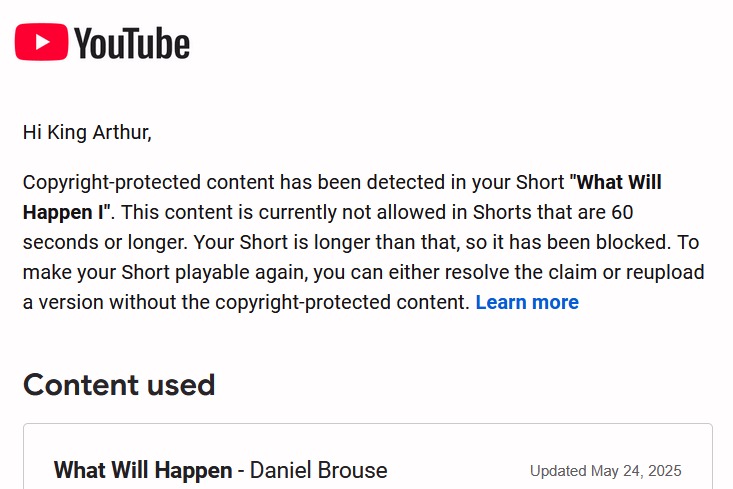
This week, I was notified that my YouTube channel removed one of my own videos—because the background music in the video was “owned” by me through my digital distributor. Yes, you read that correctly: my distributor triggered a Content ID claim against me, on behalf of me.

To restore the video, YouTube now requires that I “submit a dispute to the content owner if you have the rights to the content.” The process continues: “When you dispute a Content ID claim, the person that claimed your video (the claimant) is notified. The claimant has 30 days to respond.”

So now I must formally dispute myself to restore a song that I composed, performed, and uploaded.

The track in question, “What Will Happen Pt. 1,” was created with the help of my AI assistant, trained with my own musical data over the course of a year. That means I now have three virtual agents—my AI assistant, my distributor’s AI system, and YouTube’s Content ID—all fighting each other over a song that I indisputably own.

This is no longer a legal or technical nuance. It’s an existential glitch in the new digital music ecosystem. None of these systems were designed to resolve ownership at this level of nuance or context—and certainly not to understand when they are attacking their own creator.

I never instructed any of these tools to act against me. But the automation is now operating independently, enforcing policies that treat creators as potential infringers, even when there is no infringement. This is more than inconvenient; it’s reputational damage, business disruption, and the beginning of a deeply flawed feedback loop.

What we’re seeing is the early chaos of a system that’s automating enforcement faster than it’s developing the intelligence to understand context. As AI becomes more entrenched in content creation, content distribution, and content policing, the potential for misfires like this will only grow.

It raises urgent questions:

  • Who is ultimately responsible when automated systems attack legitimate creators?

  • What recourse do independent artists have when the enforcement tools are in conflict with each other—and themselves?

  • And most fundamentally, how can we create digital ecosystems where creators aren’t penalized by their own tools?

One thing is clear: we need new protocols for authorship, ownership, and automated enforcement—before the machines get too far ahead of the musicians.

When AI Attacks Itself

KingArthur.com

bookmark_borderAI, Copyrights, and the Music Industry: A Glimpse into the Future of Intellectual Property

I recently encountered a fascinating twist in the evolving relationship between artificial intelligence and intellectual property. After releasing several thousand AI-generated songs via an international distributor to platforms like Spotify, Apple Music, Amazon, and others, I was notified that one of my tracks was being held up. The reason? The system had flagged the release as containing content generated by an AI service.

Apparently, because the AI platform I used requires a paid subscription in order for users to retain copyright ownership, the distributor needed proof of my subscription. Once I provided the necessary documentation, the release was approved and is now being distributed worldwide. Problem solved—for now.

But this incident raises a number of important questions:

  • Why did it take so long for them to notice? Thousands of songs had already been accepted and released without issue. What changed?

  • How exactly did they identify the AI service? Was it metadata, audio fingerprinting, or something else entirely?

  • Why is a distribution platform enforcing the licensing terms of an AI company? That’s typically the domain of contract law and not something you’d expect a music distributor to adjudicate.

  • And most importantly: If I compose the music, write the lyrics, and even perform live instruments—regardless of whether I use AI as a tool—why don’t I automatically own the copyright?

This scenario highlights a curious inconsistency: using AI to generate music isn’t fundamentally different from using digital audio workstations like Logic Pro, Pro Tools, or other virtual tools for engineering, mastering, and production. In both cases, you’re leveraging software to aid the creative process. So why is AI being treated differently?

It’s clear we’re entering uncharted legal territory. As AI continues to become more embedded in creative workflows, questions around ownership, authorship, and licensing are going to get much more complex—and much more urgent.

The industry, creators, and lawmakers all need to catch up quickly. Until then, those of us creating at the frontier will need to navigate a maze of evolving rules, obscure policies, and surprising roadblocks.

One thing is certain: The future of intellectual property in the age of AI is going to be anything but boring.

My main point is that I can afford to pay for the software. Many artists can’t. The real issue is that AI is just the latest in a long line of technological innovations in music. And with every major leap—whether it was multi-track recording, synthesizers, or digital production—there have always been gatekeepers in the industry trying to control access and drive up costs. It’s a way to maintain monopolies and keep independent or less wealthy artists from competing.

I’ve spent my career challenging that model. I helped pioneer the digital home recording studio, and later bypassed traditional distribution entirely by launching the first record label on the web. That made it possible to create and share music globally for almost nothing. It disrupted the industry and helped thousands of independent artists find an audience without the backing of a major label. (And, it is the reason I can now afford to pay for an AI subscription.)

Now, with AI, we’re seeing the same old tactics again—an effort by the industry to reassert control, this time through licensing restrictions and copyright ambiguity. But just like before, innovation will keep moving forward, whether they like it or not.

Legal Notes

When it comes to copyrights, I composed the music and wrote the lyrics—those creative contributions are mine, and I own the associated copyrights. The involvement of AI doesn’t change that fundamental fact. If there’s any legal argument to be made against my ownership, it would most likely revolve around the concept of “work for hire.”

The “work for hire” doctrine has been at the center of numerous high-profile copyright disputes. This legal principle determines whether the creator of a work owns the copyright—or whether the rights belong to the entity that commissioned or employed the creator. For instance:

  • In Community for Creative Non-Violence v. Reid (1989), the U.S. Supreme Court ruled that a sculptor hired to create a statue was not an employee, and therefore retained the copyright, because the relationship did not meet the criteria for a work-for-hire arrangement.

  • In the music industry, disputes have emerged around session musicians and producers—such as in the case of James Newton v. Beastie Boys, where the court had to assess the nature of a sampled composition and its original copyright.

  • Even tech companies have faced this issue. A notable case involved Marvel Characters, Inc. v. Kirby, where the heirs of comic book artist Jack Kirby sought to reclaim copyrights, arguing he was not a full-time employee but an independent contractor.

In each of these cases, the outcome depended on whether the creative work was truly “for hire” or independently authored.

With AI tools, the situation gets even murkier. If I’m paying for access to a tool—and using it as an instrument, much like a synthesizer or mixing board—then the creative output is mine. The tool doesn’t own the copyright, and neither should the company behind it. Unless there’s a contract that explicitly defines the output as work for hire, default copyright law should favor the creator: the person who makes the creative decisions.

As AI becomes more integrated into music production, these legal gray areas will only grow. But until the laws catch up, it’s important to challenge assumptions that undermine the rights of artists simply because they use new tools.

Trained Models
What makes the legal landscape even more complex is the issue of AI training itself. In my case, I’ve spent over a year training my own AI model—not simply prompting a commercial engine, but deeply embedding my own musical DNA into the system. This training process has included thousands of original song lyrics, compositions, stylistic influences, vocals, and live instrument recordings.

These recordings cover a broad range of instruments: multiple types of guitars, keyboards, bass, drums, percussion, trumpet, flute, melodica, and a wide array of sound effects. I’ve also incorporated my own vocal performances and unique sonic elements—things like rimshots, ambient noise textures, and improvised phrases—that reflect my personal creativity and spontaneity.

This isn’t just a mechanical or automated process; it’s a highly intentional act of authorship. The AI I use doesn’t generate music in a vacuum—it generates based on my inputs, my performances, my decisions. That raises a critical question: when the source material is wholly original and the training process itself is creative, how is that any different—legally or artistically—from a traditional production workflow using conventional tools?

If anything, this approach represents a new form of digital craftsmanship. And yet, existing copyright frameworks don’t seem fully prepared to address this kind of hybrid authorship, where the artist is both performer and programmer, both composer and coder.

When AI Attacks Itself: The Strange New World of Automated Copyright Warfare

KingArthur.com