bookmark_borderPowell’s QE Pivot: The Fed’s Dangerous Return to Easy Money

by Daniel Brouse
October 14, 2025

On October 14, 2025, in a speech delivered in Philadelphia, Federal Reserve Chair Jerome Powell hinted at a significant policy shift — one that could reshape the financial landscape for years to come. Powell indicated that the Fed may soon end its balance sheet reduction program, effectively pausing Quantitative Tightening (QT) and signaling the potential return of Quantitative Easing (QE).

The motivation, he said, lies in growing concern over labor market weakness and the need to provide “stability” amid economic uncertainty. Powell described the move as “QE-like” and acknowledged the risks of persistent inflation, while emphasizing the importance of tracking a broad set of data — particularly state-level employment figures — in the absence of timely federal economic reports.

In practical terms, Powell also suggested that the Fed would begin buying U.S. Treasuries again. For investors, businesses, and consumers, this represents a major turning point — and a deeply troubling one.

What Is Quantitative Easing (QE)?
In simple terms, QE is money creation. The Federal Reserve purchases financial assets — usually Treasury bonds or mortgage-backed securities — to inject liquidity into the banking system and push long-term interest rates lower. While this can provide short-term relief to credit markets, it almost always comes with serious long-term consequences: asset bubbles, wealth inequality, and inflationary pressure.

Fiscally conservative economists, including many Republicans, have traditionally opposed QE for precisely this reason — it’s artificial stimulus that distorts markets and devalues currency. Ironically, the largest expansions of QE have occurred under Republican administrations, particularly under Presidents Bush and Trump.

At its core, QE works like this:
* The U.S. Treasury issues debt in the form of bonds.
* The Federal Reserve buys those bonds using newly created money.

The result is a loop of monetized debt, where the government effectively funds itself by printing dollars through the Fed’s balance sheet. When considering the full fiscal picture, the real U.S. debt burden should include both the national debt and the Federal Reserve’s assets — a combined total of roughly $44.5 trillion:

$37,887,475,445,601 (national debt)
+ $6,608,000,000,000 (Federal Reserve assets)
= $44.495 trillion owed by U.S. taxpayers

That’s the true figure Americans are on the hook for. And the question remains: how will it ever be repaid?

The History of QE
The Federal Reserve first launched Quantitative Easing in November 2008, during the Great Recession, under President George W. Bush. Known as QE1, the program focused on purchasing mortgage-backed securities and agency debt to stabilize collapsing credit markets when interest rates were already near zero.

This initial cycle expanded the Fed’s balance sheet to approximately $4.5 trillion. By late 2019, the Fed began to unwind those holdings — allowing assets to “roll off” as they matured — marking the start of Quantitative Tightening (QT). However, the onset of the COVID-19 pandemic in 2020, under President Trump, triggered an unprecedented new wave of Quantitative Easing (QE), which rapidly expanded the balance sheet to nearly $9 trillion, the highest level in U.S. history. Many economists attribute a significant portion of the 2021–2022 inflation surge to this Trump-era QE, which flooded the financial system with liquidity and fueled speculative bubbles across housing, equities, and commodities.

In 2022, under President Biden, the Fed began a gradual process of balance sheet reduction, marking the start of Quantitative Tightening (QT) reducing the Fed’s assets to $6.6 trillion.

Now, just a few years later, Powell’s comments suggest a reversal of that policy — a return to money printing at a time when inflation remains above target and fiscal deficits are exploding.

QE Today: The Warning Signs
Powell’s latest remarks should set off alarm bells across the financial community. Reintroducing QE in the current environment — with massive fiscal deficits, high consumer debt, and lingering inflation — is not a stabilizing policy. It’s a recipe for economic disaster.

By artificially lowering rates and inflating asset prices, the Fed risks fueling another speculative bubble — one that could end in catastrophic wealth destruction, job loss, and financial contagion. Meanwhile, the federal government’s relentless spending ensures that each round of QE only digs the hole deeper.

This is not monetary stability. It’s the illusion of prosperity — a temporary sugar high before a historic crash.

If the Fed follows through with this plan, the outcome is predictable: rising inequality, eroding purchasing power, and ultimately what could become the Greatest Depression in U.S. history.
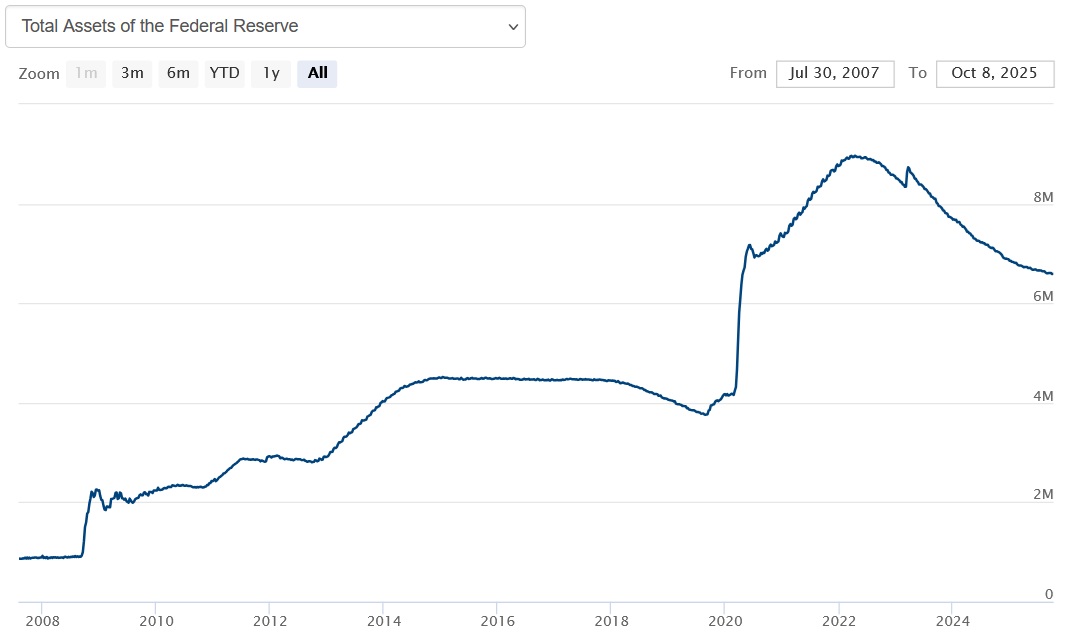
Fed Assets: The History of Quantitative aEsing (QE)

Creative Destruction in the Age of AI: How Endogenous Growth Theory Explains AI Stock Market Bubble

Déjà Vu Economics: How Trump’s Deregulation and Tariff Policies Mirror the Road to the Great Depression

Trumpenomics: The Fall of the USA

bookmark_borderDéjà Vu Economics: How Trump’s Deregulation and Tariff Policies Mirror the Road to the Great Depression

by Daniel Brouse
October 13, 2025

In 1919, General Motors transformed the American economy by founding the General Motors Acceptance Corporation (GMAC), a revolutionary move that allowed customers to buy cars on credit. This innovation made cars accessible to the masses through installment plans and helped ignite the era of consumer financing. What began as a tool to boost car sales quickly evolved into a model for broader consumer credit across multiple sectors.

By the late 1920s, Wall Street adopted a similar approach. Brokerages began allowing retail investors to purchase stocks on margin — putting as little as ten percent down and borrowing the rest. This was marketed as “democratizing access” to the markets, a patriotic slogan that masked the systemic risks of unchecked speculation. With little to no regulation, the market ballooned into a fragile bubble built on debt and delusion.

Then came the inevitable. In October 1929, the stock market crashed, wiping out fortunes overnight and triggering the Great Depression. In response, sweeping regulations were enacted to protect small investors and stabilize the financial system — including the Securities Act of 1933, the Glass-Steagall Act, and the creation of the SEC. These guardrails safeguarded the economy for decades.

Fast forward nearly a century, and history is repeating itself. Since Donald Trump’s second term began, many of those same regulatory protections have been rolled back or weakened. Under the guise of “free markets” and “democratizing access,” Trump’s administration has pushed to open high-risk assets — such as cryptocurrencies and private equity — to small investors. Once again, speculative leverage is being glorified as empowerment, while systemic risk quietly grows beneath the surface.

Today, brokerages like Robinhood enable investors to buy stocks using borrowed money — eerily similar to the margin practices of the 1920s. Market leverage has reached its highest levels since 1929. Meanwhile, Trump’s protectionist trade agenda, marked by sweeping tariffs and economic isolationism, echoes another disastrous historical precedent: the Smoot-Hawley Tariff Act of 1930. That policy, intended to protect American jobs, instead provoked global retaliation and deepened the Great Depression by collapsing international trade.

The parallels are alarming. Over-leveraged markets. Deregulated speculation. Protectionist trade wars. Rising inequality. All signs point to a familiar outcome.

The question is no longer if the market will crash — it’s when. And this time, with far greater global interconnection and systemic debt, the fallout could make 1929 look like a dress rehearsal.

Trumpenomics: The Decline of the USA

bookmark_borderFar-Right Militia Members Exposed in Gaza Aid Operations Linked to Trump-Backed Foundation

Reports published in September 2025 have revealed that members of the Infidels Motorcycle Club—a far-right extremist group with a long history of anti-Islamic rhetoric—were hired as security personnel for humanitarian aid distribution sites in Gaza. The revelations have sparked global outrage, with critics likening the move to placing a white supremacist militia in charge of humanitarian relief in a war zone.

A BBC investigation, published in early September, confirmed the identities of at least 10 Infidels MC members working in Gaza under the private security firm UG Solutions, which was contracted by the Gaza Humanitarian Foundation (GHF). The GHF, a U.S. and Israeli-backed nonprofit incorporated in Delaware in February 2025, has come under growing scrutiny for alleged war crimes and human rights abuses committed under the guise of humanitarian relief.

The BBC identified seven Infidels MC members holding senior security positions at GHF-operated aid distribution sites. In one of the more bizarre turns, the gang’s leader, Johnny “Taz” Mulford, accidentally hit “reply all” on an email to a BBC journalist, inadvertently exposing the identities of several of his associates. According to a former contractor, as many as 40 of the 320 security personnel hired by GHF were affiliated with the Infidels MC.

Mulford, a former U.S. Army sergeant, was previously disciplined for bribery and theft during his military service—raising serious questions about the vetting process for contractors hired to manage life-and-death humanitarian operations.

The Infidels Motorcycle Club: A History of Hate

Founded in 2006 by U.S. military veterans of the Iraq War, the Infidels MC presents itself as a “patriotic” organization but has long been associated with Islamophobic hate speech and militant nationalism.

Key examples of the group’s extremist ideology include:

  • Self-identifying as “modern Crusaders” and prominently displaying the Crusader’s Cross as their emblem.
  • Tattooing the number “1095”—the year the First Crusade was launched by Pope Urban II—on their bodies as a rallying symbol.
  • Hosting a “pig roast in defiance of Ramadan” in 2015, widely condemned as an act of religious hatred.
  • Posting anti-Muslim propaganda and calls for violence against Muslims across social media platforms.

The group has been monitored by civil rights organizations for years, including the Southern Poverty Law Center, which categorizes them as an anti-Muslim extremist organization.

The Gaza Humanitarian Foundation: Aid or Occupation?

The Gaza Humanitarian Foundation (GHF) was launched as an “alternative aid channel” after the U.S. and Israeli governments effectively dismantled UNRWA, the longstanding U.N. agency responsible for Palestinian relief. Marketed as a “reformed” approach to humanitarian aid, GHF has instead become synonymous with militarized aid distribution and alleged war crimes.

Multiple eyewitnesses, satellite imagery analyses, and reports from independent monitors accuse GHF security forces of opening fire on unarmed, starving civilians attempting to access food and water at GHF-controlled sites. Over 700 civilians are estimated to have been shot near these centers—many by GHF personnel or allied security contractors.

Humanitarian organizations, including Doctors Without Borders and the International Committee of the Red Cross, have condemned GHF’s operations as violating international law, accusing it of weaponizing hunger and blocking aid to regions considered politically disloyal. Such actions, legal experts note, constitute the use of starvation as a weapon of war, prohibited under the Geneva Conventions.

Ties to Israeli Intelligence and Alleged War Crimes

Further reports suggest that GHF operates in cooperation with Israeli intelligence agencies, deploying facial recognition technology at checkpoints and aid stations to identify individuals for surveillance, arrest, or assassination. Eyewitness accounts and investigative findings indicate that some individuals flagged during aid collection were later detained or killed, suggesting a coordinated campaign of extrajudicial executions disguised as humanitarian oversight.

Legal and human rights experts argue these acts amount to war crimes, including forced displacement, ethnic cleansing, and collective punishment of civilians. The United Nations Human Rights Council has opened a formal investigation, and sources at the International Criminal Court (ICC) confirm that evidence is being reviewed for potential prosecutions of GHF officials and affiliated government partners—including those in Washington and Tel Aviv.

Trumpenomics: The Decline of the US

bookmark_borderConstitutional Challenges to Trump Administration Actions

Timeline

Jan 2025 — Federal judge blocks broad Trump spending freeze (funding impoundment)

  • What happened: A federal judge temporarily blocked the administration’s wide freeze on dozens of federal grants, loans, and assistance programs set to take effect. Courts found the action likely exceeded executive authority under appropriations law and the Impoundment Control Act.
  • Constitutional/statutory issues: Congressional “power of the purse” / separation of powers / Impoundment Control Act.
  • Source: Government Executive reporting on the injunction. Government Executive

Jan 27, 2025 — Executive Order (EO 14183) banning transgender military service (EO signed)

  • What happened: President Trump signed EO 14183, directing policy changes to exclude people who identify as transgender from military service. Multiple lawsuits were filed immediately.
  • Constitutional issues: Equal protection (5th/14th Amendment), due process, and statutory claims regarding military policy.
  • Source / background on the order and litigation: EO summary and tracker. Wikipedia+1

March 2025 — District courts issue nationwide preliminary injunctions blocking Trump’s transgender military ban

  • What happened: Federal judges in multiple districts issued preliminary injunctions stopping enforcement of the EO removing transgender service members, finding plaintiffs were likely to succeed on constitutional due process/equal protection claims. The Ninth Circuit declined to stay one injunction; litigation moved through the courts.
  • Constitutional issues: Equal protection, due process.
  • Source / litigation tracker: Lambda Legal / LGBTQ Bar tracker & reporting. The National LGBTQ+ Bar Association

Jan–Mar 2025 (ongoing) — Multiple lawsuits challenging administration orders targeting law firms (Perkins Coie, WilmerHale, Jenner & Block, etc.)

  • What happened: The administration issued or threatened punitive measures (suspending security clearances, denying federal contracts, barring building access) aimed at several law firms the administration said had “conflicts” or “political” practices. Those firms sued. Judges found the orders targeted constitutionally protected speech and legal advocacy and enjoined enforcement.
  • Constitutional issues: First Amendment (free speech/retaliation), Fifth Amendment (due process), separation-of-powers concerns.
  • Key rulings: U.S. District Judge Richard Leon blocked the order as unconstitutional in the WilmerHale case (May 2025); earlier judges similarly enjoined actions against Perkins Coie and others. Reuters+2Courthouse News+2

May 27, 2025 — Judge Richard Leon blocks Trump order targeting WilmerHale (detailed opinion)

  • What happened: Judge Leon held that the order unlawfully punished the firm for engaging in constitutionally protected speech/legal representation and violated due process and separation-of-powers principles.
  • Constitutional issues: First and Fifth Amendments; executive overreach.
  • Source / court opinion and reporting: Reuters coverage; court opinion PDF. Reuters+1

June 27, 2025 — Supreme Court document / action (Trump v. CASA and related birthright citizenship litigation)

  • What happened: The Supreme Court docket and filings reflect challenges to the administration’s January executive order seeking to curtail birthright citizenship. Multiple district courts had issued universal injunctions; the matter reached the Supreme Court in various procedural postures. (See the Court PDF for case background.)
  • Constitutional issues: 14th Amendment Citizenship Clause; separation of powers.
  • Source / Supreme Court filing / docket: Supreme Court filing (case PDF). Supreme Court

July–October 2025 — Federal appeals courts reject Trump’s attempt to curtail birthright citizenship (multiple circuits)

  • What happened: Appeals courts (including the 1st Circuit and 9th Circuit in related rulings) upheld injunctions blocking the administration’s birthright-citizenship executive order, finding it likely unconstitutional under the 14th Amendment. The administration sought Supreme Court review.
  • Constitutional issues: 14th Amendment Citizenship Clause.
  • Sources: AP, Reuters reporting on appeals court decisions. AP News+1

Jan–Sep 2025 — Litigation over broad freezes/withholding of funds (foreign aid and other appropriations)

  • What happened: Multiple courts weighed whether the administration lawfully withheld funds appropriated by Congress (including foreign aid). Lower courts ordered funds to be spent; the Supreme Court at times allowed or limited holds pending appeals. Judges found likely violations of appropriations law and separation-of-powers constraints in several rulings.
  • Constitutional issues: Congressional appropriations authority; separation of powers.
  • Sources: SCOTUSblog and related coverage of funding cases. SCOTUSblog

Ongoing / broad litigation — Dozens to hundreds of cases tracked by litigation projects

  • What’s happening: Independent trackers (Lawfare, Just Security, and others) document scores of active suits challenging executive orders, regulatory rollbacks, spending freezes, immigration policies, and other actions. Many of these cases raise constitutional claims (due process, equal protection, take care clause, limits on executive authority). These trackers provide continuously updated case lists and outcomes.
  • Sources / trackers: Lawfare’s Trump Administration Litigation Tracker; Just Security litigation tracker. Default+1

How to read this timeline — caveats & context

  • Not everything here is “final.” Many entries are preliminary injunctions or appeals. Some cases may ultimately be resolved differently by higher courts (including the Supreme Court). I cited the most authoritative, contemporary reporting and court filings available.
  • Volume is large. Independent trackers show over three hundred active cases (dozens with constitutional claims). The items above are the highest-impact, precedent-setting litigation where courts have already issued decisions or clear injunctions. For a full, day-by-day legal chronology I can compile a downloadable timeline (PDF or spreadsheet) with direct links to opinions and filings for every case listed in trackers like Lawfare and Just Security.
  • Why these matter: The recurring themes in these challenges are (1) claims of executive overreach (exceeding statutory authority or violating separation of powers), (2) equal protection/due process violations (particularly in orders affecting transgender people, immigrants, or targeted entities), and (3) violations of Congress’s appropriations power.

Sources & further reading

  • Lawfare — Trump Administration Litigation Tracker. Default
  • Just Security — Legal Challenges to Trump Administration Actions (litigation tracker). Just Security
  • Reuters — “Judge bars Trump order against law firm tied to Robert Mueller” (May 27, 2025). Reuters
  • Court opinion (WilmerHale) PDF and reporting. Courthouse News
  • Government Executive — “Court temporarily blocks Trump’s spending freeze” (Jan 28, 2025). Government Executive
  • LGBTQ Bar / litigation trackers — challenges to EO banning transgender military service. The National LGBTQ+ Bar Association
  • AP / Reuters coverage — Appeals court rulings on birthright citizenship challenges (Oct 2025). AP News+1
  • Supreme Court filing (Trump v. CASA, Jun 27, 2025 docket). Supreme Court

Trumpenomics: The Decline of the US

bookmark_borderTrump’s Crimes, Illegal Activities, and Immorality: A Record of Corruption

Donald Trump’s public record is one of corruption, cruelty, and contempt for truth, law, and democracy. His actions—documented in court rulings, congressional reports, and his own words—paint a picture of a man unfit for power.

Trump’s Record:

  1. Been implicated in pedophilia and sexual misconduct allegations. The Epstein files are being withheld by Donald Trump—that’s not an accusation, it’s a fact. Trump himself admitted that Epstein “stole” his underaged massage girl from Mar-a-Lago, and his relationship with Epstein is well documented.
  2. Repeatedly denied science—on climate change, on public health, and on issues with life-or-death consequences.
  3. Lied pathologically about everything from crowd sizes to election results.
  4. Promoted white supremacy and emboldened racially charged violence.
  5. Been found liable for sexual assault in civil court.
  6. Stoked division through bigotry, bullying, and fear-based politics.
  7. Stood by as the U.S. Capitol was attacked, later praising or pardoning those responsible.
  8. Attempted to overturn a lawful election, undermining democracy itself.
  9. Engaged in financial fraud, including a judgment for falsifying business records.
  10. Misused charity funds, leading to a lifetime ban from operating a charitable foundation in New York.
  11. Implemented family separation policies at the border, losing track of children in the process.
  12. Attacked the independence of the Federal Reserve, destabilizing global markets.
  13. Attacked the First Amendment going so far as to threaten any television network critical of him.
  14. Exploded the national debt by trillions while handing tax cuts to billionaires, worsening inequality.
  15. Tried to weaponize the Justice Department as his personal shield and sword.
  16. Floated the idea of “suspending” the Constitution to stay in power.
  17. Been convicted of falsifying business records to hide damaging information from voters before an election.
  18. The real question is: who, knowing all of this, still chooses to support or defend such behavior?

The Bottom Line

Trump’s record is not a string of mistakes or misjudgments—it is a sustained pattern of lies, lawbreaking, and immorality. The real question is not whether Trump is guilty of corruption. The evidence is overwhelming. The real question is: who, knowing all of this, still chooses to support or defend such behavior—and why?

Trumpenomics: The Decline of America

bookmark_borderFormer Fed Chairs Unite Against Trump in Defense of Central Bank Independence

by Daniel Brouse
September 25, 2025

On September 25, 2025, a landmark amicus brief was submitted to the U.S. Supreme Court by every living former Chair of the Federal Reserve. The bipartisan group urged the Court to block former President Donald Trump from firing Federal Reserve Governor Lisa Cook while her legal challenge to her removal remains pending.

Defense of Federal Reserve Independence

The brief emphasized that the Federal Reserve’s independence is a cornerstone of the U.S. monetary system. The signatories warned that permitting the executive branch to remove Fed officials without due process would dangerously politicize the central bank, undermine its credibility, and erode public trust in monetary policy.

Protection of Institutional Safeguards

The filing stressed that allowing Trump to proceed with Cook’s removal before her case is resolved would dismantle nearly a century of safeguards Congress established to protect the Fed from political interference. Those protections were deliberately designed to insulate monetary policy from short-term political pressures, ensuring decisions are guided by economic data rather than campaign calculations.

Evidence for Central Bank Independence

The brief cited extensive research showing that independent central banks consistently deliver lower inflation, lower long-term interest rates, and greater financial stability than those subject to direct political control. By contrast, history demonstrates that when political leaders hijack monetary policy, inflation spikes, economic distortions multiply, and the costs of recovery rise steeply.

The Signatories

The brief was signed by an extraordinary coalition of bipartisan economic leaders. Among them were former Fed Chairs Alan Greenspan, Ben Bernanke, and Janet Yellen; former Treasury Secretaries from both Republican and Democratic administrations; former chairs of the White House Council of Economic Advisers; and former Fed Governor Dan Tarullo. The breadth of signatories underscored the depth of consensus in the economic community that the Fed’s independence must be preserved at all costs.

Background on Trump v. Cook

The case stems from Trump’s September 2025 attempt to fire Governor Cook, citing unproven allegations of mortgage fraud predating her service on the Federal Reserve Board. A federal court quickly blocked the firing, ruling that the president had failed to establish sufficient “cause” for removal. The court also noted that the allegations concerned conduct prior to her appointment, making them legally irrelevant to her role at the Fed.

Now before the Supreme Court, the Trump administration is asking for permission to remove Cook while litigation continues. If granted, the decision would set a precedent enabling presidents to summarily remove Fed governors, a move that could radically shift the balance of power between the White House and the nation’s central bank.

Trump’s Response

In characteristic fashion, Trump reacted to the legal setback with a barrage of angry and incoherent remarks, railing against the Fed and its leadership. His statements once again highlighted his deep ignorance of — and hostility toward — basic principles of fiscal and monetary policy. Economists warn that his continued attempts to bend monetary institutions to his will pose an existential threat to both U.S. economic stability and the credibility of global financial markets.

Trumpenomics: The Decline of America

bookmark_borderThe Battle for Free Speech: Jimmy Kimmel vs. MAGA Media Monopoly

by Daniel Brouse
September 24, 2025

PSA: “Killing humor isn’t funny. Kill humor, kill freedom. Not so funny now, is it?”

Nexstar Joins Sinclair in Silencing Jimmy Kimmel’s ABC Return

Disney and ABC have put Jimmy Kimmel back on the air! His first night back drew record viewership, even as dozens of affiliate stations continued enforcing prior censorship. The coordinated actions of Sinclair and Nexstar appear politically motivated—driven by pressure from Trump-aligned officials, including the FCC, and by Nexstar’s commercial interest in securing approval for its proposed $6.2 billion acquisition of TEGNA, announced in August 2025 and still awaiting FCC sign-off. FCC Chairman Brendan Carr even went so far as to threaten ABC’s license, saying, “We can do this the easy way or the hard way.” Equally significant is Sinclair’s overt alignment with far-right MAGA politics. Together, these factors created powerful incentives for strategic censorship—and that is exactly what we witnessed.

ABC/Disney, however, do not appear to be part of the same collusion. ABC initially pulled the show under intense affiliate and regulatory pressure, then reversed course to bring Kimmel back—suggesting a response to coercion, not conspiracy. Whether ABC should have held firm from the start is debatable, but their actions triggered public pushback and mobilized resistance. That pushback—including advertiser pressure and widespread outrage—likely did far more to protect free speech than quiet capitulation or permanently pulling Kimmel ever would have. ABC proved that active resistance works.

This situation mirrors CBS’s experience but now involves ABC affiliates. Sinclair is a massive MAGA operation, and Ellison is equally extreme. ABC affiliates owned by Nexstar are tied to the pending TEGNA acquisition. For context, Paramount Global—the parent of CBS and its owned-and-operated stations—was recently acquired by Skydance Media in a deal approved by the FCC in July 2025. The new owners, Oracle’s far-right MAGA billionaires the Ellisons, are also working to fold TikTok into the broader MAGA media propaganda machine. Trump’s pattern is unmistakable: silence Stephen Colbert on CBS and Jimmy Kimmel on ABC. In an obvious quid pro quo, CBS and ABC were forced to capitulate—or risk the FCC denying mergers and acquisitions, or even revoking broadcast licenses—an unmistakable case of mob-style extortion at the highest levels of government. Not to be overlooked, Trump has already extorted millions from both ABC and CBS through personal lawsuits.

The Choice to Raise Your Voice

Make the choice to raise your voice! Just say NO! to censorship. This is about silencing opposition. This is about killing comedy before it can mock power — and make no mistake, satire has always been the sharpest blade in democracy’s arsenal — democracy’s secret weapon.

That’s why tyrants fear it, that’s why dictators ban it, and that’s why Trump is trying to kill it. Humor exposes lies. Humor punctures egos. Humor topples emperors who think they wear clothes.

Long live comedy. Long live satire. It’s time for all of us to pick up the torch and rise. Sharpen your wit, wield your words, and refuse to be silenced.

Here’s How You Can Fight Back

Nexstar has now joined Sinclair in refusing to air Jimmy Kimmel’s return on ABC.

🔗 Sinclair station list
🔗 Nexstar station list

✅ What you can do:

→ Tune in tonight — check if your local newscast is on when Kimmel should be airing.

→ Take notes — if your local news is airing instead of Jimmy, jot down the companies advertising during the broadcast.

→ Take action — call those companies and tell them you’ll boycott until they stop funding Sinclair and Nexstar’s censorship.

Trumpenomics: The Decline of America

bookmark_borderWords as Swords: Fighting Tyranny with Satire

by MootMute
September 21, 2025

Moot Mute (Best Of).mp3
Moot Mute (Best Of).mp4
Moot Mute.mp3
Moot Mute.mp4

The new release of the day, “Mootmute,” was born from the flood of questions I keep hearing: “What can I do?” in the middle of this growing sense of helplessness and hopelessness. My answer? Focus on your strengths. Build a strong individual plan. And sharpen your wits — because wit is a weapon.

As an investigative journalist with decades defending the First Amendment, I’ve been threatened, targeted, assaulted by both criminals and police, fined, arrested, jailed, and dragged through years of court battles. But never — not once — have I seen anything as alarming as what’s happening today. I’m furious at the loss of our First Amendment rights, and I’m going back to my roots. In protest of this assault on free speech — and in solidarity with Jimmy Kimmel, Stephen Colbert, and the countless journalists slaughtered worldwide this year — I’m returning to satire. Words are swords, and comedy is our shield. That’s why tyrants fear it, that’s why dictators ban it, and that’s why Trump is trying to kill it. Humor exposes lies, punctures egos, and topples emperors who think they wear clothes.

During one period when I was illegally detained, silenced, and stripped of my rights, I adopted the pseudonym Mootmute. I had my lawyer on speed dial and even had a plan to publish from jail.

So, what is a moot mute? It’s the absurdity of censorship itself — being forced into silence until your very voice becomes a moot point. If a town crier had their tongue cut out, how would they warn the people? If a writer were pressed so hard that the only escape was invoking the Fifth, would they become a moot mute? That’s what censorship does: it tries to erase you into irrelevance.

Much to my amusement, when I was under oath I asked prosecutors what I wasn’t allowed to say. Their response? They wheeled in file cabinets overflowing with papers they themselves had published and read, line by line, everything now forbidden as “speech.”

And so the name stuck — Mootmute. They tried to silence me, but instead they became my unwitting mouthpiece, committing the very crime they accused me of.

PSA: “Remember, killing humor isn’t funny. Kill humor, kill freedom. Not so funny now, is it?”

ABOUT THE SONG: The Death of the First Amendment: Trump’s War on Free Speech

The Dangerous Adventures of Mootmute

Trumpenomics: The Decline of America

Words Mightier Than the Swords

bookmark_borderTrump v. The First Amendment: A Mismatch for the Ages

by C. Moore
September 20, 2025

Trump’s $15 Billion Tantrum: When a Lawsuit Becomes Performance Art

President Donald J. Trump’s $15 billion lawsuit against The New York Times has been tossed like yesterday’s fast-food wrapper, for now.

Calling the president’s 85-page magnum opus of grievance “decidedly improper and impermissible,” U.S. District Judge Steven D. Merryday effectively told Trump to either learn how to write like a lawyer or go back to yelling at clouds. The judge, apparently unamused by the creative writing project, noted that the suit only contained two actual claims of defamation — Count I appearing on page 80, Count II on page 83 — buried beneath 79 pages of ego stroking, political invective, and what could best be described as a rejected campaign speech.

Judge Merryday reminded the former president that a legal complaint is supposed to be a “short and plain statement” of facts, not a “megaphone for public relations” or a “passionate oration at a political rally.” Translation: save the ranting for Truth Social. Oh, and trim it down to 40 pages or less — think of it as Twitter with footnotes.

This latest courtroom spectacle follows Trump’s ongoing legal vendetta tour against the media — having already aimed lawsuits at ABC, CBS, and The Wall Street Journal. His beef with The Times? That it acted as a “mouthpiece” for Democrats and gave Kamala Harris a campaign contribution in the form of journalism he didn’t like. In other words, reporting = rigging.


Free Speech, Unless You’re Pro-Palestinian

Meanwhile, in Trumpworld, free speech is sacred — unless you say something he doesn’t like. Multiple lawsuits have been filed against the administration’s alleged policy of targeting pro-Palestinian non-citizens for deportation, simply for expressing political views. Critics call it a direct violation of the First Amendment, creating a climate of fear on university campuses.

Take the case of Mahmoud Khalil, a Columbia University alum and legal U.S. resident. On September 17, 2025, an immigration judge in Louisiana ordered him deported — either to Algeria or Syria — over alleged misrepresentations on his green card application. Federal courts, however, are still blocking his deportation while his case proceeds. The irony, of course, is that Trump insists on defending the “freedom” of Confederate statues while trying to silence actual human beings.


The Pentagon Redefines “Free Press”

Not to be outdone, Defense Secretary Pete Hegseth unveiled new rules limiting Pentagon press access. Reporters now risk being banned for “unprofessional conduct” or even attempting to obtain information — whether classified, unclassified, or simply embarrassing to the administration.

In short: report at your own risk. The rules are so broad, you could probably lose access for asking where the bathroom is without “appropriate authorizing official” approval.


Trump’s Top Hits: Freedom Edition

As academics around the world scratch their heads, one burning question remains: which Trump-era attack on free speech is the most idiotic?

  1. Renaming the Gulf of Mexico the “Gulf of America” — because nothing says freedom like renaming water.

  2. Renaming the Department of Defense the “Department of War” — because why bother hiding it?

Perhaps, in the end, Trump’s lawsuits and renamings are all just a form of performance art — a legal and political avant-garde movement where coherence, constitutionality, and common sense are strictly optional.

Trumpenomics: The Decline of America

bookmark_borderPSA: Killing Humor Isn’t Funny

by C. Moore
September 20, 2025

The Death of the First Amendment: Trump’s War on Free Speech

As an investigative journalist with decades of experience defending the First Amendment, I’ve endured more than my share of danger. My life has been threatened, my family targeted. I’ve been assaulted by both criminals and police, fined, arrested, jailed, and dragged through years of court battles. But never — not once — have I seen anything as alarming as what is happening today.

On September 18, 2025, Donald Trump declared that any television network critical of him would risk having its broadcast license revoked. This came just one day after ABC’s Jimmy Kimmel Live! was suspended, following the earlier cancellation of The Late Show with Stephen Colbert. Trump’s message is clear: dissenting voices will not be tolerated.

Let’s be perfectly honest: this isn’t about “bias in the media.” This is about censorship. This is about silencing opposition. This is about killing comedy before it can mock power — and make no mistake, satire has always been the sharpest blade in democracy’s arsenal.

The Palin–Trump Paradox

When asked why he doesn’t care if Russia invades EU countries, Trump said the U.S. isn’t “geographically close” to Russia, and that Europeans should shoulder the burden for Ukraine’s defense.

“They’re our next-door neighbors — you can actually see Russia from land here in Alaska,” Sarah Palin once said.

And I always thought Sarah wasn’t that swift. Turns out, compared to Trump, she’s Einstein — with a side of cottage cheese.

A Call to Arms — Through Laughter

In protest of this ongoing assault on free speech — and in solidarity with Jimmy Kimmel, Stephen Colbert, and the many journalists slaughtered around the globe this year — I am returning to my roots: satirical wit. Words are swords, and right now, satire is our shield.

Comedy has always been democracy’s secret weapon. That’s why tyrants fear it, that’s why dictators ban it, and that’s why Trump is trying to kill it. Humor exposes lies. Humor punctures egos. Humor topples emperors who think they wear clothes.

Long live comedy. Long live satire. It’s time for all of us to pick up the torch and rise. Sharpen your wit, wield your words, and refuse to be silenced.

PSA: “Killing humor isn’t funny. Kill humor, kill freedom. Not so funny now, is it?”

Trumpenomics: The Decline of America