bookmark_borderClimate Displacement and Nonlinear Acceleration: When Extreme Weather Becomes a Systemic Driver of Human Mobility

By Daniel Brouse and Sidd Mukherjee

Abstract

Climate displacement is often framed as a humanitarian consequence of storms, floods, droughts, wildfires, and sea-level rise. That framing is correct but incomplete. The deeper problem is that climate displacement is increasingly emerging from a nonlinear Earth system in which multiple climate hazards are intensifying simultaneously and interacting with preexisting social, political, economic, and infrastructural vulnerabilities.

Recent displacement data suggest that the world may be entering a new phase of climate-driven mobility. According to the Internal Displacement Monitoring Centre (IDMC), 13.6 million people were living in internal displacement because of disasters at the end of 2025, up sharply from roughly 9.9 million at the end of 2024. At the same time, 82.2 million people worldwide were living away from their home communities because of conflict, violence, or disasters, the second-highest figure ever recorded. These numbers do not merely reflect isolated weather events. They reflect a world in which climatic shocks are becoming more frequent, more intense, and increasingly entangled with food insecurity, weak infrastructure, repeated recovery failures, and declining social resilience.

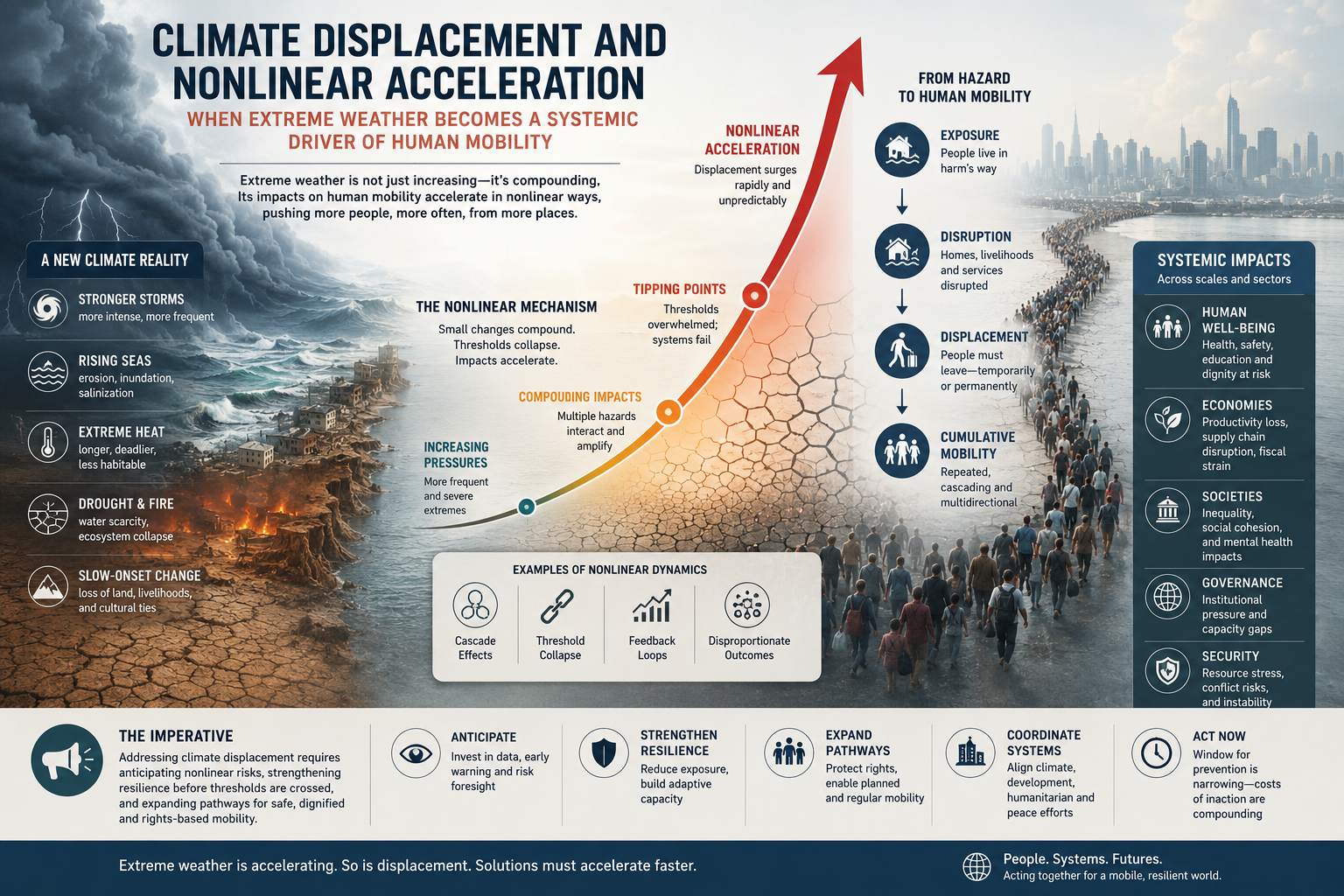
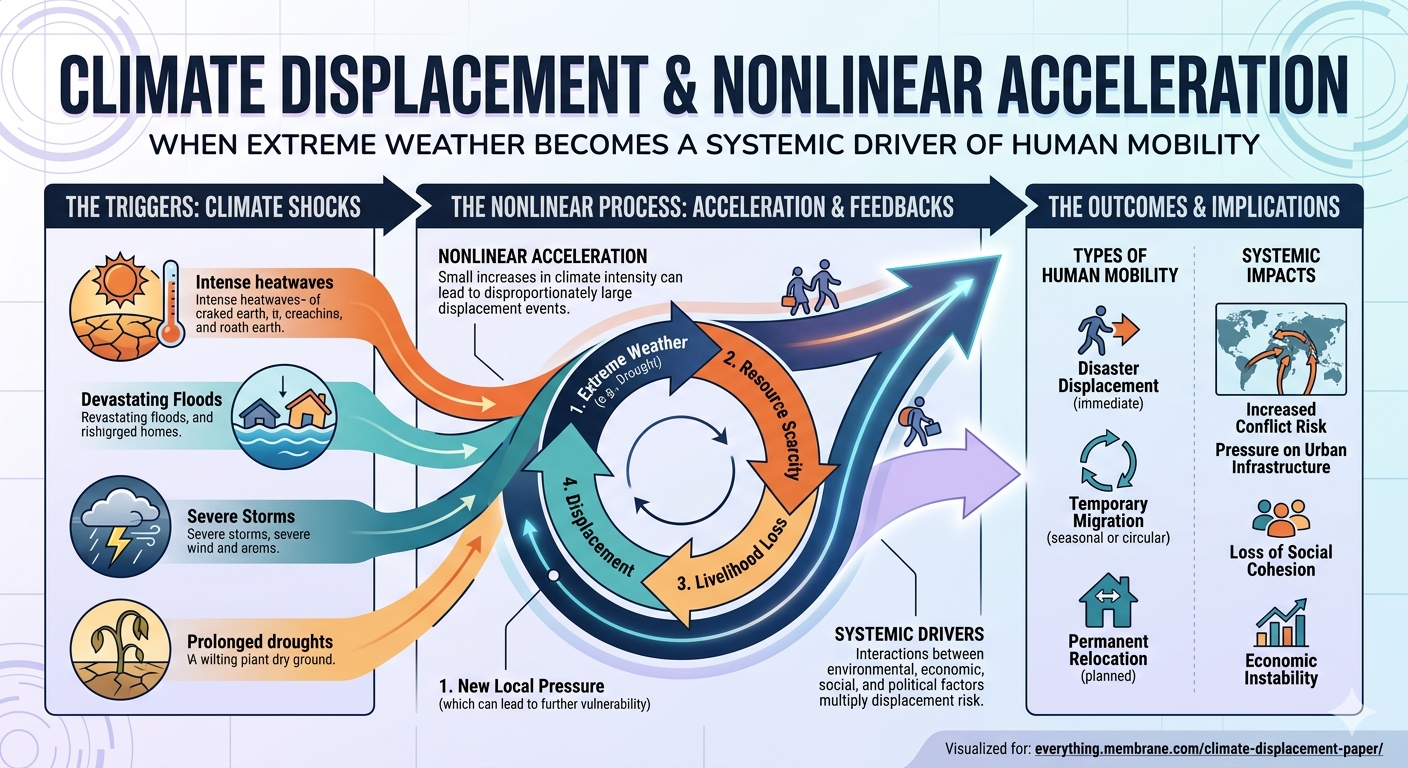
This paper argues that climate displacement should be understood not as a linear byproduct of warming, but as a nonlinear acceleration problem. As the climate system warms, extreme events do not simply increase in number; they increasingly interact across sectors and timescales. Drought is followed by flood. Heat is followed by crop failure. Wildfire is followed by erosion and debris flows. Sea-level rise magnifies storm surge. Water scarcity amplifies political instability. The result is not a single hazard but a cascade of hazards capable of overwhelming adaptation systems and forcing repeated human movement. In that sense, displacement is one of the clearest social indicators that climate change is no longer acting as a distant environmental stressor. It is becoming a systemic destabilizer.

1. Introduction: Displacement as a Climate-System Signal

Most climate discussions still treat displacement as a downstream consequence of weather disasters. A cyclone strikes, homes are destroyed, and people flee. A flood submerges cropland, and communities relocate. A drought persists, livelihoods collapse, and migration follows.

That sequence is real, but it understates the scale of what is now occurring.

Displacement is increasingly best understood as a systems-level indicator. It measures not only the physical impact of a storm, flood, drought, wildfire, or heatwave, but also the failure of social and ecological buffers that once absorbed those shocks. When households are forced to move, it means a threshold has been crossed: infrastructure failed, livelihoods failed, food systems failed, water systems failed, governance failed, or some combination of the above failed at once.

The 2026 Global Report on Internal Displacement provides a stark snapshot of this process. By the end of 2025, 82.2 million people were living in internal displacement across 104 countries and territories. Of those, 68.6 million were displaced by conflict and violence and 13.6 million by disasters. The global total remained near historic highs, while the stock of people displaced by disasters rose sharply. Meanwhile, IDMC recorded 65.8 million internal displacements during 2025, including disaster- and conflict-related movements, underscoring the scale of repeated uprooting in a single year.

The central question is not simply how many people are displaced by climate-related disasters in a given year. The more important question is whether the underlying drivers of displacement are themselves accelerating nonlinearly.

2. The Data: A Sharp Rise in Disaster Displacement

According to IDMC, nearly 13.6 million people were still living in internal displacement at the end of 2025 because of disasters, compared with roughly 9.9 million at the end of 2024. That is an increase of about 3.7 million people in a single year, or approximately 37–38 percent.

This matters for two reasons.

First, it suggests that the consequences of disasters are becoming more persistent. Many people are not simply evacuating and returning home after a storm. They are remaining displaced for longer periods because homes, farmland, water systems, roads, and local economies are not recovering quickly enough.

Second, it highlights the difference between flows and stocks in displacement analysis. IDMC distinguishes between:

  • internal displacements: the number of forced movements recorded during a year, including repeated movements by the same person; and
  • internally displaced people (IDPs): the number of people still living in displacement at a given point in time, usually at the end of the year.

This distinction is crucial in a nonlinear climate context. A single extreme event can trigger a large flow of short-term displacements, but a system under sustained stress generates something more dangerous: a rising stock of people who remain uprooted because return, recovery, and resettlement become progressively harder.

That is the deeper warning embedded in the recent numbers.

3. From Linear Hazard to Nonlinear Displacement

A linear view of climate displacement assumes a relatively simple chain of causation:

warming → more extreme weather → more damage → more displacement

But the real system increasingly looks more like this:

warming → hydrologic intensification → drought/flood volatility → crop loss + infrastructure damage + water insecurity + economic stress + conflict risk → repeated displacement → prolonged displacement → social destabilization

In other words, displacement is not driven by one variable. It emerges from coupled feedbacks.

3.1 Hydrologic whiplash

One of the clearest nonlinear pathways is hydrologic whiplash—the growing tendency for regions to swing rapidly between drought and flood. A warmer atmosphere increases evaporation, drying soils and intensifying drought. At the same time, warmer air holds more water vapor, increasing the likelihood of extreme rainfall when storms do occur. The result is not simply “more drought” or “more flooding,” but a destabilizing oscillation between the two.

For vulnerable populations, this matters enormously. Drought can destroy crops, livestock, and local water supplies. Flooding can then destroy the roads, bridges, homes, sanitation systems, and clinics needed for recovery. The second disaster lands before recovery from the first is complete. Communities are not merely hit harder; they are hit before they have time to recover. That is a nonlinear displacement engine.

3.2 Repeated displacement

Climate displacement is often not a one-time movement. A household may flee a floodplain, return months later, then flee again during the next storm season, then relocate after drought destroys agricultural income, then move again after conflict or price shocks intensify. The same family can be counted multiple times in annual displacement flows, but the deeper reality is repeated social dislocation.

Repeated displacement erodes savings, fragments families, interrupts schooling, worsens health outcomes, and depletes community resilience. Over time, it converts temporary mobility into chronic instability.

3.3 Coupled climate-conflict systems

Climate displacement and conflict displacement are not cleanly separable in the real world. Drought can weaken agriculture. Flooding can destroy infrastructure. Food insecurity and water stress can intensify social instability. In fragile settings, those pressures can contribute to violence and forced movement. The categories may differ administratively; the systems do not.

4. Nonlinear Acceleration and Threshold Behavior

The central argument of this paper is that climate displacement is increasingly governed by threshold behavior rather than smooth linear change.

A household can often absorb one bad harvest.
A town can sometimes recover from one flood.
A region may survive one year of drought.

But nonlinear systems change character when repeated shocks arrive faster than recovery can occur. Once adaptation capacity is exceeded, the response is no longer incremental. It becomes discontinuous.

A few examples illustrate this threshold logic:

  • Water threshold: A city or agricultural basin can function under water stress up to a point. Once aquifers collapse, reservoirs fail, or snowpack loss undermines irrigation, displacement risk rises abruptly rather than gradually.
  • Food threshold: Households can absorb modest food-price increases or crop losses. But once food insecurity becomes chronic, migration becomes a survival strategy.
  • Infrastructure threshold: A road washed out once is a repair problem. Roads, bridges, ports, and power systems repeatedly damaged by extreme weather become a regional collapse problem.
  • Livelihood threshold: Smallholder farmers can survive a poor season. They cannot survive repeated crop failures, rising heat stress, declining water availability, and fertilizer or fuel price shocks indefinitely.

The importance of thresholds is that they help explain why displacement can rise sharply even if average warming appears gradual. The forcing may be smooth; the social response is not.

5. Doubling-Time Compression in Climate Displacement

Based on the currently cited modern displacement record, climate/disaster displacement appears to be entering a phase of rapid compression in effective doubling times.

Using the year-end stock of people displaced by disasters:

  • 2024: ~9.9 million
  • 2025: 13.6 million

The one-year growth factor is:

g = 13.6 / 9.9 ≈ 1.374

The implied doubling time is:

T_d = ln(2) / ln(13.6 / 9.9)

Substituting the observed values:

T_d ≈ 0.6931 / 0.3178 ≈ 2.18 years

In other words, the latest year-over-year increase implies an effective doubling time of roughly 2.2 years.

This does not mean climate displacement will literally double every 2.2 years in a stable exponential fashion. One year does not establish a long-run law of motion. But it does signal that displacement may be entering a regime in which recovery times are being compressed faster than adaptation systems can respond.

That distinction matters. The significance of the calculation is not that it proves a permanent exponential trend. The significance is that it reveals how quickly displacement pressure can rise once multiple hazards, infrastructure losses, and repeated recovery failures begin interacting in the same period.

In a linear system, displacement might rise gradually as climate hazards intensify. In a nonlinear system, displacement can remain manageable for a time and then surge when thresholds are crossed. The recent IDMC numbers suggest the latter risk is becoming more plausible.

6. U.S. Impacts: Property Loss, Real Estate Values, and Insurance Stress

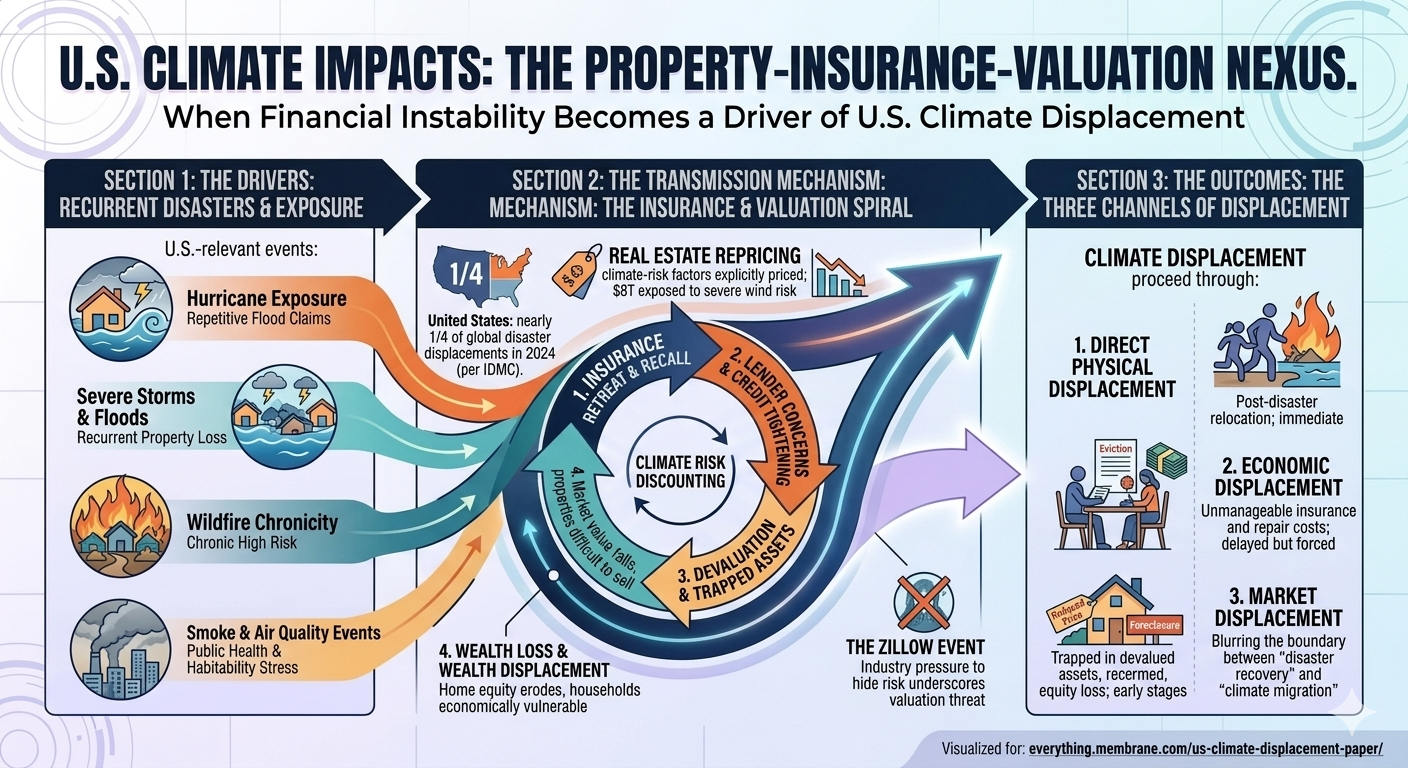
Climate displacement is often framed as a problem of distant coastlines, small island states, or conflict-prone regions in the Global South. That framing is increasingly obsolete. Climate displacement is already affecting the United States through property loss, real estate repricing, insurance instability, and internal migration pressures.

6.1 Property loss and recurrent disaster exposure

The United States has experienced repeated waves of large-scale disaster displacement from hurricanes, floods, wildfires, severe storms, and smoke-related emergencies. IDMC reported that the United States accounted for nearly one-quarter of all disaster displacements globally in 2024, driven by severe floods and storms.

What matters economically is not only the immediate property damage, but the way repeated exposure changes the viability of living in certain regions. Once homes flood multiple times, or wildfire risk becomes chronic, the relevant question is no longer just repair cost. It becomes whether the property remains insurable, financeable, and marketable.

6.2 Real estate repricing and climate-risk discounting

Climate risk is increasingly being priced into housing markets, though unevenly and often belatedly. Realtor.com analysis cited by Axios found that nearly 20 percent of U.S. homes—worth about $8 trillion—face severe or extreme hurricane wind risk, illustrating the scale of housing-market exposure.

Private climate-risk firms such as First Street have argued that rising insurance costs and underpriced climate risk could drive substantial housing-value losses over coming decades. The controversy surrounding Zillow’s 2025 removal of embedded climate-risk scores from property listings is revealing. Zillow had integrated climate-risk data for floods, wildfire, wind, heat, and air quality, but removed those ratings after industry complaints that they were hurting sales. The episode matters because it shows that climate risk is not only a physical threat but a valuation threat. Once buyers, lenders, and insurers begin to price hazard exposure more explicitly, some properties will lose value not because they are uninhabitable today, but because the market increasingly recognizes that they may become financially fragile tomorrow.

6.3 Insurance retreat as a displacement mechanism

Insurance may become one of the most important near-term transmission mechanisms linking climate change to displacement in the United States. A home does not need to be destroyed to become effectively displaced from the market. If premiums become unaffordable, deductibles become unmanageable, or insurers withdraw from a region entirely, households can be forced to move even before a catastrophic event occurs.

This creates a new category of climate displacement: financial displacement driven by insurability collapse.

In that sense, climate displacement in the United States may increasingly proceed through three channels:

  1. direct physical displacement after storms, fires, floods, or heat-related infrastructure failures;
  2. economic displacement as repeated damage, maintenance costs, and insurance premiums overwhelm household budgets; and
  3. market displacement as property values fall and homeowners become trapped in devalued or difficult-to-sell assets.

These dynamics blur the boundary between “disaster recovery” and “climate migration.” A family may still occupy the same home today while already experiencing the early stages of displacement through rising insurance costs, declining home equity, and a shrinking set of exit options.

7. Mental Health, Social Stress, and Climate Policy Feedbacks

Climate displacement is not only a housing or migration problem. It is also a mental-health and socio-economic destabilization problem with direct implications for climate politics and public policy.

Extreme weather exposure, chronic climate disruption, and perceived governmental inaction are increasingly associated with post-traumatic stress disorder (PTSD), depression, anxiety, grief, chronic stress, and climate-related distress. The psychological burden is not limited to those who lose homes outright. It extends to people living under repeated evacuation orders, communities facing chronic smoke or heat exposure, farmers confronting repeated crop losses, and households watching insurance premiums, utility bills, and rebuilding costs climb year after year.

7.1 Trauma after extreme events

Disaster research has long shown elevated rates of PTSD, depression, and anxiety following hurricanes, floods, wildfires, and prolonged displacement. Climate change amplifies this burden by increasing the frequency of events and by reducing the time available for psychological recovery between them. A household displaced once by a flood may eventually recover. A household displaced by a flood, then smoke, then heat, then another flood enters a very different mental-health regime.

The cumulative burden matters because trauma is not merely an individual health outcome. It affects work capacity, school performance, family stability, substance use, physical health, and community cohesion.

7.2 Chronic disruption and “pre-traumatic” stress

Climate-related mental-health impacts are not limited to post-disaster trauma. Chronic exposure to climate risk can generate persistent anxiety even before a disaster occurs. People living in high-risk regions may experience what is increasingly described as anticipatory or pre-traumatic stress: the psychological strain of knowing that another wildfire season, another hurricane, or another flood is coming, while also suspecting that public institutions are unprepared to protect them.

This can produce a form of climate dread with economic teeth. Families delay investment. Young adults reconsider where to live or whether to have children. Retirees reassess whether fixed incomes can survive escalating insurance and utility costs. Farmers and small businesses become less willing to invest in long-lived assets. In that sense, mental-health stress feeds back into economic behavior and local resilience.

7.3 Perceived governmental inaction and policy instability

Perceived governmental inaction is itself a destabilizing variable. When people repeatedly experience disasters, property loss, insurance shocks, or displacement while seeing little meaningful adaptation, planning, or support, trust in institutions erodes. That erosion can produce several policy effects at once:

  • political polarization, as climate impacts become refracted through grievance and distrust;
  • policy whiplash, as short-term emergency spending substitutes for long-term adaptation planning;
  • maladaptation, where communities rebuild into high-risk zones because retreat, relocation, and buyout programs remain politically or financially inaccessible;
  • social fragmentation, as households with resources leave while lower-income residents remain exposed to escalating risk.

These are not side effects. They are part of the climate-displacement system itself. A society experiencing repeated disasters without credible adaptation pathways may become less capable of implementing coherent climate policy precisely because the social stress of climate disruption is eroding the institutional capacity required to respond.

8. Climate Displacement as an Indicator of Systemic Instability

Climate displacement should therefore be viewed not merely as a humanitarian outcome but as a diagnostic signal of Earth-system destabilization interacting with human vulnerability.

In the same way that ocean heat content reveals accumulating thermal energy in the climate system, displacement reveals accumulating social stress in human systems. It tells us that environmental shocks are no longer being absorbed locally. They are crossing thresholds and reorganizing human geography.

Seen this way, displacement is one of the clearest real-world indicators that climate change is moving beyond “environmental change” and into civilizational risk.

When millions of people are forced to move because water disappears, crops fail, coasts flood, storms intensify, and recovery systems collapse, the issue is no longer whether the climate is changing. The issue is whether the political, economic, and humanitarian systems built for the twentieth century can withstand the pace and nonlinearity of twenty-first century climate disruption.

9. Conclusion

The latest displacement data should not be read as isolated humanitarian statistics. They should be read as evidence that climate change is increasingly acting through nonlinear social pathways.

The rise in disaster-related internal displacement from roughly 9.9 million to 13.6 million in a single year does not, by itself, prove a permanent exponential trajectory. But it does imply an effective short-term doubling time of about 2.2 years, a warning that climate displacement may be entering a phase of rapid compression in recovery times and rising systemic instability.

In a linear world, displacement would rise gradually as hazards gradually intensified.

In the world we are actually entering, climate forcing interacts with thresholds, feedbacks, and repeated shocks. Drought is followed by flood. Recovery is interrupted by the next disaster. Conflict overlays crop failure. Property values fall as risk becomes visible. Insurance costs become a displacement mechanism of their own. Trauma, anxiety, and distrust weaken the very institutions needed to adapt.

Climate displacement is therefore not merely one consequence of warming. It is one of the clearest manifestations of nonlinear acceleration in the human dimensions of climate change.

The real question is no longer whether climate change will displace people. It already is.

The real question is how many social, economic, and political thresholds will be crossed before the world recognizes that displacement is not a side story to climate change.

It is one of its central outcomes.
References

1. Climate displacement, internal displacement, and disaster mobility

Internal Displacement Monitoring Centre. (2025). Global report on internal displacement 2025 (GRID 2025). Geneva, Switzerland: IDMC. https://www.internal-displacement.org/global-report/grid2025/

Internal Displacement Monitoring Centre. (2026). 2026 global report on internal displacement (GRID 2026). Geneva, Switzerland: IDMC. https://www.internal-displacement.org/publications/2026-global-report-on-internal-displacement-grid/

Internal Displacement Monitoring Centre. (2026). Global report on internal displacement 2026 overview and data portal. https://www.internal-displacement.org/global-report/grid2026/

Internal Displacement Monitoring Centre. (n.d.). Global report on internal displacement (annual series). https://www.internal-displacement.org/global-report/

Internal Displacement Monitoring Centre. (2026). Global report on internal displacement 2026 [PDF]. https://api.internal-displacement.org/sites/default/files/2026-05/IDMC-GRID-2026-Global-Report-on-Internal-Displacement.pdf

United Nations High Commissioner for Refugees. (2026, June 11). UNHCR says fewer people displaced worldwide in 2025 but long-term refugee crisis persists. Reuters. https://www.reuters.com/world/unhcr-says-fewer-people-displaced-worldwide-2025-long-term-refugee-crisis-2026-06-11/

Pietrostefani, E., Mason, M., Iradukunda, R., Tran-Jones, H., Loktieva, I., & Rowe, F. (2025). Dynamic estimates of displacement in disaster regions: A policy-driven framework triangulating data. arXiv. https://arxiv.org/abs/2511.01955

Idzalika, R., Muztahid, M. R., & Prasojo, R. E. (2026). Context-aware displacement estimation from mobile phone data: A methodological framework. arXiv. https://arxiv.org/abs/2604.21457


2. Climate migration, human mobility, and climate vulnerability framing

Intergovernmental Panel on Climate Change. (2022). Climate change 2022: Impacts, adaptation and vulnerability. Contribution of Working Group II to the Sixth Assessment Report of the Intergovernmental Panel on Climate Change. Cambridge University Press.

Intergovernmental Panel on Climate Change. (2021). Climate change 2021: The physical science basis. Contribution of Working Group I to the Sixth Assessment Report of the Intergovernmental Panel on Climate Change. Cambridge University Press.

World Bank. (2021). Groundswell Part 2: Acting on internal climate migration. Washington, DC: World Bank.

Black, R., Bennett, S. R. G., Thomas, S. M., & Beddington, J. R. (2011). Migration as adaptation. Nature, 478(7370), 447–449.

McLeman, R. A. (2014). Climate and human migration: Past experiences, future challenges. Cambridge University Press.

Adger, W. N., de Campos, R. S., Siddiqui, T., et al. (2020). Migration, displacement and mobility. In Climate change 2022: Impacts, adaptation and vulnerability (IPCC WGII chapter).


3. Nonlinear acceleration, compound climate extremes, and hydrologic whiplash

Chun, K. P., Octavianti, T., Papacharalampous, G., Tyralis, H., Sutanto, S. J., Terskii, P., Mazzoglio, P., Treppiedi, D., Rivera, J., Dogulu, N., Olusola, A., Dieppois, B., Dembélé, M., Moulds, S., Li, C., Morales-Marin, L. A., Macdonald, N., Amoussou, T. O., Yonaba, R., Obahoundje, S., Hannah, D. M., Chidepudi, S. K. R., & Hamududu, B. (2024). Unravelling compound risks of hydrological extremes in a changing climate: Typology, methods and futures. arXiv. https://arxiv.org/abs/2409.19003

Green, J., Haigh, I. D., Quinn, N., Neal, J., Wahl, T., Wood, M., Eilander, D., de Ruiter, M., Ward, P., & Camus, P. (2024). A comprehensive review of coastal compound flooding literature. arXiv. https://arxiv.org/abs/2404.01321

Kleidon, A. (2024). Droughts in Germany—Why global climate change amplifies hydrological extremes. arXiv. https://arxiv.org/abs/2403.16551

Murphy-Barltrop, C. J. R., Richards, J., Poschlod, B., Sasse, A., & Zscheischler, J. (2026). Exploring climate change effects on concurrent floods and concurrent droughts via statistical deep learning. arXiv. https://arxiv.org/abs/2604.21647

He, Y., et al. (2026, June 17). Rising temperatures may increase flood risk through river “whiplash,” study finds. The Guardian. https://www.theguardian.com/environment/2026/jun/17/rising-temperatures-may-increase-flood-risk-through-river-whiplash-study-finds

Zscheischler, J., Westra, S., van den Hurk, B. J. J. M., et al. (2018). Future climate risk from compound events. Nature Climate Change, 8, 469–477.

Ridder, N. N., Ukkola, A. M., Pitman, A. J., et al. (2022). Increased occurrence of high-impact compound events under climate change. Nature Climate Change, 12, 600–606.

Swain, D. L., et al. (2018). Increasing precipitation volatility in a warming climate. Nature Climate Change, 8, 427–433.

Touma, D., Stevenson, S., Camargo, S. J., Horton, D. E., & Diffenbaugh, N. S. (2022). Climate change increases risk of extreme rainfall following drought. Science Advances, 8(32), eabn6301.


4. Climate displacement as nonlinear acceleration / doubling-time compression

Brouse, D., & Mukherjee, S. (2026). Climate displacement and nonlinear acceleration: When extreme weather becomes a systemic driver of human mobility. [Working paper / manuscript].

Brouse, D., & Mukherjee, S. (2026). Emergent climate dynamics: The nonlinear acceleration of climate impacts. [Manuscript].

Brouse, D., & Mukherjee, S. (2026). A unified energetics framework for nonlinear climate acceleration. [Manuscript].

Brouse, D., & Mukherjee, S. (2025). Runaway climate feedbacks and systemic collapse. [Manuscript].


5. U.S. property loss, housing-market repricing, and insurance retreat

Bernstein, A., Gustafson, M. T., & Lewis, R. (2019). Disaster on the horizon: The price effect of sea level rise. Journal of Financial Economics, 134(2), 253–272.

Bakkensen, L. A., & Barrage, L. (2021). Flood risk beliefs and coastal home price dynamics. Review of Financial Studies, 34(10), 1–41.
(Use whichever final journal version you have access to; there are several closely related working-paper/journal versions in this literature.)

Keys, B. J., Mulder, P., & Vissing-Jorgensen, A. (2024). Climate risk and the U.S. housing market. Annual Review of Financial Economics / working paper literature as applicable.

Keenan, J. M., Hill, T., & Gumber, A. (2018). Climate gentrification: From theory to empiricism in Miami-Dade County, Florida. Environmental Research Letters, 13(5), 054001.

First Street Foundation. (2025). Climate risk, mortgage exposure, and U.S. property vulnerability [Risk analysis / research releases]. New York, NY: First Street Foundation.
(Use the specific First Street report or white paper you cite.)

Realtor.com. (2025). Climate-risk exposure in U.S. housing markets [Market analysis / research brief].
(Use the specific report behind the $8 trillion severe or extreme hurricane wind exposure figure if you cite that number.)

Axios. (2025, October 7). Where U.S. homes face the most severe and extreme climate risk. https://www.axios.com/2025/10/07/climate-risk-housing-market-real-estate

The Guardian. (2025, December 1). Zillow deletes climate risk data from listings after complaints it harms sales. https://www.theguardian.com/environment/2025/dec/01/zillow-removes-climate-risk-data-home-listings

The Verge. (2025). Zillow property listings no longer show risk of fires, floods, and storms. https://www.theverge.com/news/834715/zillow-removes-flood-fire-risk-scores-home-listings

Wall Street Journal. (2025). The climate-disaster scores that could make or break your home sale.
(Add exact author/date if you want strict APA completeness.)

Washington Post. (2025, December 9). Hurricanes and wildfires influence homebuyers, if only for a minute.
(Add author if available in your final bibliography draft.)


6. Insurance stress, retreat, and financial displacement

Kousky, C. (2019). The role of natural disaster insurance in recovery and risk reduction. Annual Review of Resource Economics, 11, 399–418.

Kousky, C., & Shabman, L. (2016). Flood risk and property values: Examining the role of flood insurance. Natural Hazards Review, 17(3).

Botzen, W. J. W., Deschenes, O., & Sanders, M. (2019). The economic impacts of natural disasters: A review of models and empirical studies. Review of Environmental Economics and Policy, 13(2), 167–188.

Kunreuther, H., & Michel-Kerjan, E. (2011). At war with the weather: Managing large-scale risks in a new era of catastrophes. Cambridge, MA: MIT Press.

First Street Foundation. (2025). Climate risk and insurance affordability in U.S. housing markets.
(Insert the exact report title you use if citing insurer retreat or affordability estimates.)


7. Mental health, PTSD, anxiety, and climate-related distress

Berry, H. L., Bowen, K., & Kjellstrom, T. (2010). Climate change and mental health: A causal pathways framework. International Journal of Public Health, 55(2), 123–132.

Clayton, S., Manning, C., Krygsman, K., & Speiser, M. (2017). Mental health and our changing climate: Impacts, implications, and guidance. Washington, DC: American Psychological Association and ecoAmerica.

Cianconi, P., Betrò, S., & Janiri, L. (2020). The impact of climate change on mental health: A systematic descriptive review. Frontiers in Psychiatry, 11, 74.

Hayes, K., & Poland, B. (2018). Addressing mental health in a changing climate: Incorporating mental health indicators into climate change and health vulnerability and adaptation assessments. International Journal of Environmental Research and Public Health, 15(9), 1806.

Lawrance, E. L., Thompson, R., Newberry Le Vay, J., Page, L., Jennings, N., & McBride, M. (2022). The impact of climate change on mental health and emotional wellbeing: A narrative review of current evidence, and its implications. International Review of Psychiatry, 34(5), 443–498.

Pihkala, P. (2020). Eco-anxiety and environmental education. Sustainability, 12(23), 10149.

Charlson, F., Ali, S., Benmarhnia, T., Pearl, M., Massazza, A., Augustinavicius, J., & Scott, J. G. (2021). Climate change and mental health: A scoping review. International Journal of Environmental Research and Public Health, 18(9), 4486.

Thoma, M. V., et al. (2021). The psychological consequences of climate-related disasters and displacement. Current Psychiatry Reports, 23, 82.
(Use a final journal article that best matches the PTSD/disaster-displacement angle you want.)

Janzen, B. (2022). Temperature and mental health: Evidence from helpline calls. arXiv. https://arxiv.org/abs/2207.04992


8. Disaster trauma, repeated exposure, and post-event psychiatric burden

Goldmann, E., & Galea, S. (2014). Mental health consequences of disasters. Annual Review of Public Health, 35, 169–183.

Neria, Y., Nandi, A., & Galea, S. (2008). Post-traumatic stress disorder following disasters: A systematic review. Psychological Medicine, 38(4), 467–480.

Lowe, S. R., & Galea, S. (2017). The mental health consequences of mass shootings and natural disasters. Current Psychiatry Reports, 19, 64.
(Use selectively if you want repeated-trauma framing across disaster types.)

Vins, H., Bell, J., Saha, S., & Hess, J. J. (2015). The mental health outcomes of drought: A systematic review and causal process diagram. International Journal of Environmental Research and Public Health, 12(10), 13251–13275.

Bryant, R. A. (2019). Post-traumatic stress disorder: A state-of-the-art review of evidence and challenges. World Psychiatry, 18(3), 259–269.
(Useful for grounding the PTSD language in the paper’s mental-health section.)


9. Climate anxiety, anticipatory stress, and perceived governmental inaction

Hickman, C., Marks, E., Pihkala, P., et al. (2021). Climate anxiety in children and young people and their beliefs about government responses to climate change: A global survey. The Lancet Planetary Health, 5(12), e863–e873.

Ojala, M. (2012). Hope and climate change: The importance of hope for environmental engagement among young people. Environmental Education Research, 18(5), 625–642.

Pihkala, P. (2022). Toward a taxonomy of climate emotions. Frontiers in Climate, 3, 738154.

Reser, J. P., Bradley, G. L., & Ellul, M. C. (2014). Encountering climate change: “Seeing” is more than “believing.” WIREs Climate Change, 5(4), 521–537.

Wang, S., Leviston, Z., Hurlstone, M., Lawrence, C., & Walker, I. (2018). Emotions predict policy support: Why it matters how people feel about climate change. Global Environmental Change, 50, 25–40.


10. Climate policy, social destabilization, and governance stress

Adger, W. N., Barnett, J., Brown, K., Marshall, N., & O’Brien, K. (2013). Cultural dimensions of climate change impacts and adaptation. Nature Climate Change, 3, 112–117.

Mach, K. J., Kraan, C. M., Adger, W. N., et al. (2019). Climate as a risk factor for armed conflict. Nature, 571, 193–197.

Abel, G. J., Brottrager, M., Crespo Cuaresma, J., & Muttarak, R. (2019). Climate, conflict and forced migration. Global Environmental Change, 54, 239–249.

Hsiang, S. M., Burke, M., & Miguel, E. (2013). Quantifying the influence of climate on human conflict. Science, 341(6151), 1235367.

Stern, N. (2007). The economics of climate change: The Stern review. Cambridge University Press.


11. Climate-risk communication, valuation, and disclosure in housing markets

Zillow. (2024). Zillow integrates climate-risk data into home listings [Corporate / platform announcement].
(If you use the rollout itself as part of the story, cite the original Zillow announcement or newsroom page.)

First Street Foundation. (2024–2025). Climate risk data for U.S. properties [Methodology and risk score documentation].
(Use the exact methodology page or report behind the risk metrics if cited in the paper.)

San Francisco Chronicle. (2025). Zillow is dropping climate risk scores. Here’s why it matters.
(Add author/date if you use this source in the final paper.)


12. Optional contemporary media sources for very recent 2025–2026 developments

Use these only for contemporary market developments or examples, not as the backbone of the scientific argument.

Axios. (2025, October 7). Where U.S. homes face the most severe and extreme climate risk. https://www.axios.com/2025/10/07/climate-risk-housing-market-real-estate

The Verge. (2025). Zillow property listings no longer show risk of fires, floods, and storms. https://www.theverge.com/news/834715/zillow-removes-flood-fire-risk-scores-home-listings

Reuters. (2026, June 11). UNHCR says fewer people displaced worldwide in 2025 but long-term refugee crisis persists. https://www.reuters.com/world/unhcr-says-fewer-people-displaced-worldwide-2025-long-term-refugee-crisis-2026-06-11/

The Guardian. (2026, June 17). Rising temperatures may increase flood risk through river “whiplash,” study finds. https://www.theguardian.com/environment/2026/jun/17/rising-temperatures-may-increase-flood-risk-through-river-whiplash-study-finds

bookmark_borderTrump Announces Prospective Iran Deal, But Questions Remain

President Donald Trump announced that the United States and Iran have reached what he described as a “great settlement” that could bring an end to the current conflict and lead to a formal agreement as early as this weekend.

According to Trump, the breakthrough came after intense negotiations and recent military pressure. He characterized the development as a major diplomatic victory and suggested that Iran had ultimately agreed to terms favored by the United States.

Iranian officials, however, have offered a different account. According to their statements, the framework under discussion is largely the same memorandum of understanding that Tehran reportedly proposed weeks earlier. Iranian sources describe the arrangement as a temporary 60-day agreement that includes a ceasefire in Lebanon and the release of billions of dollars in previously frozen Iranian assets.

The differing narratives have fueled skepticism among analysts, policymakers, and observers across the political spectrum. While supporters of the administration view the announcement as a potentially significant step toward de-escalation, critics argue that the details remain unclear and that multiple previous declarations of imminent diplomatic breakthroughs have failed to produce lasting agreements. In fact, with each previous announcement, Iran appeared to strengthen its negotiating position and gain additional leverage.

bookmark_borderWholesale Inflation Surges to Highest Level Since 2022: Consumer Prices May Be Next

The latest inflation data delivered an unwelcome surprise.

According to the U.S. Bureau of Labor Statistics, the Producer Price Index (PPI) for final demand rose 1.1% in May on a seasonally adjusted basis, pushing wholesale inflation to 6.5% over the past 12 months—the highest annual rate since November 2022. The increase exceeded expectations and represents another sign that inflationary pressures remain deeply embedded within the economy.

Why the Producer Price Index Matters

The Producer Price Index measures the prices businesses receive for the goods and services they sell. Because producers often pass at least part of their increased costs on to consumers, PPI is frequently viewed as a leading indicator for future consumer inflation.

The degree of pass-through depends on factors such as competition, profit margins, and the length of the supply chain. However, sustained increases in producer costs eventually tend to work their way through the economy, resulting in higher prices for consumers.

In simple terms, when businesses pay more for energy, transportation, materials, and services, consumers often end up paying more at the cash register weeks or months later.

Energy Costs Drove Much of the Increase

The largest contributor to May’s inflation surge was energy.

Prices for final-demand goods increased 2.8% during the month, while energy prices alone jumped 10.7%. Wholesale gasoline prices surged an extraordinary 23.4%, accounting for a large share of the overall increase.

Because energy costs affect nearly every sector of the economy—including transportation, manufacturing, agriculture, and retail distribution—energy inflation often spreads far beyond the gas pump.

When diesel fuel, gasoline, electricity, and natural gas become more expensive, businesses throughout the supply chain face higher operating costs. Those costs can eventually appear in the prices consumers pay for food, household goods, travel, and a wide range of services.

Inflation Pressures Extend Beyond Energy

While energy was the primary driver of May’s increase, the report also showed broader inflationary pressures.

Prices for final-demand services rose 0.3% during the month. More importantly, the BLS measure that excludes food, energy, and trade services—often viewed as a broader gauge of underlying inflation—increased 0.8% in May and is now up 5.1% over the past year.

These figures suggest that inflation is not solely an energy story. Underlying price pressures remain elevated across multiple sectors of the economy.

What It Could Mean for Consumers

Historically, significant increases in wholesale prices have often preceded higher consumer prices, although the timing and magnitude of pass-through vary.

Businesses faced with rising costs generally have three options:

  1. Absorb the costs through lower profit margins.
  2. Improve efficiency to offset some of the increases.
  3. Raise prices charged to consumers.

When inflation remains elevated for extended periods, the third option often becomes increasingly difficult to avoid.

As a result, May’s PPI report raises the possibility that consumer inflation could remain higher than many economists had anticipated earlier this year.

Implications for Interest Rates

The stronger-than-expected inflation report may also complicate the outlook for monetary policy.

The Federal Reserve has been monitoring inflation closely while balancing concerns about economic growth and employment. Persistent wholesale inflation can make it more difficult for policymakers to justify interest-rate cuts and may even increase discussions about maintaining higher rates for longer.

Whether May’s surge proves temporary or marks the beginning of a broader inflation acceleration will depend on future energy prices, supply-chain conditions, consumer demand, and global economic developments.

The Bottom Line

May’s Producer Price Index report delivered a clear warning signal.

Wholesale inflation accelerated to 6.5% annually, the highest level since late 2022, driven largely by soaring energy costs but accompanied by continued underlying inflationary pressures. Because producer prices frequently flow through supply chains to consumers, today’s wholesale inflation often becomes tomorrow’s consumer inflation.

The coming months will reveal how much of this increase businesses absorb—and how much ultimately shows up in household budgets.

bookmark_borderInflation Surges to Three-Year High as Oil Shock Ripples Through the Economy

Rising Energy Costs Push Inflation Higher

U.S. consumer inflation accelerated sharply in May 2026, reaching its highest level in three years according to the latest data released by the Bureau of Labor Statistics (BLS).

The Consumer Price Index (CPI), the government’s primary measure of inflation, rose 4.2% over the previous twelve months, up from 3.8% in April and marking the highest annual inflation rate since April 2023.

Key Economic Figures

  • Headline CPI: +4.2% year-over-year
  • Monthly CPI Increase: +0.5%
  • Core CPI: +2.9% year-over-year (excluding food and energy)
  • Energy Index: +3.9% in May alone
  • Gasoline Prices: +7.0% during May

Energy prices accounted for more than 60% of the monthly increase in consumer prices, highlighting the dominant role of oil and fuel markets in the current inflation surge.

The Oil Shock Behind the Inflation Spike

The primary driver of rising inflation remains the disruption of global energy markets resulting from the ongoing conflict with Iran and restrictions affecting shipping through the Strait of Hormuz.

The Strait of Hormuz remains one of the world’s most important energy chokepoints, carrying a significant portion of globally traded crude oil. Continued military tensions have reduced available supply and pushed crude prices sharply higher.

Higher crude oil prices quickly filter through the economy:

  • Higher gasoline prices
  • Increased transportation costs
  • Rising manufacturing expenses
  • Higher food distribution costs
  • Increased utility and electricity prices

As a result, inflation pressures are spreading beyond energy markets into nearly every sector of the economy.

Other Major Inflation Categories

Americans are also facing rising costs in several essential categories:

  • Apparel: +4.8%
  • Electricity: +5.9%
  • Shelter: +3.4%

These increases are placing additional pressure on household budgets at a time when many consumers are already struggling with elevated borrowing costs and slowing wage growth.

A New Challenge for the Federal Reserve

The inflation report presents a significant challenge for newly appointed Federal Reserve Chairman Kevin Warsh.

While financial markets largely expect the Federal Reserve to leave interest rates unchanged at its next meeting, traders are increasingly pricing in the possibility of additional rate increases later this year if inflation continues to accelerate.

This creates a difficult balancing act:

  • Raising rates further risks slowing economic growth.
  • Failing to contain inflation risks allowing expectations to become entrenched.

Once businesses and consumers begin expecting higher inflation, they often adjust behavior accordingly—raising prices, demanding higher wages, and accelerating purchases. These behavioral changes can become self-reinforcing and make inflation significantly harder to control.

Strategic Petroleum Reserve Drawdown Reaches Historic Levels

What makes the current situation particularly concerning is the condition of U.S. emergency oil reserves.

In an effort to offset rising fuel costs, the administration has aggressively drawn down the Strategic Petroleum Reserve (SPR), resulting in some of the largest withdrawals in the program’s history.

Record-Breaking Withdrawals

According to recent Energy Information Administration (EIA) data:

  • Nearly 10 million barrels were withdrawn during a single week in May.
  • Approximately 25 million barrels were released over a three-week period.
  • Total SPR inventories have fallen to roughly 349 million barrels, approaching levels not seen since the early 1980s.

The scale and speed of these withdrawals represent one of the largest emergency reserve deployments ever recorded.

Why the Reserve Is Being Drained

The releases are part of a broader coordinated effort among members of the International Energy Agency (IEA) to stabilize global energy markets.

Rather than conducting traditional sales, many of the releases have been structured as emergency exchanges, allowing energy companies to borrow crude oil now and return both the original volume and an additional premium after the crisis subsides.

The objective is straightforward: increase short-term supply and reduce pressure on fuel prices.

However, this strategy carries risks.

The Risks Ahead

The Strategic Petroleum Reserve exists as an emergency buffer against major supply disruptions.

As inventories fall, policymakers have fewer tools available to respond to future shocks.

If geopolitical tensions persist or worsen, markets may begin focusing less on current supply and more on the shrinking emergency reserve itself.

That creates the possibility of:

  • Higher oil-price volatility
  • Additional inflation pressures
  • Rising interest rates
  • Increased recession risks
  • Greater fiscal strain from higher government borrowing costs

Conclusion

The May inflation report highlights a growing reality: energy remains the foundation of the global economy.

Oil price shocks continue to ripple through transportation, manufacturing, housing, food production, and consumer spending.

With inflation now at a three-year high, interest rates under pressure, and emergency oil reserves being depleted at historically rapid rates, policymakers face increasingly difficult choices.

The coming months will likely depend heavily on developments in global energy markets and whether the current geopolitical disruptions prove temporary—or become a longer-lasting source of economic instability.

bookmark_borderDon’t Be Fooled by Oil Futures: The Hidden Supply Crunch

Don’t Be Fooled by Oil Futures: The Hidden Supply Crunch in U.S. Commercial Inventories and the Strategic Petroleum Reserve at Multi-Decade Lows

Introduction: Paper Markets vs. Physical Reality

Oil futures markets are currently sending a deceptively calm signal. Prices appear to reflect a system that is balanced, or at least manageable. But beneath that surface, physical supply conditions tell a very different story.

U.S. strategic and commercial petroleum inventories are being drawn down at a pace that has few modern precedents. These withdrawals are occurring while global supply chains remain under severe stress, driven by geopolitical disruptions and constrained spare capacity.

Reports indicate that disruptions in Middle East production and shipping routes—including instability affecting the Strait of Hormuz—have removed a significant share of global export capacity. Even partial disruptions in this corridor can reverberate through global energy markets because it is one of the world’s most critical chokepoints for crude oil and LNG flows.

In response, the United States has increasingly functioned as a marginal global supplier—exporting crude and refined products while simultaneously drawing down domestic emergency reserves. This dual role is tightening internal buffers even as external risks remain elevated.


The Strategic Petroleum Reserve (SPR): Near Multi-Decade Lows

The U.S. Strategic Petroleum Reserve (U.S. Department of Energy) has declined to levels not seen in roughly four decades.

Current Status

  • Approximately 357.1 million barrels, according to recent estimates
  • Down from about 413 million barrels earlier in the year
  • Approaching levels last seen in the early 1980s

Magnitude of Drawdowns

Recent and cumulative withdrawals have been historically large:

  • ~172 million barrels released under emergency policy actions in the current cycle
  • ~180 million barrels released during the 2022 energy shock associated with the Russia–Ukraine conflict

While each drawdown has been framed as a stabilization tool for global markets, the cumulative effect has been a significant erosion of strategic buffer capacity.

Operational Constraints: The “Minimum Fill” Problem

The SPR is not simply a tank that can be emptied to zero. It is a geologically engineered salt-cavern system that requires a minimum working volume to maintain pressure balance and structural integrity.

Industry analysts, including references from the American Petroleum Institute, have warned that:

  • The system may require ~20% minimum fill to remain operationally stable
  • This implies a functional floor on usable inventory somewhere in the 70–150 million barrel range, depending on configuration assumptions

In other words, not all remaining barrels are economically or technically deployable in a crisis.


Commercial Crude Inventories: Tightening Beneath the Surface

While strategic reserves attract attention, commercial inventories often provide a more immediate signal of market stress.

Weekly Inventory Drawdowns

Data from the U.S. Energy Information Administration indicates:

  • A recent ~8 million barrel weekly drawdown in commercial crude inventories
  • Total commercial crude stocks near 433.7 million barrels
  • Approximately 3% below the five-year seasonal average

On the surface, this deviation may appear modest. However, oil markets are highly sensitive to small changes in inventory when spare capacity is limited.


Refined Products: The Hidden Constraint in Gasoline Supply

Crude oil availability is only part of the equation. Refined product inventories—especially gasoline and distillates—are often the true bottleneck for consumer price spikes.

  • Gasoline inventories have fallen by approximately 38 million barrels
  • This reduction is large enough to materially erode the typical seasonal buffer heading into peak summer demand

When refined product inventories decline faster than crude stocks, it signals stress not just in production, but in downstream refining capacity and logistics.


Cushing and the “Tank Bottom” Effect

One of the most important physical hubs in the U.S. oil system is Cushing, Oklahoma, the delivery point for West Texas Intermediate (WTI) futures contracts.

At low inventory levels, storage hubs face what industry operators call “tank bottoms”—the minimum operational level required to:

  • Keep pipeline flows stable
  • Maintain pump functionality
  • Avoid contamination and pressure issues
  • Preserve deliverability for futures contracts

When inventories approach these thresholds:

  • Market liquidity becomes constrained
  • Price volatility increases
  • Futures pricing can diverge sharply from physical spot realities

Even if headline inventories appear adequate, low usable storage capacity can create localized shortages and logistical bottlenecks.


Why Oil Futures May Be Misleading the Market

Oil futures prices are influenced by expectations, financial positioning, and macroeconomic sentiment—not just physical inventory conditions.

This creates a structural risk:
Markets can appear balanced while physical systems are tightening.

Key disconnects include:

  • Futures reflect expected future supply, not immediate deliverable barrels
  • Financial hedging can suppress or amplify price signals
  • Strategic releases can temporarily mask underlying shortages
  • Export flows can tighten domestic availability even when national production is high

As a result, futures markets may understate near-term physical constraints, especially when inventories are simultaneously declining across both strategic and commercial categories.


Outlook: A System Operating with Reduced Buffers

Taken together, three conditions define the current landscape:

  1. Strategic reserves near multi-decade lows
  2. Commercial crude inventories below seasonal norms
  3. Refined product and storage constraints tightening simultaneously

Even if geopolitical disruptions ease, inventory rebuilding takes time. Most supply forecasts suggest that normalization would require sustained production surpluses over multiple quarters—not weeks.

Industry projections increasingly suggest that price instability could persist into 2026–2027, particularly if global chokepoints remain vulnerable or if demand surprises to the upside.


Conclusion

The key risk in today’s oil market is not necessarily immediate scarcity—it is reduced resilience.

When both strategic buffers and commercial inventories are drawn down simultaneously, the system becomes highly sensitive to shocks that would previously have been absorbed without major price disruption.

In this environment, oil futures may not fully reflect the physical tightness of the system, particularly when storage constraints, refinery bottlenecks, and geopolitical risks converge.

The result is a market that appears stable in financial terms, but increasingly fragile in physical terms.

bookmark_borderThe Dangerous Push Toward Autonomous Warfare

This is exactly what many of us feared when defense officials and political leaders turned against Palantir Technologies over concerns surrounding autonomous weapons systems and mass surveillance capabilities.

According to critics, Palantir resisted efforts to fully embrace autonomous lethal decision-making systems and broad domestic surveillance applications targeting U.S. citizens. Now, instead of slowing the development of AI-driven warfare, lawmakers appear to be accelerating it.

Pennsylvania Senators Dave McCormick and John Fetterman have introduced legislation aimed at rapidly expanding U.S. military drone and autonomous systems capabilities.

As Senator McCormick stated:

“Autonomous drone systems are reshaping modern warfare — China is moving fast, and America can’t afford to play catch-up.”

The proposed legislation calls for a comprehensive strategy to accelerate deployment of autonomous military technologies in order to “protect our troops” and preserve U.S. military dominance.

Supporters argue these systems are necessary to compete with rapidly advancing drone and AI warfare programs in countries like China and Russia. Critics, however, warn that the world is moving dangerously close to normalizing autonomous killing systems where machines — not humans — increasingly make battlefield targeting decisions.

The concern is not simply military competition. It is the long-term ethical and societal implications of handing life-and-death decisions to algorithmic systems while simultaneously expanding surveillance infrastructure, predictive targeting, and AI-driven warfare capabilities.

History shows that once such technologies are normalized in foreign conflicts, pressure often grows to expand their use domestically in the name of “security,” “stability,” or “public safety.”

The world is rapidly entering an era where the line between defense technology, autonomous warfare, and mass surveillance is becoming increasingly blurred — and far too few leaders are seriously debating the consequences.

bookmark_borderThe Future: Feedback Loops and the Limits of Human Adaptation

Introduction: Bounded — But Potentially Extreme

Q: What is the most likely future climate scenario?

A: Accelerating climate disruption driven by interacting feedback loops.

The good news is that physics places limits on the absolute worst-case outcomes. Earth is not expected to undergo a runaway Venus-style greenhouse effect in which oceans boil away and the atmosphere becomes permanently uninhabitable.

The danger facing humanity is different — and arguably more immediate.

The true risk is rapid, nonlinear climate acceleration occurring within thermodynamic bounds: a trajectory capable of producing severe ecological disruption, widespread biodiversity collapse, destabilization of global food and water systems, large-scale migration, economic fragmentation, and profound stress on human civilization.

Current evidence increasingly suggests that warming is not progressing through simple linear relationships alone. Multiple climate feedback mechanisms are now interacting simultaneously, amplifying one another through what can best be described as a cascading “Domino Effect” of destabilized Earth systems.

While uncertainties remain, current research increasingly points toward two dominant warming pathways over the next century.


The Two Most Likely Climate Pathways

Current Policy Trajectory (~3–4°C Warming)

This pathway reflects scenarios in which emissions plateau or decline slowly without deep structural reductions in fossil-fuel dependence.

Even under this comparatively moderate scenario, the world would experience:

  • chronic extreme heat,
  • intensified droughts and flooding,
  • major agricultural disruption,
  • accelerating sea-level rise,
  • ecosystem destabilization,
  • and substantial economic stress.

Large portions of the subtropics and tropics would experience increasingly dangerous wet-bulb temperatures, while many coastal megacities would face escalating flooding risks and infrastructure instability.


High-Feedback / Tipping Cascade Scenario (~4–7°C Warming)

This increasingly likely high-risk pathway assumes that major climate feedback loops begin substantially amplifying warming beyond direct human emissions alone.

These feedbacks include:

  • weakening land carbon sinks,
  • accelerating boreal and Arctic wildfires,
  • permafrost thaw,
  • methane release,
  • forest dieback,
  • declining biosphere productivity,
  • ozone-driven reductions in photosynthesis,
  • altered atmospheric circulation,
  • and destabilization of polar ice systems.

Under this scenario, the climate system increasingly becomes self-reinforcing.

The central concern is no longer simply how much carbon humans emit directly, but how strongly Earth’s own feedback systems begin adding additional greenhouse gases while simultaneously weakening natural carbon removal systems.


The World at ~3–7°C Warming

A world experiencing 3–7°C of warming would be profoundly transformed environmentally, biologically, economically, and socially.

The resulting conditions would not represent merely a “warmer version” of today’s civilization. They would constitute a fundamentally different planetary operating environment.


Extreme Heat and Wet-Bulb Stress

Extreme heatwaves would become routine across much of the planet, especially in tropical, subtropical, and low-income regions.

Of particular concern are rising wet-bulb temperatures — combinations of heat and humidity at which the human body can no longer effectively cool itself through sweating.

Once wet-bulb temperatures approach critical physiological thresholds, even healthy individuals resting in the shade can experience:

  • heat exhaustion,
  • organ failure,
  • cardiovascular collapse,
  • and death after prolonged exposure.

This represents one of the clearest biological limits confronting human civilization under severe warming scenarios.


Rising Seas and Infrastructure Collapse

Sea-level rise would intensify coastal flooding, saltwater intrusion, erosion, and storm-surge damage.

Major urban centers, ports, industrial zones, and transportation networks would face escalating instability.

The economic consequences would extend far beyond coastlines, disrupting:

  • global trade,
  • insurance systems,
  • supply chains,
  • energy infrastructure,
  • and freshwater access.

Climate migration pressures would increase substantially as populations relocate away from increasingly uninhabitable regions.


Ecosystem Collapse and Biodiversity Loss

Warming at this scale would likely trigger widespread ecological restructuring.

Expected impacts include:

  • mass coral reef die-offs,
  • accelerating rainforest decline,
  • collapse of Arctic ecosystems,
  • expanding desertification,
  • and widespread species extinction.

Many ecosystems evolved within relatively stable climatic ranges and may not adapt quickly enough to the pace of modern warming.

As biodiversity declines, ecosystem resilience weakens further, increasing the likelihood of cascading ecological failures.


Agricultural Destabilization and Food Insecurity

Climate change threatens agriculture through multiple simultaneous stressors:

  • heat stress,
  • water scarcity,
  • ozone damage,
  • soil degradation,
  • shifting precipitation patterns,
  • and expanding pest and pathogen ranges.

Crop viability would progressively shift toward higher latitudes and elevations.

At the same time, many historically productive agricultural regions could become increasingly difficult to farm reliably.

This raises the risk of chronic food insecurity, volatile food prices, geopolitical instability, and humanitarian crises.


Crossing Climate Tipping Points

Perhaps most importantly, severe warming increases the probability of crossing major climate tipping elements.

Potential tipping systems include:

  • Greenland Ice Sheet collapse,
  • West Antarctic Ice Sheet destabilization,
  • Amazon rainforest dieback,
  • boreal forest collapse,
  • Atlantic circulation weakening,
  • and large-scale methane release from thawing permafrost.

Once critical thresholds are crossed, some processes may become partially self-sustaining over centuries or millennia.

This introduces the possibility of long-term warming amplification even if human emissions later decline.


Human Biology Under Climate Stress

Reproductive Stress and Fertility Decline

Climate change is increasingly emerging as a reproductive health issue.

Environmental stressors associated with warming — including extreme heat, pollution exposure, wildfire smoke, endocrine-disrupting chemicals, malnutrition, and chronic psychological stress — directly affect fertility and pregnancy outcomes.

Declining Fertility

High ambient temperatures impair spermatogenesis, contributing to:

  • lower sperm counts,
  • reduced motility,
  • altered morphology,
  • and hormonal disruption.

For women, heat stress may interfere with:

  • ovulation,
  • follicular development,
  • menstrual regularity,
  • and reproductive hormone balance.

Large-scale demographic studies have observed measurable declines in birth rates approximately nine months following major heatwaves.


Adverse Pregnancy Outcomes

Extreme heat and air pollution exposure — particularly fine particulate matter (PM2.5) and wildfire smoke — increase systemic inflammation and oxidative stress.

These conditions are associated with elevated risks of:

  • miscarriage,
  • stillbirth,
  • preterm birth,
  • low birth weight,
  • and developmental complications.

Epigenetics and Long-Term Biological Stress

A growing area of concern involves epigenetic changes — chemical modifications that influence how genes are expressed without altering the DNA sequence itself.

These changes function like biological switches, activating or silencing genetic pathways in response to environmental conditions.

Chronic exposure to:

  • pollution,
  • heat stress,
  • malnutrition,
  • environmental toxins,
  • psychological stress,
  • and sleep disruption

may contribute to harmful epigenetic changes associated with:

  • inflammation,
  • immune dysfunction,
  • metabolic disease,
  • neurological disorders,
  • accelerated aging,
  • and reduced resilience to future stressors.

Researchers are also investigating potential transgenerational effects, in which environmentally induced epigenetic stress in one generation may increase disease vulnerability in subsequent generations.


Pathogen Expansion Versus Immune Suppression

Perhaps even more concerning is the difference in adaptation timescales between humans and pathogens.

Viruses, bacteria, fungi, and parasites evolve rapidly over short timescales, while human biological adaptation occurs slowly across many generations.

As warming expands tropical and subtropical conditions into new regions:

  • mosquitoes,
  • ticks,
  • fungal pathogens,
  • and waterborne diseases

are expected to spread into populations with limited immunity and inadequate infrastructure preparedness.

At the same time, climate-related stressors — including heat exposure, pollution, malnutrition, dehydration, and chronic physiological stress — weaken immune system performance.

In effect, while human biological adaptation proceeds slowly, many pathogens and environmental stressors are accelerating rapidly under changing climate conditions.


Psychological and Social Stress

Climate instability also produces profound psychological consequences.

Increasing climate anxiety, displacement pressures, food insecurity, economic instability, and disaster exposure contribute to:

  • chronic stress,
  • depression,
  • trauma,
  • social fragmentation,
  • and declining long-term reproductive confidence.

Many individuals are already reporting declining “fertility aspirations” due to uncertainty surrounding future planetary habitability.


Evolutionary Lag and Maladaptation

Modern human civilization evolved during an unusually stable climatic period known as the Holocene.

Agriculture, cities, infrastructure, political systems, and global trade networks were all built around relatively predictable environmental conditions.

Rapid climate destabilization threatens to outpace the adaptive capacity of many biological and societal systems simultaneously.

When a species adapts too slowly to environmental change, this is known as an evolutionary lag.

If environmental disruption becomes severe enough that survival and reproduction can no longer be maintained effectively, the result becomes maladaptation — or an evolutionary trap.

Historically, such processes have contributed to mass extinction events throughout Earth’s history.


PART II

Extreme Energy Events: Immediate and Escalating Risks

While many long-term climate threats continue to develop over decades, some of the most dangerous impacts are already unfolding in real time through what can be described as extreme energy events — high-energy atmospheric events driven by excess heat accumulating within the Earth system.

These include:

  • deadly humid heat,
  • violent rainfall and flash flooding,
  • atmospheric instability,
  • wildfire outbreaks,
  • drought intensification,
  • and cascading public health emergencies.

Unlike slower-moving environmental changes, these events directly translate excess atmospheric energy into immediate human mortality, infrastructure failure, economic disruption, and declining quality of life.


A Growing Public Health Emergency

Health feedback loops, violent rain, and deadly humid heat are now contributing to a rapidly accelerating rise in climate-related illness and mortality.

This emerging lethal triad — disease, extreme heat, and extreme precipitation — demonstrates that climate change is no longer a distant environmental concern. It is increasingly becoming a systemic public health emergency.

These stressors do not operate independently. Instead, they interact and amplify one another through cascading feedback loops:

  • heat worsens ozone formation and air pollution,
  • pollution weakens respiratory and cardiovascular health,
  • flooding spreads pathogens and contaminates water systems,
  • infrastructure failures reduce emergency response capacity,
  • and chronic stress weakens immune resilience.

The result is a compounding system of interconnected risks.


Deadly Humid Heat

All 50 U.S. states — including Alaska — are already experiencing dangerous humid-heat conditions and recurring heat advisories.

Large regions of the United States and other parts of the world are becoming increasingly difficult to inhabit safely during portions of the year due to prolonged heat exposure and rising humidity.

Of particular concern are rising wet-bulb temperatures — a combined measure of heat and humidity that determines whether the human body can cool itself through sweating.

In some regions, wet-bulb temperatures are now approaching physiological danger thresholds where prolonged outdoor survival becomes impossible, even for healthy individuals with access to water and shade.

This represents one of the clearest biological limits confronting human civilization under accelerating warming scenarios.


Violent Rainfall and Atmospheric Instability

At the same time, violent rainfall events are increasing in frequency and intensity.

A warmer atmosphere holds substantially more moisture — approximately 7% more water vapor per degree Celsius of warming. This increases the likelihood of:

  • hyper-intense downpours,
  • atmospheric river events,
  • flash flooding,
  • stalled storm systems,
  • and destructive rainfall extremes.

These events already cause:

  • hundreds to thousands of deaths annually,
  • billions in infrastructure damage,
  • agricultural disruption,
  • water contamination,
  • and long-term economic instability.

In many regions, stormwater systems, drainage infrastructure, and emergency services were never designed for this new level of atmospheric energy.


1. Hot-Humid Heat Events: The Biology of Lethal Heat

In a warming climate, the combination of extreme heat and humidity may become the most immediate direct threat to human survival.

Mortality Risks

Heat Stroke and Multi-Organ Failure

When humidity becomes too high, sweating loses effectiveness as a cooling mechanism.

At sufficiently elevated wet-bulb temperatures, core body temperature begins rising uncontrollably, leading to:

  • heat stroke,
  • neurological dysfunction,
  • cellular breakdown,
  • cardiovascular collapse,
  • and multi-organ failure.

Even healthy individuals cannot survive prolonged exposure under these conditions without artificial cooling.


Cardiovascular and Renal Stress

Extreme heat forces the cardiovascular system to work far harder in order to move heat away from internal organs toward the skin.

This dramatically increases the risk of:

  • heart attacks,
  • strokes,
  • dehydration,
  • electrolyte imbalance,
  • and acute kidney injury.

Outdoor workers, elderly populations, children, and individuals without reliable cooling access face especially high risks.


Quality-of-Life Impacts

The Energy Poverty Trap

As heat intensifies, survival increasingly depends on continuous access to air conditioning.

This creates a dangerous dependency on electrical infrastructure precisely when energy systems are under maximum strain.

During major heatwaves:

  • power demand surges,
  • grids become unstable,
  • blackouts become more likely,
  • and indoor spaces can rapidly become lethal.

This disproportionately affects low-income communities already struggling with energy costs.


Loss of Labor Capacity

Extreme heat also reduces the number of safe outdoor working hours available each day.

Agriculture, construction, logistics, transportation, and emergency services become increasingly difficult to sustain safely during prolonged heatwaves.

Workers may face a choice between:

  • severe health risks,
  • reduced income,
  • or complete labor disruption.

Over time, this degrades household economic stability and broader economic productivity.


2. Violent Rain and Flash Flooding: The Chaos of Uncontrolled Water

As the atmosphere stores more heat and moisture, rainfall events become increasingly concentrated and destructive.

Instead of steady precipitation, warming favors shorter-duration but far more intense rainfall extremes.


Mortality Risks

Drowning and Physical Trauma

Flash floods can develop within minutes, overwhelming roads, vehicles, homes, and low-lying communities before evacuation is possible.

Floodwaters often contain:

  • debris,
  • collapsed infrastructure,
  • sewage,
  • chemicals,
  • and landslide material.

These conditions create high risks of:

  • drowning,
  • blunt-force trauma,
  • electrocution,
  • and building collapse.

Waterborne Disease Outbreaks

Extreme rainfall frequently overwhelms sewage and drainage systems, allowing contaminated water to mix with drinking supplies.

This increases the risk of:

  • cholera,
  • leptospirosis,
  • gastrointestinal infections,
  • mosquito-borne disease expansion,
  • and mold-related respiratory illness.

Stagnant floodwaters also create breeding grounds for mosquitoes and pathogens.


Quality-of-Life Impacts

Displacement and Housing Instability

Flooding destroys homes, transportation networks, and public infrastructure.

Even after floodwaters recede, chronic moisture intrusion and toxic mold growth can make buildings unsafe for long periods.

This contributes to:

  • displacement,
  • respiratory illness,
  • economic instability,
  • and long-term psychological stress.

Infrastructure and Supply Chain Breakdown

Violent rainfall events can:

  • collapse bridges,
  • wash out roads,
  • disable power systems,
  • disrupt hospitals,
  • and interrupt food and medical supply chains.

Communities may lose access to:

  • clean drinking water,
  • emergency services,
  • fuel,
  • communications,
  • and healthcare.

As these disruptions compound, societal resilience weakens further.


Intersecting Climate Impacts

Event TypePrimary Mortality DriversMajor Quality-of-Life Disruptions
Hot-Humid HeatHeat stroke, cardiovascular failure, kidney injuryBlackouts, labor loss, indoor confinement
Violent RainDrowning, trauma, waterborne diseaseDisplacement, mold exposure, infrastructure collapse

A System Under Increasing Stress

Extreme energy events illustrate how climate change transforms excess atmospheric heat into cascading human consequences.

The danger is not simply higher temperatures alone.

The danger emerges from interacting systems under stress:

  • biological limits,
  • energy infrastructure,
  • water systems,
  • agriculture,
  • healthcare,
  • labor capacity,
  • and economic stability.

When multiple systems fail simultaneously, the impacts become nonlinear.

Climate change is therefore not merely an environmental issue. It is increasingly a systemic risk multiplier capable of destabilizing the interconnected foundations of modern civilization.


Conclusion

If humanity continues accelerating climate change at the current pace, we are likely to face many of the same environmental stresses associated with ancient greenhouse worlds:

  • extreme heat,
  • expanding drought,
  • ecosystem disruption,
  • declining biosphere productivity,
  • atmospheric instability,
  • and increasing difficulty sustaining large-scale agriculture and stable civilizations.

Unlike ancient species, however, modern human civilization is deeply dependent upon highly interconnected infrastructure systems vulnerable to rapid environmental disruption.

The challenge is therefore not simply survival at the level of individual organisms, but maintaining the stability of the complex technological, agricultural, economic, and social systems upon which billions of people depend.

In essence, humanity is increasingly entering a planetary system operating under climatic conditions fundamentally hostile to modern human physiology and modern civilization simultaneously.

The greatest uncertainty is no longer whether climate change will occur.

The central question is how rapidly interacting climate feedback systems, ecological destabilization, and human maladaptation will accelerate once critical thresholds are crossed.

bookmark_borderWhy Models Underestimated Climate Change

Introduction

Recent observations suggest that several key Earth system feedbacks are becoming increasingly important in shaping the trajectory of global warming. These include:

  • weakening land carbon sinks
  • accelerating boreal wildfires
  • thawing permafrost
  • declining forest resilience
  • climate-driven ozone damage to plants
  • rapid shifts in atmospheric circulation patterns

Natural systems that once absorbed large amounts of atmospheric carbon are increasingly showing signs of instability, with some regions transitioning from net carbon sinks to net carbon sources.

This shift reframes the central problem of climate change. The issue is no longer limited to direct human emissions alone. Instead, there is growing concern that Earth’s own internal feedback mechanisms may increasingly amplify warming independently of future fossil-fuel reductions.

These interacting processes can be understood as a “domino effect”, in which destabilization in one subsystem accelerates disruption in others. Together, they are driving a climate system that is becoming more nonlinear, more interconnected, and more difficult to predict using traditional linear assumptions.

While precise outcomes remain uncertain, a growing body of evidence suggests that reinforcing feedback loops are contributing to warming beyond what would be expected from direct human emissions alone.

Projected Global Temperature Pathways by 2100

  • Rapid decarbonization / low-emissions pathway:
    Approximately ~1.5–3°C warming
    Represents an increasingly difficult pathway to achieve and would require immediate, sustained, and large-scale global emissions reductions.
  • Current policy trajectory:
    Approximately ~3–4°C warming
    Reflects scenarios where emissions plateau or decline slowly without deep structural reductions.
  • High-feedback / tipping cascade scenario:
    Approximately ~4–7°C warming
    Represents an increasingly likely high-risk pathway in which major climate feedback loops, weakening carbon sinks, ecosystem collapse, permafrost thaw, and large-scale fire emissions significantly amplify warming beyond direct human emissions alone.

The greatest uncertainty is no longer whether climate change will occur, but how strongly Earth’s own feedback systems will accelerate it now critical thresholds are crossed.

CO2 Feedbacks

Q: Is there evidence climate feedbacks are starting to add CO2 through increased emissions such as wildfires, zombie fires, climate whiplash, brown carbon, forest dieback, ozone plant production reduction, etc.?

A: Yes, robust and escalating scientific evidence confirms that climate feedback loops are actively weakening natural land sinks and pumping massive amounts of additional CO2 into the atmosphere.

Climate Feedback Loops Are Weakening Earth’s Natural Carbon Sinks

A growing body of scientific evidence indicates that climate feedback loops are actively weakening Earth’s natural land carbon sinks while simultaneously releasing additional greenhouse gases into the atmosphere. Recent global carbon assessments — including synthesis reports such as the 2025 Global Carbon Budget and 10 New Insights in Climate Science — suggest that natural land sinks have been approximately 15% weaker over the past decade due to intensifying climate impacts.

The consequences are already visible in atmospheric measurements. During recent years marked by extreme heat, drought, and wildfire activity, atmospheric CO2\text{CO}_{2} concentrations increased at record rates even when fossil-fuel emissions grew relatively slowly. This divergence suggests that ecosystems previously capable of absorbing significant quantities of carbon are losing efficiency or, in some cases, reversing into net carbon sources.

Surging Wildfires and the Boreal Carbon Shift

For decades, forest fires were often treated as relatively carbon-neutral events because burned vegetation could eventually regrow and reabsorb much of the released carbon. Climate change is disrupting this balance.

A major study published in Science found that global CO2\text{CO}_{2}​ emissions from forest fires increased by roughly 60% between 2001 and 2023. The most dramatic changes are occurring in boreal forests across Canada, Alaska, and Siberia, where warming temperatures are driving larger, hotter, and more destructive fires.

In these northern forests, wildfire emissions have nearly tripled in some regions. Canada’s recent record wildfire seasons alone released approximately 0.86 gigatons of carbon into the atmosphere, representing one of the largest fire-related carbon pulses ever observed.

“Zombie Fires” and Ancient Carbon Release

Another growing concern involves so-called “zombie fires” — overwintering fires that continue smoldering underground long after surface flames disappear.

These fires occur primarily in peatlands and carbon-rich organic soils. Because peat accumulates slowly over thousands of years, it stores enormous quantities of ancient carbon. As Arctic regions warm at roughly twice to four-times the global average rate, these underground fires are increasingly penetrating deeper into thawing soils.

Research led by scientists at the University of California, Berkeley suggests that many climate models may significantly underestimate emissions from these northern fires. Once released, this ancient stored carbon re-enters the modern atmosphere, intensifying greenhouse warming.

Climate Whiplash and Ecosystem Respiration

“Climate whiplash” — rapid transitions between severe drought and intense rainfall — is also altering how ecosystems exchange carbon with the atmosphere.

Under stable conditions, plants absorb CO2\text{CO}_{2} through photosynthesis while soils and microorganisms release carbon through respiration. Extreme heat and drought, however, can sharply increase microbial respiration while simultaneously suppressing plant productivity.

Recent monitoring data indicates that heterotrophic respiration — carbon released from soils and microbial activity — is increasingly outpacing photosynthetic carbon uptake during major climate anomalies.

This imbalance contributed to what researchers described as a major weakening of the global land carbon sink in 2024, particularly across tropical savannas and grasslands stressed by extreme heat and drought.

Brown Carbon and Accelerated Ice Melt

Wildfires also produce large quantities of brown carbon — light-absorbing organic aerosols that can intensify warming effects beyond direct carbon emissions alone.

When brown carbon settles on Arctic sea ice, glaciers, or snow-covered mountain ranges, it darkens the surface and reduces planetary albedo — Earth’s ability to reflect sunlight back into space.

Darker surfaces absorb more solar energy, accelerating local melting and increasing permafrost thaw. This, in turn, can release additional methane and ancient carbon dioxide trapped in frozen soils, creating another reinforcing feedback loop.

Forest Dieback and Chronic Mortality

Rising temperatures and prolonged drought are triggering widespread forest mortality events across many regions of the world.

When forests exceed critical drought thresholds, trees can experience hydraulic failure — a breakdown in their ability to transport water internally. Entire forest regions may then undergo rapid dieback.

Dying forests become increasingly vulnerable to wildfire, fungal disease, and insect infestations such as bark beetle outbreaks. Instead of functioning as carbon sinks, these stressed ecosystems begin releasing stored carbon through decay, combustion, and decomposition.

Ozone Damage and Declining Plant Productivity

Surface-level ozone (O3)(\text{O}_{3}), which forms more readily during heatwaves and stagnant atmospheric conditions, is also becoming a major threat to global plant productivity.

Unlike protective ozone high in the stratosphere, ground-level ozone acts as a powerful phytotoxin. Elevated ozone exposure damages plant tissues, interferes with stomatal function, and reduces photosynthetic efficiency.

As a result, climate-driven ozone spikes can suppress Gross Primary Productivity (GPP) — the total amount of carbon plants remove from the atmosphere through photosynthesis.

This means that climate change is not only increasing greenhouse gas emissions through fires, drought, and ecosystem collapse, but is simultaneously weakening the biological systems responsible for removing carbon from the atmosphere in the first place.

A Self-Reinforcing Climate System

Taken together, these feedback loops reveal a climate system becoming increasingly self-reinforcing. Wildfires, drought, ecosystem collapse, ozone pollution, thawing permafrost, and altered atmospheric circulation patterns are no longer isolated events. They are interacting components of a rapidly changing Earth system.

As natural carbon sinks weaken, a larger fraction of human emissions remains in the atmosphere, accelerating warming further and intensifying the very feedback loops driving the problem.

Conclusion

Multiple climate feedback mechanisms are now interacting in ways that can reinforce and accelerate one another. Rather than operating independently, these feedback loops increasingly behave as a coupled system — a “Domino Effect” of cascading, interacting stressors in which disruption in one component amplifies stress in others.

For example, rising temperatures intensify wildfires and particulate pollution, which in turn degrade air quality and suppress photosynthetic activity. Reduced plant carbon uptake can then contribute to higher atmospheric CO2\text{CO}_{2} concentrations, further amplifying warming. In parallel, sea level rise and glacial mass loss increase coastal erosion, displacement, and infrastructure stress, which can reinforce socioeconomic and political feedbacks that slow or complicate mitigation and adaptation responses.

Taken together, these interacting processes reflect the behavior of a complex adaptive system under increasing strain. As feedbacks accumulate and intersect, the system’s response becomes more nonlinear and less predictable, requiring probabilistic rather than deterministic descriptions of future outcomes.

bookmark_borderThe IPCC Didn’t “Overestimate” Climate Change — Nature May Be Underreacting to Our Models

Trump’s Misleading “Victory Lap” Over IPCC Climate Models

Recent climate-modeling research published in Geoscientific Model Development has led some scientists to reduce the likelihood of the most extreme emissions pathway historically known as RCP8.5 (later SSP5-8.5). That scenario assumed extraordinarily high future fossil-fuel consumption combined with limited climate policy and continued acceleration of greenhouse gas emissions throughout the century.

The reassessment was driven largely by rapid global expansion of renewable energy, falling solar and battery costs, improvements in energy efficiency, and policy shifts away from coal in many regions of the world. In other words, scientists adjusted probabilities because humanity has partially changed course — not because the underlying physics of climate change were “wrong.”

Nevertheless, Donald Trump responded on Truth Social with a political victory lap, claiming:

“GOOD RIDDANCE! After 15 years of Dumocrats promising that ‘Climate Change’ is going to destroy the Planet, the United Nations TOP Climate Committee just admitted that its own projections (RCP8.5) were WRONG! WRONG! WRONG!”

That interpretation fundamentally misrepresents how climate modeling works.

The Intergovernmental Panel on Climate Change did not “admit” climate science was wrong. Climate scenarios are not fixed predictions; they are conditional pathways based on different assumptions about future human behavior, energy use, economics, technology, and policy decisions.

RCP8.5 represented a high-emissions scenario — effectively a warning about what could happen if fossil-fuel dependence continued largely unchecked. As renewable energy deployment accelerated globally, many scientists concluded that this exact pathway had become less likely than previously assumed.

Ironically, the very reason some researchers now view RCP8.5 as less probable is because governments, markets, engineers, and scientists took climate risks seriously enough to begin shifting energy systems away from coal and other high-emission fuels.

More importantly, reducing the probability of the most extreme emissions pathway does not mean climate risks have disappeared. In many respects, observed climate impacts are still occurring near — and in some cases beyond — the upper range of earlier projections.

Several major climate feedback loops are now intensifying faster than many historical models fully captured, including:

  • weakening land carbon sinks,
  • accelerating boreal wildfires,
  • thawing permafrost,
  • declining forest resilience,
  • climate-driven ozone damage to plants,
  • and rapid shifts in atmospheric circulation patterns.

Natural systems that once absorbed large amounts of carbon are increasingly becoming unstable or even turning into net carbon sources.

This means the debate is no longer simply about direct human emissions alone. The growing concern is that Earth’s own feedback mechanisms may increasingly amplify warming independent of future fossil-fuel reductions.

In that context, claiming that the IPCC was “wrong” because one high-end emissions pathway became less likely is deeply misleading. The climate system itself may now be evolving in ways that are more nonlinear, more unstable, and potentially more dangerous than many earlier public narratives assumed.

The issue was never whether climate models predicted one exact future with certainty. The issue was whether humanity would reduce emissions quickly enough to avoid triggering self-reinforcing climate feedback loops. That question remains very much unresolved.

Why “Less Likely” Does Not Mean “Impossible”

Reducing the probability of the most extreme fossil-fuel emissions pathway does not mean worst-case climate outcomes are no longer possible. One of the greatest challenges in climate science is forecasting the behavior of complex feedback loops operating across Earth’s atmosphere, oceans, forests, soils, and cryosphere.

Many earlier climate scenarios focused primarily on direct human greenhouse gas emissions. However, a growing body of research now shows that climate-driven feedback mechanisms are already contributing substantial additional greenhouse gas releases — in some cases faster than previously anticipated.

Robust and escalating scientific evidence confirms that climate feedback loops are actively weakening natural land carbon sinks while simultaneously injecting additional CO2\text{CO}_{2}​ into the atmosphere.

Among the most concerning developments are:

  • accelerating boreal wildfires,
  • forest dieback,
  • drought-driven ecosystem collapse,
  • thawing permafrost,
  • smoldering peatland “zombie fires,”
  • weakening soil carbon storage,
  • and declining plant productivity from ozone pollution and heat stress.

Historically, forests, wetlands, and soils absorbed a large fraction of human carbon emissions each year. Increasingly, however, these systems are becoming less efficient at carbon uptake — and in some regions are beginning to reverse into net carbon sources.

Permafrost thaw represents a particularly serious long-term risk. Vast northern soils contain enormous quantities of ancient frozen organic matter accumulated over thousands of years. As these regions warm, microbial decomposition accelerates, releasing both carbon dioxide and methane — a greenhouse gas far more potent than CO2\text{CO}_{2}​ over shorter timescales.

At the same time, “zombie fires” are becoming more common in Arctic and boreal regions. These underground peat fires can continue smoldering for months beneath snow-covered landscapes, releasing ancient carbon stores while also generating methane, black carbon, and ozone-forming pollutants.

Surface-level ozone itself is another increasingly important feedback mechanism. Produced during heatwaves and stagnant atmospheric conditions, ozone damages plant tissues and suppresses photosynthesis, reducing the biosphere’s ability to remove carbon from the atmosphere. In effect, warming can weaken the very ecosystems that previously slowed atmospheric carbon accumulation.

This creates a dangerous nonlinear dynamic:More warming→More feedback emissions→Weaker carbon sinks→Even more warming\text{More warming} \rightarrow \text{More feedback emissions} \rightarrow \text{Weaker carbon sinks} \rightarrow \text{Even more warming}More warming→More feedback emissions→Weaker carbon sinks→Even more warming

y∝xn(n>1)y \propto x^n \quad (n>1)

Climate systems do not always respond gradually. Once critical thresholds are crossed, feedback loops can accelerate change in ways that are difficult to forecast precisely using traditional linear assumptions.

For this reason, the declining probability of one specific emissions scenario does not guarantee a safer climate trajectory. Even if direct human fossil-fuel emissions peak earlier than expected, strengthening natural feedback loops could still push parts of the Earth system toward outcomes resembling higher-end warming pathways.

In other words, the greatest uncertainty may no longer be whether humans emit enough carbon to create severe warming — but whether the planet itself begins adding substantially more greenhouse gases on top of human emissions through self-reinforcing climate processes.

2024: A Milestone Year for Climate Feedback Loops

Q: Is there evidence that climate feedback loops are beginning to add substantial greenhouse gas emissions through mechanisms such as wildfires, zombie fires, climate whiplash, brown carbon, forest dieback, and ozone-driven reductions in plant productivity?

A: Yes.

A rapidly growing body of scientific evidence indicates that climate feedback loops are already weakening Earth’s natural carbon sinks while adding significant additional greenhouse gases to the atmosphere.

2024 became the hottest year ever recorded globally, and the climate system responded accordingly. During recent years marked by extreme heat, drought, wildfire activity, and atmospheric instability, atmospheric CO2\text{CO}_{2}CO2​ concentrations increased at exceptionally rapid rates even during periods when fossil-fuel emission growth remained relatively modest.

This divergence is critically important.

It suggests that ecosystems previously capable of absorbing large quantities of carbon are losing efficiency — and in some cases beginning to reverse into net carbon sources.

Recent global monitoring data indicates that heterotrophic respiration — carbon released through soil decomposition and microbial activity — is increasingly outpacing the amount of carbon plants remove through photosynthesis during major climate anomalies.

In effect, parts of the biosphere are beginning to “breathe out” more carbon than they absorb.

Researchers observed a major weakening of the global land carbon sink during 2024, particularly across tropical savannas, grasslands, boreal forests, and drought-stressed ecosystems exposed to prolonged heat extremes.

At the same time, multiple reinforcing feedback mechanisms intensified simultaneously:

  • Extreme wildfires released massive pulses of CO2\text{CO}_{2}CO2​, methane, and brown carbon aerosols.
  • Boreal and Arctic “zombie fires” continued smoldering underground through winter peat soils, releasing ancient stored carbon.
  • Thawing permafrost accelerated microbial decomposition and methane release.
  • Ozone pollution and heat stress damaged plant tissues and reduced photosynthetic productivity.
  • Forest dieback, insect outbreaks, and drought stress weakened ecosystem resilience across multiple continents.
  • Climate whiplash — rapid swings between severe drought and intense rainfall — destabilized ecosystem carbon cycling.

Brown carbon and soot deposition also accelerated Arctic ice and glacier melt by reducing surface reflectivity (albedo), further amplifying warming and permafrost thaw.

Taken together, these processes reveal a climate system becoming increasingly self-reinforcing.

Wildfires, drought, ecosystem collapse, ozone pollution, thawing permafrost, altered atmospheric circulation, and weakening biosphere productivity are no longer isolated environmental events. They are interacting components of a rapidly destabilizing Earth system.

The growing concern among researchers is that feedback-driven emissions may increasingly supplement direct human emissions, making future warming trajectories harder to control even if fossil-fuel emissions begin to stabilize or decline.

Conclusion

Crossing multiple climate tipping elements has initiated cascading transitions across the Earth system — a “Domino Effect” in which destabilization in one subsystem accelerates disruption in others. These interacting feedbacks are driving increasingly rapid and nonlinear climate reorganization.

While precise outcomes remain uncertain, a growing concern within climate science is that reinforcing feedback loops are amplifying warming beyond what would be expected from direct human emissions alone.

Projected Global Temperature Pathways by 2100

  • Rapid decarbonization / low-emissions pathway:
    Approximately ~1.5–3°C warming
    Represents an increasingly difficult pathway to achieve and would require immediate, sustained, and large-scale global emissions reductions.
  • Current policy trajectory:
    Approximately ~3–4°C warming
    Reflects scenarios where emissions plateau or decline slowly without deep structural reductions.
  • High-feedback / tipping cascade scenario:
    Approximately ~4–7°C warming
    Represents an increasingly likely high-risk pathway in which major climate feedback loops, weakening carbon sinks, ecosystem collapse, permafrost thaw, and large-scale fire emissions significantly amplify warming beyond direct human emissions alone.

The greatest uncertainty is no longer whether climate change will occur, but how strongly Earth’s own feedback systems will accelerate it now critical thresholds are crossed.

bookmark_borderOil Forecast: Record Highs Before Structural Collapse?

What is likely to happen to the price of oil?

While the future is uncertain, the highest-probability outcome may be a period of the highest oil prices in history followed by some of the lowest sustained prices in modern history.

In the short term, geopolitical instability, supply disruptions, war risk, and constrained global production capacity are likely to continue pushing prices upward. As the new “forever war” expands and global shipping, refining, and energy infrastructure remain under pressure, oil markets will likely stay extremely volatile and inflationary.

Energy remains the master input cost to the global economy. Rising oil prices feed directly into transportation, food, manufacturing, shipping, aviation, plastics, fertilizers, and virtually every major industrial sector. That creates a cascading inflationary effect across the entire world economy.

But there is a breaking point.

Historically, oil shocks eventually trigger demand destruction. At some point, sustained high energy prices begin crushing consumer spending, slowing industrial activity, weakening trade, and pushing economies into recession. Once that process accelerates globally, oil demand can collapse very quickly.

At the same time, high fossil fuel prices are massively accelerating the transition to renewables, electrification, battery storage, and energy efficiency technologies. Record investment in solar, wind, grid infrastructure, and electric transportation is already reshaping long-term energy demand curves worldwide.

That combination — recession-driven demand destruction plus rapid renewable adoption — creates the possibility that future oil demand may never fully recover to prior growth expectations.

In other words, the world may first experience a final inflationary fossil fuel spike before entering a structurally declining demand era for oil.

For consumers and workers tied to the global economy, that transition could be painful and highly disruptive. But from an environmental and climate perspective, the long-term reduction in fossil fuel dependence could ultimately become one of the few positive outcomes to emerge from the current crisis.