bookmark_borderUncertainty Reigns: The Fed, Trade Policy, and a Clouded Economic Outlook

by Daniel Brouse
May 6, 2025

The Federal Reserve continues to signal uncertainty about the economic outlook, refraining from lowering interest rates amid what it described as “extreme uncertainty.” The central bank appears caught between the two competing arms of its dual mandate—ensuring price stability and maximizing employment—both of which are increasingly in tension. Notably, the Fed provided little to no guidance on the trajectory of future interest rate policy, nor did it offer clarity on the direction of its balance sheet strategy.

Despite earlier expectations of continued balance sheet reduction, there are increasing indications that the Federal Reserve may be quietly shifting toward renewed quantitative easing (QE) to stabilize financial markets—an implicit admission that financial stability concerns may now take precedence over inflation control. QE, often colloquially described as “printing money,” is widely viewed as inflationary. Moreover, it is a fundamentally unsustainable policy that risks eroding confidence in the Treasury’s ability to finance deficits through traditional bond markets, potentially forcing greater reliance on central bank intervention rather than market-based borrowing.

Compounding the murky outlook is the Trump administration’s erratic and often contradictory approach to trade policy. While a high-level meeting with China is scheduled, President Trump has already stated that existing tariffs will remain in place, undermining prospects for a de-escalation. On the same day, Trump claimed he would announce a new trade deal with the UK. However, absent concrete terms or legal framework, any such “deal” risks adding to the uncertainty—especially if it simply reiterates the status quo, such as maintaining a 10% tariff under a different name.

In sum, both monetary and trade policy are currently characterized more by ambiguity than by coherent strategy. This leaves markets, businesses, and consumers navigating a landscape clouded by inconsistent signals and unresolved tensions.

Trump’s UK Trade Deal: Style Over Substance Amid Rising Economic Uncertainty

President Trump has announced a new trade deal with the United Kingdom, but the lack of clear terms or a binding legal framework raises more questions than it answers. Without details, the announcement risks becoming another source of economic uncertainty—particularly if the so-called deal merely maintains existing tariffs under a rebranded label, such as the continuation of the current 10% tariff on UK goods.

The economic significance of this deal is also questionable. The UK currently runs a trade surplus with the United States, meaning it imports more U.S. goods than it exports—contrary to Trump’s longstanding narrative that America is consistently on the losing end of global trade relationships. If Trump’s approach to trade, often referred to as “Trumpenomics,” were applied logically, one would expect a deal that eliminates tariffs on UK exports to the U.S., while encouraging the UK to impose new tariffs on American goods. This would mirror the punitive tariffs the U.S. has recently placed on other trading partners, such as the 46% tariffs now proposed on imports from Vietnam.

Furthermore, the UK’s role in U.S. trade is relatively minor. It ranks only 11th among America’s trading partners, making this announcement more symbolic than impactful in macroeconomic terms. Without genuine reform or reciprocal concessions, the deal appears to be more of a political gesture than a meaningful shift in trade policy.

In short, the announcement adds noise rather than clarity. Unless the deal results in significant and enforceable changes to trade flows or tariff structures, it risks reinforcing the pattern of headline-grabbing pronouncements that fail to translate into real economic strategy.

UPDATE: Trump’s UK Trade Deal Falls Flat as Markets React Unevenly

President Trump formally announced a trade agreement with the United Kingdom today, but as many anticipated, the announcement proved largely symbolic—a classic “nothing burger.” Despite the fanfare, the deal does little to alter the existing trade framework. Most notably, the blanket 10% tariff on UK imports remains in place, offering no meaningful relief for businesses or consumers and signaling a lack of substantive progress in U.S.-UK trade relations.

Shortly after the announcement, Trump pivoted to future trade negotiations with China, encouraging the public to “buy stocks,” a comment that appeared to be aimed more at boosting market sentiment than signaling any real policy breakthrough. The equity markets responded with a brief rally, but the enthusiasm quickly faded as investors digested the lack of concrete developments. Major indices gave back most of their gains by the end of the session.

Meanwhile, the bond market reacted more sharply. Treasury prices declined, pushing yields higher—a sign that fixed-income investors interpreted the news as potentially inflationary or indicative of increased borrowing needs. The rise in yields also reflects growing skepticism about the effectiveness and consistency of U.S. trade and fiscal policy under Trump, particularly given ongoing deficit concerns and the prospect of looser monetary policy.

In sum, the day’s developments did little to reduce the cloud of uncertainty hanging over U.S. economic policy. With unresolved tensions on multiple trade fronts and no coherent path forward, markets remain volatile and wary of short-term political posturing.

Trumpenomics: The Decline of the US

bookmark_borderClimate Denial and Disaster Capitalism: How $1.4 Billion in Hurricane Helene Aid Exposes the Cost of Ignoring Science

by Daniel Brouse
May 6, 2025

The $1.4 billion in federal grants allocated to North Carolina for Hurricane Helene recovery is a textbook example of what’s wrong with President Trump’s economic and environmental legacy. These funds, distributed through the U.S. Department of Housing and Urban Development’s (HUD) Community Development Block Grant–Disaster Recovery (CDBG-DR) program, are intended as a last resort—supporting long-term disaster recovery when all other avenues, such as insurance and FEMA aid, have been exhausted.

But what we’re witnessing isn’t just a recovery plan—it’s a glaring indictment of policy failure. This is not how we should be dealing with climate change or taxpayer-funded bailouts. Instead of investing in long-term climate solutions, resilience, and retreat from high-risk zones, we are using public funds to rebuild the same homes, roads, and infrastructure that were just destroyed—knowing full well they’ll likely be destroyed again.

The irony is painful. Had the federal government seriously acted on the warnings of climate scientists—like those championed by Al Gore over two decades ago—this entire crisis could have been mitigated or even avoided. Instead, climate denial and deregulation became official policy under Trump. Science was sidelined, fossil fuel interests were protected, and now American taxpayers are footing the bill.

And this is just the beginning. Rebuilding in disaster-prone areas not only wastes money, it also contributes to a vicious cycle of destruction, insurance collapse, and economic displacement. The rebuilt infrastructure won’t survive intensifying storms, floods, and heat waves—so this $1.4 billion won’t be the last federal handout. Meanwhile, private insurers are fleeing high-risk states, leaving public programs—funded by all of us—to pick up the pieces.

Just look to Florida, Louisiana, and California for a glimpse of what’s to come. In Florida, Citizens Property Insurance Corporation—the state-run insurer of last resort—has become the top provider in many regions. Premiums have skyrocketed, in some cases reaching 20 times the cost of coverage in more stable states like Pennsylvania. Much of Florida’s coastal real estate has become virtually uninsurable.

California’s FAIR Plan tells a similar story. Originally created in 1968 to help homeowners in wildfire-prone areas who couldn’t get private coverage, it was supposed to be a temporary solution. Today, it’s one of the largest providers in the state, a reflection of how many private insurers have simply walked away from the growing risks of climate-exacerbated disasters.

Perhaps the most glaring contradiction of all is the Republican embrace of socialized risk. The very politicians who deny the reality of climate change and preach free-market values are the same ones who rely on publicly funded insurance backstops and disaster aid to subsidize rebuilding in increasingly uninhabitable regions.

Until we align economic policy with climate science, the cycle will repeat: denial, disaster, bailout, rebuild, repeat. And each time, the cost—in taxpayer dollars, in displaced families, in lost lives—will grow.

Trumpenomics: The Decline of the US

The Human Induced Climate Change Experiment

bookmark_borderBozo the Rodeo Clown and the Accidental Hits: Music, Message, and the Madness of Our Times

By Daniel Brouse
May 6, 2025

The music business remains one of the strangest combinations of art, science, and economics. It’s a world where emotional resonance trumps logic, and where market forces, social movements, and sheer randomness collide to define success. I should know—I put the first record company on the internet back in 1992.

Since then, I’ve published tens of thousands of songs, streamed music before Spotify was a concept, and held one of the largest collections of privately owned music copyrights in the world. Yet, for all my experience, I’ve never correctly predicted which song would become a hit.

My first “viral” success was, quite frankly, a mistake. In the early 90s, while experimenting with Napster, I connected my studio hard drive to the platform and unintentionally released a song I didn’t even like—a song about vomiting, of all things. It hadn’t been officially released. It was raw, odd, and completely unintentional. But somehow, it resonated, racking up over a million downloads and becoming our most listened-to track at the time.

That was my first taste of something every honest artist eventually learns: we are terrible judges of our own work.

Over the years, accidental hits became a pattern. Time and again, songs I barely believed in found audiences I never imagined. But none were as politically charged—or culturally ironic—as one that took off in 2024.

In June of that year, I released a song titled “Bozo the Rodeo Clown.” It was a satirical critique of the rural, conservative subculture I grew up in—one that, in my experience, too often glorifies ignorance and cruelty. The song was a direct response to the MAGA movement, and its lyrics confront climate denial, arrogance, and political extremism head-on.

Despite my reservations about the genre and the song’s tone, it struck a nerve. It shot into the top ten across platforms like Spotify, Amazon, and TikTok, with millions of streams and still remains in the top ten. Apparently, the clown hit a chord.

Bozo the Rodeo Clown

Here are some of the lyrics that sparked the fire:

Chorus
Are you more important
’cause you represent ignorance
With arrogance
One brow primate (irate)
Destroys the climate
(At a rapid rate)

It wasn’t designed to be a hit. It was a message—a callout. A mirror. And yet, the music did what it’s always done best when it’s real: it cut through.

The Lesson for Young Artists
There’s a lesson in all this for the next generation of musicians: Stop trying to write a hit. Write what matters. Write the truth. The audience may surprise you—but they will always recognize authenticity.

Science, Satire, and Sad Reality
“Bozo the Rodeo Clown” also serves as an urgent reminder that satire sometimes becomes prophecy. The climate crisis is worsening, and the U.S.—despite having unparalleled scientific resources—is among the least prepared countries to face it.

Ironically, some of the loudest voices calling it a “manufactured crisis” are in areas already suffering the consequences. And in a linguistic twist, they’re not entirely wrong: it is manufactured—by us. By industry. By policy. By denial.

The numbers speak volumes. In 2023 alone, the United States faced 28 separate billion-dollar climate disasters—a record. Instead of funding proactive prevention, both major political parties continue to write blank checks for disaster relief. Republicans want more fossil fuels. Democrats won’t shut down oil production either. President Biden’s administration, for all its climate talk, has presided over record levels of oil output.

And so we spiral deeper. Worst-case climate scenarios are no longer speculative—they’re conservative estimates.

The Rural Barrier
Many conservative politicians in rural America—communities I know intimately—continue to reject the science. Fueled by distrust in institutions, backed by the fossil fuel lobby, and wrapped in a narrative of rugged independence, they obstruct meaningful action.

It’s not just ignorance. It’s performative ignorance. As if denying the science is a badge of honor. And that’s the twisted genius behind “Bozo the Rodeo Clown”: it holds a mirror up to the culture that wears its own destruction like a cowboy hat.

Conclusion
Music can make us dance, cry, love, and—occasionally—wake up. “Bozo the Rodeo Clown” wasn’t meant to be a hit. It was meant to be a warning. But if millions are listening, maybe, just maybe, it can be both.

So here’s my advice to anyone wondering how to find success in music—or in life: Forget formulas. Forget what the algorithms say. Say what needs to be said. Sing what needs to be sung.

Even if you’re just another clown in the rodeo.

Bozo the Rodeo Clown

Trumpenomics: The Decline of the US

The Human Induced Climate Change Experiment

bookmark_borderEconomic Outlook: Short-Term Uncertainty and Long-Term Certainty

By Daniel Brouse
May 3, 2025

The current economic outlook is defined by a climate of short-term uncertainty paired with an emerging long-term certainty—though not of the reassuring kind. Recent GDP data show the U.S. economy contracting in the first quarter of 2025, signaling the beginning of a potential recession. However, these numbers do not tell the full story. Much of the apparent contraction is due to front-loaded inventory buildup ahead of “Liberation Day,” when businesses sought to avoid potential tariff hikes and logistical disruptions. These goods were stored in bonded warehouses, where the economic activity isn’t fully recorded in the current quarter, leading to misleading signals about the true pace of economic activity.

This distortion is likely to reverse itself in the second quarter, with GDP numbers appearing stronger than the actual underlying growth. The result is a volatile and misleading picture of the economy, compounded by the fact that GDP is a lagging indicator and does not fully capture the complex dynamics now at play.

Another significant distortion arises in the employment numbers, which are increasingly unreliable as a barometer of economic health. The dramatic reduction in immigrant students and workers—due in large part to renewed anti-immigration policies under Trump—has left critical gaps in labor supply. At the same time, AI adoption is reshaping the labor force in ways economists and policymakers are only beginning to grasp. These two forces together may create the illusion of rising productivity and stable employment, even as large segments of the labor market experience underemployment or displacement. The headline figures fail to capture the precarious nature of this transition, masking the deeper structural weaknesses in the economy.

This combination of distorted economic indicators, labor market shifts, and geopolitical instability is creating an environment of extreme volatility across both equity and bond markets. Investors are whipsawed between overinflated optimism and abrupt corrections, as markets test both recent highs and lows in search of clarity that may not come anytime soon.

Looking ahead, the short-term chaos may soon give way to long-term certainty—but not of the positive variety. The looming expiration of the pause on reciprocal tariffs is likely to be a key turning point. If tariffs are reinstated, the economic slowdown will likely accelerate sharply, pushing the economy deeper into contraction. Even if new trade deals are negotiated or existing tariffs are reduced, the damage may already be irreversible. The current “paused” state has left an effective average tariff rate of roughly 35%—among the highest in U.S. history—cementing a legacy of protectionism and economic isolation. Whether officially reinstated or not, these trade policies have already disrupted global supply chains, damaged relationships with key trading partners, and raised costs across the board for American businesses and consumers.

What’s more, the tariff wars have shifted attention away from two equally consequential and economically damaging forces: immigration policy and climate inaction. The continued restriction of immigration undermines the U.S. economy’s primary growth engine—population expansion. In a system structurally dependent on demographic growth, a stagnant or shrinking labor force spells long-term decline.

Even more critical is the rapidly accelerating climate breakdown. The economic costs of climate change are no longer theoretical—they are now driving up the cost of insurance, threatening the affordability and availability of housing, and resulting in billions of dollars in losses from increasingly frequent and severe weather events. These pressures are now embedded in the inflationary dynamics of the economy and will only intensify over time, especially in the absence of effective mitigation policies.

In summary, the U.S. economy is facing a double bind. In the short term, distorted data and unpredictable policies are creating extreme volatility and confusion. In the long term, deeper structural problems—trade isolationism, demographic stagnation, and unchecked climate risk—are converging to produce a future of sustained economic decline unless there is a fundamental shift in direction. The certainty we face is not one of stability or growth, but of the consequences of inaction and misdirection.

Trumpenomics: The Decline of the US

The Human Induced Climate Change Experiment

bookmark_borderThe $8 Trillion Disappearing Act: How U.S. Multinationals Skew the Trade Deficit

by Daniel Brouse
May 1, 2025

Donald Trump’s Trade Deficit Calculations Ignore the Real Structure of the Modern U.S. Economy

Donald Trump’s trade deficit claims are fundamentally flawed, reflecting an outdated view of global commerce and overlooking several major components of the U.S. economy. Most notably, his figures exclude the substantial value of U.S. service exports—ranging from financial services and software to entertainment and cloud computing—which now account for a significant and growing portion of America’s global trade footprint.

Even more consequential is the exclusion of the economic activity generated by U.S.-headquartered multinational corporations (MNCs) such as McDonald’s, PepsiCo, and Coca-Cola. These companies earn hundreds of billions of dollars each year through foreign subsidiaries, yet much of this global income is not reflected in U.S. trade statistics. This is due to aggressive transfer pricing, intra-firm transactions, and profit-shifting strategies that shift reported revenues and profits to low-tax jurisdictions abroad—even though the intellectual property, branding, and innovation driving those revenues are created in the United States.

The Key Issue: $8 Trillion in Uncounted Exports

An estimated $8 trillion in U.S. exports go uncounted or undercounted in official trade data due to how multinational corporations structure their operations and internal accounting. Here’s how it works:

  • U.S.-based firms often “sell” products, licenses, or services to their own foreign subsidiaries at artificially low internal prices.

  • The subsidiary then sells those goods to foreign customers at market prices, making it appear as though the export originated from the foreign country rather than the U.S.

  • Meanwhile, intellectual property—like McDonald’s branding, Coca-Cola’s formulas, or Microsoft’s software—is typically assigned to subsidiaries in tax havens like Ireland or Bermuda, masking the fact that the true value creation occurred domestically.

As a result, these massive flows of economic value are excluded from official U.S. export figures, even though they are functionally no different from conventional exports.

The Effect on Trump’s Trade Deficit Narrative

Trump’s administration focused almost exclusively on the visible goods trade deficit, especially with countries like China and Germany, using it as a rationale for tariffs and trade wars. But that narrative was based on incomplete and distorted data. Specifically:

  • It ignored the United States’ invisible trade surplus in services and intellectual property.

  • It failed to recognize that U.S. MNCs often account for final goods exports elsewhere, even when value creation occurred in the U.S.

  • If these hidden exports were properly accounted for, the real U.S. trade deficit would be significantly smaller—perhaps even reversed in some sectors.

  • This flawed accounting led to misguided policies like tariffs, which hurt U.S. consumers and global supply chains without addressing the actual structure of the trade imbalance.

The Hidden Reality: The Profits Still Flow Back to the U.S.

Ironically, while profits may be reported abroad, the financial benefits are largely retained or returned to the United States:

  • U.S. shareholders benefit through dividends, stock buybacks, and rising equity values.

  • Capital gains from these profits are realized and taxed in the U.S., contributing to federal revenues.

  • Many MNCs also reinvest abroad-earned profits in U.S. operations, research, and acquisitions, strengthening the domestic economy.

Following the 2017 tax reform, corporations were given incentives to repatriate some of the $1.6 trillion held offshore—further blurring the line between “foreign” profits and domestic benefit.

In summary, Donald Trump’s trade deficit calculations fundamentally misrepresent the true structure of the modern U.S. economy.

Trumpenomics: The Decline of the US

bookmark_borderThe Unraveling of American Leadership: How Trump’s Policies Are Reshaping the Global Order and Undermining U.S. Credibility

by Daniel Brouse
April 20, 2025

Donald Trump’s economic, immigration, and environmental policies have had significant ripple effects that are altering the global order and undercutting America’s role as a global leader. Here’s a breakdown of how each domain contributes to these broader consequences:

1. Economic Policies: Nationalism Over Globalism

Tariffs and Trade Wars:

Trump’s use of tariffs, especially against China and even traditional allies like the EU and Canada, disrupted global supply chains and undermined trust in the U.S. as a reliable trade partner. Instead of fostering a rules-based global economy, this approach favored ad hoc, transactional negotiations, creating uncertainty.

  • Impact: Destabilized global trade norms, encouraged other nations to seek alternatives to U.S.-dominated institutions, and hurt U.S. manufacturers and farmers via retaliatory tariffs.

  • Result: Accelerated the emergence of regional trade blocs (e.g., China’s RCEP, EU-Mercosur deal) and weakened the WTO’s influence.

Deficit Spending Without Structural Reform:

Trump pushed through major tax cuts (e.g., 2017 Tax Cuts and Jobs Act) disproportionately benefiting the wealthy and corporations, with no corresponding cuts in spending. This exacerbated long-term deficits and debt without improving productivity.

  • Impact: Fed an overheating economy pre-pandemic and constrained the government’s ability to respond to future crises.

  • Result: Undermined U.S. fiscal credibility and created inflationary pressures that eroded global confidence in the dollar as a stable reserve currency.

2. Immigration Policies: Erosion of Human Capital and Global Trust

Restrictionism and Deterrence:

The Trump administration cut legal immigration levels, enacted bans on several Muslim-majority countries, and used family separation as a deterrent—policies widely condemned as inhumane.

  • Impact: Weakened the U.S. as a magnet for global talent, particularly in STEM fields, undermining innovation and economic competitiveness.

  • Result: Countries like Canada, Australia, and Germany increasingly attract high-skill immigrants who once preferred the U.S.

Global Image and Soft Power:

By closing doors and demonizing immigrants, Trump damaged the U.S.’s image as a land of opportunity and moral leadership.

  • Result: Lost soft power, especially among allies and global youth, eroding the moral foundation of U.S. leadership.

3. Environmental Policies: Accelerating Climate Collapse and Global Isolation

Withdrawal from the Paris Agreement:

Trump’s decision to pull out of the Paris Climate Accord isolated the U.S. from nearly every other country on Earth in global climate efforts.

  • Impact: Delayed climate action during a critical decade and gave cover for other lagging countries to stall progress.

  • Result: Damaged U.S. credibility on environmental leadership and led to China and the EU stepping in to fill the void.

Rollback of Domestic Environmental Protections:

By gutting EPA regulations, weakening the Clean Power Plan, and promoting fossil fuels over renewables, Trump accelerated environmental degradation at home.

  • Impact: Increased pollution and carbon emissions, undermining long-term sustainability and economic health.

  • Result: Made the U.S. economy more vulnerable to climate risks—wildfires, storms, floods—while ignoring clean energy opportunities that other nations are rapidly seizing.

Global Consequences: Changing the World Order

Erosion of Alliances and Institutions:

Trump undermined NATO, threatened to pull out of longstanding agreements (e.g., WHO, WTO), and prioritized transactional diplomacy.

  • Impact: Allies question whether the U.S. will honor its commitments, pushing Europe to explore strategic autonomy and Asian countries to hedge with China.

  • Result: A multipolar world is accelerating, with China, the EU, and even regional blocs gaining influence at America’s expense.

Loss of Confidence in U.S. Leadership:

Perhaps most importantly, Trump’s erratic leadership style, disdain for expert advice, and embrace of authoritarian figures has fostered global skepticism.

  • Impact: The U.S. is no longer seen as a predictable or principled leader on major global issues—from pandemics to democracy promotion to climate change.

  • Result: A decline in American credibility, making it harder to form coalitions, lead on values, or coordinate global responses to crises.

Outlook: A Nation in Retreat

If Trump’s influence persists or returns in full via another term, the damage to U.S. leadership could become permanent. The consequences include:

  • A weakened U.S. dollar as global reserves diversify.

  • Brain drain in reverse, with innovators choosing more stable nations.

  • Loss of green energy dominance, with China and the EU leading.

  • A damaged reputation that undermines diplomacy, trade, and investment.

In sum, Trump’s policies—rooted in short-termism, xenophobia, and anti-globalism—are diminishing U.S. leadership, weakening global institutions, and accelerating the long-term decline of America’s credibility and economic future. If not reversed, this shift could mark the end of the U.S.-led liberal world order.

The Human Induced Climate Change Experiment

Trumpenomics: The Decline of the US

bookmark_borderThe Dollar in Decline: Capital Flight, Reserve Status, and America’s Economic Reckoning

by Daniel Brouse
April 19, 2025

The recent flight from the U.S. dollar reflects a growing movement by investors and central banks to reduce their holdings of dollar-denominated assets—like U.S. Treasury bonds—in favor of alternative currencies, commodities such as gold, or more stable markets offering higher returns. This trend is accelerating due to a combination of fiscal instability, political dysfunction, and waning global confidence in American leadership.

Why Is Capital Fleeing the Dollar?

1. Unsustainable Debt and Deficits

The U.S. national debt now exceeds $36 trillion, with interest payments consuming a growing share of the federal budget. Investors fear that without serious structural reforms, the U.S. may resort to currency debasement or endure persistent inflation to manage its obligations.

Donald Trump significantly expanded the national debt during both his first and second terms through sweeping tax cuts, increased federal spending, and economic disruption stemming from trade policies. Between 2017 and 2021, the national debt ballooned by approximately $7.8 trillion—rising from $19.9 trillion to $27.7 trillion. The 2017 Tax Cuts and Jobs Act (TCJA), which slashed the corporate tax rate from 35% to 21% and lowered individual income taxes, failed to spur enough economic growth to offset lost revenues. The Congressional Budget Office estimated the TCJA would add nearly $1.9 trillion to the deficit over ten years.

Trump also ramped up military and discretionary spending through bipartisan deals, while the COVID-19 pandemic triggered an additional $3–4 trillion in emergency stimulus—further straining the federal balance sheet.

In his second term, which began in 2025, debt growth has again accelerated. Trump’s renewed protectionist agenda—including sweeping tariffs—has hurt economic output and reduced global appetite for dollar-based assets. Slower GDP growth and lower tax revenues have compounded fiscal pressures, while proposed extensions of the 2017 tax cuts and further corporate tax relief have deepened structural deficits. Simultaneously, higher interest rates—driven in part by diminishing global trust in U.S. fiscal management—have made it more expensive for the U.S. to service its debt.

Altogether, these trends push the U.S. toward a dangerous fiscal cliff, with debt-to-GDP ratios approaching record highs and investor confidence in the dollar as a reserve currency eroding.

2. Weaponization of the Dollar

The use of the U.S. dollar as a geopolitical tool—such as freezing Russian central bank reserves after the Ukraine invasion—has alarmed other nations. These moves demonstrate the dollar’s vulnerability to U.S. political decisions, prompting countries to seek alternatives. Trump’s polarizing foreign policy has only reinforced this trend, encouraging nations to diversify away from dollar-based assets.

3. Geopolitical Realignment

Nations like China, Russia, Brazil, and the Gulf states are accelerating efforts to reduce dependence on the dollar. Initiatives such as BRICS+ and bilateral trade agreements in yuan, euros, or local currencies are forming an emerging multi-currency world. Ironically, Trump’s isolationist and protectionist stances have only hastened this realignment by undermining global trust in U.S. engagement.

4. Loss of Confidence in U.S. Governance

Political dysfunction—manifested in repeated debt ceiling crises, erratic economic policies, and the erosion of democratic norms—has severely damaged global confidence in U.S. institutions. Trump’s populist leadership style, his open disregard for the rule of law, and his rejection of basic economic principles have deepened international distrust. Federal Reserve Chair Jerome Powell remarked, “We’ve had a big shock. These tariffs are larger than anybody expected. There’s a new global trade order potentially emerging here, and markets are doing what markets do, which is reprice.” Trump’s direct interference in monetary policy—including public attacks on the Fed and calls to remove Powell—has only amplified global concerns, further destabilizing trust in U.S. financial markets. As a result, some world leaders increasingly view China as a more stable and reliable economic partner.

5. Tariffs and Protectionism

Trump’s continued use of tariffs and other protectionist tools has disrupted global trade and damaged America’s reputation as a reliable economic partner. These policies create volatility in supply chains and discourage international businesses from conducting trade in dollars. As countries turn to more stable alternatives to hedge against future trade shocks, fewer surplus dollars return to U.S. markets—reducing demand for Treasuries and weakening the dollar’s foundation. Over time, this trend threatens the liquidity and attractiveness of U.S. financial markets and accelerates the erosion of the dollar’s global status.

What Happens If the U.S. Loses Reserve Currency Status?

1. A Weaker Dollar

  • Falling demand for the dollar would cause depreciation.

  • Imports—especially energy and consumer goods—would become significantly more expensive.

  • Inflation could spike, reducing household purchasing power.

2. Higher Interest Rates

  • Foreign investors would be less willing to finance U.S. debt.

  • To attract buyers, the U.S. would have to offer higher yields, driving up interest rates.

  • Higher borrowing costs would crowd out private investment and slow economic growth.

3. Diminished Economic Power

  • Without the ability to print the global reserve currency, the U.S. would lose its “exorbitant privilege.”

  • Trade deficits would become increasingly unsustainable.

4. Global Financial Instability

  • Many central banks hold U.S. debt as reserves. A collapse in dollar value could reverberate across global markets.

  • Investors may turn to gold, the euro, or emerging digital currencies as alternative safe havens.

Long-Term Outlook

If current trends continue:

  • The U.S. may experience a long-term economic decline, echoing Britain’s loss of pound sterling dominance after World War II.

  • Radical reforms in fiscal and monetary policy will become necessary to stabilize the economy.

  • A multi-polar global financial system—with no single dominant currency—could emerge, increasing transaction costs and global market volatility.

The decline of the dollar is no longer a distant hypothetical—it is an unfolding reality. And unless the U.S. addresses the root causes—ballooning debt, poor governance, and global disengagement—it risks permanently ceding its economic leadership in the 21st century.

Trumpenomics: The Decline of the US

The Human Induced Climate Change Experiment

bookmark_borderWTO Warns of Global Trade Slump as U.S. Tariff Policies Hit North America Hardest

By Daniel Brouse
April 16, 2025

The World Trade Organization (WTO) highlighted significant concerns regarding the impact of U.S. tariff policies on the global economy, with North America experiencing the most pronounced negative effects.​

Global Trade Outlook Deteriorates

The WTO has revised its 2025 forecast for global merchandise trade, now predicting a 0.2% decline, a sharp downgrade from the previous estimate of 3.0% growth. This adjustment is primarily attributed to escalating U.S. tariffs under President Donald Trump and the intensifying trade disputes, particularly with China.

North America Faces Significant Trade Contraction

The WTO reports that North America is expected to bear the brunt of these trade tensions, with projections indicating a 12.6% decrease in exports and a 9.6% reduction in imports. These figures suggest a substantial contraction in trade activity within the region.

Potential for Deeper Economic Impact

Should the U.S. implement its most severe proposed tariffs, the WTO warns that global trade could contract by up to 1.5%, potentially leading to broader economic downturns. The organization emphasizes that such measures could have long-term implications, including a potential decoupling of the U.S. and Chinese economies, which might shrink global GDP by up to 7%.

Call for Multilateral Engagement

WTO Director-General Ngozi Okonjo-Iweala has urged member countries to engage in dialogue and utilize the organization’s dispute resolution mechanisms to address trade disagreements. She cautions against unilateral tariff implementations, highlighting the risk of triggering retaliatory measures that could exacerbate global economic challenges.

In summary, the WTO’s analysis underscores the significant risks posed by current U.S. tariff policies, particularly for North America, and calls for collaborative efforts to mitigate potential adverse effects on the global economy.

Trumpenomics: The Decline of the US

bookmark_borderCracked Safe Haven: Historic Deviations in U.S. Treasury Bonds

By Daniel Brouse
April 16, 2025

Exceeding a standard deviation means that a data point is significantly different from the average — a statistical red flag.

In finance or economics:

  • A move of 1 standard deviation is unusual but not rare.

  • 2 or more indicates extreme behavior — often signaling stress, instability, or systemic change.

When U.S. Treasury bonds — historically the world’s most stable asset — move multiple standard deviations, it’s not just noise. It suggests deep structural shifts in fiscal policy, market confidence, or macroeconomic expectations.

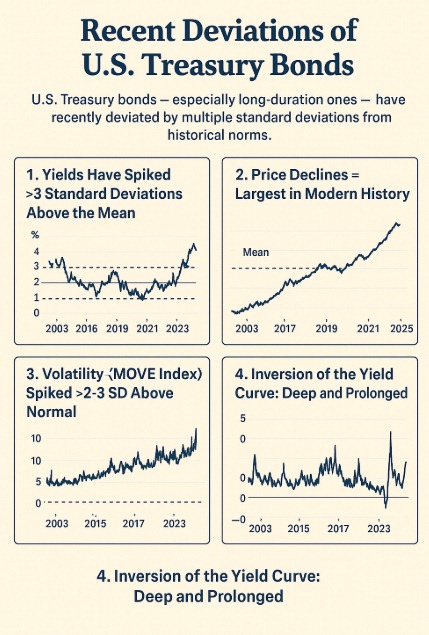
U.S. Treasury bonds — especially long-duration ones like the 10-year and 30-year Treasuries — have recently deviated by multiple standard deviations from historical norms in several key dimensions:

Historic Deviations in U.S. Treasury Bonds

1. Yields Have Spiked >3 Standard Deviations Above the Mean

  • As of late 2023 and early 2024, 10-year Treasury yields rose to around 4.5%–5%, levels 3+ standard deviations above the post-2008 average (~2%).

  • 30-year yields followed a similar pattern.

  • This is a massive deviation in historical bond market terms, which are usually stable and mean-reverting.

 This is a “once-in-a-generation” spike — the bond market equivalent of a hundred-year flood.

2. Price Declines = Largest in Modern History

  • Bond prices move inversely to yields.

  • The Bloomberg U.S. Treasury Index logged a historic drawdown (over –15%) in 2022–2023 — the worst since the 1780s in real terms.

  • That decline represents a >4 standard deviation move in price terms — practically unheard of in government bond history.

3. Volatility (MOVE Index) Spiked >2–3 SD Above Normal

  • The MOVE Index (bond market’s version of the VIX) soared past 160 in 2023.

  • Its long-term average is around 80–100.

  • A reading above 150 is a 3-sigma event — indicating extreme stress and uncertainty.

4. Inversion of the Yield Curve: Deep and Prolonged

  • The 2-year vs. 10-year yield inversion (short-term yields higher than long-term) has persisted at extreme levels — >1 standard deviation deeper and longer than historical precedent.

  • This inversion is a classic recession signal, but now it’s part of a structurally altered interest rate environment.

Summary: What’s Askew in U.S. Treasury Bonds


Metric Deviation from Norm Std. Dev. Estimate
10-yr Yield Sharp rise +3 to +4 SD
Treasury Price Index Historic loss –4+ SD
MOVE Volatility Index Sustained high volatility +2 to +3 SD
Yield Curve Inversion Depth Longest & deepest in decades >1 SD

Why It Matters

  • Bonds are usually the “safe haven” — but now they’re chaotic, cracked, and misaligned.

  • This upends traditional risk models used by banks, pensions, and governments.

  • It’s also a signal of fiscal fragility — markets demanding higher compensation for lending to the U.S.

The Big Question: What If the Dollar Loses Its Reserve Status?

Ultimately, the darkest scenario is no longer unthinkable: What happens if the U.S. dollar loses its status as the world’s reserve currency?

This would unleash a profound economic reset, marked by:

  • Exploding U.S. borrowing costs

  • A collapse in consumer purchasing power

  • Global capital flight from U.S. assets

  • Severe contraction in both trade and credit

  • Domestic political and economic instability unlike anything in modern history

Conclusion: We Are In the Experiment Now

Capital Preservation During Trumpenomics

The Inevitable Collapse: How Trump’s Policies and Climate Neglect Will Reshape the Economy

Trumpenomics: The Decline of the US

bookmark_borderDeviation, Cracked Fractals, Climate, and Economics

by Daniel Brouse
April 14, 2025

Cracked Fractals & U.S. Climate/Fiscal Policy

The U.S. economy and climate systems are exhibiting the erratic behavior of complex systems approaching critical thresholds — resembling “cracked fractals,” those chaotic, fragile patterns that form when dynamic systems near collapse. These structures are not just visual metaphors; they represent branching futures, fragmented stability, and points beyond which recovery may no longer be possible.

At the same time, key economic and climate indicators — including the federal deficit, disaster recovery costs, housing unaffordability, and insurance risk exposure — are now 2 to 3 standard deviations above historical norms. In statistical terms, this suggests we are far outside the “normal range” of fluctuation — a danger signal flashing red across multiple sectors.

These deviations, when interpreted through the lens of chaos theory and nonlinear dynamics, signal profound instability in both natural and economic systems.

What Are Cracked Fractals?

A “cracked fractal” describes a breakdown in the typical structure of a complex system. Unlike traditional fractals that are self-similar and stable within bounds, cracked fractals emerge when stress fractures the system’s underlying attractor — the set of conditions it returns to over time.

This breakdown often occurs when:

  • The system is pushed past a critical threshold (bifurcation point),

  • Feedback loops amplify instability,

  • The original symmetry or balance can no longer be maintained.

In climate science, this might manifest as rapid shifts in ocean currents or runaway feedbacks in polar ice melt. In economics, it could be a sovereign debt spiral, liquidity collapse, or the disintegration of monetary confidence.

Standard Deviations: Statistical Red Flags

A standard deviation is a statistical tool used to measure the dispersion of data from its average. When indicators deviate by 2 or more standard deviations from the mean, they are considered extreme outliers — rare events with serious implications.

In a normal distribution:

  • 68% of values lie within 1 standard deviation,

  • 95% within 2,

  • 99.7% within 3.

So when key indicators consistently exceed these bounds, it’s not a fluke — it’s a structural failure in progress.

Real-World Examples of Outlier Behavior (2024–2025)

1. Inflation Volatility

Core inflation has fluctuated wildly since 2021 — sometimes 2–3 standard deviations above long-term norms. These shifts have been driven by:

  • Pandemic-induced supply chain shocks,

  • Energy market instability from geopolitical conflict,

  • Erratic or delayed monetary responses.

2. Federal Deficit (as % of GDP)

The U.S. deficit has ballooned to nearly 7% of GDP in fiscal year 2024 — a figure more than two standard deviations above historical peacetime averages. This debt is increasingly difficult to finance amid rising interest rates.

3. Housing Unaffordability

Home price-to-income ratios have exploded. In cities like San Francisco and Austin, the median home now costs more than 10x median income — well beyond the historical norm of 3–4x and more than 2 standard deviations above long-term affordability trends.

4. Stock Market Overvaluation

The S&P 500’s Shiller CAPE ratio is hovering near levels seen only before the Great Depression and the Dot-Com crash. Valuations are now 2–3 standard deviations above the 150-year average.

5. Corporate Debt Overhang

Non-financial corporate debt as a percent of GDP is near all-time highs. Many firms are increasingly reliant on rolling over existing debt at higher rates — a fragile position vulnerable to shocks.

6. Climate-Driven Insurance Losses

U.S. insured losses from climate disasters — wildfires, floods, hurricanes — are now regularly exceeding $100 billion per year. These losses are now normalized, rather than considered “black swan” events. In actuarial terms, that’s multiple standard deviations away from historical climate stability.

Fractals, Chaos Theory, and Tipping Points

Chaos theory deals with systems that are deterministic but highly sensitive to initial conditions — where tiny changes can lead to vastly different outcomes. This “butterfly effect” describes how once-stable systems can become chaotic.

Cracked Fractal
Cracked Fractal

Cracked fractals emerge near bifurcation points — thresholds beyond which the system evolves in an entirely new direction, often unpredictably. In climate systems, these bifurcations could be:

  • The sudden collapse of the Atlantic Meridional Overturning Circulation (AMOC),

  • Massive methane release from permafrost,

  • Shifts in the jet stream or monsoon patterns.

In the economy, these might manifest as:

  • Sudden dollar devaluation,

  • Foreign dumping of U.S. Treasury debt,

  • Collapse of consumer demand due to runaway inflation or debt.

Chaos Meets Climate: A Dual Collapse?

The real danger is that these systems — climate and economy — are not isolated. They are interacting.

  • Climate disasters strain public budgets and private insurance systems.

  • Economic fragility reduces the capacity to respond to climate emergencies.

  • Environmental destruction undermines long-term productivity and food security.

This mutual reinforcement may lead to a compound crisis, accelerating both fiscal and ecological collapse. Each system may be a cracked fractal — but together, they risk triggering a global phase shift into uncharted territory.

Conclusion: A Fractured Future

Humanity is now at a critical junction — a bifurcation point — where the complex systems governing life, economy, and climate are diverging into new, unstable paths.

Unless structural reforms are made — including coordinated climate action, debt restructuring, and transition away from carbon-heavy growth models — we may be entering a prolonged period of instability marked by:

  • Market dislocations,

  • Sovereign debt crises,

  • Mass migration and food insecurity,

  • Potential breakdowns in democratic governance.

If left unaddressed, the question is no longer if these systems will fracture, but how violently and how soon.

The cracked fractal is not just a metaphor — it’s a warning.

URGENT CLIMATE WARNING
Our latest climate model — now incorporating complex social-ecological feedback loops within a dynamic, non-linear system — projects that global temperatures could rise by up to 9°C (16.2°F) within this century. This far exceeds earlier estimates, which predicted a 4°C rise over the next thousand years, and signals a dramatic acceleration of warming.

At this level of heating, large regions of the planet will become uninhabitable due to extreme heat, sea level rise, agricultural collapse, and mass migration. Critically, parts of the U.S. are already experiencing wet-bulb temperatures approaching or exceeding 31°C (87.8°F) — a physiological limit beyond which the human body can no longer regulate its internal temperature, even in the shade with ample water.

This is no longer a distant threat. The climate system is entering a phase of compound risk and cascading collapse — and we are already seeing the early signs.

Immediate, radical mitigation and adaptation efforts are now essential to preserve habitable zones, food systems, and public health.

WET-BULB TEMPERATURES

Wet-bulb temperatures above 31°C (87.8°F) are extremely dangerous — at these levels, the human body cannot cool itself through sweating, even in the shade, leading to potentially fatal heat stress within hours. While these thresholds have historically been rare outside the tropics, parts of the U.S. are now beginning to approach or breach this limit during extreme heat events — something that used to be considered virtually impossible in the U.S. climate.

Here are the U.S. regions most at risk and already showing wet-bulb temperatures exceeding 31°C or very close — often 2–3 standard deviations above historical norms:

 1. South Texas & Gulf Coast (Brownsville, Corpus Christi, Houston)

  • Already observed wet-bulb temperatures > 31°C, especially during heatwaves with high humidity and stagnant air.

  • This region is closest in climate to subtropical zones, with high Gulf moisture and intense solar heating.

  • Notable Event: July 2023 saw Brownsville record a wet-bulb of 31.2°C, nearing human survivability thresholds.

2. Louisiana, Mississippi & Coastal Alabama

  • High humidity from the Gulf + high temps create perfect storm conditions for wet-bulb extremes.

  • New Orleans and Baton Rouge have clocked wet-bulb temps around 30.5°C to 31.0°C in recent summers.

  • Trend: Average summer humidity and nighttime minimum temps have increased significantly since the 1980s.

3. Florida (Miami, Tampa, Fort Myers, and inland Everglades)

  • Very high baseline humidity and increasing urban heat island effects are pushing wet-bulb temps near critical thresholds.

  • Miami-Dade’s urban core can hit 30.5°C wet-bulb, with some inland areas (Everglades edge) hitting 31°C under stagnant conditions.

4. Mississippi River Valley & Midwest (in isolated events)

  • While not traditionally at risk, heat dome events have caused spikes in wet-bulb readings in Illinois, Missouri, and Iowa.

  • Wet-bulbs of 29.5°C–30.5°C were observed during July 2023 under extreme dew points (~80°F) and triple-digit heat.

5. Southwest Deserts (Phoenix, Las Vegas, Death Valley) — Dry Heat, but Changing

  • Typically hot but dry, these regions have avoided extreme wet-bulb temps historically.

  • However, monsoonal moisture and climate shifts are making 30°C+ wet-bulb temps more common — especially during nighttime heatwaves when humidity is trapped.

Climate Collapse Will Break Capitalism

The Decline of Economic Power and the Ascent of Environmental Reality

The Destructive Legacy of Trump’s Climate and Economic Policies

Trumpenomics: The Decline of the US

State of the Climate Crisis 2025

Updates

The Human Induced Climate Change Experiment