bookmark_borderThe Plight of the Penguin: Will Humans Follow?

by Daniel Brouse and Sidd Mukherjee
December 7, 2025

The Plight of the Penguin: Will Humans Follow?

Adaptation Part I

Abstract

Penguin populations across the Southern Hemisphere are undergoing rapid collapse as climate change, ocean warming, disrupted food webs, and human exploitation destabilize their ecosystems. This paper synthesizes new evidence from Antarctic system destabilization, emerging penguin population studies, and interlinked climate tipping points to examine the existential crisis facing both penguin species and humanity. While some penguin species exhibit short-term adaptability, the majority face extinction within the century. Likewise, accelerating nonlinear climate dynamics and cascading feedback loops threaten to exceed human adaptive capacity. Understanding the penguin’s collapse offers a preview of humanity’s own trajectory under unchecked climate destabilization.

1. Introduction

Over the past year, the severity of global penguin declines has become unmistakably clear. These declines are not isolated events: they are symptoms of a rapidly destabilizing Earth system. From Antarctica to South Africa to the Galápagos, penguins serve as indicator species—sentinels signaling the collapse of marine and cryospheric ecosystems.

At the same time, new climate science—particularly the August 2025 paper Emerging Evidence of Abrupt Changes in the Antarctic Environment—confirms that Antarctica is destabilizing far faster than previously modeled. Processes once thought to unfold over millennia are now accelerating on decadal or even annual scales.

What is happening to the penguins is not separate from humanity’s fate. It is a preview.

2. The Emperor Penguin and the Antarctic System Collapse

2.1 Antarctica: The Fastest-Moving Existential Threat

Antarctica represents the single greatest existential threat to human civilization. The collapse of the West Antarctic Ice Sheet alone commits the planet to ~3.3 meters (11 feet) of sea-level rise; full destabilization of East Antarctica commits humanity to more than 50 meters (164 feet).

The August 2025 Antarctic study revealed several accelerated processes:

  • Ice shelf disintegration occurring a century ahead of projections

  • Runaway marine ice sheet instability along the Amundsen sector

  • Rapid weakening of the Antarctic overturning circulation (AOC)

  • Record-low sea-ice extent for consecutive years

  • Nonlinear acceleration of glacial outflow

These are tipping points, and evidence indicates many have already been crossed.

2.2 Biological Collapse: The Emperor Penguin

The Emperor Penguin (Aptenodytes forsteri), entirely dependent on stable, land-fast sea ice, has become the symbol of Antarctic ecological collapse.

Key Impacts

  • Breeding failures
    Early sea-ice breakup plunges downy chicks into freezing water; they drown or die of hypothermia. Entire colonies experience total reproductive collapse.

  • Colony declines
    Between 2018 and 2022, 30% of all known colonies experienced major or total sea-ice loss.

  • Population crash
    Some regions show a 22% decline, nearly 50% worse than previous worst-case predictions.

  • Extinction risk
    Under current emissions scenarios, >90% of colonies may reach quasi-extinction by 2100.
    The species was listed as Threatened under the U.S. Endangered Species Act in 2022.

The Emperor Penguin is not merely “at risk.” It is on a countdown to extinction.

3. African Penguins: A Parallel Collapse

A newly published analysis from the University of Exeter and South Africa’s Department of Forestry, Fisheries, and the Environment (Ostrich: Journal of African Ornithology) reveals staggering losses in African penguin (Spheniscus demersus) populations.

3.1 Catastrophic Findings

  • 62,000 breeding adults died between 2004–2011

  • 95% colony collapse at Dassen and Robben Islands

  • 80% global decline over 30 years

  • Species now classified as Critically Endangered

3.2 Drivers of Collapse

  1. Commercial overfishing
    Exploitation of sardines and anchovies reached ~80%, leaving insufficient forage.

  2. Climate-driven ecosystem shift
    Warming and changing salinity pushed prey far offshore.
    Penguins cannot forage more than ~40 km from the nest—beyond that, they starve.

This is not a natural fluctuation. It is a human-driven collapse.

4. The Broader Penguin Crisis

A snapshot of current conservation status:

4.1 Endangered or Declining Species

  • Yellow-eyed Penguin (Hoiho) – <3,000 mature individuals

  • Erect-crested Penguin – declining, restricted to sub-Antarctic islands

  • Galápagos Penguin – threatened by El Niño amplification

  • Macaroni & Southern Rockhopper Penguins – food scarcity, climate extremes

These declines highlight the fragility of polar and marine ecosystems under rapid warming.

5. Species Showing Short-Term Adaptation

A few penguin species—temporarily—appear stable or increasing:

  • Gentoo Penguins
    Thrive with reduced ice; flexible diet and foraging range.

  • Adélie Penguins (regional)
    Declining in the warming Peninsula but increasing in the Ross Sea and East Antarctica.

  • King Penguins
    Overall stable and increasing, though some colonies show sharp declines.

  • Little Penguins
    Generally stable; primary threats are human disturbance rather than climate.

These species are not “safe.” They are simply not yet in freefall.

6. Can Humans Adapt?

The question is no longer theoretical.

Humanity has triggered:

  • Antarctic and Arctic permafrost thaw

  • Carbon-sink collapse in mature forests

  • Nonlinear amplification of feedback loops

  • Accelerating sea-level rise

  • Disrupted global heat and moisture transport

  • Destabilized agriculture, fisheries, and water systems

As of 2020–2025, most of Earth’s major carbon sinks—including Amazonia, boreal forests, and thawing permafrost—have shifted from net absorbers to net sources of greenhouse gases. This marks the onset of an accelerating planetary cascade.

Migration? Limited.
Geoengineering? Unproven and high-risk.
Adaptation? Insufficient.
Restoring lost ice? Impossible on human timescales.

Without unprecedented global action—and likely without breakthroughs in AI-accelerated climate solutions—human adaptive capacity will be exceeded within decades.

Penguins are simply ahead of us in the timeline.

7. Conclusion

Penguin collapse is not just a biodiversity tragedy—it is a systems-level warning of Earth’s destabilization. The same forces driving penguin extinction are driving humanity toward an adaptation threshold we are unlikely to surpass.

The question is not whether the penguins can adapt.
It is whether we can.

And the window to answer that question is rapidly closing.

* Our probabilistic, ensemble-based climate model — which incorporates complex socio-economic and ecological feedback loops within a dynamic, nonlinear system — projects that global temperatures are becoming unsustainable this century. This far exceeds earlier estimates of a 4°C rise over the next thousand years, highlighting a dramatic acceleration in global warming. We are now entering a phase of compound, cascading collapse, where climate, ecological, and societal systems destabilize through interlinked, self-reinforcing feedback loops.

What Can I Do?
The single most important action you can take to help address the climate crisis is simple: stop burning fossil fuels.

Tipping points and feedback loops drive the acceleration of climate change. When one tipping point is breached and triggers others, the cascading collapse is known as the Domino Effect.

The Climate Crisis: Violent Rain | Deadly Humid Heat | Health Collapse | Extreme Weather Events | Insurance | Trees and Deforestation | Soil | Rising Sea Level | Food and Water | Updates
The Human Induced Climate Change Experiment

bookmark_borderAmerica’s Water Crisis: Climate Change Is Reshaping Freshwater Security in the U.S.

by Daniel Brouse / December 5, 2025

Much of the United States is already experiencing severe, measurable impacts of climate change on freshwater availability. These changes are not abstract predictions — they are unfolding in real time, impacting drinking water supplies, agriculture, ecosystems, and energy production. From the rapidly drying West to the saltwater-intruded aquifers of Florida and New Jersey, the nation’s water security is under unprecedented strain.

The Western U.S.: From Drought to Permanent Aridification

For decades, the Western United States has cycled through droughts, but the current crisis is fundamentally different. Scientists increasingly refer to the region’s condition not as a drought — which implies a temporary deviation — but aridification, a long-term drying driven by rising temperatures.

Record Lows in Major Reservoirs

The Colorado River Basin, which serves 40 million people across seven states and Mexico, is the clearest example of how climate change is reshaping water security.

Lake Mead

Lake Mead, the country’s largest reservoir, has dropped to the lowest levels since it was filled in the 1930s. The enormous white “bathtub ring” etched into its canyon walls is visible proof of its historic decline.

In 2021, the federal government declared the first-ever Tier 1 water shortage, triggering mandatory cuts — most notably for Arizona and Nevada. Mead’s decline has grown so severe that it threatens hydroelectric generation at the Hoover Dam.

Lake Powell

Upstream, Lake Powell has fared no better. Water levels have approached the minimum power pool, the threshold below which the Glen Canyon Dam’s turbines can no longer operate. Federal officials have had to take emergency actions, including releasing water from upstream reservoirs and withholding water traditionally sent downstream.

Unprecedented Federal Mandates and Local Water Restrictions

The worsening crisis has forced all levels of government to intervene:

1. Federal Water Reductions

The Bureau of Reclamation has required massive cuts — 2 to 4 million acre-feet annually across the basin.

  • Arizona lost 18% of its entire Colorado River allocation in a single year.

2. Urban Water Conservation

Cities dependent on the river — including Las Vegas, Phoenix, and Los Angeles — have introduced aggressive conservation programs and, in some cases, mandatory rationing. Despite efforts to diversify water portfolios, long-term water security remains precarious.

3. Agricultural Fallout

Agriculture, which consumes roughly 70–80% of Colorado River water, is being forced into drastic measures. Farmers are:

  • shifting away from water-intensive crops,
  • adopting new irrigation technologies, or
  • fallowing land entirely.

The economic implications reach far beyond the farm gate.

How Climate Change Is Driving the Collapse

The Colorado River Compact, signed in 1922, dramatically overestimated the river’s annual flow. Climate change has transformed a historically strained system into an outright failing one.

Reduced Snowpack and Early Melt

Warmer winters mean less snowfall in the Rockies and Sierra Nevada. What snow does fall melts too early, disrupting the timing of spring runoff — the pulse that has always sustained the river through summer.

Increased Evaporation and Soil Moisture Loss

Higher temperatures accelerate evaporation from reservoirs and rivers. Meanwhile, parched soils absorb more water before it reaches tributaries and main stems.

A 2023 study found that human-caused warming has removed the equivalent of an entire Lake Mead from the basin since 2000.

This is not natural variability — it is climate-driven hydrological destabilization.

The Pacific Northwest: Myths and Realities of the Lower Snake River Dams

Some political voices claim the lower Snake River dams are essential for regional energy security. The data says otherwise:

  • They contribute less than 4% of the Northwest’s electricity.
  • They operate at a small fraction of theoretical capacity.
  • As run-of-river dams, they offer minimal storage — unlike major storage systems such as Grand Coulee.
  • They require tens of millions in taxpayer subsidies to remain operational.
  • They are a leading driver of salmon population collapse, threatening tribal treaty rights and devastating ecosystems and fisheries.

Labeling dam removal as “climate craziness” ignores hydrology, ecology, economics, and modern grid modeling.

Florida: Freshwater on the Brink

While the West grapples with aridification, Florida faces a different climate-driven threat: saltwater intrusion.

Saltwater Invading Drinking Water Aquifers

South Florida’s primary freshwater source, the Biscayne Aquifer, is becoming increasingly contaminated as rising sea levels push saltwater inland. This process accelerates when rainfall declines, river flows weaken, and groundwater pumping intensifies.

Emergency Water Purchases in Tampa

A stark illustration of the crisis:

  • Tampa is currently buying 10 million gallons of water per day,
  • an action officials describe as “very rare” — especially this early in the year.

Saltwater intrusion and diminished river flows are forcing utilities into emergency measures far earlier than in previous decades. And this isn’t just a Florida problem — it’s unfolding across the Eastern U.S.

Along the Delaware River, saltwater has been pushing farther upstream than ever recorded, killing cedar forests in New Jersey and threatening Philadelphia’s drinking water supply. Large stretches of the East Coast and Gulf Coast are experiencing the same accelerating pattern.

Louisiana’s coastline remains deeply damaged and largely infertile even decades after Hurricane Katrina, and successive storms have further degraded ecosystems and freshwater systems across Louisiana, Alabama, Texas, and the Florida Panhandle.

Climate-driven hydrological collapse is no longer a regional issue — it’s a national one.

A National Crisis: Different Regions, Same Driver

From the drying reservoirs of the West to the compromised aquifers of the Southeast, America’s water systems are being reshaped by the same underlying force: climate-driven hydrological disruption.

The consequences are already visible:

  • collapsing reservoirs
  • failing aquifers
  • disappearing snowpack
  • rising salinity
  • ecological devastation
  • increased water costs
  • declining hydroelectric capacity
  • agricultural instability
  • regional economic stress

This is not a future scenario — it is the present, and it is accelerating.

* Our probabilistic, ensemble-based climate model — which incorporates complex socio-economic and ecological feedback loops within a dynamic, nonlinear system — projects that global temperatures are becoming unsustainable this century. This far exceeds earlier estimates of a 4°C rise over the next thousand years, highlighting a dramatic acceleration in global warming. We are now entering a phase of compound, cascading collapse, where climate, ecological, and societal systems destabilize through interlinked, self-reinforcing feedback loops.

What Can I Do?
The single most important action you can take to help address the climate crisis is simple: stop burning fossil fuels. There are numerous actions you can take to contribute to saving the planet. Each person bears the responsibility to minimize pollution, discontinue the use of fossil fuels, reduce consumption, and foster a culture of love and care. The Butterfly Effect illustrates that a small change in one area can lead to significant alterations in conditions anywhere on the globe. Hence, the frequently heard statement that a fluttering butterfly in China can cause a hurricane in the Atlantic. Be a butterfly and affect the world.

Tipping points and feedback loops drive the acceleration of climate change. When one tipping point is breached and triggers others, the cascading collapse is known as the Domino Effect.

The Human Induced Climate Change Experiment

bookmark_borderFlorida at the Front Line: How Accelerating Sea-Level Rise Is Reshaping the State in Real Time

by Daniel Brouse
December 5, 2025

Florida faces a long list of climate-driven threats — extreme heat, stronger hurricanes, toxic algal blooms, and collapsing insurance markets — but accelerating sea-level rise (SLR) sits at the center of nearly all of them. Although the current rise of a few millimeters per year may sound trivial, the reality is anything but. Sea-level rise is no longer linear; it is entering a phase of nonlinear, exponential acceleration, and Florida is already experiencing the consequences.

1. Sea-Level Acceleration: From Millimeters to Centimeters

Sea level has been rising for a century, but what matters most is the rate of change. Historically, it took roughly a century for the rate to jump from ~3 mm/year to ~6 mm/year. Now, that doubling has happened in just eight years.

This exponential acceleration is driven by:

  • Rapid ice-sheet melt in Greenland and Antarctica
  • Thermal expansion of superheated oceans
  • Slowing ocean circulation (including the AMOC)
  • Increased land subsidence in coastal regions

If current trends hold — and most projections underestimate nonlinear behavior — Florida could see centimeters per year within the next decade and experience multiple surge-years this century where sea levels jump over a foot in a single year due to ice-sheet pulses and ocean heat anomalies.

This is not a distant scenario. It is unfolding now.

2. Everyday Flooding: Surge Without a Storm

Storm surge is no longer just a hurricane problem. Florida now experiences regular tidal flooding with no storms at all, as “sunny-day floods” push seawater into streets, yards, and infrastructure simply because the baseline sea level is higher.

Consequences include:

• Infrastructure decay

Saltwater corrodes electrical systems, sewer lines, bridges, roads, pumps, and underground cables. Critical infrastructure in Miami-Dade, Tampa Bay, the Keys, and Jacksonville is suffering chronic damage.

• Soil and ecosystem collapse

Saltwater intrusion destroys soil structure, kills vegetation, and converts freshwater wetlands into ghost forests.

• Drinking-water contamination

Saltwater is infiltrating freshwater aquifers — especially the Biscayne Aquifer — which supply millions of Floridians with drinking water.

One striking example of the water crisis:

“VERY RARE”: Tampa is currently purchasing about 10 million gallons of water per day — something officials say almost never happens this early in the year.
Saltwater intrusion and low river flows are driving emergency purchases months ahead of schedule.

3. Insurance Market Collapse: Climate as an Economic Wrecking Ball

Extreme saltwater events, chronic flooding, stronger hurricanes, and skyrocketing property risk have triggered a full-scale insurance meltdown in Florida.

The results:

  • Dozens of private insurers have left the state
  • Those remaining have raised premiums by 50–200%
  • Auto insurance rates are rising due to saltwater-related electronics failures and flood losses
  • Citizens Property Insurance — the taxpayer-funded state insurer of last resort — is now the largest insurer in Florida

This means the financial burden is shifting directly onto Florida taxpayers, even if they live nowhere near the coast.

4. The Bottom Line

Florida’s sea-level rise is not “millimeters that don’t matter.”
It is:

  • Accelerating at a historically unprecedented rate
  • Flooding infrastructure even on sunny days
  • Salting soils and destroying ecosystems
  • Contaminating drinking water
  • Collapsing the private insurance market
  • Forcing taxpayers to absorb billions in risk

Florida is already living in the future the rest of the country is headed toward. The question is no longer if sea-level rise will reshape the state, but how fast and how prepared communities will be for what’s coming next.

* Our probabilistic, ensemble-based climate model — which incorporates complex socio-economic and ecological feedback loops within a dynamic, nonlinear system — projects that global temperatures are becoming unsustainable this century. This far exceeds earlier estimates of a 4°C rise over the next thousand years, highlighting a dramatic acceleration in global warming. We are now entering a phase of compound, cascading collapse, where climate, ecological, and societal systems destabilize through interlinked, self-reinforcing feedback loops.

What Can I Do?
The single most important action you can take to help address the climate crisis is simple: stop burning fossil fuels. There are numerous actions you can take to contribute to saving the planet. Each person bears the responsibility to minimize pollution, discontinue the use of fossil fuels, reduce consumption, and foster a culture of love and care. The Butterfly Effect illustrates that a small change in one area can lead to significant alterations in conditions anywhere on the globe. Hence, the frequently heard statement that a fluttering butterfly in China can cause a hurricane in the Atlantic. Be a butterfly and affect the world.

Tipping points and feedback loops drive the acceleration of climate change. When one tipping point is breached and triggers others, the cascading collapse is known as the Domino Effect.

The Human Induced Climate Change Experiment

bookmark_borderWhy the Deep Freeze Is a Warning Sign: How Global Warming Is Driving the Siberian Express

by Daniel Brouse
December 4, 2025

Cold weather brought to you by global warming.

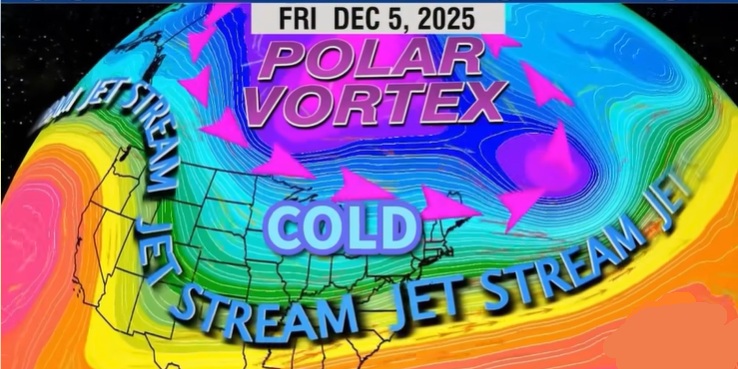
Over the next several days, the Northeastern United States will experience unusually cold temperatures delivered by what meteorologists call the Siberian Express — a mass of frigid Arctic air plunging southward into North America. While this may feel like a contradiction to global warming, it is in fact one of the clearest signatures of a destabilizing climate system. The very forces warming the planet overall are also helping unleash more extreme cold spells in the mid-latitudes.

At the heart of this counterintuitive pattern are two major disruptions: the weakening of the AMOC (Atlantic Meridional Overturning Circulation) and the increasing waviness and instability of the jet stream. These changes are direct consequences of unprecedented ocean heating and rapid Arctic amplification.

What Is the “Siberian Express”?

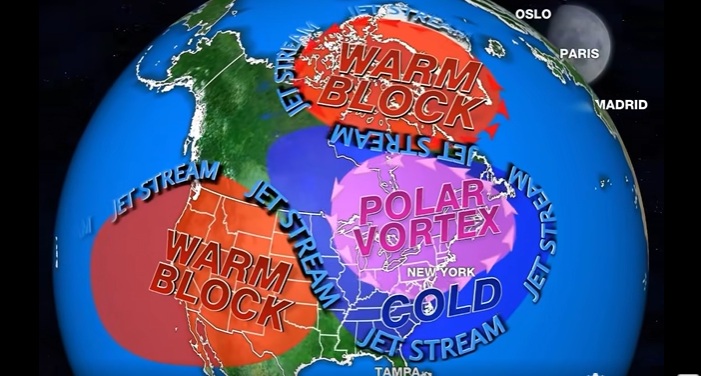
The “Siberian Express” refers to a weather pattern in which extremely cold, dense Arctic air is displaced from its usual position near the pole and funneled southward into North America. Despite the name, this air mass often forms in the Canadian Arctic, where strong high-pressure systems develop over extensive snow and ice. In this case, however, the cold air does originate in Russia and is being held north by a blocking high positioned between Russia and Canada. After sweeping over the Northwestern United States, the jet stream then dips sharply, steering the frigid air directly over Pennsylvania.

This displacement comes from:

  • A weakened or disrupted polar vortex
  • A deeply dipping jet stream
  • A “cross-polar flow” pattern that bridges Asia, the Arctic, and North America

The jet stream acts like an atmospheric conveyor belt. When it becomes wavier and slower, it can scoop up Arctic air and drive it far south into the continental United States, delivering the kind of bitter cold typically confined to the high latitudes.

The blue and purple regions commonly shown on temperature anomaly maps reflect areas experiencing temperatures far below average during these events.

Why Global Warming Is Causing More Extreme Cold Bursts

At first glance, “global warming causes cold” seems paradoxical. But in a nonlinear climate system, warming does not simply raise all temperatures evenly—it disrupts circulation patterns that have stabilized Earth’s climate for thousands of years.

1. The Arctic Is Warming 3–4 Times Faster Than the Global Average

This process, called polar amplification, reduces the temperature contrast between the Arctic and the mid-latitudes — the very contrast that powers a strong, stable jet stream.

2. A Weaker Temperature Gradient Means a Weaker Jet Stream

With less difference between Arctic cold and mid-latitude warmth, the jet stream slows, becomes wavier, and meanders. These waves can dip deeply southward, dragging Arctic air with them.

3. A Disrupted Polar Vortex Spills Cold Air South

When the stratospheric polar vortex weakens or splits, cold air that was once confined to the Arctic is free to plunge into regions unaccustomed to such extremes.

Ocean Heating, AMOC Slowdown, and the Breakdown of Planetary Circulation

More than 90% of the excess heat trapped by greenhouse gases is absorbed by the oceans. This enormous thermal load is now reshaping planetary circulation systems, setting the stage for weather extremes of all kinds — including sudden, intense cold outbreaks.

Key destabilizing impacts of ocean warming:

  • Weakening of the AMOC, which normally helps distribute heat from the tropics to the North Atlantic
  • Slowing, stretching, and increased waviness of the jet stream, allowing Arctic air to spill south
  • Persistent heat domes and atmospheric blocking patterns, which can trap cold air in place for days or weeks
  • Amplification of storms, including more powerful nor’easters fueled by warm Atlantic waters

These shifts introduce chaotic behavior into global weather patterns—creating an atmosphere that oscillates between extremes: historic droughts one season, record floods the next, blistering heat followed by abnormal cold.

Cold Is Not a Contradiction — It’s a Symptom

The same climate forces that bring deadly heat waves, supercharged rainfall, intensifying hurricanes, and historic wildfires are also responsible for destabilizing winter.

Extreme cold events in a warming world are not only possible; they are increasingly expected.

The Siberian Express hitting the Northeast is not a sign that global warming has paused. It is evidence that the planetary circulation systems that once regulated our seasons are breaking down — and extremes of all kinds are becoming the new normal.

* Our probabilistic, ensemble-based climate model — which incorporates complex socio-economic and ecological feedback loops within a dynamic, nonlinear system — projects that global temperatures are becoming unsustainable this century. This far exceeds earlier estimates of a 4°C rise over the next thousand years, highlighting a dramatic acceleration in global warming. We are now entering a phase of compound, cascading collapse, where climate, ecological, and societal systems destabilize through interlinked, self-reinforcing feedback loops.

What Can I Do?
The single most important action you can take to help address the climate crisis is simple: stop burning fossil fuels. There are numerous actions you can take to contribute to saving the planet. Each person bears the responsibility to minimize pollution, discontinue the use of fossil fuels, reduce consumption, and foster a culture of love and care. The Butterfly Effect illustrates that a small change in one area can lead to significant alterations in conditions anywhere on the globe. Hence, the frequently heard statement that a fluttering butterfly in China can cause a hurricane in the Atlantic. Be a butterfly and affect the world.

Tipping points and feedback loops drive the acceleration of climate change. When one tipping point is breached and triggers others, the cascading collapse is known as the Domino Effect.

The Human Induced Climate Change Experiment

Siberian Express and the  Jet Stream Collapse
Siberian Express and the Jet Stream Collapse
Polar Blocks
Polar Blocks

bookmark_borderClimate Chain-Reaction: How Nonlinear Feedback Loops Are Driving Runaway Global Warming

by Daniel Brouse and Sidd Mukherjee
December 3, 2025

Earth’s climate is a nonlinear, chaotic system composed of tightly interdependent subsystems—atmosphere, hydrosphere, cryosphere, lithosphere, and biosphere. Drawing from chaos theory, nonlinear thermodynamics, and emerging observations of accelerating climate instability, this paper examines how feedback loops and tipping points are now interacting in a compounding, cascading sequence similar to the self-accelerating chain-reaction of a nuclear explosion.

Human-induced climate change is no longer a slow, linear warming trend; it has entered a phase defined by feedback-driven acceleration, where each stage amplifies the next. This chain-reaction dynamic is rapidly pushing the climate toward states previously considered centuries away.

1. Ignition: Fossil Fuels, Pollution, and Initial Forcing

The chain reaction begins with the combustion of fossil fuels. This produces:

  • Greenhouse gases: CO₂, CH₄, and tropospheric ozone (O₃)

  • Particulate pollution: PM₂.₅ and other aerosols

  • Secondary health effects: heart disease, stroke, respiratory failure, and compounding stress on human physiological systems

Fine particulate pollution and ozone feed directly into a health-driven feedback loop—weakening human resilience, increasing mortality, reducing labor productivity, and indirectly accelerating global warming through economic disruption and heightened energy demand.

Meanwhile, CO₂ and methane trap longwave radiation, raising global temperatures and injecting more thermal energy into every component of the climate system.

2. Atmospheric Moisture Feedback: The First Major Amplifier

A fundamental physical law governs what happens next: warmer air holds more water vapor, and water vapor is itself the most powerful greenhouse gas on the planet.

  • For every 1°C (1.8°F) of warming, the atmosphere can hold ~7% more moisture.

  • Over 10°C, water-holding capacity nearly doubles.

  • Increased evaporation → increased atmospheric moisture → increased back-radiation → more warming → more evaporation.

This is a classic positive feedback loop.

More water vapor also supercharges extreme precipitation events, creating catastrophic inland and coastal flooding, particularly in regions like the Mid-Atlantic United States where river basins, stormwater systems, and aging infrastructure are already overwhelmed.

3. Permafrost Thaw, Boreal Forest Collapse, and the Carbon Bomb

As global temperatures rise, the Arctic warms 3–4 times faster than the global average—a phenomenon known as polar amplification. This triggers the next phase of the chain reaction:

Permafrost Thaw

  • Releases vast stores of CO₂ and CH₄ trapped for millennia

  • Destabilizes soils, infrastructure, and entire ecosystems

  • Forms thaw lakes that leak methane at accelerating rates

Zombie Fires and Boreal Wildfires

The thawing cryosphere has enabled:

  • “Zombie fires” smoldering underground year-round

  • Record-breaking boreal forest fires in Canada, Alaska, and Siberia

  • Fire emissions now exceeding the annual fossil-fuel emissions of countries like Canada

These fires convert carbon sinks into carbon sources—an irreversible shift.

4. Ocean Heating, Jet Stream Disruption, and the Breakdown of Planetary Circulation

The oceans absorb over 90% of the excess heat trapped by anthropogenic greenhouse gases. This thermal accumulation drives multiple destabilizing processes:

  • Weakening of the AMOC (Atlantic Meridional Overturning Circulation)

  • Slowing and increased waviness of the jet stream

  • Prolonged heat domes, atmospheric blocking, and stalled storm systems

  • Intensification of tropical cyclones through ocean heat content

These system-level shifts introduce chaotic behavior into global weather patterns—persistent drought where water is needed, and supersaturated storms where the atmosphere is already overloaded.

5. The Scale of Heat Accumulation: A Planet-Wide Nuclear Equivalent

The increase in Earth’s thermal energy is almost impossible for the human mind to process. The planet currently gains heat at a rate equivalent to:

  • Several Hiroshima-sized atomic bombs per second

  • 400,000–1,000,000 Hiroshima bombs per day

Between 1971 and 2020, Earth accumulated roughly 380 zettajoules of additional heat—equivalent to: ~25 billion Hiroshima bombs of energy

Most of this energy is now locked in the oceans, driving stratification, deoxygenation, coral die-off, species collapse, and further disruption of heat distribution mechanisms.

Unlike a nuclear bomb—which expends its chain reaction in microseconds—Earth’s climatic chain reaction is continuous, compounding, and accelerating.

6. Runaway Phase: When Drivers Become Amplifiers

As described in the linked papers (“Drivers and Amplifiers,” “Non-Linear Acceleration,” “Runaway Phase”), the boundary between “cause” and “effect” begins to dissolve:

  • Warming creates more warming.

  • Melting creates more melting.

  • Extinction accelerates more extinction.

  • Infrastructure failures multiply future failures.

  • Human health decline increases vulnerability to further environmental shocks.

At this stage, feedback loops interact, producing nonlinear acceleration. These interactions include:

  • Ice-albedo loss

  • Methane release

  • Soil respiration increases

  • Ocean stratification and reduced carbon uptake

  • Vegetation dieback

  • Wildfire-carbon amplification

  • Population displacement and weakened institutional response capacity

This is the signature of a system entering runaway dynamics.

Conclusion: A Planet in a Chain Reaction

Climate drivers and amplifiers now form an interconnected series of cascading feedback loops that are accelerating global warming far beyond linear predictions. The climate is no longer responding to “emissions alone”; it is responding to its own destabilization.

Earth’s climate chain reaction is not theoretical or distant—it is unfolding in real time.

To interrupt this runaway process, humanity must:

  • Rapidly eliminate fossil fuel combustion

  • Restore carbon sinks

  • Rebuild resilient infrastructure

  • Reduce pollution

  • Strengthen global cooperation rather than retreat into isolation

Without decisive action, the chain reaction will continue until multiple tipping points lock the planet into an unlivable state.

Infectious disease vectors, violent rain, and deadly humid heat now stand among the greatest threats of climate change, no longer future warnings but present realities. This deadly triad — rising infectious diseases, escalating heat extremes, and intense rainfall events — has begun driving an exponential increase in climate-related deaths worldwide. These hazards do not operate in isolation; they amplify one another’s impacts, creating cascading risks that strain health systems, destabilize communities, and accelerate global mortality. Climate change has become a full-scale health crisis, demanding urgent, systemic action before these accelerating threats overwhelm society’s ability to respond.

* Our probabilistic, ensemble-based climate model — which incorporates complex socio-economic and ecological feedback loops within a dynamic, nonlinear system — projects that global temperatures are becoming unsustainable this century. This far exceeds earlier estimates of a 4°C rise over the next thousand years, highlighting a dramatic acceleration in global warming. We are now entering a phase of compound, cascading collapse, where climate, ecological, and societal systems destabilize through interlinked, self-reinforcing feedback loops.

What Can I Do?
The single most important action you can take to help address the climate crisis is simple: stop burning fossil fuels. There are numerous actions you can take to contribute to saving the planet. Each person bears the responsibility to minimize pollution, discontinue the use of fossil fuels, reduce consumption, and foster a culture of love and care. The Butterfly Effect illustrates that a small change in one area can lead to significant alterations in conditions anywhere on the globe. Hence, the frequently heard statement that a fluttering butterfly in China can cause a hurricane in the Atlantic. Be a butterfly and affect the world.

The Human Induced Climate Change Experiment

bookmark_borderClimate-Accelerated Flooding in Delaware and Chester Counties: The Brandywine Creek Threat

by Daniel Brouse
December 2, 2025

Mapping by the U.S. Geological Survey (USGS) highlights Brandywine Creek, the Christina Basin, and multiple watersheds across Delaware County as major flood-risk zones—an assessment that aligns with the region’s accelerating exposure to extreme weather. The USGS flood inundation maps show that the Brandywine is especially prone to rapid rises in water level during heavy rainfall events, often swelling far beyond its banks and inundating nearby neighborhoods, roadways, and infrastructure.

Several factors compound this vulnerability:

• Increased rainfall intensity
Climate data show that the Mid-Atlantic is experiencing more frequent high-intensity rainstorms, with total precipitation delivered in fewer, more extreme bursts. This overwhelms the creek’s capacity and turns tributaries into fast-moving flood channels.

• Watershed geometry and urbanization
Much of Delaware County lies in narrow river valleys with steep topography, which funnels rainfall directly into creeks and accelerates runoff. As urban development expands—adding impervious surfaces such as asphalt and concrete—the watershed loses its natural ability to absorb water, amplifying flash-flood potential.

• Aging and undersized infrastructure
Stormwater systems in many of these communities were not designed for 21st-century rainfall extremes. As a result, drainage networks back up quickly, turning what would once have been manageable floods into dangerous, property-damaging events.

• Climate-driven amplification
Warming oceans and atmospheric moisture increases—roughly 7% more water vapor available in the atmosphere per 1°C of global warming—supercharge storms in the region. This means each storm has the potential to deliver far more rain in a shorter timeframe, a trend consistent with the catastrophic floods the Brandywine watershed has experienced in recent years (e.g., the remnants of Hurricane Ida).

As a result, Delaware and Chester Counties are now among the fastest-escalating inland flood zones in the Mid-Atlantic, with climate-driven rainfall extremes transforming what were once episodic flood events into recurrent, high-impact disasters. Homes, businesses, schools, roadways, critical utilities, and regional transportation corridors along Brandywine Creek, Chester Creek, Darby Creek, and their tributaries face increasing year-over-year risk as the hydrologic regime becomes more volatile.

Chester County: Critical Infrastructure at High Risk

In Chester County, vulnerability extends well beyond residential flooding. The county’s wastewater system is centrally dependent on the Brandywine Creek, meaning multiple municipal sewage treatment facilities sit directly within high-risk floodplains. These facilities are increasingly exposed to:

  • Overbank flooding that can overwhelm treatment capacity
  • Structural inundation leading to electrical and pump failures
  • Raw sewage releases into the Brandywine and downstream into Wilmington’s water supply
  • Loss of operational access for emergency crews during severe flood stages

A major breach or system failure would trigger cascading public-health hazards, contaminate drinking water infrastructure, and disrupt wastewater services for tens of thousands of residents.

Additionally, stormwater basins, dams, aging bridges, and low-lying roadways—many built decades before modern flood-risk standards—are failing more frequently under record rainfall. The increasing intensity of flash-flood events threatens life-safety response times, evacuation routes, and continuity of essential services.

Delaware County: Industrial Legacy + Rising Water = Compounding Hazard

In Delaware County, the risk is even more severe due to the region’s industrialized, low-lying riverfront, much of which was historically built on wetlands, marshlands, and filled swamp soils that were never engineered to withstand modern hydrologic extremes.

Along the Delaware River and lower creek systems, the county hosts:

  • Petroleum refineries and former refinery complexes
  • Bulk fuel storage farms and transfer terminals
  • Chemical manufacturing sites
  • Rail corridors carrying hazardous materials
  • Natural gas infrastructure and distribution hubs
  • Superfund and brownfield sites with residual contaminants in soil and groundwater

As climate-amplified flooding intensifies:

  • Rising groundwater mobilizes petroleum residues, solvents, and heavy metals trapped in fill soils.
  • Floodwaters can inundate storage tanks, pipelines, rail lines, and industrial yards, increasing the risk of spills or chemical releases.
  • Power outages combined with inundation threaten refinery pump systems, tank farm containment walls, and emergency shutoff controls.
  • Flood-driven erosion can undermine pipelines and buried utility conduits, increasing explosion or leak risk.

This combination of subsiding land, sea-level rise, industrial contamination, and extreme rainfall places Delaware County in a uniquely dangerous situation: a region where climate-accelerated flooding threatens not just property and infrastructure, but public health, the regional economy, and environmental stability.

USGS and NOAA both warn that without aggressive climate mitigation and local adaptation—such as updated floodplain zoning, expanded stormwater capacity, and restoration of natural wetlands—the region’s flood severity will continue to worsen as climate change accelerates.

* Our probabilistic, ensemble-based climate model — which incorporates complex socio-economic and ecological feedback loops within a dynamic, nonlinear system — projects that global temperatures are becoming unsustainable this century. This far exceeds earlier estimates of a 4°C rise over the next thousand years, highlighting a dramatic acceleration in global warming. We are now entering a phase of compound, cascading collapse, where climate, ecological, and societal systems destabilize through interlinked, self-reinforcing feedback loops.

What Can I Do?
The single most important action you can take to help address the climate crisis is simple: stop burning fossil fuels. There are numerous actions you can take to contribute to saving the planet. Each person bears the responsibility to minimize pollution, discontinue the use of fossil fuels, reduce consumption, and foster a culture of love and care. The Butterfly Effect illustrates that a small change in one area can lead to significant alterations in conditions anywhere on the globe. Hence, the frequently heard statement that a fluttering butterfly in China can cause a hurricane in the Atlantic. Be a butterfly and affect the world.

Tipping points and feedback loops drive the acceleration of climate change. When one tipping point is breached and triggers others, the cascading collapse is known as the Domino Effect.

The Human Induced Climate Change Experiment

bookmark_borderPolar Amplification and the Collapse of Climate Stability: How Shrinking Temperature Gradients Are Driving Extreme Weather

By Daniel Brouse and Sidd Mukherjee
December 1, 2025

The rapid escalation of extreme weather across the planet is not random—it is tied directly to one of the clearest signatures of anthropogenic climate change: polar amplification, the phenomenon in which the Arctic and Antarctic warm much faster than the global average. The resulting shrinkage in the temperature gradient between the equator and the poles is destabilizing the fundamental circulation systems that have governed Earth’s climate for thousands of years.

This loss of contrast—once the engine of atmospheric order—is now ushering in a new era of climatic chaos.

How Polar Amplification Destabilizes the Planet

Normally, large temperature differences between the tropics and the poles help maintain a fast, well-organized jet stream in the upper atmosphere and a powerful ocean circulation in the North Atlantic known as the Atlantic Meridional Overturning Circulation (AMOC). These systems work together to redistribute heat, prevent stagnation, and maintain seasonal predictability.

But as the Arctic warms nearly four times faster than the global average, and as the Antarctic undergoes record ice loss, these temperature gradients are collapsing.

Two Major Climate Systems Have Now Crossed Tipping Points

Recent observations indicate that:

1. The Jet Stream
Once strong and relatively stable, the jet stream is weakening and meandering. With less temperature contrast to drive it, the flow now stalls, buckles, and forms persistent “omega blocks” and polar vortex leaks that trap extreme weather in place.

2. The AMOC
Freshwater from accelerating Arctic melt is disrupting the sinking of salty, dense water in the North Atlantic—a key driver of the AMOC. Multiple studies now show significant weakening, with early-stage collapse signatures emerging.

Both systems now oscillate directly over the North and Mid-Atlantic United States. Pennsylvania, situated beneath these interacting instabilities, has become a frontline example of climate volatility.

Pennsylvania: A Case Study in Rapid Climate Whiplash

In recent years—and especially in 2025—Pennsylvania has experienced dramatic climate swings that would have been statistically implausible just decades ago.

  • A record-wet spring driven by atmospheric rivers brought weeks of torrential rainfall.
  • This was followed almost immediately by drought conditions and repeated heat domes.
  • By late autumn, a stalled polar vortex plunged temperatures across much of the United States while drought re-emerged across the region.

These contradictions reflect a climate no longer anchored by stable circulation but instead governed by chaotic oscillations.

Rossby Waves: The Engine of Weather Extremes

Rossby waves—large meanders in the jet stream—are now amplified by polar warming. Their exaggerated loops trap weather systems, leading to:

  • Prolonged floods
  • Stalled heat domes
  • Flash droughts
  • Severe cold outbreaks

This “hydrologic whiplash” is a textbook example of nonlinear climate acceleration.

Late 2025: Polar Regions Show Record-Breaking Instability

As of November 2025, climate monitoring agencies report extreme conditions at both poles:

Antarctica

  • Lowest November sea ice extent on record
  • Regions near the Amundsen and Bellingshausen seas recorded extreme above-average temperatures
  • Large portions of ice shelves continue unprecedented thinning

Arctic

  • Second-warmest November ever recorded
  • Third-lowest November sea ice extent
  • Atmospheric temperatures soared above historical norms from Alaska to Siberia

These are not anomalies—they are acceleration signals.

Extreme Events of 2025 Illustrate a System in Breakdown

Hurricane Melissa: A New Benchmark for Rapid Intensification

Melissa ranks among the most explosively intensifying hurricanes in Atlantic history.

  • Winds doubled from 70 mph to 140 mph in only 18 hours
  • One of the fastest 24-hour intensification rates ever observed
  • Warm waters and decreased wind shear—both outcomes of climate warming—created ideal conditions

Rapid intensification is becoming the rule, not the exception.

Asia’s Twin Cyclone Catastrophe: A Rare and Deadly Event

The November 2025 rainstorms and landslides across Southeast Asia now rank among the region’s most devastating disasters in decades.

Severity Highlights:

  • Death toll exceeds 1,150 across Indonesia, Sri Lanka, Thailand, Malaysia, the Philippines, and Vietnam
  • Hat Yai, Thailand recorded 335 mm (13 in) of rain in a single day—the highest in 300 years
  • Cyclone Senyar formed in the Malacca Strait, only the second cyclone ever documented there
  • Infrastructure collapse affected over four million people
  • Catastrophic flooding and landslides followed back-to-back typhoons and monsoon rains

The rarity of these events reflects a system moving into previously uncharted territory.

The Broader Picture: A Climate System Entering Nonlinear Instability

What we are now witnessing is the combined outcome of:

  • Shrinking equator-to-pole temperature gradients
  • Jet stream destabilization
  • AMOC weakening
  • Accelerated polar melt
  • Intensification of Rossby waves
  • Record-breaking sea surface temperatures
  • Cascading feedback loops and tipping-point interactions

This is not simply “more extreme weather.” It is the emergence of a chaotic, nonlinear climate regime in which extremes intensify, persist, and compound in ways early climate models never captured.

The climate is no longer shifting gradually—it is reorganizing.

* Our probabilistic, ensemble-based climate model — which incorporates complex socio-economic and ecological feedback loops within a dynamic, nonlinear system — projects that global temperatures are becoming unsustainable this century. This far exceeds earlier estimates of a 4°C rise over the next thousand years, highlighting a dramatic acceleration in global warming. We are now entering a phase of compound, cascading collapse, where climate, ecological, and societal systems destabilize through interlinked, self-reinforcing feedback loops.

What Can I Do?
The single most important action you can take to help address the climate crisis is simple: stop burning fossil fuels.

Tipping points and feedback loops drive the acceleration of climate change. When one tipping point is toppled and triggers others, the cascading collapse is known as the Domino Effect.

The Human Induced Climate Change Experiment

bookmark_borderUpdate: Tree Extinction Due to Human-Induced Environmental Stress

by Daniel Brouse & Sidd Mukherjee

(Originally titled: “Foliage Spoilage & the Trees’ Canopy Collapse”)
A study by The Membrane Domain (2005–ongoing)

I. Overview

Long-term field observations, remote-sensing data, and new climate–biosphere models now converge on a disturbing conclusion: Earth’s forests are undergoing rapid, nonlinear decline driven by a cascading series of human-induced stressors. The interacting effects of pollution, drought, extreme weather, pest outbreaks, wildfire acceleration, and climate feedback loops have pushed multiple forest biomes into sink-to-source transitions, where forests emit more carbon than they absorb.

What began in 2001 as a study of visible canopy loss has evolved into documentation of a global systemic collapse. Satellite evidence confirms that large forest regions—including the African tropical moist broadleaf biome—have already shifted from net carbon sinks to net sources in a period of only seven years (Mensah et al. 2025). Similar transitions are now observed in boreal forests, peatlands, and other major carbon reservoirs.

These processes are not isolated. They are coupled, mutually reinforcing feedback loops capable of accelerating tree mortality on timescales far faster than traditional models predicted.

II. Sampling of Contributing Variables

A. Pollution

Pollution remains the most significant driver of global tree decline—and the most underestimated. Because pollution affects air, water, soil chemistry, and atmospheric chemistry simultaneously, its effects manifest through multiple pathways.

At the center of the problem is tropospheric ozone, a toxic oxidant produced by combustion byproducts (NOₓ, VOCs, methane). Ground-level ozone:

  • damages foliage and suppresses photosynthesis
  • reduces stomatal conductance and growth
  • diminishes drought and heat tolerance
  • increases vulnerability to pests, pathogens, and wildfire

Field and global datasets show that ozone pollution is responsible for a substantial portion of current forest mortality. A 2024 tropical forest analysis found that human-derived ozone has reduced net primary productivity (NPP) by ~17% since 2000, significantly weakening the tropical carbon sink.

Further reading:

  • The Dangers of Tropospheric Ozone
  • Tropospheric Ozone = Bad Ozone
  • The Ozone Know Zone
  • Gasoline Plus Ethanol Equals Bad Ozone

Ozone interacts with other pollutants—including nitrogen deposition, particulate matter, and acidifying compounds—to accelerate canopy loss and soil nutrient depletion. Thermal pollution (heat from combustion and urban surfaces) additionally increases ozone formation rates.

B. Water Stress

1. Drought

Recent decades have experienced unprecedented drought frequency and severity. Lower water tables, heat waves, and multi-year moisture deficits weaken root systems and diminish trees’ ability to withstand pests and disease.

2. Excess Rain / Acid Rain

Conversely, excessive rainfall—often more acidic and chemically reactive—damages leaves, alters soil pH, and dissolves essential micronutrients. Acid fog and cloudwater have been documented causing widespread leaf necrosis.

Both extremes—too little and too much water—are now more common due to climate change’s amplification of the hydrological cycle.

Further reading:
Will Tree Species Survive Climate Change?

C. Pests

1. Insects and Worms

Tree mortality from insects such as gypsy moths and borers has long been understood, but recent collapses in insect biodiversity (~80% declines) and changes in soil invertebrates are novel phenomena linked to warming and acidification.
Bee population losses create critical pollination failures. Worm colonization in previously worm-free northern forests has transformed soil structure and nutrient cycling, contributing to tree decline.

2. Invasive Species

A proliferation of invasive insects and plants—including ailanthus, Asian longhorn beetle, emerald ash borer, and persistent non-native earthworms—has destabilized forest ecosystems.

3. Short, Warm Winters

Warmer winters dramatically reduce larval mortality. USDA data:

  • At –17.8 °C: only 5% of emerald ash borer larvae die
  • At –34 °C: 98% mortality

These lethal cold thresholds are now rarely reached in many northern regions.

4. Deadwood Decomposition Feedback

A Nature study shows that insects contribute to ~29% of global deadwood carbon emissions, releasing ~10.9 Gt of carbon annually, comparable to or exceeding fossil-fuel emissions.

Examples:

  • Emerald Ash Borer
  • Whitebark Pine Beetle
  • Worm Invasion
  • Beetlemania
  • Utah Beetles

D. Climate Change Feedback Loops

Pollution, drought, heat, and pests each contribute to mortality—but it is the feedback between them that drives runaway decline.

Key climate feedback loops affecting trees:

  1. Warming → drought + heat waves → tree death → reduced carbon sink → more warming
  2. Ozone formation → reduced NPP → increased atmospheric CO₂ → enhanced warming
  3. Wildfires → massive GHG release + ozone production → more warming → more fires
  4. Permafrost thaw → CO₂ and CH₄ release → accelerated warming → boreal forest die-off

The Tree Extinctions scientific warning states that one-third of global tree species are now threatened with extinction, risking ecosystem collapse.

Wildfires as Accelerating Forces

Warming has intensified wildfire seasons globally. Highlights:

  • Australia (2019–2020): 24 million hectares burned; ecosystems that had not burned for 35,000 years were consumed
  • Northwestern U.S. & Canada (2021): record wildfire extent
  • Three of the last five U.S. years: >10 million acres burned
  • Canada 2023–2024: largest fires in modern history, releasing massive permafrost carbon

Hotter temperatures → more fires → fewer forests → more carbon emissions → hotter temperatures.

By 2070, ~2 billion people may live in Saharan-like heat zones (PNAS).

III. Example: The Decline of Penn’s Sylvania

Pennsylvania (“Penn’s Woods”) once embodied dense, towering forest ecosystems. Today, long-term observational data show:

  • rapid loss of older canopy trees
  • increased vine domination of the mid- and upper canopy
  • widespread ozone damage
  • drought-related stress
  • invasive species pressures
  • reduced winter chill
  • declining biodiversity

When canopy giants fall, light floods the understory, triggering explosive vine expansion that further suppresses regrowth. Trees, rooted in place, cannot migrate northward fast enough to escape rising temperatures and altered precipitation.

Pennsylvania’s decline mirrors global trends in temperate and boreal forests.

IV. Conclusion

Human activities—pollution, fossil combustion, land use, and climate alteration—are driving an accelerating cycle of tree mortality. Tropospheric ozone, previously underestimated in its global effect, now appears to be one of the dominant controls on forest health and productivity. When combined with drought, pests, invasive species, and wildfires, the result is a self-reinforcing, exponential decline in global forest stability.

Tree mortality accelerates global warming; warming accelerates further tree mortality.
This is no longer a linear problem—it is a cascading climate-biosphere emergency.

Immediate mitigation of fossil-fuel emissions, ozone precursors, and land-use drivers is essential if Earth’s forests—and the ecosystems and climate stability they support—are to survive the 21st century.

SOURCES
World Meteorological Organization (WMO) — Annual & special reports (2024–2025)


  • Global Carbon Project — Global Carbon Budget (2024–2025)

  • “Loss of tropical moist broadleaf forest has turned Africa’s forests from a carbon sink into a source,” Nature (2025).

  • R. (2025). “Evolution of Shear-Zone Fractures Presages the Disintegration of Thwaites Eastern Ice Shelf,” Adv. Earth & Space Sci., doi:10.1029/2025JF008352.

  • Hansen, J., Kharecha, P., & Morgan, D. (2025). “Global Warming Acceleration: Impact on Sea Ice” — data-driven analysis confirming acceleration of forcing trends. (Author manuscript/report.)

  • Lancet Countdown on Health and Climate Change — Annual report (2024–2025).

  • Natural Resources Canada — Coverage of Canada’s 2023 wildfires and permafrost/fire interactions (2023–2024).
  • “The contribution of insects to global forest deadwood decomposition,” Nature (2021).

  • IPCC AR6 and Assessment Reports — working group findings on forcings, feedbacks and sea-level projections.

  • NOAA — Sea level, extreme weather, and climate monitoring datasets (Tide gauge, satellite altimetry).
  • NASA — Ocean heat content and cryosphere monitoring pages (sea ice, glaciers, ice-sheet mass balance).

  • World Health Organization — Air pollution and health (PM2.5, ozone) statistics and reports.

  • Aviva / GallagherRE / Zurich — Industry reports and estimates on insured losses from extreme weather (2013–2024).

  • Membrane Domain — “Systemic Collapse” (Brouse & Mukherjee notes and working reports).

  • Membrane Domain — “The Dangers of Tropospheric Ozone: A Silent Threat to Health and the Environment.”

  • Mensah, A., et al. (2025). “Africa forest sink-to-source transition (2007–2017).” Scientific Reports / Nature family (see Nature link above).

  • Peer-reviewed studies and reviews on permafrost thaw, methane release, and boreal fire feedbacks (selected PNAS, Nature, Science articles, 2018–2025).

  • Trees and Deforestation

    The Human Induced Climate Change Experiment

    bookmark_borderTipping Into the Collapse Zone: How Feedback Loops Are Transforming Earth’s Carbon Sinks Into Carbon Sources

    By Daniel Brouse & Sidd Mukherjee
    November 30, 2025


    Introduction: The Carbon Sink Collapse Has Begun

    Earth’s major carbon sinks — forests, permafrost, and peatlands — have long buffered humanity from the full force of climate change. That buffer is now failing. Evidence from satellite data, field measurements, atmospheric chemistry, and wildfire emissions shows that multiple ecosystems are crossing tipping points simultaneously. These shifts are not gradual; they are driven by nonlinear feedback loops that accelerate greenhouse gas release and destabilize the climate system.

    Human activity is the root cause of this transition. Fossil fuel combustion, deforestation, land degradation, and pollution have combined to weaken and reverse the natural carbon balance, turning once-stable sinks into net greenhouse gas emitters of both CO₂ and methane.

    The emerging reality is stark: Earth’s biosphere is no longer reliably absorbing carbon — it is amplifying climate change.


    Africa’s Carbon Sink Reversal: A Planetary Warning

    A landmark 2025 study published in Nature, Loss of tropical moist broadleaf forest has turned Africa’s forests from a carbon sink into a source, provides a crucial data point in this global shift.

    Key findings include:

    • African forests and woody savannas historically served as a major carbon sink.
    • 2007–2010: Biomass increased by +439 ± 66 Tg yr⁻¹.
    • 2010–2015: Biomass shifted to a net loss of –132 ± 20 Tg yr⁻¹.
    • 2015–2017: Net biomass loss continued at –41 ± 6 Tg yr⁻¹.
    • Tropical moist broadleaf forest deforestation was the primary driver.
    • Shrub encroachment in savannas offered only limited offsetting gains.

    The transition from sink to source occurred within a decade — far faster than conventional climate models predicted.

    The authors warn that achieving the Glasgow Leaders’ Declaration and updating Nationally Determined Contributions under the Paris Agreement will require far more ambitious global deforestation policies, as the decline of natural carbon sinks is widening the emissions gap.


    Runaway Feedback Loop #1: Permafrost Collapse and Year-Round Fire

    Permafrost melt is one of the clearest demonstrations of how climate feedback loops exceed linear expectations.

    Old assumption:
    Permafrost would thaw gradually over millennia, releasing CO₂ and CH₄ slowly.

    Observed reality:
    Large swaths of permafrost are thawing abruptly, collapsing into mud, and — in an unprecedented development — burning year-round.

    Wildfires in high-latitude peat soils are now releasing carbon on a scale once thought impossible in this century. Data from Canada’s record-shattering 2023 wildfire season confirms that its forests have become net carbon sources for the first time on record.
    (See: Natural Resources Canada, 2023)

    New Scientific Unknowns Introduced by Permafrost Fire

    • Combustion releases CO₂ rapidly, accelerating warming.
    • Some methane ignites and is converted to CO₂ — a minor “natural flaring” effect.
    • Much methane escapes unburned.
    • The ratio of burned vs. unburned methane remains poorly constrained.

    The key point: permafrost carbon feedbacks are releasing greenhouse gases orders of magnitude faster than legacy climate models projected.


    Runaway Feedback Loop #2: Tropospheric Ozone and the Collapse of Biospheric Productivity

    Climate feedbacks are not limited to warming. The chemistry of fossil fuel combustion creates secondary pollutants that directly attack the biosphere. One of the most dangerous is tropospheric ozone — a potent phytotoxin.

    Ozone’s Role in Accelerating Ecosystem Collapse

    • Reduces plant growth by 10–40% across many species.
    • Causes direct tissue damage to leaves and roots.
    • Weakens resistance to drought, pests, pathogens, and heat.
    • Leads to premature mortality in trees and crops.
    • Drives reductions in Net Primary Productivity (NPP) of 20–70% in sensitive regions.
      (See: Ground-Level Ozone and Carbon Drawdown, membrane.com)

    This is not hypothetical. Global forests have shifted from carbon sinks to net carbon sources for the past two consecutive years, driven by ozone stress, wildfire emissions, and drought compounds.

    Field Evidence From Pennsylvania

    Our two-decade field study (2003–2025) shows:

    • Old-growth trees have lost ~40% of foliage over multi-year intervals.
    • Canopy height has declined by ~33%.
    • Mortality rates have accelerated dramatically.

    These findings mirror global NPP declines and highlight ozone as an underrecognized driver of biospheric collapse.


    The Feedback Web: How Warming, Ozone, Wildfire, and Ecosystem Death Reinforce Each Other

    The feedback loops described here are tightly interconnected:

    1. Fossil fuel combustion → increases CO₂ + ozone precursors.
    2. Ozone → reduces plant productivity → lowers carbon uptake.
    3. Warming + drought → increase wildfire frequency.
    4. Wildfires → emit CO₂ + ozone precursors → produce more ozone.
    5. Permafrost fires → add CO₂ and CH₄ at record rates.
    6. Methane release → accelerates warming → further ozone formation.

    This is not a linear sequence — it is a self-reinforcing network of processes, each amplifying the others. Earth’s regulatory systems are being destabilized simultaneously, pushing the planet toward a state of compound, cascading instability.


    Crossing the Threshold Into Nonlinear Climate Behavior

    Linear projections drastically underestimate the risk. Nonlinear systems behave differently:

    • Thresholds can be crossed abruptly.
    • States can shift rapidly and irreversibly.
    • Small additional forcings can trigger large-scale transformations.
    • Feedbacks can synchronize and accelerate together.

    The collapse of forests, the thawing of permafrost, and the rise of global ozone stress reflect active tipping points, not future ones.

    The Climate Trajectory Is Compressing

    Processes once believed to unfold over centuries are now occurring within decades — or even years. Feedbacks once considered “theoretical” are already reshaping Earth’s atmosphere, hydrology, and ecosystems.

    This is the central scientific question of our time:
    How quickly, and through what pathways, will runaway feedbacks redefine Earth’s climate system?

    Our research focuses on quantifying these acceleration rates and mapping the tipping dynamics that will determine the future of human civilization.


    Additional References

    http://membrane.com/global_warming/Systemic-Collapse.html
    http://membrane.com/global_warming/Ozone-Low-Level.html
    http://membrane.com/global_warming/Amazon-Collapse.html
    http://membrane.com/global_warming/Nonlinear-Dominoes-of-Climate-Collapse.html
    http://membrane.com/trees/
    http://membrane.com/trees/death-by-ozone.html

    bookmark_borderThe Collapse Point: How Climate Change Is Breaking Insurance — and Capitalism With It

    by Daniel Breouse / November 26, 2025

    As extreme weather accelerates, humanity is nearing a tipping point where insurance — and the economic system built upon it — may no longer function. One of the world’s largest insurers, Allianz SE, has issued an unusually blunt warning: the climate crisis is destabilizing global capitalism from within, and the breakdown has already begun.

    Allianz board member Gunther Thallinger, who also chairs the company’s investment board, argues that rising temperatures and worsening climate disasters are pushing many risks past the limits of insurability. And when insurance fails, everything built on top of it — mortgages, real estate markets, infrastructure investment, business lending, and even municipal budgets — begins to unravel.

    His message is simple and grim:
    “Heat and water destroy capital.”

    Flooded homes lose value. Overheated cities become uninhabitable. Billion-dollar infrastructure corrodes, warps, or burns. Entire asset classes are degrading in real time.

    The consequences ripple far beyond insurance claims. They threaten the foundational assumptions of modern capitalism itself.

    A Financial System on the Brink

    The planet is currently on track for 2.2°C to 3.4°C of warming — well beyond the thresholds that insurers, governments, and markets are designed to withstand. Global temperatures have already surpassed 1.5°C and are projected to blow past 3°C within a decade.

    At that level of heating:

    • The number and severity of disasters become too frequent to price.
    • Extreme losses arrive faster than insurers can rebuild capital.
    • Governments cannot bail out the private sector at the required scale.
    • Entire regions become economically nonviable.

    The numbers already paint the picture of an economy under siege:

    • $2 trillion in climate-related damages from 2013–2023 (Aviva).
    • $400 billion in 2024 alone (Gallagher RE).
    • A fivefold increase in annual weather-related losses in Europe since the 1980s.

    Insurers like Zurich now openly state that achieving net-zero emissions by 2050 is essential to prevent systemic collapse.

    Thallinger’s warning:
    We may not have until 2050.

    In California, major carriers have already stopped writing home insurance in fire-prone regions. In Florida, companies are fleeing as storm intensities shred actuarial models. These are not hypotheticals — they are the first cracks in the global financial foundation.

    When the Math Breaks Down

    Insurance only works when the risks are measurable and the premiums remain affordable. Climate change destroys both conditions.

    Thallinger is explicit:

    “As temperatures rise to 1.5°C, 2°C, 3°C, insurers will no longer be able to offer coverage. The premiums required exceed what people or companies can pay. This is already happening.”

    If insurance fails:

    • Banks cannot issue mortgages.
    • Developers cannot secure financing.
    • Cities cannot bond infrastructure.
    • Home values collapse.
    • Industries become stranded.
    • Governments face spiraling bailout demands they cannot meet.

    This is the hidden climate tipping point — a systemic failure that happens quietly, through spreadsheets and canceled policies, before it erupts into a full-blown economic crisis.

    What the Industry Says Must Happen (and Why It Isn’t Happening)

    Klaus-Peter Röhler, another Allianz board member, outlines what is required to keep insurance viable:

    1. Massive prevention and adaptation

    Climate-resilient building codes, flood defenses, and infrastructure upgrades.
    Europe has completed only 5% of its planned flood protection projects.
    At the current pace, it will take 100 years to finish.

    2. Risk-based pricing

    Political pressure often forces insurers to keep premiums artificially low — a recipe for insolvency. Without prices that reflect real risk, insurers collapse sooner.

    3. Government stop-loss support for extreme events

    Governments should backstop only the rarest, most catastrophic disasters — not routine damage that should be prevented through better planning.

    No country has successfully implemented this triad.
    Some, notably the United States, demonstrate what happens when policymakers block these measures:

    • California: Wildfire risk makes coverage unavailable at any price.
    • Florida: Storm losses and dysfunctional regulation have triggered an insurance exodus.
    • State-run bailout insurers are failing under the load.

    The lesson is clear: Insurability is not guaranteed.
    It must be preserved — and it is being lost region by region.

    What Happens Next

    Allianz emphasizes that policyholders, governments, and insurers all have roles to play — but adaptation can only delay collapse if emissions continue rising.

    Without rapid decarbonization:

    • More regions will become uninsurable.
    • Financial shocks will cascade into housing, banking, and municipal finance.
    • Capitalism, which relies on pricing risk, will have no mechanism to allocate it.
    • Entire coastal and heat-exposed regions could lose economic viability.

    We are approaching a world in which the question will not be whether people can afford insurance — but whether insurance can afford people.

    The Real Tipping Point Isn’t Just Environmental — It’s Economic

    Climate change is often framed as a humanitarian crisis or an environmental challenge. It is far more than that.

    It is a capital destruction engine operating on a planetary scale.

    Insurance is simply the first part of the system to falter, because it is the first to directly feel the mathematical impossibility of infinite losses on a finite balance sheet. But what follows is not limited to insurers:

    • Mortgage markets fail.
    • Municipal bond markets seize up.
    • Infrastructure investment dries out.
    • Property values collapse.
    • Supply chains face continuous disruption.
    • Governments pick up costs they cannot bear.
    • Capitalism enters an unmanageable risk spiral.

    Unless warming is rapidly halted, we will cross a line where risk can no longer be transferred, financed, or recovered.

    That is the collapse point.

    * Our probabilistic, ensemble-based climate model — which incorporates complex socio-economic and ecological feedback loops within a dynamic, nonlinear system — projects that global temperatures are becoming unsustainable this century. This far exceeds earlier estimates of a 4°C rise over the next thousand years, highlighting a dramatic acceleration in global warming. We are now entering a phase of compound, cascading collapse, where climate, ecological, and societal systems destabilize through interlinked, self-reinforcing feedback loops.

    What Can I Do?
    The single most important action you can take to help address the climate crisis is simple: stop burning fossil fuels.

    Tipping points and feedback loops drive the acceleration of climate change. When one tipping point is toppled and triggers others, the cascading collapse is known as the Domino Effect.

    The Human Induced Climate Change Experiment