bookmark_borderThe Collapse of Climate Predictability

by Daniel Brouse

How Coupled Climate Feedbacks Are Changing Earth’s Behavior

Abstract

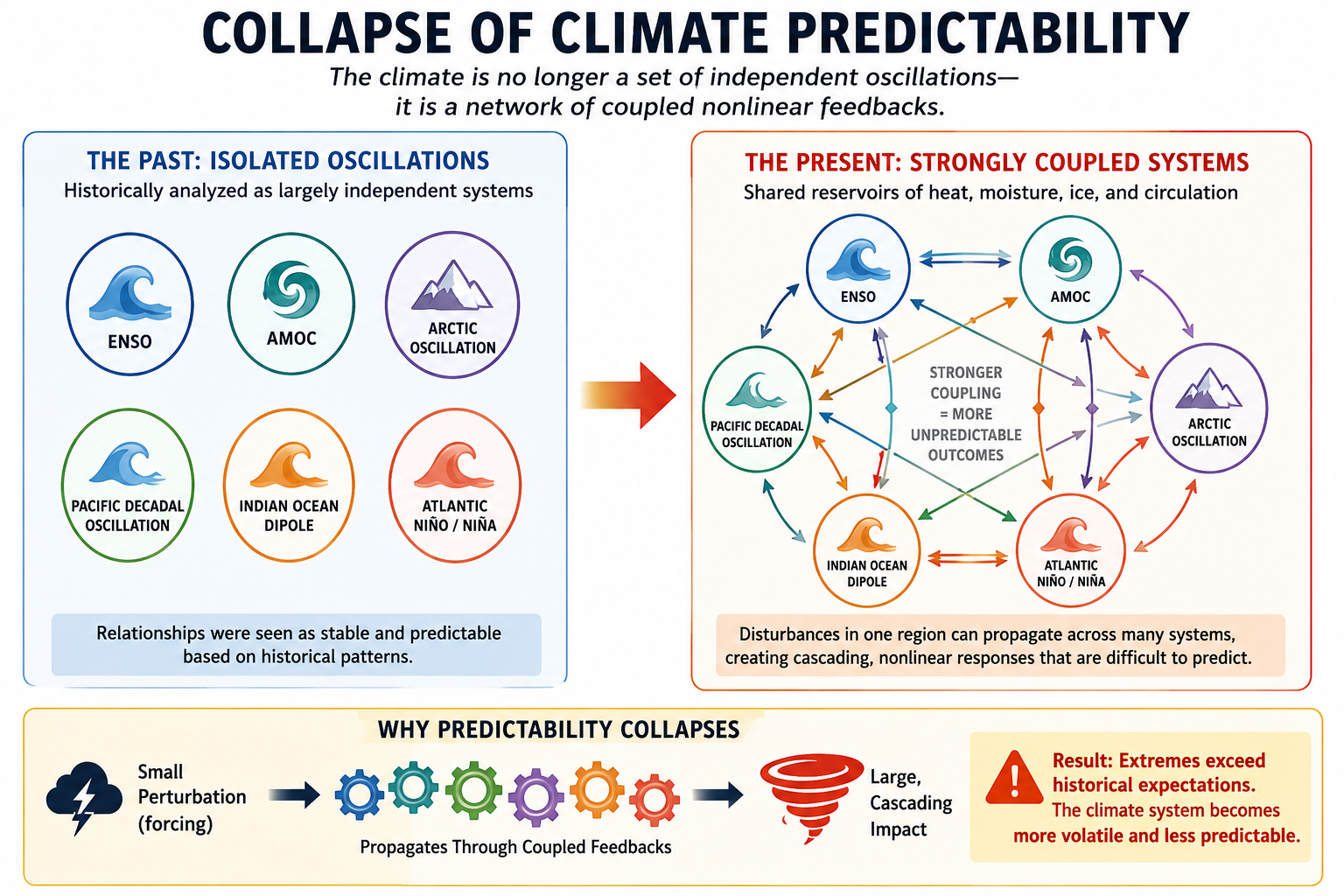
For much of the modern scientific era, Earth’s major climate oscillations were studied as largely independent systems. Phenomena such as the El Niño–Southern Oscillation (ENSO), the Atlantic Meridional Overturning Circulation (AMOC), the Arctic Oscillation (AO), the Pacific Decadal Oscillation (PDO), the Indian Ocean Dipole (IOD), and the Atlantic Niño/Niña each possessed recognizable patterns, historical relationships, and reasonably predictable behavior.

Today, however, a growing body of observations suggests these systems are becoming increasingly interconnected through shared reservoirs of heat, moisture, ice, and atmospheric circulation. Rather than behaving as isolated oscillators, they are evolving into a tightly coupled network in which disturbances propagate across multiple components of the Earth system. This increasing connectivity reduces the reliability of historical climate relationships and contributes to what can be described as the collapse of climate predictability.


From Independent Oscillators to a Coupled System

Classical climatology often treated Earth’s major modes of variability as separate oscillations whose interactions were relatively weak and occurred over well-defined time scales.

Examples include:

  • El Niño–Southern Oscillation (ENSO)
  • Atlantic Meridional Overturning Circulation (AMOC)
  • Arctic Oscillation (AO)
  • Pacific Decadal Oscillation (PDO)
  • Indian Ocean Dipole (IOD)
  • Atlantic Niño/Niña

These oscillations remain useful conceptual tools, but they no longer appear to behave as isolated components. Instead, they increasingly exchange energy through atmospheric circulation, ocean heat transport, cryospheric change, and hydrologic feedbacks.

The climate system is transitioning from a collection of loosely connected oscillators to a highly interconnected nonlinear network.


The Common Driver: Earth’s Growing Energy Imbalance

The increasing coupling among climate systems is not random.

It is driven by a steadily increasing accumulation of heat within the Earth system.

More than 90 percent of the excess energy trapped by greenhouse gases is absorbed by the oceans. Rising ocean heat content increases evaporation, atmospheric water vapor, sea surface temperatures, and latent heat available to storms. At the same time, declining sea ice reduces Earth’s reflectivity, allowing additional solar energy to be absorbed. Melting glaciers introduce freshwater into the oceans, altering circulation patterns, while warming soils and thawing permafrost release additional greenhouse gases.

These processes all originate from the same growing energy imbalance, linking climate systems that historically behaved more independently.


Emerging Climate Couplings

Numerous examples illustrate this increasing interconnectedness.

Super El Niño–Atlantic Niña

Exceptional Pacific warming modifies atmospheric circulation, strengthening Atlantic trade winds and promoting cooling in portions of the tropical Atlantic. The altered Atlantic circulation then feeds back into global atmospheric patterns, influencing hurricane development, African rainfall, and Amazon precipitation.


Arctic Amplification–Jet Stream Coupling

Rapid Arctic warming weakens the north-south temperature gradient that maintains the polar jet stream. The resulting slower, more meandering jet stream favors persistent blocking patterns, prolonged heat domes, stalled storms, and extended droughts. Those weather extremes further accelerate Arctic warming through enhanced ice loss and wildfire activity.


Greenland Melt–AMOC Coupling

Accelerated melting of the Greenland Ice Sheet introduces freshwater into the North Atlantic, reducing salinity and slowing deep-water formation. A weaker AMOC alters weather patterns across the Northern Hemisphere, changing precipitation and temperature patterns that can further influence Greenland’s mass balance.


Marine Heatwaves–Atmospheric Rivers

Warmer oceans increase evaporation and atmospheric moisture. Enhanced water vapor intensifies atmospheric rivers, producing heavier precipitation while simultaneously reinforcing marine heatwaves through changes in ocean mixing and heat distribution.


Permafrost–Wildfire–Atmosphere Coupling

Permafrost thaw releases methane and dries peatlands, increasing wildfire activity. Wildfires emit greenhouse gases and black carbon, which darkens snow and ice surfaces, accelerating melting and further warming high-latitude regions.


Forest Dieback–Rainfall Coupling

Forests recycle enormous quantities of moisture through evapotranspiration. As forests decline from heat, drought, or wildfire, atmospheric moisture recycling weakens, reducing rainfall and increasing drought severity, which in turn accelerates additional forest loss.


Why Predictability Is Declining

Historically, climate forecasting relied heavily on recurring relationships.

Meteorologists and climatologists could often estimate future conditions because the underlying oscillations behaved within relatively stable statistical boundaries.

As coupling strengthens, those assumptions become increasingly unreliable.

A disturbance originating in one ocean basin can now propagate through atmospheric circulation into multiple ocean basins, alter sea surface temperatures elsewhere, modify jet stream behavior, influence storm tracks, and feed back into the original disturbance.

Small changes no longer remain local.

Instead, they cascade through interconnected systems.

The result is increasing uncertainty, even while the underlying driver—Earth’s growing energy imbalance—continues to strengthen.


A Network of Nonlinear Feedbacks

This transition is fundamentally a problem of nonlinear dynamics.

In linear systems:

  • responses are generally proportional to the forcing;
  • disturbances remain localized; and
  • historical relationships remain relatively stable.

In nonlinear systems:

  • small perturbations can produce disproportionately large responses;
  • interactions among multiple feedback loops amplify disturbances; and
  • outcomes become increasingly sensitive to initial conditions.

As climate systems become more strongly coupled, Earth’s behavior increasingly resembles a nonlinear network rather than a collection of independent oscillators.

This is the climate-scale manifestation of the Butterfly Effect.


Cascading Climate Responses

Once coupling strengthens sufficiently, climate events begin propagating across multiple systems.

For example:

Ocean Warming → Marine Heatwaves → Increased Evaporation → Higher Atmospheric Water Vapor → Stronger Atmospheric Rivers → Extreme Flooding → Reduced Snowpack → Earlier Runoff → Hotter Soils → Stronger Heat Domes → Additional Ocean Warming

Each step reinforces subsequent processes, creating cascading responses that are considerably larger than the original perturbation.


Beyond Traditional Climate Variability

Many recent extreme events have exceeded expectations based on historical climate statistics.

Persistent heat domes, multi-day atmospheric rivers, marine heatwaves, rapid intensification of tropical cyclones, widespread wildfire outbreaks, and simultaneous extremes occurring across multiple continents increasingly reflect the behavior of an interconnected system rather than isolated weather anomalies.

The climate is no longer responding solely through individual oscillations.

It is responding through interactions among oscillations.


A New Framework for Climate Science

Understanding future climate risk increasingly requires moving beyond analyses that focus on individual climate modes in isolation.

Future prediction will depend on understanding:

  • cross-basin ocean interactions;
  • atmospheric teleconnections;
  • cryosphere–ocean coupling;
  • biosphere–atmosphere feedbacks;
  • hydrologic amplification; and
  • nonlinear propagation through coupled climate networks.

The central scientific challenge is no longer identifying individual feedbacks, but understanding how those feedbacks interact simultaneously.


Conclusion

The growing accumulation of heat within Earth’s climate system is strengthening connections among atmospheric, oceanic, cryospheric, and biological processes. These interactions are transforming once largely independent climate oscillations into a coupled network of nonlinear feedbacks.

As coupling intensifies, disturbances spread more efficiently across the Earth system, historical relationships become less reliable, and extreme events increasingly exceed expectations derived from the past. The resulting decline in predictability is not evidence that the climate has become random. Rather, it reflects the behavior of a highly interconnected nonlinear system whose responses are increasingly governed by cascading interactions instead of isolated processes.

The collapse of climate predictability is therefore best understood not as the failure of climate science, but as the emergence of a new climatic regime—one in which understanding the connections between Earth’s major systems becomes as important as understanding the systems themselves.
bookmark_borderThe Collapse of Climate Predictability: Emerging Coupled Climate Systems

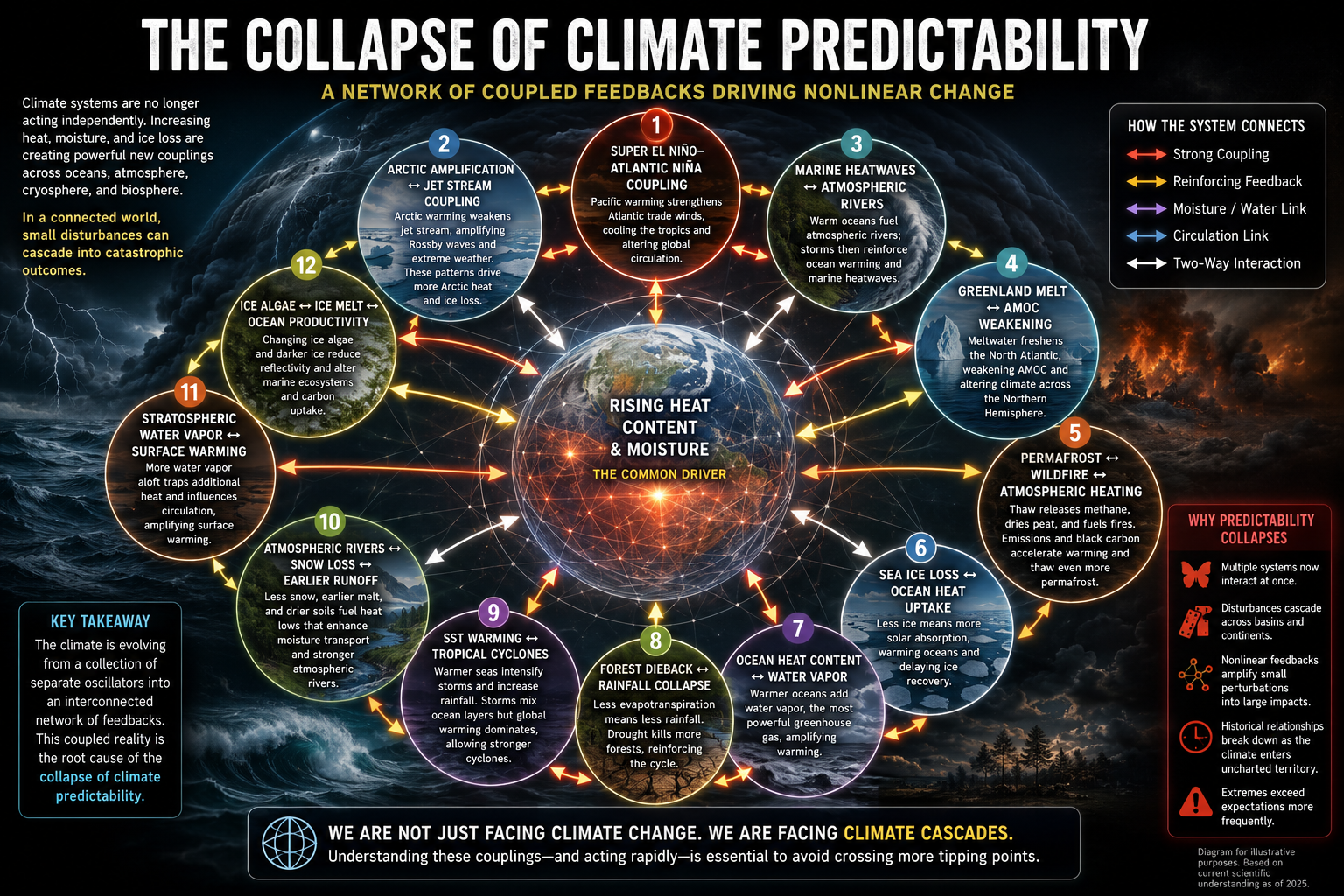
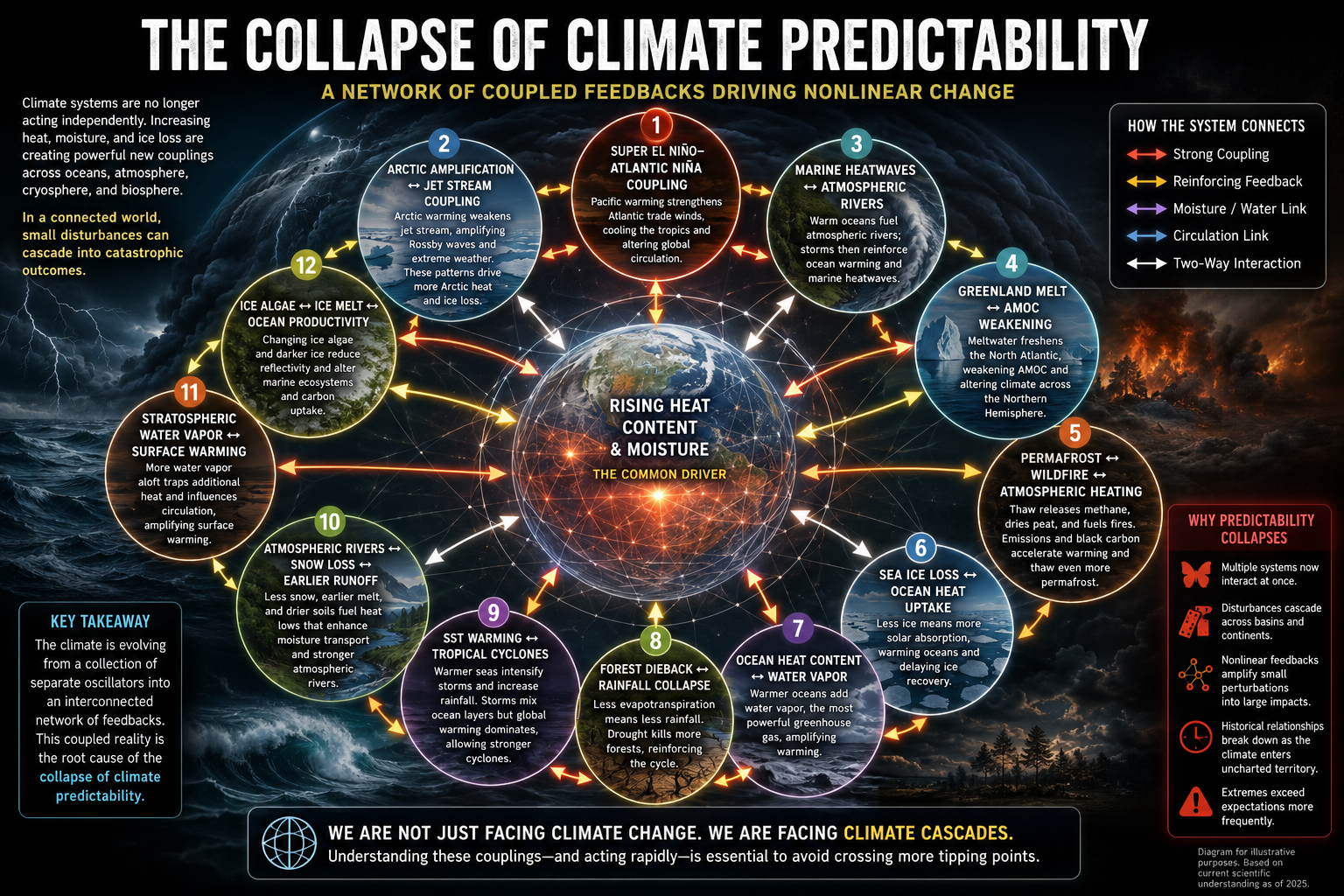
The Super El Niño–Atlantic Niña coupling is one of the clearest examples of how formerly semi-independent climate oscillations are becoming more tightly linked in a warmer world. But it is far from the only coupling now being observed. Increasing ocean heat content, declining sea ice, changing atmospheric circulation, and enhanced moisture transport are creating new interactions that reduce the reliability of historical climate relationships.

Here’s a framework of the most important coupled systems contributing to the collapse of climate predictability.


1. Super El Niño ↔ Atlantic Niña

(Cross-basin ocean-atmosphere coupling)

Mechanism

  • Exceptional warming in the equatorial Pacific alters the Walker Circulation.
  • Atmospheric teleconnections strengthen Atlantic trade winds.
  • Stronger trades cool the eastern tropical Atlantic.
  • The Atlantic then feeds back into global circulation.

Consequences

  • Hurricane seasons become less predictable.
  • African monsoon shifts.
  • Amazon rainfall changes.
  • Jet streams reorganize globally.

This is no longer simply ENSO affecting the Atlantic—it becomes a two-way coupled system.


2. Arctic Amplification ↔ Jet Stream Coupling

https://images.openai.com/static-rsc-4/46ncsF8_9GG4siDyc32ADxP5GwOINVl3OfDMbEjPRFCba2uwd0011nJDsdFyltCtWvbHj2QEdKTwLZZd_TyEw1_YzdsA9eF_UnO2lljtHwZhfICgJqTTKnKCg4wfMwSoKM5I_jgRi0Hhr5Iv8FhDRYfHZh9X0cgo5Po-CNmgzyUHz2sXDaoPjisc0eLTEmMQ?purpose=fullsize
https://images.openai.com/static-rsc-4/xyk54CAVCf_fPcArP-TE8Itqp89dc1knn3topbWBG-325Xy-ooKcZvqnQUsATsWlNzQHnhZ95b002TG_nAC1N0FdQthqm5QrL2PlkEqrZe4KcKolh3ZoU6Brbv3mVe9ntbD5T6JJZg_I3x3Wd5dwq1kRvyslwAJq_jbdk6L29OIZijzSTe-mjevmgxmp6dCB?purpose=fullsize
https://images.openai.com/static-rsc-4/9vz7Bo0xs27uiBWyPc0tJsSiyy1qNbuxBBqwKDk8PMhNwW1gq-6gqfGDyLf6ypFzVyrK1KiheuyI0WQ59ErVxeyHsxRT3QdW7BQIjCskfpAzFhqIkrU_tPE-t3ZxJFVYGE2-sHKx432TMKYfLvtw_wr0QiP5GpEcitMlP5uTC9mWPmLTJo4rIFMgILvTWXl4?purpose=fullsize

6

As the Arctic warms 3–4 times faster than the global average:

  • temperature gradients weaken
  • jet stream slows
  • Rossby waves amplify
  • blocking patterns persist longer

The weakened jet stream then:

  • allows additional Arctic heat transport
  • increases sea ice melt
  • reinforces Arctic amplification

This positive feedback produces

  • prolonged heat domes
  • stalled atmospheric rivers
  • persistent droughts
  • multi-day flooding events

3. Marine Heatwaves ↔ Atmospheric Rivers

Warm oceans increase

  • evaporation
  • atmospheric water vapor
  • latent heat release

That additional moisture intensifies atmospheric rivers.

The storms themselves:

  • warm coastal oceans
  • reduce ocean mixing
  • reinforce marine heatwaves

Result:

  • stronger flooding
  • stronger coastal storms
  • longer marine heatwaves

4. Greenland Melt ↔ AMOC Weakening

https://images.openai.com/static-rsc-4/GhdR5yIRqcOsgoIqF9_GvqcdL7iSaPzkqc6B61sX70l_Ze8iASi0h1havMxR2yfv7FPr4GgH_8JyuXWgdDzOhUAYXbNalEPral78JaCKcXy2gws7E0iR28Drwx_Uz7e2D6Z_r--t_6gNq3sk9bxz3SeLZIMVcvJWVbxyXpKxokkVuDwCuBVCS8OpSMDlbe5E?purpose=fullsize
https://images.openai.com/static-rsc-4/CRtckJndCjBgbYgNd4mFtuROIf-cYhELv2dYJPSIcWBl6pyW6-M77t44IExExOM5aKPNuxOCLx1Xrw97TPy5iMHfu1FImJkY7kM_v9kAlF-MhuXIw699o_zzV1VTBwCnpLFcqisKJ2n6LKRrVkLFFQbRVhz3WarOolGAVhGBt7fH0ZRZnMZ3zWtdeulUNWlm?purpose=fullsize
https://images.openai.com/static-rsc-4/ctd1USQ9hzkJeKXz4flMdxmE5LVl2pddPbIszbkbJcb2piFVNhAjkGGPegD6CjpQ0flgdiFSm4Mf6QDWd1NnG7Pm_pOyUaMs5B8O9fUvYBgKEu12T5JxYglT_NMeAg82y-VOWBH0mTjTnCy8cdyUv1iXD2BUKsmmY1AxCA4b03FbErEXTTpUwnfFZaFLOQai?purpose=fullsize

5

Greenland melt adds enormous volumes of freshwater.

Freshwater reduces salinity.

Lower salinity reduces deep water formation.

The Atlantic Meridional Overturning Circulation (AMOC) weakens.

A weaker AMOC then alters

  • North Atlantic temperatures
  • European weather
  • tropical rainfall
  • hurricane development

Those changes affect Greenland snowfall and melting, completing another coupled feedback.


5. Permafrost ↔ Wildfire ↔ Atmospheric Heating

One of the fastest emerging feedbacks.

Warming causes:

  • permafrost thaw
  • methane release
  • peat drying

Dry peat fuels zombie fires.

Wildfires release

  • CO₂
  • methane
  • black carbon

Black carbon settles on Arctic snow.

Lower albedo accelerates melting.

Additional warming thaws even more permafrost.


6. Sea Ice Loss ↔ Ocean Heat Uptake

Sea ice reflects sunlight.

Open ocean absorbs sunlight.

As sea ice retreats:

  • solar absorption increases dramatically
  • upper ocean warms
  • autumn freeze is delayed
  • winter ice becomes thinner

The thinner ice melts faster the following year.

This coupling is one reason Arctic warming has accelerated so rapidly.


7. Ocean Heat Content ↔ Water Vapor

This is perhaps the most fundamental coupling.

Warmer oceans

↓

greater evaporation

↓

more atmospheric water vapor

↓

stronger greenhouse effect

↓

warmer oceans

Water vapor also fuels:

  • heavier rainfall
  • stronger hurricanes
  • more latent heat release
  • explosive convection

8. Forest Dieback ↔ Rainfall Collapse

https://images.openai.com/static-rsc-4/NicW5JDvsJQBNmALB7jrzeICHXtqKuQoOz5gSqG2MxPWydK6Qg8PtK9bns1a0x5c_6lqEsObD_pKvob7iK-EPfzPQPAoH9gvXO3ivTnf3Rv0se3x4ckR05-BLy-B8wSrCZ37ME9XD9AJlJvgUJaGwzwmybFVv6uVuw3pvf042_0N7R6eDsE0buIOMJ9cZgCc?purpose=fullsize
https://images.openai.com/static-rsc-4/A4OuRFO5wr8e_czptme94_djylOnxNE0lepqsn_dyHmmeBLsuDi30gXN1c3MGEl8HCauP-8R7lbOhleBdGMMV14IzvUpuxNPHkML3UX6m1iCJNTEJJgQ096YI7vhJLumO1SAiDCvWOfcaJuli9PfWxVzKgss71MyTSl4NgG1eEJxHzRdUJwihLkLZ6bTD1Tf?purpose=fullsize
https://images.openai.com/static-rsc-4/-CmFYZs0NFCZ5gEwP8JrtgHgjrc8iItp0FDTF6F_tflIJlbpXnmHDyoh1j-qOI67pIv3-eTbRrGpkqhttMDgjt_3EVflb-r7i5j-f35WXAe9orMHlVtTQcbk-wEf-H965V6S840eVL1LazGKZw-Q6G4iKVgJwYc7ae-IrVnaqXJV9-NBZtQNNc3yX9lliILW?purpose=fullsize

5

Forests recycle enormous amounts of moisture.

Loss of forests means

  • less evapotranspiration
  • less rainfall
  • longer droughts

Drought kills more forests.

This coupling is becoming increasingly important in

  • Amazon
  • Boreal Canada
  • Siberia

9. Sea Surface Temperature ↔ Tropical Cyclones

Warmer oceans produce

  • stronger hurricanes
  • slower-moving hurricanes
  • greater rainfall

Storms mix the upper ocean.

Sometimes mixing cools local waters.

But globally, warming oceans increasingly outweigh this cooling, allowing storms to intensify more rapidly and maintain higher rainfall rates.


10. Atmospheric Rivers ↔ Snow Loss ↔ Earlier Runoff

Reduced mountain snowpack means

  • less spring melt
  • drier soils
  • warmer land surfaces

Warmer land strengthens heat lows.

Heat lows enhance moisture transport.

Atmospheric rivers become stronger.


11. Stratospheric Water Vapor ↔ Surface Warming

Increasing methane oxidation and occasional injections of water vapor into the stratosphere increase its greenhouse effect.

Additional warming raises sea surface temperatures, which increase evaporation and atmospheric moisture, further reinforcing warming.


12. Ice Algae ↔ Ice Melt ↔ Ocean Productivity

Melting sea ice changes the timing and distribution of ice algae blooms.

Dark algal communities can reduce ice reflectivity locally, while shifts in marine ecosystems affect carbon uptake. Although smaller than many other feedbacks, these biological changes interact with physical ice loss and ocean warming.


Why This Leads to the Collapse of Climate Predictability

Historically, climate scientists often analyzed these systems as largely independent oscillations:

  • ENSO
  • AMOC
  • Arctic Oscillation
  • Pacific Decadal Oscillation
  • Indian Ocean Dipole
  • Atlantic Niño/Niña

Increasing evidence shows they are interacting more strongly through shared reservoirs of heat, moisture, ice, and atmospheric circulation. As coupling strengthens, disturbances in one region can propagate across multiple climate systems, creating cascading responses that are difficult to anticipate with historical relationships alone.

Instead of isolated oscillators, the climate increasingly behaves as a network of coupled nonlinear feedbacks. In such systems, modest perturbations can cascade through multiple connected processes, producing responses much larger than the initial forcing. This interconnected behavior helps explain why recent extremes have often exceeded expectations based on past climate variability and why forecasting becomes more challenging as the system evolves.

bookmark_borderThe Collapse of Climate Predictability: The Pacific Super El Niño–Atlantic Niña Coupling in a Rapidly Changing Earth System

by Daniel Brouse

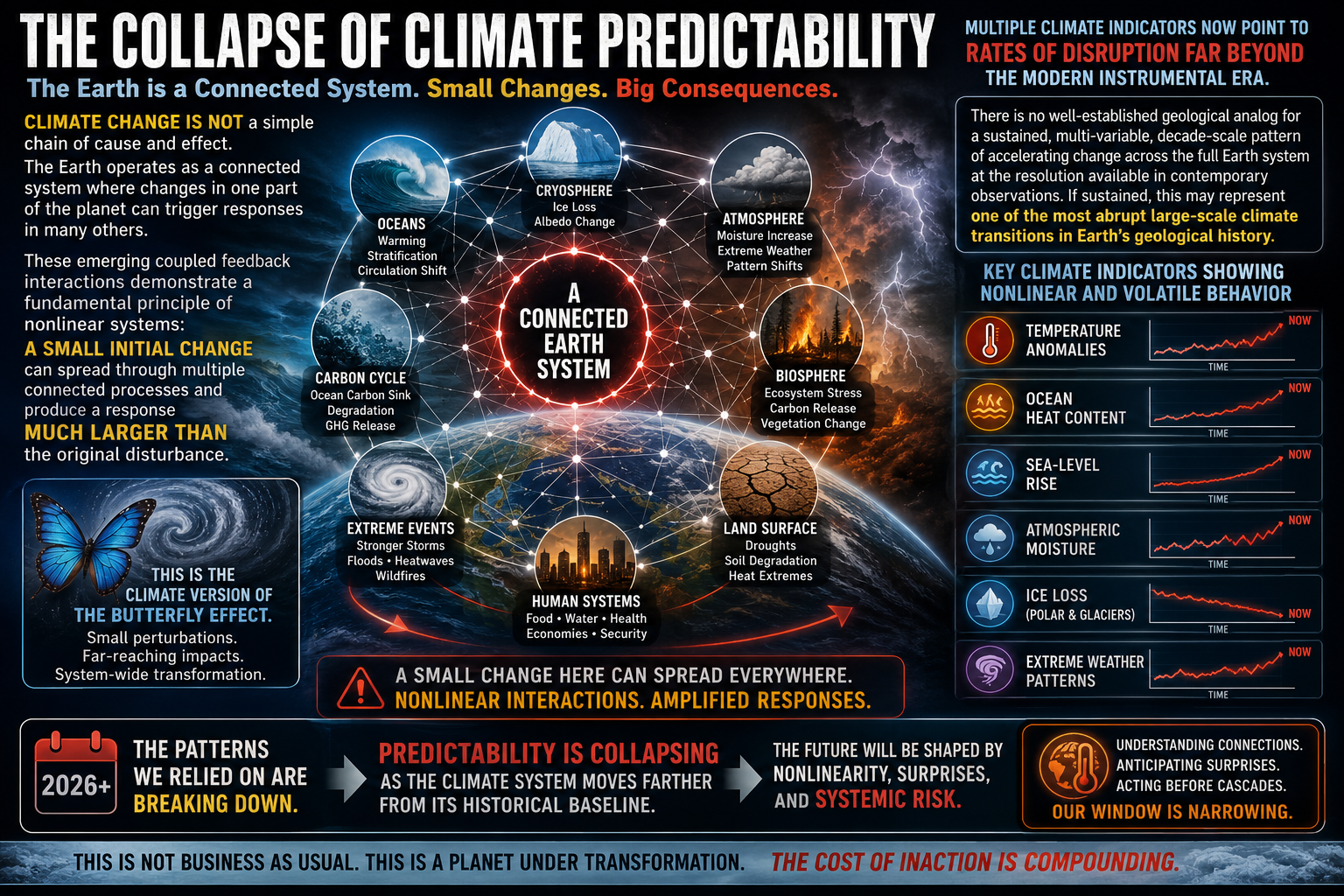
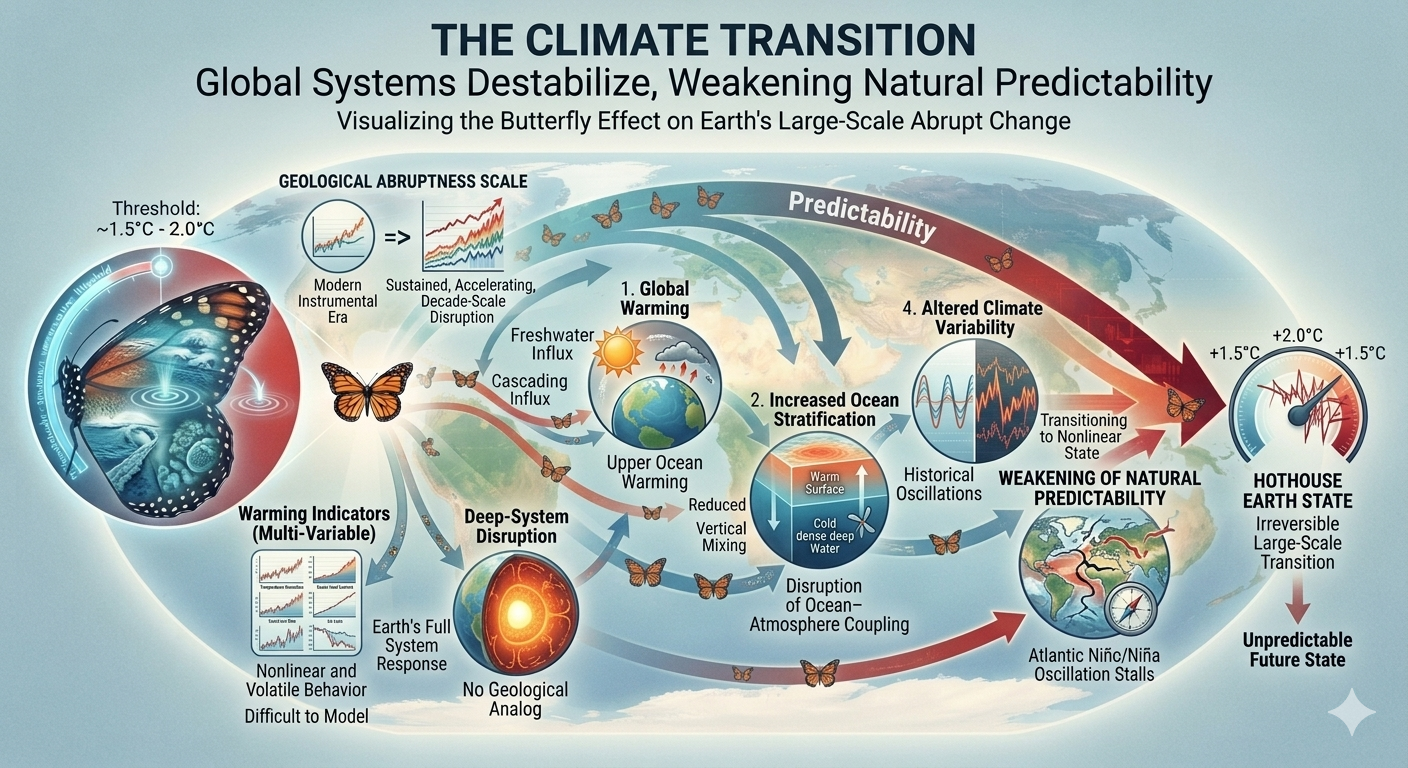
Multiple climate indicators now point to rates of warming-related disruption far beyond those observed during the modern instrumental era. There is no well-established geological analog for a sustained, multi-variable, decade-scale pattern of accelerating change across the full Earth system at the resolution available in contemporary observations. If sustained, this may represent one of the most abrupt large-scale climate transitions in Earth’s geological history.

Many of the climate indicators traditionally used for forecasting are exhibiting increasingly nonlinear and volatile behavior. Temperature anomalies, ocean heat content, sea-level rise, atmospheric moisture, ice loss, and extreme weather patterns are showing changes that are becoming more difficult to model using assumptions based primarily on historical variability.

Abstract

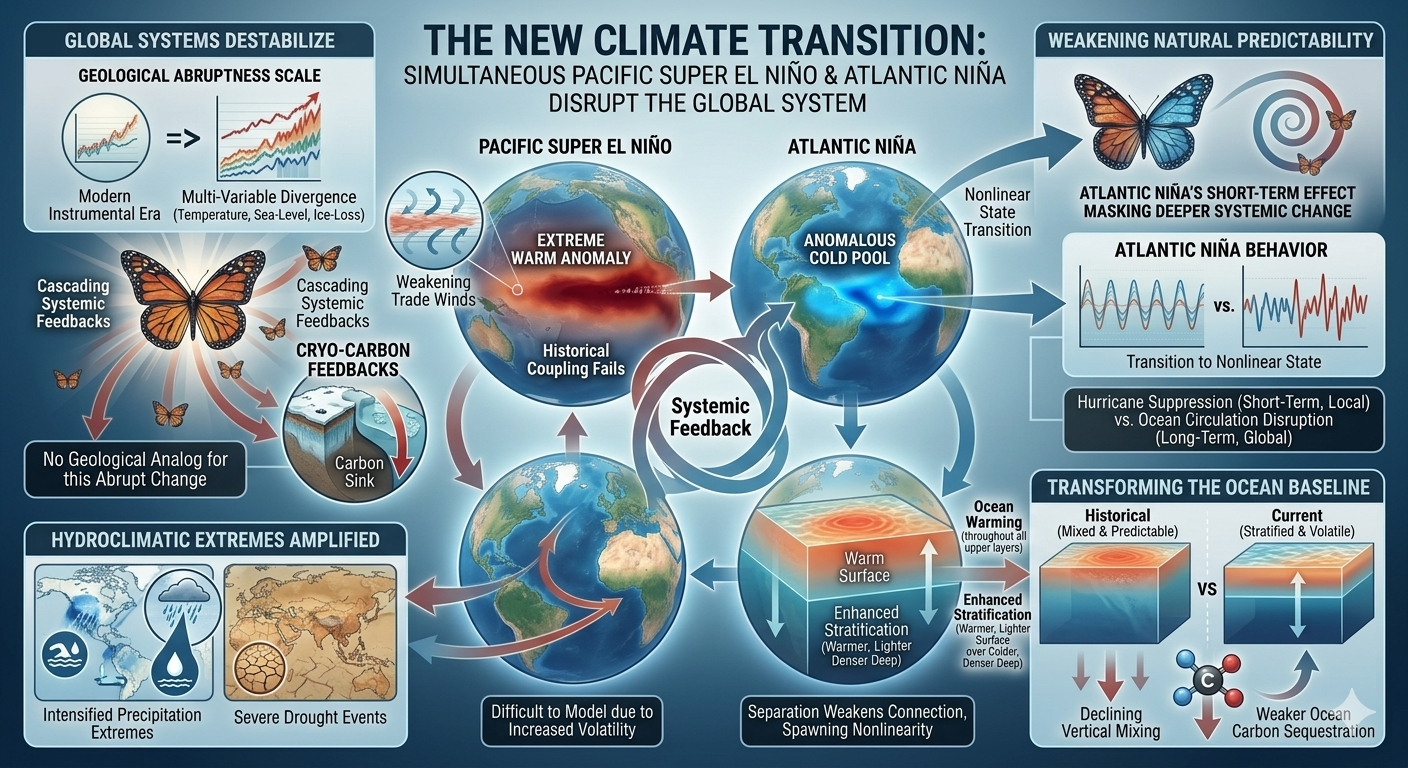
The simultaneous occurrence of an extreme Pacific Super El Niño and an anomalous Atlantic Niña represents a significant disruption of historically observed ocean–atmosphere interactions. These coupled climate anomalies illustrate how anthropogenic warming is altering the baseline state of Earth’s climate system, reducing predictability, amplifying hydroclimatic extremes, and accelerating interconnected feedback mechanisms. While an Atlantic Niña pattern may temporarily suppress Atlantic hurricane activity through increased atmospheric stability and wind shear, this short-term effect masks deeper systemic changes occurring within global ocean circulation, carbon cycling, and energy redistribution.

Climate change is increasingly modifying the physical conditions under which natural climate oscillations such as El Niño–Southern Oscillation (ENSO) and Atlantic Niño variability operate. Warmer ocean surfaces, enhanced stratification, declining vertical mixing, and changing circulation patterns are transforming previously stable climate relationships into increasingly nonlinear and difficult-to-predict interactions. These changes threaten to intensify global precipitation extremes, weaken ocean carbon sequestration, and accelerate reinforcing feedback loops involving greenhouse gas emissions, ocean warming, and cryosphere loss.


1. Introduction: A Changing Climate Baseline

Earth’s climate system is governed by complex interactions between the atmosphere, oceans, cryosphere, and biosphere. Natural climate oscillations, including Pacific El Niño events and Atlantic Niño/Niña variability, have historically provided a degree of predictability by influencing global temperature patterns, rainfall distributions, and storm activity.

However, climate change is altering the fundamental conditions under which these oscillations occur. The emergence of an extreme Pacific Super El Niño coinciding with an Atlantic Niña demonstrates a growing departure from historical climate behavior. Rather than acting as isolated events, these anomalies increasingly interact within a warmer planetary system, producing nonlinear responses that amplify regional and global impacts.

The key concern is not the individual climate pattern itself, but the changing background state in which these patterns develop.


2. Weakening of Natural Climate Predictability

2.1 Disruption of Ocean–Atmosphere Coupling

The Atlantic Niño/Niña cycle depends on interactions between surface ocean temperatures, subsurface heat content, atmospheric circulation, and equatorial wind patterns. Under historical conditions, these interactions produced recognizable oscillations that contributed to seasonal climate predictability.

Global warming is now modifying this relationship.

As greenhouse gas accumulation increases ocean heat content, warming is occurring throughout the upper ocean layers. This enhanced surface warming increases ocean stratification—the separation between warmer, lighter surface water and colder, denser deep water.

The result is a reduction in vertical ocean mixing:Ocean Warming→Increased Stratification→Reduced Vertical Mixing→Altered Climate Variability\text{Ocean Warming} \rightarrow \text{Increased Stratification} \rightarrow \text{Reduced Vertical Mixing} \rightarrow \text{Altered Climate Variability}Ocean Warming→Increased Stratification→Reduced Vertical Mixing→Altered Climate Variability

This separation weakens the connection between surface conditions and deeper ocean processes, making climate oscillations more irregular and reducing the reliability of historical forecasting models.

The Atlantic Niño/Niña system is therefore transitioning from a relatively predictable oscillatory behavior toward a more complex, nonlinear state influenced by persistent anthropogenic forcing.


3. Global Redistribution of Rainfall Extremes

The interaction between a Pacific Super El Niño and Atlantic Niña creates a highly disrupted global precipitation pattern.

3.1 Extreme Flooding in West Africa

An intensified Atlantic Niña can strengthen atmospheric circulation patterns associated with the West African monsoon.

Enhanced ocean–atmosphere energy exchange increases moisture transport into the Gulf of Guinea region, potentially producing:

  • Extreme rainfall events
  • River flooding
  • Agricultural disruption
  • Infrastructure damage
  • Increased risks to vulnerable populations

Rather than representing a simple regional anomaly, these changes demonstrate how altered ocean temperatures can reorganize atmospheric circulation thousands of kilometers away.


3.2 Intensified Drought in Northeastern South America

At the same time, Atlantic Niña conditions can reduce moisture transport into northeastern South America.

When combined with Pacific El Niño influences, this can amplify drought conditions through:

  • Reduced atmospheric moisture availability
  • Persistent high-pressure systems
  • Increased evaporation from warming land surfaces
  • Reduced soil moisture retention

The result is a climate paradox: one region experiences catastrophic flooding while another experiences severe drought, both driven by the same reorganizing global climate system.


4. Amplification of Climate Feedback Loops

The 2026 ocean–atmosphere configuration illustrates how climate variability can interact with long-term warming trends to activate reinforcing feedback mechanisms.

A simplified representation is:Ocean Warming→Stronger Stratification→Reduced Mixing\text{Ocean Warming} \rightarrow \text{Stronger Stratification} \rightarrow \text{Reduced Mixing}Ocean Warming→Stronger Stratification→Reduced Mixing↓\downarrow↓Increased Greenhouse Gas Release→Accelerated Warming→Further Ocean Warming\text{Increased Greenhouse Gas Release} \rightarrow \text{Accelerated Warming} \rightarrow \text{Further Ocean Warming}Increased Greenhouse Gas Release→Accelerated Warming→Further Ocean Warming

These feedbacks transform climate change from a linear response into a nonlinear system where small perturbations can trigger increasingly larger consequences.


5. The Marine Methane Feedback Loop

5.1 Stratification and Ocean Biological Disruption

The ocean plays a critical role in regulating atmospheric greenhouse gases. However, warming-driven stratification threatens this regulatory function.

Normally, ocean circulation transports nutrients such as phosphate and nitrogen from deep waters toward the surface, supporting marine ecosystems and biological carbon uptake.

As stratification increases:Surface Warming→Reduced Nutrient Mixing→Altered Marine Ecosystems\text{Surface Warming} \rightarrow \text{Reduced Nutrient Mixing} \rightarrow \text{Altered Marine Ecosystems}Surface Warming→Reduced Nutrient Mixing→Altered Marine Ecosystems

Nutrient limitation changes microbial communities and can increase conditions favorable for methane-producing organisms.


5.2 Methane Amplification

Methane (CH4CH_4CH4​) is a highly effective greenhouse gas, particularly over shorter atmospheric timescales.

Over a 20-year period, methane has a substantially greater warming influence than carbon dioxide (CO2CO_2CO2​).

A potential reinforcing cycle emerges:Ocean Warming→Increased Methane Production→Atmospheric Warming→Additional Ocean Warming\text{Ocean Warming} \rightarrow \text{Increased Methane Production} \rightarrow \text{Atmospheric Warming} \rightarrow \text{Additional Ocean Warming}Ocean Warming→Increased Methane Production→Atmospheric Warming→Additional Ocean Warming

This represents a positive feedback loop in which warming creates conditions that generate additional warming.


6. Degradation of the Ocean Carbon Sink

6.1 The Ocean as a Global Carbon Reservoir

The ocean currently absorbs approximately one-quarter of anthropogenic carbon dioxide emissions, functioning as one of Earth’s most important climate stabilizing mechanisms.

This process depends heavily on ocean circulation systems, including the Atlantic Meridional Overturning Circulation (AMOC).

The AMOC transports warm surface water northward, where cooling increases density and allows carbon-rich water to sink into the deep ocean.


6.2 Weakening Carbon Removal Capacity

Climate change threatens this process through:

  • Rising ocean temperatures
  • Increased freshwater input from melting ice sheets
  • Reduced deep-water formation
  • Increased ocean stratification

Warmer water absorbs less dissolved gas, while weaker circulation reduces the transport of carbon into the deep ocean.

The resulting feedback is:Ocean Warming→Reduced Carbon Storage→More Atmospheric CO2→Further Warming\text{Ocean Warming} \rightarrow \text{Reduced Carbon Storage} \rightarrow \text{More Atmospheric CO}_2 \rightarrow \text{Further Warming}Ocean Warming→Reduced Carbon Storage→More Atmospheric CO2​→Further Warming

A weakened ocean carbon sink represents a fundamental shift from a stabilizing Earth system component toward a potential climate amplifier.


7. The Ice–Albedo Feedback Loop

Super El Niño events often produce temporary increases in global temperatures by redistributing stored ocean heat into the atmosphere.

During these periods, extreme heat accelerates melting of:

  • Arctic sea ice
  • Mountain glaciers
  • Polar ice sheets

The loss of reflective ice surfaces activates the ice–albedo feedback:Ice Loss→Reduced Solar Reflection→Increased Ocean Heat Absorption→Accelerated Ice Loss\text{Ice Loss} \rightarrow \text{Reduced Solar Reflection} \rightarrow \text{Increased Ocean Heat Absorption} \rightarrow \text{Accelerated Ice Loss}Ice Loss→Reduced Solar Reflection→Increased Ocean Heat Absorption→Accelerated Ice Loss

Bright ice reflects incoming solar radiation back into space. Dark ocean water absorbs much more solar energy, increasing local warming and accelerating further melting.

This creates a self-reinforcing cycle affecting polar regions and global temperature patterns.


8. Conclusion: From Climate Variability to Climate System Transformation

The interaction between a Pacific Super El Niño and an Atlantic Niña provides a window into a rapidly changing climate system. While individual climate anomalies may temporarily produce localized benefits, such as reduced Atlantic hurricane activity, these short-term effects do not indicate increased climate stability.

Instead, the emergence of unusual ocean–atmosphere configurations reflects deeper structural changes:

  • Reduced predictability of natural climate oscillations
  • Increasing precipitation extremes
  • Weakening ocean carbon storage
  • Intensifying greenhouse gas feedback loops
  • Accelerating cryosphere loss

Climate change is not simply increasing average global temperatures; it is reorganizing the interactions between Earth’s major systems. The greatest risk arises from the increasing coupling of multiple feedback processes, where changes in one component of the climate system amplify changes elsewhere.

The future trajectory of climate stability will depend not only on reducing greenhouse gas emissions but also on understanding and monitoring these increasingly interconnected nonlinear responses within the Earth system.

bookmark_borderClimate Dominoes: How Small Changes Trigger Cascading Feedbacks Across Earth’s Systems

by Daniel Brouse

Introduction: The Hidden Connections Driving Climate Change

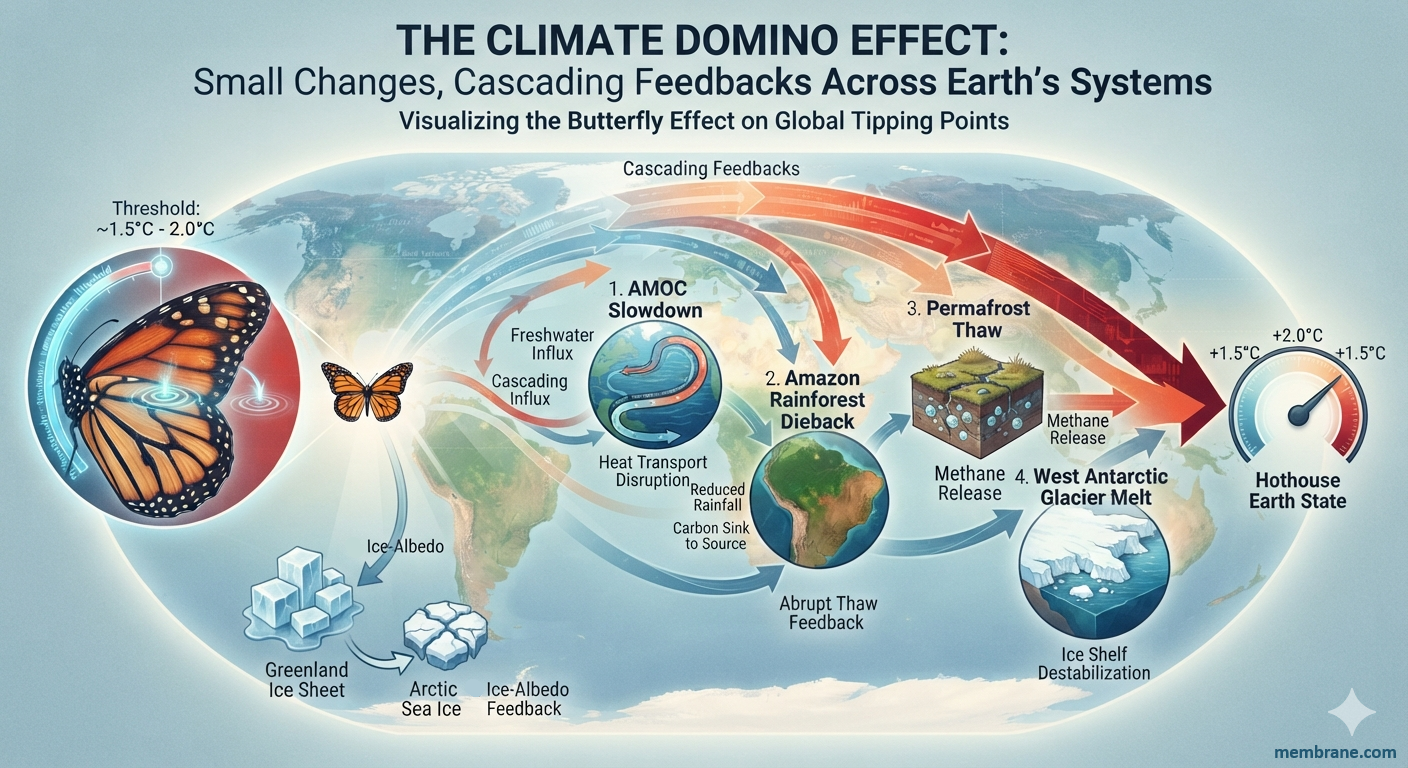
Climate change is not a simple chain of cause and effect. The Earth operates as a connected system where changes in one part of the planet can trigger responses in many others. These emerging coupled feedback interactions demonstrate a fundamental principle of nonlinear systems: a small initial change can spread through multiple connected processes and produce a response much larger than the original disturbance. This is the climate version of the Butterfly Effect.

Climate feedbacks do not operate independently. Instead, they interact as a vast network linking the atmosphere, oceans, ice sheets, forests, soils, and ecosystems. When one feedback strengthens another, the combined effect can become greater than the sum of the individual parts. This is why climate change can sometimes accelerate faster than expected and why predicting future changes is so challenging.

From Individual Feedbacks to Climate Cascades

A traditional climate feedback is often described as a single process:

  • warming melts ice,
  • melting ice reduces reflectivity,
  • reduced reflectivity causes more warming.

However, the real climate system is more complex. One feedback can activate several others, creating a chain reaction across different parts of the planet.

These connected processes are called coupled feedback interactions. They occur when multiple feedbacks reinforce one another, creating cascading effects that cannot be understood by studying each process separately.

Wildfires: From Local Fires to Global Feedbacks

A powerful example begins with heat and drought.

As temperatures rise and soils dry, forests become more vulnerable to large wildfires. These fires release carbon dioxide stored in trees and soils, adding more greenhouse gases to the atmosphere. They also produce black carbon, or soot, which can travel long distances and settle on snow, glaciers, and Arctic sea ice.

Darkened ice and snow absorb more sunlight than clean, reflective surfaces. This increases melting, exposes darker land and ocean surfaces, and allows even more solar energy to be absorbed.

At the same time, burned forests lose their ability to remove carbon dioxide from the atmosphere. A regional drought can therefore trigger a chain of connected responses involving the atmosphere, forests, ice, and oceans.

A single wildfire can become part of a much larger climate feedback network.

Arctic Permafrost: The Sleeping Carbon Reservoir

The Arctic contains enormous amounts of carbon stored in frozen soils known as permafrost. As the Arctic warms, this frozen ground begins to thaw.

When permafrost melts:

  • microorganisms break down ancient organic material,
  • carbon dioxide and methane are released,
  • additional greenhouse gases enter the atmosphere,
  • warming increases further.

Thawing permafrost can also create thermokarst lakes—collapsed areas filled with water. These lakes absorb heat more efficiently than frozen ground, accelerating nearby thaw.

Another unusual example is the rise of zombie fires. These underground fires can continue burning beneath snow throughout the winter, then reappear during warmer seasons. They release carbon, damage vegetation, and accelerate the loss of the insulating layers that protect permafrost.

Together, permafrost thaw, methane release, thermokarst lakes, and zombie fires form a connected Arctic amplification system.

Greenland Ice Algae: When Life Darkens Ice

Greenland provides one of the most surprising examples of a biological climate feedback.

As temperatures rise, more snow and ice melt during summer. This exposes surfaces where microscopic algae can grow. These algae contain dark pigments that reduce the brightness of the ice.

Normally, bright ice reflects sunlight back into space. Darker ice absorbs more solar energy.

The result:

melting ice → more algae growth → darker ice → more solar absorption → faster melting

As melting increases, more liquid water becomes available, creating conditions that can support additional algal growth. A biological process becomes directly connected to the physical loss of an ice sheet.

Oceans and the Atmosphere: A Heat and Moisture Engine

The oceans absorb most of the excess heat trapped by greenhouse gases. As ocean temperatures rise, evaporation increases, adding more water vapor to the atmosphere.

Water vapor is itself a greenhouse gas, creating additional warming.

A warmer ocean and atmosphere can contribute to:

  • stronger atmospheric rivers,
  • heavier rainfall events,
  • more intense tropical storms,
  • longer-lasting marine heatwaves.

At the same time, warmer oceans can become less effective at absorbing carbon dioxide. Marine heatwaves can also damage ecosystems such as kelp forests and phytoplankton communities that help remove carbon from the atmosphere.

The ocean, atmosphere, and biosphere therefore form a tightly connected climate system.

Vegetation Changes: The Arctic Landscape Transforms

Climate change can also reshape ecosystems in ways that amplify warming.

As Arctic temperatures increase, shrubs expand into areas that were previously dominated by low vegetation. These darker shrubs absorb more sunlight than snow-covered tundra.

Shrubs also trap more snow during winter. Deeper snow acts like a blanket, keeping the ground warmer and accelerating permafrost thaw.

A similar process occurs in forests. Warmer winters allow pests such as bark beetles to survive in greater numbers. Large areas of weakened forest can then become vulnerable to wildfire, releasing more carbon and reducing future carbon storage.

The Bigger Picture: Earth as a Connected System

These examples reveal an important shift in how we understand climate change.

The Earth system is not simply a collection of separate feedback loops. It is a network of interacting systems where changes in one area can activate responses elsewhere.

A warming ocean can influence the atmosphere.
A wildfire can influence ice melt.
Melting ice can influence ecosystems.
Changing ecosystems can influence greenhouse gases.

These connections create climate cascades—chains of interacting processes that can amplify change throughout the planet.

The future of climate change will depend not only on the amount of greenhouse gases added to the atmosphere, but also on how these interconnected feedbacks evolve, interact, and influence one another.

Understanding these hidden connections is essential for understanding why climate change is not just warming—it is a rapidly evolving Earth system response.

bookmark_borderThe Acceleration of Acceleration

Coupled Climate Feedbacks, Nonlinear Amplification, and the Physical Limits of Earth’s Warming

by Daniel Brouse

Introduction

Emerging coupled feedback interactions exemplify nonlinear amplification: a modest initial perturbation can propagate through multiple coupled systems, producing a response much larger than the original forcing—a climate-scale manifestation of the Butterfly Effect. Rather than operating independently, feedbacks interact as an interconnected network in which biological, atmospheric, oceanic, cryospheric, and ecological processes reinforce one another. This networked behavior is one reason Earth-system responses become increasingly difficult to predict using traditional linear cause-and-effect thinking.

Unlike traditional climate feedbacks, which are often described individually, coupled feedback interactions arise when one feedback activates, strengthens, or synchronizes with others, producing cascading amplification throughout the Earth system. These interactions create emergent behavior that cannot be understood by examining any single process in isolation.

For example, prolonged heat and drought increase the likelihood of large wildfires. Those fires release massive quantities of carbon dioxide while depositing black carbon (soot) onto glaciers, Arctic sea ice, and seasonal snowpack. The resulting darkened surfaces absorb more solar radiation, accelerating melt and exposing darker land and ocean surfaces that absorb even more heat. At the same time, burned forests lose their capacity to sequester carbon, allowing atmospheric greenhouse gas concentrations to rise further. What begins as a regional drought evolves into an interconnected atmospheric, cryospheric, and ecological feedback network.

A second example occurs across the Arctic. Rising temperatures thaw permafrost, releasing carbon dioxide and methane from previously frozen organic material. Ground collapse forms thermokarst lakes that transfer heat more efficiently into surrounding permafrost, accelerating additional thaw. In Canada and Siberia, “zombie fires” can continue smoldering beneath snow throughout the winter, reigniting during spring while further degrading permafrost and releasing additional greenhouse gases. Together, these processes couple biological decomposition, wildfire dynamics, methane emissions, and cryospheric change into a self-reinforcing amplification cycle.

Greenland provides another striking example. As snow and ice melt, microscopic ice algae colonize newly exposed surfaces. Their dark pigments reduce the ice sheet’s reflectivity (albedo), allowing greater solar absorption and accelerating surface melt. Increased meltwater creates a more favorable habitat for additional algal growth while exposing larger areas of bare ice. This biological feedback couples directly with cryospheric processes, amplifying mass loss from the Greenland Ice Sheet.

Ocean-atmosphere interactions also demonstrate powerful coupling. Increasing ocean heat content enhances evaporation, raising atmospheric water vapor—the atmosphere’s most abundant greenhouse gas. Higher moisture levels increase latent heat transport and intensify extreme precipitation, atmospheric rivers, and tropical cyclones. Warmer oceans simultaneously reduce their capacity to absorb additional carbon dioxide, while marine heatwaves weaken phytoplankton and kelp ecosystems that normally remove carbon from the atmosphere. These coupled oceanic, atmospheric, and biological feedbacks amplify both the hydrologic cycle and the planetary energy imbalance.

Even ecological changes can initiate broad climate responses. Warming allows shrubs to expand across Arctic tundra, replacing highly reflective snow-covered landscapes with darker vegetation that absorbs more solar energy. Shrubs also trap deeper snow during winter, insulating the ground and increasing soil temperatures, which accelerates permafrost thaw and greenhouse gas release. Similarly, warmer winters enable bark beetles to survive in greater numbers, killing vast boreal forests that become increasingly susceptible to catastrophic wildfire, further strengthening carbon and albedo feedbacks.

These examples illustrate a fundamental shift in climate dynamics. The Earth system is no longer adequately described as a collection of isolated feedback loops. Instead, it behaves as a network of interacting feedback networks, in which newly activated processes strengthen existing feedbacks while increasing the probability that additional feedbacks will emerge. This progressive coupling is a defining characteristic of nonlinear systems and suggests that future climate evolution may depend as much on the interactions among feedbacks as on the magnitude of the initial radiative forcing itself.

Accelerating Acceleration

Recent observations suggest that climate change is unfolding more rapidly than many earlier projections anticipated, with multiple indicators—including ocean heat content, sea-level rise, atmospheric water vapor, and the frequency of extreme events—showing evidence of accelerating change. As additional feedback mechanisms emerge and become more strongly coupled, the amplification itself may accelerate. In other words, the rate of climate change is not only increasing, but evidence from multiple climate indicators suggests that the rate of acceleration is also increasing as reinforcing feedbacks become more tightly coupled across the Earth system. This raises a new scientific challenge: not simply determining how fast the climate is changing, but quantifying how rapidly the acceleration itself is evolving, how long this phase of increasing acceleration will persist, and what physical limits will ultimately constrain it. As coupling among feedbacks strengthens, the system may experience increasingly rapid changes in growth rates before approaching the thermodynamic and radiative equilibrium imposed by the laws of physics.

One of the greatest scientific uncertainties is determining the ultimate upper bound of this amplification. While the physics governing Earth’s energy balance impose finite constraints, the magnitude and timing of future radiative forcing remain uncertain because they depend on the strength, interaction, and persistence of coupled feedbacks that are still being discovered and quantified. Likewise, the eventual upper limit of ocean heat content—the largest reservoir of excess thermal energy in the climate system—will depend on how efficiently the oceans continue to absorb, redistribute, and eventually release heat under increasingly nonlinear conditions.

Fundamental thermodynamics indicate that runaway warming is not unbounded. Current physical understanding suggests that the Earth system likely possesses an upper equilibrium limit well below a true Venus-like runaway greenhouse state. Some theoretical analyses place this upper bound near 9°C of global mean warming above preindustrial temperatures, although the precise value remains uncertain and depends on long-term feedbacks, cloud dynamics, atmospheric composition, and ocean-atmosphere interactions. The critical scientific question is therefore not whether warming is infinite, but how rapidly the climate system approaches its physical limits, and how many ecological, societal, and economic thresholds are crossed long before equilibrium is reached.

Understanding these nonlinear interactions is therefore essential. The Earth’s climate is not merely responding to increasing greenhouse gas concentrations; it is evolving as a complex adaptive system in which newly activated feedbacks can amplify one another, creating cascading responses that challenge conventional linear forecasting methods and underscore the importance of incorporating chaos theory into future climate modeling.


1. From Linear Warming to Network Dynamics

Traditional descriptions of climate change often portray global warming as a relatively straightforward response to increasing greenhouse gas concentrations. In reality, greenhouse gases provide the initial radiative forcing, while the Earth system determines how that energy is redistributed. As warming progresses, the atmosphere, oceans, cryosphere, biosphere, and lithosphere become increasingly coupled through exchanges of heat, moisture, carbon, momentum, and radiation.

These exchanges create a network of positive and negative feedbacks whose combined behavior cannot be understood by studying any single process in isolation. Instead, climate evolves as a nonlinear system in which interactions among feedbacks generate new system-wide responses. The collective behavior of the network becomes more important than the behavior of its individual components.


2. Feedback Networks and Emergent Amplification

Positive feedbacks rarely occur independently. A single warming event may simultaneously trigger increased atmospheric water vapor, accelerated glacier melt, reduced surface albedo, greater wildfire activity, enhanced methane emissions from thawing permafrost, and changes in ocean circulation. Each process contributes additional energy or greenhouse gases to the climate system while also increasing the likelihood that other feedbacks will intensify.

Examples include:

  • Zombie fires that continue burning beneath snow, releasing carbon while removing insulating vegetation and accelerating permafrost thaw.
  • Greenland ice algae that darken ice surfaces, reducing albedo and increasing solar absorption.
  • Thermokarst lakes that expand methane emissions while increasing heat transfer into permafrost.
  • Marine heatwaves that weaken biological carbon uptake while strengthening ocean stratification.
  • Wildfire soot that darkens glaciers and seasonal snowpack, increasing melt rates.

Viewed individually, each represents an important feedback. Viewed collectively, they form an interconnected amplification network capable of producing emergent behavior.


3. The Acceleration of Acceleration

One consequence of increasing feedback connectivity is that acceleration itself may evolve.

In a linear system, acceleration remains approximately constant. In a nonlinear network, every newly activated feedback can increase both the rate of warming and the effectiveness of existing feedbacks. As coupling strengthens, the overall amplification of the climate system may itself increase.

Conceptually, this progression can be viewed as:

Radiative Forcing → Initial Warming → Positive Feedback Activation → Coupled Feedback Interactions → Nonlinear System Amplification → Emergent Climate Feedback Networks → Increasing Rate of Acceleration → Further Coupling and Amplification

This hypothesis does not imply unlimited growth. Rather, it suggests that the climate system may pass through successive stages in which feedback interactions become progressively more efficient before approaching physical constraints.


4. Ocean Heat Content as the Integrator of Climate Change

More than 90 percent of Earth’s excess heat is stored in the oceans, making ocean heat content one of the most comprehensive indicators of planetary energy imbalance. Unlike surface air temperature, which fluctuates over relatively short timescales, ocean heat content integrates decades of accumulated warming.

Increasing ocean heat influences nearly every component of the climate system by increasing evaporation, strengthening atmospheric moisture transport, intensifying tropical cyclones, raising sea level through thermal expansion, reducing sea-ice formation, and altering global ocean circulation.

As long as Earth’s energy imbalance remains positive, ocean heat content will continue to increase. Understanding its long-term evolution therefore becomes central to understanding the future trajectory of climate change.


5. Radiative Forcing and Thermodynamic Constraints

Although positive feedbacks amplify warming, they operate within the constraints imposed by fundamental physics. As Earth’s temperature increases, outgoing longwave radiation also increases according to the Stefan-Boltzmann relationship. These radiative responses act as stabilizing mechanisms that eventually balance incoming solar energy.

Current theoretical studies suggest that Earth’s equilibrium climate remains well below the conditions required for a classical runaway greenhouse effect. Some analyses estimate an upper equilibrium near approximately 9°C above preindustrial temperatures, although this value remains uncertain because it depends upon cloud feedbacks, atmospheric composition, aerosol loading, ocean circulation, and long-term cryospheric evolution.

Consequently, the principal scientific challenge is not determining whether warming is limitless, but understanding how rapidly Earth approaches its physical equilibrium and what irreversible changes occur before that equilibrium is reached.


6. Scientific Uncertainties

Several major questions remain unresolved.

  • How many significant feedback mechanisms have yet to be identified?
  • At what point do independent feedbacks begin behaving as an integrated network?
  • Does amplification increase gradually, or does it occur through abrupt transitions?
  • How will evolving cloud dynamics modify future radiative forcing?
  • What are the practical upper limits of ocean heat storage before large-scale circulation patterns fundamentally change?
  • Can currently weak feedbacks become dominant as environmental thresholds are crossed?

These uncertainties represent some of the most important frontiers in Earth-system science.


7. Toward a Chaos-Theory Framework

Chaos theory provides a framework for understanding why increasingly connected feedback networks may generate behavior that appears abrupt, disproportionate, or unexpected. Small perturbations need not remain small when repeatedly amplified through nonlinear interactions.

Rather than viewing climate change as a sequence of independent cause-and-effect relationships, the Earth system can be understood as a continuously evolving adaptive network. Feedbacks alter one another’s strength, timing, and spatial extent, producing emergent behavior that cannot always be inferred from the properties of individual processes alone.

This perspective complements traditional climate modeling by emphasizing the importance of network interactions, threshold behavior, and nonlinear amplification.


Conclusion

Climate change is more than a gradual increase in global temperature. It is the evolution of an increasingly interconnected Earth system whose components continuously exchange thermal energy, moisture, carbon, and momentum through a growing network of coupled feedbacks.

The possibility that the acceleration of climate change may itself accelerate represents one of the most consequential hypotheses in modern climate science. If correct, future climate change will depend not only on greenhouse gas emissions but also on how rapidly feedbacks become interconnected and how efficiently they amplify one another.

Determining the limits of this amplification—including the upper bounds of radiative forcing, ocean heat content, and equilibrium warming—will require integrating chaos theory, nonlinear dynamics, thermodynamics, and Earth-system science into the next generation of climate models. Understanding these interactions may prove essential for anticipating future climate trajectories and the societal, ecological, and economic thresholds they may cross.

bookmark_borderFoundations: Nonlinearity and Thermal Energy Redistribution

“General Circulation Models (GCMs) of Earth’s climate are nonlinear and highly teleconnected. That means a small change in temperature or pressure or humidity in one small area on the globe can cause _large_ changes in conditions _anywhere_ on the globe. This phenomenon is often referred to as the Butterfly Effect — the idea that a butterfly flapping its wings in China could ultimately contribute to a hurricane forming in the Atlantic. The complexity of these models can lead to chaotic behavior. Climate science must grapple with these models and extract results in spite of the mathematical difficulties, and there have been remarkable successes in some cases and sad failures in others. Nevertheless we must proceed.”

by Daniel Brouse and Sidd Mukherjee

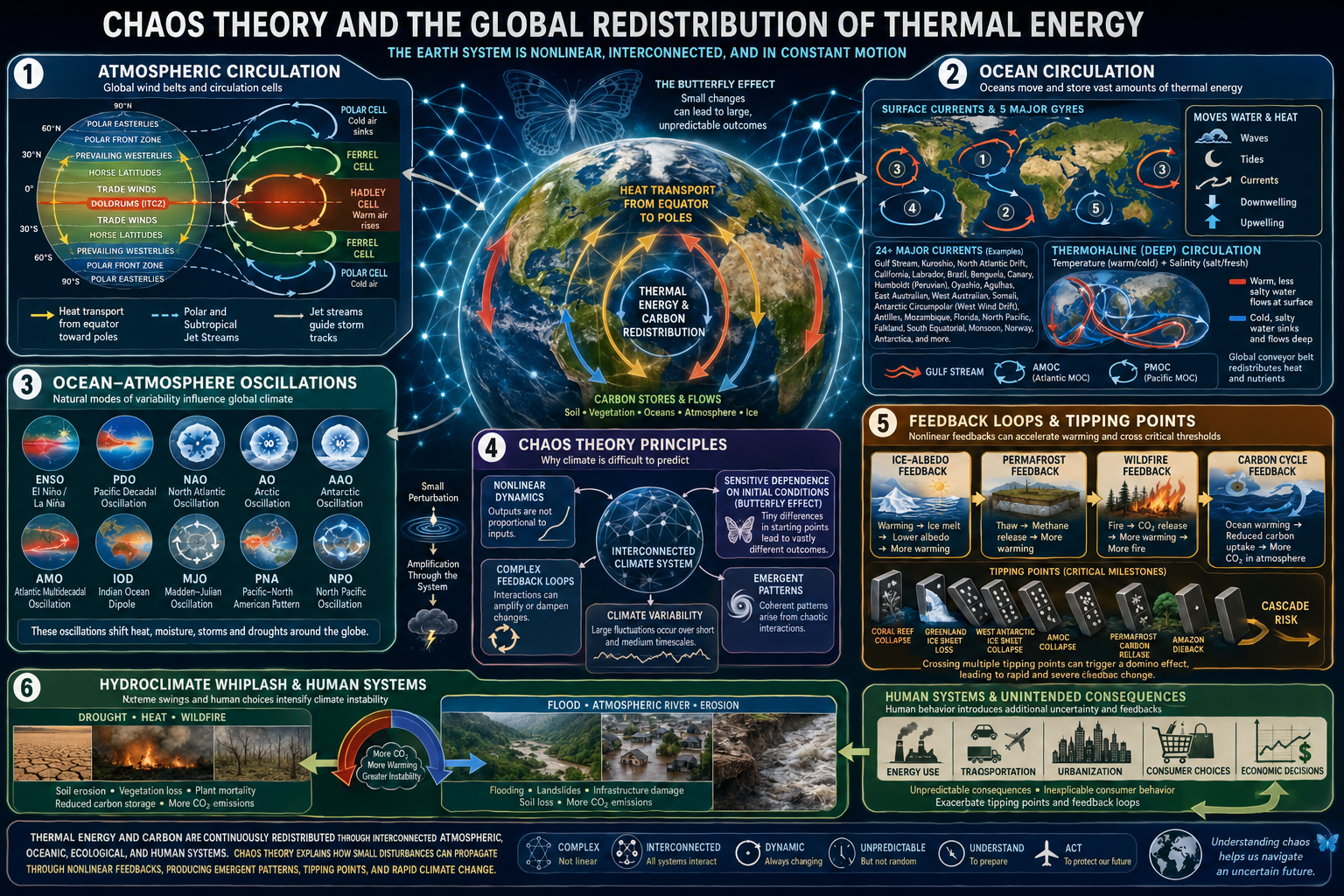
The Earth’s climate is a nonlinear, coupled dynamical system consisting of the atmosphere, oceans, cryosphere, lithosphere, biosphere, and human systems. Rather than operating independently, these components continuously exchange thermal energy, moisture, carbon, momentum, and chemical constituents across multiple spatial and temporal scales.

Global warming is fundamentally an increase in the total thermal energy stored within the Earth system. This additional energy does not remain uniformly distributed. Instead, it is constantly redistributed through complex interactions among atmospheric circulation, ocean currents, land-atmosphere exchanges, and biological processes. The result is a climate system characterized by variability, emergent behavior, and increasing instability.

Chaos theory provides a powerful framework for understanding these dynamics. It explains how nonlinear interactions, sensitive dependence on initial conditions, and interconnected feedbacks allow relatively small perturbations to propagate throughout the climate system, sometimes producing disproportionately large regional and global responses.

Fundamental Principle

Small changes in atmospheric temperature, pressure, humidity, ocean salinity, soil moisture, or surface reflectivity can trigger large-scale climate responses through nonlinear amplification and interconnected feedback loops. As additional thermal energy accumulates in the Earth system, these interactions become increasingly energetic, increasing the likelihood of extreme weather, abrupt transitions, and cascading tipping points.

Global Thermal Energy Redistribution

Thermal energy is continually redistributed through an interconnected network of atmospheric and oceanic circulation systems.

Atmospheric Circulation

Major atmospheric circulation includes:

  • Hadley, Ferrel, and Polar circulation cells
  • Intertropical Convergence Zone (ITCZ or “doldrums”)
  • Trade winds
  • Horse latitudes
  • Prevailing westerlies
  • Polar easterlies
  • Polar front zone
  • Subtropical and polar jet streams
  • Atmospheric rivers
  • Rossby waves
  • Blocking highs and Omega blocks

These circulation systems transport heat and moisture from the tropics toward the poles while governing storm tracks, precipitation patterns, droughts, and heat waves.

Ocean Circulation

The oceans absorb more than 90% of the excess heat produced by greenhouse gas forcing, making them Earth’s primary thermal reservoir. Heat redistribution occurs through:

  • Surface currents
  • Deep-water thermohaline circulation
  • Upwelling and downwelling
  • Tides and wave-driven mixing
  • Five major subtropical gyres
  • The Antarctic Circumpolar Current
  • More than two dozen major ocean currents, including the Gulf Stream, Kuroshio Current, Humboldt Current, California Current, Labrador Current, Benguela Current, Agulhas Current, Florida Current, Brazil Current, Canary Current, Norwegian Current, and Oyashio Current.

Large-scale overturning circulations—including the Atlantic Meridional Overturning Circulation (AMOC) and Pacific Meridional Overturning Circulation (PMOC)—play central roles in regulating long-term climate stability by transporting heat between the tropics and high latitudes.

Ocean-Atmosphere Oscillations

Coupled oscillations redistribute thermal energy over seasonal, interannual, and multidecadal timescales. Major oscillations include:

  • El Niño-Southern Oscillation (ENSO)
  • Pacific Decadal Oscillation (PDO)
  • Atlantic Multidecadal Oscillation (AMO)
  • North Atlantic Oscillation (NAO)
  • Arctic Oscillation (AO)
  • Antarctic Oscillation (AAO)
  • Madden-Julian Oscillation (MJO)
  • Indian Ocean Dipole (IOD)
  • Pacific-North American (PNA) Pattern
  • North Pacific Gyre Oscillation (NPGO)
  • North Pacific Oscillation (NPO)

Although these oscillations have existed for millennia, increasing thermal energy alters their frequency, persistence, intensity, and interactions, contributing to more frequent climate extremes.


Chaos Theory and Climate Dynamics

Chaos theory helps explain why climate change is more than a gradual warming trend. As thermal energy accumulates, the climate system becomes increasingly nonlinear, allowing small disturbances to generate disproportionately large responses.

Sensitive Dependence on Initial Conditions

Often referred to as the “butterfly effect,” small differences in initial atmospheric or oceanic conditions can lead to vastly different weather and climate outcomes. Slight variations in sea surface temperatures, humidity, soil moisture, or atmospheric pressure may eventually influence hurricanes, atmospheric rivers, heat waves, droughts, or persistent blocking patterns thousands of kilometers away.

Nonlinear Feedback Loops

The Earth system contains numerous interacting positive and negative feedback mechanisms.

Examples include:

  • Ice-albedo feedback
  • Water vapor feedback
  • Permafrost carbon release
  • Forest dieback
  • Ocean carbon uptake changes
  • Cloud feedbacks
  • Soil moisture-precipitation feedbacks

Positive feedbacks amplify warming by increasing the amount of thermal energy retained within the climate system, while negative feedbacks partially offset change. As warming continues, positive feedbacks increasingly dominate many regions.

Emergent Behavior

Despite underlying chaos, coherent climate patterns emerge naturally from nonlinear interactions. These include:

  • El Niño and La Niña
  • Madden-Julian Oscillation
  • Atmospheric blocking events
  • Heat domes
  • Atmospheric rivers
  • Polar vortex disruptions

These organized structures redistribute enormous amounts of thermal energy and moisture while influencing weather patterns across entire continents.

Climate Variability

Chaos theory explains why natural variability remains large even during long-term warming. Individual years may be cooler or warmer than expected, yet the long-term accumulation of thermal energy continues to drive rising temperatures, stronger hydrologic extremes, accelerating sea-level rise, and increasing ocean heat content.


Hydroclimate Whiplash

One consequence of increasing nonlinearity is hydroclimate whiplash—rapid transitions between prolonged drought and extreme flooding.

As the atmosphere warms, it can hold approximately 7% more water vapor for every 1°C of warming, increasing the potential for intense precipitation. At the same time, higher temperatures accelerate evaporation and soil drying, intensifying drought conditions.

Small shifts in atmospheric circulation can therefore produce abrupt swings between:

  • severe drought,
  • wildfire,
  • atmospheric rivers,
  • flash flooding,
  • landslides, and
  • repeated agricultural failures.

These extremes damage ecosystems, reduce vegetation recovery, erode soils, and release additional carbon dioxide and methane, reinforcing warming through additional positive feedback loops.


Human Systems as Part of the Climate System

Human societies have become an increasingly important component of the Earth’s coupled climate system.

Economic decisions, energy production, land-use change, urbanization, deforestation, agriculture, technological innovation, and public policy continuously alter greenhouse gas emissions and the Earth’s energy balance. Unlike physical processes, human behavior often exhibits nonlinear dynamics driven by psychology, economics, politics, and social networks.

Consequently, climate change results from the interaction of biogeophysical systems and socio-economic systems, each capable of amplifying or moderating climate feedbacks.


Cascading Feedbacks and Climate Tipping Points

A climate tipping point is a critical threshold beyond which part of the Earth system undergoes a self-sustaining and often irreversible transition to a new state.

Examples include:

  • Greenland Ice Sheet destabilization
  • West Antarctic Ice Sheet collapse
  • AMOC weakening or collapse
  • Boreal forest dieback
  • Amazon rainforest dieback
  • Permafrost thaw
  • Coral reef collapse

Crossing one tipping point can increase the probability of triggering others, producing cascading tipping events that accelerate the redistribution of thermal energy and carbon throughout the Earth system.

Rather than responding linearly to continued warming, the climate may increasingly behave as a complex adaptive system in which multiple interacting feedbacks generate abrupt transitions, emergent behavior, and nonlinear acceleration. Understanding these interactions is essential for improving climate projections, identifying early warning signals, and developing effective mitigation and adaptation strategies.

bookmark_borderThe Birnam Wood Experiment: Moving Forests for a Cooler, More Efficient Home

by Daniel Brouse

DIY Climate Control: Save Money, Reduce Waste, and Cut Greenhouse Gas Emissions

In Shakespeare’s Macbeth, Birnam Wood appears to come alive as Malcolm’s army cuts branches from the forest and carries them toward Dunsinane Castle, concealing its advance. What seemed like magic was actually an ingenious use of nature to solve a practical problem.

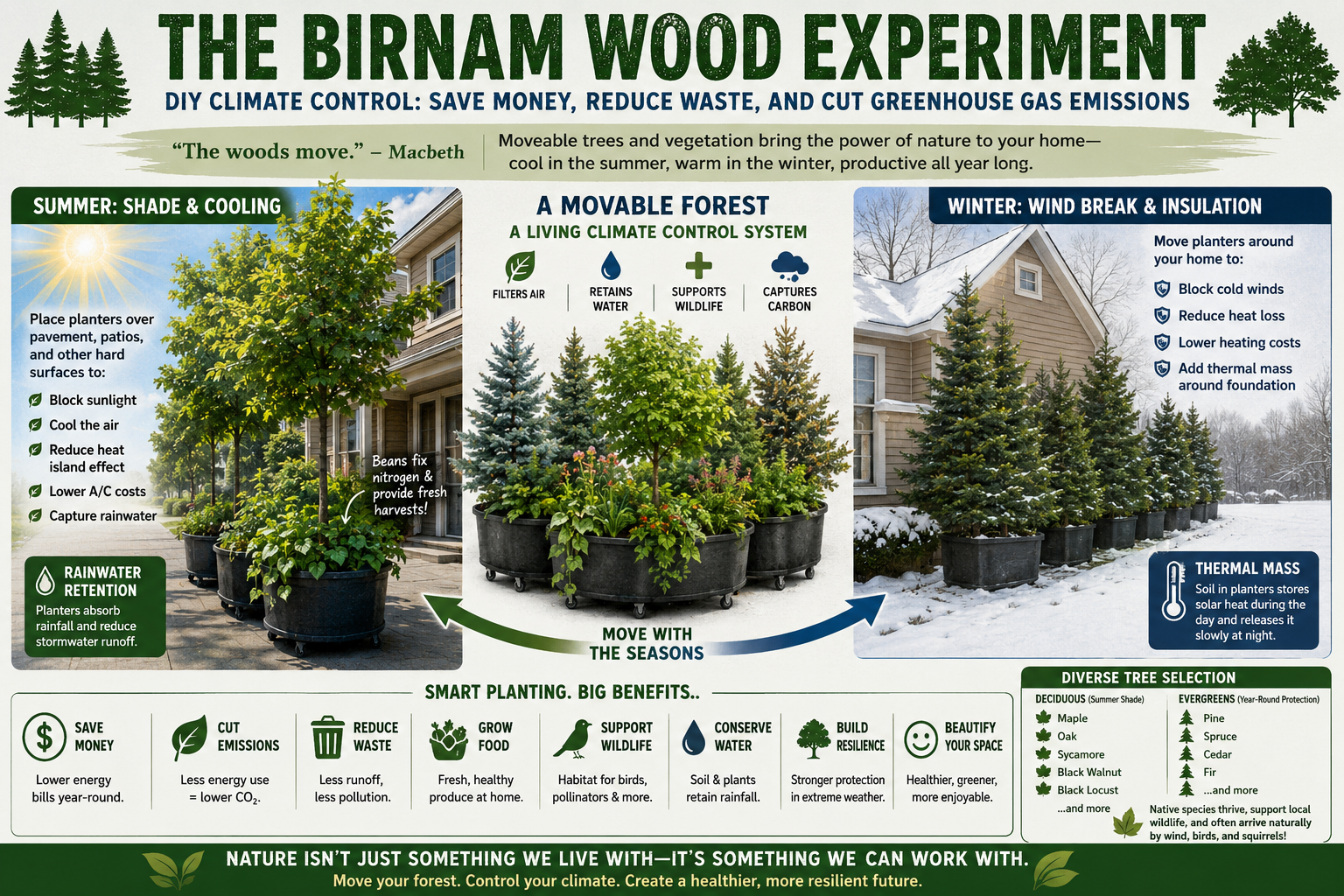
The Birnam Wood Experiment applies that same concept to climate resilience by using moveable trees and vegetation to improve home energy efficiency, reduce urban heat, harvest rainwater, provide food, and create healthier outdoor living spaces.

Rather than planting every tree permanently in the ground, many are grown in large mobile planters that can be repositioned throughout the year wherever they provide the greatest environmental and economic benefit.

A Living Climate Control System

Unlike traditional landscaping, movable planters allow homeowners to adapt their landscape to changing seasons and weather conditions.

The planters serve multiple purposes:

  • Summer shade for homes, patios, and paved surfaces
  • Winter windbreaks around buildings
  • Rainwater retention
  • Reduced stormwater runoff
  • Heat storage within the soil
  • Wildlife habitat
  • Carbon storage
  • Food production
  • Improved air quality

Instead of relying entirely on mechanical heating and cooling, the landscape itself becomes part of the home’s climate-control system.

Building the Mobile Forest

Large containers are planted with a mixture of trees, companion plants, and climbing vegetables.

Beans are especially valuable because they naturally fix nitrogen in the soil through symbiotic bacteria living on their roots. This reduces fertilizer requirements while producing a fresh harvest throughout the growing season.

Other vegetables, herbs, flowers, and pollinator-friendly plants can also be incorporated depending on the available space.

Selecting Trees

A diverse mixture of trees provides the greatest resilience.

Both deciduous and evergreen (conifer) species should be included whenever practical.

Deciduous trees provide:

  • Dense shade during summer
  • Natural cooling through evapotranspiration
  • Autumn leaf mulch
  • Winter sunlight after leaves fall

Evergreens provide:

  • Year-round wind protection
  • Winter insulation
  • Wildlife shelter
  • Continuous carbon capture

Whenever possible, native species should be prioritized because they support local wildlife, require less maintenance, and are naturally adapted to regional conditions.

Nature often contributes to the experiment as well. Birds, squirrels, and the wind frequently plant volunteer seedlings that can be transplanted into containers.

During the Pennsylvania experiment, naturally occurring species included:

  • Black locust
  • Red maple
  • Oak
  • Sycamore
  • Black walnut

Additional conifer species were intentionally planted to maintain year-round coverage and maximize winter protection.

Summer Operation

During the hottest months, the containers are positioned over driveways, sidewalks, patios, parking areas, and other impervious surfaces.

These surfaces normally absorb enormous amounts of solar radiation before reradiating heat back into the surrounding air.

The movable trees interrupt this process by:

  • Blocking direct sunlight
  • Cooling the air through evapotranspiration
  • Reducing pavement temperatures
  • Lowering reflected heat reaching nearby buildings

Even modest reductions in surrounding temperatures can decrease air-conditioning demand while making outdoor spaces significantly more comfortable.

The planters also capture rainfall that would otherwise become runoff, allowing water to infiltrate the soil where it supports plant growth and evaporative cooling.

Winter Operation

As temperatures fall, the same planters are relocated around the home’s foundation and along prevailing wind directions.

Rows of evergreens create effective windbreaks that reduce wind speed before it reaches exterior walls.

Reducing wind exposure decreases convective heat loss from the building envelope, helping the home retain warmth while lowering heating costs.

The large soil volumes inside the containers also function as thermal mass. During sunny winter days, the soil absorbs solar energy and slowly releases heat after sunset, moderating temperature fluctuations around the foundation.

More Than Landscaping

The Birnam Wood Experiment demonstrates that landscaping can become an active component of home energy management rather than simply decoration.

Each planter performs multiple functions simultaneously:

  • Shades buildings
  • Insulates against winter winds
  • Produces food
  • Stores carbon
  • Improves biodiversity
  • Supports pollinators
  • Retains rainwater
  • Reduces erosion
  • Filters air pollutants
  • Beautifies the property

This multifunctional approach maximizes the return on every square foot of landscape.

Climate Benefits

Trees provide some of the most cost-effective climate solutions available to homeowners.

A well-designed mobile forest can help:

  • Reduce cooling energy demand
  • Lower heating costs
  • Decrease greenhouse gas emissions
  • Improve local air quality
  • Reduce urban heat island effects
  • Capture atmospheric carbon dioxide
  • Increase climate resilience during heat waves
  • Reduce pressure on stormwater systems

Because the trees can be repositioned as conditions change, the system remains flexible and can evolve as the landscape matures.

A Living Investment

Unlike many home improvements that slowly depreciate, healthy trees generally become more valuable over time. As they grow, they provide greater shade, stronger wind protection, increased carbon storage, more wildlife habitat, and larger harvests where edible species are included.

The Birnam Wood Experiment illustrates an important principle of climate adaptation: nature can be engineered to work alongside modern technology rather than replacing it. By treating trees as movable infrastructure instead of fixed landscape features, homeowners can create a dynamic, low-cost climate control system that saves money, reduces waste, strengthens local ecosystems, and lowers greenhouse gas emissions—all while bringing a little of Shakespeare’s legendary Birnam Wood to life.

bookmark_borderLiving Shades: Nature’s Window Insulation

DIY Climate Control: Save Money, Reduce Waste, and Cut Greenhouse Gas Emissions

by Daniel Brouse

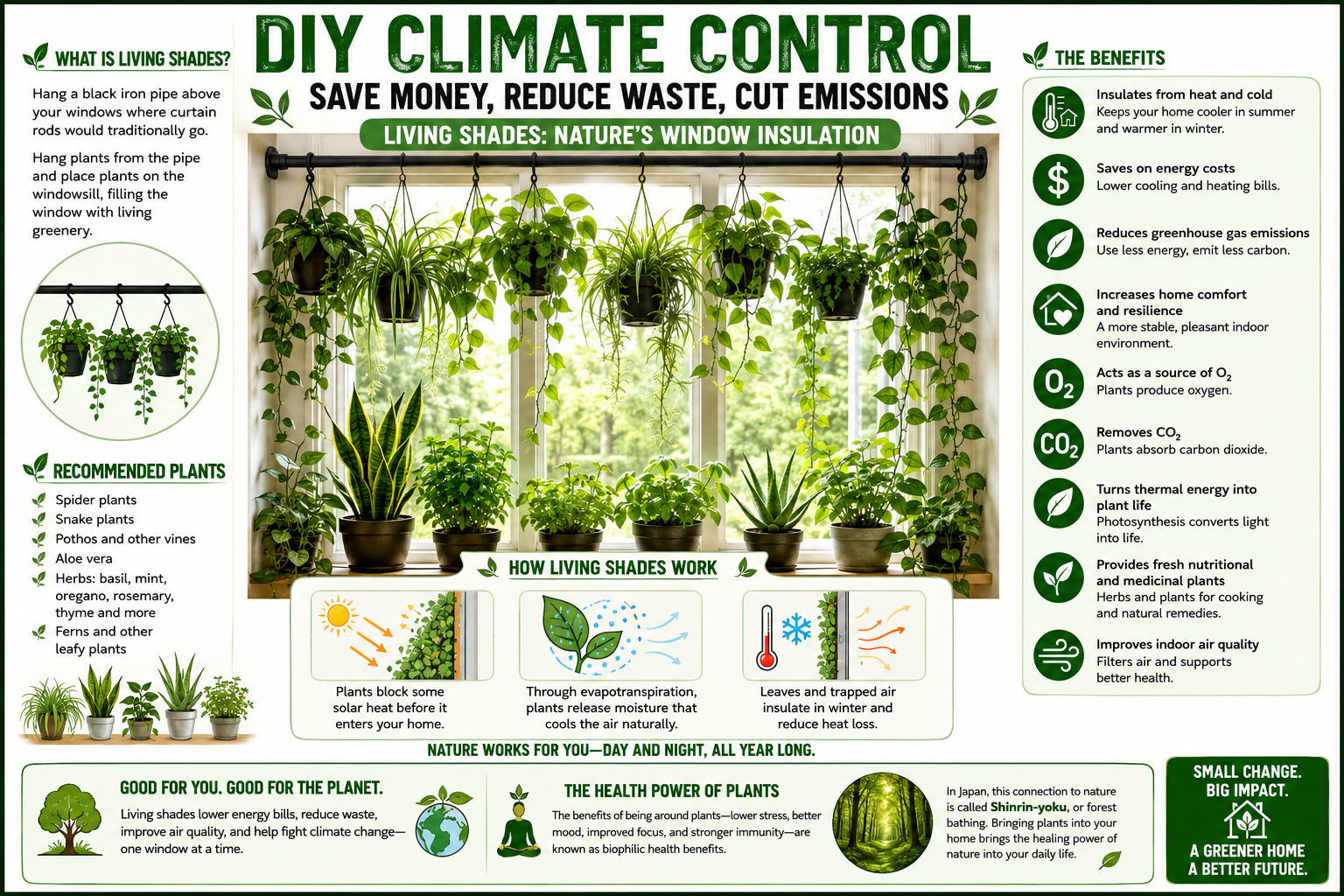
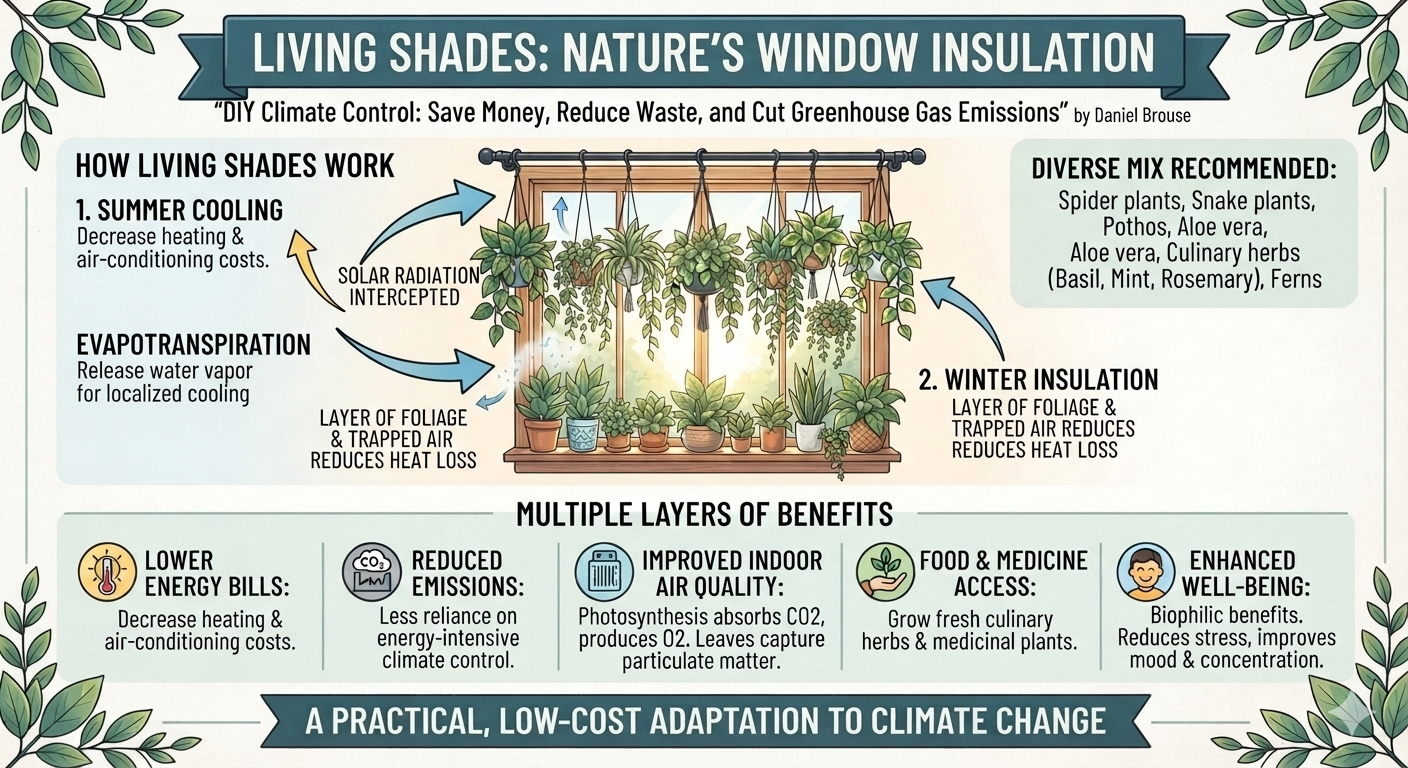
One of the simplest and most affordable ways to improve your home’s energy efficiency is to create living shades. Instead of installing traditional curtains or blinds, mount a sturdy black iron pipe above each window and suspend a collection of houseplants from it. Complement the hanging plants with additional plants on the windowsill, creating a dense layer of living vegetation between the window and the room.

A diverse mix of plants works best. Excellent choices include:

  • Spider plants
  • Snake plants
  • Pothos and other trailing vines
  • Aloe vera
  • Culinary herbs such as basil, mint, oregano, rosemary, and thyme
  • Ferns and other leafy houseplants

As the plants mature, they naturally form a living curtain that performs several useful functions simultaneously.

How Living Shades Work

Plants intercept a portion of incoming solar radiation before it enters the room. Through evapotranspiration, they also release water vapor that provides localized evaporative cooling around windows. During winter, the layer of foliage and trapped air provides modest insulation that helps reduce heat loss.

Unlike synthetic window coverings, living shades continuously improve indoor environmental quality while producing no waste and requiring very little energy to operate.

Benefits

Living shades can help:

  • Lower indoor temperatures during sunny weather.
  • Reduce winter heat loss through windows.
  • Decrease heating and air-conditioning costs.
  • Improve household energy efficiency.
  • Reduce greenhouse gas emissions associated with home energy use.
  • Increase indoor humidity during dry winter months.
  • Capture small amounts of airborne particulate matter on leaf surfaces.
  • Absorb carbon dioxide while producing oxygen through photosynthesis.
  • Improve indoor air quality and occupant comfort.
  • Provide fresh culinary herbs and medicinal plants.
  • Increase household resilience by producing small quantities of food year-round.
  • Create a calming, attractive indoor environment.

While individual houseplants should not be viewed as major carbon sinks, a home filled with vegetation contributes to a healthier indoor ecosystem while reducing reliance on energy-intensive climate control.

Beyond Energy Savings: The Health Benefits of Indoor Nature

The benefits of living plants extend beyond lower utility bills.

A growing body of research shows that exposure to vegetation can reduce stress, improve mood, enhance concentration, and promote psychological well-being. Collectively, these effects are known as biophilic health benefits, reflecting humanity’s innate connection to the natural world.

In Japan, the practice of intentionally immersing oneself in nature is known as Shinrin-yoku, or forest bathing. Research has shown that spending time around plants and trees can lower stress hormones, reduce blood pressure, improve immune function, and promote relaxation. While a living room cannot replace a forest, incorporating abundant indoor vegetation brings many of these restorative qualities into everyday life.

Living shades therefore provide multiple layers of value:

  • Lower energy bills.
  • Reduced greenhouse gas emissions.
  • Improved indoor air quality.
  • Increased food and medicinal plant production.
  • Enhanced physical comfort.
  • Better mental health and overall well-being.

As climate change drives higher temperatures and rising energy costs, living shades represent a practical, low-cost adaptation strategy that transforms ordinary windows into productive, energy-saving ecosystems.

bookmark_borderClimate Change as a Macroeconomic Threat Multiplier: Rising Healthcare Costs, Cost-of-Living Pressures, and Declining Human Longevity

by Daniel Brouse

Introduction: Climate Change as an Economic and Human Security Crisis

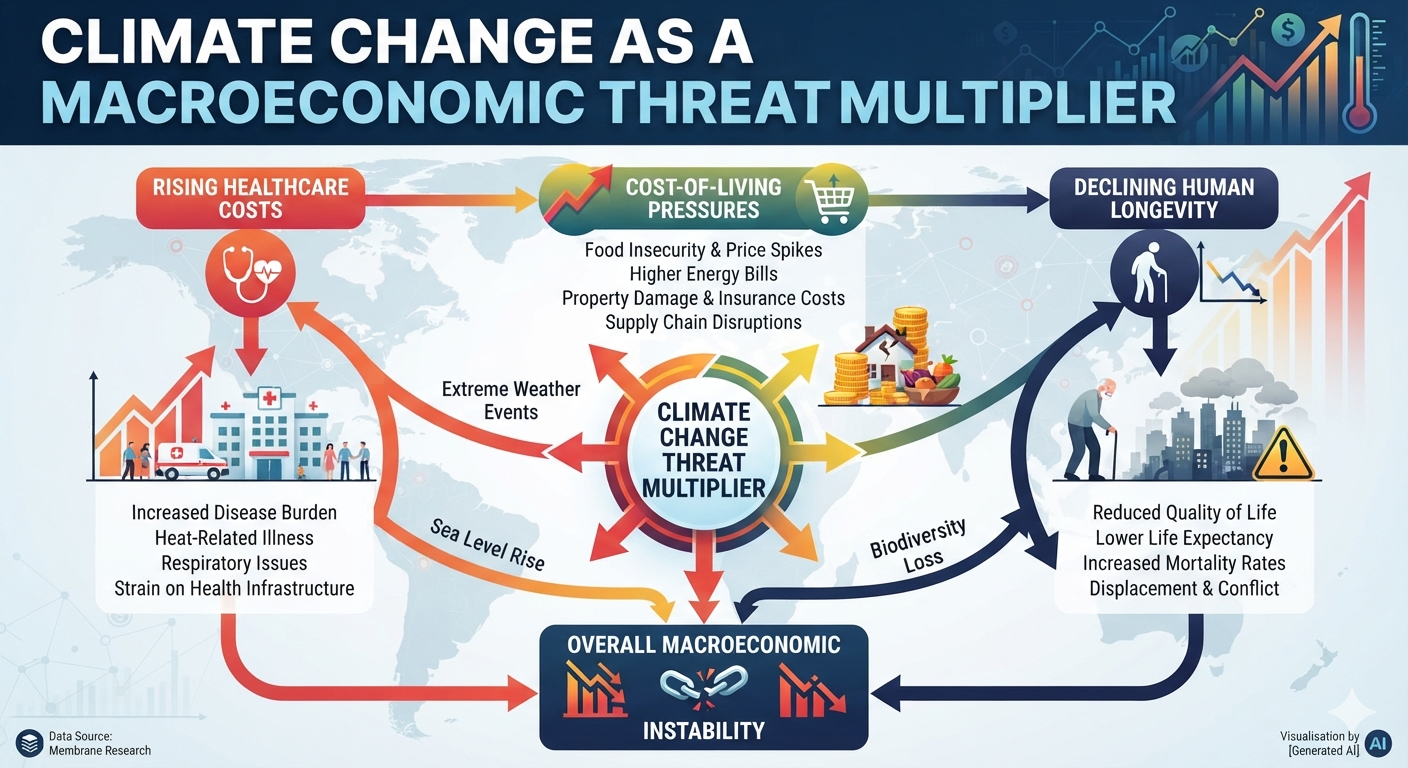
Climate change is no longer only an environmental challenge; it has become a powerful macroeconomic threat multiplier that amplifies existing social, economic, and public health vulnerabilities. Rising temperatures, increasingly extreme weather events, deteriorating air quality, and destabilized ecosystems are creating cascading financial pressures that extend from governments and businesses to individual households.

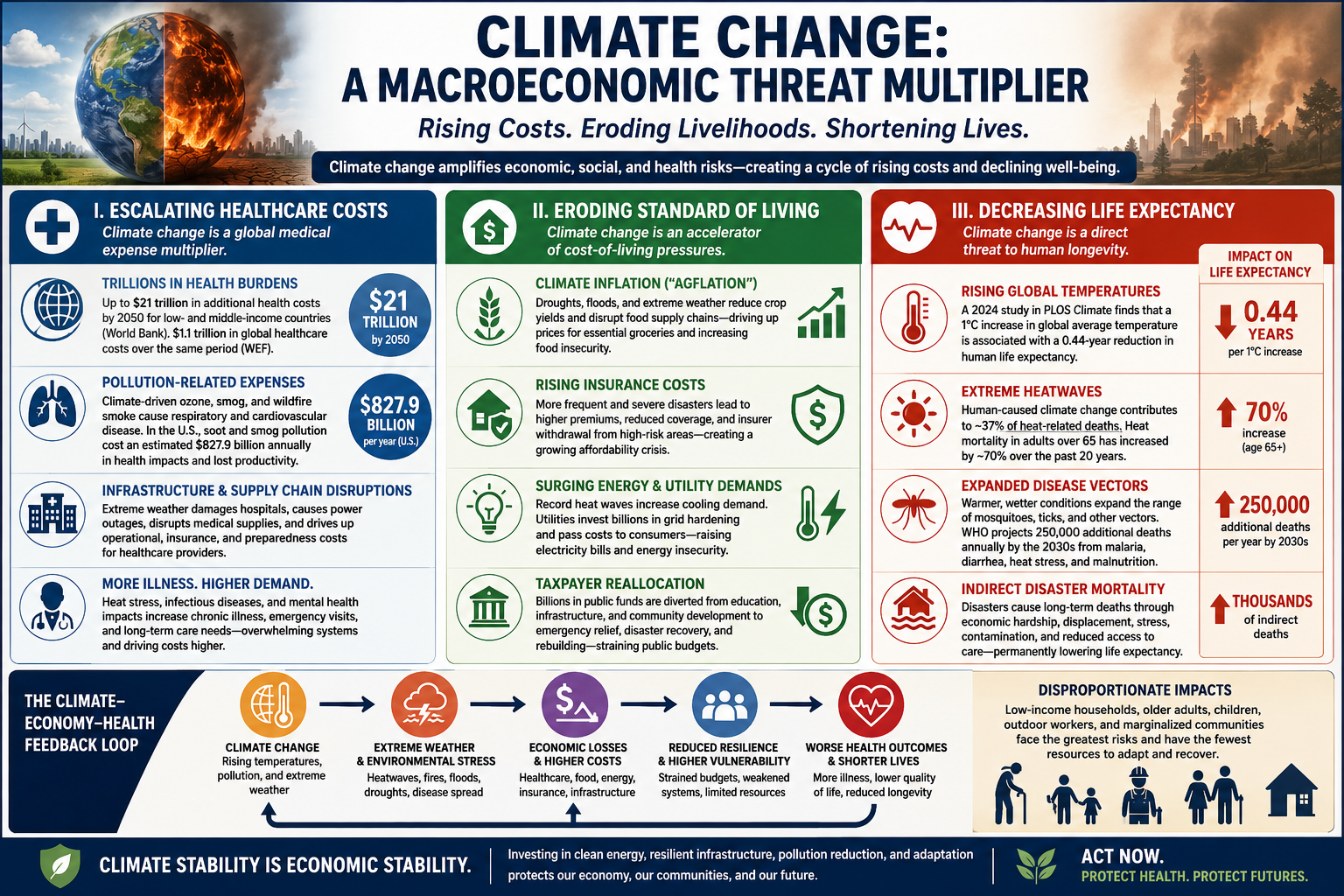
The economic consequences of climate change are increasingly visible through three interconnected pathways:

  1. Escalating healthcare costs caused by heat exposure, air pollution, infectious diseases, and climate-related disasters.
  2. Erosion of living standards through inflationary pressures on food, energy, insurance, housing, and public infrastructure.
  3. Declining human longevity as environmental stressors undermine physical health, increase mortality, and reverse decades of progress in life expectancy.

These impacts are not distributed equally. Low-income households, elderly populations, outdoor workers, and marginalized communities often face the greatest exposure while having the fewest resources to adapt. Climate change therefore transforms environmental instability into a localized economic and human health crisis.


I. Escalating Healthcare Costs: Climate Change as a Global Medical Expense Multiplier

Climate change is placing unprecedented strain on healthcare systems by increasing both the frequency and severity of climate-related illnesses while simultaneously disrupting healthcare infrastructure.

1. Trillions of Dollars in Climate-Driven Health Burdens

The financial consequences of climate-related health impacts are expected to reach historic levels.

  • The World Bank estimates that climate-related health crises could impose approximately $21 trillion in additional costs by 2050 across low- and middle-income countries, reflecting increased disease burdens, reduced productivity, and expanding healthcare needs.
  • The World Economic Forum estimates that climate change could create approximately $1.1 trillion in additional global healthcare costs over the same period.

These costs represent more than direct medical expenses. They include lost productivity, reduced workforce participation, premature mortality, emergency response requirements, and infrastructure adaptation.


2. Pollution-Related Healthcare Expenses

Climate change and fossil fuel combustion are closely linked. Rising temperatures accelerate atmospheric chemical reactions that increase ground-level ozone formation, intensifying smog episodes and worsening respiratory and cardiovascular disease.

Fine particulate matter (PM2.5), ozone, wildfire smoke, and other pollutants contribute to:

  • Asthma and chronic respiratory illness
  • Heart attacks and strokes
  • Lung disease
  • Premature deaths
  • Increased emergency room visits

In the United States alone, soot and smog pollution are estimated to generate hundreds of billions of dollars annually in health-related costs, including medical expenses and lost economic productivity.

The growing frequency of wildfire smoke events demonstrates how climate impacts can transform regional air pollution into a national health emergency. Smoke from distant wildfires can travel thousands of miles, exposing millions of people far from the original source.


3. Healthcare Infrastructure and Supply Chain Disruptions

Extreme weather events increasingly threaten the operational stability of healthcare systems.

Climate-related disruptions include:

  • Hospitals losing electrical power during heat waves, hurricanes, and wildfires
  • Flooding damaging medical facilities
  • Disruptions in pharmaceutical and medical equipment supply chains
  • Increased emergency response costs
  • Higher insurance and operational expenses for healthcare providers

Hospitals are being forced to spend billions on climate resilience measures, including backup power systems, flood protection, cooling infrastructure, and emergency preparedness.


II. Eroding Standard of Living: Climate Change as a Cost-of-Living Accelerator

Climate change is increasingly becoming an economic reality experienced directly through household budgets. The same forces increasing healthcare costs are also driving inflationary pressures throughout the economy.


1. Climate Inflation and Agricultural Instability (“Agflation”)

Food systems are among the most climate-sensitive sectors of the global economy.

Rising temperatures, droughts, flooding, changing precipitation patterns, and extreme storms reduce agricultural productivity by damaging:

  • Crop yields
  • Livestock health
  • Fisheries
  • Agricultural infrastructure
  • Transportation networks

These disruptions create supply-side inflation, increasing prices for essential goods including:

  • Grains
  • Fruits and vegetables
  • Meat and dairy products
  • Transportation-dependent food products

Climate-driven food inflation disproportionately harms lower-income households because food represents a larger percentage of their monthly expenses.


2. Rising Insurance Costs and the Retreat From High-Risk Regions

The insurance industry has become one of the clearest economic indicators of accelerating climate risk.

As hurricanes, wildfires, floods, and severe storms become more frequent and destructive:

  • Insurance premiums increase dramatically.
  • Coverage becomes more restricted.
  • Insurers withdraw from vulnerable markets.
  • Property values decline in high-risk regions.

Homeowners increasingly face a difficult choice: pay rapidly increasing premiums or assume greater financial risk without adequate coverage.

This creates a growing climate affordability crisis, particularly for homeowners living in areas exposed to wildfire, coastal flooding, extreme storms, and severe weather.


3. Rising Energy Demand and Utility Costs

Climate change increases energy demand while simultaneously placing stress on energy infrastructure.

During extreme heat events:

  • Electricity consumption rises sharply due to increased air conditioning demand.
  • Utilities must invest billions in grid upgrades.
  • Transmission systems require additional protection against storms and wildfires.
  • Maintenance costs are passed onto consumers.

The result is a climate feedback loop:

Hotter temperatures → Greater cooling demand → Higher electricity consumption → Increased infrastructure costs → Higher household energy bills

Energy insecurity becomes a growing concern as vulnerable households struggle to afford cooling during dangerous heat events.


4. Taxpayer Costs and Public Financial Burdens

Climate disasters increasingly redirect public resources away from long-term investments toward emergency response and recovery.

Government spending is increasingly allocated toward:

  • Disaster relief
  • Infrastructure repairs
  • Emergency housing assistance
  • Flood recovery
  • Wildfire response
  • Agricultural assistance

These expenditures compete directly with funding for:

  • Education
  • Transportation improvements
  • Community development
  • Public health programs

Climate change therefore functions as a long-term fiscal drain, increasing government expenditures while reducing resources available for economic development.


III. Declining Human Longevity: Climate Change as a Biological Stressor

Beyond economic impacts, climate change increasingly affects the fundamental measure of human well-being: life expectancy.

The cumulative effects of extreme heat, pollution exposure, disease expansion, food insecurity, and climate disasters are slowing—and in some regions reversing—historical gains in longevity.

Climate DriverImpact on Human Health and Longevity
Rising Global TemperaturesA 2024 study published in PLOS Climate found that a 1°C increase in global average temperature is associated with approximately a 0.44-year reduction in life expectancy.
Extreme HeatwavesHuman-caused climate change is estimated to contribute to approximately 37% of heat-related deaths. Heat-related mortality among adults over age 65 has increased substantially over recent decades.
Expanded Disease Vector RangesWarmer and wetter conditions allow mosquitoes, ticks, and other disease vectors to expand into new regions, increasing risks from malaria, dengue fever, Lyme disease, and other infections.
Food and Water StressClimate disruption increases risks of malnutrition, dehydration, agricultural failure, and water insecurity, particularly in vulnerable populations.
Indirect Disaster MortalityFloods, hurricanes, wildfires, and other disasters create long-term health impacts through displacement, economic hardship, psychological stress, and environmental contamination.

IV. The Climate-Economy-Health Feedback Loop

Climate change creates a reinforcing cycle:

Climate Change → Extreme Weather → Economic Losses → Higher Costs → Reduced Adaptation Capacity → Greater Vulnerability → Increased Health Impacts

This feedback loop means climate impacts are not isolated events. A wildfire, flood, or heat wave can simultaneously damage infrastructure, increase healthcare expenses, reduce productivity, raise insurance costs, and shorten human lives.

The poorest communities often experience the strongest effects because they have fewer resources to prepare, recover, and relocate.


Conclusion: Climate Stability Is Economic Stability

Climate change represents one of the largest economic and public health challenges of the modern era. Its consequences extend far beyond environmental degradation, affecting national budgets, household finances, healthcare systems, and human survival.

The emerging reality is clear:

  • Climate change increases healthcare expenditures.
  • Climate change accelerates inflationary pressures.
  • Climate change reduces economic security.
  • Climate change threatens human longevity.

Addressing climate change is therefore not simply an environmental investment—it is an economic resilience strategy and a public health imperative. Investments in clean energy, resilient infrastructure, pollution reduction, efficient buildings, and climate adaptation can reduce future costs while protecting both human health and economic stability.

The cost of inaction is no longer measured only in degrees of warming. It is measured in rising medical bills, shrinking household budgets, damaged communities, and lost years of human life.

bookmark_borderClimate Change and Personal Finances: Managing Household Costs in an Era of Rising Climate Risk

by Daniel Brouse

🌎 Climate Change and Personal Finances: The Rising Cost of a Changing Climate

Climate change is no longer only an environmental challenge—it is becoming a growing financial challenge for households everywhere.

While headline inflation may appear moderate, the costs most affected by climate change are rising faster than many household incomes.

🔥 Extreme heat is increasing electricity demand and stressing energy infrastructure.
⛈️ Severe storms and hail events are driving higher comprehensive auto insurance costs.
🏠 Floods, hurricanes, wildfires, and extreme weather are pushing homeowners insurance premiums higher.
🌾 Droughts, floods, and shifting growing conditions are increasing food-price volatility.
🔨 Climate-related damage and rebuilding costs are raising housing expenses.

A new economic reality is emerging:

Climate-sensitive expenses are becoming a larger share of household budgets.

The financial impacts of climate change are not limited to major disasters. They appear in recurring expenses—monthly utility bills, insurance premiums, repair costs, and the price of everyday goods.

Building financial resilience means preparing for this changing economic landscape:

✅ Reduce high-interest debt
✅ Build emergency savings
✅ Improve home energy efficiency
✅ Review insurance coverage
✅ Invest in weather protection and resilience
✅ Plan for increasing climate-related costs

Climate change is reshaping not only our environment, but also the economics of everyday life.

📊 Read the full report:

“Climate Change and Personal Finances: Managing Household Costs in an Era of Rising Climate Risk”

Climate change is no longer simply an environmental issue. It has become an economic force that influences nearly every aspect of household finances. Extreme weather, rising insurance losses, damaged infrastructure, disruptions to agriculture, and increasing energy demand are reshaping the cost of living.

While the overall inflation rate captures broad price changes across the economy, climate change increasingly creates uneven inflation. Some goods remain relatively stable, while climate-sensitive sectors experience much faster price growth.

Understanding these trends allows households to better prepare for an increasingly volatile financial future.


Overall Inflation

The Consumer Price Index for All Urban Consumers (CPI-U) currently reflects annual inflation of approximately 3.5%.

Although this represents moderate overall inflation, it masks significant differences among individual household expenses. Energy, insurance, housing, and weather-sensitive goods continue to experience above-average price increases, while wages have largely kept pace only with headline inflation.

As climate change intensifies, these differences are expected to become even more pronounced.


Household Price Trends

Major components of household budgets are experiencing dramatically different rates of inflation. Essential expenses increasingly affected by climate change—such as insurance, energy, housing repairs, and food—are rising faster than average wage gains. As a result, many households are experiencing a decline in real purchasing power despite wages keeping pace with headline inflation.

Household ExpenseAnnual Change
Overall CPI Inflation+3.5%
Gasoline+26.7%
Electricity+4.0%
Comprehensive Auto Insurance (weather-related losses)+10% to +15%
Homeowners Insurance+10–15%
Private Sector Wages+3.5%

One consistent pattern is emerging:

One consistent pattern is emerging: climate-sensitive expenses are rising faster than overall inflation and household income growth, creating increasing financial pressure for families adapting to a changing climate.


Energy Costs

Energy remains one of the largest sources of household inflation.

Gasoline prices have risen sharply due to geopolitical tensions, supply disruptions, refinery constraints, and transportation bottlenecks. While climate change is not the sole cause of gasoline inflation, extreme weather increasingly disrupts oil production, refining capacity, pipelines, and shipping routes.

Electricity prices have also continued to climb.

Several factors contribute:

  • Increased demand during prolonged heat waves
  • Expansion of electric transmission infrastructure
  • Grid modernization
  • Storm damage and repairs
  • Higher fuel and maintenance costs

As summers become hotter and heat waves last longer, residential electricity demand for air conditioning continues to increase.


The Insurance Crisis

Perhaps no household expense illustrates climate change more clearly than insurance.

Insurers base premiums on expected future losses—not past averages.

As hurricanes, wildfires, hailstorms, tornadoes, flooding, and severe convective storms become more destructive, insurance companies are paying record claims.

These losses eventually appear as:

  • Higher premiums
  • Larger deductibles
  • Reduced coverage
  • More exclusions
  • Non-renewals
  • Complete withdrawal from high-risk markets

Homeowners insurance has become one of the fastest-growing household expenses in many regions.

In some states, premiums have doubled within only a few years.

For households, insurance is increasingly becoming a direct monthly cost of climate change.

Comprehensive Auto Insurance and Climate Risk

Unlike collision insurance, which covers accidents between vehicles, comprehensive automobile insurance protects against damage caused by natural hazards and other non-collision events. As climate change increases the frequency and severity of extreme weather, comprehensive claims have risen substantially.

Common climate-related comprehensive claims include:

  • Hail damage
  • Falling trees and branches during windstorms
  • Flash flood damage
  • Hurricane storm surge
  • Wildfire damage
  • Tornado debris
  • Lightning strikes
  • Wind-blown objects
  • Ice and snow damage

Large hailstorms alone now produce billions of dollars in insured vehicle losses each year. Modern vehicles are particularly vulnerable because aluminum body panels, panoramic glass roofs, advanced sensors, cameras, and radar systems are expensive to repair or replace.

Flash flooding has also become one of the fastest-growing sources of comprehensive auto losses. Vehicles caught in flooded roadways often suffer catastrophic engine, electrical, and electronic damage, resulting in total-loss claims.

As insurers pay increasing numbers of weather-related claims, many companies have adjusted comprehensive premiums, increased deductibles, or refined risk models based on regional exposure to hail, flooding, hurricanes, wildfires, and severe convective storms.

While collision coverage is primarily influenced by driving behavior, repair costs, and accident frequency, comprehensive insurance increasingly reflects the financial consequences of a changing climate. For many households, the rising cost of comprehensive coverage has become another indirect expense associated with more frequent and more destructive extreme weather events.


Food Prices

Although food inflation fluctuates from year to year, climate change is placing increasing pressure on agricultural production.

Extreme heat, drought, flooding, hurricanes, and shifting growing seasons reduce crop yields while increasing production costs.

Examples include:

  • Heat-stressed livestock
  • Drought-reduced grain harvests
  • Flood-damaged vegetables
  • Disease outbreaks
  • Pollinator decline
  • Water shortages

The result is greater price volatility at grocery stores.

Consumers may increasingly experience periods where staple foods rise rapidly following major climate disasters.


Housing Costs

Housing costs are increasingly influenced by climate risk.

Construction materials become more expensive following disasters.

Labor shortages emerge after major storms.

Building codes become stricter.

Flood-resistant construction, stronger roofing systems, improved insulation, and wildfire-resistant materials all increase upfront construction costs while reducing long-term risk.

Mortgage lenders are also beginning to incorporate climate risk into property valuations.

Properties facing repeated flooding, wildfire exposure, or coastal erosion may experience declining values while insurance costs continue rising.


Wages and Purchasing Power

Private-sector wages have increased approximately 3.5% over the past year.

While this roughly matches headline inflation, it does not fully offset the faster growth of essential household expenses such as insurance, electricity, housing, and healthcare.

As a result, many households experience “cost-of-living compression,” where income keeps pace with average inflation but fails to keep pace with the expenses that matter most.


Interest Rates: Earning Versus Paying

One of the largest financial challenges facing households is the enormous difference between what consumers earn on savings and what they pay on debt.

Financial InstrumentTypical Rate
Credit Card Interest22.15–25.16% APR
30-Year Fixed Mortgage6.51% APR
High-Yield Savings Account4.0%+
4-Week U.S. Treasury Bill3.64–3.70%
Standard Savings Account0.38–0.73%

The modern banking system rewards households that maintain liquidity while imposing extremely high costs on revolving debt.

Credit card interest rates frequently exceed 20%, making high-interest debt one of the largest obstacles to long-term financial security.

Conversely, households that maintain emergency savings can now earn meaningful returns through high-yield savings accounts and short-term Treasury securities.


Climate Change and Financial Risk

Climate change introduces several new forms of financial risk that traditional household budgeting rarely considered:

  • Increasing insurance premiums
  • Larger deductibles
  • Rising utility bills
  • Disaster repair costs
  • Temporary job interruptions after extreme weather
  • Declining property values in high-risk areas
  • Higher food prices
  • Greater investment volatility

These risks compound over time, making financial resilience increasingly important.


Strategies for Financial Resilience

Households can take practical steps to reduce their financial vulnerability to climate-related economic shocks.

Build an Emergency Fund

Maintaining three to six months of living expenses provides flexibility following disasters, temporary unemployment, or unexpected repairs.

Eliminate High-Interest Debt

Paying down credit cards earning 22–25% interest often provides a greater guaranteed return than most investments.

Improve Energy Efficiency

Investments such as insulation, efficient appliances, heat pumps, smart thermostats, and LED lighting can reduce utility costs while improving comfort during heat waves.

Review Insurance Coverage

Homeowners should regularly review policy limits, deductibles, exclusions, flood coverage, and replacement-cost estimates to ensure protection reflects today’s risks.

Diversify Investments

Diversification across asset classes, industries, and geographic regions can help reduce exposure to climate-related disruptions affecting any single sector.

Prepare for Extreme Weather

Emergency supplies, backup power, important documents, evacuation plans, and home maintenance can reduce both financial losses and recovery time after disasters.


The Economics of Adaptation

One of the defining economic realities of the coming decades will be the growing cost of adaptation.

Communities will invest billions in:

  • Stronger electrical grids
  • Flood-control systems
  • Coastal defenses
  • Wildfire mitigation
  • Stormwater infrastructure
  • More resilient buildings
  • Expanded emergency response capabilities

Although these investments require substantial upfront spending, they often cost far less than rebuilding after repeated disasters. For individual households, similar investments—such as reinforcing roofs, improving drainage, elevating utilities in flood-prone areas, or increasing home energy efficiency—can reduce future repair costs, lower insurance claims, and improve long-term resilience.


Conclusion

Climate change is increasingly shaping household finances through higher insurance premiums, rising energy costs, greater food-price volatility, and growing expenditures on disaster preparedness and infrastructure. At the same time, high borrowing costs amplify the financial strain on families carrying significant debt.

The central challenge is no longer simply inflation, but the uneven way inflation affects climate-sensitive expenses. Insurance, utilities, housing, and food are consuming a larger share of household budgets, even when overall inflation appears moderate.

Building emergency savings, reducing high-interest debt, investing in energy efficiency, maintaining appropriate insurance coverage, and preparing for extreme weather can strengthen financial resilience. As climate risks continue to evolve, households that proactively adapt their financial strategies will be better positioned to absorb future economic shocks and maintain long-term financial stability.