bookmark_borderUnderstanding Straight-Line Winds and Climate Change

By Daniel Brouse
May 18, 2024

Weather Like the Deadly Houston Windstorm Is Being Fueled in Part by Climate Change

Scientists have detected an increase since the 1980s in what are known as straight-line winds, and climate change is playing a significant role. These winds, which are often associated with severe thunderstorms, can reach speeds exceeding 100 mph and cause damage similar to that of a tornado, but they move along a straight path.

Understanding Straight-Line Winds

Straight-line winds, also known as derechos when they cover a particularly large area, are powerful, sustained winds that originate from downdrafts in thunderstorms. Unlike the rotating winds of a tornado, straight-line winds blow in a single direction, hence their name. These winds can flatten trees, knock down power lines, and cause extensive damage to buildings and infrastructure.

The Role of Climate Change

Recent studies indicate that climate change is contributing to an increase in the frequency and intensity of these wind events. The following factors explain how climate change is influencing straight-line winds:

  1. Increased Atmospheric Instability: As global temperatures rise, the atmosphere becomes more unstable. Warmer air holds more moisture, leading to more intense thunderstorms, which are a primary source of straight-line winds. The increased energy in the atmosphere enhances the formation of severe weather systems capable of producing strong downdrafts.
  2. Enhanced Convective Available Potential Energy (CAPE): CAPE is a measure of the energy available for convection, which is a key process in the formation of thunderstorms. Higher CAPE values are associated with more vigorous updrafts and downdrafts, resulting in stronger winds. Climate change is leading to higher CAPE values in many regions, contributing to more powerful straight-line winds.
  3. Changing Wind Patterns: Climate change is altering global wind patterns, which can influence the development and movement of severe weather systems. These changes can result in more frequent and intense straight-line wind events, particularly in areas that are becoming more prone to severe thunderstorms.

The Impact of Straight-Line Winds

The deadly Houston windstorm is a stark reminder of the destructive power of straight-line winds. The storm left a trail of devastation, with thousands of residents losing power and homes being damaged or destroyed. The aftermath of such storms can be particularly dangerous during extreme weather events like heatwaves, which are also becoming more common due to climate change.

Conclusion

As the climate continues to change, the occurrence of extreme weather events like straight-line winds is expected to increase. This poses significant challenges for communities, infrastructure, and emergency response systems. Understanding the role of climate change in these events is crucial for developing strategies to mitigate their impact and enhance resilience against future storms. Scientists and policymakers must work together to address the root causes of climate change and implement measures to protect vulnerable populations from the growing threat of severe weather.

What Can I Do?
Our climate model uses chaos theory in an attempt to adequately account for humans and forecasts a global average temperature increase of 9℃ above pre-industrial levels. Everybody has the responsibility not to pollute. There are plenty of things you can do to help save the planet. Stop using fossil fuels. Consume less. Love more. Here is a list of additional actions you can take.

How is All Real Estate at Risk From Climate Change?
The Human Induced Climate Change Experiment

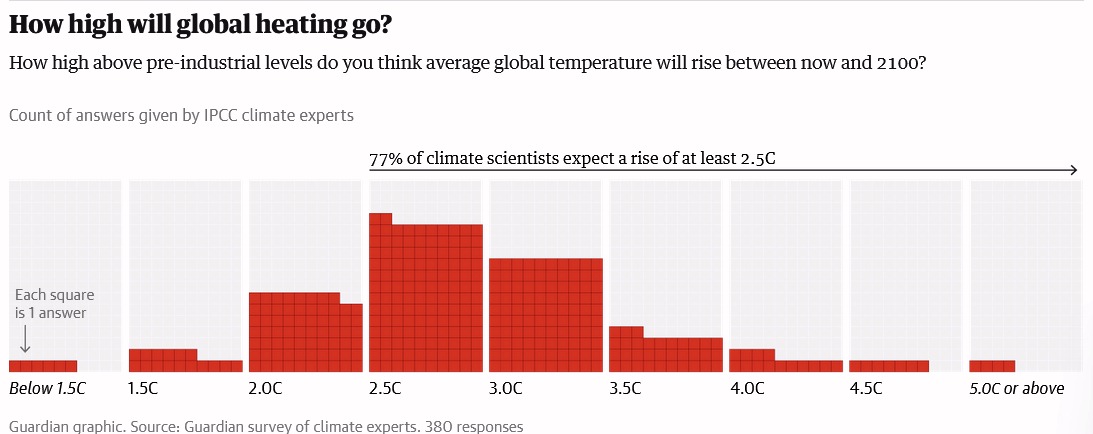
bookmark_borderSurvey of Experts: Climate Crisis Going Past 2.5 Degrees

by Daniel Brouse

The Guardian reports, “Many of the scientists envisage a ‘semi-dystopian’ future, with famines, conflicts and mass migration, driven by heatwaves, wildfires, floods and storms of an intensity and frequency far beyond those that have already struck.”

In a recent survey of climate scientists, the consensus suggests that global warming is on track to exceed 2.5 degrees Celsius this century, with some projections indicating a rise of over 5 degrees.

“I foresee significant societal upheaval within the next five years,” stated Gretta Pecl from the University of Tasmania. “We’ll face overwhelming challenges as extreme events become the norm, disrupting food production and beyond. The future seems increasingly bleak.”

Peter Cox from the University of Exeter emphasized, “Climate change isn’t waiting to become dangerous at 1.5 degrees Celsius – it already poses severe risks. Surpassing 2 degrees Celsius won’t signal ‘game over,’ but the urgency for action is dire.”

Nathalie Hilmi, representing the Monaco Scientific Centre, echoed the sentiment, asserting, “Limiting warming to 1.5 degrees Celsius is imperative. We cannot afford to exceed this threshold.”

The experts unanimously stressed the urgent need for extensive preparations to safeguard communities from impending climate catastrophes. Leticia Cotrim da Cunha from the State University of Rio de Janeiro expressed deep concern, particularly regarding the potential human toll.

The 1.5 degrees Celsius target, intended to avert the worst impacts of the climate crisis, has served as a crucial reference point in global climate negotiations. However, with current policies setting the world on a trajectory for around 2.7 degrees Celsius of warming, the survey indicates widespread skepticism among IPCC experts regarding the likelihood of sufficient action to curb emissions.

Climate Scientist Survey 2024

The Human Induced Climate Change Experiment

bookmark_borderChaos Theory: Evolving Winter Atmospheric Teleconnection Patterns

By Daniel Brouse

  1. Teleconnections: Teleconnections refer to climate anomalies and patterns that occur over large distances and are often linked to each other. These connections can manifest as recurring climate patterns, such as El Nino and La Nina events, the North Atlantic Oscillation (NAO), and the Southern Oscillation (SO). Teleconnections can influence weather and climate conditions globally, impacting precipitation, temperature, and atmospheric circulation patterns.
    • El Nino and La Nina: These are phases of the El Nino-Southern Oscillation (ENSO) phenomenon, characterized by anomalous warming (El Nino) or cooling (La Nino) of sea surface temperatures in the tropical Pacific Ocean. These events can lead to widespread changes in weather patterns worldwide, affecting rainfall, temperatures, and storm activity.
    • North Atlantic Oscillation (NAO): The NAO is a climate pattern characterized by changes in atmospheric pressure differences between the Icelandic Low and the Azores High over the North Atlantic Ocean. It influences weather patterns in North America, Europe, and North Africa, impacting temperatures, storm tracks, and precipitation patterns.
    • Southern Oscillation (SO): The SO is closely related to ENSO and refers to the atmospheric component of the El Nino-Southern Oscillation system. It influences weather patterns across the globe, particularly in the tropical Pacific region.
  2. Chaos Theory: Chaos theory emphasizes the inherent complexity and unpredictability of dynamic systems, such as the Earth’s climate system. It recognizes that small changes in initial conditions can lead to significant and unpredictable outcomes over time. In the context of climate change, chaos theory underscores the nonlinear interactions between various components of the climate system, including the atmosphere, oceans, ice, and biosphere.
    • Sensitive Dependence on Initial Conditions: Chaos theory highlights the sensitivity of complex systems to initial conditions, where small variations can amplify and lead to divergent outcomes. In the climate system, this sensitivity can manifest as abrupt shifts, tipping points, and feedback loops, contributing to nonlinear responses to external forcings like greenhouse gas emissions.
    • Emergent Behavior: Complex systems exhibit emergent behavior, where collective interactions between individual components give rise to new and often unpredictable phenomena. Climate change can lead to emergent properties such as extreme weather events, shifts in climate regimes, and changes in ecosystem dynamics.
    • Nonlinear Dynamics: Climate systems often exhibit nonlinear dynamics, meaning that changes in one component can trigger nonlinear responses in other parts of the system. This complexity makes it challenging to accurately model and predict the long-term impacts of climate change.

The study, “Evolving winter atmospheric teleconnection patterns and their potential triggers across western North American-Patterns” reports:

We present a comprehensive analysis diagnosing the primary factors driving the observed changes in major atmospheric teleconnection patterns in the Northern Hemisphere winter, including the Pacific North American pattern (PNA), North Atlantic Oscillation (NAO), and North American winter dipole (NAWD), with particular focus on their roles in shaping anomalous weather across North America. Our investigation reveals a consistent influence of the NAWD over seven decades, contrasting with fluctuating impacts from PNA and minor impacts from NAO. In particular, an emergent negative correlation between the NAWD and PNA, signaling a shifted phase of teleconnection patterns, is identified. Such a relationship change is traced to enhanced upper-level ridges across western North America, reflecting a reinforced winter stationary wave. Through attribution analysis, we identify greenhouse gas emissions as a probable driver for the northward drift of the Asia-Pacific jet core, which, aided by orographic lifting over the Alaskan Range, subsequently amplifies the winter stationary wave across western North America. This work emphasizes the pronounced effect of human-induced global warming on the structure and teleconnection of large-scale atmospheric circulation in the Northern Hemisphere winter, providing vital perspectives on the dynamics of current climate trends.

Chaos theory offers insights into the complex dynamics of the Earth’s atmosphere, particularly regarding the interactions between different atmospheric teleconnection patterns and their response to external forcings such as greenhouse gas emissions. Chaos theory can help elucidate how seemingly minor changes in atmospheric circulation patterns can lead to significant and often unpredictable changes in weather patterns across North America.

The analysis highlights the interplay between major atmospheric teleconnection patterns in the Northern Hemisphere winter, including the Pacific North American pattern (PNA), North Atlantic Oscillation (NAO), and North American winter dipole (NAWD). These patterns are known to influence weather conditions over vast regions and are sensitive to external drivers such as greenhouse gas emissions.

Chaos theory suggests that even small perturbations in the atmosphere, such as changes in temperature or pressure, can lead to nonlinear responses and amplify into larger-scale changes in weather patterns. In this case, the study identifies a consistent influence of the NAWD over several decades, indicating a robust relationship between this teleconnection pattern and anomalous weather across North America.

The emergence of a negative correlation between the NAWD and PNA, signaling a shifted phase of teleconnection patterns, is particularly noteworthy. This shift reflects a complex interplay of atmospheric dynamics, including the amplification of winter stationary waves across western North America.

Moreover, chaos theory underscores the role of human-induced global warming as a probable driver for these changes in atmospheric circulation. Greenhouse gas emissions are identified as a key factor contributing to the northward drift of the Asia-Pacific jet core, which, in turn, amplifies the winter stationary wave across western North America. This highlights the interconnectedness of human activities and Earth’s climate system, with potentially far-reaching consequences for weather patterns and climate trends.

Chaos theory provides a framework for understanding the intricate and often nonlinear relationships between atmospheric teleconnection patterns, external forcings, and the dynamics of current climate trends. By applying chaos theory principles, researchers can gain vital perspectives on the complex interactions shaping Earth’s climate system and inform efforts to mitigate and adapt to climate change.

Chaos Theory and Climate Systems

bookmark_borderThe Decline of Penn’s Sylvania

By Daniel Brouse

Penn’s Sylvania
Pennsylvania derives its name from the land grant bestowed upon William Penn. Penn’s grant, known as “sylvania,” translates to “forest” in Latin. Prior to the arrival of European settlers, the region was predominantly covered by vast expanses of dense forests, with a wide range of biodiversity and inhabited by indigenous peoples who relied on the land for sustenance and cultural practices.

In the 17th and 18th centuries, European settlers began to clear land for agriculture and settlement, leading to widespread deforestation in Pennsylvania. The demand for timber and wood products grew rapidly as the population expanded and industries such as shipbuilding, construction, and manufacturing developed. Logging became a prominent economic activity in Pennsylvania, with vast quantities of timber harvested. By the 19th century, Pennsylvania had become one of the leading timber-producing states in the United States, with extensive logging operations throughout the region. The emergence of the lumber industry brought prosperity to many communities but also led to widespread environmental degradation, including soil erosion, loss of biodiversity, and disruption of watershed systems.

As concerns grew over the sustainability of logging practices and the conservation of natural resources, efforts were made to regulate and manage forest resources more effectively. In the late 19th and early 20th centuries, the conservation movement gained momentum, leading to the establishment of state and federal agencies tasked with overseeing forestry and conservation efforts.

A Troubling Decline
In Pennsylvania, the once lush and verdant tree canopy is now facing a troubling decline, as the old growth trees succumb to the relentless pressures of human activities. The consequences of this ecological imbalance reverberate through the forest, as vines empowered by the thinning canopy are able to reach higher.

As these vines ascend to new heights, they cover and kill the venerable trees below. The intricate balance of nature is disrupted, as the loss of the old growth trees impacts biodiversity, soil stability, and wildlife habitats.

The gradual encroachment of vines into the upper reaches of the forest canopy represents a poignant symbol of the broader environmental challenges facing Pennsylvania and beyond. It serves as a stark reminder of the interconnectedness of all living beings and the urgent need for stewardship and conservation to preserve the natural wonders that enrich our lives.

ABOUT U.S. Temperate Zones
Climate change is significantly impacting the temperate zones in the United States in several ways:

  1. Shifts in Temperature: Temperate zones are experiencing changes in temperature patterns, with increases in both average temperatures and the frequency of extreme heat events. Winters are becoming milder, and summers are growing hotter, leading to shifts in growing seasons and ecosystem dynamics.
  2. Altered Precipitation Patterns: Climate change is causing alterations in precipitation patterns, including changes in rainfall intensity, frequency, and distribution. Some regions within temperate zones may experience more frequent and intense rainfall events, leading to increased flooding and soil erosion, while others may face more prolonged periods of drought, impacting water resources and agriculture.
  3. Changes in Ecosystems: The distribution and composition of ecosystems within temperate zones are being disrupted by climate change. Species ranges are shifting, and migration patterns are changing as plants and animals respond to altered temperature and precipitation conditions. This can lead to mismatches in timing between species interactions, such as flowering and pollination, or disruptions in food webs.
  4. Impacts on Agriculture: Climate change is posing challenges to agriculture in temperate zones, affecting crop yields, pest and disease dynamics, and the availability of suitable growing conditions. Heat stress, drought, and extreme weather events can damage crops and reduce agricultural productivity, impacting food security and economic livelihoods.
  5. Increased Risk of Wildfires: Warmer temperatures and drier conditions are contributing to an increased risk of wildfires in temperate zones, particularly in regions with dense vegetation and susceptible to drought. Wildfires can have devastating consequences for ecosystems, communities, and air quality, posing risks to human health and safety.
  6. Threats to Human Health: Climate change in temperate zones can exacerbate health risks associated with extreme heat events, air pollution, and the spread of vector-borne diseases. Vulnerable populations, such as the elderly, children, and individuals with pre-existing health conditions, may face increased risks of heat-related illnesses and respiratory problems.

Overall, climate change is reshaping the environmental, social, and economic landscapes of temperate zones in the United States, underscoring the need for proactive measures to mitigate its impacts and enhance resilience in affected regions.

* Our climate model / experiment employs chaos theory to comprehensively consider human impacts and projects a potential global average temperature increase of 9℃ above pre-industrial levels. Global warming is a consequence of elevated thermal energy in the climate system, which comprises various subsystems. Chaos theory underscores the intricate and nonlinear nature of dynamic systems. Human well-being is compromised above a 1.5-degree temperature rise, rendering much of the Earth uninhabitable. A 9-degree Celsius increase would bring the Earth close to a wet-bulb temperature incapable of sustaining human life.

Tree Extinction Due to Human Induced Environmental Stress

The Human Induced Climate Change Experiment

.

bookmark_borderExtreme Weather and Violent Rain

by Daniel Brouse

Between April 1 and 4, Southeastern Pennsylvania experienced another severe weather event attributed to atmospheric rivers and strong winds. Rainfall accumulation exceeded 3 inches, accompanied by wind gusts ranging from 35 to 45 mph. Tragically, two individuals lost their lives in unrelated incidents, one in Montgomery County and the other in Delaware County, when trees collapsed onto their vehicles.

Part of the The Philadelphia Violent Rain Experiment
The Greater Philadelphia Area serves as our focal point for studying non-coastal violent rain events. Although situated 78 miles from the nearest coast, Philadelphia has experienced a surge in violent rainstorms since 2021, with each episode yielding more precipitation than the typical monthly average. In addition to enduring Nor’easters and tropical storms from the Southeast, Philadelphia is increasingly subjected to deluges originating from the Gulf of Mexico.

Vine Street Expressway Flooded

Hurricane Ida in the summer of 2021 is a good example. Because of the 85 degrees Fahrenheit Gulf of Mexico ocean temperature, Ida rapidly gained strength right before it made landfall jumping from a Category 1 to a Category 4 storm. The warm air allowed more moisture to be carried as rain. The storm was so large that it was able to pick up more moisture from the Atlantic Ocean. After destroying parts of Florida, the ocean moisture was carried inland and dumped over places like Pennsylvania and New York. Ida caused record flood damage in parts of Pennsylvania. The Philadelphia Inquirer reported, “The remnants of Hurricane Ida destroyed or damaged hundreds of homes in Southeastern Pennsylvania and caused more than $100 million in public infrastructure damage across the state.” There were more deaths in the Northeastern USA than where the storm made landfall in Louisiana. The New York Times reported, “The remnants of Hurricane Ida caused flash flooding and a number of deaths and disrupted transit across parts of New York and New Jersey. The storm killed at least 43 people in New York, New Jersey, Pennsylvania and Connecticut and left more than 150,000 homes without power.” Ida’s Philadelphia area destruction included 5 deaths, 7 tornadoes, record flooding, hundreds of water rescues, and “one incredibly soggy mess.” The violent rain in Philadelphia was so extreme that the main road across the city from the Delaware River to the Schuylkill River, the Vine Street Expressway, was turned into a canal. “You could’ve swam from 22nd Street to about 15th Street,” said Justin Galbreath, a district maintenance manager at the Pennsylvania Department of Transportation. As climate change intensifies, the frequency of Vine Street becoming a river will likely increase until such time as it becomes permanent.

The train derailment in Plymouth Meeting (July 17, 2023), the eleven vehicles swept away, and the seven people drowned by flood waters in Washington Crossing (July 15, 2023) were caused by a deluge of rain and flash flooding. “In my 44 years, I’ve never seen anything like it,” Upper Makefield Fire Chief Tim Brewer said. “When the water came up, it came up very swiftly. We do not think that anybody drove into it, that they were actively on that road when it happened.” CBS news reported, “Over 6 inches of rain in an hour caused the flash flooding according to Brewer. The fire department was dispatched in that area for a lightning strike and just by happenstance they found 11 cars. Eight people were rescued from the cars and two from the creek.” In July and December of 2023, extreme rainfall resulted in sinkholes being exposed in the carbonate rock under Route 202 in nearby King of Prussia, PA.

In September of 2023, the Philadelphia Inquirer reported, “The remnants of Tropical Storm Ophelia soaked the entire Philadelphia region with episodic downpours on Saturday, the first day of fall, conspiring to incite 60-mph wind gusts at the Shore and high-tide flooding that closed numerous roads in beach and back-bay towns.” There were up to 8 inches of rain recorded throughout the Philadelphia region over the three day event.

The winter of 2023 saw near weekly atmospheric river flash flooding events. On January 9, the Greater Philadelphia Region incurred an historic winter tropical violent rain event. CBS news reported, “If it feels like it’s been an abnormally rainy few weeks, you’re right. Normal rainfall totals between Dec. 1 and Jan. 9 amount to about 4.78 inches. Between December 2023 and Tuesday, we’d already recorded more than 9 inches of rain, an amount normally recorded in December, January and February combined.” The January 9 storm brought over 4 inches of rain to many areas. The Delaware River peaked at its highest level ever. There were hurricane strength winds with wind gusts over 70mph.

On March 23, 2024, Philadelphia witnessed its wettest March day on record. The rain gauge at the airport measured over 3 inches of rainfall, with parts of New Castle County, Delaware, also receiving over 3 inches. Some areas in Gloucester County and Camden County, New Jersey, recorded rainfall exceeding 4 inches. The precipitation observed on that day was roughly equivalent to the typical rainfall for the entire month. A young girl was swept away by the rapidly rising and swift moving waters of the Chester Creek in Delaware County, PA.

On the same day, an atmospheric river event brought heavy rains to Brazil’s Rio de Janeiro state, resulting in at least nine fatalities, with Petropolis being the hardest hit. A staggering 270 mm (11 inches) of rain fell within 24 hours, significantly impacting the region and leading to numerous incidents, including landslides and house collapses.

The Human Induced Climate Change Experiment

bookmark_border9 Climate Change Tipping Points Crossed

By Daniel Brouse
March 28, 2024

Tipping points are Critical Milestones that directly impact the rate of acceleration in climate change by multiplying the number and intensity of feedback loops. Identifying and understanding these tipping points is crucial for climate science and policymaking. Crossing multiple tipping points could lead to a domino effect, resulting in a much more rapid and severe climate change than currently projected.

A look at nine (9) of the multiple tipping points that are in play during 2024. The first dominoes have fallen and will continue to knock down more tiles with each escalating step. The crossing of these nine climate tipping points represents a critical threshold in the Earth’s climate system, with potentially irreversible consequences for global ecosystems and human societies:

  1. Greenland Ice Sheet Collapse: The melting of the Greenland Ice Sheet has accelerated in recent years, leading to increased rates of ice loss and sea level rise. As glaciers retreat and ice shelves collapse, vast quantities of freshwater enter the ocean, disrupting marine ecosystems and contributing to global sea level rise.
  2. West Antarctic Ice Sheet Collapse: Similar to Greenland, the West Antarctic Ice Sheet is experiencing rapid melting and destabilization. The collapse of this ice sheet has the potential to raise sea levels by several meters, inundating coastal areas and triggering widespread impacts on infrastructure, agriculture, and human populations.
  3. Labrador-Irminger Seas/SPG Convection Collapse: The collapse of convection in the Labrador-Irminger Seas, part of the North Atlantic Ocean, could disrupt the Atlantic Meridional Overturning Circulation (AMOC). This circulation pattern plays a crucial role in regulating global climate and ocean circulation, influencing weather patterns and heat distribution worldwide.
  4. East Antarctic Subglacial Basins Collapse: The East Antarctic Ice Sheet contains vast quantities of ice, much of which is grounded below sea level. The collapse of subglacial basins in East Antarctica could lead to rapid ice loss and contribute to sea level rise, with potentially far-reaching consequences for coastal regions and global climate stability.
  5. Arctic Winter Sea Ice Collapse: Arctic sea ice has been declining rapidly in extent and thickness due to rising temperatures. The loss of winter sea ice in the Arctic not only accelerates regional warming but also affects global weather patterns, ocean circulation, and biodiversity in the Arctic ecosystem.
  6. East Antarctic Ice Sheet Collapse: While traditionally considered more stable than its western counterpart, the East Antarctic Ice Sheet is also vulnerable to collapse under continued warming. The disintegration of ice shelves and glaciers in East Antarctica could significantly contribute to sea level rise and alter ocean circulation patterns.
  7. Amazon Rainforest Dieback: Deforestation, drought, and climate change threaten the resilience of the Amazon Rainforest, the world’s largest tropical rainforest. The dieback of the Amazon could result in decreased rainfall, increased carbon emissions, and loss of biodiversity, impacting regional and global climate systems.
  8. Boreal Permafrost Collapse: Permafrost in the northern regions of the globe contains vast stores of carbon in the form of frozen organic matter. As permafrost thaws due to rising temperatures, it releases greenhouse gases such as methane and carbon dioxide, further exacerbating climate change and creating a feedback loop of increased warming.
  9. Atlantic Meridional Overturning Circulation Collapse: The collapse of the AMOC, driven by changes in ocean temperature and salinity, could have profound consequences for global climate stability. Disruption of this circulation pattern could lead to abrupt shifts in weather patterns, including changes in temperature, precipitation, and ocean currents, with far-reaching impacts on ecosystems and human societies.

The crossing of these tipping points underscores the urgent need for decisive action to mitigate climate change and adapt to its impacts. Without concerted efforts to reduce greenhouse gas emissions and protect vulnerable ecosystems, the consequences of these tipping points could pose significant challenges to the well-being of present and future generations.

Toppled Tipping Points: The Domino Effect Brouse and Mukherjee (2023)

Coral Reefs’ Tipping Point Brouse (2024)

Tipping Cascades, Social-Ecological Systems, and the Hottest Year in History Brouse (2024)

Chaos Theory and Climate Change Brouse and Mukherjee (2024)

bookmark_borderClimate Change: Inexplicable Consumer Behavior

By Daniel Brouse
March 24, 2024

Climate change is primarily driven by the escalation of thermal energy affecting biogeophysical and socio-economic systems. While biogeophysical factors can be studied using math, physics, and historical records, socio-economic systems pose greater challenges due to the unpredictable consequences of human behavior and inexplicable consumer choices.

Inexplicable consumer behavior in the face of known consequences of anthropogenic climate change can manifest in various ways. Some examples include:

  1. Excessive Consumption: Despite awareness of the environmental impact of overconsumption, some individuals continue to engage in excessive buying behaviors, contributing to resource depletion, waste generation, and carbon emissions.
  2. Preference for Non-sustainable Products: Despite the availability of sustainable alternatives, some consumers may choose products with high environmental footprints due to perceived convenience, lower cost, or brand loyalty, ignoring the long-term consequences.
  3. Disregard for Energy Efficiency: Despite the availability of energy-efficient appliances and technologies, some consumers may prioritize other factors (e.g., aesthetics, initial cost) over energy savings, leading to higher energy consumption and greenhouse gas emissions.
  4. Single-Use Plastic Consumption: Despite widespread knowledge of the detrimental effects of single-use plastics on the environment, some consumers continue to use disposable plastic products excessively, contributing to plastic pollution in oceans and ecosystems.
  5. Inefficient Transportation Choices: Despite awareness of the environmental impact of fossil fuel-powered vehicles, some consumers may prefer inefficient modes of transportation (e.g., driving alone in gas-guzzling vehicles) over sustainable alternatives (e.g., public transit, biking, walking).
  6. Food Waste: Despite understanding the environmental consequences of food waste, some consumers may continue to waste food due to overbuying, improper storage, or disregard for expiration dates, contributing to greenhouse gas emissions from landfills.
  7. Fast Fashion Consumption: Despite awareness of the environmental and social impacts of fast fashion, including water pollution, chemical usage, and labor exploitation, some consumers continue to support the industry by purchasing cheap, disposable clothing.
  8. Reluctance to Adopt Sustainable Practices: Despite increasing awareness of sustainable living practices (e.g., recycling, composting, reducing meat consumption), some consumers may be resistant to change due to inertia, lack of knowledge, or perceived inconvenience.

These examples illustrate how consumer behavior can sometimes defy logic or go against the imperative of addressing climate change and environmental degradation. Addressing these behaviors often requires a combination of education, policy interventions, market incentives, and societal norms to encourage more sustainable choices.

The Age of Loss and Damage Brouse (2023)

Tipping Cascades, Social-Ecological Systems, and the Hottest Year in History Brouse (2024)

bookmark_borderShipping Pollution (Sulfur Emissions and Climate Change)

by Daniel Brouse

There are several critical issues associated with marine fuel pollution used in international shipping. Shipping pollution is a global problem, spreading air pollution across the world. Historically, marine fuels have contained higher levels of sulfur due to the lower cost of lower-grade fuel oil. However, heavy fuel oil contains, on average, 2700 times more sulfur than road fuel. Sulfur in fuel leads to emissions of sulfur dioxide (SO2) and contributes to the formation of secondary particulate matter (PM), which is highly detrimental to both human health and the environment.

Acid rain is a consequence of chemical reactions initiated when compounds like sulfur dioxide and nitrogen oxides are released into the atmosphere. These substances can rise into the upper atmosphere, where they mix and react with water, oxygen, and other chemicals, forming more acidic pollutants known as acid rain. Acid rain, when absorbed by the ground, can dissolve essential nutrients like magnesium and calcium, crucial for the health of trees. Additionally, it releases aluminum into the soil, hindering trees’ ability to absorb water. This influx of chemicals also alters the chemistry of seawater, reducing its pH and capacity to store carbon. Ocean acidification, often dubbed “osteoporosis of the sea,” can erode the minerals essential for the shells and skeletons of marine life, including oysters, clams, lobsters, shrimp, and coral reefs.

Exposure to particulate matter (PM10 and PM2.5) poses numerous health risks, compromising respiratory and cardiac health. PM2.5, in particular, can deeply penetrate the lungs, causing inflammation and damage to lung tissue. Currently, approximately 7 million people die each year from exposure to particulate matter, with millions more experiencing severe health complications. Health impacts of air pollution encompass a wide range of ailments, including Alzheimer’s disease, asthma, bronchitis, cancer, cataracts, chronic obstructive pulmonary disease (COPD), dementia, developmental damage, emphysema, gastrointestinal disorders, heart ailments, heart attacks, immune system dysfunction, ischaemic heart disease, impaired brain development in children, kidney disease, liver disease, lung disease, premature death, pneumonia, nasal and upper respiratory tract health problems, neurological disorders, reproductive harm, respiratory system failure, skin diseases, and strokes.

The Restriction of Sulfur in Marine Fuel
In 2020, the International Maritime Organization (IMO) introduced regulations imposing strict limits on the sulfur content of marine fuels. These rules mandated a reduction in the maximum percentage of sulfur from 3.5% to 0.5% for all ships operating worldwide.

The restriction on sulfur in marine fuel has indirectly contributed to increased ocean surface temperatures. As sulfur emissions from marine fuels decrease, ships transition to cleaner fuels with lower sulfur content. However, these cleaner fuels often contain higher levels of carbon dioxide (CO2), a potent greenhouse gas. The increased CO2 emissions from ships burning cleaner fuels exacerbate global warming, leading to elevated ocean surface temperatures. This phenomenon underscores the broader impact of human activities on climate change, driving overall increases in global temperatures, including those of the Earth’s oceans.

According to a NASA-led analysis, global average sea level rose by approximately 0.3 inches (0.76 centimeters) from 2022 to 2023. When our paper, “Climate Change: Rate of Acceleration“, was authored in 2023, the swift acceleration of this trend was unforeseen. Initially projected to double over 100 years, the rate of sea level rise dramatically escalated, shortening the doubling period to just 10 years by 2020. Recent observations suggest a further compression of this doubling period to a mere 2 years, raising significant concerns. It is imperative to acknowledge and address this alarming trend, hoping it is not indicative of a new norm but rather an anomaly.

Sidd elaborated, stating, “I suspect this is linked to the large jump in sea surface temperature last year, perhaps due to the restriction on sulfur in marine fuel. The rapid warming and expansion of the ocean’s surface warrant close observation to determine if this trend is sustained.”

Health and Wellness
Humans will experience greater loss and damage to life and quality of life from air pollution, decreasing supply of potable water, extreme weather events, disease, and other adverse health outcomes The greatest short term climate change risk to human health is deadly humid heat (wet-bulb temperature).

The environmental changes and uncertainties associated with climate change can contribute to mental health issues, including anxiety, depression, and post-traumatic stress disorder (PTSD). Almost all survivors of climate-related disasters suffer from mental distress and experience PTSD. Of those who have not experienced climate disasters, over two-thirds of U.S. adults (68%) report having climate change anxiety.

* Our climate model employs chaos theory to comprehensively consider human impacts and projects a potential global average temperature increase of 9 degrees Celsius above pre-industrial levels.

The Human Induced Climate Change Experiment

bookmark_borderThe Sleeping Giant Rages Against the Ghost in the Machine Update

by Daniel Brouse
March 23, 2024

You asked: I am terrified of what the summer will bring. Yet I also wonder if enough people suffer from out-of-control heat, might it wake up some sleepers? There aren’t enough people paying attention.

This is also a significant concern for me. Traditionally, we would expect to observe a slowdown in ocean surface temperatures during ENSO-neutral and La Niña phases; however, two primary factors may hinder this cooling effect:

  1. The unprecedented acceleration in ocean surface temperatures and sea level rise could counteract the upwelling of cool water typically associated with La Niña.
  2. The restriction on sulfur in marine fuel has indirectly contributed to increased ocean surface temperatures. When sulfur emissions from marine fuels are reduced, ships switch to using cleaner fuels that emit fewer sulfur compounds. However, these cleaner fuels often contain more carbon dioxide (CO2), a potent greenhouse gas.

PART II: Don’t Wake a Sleeping Giant

Regarding people waking up to the climate crisis:

  1. It seems that nothing can prompt the anti-woke to acknowledge the severity of the issue. For instance, Arizona experienced nearly two months of days with temperatures exceeding 110 degrees last year, with wet-bulb temperatures posing lethal risks for outdoor workers. Despite this, Arizona remains one of the strongest concentrations of climate deniers.
  2. If those who are currently unaware suddenly awaken en masse, the resulting panic and knee-jerk reaction could be equally harmful. We wrote a paper on this phenomenon in 2004 titled “The Sleeping Giant Rages Against the Ghost in the Machine.” The essence of the paper is that awakening the sleeping giant leads to panic, potentially resulting in harm to others.

The Human Induced Climate Change Experiment

bookmark_borderClimate Change Rate of Acceleration Update

by Brouse and Mukherjee

Doubling time is the amount of time it takes for a quantity to double in size (exponential growth). By 2020, there was enough data to see the doubling time of some anthropogenic climate affects had gone from 100 years to 10 years. For instance the rate of sea level rise has gone from about 1.5 millimeters per year to over 3 millimeters. We expect to see the doubling period to continue to shrink raising the possibility of sea levels rising a foot/year by 2050.

Global average sea level rose by about 0.3 inches (0.76 centimeters) from 2022 to 2023, according to a NASA-led analysis. When we authored this paper in 2023, we could not have foreseen the swift acceleration of this trend. Initially projected to double over a span of 100 years, the rate of sea level rise dramatically escalated, shortening the doubling period to a mere 10 years by 2020. Shockingly, recent observations suggest that this doubling period has further compressed to just 2 years. It is imperative to acknowledge and address this concerning trend, hoping it is not a foreboding indication of a new norm but rather an anomaly.

Sidd elaborated, “I suspect this is linked to the large jump in sea surface temperature last year, perhaps because of the restriction on sulfur in marine fuel. The top of the ocean warmed quickly and expanded. Let’s see if it is sustained.”

— from Climate Change: Rate of Acceleration Brouse and Mukherjee (2023-2024)


Also see:

How is All Real Estate at Risk From Climate Change? Brouse and Mukherjee (2024)

Climate Change Increases Moisture in the Atmosphere Brouse (2024)

Atmospheric Rivers Mukherjee and Brouse (2022-2023)

East Coast Atmospheric Rivers and AMOC (Atlantic Meridional Overturning Circulation) Brouse (2024)

Climate Change, the Jet Stream, and East Coast Atmospheric Rivers Brouse (2024)

Sea-level Rise: Greenland and the Collapse of the East Antarctic Ice Sheet Mukherjee and Brouse (2022 and 2023)

Sea Level Rise: Then and Now Mukherjee and Brouse (2023)

Measuring Sea Level Rise, Storm Surge, and Gravity Brouse and Mukherjee (2024)

Violent Rain and the Substrate Brouse and Laden (2024)