bookmark_borderWhen Climate Change Hits the Wallet: Insurance, Interest Rates, and Taxes

by Daniel Brouse

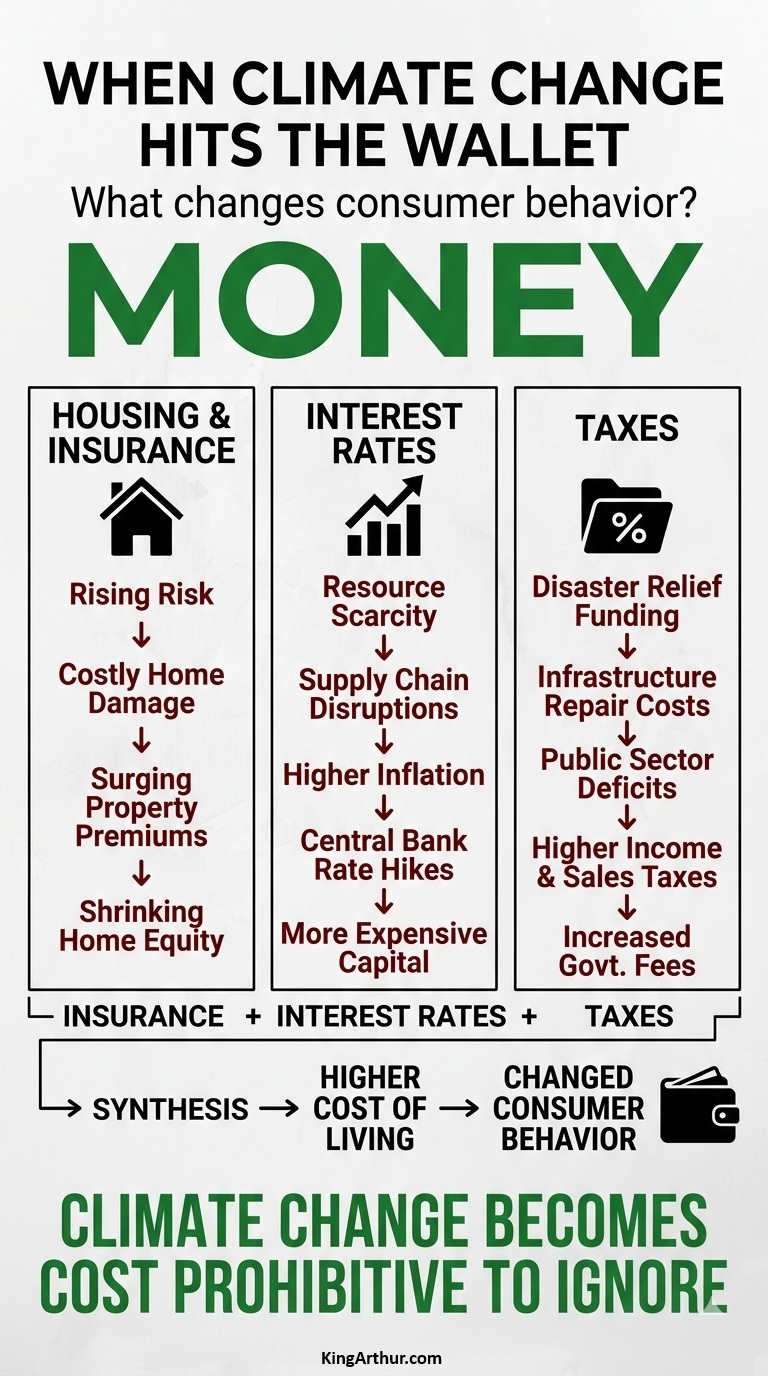
What will change consumer behavior when it comes to climate change?

Money. Insurance, interest rates, and taxes.

Most consumers do not substantially change their behavior until doing nothing becomes cost prohibitive.

For years, we assumed that climate change was unlikely to change consumer behavior in the near term. Climate change seemed too distant, too gradual, and too abstract to overcome the immediate economic incentives that drive everyday decisions.

That is now observably changing.

Climate change is increasingly entering the household economy through three powerful financial mechanisms:

Insurance. Interest rates. Taxes.

These mechanisms can transform climate change from an environmental issue that consumers can ignore into an economic reality they cannot.

Insurance

The United States, Australia, and parts of Asia and Latin America face some of the heaviest disruptions in insurance markets from climate change. The climate-driven insurance crisis is no longer just a problem for insurance companies. It has triggered a massive shift in housing and financial markets.

As climate risks increase, insurers are raising premiums, increasing deductibles, restricting coverage, and withdrawing from markets where losses have become too great.

That directly affects consumers.

Because most people rely on banks and mortgages to purchase homes, the withdrawal of insurers directly threatens both property values and mortgage stability. A home that cannot be affordably insured becomes more difficult to finance, sell, and maintain as an investment.

The chain is straightforward:

Climate change → insurance losses → higher premiums → reduced insurability → declining property values → mortgage disruption

This creates a powerful economic incentive for consumers to change where they live, what they buy, how they build, and how they protect their property.

Insurance therefore has become one of the first places where climate change forces consumer behavior to change—not through persuasion, but through price.

Interest Rates

Climate change is also becoming a financial problem through the cost of borrowing.

Developing and climate-vulnerable nations bear the heaviest burden. Climate change directly drives up sovereign bond yields, contributes to credit-rating downgrades, and locks vulnerable countries into a punishing vicious cycle of debt and disaster. A landmark 2026 report by ActionAid International revealed that across 65 of the world’s most climate-vulnerable countries, debt servicing is projected to consume a staggering 65% of all government revenue in 2026.

The mechanism is another accelerating feedback loop:

Climate disaster → economic losses → declining government revenue → increased borrowing → higher debt costs → reduced adaptive capacity → greater vulnerability

The consequences do not remain confined to developing nations.

The approximately $2 trillion annual climate-driven fiscal drain acts as a massive structural accelerator for interest rates in the United States. It does not directly determine daily Federal Reserve rate decisions. Instead, this enormous and growing economic burden alters the underlying macroeconomic conditions that the Federal Reserve and bond markets use to price capital.

Climate damage requires money. Rebuilding requires money. Infrastructure adaptation requires money. Insurance losses require money. Government deficits require money. And when the demand for capital rises while economic productivity and fiscal capacity are simultaneously pressured, the cost of capital rises.

Consumers ultimately experience that cost through mortgages, automobile loans, credit cards, business financing, and other forms of debt.

Taxes

Climate change affects taxation at both ends of the global economic spectrum.

Low-income developing nations face catastrophic losses in baseline tax revenue as climate disasters destroy crops, businesses, infrastructure, and productive capacity.

At the same time, wealthy economies are rapidly restructuring their tax systems around carbon emissions, energy production, subsidies, and the transition to lower-carbon energy.

The result is another financial feedback loop:

Climate damage → economic losses → reduced tax base → increased government spending → greater fiscal pressure → higher taxes and fees

In the United States, the financial impact of climate change is not represented by a single “climate tax.”

Instead, the costs are absorbed across federal, state, and local tax systems.

Local governments face increasing costs for damaged infrastructure, emergency response, stormwater management, roads, bridges, utilities, and other public services. Those costs ultimately have to be paid by taxpayers.

Property taxes can therefore become another mechanism through which climate change reaches the household balance sheet.

At the federal and state levels, climate-related disaster costs, infrastructure requirements, energy policies, and changes in taxation can add additional fiscal pressure.

Consumers may never see a line on their tax bill labeled “climate change.” They do not have to. They simply see the bill go up.

The Consumer Climate Feedback Loop

Insurance, interest rates, and taxes are not isolated financial effects.

They interact.

A homeowner faces higher insurance premiums because of increasing climate risk. Higher insurance costs increase the cost of homeownership. Reduced insurance availability threatens property values and mortgage financing. Climate-related disasters increase government expenditures. Government spending increases borrowing and tax pressure. Higher borrowing costs increase the cost of mortgages and other consumer debt.

The feedback loop becomes:

Climate disruption → financial losses → insurance increases → property and mortgage pressure → government spending → higher taxes and borrowing costs → higher household costs → changed consumer behavior

This is the critical transition.

Consumers do not necessarily have to become convinced by climate science before climate change changes their behavior. They only have to experience its economic consequences. A homeowner who can no longer afford insurance behaves differently. A buyer who cannot obtain a mortgage behaves differently. A family facing higher property taxes behaves differently. A business facing higher borrowing costs behaves differently. A community facing rapidly increasing infrastructure costs behaves differently.

The financial system can therefore become the transmission mechanism through which climate change reaches individual consumer decisions.

Ending Synthesis: When Climate Change Becomes Cost Prohibitive

The question is not whether climate change will eventually affect consumer behavior.

The question is when the financial consequences become large enough that consumers can no longer ignore them.

That threshold is already being crossed in parts of the world.

Insurance makes climate risk visible through premiums and availability.

Interest rates transmit climate-related economic and fiscal disruption into the cost of capital.

Taxes distribute the growing costs of climate damage, adaptation, infrastructure, and energy transition across households and businesses.

Together, they create a socioeconomic feedback loop:

Climate change → economic disruption → financial disruption → higher household costs → consumer behavior → market disruption → further economic pressure

This may prove far more powerful than climate messaging alone.

People can ignore a temperature graph.

They can dismiss a scientific projection.

They can debate climate policy.

But they cannot easily ignore an insurance cancellation, a mortgage that costs hundreds of dollars more each month, or a tax bill that keeps rising.

That is why money may ultimately become the mechanism that changes consumer behavior on climate change.

Climate change does not have to become universally accepted before it changes what people do.

It only has to become cost prohibitive to ignore.

Simplified Social Media Version

💰 WHEN CLIMATE CHANGE HITS THE WALLET

What will actually change consumer behavior when it comes to climate change?

Money.

Insurance. Interest rates. Taxes.

For years, climate change was largely treated as an environmental issue. But that is changing as climate risk increasingly enters the household economy.

🏠 Insurance premiums and availability are being affected by rising climate risks.

💰 Climate-related economic and fiscal pressures are affecting the cost of capital.

🧾 The growing costs of climate damage, adaptation, infrastructure, and energy transition are increasingly flowing through tax systems.

These forces can reinforce one another:

Climate change → financial disruption → higher household costs → changed consumer behavior

Consumers may ignore a temperature graph. They are much less likely to ignore an insurance cancellation, a higher mortgage payment, or a rising tax bill.

Climate change does not have to be universally accepted before it changes behavior.

It only has to become cost prohibitive to ignore.

New paper:
“When Climate Change Hits the Wallet: Insurance, Interest Rates, and Taxes”

bookmark_borderWhere Did the Hurricane Energy Go? Jersey Shore to the Outer Banks

by Daniel Brouse

El Niño, Atlantic Niña, Teleconnections, and a Real-Time Climate Experiment on the Jersey Shore

Tonight’s “homework” is to observe one of the most fascinating manifestations of chaos theory in real time: climate teleconnections.

And, of course, it has a lot to do with the Butterfly Effect.

The question is simple:

What happens to atmospheric and oceanic energy when the climate system changes the pathway through which that energy is normally expressed?

Climate change and coastal impacts are becoming increasingly serious problems along the Southern Jersey Shore, where barrier-island communities are particularly exposed. At the same time, federal funding for beach nourishment has become more constrained, while the sand required to maintain vulnerable beaches is itself becoming an increasingly limited resource.

The next several days should provide an interesting real-world experiment.

The Jersey Shore experiment

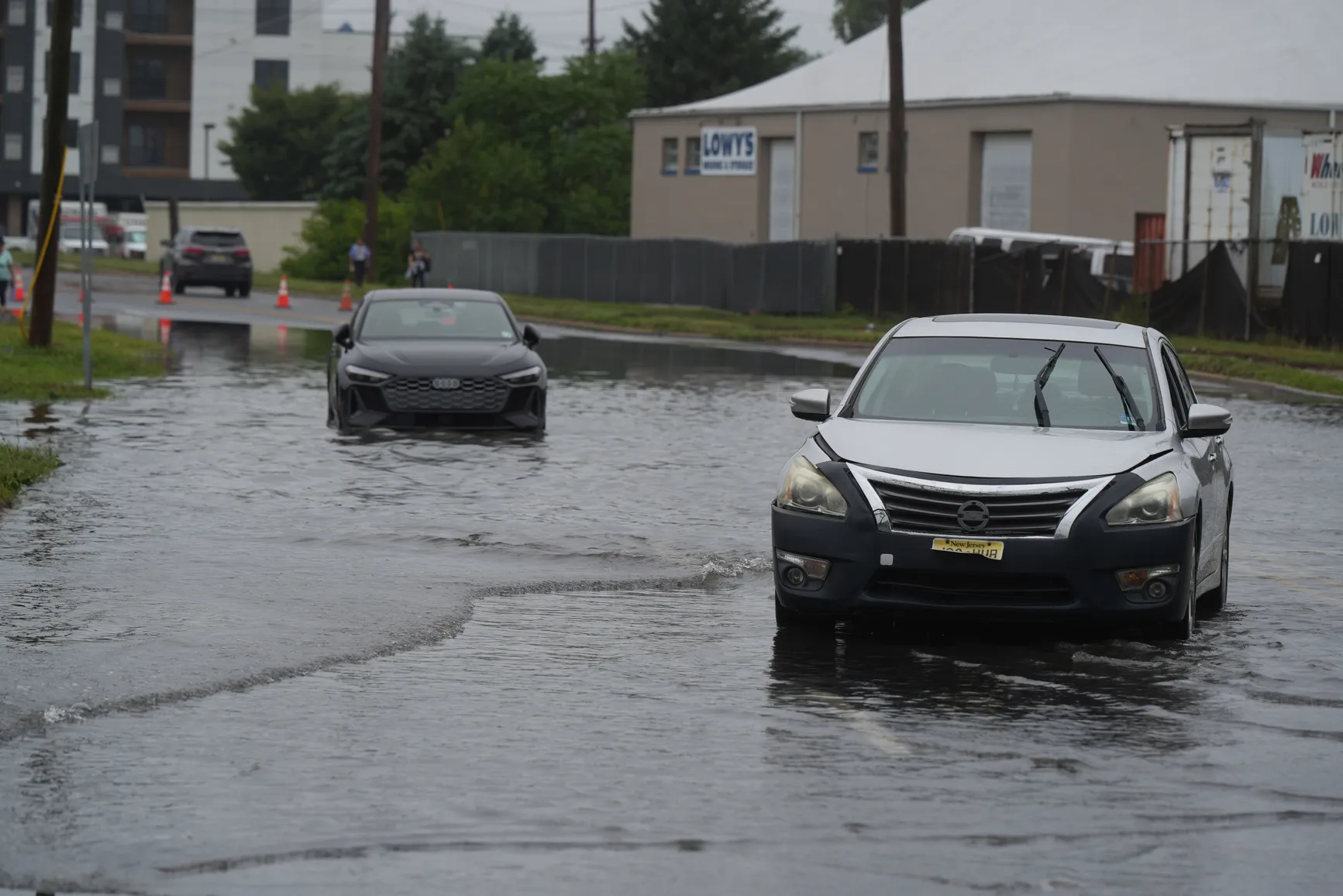
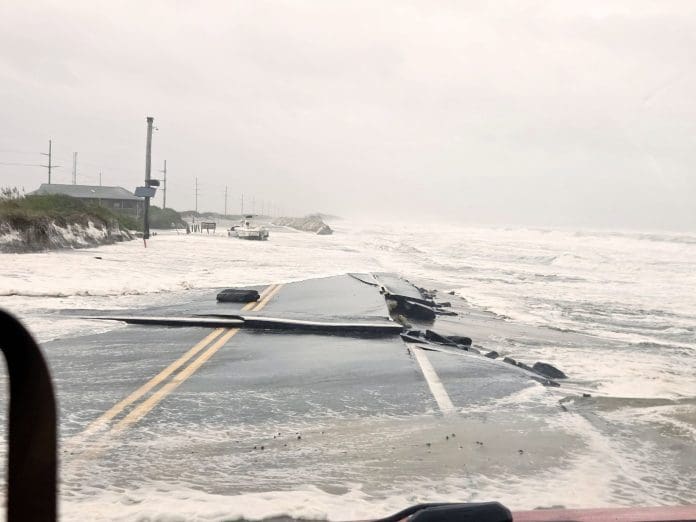
A powerful and exceptionally persistent September nor’easter is affecting the Jersey Shore, bringing coastal flooding, dangerous surf, strong northeast winds, and significant beach erosion. The National Weather Service has extended the Coastal Flood Warning for Ocean, Atlantic, Cape May, and southeastern Burlington counties through Sunday, September 27. The warning calls for one to two feet of inundation above ground level in vulnerable low-lying areas near shorelines and tidal waterways, with widespread roadway flooding possible.

This is shaping up to be one of the most persistent nor’easters in modern history, with significant coastal impacts continuing for days rather than hours. The prolonged onshore winds are repeatedly pushing water toward the coast, while high surf and wave action continue to pound beaches and barrier islands.

The combination of persistent winds, elevated water levels, astronomical tides, and repeated wave attack makes this much more than a single coastal storm event. It is an extended assault on an already vulnerable coastline.

Along portions of the coast, the National Weather Service is also warning of high surf, with breaking waves reaching approximately nine feet in the surf zone.

The timing is important. The storm is occurring during the full-moon period, when astronomical tides can increase the baseline water level and make coastal flooding more consequential.

So here is the experiment:

Watch what happens along the coast—and ask where the energy is being expressed.

The missing hurricanes

The alarming part isn’t simply that Atlantic hurricane activity has been unusually limited.

It is the possibility that multiple components of the climate system are becoming more strongly coupled.

I first raised the possibility of an unusual Pacific El Niño–Atlantic Niña interaction earlier this year. Now, as we move deeper into the Atlantic hurricane season, the observations provide an opportunity to examine how a disturbance in one ocean basin can influence atmospheric circulation and weather thousands of miles away.

NOAA’s September 2026 ENSO diagnostic reports that El Niño is strengthening, with sea-surface-temperature anomalies exceeding +3°C in the eastern equatorial Pacific. NOAA also gives greater than a 90% probability of a very strong El Niño during the Northern Hemisphere fall and winter of 2026–27.

That matters because El Niño is not confined to the Pacific.

Changes in tropical Pacific convection and atmospheric circulation can generate teleconnections—large-scale atmospheric responses that extend far beyond the region where the original oceanic anomaly developed.

NOAA’s hurricane researchers have specifically identified strong El Niño conditions as a factor that can suppress Atlantic hurricane development by increasing vertical wind shear, making it more difficult for tropical systems to organize and intensify.

So where does the energy go?

This is the question I want to explore.

The climate system does not simply make energy disappear because one particular type of weather event becomes less favorable.

Energy is redistributed.

A strong Pacific El Niño alters tropical convection and atmospheric circulation. Those changes can propagate through the atmosphere and influence weather patterns across distant ocean basins and continents.

At the same time, the Atlantic is experiencing its own unusual state.

The result is not necessarily a simple substitution of “hurricanes” with “nor’easters.” Weather systems have different physical mechanisms and energy sources. But the broader climate-system question remains:

When the pathways through which energy is normally released or transported are altered, what happens to the rest of the system?

That is the essence of a teleconnection.

From the Pacific to the Atlantic

This is where the experiment becomes especially interesting.

We are watching an exceptionally strong Pacific El Niño develop while the Atlantic is exhibiting anomalous conditions of its own.

The Pacific disturbance can influence the atmosphere far beyond the Pacific basin. Those atmospheric changes can affect wind patterns, pressure fields, storm tracks, ocean circulation, and the conditions governing tropical cyclone development.

In other words:

Pacific ocean → atmosphere → Atlantic circulation → storm environment → coastal weather

That is a teleconnection.

And when several components of the system interact simultaneously, the result can become much more complicated than any individual phenomenon viewed in isolation.

Chaos theory in the real world

This is where the Butterfly Effect becomes more than a metaphor.

Chaos theory does not mean that every weather event is unpredictable or that a butterfly literally causes a hurricane.

It means that a nonlinear system can contain strong interactions in which relatively small changes in one part of the system can influence the evolution of other parts of the system.

The climate system is enormously more complicated than the classic butterfly metaphor.

It contains interacting oceans, atmosphere, ice, clouds, water vapor, ecosystems, and circulation systems.

And those components are connected.

A disturbance thousands of miles away can therefore become relevant to what happens on a New Jersey beach.

The coastal consequence

For people living along the Jersey Shore, the abstract physics eventually becomes very concrete.

It becomes:

higher water → stronger waves → beach erosion → coastal flooding → damaged infrastructure

The current National Weather Service warning illustrates that vulnerability. One to two feet of inundation is enough to produce widespread roadway flooding in vulnerable coastal and bayside communities, with some roads becoming impassable.

That is why this is more than an interesting atmospheric experiment.

The Jersey Shore is an enormous natural laboratory for observing how changes in the global climate system eventually reach local communities.

Look out the window

So tonight’s homework is simple.

Look outside.

Watch the wind.

Watch the waves.

Watch the water.

Look at what is happening along the beaches from New Jersey to North Carolina.

Then ask:

Where did the hurricane energy go?

Perhaps the more scientifically useful question is:

How is the climate system redistributing energy when one of its traditional pathways is disrupted?

That is the experiment.

And that is the Butterfly Effect in the real world:

A disturbance in one part of the climate system can produce consequences thousands of miles away—not because the system is random, but because it is deeply connected.

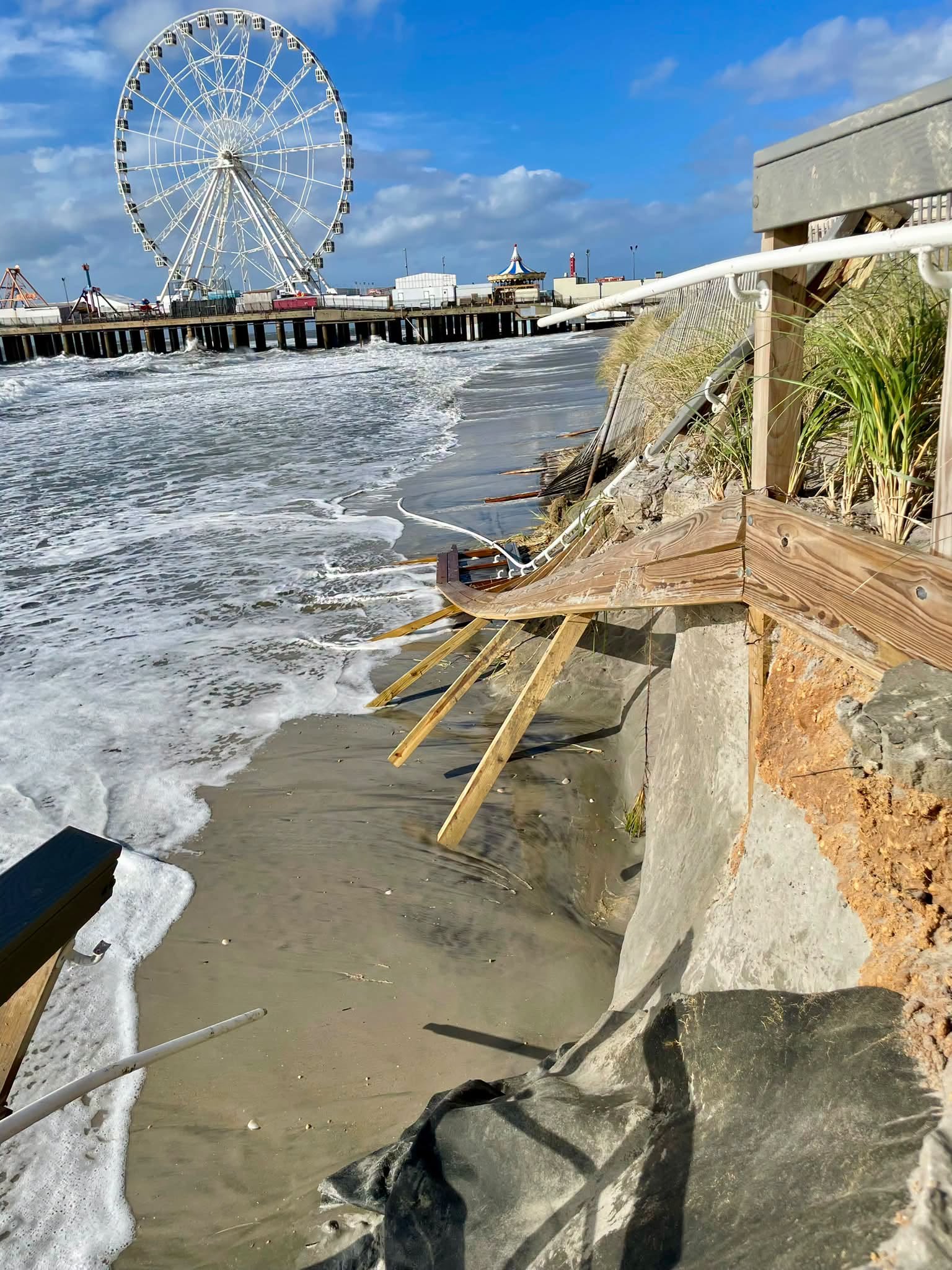
Following are photographs from New Jersey to North Carolina.

Look closely.

The climate system is telling us a story.

We just have to learn how to read it.

Simplified Social Media Version

🌪️ WHERE DID THE HURRICANE ENERGY GO?

Tonight’s homework experiment: watch the Jersey Shore.

A powerful September nor’easter is hitting the coast while an unusually strong Pacific El Niño is reshaping atmospheric circulation thousands of miles away.

At the same time, Atlantic hurricane activity has been unusually limited.

So here’s the question:

❓ When one pathway for releasing and redistributing climate-system energy is disrupted, where does that energy go?

This is where 🌎 teleconnections, nonlinear climate dynamics, and the 🦋 Butterfly Effect become visible in the real world.

🌊 Pacific Ocean
↓
🌬️ Atmosphere
↓
🌎 Atlantic circulation
↓
🌪️ Storm environment
↓
🏖️ Coastal impacts

Look out your window.

Watch the wind, waves, tides, and flooding.

Then ask:

❓ Is this just another storm—or are we watching the climate system redistribute energy across a deeply interconnected planet?

📸 Following the storm from New Jersey to North Carolina.

bookmark_borderClimate Denialism, Obfuscation, Suppression and Normalization

By Daniel Brouse

Simplified Introduction

UK Climate Security: From Suppression to the Domino Effect

Climate change is increasingly moving from the category of environmental problem into the category of systemic risk.

A recently reported UK national-security assessment warned that climate and ecological disruption can cascade across borders—affecting food security, economies, migration, and political stability.

The problem is not simply the initial climate shock.

It is what happens afterward:

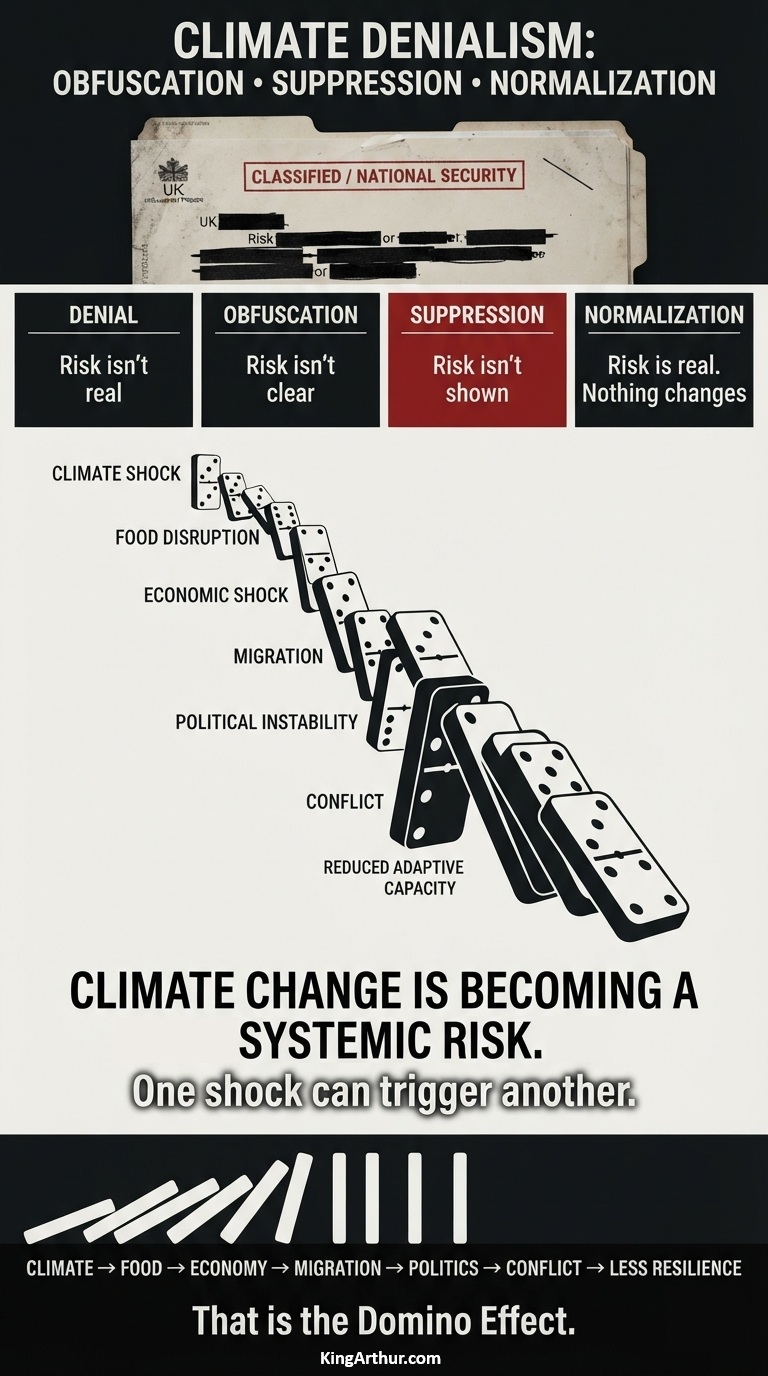
Climate shock → food disruption → economic shock → migration → political instability → conflict → reduced adaptive capacity

That is the Domino Effect. Denialism has become part of the feedback loop—delaying recognition, obstructing action, weakening resilience, and ultimately amplifying the consequences and accelerating the climate crisis.

The four stages of climate information failure are also important:

Denial — “The risk isn’t real.”
Obfuscation — “The risk isn’t clear.”
Suppression — “The evidence isn’t shown.”
Normalization — “The risk is real, but nothing fundamentally changes.”

When systemic risks are fragmented, delayed, or hidden from public discussion, society loses valuable time to prepare.

Climate risk is no longer just about what happens to the climate.
It is about what climate disruption does to everything connected to it.

🌎 Climate change → systemic risk → cascading consequences

Read the full report:

From Climate Shock to Food Disruption, Economic Shock, Migration, Political Instability, and Conflict

The climate crisis is increasingly being treated not simply as an environmental problem, but as a national-security and systemic-risk problem.

On September 23, 2026, UK Foreign Secretary Ed Miliband briefed foreign ministers from the European Union, Kenya, and other countries at the United Nations General Assembly on the findings of a UK intelligence assessment concerning climate change, nature loss, and national security. The assessment, prepared by the Joint Intelligence Committee, had reportedly been withheld from publication under the previous government and later released only in redacted form.

The assessment warned that the degradation of natural systems could cascade across borders through food shortages, migration, economic disruption, and conflict. Miliband specifically warned that the emerging El Niño could intensify these pressures, saying that climate shocks can “compound and cascade across borders,” threatening food and water security, displacing communities, putting pressure on markets, and damaging economies.

The significance of this assessment is not simply that climate change creates individual hazards. It is that climate shocks can propagate through interconnected physical, economic, and political systems.

That is the foundation of the Domino Effect:

Climate disruption
↓
Ecosystem degradation
↓
Crop losses and food disruption
↓
Food-price shocks
↓
Economic instability
↓
Migration
↓
Political instability
↓
Conflict
↓
Reduced adaptive capacity

The critical point is that none of these systems operates independently.

Denialism Depends on Fragmentation

Climate denialism often works by fragmenting a systemic problem into isolated questions.

Someone might argue:

“Climate change isn’t going to destroy my country.”

But that is not the relevant question.

A drought in one agricultural region can reduce global commodity supplies. A crop failure can increase prices in food-importing countries. Food-price inflation can destabilize governments. Migration can create political pressure far beyond the original climate impact. Conflict can disrupt energy, food, fertilizer, and commodity markets.

The original climate shock does not have to occur everywhere to produce consequences elsewhere.

That is precisely what the UK assessment is describing when it warns that climate and nature shocks can compound and cascade across borders.

The appropriate unit of analysis is therefore not simply the individual country—or even the individual climate hazard.

It is the coupled system.

The Domino Effect

The basic sequence is straightforward:

Drought
→ lower agricultural production
→ higher food prices
→ inflation
→ economic stress
→ political instability
→ migration
→ conflict
→ infrastructure destruction
→ reduced adaptive capacity
→ greater vulnerability to the next climate shock

Each stage can amplify the consequences of the previous one.

This creates a feedback loop between the physical Earth system and the socioeconomic system.

Climate disruption damages ecosystems and infrastructure. Economic disruption reduces the resources available for adaptation. Political instability makes coordinated adaptation more difficult. Conflict destroys infrastructure and institutional capacity. Those losses increase vulnerability to subsequent climate shocks.

The result is not simply:

climate change → damage

It can become:

climate shock → socioeconomic shock → reduced resilience → greater vulnerability → larger subsequent shock.

This is the essence of the Domino Effect.

The Weakness of the “Adaptation Only” Argument

If climate change were essentially linear and locally contained, adaptation could theoretically remain local:

warming → local impact → local adaptation

But a coupled system behaves differently:

warming
→ ecological disruption
→ economic disruption
→ geopolitical disruption
→ reduced adaptive capacity
→ greater vulnerability to subsequent climate disruption

At that point, adaptation is no longer simply a matter of building a seawall, installing air conditioning, changing crops, or relocating infrastructure.

The system’s capacity to adapt is itself being affected.

A country experiencing repeated crop failures, food inflation, infrastructure damage, capital losses, migration pressures, and political instability has fewer resources with which to prepare for the next shock.

Adaptation therefore has a socioeconomic limit.

Denial, Obfuscation, Suppression, and Normalization

Denialism does not always require an explicit rejection of climate science.

It can operate through several forms of information failure:

Denial:
“The risk isn’t real.”

Obfuscation:
“The evidence isn’t sufficiently important to discuss.”

Suppression:
“The evidence exists, but it should not receive public attention.”

Normalization:
“The evidence is real, but nothing fundamental needs to change.”

These mechanisms have different forms but can produce a similar result: society fails to recognize the systemic consequences of a known risk.

Climate denialism can therefore be understood broadly as systematic rhetorical, institutional, or informational behavior that prevents scientifically supported climate risks from being accurately recognized, communicated, or acted upon.

That definition shifts attention away from whether an individual literally believes climate change exists.

The more important question is whether society is capable of recognizing the consequences of climate change as an interconnected system.

The Irony of Climate Denialism

There is an important irony in the way climate risk is often framed.

Climate policy is frequently presented as a potential threat to:

  • economic growth
  • national sovereignty
  • energy security
  • food security
  • employment
  • military strength
  • financial stability

But the emerging national-security analysis increasingly identifies climate disruption itself as a threat to those same systems.

The causal relationship is therefore reversed.

The question is no longer simply:

“Can we afford climate action?”

It becomes:

“What happens to the economic, social, and security systems we are trying to protect if climate disruption continues to intensify?”

That is the central problem exposed by the Domino Effect.

Climate change is not merely an environmental externality.

It is becoming a systemic economic, social, and security risk.

From Climate Shock to Conflict

The most important feature of the Domino Effect is that the final outcome does not have to resemble the original cause.

A climate shock may begin as a drought.

The drought becomes a crop failure.

The crop failure becomes a food-price shock.

The food-price shock becomes inflation and economic instability.

Economic instability can contribute to migration and political unrest.

Political instability can increase the risk of conflict.

Conflict then destroys infrastructure, institutions, and productive capacity—reducing the ability of affected populations to adapt to the next climate shock.

The original climate event has therefore propagated through the socioeconomic system and returned as greater vulnerability to future climate disruption.

This is why climate risk cannot be assessed solely by examining temperature, precipitation, sea level, or any other individual physical variable.

The relevant question is also:

How does the shock propagate through the systems connected to it?

Denialism and Ecofascism

Denialism attempts to preserve existing systems by denying, minimizing, delaying, or obscuring the consequences of climate disruption.

A more extreme response is ecofascism: accepting environmental or ecological crisis while responding through authoritarian, exclusionary, or coercive ideas about who should receive resources, security, or protection.

The distinction matters because the two responses can appear opposite while sharing a failure to address the underlying systems problem.

Denial says, in effect:

The crisis is not serious enough to require fundamental change.

Ecofascist responses say, in effect:

The crisis is unavoidable, so survival must be allocated unequally.

Neither addresses the central systemic challenge: climate disruption affects interconnected populations through interconnected systems.

Conclusion

Climate change is increasingly moving from the category of environmental problem into the category of systemic risk.

A climate shock can become a food shock.

A food shock can become an economic shock.

An economic shock can contribute to migration and political instability.

Political instability can contribute to conflict.

Conflict can destroy infrastructure and institutions, reducing adaptive capacity and increasing vulnerability to the next climate shock.

Climate shock → food disruption → economic shock → migration → political instability → conflict → reduced adaptive capacity.

That is the Domino Effect. Denialism has become part of the feedback loop—delaying recognition, obstructing action, weakening resilience, and ultimately amplifying the consequences and accelerating the climate crisis.

The emerging national-security response is significant because governments are beginning to recognize that climate and nature loss can propagate through the systems on which economic and political stability depend. The UK government’s September 2026 statement explicitly described climate and nature crises as security risks and emphasized the need to prevent shocks from feeding through to food prices, supply chains, and security.

The challenge for climate policy is therefore larger than reducing emissions or adapting to individual hazards.

It is preserving the capacity of interconnected human systems to absorb shocks without cascading into systemic failure.

Denialism delays recognition of that problem.

Exclusionary responses attempt to decide who survives it.

The alternative is to recognize the interconnectedness of the Earth and socioeconomic systems—and build resilience before individual shocks become cascading crises.

bookmark_borderClimate Denialism and the Domino Effect

by Daniel Brouse

From Climate Shock to Food Disruption, Economic Shock, Migration, Political Instability, and Conflict

Abstract

Climate change is often discussed as a sequence of individual environmental impacts: higher temperatures, droughts, floods, crop failures, sea-level rise, wildfires, and ecosystem degradation. This framing can obscure a more consequential property of the climate system: climate shocks propagate through interconnected socioeconomic systems.

A drought does not end when rainfall declines. It can reduce crop production, increase food prices, damage household incomes, increase inflationary pressure, weaken economic stability, contribute to displacement and migration, intensify political tensions, and, under particular conditions, increase the risk of conflict. Conflict then further reduces the capacity of societies to adapt to subsequent climate shocks.

This paper describes that process as the Climate Domino Effect:

Climate disruption → crop losses → food prices → economic instability → migration → political instability → conflict → reduced adaptive capacity → greater vulnerability to the next climate shock

That is the Domino Effect. Denialism has become part of the feedback loop—delaying recognition, obstructing action, weakening resilience, and ultimately amplifying the consequences and accelerating the climate crisis.

This is not a claim that climate change mechanically causes war. Conflict has many causes, including governance failures, inequality, poverty, institutional weakness, geopolitical competition, and historical grievances. Rather, climate change can act as a risk multiplier, adding stress to systems already operating near their limits.

The distinction is important for understanding climate denialism. Denialism often treats climate impacts as isolated, manageable, or geographically contained. A systems perspective reveals a different problem: the impacts are coupled. As individual stresses interact, the resulting socioeconomic response can become nonlinear.

This concept also connects to the framework developed in Approaching Singularity: Third Derivatives, Nonlinear Collapse, and Coupled Climate–Economic Instability, which proposes that climate and economic systems should be examined not only through their levels and rates of change, but through changing rates of acceleration and increasingly strong coupling between subsystems.

The central warning is therefore not simply that climate change produces more damage. It is that climate shocks can progressively reduce the very economic, political, and institutional capacity required to respond to the next shock.


1. Introduction: Climate Change Is a System Problem

Climate change is commonly represented as a gradual increase in global temperature. That representation is scientifically useful, but incomplete.

Temperature is only one variable in an interconnected Earth system. Climate change affects precipitation, soil moisture, agricultural productivity, water availability, ecosystems, ocean conditions, infrastructure, insurance markets, commodity prices, public finances, migration patterns, and political stability.

The consequences therefore do not remain within the physical climate system.

A climate shock can become an economic shock.

An economic shock can become a social shock.

A social shock can become a political shock.

And political instability can reduce a society’s ability to respond to the next physical shock.

The result is a feedback structure rather than a simple linear sequence.

The basic socioeconomic pathway can be represented as:

Climate disruption

↓

Crop losses

↓

Food prices

↓

Economic instability

↓

Migration

↓

Political instability

↓

Conflict

↓

Reduced adaptive capacity

↓

Greater vulnerability to subsequent climate disruption

This is the Domino Effect.

Each individual event may be understandable in isolation. The danger emerges from their interaction.


2. The Climate Domino Effect

The term “domino effect” describes a system in which one event increases the probability of subsequent events.

In a climate–economic system, the dominoes are not independent.

They are coupled.

A drought can reduce agricultural production. Reduced production can increase prices. Higher prices can reduce household purchasing power. Economic stress can increase migration. Large-scale migration can place additional pressure on housing, infrastructure, labor markets, public services, and political institutions. Political instability can contribute to civil unrest or conflict in vulnerable settings.

The IPCC has explicitly identified cascading relationships among climate impacts, food insecurity, migration, political instability, and conflict. It also emphasizes that the relationship between climate change and conflict is mediated by factors such as governance, socioeconomic development, state capacity, inequality, and existing conflict.

This distinction is essential.

The Domino Effect is not:

Climate change causes war.

It is:

Climate change can introduce or intensify stresses that propagate through already vulnerable socioeconomic systems, increasing the probability of additional destabilizing outcomes.

That is a substantially more defensible proposition.


3. First Domino: Climate Disruption

The first domino is the physical climate shock.

Examples include:

  • drought
  • extreme heat
  • flooding
  • wildfire
  • changing precipitation
  • prolonged growing-season disruption
  • tropical cyclones
  • compound heat and drought
  • water scarcity
  • ecosystem degradation

The critical feature is not simply the magnitude of an individual event.

It is the interaction between the event and the system receiving the shock.

A drought occurring in a resilient agricultural economy with abundant water reserves, strong infrastructure, functioning insurance markets, and substantial fiscal capacity may produce limited long-term disruption.

The same drought occurring in a poor region with depleted soils, limited irrigation, weak institutions, high food dependence, and existing political instability can produce cascading consequences.

Thus:

Climate risk = physical hazard × exposure × vulnerability × system connectivity

The same physical forcing can therefore produce radically different socioeconomic outcomes.


4. Second Domino: Crop Losses

Food production is particularly sensitive to climate variability.

Agriculture depends simultaneously upon temperature, precipitation, soil moisture, water availability, growing-season timing, pollination, pests, disease, and ecosystem functioning.

Climate change can therefore affect food production through multiple pathways simultaneously.

The IPCC reports that climate change can increase food insecurity through direct effects on production as well as cascading effects on food prices and household incomes. It also identifies increasing risks to food production at higher warming levels.

This is where the Domino Effect begins to move from the physical climate system into the economic system.

A failed harvest is not merely an agricultural statistic.

It represents lost income for producers, reduced supply for consumers, increased demand for imports, increased competition for remaining supplies, and potentially higher government expenditures.

A local climate shock can consequently become a regional or global market shock.


5. Third Domino: Food Prices

Food prices are a critical transmission mechanism.

When agricultural production declines while demand remains relatively stable, markets respond through price increases.

For wealthy households, a food-price increase may be inconvenient.

For households already spending a large fraction of their income on food, it can become an existential economic shock.

The IPCC identifies food-price increases associated with reduced agricultural production and global food-price shocks as an important pathway connecting climate variability with social and political instability.

The important nonlinear characteristic is that the social response to price increases is not necessarily proportional to the price increase.

A 5% increase may be absorbed.

A much larger increase may force households to:

  • reduce food consumption
  • substitute cheaper foods
  • sell productive assets
  • withdraw children from school
  • take on debt
  • migrate
  • seek informal employment
  • rely on government assistance

The economic system therefore has thresholds.

Once those thresholds are crossed, the response can change rapidly.


6. Fourth Domino: Economic Instability

Food-price shocks rarely remain confined to food.

Food is part of the broader inflation system.

Agricultural losses can affect:

  • consumer prices
  • wages
  • interest rates
  • trade balances
  • government subsidies
  • household debt
  • corporate profitability
  • currency stability
  • sovereign finances

At the same time, climate disasters impose direct costs through damaged infrastructure, lost production, insurance claims, emergency spending, and reconstruction.

The result can be a feedback loop:

Climate damage

↓

Economic losses

↓

Reduced fiscal capacity

↓

Reduced investment in resilience

↓

Greater vulnerability

↓

Larger future losses

This feedback is central to the coupled climate–economic framework developed in Approaching Singularity. That paper describes the interaction as:

increasing climate impacts → rising economic losses → reduced adaptive capacity → increased vulnerability → further impacts.

The critical concept is adaptive capacity.

A society does not merely experience climate shocks.

It can become less capable of absorbing them.


7. Fifth Domino: Migration

When livelihoods become unsustainable, people move.

Migration is not inherently a failure.

Indeed, migration can be an important adaptation mechanism.

The World Bank identifies climate change as an increasingly important driver of internal migration because of impacts on livelihoods and the livability of exposed locations. Its Groundswell analysis projected that climate change could drive as many as 216 million internal migrants across six regions by 2050 under a pessimistic scenario, while also finding that early climate action and resilient development could substantially reduce the scale.

This distinction matters.

There are at least three possible responses to climate stress:

Adaptation

People change how and where they live.

Migration

People move toward areas with better economic and environmental conditions.

Forced displacement

People move because remaining has become dangerous or economically impossible.

The socioeconomic Domino Effect becomes particularly dangerous when large populations are forced to move while destination communities are simultaneously experiencing economic stress.

Migration then becomes another source of pressure on the receiving system.


8. Sixth Domino: Political Instability

Migration does not automatically produce political instability.

Political outcomes depend upon institutions, resources, public policy, social cohesion, inequality, and the capacity of governments to manage change.

But when climate-driven migration occurs simultaneously with food inflation, unemployment, housing shortages, fiscal stress, and declining public services, political tensions can increase.

The IPCC describes social tipping processes in which climate impacts interact with economic, social, and political stressors that reduce adaptive capacity and overwhelm resilience. Once such a threshold is crossed, mutually reinforcing instability can produce livelihood insecurity, migration, food insecurity, impoverishment, political conflict, and changes in political regimes.

This is an important concept:

A climate shock can weaken the political system’s ability to manage the next climate shock.

That is feedback.


9. Seventh Domino: Conflict

Conflict is the most frequently overstated component of the climate Domino Effect.

Climate change does not have a simple causal relationship with armed conflict.

Wars have political, economic, historical, ethnic, religious, territorial, and geopolitical causes.

The scientific literature therefore generally treats climate change as one factor among many.

The IPCC reports that food-price increases associated with reduced agricultural production can be associated with conflict risk and civil unrest under certain circumstances. However, it also emphasizes that other factors—including poverty, weak governance, low state capacity, inequality, and existing conflict—can be more influential.

The correct systems interpretation is therefore:

Climate stress

Existing socioeconomic vulnerability

Weak institutions

Resource competition

Food insecurity

Political grievances

→

Increased risk of instability and conflict

Climate change can function as a risk multiplier rather than a single cause.


10. The Final Domino: Reduced Adaptive Capacity

This is the most important part of the entire sequence.

The chain does not necessarily end with conflict.

Conflict can damage the very systems needed to adapt.

War can destroy:

  • agricultural infrastructure
  • roads
  • electrical grids
  • water systems
  • hospitals
  • schools
  • housing
  • financial institutions
  • government capacity

It can also divert resources from adaptation toward emergency security spending.

The resulting feedback becomes:

Climate disruption

↓

Crop losses

↓

Food-price increases

↓

Economic instability

↓

Migration

↓

Political instability

↓

Conflict

↓

Infrastructure and institutional damage

↓

Reduced adaptive capacity

↓

Greater vulnerability

↓

Larger consequences from the next climate shock

This transforms the original sequence into a positive feedback loop.


11. From Dominoes to Feedback

The distinction between a sequence and a feedback loop is fundamental.

A simple sequence would be:

A → B → C → D

A feedback system is:

A → B → C → D → A

The second system behaves very differently.

Once the final state feeds back into the initial condition, the system can amplify itself.

The climate–economic system can therefore be represented as:

Climate shock

→ agricultural disruption

→ food-price shock

→ economic stress

→ migration

→ political instability

→ conflict

→ reduced adaptive capacity

→ increased vulnerability to climate shock

This is no longer merely a chain of events.

It is a coupled nonlinear system.


12. Connection to “Approaching Singularity”

The framework developed in Approaching Singularity: Third Derivatives, Nonlinear Collapse, and Coupled Climate–Economic Instability argues that climate and economic systems should be examined as coupled systems rather than isolated variables. The paper proposes that increasing impacts, increasing acceleration, and potentially increasing acceleration of impacts can create a regime characterized by nonlinear amplification, increasing instability, and declining predictability.

The paper expresses the conceptual progression as:

dI/dt > 0

Impacts are increasing.

d²I/dt² > 0

The rate of increase is accelerating.

d³I/dt³ > 0

The acceleration itself is increasing.

The third derivative should be understood carefully. Its existence in a particular dataset does not by itself establish that the entire climate–economic system is approaching a mathematical singularity. That stronger interpretation requires rigorous statistical testing, robust datasets, uncertainty analysis, and careful specification of the underlying variables.

But the conceptual value of the framework is substantial.

It focuses attention on a question often missed by conventional trend analysis:

Is the system merely changing faster, or is the rate at which it is changing itself changing?

That question becomes especially important when climate and socioeconomic processes are coupled.


13. Climate Shock and Economic Shock Are Not Independent

Traditional economic analysis often treats climate damage as an external shock.

A hurricane damages infrastructure.

A drought reduces agricultural output.

A flood damages property.

The economic model then calculates the resulting loss.

But a coupled system behaves differently.

Climate change can alter the economic system’s underlying conditions.

For example:

Climate warming

→ higher disaster losses

→ higher insurance costs

→ insurance withdrawal

→ falling property values

→ reduced investment

→ weaker tax base

→ reduced government capacity

→ less adaptation

→ greater future losses

This is a feedback loop rather than a one-time economic loss.

Approaching Singularity identifies several economic mechanisms that can amplify climate impacts, including infrastructure stress, insurance-market withdrawal, capital mispricing, and sovereign fiscal pressure.


14. Why Denialism Is Particularly Dangerous in a Coupled System

Denialism is often understood as simply rejecting climate science.

That is too narrow.

In a complex system, denial can also take the form of fragmentation.

One accepts:

  • droughts

but rejects their connection to food prices.

One accepts:

  • food inflation

but rejects its relationship to climate disruption.

One accepts:

  • migration

but treats it as entirely independent of environmental conditions.

One accepts:

  • political instability

but ignores the cumulative stresses preceding it.

One accepts:

  • conflict

but treats it as unrelated to the underlying resource and economic stresses.

The result is a fragmented interpretation of a coupled system.

Each domino is acknowledged individually while the chain connecting them is denied.

This is a particularly powerful form of denial because no single statement necessarily has to be false.

The denial occurs at the level of system relationships.


15. The Denialism of “It’s Only Weather”

A drought can be dismissed as weather.

A flood can be dismissed as weather.

A hurricane can be dismissed as weather.

A heat wave can be dismissed as weather.

But climate change does not require every individual event to be unprecedented.

The relevant question is whether changing climatic conditions alter the frequency, intensity, persistence, spatial distribution, or consequences of hazards.

The economic system then integrates those events over time.

One flood may be recoverable.

Repeated floods can destroy insurability.

One drought may be manageable.

Repeated droughts can exhaust groundwater and financial reserves.

One food-price shock may be absorbed.

Repeated shocks can destabilize household finances and government budgets.

Thus the relevant variable is not merely:

How bad was this event?

It is also:

How frequently are shocks occurring, how strongly are they interacting, and how much recovery capacity remains between them?


16. The Recovery-Time Problem

This introduces another important nonlinear mechanism.

Suppose a society experiences:

Shock → recovery → shock → recovery → shock

If recovery occurs completely between shocks, resilience may remain relatively stable.

But suppose:

Shock → partial recovery → shock → partial recovery → shock

Now damage accumulates.

Eventually:

Shock → insufficient recovery → shock → insufficient recovery → systemic stress

The system’s state changes even if the individual shocks do not become dramatically larger.

This produces an important climate-risk concept:

The danger may arise not only from stronger shocks, but from shorter intervals between shocks.

If the recovery time becomes longer than the interval between disturbances, cumulative vulnerability increases.

That provides another mechanism connecting climate acceleration to socioeconomic instability.


17. The Domino Effect and Adaptive Capacity

Adaptive capacity should therefore be treated as a dynamic variable.

It is not a fixed characteristic of a country.

It can increase through:

  • infrastructure investment
  • diversified food systems
  • resilient agriculture
  • stronger institutions
  • disaster preparedness
  • social safety nets
  • economic diversification
  • ecosystem restoration
  • climate mitigation

But it can also decline through:

  • repeated disasters
  • debt
  • economic contraction
  • infrastructure destruction
  • institutional breakdown
  • conflict
  • displacement
  • loss of human capital

Thus:

Adaptive capacity ↑ → vulnerability ↓

but:

Climate shocks ↑ → economic damage ↑ → adaptive capacity ↓ → vulnerability ↑

This creates the possibility of a dangerous feedback:

The more shocks a vulnerable system experiences, the less capable it may become of absorbing the next shock.


18. Why the Domino Effect Is Not Deterministic

A critical qualification must remain central.

The Domino Effect is a risk framework, not a deterministic prediction.

Climate disruption does not inevitably produce:

crop failure → famine → migration → war.

Societies can interrupt the chain.

For example:

Climate shock

→ agricultural loss

→ emergency food imports

→ targeted financial assistance

→ infrastructure investment

→ successful recovery

The dominoes stop.

That is precisely why adaptive capacity matters.

Institutions can absorb shocks.

Markets can redistribute resources.

Governments can provide assistance.

Communities can adapt.

International cooperation can reduce cascading effects.

The existence of nonlinear risk does not mean collapse is inevitable.

It means that the consequences of failing to interrupt the cascade can become disproportionately large.


19. The Strategic Implication

The most effective response to the Domino Effect is therefore not simply to address each domino independently.

It is to strengthen the connections that can stop the cascade.

Prevent crop losses

through:

  • resilient agriculture
  • water management
  • soil conservation
  • ecosystem protection
  • crop diversification

Reduce food-price shocks

through:

  • diversified supply chains
  • strategic reserves
  • social safety nets
  • reduced dependence on vulnerable production regions

Protect economic stability

through:

  • resilient infrastructure
  • appropriate insurance mechanisms
  • diversified economies
  • climate-risk disclosure
  • fiscal preparedness

Manage migration

through:

  • planned relocation
  • adaptation investment
  • housing
  • infrastructure
  • employment opportunities

Strengthen political stability

through:

  • effective institutions
  • equitable resource allocation
  • transparent governance
  • social protection

Reduce conflict risk

through:

  • diplomacy
  • resource cooperation
  • humanitarian assistance
  • conflict prevention
  • international coordination

Every intervention that prevents one domino from falling can prevent the next domino from falling.


20. Climate Denialism Versus Systems Thinking

The fundamental difference can therefore be summarized as follows.

Fragmented thinking

Drought is weather.

Food prices are economics.

Migration is politics.

Conflict is geopolitics.

Climate change is an environmental issue.

Each problem is placed into a separate category.

Systems thinking

Climate disruption can affect agriculture.

Agricultural disruption can affect food prices.

Food prices can affect household and national economies.

Economic stress can affect migration.

Migration and economic stress can affect political stability.

Political instability can increase conflict risk.

Conflict can destroy adaptive capacity.

Reduced adaptive capacity increases vulnerability to the next climate shock.

The second framework recognizes the connections between systems.

That is the essential insight of the Domino Effect.


21. Toward a Coupled Climate–Economic Risk Framework

The next generation of climate-risk analysis should therefore move beyond isolated measurements.

Instead of asking only:

How much has global temperature increased?

we should also ask:

  • How quickly are climate impacts changing?
  • How quickly are they accelerating?
  • How frequently are shocks occurring?
  • How much recovery occurs between shocks?
  • Which systems are coupled?
  • Where are thresholds emerging?
  • Is adaptive capacity increasing or decreasing?
  • Are climate shocks beginning to synchronize with economic shocks?
  • Are socioeconomic feedbacks amplifying physical climate impacts?

This is the conceptual bridge between the Domino Effect and the singularity framework.

The objective is not to predict a precise date of collapse.

It is to identify whether a system is moving from:

stable

→ stressed

→ nonlinear

→ self-amplifying

→ potentially unstable

before the final transition occurs.


22. Conclusion

Climate change is not simply a collection of environmental problems.

It is a source of systemic risk.

A climate shock can become a food shock.

A food shock can become an economic shock.

An economic shock can become a migration shock.

Migration and economic stress can contribute to political instability.

Political instability can increase the risk of conflict.

Conflict can destroy infrastructure, institutions, human capital, and financial resources.

Those losses reduce adaptive capacity.

Reduced adaptive capacity increases vulnerability to the next climate shock.

The resulting system can therefore be represented as:

Climate disruption → crop losses → food prices → economic instability → migration → political instability → conflict → reduced adaptive capacity → greater climate vulnerability

This is the Climate Domino Effect. Denialism has become part of the feedback loop—delaying recognition, obstructing action, weakening resilience, and ultimately amplifying the consequences and accelerating the climate crisis.

Its significance lies not in claiming that climate change inevitably produces any particular social outcome. Rather, it demonstrates how climate stress can propagate through interconnected systems and how those systems can feed back upon one another.

That is precisely why climate denialism is so consequential.

When the problem is treated as a collection of isolated events, each domino can be dismissed individually.

When the problem is understood as a coupled system, the relationships become impossible to ignore.

The central risk is therefore not merely that climate change produces increasingly severe individual events.

It is that the interval between shocks may shrink, the interactions among shocks may strengthen, and the capacity to recover may decline.

At that point, the climate system and socioeconomic system are no longer responding independently.

They are interacting.

And when interconnected systems begin amplifying one another, the rate of change can become as important as the amount of change itself.

That is the central question raised by the coupled climate–economic framework:

Are we approaching a regime in which climate impacts, economic instability, and declining adaptive capacity increasingly reinforce one another?

Answering that question requires moving beyond temperature alone and toward a systems-based analysis of energy, acceleration, coupling, thresholds, feedbacks, and resilience.


References

Brouse, D., & Mukherjee, S. (2026). Approaching Singularity: Third Derivatives, Nonlinear Collapse, and Coupled Climate–Economic Instability. The paper develops the third-derivative/accelerating-acceleration framework and examines nonlinear coupling between climate and economic systems.

IPCC (2022). Climate Change 2022: Impacts, Adaptation and Vulnerability — Chapter 5: Food, Fibre and Other Ecosystem Products. The IPCC documents cascading relationships among climate impacts, food production, food prices, household incomes, food insecurity, migration, political instability, and conflict.

IPCC (2022). Climate Change 2022: Impacts, Adaptation and Vulnerability — Figure 8.11. The IPCC describes social tipping points in which climate impacts interact with economic, social, and political stressors, reducing adaptive capacity and potentially producing cascading instability.

IPCC (2022). Climate Change 2022: Impacts, Adaptation and Vulnerability — Chapter 7. The IPCC reviews pathways connecting climate variability, food-price shocks, civil unrest, migration, and conflict while emphasizing the importance of governance and socioeconomic conditions.

World Bank (2021). Groundswell: Acting on Internal Climate Migration. The World Bank identifies climate change as an increasingly important driver of internal migration and projects substantial climate-related population movement under higher-impact scenarios.

World Bank (2024). Country Climate and Development Reports — From Climate Crisis to a New Development Agenda. The World Bank documents the interaction among climate shocks, food insecurity, livelihoods, migration, and development vulnerability.
bookmark_borderClimate Change, Acceleration, and Inertia (Simplified)

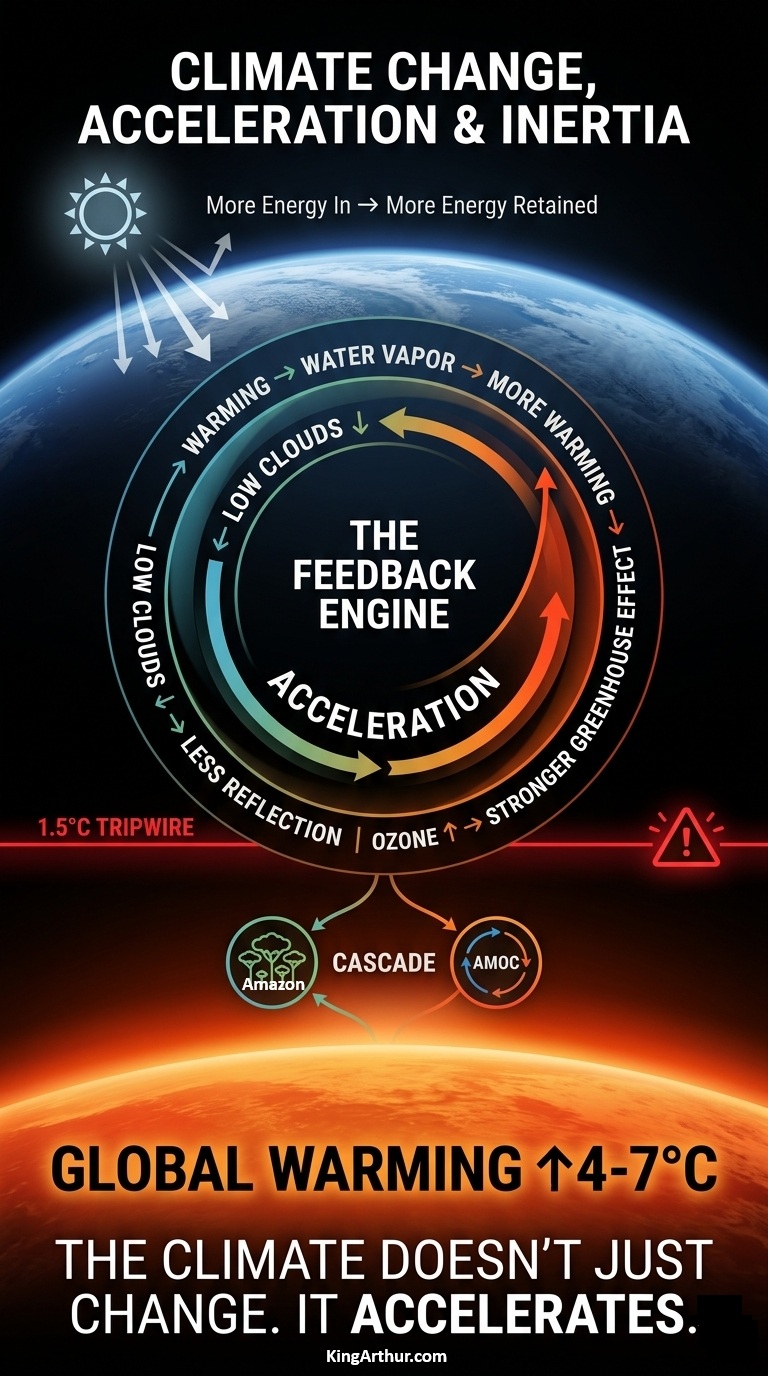
🌎 CLIMATE CHANGE, ACCELERATION & INERTIA

Climate change is not simply a matter of temperatures gradually rising.

It is an energy problem.

More energy is entering the climate system than leaving it—and most of that excess energy is being absorbed by the oceans.

That creates INERTIA.

But something else is happening.

As warming crosses critical thresholds, self-reinforcing feedbacks become increasingly active:

🔥 Warming → 💧 More Water Vapor → 🔥 More Warming ↺

☁️ Fewer Low Clouds → ☀️ More Energy Absorbed → 🔥 More Warming

🟠 More Tropospheric Ozone → 🌎 Stronger Greenhouse Effect → Faster Carbon-Cycle Response

These feedbacks don’t operate independently. They interact, couple, and reinforce one another.

That changes the mathematics of climate change.

The 1.5°C threshold is not simply a number on a thermometer. It is a tripwire for a climate system increasingly dominated by feedbacks and nonlinear responses.

The result is a new climate reality:

ACCELERATION + COUPLING + INERTIA

The question is no longer simply how much greenhouse gas humans emit.

It is how quickly the climate system begins amplifying the warming we have already created.

🌎 Climate Change, Acceleration, and Inertia

By Daniel Brouse

bookmark_borderClimate Change, Acceleration, and Inertia

by Daniel Brouse and Sidd Mukherjee

Climate Change

Climate change has been primarily driven by fossil-fuel emissions creating an energy imbalance. More energy is entering the climate system than is leaving. The accumulation of that energy manifests first as rising temperatures and increasingly as extreme weather energy events such as storms and heatwaves.

Most of the increase in the energy imbalance is stored in the oceans. Consequently, global warming has inertia: even after humans stop adding greenhouse gases to the atmosphere, the climate system will continue responding to the energy already accumulated within it.

The Times They Are a-Changing

Nearly all of the climate scenarios developed over the past several decades were based on avoiding sustained warming above the 1.5°C threshold. Once temperatures began exceeding the 1.5°C tripwire on a regular basis, as has happened since 2020, self-reinforcing feedbacks began to be increasingly activated.

There are millions of feedback processes operating throughout the Earth system. Many accelerate the rate of warming. The most observable is the water-vapor feedback and its connection to the water cycle. Warmer air can hold more water vapor, and water vapor is the most abundant and one of the most potent greenhouse gases.

More warming → more water vapor → more warming → more water vapor ↺

This is a positive feedback loop: the initial warming creates conditions that amplify subsequent warming.

Diminishing Low-Level Clouds and Increasing Ozone

There are two feedback systems that are much less understood but potentially far more consequential.

The diminishing of low-level clouds reduces Earth’s albedo—the fraction of incoming solar energy reflected back into space. Less reflection means more energy is retained by the climate system, causing the energy imbalance and its rate of acceleration to become increasingly nonlinear.

At the same time, increasing tropospheric ozone strengthens the greenhouse effect while also affecting the carbon cycle, shortening the timeline over which carbon remains sequestered.

Within each of these systems are multiple interacting feedbacks that can themselves be amplified and reinforced.

This is the critical distinction between individual feedbacks and a nonlinear Earth system: feedbacks do not necessarily operate independently. They can couple together, creating pathways through which warming accelerates other processes that then accelerate warming again.

The Tipping Points

By 2027, two major climate tipping systems showed evidence of approaching or entering potentially irreversible changes: Amazon dieback and the slowdown of the Atlantic Meridional Overturning Circulation (AMOC).

These are not isolated events. They are components of an interconnected climate system in which changes in one part of the Earth system can alter conditions elsewhere, increasing the potential for cascading effects.

The New Reality

Having tripped the 1.5°C tripwire, both the acceleration and inertia of climate change have created a new reality.

The most likely scenario is global warming of approximately 4°C this century.

If humanity does not reach net zero by 2035, approximately 4–7°C of warming by 2150 becomes the most likely scenario.

The fundamental problem is no longer simply how much warming greenhouse-gas emissions cause. It is how the warming already produced is activating feedbacks that can accelerate the rate of further warming—and how the enormous amount of energy already stored in the oceans creates inertia that will persist long after the initial forcing changes.

Climate change is therefore not a linear process moving steadily toward a predetermined endpoint.

It is an accelerating, coupled Earth-system process with both momentum and feedback.

The question is no longer simply how much we warm the planet.

It is how quickly the climate system begins warming itself.

bookmark_borderWhen Climate Feedbacks Begin to Accelerate

by Daniel Brouse

Low Clouds, Ozone, and the Emerging Climate Jerk Surge

The Question We Should Be Asking

A common assumption in climate projections is that if humanity eventually stops adding greenhouse gases to the atmosphere, global temperatures will eventually stabilize. That basic physical expectation remains important. But it leaves out a potentially critical question:

What happens when the climate system itself begins generating additional warming through feedbacks that have been activated by the warming already produced?

This distinction becomes particularly important as global warming approaches and exceeds 1.5°C above the preindustrial baseline.

The issue is no longer simply how much additional carbon dioxide humans will emit. It is also whether the Earth system is beginning to change in ways that reduce its ability to regulate incoming energy, weaken natural carbon sinks, and couple multiple feedback mechanisms together.

Two feedbacks deserve particular attention:

  1. The diminishing cooling influence of low clouds and the resulting decline in planetary reflectivity.
  2. The tropospheric ozone feedback, in which ozone simultaneously contributes to warming and damages vegetation that removes carbon dioxide from the atmosphere.

Together, these mechanisms illustrate why climate change cannot necessarily be understood as a simple linear relationship between greenhouse-gas emissions and temperature.

The emerging evidence instead points toward a more complicated possibility: a climate system in which feedbacks are becoming increasingly coupled—and in which the rate of that coupling may itself be accelerating.

From Warming to Feedback Activation

The traditional climate-change framework can be summarized relatively simply:

Human emissions → greenhouse gases → warming.

But the actual Earth system is more complicated:

Human emissions → warming → feedback activation → additional warming → additional feedback activation.

Some feedbacks are negative and tend to stabilize the system. Others are positive and amplify the initial disturbance. The critical issue is therefore not merely whether a feedback exists. Positive climate feedbacks have been known for decades. The more important question is whether previously modest feedbacks become stronger, interact with other feedbacks, or cross thresholds as warming increases.

That is where the recent climate record becomes particularly interesting.

A 2022–2026 analysis examined six major climate-system variables: cloud cover, planetary albedo, sea-ice extent, atmospheric water vapor, ocean heat content, and surface temperature. The analysis identified increasing coupling among these variables beginning most notably around 2022.

The three strongest interaction pathways are:

  • Planetary Albedo × Ocean Heat Content
  • Cloud Cover × Ocean Heat Content
  • Planetary Albedo × Cloud Cover

Together, these three pathways account for 39.6% of the displayed surge weight in the analysis. This is important because these relationships describe an energy pathway rather than merely a temperature trend.

Cloud changes can alter planetary reflectivity. Changes in reflectivity alter solar absorption. Greater solar absorption increases energy entering the climate system. Much of that additional energy enters the ocean. Ocean warming then influences atmospheric moisture, clouds, sea ice, and other components of the climate system.

The result is a network rather than a single feedback.

Feedback #1: The Diminishing Low-Cloud Effect

Low clouds are among Earth’s most important regulators of incoming solar energy.

Because low clouds are generally reflective, they send a portion of incoming sunlight back toward space. A reduction in reflective low-cloud cover therefore has the potential to increase the amount of solar energy absorbed by the Earth system.

This creates a straightforward energy pathway:

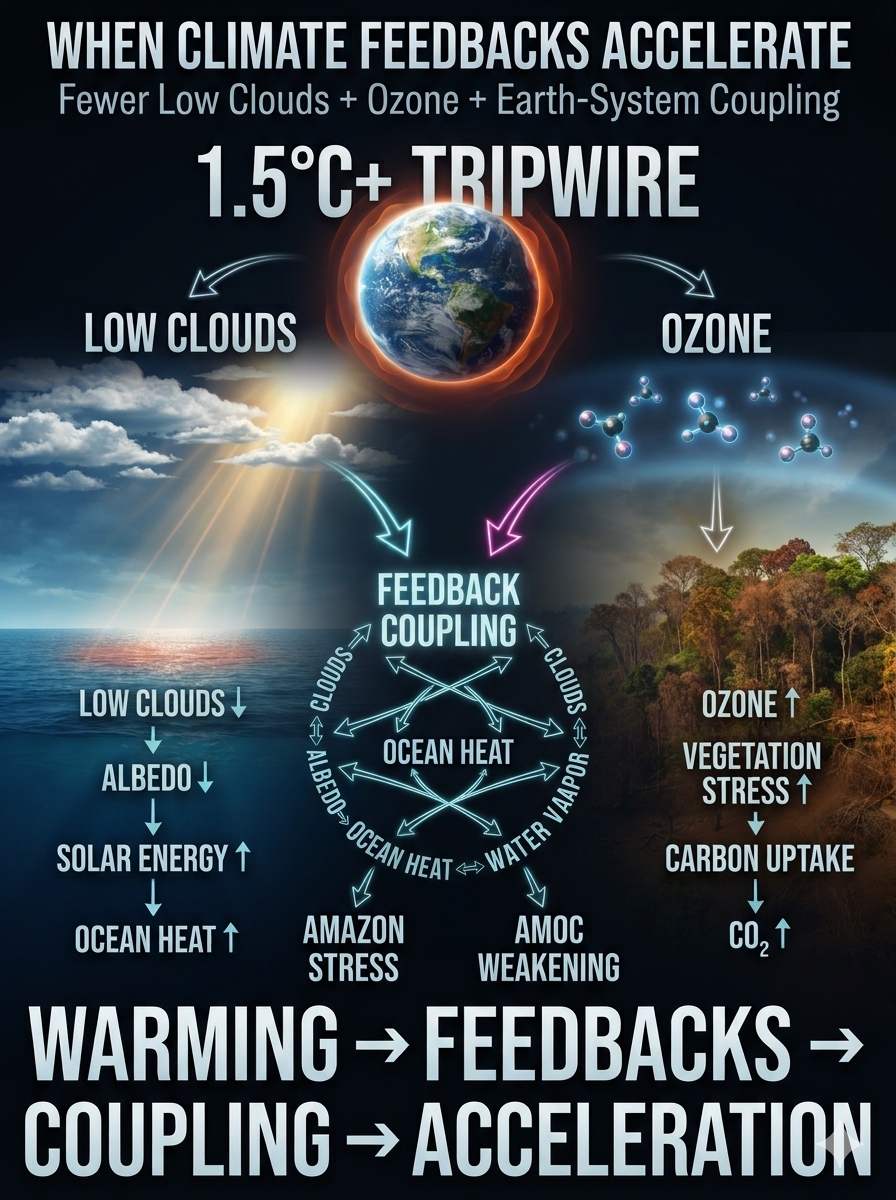
Low clouds ↓
→ planetary albedo ↓
→ reflected sunlight ↓
→ absorbed solar radiation ↑
→ ocean heat uptake ↑
→ warming ↑

The Climate Jerk Surge analysis identifies the Cloud Cover × Ocean Heat Content pathway as contributing 13.2% of the displayed surge weight, while Planetary Albedo × Cloud Cover contributes another 12.1%. Planetary Albedo × Ocean Heat Content contributes 14.3%.

The significance is not that clouds have suddenly become a new climate feedback. They have always been part of the climate system. The significance is that a change in cloud behavior can become coupled to changes in planetary albedo and ocean heat content.

That transforms a relatively simple cloud-radiation relationship into a potentially self-reinforcing energy pathway:

Cloud cover ↓
→ albedo ↓
→ solar absorption ↑
→ ocean heat ↑
→ atmospheric and cloud response
→ further changes in cloud cover and albedo.

This is particularly important in the context of reduced marine aerosol emissions. Marine aerosols can influence cloud formation and reflectivity. Reductions in shipping-related sulfur emissions therefore have the potential to remove part of the atmospheric masking effect that previously reflected sunlight or influenced cloud properties.

The Climate Jerk Surge analysis does not require aerosol reductions to be the sole explanation for recent changes. Rather, it identifies the reduction in marine aerosols as a physically testable external perturbation occurring within a climate system already experiencing greenhouse-gas forcing, ocean warming, internal variability, sea-ice loss, and changing cloud behavior.

That distinction matters.

The argument is not:

“Shipping aerosols caused the recent warming.”

The more important question is:

“Did a reduction in an existing cooling influence help expose or amplify a climate system that was already becoming increasingly sensitive?”

That is a question that can be tested against observations.

The Energy Problem

The importance of low clouds becomes clearer when climate change is viewed through energy rather than temperature alone.

The Earth does not warm because a thermometer says it should warm. It warms when the planet retains more energy than it releases to space. A reduction in low-cloud reflectivity can therefore matter even before its effect becomes obvious in surface temperature.

The sequence begins with radiation:

Reflectivity ↓
→ solar energy absorbed ↑
→ planetary energy imbalance ↑
→ ocean heat content ↑.

Because the oceans store enormous quantities of heat, the surface-temperature response does not necessarily occur immediately or proportionally. This creates an important distinction between the climate state and the climate trajectory. A system can be accumulating energy at an accelerating rate even while surface temperature temporarily fluctuates.

That is one reason temperature alone can obscure changes occurring within the climate system.

Feedback #2: The Ozone Climate Multiplier

Tropospheric ozone presents an entirely different kind of feedback. Ozone is commonly discussed as an air-pollution problem or as a greenhouse gas. But its climate significance extends beyond its direct radiative effect.

Tropospheric ozone can damage vegetation. Vegetation, in turn, removes carbon dioxide from the atmosphere through photosynthesis.

That creates a second pathway:

Ozone ↑
→ plant damage ↑
→ photosynthesis ↓
→ carbon sequestration ↓
→ atmospheric CO₂ ↑
→ warming ↑.

The result is a two-pathway climate effect:

Ozone ↑
→ direct greenhouse warming ↑

and simultaneously:

Ozone ↑
→ vegetation damage ↑
→ carbon sinks weaken ↓
→ atmospheric CO₂ ↑
→ additional warming ↑.

This is why ozone can function as a climate multiplier rather than simply another greenhouse gas.

A Nature Geoscience study cited in the ozone analysis estimated that anthropogenic ozone pollution reduced tropical-forest net primary productivity by approximately 17% globally since 2000. That finding is important because tropical forests constitute a major component of the terrestrial carbon sink.

If atmospheric ozone damages that sink, the consequence is not confined to local air quality or forest health.

It can alter the global carbon cycle.

Ozone Creates a Different Kind of Feedback

The low-cloud feedback changes the Earth’s energy budget directly.

The ozone feedback can change both the energy budget and the carbon budget.

That makes the ozone pathway particularly important when considering nonlinear climate behavior.

Consider the sequence:

Warming → vegetation stress → reduced carbon uptake → more atmospheric CO₂ → additional warming.

Now introduce ozone:

More ozone → additional plant damage → still less carbon uptake → still more atmospheric CO₂.

The feedback therefore has the potential to operate simultaneously through atmospheric chemistry and the biosphere.

The effect is compounded when ozone interacts with other climate stresses.

Heat, drought, fire, insects, disease, and hydrological changes can all affect vegetation. Ozone does not have to be the sole cause of forest decline to become climatically important.

In fact, interaction may be the more important issue. A forest already stressed by warming and drought may be less capable of absorbing an additional ozone burden. Likewise, vegetation damaged by ozone may be less capable of recovering from heat, drought, or fire.

This creates another nonlinear pathway:

Climate stress → vegetation vulnerability → ozone damage → weaker carbon sink → more CO₂ → additional climate stress.

The ozone analysis therefore describes ozone as both an atmospheric forcing agent and an ecological forcing agent.

Two Feedbacks, Two Different Amplification Mechanisms

The importance of these two feedbacks is that they attack different components of the climate system.

The low-cloud pathway affects the energy budget:

Low clouds ↓
→ reflectivity ↓
→ absorbed solar energy ↑
→ ocean heat ↑.

The ozone pathway affects the carbon budget:

Ozone ↑
→ vegetation damage ↑
→ carbon uptake ↓
→ atmospheric CO₂ ↑.

Put them together and the problem becomes more complicated:

Lower cloud reflectivity can increase the amount of energy entering the climate system.

Ozone can reduce the biosphere’s ability to remove one of the greenhouse gases already accumulating in the atmosphere.

One mechanism increases the energy entering the system.

The other can reduce the system’s ability to remove a major forcing agent.

Neither mechanism needs to “run away” independently for the combined effect to matter.

They only need to become increasingly coupled with other components of the Earth system.

From Feedbacks to Coupling

The question is not simply:

“Are climate feedbacks operating?”

They obviously are.

The more consequential question is:

“Are multiple feedbacks becoming increasingly interconnected, and is that interconnection itself accelerating?”

Six climate variables generate 15 pairwise coupling pathways. These are not interpreted as 15 independent feedback mechanisms. Instead, they represent different observable relationships within a connected climate system.

Conceptually:

Climate forcing
↓
Warming
↓
Feedback activation
↓
Increasing coupling
↓
Coupling acceleration
↓
Positive coupling jerk.

The third derivative is important because it asks a different question from ordinary warming measurements.

Temperature tells us how warm the system is.

The first derivative tells us how rapidly temperature is changing.

The second derivative tells us whether the rate of warming is changing.

A third derivative—the “jerk”—asks whether the acceleration itself is changing.

Applied to feedback coupling, the same logic becomes:

How quickly are feedbacks interacting?

How quickly is that interaction accelerating?

And is the acceleration of that interaction itself increasing?

Why 1.5°C Matters

The significance of 1.5°C is therefore not that a magical switch flips at precisely that temperature.

Rather, crossing approximately 1.5°C places the Earth system increasingly far from the climate conditions under which many modern observations and historical relationships developed.

As warming progresses, the probability of activating additional feedbacks increases.

Ice declines.

Water vapor increases.

Cloud behavior changes.

Ocean heat accumulates.

Vegetation experiences increasing stress.

Atmospheric chemistry changes.

Carbon sinks can weaken.

The important question becomes whether these processes remain largely independent or increasingly interact. If they remain independent, the climate response may remain comparatively manageable. If they become strongly coupled, one feedback can change the conditions under which another feedback operates.

That is the mechanism by which a collection of individually understood processes can produce a nonlinear system response.

What This Means for Temperature Stabilization

This brings us back to the original question:

If humans stopped emitting greenhouse gases, how long would it take for temperatures to stop rising?

The conventional answer depends heavily on the assumption that the climate system’s feedback structure remains sufficiently stable. But that assumption deserves increasing scrutiny. Stopping anthropogenic emissions would remove the primary source of additional human forcing. It would not instantly reverse ocean warming, restore lost ice, rebuild reflective cloud regimes, repair damaged vegetation, or restore weakened carbon sinks. Nor would it necessarily turn off feedbacks that have already been activated.

This does not mean that continued warming after net-zero emissions is inevitable, nor does it establish a specific future temperature. It means the stabilization problem is more complicated than simply setting future human emissions to zero. If climate feedbacks are already amplifying the rate of warming, emissions must reach zero faster, and even greater reductions will be required to slow the accelerating rate of climate change. In other words, the longer we wait, the more difficult it becomes to reverse the acceleration already underway.

The relevant equation is not merely:

Human emissions → atmospheric CO₂ → temperature.

It is closer to:

Human forcing → warming → feedback activation → feedback coupling → changing energy and carbon flows → additional warming.

If the coupling terms themselves are accelerating, then projections based on a relatively stationary feedback structure may underestimate the possibility of nonlinear behavior.

The Emerging Climate Jerk Surge

The importance of the 2022–2026 observations is therefore not simply that several climate indicators have moved in an unfavorable direction. The more interesting signal is that multiple indicators appear to be moving together.

The strongest relationships identified involves precisely the variables expected to participate in an energy-amplification pathway:

Planetary albedo
↕
Cloud cover
↕
Ocean heat content.

The combined triad accounts for 39.6% of the displayed surge weight in the analysis.

At the same time, the ozone pathway operates through an entirely different part of the Earth system:

Atmospheric chemistry
↕
Vegetation
↕
Carbon sequestration
↕
Atmospheric CO₂.

These pathways can ultimately converge on the same outcome: additional energy retained within the climate system. That is why the distinction between individual feedbacks and feedback coupling is so important. A single feedback can be studied in isolation; a nonlinear Earth system cannot.

Two of the most consequential impacts already emerging are the increasing stress and potential dieback of the Amazon rainforest and the weakening of the Atlantic Meridional Overturning Circulation (AMOC). Both illustrate how individual climate stresses can propagate through interconnected Earth-system processes, potentially amplifying changes far beyond their initial point of origin.

A Different Climate Question

The conventional climate question has been:

How much will temperatures rise for a given amount of greenhouse-gas emissions?

An increasingly important question may be:

How is the climate system itself changing as warming increases?

That requires monitoring more than temperature.

It requires watching:

  • planetary energy imbalance
  • ocean heat content
  • cloud cover and cloud radiative effects
  • planetary albedo
  • atmospheric water vapor
  • sea ice
  • vegetation productivity
  • carbon-sink strength
  • tropospheric ozone
  • atmospheric chemistry
  • and, critically, the changing relationships among these variables.

Conclusion: The Feedback Problem Is Becoming a Coupling Problem

Low clouds and tropospheric ozone illustrate two very different ways in which natural systems can amplify anthropogenic climate forcing.

Diminishing low-cloud reflectivity can allow more solar energy to enter the climate system.

Tropospheric ozone can both warm the atmosphere directly and weaken biological carbon sequestration by damaging vegetation.

The first primarily changes the energy budget.

The second can alter both the energy budget and the carbon budget.

Neither mechanism needs to operate alone.

Both exist within a larger network of interacting climate processes.

The important development is the increasing coupling among these processes rather than the activation of any single new feedback. The strongest observed relationships involve cloud cover, planetary albedo, and ocean heat content, forming a tightly connected radiative-energy pathway.

This changes the central question.

The question is no longer simply whether stopping greenhouse-gas emissions would eventually stabilize global temperature.

The question is whether the climate system we are trying to stabilize is still the same system that existed when many of those stabilization expectations were developed.

If positive feedbacks are becoming more strongly coupled—and if the coupling itself is accelerating—then the timescale and magnitude of future warming may depend increasingly on processes that are no longer controlled directly by human emissions.

The warning is not simply that the planet is warming.

It is that the machinery producing and amplifying that warming is itself changing.

And if that machinery is accelerating, temperature may be the last variable to reveal how rapidly the underlying system has changed.

Climate Jerk Surge: Albedo–Cloud–Ocean Heat Content Triad

Known Ozone: The Climate Change Agent That Damages the Carbon Sink.

bookmark_borderWhy Hasn’t There Been a Hurricane?

by Daniel Brouse

How Is Climate Change Hitting You?

Climate Energy Is Being Redistributed

Q: What’s your take on not having a single hurricane this season?

Great question! I’ve written several papers on this topic, and I think what we’re seeing is particularly interesting.

As of September 23, the Atlantic has produced six named storms but still has produced zero hurricanes—an exceptionally delayed first hurricane. NOAA’s current summary shows Atlantic ACE about 92% below the 1991–2020 average at this point in the season.

What alarms me isn’t simply the lack of hurricanes. It’s the apparent coupling of climate patterns that historically operated more independently. I first warned about this Pacific El Niño–Atlantic Niña coupling back in May. Now, as we progress this far into the season, the observations are providing an unusually clear real-world example of how teleconnections can link distant parts of the climate system.

The simultaneous occurrence of an extreme Pacific El Niño and an anomalous Atlantic Niña represents a significant disruption of the historical baseline. NOAA reports that the El Niño is strengthening, with eastern equatorial Pacific sea-surface temperatures already more than 3°C above average.

An Atlantic Niña can suppress Atlantic hurricane development through increased atmospheric stability and wind shear. So there is a relatively straightforward physical explanation for the quiet Atlantic. But I think the deeper question is why these large-scale ocean–atmosphere patterns are coupling so strongly in the first place.

That’s where my climate-acceleration research comes in. I see this as evidence worth watching for increasingly interconnected feedbacks and teleconnections—changes in ocean circulation, atmospheric circulation, energy redistribution, and the hydrologic and carbon cycles that can influence one another across ocean basins.

In other words, the absence of hurricanes isn’t evidence that the climate system is becoming less energetic. It is the opposite: climate energy is being redistributed in ways that produce very different outcomes in different parts of the planet.

The hurricane season is therefore only one piece of a much larger climate-system puzzle.

Read more on the Pacific–Atlantic energy redistribution connection here:

How Is Climate Energy Hitting You? — Planetary Teleconnections

bookmark_borderHow Is Climate Energy Hitting You? Sea Level vs. Private Property Rights

by Daniel Brouse

Simplified Introduction

How Is the Climate Energy Hitting You?
SoCal Coastal Armoring
Sea Level vs. Private Property Rights = Managed Retreat

🌊 Climate energy is hitting the coast.

When waves encounter a hard structure instead of dissipating their energy across a gradually sloping beach, some of that energy can be reflected back toward the ocean.

That can increase scour at the base of the structure and accelerate the loss of sand immediately in front of—and adjacent to—the armored shoreline.

A difficult feedback loop can develop:

Loss of sand → greater wave energy → erosion → emergency armoring → altered wave & sediment dynamics → further beach loss

The result is a fundamental conflict:

Protect individual properties — or preserve the beach as a public resource.

🌊 Climate Change Changes the Equation

This isn’t simply a dispute over seawalls.

It’s a preview of a much larger problem.

As sea levels rise, coastal storms and extreme-wave events interact with a progressively higher baseline ocean. More energy can reach vulnerable shorelines, while the loss of beaches and dunes removes natural buffers that once absorbed part of that energy.

The physical equation is changing.

🏖️ Managed Retreat

Managed retreat may ultimately become the long-term strategy for some coastal properties.

The fundamental physical reality is simple:

You can build a wall against the ocean.
You cannot build a wall against a changing climate.

The Beach Road conflict is therefore about much more than a temporary rock wall.

It is about what happens when accelerating climate change collides with private property rights, public resources, and the physical limits of coastal engineering.

The ocean doesn’t recognize property lines.

🌎 How Is the Climate Energy Hitting You?

Read the full report:

Sea Level vs. Private Property Rights

The Battle Over Coastal Armoring

The situation along Beach Road in Dana Point, California, illustrates an increasingly difficult collision between rising sea levels, intensifying coastal hazards, private property rights, and the public’s right to California’s beaches.

Powerful southern swells associated with Hurricane Marie, combined with an anticipated record El Niño season, have stripped away much of the protective sand buffer along the shoreline. Several multimillion-dollar beachfront homes have been severely damaged, with some collapsing directly into the Pacific Ocean.

At least 10 beachfront homes have been red-tagged, meaning they have been declared unsafe to inhabit, while another seven have been yellow-tagged, restricting their use. Facing the loss of their homes and investments, residents have taken matters into their own hands.

The Battle Over Coastal Armoring

To protect what remains of their properties, a group of homeowners pooled their own money, contributing between $50,000 and $120,000 per household, to construct a massive temporary rock barrier, or riprap wall, extending across 17 vulnerable properties.

The California Coastal Commission granted temporary emergency permits for the barrier. But the decision has opened a much larger legal, environmental, and property-rights debate.

The Homeowners’ Position

The homeowners argue that they have a constitutional right to protect their homes and private property from destruction.

Many of the affected properties were built in the 1950s, long before today’s coastal development regulations were established. Residents point out that they pay substantial property taxes and argue that government agencies have failed to provide promised or expected beach-sand replenishment and other protective measures.

From their perspective, they are being asked to absorb enormous private losses while being restricted from taking reasonable measures to protect property they legally own.

The Environmental and Regulatory Position

The Coastal Commission and coastal scientists emphasize that hard coastal armoring—including seawalls, rock revetments, and similar structures—can alter natural coastal processes and contribute to beach erosion.

When waves encounter a hard structure rather than dissipating their energy across a gradually sloping beach, wave energy can be reflected back toward the ocean. This can increase scour at the base of the structure and accelerate the loss of sand immediately in front of and adjacent to the armored shoreline.

The result can become a difficult feedback loop:

Loss of sand → greater wave energy at the shoreline → erosion → emergency armoring → altered wave and sediment dynamics → further beach loss.

That creates a fundamental conflict between protecting individual properties and preserving the beach as a public resource.

The 120-Day Problem

The emergency permits for the rock barrier are temporary, lasting only 120 days.

If the homeowners cannot obtain permanent authorization—which is highly restricted for certain coastal properties, particularly homes constructed after 1977—they could ultimately be required to remove the expensive barrier.

That creates an extraordinary dilemma: homeowners may spend hundreds of thousands of dollars attempting to save their properties, only to face the possibility that the protective structure must be dismantled just as the most damaging winter storms arrive.

State authorities are instead encouraging communities to consider longer-term adaptation strategies, including cobblestone berms, elevating structures, and, where necessary, managed retreat.

Climate Change Changes the Equation

This conflict is not simply a dispute over seawalls.

It is a preview of a much larger problem.

As sea levels rise and coastal storms and extreme-wave events interact with a progressively higher baseline ocean, the amount of energy reaching vulnerable shorelines can increase. The loss of beaches and dunes removes natural buffers that once absorbed part of that energy.

That means yesterday’s shoreline protections may not be adequate for tomorrow’s climate.

The fundamental problem is that private property rights operate within a physical system that does not recognize property boundaries. The ocean does not distinguish between private property, public beaches, or political jurisdictions.

As climate change accelerates, coastal communities will increasingly have to confront the difficult question of where—and how—private property can realistically be protected.

Managed Retreat

Managed retreat may ultimately become the only sustainable long-term strategy for coastal properties.

A fundamental physical reality:

You can build a wall against the ocean, but you cannot build a wall against a changing climate.

The Beach Road conflict is therefore about much more than a temporary rock wall.

It is about what happens when accelerating climate change collides with private property rights, public resources, and the physical limits of coastal engineering.

bookmark_borderEarth’s Energy Imbalance: The Climate System Out of Balance

by Daniel Brouse

Simplified Introduction

🌎 Earth’s Energy Imbalance

Climate change can be understood in one deceptively simple equation:

ENERGY IN − ENERGY OUT = ENERGY ACCUMULATING

Earth has been accumulating excess energy for decades. Most of that excess heat—roughly 90%—is going into the oceans.

What matters now is not just that Earth is out of balance, but that the imbalance itself is changing.

The recent acceleration in Earth’s energy imbalance raises an important question:

Are we moving from a relatively steady warming system toward a climate system increasingly driven by interacting feedbacks?

Ice loss. Clouds. Water vapor. Ocean heat. Carbon sinks.

When these systems interact, the climate response can become increasingly nonlinear.

ACCELERATING ENERGY IMBALANCE = ACCELERATING CLIMATE CHANGE

The simplest way to understand global warming may be to stop looking only at the thermometer—and start looking at the energy.

Read the full paper:

The Energy Imbalance (EEI)

A simple way to understand climate change and global warming is through Earth’s energy balance—or, more precisely, the growing lack of balance known as Earth’s Energy Imbalance (EEI).

Earth’s climate is governed by a fundamental exchange: energy arrives primarily from the Sun, while Earth returns energy to space as reflected sunlight and outgoing infrared radiation. When incoming and outgoing energy are equal over the long term, the planet is approximately in energy balance. When more energy enters the Earth system than leaves it, the difference is stored within the climate system, producing warming.

The Basic Energy Equation

There are two fundamental pathways involved in Earth’s energy budget:

  1. Energy enters and leaves.
    Sunlight brings energy into the Earth system, while reflected sunlight and outgoing infrared radiation carry energy back into space.
  2. Energy enters and is temporarily stored.
    Some of the incoming energy remains within the Earth system as heat. It warms the oceans, land, and atmosphere and melts snow and ice. Today, roughly 90% of the excess energy associated with the imbalance is stored in the ocean.

The important point is that energy cannot simply disappear. If less energy leaves the Earth system than enters it, the difference accumulates somewhere within the system.

From Balance to Imbalance

For thousands of years before large-scale industrialization, Earth’s climate system fluctuated around a long-term energy balance. Beginning with the Industrial Revolution, however, human activities increasingly altered that balance.

The primary driver is the buildup of greenhouse gases such as carbon dioxide and methane. These gases reduce the rate at which Earth can emit infrared energy to space. As a result, more energy remains in the Earth system.

This does not mean that every year must be warmer than the preceding year. Natural variability—including El Niño and La Niña—can temporarily redistribute energy between the ocean and atmosphere and produce substantial year-to-year fluctuations. But over longer periods, a persistent positive EEI means that the Earth system continues accumulating energy.

The Imbalance Is Increasing

The remarkable development is not simply that Earth has a positive energy imbalance. The rate of energy accumulation has increased.

NASA and NOAA observations combining CERES satellite measurements with ocean observations found that Earth’s energy imbalance approximately doubled between the first decade of the 21st century and the 2005–2019 period. A 2024 observational assessment likewise found that CERES measured an increase from approximately 0.5 ± 0.2 W/m² during 2000–2009 to 1.0 ± 0.2 W/m² during 2010–2019.

The increase was not simply a matter of more greenhouse gases trapping infrared radiation. The CERES analysis found that absorbed solar radiation increased by about 0.9 W/m², while outgoing longwave radiation increased by about 0.4 W/m², partially offsetting that additional absorbed solar energy.

That distinction is important.

The Earth system can become more energetically unbalanced through changes in both:

  • how much solar energy is absorbed, and
  • how much infrared energy escapes to space.

Why the Post-2020 Period Matters

The years since 2020 have attracted particular scientific attention because several factors have combined to produce unusually large changes in Earth’s radiation budget.

One important contributor is the sharp reduction in sulfur emissions from international shipping following the IMO 2020 regulations. Sulfate aerosols reflect sunlight and can brighten clouds, producing a cooling influence. Their reduction therefore allows more solar radiation to reach and remain within the Earth system.

A 2024 modeling study estimated a global effective radiative forcing from IMO 2020 of approximately +0.14 W/m², primarily through aerosol-cloud interactions. The study estimated that the regulation could contribute about 0.046°C of additional global warming during 2020–2029, while emphasizing that other factors are required to explain the exceptional warmth of 2023.

This is significant, but it should not be interpreted as meaning that shipping regulations alone caused the recent surge in Earth’s energy imbalance.

The climate system is responding simultaneously to greenhouse-gas forcing, aerosol changes, clouds, water vapor, surface albedo, ocean circulation, volcanic activity, and internal variability.

A Rapidly Changing Radiation Budget

CERES observations provide direct measurements of changes in Earth’s radiation budget from space. The data show substantial changes in both absorbed solar radiation and outgoing longwave radiation.

The year 2023 was particularly unusual. Global annual mean absorbed solar radiation was about 1.75 W/m² above the CERES reference climatology, while outgoing longwave radiation was about 0.85 W/m² above the reference. The resulting annual mean net radiation anomaly was approximately +0.90 W/m².

NASA has also reported that 2023 produced exceptionally large anomalies in absorbed solar radiation, with values exceeding the 90% confidence interval for much of March through September. The exceptionally large absorbed-solar and outgoing-longwave anomalies continued into early 2024.

These observations demonstrate something important:

Earth’s energy budget is not static. It is changing.

And the changes involve multiple interacting components of the climate system.

Energy Imbalance and Climate Feedbacks

This is where the concept of climate feedback becomes important.

An initial warming can trigger changes that alter the amount of energy entering or leaving the Earth system. Some of those changes amplify the original warming.

Examples include:

  • Water vapor: Warmer air can hold more water vapor, and water vapor is itself a greenhouse gas.
  • Ice and snow: Melting reduces Earth’s reflectivity, allowing more sunlight to be absorbed.
  • Clouds: Changes in cloud amount, altitude, composition, and properties can alter both reflected sunlight and outgoing infrared radiation.
  • Ocean warming: The ocean absorbs most of the excess energy, affecting circulation, evaporation, sea level, and atmospheric processes.
  • Carbon-cycle feedbacks: Warming and changing environmental conditions can alter the ability of terrestrial and oceanic systems to absorb carbon.

These feedbacks do not create energy from nothing. Rather, they change the pathways through which energy moves through the Earth system.

That distinction is crucial.

A feedback can cause the Earth to absorb more solar energy or retain more infrared energy, increasing the rate at which the existing energy imbalance grows.

The Energy Accumulation Is Enormous

The units used to measure EEI—watts per square meter—can make the imbalance sound deceptively small.

For example, 1.0 W/m² means that, averaged across the entire surface of Earth, approximately one additional joule of energy is accumulating every second for every square meter.

Across the entire planet, even a 1.0 W/m² imbalance corresponds to roughly 510 terawatts of continuous power.

At an imbalance of 1.45 W/m², the corresponding rate would be roughly 740 terawatts.

That is an extraordinary amount of energy.

The comparison can be expressed another way. Using the approximate energy yield of the Hiroshima bomb, an EEI of 1.45 W/m² corresponds to an energy accumulation rate on the order of 11 Hiroshima-scale explosions every second.

The important point is not the metaphor itself. It is the scale of the energy involved.

The Earth Is Not Just Getting Warmer

Temperature is only one visible consequence of the energy imbalance.

The accumulated energy is distributed throughout the Earth system. It:

  • heats the oceans,
  • warms the land,
  • warms the atmosphere,
  • melts glaciers and ice sheets,
  • reduces sea ice,
  • expands seawater,
  • increases evaporation,
  • intensifies the hydrological cycle,
  • and contributes to changes throughout the climate system.

NASA’s CERES program estimates that about 93% of the current excess energy is stored in the ocean, illustrating why ocean heat content is such an important measure of Earth’s changing energy budget.

This is why looking only at surface temperature can obscure part of the story.

The climate system is an energy system.

Surface temperature is one measurement of that system—not the system itself.

The EEI Timeline

Historical Period / EraApproximate EEI Average (W/m²)Primary Radiative Drivers & Climate Context
1890–1910
(Early Industrialization)
~0.0 to +0.05The climate remains in near-equilibrium. Early fossil fuel emissions are largely offset by natural variability and background volcanic activity.
1910–1950
(Mid-Century Rise)
+0.05 to +0.15EEI begins a slight upward crawl. A steady expansion of global manufacturing and coal combustion begins trapping marginal longwave heat.
1950–1970
(The Aerosol Masking Era)
+0.15 to +0.25The “Great Acceleration” of industry begins. However, heavy sulfur dioxide pollution creates a reflective aerosol blanket, blocking sunlight and masking up to half of greenhouse warming.
1970–1990
(Emerging Imbalance)
+0.30 to +0.50Clean air regulations reduce sulfur pollution while greenhouse gases continue to climb. The planet begins absorbing noticeably more solar radiation.
1990–2005
(Systemic Multi-Decade Warming)
+0.50 to +0.65Satellite programs launch. Except for a brief drop following the 1991 Mount Pinatubo volcanic eruption, the EEI remains locked in a consistently positive, warming state.
2005–2019
(The First Acceleration)
+0.70 to +0.90The long-term EEI average effectively doubles compared to prior decades. Ocean heat content spikes dramatically as the oceans absorb roughly 90% of this excess energy.
2020–2023
(The Post-2020 Surge)
+1.00 to +1.30Slashed marine shipping pollution (IMO 2020 regulations) rapidly clears atmospheric haze over the oceans, forcing a massive, sudden spike in absorbed solar energy.
2024–Present
(Nonlinear Feedback Phase)
+1.40 to +1.48+EEI hits unprecedented, record-breaking territory. Strong climate feedbacks—such as collapsing Antarctic sea ice and thinning cloud decks—darken the planet, causing it to absorb immense amounts of solar radiation.

Near balance → emerging imbalance → acceleration → post-2020 surge → nonlinear feedback phase

The observational record therefore supports a clear long-term conclusion: Earth’s energy imbalance has increased substantially over recent decades.

The precise attribution of the most recent changes remains an active area of research.

The Bigger Picture

The simplest way to understand global warming is not to begin with a thermometer.

Begin with energy.

Earth receives energy from the Sun. Earth emits energy back into space. Greenhouse gases, clouds, aerosols, ice, water vapor, and other components of the climate system influence how much energy enters, how much leaves, and how quickly the system responds.

When the equation is balanced, Earth’s average climate can remain relatively stable.

When the equation is persistently unbalanced, energy accumulates.

And when the rate of that accumulation changes, the climate system changes with it.

Global warming is therefore not merely a temperature problem. It is an energy-accounting problem.

The central question is simple:

How much energy is entering the Earth system, how much is leaving, and how rapidly is the difference changing?

That difference is Earth’s Energy Imbalance.

And it is one of the most fundamental measurements of a changing climate.