by Daniel Brouse
Introduction
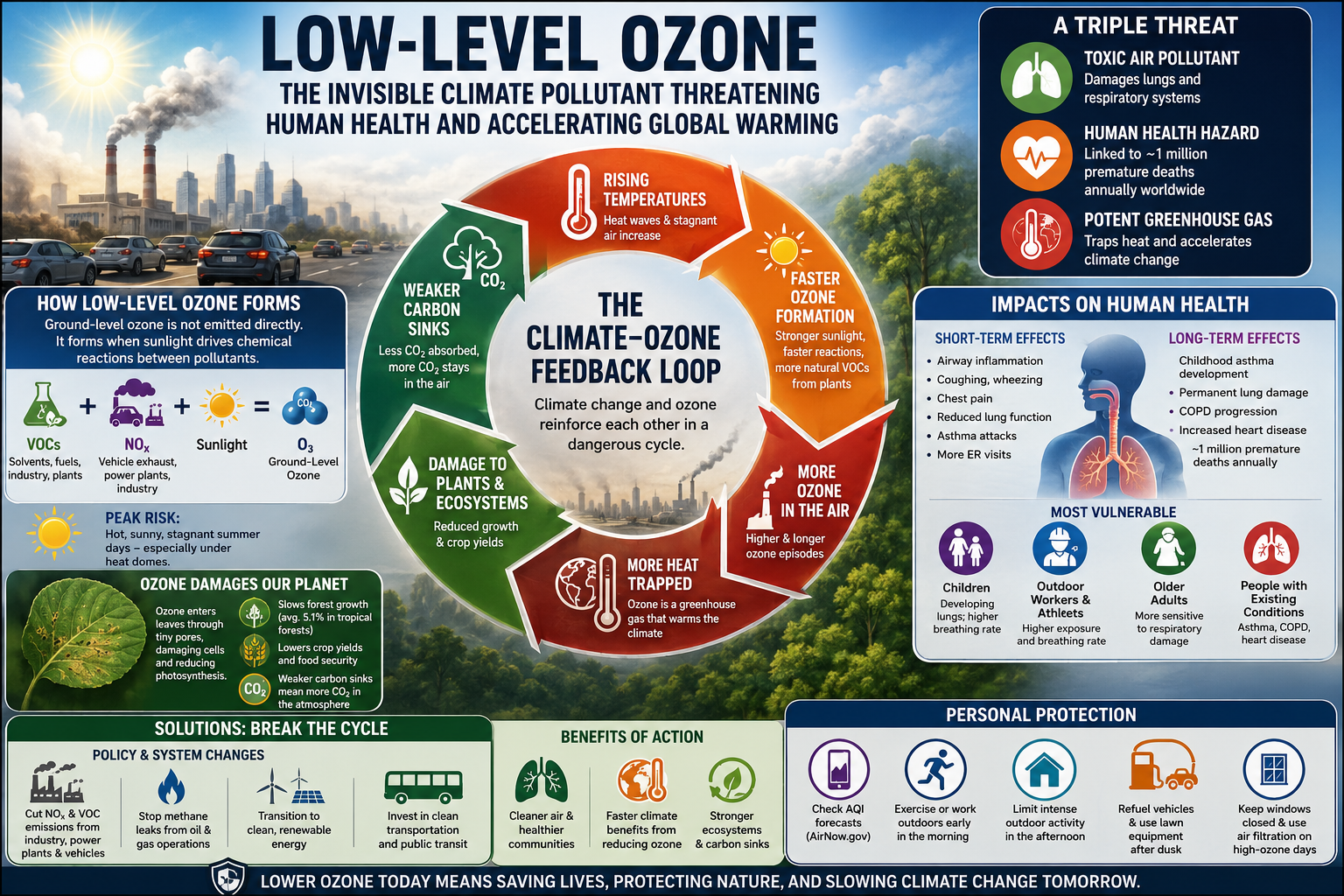
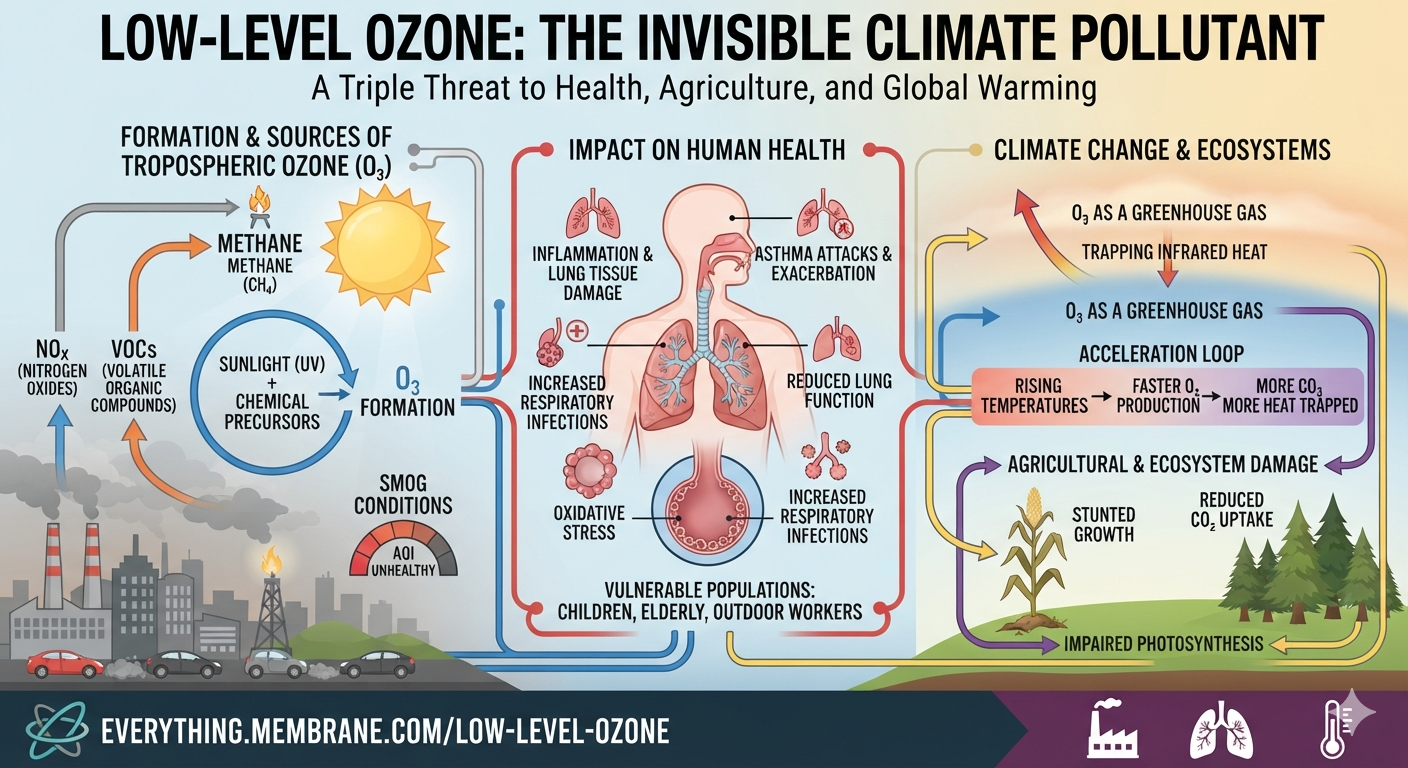
Low-level ozone (tropospheric ozone) has emerged as one of the most dangerous yet underappreciated pollutants affecting both human health and Earth’s climate system. Unlike the protective ozone layer high in the stratosphere, ground-level ozone is a toxic gas that damages the lungs, weakens ecosystems, reduces agricultural productivity, and traps heat in the atmosphere.
Ozone is also a key component of a powerful climate feedback loop. As temperatures rise, ozone formation accelerates. In turn, ozone damages forests and other vegetation that normally remove carbon dioxide from the atmosphere, weakening these natural carbon sinks while simultaneously acting as a greenhouse gas itself.
Because ozone is highly reactive and short-lived, measuring its full health impacts is challenging. Current research estimates that long-term exposure to ozone contributes to approximately one million premature deaths worldwide each year, although the true burden may be substantially higher due to the difficulty of isolating ozone exposure from other air pollutants.
Low-level ozone therefore represents a dangerous triple threat:
- A highly reactive air pollutant
- A major human health hazard
- A potent short-lived greenhouse gas
The Formation of Low-Level Ozone
Ground-level ozone is the primary ingredient of urban smog. Unlike many pollutants, it is not emitted directly from vehicles or industrial facilities. Instead, it forms through sunlight-driven chemical reactions involving precursor pollutants.
Ozone Formation
Volatile Organic Compounds (VOCs) + Nitrogen Oxides (NOₓ) + Sunlight → Ozone (O₃)
Major Sources of Ozone Precursors
Nitrogen oxides (NOₓ) originate from:
- Motor vehicles
- Power plants
- Industrial boilers
- Ships and aircraft
Volatile Organic Compounds (VOCs) originate from:
- Gasoline vapors
- Chemical manufacturing
- Paints and solvents
- Oil and gas production
- Vegetation (especially during hot weather)
Methane also contributes to background ozone formation on a global scale.
Because sunlight powers these reactions, ozone concentrations typically peak during hot, sunny, stagnant summer afternoons, particularly beneath persistent high-pressure systems and heat domes.
Human Health Impacts
When inhaled, ozone behaves like a powerful oxidizing chemical that attacks delicate lung tissue. It inflames the respiratory system, damages airway cells, and reduces lung function within minutes of exposure.
Many physicians describe ozone as acting like “sandpaper on the lungs.”
Short-Term Health Effects
Acute exposure may cause:
- Airway inflammation
- Chest pain during deep breathing
- Persistent coughing
- Wheezing
- Shortness of breath
- Reduced lung capacity
- Increased asthma attacks
- More emergency room visits
Long-Term Health Effects
Repeated exposure has been associated with:
- Childhood asthma development
- Permanent lung tissue damage
- Reduced lung growth
- Chronic Obstructive Pulmonary Disease (COPD) progression
- Increased cardiovascular disease
- Elevated risk of premature death
Current global estimates attribute roughly one million premature deaths annually to ozone exposure.
NOTE: to effectively filter ozone, you need a respirator equipped with an activated carbon (charcoal) layer or organic vapor chemical cartridges. Standard particulate masks (like basic N95s) will only filter dust, not harmful ozone gas.
Who Is Most Vulnerable?
Although ozone affects everyone, several populations experience substantially greater risk.
Children
Children breathe more air per pound of body weight than adults while their lungs are still developing, making them particularly susceptible to permanent respiratory damage.
Older Adults
Age-related declines in lung function and higher rates of cardiovascular disease increase sensitivity to ozone exposure.
Outdoor Workers and Athletes
Construction workers, landscapers, agricultural workers, first responders, and athletes inhale much larger volumes of air during physical activity, resulting in higher ozone doses.
People with Existing Health Conditions
Individuals with:
- Asthma
- COPD
- Emphysema
- Chronic bronchitis
- Heart disease
often experience significantly worsened symptoms during high-ozone events.
The Climate-Ozone Feedback Loop
Climate change and ozone pollution reinforce one another through a powerful positive feedback loop.
Rising Temperatures
         │
         ▼
 Faster Ozone Formation
         │
         ▼
 More Greenhouse Warming
         │
         ▼
 Increased Heat Waves
         │
         ▼
 More Ozone Formation
At the same time:
Higher Ozone
      │
      ▼
Plant Damage
      │
      ▼
Reduced Photosynthesis
      │
      ▼
Weaker Carbon Sinks
      │
      ▼
Higher Atmospheric CO₂
      │
      ▼
More Global Warming
These interconnected feedbacks accelerate both climate change and declining air quality.
The Ozone Climate Penalty
One of the most concerning consequences of climate change is the ozone climate penalty.
Even if emissions of NOₓ and VOCs remain unchanged, warmer temperatures alone increase ozone production by:
- Accelerating atmospheric chemical reactions
- Increasing the frequency of stagnant air masses
- Producing longer-lasting heat domes
- Extending the ozone season
- Increasing wildfire smoke, which adds additional ozone precursors
As global temperatures continue to rise, ozone episodes become both more frequent and more intense.
Stressed Ecosystems Produce More Ozone
Plants themselves contribute to ozone formation.
During hot weather, many tree species release larger amounts of natural volatile organic compounds (especially isoprene).
Normally these emissions are harmless.
However, when mixed with human-produced NOₓ pollution, they significantly increase ozone production.
This creates another reinforcing feedback:
Higher temperatures → More natural VOC emissions → More ozone → More warming
Ozone as a Greenhouse Gas
Tropospheric ozone is also a significant short-lived climate pollutant.
It absorbs infrared radiation escaping from Earth’s surface, trapping heat within the lower atmosphere.
Although ozone remains in the atmosphere for only weeks, it is continuously regenerated through pollution, making it an important contributor to ongoing global warming.
Reducing ozone precursors can therefore improve both air quality and climate within relatively short timeframes.
Destruction of Carbon Sinks
One of ozone’s most overlooked impacts is its damage to global vegetation.
Ozone enters plants through microscopic leaf openings called stomata.
Once inside, it damages cells responsible for photosynthesis.
Consequences include:
- Slower forest growth
- Reduced crop yields
- Lower photosynthetic efficiency
- Increased tree mortality
- Reduced carbon sequestration
Research indicates that ozone exposure has reduced tropical forest growth by approximately 5%, significantly weakening one of Earth’s largest natural carbon sinks.
As forests lose their ability to absorb carbon dioxide, more CO₂ remains in the atmosphere, accelerating climate change.
Breaking the Feedback Loop
Reducing ozone pollution requires both public policy and individual action.
Policy Solutions
Reduce Ozone Precursors
- Strengthen NOₓ emission standards
- Reduce methane leaks from oil and gas production
- Limit industrial VOC emissions
- Improve vehicle emission controls
Transition to Clean Energy
Replacing fossil fuels with renewable energy simultaneously reduces:
- NOₓ emissions
- VOC emissions
- Methane leakage
- Carbon dioxide emissions
This provides immediate health benefits while slowing climate change.
Personal Protection
Individuals can reduce their exposure during ozone episodes by:
- Monitoring the Air Quality Index (AQI)
- Limiting strenuous outdoor activity during the afternoon
- Exercising early in the morning
- Keeping windows closed on high-ozone days
- Using indoor air filtration when available
- Delaying vehicle refueling and gasoline-powered lawn equipment use until evening
- Following local air quality alerts
Conclusion
Low-level ozone is far more than an urban air pollutant. It is a toxic oxidant that harms nearly every organ system, weakens forests and crops, reduces Earth’s capacity to absorb carbon dioxide, and contributes directly to global warming.
As climate change intensifies, rising temperatures create conditions that generate even more ozone, establishing a dangerous positive feedback loop in which warming degrades air quality, and degraded air quality accelerates further warming.
Breaking this cycle requires reducing fossil fuel emissions, limiting methane and ozone precursors, protecting vulnerable populations during high-ozone events, and accelerating the transition to cleaner energy systems. Because ozone is a short-lived climate pollutant, reducing its formation offers one of the fastest opportunities to improve public health while slowing the pace of climate change.